Part 2 — CHAP. XIII.
Reading edition
JOURNEY TO FEIUM.
Tamieh — Canals — Feiûm — Roses — Lake Mœris — Oasis Parva — Pyramids — of Hawara — of Dashûr — of Sakarra — of Jizé, or the great Pyramids — Antient Memphis — Egyptian Capitals.
On the 28th of December 1792 left Kahira to visit Feiûm, a city distant about sixty miles to the South-west. At Moknân procured from the Shech a letter to one of his officers, residing at Bedis, another village further on to the Southward, commanding him to accompany me to Feiûm. Proceeded through a grove of large date trees, which are watered from several cisterns, all of them supplied from the Nile, during its increase.
Between Bedis and Tamieh passed a natural opening, in the chain which constitutes the Western wall of Egypt. A small canal runs through Tamieh[29], and here the country again assumes the aspect of cultivation. This little town is remarkable for a manufacture of mats, though the situation be so insecure, that the Arabs in the preceding night had plundered their whole stock, to the value, as they said, of five or six thousand patackes. The Arabs still haunted the neighbourhood, and we were forced to discharge a few musket shot to keep off a small party that assailed us in the morning.
Passed another canal at Senûris, the seat of an hospitable Shech of the Bedouins. These canals reach from the Nile to the lake called Mœris. Left Senûris at half past seven on the 1st January 1793 and in two hours arrived at Feiûm.
At a small distance to the North are the ruins of an antient town, called by the Arabs Medinet Faris, city of the Persians, probably antient Arsinoe. Some mutilated busts and statues found here were offered for sale. I also observed some jars, resembling those used to contain the dead Ibis, and some vitrifications that seemed to indicate an Arab glass-work.
Feiûm stands on the principal canal leading from the Nile to the lake, and is surrounded with cultivated ground, a great part gardens, producing that profusion of roses for which this place was celebrated, and which were distilled into rose-water. The mode of propagating them was by continued layers; the young twigs thence arising being found to produce the largest and most fragrant flowers. The rose-water was excellent, and sent to all quarters; but the cultivation is now running gradually to decay. Wheat and other grain abound in the vicinity.
This city is not walled, but is populous, though on the decline; it contains several mosques and okals. There are few Copts, the inhabitants being chiefly Mohammedans. The houses are partly stone, partly unburned bricks. It is governed by a Cashef. The fish from the lake cannot be praised. Provisions tolerably plentiful; water good.
After passing three days at Feiûm, proceeded towards the lake, of which I wished to make the circuit. This is the Mœris of Strabo and Ptolemy; and the testimony of the latter, living in Egypt, seems unquestionable. However this be, the lake, now called Birket-el-kerun, probably from its extremities bearing some resemblance to horns, bears no mark of being, as some suppose, the product of human art. The shape, as far as was distinguishable, seems not inaccurately laid down in D’Anville’s map, unless it be that the end nearest the Nile should run more in a North-west and South-east direction. The length may probably be between thirty and forty miles; the breadth, at the widest part I could gain, was 5000 toises, as taken with a sextant, that is, nearly six miles. The utmost possible extent of circuit must of course be thirty leagues. On the North-east and South is a rocky ridge, in every appearance primeval: there are some isles in the extremity nearest Feiûm, where there is a flat sandy shore. In short, nothing can present an appearance more unlike the works of men. Several fishermen, in miserable boats, are constantly employed on the lake. The water is brackish, like most bodies of water under the same circumstances.
The western extremity of this lake is in the dominion of the Muggrebine Arabs, who pass thither from El-wah el-ghurbi, and other places, and who being there under no control, suffer no person to travel thither, unless under their immediate protection. This information, which I received not till my arrival at Feiûm, frustrated my expectations of reaching some ruins which are said to exist there. The Arab Shech of Abu-kissé told me it would require four days to go round the lake, and return on the other side. That there are no villages near it, nor any thing to be procured but from the Muggrebines just mentioned. On one of the isles at the Eastern extremity it is said that human bones are sometimes found.
From Feiûm travelled South-east. At Hawâra are two small pyramids of unburned brick, and another passage through the mountain. The plain from Feiûm to the Nile is in excellent cultivation, chiefly wheat, then just rising from the ground. Illahôn is a town or large village, filled with persons whose chief employment is the culture of the soil. Passed the Bahr-bila-ma, the channel of a large canal. Farther on is Bathen[30], a long deep cut, supposed to be the artificial Mœris of Herodotus and Diodorus Siculus.
Returned to Bedis. On the following day passed the pyramids of Dashûr. Five appear successively, exclusive of those of Sakarra. The third after those of Hawâra, already mentioned, is that of Medûn, which has been very elegant, and built in this singular form,
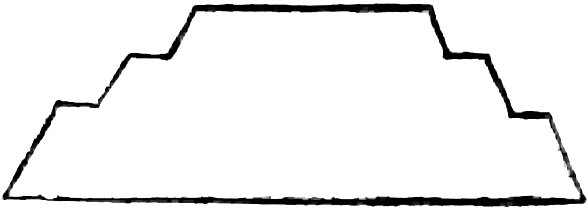
It is composed of large pieces of the usual soft free-stone, joined together with a little cement; and has been hewn off to a straight surface. It would be extremely difficult to ascend to the top, which is now very broad; but it is probable that there was another square, completing its summit, which has been removed. The north side has been injured by tearing out stones, which open a view of the interior, which is however entirely solid. This pyramid has been supposed to be natural rock at the base, but this mistake must have arisen from a part being concealed. On removing the sand, (which rises chiefly in the middle,) and on examining the corners, the stones and cement may be observed to the very bottom.
The fourth is the most southerly of the four pyramids of Dashûr, where are two large and two small. It is in the form of a cone, terminating in an obtuse triangle, and is now much damaged. There is no appearance of any casing on this or any other of the pyramids. The stones do not point to the center, like those of the great pyramids of Jizé. The faces of all these pyramids are directed to the four cardinal points of the compass. Near them stands one of unburned brick, and a small one of stone, not completed.
At Sakarra a great number exist, among which ten are of a large size. The smaller ones are sometimes almost undistinguishable from the sand-hills, and are dilapidated; the stones being used as materials for building at Kahira, Jizé, &c.
The two largest of the pyramids are at about the distance of two hours and a half from Jizé, and are well known to all who have visited Egypt. The dimensions of that which has been opened I found to be as follow:
Feet. Inches.
Great chamber 34 5
Breadth 17 2
Sarcophagus 7 8
Breadth 3 2
Depth within 2 10½
Thickness 0 6
The galleries and great chamber are situated due North and South, allowing for the variation of the needle.
Feet. Inches.
The first passage descending 105 1
Small chamber, length 18 9
breadth 17 1
Antichamber, length 7 5
Main gallery, upper part 150 0
lower part 148 0
Passage to inferior chamber 109 1
An absurd opinion has recently been stated, that the pyramids are hewn out of the rock on which they stand; but the first ocular inspection would set this aside, the joinings of the stones being everywhere marked with cement. But it is unnecessary to dwell on a conjecture so futile.
In the open pyramid, the chamber is lined with granite, and the sarcophagus also formed of that stone. But the materials used in the general fabrication of these edifices is free-stone, of a soft kind and white hue; it is replete with shells. The rock on which they stand is of the same soft stone. Returned to Kahira.
On another occasion I visited the pleasant site of the antient Memphis, on the left bank of the Nile, about two hours to the South of Kahira, in a plain above three miles broad, between the river and the mountains. The land is now laid down in corn, with date trees toward the mountains. Nothing remains except heaps of rubbish, in which are found pieces of sculptured stone. The spot has been surrounded with a canal, and seems every way a more eligible situation than that of Kahira[31]. Its extent might be marked by that of the ground where remains are dug up, and which is always overgrown with a kind of thistle that seems to thrive among ruins. It is most conveniently visited from the Coptic convent called Abu-Nemrûs.
None of the fine marbles that are scattered so profusely at Alexandria are discoverable here; whether it be that they were never used, or carried away to adorn other places.
Of the several capitals of Egypt in successive ages, Thebes, or Diospolis, seems the most antient. Next was Memphis, itself a city of the most remote antiquity. Babylon seems to have been only the capital of a part retained by the Persians, after Cambyses had subdued Egypt, and was, by all accounts, founded by the Persians. Alexandria succeeded Memphis, and remained the chief city, till the Saracens founded Misr-el-Kahira.