Part 2 — CHAP. XIV.
Reading edition
JOURNEY TO SINAI.
Route — Suez — Ships and ship-building — Trade — Scarcity of water — Remains of the antient canal — Tûr — Mountains of red granite — Description of Sinai — Eastern gulf of the Red Sea — Return to Kahira.
On the 1st of March 1793 left Kahira to proceed to Suez. I had made an agreement with the Arab Shech, who was charged with the care of the caravan, that he and his servant should accompany me, without waiting for its slow progress. But he broke his engagement, as usual with the Arabs, and I was constrained to wait for the departure of a large body, consisting of an hundred and fifty persons and two hundred camels.
The route to Suez is nearly one uniform plain, generally hard and rocky, though here and there spots of deep sand occur. The journey was very slowly conducted, as the camels were permitted to brouze on the verdure which sprinkles the desert solely after the winter. On the third day, a South-west wind having subsided, rain fell for four hours and a quarter. The mornings and evenings were cold, though hot in the day. Some have ignorantly conceived that no rain falls in Egypt. At Alexandria showery weather will prevail for a week together; and I have sometimes seen rain at Kahira. In Upper Egypt even showers are very rare, and only one fell while I was in that country.
After a heavy progress of five days reached Suez. The town is small, and built of unburned brick. It contains twelve mosques, of which some are stone, but the most are mean buildings. The sea near the town is very shallow, yet there is a small yard for ship-building. Population, Mohammedans, with a very few Greeks. Suez is very modern, probably built within these last three hundred years; being unknown to travellers of a more antient date.
There are here at present four three-masted vessels, and ten others, some with two, some with one. Two building, one of which is pierced for twelve guns; and ten large boats, without masts. The largest of these ships was intended for the Indian trade, the rest for traffic to Jidda; one or two of them had been built in Yemen.
The Arab mode of ship-building is singular. They have no art to bend the timbers; none of them are crooked except naturally so. They are very slender, and where the upper and lower ribs join, do not pass one over the other, but by the side of each other.
At Suez coffee forms the chief article of trade. It is a place of no strength, and has only eight old cannon, seemingly unfit for service; the others were removed to Jizé by Ismaîl Bey. The sea here produces few fish. Oysters indeed, and a few others of the shell kind, are seen; the best fish not coming higher than Cossîr. Meat is scarce, bread of an inferior quality, sometimes hardly eatable. Butter and milk are brought in small quantities by the Arabs. Water is brought from three several places. Bîr Naba, to the northward, affords the best; the others are Aiûn Mûsa and Bîr-es-Suez. It is always bought by the skin at a considerable price, and if a war were to arise with the Arabs, none could be found.
I was very desirous to inspect the Eastern portion of the canal cut by Adrian, according to D’Anville, which extends from Birket-es-Sheib to Suez, but my Arab guides would not accompany me, in spite of a previous agreement made for that purpose. All consented that marks of the canal existed, and some of them arose to my own observation.
The ruins of Arsinoe may yet be recognized in a mount of rubbish in the neighbourhood of Suez. The spot is now called Kolsûm, and remains exist of a stone pipe for conveying water thither from Bîr Naba. A rock, on the African side of the gulf, furnishes petroleum, which is brought to Suez, and esteemed a cure for bruises, &c. In crossing the gulf just before Suez, boats are used at high water, which comes in rapidly to the height of four feet; at other times camels, horses, and men ford it with safety.
At Suez I observed in the shallow parts of the adjacent sea, a species of weed, which in the sunshine appeared to be red coral, being of a hue between scarlet and crimson, and of a spungy feel and quality. I know not if any use be made of it, nor am I acquainted with its Arabic name; but it strikes me, that, if found in great quantities at any former period, it may have given the recent name to this sea; for this was the Arabian gulf of the Antients, whose Mare Erythræum, or Red Sea, was the Indian Ocean. This weed may perhaps be the סוּפ suph of the Hebrews, whence ים סוּפ Yam Suph, their name for this sea.
The shores here abound in beautiful shells of various kinds; a circumstance which might also have been remarked in speaking of Maadié near Abukîr.
On the 8th of March 1793, passed the ford at Suez, and on the 14th arrived at Tûr. So many journies to Mount Sinai have been published, that I shall not dwell much on the particulars. The route from Suez to Tûr at first lies along a barren coast, but afterwards some pleasant vales of verdure are found, particularly Wadi Corondel, where grow some date trees and shrubs. Mountains of red granite are seen, perhaps too interspersed with porphyry.
A spot is pointed out by the Greek priests of a small convent near Tûr, where a church is said to have been buried, and miraculous noises still heard, but on visiting it, in the mere expectation of some natural phenomenon, found nothing.
On the 18th left Tûr, and on the 22d, at 3½ hours A.M. reached the monastery of Sinai. Shot a red-legged partridge. The convent is large, with a good garden, to which there is a subterraneous passage. Within the walls is a small mosque for the convenience of the Arabs. The mountain now called Sinai is high and abrupt. On the North side of it some snow was visible. The whole is a very remarkable rock of red granite, interspersed with spots, to which soil has been brought by human toil, or washed down by rain, and in which grow almond trees, (now in bloom,) figs, and vines. Numerous rills of excellent water gush from various apertures in the precipice, and wander among the little gardens. Sinai has two summits somewhat resembling Parnassus, another scene of inspiration; and the one termed St. Catherine, being, it is believed, the highest, may be the Sinai of Moses.
The weather being very clear, I observed, from Mount Sinai, the Eastern gulph of the Red Sea, which appears very small, and more round and short than is laid down in the latest maps.
Returned to Suez and Kahira, meeting with nothing memorable on the route.
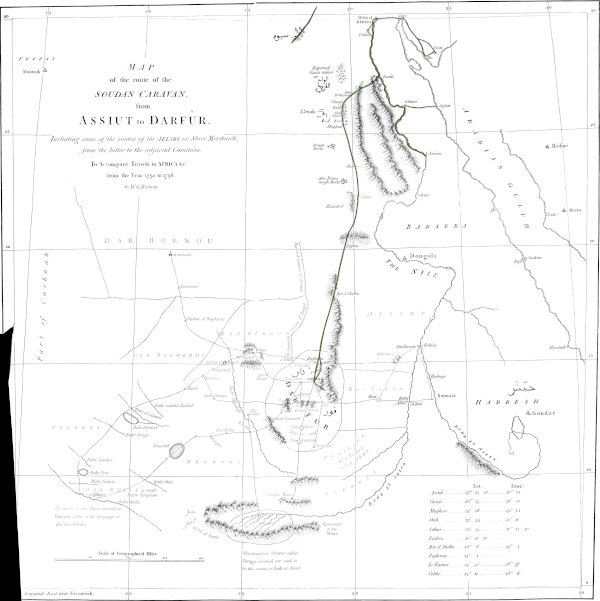
Map of the route of the Soudan Caravan, from Assiut to Darfûr, Including some of the routes of the Jelabs, or Slave Merchants, from the latter to the adjacent Countries. To Accompany Travels in Africa &c. from the Year 1792 to 1798. by W. G. Browne. to face page 180. London, Published by Messrs. Cadell and Davies Strand 4 June 1799. (Large-size)