Part 2 — CHAPTER IV A TRAM-CAR
Reading edition
This toy is made of wood, cardboard and paper (cartridge).
A piece of wood, E F G H (Fig. 292), 8½ inches by 2¼ inches is required for the bottom of the car, and two pieces, A B C D, 5 inches by 1½ inches, for the sides.
The supports (1, 2, 3, 4, 5, 6) are pieces of stripwood ¼" × ¼" × 3½".
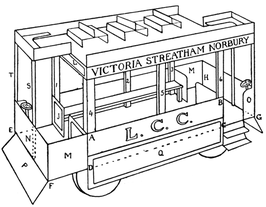
Fig. 292
Glue three of these to one of the sides as in Fig. 293, allowing A B C D to project beyond them for a space equal to the thickness of the wooden bottom of the car, E F G H. This forms one side of the car; make the other in the same way.
Fig. 294 shows how the sides and seats are fastened to the bottom of the car.
The seat is a piece of stripwood ¼" × ½" × 5".
The top of the car is made of thick cardboard cut as in Fig. 295 to the given measurements. Before the top is fastened on strips of cartridge paper are gummed round its sides. These strips are about an inch wide, and are doubled in half; one half is gummed to the cardboard as in Fig. 296. The other half bends downward and the names of places to which the car runs are printed on it. Similar pieces are gummed to the top and bent upward to form the railings round the top (Fig. 297.)
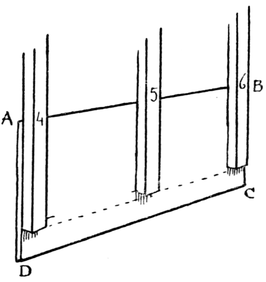
Fig. 293
These pieces are painted yellow and edged with dark brown. Fig. 298 shows the entrance to the interior of car. J and K are pieces of cardboard, coloured yellow, and glued into position; L is a similarly coloured piece of cardboard or paper glued to supports 1 and 4. The other entrance is finished off in the same way.
Cut two pieces of cardboard, 4½ inches by 1½ inches, as in Fig. 299. Make half-cuts along the dotted lines. These pieces are bent round and glued to the ends of the bottom of the car (M, N, O in Fig. 292).
These are also coloured yellow and their edges are dark brown.
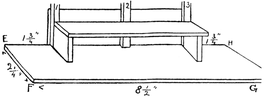
Fig. 294
The wheels are put on as the wheels of the engine (Part I, Chapter XIII).
Cut two pieces of cartridge paper (P in Fig. 292), colour as described before, and gum under each end of car.
Part Q is a piece of cardboard one inch wide, coloured like M N O, and gummed along the side, so that it covers at least half the wheels.
The top can now be glued on. Thin strips of wood or pieces of cane (S and T in Fig. 292 and 296) are gummed in position.
The steps into the car are made of cartridge paper coloured black.
Fig. 300 shows the simplest way of making the stairs leading to the top of the car.
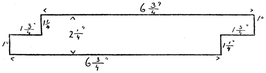
Fig. 295
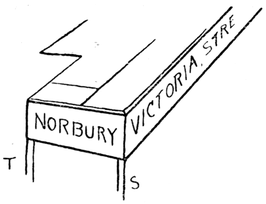
Fig. 296
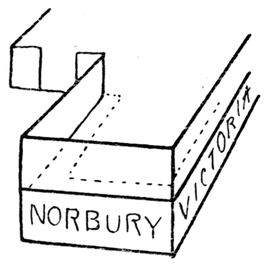
Fig. 297
W Y is a piece of cardboard, 1 inch wide, to which pieces of stiff paper are gummed as in diagram. X is a flap of paper which fastens the steps to the top of the car.
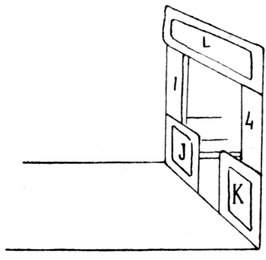
Fig. 298
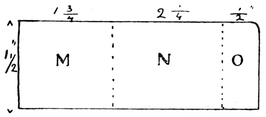
Fig. 299
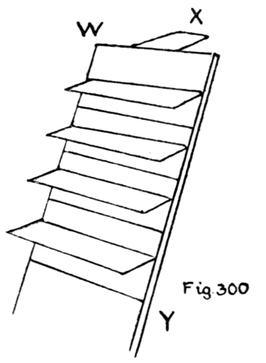
Fig. 300
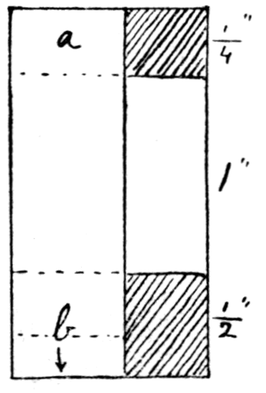
Fig. 301
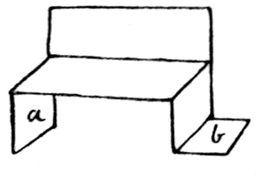
Fig. 302
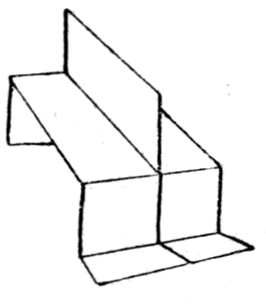
Fig. 303
Seats for the Top. Pieces of cartridge paper are cut out, 1¾ inches by ¾ inch, and coloured yellow. These are folded and cut as in Figs. 301 and 302. Part a is gummed to the side of the car, flap b is gummed to the floor. The second seat is gummed back to back to the first seat (Fig. 303). The top of the car will hold about six of these double seats. Single seats can be gummed in the corners.
Steering-wheels are made as in Fig. 292. The top is of cardboard, cut or marked as in the figure and coloured black. This is gummed to a round rod, about 1¾ inches in length, which is fastened to the end of the car (N in Fig. 292). A similar steering-wheel is fastened to the other end.