Chapter XV · FLYING AIRSHIPS, GONDOLAS, AND BIRDS (Plate VI)
Reading edition
These toys are made in a somewhat similar manner to the merry-go-round.
Get a large reel (diameter about 1½ inches). Next saw a piece of stripwood, A B, ¼" × ¼" × 12¼". Glue and nail to the ends of this cross-pieces of the same stripwood, 4½ inches long. Make holes for nails with a fine drill, otherwise the stripwood may split. Glue and nail A B across the top of the reel as in Fig. 205.
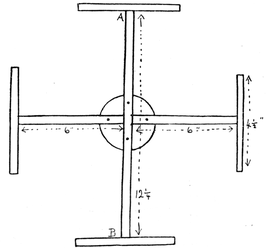
Fig. 205
Cut two pieces of stripwood, ¼" × ¼" × 6". Glue and nail cross-pieces 4¼ inches long to one end of each of these. Glue and nail them to the reel as in figure.
Next glue and nail another large reel to the centre of a board about 4 inches by 5¾ inches. Get a dowel rod that will fit the reels (diameter about ¼ inch), or file the ends of a square stick to fit; this central pillar should be about 13 inches high. Glue this pillar into the reel on the board and fit the other reel with the cross-pieces on the top of the pillar.
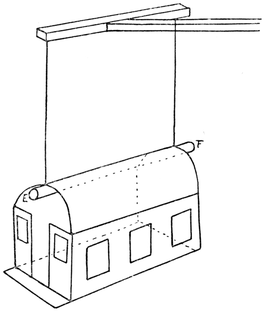
Fig. 206
The cars must next be made; they will hang by two strings from the ends of the cross-pieces (Fig. 206). Grooves may be filed round the ends of the cross-pieces for tying the cotton, or holes can be drilled in the ends before the cross-pieces are fastened on.
The cars are made of paper, cardboard or wood. Fig. 207 shows the pattern of a car. It should be 4½ inches long and 2 inches wide. The dotted lines show where the paper is to be bent, or in the case of cardboard half cut and bent.
The width of the bottom of the car is 2 inches, the roof 2¾ inches; this allows for bending, and makes a curved roof. The doors can be made to meet if desired; in this case each door will be 1 inch wide.
Five, four or three windows may be cut in the sides, and windows in the doors.
Paper seats may be fitted inside.
To hang the car a rod is cut, about 5 inches long, E F in Fig. 206, and grooves are filed at each end. This is glued to the top of the car, with the ends projecting. Pieces of cotton attach the beam E F to the cross-piece. (Length of cotton, about 7 inches.)
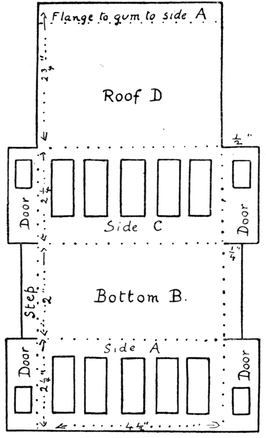
Fig. 207
A reel may be glued on the top of the arms for turning the airships; cotton may be wound round this, and when pulled causes the cars to revolve. Into the hole of the top reel may be inserted a stick bearing a flag.
Paint the cars according to taste.
When the top reel is set spinning the cars fly round and outward in a delightful manner, gradually returning to a vertical position as the speed lessens.
Gondolas. For the cars gondolas may be substituted, as in Fig. 208. These gondolas form simple and effective paper toys, even if not attached to revolving arms.
Draw on stout paper or cardboard and cut out the two sides, A A, as in Fig. 208. The total length of the boat should be 9 inches.
Next draw a line on a piece of paper, a´ b´ in Fig. 209, the same length as a b in Fig. 208. Divide the line into three parts at c´ and d´. a´ c´ represents the length a c in Fig. 208; c´ d´ (not shown to scale), the length of the cabin c d. If the full length of the gondola is 9 inches, the length a b will be about 8½ inches, and the length a c should be 3 inches; this makes the length of the cabin, c d, about 1¾ inches. Draw two lines at c´ and d´ at right angles to a´ b´. Make e f and g h (Fig. 209) equal to the widest part of the gondola. (If the length of 9 inches has been decided on, the width of the gondola should be 1¼ inches.) Complete triangles a´ f e and g b´ h as in Fig. 209; draw flanges as in diagram and cut out. Two other triangles exactly the same size with flanges will be required.
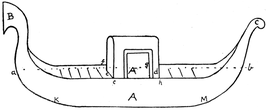
Fig. 208
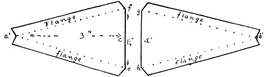
Fig. 209
Now fasten together the bows, B, and the sterns, C, of the sides, A A (Fig. 208), with seccotine, taking care that no gum comes below the line a b. Gum the triangle a´ f e (Fig. 209) to the sides, A A, as in Fig. 208. Point a must come at the very end of the sides A, and the surface of a f e forms the deck. Gum triangle g h b´ to the sides, A, in the same way (Fig. 208). Now gum the other two triangles to the bottom of the gondola. Their apexes will probably come at about K and M in Fig. 208. The positions of these points can be determined by finding out at what spot the triangle brings the sides A A closely together; try to keep them as far from ends a and b as possible.
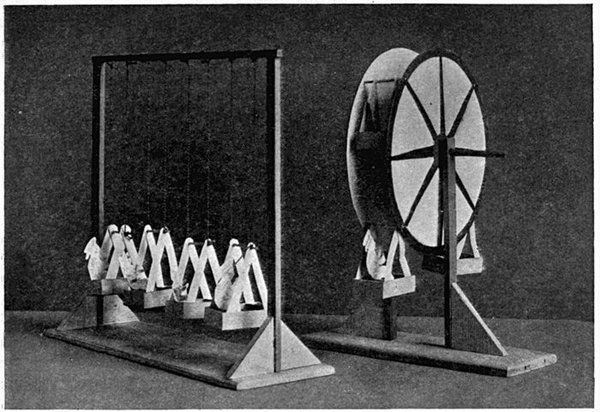
SWINGING BOATS AND GREAT WHEEL (Chapter XIV)
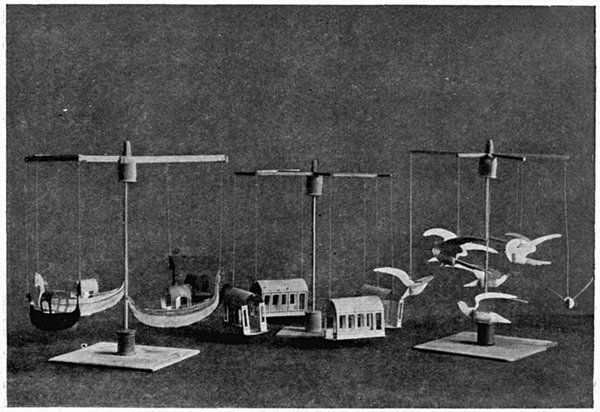
Plate VI FLYING GONDOLAS, ETC.
The space left between the two bottom triangles has a piece of paper gummed over it.
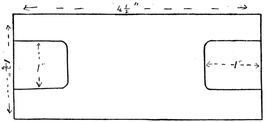
Fig. 210
Fig. 210 shows the shape of the cabin and the measurements required for a cabin for a gondola of 9 inches. Four gondolas should be made. They should be painted black and red, or black and yellow, according to taste.
The gondolas are hung from cross-pieces, like the airships, but the arms should be 12½ inches, and the cross-pieces 9 inches; the strings must be of different lengths, since the bow is higher than the stern. Seats may be put in the cabins if desired.
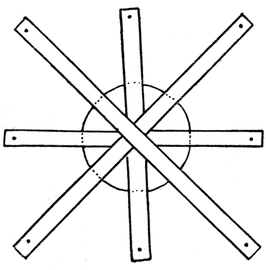
Fig. 211
Flying Birds. Cut four arms as for the gondolas (stripwood ¼" × ¼" will do), drill small holes at one end, glue and nail them to a reel. Cut four short arms 3½ inches and glue them on between the long arms as in Fig. 211.
The birds are made of cardboard and corks. The birds from the long arms should hang low down, and the birds from the short arms higher up. Cane may be used for hanging the birds to the arms. The outer circle may be hung with sea-gulls (Fig. 212), and the inner circle with swallows (Fig. 213), or all the birds may be swallows. When the reel is turned quickly the birds in flight are very effective.
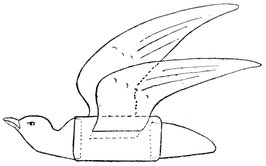
Fig. 212
Fig. 212 shows how the sea-gull is made out of a cork and four pieces of cardboard (one for the head, two for the wings, one for the tail). Paint the cork white, paint eyes and a beak, mark a few feathers on the wings. Figs. 213, 214, 215 show how the swallow is made.
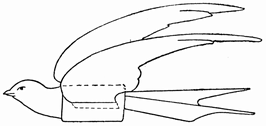
Fig. 213
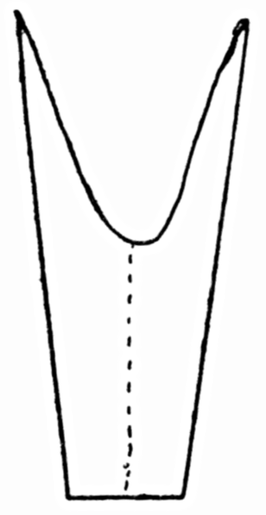
Fig. 214
Fig. 215