Chapter XVI · FIRE-ENGINE, MOTOR-LORRY, AND STEAM-ROLLER (Plate VII)
Reading edition
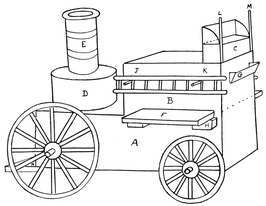
Fig. 216
A Fire-engine (Fig. 216). For this toy two cardboard boxes are required, one about 6" × 2" × 2", A in Fig. 216, and the other, B, 3" × 2" × 2". The cardboard case that contains Le Page's glue is a suitable size for B. Make holes through both sides of A, about 1 inch from one end, for the axle of the large wheels, and holes through B at K and J for the pieces of cane that support the ladders. Gum B to A and cover both with red paper. D is part of a round mantle-box, and the funnel, E, a roll of paper. Both are coloured yellow, F is a piece of stripwood, ½ inch by ¼ inch, cut the right length and glued to B and to two supports, H. A similar piece is fastened on the other side. These are for the firemen to stand on. They may be left their natural colour or coloured grey. The seat, C, is a piece of stripwood, ½ inch by ½ inch, with a paper back, and L M are match sticks glued to the sides. G, the foot-rest, is made of cardboard and fastened to box, B, by two wedge-shaped pieces of wood. The ladders are made of strips of cardboard, with half matches as rungs. N is a piece of cardboard gummed underneath A and projecting from it ½ inch for the fireman's stand. This stand, seat, foot-rest, ladders, etc., should be coloured red. The small wheel is about 2 inches in diameter. The diameter of the large wheel can be measured when the smaller wheels are in position.
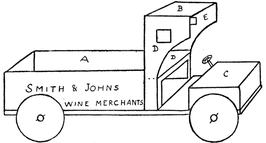
Fig. 217
A Motor-lorry (Fig. 217). The foundation is a piece of stout cardboard or wood. A is an open box gummed to this, and covered with paper, suitably coloured. B is part of a box cut as in figure and gummed to A. Inside B a wooden seat, D, is fixed. C is a smaller box, gummed upside down. The size of the lorry will depend upon the boxes procurable. It can also be made of wood, in which case the windows, D and E, and the curved portion of B can be cut out with a fret-saw (see Part II). Both this toy and the fire-engine look very effective made of wood.
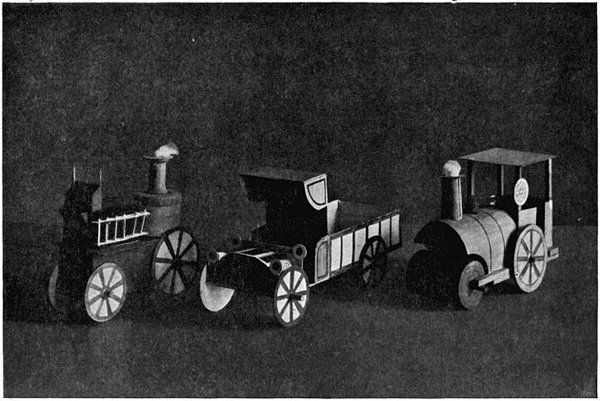
Plate VII FIRE-ENGINE, MOTOR-LORRY AND STEAM-ROLLER
A Steam-roller (Fig. 218). Fig. 219 shows the foundation of the steam-roller, A B, C D, etc., are pieces of stripwood, ¼ inch by ¼ inch. The front roller is made of a small mantle-box about 2-5/8 inches in length. The cover is glued on, holes are made at each end and a round, wooden axle passed through. The ends of the axle should be filed flat as in Fig. 220, so that A and C (Fig. 219) can be glued to them. The roller may be painted black. Cut a piece of cardboard, 6½ inches by 4¼ inches. Bend this round so that it fits between A B and C D (Fig. 219); place the roller in position, mark with pencil the portions of cardboard that cover the roller and cut these off (see the shaded parts in Fig. 221).
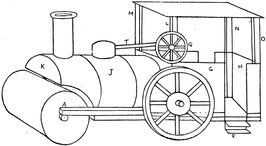
Fig. 218
Fig. 222 shows the construction from cardboard of the part of the cab marked G in Fig. 218. Half cuts are made along the dotted lines; the axle of the side wheels passes through the openings X and Y.
Fig. 223 shows the part of the cab marked H in Fig. 218.
Next cut a strip of wood, 4¼" × ¼" × ¼", for an axle for the side wheels, and round the ends; the wheels are 3 inches in diameter. Fasten these to the axle. Now glue the ends of the axle for the front roller to A and C. While this is drying colour the cardboard parts of the engine dark green. Bend J (Fig. 221) and glue this part to the inner sides of A B and C D. Cover the part marked K (Fig. 218) with paper; the part underneath K may remain uncovered. Glue the axle of the side wheels in position behind J, with just sufficient space for G to slip in between the engine and the axle. When the axle is secure glue G and H in position; G is glued to the inner sides of D C and B A, H is glued to the inner sides of blocks E and F.
The supports, O and N (Fig. 218), are 4½" × ¼" × ¼".
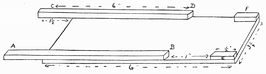
Fig. 219

Fig. 220
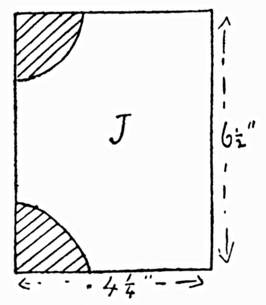
Fig. 221
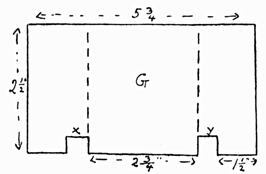
Fig. 222
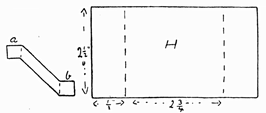
Fig. 223
M and L are 4¼" × ¼" × ¼". These supports are ¼ inch shorter, as they stand on the axle of the side wheels. The roof is of cardboard coloured green. Q is a cardboard wheel glued to L, and joined to the dome by a strip of cardboard, T, bent as in Fig. 223. a is inserted into a slit in the cork, and b is gummed to the wheel. The steps, R, are made of stiff paper. The funnel and the dome are made of corks.