Part 2 — CHAPTER XVII MOVING FIGURES
Reading edition
Fig. 416, "The Washing Day," shows a pattern that will please little English toy-makers. It can be cut from wood with the fret-saw, or with scissors from cardboard of medium thickness.
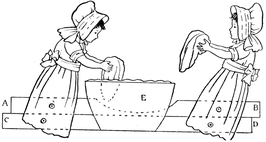
Fig. 416
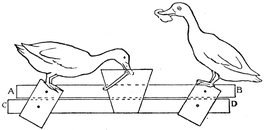
Fig. 417
To make the Design. First cut two lengths of three-ply wood or cardboard, ½ inch by 8 inches, A B and C D.
Next draw on wood or cardboard, and cut out, the two little washer-women (they are about 4½ inches high). They look more effective if painted.
These are fastened to the strips of cardboard by means of paper-fasteners (Size 000; one gross sixpence); the holes for the fasteners are about 1¼ inches from the ends. The holes in the little washer-women are exactly one above the other, so that when the paper-fasteners are in and A B is exactly above C D, the figures are upright.
A washing tub, E, is cut out of cartridge paper (top of tub, 3 inches, bottom 1¾ inches); this can be painted brown or green and have a white rim round the top to represent soap-suds. This tub is gummed to C D, exactly between the two little washers. If the part of A B that comes behind the tub is cut away as in diagram the figures will work better.
When the strips of cardboard are moved backward and forward the figures put their clothes in the tub and take them out again. The toy works best if a little space is left between A B and C D, as in Fig. 417. If it is cut out of fret-wood the figures are fastened by rivets, as explained in Chapter XV.
Fig. 417 shows two ducks eating out of the same bucket; strips of cardboard, A B and C D, are the same size as those in Fig. 416. The bucket is cut out of cardboard and gummed to C D.
The sailors in Fig. 418 are made in the same way, holes are made in their hands, through which yarn is passed (the thicker the yarn the more like rope it is) or oars can be cut out of cardboard and fitted in the holes in their hands, when they will appear to row.
Fig. 419 shows a man driving a donkey. It is made of cardboard, except the whip, A, which is thread tied into a hole in the cardboard at C. The whip will work better if a little piece of lead or something heavy is tied at the end of the thread. The reins, B, are of thread or yarn, and pass through holes in the donkey's mouth and in the man's hand.
Two fishermen can be made in the same way, the whip easily becomes a fishing-rod and a lead fish can be attached to the end of the line.
In the case of the donkey-driver and the fishermen the strips of cardboard should be longer than shown in the figure, to leave room for holding. The strip for the donkey-driver should be about 9 inches, the fishermen require at least 12 inches if their lines are not to get entangled.
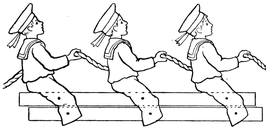
Fig. 418
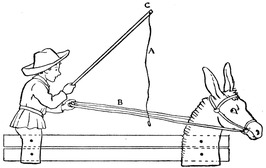
Fig. 419
Children will readily think of other designs for this simple but interesting toy.