Part 2 — CHAPTER XXVIII A THEATRE
Reading edition
This is a toy that will provide hours of happy play.
There are many effective ways of making a toy theatre, and the planning and designing of one is a pleasant piece of work. This chapter gives a few suggestions to future theatre builders, who must adopt those that appeal most to them. A large stage is the most necessary part, so that there is plenty of room to set up the scenes and room for the actors. A small stage limits the choice of plays considerably.
A pretty and useful theatre can be made thus. Get a wooden box 8¾ inches wide, about 1 foot long and 2¼ inches deep. (The theatre described in this chapter was made from a wooden box containing Fry's Nut Milk Chocolate—this box is exactly the right size.) This box forms the basis of the platform; stand it bottom upward, nail to the back of it a piece of wood, G H C D, which is 1 foot square (see Fig. 548). The platform, A B L M, is a piece of stiff cardboard or wood, A B is length of box, L M is 2 feet. This makes a fine large platform for arranging scenes.
Pieces of stripwood ¼ inch by ½ inch are glued across the platform, A L B M, each strip a little over a ¼ inch from the other (the ¼ inch side is glued to platform). About eleven strips can be thus glued across; their ends should project about ¼ inch beyond the platform.
The grooves thus formed are for running the actors up and down in.
A piece of wood, a b c d, is now cut 2 feet by 3¼ inches.
Holes are drilled along the top of it about ¼ inch in diameter, and red paper gummed at the back of them for the footlights. Panels or a pretty design of some kind should be painted on it, or it may have coloured paper pasted on it. This piece of wood is glued to K J E F so that its ends project equally on each side.
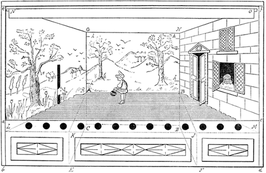
Fig. 548
Now cut two pieces of stripwood ½" × ¼" × 16¼" (e b and f d in Fig. 548). Bevel the top ends to hold up cardboard roof e f G H (the measurements for which can be easily found). The roof is secured by a flap glued behind A G H B, the roof is also glued to the tops of the strips eb and fd. These posts are glued to sides of abcd. Before they are glued on, however, they must have holes drilled near their upper ends for pole, N O, to pass through. The curtain must be made of fairly thin stuff glued to pole, N O. It can be pulled up and down by means of pulley wheels attached on each side. (For making pulley see Part I, Chapter XIV.) Pieces of lead can be sewn in the corners to make the curtain run down more easily.
Saw cuts are made across the strips of wood that cover the platform along lines B M and A L. Into these slits the side scenes fit. These side scenes are cut out of cardboard and have drawings and painting on them according to the story that is being acted. They must have slits cut in them (corresponding to the grooves in the platform), the number of slits depending on the number of actors. For example in Fig. 548 side scene H f B M has an open door through which Red Riding Hood can be pushed. She is cut out of either cardboard or wood, and glued to the end of a piece of stripwood, ¼ inch by ¼ inch, by means of which she is pushed from the side along the groove in the stage and so off through the corresponding slit in scene G e L A. (In Fig. 548 the Wolf is looking through this slot.) The window in scene H f B M can be made to open and show the Grandmother inside. The cardboard scene, G H A B, is kept in its place by pieces of wire (h, h, h, h) fastened at the back and bent over.
Almost any story can be acted in this theatre. All the actors are fastened to lengths of stripwood by means of which they are passed in and out. Sometimes two, three or more may be fastened to one length. The number of openings in the side scenes will, of course, depend on the story being acted.
Trees, etc., can also be cut out as described in Chapter XX (Part II), and stood about.
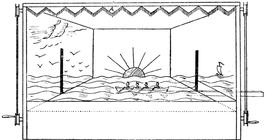
Fig. 549
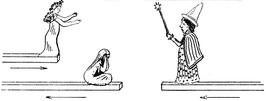
Fig. 550
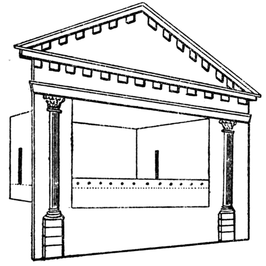
Fig. 551
A sea scene looks very effective. Waves can be cut out of cardboard and placed in every groove, as in Fig. 549, and a ship drawn across. A shipwreck forms an exciting scene. Indeed, there is no end to the scenes—soldiers marching past, stories and scenes from history and literature, etc., etc. The ingenious owner of the theatre will think of many, and add many improvements. It must not be forgotten that the stage is large enough to hold small objects—trees, etc.—to make the scenes look more realistic. Also holes or slits can be made in the roof if it is necessary to pull anything up or hang anything. Fig. 549 shows how a fringe of paper, A, can be fastened to the roof and bent over to hide the pole on which the curtain is wound.
Fig. 550 shows how the scenes are worked; as the Witch is pushed on from one side, the weeping Cinderella is pushed off; when she has quite gone and only the Witch remains, a radiant Cinderella comes on, followed by a coach, etc.
Lastly, Fig. 551 shows a proscenium, which may be built up of either cardboard or wood, and fixed to the front of the theatre. The sides should project sufficiently to hide the working of the strips by means of which the actors are moved on the stage.
Here, for the present, we take leave of the reader, having given him or her some insight into a subject both pleasant and profitable. The preceding pages are no more than an introduction to the art of making toys, and of making the most of simple tools and simple materials, and their real purpose is to encourage our young people not only to copy but also to create, or at any rate to copy not only from our book but from the world around them.
Dolls' houses and furniture, railways, boats and other vehicles offer endless possibilities of original and attractive design, and mechanical toys, whether driven by wind, water, elastic or the works of an old clock, offer an equally wide field for invention. At a later age girls will no doubt be ambitious to devise useful articles for the home, while boys may become interested in engineering and electrical models, optical toys, etc.; the deftness of hand, acquaintance with elementary principles, and self-confidence acquired through the simple work which we have described, should stand them in good stead.
Self-reliance and ingenuity are valuable assets with which to start upon the more serious tasks of life, and if our hints on toy-making contribute in any way to the development of these qualities this book will not have been written in vain.