THE PREFACE (continued 2)
Reading edition
In greit Tounis we think expedient that everie day thair be eathir Sermon, or ellis Common Prayeris, with some exercise of reiding the Scripturis. What day the publict Sermon is, we can neathir require or gretlie approve that the Commoun Prayeris be publictlie used, least that we shall eathir fostar the peple in superstitioun, wha come to the Prayeris as thay come to the Messe; or ellis give thame occasioun to think that those be no prayeris whiche ar maid before and efter Sermon.
In everie notable Toun, we require that one day besydis the Sunday, be appointed to the Sermone and Prayeris; whiche, during the tyme of Sermone, must be keipit fre frome all exercise of laubour, alsweill of the maister as of the servandis. In smaller tounis, as we have said, the commoun consent of the Churche must put ordour. But the Sunday must straitlie be keipit, both before and efter noon, in all tounis. Before noon, must the word be preached and sacramentis ministered, as also Mariage solempnissed, yf occasioun offer: After noon must the young children be publictlie examinated in thair Catechisme in audience of the pepill, in doing whairof the Minister must tak gret deligence, alsweill to cause the Pepill to understand the questionis proponed, as the ansueiris, and the doctrine that may be collected thairof. The ordour[530] and how much is appointed for everie Sunday, is alreaddy distinctit in oure buke of Common Ordour;[531] whiche Catechism is the most perfite that ever yit was used in the Churche. At efter noon also may Baptisme be ministered, whan occasioun is offered of great travell before noon. It is also to be observit, that prayeris be used at after noon upoun the Sunday, whair thair is neathir preching nor catechisme.
It apperteaneth to the Policie of the Churche to appoint the tymes whan the Sacramentis shall be ministered. Baptisme may be ministrat whensoever the word is preached; but we think it more expedient, that it be ministered upoun the Sunday, or upoun the day of prayeris, onlie after the sermon; partlie to remove this gross errour by the which many deceaved, think[532] that children be dampned yf thay die without Baptisme; and partlie to mak the people assist the administratioun of that sacrament with greater reverence than thei do.[533] For we do see the people begyn alreddie to wax weary be reasoun of the frequent repetitioun of those promisses.
Foure tymes in the yeare we think sufficient to the administratioun of the Lordis Tabill, which we desire to be distincted, that the superstitioun of tymes may be avoided so far as may be. Your Honouris ar nocht ignorant how superstitiouslie the people ryn to that actioun at Pasche, evin as [if] the tyme gave virtue to the Sacrament; and how the rest of the hoill yeare thai ar cairles and negligent, as [if] that it apperteaneth not unto thame but at that tyme onlie. We think thairfore most expedient, that the first Sunday of Marche be appointed for one [time]; the first Sunday of Junij for ane uther; the first Sunday of September for the thrid; and the first Sunday of December for the fourt. We do not deny but that any severall churche, for reasonable causses, may change the tyme, and may minister ofter; but we study to suppresse[534] superstitioun. All Ministeris must be admonisched to be more cairfull to instruct the ignorant than readdie to satisfie[535] thair appetiteis, and more scharp in examinatioun then indulgent, in admitting to that great Mysterie[536] such as be ignorant of the use and virtu of the same: and thairfore we think that the administratioun of the Table aught never to be without that examinatioun pass before, especiallie of those whose knawledge is suspect. We think that none ar apt to be admitted to that Mysterie who can not formalie say the Lordis Prayer, the Articles of the Beleif, and declair the soume of the Law.[537]
Farthir, we think it a thing most expedient and necessarie, that everie Churche have a Bibill in Inglische, and that the people be commanded to convene to heir the plane reiding or interpretatioun of the Seripturis, as the Churche shall appoint; that be frequent reiding this gross ignorance, whiche in the cursit Papistrie hath overflowne all, may partlie be removit. We think it most expedient that the Seripturis be red in ordour, that is, that some one buke of the Auld and the New Testament be begun and ordourlie red to the end. And the same we judge of preching, whair the Minister for [the] maist part remaneth in one place: For this skipping and divagatioun frome place to place of the Scripture, be it in reiding, or be it in precheing, we judge not so proffitabill to edifie the Churche, as the continewall following of ane text.
Everie Maister of houshald must be commandit eathir to instruct, or ellis caus [to] be instructed, his children, servandis, and familie, in the principallis of the Christiane religioun; without the knawledge whairof aught none to be admitted to the Tabill of the Lord Jesus: for suche as be so dull and so ignorant, that thei can neathir try thame selfis, neathir yit know the dignitie and misterie of that actioun, can not eat and drink of that Tabill worthelie. And thairfore of necessitie we judge it, that everie yeare at least, publict examinatioun be had by the Ministeris and Elderis of the knawledge of everie persoun within the Churche; to wit, that everie maister and maistres of houshald cum thame selvis and thair familie so many as be cum to maturitie, before the Ministeris and Elderis, to gyf confessioun of thair faith, and to ansueir to such cheaf points of Religioun as the Ministeris shall demand. Such as be ignorant in the Articulis of thair Faith;[538] understand not, nor can not rehearse the Commandimentis of God; knaw not how to pray; neathir whairinto thair richtuousnes consistis, aught not to be admitted to the Lordis Tabill. And gif thay stuburnlie continew,[539] and suffer thair children and servandis to continew in wilfull ignorance, the discipline of the Churche must proceid against them unto excommunicatioun; and than must the mater be referred to the Civill Magistrat. For seing that the just levith be his awin faith, and that Christ Jesus justifieth be knawledge off him self, insufferable we judge it that men shall be permitted to leve and continew in ignorance as memberis of the Churche of God.[540]
Moreover, men, wemen, and children wald be exhorted to exercise thame selvis in the Psalmes, that when the Churche convenith, and dois sing, thai may be the more abill togither with commoun heart and voice to prayse God.
In private housses we think it expedient, that the most grave and discreate persoun use the Commoun Prayeris at morne and at nycht, for the confort and instructioun of uthiris. For seing that we behald and se the hand of God now presentlie striking us with diverse plagues, we think it ane contempt of his judgementis, or ane provocatioun of his anger more to be kendillit against us, yf we be not movit to repentence of oure formar unthankfulnes, and to earnist invocatioun of His name, whois onlie power may, (and great mercy will,) yff we unfeynedlie convert unto him, remove from us these terribill plagues whiche now for our iniquiteis hing oure our headis. "Convert us, O Lord, and we shall be converted."
For Preacheing,[541] and Interpreting off Scripturis, &c.
1 Cor. 14:29
To the end that the Churche of God may have a tryell of mennis knawledge, judgementis, gracis, and utterancis; and also, that suche as somewhat have proffited in Goddis worde, may from tyme to tyme grow to more full perfectioun to serve the Churche, as necessitie shall require: it is most expedient that in everie Toune, whaire Schollis and repair of learned Men ar, that thair be one certane day everie weake appointed [to] that Exercise, which Sanct Paull calleth prophecieing; the ordour whairof is expressed by him in these words: "Let two or thre propheitis speik; and lat the rest judge: But yf any thing be reveilled to him that sitteth by, lat the formar keip silence: [For] ye may, one by one, all prophecie, that all may learn, and all may receave consolatioun. And the Spreittis (that is, the judgementis) of the Propheitis, are subject to the propheitis." Off whiche wordis of the Apostle, it is evident that in Corinthus, whan the Churche did assemble[542] for that purpose, sum place of Scripture was red; upoun the whiche, first one gyf his judgement to the instructioun and consolatioun of the auditouris; after whome did one uthir eathir conferme what the formare had said, or did add what he had omitted, or did gentillie correct or explane more properlie whair the hoill veritie was not reveilled to the formar. And in case sum thingis war hid frome the one and frome the uthir, libertie was gevin to the thrid to speik his judgement for edificatioun of the Churche. Above the whiche nomber of three, (as appereth,) thay passed not, for avoiding of confusioun.
These Exercisses, we say, ar thingis most necessarie for the Churche of God this day in Scotland; for thairby (as said is) shall the Churche have judgement and knawledge of the gracis, giftis, and utterances of everie man within thair awin body; the simple, and suche as have sumwhat proffited, shall be encurageit dalie to study and proceid in knawledge; the Churche shall be edifyed; (for this Exercise must be patent to suche as list to heir and learne,) and everie man shall have libertie to utter and declair his mynd and knawledge to the confort and edificatioun of the Churche.
But least that of a profitable Exercise mycht aryise[543] debate and strife, curiouse, peregryne and unprofitable questionis ar to be avoided. All interpretatioun disaggreing from the principallis of oure faith, repugnyng to cheritie, or that standis in plane contradictioun to ony uthir manifest place of Scripture, is to be rejected. The Interpretour in that exercise, may nocht tack to him self the libertie of ane publict Precheour, yea, althocht he be a Minister appointed; but he must bind him self to his text, that he enter not by disgressioun in explanyng commoun places. He may use no invective in that exercise onles it be with sobrietie in confuting heresyes. In exhortationis or admonitionis he must be schorte, that the tyme may be spent in oppenyng of the mynd of the Holy Ghost in that place; in following the fyle[544] and dependence of the text, and in observing suche notes as may instruct and edifie the auditour. For avoyding of contentioun, neathir may the interpretour, neathir yit any of the assemblie, move any questioun in oppen audience, whairto him self is not content[545] to geve resolutioun without reasoning with any other; but everie man ought to speik his awin judgement to the edificatioun of the Churche.
Yf any be noted with curiositie, or bringyng in any strange doctrine, he must be admonished by the Moderatouris, the Ministeris and Eldaris, immediatlie after that the interpretatioun is ended. The hoill memberis,[546] and nomber of thame that ar of the Assemblie, ought to convene togetther, whair examinatioun should be had, how the persones that did interprete did handle and convey the mater; thei thame selffis being removed till every man have gevin his censure; after the whiche, the persones being called, the faultes (yf any notable be found) ar noted, and the persone gentillie admonished. In that last Assemblie all questionis and dowtis, (yf any arryise,) should be resolved without contentioun.
The Ministeris of the Paroche churches to Landwarte, adjacent to everie cheaf toune, and the Readaris, gif thai have any gift of interpretatioun, within sex myles must assist and concur to those that prophecie within the townes; to the end that thei thame selves may eather learne, or ellis utheris may learne be thame. And moreover, men in whome ar supposed any giftis to be, which mycht edifie the Churche yf thei war weall apply ed, must be charged by the Ministeris and Eldaris to joyne thame selfis with that sessioun and cumpany of Interpretouris, to the end that the Churche may judge whether thei be able to serve to Goddis glorie, and to the proffeit of the Churche in the vocatioun of Ministeris or not. And yf any be found disobedient, and not willing to communicat the giftis and spirituall graces[547] of God with thair brethren, after sufficient admonitioun, discipline must procead against thame; provided that the Civile Magistrate concur with the judgement and electioun of the Churche. For no man may be permitted to leave[548] as best pleasseth him within the Churche of God; but everie man must be constrayned, by fraterall admonitioun and correctioun, to bestow his laubouris, when of the Churche thei ar required, to the edificatioun of otheris.
What day in the week is most convenient for that exercise, and what bookes of the Scripturis salbe most profitable to be red, we refer to the judgment of everie particulare Churche, we meane, to the wisdome of the Ministeris and Eldaris.
Of Mariage.[549]
Becaus that Mariage, the blessed ordinance of God, in this cursed Papistrie hath partlie bene contempned; and partlie hath bene so infirmed, that the personis conjoyned could never be assured of continewance,[550] yf the Bischoppis and Prelattis list to dissolve the same; we have thocht goode to schaw oure judgmentis how such confusioun in tymes cuming may be best avoyded.
And first publict inhibitioun must be maid, that na personis under the power and obedience of otheris; suche as sonnes and dochteris, [and] these that be under curatouris, neather men nor wemen, contract Mariage privelie and without knawledge [of their parents, tutors, or curators, under whose power they are for the time:][551] whiche yf thei do, the censure and discipline of the Churche to procead against thame. Yf the sone or dowghter, or other, have thair hearte tweiched with desyre of mariage, thei ar bound to geve that honour to the parentis that thei oppin unto thame thair affectioun, askyng of thame counsall[552] and assistance, how that motioun, which thei judge to be of God, may be performed. Yf the father, friend, or maister, ganestand thair requeast, and have na other caus then the commoun sorte of men have; to wit, lack of guidis, or because thei ar nott so hyght-borne as thai requyre; yit must not the pairteis whose heartis ar tweiched mak ony covenant till farther declaratioun be maid unto the Churche of God. And, thairfoir, efter thei have opened thair myndis to thair parentis, or suche otheris as have charge oure thame, thei must declair it also to the Ministrie, or to the Civile Magistrat, requyring thame to travaill with thair parentis for thair consent, whiche to do thei ar bound. And yf thei, to wit, the Magistrate or Ministeris, fynd no just caus why the mariage requyred may not be fulfilled, then efter sufficient admonitioun to the father, friend, maister, or superiour, that none of thame resist the work of God, the Ministerie or Magistrat may enter in the place of the parent, and by consenting to thair just requeastis may admit thame to mariage: for the work of God aught not to be hyndered by the corrupt affectionis of worldlie men. The work of God we call, when two heartis (without filthynes befoir committit) ar so joyned, that boyth requyre and ar content to live together in that holy band of Matrimonye.
Yf any man commit fornicatioun with the woman whome he requyred in mariage, then do boyth lose this foirsaid benefite alsweall of the Churche as of the Magistrat; for neather of boyth aught to be intercessouris or advocattis for fylthie fornicatours. But the father, or neyrest friend, whose dowghter being a virgine is deflored, hath power by the law of God to compell the man that did that injurie to marie his dowghtter; or yf the father will not accept him be reassone of his offense, then may he requyre the dote[553] of his dowghter; whiche yf the offendar be nott able to pay, then aught the Civile Magistrat to punishe his body by some other punishement.
And becaus that fornicatioun, huredome, and adulterye, ar synnes most commoun in this Realme, We requyre of your Honouris, in the name of the Eternall God, that severe punishement, according as God hath commanded, be executed against suche wicked offendaris;[554] for we doubt not but suche enorme crymes[555] oppenlie committed, provoketh the wrayth of God, as the Apostle speaketh, not onlie upoun the offendaris, but also upoun suche places as whair, without punishement, thei ar committed.
AGGREIS TO THE HEAD OF MARIAGE.
But to returne to oure formar purpose: Mariage owght not to be contracted amongis personis that have no electioun for lack of understanding; and thairfoir we affirm, that bairns and infantis can nocht lauchfullie be mareid in thair minor aige, to wit, the man within fourtene yeiris of aige, and the woman within twelf yearis, at the least. Whiche yf it chance any to have bene, and have keapt thair bodyis always separat, we can not judge thame bound to adhear as man and wyiff, by reassone of that promeis, which in Goddis presence was no promeise at all. But yf in the yearis of judgment thai have embrased the one the other, then be reassone of thair last consent, thai have ratifeid that which otheris did promeise for thame in thair youth-head.[556]
In a Reformed Churche, Mariage ought nott to be secreatlie used, but in open face and publict audience of the Churche: And for avoyding of dangearis, expedient it is that the bannes be publictlie proclamed thre Sundayis, (onles the persones be [so] knawin, that no suspitioun of dangear may arise, and then may the bannes[557] be schortned at the discretioun of the Ministerie.) But in no wyse can we admitt Mariage to be used secreatlie, how honorable that ever the personis be. The Sunday befoir sermon we think most convenient[558] for mariage, and it to be used no day ellis without the consent of the hoill Ministerie.
Mariage once lauchfullie contracted, may not be dissolved at manis pleasour, as oure maister Christ Jesus doeth witnesse, onles adulterie be committed; which being sufficientlie proven in presence of the Civil Magistrat, the innocent (yf thei so requyre) ought to be pronunced frie, and the offendar aught to suffer the death as God hath commanded. Yf the Civile sweard foolischelie spair the lyeff of the offendar, yit may not the Churche be negligent in thair office, which is to excommunicat the wicked, and to repute thame as dead memberis, and to pronunce the innocent partie to be at freedome, be thei never so honourabile befoir the warld. Yf the lyfe be spared (as it ought not to be) to the offendaris, and gif the fructis of repentance of long tyme appeir in thame, and gif thai earnestlie desyre to be reconceilled with the Churche, we judge that thai may be receaved to participatioun of the Sacramentis, and of the other benefits of the Churche, (for we wold not that the Churche sould hold those excommunicat whom God absolved, that is, the Penitent.)
Yf any demand, whether that the offendar after reconciliatioun with the Churche, may not marye agane? We answer, That yf thai can not leve continent, and yf the necessitie be suche as that thai fear farther offence of God, we can not forbid thame to use the remeady ordayned of God. Yf the partie offended, may be reconcilled to the offendar, then we judge that in nowyse it shall be lauchfull to the offendar to mary any other, except the partie that befoir hath bene offended; and the solempnizatioun of the latter mariage must be in the open face of the Churche lyke as the formare, but without proclamatioun of banns.
This we do offer as the best Counsall that God geveth unto us in so doubtsome a case. But the most perfyte Reformatioun war, yf your Honouris wald give to God his honour and glorie, that ye wold prefer his expresse commandiment to your awin corrupt judgmentis, especially in punisheing of those crymes whiche he commandeth to be punished with death. For so should ye declair your selfis Godis treu and obedient officiaris, and your Commoun-wealth should be redd of innumerable trubles.
NOTA
We meane not, that synnes committed in our formar blyndnes, (whiche be almost buried in oblivioun,) salbe callit agane to examinatioun and judgment. But we requyre that the law may now and heirafter be so establisched and executed, that this ungodlie impunitie of synne have no place within this Realme. For in the fear of God we signifie unto your Honouris, that whosoever persuadeth unto you, that ye may pardone whair God commandeth death, deceaveth your saulles, and provokes you to offend Goddis Majestie.
Off Buriall.[559]
Buriall in all aiges hath bene holden in estimatioun, to signifie that the same body that was committed to the earth should not utterlie perishe, but should ryse agane. And the same we wold have keapt within this Realme, provided that superstitioun, idolatrie, and whatsoever hath proceaded of a fals opinioun, and for advantage saik, may be avoyded; as singing of Messe, Placebo, and Dirige, and all other prayeris over or for the dead, are not onlie superfluous[560] and vane, but also ar idolatrie, and do repugne to the plane Scriptures of God. For, plane it is, that everie one that dyeth, departeth eather in the fayth of Christ Jesus, or ellis departeth in incredulitie: Plane it is, that thei that depart in the treu fayth of Christ Jesus, rest frome thair laubouris, and frome death [doe] go to lyef everlasting, as by oure Maister and by his Apostle we ar taught: But whosoever departe in unbeleve or in incredulitie, shall never see lyef, but the wrayth of God abydeth upoun him. And so, we say that Prayeris for the Dead ar not onlie superfluous[561] and vane, but do expreslie repugne to the manifest Scripturis and veritie thairof.
REFERRES THIS ARTICLE TO THE JUDGMENT OF THE CHURCHE.
For avoyding all inconvenientis,[562] we judge it best, that neather singing nor reading be at the Buryall: for albeit thingis song and red may admonishe some of the leving to prepair thame selfis for death, yit shall some superstitious and ignorant personis ever think,[563] that the workis synging or reading of the levying do and may proffat the dead. And thairfoir, we think most expedient that the Dead be convoyed to the place of buriall with some honest cumpany of the Churche, without eather singing or reading; yea, without all kynd of ceremony heirtofore used, uther than that the dead be committed to the grave, with suche gravitie and sobrietie, as those that be present may seame to fear the judgmentis of God, and to hate synne, whiche is the caus of death.
ADDITIO.[564]
And yit, nochtwithstanding, we are not so precise, but that we ar content that particular Kirkis use thame in that behalf, wyth the consent of the Ministerie of the same, as thei will answeir to God, and Assemblie of the Universall Kirk gathered within the Realme.
We ar nott ignorant that some requyre ane Sermone at the Buriall, or ellis some places of Scripturis to be red, to put the leving in mynd that thei ar mortall, and that lykwyise thei must dye. Bot lett those men understand, that the sermonis whiche be daily maid, serve for that use; whiche yf men dispyse, the preaching of the[565] Funerall sermonis shall rather nureise superstitioun and a false opinioun, (as befoir is said,) then that thei shall bring suche persones to any godlie consideratioun of thair awin estaite. Attour, eather shall the Ministeris for the most parte be occupyed in preaching Funerall sermonis, or ellis thei shall have respect to personis, preaching at the buriall of the rich and honorabill, but keaping silence when the poore or dispysed departeth; and this with saif conscience can not the Ministeris do. For, seing that befoir God, thair is no respect of personis, and that thair ministerie apperteaneth to all alike, whatsoever thei do to the riche, in respect of thair ministerie, the same thei ar bound to do to the poorest under thair charge.
In respect of diverse inconvenientis, we think it neather seamlie that the Churche appointed to Preaching and ministratioun of the Sacramentis shalbe maid a place of Buriall; but that some other secreat and convenient place, lying in the most free air, be appointed for that use; the whiche place aught to be weill walled and fensed about, and keaped for that use onlie.
For Reparatioun of Churches.[566]
AGGREIT ON.
Least that the worde of God, and ministratioun of the Sacramentis, by unseamelynes of the place, come in contempt, of necessitie it is, that the Churches and places[567] whair the people aught publictlie to convene, be with expeditioun repaired in durres, wyndois, thak, and with suche preparationis within, as apperteaneth, alsweall to the majestie of the word[568] of God as unto the ease and commoditie of the people. And becaus we knaw the slouthfulnes of men in this behalf, and in all other whiche may not redound to thair privat commoditie; strait charge and commandiment must be gevin, that within a certane day the reparationis must be begune, and within another day, to be affixed by your Honouris, that thei be finished: penalteis and soumes of money must be injoyned, and without pardone taken from the contempnaris.
The reparatioun would be according to the possibilitie and nomber of the Churche.[569] Everie Churche must have durres, cloise wyndoes of glass, thak or sclait able[570] to withhold raine, a bell to convocat the people together, a pulpite, a basyn for baptisme, and tables for the ministratioun of the Lordis Suppar. In greater churches, and whair the congregatioun is great in number, must reparatioun be maid within the Churche for the quiet and commodious receaving of the people. The expensses to be lyfted partlie of the people, and partlie of the teindis, at the consideratioun of the Ministerie.
For Punishment of those that prophane the Sacramentis and do contempt the Word of God, and Dare presume to minister thame, not being thairto lauchfullie called.[571]
As Sathan hath never ceassed frome the begyning to draw mankynd in one of two extremiteis, to wit, that men should eathir be so ravished with gazing upoun the visible creaturis, that forgetting the caus why thai war ordeyned,[572] thai attributed unto thame a vertew and power which God hath not granted unto thame; or ellis that men should sa contempne and dispyse Godis blessed ordinance and holy institutionis, as [if] that neathir in the rycht use of thame war thair any proffeit, neathir yit in thair prophanatioun war thair any danger. As this wyese, we say, Sathan hath blynded the most parte of mankynd from the begyning; so doubt we not, but that he will stryve to continew in his malice evin to the end. Oure eyis have seane, and presentlie do see the experience of the one and of the other. What was the opinioun of most parte of men, of the Sacrament of Christis bodie and bloode, during the darknes of superstitioun, is not unknawin, how it was gazed upoun, kneeled unto, borne in processioun, and finallie wirschipped and honored as Christ Jesus him selve. And so long as Sathan mycht thane reteane man in that damnable idolatrie, he was quyet, as one that possessed his kingdome of darknes peceablie. But since that it hath pleased the mercyis of God to reveill unto the unthankfull world the lyght of his wourd, the rycht use and administratioun of his sacramentis, he assayis man upoun the contrarie parte. For whair, (not lang ago,) men stude in suche admiratioun of that idoll in the Messe, that none durst presume to have said the Messe, but the foirsworne schavin sorte, the beastis marked men some dar now be so bald; as without all convocatioun, to minister, (as thai suppoise,) the treu sacramentis in open assemblies; and some idiottis, (yit more wickedlie and more imprudentlie,) dar counterfeit in thair housses that which the treu Ministeris do in the open congregatioun; thei presume, (we say,) to do it in housses without reverence, without word preached, and without Minister, other then of companioun to companioun.[573] This contempt proceideth, no doubt, from the malice and craft of that Serpent who first deceaved man, of purpoise to deface the glory of Christis evangell, and to bring his blessed sacramentis in a perpetuall contempt. And farther, your Honouris may clearlie see how proudlie and stubburnlie the most parte despyse the Evangell of Christ Jesus offered unto you; whome onles that scharplie and stoutlie ye resist, we meane alsweill the manifest dispysar as the prophanare of the sacramentis, ye shall fynd thame pernitious ennemyes or it be long. And thairfoir, in the name of the Eternall God, and of his Sone Christ Jesus, we require of your Honouris, that, without delay, strait Lawis be maid against the one and the other.
OPTIMA COLLATIO.
We dare not prescribe unto you what penalties shalbe required of suche: But this we fear not to affirme, that the ane and the other deserve death; for yf he which doeth falsefye the the seall, subscriptioun, or coynzie of a king is adjudged worthy of death; what shall we think of him who planlie doeth falsefye the Seallis of Christ Jesus, Prince of the Kingis of the earth? Yf Darius pronunced, that a bauk[574] should be taken frome the house of that man, and he him self hinged upoun it, that durst attempt to hinder the re-edificatioun[575] of the materiall Temple, What shall we say of those that contempteouslie blaspheme God, and manifestlie hynder the [spirituall] Temple of God, which is the saullis and bodyis of the elect, to be purged by the treu preaching of Christ Jesus, from the superstitioun and damnable idolatrie in which thai have bene of long plunged and holdin captive? Yf ye, (as God forbid,) declair your selfis cairless ower the treu Religioun, God will not suffer your negligence unpunished. And thairfoir, moir earnestlie require we, that strait lawis may be maid against the stubburne contempnaris of Christ Jesus, and against such as dare presume to minister his Sacramentis, not ordourlie called to that office, least that whill thair be none found to ganestand impietie, the wrayth of God be kindilled against the hoill.
The Papisticall Preastis have neather power nor authoritie to minister the Sacramentis of Christ Jesus; becaus that in thair mouth is not the sermon of exhortatioun. And thairfoir, to thame most strait inhibitioun be maid, notwithstanding any usurpatioun whiche thai have had in that behalf in the tyme of blyndnes:[576] It is neathir the clipping of thair crownes, the crossing[577] of thair fingaris, nor the blowing of the dum doggis, called the Bischopis, neathir yit the laying on of thair handis, that maketh thame treu Ministeris of Christ Jesus. But the Spreit of God inwardlie first moving the heartis to seke[578] Christis glorie and the proffeit of his Churche, and thaireftir the nominatioun of the People, the examinatioun of the learned, and publict admissioun, (as befoir is said,) maikis men lauchfull Ministeris of the wourd and sacramentis. We speak of ane ordinarie vocatioun, whare churches ar reformed, or at least tend to reformatioun,[579] and not of that which is extraordinarye, when God by him self, and by his only power, raseth up to the Ministerie such as best pleaseth his wisdome.
The Conclusioun.
Thus have we, in these few Headis, offered unto youre Honouris oure judgmentis, according as we war commanded, tueching the Reformatioun of thingis which heirtofoir have altogidder bene abused in this curssed Papistrie. We doubt not but some of oure Petitionis shall appear strange unto you at the first sight. But yf your Wisdomes deaplie considder, that we must ansuer not onlie unto men, but also befoir the throne of the Eternall God, and of his Sone Christ Jesus, for the counsall which we geve in this so grave a mater; your Honouris shall easilie considder, that more assured it is till us to fall in the displeasour of all men in earth, then to offend the Majestie of God, whose justice can not suffer flatteraris and deceitfull Counsalouris unpunished.
That we require the Churche to be set at suche libertie, that scho neathir be compelled to fead idill bellyes, neathir yit to susteane the tyrannye which heirtofoir by violence hath bene manteaned, we know will offend many. But yf we should keape silence heirof, we ar most assured to offend the just and rychteous God, who by the mouth of his Apostle hath pronunced this sentence:—"He that lauboreth nott, let him not eat." Yf we in this behalf, or in any other, requyre or ask any [other] thing, than by Goddis expressed commandiment, by equitie and good conscience ye ar bound to grant, lett it be noted, and after repudiat; but yf we require nothing which God requyreth not also, let your Honouris tack head, how ye ganestand the charge of him whose hand and punishment ye can not eschape.
Yf blynd affectioun rather lead you to have respect to the sustentatioun of those your carnall Freindis, who tyrannouslie have impyred above the poor flock of Christ Jesus, than that the zeall of Goddis glorie provock and move you to sett his oppressed Churche at fredome and libertie, we fear your scharpe and suddane punischmentis, and that the glorie and honour of this interpryse be reserved unto otheris.
And yitt shall this oure judgment abyd to the Generationis following for a monument and witness, how lovinglie God called you and this Realme[580] to repentance, what counsallouris God send unto you, and how ye [have] used the same. Yf obedientlie ye hear God now calling, we doubt not but he shall hear you in your greatest necessitie. But yf, following youre awin corrupt judgmentis, ye contempt his voice and vocatioun, we ar assured that your formare iniquitie, and present ingratitude, shall togither crave just punishment frome God, who can not long delay to execute his most just judgmentis, when, after many offenses and long blyndness, grace and mercy offered is contemptuouslie refused.
God the Father of oure Lord Jesus Christ, by the power of his Holy Spreit, so illuminat your heartis, that ye may clearlie see what is pleasing and acceptable in his presence; so bow the same till his obedience, that ye may prefer his reveilled will to your awin affectionis; and so strengthen you by the spreit of fortitude, that boldlie ye may punishe vyce, and maintene virtue within this Realme, to the praise and glorie of his Holy name; to the conforte and assurance of your awin Consciences, and to the consolatioun and good example of the Posteriteis following. Amen. So be it.
By your Honouris Most humble Servitouris, etc.
Frome Edinburgh, The 20 of Maij 1560.
Act of Secreit Counsall, xxvii Januarii, Anno &c., lxo.[581]
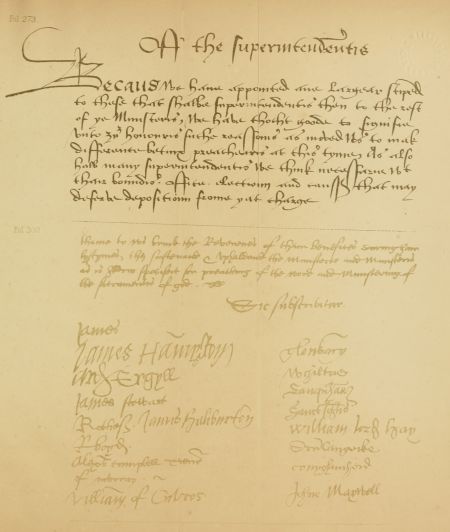
We, quhilkis hes subscryvit thir Presentis, haveand avysit with the Articles heirin specifeit, as is abone mentionat fra the begynning of this Book, thinkis the samin good, and conforme to Goddis Word in all pointis; conforme to the Notes and Additionis thairto eikit; and promittis to sett the samin fordwarte at the uttermost of oure poweris: Providing that the Bischoppis, Abbotis, Priouris, and otheris Prelattis and beneficit men, quhilkis ellis hes adjonit thame to us, bruik the reveneues of thair benefices during thair liftymes, thei susteanand and uphaldand the Ministerie and Ministeris, as is herein specifeit, for preaching of the Word, and ministering of the Sacramentis of God.
(Sic Subscribitur.)
James.[582] James Hammylton.[583] Ard. Ergyll.[584] James Stewart.[585] Rothess.[586] James Haliburton.[587] R. Boyd.[588] Alexr}. Campbell, Dene of Murray.[589] Villiam OF Culros.[590] Maister Alexr. Gordoun.[591] Bargany Younger.[592] Andro Ker of Fawdonsyd.[593] T. Scott of Hanyng.[594] Johne Lokhart of Barr.[595] George Corrie of Kelwod.[596] Johne Schaw of Halie.[597] Andro Hammyltoun of Lethame.[598] Glencarn.[599] Uchiltrie.[600] Sanquhar.[601] Sanctjohns.[602] William Lord Hay.[603] Drumlangrike.[604] Conyghamheid.[605] Johne Maxwell.[606] George Fentoun of that Ilk.[607] Lochinware.[608]
According to Knox, (see page 129,) who is followed by Calderwood, Petrie, Spotiswood, and other writers, in addition to the above Subscribers to the Book of Discipline, there were,
William, Earl Marischall. John, Earl of Menteith. James, Earl of Morton, (afterwards Regent.) John, Lord Lindesay of the Byris. Patrick Master of Lindesay. Sir Alexander Stewart, Younger of Garlies, (who was slain at Stirling in September 1571.)
THE FOURT BOOK OF THE PROGRESSE AND CONTINUANCE OF TREU RELIGIOUN WITHIN SCOTLAND.
In the former Bookis,[609] gentill Reidar, thou may clearlie see how potentlie God hath performed, in these our last and wicked dayis, alsweall as in the aiges that have passed befoir us, the promisses that is maid to the servandis of God, by the propheite Esais, in these wordis:—"Thei that waite upoun the Lord shall renewe thair strenth; thei sall lift up the wynges as the egles: thei shall runne, and not be wearie; thei shall walke, and not fainte." This promeise, we say, suche as Sathan hath not utterlie blyndit may see performed in us, the professouris of Christ Jesus, within this Realme of Scotland, with no les evidencye, than it was in any aige that ever have passed befoir us. For what was oure force? What was our nomber? Yea, what wisdome or warldlie pollicey was into us, to have brought to ane goode end so great ane interpryse? Oure verray enemyes can bear witnesse. And yit in how great puritie God did establisse amanges us his treu Religioun, alsweall in doctrine as in ceremonyes! To what confusion and fear war idolateris, adulteraris, and all publict transgressoris of Goddis commandimentis, within short tyme brought? The publict ordour of the Churche,[610] yet by the mercy of God preserved, and the punishmentis executed against malefactouris, can testifie unto the world. For as tueching the doctrine taught by our Ministeris, and as tueching the administratioun of Sacramentis used in our Churches, we ar bold to affirme, that thair is no realme this day upoun the face of the earth, that hath thame in grettar puritie;—yea, (we mone speak the treuth whomesoever we offend,) thair is none (no realme, we meane) that hath thame in the lyek puritie: For all otheris (how synceare that ever the doctrine be, that by some is taught,) reteane in thair churches, and the ministeris thairof, some footsteppis of Antichrist, and some[611] dreggis of Papistrie;[612] but we (all praise to God alone) have no thing within oure Churches that ever flowed frome that Man of synne: And this we acknowledge to be the strenth gevin unto us by God, because we esteamed nott our selves wyise in oure awin eyes, but understanding our hoill wisdome to be but meare foolishnes, befoir [the Lord] our God, layed it asyd, and followed onlie that whiche we fand approved by him self.
THE FIRST PETITIOUN OF THE PROTESTANTIS OF SCOTLAND.
In this poynt could never our enemyes caus us to fainte, for Our first Petitioun was, "That the reverent face of the primitive and apostolick Churche should be reduced agane to the eyes and knowledge of men."[613] And in that poynt, we say, our God hath strenthened us till that the work was finished, as the world may see. And as concerning the suppressing of vice, yea, and of the abolishing of all suche thingis as myght nureise impietie within the Realme, the actes and statutis of the principale Townes reformed will yitt testifie: For what adulterar, what fornicatour, what knawin messe-mongare, or pestilent Papist, durst have been seen in publict, within any reformed town within this Realme, befoir that the Quene arryved? And this victorie to his wourde, and terrour to all fylthie lyvaris, did oure God wirk by such as yit leave and remaine witnesses (whither thei will or not) of the foirsaid workis of our God. We say, our God suffered none of those whome he first called to the battell, to perishe or to fall, till that he maid thame victouris of thair ennemyes: For evin as God suffered none of those whome he called frome Egypt to perishe in the Red Sea, how fearfull that ever the danger appeared; so suffered he none of us to be oppressed, nor yit to be takkin from this lyeff, till that mo Pharaoes then one war drowned, and we set at fredome, without all dangear of our ennemyes; to lett boyth us and our posteritie understand, that suche as follow the conducting of God can not perishe, albeit that thei walked in the verray schaddo of death.
THE CAUS OF THE TRUBILLIS OF THE KIRK WITHIN SCOTLAND FLOWED FROME THE COURTEIRS THAT SEEMED TO PROFESS THE EVANGELL.[614]
But frome whence (allace) cumeth this miserable dispersioun of Goddis people within this Realme, this day, Anno 1566, in Maij?[615] And what is the cause that now the just is compelled to keap silence? good men ar banished, murtheraris, and such as ar knowin unworthie of the commoun societie, (yf just lawis war put in deu executioun,) bear the hoill regiment and swynge within this Realme? We answere, Becaus that suddandlie the most parte of us declyned from the puritie of Goddis word, and began to follow the warld; and so agane to schaik handis with the Devill, and with idolatrie, as in this Fourte Booke we will hear.
For whill that Papistis war so confounded, that none within the Realme durst more avow the hearing or saying of Messe, then the theavis of Lyddesdaill durst avow thair stowth in presence of ane upryght judge, thair war Protestants found, that eschamed not at tables, and other open places, to ask, "Why may nott the Queyn have hir awin[616] Messe, and the forme of hir Religioun? What cane that hurte us or our Religioun?" And from these two, "Why" and "What," at lenthe sprange out this affirmative, "The Quenis Messe and hir Preastis will we manteine: this hand and this rapper sall feght in thair defence, etc."
The inconvenientis war schawin, both by tongue and pen; but the advertissaris war judged to be men of unquyet spreatis. Thair credytt was defaced at the handis of suche as befoir war not eschamed to have used thair counsall, in materis of greattar importance then to have resisted the Messe. But then, my Lord, my Maister, may nott be thus used: he hes that honour to be the Quenis brother; and thairfoir we will that all men shall understand that he man tender her as his sister; and whosoever will counsall him to displease her, or the least that apperteanes unto hir, shall not find him thair freind; yea, thei ar worthy to be hanged that wald so counsall him, etc.
THE CORRUPTIOUN THAT ENTERED IN THE QUENIS COURTE.
THE THEOLOGIE OF THE COURTE, AND THAIR REASSONIS.
These and the lyke reassonis took suche deape roote in flesche and bloode, that the trewth of God was almost foryett; and from this fontaine (to wit, that flesche and blood was, and yitt allace, is preferred to God, and to his messengeris rebucking vice and vanitie) hath all our miserie proceeded. For as befoir, so even yitt, althought the Ministeris be sett to beg, the Guard and the Men of war maun be served. Though the blood of the Ministeris be spylt, it is the Quenis servand that did it. Althought Messes be multipleyed in all quarteris of the Realme, who can stop the Quenis subjectis to lyve of the Quenis religioun. Althought innocent men be empreasoned, it is the Quenis pleasur: sche is offended at such men. Althought under pretence of justice innocentis be crewellie murthered; the Lordis shall weape, but the Quenis mynd must be satisfeid. Nobillis of the Realme, Baronis and Counsallouris ar banished, thair eschaittis disponed, and thair lyves maist injustlie persewed. The Quene hes lost hir trusty servand Davy: he was dear unto hir; and thairfoir, for hir honouris sake, sche maun schaw rigour to revenge his death. And yit farther, albeit that some know that sche hes plainlie purposed to wrak the religioun within this Realme; that to that Romane Antichrist sche hath maid hir promeise; and that from him sche hath tackin money to uphold his pompe within this Realme; yit will thai lett the people understand, that the Quene will establisse religioun, and provide all thingis ordourlie, yf scho war anes delivered.
THIS WAS WRITTEN WHEN THE SECOUND RANK OF THE LORDIS WAS BANISSHED.[617]
Yf such dealings, which ar commoun amangis our Protestantis, be nott to prefer flesche and blood to God, to his treuth, to justice, to religioun, and unto the libertie of this oppressed Realme, let the warld judge. The plagues have bein, and in some part ar present, that war befoir threatned; the rest ayproaches: And yitt who from the heart cryis, "I have offended; the Lord knows: in Thee onlie is the trust of the oppressed; for vaine is the help of man." But now return we to our Historie.
THE QUENIS LAST ARRIVAL IN SCOTLAND.[618]
The nyntene day[619] of August, the year of God Jm Vc threscoir ane yearis, betwix sevin and aught houris befoir noon, arryved Marie Quene of Scotland, then widow, with two galayis furth of France.[620] In[621] hir cumpany, (besydis hir gentilwemen, called the Maries,)[622] war hir thre uncles, the Duck D'Omall,[623] the Grand Priour,[624] and the Marques D'Elbuf.[625] Thare accumpanyed hir also,[626] D'Anweill, son to the Constable of France, with other gentilmen of inferiour conditioun, besydis servandis and officiaris.[627] The verray face of heavin, the time of hir arryvall, did manifestlie speak what confort was brought unto this cuntrey with hir, to wit, sorow, dolour, darknes, and all impietie; for in the memorie of man, that day of the year, was never seyn a more dolorous face of the heavin, then was at hir arryvall, which two days after did so contineu; for besides the surfett weat,[628] and corruptioun of the air, the myst was so thick and so dark, that skairse mycht any man espy ane other the lenth of two pair of buttis. The sun was not seyn to schyne two dayis befoir, nor two dayis after. That foir-warning gave God unto us; but allace, the most pairt war blynd.
THE QUENIS FIRST GRACE IN DISPYTE OF RELIGIOUN.
At the sound of the cannonis whiche the galayis schot, the multitude being advertissed, happie was he and sche that first myght have the presence of the Quene. The Protestantis war not the slowest, and thairintill thai war not to be blamed.[629] Becaus the Palace of Halyrudhous was not throughlie put in ordour, (for hir cuming was more suddane[630] than many looked for,) sche remaned in Leyth till towardis the evenyng, and then repaired thitther. In the way betwixt Leith and the Abbay, met hir the rebellis of the craftis, (of whom we spak befoir,[631]) to wit, those that had violated the authoritie of the Magistratis, and had besieged the Provost. But, because sche was sufficientlie instructed, that all thai did was done in dispite of the religioun, thai war easilie apardoned. Fyres of joy war sett furth all nyght, and a cumpany of the most honest,[632] with instrumentis of musick, and with musitians, geve thair salutationis at hir chalmer wyndo.[633] The melody, (as sche alledged,) lyked hir weill; and sche willed the same to be contineued some nightis after.
THE QUENIS FIRST MESSE.
LORD JAMES [HIS] FACT.
CONVOYARIS OF THE PREAST.
With great diligence[634] the Lordis repared unto hir from all quarters. And so was nothing understand[635] but myrth and quyetness till the nixt Sunday, which was the xxiiij of August, when preparatioun began to be maid for that idoll the Messe to be said in the Chapell; which perced the hartis of all. The godlie[636] began to bolden; and men began openlie to speak, "Shall that idoll be suffered agane to tack place within this Realm? It shall not." The Lord Lyndesay, (then but Maister,)[637] with the gentilmen of Fyiff, and otheris, plainlie cryed in the close, "The idolater Preast should dye the death," according to Goddis law. One that caryed in the candell was evill effrayed; but then began flesche and blood to schaw the self. Thair durst no Papist, neathir yitt any that cam out of France whisper. But the Lord James[638] (the man whom all the godlye did most reverence) took upoun him to keap the Chapell door. His best excuse was, that he wald stop all Scotishe men to enter in to the Messe. But it was, and is sufficientlie known, that the door was keapt, that nane should have entress to truble the Preast; who, after the Messe, was committed to the protectioun of Lord Johne of Coldinghame,[639] and Lord Robert of Halyrudehouse,[640] who then war boyth Protestantis, and had communicat at the Table of the Lord. Betwix thame two was the Preast convoyed to his chalmer.
THE END IS NOTT YITT SEANE.
And so the godlie departed with great greaf of heart, and at after noon repaired to the Abbay in great companeis, and gave plane significatioun, that thai could not abyd that the land which God by his power had purged from idolatrie, should in thair eyes be polluted agane. Which understand, thair began complaint upoun complaint. The old dounty-bowris, and otheris that long had served in the Court, and hes no remissioun of synnes, but by virtew of the Messe, cryed, "Thai wald to France without delay: thai could not live without the Messe." The same affirmed the Quenis Uncles. And wold to God that that menzie, togitther with the Messe, had tacken good nyght at this Realme for ever; for so had Scotland bene rydd of ane unprofitable burthen of devouring strangearis, and of the maledictioun of God that hes stricken, and yitt will strike for idolatrie.
THE PERSUASIOUN OF THE COURTEOURIS.
The Counsall assembled, disputatioun was had of the nixt remeadye. Polytick headis war send unto the Gentilmen, with these and the lyke persuasionis, "Why, allace, will ye chase our Soverane from us? Sche will incontinent return to hir galayes; and what then shall all Realmes say of us? May we nott suffer hir a lytill whill? We doubt not but sche shall leave it. Yf we war not assured that sche myght be wonne, we should be als greate ennemyes to hir Masse, as ye should be. Hir Uncles will depart, and then sall we reull all at our plesour. Wold not we be as sorry to hurt the Religioun as any of you wald be?"
With these and the lyke persuasionis, (we say,) was the fervencie of the Bretheren quenched; and ane Act[641] was framed: the tennour whairof followeth:—
Apud Edinburgh, xxvto Augusti Anno &c. lxio.
Forsamekle as the Quenis Majestie hes understand the great inconvenientis that may come, through the divisioun presentlie standing in this Realme, for the difference in materis of Religioun, that hir Majestie is most desirous to see [it] pacifeit be ane good ordour, to the honour of God, and tranquillitie of hir Realme, and meanes to tack the same be advyse of hir Estaitis, sa soon as convenientlie may be; and that hir Majesties godlie resolutioun thairin may be greatlie hyndered, in case any tumult or seditioun be raised amanges the lieges, yf any suddane[642] alteratioun or novatioun be preassed [at] or attempted, befoir that the ordour may be establissed: Thairfoir, for eschewing of the saidis inconvenientis, hir Majestie ordanes letteris[643] to be direct to charge all and sindrie hir leiges, be oppin proclamatioun at the Mercat Croce of Edinburgh, and otheris places neidfull, that thai, and everie ane of thame, conteane thame selffis in quyetnesse, keap peace and civile societie amongis thame selffis: And in the meanetyme, while the Estaittis of this Realme may be assembled, and that hir Majestie have tackin ane finall ordour be thair advyse and publict consent, quhilk hir Majestie hopes shalbe to the contentment of the haill, That nane of thame tack upoun hand, privatlie or openlie, to mack alteratioun or innovatioun of the staite of Religioun, or attempt any thing against the form quhilk hir Majestie fand publictlie and universallie standing at hir Majesties arryvell in this hir Realme, under the pane of death: With certificatioun, that yf any subject of the Realme, shall cum in the contrarie heirof, he shalbe estemed and holden a seditious persone and raiser of tumult, and the said paine salbe execut upoun him with all rigour, to the example of otheris. Attour, hir Majestie, be the advise of the Lordis of hir Secreit Counsall, commandis and charges all hir leiges, that nane of thame tack upoun hand to molest or truble any of hir domesticall servandis, or personis whatsumever, come furth of France, in hir Gracis cumpany at this tyme, in wourd, deed, or countenance, for any caus whatsumever, eather within hir Palace or without, or mack ony derisioun[644] or invasioun upoun any of thame, under whatsumever cullour or pretence, under the said paine of death: Albeit hir Majestie be sufficientlie persuaded, that hir good and loving subjectis wold do the same, for the reverence thai bear to hir persone and authoritie, notwithstanding that na sick commandiment war publisshed.
This Act and Proclamatioun, penned and put in form by such as befoir professed Christ Jesus, (for in the Counsall then had Papistis neathir power nor vote,) it was publictlie proclaimed at the Mercat Croce of Edinburgh, upoun Mononday foirsaid. No man reclamed, nor maid repugnance to it, except the Erle of Arrane onlie;[645] who, in open audience of the Heraldis and people protested, "That he dissasented that any protectioun or defence should be maid to the Quenis domestickis, or to any that came from France, to offend Goddis Majestie, and to violat the lawis of the Realme, more then to any other subject: for Goddis law had pronunced death against the idolater, and the lawis of the realme had appoynted punishment for sayaris and heararis of Masse; quhilkis, (said he,) I here protest, be universallie observed, and that none be exempted, unto such tyme as a law, als publictlie maid, and als consonant to the law of God, have disannulled the formar." And thairupoun he took documentis, as the tenour of this his Protestatioun doeth witnesse:—
In sa far as be this Proclamatioun it is understand to the Kirk of God, and memberis thairof, that the Quenis Grace is mynded, that the treu religioun and wyrschipping ellis establissed procead fordwart, that it may daly increase, unto the Parliament, that ordour then may be tane for extirpatioun of all idolatrie within this Realme: We rander maist hartlie thankis to the Lord our God for hir Gracis good mynd, earnestlie praying that it may be encreassed in hir Hienes, to the honour and glorie of His name, and weill of his Kirk within this Realme. And as tueching the molestatioun of hir Hienes servandis, we suppose that nane dare be sa bald as anes to move thair fyngar at thame, in doing of thair lefull busines; and as for us, we have learned at oure maister Christis school, "to keap peace with all men;" and thairfoir for our part, we will promeis that obedience unto hir Majestie (as is our dewitie) that nane of hir servandis salbe molested, trubled, or anes tueched, be the Kirk, or any member thairof, in doing thair lefull affairis. But, sen that God hes said, "The idolater shall die the death;" we Protest solempnedlie, in presence of God, and in the earis of the haill people that hearis this Proclamatioun, and specialie in presence of you Lyoun Herald, and of the rest of your collegues, &c., makaris of this Proclamatioun, that yf any of hir servandis shall commit idolatrie, specialie say Messe, participat thairwith, or tack the defence thairof, (quhilkis we war leyth should be in hir Grace cumpany,) in that caise, that this Proclamatioun be nott extended to thame in that behalf, nor be not a salfgard or gyrth to thame in that behalf, na mair nor give thai committ slauchter or murther, seing the ane is mekle mair abhominable and odiouse in the syght of God, then is the other: But that it may be laughtfull to inflict upoun thame the painis conteyned in Goddis word aganis idolateris, whairever thai may be apprehended, but favour. And this oure Protestatioun we desyre you to notifie unto hir, and gif hir the copie heirof, least hir Hienes should suspect ane uproar, gif we should all come and present the same. At Edinburgh, the day and year foirsaid.
ROBERT CAMPBELL TO THE LORD VCHILTRIE.
THE QUENIS PRACTISES AT THE FIRST.
This baldnes did somewhat exasperat the Quene, and such as favoured hir in that poynt. As the Lordis, callit[646] of the Congregatioun, repared unto the Town, at the first cuming thai schew thame selves wonderouslie offended, that the Messe was permitted; so that everie man as he cam accused thame that war befoir him: but after that thai had remaned a certane space, thai war as quyet as war the formare. Which thing perceaved, a zealous and godlie man, Robert Campbell of Kingzeancleucht, said unto the Lord Vchiltrie, "My Lord, now ye are come, and almost the last of all the rest; and I perceave, by your anger, that the fyre-edge is nott of you yit; but I fear, that after that the holy watter of the Courte be sprinckled upoun you, that ye sall become als temperat[647] as the rest: For I have bene here now fyve dayis, and at the first I hard everie man say, 'Let us hang the Preast;' but after that thai had bene twyse or thrise in the Abbay, all that fervency was past. I think thair be some inchantment whareby men ar bewitched." And in verray deed so it came to pass: for the Quenis flattering wordis, upoun the ane pairte, ever still crying, "Conscience, conscience: it is a sore thing to constreane the conscience;" and the subtile persuasionis of hir suppostis (we mean evin of such as sometymes war judged most fervent with us) upoun the other parte, blynded all men, and putt thame in this opinioun, sche wilbe content to hear the preaching; and so no doubt but sche may be wone. And thus of all it wes concluded, to suffer hir for a tyme.
THE JUDGMENT OF JOHNE KNOX UPOUN THE SUFFERING OF THE QUENIS MESSE.[648]
THE COURTEOURIS.
JOHNE KNOX CONFESSIOUN.
The nixt Sounday, Johnne Knox, inveighing against idolatrie, schew what terrible plagues God had tacken upoun Realmes and Nationis for the same; and added, "That one Messe (thair war no mo suffered at the first) was more fearful to him then gif ten thousand armed enemyes war landed in any pairte of the Realme, of purpose to suppress the hoill religioun. For (said he) in our God thair is strenth to resist and confound multitudis, yf we unfeanedlie depend upoun him; whairof heirtofoir we haif had experience; but when we joyne handis with idolatrie, it is no doubt but that both Godis amicable presence and confortable defence leaveth us, and what shall then become of us? Allace, I fear that experience shall teach us to the greaf of many." At these wordis, the guydaris of of the Court mocked, and plainlie spak, "That such fear was no poynt of thair fayth: it was besyd his text, and was a verray untymelie admonitioun." But we heard this same Johnne Knox, in the audience of the same men, recyte the same wordis agane in the myddest of trubles; and in the audience of many ask God mercy, that he was nott more vehement and upryght in the suppressing of that idoll in the begynning. "For, (said he,) albeit that I spack that which offended some, (which this day thai see and feall to be treu,) yit did I not [that] which I myght have done; for God had not onlie gevin unto me knowledge, and toung to maik the impietie of that idoll knowin unto this Realme, but he had gevin unto me credyte with many, who wold have put in executioun Goddis judgmentis, yf I wold onlie have consented thairto: But so cairfull was I[649] of that commoun tranquillitie, and so loth was I to have offended those of whom I had conceaved a good opinioun, that in secreat conference with earnest and zealous men, I travaled rather to mitigat, yea, to slokin, that fervencye that God had kyndled in otheris, than to animat or encorage thame to put thair handis to the Lordis work: Whairintill I unfeanedlie acknowledge my selff to have done most wickedlie; and from the bottom of my hart, askis of my God grace and pardon, for that I did not what in me lay to have suppressed that idoll in the begining." These and other wordis did many hear him speak in publict place, in the moneth of December, the year of God Jm Vc and threscoir fyve yearis, when such as at the Quenis arryvell onlie manteyned the Masse, war exyled the Realme, summoned upoun treassone, and decreit of forfaltour intended against thame. But to return from whence we have digressed.
THE FIRST REASSONING BETWIX THE QUEYN AND JOHNE KNOX.
Whetther it was by counsall of otheris, or of the Quenis awin desyre, we knaw not; but the Quene spack with Johne Knox, and had long ressoning with him, none being present except the Lord James: (two gentilwemen stood[650] in the other end of the house.) The summe of thair reassoning was this. The Quene accused him, that he had raysed a part of hir subjectis against hir Mother, and against hir self: That he had writtin a book against hir just authoritie, (sche ment the treatise against the Regiment of Wemen[651]) which sche had, and should caus the most learned in Europe to wryte against it: That he was the caus of great seditioun and great slauchter in England; and that it was said to hir, that all which he did was by necromancye, &c.
To the whiche the said Johne answered, "Madam, it may please your Majestie patientlie to hear my sempill ansures. And first, (said he,) yf to teach the treuth of God in synceritie, yf to rebuke idolatrie, and to will a people to wyrschip God according to his word, be to raise subjectis against thair Princes, then can not I be excused; for it hes pleased God of his mercy to mack me ane (amongis many) to disclose unto this Realme the vanitie of the Papisticall religioun, and the deceat, pryde, and tyranny of that Romane Antichrist. Bot, Madam, yf the treu knowledge of God, and his rycht wirschipping be the cheaf causses, that must move men from thair heart to obey thair just Princes, (as it is most certane that thai ar,) whairin can I be reprehended? I think, and am surelie persuaded, that your Grace have had, and presentlie have, als unfeaned obedience, of such as profess Jesus Christ within this Realme, as ever your Father, or other progenitouris had of those that war called Bischoppis. And tueching that booke, which seameth so highlie to offend your Majestie, it is most certane that I wrait it, and am content that all the learned of the world judge of it. I hear that ane Englishe man hath writtin against it,[652] but I have not redd him. Yf he have sufficientlie improved my ressones, and establissed his contrarie propositioun, with als evident testimonyes as I have done myne, I shall nott be obstinat, but shall confess my errour and ignorance. Bot to this hour I have thocht, and yit thinkis my self allone to be more able to sustene the thingis affirmed in that my wark, than any ten in Europe salbe able to confute it."
"Ye think then, (quod sche,) that I have no just authoritie?"
"Pleise your Majestie, (said he,) that learned men in all aiges have had thair judgmentis free, and most commonlie disagreing frome the commoun judgment of the warld; suche also have thei publisshed, boyth with pen and toung, and yit notwithstanding thei thame selves have lived in the commoun societie with otheris, and have borne patientlie with the errours and imperfectionis whiche thei could not amend. Plato, the philosopher, wrote his Bookis of the Commounwealth, in the whiche he dampneth many thingis that then war manteaned in the world, and required many thingis to have bene reformed; and yitt, notwithstanding he lived evin under suche policies, as then war universallie receaved, without farther trubling of any estait. Evin so, Madam, am I content to do, in uprightness of heart, and with a testimonye of a good conscience. I have communicat my judgment to the world: Yf the Realme fyndis no inconvenience frome the regiment of a woman, that whiche thei approve shall I not farther disallow, then within my awin breast, but salbe alse weall content to lyve under your Grace, as Paull was to lyve under Nero; and my hope is, that so long as that ye defyle not your handis with the blood of the sanctis of God, that neather I nor that Booke shall eather hurt you or your authoritie: for in verray deed, Madame, that Book was written most especialie against that wicked Jesabell of England."[653]
"But (said sche) ye speak of women in generall."
"Most treu it is, Madame, (said the other,) and yit it appeareth to me that wisdome should persuade your Grace, never to raise truble for that, whiche to this day hath not trubled your Majestie, neather in persone nor yit in authoritie. For of lait yearis, many thingis, whiche befoir war haldin stable, have bene called in doubt; yea thei have bene plainlie impugned. But yit, Madame, (said he,) I am assured that neather Protestant nor Papist shalbe abill to prove, that any suche questioun was at any time moved in publict or in secreat. Now, Madam, (said he,) yf I had intended to have trubled your estaite, becaus ye ar a woman, I myght have chosen a tyme more convenient for that purpose, then I can do now, when your awin presence is within the Realme.
"But now, Madam, schortlie to ansuer to the other two accusationis. I hartlie praise my God, throwgh Jesus Christ, that Sathan the ennemye of mankynd, and the wicked of the world, have no other crymes to lay to my charge, then suche as the verray world it self knoweth to be most fals and vane. For in England I wes resident onlie the space of fyve yearis.[654] The places war Berwick, whair I abode two yearis; so long in the New Castell; and a year in London. Now, Madam, yf in any of these places, during the tyme that I wes thair, any man salbe able to prove, that thair wes eather battell, seditioun, or mutinie, I shall confesse that I my selff was the malefactour, and the scheddar of the bloode. I eschame not, Madam, farther to affirme, that God so blissed my waik laubouris, that in Berwick (whair commonlie befoir thair used to be slauchter, be ressone of quarrellis that used to aryse amongis soldartis) thair was as great quyetnes, all the tyme that I remaned thair, as thair is this day in Edinburgh.[655] And whare the sclander me of magick, nycromancie, or of any other arte forbidden of God, I have witnesses, (besydis my awin conscience,) all[656] congregationis that ever heard me, what I spake both against suche artis, and against those that use suche impietie. But, seing the wicked of the world said, That my Maister, the Lord Jesus, was possessed with Beelzebub, I man patientlie bear, albeit that I, wretched synnar, be injustlie accused of those, that never delyted in the veritie."
THE QUENIS SECOUND OBJECTIOUN.
"But yit, (said sche) ye have taught the peeple to receave ane other Religioun, than thair Princes can allow: And how can that doctrin be of God, seing, that God commandis subjectis to obey thair Princes?"
[ANSWER]
"Madam, (said he,) as rycht Religioun tooke nather originall strenth[657] nor authoritie frome worldly Princes, but frome the Eternall God allone, so are not subjectis bound to frame thair Religioun according to the appetites of thair Princes. For oft it is, that Princes ar the most ignorant of all otheris in Goddis treu Religioun, as we may reid in the historyes alse weill befoir the death of Christ Jesus, as efter. Yf all the sead of Abraham should have bene of the Religioun of Pharao, whome to thei war lang subjectis, I pray you, Madam, what Religioun should thair have bene in the world? Or, yf all men in the dayis of the Apostles should have bene of the Religioun of the Romane Emperouris, what Religioun should thair have bene upoun the face of the earth? Daniell and his fellowis war subjectis to Nabuchadonozzar, and unto Darius, and yitt, Madam, thei wold nott be of thair Religioun, neather of the one or of the other: for the thre Children said, "We maik it known unto thee, O King, that we will not worschip thy goddis." And Daniell did pray publictlie unto his God against the expressed commandiment of the King. And so, Madam, ye may perceave, that subjectis ar not bound to the Religioun of thair Princes, albeit thei ar commanded to geve thame obedience."
THE THIRD OBJECTIOUN.
"Yea, (quod sche,) but nane of thai men raised the sweard against thair Princes."
[ANSWER]
"Yit, Madam, (quod he,) ye cane not deny but that they resisted: for these that obey nott the commandimentis that ar gevin, in some sort resist."
QUESTIOUN.
"But yit, (said sche,) thei resisted not by the sweard?"
[ANSWER.]
"God, (said he,) Madam, had not gevin unto thame the power and the meanes."
"Think ye, (quod sche,) that subjectis having power may resist thair Princes?"
QUESTION TO ANSWER THE FORMAR
BLYND ZEALL WHAT.
WHEN THIS WAS WRITTEN, THAIR WES NO APPEARANCE OF MARIES IMPREASONMENT.[658]
"Yf thair Princes exceed thair boundis, (quod he,) Madam, and do against that whairfoir they should be obeyed, it is no doubt but thei may be resisted, evin by power. For thair is neather greattar honour, nor greattar obedience to be gevin to kings or princes, then God hes commanded to be gevin unto father and mother: But so it is, Madam, that the father may be stricken with a phrensye, in the which he wold slay his awin childrene. Now, Madame, yf the children aryese, joyne thame selfis togetther, apprehend the father, tack the sweard or other weaponis frome him, and finallie bind his handis, and keape him in preasone, till that his phrenesy be over past; think ye, Madam, that the children do any wrang? Or, think ye, Madam, that God wilbe offended with thame that have stayed thair father to committ wickedness? It is even so, (said he,) Madam, with Princes that wold murther the children of God that are subject unto thame. Thair blynd zeall is no thing but a verray mad phrenesie; and thairfoir, to tack the sweard frome thame, to bynd thair handis, and to cast thame selfis in preasone, till that thei be brought to a more sober mynd, is no disobedience against princes, but just obedience, becaus that it aggreith with the will of God."
At these wordis, the Quene stood as it war amased, more then the quarter of ane hour. Hir countenance altered, so that Lord James begane to entreat her, and to demand, "What hes offended you, Madam?"
THE QUENIS CONCLUSIOUN.
At lenth, sche said, "Weall then I perceave that my subjectis shall obey you,[659] and not me; and shall do what thei list, and nott what I command: and so man I be subject to thame, and nott thei to me."
"God forbid, (answered he,) that ever I tack upoun me to command any to obey me, or yitt to set subjectis at libertie to do what pleaseth thame. Bot my travell is, that boyth princes and subjectis obey God. And think not, (said he,) Madam, that wrong is done unto you, when ye ar willed to be subject unto God: for it is he that subjects people under princes, and causses obedience to be gevin unto thame; yea, God craves of Kingis That thei be as it war foster-fatheris to his Churche, and commands Quenis to be nurisses unto his people. And this subjectioun, Madam, unto God, and unto his trubled Churche, is the greatest dignitie that flesche can get upoun the face of the earth, for it shall cary thame to everlasting glorie."
THE QUENIS KIRK.
"Yea, (quod sche,) but ye are not the Kirk that I will nureiss. I will defend the Kirk of Rome, for, I think, it is the treu Kirk of God."
"Your will, (quod he,) Madam, is no reassone; neather doeth your thoght maik that Romane harlot to be the treu and immaculat spous of Jesus Christ. And wonder nott, Madam, that I call Rome a harlott; for that Churche is altogidder polluted with all kynd of spirituall fornicatioun, alsweall in doctrine as in maneris. Yea, Madam, I offer myselff farther to prove, that the Churche of the Jewes that crucifyed Christ Jesus, was not so far degenerated frome the ordinances and statutis which God gave be Moses and Aharon unto his people, when that thei manifestlie denyed the Sone of God,[660] as that the Churche of Rome is declyned, and more than five hundreth year hath declyned frome the puritie of that Religioun, whiche the Apostles taught and planted."
"My conscience, (said sche,) is nott so."
"Conscience, Madam, (said he,) requyres knowlege; and I fear that rycht knowlege ye have none."
"But, (said sche,) I have bayth heard and red."
QUESTIOUN.
"So, (said he,) Madam, did the Jewes that crucifyed Christ Jesus, read both the Law and the Prophetis, and heard the same interprete after thair maner. Have ye heard, (said he,) any teache, but such as the Pope and his Cardinalles have allowed? And ye may be assured, that suche will speak nothing to offend thair awin estaite."
ANSWRE.
"Ye interprete the Scripturis (said she,) in one maner, and thei interprete in ane other; Whome shall I beleve? And who shalbe judge?"
MESSE.
"Ye shall beleve (said he,) God, that planelie speaketh in his word: and farther then the word teaches you, ye neather shall beleve the ane or the other. The word of God is plane in the self; and yf thair appear any obscuritie in one place, the Holy Ghost, whiche is never contrariouse to him self, explanes the same more clearlie in other places: so that thair can remane no doubt, but unto suche as obstinatlie remane ignorant. And now, (said he,) Madam, to tack ane of the cheaf pointis, whiche this day is in contraversie betwix the Papistis and us: for example, the Papistis allege, and boldly have affirmed, That the Messe is the ordinance of God, and the institutioun of Jesus Christ, and a sacrifice for the synnes of the quyck and the dead. We deny bothe the one and the other, and affirme, that the Messe, as it is now used, is nothing but the inventioun of man; and, thairfoir, is an abominatioun befoir God, and no sacrifice that ever God commanded. Now, Madam, who shall judge betwix us two thus contending? It is no reassone that eather of the parteis be farther beleved, then thei are able to prove by insuspect witnessing: Let thame lay down the book of God, and by the plane wordis thairof prove their affirmatives, and we shall geve unto thame the pley granted. But so long as thei ar bold to affirme, and yit do prove nothing, we man say, that albeit all the warld beleved thame, yit beleve thei not God, but receaves the lyes of men for the treuth of God. What oure maister Jesus Christ did, we know by his Evangelistis: what the preast doeth at his Messe, the warld seeth. Now, doeth nott the word of God planelie assure us, that Christ Jesus neather said, nor yit commanded Messe to be said at his Last Suppar, seing that no suche thing as thair Messe is maid mentioun of within the whole Scripturis?"
"Ye ar oure sair for me, (said the Quene,) but and yf thai war here that I have heard, thai wold ansuer you."
"Madam, (quod the other,) wold to God that the learnedest Papist in Europe, and he that ye wold best beleve, war present with your Grace to sustene the argument; and that ye wald patientlie abyd to hear the mater reassoned to the end; for then I doubt not, Madam, but that ye should hear the vanitie of the Papisticall religioun, and how small[661] ground it hath within the wourd of God."
"Weall (said sche) ye may perchance gett that sonner than ye beleve."
"Assuredlie, (said the other) yf ever I gett that in my lyeff, I gett it sonnar than I beleif; for the ignorant Papistis can not patientlie reassoun, and the learned and crafty Papist will never come in your audience, Madam, to have the ground of thair religioun searched out; for thai know that thai ar never able to sustene ane argument, except fyre and sweard, and thair awin lawis be judges."
"So say ye, (quod the Quene,) but I cane beleve that."
"It hes bene so to this day,[662] (quod he,) for how oft have the Papistis in this and other realmes bein required to come to conference, and yitt could it never be obteaned, unless that thame selfis war admitted for judges. And thairfoir, Madam, I must yitt say agane, that thai dar never dispute, but whare thame selfis are both judge and partye. And whensoever that ye shall let me see the contrarye, I shall grant my selff to have bene deceaved in that poynt."
And with this the Quene was called upon to dennar, for it was after-noon. At departing, Johnne Knox said unto hir, "I pray God, Madam, that ye may be als blessed within the Commoun-wealth of Scotland, yf it be the pleasur of God, as ever Debora was in the Commoun-wealth of Israell."
Of this long Conference, whairof we onlie tueich a part, war diverse opinionis. The Papistis grudged, and feared that which thai neided not. The godlye, thinking at least that sche wold have heard the preaching, rejoised; but thai war alluterly deceaved, for sche continewed in her Messing; and dispised and quyetlie mocked all exhortationis.
JOHNE KNOX HIS JUDGMENT OF THE QUENE AT THE FIRST, AND EVER SINCE.
Johne Knox his awin judgement, being be some of his[663] familiaris demanded, What he thought of the Quene? "Yf thair be not in hir (said he) a proud mynd, a crafty witt, and ane indurat hearte against God and his treuth, my judgment faileth me."
When the hoill Nobilitie war convened, the Lordis of Privey Counsall war chosen,[664] who war appointed,[665] the Duke his Grace, the Erles of Huntley, Ergyle, Atholl, Mortoun, Glencarne, Merschell, Bothwell: Lordis Erskin, &c., Lord James, &c. Of these war a certane appointed to wait upoun [the] Court by course; but that ordour continewed not lang.
Duck D'Omell[666] returned with the galayes to France. The Quene entered in hir progresses, and in the moneth of September traveled from Edinburgh to Lynlythqu, Striveling, Sanct Johnestoun, Dondie, Sanctandrois;[667] which all partis sche polluted with hir idolatrie. Fyre followed hir verray commounlie in that jorney. The townis propyned hir liberallie, and thairof war the Frenche enriched.
BALFOUR, HIS DOCTRINE.
In the begyning of October,[668] sche returned to Edinburgh, and at the day appointed sche was receaved in the Castell. Great preparationis war maid for hir enteress in the town. In ferses, in masking, and in other prodigalities, faine wold fooles have counterfooted France. Whatsoever myght sett furth hir glory, that sche heard, and glaidlye beheld. The keyes war delivered unto hir by a pretty boy, descending as it war from a cloud. The verses of hir awin praise sche heard, and smyled. But when the Bible was presented, and the praise thairof declared, sche began to frown: for schame sche could not refuise it.[669] But she did no better, for immediatelie sche gave it to the most pestilent Papist within the Realme, to wit, to Arthoure Erskyn.[670] Edinburgh since that day had reaped as thai sew. Thai gave hir some taist of thair prodigalitie; and becaus the liquor was sweet, sche hes licked of that buist oftar than twyse since.[671] All men know what we mean: the Quene can not lack, and the subjectis have.
In Edinburgh it hath bene ane auncient and laudable custom, that the Provest, Baillies, and Counsall, after thair electioun, which useth to be at Michaelmess, caused publictlie proclame[672] the Statutes and Ordinances of the town. And thairfoir Archibald Dowglas, Provest; Edwarde Hope, Adame Fowllartoun, [Mr. James Watsone, and David Somer,[673]] Baillies, caused proclame, according to the formar Statutes of the town, that no adulterar, [no fornicatour,] no noted drunkard, no mess-mongare, no obstinate Papistis that corrupted the people, such as preastis, freiris, and otheris of that sorte, should be found within the toun within fourty-aught houris thairafter, under the paines conteaned in the statutes. Which blawin in the Quenis earis, thair began pryde and maliciousnes to schaw the self; for without farther cognitioun of the caus, was the Provest and Baillies charged to ward in the Castell; and immediatlie was commandiment gevin, that other Provest and Baillies should be elected.[674]
THE QUENIS FIRST PRYDE AFTER HIR ARRYVALL.
Some ganestood for a while the new electioun, alledgeing, that the Provest and Baillies whom thai had chosen, and to whom thai had gevin thair oath, had committed no offence whairfoir that justlie thai aught to be depryved. But whill charge was doubled upoun charge, and no man was found to oppone thame selffis to iniquitie,[675] Jesabellis letter and wicked will is obeyed as a law. And so was Mr. Thomas Mackalzeane chosen[675] for the other. The man, no doubt, was boyth discreat and sufficient for that charge;[676] but the depositioun of the other was against all law. God be mercyfull to some of our owen; for thai war not all blameless that hir wicked will was so far obeyed.
THE QUENIS TREW LIEGES, WHA?
A contrair proclamatioun was publictlie maid, that the toun should be patent unto all the Quenis lieges; and so murtheraris, adulteraris, theavis, hooris, drunkardis, idolateris, and all malefactouris, gatt protectioun under the Quenis wyngis, under that cullour, becaus thai war of hir religioun. And so gatt the Devill fredome agane, whair that befoir he durst nott have bene sene in the day lyght upoun the commoun streatis. "Lord deliver us from that bondage."
THE DEVILL GETTING ENTRESS WITH HIS FYNGAR, WILL SCHOOT FURTH[677] HIS HOLL ARME.
The Devill finding his rainzeis lowse, ran fordwarte in his course; and the Quene took upoun hir grettar boldness than sche and Baalles bleatting preastis[678] durst have attempted befoir. For upoun Allhallow day[679] thai blended up thair Messe with all myscheivous solempnitie. The ministeris thairat offended, in plane and publict place, declared the inconvenientis that thairupoun should ensew. The Nobilitie war sufficientlie admonished of thair dewiteis. But affectioun caused men to call that in doubt, whairin schort befoir thai seamed to be most resolute, to wit, "Whitther that subjectis mycht put to thair hand to suppresse the idolatrie of thair Prince?" And upoun this questioun conveined in the house of Mr. James[680] Mackgill, the Lord James, the Erle of Mortoun, the Erle Merschell, Secretarie Lethingtoun, the Justice Cleark,[681] and Cleark of Registre;[682] who all reassoned for the parte of the Quene, affirmyng, "That the subjectis mycht not lauchfullie tack hir Messe frome hir." In the contrair judgement war the principall Ministeris, Mr. Johne Row,[683] Maister George Hay,[684] Maister Robert Hammyltoun,[685] and Johne Knox. The reassonis of boyth partyes we will omitt, becaus thai wilbe explaned after, whair the same questioun, and otheris concernyng the Obedience dew unto Princes, war long reassoned in open assemblie. The conclusioun of that first reassonyng was, "That the questioun should be formed, and letteris direct to Geneva for the resolutioun of that Churche," whairin Johne Knox offered his laubouris. But Secretarie Lethingtoun, (alledging that thair stood mekle in the informatioun,) said, that he should wryte. But that was onlie to dryve tyme, as the treuth declaired the self. The Quenis partye urged, "That the Quene should have hir religioun free in hir awin chapell, to do, sche and hir houshold, what thei list." The Ministeris boyth affirmed and voted the contrair, adding, "That hir libertie should be[686] thair thraldome or it was long." But neathir could reassone nor threatnyng move the affectionis[687] of such as war creipping in credite. And so did the vottis of the Lordis prevail against the Ministeris.
For the punishement of thift and of reaf, which had encreassed upoun the Borders, and in the Sowth, from the Quenis arryvall, was the Lord James maid Lievtenent.[688] Some suspected that suche honour and charge proceaded frome the same heart and counsall that Saull maid David capitane against the Philisteanis. But God assisted him, and bowed the heartis of men boyth to fear and obey him. Yea, the Lord Bothwell him self at that tyme assisted him (but he had remissioun for Lyddisdaill.) Scharpe executioun was maid in Jedburgh,[689] for twenty-aught of ane clan, and others war hanged at that Justice Courte. Brybes, buddis, nor solisitatioun saved not the gilty, yf he myght be apprehended; and thairfoir God prospered him in that his integritie.
That same tyme the said Lord James spack the Lord Gray of England at Kelso, for good reull to be keapt upoun boyth the Bordouris, and agreed in all thingis.
THE QUENIS FIRST FRAY IN HALYRUDHOUSE
Befoir his returnyng,[690] the Queyn upoun a nycht took a fray in hir bedd, as yf horse men had bein in the close, and the Palace had bene enclosed about. Whitther it proceaded of hir awin womanlie fantasye, or, yf men pat hir in fear,[691] for displeasur of the Erle of Arrane, and for other purposes, as for the erecting of the garde, we know not. But the fear was so great, that the toun was called to the watch. Lordis Robert of Halyrudhous,[692] and Johne of Coldinghame[692] keapt the watche by course. Scouttis war send furth, and centenallis war commanded under the pane of death to keap thair stationis. And yitt thai feared whair thair was no fear: neathir yit could ever any appeirance or suspitioun of suche thingis be tryed.
Schort after the returnying of the Lord James, thair cam from the Quene of England, Sir Petir Mewtess,[693] with commissioun to requyre the ratificatioun of the Peace made at Leyth. His ansuer was[694] evin such as we have heard befoir, that sche behoved to advise, and then sche should send ansuer.
In presence of hir Counsall, sche keapt hir self [very] grave, (for under the dule wead, sche could play the hypocryte in full perfectioun;) but how soon that ever hir Frenche fillockis, fydlaris, and otheris of that band, gatt the howse allone, thair mycht be sean skipping not verry cumlie for honest wemen. Hir commoun talk was in secreat, sche saw nothing in Scotland but gravitie, which repugned alltogetther to hir nature, for sche was brocht up in joyusitie; so termed sche hir dansing, and other thingis thairto belonging.
DIVISIOUN BETWIX THE LORDIS AND THE MINISTERIS.
The Generall Assemblie of the Churche[695] approched, holdin in December[696] after the Quenis arryvall; in the which began the reullaris of the Courte to draw tham selfis apart from the societie of thair brethren, and began to sturr and grudge that any thing should be consulted upoun, without thair advises. Maister Johne Wode,[697] who befoir had schawin him self verray fervent in the caus of God, and fordward in giveing of his counsall in all doubtfull materis, planelie refused ever to assist the Assemblie agane, whairof many did wonder. The Courteouris drew unto thame some of the Lordis, and wold nott convene with thair brethren, as befoir thai war accustomed, but keapt thame in the Abbay. The principall Commissionaris of the Churches,[698] the Superintendentis, and some Ministeris, past unto thame, whair thai war convened in the Abbottis ludging within Halyrudhouse. Boyth the partyis began to oppin thair greaf. The Lordis complayned that the Ministeris drew the gentilmen into secreat, and held counsallis without thair knowledge. The Ministeris denyed that thai had done any thing in secreat, or otherwyse than the Commoun Ordour commanded thame; and accused the Lordis (the flatteraris of the Quene we mean) that thai keapt not the Conventioun with thair brethren, considdering that thai know the Ordour, and that the same was appointed by thair awin advises, as the Buke of Discipline, subscrivit with the most part of thair awin handis, wold witness. Some began to deny that ever thai knew such a thing as the Buke of Discipline; and called also in doubt, whitther it was expedient that such Conventionis should be or not; for glaidlye wold the Quene and hir Secreat Counsall have had all assemblies of the godly discharged.
The reassonyng was scharp and quick on eather part.[699] The Quenis factioun alledged, that it was suspitious to Princes that subjectis should assemble thame selffis and keape conventionis without thair knowledge. It was ansuered, That without knowledge of the Prince, the Churche did nothing. For the Prince perfytlie understood, that within this Realme thair was a Reformed Churche, and that thai had thair ordouris and appointed tymes of conventioun; and so without knowledge of the Prince thai did nothing. "Yea," said Lethingtoun, "the Quene knew and knowest it weill yneuch; but the questioun is, Whetther that the Quene allowis such Conventionis?" It was ansuered, "Yf the libertie of the Churche should stand[700] upoun the Quenis allowance or dyssallowance, we are assured not onlie to lack assemblies, but also to lack the publict preaching of the Evangell." That affirmative was mocked, and the contrarie affirmed. "Weill, (said the other,) tyme will try the treuth; but to my formar wordis, this will I add, tack from us the fredome of Assemblies, and tack from us the Evangell; for without Assemblies, how shall good ordour and unitie in doctrine be keapt? It is not to be supposed, that all Ministeris shalbe so perfyte, but that thai shall nead admonitioun, alsweill concernyng maneris as doctrin, as it may be that some be so styff necked that thai will not admitt the admonitioun of the simple; as also it may be that falt may be found with Ministeris without just offence committed: and yit yf ordour be not tacken boyth with the compleaner and the personis compleaned upoun, it can not be avoided, but that many grevouse offenses shall aryse. For remeady whairof, of necessitie it is, that Generall Assemblies maun be, in the which the judgement and the gravitie of many may concur, to correct or to represse the folyes or errouris of a few." Heirunto consented the most parte, alsweill of the Nobilitie as of the Baronis, and willed the reassonaris for the parte of the Quene to will hir Grace, yf that sche stood in any suspitioun of any thing that was to be entreated in thair Assemblies, that it wold please hir Grace to send such as sche wold appoint to hear whatsoever was proponed or reassoned.
LEDINGTON APPONED HYM TO THE BOOK OF DISCIPLENE
Heirafter was the Buke of Discipline proponed, and desyred to have been ratified by the Quenys Majestie. That was scripped at, and the questioun was demanded, "How many of those that had subscrived that Buke wald be subject unto it?" It was answered, "All the godly." "Will the Duck?" said Lethingtoun. "Yf he will nott," answered the Lord Ochiltrie,[701] "I wold that he war scrapped out, not only of that book, but also out of our nomber and cumpany: For to what purpoise shall laubouris be tane to putt the Kirk in ordour, and to what end shall men subscrive, and then never mean to keap wourd of that quhilk thei promeisse?" Lethingtoun answered, "Many subscrived thair in fide parentum, as the barnes ar baptized." One, to wit Johne Knox,[702] answered, "Albeit ye think that scoiif propir, yit as it is most untreu, so is it most improper. That Buke was red in publict audience, and by the space of diverse dayis the headis thairof war reasoned, as all that hear sit know weill yneuche, and ye your self can nott deny; so that no man was required to subscrive that whiche he understood not." "Stand content, (said one,) that Buke will nott be obteaned." "Let God (said the other) requyre the lack which this poore Commoun-wealth shall have of the thingis thairin conteaned, from the handis of such as stope the same."
The Baronis perceaving that the Buke of Discipline was refused, presented unto the Counsall certane articles, requiring Idolatrie to be suppressed, thair Churches to be planted with treu Ministeris, and some certane Provisioun to be maid for thame, according to equitie and conscience; for unto that tyme, the most parte of the Ministeris had lyved upoun the benevolence of men. For many held into thair awin handis[703] the fructis that the Bischoppis and otheris of that sect had befoir abused; and so some parte was bestowed upoun the Ministeris. But then the Bischoppis began to grypp agane to that which most injustlie thei called thair awin; for the Erle of Arrane was discharged of Sanctandrois and Dunfermeling, whairwith befoir, be verteu of a factorie, he had intromitted: and so war many otheris. And thairfoir the Barones requyred, that ordour mycht be tacken for thair Ministeris, or ellis thei wold no moir obey the Bischoppis, neather yitt suffer any thing to be lifted up to thair use after the Quenis arryvall, then that thei did befoir; for thei verrelie supposed that the Quenys Majestie wold keapt promeisse maid unto thame; whiche was, nott to alter thair religioun, whiche could nott remane without Ministeris, and Ministeris could nott lyve without provisioun: and thairfoir thei heartlie[704] desyred the Counsall to provid some convenient ordour in that head.
That somewhat moved the Quenys flatteraris; for the rode of impietie was not then strenthened in hyr and thair handis. And so began thei to practise how thei should pleise the Queyn, and yit seam somewhat to satisfie the faythfull; and so devised thei, that the Church men should have intromissioun with the Two parte of thair benefices, and that the Third parte[705] should be lifted up by suche men as thairto should be appointed, for suche uses, as in these subsequent Actis[706] ar more fullie expressed.
Apud Edinburgh, xxij Decembris, Anno lxjo. [Sederunt.
Jacobus Dux de Chattellarault, Georgius Comes de Huntlie, Archibaldus Ergadie Comes, Willelmus Marescalle Comes, Joannes Atholie Comes, Willelmus Comes de Montross, Jacobus Comes de Mortoun, Alexander Comes de Glencarne, Jacobus Commendatarius St. Andree et Pittenweme, Joannes Dns. Erskin, Magr. Robertus Richardsoun Thesaurarius, Magr. Jabus Makgill de Nether Rankelour Clericus Registri, Joannes Ballenden de Auchnoule miles Clericus Justiciarie, Willelmus Maitland de Lethingtoun junior Secretarius.
Presentibus etiam Dominis subscriptis ratione Conventionis, viz. Joanne Comite de Sutherland, Georgio Comite de Cathenes, Andrea Comite de Rothes, Joanne Domino de Menteith, Joanne Domino Glammis, Hugone Domino Somervell, Roberto Domino Boyd, Joanne Domino Flemyng, Georgio Domino Seytoun, Joanne Domino Innermeth, Alexandro Domino Hume, Davide Domino Drummond, Andrea Domino Stewart de Vchiltre, Jacobo Domino Sancti Joannis, Joanne Magistro de Maxwell, et Jacobo Dowglass de Drumlanrig, milites.][707]
The samyn day, forsamekle as the Quenis Majestie, be the advise of the Lordis of hir Secreit Counsall, foirseand the eminent truble quhilk appeirandlie was to aryse amangis the lieges of hir realme for materis of Religioun; to evaid the samyn, and to stay all inconvenientis that may follow thairupoun,[708] intercommonit with ane parte of the Clergie and Estait Ecclesiasticall; with whome then reasonyng being had, it was thocht good and expedient be hir Hienes, that ane generall Conventioun should be appointed the xv. day of December instant, whairto the rest of that Estaite mycht have repaired, and be the advyse of the haill, ane reassonable overtoure maid and ordour taken for staying of the appearand truble, and quyetting of the haill countrey: Quhilk Conventioun being be hir Majestie appointed, and syndrie dayis of Counsale keaped, and the said Ecclesiasticall Estaite ofttymes required, that the said ordour mycht be taken and overtoure maid for staying of truble and quyetting of the countrey; last of all, in presence of the Quenis Majestie, and Lordis of Counsale foirsaid, and otheris of the Nobilitie of this Realme, compeired Johne Archbischopp of Sanctandrois, Robert Bischopp of Dunkelden, Patrik Bischopp of Murray, and Henrie Bischopp of Ross,[709] and for thame selfis respective offered to the Quenis Grace, to be content of Three partis of the rentis of thair benefices, and the Ferd parte thairof to be employed[710] as hir Grace thocht expedient. And becaus the certantie thairof was not knawin, nor yitt what sowmes of money wald sufficientlie susteane the Ministrie and Ministeris of Goddis worde within this Realme, nor yit how mekle was necessar to supporte the Quenis Majestie abone hir awin rentis for the commoun effairis of the countrey: Thairfoir, it is concludit, decernit, and determinat be the Quenis Grace and Lordis of Counsale foirsaid, and utheris of the Nobilitie present, that gif the Ferd parte[711] of the fructes of the haill Benefices ecclesiasticall within this Realme may be sufficient to susteane the Ministerie throw the haill Realme, and supporte the Quenis Majestie to interteany and sett fordwarte the commoun effaires of the countrey, failzeing thairof, the Third parte of the saidis fructis, or mair, quhill it be found sufficient to the effect foirsaid, to be tacken up yearlie in tyme cuming, quhill ane generalle ordour be taken thairin; samekle thairof to be employed to the Quenis Majestie for entertenying and setting fordwarte of the commoun effaires of the countrey, and samekle thairof unto the Ministeris and sustentatioun of the Ministerie, as may reassonablie susteane the samin, at the sycht and discretioun of the Quenis Majestie and Counsale foirsaid: and the excrescens and superplus to be assigned unto the auld Possessouris. And to that effect that the rentis and yearlie availl of the haill benefices within this Realme may be clearlie knawin to the Quenis Majestie and Counsale foirsaid, It is statute and ordanit, that the haill Rentallis of all benefices within this Realme be produced befoir hir Grace and Lordis foirsaidis, at the tymes underwritten; That is to say, of the Benefices on this syde of the Month,[712] the xxiiij day of Januar nixttocum, and beyond the Month, the tenth of Februar next thairefter. And ordanis letteris to be direct to officiaris of the Quenis schirreffis in that parte to pass, charge, and requyre, all and syndrie Archbischoppis, Bischoppis, Abbottis, Commendatouris, and Priouris of this Realme, on this syd of the Mounth personallie, gif thai can be apprehended, and failzeing thairof, at the saidis Archbischoppis, Bischoppis, Abbottis, Commendatouris, and Priouris dwelling-places, cathedrall kirkis, or abbayis; and all Deanis, Subdeanis, Archdeanis, Chantouris, Subchanteris, Provestis, Personis, Vicaris, and other beneficit men whatsomever, thair Chalmerlanis and Factouris, personallie or at thair dwelling-places, or at thair paroche kirkis, quhair thai suld remane, to exhibit and produce befoir the Quenis Majestie and Lordis foirsaidis, the said xxiiij day of Januar nixttocum, the just and treu Rentalle of the availle and rentis of thair Benefices to the effect foirsaid; and to charge the Prelattis and utheris beneficit men on the yond syd of the Mounth in maner respective foirsaid, to [exhibite and[713]] produce the just and treu Rentale of thair Benefices befoir the Quenis Majestie and Lordis foirsaidis the said tent day of Februar nixttocum, to the effect abone rehersit, With certificatioun to thame that failzeis, the Quenis grace and Counsale will proceid heirin as accordis: And sicklyk to charge the haill Superintendentis, Ministeris, Eldaris, and Deaconis of the principall townes and schyres of this Realme, to give in befoir the Quenis Grace and Lordis of Counsale foirsaidis, the said xxiiij day of Januar nixttocum, ane formall and sufficient roll and memoriall, what may be sufficient and reasonable to susteane the Ministerie and hale Ministeris of this Realme, that hir Majestie and Lordis of Counsale foirsaidis may tak ordour thairintill as accordis: And farther, that the Quenis Majestie and Lordis of Counsale foirsaidis may ryplie and digestlie wey and considder what necessarie supporte is required to be taken yearlie of the fructis of the saidis Benefices by hir Grace's awin yearlie rent, to enterteany and sett fordwart the commoun effaires of this Realme, agane the said xxiiij day of Januare nixttocum, that then it may be proceided in the said mater, all parties be satisfied, and the haill countrey and lieges thairof sett in quyetnesse.