ADVERTISEMENT. (continued 2)
Reading edition
THE DOCHTER WILL NOT TAK EXAMPILL BY THE MOTHER.
THE 20 OF MAIJ, ANNO 1566.[148]
This Contract and Band came not onlie to the eiris, bot alssua to the sycht of the Quene Dowager; quhairat sche stormit nott a little, and said, "The maledictioun of God I gif unto thame that counsaleit me to persecute the prechearis, and to refuise the petitiouns of the best pairt of the trew subjects of this realme. It was said to me, That the Yngliss army could not ly in Scotland ten dayis; bot now thay [have] lyin near ane moneth, and ar mair lyk to remane than the first day thay came." Thay that gaif sick informatioun to the Quene, spak as wardlie wyise men, and as thingis appeirit to have bene; for the cuntrey being almaist in all the partis thairof waistit, the victuallis nixt adjacent to Leith either brocht in to thair provisioun, or ellis destroyit; the mylnis and uther placeis, as befoir is said, being cassin doun, it appeirit that the camp could not have bene furnissit (except it haid bene by thair awin schippis, and as that could nocht have bene of ony lang continewance, sua sould it have bene nathing confortable:) Bot God confoundit all warldlie wisdome, and maid his awin benedictioun als evidentlie to appeir as gif in ane maner he had fed the army from above. For all kind of victuallis thair was mair aboundante, and of mair easie priceis, in the camp all the tyme that it lay, efter that aucht dayis war past, than either thay haid bene in Edinburgh any of the twa yeires of befoir, or yit hes bene in that toun to this day. The pepill of Scotland sa mekill abhorrit the tyrrannye of the Frenche, that thay wald have gevin the substance that thay had, to have bene ridd of that chargeable burding, quhilk oure synnis had provockit God to lay upoun us, in geving us in the handis of ane woman, quhom our Nobilitie in thair fulischnes sauld unto strangearis, and with hir the libertie of the Realme. "God, for his greit mercies saik, preserve us yitt from farther bondage, in the quhilk we ar lyke to fall, gif he provyde not remedy; for oure Nobilitie will yett remane blynd still, and will follow hir affectiouns, cum efter quhat sua may." Bot to returne to oure Historie.
THE ASSAULT OF LEITH, THE 7 OF MAIJ 1560.
The campe abounding in all necessarie provisioun, ordour was taikin for confirmatioun of the Seige;[149] and sa the trynches war drawin als neir the toun, as thay gudlie mycht. The greitt campe removit fra Restalrig to the west syde of the Watter of Leith; and sa war the cannounis plantit for the batterie, and did schute at the south-west wall. But be reassone all was eird, the brek[150] was nott maid sa greit upoun the day bot that it was sufficientlie repairit upoun the nycht. Quhairof the Inglismen begynning to weary, determinit to gyve the brusche and assault; as that thay did upoun the sevint day of Maij, beginning befoir the day-licht, and contineuing till it was neir sevin houris. And albeit that the Ingliss and Scottis, with greit slauchter of the suldiouris of baith, were repulsit, yitt was thair never ane scharpar assault gevin of so few handis; for thay exceidit not ane thousand men that assaultit the haill twa quarteris of the toun, and yitt thay dampnit the haill blok-housses; yea, thay anis pat the Frenche clene of thair wallis, and were upoun baith the west and eist blokhousses. Bot thay wantit baking; for thair ledderis wantit sax quarteris of the just hicht; and sua quhill the former wer compellit to fecht upoun the tope of [the] wall, thair fellowis could nott win to support thame, and sa war thay be multitude dung back agane, quhen it was anis thocht the Toune was win.
Sir James Croftis[151] was blamit of mony for not doing his dewitie that day; for he was appoyntit, with ane sufficient nomber of the maist abill men, to haif assaultit the north-west quarter upoun the sey-syde, quhair, at an low-water (as at the tyme of the assault) [the passage] was easy:[152] bot neather he nor his approchit to thair quarter appoyntit. He had befoir, at thair first cuming in, spokin with the Quene Regent[153] at the foir blok-house of the Castell of Edinburgh. Quhidder sche had enchantit him we knew nott, but by suspitioun of that day, in the quhilk he desaivit the expectation of many, and, sa far as man could judge, was the caus of that greit repulse; for sum ascribit the schortnes of the ledderis to him: bot that omittit, quhilk mycht have proceidit of negligence, his absens frome the persute of his quarter, was the cause that sick Frenche as war appointit thair to defend, seing na persewar, came to the releif of thair fellowis, and sa the twa joyning togidder, with greit slauchter gaif the repulse to oure company. The Frenche menis harlotis, of quhom the maist pairt war Scottis hureis, did na less creweltie than did the souldiaris; for besydis that thay chargeit thair peceis, and ministrit unto thame uther weaponis, sum continewallie cast staneis, sum careit chymnayis of burnyng fyre, sum brocht tymmer and uther impedimentis of wecht, quhilk with great violence thay threw over the wall upoun oure men, bot especiallie quhen thay began to turne backis. Now, albeit in all this we acknawlege the secreit wark of God, quha by sick meanis wald beat doun alsweill the pryde of Ingland as of Scotland, yitt neather aucht the febilnes nor falsett of man to be excusit, neather yitt the cruelty of the adversareis be conceilit. The Quene Regent satt all the tyme of the assault (quhilk was baith terribill and lang) upon the foir-wall of the Castell of Edinburgh; and quhen sche perceivit the overthraw of us, and that the ensenyeis of the Frenche war agane displayit upoun the wallis, sche gaif ane gawfe of lauchter, and said, "Now will I go to the Messe, and prayse God for that quhilk my eyes have sene!" And sa was Freir Black[154] reddy for that purpose, quhom sche hir self a little of befoir had deprehendit with his harlott in the chapell: But huredome and idolatrye aggre weill togidder, and that oure Courte can witnesse this day, 16 Maij 1566.[155]
THE INUMANITIE OF THE MERCYLES FRENCHE.
THE QUENE REGENTIS CREWELL HART.
The Frenche, prowd of the victorie, strypeit naikit all the slayne, and laid thair deid[156] carcassis befoir the hot sune alang thair wall, quhair thay sufferit thame to lye ma dayis nor ane: unto the quhilk, quhen the Quene Regent luikit, for myrth sche happit and said, "Yonder are the fairest tapestrie that ever I saw: I wald that the haill feyldis that is betwix this place and yon, war strowit with the same stuiffe." This fact was sene of all, and hir wordis war hard of sum, and mislykeit of many. Against the quhilk Johnne Knox spak oppinlie in pulpeit, and baldlie affirmeit, "That God sould reveange that contumelye done to his image, not onlie in the furiouse and godless souldiaris, bot evin in sick as rejoysit thairat." And the verray experience declairit, that he was nott deceavit; for within few dayis thair efter, (yea sum say that same day,) began hir bellie and lothsome leggis to swell, and sa continewit, till that God did execute his judgementis upoun hir, as efter we sall heir.
The defait receavit, it was fully perswadit to the Queen Regent and hir factioun, that the Seige wald ryse, and that the Ingliss army wald depairt: and sua began the Papistis wondrouslie to brag; and yitt God did frustratt thair expectation; for the army concludit[157] to remane till new adverteisment came fra the Quene in Counsall.
THE COMFORTABLE LETTER OF THE DUICK OF NORTHFOLK.
The Duck of Northfolk, quha than lay at Berwick, commandit the Lord Gray to continew the seige, and promeisit "That he sould not laick men sa lang as ony war to be had betwix Trent and Tweid, for sa far was he lieutennent." He farther promeisit his awin presens, in caise he sould be requyreit; and for assurance thairof, he send his awin palzeounis,[158] sic as seldome befoir had bene sene in Scotland, with his officiaris and provisioun. And with expeditioun war send twa thousand fresche men, quhairby the campe, greitlie confortit, began to forgett the former disconfiture, and to sustene the daylie skyrmissing as thay did befoir; in the quhilk the Frenche, efter the day of the assault, did ever resaif the hurt and the repulse, as the slauchter of many that came to the cockill-raik[159] did witnesse. The greatest damage that ather Ingliss or Scottis receavit efter that day, was the slauchter of twa gentilmen, the ane Master of Househald to my Lord James, Robert Colvene of Cleysche,[160] ane man stowt, modest, and wise; quha was schot in the thigh with ane falcone or haquebute of crock, and depairtit the miserie of this lyfe within twa houris efter. The uther was Alexander Lockart, brother to the Laird of Barr,[161] quha raschelie discovering him selff in the trynschis, was schot in the heid, and immediatlie thairefter depairtit this lyff.
Quhill the seige thus continewit, ane suddane fyre chanceit in Leith, quhilk devourit many housses and mekill victuall; and sa began God to fecht for us, as the Lord Erskin in plane wordis said to the Quene Regent: "Madam, (quod he,) I can se na mair, but seing that men may not expell injust possessouris furth of this land, God him self will do it; for yon fyre is nocht kindellit be man." Quhilk words offendit the Quene Regent not a littill; quhais seiknes daylie increassing, greit craft sche usit that Monsieur D'Osell mycht have bene permitit to have spokin with hir; belyke sche wald have biddin him fairweill (for auld familiaritie was greit); bot that denyit, sche wrait as it [had] bene to hir chyrurgian and apothecar, schawing hir seiknes, and requyreing sum droggis. The letter being presentit to the Lord Gray, he espyit the craft; for few lyneis being writtin above and sa mekill quhyte paper left, he said, "Drogis ar aboundand and freschear in Edinburgh than thay can be in Leith: thair lurkis heir sum uther misterie." And sa he began to try; and be halding the paper to the fyre, he persavit sum writting [to] appeir, and sa began he to reid. Bot quhat it was, na uther man can tell; for immediatelie he brunt the bill, and said to the messinger, "Albeit I have bene hir Secretary, yitt tell hir I sall keip hir counsall. But say to hir, Sik wairis will nocht sell till a new marcatt."
THE DEATH OF THE QUENE REGENT.
The answer receavit, sche was nathing content: and than travellit sche earnistlie that sche mycht speik with the Erlles Argyle, Glencairne, Merschell, and with the Lord James. Efter deliberatioun it was thocht expedient that they sould speik hir, bot nocht altogidder, leist that sum pairt of the Guysianis practise had lurkit under the cullour of [sik] freindscheip. Hir regrait was unto thame all, "That sche haid behavit hir self sa fulischlie, that sche had compellit thame to seik the support of otheris than of thair awin Soverane; and said, that sche soir repentit that ever it came to that extremitie. Bot sche was nocht the wyte, bot the wickit counsell of hir freyndis on the ane pairt, and the Erle of Huntley upoun the uther; for gif he had nocht bene, sche wald have fully aggreit with thame at thair communyng at Prestoun." Thay gave unto hir baith the counsale and the confort quhilk thai could in that extremitie, and willit her to send for sum godlie learnit man, of quhom sche mycht resaif instructioun; for these ignorant Papistis that war about hir, understude nathing of the mysterie of oure Redemptioun. Upoun thair motyve was Johnne Willock send for, with quhom sche talkit ane reassonabill space, and quha did planelie schaw unto hir, alsweill the vertew and strenth of the death of Jesus Christ, as the vanitie and abominatioun of that idole the Mess. Sche did oppinlie confesse "That thair was na salvatioun, bot in and by the death of Jesus Christ." Bot of the Mess we hard not hir confessioun. Sum said sche was annoyntit of the Papisticall maner, quhilk was ane sygne of small knawledge of the treuth, and of less repentance of hir former superstitioun. Yitt quhowsoever it was, Christ Jesus got na small victorie over sick an ennemy. For albeit before sche had avowit, that in dyspite of all Scotland, the preachearis of Jesus Christ sould ather die or be banischeid the realme; yitt was sche compellit not onlie to heir that Chryst Jesus was precheit, and all idolatrie oppinlie rebuikit, and in many placeis suppressit, bot alssua sche was constraineit to heir ane of the principall ministeris within the realme, and to approve the cheif heid of oure religioun, quhairin we dissent frome all Papistis and Papistrie. Schort thairefter sche fynischeit hir unhappy lyfe; unhappy, we say, to Scotland, fra the fyrst day sche enterit into it, unto the day sche depairtit this lyfe, quhilk was the nynt of June,[162] the zeir of God Jm Vc threscoir zeiris. "God, for his greit mercyis saik, red us frome the rest of the Guysiane blude. Amen, Amen." For of the tyrranie of the Guysiane blud in hir,[163] that for our unthankfulness now reignis above us, we have had sufficient experience. Bot of any vertew that ever was espyit in Kyng James the Fyft (quhais dochter sche is callit) to this houre we have never sene any sparkle to appeir.
Upone the saxtene day of June, efter the death of the Quene Regent, came in Scotland[164] Monsieur Randan,[165] and with him the Bischop of Valance,[166] in commissioun fra France, to entreat of peace. Fra Ingland thair came Sir Williame Cicill,[167] chief Secretary, and Doctor Wottoun.[168] Thair negotiation was langsum; for baith Ingland and we feiring deceat, socht be all meanis that the contract sould be sure. And thay upoun the uther pairt, meanyng to gratifie sick as had send thame, (quha menit nathing bot mere falsett,) protractit tyme to the uttermost; yea, quhill thame of Leith war verray skairce of victualls, and thay of the Insche had perescheit, had not bene that by policy thay gatt ane schip with victuallis, and some munitioun, quhilk was upoun Mydsomer evin, quhairof thay maid no small tryumphe; quhilk alsua for ane seassone stayit the Appoyntment. Yitt in the end peace was concludit, in forme as follows:—
The Articles transactit and aggreit be the Reverend Father in God, Johne Bischop of Valance, and Monsieur Randan, deputtis to the King and Quene of Scotland, upoun the matteris presentit to thame, be way of Petitioun, for the pairt of the Nobilitie and Pepill of Scotland.[169]
In the first, Upoun the complaynt and petitioun of the said Nobilitie and pepill of this cuntrey, anent the number of men of weir sustenit be thair Majesties in thir pairtis in tyme of peace; It is humblie requeistit to the saidis Deputis, that thay wald provide oportune remedy thairupoun, to the solace and releif of the cuntrey. The saidis Deputis considerand the said desyre to be just, and conforme to reasone, concludit, concordit, and affirmit, That the Kyng and Quene sall procure na Frenche men of weir, nor na uther natioun to cum to thir pairtis in tyme cuming; bot gif strangearis wald pretend to enter in this realme with ane navy or army to occupy the same; in the quhilk caise provisioun sall be maid be thair Majesties, the judgement and counsale of the Estaitis of the realm be haid thairto: And that the Frenche men of weir, being now in the toun of Leith, sall be send to France the same tyme that the navy and army of Inglissmen and Scottismen has scaillit and depairtit baith be sey and land; the quhilk sall be done in the best maner may be, as at mair lenth consideratioun sall be had thairupone. As to the bandis of Scottismen of war being at the said place, thay sall be brokin, and the men of war licentiat[170] to depairt. Mairover, as to the fortis of Dumbar and Insche Keyth,[171] thair sall remane in thame ane hundreth and twenty Frenche men of weir[172] allanerlie, quhilkis sall be pairtit and distributit in thir twa placeis; and thair sall remane na ma in Dumbar bot threscoir men of war, sua it be not affirmit be the Capitaneis chosin to that effect be baith the pairteis, that for the keiping of the same ane greitar number is not neidfull; alssua to depairt quhen the Estaitis of the realme can fynd ane guid and sure remedy, upoun the expensses maid in the saidis placeis, to keip the same fra perell of invasioun, or deprivatioun thairof fra thame that wald pretend to occupy the samyn, thay sall schaw the same to thair Majesties alse haistilie as may be done: and in the menetyme, the number of the said men of war sall not be augmentit. And in lyk maner it sall nocht be lefull to the said men of war to do ony injureis to ony personis, or yitt to menteyne or defend ony Scottismen, of what qualitie so ever thay be of, againis the will and authoritie of the magistratis of the realme, nor to resaif thame in the saidis placeis that the minister of justice may not putt handis in thame; nor yitt sall intromett with tham any maner of way, with the quarrellis and discordis of the Lordis, or uthir particular men of this realme; bot thay thame selffis sall be obligit, in caise of ony quarrell to be punischitt efter the lawis and consuetude[173] of this Realm, and to answer for thame selffis befoir the Judgeis Ordinaris of the same. Last of all, that fra this furth[174] thay be not compellit to taik ony credeit, they sall be every moneth satisfeit of thair wageis; sua that twa Scottis Lordis chosin be the Counsale, may present it, at weappon-schawing and mustouris of the said men of weir; and alsua to viseit the saidis fortis to se gif the number of thame be eikit; and it sall not be lesum to the said men of war to tak ony victuallis for thair sustentatioun, to the munitioun of the saidis placeis, bot be payment of reddy money, numerat, and with the plesour of thame that delyveris the same to thame: And thairfoir, the saidis Lordis oblisses thame to gif thame sa mekill as is neidfull to thame, thay having to pay thairfoir.
Item, Upoun the petitioun presentit to the saidis Lordis Deputis, anent the demolitioun of the fortificationis, the saidis Deputis consentit, concordit, and affirmit, That the fortificatioun of Leith sall be demolischit, and that twa, thre, or four capitaneis sall be chosin be baith of the pairteis, to visite the Castell of Dumbar; and gif it beis fundin be thame, that the reparatioun, amplificatioun, and fortifeing[175] maid thairof now efter the peace, greittar nomber of men to the keiping thairof is requyreit, the reparatioun and fortificatioun thairof sall be demolischeit, sua sone as may be done, and sall remane onlie untuicheit, that thing quhilk may mak the said Castell mair sure, and leist dainger fra invasioun; provyding nocht the less that na grettar nomber of men thairin be requyreit for keiping of the same. Mairover, in tymeis cuming the Kyng and Quene sall mak na ma new fortis within this realme, and sall nocht augment thame that ar ellis maid, nor sall repair thame that are demolischeit, without counsal and consent of the Estaites; nor yitt sall transport to uthir partis ony artailyerie, munitioun of war, powder, or victuallis, bot sa mekill as may gayne for keiping of the saidis placeis be the space of sax monethis or ane yeir.
Item, Anent the petitioun maid anent the debtis contractit be the Frenche men of weir in this countrey, the saidis [Deputis] concordit, That the Kyng and Quene sall cause restoir all that quhilk happinis to be fund gevin and grantit to the Kyngis Lieutennent and his Capitaneis, and uthiris Officiaris, for the nureisment, sustentatioun, and menteinance of the said Frensche men, or that quhilk beis fundin aucht be the lieutennent for service of his Majestie, that may appeir be writt, or confessioun of parteis.
Item, Upoun the petitioun maid anent the Conventioun of Estaitis of this Realme, the saidis Deputis consentit, concordit, &c., That the Estaites of the Realme may convene and hald Parliament, the twenty day[176] of the moneth of Julij nixt to cum; upone the quhilk day the Parliament sall be contyneuit, as use is, unto the fyrst day of the moneth of August following. Provyding alwayis, that befoir or thay begin to treat ony thyng in the said Parliament, all tumult of weir be dischargeit and ceise, that they that are present may be free without feir of men of weir or uthiris; and that in the menetyme ane messinger be send be the saidis Deputis to the Kyng and Quene, to certifie thame of thay thyngis aggreit, treatit, and concordit, requeisting thair Majesteis humbillie to be contentit with the samyn: And the said Conventioun sall be alse lauchfull in all respectis, as the samyn had bene ordanit and done be expres commandyment of thair Majesteis; providing that na mater be treatit thairintill befoir the said fyrst day of August.
Item, Upoun the article presentit anent Weir and Peace, the saidis Deputis consentit, concordit, etc., That the Kyng and Quene neither mak peace nor weir in thir pairtis, bot be counsale, judgment, and consent of the Thre Estaitis, according to the ordinance and consuetudis of the countrey; and as was observit be thair predecessouris.
Item, Upoun the petitioun presentit to the saidis Deputis, anent the governament and regiment of the Policey, thay have consentit, etc., That twenty-four worthy men of this realme be chosin be the Three Estaitis, of the quhilkis the Kyng and the Quene sall chuse sevin, and the Estaitis sevintene; quhilkis in thair Majesteis absens sall tak ordour, and mak an ordinarie counsall for administratioun foirsaid, sua that na man, of quhatsoever qualitie he be, sall have the power to ordour ony thing to be done touching the saidis busynes, without the mediatioun, authorities, and consent of thame: sua that the saidis counsallaris sall convene togidder alse oft as thay may, but thay sall convene na less nor sax[177] togidder; And quhen ony mater of importance occurris, thay sall be all callit to counsale, and tak ordour be thame, or the maist pairt of thame, gif neid beis. And gif it happinis ony of the said sevin chosin be the Kyng and Quene to deceis, thair Majesties sall choise ane uthir furth of the said nomber of xxiv. in place of him that deceassit; and gif ony of the saidis xvii. chosin be the Estaitis deis, the remanent foirchosen be thame sall name are uther of the said nomber of twentie foure. Mairover, gif it beis thocht expedient be the saidis Estaitis, that uther twa be augmentit to the said nomber of twelf, than and in that caise, the Kyng and Quene sall choise ane, and the Estaitis ane uther. And sua was this Article aggreit under conditioun, that is to say, That the samyn be na prejudice in tyme cuming to the Kyng and Quene, and rychtis of the Croune: And the saidis Deputis offerrit thair laubouris to mak mediatioun to the Kyng and Quene, for menteining pensiouns and expensses of the said Counsellouris, and ordinar officiaris of the said counsall, to be providit of the rentis and proventis[178] of the Croun.
Item, Upoun the petitioun maid to the saidis Deputis anent the Officiaris of this realme, thay consentit and concordit, &c., That in tyme cuming the King and Quene sall not depute ony stranger in the administratioun of the civile and criminall Justice; and in lykwyise in the office of Chancellarie, Keipar of Seall, Thesaurer, Compttrollar, and uther lyk officeis, and sall not use thame, but sall be content with thair awin subjectis borne in this realme. Mairover, it sall not be lefull to put the office of Thesaurarie, Comptrollarie, in the handis of any kirk man, or utheris quhilkis ar not abill to exercise the saidis officeis; the quhilkis Thesaurer and Compttrollar sall be providit of sufficient commissioun to use the saidis officeis. Bot it sall not be lefull to thame to dispone or sell wairdis of mariageis, or uther casualiteis, or any uther thyngis quhatsumever thay be perteinyng to thair officeis, without counsall or consent of the said Counsale, to that effect that the Counsale may know that all thyngis be done to the proffitt of the Kyng and Quene; and yitt thay will not bynd, or astrict the Kyng and Quene be this article, that thay may not gif quhen thay think expedient.
Item, Thay concordit, That in the first conventioun of the Estaitis of this Realme, thair sall be constitut, ordanit, and establischeit ane law of oblivioun, quhilk efterward sall be confirmit be the Kyng and Queneis Majesties; be the quhilk all rememberance of beiring of armour, and utheris thyngis quhilk it hes bene done, sall be eirdit and forgett,[179] fra the saxt day of the moneth of Marche, in the yeir of God Jm Vc fyftie aucht yeiris:[180] And be the samyn law, thay quhilkis hes contravenit the lawis of the realme, sall be exemit and fre of all payne contenit thairin, siclik as gif it never had bene contravenit; providing that the privilegis of the said law be not extendit to thame, quhilkis the Estaitis of the Realme sall judge[181] unworthie thairof.
Item, It is aggreit and concludit, That in the said Conventioun or Parliament, the Estaitis of the Realme, as use is, and of the maner is requireit, sall be callit; in the quhilk all thay that hes usit to convene, and be present, may cum without all feir or force done, or to be done to thame be any persone, sua that the saidis sall oblisse thame, that quhair in tyme cuming ony seditioun, or conventioun of men of war sall happin to be, without command of the Counsall, being of the number of twelf, the realme and cuntrey sall repute the causseris thairof, and thame that conveneis as rebellis, and sall persew thame as siclyk, that thay may be punischeit be the lawis of the Realme, sua that the Kyng and Quene sall not be compellit in tyme cuming to send ony men of war, or strangeris in thir pairtis, for obtenying of dew obedience of thair subjectis.
Item, Thay offerit, concordit, and aggreit, That thair sall be generall peace and reconciliatioun amang all Lordis and subjectis of this Realme; so that thay that are callit of the Congregatioun, and thay quhilkis are not of the samyn, sall put na reproche to utheris of the thingis quhilk are done fra the said saxt day of Marche 1558 [-9.]
Item, Thay offerrit, concordit, and affirmit, That the King and Quene sall not persew, revenge, nor mak ony persecutioun of the thyngis that hes bene done, nor yitt sall thay suffer the samyn to be done be thair subjectis, Frenche men, bot sall have all thyngis in oblivioun, as the samyn had never bene done. And siclyk, the Lordis of this Realme of Scotland sall do of all busynes betwix thame and the Frenche men in thir pairtis. And gif, be sinister informatioun, or ony uther occasioun, thair Majesteis hes conceavit ony evill opinioun against thair subjectis, thay sall alluterlie forgett, and change the samyn; nor thay sall not depryve any of thame, nor denude any of thame, or of thair subjectis, of the officeis, beneficeis, or estaitis, quhilkis thay have bruikit in the said Realme befoir, be rassone of ony thyngis thay have middillit with, fra the said saxt day of Marche 1558 [-9.] And farther, sall mak na occasioun of deprivatioun, or deposing of thame be any uther cullour without caus; bot rather thay sall esteme and treit thame in tyme cuming as gude and obedient subjectis, providing that the saidis Lordis and uther subjectis, on thair pairtis, mak to thair Majesteis haill obedience, siclyk as utheris faithfull and naturall subjectis aucht to thair Soveraneis.
Item, It is concordit and aggreit, That it sall be lefull to nane of the Lordis of the Nobilitie of Scotland, or ony utheris, to mak convocatioun of men of weir, bot in the ordinarie causses approvit be the lawis and consuetude of the Realme; and that nane of thame sall cause ony men of weir, strangeris, to cum in thir pairtis, and mekill less sall attempt to do ony thyng against the Kyng and Quene, or aganeis the authoritie of the Counsall, and utheris Magistratis of the Realme; and thay quhilkis hes presentit the said petitioun sall be obleist thairunto. And in caise any of thame, or utheris, find occasioun to invaid, or tak armour aganist any man, as he pretendis, efter that he have communicatit the mater with the counsall of the Realme, he sall present his complaynt to thair Majesteis: and generallie, thay sall obliss thame, under the saidis paines, to do the thyngis quhilkis pertenis to guid and faithfull subjectis, for the quyetnes and tranquillitie of the Realme, and rychtis of thair Soveraneis.
Item, It is aggreit, &c., That gif ony Bischopis, Abbotis, or uther kyrk men sall playnt, or allege thame to have resavit any injureis, eyther in thair personeis or guidis, the playnt sall be sene and considderit be the Estaitis in the said Conventioun and Parliament; and thair sall be maid redress, as thay sall find according to reassone: And in the meinetyme, na man sall stopp thame, bot thay sall bruik thair guddis; nor sall do any skaith, injurie, or violence to thame: and gif ony dois contravene to this article, he sall be persewit be the Lordis as ane perturbar of ane guid communwelth.
Item, It is concordit, &c., That the saidis Lordis sall obliss thame to observe, and cause be observit, all and sindrie pointis and articleis aggreit in this Treateis: and gif it happinis that any of thame, or ony uther, wald contravene the same, the remanent Lordis and residew of the haill pepill, sall be ennemeis to him, and sall persew him till he be chaistisit and puneisit according to his demereitis.
Item, It is concordit, &c., That all the haill Realme may know that the Kyng and Quene ar not willing to keip any rememberance of the trubillis and differencis bygane; and sa far as concernis the Nobilitie and utheris subjectis of the Realme, that thair Majesteis desyris to treit thame humanelie, and to be favourabill to thame; the saidis Deputis hes promeist and concordit that the Duck of Chastellarault, and all uthiris Nobillmen of Scotland, sall be remittit, and put again in all thair guddis and beneficeis, quhilkis thay haid and joysit in France, that thay may bruik and joyse the same in the samyn maner as thay did of befoir thay differenceis, the said saxt day of Marche, and yeir foirsaid, evin as the saidis contraverseis had never chanceit. And alssua, that all capitulatiouns and articleis aggreit upoun in tymeis bigane, and speciallie thay that war appointit in the Kyng and Queneis contract, sall be observit and keipit, alsweill for the pairt or thair Majesteis as for the pairt of the Nobilitie and pepill of Scotland. And as concerning David, sone to the said Duck of Chastellarault,[182] now being in Boys de Vincent, libertie sall be grantit to him to returne to Scotland, and to do as he pleise.
Mairover, quhen the saidis Deputis exponit, that sum tyme it mycht chance that the Kyng mycht mister of his greit gunis and artailyerie in France, the saidis Lordis having consideratioun thairof, concordit, That na uther artailyerie be translatit out of this Realme, bot thay quhilkis war send and brocht in fra the day and deceise of Francis, King of France,[183] of guid memorie to thir pairtis; and that all uther artailyerie and munitioun be reponit in placeis quhair thay war takin furth, and speciallie [those] that hes the armeis[184] of Scotland sall be put in the placeis quhair thay war takin furth of; and their sall be Nobill men of Scotland [appointed] thairfoir, and twa for the pairt of the Kingis Majestie is to be deput, to recognosce the samyn befoir the schipping thairof.
And, mairover, that quhair for the pairt of the Nobilitie and pepill of Scotland, certane Articles concerning the Religioun[185] and uthiris pointis war presentit, quhilkis the saidis Deputis wald not tuyche, bot considering the wecht and importance of thame, remittit the samyn to be recognoscit and decidit be thair Majesties; the saidis Lordis and Nobilitie promeisit, that ane certane number of Nobill men sall be chosin in the nixt Convention and Parliament, to be sent to their Majesties, quhilkis sall expone to thair Hienes the thingis quhilkis sall be thocht neidfull for the estait of thair busyness, and for the foirmentionat and utheris articles and pointis undecidit with the saidis Deputis, to the effect that thay may knaw thair Majesties intention and benevolence upon the thingis quhilkis sall be exponit for the pairt of the country; the quhilkis alsua sall have with thame ane confirmatioun and ratificatioun be the Estaitis of the Realme of the Articleis quhilkis ar concordit and aggreit be the saidis Deputis, to quham alsua the same tyme, or of befoir, sall be gevin and delyverit ane lyk confirmatioun and ratificatioun maid be thair Majesties, sua being that the saidis Estaitis send thair ratificatioun foirsaid.
[In witness whereof, &c.]
The Proclamatioun of the thyngis above writtin, maid the aucht day of Julij, the yeir of God Jm Vc threscoir yeiris.
To the loving of the maist puissant Lord, and confort of all Christianis: The maist puissant Prince and Princess, and maist Christiane Kyng and Quene Francis and Marie, be the grace of God Kyng and Quene of France and Scotland, and the maist puissant Princess Elizabeth, be the samyn grace Quene of Ingland, Ireland, &c.: It is concordit, and reconciliatioun of peace and amitie maid, quhilk is to be observit inviolablie amangis thame, thair subjects, realmes, and countreys: Forsamekle in name of the said Prince and Princesses, it is commandit and straitlie chargeit, to all maner of personis under thair obedience, or being in thair service, fra this furth,[186] to desist fra all hostilitie, baith by sey and land, and to keip ane good peace the ane with the uther; and with charge to the brekaris under their greit parrell, &c.
THE PROFFITT THAT LEYTH GAT OF THAIR PROMESIT LIBERTIE.
Thir thingis transactit, and the peace proclamit, as said is, suddane provisioun was maid for the transporting of the Frensche to France, of whom the maist pairt were put into the Ingliss schippis, quha alsua careit with thame the haill spulzie of Leith; and that was the secund benefite quhilk thay resavit of thair lait promeisit libertie, the end quhairof is not yitt cum. The Ingliss army be land depairtit the sextene day of Julij, the yeir of God Jm Vc threscoir yeiris. The maist pairt of oure Nobilitie, Protestantis, honorabillie convoyit thame (as in verray deid thay had weill deservit): Bot the Lord James wald nocht leave the Lord Gray, with the uther nobill men of Ingland, till that thay enterit in Berwick. Efter quhaise returnyng, the Counsall began to luik, alsweill upoun the effairis of the commonwelth, as upoun the matteris that mycht concerne the stabilitie of Religioun.
As befoir we have heard, the Parliament [was] concludit to begyn the xx. [10th] of July, and to be contynewit to the first of August nixt;[187] and thairfoir the Lordis maid the greater expeditioun, that all thyngis mycht be put in convenient ordour. Bot befoir all thyngis the Preachouris exhortit thame, (for than in Edinburgh war the maist pairt of the cheif Ministeris of the Realme) to be thankfull unto God, and nixt to provyde, that the ministeris mycht be distributeit as the necessitie of the countrey requyreit. Ane day was statute, quhen the haill Nobilitie, and the greitest pairt of the Congregatioun assembillit in Sanct Geilis Kirk in Edinburgh, quhair, efter the sermond maid for that purpoise, publick thankis war gevin unto God for his mercifull deliverance, in forme as followis:—
Thankis geving for our delyverance, with Prayeris.
O Eternall and Everlasting God, Father of oure Lord Jesus Chryst, quha hes nocht onlie commandit us to pray, and promeisit to heir us, but alsua willis us to magnifie thy mercies, and to glorifie thy name quhen thou schawis thy self pitiefull and favorabill unto us, especiallie quhen thow delyveris us frome disperatt daingearis: ffor sa did thy servantis Abraham, David, Jehosaphatt, and Ezekias; yea, the haill pepill of Israell omittit nott the same, quhen thow by thy mychtie hand did confound thair ennemeis, and deliver thame frome feir and daingear of death intentit. We aucht not, nor can not forgett, O Lord, in how miserabill estait stude this poore countrey, and we the just inhabitants of the same, not many dayis past, quhen idolatrie was menteynit, quhen creuell straingearis did impyre, quhen virgennis war deflorit, matronis corruptit, mennis wyfeis violentlie and vylanouslie oppressit, the blud of innocentis sched without mercie; and finallie, quhen the unjust commandementis of proud tyrannis war obeyit as ane law. Out of thir miseries, O Lord, could nather our witt, policey, nor strength delyver us; yea did schaw unto us how vayne was the help of man, quhair thy blessing gevis not victorie. In thir our anguischeis, O Lord, we suitit[188] unto thee, we cryit for thy help, and we reclameit[189] thy name, as thy trubillit flock, persecutit for thy treuth saik. Mercifullie hes thow hard us, O Lord, mercifullie, we say, becaus that neither in us, neither yitt in our confederatis was thair any caus quhy thou souldest have gevin unto us sa joyfull and suddane a delyverance: for neither of us bayth ceassit to do wickitlie, evin in the myddis of oure greitest trubillis. And yitt hes thow lukit upoun us sa pitifullie as that we haid gevin unto thee maist perfyte obedience, for thou hes disapoyntit the counsals of the crafty, thow hes brydillit the rage of the crewell; and thow hes of thy mercie sett this oure perisching Realme at ane reasonabill libertie. Oh, gif us hartis (thou, Lord, that onlie gifis all guid gyft,) with reverence and feir, to meditat thy wondrouse warkis lait wrocht in oure eyes. Let not the remembrance of the same unthankfullie to slip frome oure wavering myndis. We grant and acknawlege, O Lord, that quhat soever we haif resavit sall fall in oblivioun with us, and so turne to oure condempnatioun, unless thou, by the power of thy Holie Spreit, keip and reteyne us in recent and perpetuall memorie of the same. We beseik thee thairfoir, O Father of mercyis, that as of thy undeservit grace thow hes partlie removit our darknes, suppressit idolatrie, and taikin frome above oure heidis the devouring sword of mercyless strangearis, that sa it wald pleise thee to proceid with us in this thy grace begune. And albeit that in us thair is nathing that may move thy Majestie to schaw us thy favour, O yit for Christ Jesus, thy onlie weilbelovit Sonis saik, quhais name we beir, and quhais doctrin we profess, we beseik thee never to suffer us to foirsaik or deny this thy veritie quhilk now we professe. Bot seing that thou hes mercifullie heard us, and hes caussit thy veritie to triumphe in us, sa we crave of thee continewance unto the end, that thy godlie name may be glorifeit in us thy creaturis. And seing that nathing is mair odiouse in thy presence, O Lord, than is ungratitud and violatioun of ane aith and convenant maid in thy name; and seing that thou hes maid our confederatis of Ingland the instrumentis by quhom we are now sett at this libertie, to quhom we in thy name have promeisit mutuall fayth agane; lett us never fall to that unkyndnes,[190] O Lord, that ather we declair oure selfis unthankfull unto thame, or prophanaris of thy holie name. Confound thow the counsalls of thame that go about to brek that maist godlie liegue contractit in thy name, and reteyne thou us sa firmlie togidder by the power of thy Holie Spreit, that Sathan have never power to sett us agane at variance nor discord. Geve us thy grace to leif in that Christiane cheritie quhilk thy Sone, our Lord Jesus, hes sa earnestlie commandit to all the memberis of his body; that uther natiouns, provockit be our example, may sett asyde all ungodlie weir, contentioun, and stryff, and studie to leif in tranquilitie and peace, as it becumis the scheip of thy pasture, and the pepill that daylie luikis for our finall delyverance, by the cuming agane of oure Lord Jesus; to whom with Thee, and the Holie Spreit, be all honour, glorie, and prayse, now and ever. Amen.
Heirefter war the Commissionaris of Bruchis, with sum of the Nobilitie and Barronis, appoyntit to see the equall distributioun of Ministeris, to change and transport as the maist pairt sould think expedient. And sua was Johne Knox appointit to Edinburgh; Christopher Gudman, (quha the maist pairt of the trubillis had remanit in Ayre,) was appointit to Sanctandrois: Adame Heryot to Abirdene; Maister Johnne Row to Sanct Johnestoun; Paull Meffen, (to quhom was no infamie than knawin,) to Jedburgh; Williame Crystesoun to Dundie; and David Fergusoun to Dumfermling, and Maister David Lyndsay to Leith. Thair war nominat for Superintendantis, Maister Johnne Spottiswod for Lowtheane; Maister Johnne Wynrame for Fyff; Maister Johnne Willok for Glasgow; the Laird of Dun for Anguss and Mearnis; Maister Johnne Carswall for Ergyle and the Iles.[191] Thir to be electit at the dayis appointit, unless that the countreyis quhairto thay war to be appointit could in the menetyme fynd out men mair abill and sufficient, or ellis schaw sick causses as mycht inhabill thame from that dignitie.
The Parliament[192] approaching, dew adverteisment was maid, be the Counsall, to all sick as by law and ancient custome had or mycht clame to have vote thairin. The assembillie was great, nochtwithstanding that sum, alsweill of thame that be callit Spirituall as Temporall Lordis, contemptuouslie did absent thame selffis: And yit the cheif pillaris of the Papisticall Kirk gave thair presence, sick as the Bischoppis of Sanctandrois,[193] Dumblane,[194] and Dunkell,[195] with otheris of the inferiour sort, besydeis thame that had renunceit Papistrie, and oppinlie professit Jesus Chryst with us; sick as the Bischop of Galloway,[196] the Abbotis of Lendorse,[197] Culroiss,[198] Sanct Colmeis Insche,[199] Newbottill,[200] Halyrudhouse,[201] the Priour of Sanctandrois,[202] Coldinghame,[203] and Sanct-Marie Ile,[204] the Suppriour of Sanctandrois,[205] and dyverse otheris quham we observit not.
WILLIAM MAITLAND'S MOCKAGE OF GOD
At the samyn tyme of Parliament, Johne Knox taught publicklie the propheit Haggeus. The doctrin was proper for the tyme; in applicatioun quhairof he was so speciall and so vehement, that sum (having greater respect to the warld than to Goddis glory,) feilling thair selffis prickit, said in mockage, "We mon now forget our selffis, and beir the barrow to buyld the housses of God."[206] God be mercifull to the speikar; for we feir that he shall have experience that the buylding of his awin house (the house of God being despisit) sall not be so prosperouse, and of sick firmitie, as we desyre it were. And albeit sum mockit, yitt utheris were godlie movit, quha did assembill thame selffis togidder to consult quhat thyngis were to be proponit to that present Parliament, and efter deliberatioun, was this subsequent Supplicatioun offerit:—
The Barronis, Gentilmen, Burgesses, and utheris, trew subjectis of this Realme, professing the Lord Jesus Chryst within the samyn: To the Nobilitie and Estaitis of Parliament, presentlie assemblit within the said Realme, desyre grace, mercy, and peace, frome God the Father of our Lord Jesus Chryst, with the incress of His Holy Spreit:
PLEIS youre Honouris to reduce to remembrance, how dyverse and sundrie tymeis we (with sum of youre selffis) maist humbillie suitit at the feit of the lait Quene Regent fredome and libertie of conscience, with a godlie reformatioun of abuseis, quhilk by the malice of Sathane and negligence of men, are cropin in Religioun of God, and are menteynit by sick as tak upoun thame the name of Clergye. And albeit that oure godlie and maist reassonable suyte was then disdainfullie rejectit, quhairof na small trubillis have ensewit, as your Honouris weill knaw, yit seing that the same necessitie yit remaneis that then movit us, and, mairover, that God of his mercie has now put into your handis to tak sic ordour as God thairby may be glorifeit, this communwelth quietit, and the policie thairof establischeit: We can not cease to crave of youre handis the redress of sick enormiteis, as manifestlie are (and of lang tyme have bene) committit be the placehalderis of the Ministerie, and utheris of the Clergy within this Realm.
And First, Seing that God of his greit mercy by the lycht of his word, has manifestit to no small number of this Realme, that the doctrin of the Roman Kyrk, resaveit be the said Clergy, and menteynit throu thair tyrannie by fyre and sword, conteinit in the self many pestiferous errouris, quhilk can not but bring dampnatioun to the saullis of sick as thairwith sall be infectit; sick as are the doctrine of Transsubstantiatioun; of the Adoratioun of Chryst his body under the forme of breid, as thay term it; of the mereitis of Warkis, and Justificatioun that thay allege cumis thairby; togidder with the doctrin of the Papisticall Indulgencis, Purgatorie, Pilgrimage, and Praying to Sanctis depairtit; quhilk all either repugne to the plane Scripturis, or ellis have no ground of the doctrine of our Maister Jesus Christ, his Propheitis, nor Appostillis. We humbillie thairfoir crave of your Honouris, that sick doctrine and idolatrie as by Goddis word are condempnit, so may thay be abolischeit be Act of this present Parliament, and punischement appointit for the transgressouris.
Secundlie, Seing that the Sacramentis of Jesus Chryst are maist schamefullie abusit and prophanit by that Romane harlot and hir sworne vassallis; and alssua because that the treu disciplyne of the ancient Kirk is utterlie now amangis that sect extinguischeit: for quha within the Realme are mair corrupt of lyff and maneris than are thay that are callit the Clergye, living in huredome, adultery, defloring virgeinis, corrupting matronis, and doing all abominatioun, without feir of punischement; We humbillie thairfoir desyre youre Honouris to fynd remedy against the ane and the uther.
Thirdlie, Because that Man of Syn often maist falslie clames to him self the titillis of "The Vicare of Chryst; the successour of Peter; the heid of the Kirk; that he can not err; that all power is grantit unto him," &c., by the quhilk usurpit authoratie, he taikis upoun him the distributioun and possessioun of the haill patrimony of the Kirk, quhairby the trew Ministeris of the word of God lang tyme hes bene altogidder neglectit, the godlie learning dispysit, the sculeis not providit, and the poore not onlie defraudit of thair portioun, but alssua tyrannouslie oppressit; We lykwise heirof desyre remedy.
And least that your Honouris sould dowt of any of thir premisses, we offer oure selfis evidentlie to prove, that in all the [rabill of the] Clergye thair is not ane lauchfull minister, gif Godis word, the practise of the Apostillis, and thair awin ancient Lawis, sall judge of lauchfull electioun. We farther offer oure selfis to prove thame all thevis and murtheraris, yea, rebellis and tratouris to the lauchfull authoritie of Empriouris, Kyngis, and Prenceis; and thairfor unworthy to be sufferrit in any Reformeit Commonwealth. Quhow malitiouslie thay have murtherit oure brethren, for na uther cause, bot for that thay offerrit to us the licht of Godis word, your Honouris can not be ignorant; and in quhat hasard thair tyrranie hes brocht this haill Realme, the ages after will considder. Gif ye luik of thame any uther fruit in tymeis cuming, than ye have sene in thame quham we accuse, we ar assurit ye sall be desavit. Now hes God, beyond all expectatioun of man, maid youre selfis, quha sum tymeis war suppliantis with us for Reformatioun, jugeis, as it war, in the caus of God. At least he hes subdewit your ennemeis unto you, that by violence thay ar nocht abill to suppress the veritie, as heirtofoir thay haif done.
We thairfoir, in the bowellis of Jesus Chryst, crave of your Honouris, that ather thay be compellit to answer to our former accusationis, and to sick uthiris as we justlie have to lay to thair chargeis, or ellis that, all affectioun laid asyde, ye pronunce thame be censement of this Parliament sick, and cause thame to be sua reputit, as by us maist justlie thay ar accusit; especiallie, that thay be decernit unworthy of honour, authoritie, charge, or cure within the Kyrk of God, and sa from hencefurth never to joy vote[207] in Parliament. Quhilk gif ye do not, than in the feir of God, and by the assurance of his word, We foirwairne you, that as ye haif ane grevouse yock, and ane burding intollerabill upoun the kyrk of God within this Realme, so sall thay be thornis in youre eyes, and pryckis in your sydis, quhom efter, quhen ye wold, ye sall have no power to remove. God the Father of our Lord Jesus Chryst give yow upricht hartis, seiking his glory; and trew understanding quhat this day he quha delyverit yow fra bondage, baith spirituall and temporall, cravis of yow by his servandis: And youre Honouris Answer maist humbly we requyre.
This oure Supplicatioun being red in audience of the haill assembly, dyverse men war of dyverse jugementis; for als sone thair war that uprichtlie favourit the cause of God, sa war thair many that for warldlie respectis abhorrit ane perfect Reformatioun, (for how many within Scotland that have the name of Nobilitie, ar not injust possessouris of the patrimony of the Kyrk.) And yitt war the Barronis and Ministeris callit, and commandement gevin unto thame, to draw, in playne and severall heidis, the summe of that Doctrine, quhilk thay wald menteyne, and wald desyre that present Parliament to establische, as hailsome, trew, and onlie necessarie to be beleivit, and to be resavit within that Realme: Quhilk thay willinglie acceptit, and within foure dayis presentit this Confessioun as it followis, without alteratioun of any ane sentence:—
THE CONFESSIOUN OF FAITH PROFESSIT AND BELEVIT BE THE PROTESTANTIS WITHIN THE REALME OF SCOTLAND, PUBLISCHEIT BY THAME IN PARLIAMENT, AND BE THE ESTAITIS THAIROF RATIFEIT AND APPROVIT, AS HAILSOME AND SOUND DOCTRINE, GROUNDIT UPOUN THE INFALLABLE TREWTH OF GODIS WORD.
MATHEI 24.
AND THIS GLAID TYDINGIS OF THE KYNGDOME SALL BE PRECHEIT THROUGH THE HAILL WARLD, FOR A WITNES UNTO ALL NATIOUNS, AND THEN SALL THE END CUM.
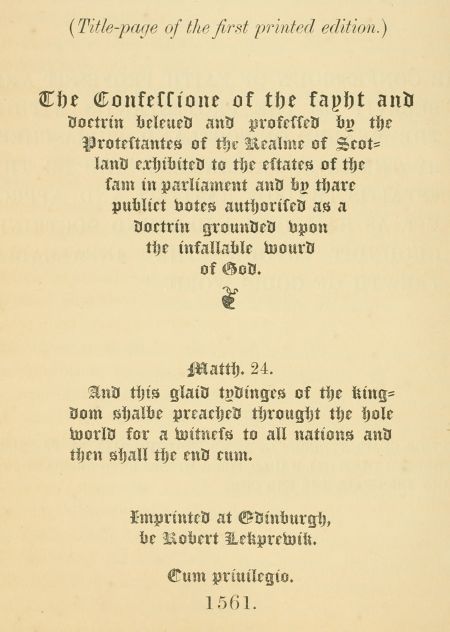
(Title-page of the first printed edition.)
The Confessione of the fayht and doctrin beleued and professed by the Protestantes of the Realme of Scotland exhibited to the estates of the sam in parliament and by thare publict votes authorised as a doctrin grounded vpon the infallable wourd of God.
Matth. 24
And this glaid tydinges of the kingdom shalbe preached throught the hole world for a witness to all nations and then shall the end cum. Imprinted at Edinburgh, be Robert Lekprewik. Cum priuilegio. 1561.