Front matter
Reading edition

THE
WATERLOO CAMPAIGN
1815
WILLIAM SIBORNE
Captain, Half Pay, Unattached, Constructor of the Waterloo Model
FIFTH EDITION
WESTMINSTER ARCHIBALD CONSTABLE AND CO., LTD. 1900
PREFACE.
BY common consent, this Work is regarded as the best comprehensive account in the English language of the Waterloo Campaign. Even those who differ from the Author upon particular points, most cordially admit the general accuracy and fulness of his History. It is charmingly written, is graphic yet precise, and abundantly witnesses to the Author's most strenuous endeavour to do justice to every one who took part in that great Conflict.
This Work will henceforth be a household book amongst the Teutonic race; and all who read it will gain a very clear insight into the methods of Military Strategy as they were practised by the great Captains of that Age.
It is impossible to repress one's admiration of the heroic bravery displayed in this brief Campaign: whether amongst the Allies at Quatre Bras and Waterloo, or by the Imperial Guard at Planchenoit, or by the Prussians at Ligny, Wavre, and Le Chesnay.
The reader must be good enough to observe that a Prussian Brigade then equalled in numbers a French or an English Division.
This Work has extended to such great length that one half of the Appendix (see pages 42 to 44) and nearly all the Notes have been, most unwillingly, omitted. Only those Foot Notes have been inserted which are absolutely essential to the Text. Room has however been found, at pages 798 to 826, for the Nominal Lists of Officers at Waterloo, &c.
One would most earnestly wish that Wars may cease until the end of Time; but if that may not be, then may they be as bravely fought as was this War of Twenty Days: from the 15th June, when Napoleon crossed the Sambre; to the 4th July 1815, the day on which the Allies took possession of Paris.
EDWARD ARBER. Edgbaston, Birmingham.
THE TITLE PAGE OF THE THIRD EDITION.

TO THE
QUEEN'S MOST EXCELLENT MAJESTY.
Madam,
IN graciously deigning to accept the Dedication of these pages, Your Majesty has afforded the greatest possible encouragement to my humble endeavours to record, with simplicity, impartiality, and truth, the incidents of an eventful War, resulting in a long enduring Peace; a War which shed a new and brighter lustre on the valour and discipline of the British Army, and once more called forth the consummate sagacity and far-extending prescience of that illustrious Chief, whom Your Majesty, with wise appreciation and a just pride, retains at its head.
Earnestly hoping that the result of those endeavours may prove not altogether undeserving of Your Majesty's approbation,
I have the honour to be, With profound respect, Madam, Your Majesty's most humble And most devoted servant, WILLIAM SIBORNE, Captain Unattached.
PREFACE TO THE THIRD EDITION.
IN offering to the Public this Third Edition, I feel called upon to state, by way of explanation, in what respect it differs from the two former Editions. During the interval which has elapsed, I have not failed to avail myself of every opportunity to correct and improve any points which further investigation rendered desirable; and I have been much gratified in finding that the general plan and arrangement of the Work, together with the elucidation of the military operations, and the views of their tendency and effect, have been generally borne out and approved; and that, consequently, in these respects little alteration has been required.
The exceptions, which consist principally in details, and amount in number to only four or five, have been rectified in this edition. They are chiefly the result of discussions which have appeared in the pages of the United Service Magazine; and relate to a portion of the proceedings of Sir Colin Halkett's and Sir Denis Pack's Brigades at Quatre Bras and Waterloo.
Through the kindness of His Excellency the Prussian Ambassador, Chevalier Bunsen, and of the Prussian Generals von Canitz and von Krauseneck, and of Major Gerwien of the Prussian Head Quarters Staff; I have obtained additional interesting details connected with the Prussian operations; more especially as regards the opening of the Campaign.
A Dutch work published, apparently under authority, by Major Van Löben Sels, Aide de Camp to his Royal Highness Prince Frederick of the Netherlands, and entitled B dragen tot de Kr gsgeschiedenis van Napoleon Bonaparte, of which I was not previously in possession, has enabled me to give additional particulars respecting the movements and dispositions of the most advanced portion of the Dutch-Belgian troops, on the first advance of the Enemy; and also to explain particular circumstances and qualify some observations respecting those troops which appeared in former Editions.
The Editor of an Article in The Quarterly Review, No. CLI., entitled Marmont, Siborne, and Alison, having, in his comments upon this Work, denied the accuracy of one or two important facts therein stated; I have, in notes at pages 57 and 152,[2] entered into more minute details, which explain the grounds that warrant me in adhering to the original statements.
The observations made in the Preface of a Volume of "Murray's Home and Colonial Library," entitled The Story of Waterloo, and the palpable embodiment of the present Work into the pages of the latter, have been such as could scarcely fail to attract attention; and I have accordingly appended to this Edition, in a separate form, some remarks upon that publication.[3] Public opinion (if I may judge by the unanimous consent of the press) having so distinctly pronounced its acknowledgment of the value of my Work, as one of History; I could not disregard the conduct of a Writer, who, in the first place endeavours to depreciate that value, and then unblushingly makes the most ample and unlicensed use of it for his own purposes.
W. SIBORNE. 18th June 1848.
FOOTNOTES:
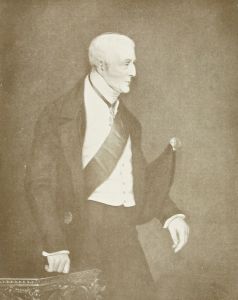
The Duke of Wellington.
PREFACE TO THE SECOND EDITION.
THE circumstance of the First Edition having been sold off within a very few days, combined with the highly favourable notices taken of the Work by professional as well as other critics, and, I may be permitted to add, the very flattering encomiums which have been pronounced upon it by so many who, from their position, are the most competent to form an opinion on its merits, cannot fail to afford proofs, the most satisfactory to the Public, and, at the same time, the most gratifying to the Author, that, in the production of these Volumes,[4] upon a subject of such stirring national interest, neither the expectations of the former have been altogether disappointed, nor the labours of the latter bestowed in vain.
The present Edition contains corrections on one or two points of trivial importance, to which my attention has been directed; and I shall be happy to receive further information from surviving Eye Witnesses who may discover any instances in which the facts related appear either inaccurately or insufficiently explained.
W. SIBORNE. August 23rd, 1844.
FOOTNOTES:
PREFACE.
SOME years ago, when constructing a Model of the Field of Waterloo, at a particular period of the Battle; I found it necessary to make great exertions to procure that detailed information for which I had sought in vain in the already numerous published accounts of the military transactions of 1815. Anxious to ensure the rigorous accuracy of my work, I ventured to apply for information to nearly all the surviving Eye Witnesses of the incidents which my Model was intended to represent. In every quarter, and among Officers of all ranks, from the General to the Subaltern, my applications were responded to in a most liberal and generous spirit; and the result did indeed surprise me, so greatly at variance was this historical evidence with the general notions which had previously prevailed on the subject. Thus was suggested the present Work. I was induced by the success of this experiment to embrace a wider field, and to extend my enquiries over the entire Battle; and, ultimately, throughout the Campaign itself, from its commencement to its close.
Having become the depository of such valuable materials, I felt it a duty to the honourable profession of which I am a humble member, to submit to it, and to the World, a true and faithful account of this memorable epoch in the history of Britain's military greatness.
Though not so presumptuous as to imagine that I have fully supplied so absolute a desideratum; yet I consider myself fortunate in being the instrument of withdrawing so far the veil from Truth. One of my Waterloo correspondents has humorously remarked, that "if ever truth lies at the bottom of a well, she does so immediately after a great Battle; and it takes an amazingly long time before she can be lugged out." The time of her emerging appears to have at length arrived; but, while I feel that I have brought to light much that was involved in obscurity, I cannot but be sensible that I may have fallen into errors. Should such be the case, I shall be most ready, hereafter, to make any corrections that may appear requisite, on my being favoured, by Eye Witnesses, with further well authenticated information.
I take this opportunity of returning my sincere thanks to the numerous Officers of the British Army, who have so kindly committed to my keeping their recollections of the events which I have attempted to describe. Similar thanks are likewise due to the Officers of the King's German Legion and Hanoverian Subsidiary Corps; as also to the General Officers who respectively furnished me with such information as related to the troops of Brunswick and Nassau.
I beg also to express my obligations to the Prussian Minister of War, and the Officers of the Prussian General Staff in Berlin, for the readiness and liberality with which they have supplied me with such details concerning the dispositions and movements of the troops of their Sovereign, as were essential to me in prosecuting the task I had undertaken.
Having briefly explained the circumstances that led to the construction of the Work which I thus venture to place before the Public, I have now only to express a hope that my labours may be crowned with usefulness. Should such a result occur, I shall then have obtained the only fame I seek.
W. SIBORNE. March 1844.
TABLE OF CONTENTS.
CHAPTER I.
PAGE
Landing of Napoleon Buonaparte in France after his escape from Elba 47
Flight of Louis XVIII. 47
Decision of the Congress of Vienna 48
Preparations on the part of the Allied Powers for opening a Campaign against Napoleon 49
Great Britain and Prussia occupy Belgium 49
Advance of the Russians towards the French frontier 51
Advance of the Austrians 52
The troops of Bavaria, Baden, Würtemburg, and of Hesse, assemble upon the Upper Rhine 52
Preparations on the part of Napoleon 53
General aspect of France 57
Spirit of the French Army 58
Public Opinion and state of Parties in France 59
CHAPTER II.
Belgium again destined to become the Theatre of War 62
The British Army 62
The Duke of Wellington 63
The Prussian Army 67
Prince Blücher von Wahlstadt 67
The King's German Legion; the Hanoverian, Brunswick, Dutch, Belgian, and Nassau troops 67
Napoleon and the French Army 68
Prospect of a severe struggle 69
CHAPTER III.
Strength, composition, and distribution of the Anglo-Allied Army under Wellington 71
Its projected concentration in the event of Napoleon's advance 75
Strength, composition, and distribution of the Prussian Army under Blücher 76
Its projected concentration in the event of Napoleon's advance 79
The line on which Wellington's Left and Blücher's Right rested, selected by Napoleon for the direction of his attack 82
Strength, composition, and distribution of the French Army under Napoleon 82
Necessity under which the French Emperor is placed of opening the Campaign without awaiting the further development of his resources 87
Slight retrospect of the Campaign of 1814 88
Napoleon's prospect of success 88
His preparations for the commencement of hostilities 90
Wellington receives information from his Outposts in front of Tournai, of the assembling of French troops on the frontier; but delays the concentration of the Anglo-Allied troops until certain of the object and direction of Napoleon's main operation 91
Concentration of the French Army 91
Napoleon joins the latter in person 92
Ordre du Jour of the 14th of June 93
CHAPTER IV.
Zieten ascertains and communicates to the Allied Commanders the assembling of French troops in his front, and that there is every probability of an attack by the Enemy on the 14th or 15th of June 94
Blücher's dispositions 96
Extent of information gained by Wellington and Blücher immediately previous to the commencement of hostilities 97
Position of the First Prussian Corps d'Armée under Zieten 97
Advance of the French Army into Belgium on the 15th of June 98
The French force the Prussian Outposts; cross the Sambre, and gain possession of Charleroi 98
Retreat of the different Brigades of Zieten's Corps upon Fleurus 104
Affair at Gilly 106
Zieten's Corps concentrates in position between Ligny and St Arnaud 110
Losses experienced by this Corps on the 15th 111
The Second and Third Prussian Corps d'Armée, under Pirch and Thielemann, concentrate and bivouac on the night of the 15th; the former between Onoz and Mazy not far from Sombref, the latter in and around Namur 111
Bülow is desired to concentrate the Fourth Prussian Corps d'Armée at Hannut 112
Cause of this operation being deferred until the 16th 113
Ney joins the French Army, and receives from Napoleon the command of a detached Corps destined to operate by the Brussels road from Charleroi 114
The Advanced Post at Frasne, upon the extreme Left of the Duke of Wellington's Army, receives intelligence of the French attack 115
Consequent movements of de Perponcher's Dutch-Belgian Division 115
The Anglo-Allied Post at Frasne is driven in by the Advanced Guard of Ney's Corps; the progress of which is checked by Prince Bernhard of Saxe Weimar's Dutch-Belgian Brigade in front of Quatre Bras 116
Disposition of Ney's forces in the night of the 15th of June 118
Wellington is informed of Napoleon's advance, and makes his dispositions accordingly 119
Order of the movements of the Anglo-Allied Army 120
Disposition of the Centre and Right Columns of the French Army during the night of the 15th 123
Remarks on the result of Napoleon's operations on the 15th of June 123
CHAPTER V.
On the morning of the 16th, Wellington's troops are in movement upon Nivelles and Quatre Bras 129
The Dutch-Belgian Detachment at the latter point is reinforced, and becomes engaged with the French Advanced Guard 129
The Prince of Orange arrives, and succeeds in forcing back the French upon Frasne 131
Ney's views and dispositions 131
Wellington arrives in person at Quatre Bras 134
He proceeds to the Prussian Head Quarters for the purpose of holding a conference with Blücher 134
Adopted Plan of Operations 135
Instructions received by Ney from Napoleon 135
Ney's advance 143
The Prince of Orange's dispositions to meet it 143
Relative strength 143
The Prince of Orange retires towards Quatre Bras, occupies the Wood of Bossu, and endeavours to maintain the Post of Gemioncourt 144
Arrival of Picton's Division 145
Conspicuous gallantry of the Prince of Orange 147
Arrival of van Merlen's Light Cavalry Brigade 148
Van Merlen advances in support of Perponcher's Infantry 148
Both are driven back: the former to Quatre Bras; the latter into the Wood of Bossu, which is now attacked by the French 148
The latter occupy Gemioncourt and Piermont 148
Ney's position 149
Arrival of the principal portion of the Brunswick troops 149
Relative strength 150
Part of the Brunswick Corps posted between the Charleroi road and the Wood of Bossu 151
French attack 152
Wellington decides on meeting it 153
Advance of Picton with the Fifth British Division 153
The French Infantry gallantly repulsed by the British 154
Attack upon the Brunswickers 155
The Duke of Brunswick makes an ineffectual charge at the head of his Lancers 157
Retreat of the Brunswickers 157
Fall of the Duke of Brunswick 158
Conspicuous gallantry of the 42nd and 44th British Regiments 159
The French Cavalry advances as far as Quatre Bras 162
Is checked by the 92nd Highlanders 162
Kellermann joins Ney with L'Heritier's Cavalry Division 163
The French Cavalry attacks the British Squares 164
Picton advances his Infantry into the midst of the French Cavalry 166
Remarkable steadiness of the British Squares 167
Manner in which the charges of the French Cavalry were executed 167
The French are rapidly gaining possession of the entire Wood of Bossu, are reinforcing their Light Troops in Piermont, and are preparing to renew their attack upon Quatre Bras 172
Alten joins Wellington with two Infantry Brigades of the Third Division 173
Ney is joined by the remaining Division of Kellermann's Corps of Heavy Cavalry 173
Relative strength 173
Ney, after despatching an Order to d'Erlon to join him without delay, commences another general attack 174
Two French Foot Batteries suddenly open a fire from the edge of the Wood of Bossu upon the Brunswick Infantry 174
Gallant conduct of Lloyd's British Foot Battery 174
Advance of Halkett's British Infantry Brigade posted between the Wood of Bossu and the Charleroi road 175
Kielmansegge's Hanoverian Infantry Brigade advances along the Namur road to reinforce and support Picton's Division 175
Advance of French Infantry against Quatre Bras 176
The latter gallantly charged and pursued by the 92nd Highlanders 176
Halkett's Brigade posted between the Wood of Bossu and the Charleroi road 177
The 69th British Regiment is attacked and dispersed by French Cuirassiers 178
Vigorous assault along the whole of the Anglo-Allied Line 180
Arrival of British and German Artillery 181
French Cuirassiers driven back in confusion from Quatre Bras 182
Ney receives intelligence that d'Erlon's Corps has been ordered by Napoleon to march towards the Prussian Extreme Right on the Field of Ligny; and shortly afterwards a despatch reaches him, requiring him to attack and repulse whatever Enemy may be in his front, and then to fall upon the Prussian Right 182
Vigorous attack upon the Left of Wellington's Line successfully repelled 184
The French Cavalry continues its attacks upon the central portion of the Anglo-Allied Army 184
Ney receives a further despatch from the Emperor, urging him to comply immediately with the instructions previously given 185
Arrival of Brunswick reinforcement 185
Also of the First British Division under Cooke 186
Relative strength 186
Halkett is again attacked by French Cavalry, after which he makes a further advance of his Brigade 187
The British Guards succeed in forcing the French out of the Wood of Bossu 188
Signal defeat of French Cavalry by the British Guards and the Brunswick Guard Battalion 189
Wellington's victorious advance 191
Ney withdraws the whole of his forces to the Heights of Frasne, on which they bivouac for the night 191
D'Erlon joins Ney after the termination of the action 191
Losses in killed and wounded 193
Remarks upon the Battle 193
CHAPTER VI.
Blücher decides upon accepting battle in the position in rear of Fleurus 199
The position of Ligny strategically considered 200
The position itself described 201
Distribution of Zieten's Corps on the morning of the 16th of June 201
At eleven o'clock Pirch's Corps is posted as a Reserve to Zieten's 203
Thielemann's Corps reaches Sombref about noon 204
Its distribution on the Field 204
General view of Blücher's dispositions 204
About ten o'clock the foremost of the French troops debouch in two Columns from the Wood of Fleurus, and draw up in front of this town 204
Napoleon's views and dispositions 205
At two o'clock he communicates to Ney his intention to commence his attack upon the Prussians, and desires that Marshal also to attack the Enemy in his front 206
The French Light Troops gain possession of Fleurus 206
The Cavalry of Zieten's Corps falls back upon the position of Ligny 206
The French Army advances and takes up a position preparatory to its attack 207
Strength of the French forces under Napoleon 208
Strength of the Prussian forces under Blücher 209
Blücher's arrangements 209
He moves Thielemann's Corps into his Front Line, of which it then forms the Left Wing 210
Blücher's views and dispositions 211
Tactical defects of the position of Ligny 213
Napoleon commences the Battle with an attack by Vandamme's Corps upon St Amand 213
Gérard's Corps attacks Ligny 214
Contest in these Villages 215
The French carry St Amand 216
Renewed attack upon Ligny 217
Nature of the contest between Thielemann's and Grouchy's Corps 217
Girard's Division gains possession of St Amand la Haye 218
Blücher's dispositions for retaking this Village, securing Wagnelé, and impeding any further advance from the French Left 218
Failure of the Prussian attack upon St Amand la Haye 219
Blücher decides on a renewed attack upon this Village, as a diversion in favour of his projected movement against the French Left 219
Napoleon reinforces this Flank 220
The Prussians retake St Amand la Haye 220
Blücher reinforces his extreme Right with Cavalry 221
Prussian attack upon Wagnelé unsuccessful 222
The French regain St Amand la Haye 223
Continued contest at Ligny 223
Blücher reinforces his troops employed in the defence of this Village 224
Long and desperate struggle in the Villages of St Amand la Haye, Wagnelé, and the Hameau de St Amand 227
Napoleon, perceiving that Blücher has scarcely any Reserve remaining at his disposal, resolves upon attacking the Prussian Centre 230
He suspends his meditated attack in consequence of a large Column advancing apparently from Frasne towards his Left Rear 231
This Column is discovered to be d'Erlon's Corps d'Armée 234
This circumstance explained 234
Thielemann detaches a portion of his Cavalry with some guns across the Ligny, along the Fleurus road 237
They are attacked and driven back by part of Grouchy's Cavalry 237
Disposition and state of the Prussian troops at the moment Napoleon advances with a formidable Reserve across the Ligny 239
The Prussian Infantry forced to evacuate Ligny 242
Failure of Prussian Cavalry attacks upon the advancing Column of French Infantry 243
Blücher's horse is killed, and the Prince thrown under him 245
Critical situation of the Prussian Commander 246
He is removed from the Field 246
Retreat of Prussian Infantry upon Bry 247
Contest at Sombref 249
Retreat of the Prussians from St Amand and St Amand la Haye 250
Zieten's and Pirch's Corps retire by Marbais and Tilly 251
Thielemann's Corps retains its position 252
Close of the Battle 253
Distribution of the French troops 254
Disposition of the Prussian troops 254
Bülow's Corps reaches Gembloux during the night 255
Losses sustained by both Armies 255
Consequences of the Prussian defeat 255
Remarks upon the Battle 256
CHAPTER VII.
An engagement of short duration, and originating accidentally, takes place between the French and Anglo-Allied Picquets on the Field of Quatre Bras, about an hour before daylight of the 17th June 259
Wellington detaches a Patrol to his Left for the purpose of gaining intelligence concerning Blücher's movements 261
The Patrol finds the Prussians at Tilly 262
Upon its return Wellington decides on retrograding his forces to the position in front of Waterloo 263
Order of Movement 263
Communications between Blücher and Wellington 264
Retreat of the Anglo-Allied Infantry; masked from the Enemy 264
Ney's views and dispositions 266
Napoleon communicates to Ney the result of the Battle of Ligny; and proposes, should the Enemy's force at Quatre Bras advance against him, to co-operate with the Marshal in a combined attack upon the Anglo-Allied Army 267
Tardiness of Napoleon's movements 267
Simultaneous advance of Napoleon and Ney against Wellington 268
Uxbridge's dispositions for the retreat of the British Cavalry 270
Brilliant Cavalry Affair at Genappe 281
Retreat continued to the Waterloo position 282
Napoleon's advance checked on his reaching La Belle Alliance 282
Remarks on the retreat 283
Blücher's promised support 285
Wellington's disposition of his detached troops under Sir Charles Colville and Prince Frederick of Orange 285
The French and Anglo-Allied Armies establish their respective bivouacs for the night 286
CHAPTER VIII.
At daybreak of the 17th, the Prussian Army commences its retreat upon Wavre 287
Zieten's Corps retires by Mont St Guibert, and reaches Wavre about mid day 287
Pirch's Corps follows the same route, and takes post upon the right bank of the Dyle 287
Thielemann, having collected together the Brigades of his Corps, begins to retire from the Field of Ligny at two o'clock in the morning 288
He halts in rear of Gembloux 289
Bülow retires by Walhain and Corbaix to Dion le Mont, near which he takes up a position 290
Thielemann resumes his march at two o'clock in the afternoon, and arrives at the position of Wavre late in the evening 290
Prussian Head Quarters established at Wavre 291
Blücher receives a message from Wellington 291
While the Prussians are effecting their retreat during the early part of the morning, the French continue quietly in their bivouac 292
Pajol, with the Light Cavalry Division, seeks the Prussians along the Namur road; followed by Lieutenant General Teste's Infantry Division, in support 292
Other troops detached towards Gembloux, near which traces of the Prussian retreat are discovered 293
Remarks upon the extraordinary degree of inactivity on the part of Napoleon 293
About noon, Napoleon proceeds to collect, in advance of Marbais, on the high road to Quatre Bras, a portion of the troops that had fought at Ligny; and detaches the remainder, under Grouchy, in pursuit of the Prussians 296
Napoleon's instructions to Grouchy 297
The troops assembled near Marbais advance upon Quatre Bras, which they reach about two o'clock 298
The Corps of Vandamme and Gérard do not reach Gembloux until late in the evening 299
Grouchy's dispositions 300
Disposition of the Prussian troops during the 17th 302
Influence of the defeat at Ligny upon the morale of the Prussian Army 305
Blücher is informed of the position of the Anglo-Allied Army 306
His instructions to Bülow 306
On the 18th, Vandamme's and Gérard's Corps commence the march from Gembloux, at nine o'clock, upon Wavre, preceded by the Heavy Cavalry under Excelmans, and supported on their left by Maurin's Light Cavalry 307
At half past ten o'clock, Excelmans' Advanced Guard comes in contact with the Prussian Rear Guard 307
At Sart à Wallain Grouchy's attention is called to the sound of a heavy cannonade in the direction of Mont St Jean 308
Gérard suggests to Grouchy the expediency of marching towards the cannonade 308
Grouchy's reasons for rejecting this proposal 309
The march upon Wavre continued 309
At daybreak on the 18th, Bülow quits his position near Dion le Mont to march through Wavre upon St Lambert, and thus commences the flank movement of the Prussians in support of the Anglo-Allied Army at Waterloo 310
Blücher communicates to Wellington his intention of immediately attacking the Enemy's Right Flank 311
Dispositions made for giving security to this movement 312
Blücher directs that as soon as Bülow's Corps has proceeded beyond Wavre, Zieten's Corps is to commence its march by Fromont and Ohain to join the Left Wing of Wellington's Army 312
Pirch's Corps to follow Bülow's in the direction of St Lambert; and Thielemann's to follow Zieten's as soon as its presence at Wavre is no longer essential 312
The march of Bülow's Corps through Wavre delayed by an accident 313
Bülow's Advanced Guard crosses the Defile of St Lambert, and halts in the Wood of Paris 313
Pirch, having strengthened his Rear Guard in consequence of the approach of the French, effects the passage of his Corps across the Dyle at Wavre 314
Blücher's instructions to Thielemann 316
Remarks upon Grouchy's movements during the 17th, and the early part of the 18th 316
Their influence upon the Battle of Waterloo 321
CHAPTER IX.
The French and Anglo-Allied Armies break up their bivouacs early on the morning of the 18th of June, in front of Waterloo 324
Preparations for Battle 325
The Field 325
Wellington's position 326
Distribution of the Anglo-Allied Army 327
Front Line: with the Advanced Posts of Smohain, La Haye, La Haye Sainte, and Hougomont 327
Second Line 347
Reserves 348
Detached forces in observation near Hal, and at Tubize; the former under Prince Frederick of Orange, the latter under Sir Charles Colville 350
Braine l'Alleud and Vieux Foriez occupied 350
Distribution of the Anglo-Allied Artillery 351
General view of the disposition of Wellington's forces 353
Napoleon's position 355
Distribution of the French Army 355
Front Line 355
Second Line 359
Reserves 362
General view of the disposition of Napoleon's forces 363
Remarks on the Emperor's delay in commencing the Battle 364
Strength of the Anglo-Allied Army in the Field 367
Strength of the French Army 368
The French Columns moving into position 368
Intense interest excited in both Armies when drawn up in presence of each other, and on the point of commencing the Battle 368
CHAPTER X.
Napoleon's instructions to Grouchy previously to the Battle of Waterloo 370
A Prussian Officer joins the extreme Left of the Anglo-Allied Army, and reports that Bülow's Corps has reached St Lambert 371
Napoleon passes along the French Lines 372
The Battle commences about half past eleven o'clock, with an attack upon the Wood of Hougomont, by part of Prince Jerome's Division 375
The cannonade is opened by the guns of Sandham's Foot Battery in front of Cooke's Division 375
The French gain possession of a portion of the Wood and other inclosures of Hougomont 376
They are driven out 377
The French reconnoitre the Anglo-Allied Left 377
Jerome renews his attack, supported by part of Foy's Division 378
Fire opened upon the attacking troops by the Batteries posted with Clinton's Division 378
The French gain the Wood 378
Signal service rendered by Bull's Howitzer Battery 379
The French Skirmishers succeed in turning the Right of Hougomont, and in forcing the great Gate; which, however, is soon closed against the assailants 380
They then press forward against the Right of the Allied Front Line, and force Webber Smith's Horse Battery to retire into a hollow way to refit 381
They are charged and driven back by four Companies of the Coldstream Guards, under Lieutenant Colonel Woodford, which force then joins the defenders of Hougomont 381
The French, on debouching from the Wood into the Great Orchard, are gallantly charged and driven back by Lieutenant Colonel Lord Saltoun with the Light Companies of the First Brigade of Guards 383
The latter, being attacked in both front and flank, are compelled to fall back upon the hollow way in rear of the Great Orchard 383
On being reinforced by two Companies of the 3rd Regiment of Guards; they resume the offensive, and clear the Orchard of the Enemy 383
Ney's dispositions for a grand attack upon the Left Wing and Centre of the Anglo-Allied Army 384
Napoleon perceives troops in motion at some distance on his right 385
He detaches Domon's and Subervie's Light Cavalry Brigades in that direction 386
He ascertains that the troops he has seen belong to the Prussian Corp's d'Armée of Count Bülow 386
His Orders to Grouchy 387
Napoleon neglects to adopt effectual measures for securing his Right Flank 389
CHAPTER XI.
Commencement of the grand attack upon the Left Wing and Centre of the Anglo-Allied Army 392
On the right of the attack the French gain possession of the Farm of Papelotte; which, however, is soon retaken by the 3rd Battalion of the 2nd Regiment of Nassau 393
Retreat of Bylandt's Dutch-Belgian Infantry Brigade 395
Picton's dispositions 397
Attack by the French Left Central Column 399
Gallant charge by Kempt's Brigade 401
Death of Picton 402
Contest between Cuirassiers and the 2nd Life Guards in front of the Right of Kempt's Brigade 403
Attack upon La Haye Sainte by the Left Brigade of Donzelot's Division 404
Advance of Roussel's Cavalry Brigade by the French left of La Haye Sainte 405
Uxbridge decides upon charging the Enemy's attacking force with Somerset's and Ponsonby's Cavalry Brigades 406
Charge by the French Cuirassiers and Carabiniers 408
It is met by that of Somerset's Cavalry Brigade 409
Advance of Ponsonby's Cavalry Brigade 411
Advance of Alix's and Marcognet's French Infantry Divisions 411
They reach the crest of the Anglo-Allied position 412
Advance of the 92nd Highlanders 413
Their attack upon the head of Marcognet's Column 413
Charge by Ponsonby's Cavalry Brigade 413
Complete overthrow of the French Columns 414
The Greys capture the Eagle of the 45th French Regiment 415
They also charge and defeat a supporting Column of Marcognet's attacking force 415
The Royals capture the Eagle of the 105th French Regiment 418
The Inniskillings defeat and disperse the Columns to which they are opposed 419
Continuation of the charge by Somerset's Brigade 419
Disordered state of the two British Cavalry Brigades 420
They crown the Enemy's position, and cut down the Gunners and horses of the French Batteries 421
At length they retire 421
The Left of their Line suffers severely from a charge by Jaquinot's Light Cavalry Brigade 421
Vandeleur's Light Cavalry advances in support upon the left 422
Charge by the 12th and 16th British Light Dragoons 422
The French Cavalry is driven back 423
Advance of Ghigny's Light Cavalry Brigade 423
Vivian moves his Brigade to the right, and opens a fire from two guns of his Horse Artillery 424
The British Cavalry engaged in this affair sustains a heavy loss 425
Disposition of the troops on the Anglo-Allied Left and Centre 426
Tableau of the Battle at this period 427
CHAPTER XII.
Continuation of the contest at Hougomont 434
Attempted flank attack upon this Post completely defeated by Captain Cleeves's Foot Battery of the King's German Legion 436
The principal buildings of Hougomont, including the Château, set on fire by the French 437
Napoleon prepares a grand Cavalry attack upon Wellington's Right Wing 439
Renewed attack upon La Haye Sainte 439
Tremendous cannonade along the French Heights 441
French grand Cavalry attack 443
Its failure 446
Its renewal 448
Second failure 449
Ney, on being reinforced by Kellermann's Corps of Heavy Cavalry, and Guyot's Heavy Cavalry Division of the Guard, renews his attack 452
This is most successfully resisted 455
Ney directs another attack upon La Haye Sainte, and advances a heavy Column of Bachelu's Infantry against the Centre of the Anglo-Allied Right Wing 458
Wellington draws Chassé's Dutch-Belgian Division from Braine l'Alleud towards the principal scene of action, and moves Clinton's Division into the Front Line 458
Contest at La Haye Sainte 459
The 5th and 8th Line Battalions of the King's German Legion, on advancing to charge French Infantry in rear of La Haye Sainte, are suddenly assailed in flank by French Cavalry, and the 8th Battalion is almost entirely destroyed 460
Artillery in the Anglo-Allied Front Line reinforced 461
Attack by a Column of French Heavy Cavalry upon the Anglo-Allied Right completely defeated by Major Mercer's Battery of British Horse Artillery 461
A strong Column of French Infantry, supported by Cavalry, advances against the Centre of the Anglo-Allied Right Wing 462
It is charged by Somerset's Heavy Cavalry Brigade 463
Conduct of Trip's Dutch-Belgian Carabinier Brigade 463
Gallant charge by the 3rd Hussars of the King's German Legion 464
Renewed attack by the Column of French Heavy Cavalry in front of Major Mercer's Horse Battery 466
It is repulsed as before 466
Wellington reinforces the right of his Front Line by du Plat's Infantry Brigade of the King's German Legion, accompanied by Captain Sympher's Horse Battery of the same Service 467
It is attacked by French Cuirassiers 467
These are driven off by the Battalions of du Plat's Brigade 468
Renewed charge by the Cuirassiers equally unsuccessful 468
Failure of the French Cavalry attack upon the Right Centre of the Anglo-Allied Line 469
Adam's British Light Infantry Brigade advances into the Front Line, on the right of Maitland's Brigade; crosses the ridge, and takes up a position on the exterior slope 470
Here it is repeatedly attacked by French Cavalry 471
Advance of Halkett's Hanoverian Brigade 472
The French assail the Post of La Haye Sainte with the utmost vigour 474
It falls into their possession 478
Napoleon directs Ney to follow up this advantage with a vigorous attack upon the Centre of the Anglo-Allied Line, and at the same time to renew the assault upon Hougomont 478
Ney's views and dispositions 479
Attack upon Alten's Division 481
The 5th Line Battalion of the King's German Legion, led by Ompteda, gallantly charges French Infantry; but is furiously assailed in flank by a Regiment of Cuirassiers, and nearly destroyed. Ompteda is killed 482
Gallant repulse of an attack made upon portions of Maitland's and Adam's Brigades 483
British Squares in advance of the Duke's Line 484
Renewed but unsuccessful attack upon Hougomont 485
Adam's Brigade withdrawn to the reverse slope of the main position 487
General view of the Anglo-Allied Line 487
CHAPTER XIII.
Advance of the Prussians towards the Field of Waterloo 490
Difficulties and impediments attending their march 491
The Fifteenth and Sixteenth Prussian Brigades reach the Wood of Paris 492
At half past four o'clock, Blücher decides upon attacking the Right Flank of the French Army with these Brigades, without waiting for the arrival of more of his troops 493
Prussian Cavalry driven back by Domon 494
Three Prussian Battalions attack the Extreme Right of the French general Front Line, near Smohain; but are compelled to retire into the Village 495
Napoleon detaches Lobau's Corps in support of Domon 495
The French Regiments of the Old and Middle Guard take up the position, in reserve, on the Heights of La Belle Alliance, vacated by Lobau's Corps 495
Blücher's dispositions 496
Lobau becomes engaged with Bülow 496
The remainder of Bülow's Corps reaches the Field 496
Blücher's dispositions 496
Relative strength of Bülow's and Lobau's forces 497
Napoleon detaches the Young Guard to Planchenoit, in support of Lobau's Right 498
At about six o'clock, Blücher is informed that Thielemann is attacked by a superior force at Wavre 499
He does not allow this circumstance to deter him from his present purpose 499
Bülow attacks Planchenoit 500
Contest in the Village 500
The Prussian troops driven out 500
Having rallied, they renew their attack 501
Napoleon detaches two Battalions of the Old Guard to Planchenoit 501
The Prussians are again driven out of the Village, and pursued as far as their main position 501
French and Prussian Cavalry become engaged 501
Napoleon, perceiving preparations on the part of the Prussians for renewing the attack upon Planchenoit, detaches General Pelet with another Battalion of the Old Guard to that Village 502
Critical situation of Napoleon 503
He resolves on making a renewed and formidable attack upon Wellington's Line 503
Wellington despatches Lieutenant Colonel Fremantle to the Left, to seek for the Prussian forces expected on that Flank 505
Situation of the Duke, and state of the Anglo-Allied Troops 505
Napoleon's dispositions for the attack 507
The Advanced Guard of Zieten's Corps approaches the Extreme Left of the Anglo-Allied Line 508
Vivian's and Vandeleur's Light Cavalry Brigades are removed from that Flank to the Centre 509
Wellington's dispositions 510
Centre of the Duke's line vigorously assailed by the French troops collected in and about La Haye Sainte 511
Sudden and destructive fire opened upon Kielmansegge's Brigade from French guns brought up to the very crest of the Allied position 513
The Prince of Orange is wounded whilst leading forward the Nassau Troops to repel the French attack upon that part of the Line 514
Wellington reinforces the latter with five Battalions of Brunswick Infantry 514
These, together with Kielmansegge's, Ompteda's, and Kruse's Brigades, are compelled to fall back a short distance 514
The Duke rallies the Brunswickers, who maintain their ground; as do also the before mentioned Brigades 515
Vivian's Hussar Brigade draws up in rear of these troops 515
Kielmansegge, on whom the command of the Third Division has devolved, succeeds in establishing the latter upon its former position 516
CHAPTER XIV.
Commencement of Napoleon's last grand attack upon Wellington's line 518
Napoleon stations himself so that the Guard may pass by him as it advances to the attack 519
Disposition of d'Erlon's and Reille's Corps 520
The leading Column of the Imperial Guard suffers severely from the fire of the Allied Artillery, as it approaches the Duke's Line 521
Contest between the leading Column of the French Imperial Guards and Maitland's Brigade of British Guards 523
The former completely defeated and dispersed 523
Contest between Halkett and the Imperial Guards 524
Conduct of d'Aubremé's Dutch-Belgian Brigade 526
Advance of the second attacking Column of the Imperial Guard 527
Charge upon French Cuirassiers by a Squadron of the 23rd Light Dragoons 530
The second Column of the Imperial Guard charged in flank by the 52nd Regiment and 2nd Battalion 95th Regiment 532
Its defeat and dispersion by this charge 532
Adam's Brigade continues its forward movement, supported on its Right by a Battalion of Lieutenant Colonel Halkett's Hanoverian Brigade 535
State of d'Aubremé's Dutch-Belgian Brigade 537
Upon the extreme Left of the Anglo-Allied Line, the Skirmishers of Durutte's Division endeavour to establish themselves in the houses and inclosures in the valley on that Flank, and become engaged with the Prussians in and about Smohain 538
Blücher's dispositions 539
Formation and advance of Bülow's Left Wing for the Third attack upon Planchenoit, and of his Right Wing for a simultaneous attack upon Lobau 539
Junction of the Advanced Guard of Zieten's Corps with the troops constituting the Extreme Left of the Anglo-Allied Army 541
General view of the disposition of the Prussian forces relatively with that of the Anglo-Allied troops 542
General view of the state of the Anglo-Allied Army at the period of the attack and defeat of the French Imperial Guard 542
Prompt decision and admirable skill evinced by Wellington in seizing upon the advantage presented by the discomfiture of the French Guards 542
Advance of Vivian's Hussar Brigade to the attack of Napoleon's Reserves near La Belle Alliance 546
Disposition of these Reserves 548
Brilliant charge by the 10th British Hussars 549
Charge by the 2nd Light Dragoons of the King's German Legion 551
Adam's Brigade, continuing its advance, reaches the nearest French Height, intersected by the Charleroi road, and on which three Squares of the Imperial Guard are posted 552
General advance of the Anglo-Allied Line 553
The Duke orders Adam to attack the Squares of the Imperial Guard 555
The Earl of Uxbridge falls, severely wounded 556
The Imperial Guard retires from the charge by Adam's Brigade 557
Gallant charge by the 18th British Hussars near La Belle Alliance 559
Charge by a Squadron of the 10th British Hussars upon a Square of the Grenadiers of the Old Guard; which retires, and eventually disperses 560
The Left and Centre Squadrons of the 10th Hussars, continuing their pursuit, after the first charge, make another charge upon both Infantry and Cavalry, on the right, and beyond La Belle Alliance 561
A party of the 18th Hussars makes a dashing but ineffectual charge upon a Square, still further in advance 562
Lieutenant Colonel Halkett, with the Osnabrück Landwehr Battalion, pursues a Column of the Old Guard; and captures General Cambronne 563
Singular situation of the Duke of Wellington 565
CHAPTER XV.
Advance of Vandeleur's Light Cavalry Brigade 566
It charges and disperses a large Column of French Infantry, and captures a Battery 566
Adam's Brigade continues driving the Enemy before it along the left side of the Charleroi road 567
Effect produced upon the Right Wing of the French Army by the advance of Adam's, Vivian's, and Vandeleur's Brigades 568
Its effects also upon the French Left Wing 569
Napoleon takes shelter within a Square of the Imperial Guard 569
Continuation of the advance of the Anglo-Allied Army 570
In the Centre, La Haye Sainte is retaken: on the Right, Hougomont is cleared of the Enemy: on the Left, Durutte's Division, forming the Right of the French Front Line, takes to flight 570
The Left Wing captures the opposite line of Batteries 571
Disorder and flight of the whole of d'Erlon's Corps along the rear of Lobau's Corps; which, being at the same time assailed by part of Bülow's Corps, partakes of the panic, and mingles with the fugitives 571
The British troops near La Belle Alliance fall into the line of fire from a Prussian Battery, to which Wellington sends directions to cease firing 572
French Infantry dispersed, and a Battery captured, by the 52nd British Regiment 572
Capture of a Battery by the 71st British Regiment 573
Last French gun fired by Adam's Aide de Camp 573
A Battery captured by the Osnabrück Hanoverian Battery, under Halkett 573
The British Advanced Cavalry is in the midst of crowds of defeated French soldiers 574
Remarkable steadiness of the French Grenadiers à Cheval 575
Contest in Planchenoit 576
Gallant conduct of Pelet and a portion of the Chasseurs of the Guard 579
The French Troops that have been engaged at Planchenoit, retire in disorder and confusion towards the high road between Rossomme and Maison du Roi; the former of which points the British Advanced Brigades have already reached 580
Partial collision between the 18th British Hussars and a Prussian Regiment of Cavalry 580
The 1st Hussars of the King's German Legion narrowly escape coming into serious collision with the 11th and 16th British Light Dragoons 580
Wellington halts the main body of his Army upon the original French position 581
Blücher undertakes the pursuit 581
Wellington having satisfied himself, by his observations from the high ground beyond Rossomme, that the victory is secured beyond a doubt, returns towards Waterloo 581
On reaching La Belle Alliance, he meets Blücher 582
Dispositions made by the latter for effecting a vigorous pursuit 583
The Prussian troops headed in advance by Gneisenau, reach Genappe; where they capture a quantity of baggage, including Napoleon's travelling carriage 584
Napoleon at Quatre Bras 584
Direction of the retreat of the French troops 585
Napoleon proceeds to Charleroi; whence he despatches Jerome with Orders to rally the troops between Avesnes and Maubeuge 585
Gneisenau continues the pursuit, passing through Quatre Bras, and not resting until he arrives beyond the Heights of Frasne 585
Losses sustained by the respective Armies 587
Remarks upon the Battle 588
Relative numerical strength of the Combatants 589
Relative proportions in which the troops of the Anglo-Allied Army were actively engaged 589
Conduct of these troops 592
Extent of the actual share taken in the Battle by the Prussians 594
CHAPTER XVI.
Upon the appearance of Vandamme's Corps in front of Wavre; Thielemann decides on maintaining the position at that point instead of following the remainder of the Prussian Army towards the Field of Waterloo 601
The Field of Wavre 602
Disposition of the different Brigades of Thielemann's Corps 603
Disposition of Grouchy's forces 605
The Light Troops of Vandamme's Corps gain possession of that part of the town of Wavre which lies on the right bank of the Dyle 606
Gérard makes an unsuccessful attack upon the Mill of Bierge 607
Vandamme fails in his efforts to carry the Bridge of Wavre 608
Grouchy, in person, leads another attack upon the Bridge of Bierge; which proves as fruitless as the former attempt, and on which occasion Gérard falls severely wounded 609
Pajol gains possession of the Bridge of Limale by a Cavalry attack 610
Grouchy, having pushed a portion of Gérard's Corps across the Dyle by Limale, disposes these troops so as to turn the Right of Thielemann's Corps 610
They are attacked by the Prussians, who are defeated; and forced to fall back upon the Wood near Point du Jour 611
The contest for the possession of the Bridges and Town of Wavre is continued until late in the night; the Prussians sustaining and repelling thirteen assaults 612
Disposition of the contending Forces on the morning of the 19th of June 616
Contest between Thielemann's Right, and Grouchy's Left, Wing; during which the French gain possession of part of the Wood of Rixansart 617
Teste's Division makes another attack upon Bierge 619
Thielemann takes up a second position 619
About eight o'clock he hears of the overthrow of Napoleon's Army at Waterloo 619
He renews the attack, which is attended with complete success; and retakes the Wood of Rixansart 619
The Wood again falls into the possession of the French 619
The latter capture the Village of Bierge 619
Thielemann decides upon effecting a retreat 620
The Prussians abandon the Town of Wavre 620
The French cross the Dyle, both at Wavre and at Bierge 621
The retreat is covered by Cavalry under Colonel von der Marwitz 621
Proceedings of General von Borcke, who had marched his Brigade on the previous evening to St Lambert 622
Thielemann retires along the road to Louvain, and takes up a position at St Achtenrode 622
Losses sustained by the Prussians and French 623
Remarks upon the Battle and its results 623
Grouchy decides on retiring upon Namur 625
CHAPTER XVII.
Retreat of the French Army from the Field of Waterloo 627
On the 19th of June, the Prussian Army pursues in the direction of Charleroi, Avesnes, and Laon; the Anglo-Allied Army, in that of Nivelles, Binche, and Peronne 628
Bülow's Corps reaches Fontaine l'Evêque; and Zieten's Corps halts for the night at Charleroi 628
Thielemann continues during the night of the 19th at St Achtenrode 629
Pirch's Corps proceeds, on the evening of the 18th, in the direction of Namur; for the purpose of intercepting Grouchy's retreat 629
On the 19th, it halts at Mellery 629
The Anglo-Allied Army occupies Nivelles and its vicinity during the night of the 19th 631
Napoleon's flight through Charleroi 631
He desires Soult to collect the troops and march them to Laon 632
Grouchy retires upon Namur 632
Disposition of the respective Armies on the evening of the 19th 632
The Duke of Wellington's views on entering the French territory; and his General Order to the troops on the 20th of June 633
The Saxon Corps d'Armée is placed under his Grace's command 635
The Anglo-Allied Army reaches Binche and Mons 635
Grouchy's retreat to Namur 637
He is pursued by Thielemann and Pirch 638
Contest at Namur 641
The Prussians gain possession of this place 643
Remarks upon Thielemann's and Pirch's proceedings in connection with Grouchy's retreat to Namur and Dinant 645
Disposition of the respective Armies on the evening of the 20th 649
Wellington crosses the French frontier on the 21st 650
Blücher places Pirch's Corps under Prince Augustus of Prussia, to be employed in besieging the Fortresses left in rear of the main Army 651
Avesnes captured by Zieten's Corps 652
Blücher's farewell Address to the Belgians 653
Disposition of the respective Armies on the evening of the 21st 654
Wellington's Proclamation to the French people 654
Contrast between the conduct of the Prussian troops and that of the Anglo-Allied Army towards the inhabitants of the country through which they pass, attributable to the dissimilarity of views entertained by their Chiefs 656
Influence of Wellington's measures upon the cause of Louis XVIII. 657
CHAPTER XVIII.
On the 22nd of June, the Anglo-Allied Army reaches Le Cateau 659
The Corps under Prince Frederick of the Netherlands is destined to be employed in besieging the Fortresses 659
Blücher, in order to bring his First, Fourth, and Third Corps into closer communication, moves the two former only half a march on the 22nd: the latter reaches Beaumont 659
Disposition of the Second Corps 660
Decline of the political influence of Napoleon 661
His arrival in Paris on the 21st 661
His consultation with his Ministers 662
Policy of Fouché 663
Debates in the Chamber of Deputies 665
Speech of La Fayette 665
Resolutions adopted by the Chambers 666
Their effect upon Napoleon 667
His Message to the Chambers 668
Renewed debates 668
A Commission appointed 669
Its Report 670
Sensation produced by the speeches of Monsieur Duchesne and General Solignac 671
Napoleon abdicates the Throne in favour of his son 674
Independent character of the French Parliament 675
On the 23rd, Wellington and Blücher give their troops a halt 676
Force detached under Colville to attack Cambray 676
The Allied Commanders have an interview at Catillon, and arrange their Plan of Advance upon Paris 677
On the 24th, Wellington reinforces the troops under Colville 678
Capture of Cambray 679
Proposals are made at the Outposts of the Allied Armies for a Suspension of Hostilities 679
These are rejected 680
Louis XVIII. arrives at Le Cateau 680
Guise surrenders to Zieten's Corps 681
The Prussians are one day's march in advance of the Anglo-Allied Army 682
Disposition of the respective Armies on the evening of the 24th 682
Proclamation issued by the Provisional Government in Paris 683
Surrender of the Citadel of Cambray 684
On the 25th, the Anglo-Allied Army reaches Joncour 684
The Fortress of La Fère on the Oise invested by part of Zieten's Corps 684
The Advanced Guard and Cavalry of the Right Prussian Column reach Montescourt 686
The main body of Bülow's Corps arrives at Essigny le Grand 686
Blücher's reply to an application by the Commissioners from the French Chambers for a Suspension of Hostilities 686
The French troops collected at Laon march to Soissons, towards which point Grouchy's force is also approaching 687
Soult, finding himself superseded in the command, quits the Army 687
Disposition of the respective Armies on the evening of the 25th 687
Napoleon quits Paris 688
His Address to the Army 688
CHAPTER XIX.
On the 26th, the main body of the Anglo-Allied Army moves to Vermand 689
Capture of Peronne 689
Colville's Division rejoins the main Army 690
Wellington's reply to the French Commissioners 690
La Fère holds out against the Prussians 692
The First and Fourth Prussian Corps advance by forced marches towards Compiegne and Pont St Maxence 694
Disposition of the respective Armies on the evening of the 26th 695
Early on the morning of the 27th, the Advanced Guard of Zieten's Corps secures the Bridge and Town of Compiegne; when the French, under d'Erlon, are within half an hour's march of that point 695
The latter, after an unsuccessful attempt to take the place, retire upon Soissons 696
Movements of Zieten's and Thielemann's Corps upon Soissons, Villers Cotterets, and Crespy 697
Bülow secures the Bridge over the Oise at Creil 699
Affair at Senlis 700
Blücher succeeds in securing the line of the Oise 701
Grouchy endeavours to effect his retreat to Paris by forced marches 702
The main body of Wellington's Army crosses the Somme and marches to Roye 702
The Duke's anger and indignation excited by the conduct of the Dutch-Belgian troops on the march 703
Disposition of the respective Armies on the evening of the 27th 704
Affair at Villers Cotterets between the Advanced Guard of Zieten's Corps and the French Troops under Grouchy and Vandamme 705
Affair at Nanteuil between part of Zieten's Corps and Reille's Corps 708
Reille succeeds in effecting a junction with d'Erlon 709
Direction of the retreat of the Imperial Guard and Sixth Corps; also of the Third and Fourth French Corps 709
The Advanced Guard and the Reserve Cavalry of Zieten's Corps, under Prince William of Prussia, fall upon Reille's troops in full retreat, attack them, and make 2,000 prisoners 709
The main body of Thielemann's Corps moves on to Crespy in support of Zieten 710
The Prussian operations have the effect of cutting off the retreat of the French troops to Paris by the great Soissons and Senlis roads 711
The French Provisional Government sends another Deputation to request the Allied Commanders to agree to a Suspension of Hostilities 711
Disposition of the respective Armies on the evening of the 28th 713
On the 29th, Bülow's and Zieten's Corps take up a position in front of Paris 714
The remains of the French Grand Army of the North retire within the lines of the capital 714
The Anglo-Allied Army reaches different points between Gournay and Pont St Maxence 715
Positions of the respective Armies on the evening of the 29th 715
Composition of the garrison of Paris 716
Its means of defence 717
Policy of the Provisional Government 718
Napoleon quits Paris for Rochefort 720
His narrow escape from falling into the hands of the Prussians 720
New Commissioners appointed by the Government to wait upon the Duke of Wellington for the purpose of negotiating a Suspension of Hostilities 720
Sound judgment and extraordinary foresight evinced in his Grace's Reply to their Proposals 721
CHAPTER XX.
Blücher directs Bülow to make an attack upon Aubervilliers in the night of the 29th 725
He is joined by Wellington in person, when the two Commanders agree not to suspend their operations so long as Napoleon remains in Paris 725
The Prussians carry the Village of Aubervilliers, and drive the French back upon the Canal of St Denis 726
The Allied Commanders decide upon masking the fortified Lines of St Denis and Montmartre with one Army; whilst the other should move to the right, and cross to the opposite bank of the Seine 727
Projected Plan of Operations 727
On the 30th, Zieten's and Thielemann's Corps move off to the right, while Bülow's continues in its position 729
Disposition of the respective Armies on the evening of the 30th 731
Policy of Fouché 732
Letter from Davoust (Prince of Eckmühl) to Wellington and Blücher, demanding a Suspension of Hostilities 733
Wellington's reply 734
Blücher's reply 735
Address to the Chamber of Deputies from Davoust and other Generals of the Army 736
Proclamation issued by the Chambers 738
On the morning of the 1st of July, Bülow's Corps moves off to the right, towards Argenteuil 739
The Anglo-Allied Army reaches Le Bourget, and takes up the position vacated by the Prussians 739
The French attack Aubervilliers, and gain possession of half the Village 739
The British Light Troops of Colville's Division retake the greater part of Aubervilliers 740
Lieutenant Colonel von Sohr's Prussian Light Cavalry Brigade reaches Versailles 741
He is attacked by the French Cavalry under Excelmans 742
Affairs at Rocquencourt, Versailles, and Le Chesnay 743
Remarks upon the detaching of Sohr's Brigade 744
Positions of the respective Armies on the evening of the 1st of July 747
On the 2nd of July, the Prussian Army moves towards the Heights of Meudon and Chatillon, on the south side of Paris 748
Affairs at Sèvres, Moulineaux, and Issy 748
The Anglo-Allied Army continues in position in front of St Denis 750
Wellington establishes a Bridge at Argenteuil, and keeps open the communication with the Prussian Army 750
Critical situation of the French Army 750
The Provisional Government directs the Commissioners to wait again upon the Duke of Wellington 751
His Grace's reply to their request 751
Position of the respective Armies during the night of the 2nd of July 751
Affair at Issy on the morning of the 3rd of July 752
Cessation of Hostilities 753
Convention of Paris 754
Conclusion 758
SUPPLEMENT 763
APPENDIX 781
I. Declaration, on the 13th of March 1815, of the Allied Powers, upon the return of Napoleon Buonaparte to France [5]
II. Treaty of Alliance of the 24th of March 1815, concluded between Austria, Russia, Prussia, and Great Britain [5]
III. Proclamation of the King of Prussia to his Army [5]
IV. Address of the Emperor Alexander to a numerous body of Russian troops which he reviewed on the 5th of April 1815 [5]
V. The Convocation of the Champ de Mai [5]
VI. Effective strength and composition of the Anglo-Allied Army, under the command of Field Marshal the Duke of Wellington 783
VII. Orders for the defence of the towns of Antwerp, Ostend, Nieuport, Ypres, Tournai, Ath, Mons, and Ghent [5]
VIII. Effective strength and composition of the Prussian Army, under the command of Field Marshal Prince Blücher von Wahlstadt 790
IX. Effective strength and composition of the French Army, under the command of Napoleon Buonaparte 794
X. Strength of the French Army, according to information received at the Prussian Head Quarters, shortly before the commencement of hostilities [5]
XI. Ordre du Jour: le 13 Juin 1815 [5]
XII. Orders given by Lieutenant General von Zieten, Commanding the First Prussian Corps d'Armée, on the 2nd May 1815, to be acted upon by his Brigadiers, in case of the Enemy's attack [5]
XIII. Ordre du Mouvement: 14 Juin 1815 [5]
XIV. Memorandum for the Deputy Quartermaster General of the Anglo-Allied Army, on the 15th June [5]
XV. Movement of the Anglo-Allied Army: 15th of June [5]
XVI. Despatch from Napoleon to Marshal Ney: 16th of June [5]
XVII. Order of Movement for Marshal Ney: 16th of June [5]
XVIII. Order of Movement for Count Reille: 16th of June [5]
XIX. Despatch from Count Reille to Marshal Ney: 16th of June [5]
XX. Orders from Napoleon to Marshal Ney: 16th of June [5]
XXI. Orders from Napoleon to Marshal Ney: 16th of June [5]
XXII. Orders from Napoleon to Marshal Ney: 16th of June [5]
XXIII. Return of killed, wounded, and missing, of the British troops, at the Battle of Quatre Bras [5]
XXIV. Return of killed, wounded, and missing, of the Brunswick troops, at the Battle of Quatre Bras [5]
XXV. Effective strength of the French Army at the Battle of Ligny [5]
XXVI. Effective strength of the Prussian Army at the Battle of Ligny [5]
XXVII. Orders from Napoleon to Marshal Ney: 17th of June [5]
XXVIII. Orders from Napoleon to Marshal Ney: 17th of June [5]
XXIX. Return of killed, wounded, and missing, of the British troops, and King's German Legion, on the retreat from Quatre Bras to Waterloo [5]
XXX. Effective strength of the Anglo-Allied Army at the Battle of Waterloo [5]
XXXI. Effective strength of the French Army at the Battle of Waterloo [5]
XXXII. List of Officers of the King's German Legion, who were present at the Defence of La Haye Sainte 798
XXXIII. Effective strength of the Prussian troops on the Field of Waterloo [5]
XXXIV. Lines descriptive of the part taken in the Battle of Waterloo by the Sixth Brigade of British Cavalry, upon the repulse of the last attack by the French; with the death of Major the Hon. Frederick Howard [5]
XXXV. List of British Officers who were present at the Defence of Hougomont 799
XXXVI. Return of killed, wounded, and missing, of the British troops, at the Battle of Waterloo [5]
XXXVII. Return of killed, wounded, and missing, of the King's German Legion, at the Battle of Waterloo [5]
XXXVIII. Return of killed, wounded, and missing, of the Hanoverian troops, on the 16th, 17th, and 18th of June 1815 [5]
XXXIX. Return of killed, wounded, and missing, of the Brunswick troops, at the Battle of Waterloo [5]
XL. Return of killed, wounded, and missing, of the troops of the Nassau Contingent (1st Regiment), at the Battle of Waterloo [5]
XLI. List of Officers of the British Army who were present in the Actions on the 16th, 17th, and 18th of June 1815, including those posted near Hal on the 18th; and distinguishing such as were killed, wounded, or missing 800
XLII. List of the Officers of the King's German Legion, killed, wounded, or missing, in the Actions of the 16th, 17th, and 18th of June 1815 820
XLIII. List of the Officers of the Hanoverian troops, killed, wounded, and missing, in the Actions of the 16th, 17th, and 18th of June 1815 822
XLIV. List of the Officers of the Brunswick troops killed in the Actions of the 16th and 18th of June 1815 823
XLV. Return of killed, wounded, and missing, of the Dutch-Belgian troops, on the 16th, 17th, and 18th of June 1815 [5]
XLVI. Return of killed, wounded, and missing, of the Prussian troops, at the Battle of Waterloo [5]
XLVII. List of the Officers of the Prussian Army, killed, wounded, and missing, at the Battle of Waterloo 824
XLVIII. Letter from the Duke of Wellington to Earl Bathurst, being his despatch after the Battle of Waterloo 827
XLIX. Proclamation of Louis XVIII. to the French people [5]
FOOTNOTES:
MAPS AND PLANS.
Belgium and Part of France The Field of Quatre Bras at 3 o'clock P.M., June 16 The Field of Quatre Bras at 9 o'clock P.M., June 16 The Field of Ligny at a quarter past 2 o'clock P.M., June 16 The Field of Ligny at half past 8 o'clock P.M., June 16 The Field of Waterloo at a quarter past 11 o'clock P.M., June 18 [Plan of La Haye Sainte] [Plan of Hougomont] [The Field of Waterloo at a quarter to 2 o'clock P.M., June 18] The Field of Waterloo at a quarter to 8 o'clock P.M., June 18 The Field of Waterloo at five minutes past 8 o'clock P.M., June 18 The Field of Wavre at 4 o'clock P.M., June 18 The Field of Wavre at 4 o'clock A.M., June 19 Part of France, Section I. Part of France, Section II.
[The Three Plans within brackets have been specially prepared for this Fourth Edition.—E.A.]
PORTRAITS.
The Duke of Wellington Engraved from a Medallion by E.W. Wyon The reverse From a Medal by J. Henning, Esq. Prince Blücher von Wahlstadt From a Medal struck in honour of the Prince by the citizens of Berlin The reverse From a Medallion by W. Foster, Esq. Napoleon Buonaparte The Prince of Orange The Duke of Brunswick Sir Thomas Picton Count Sir Charles Alten Lord Hill Marshal Soult, Duke of Dalmatia The Marquess of Anglesey Marshal Ney, Prince of the Moskwa
HISTORY
OF THE
WAR IN FRANCE AND BELGIUM IN 1815.
CHAPTER I.
THE history of Europe records but few events so universally and so intimately involving the policy and interests of her component States, as the escape of Napoleon Buonaparte from the island of Elba, on the 26th of February 1815—his landing in France, and his again ascending, unopposed, that throne from which Louis XVIII. had fled with precipitation, upon learning the triumphal approach towards the capital of his successful and formidable rival. With the rapidity of lightning the intelligence spread itself over the whole Continent, and with all the suddenness and violence of an electric shock did it burst amidst the delegates from the different States, who were then asembled in Congress at Vienna. This important Assembly, so unexpectedly interrupted, had been called together to deliberate upon measures of international security and prosperity; and to solve those intricate questions of policy necessarily arising out of the various combinations, which, in the course of a general War, carried on with unmitigated violence, and but little intermission, for nearly a quarter of a century, had so fatally unhinged and dismembered the previously existing social order and polity of Europe. With one accord, a fresh appeal to the sword was decided upon; the military resources of every nation were again called into requisition. From State to State the cry "To arms!" was responded to with cheerfulness and alacrity, and immense Armies were put in motion towards the French frontier: all animated with the sole object and fixed determination of annihilating, for ever, the common foe whom they had already conquered; but whom, as it would then appear, they had but ineffectually humbled.
The openly declared project of the Allied Sovereigns to employ all their means, and combine all their efforts, towards the accomplishment of the complete overthrow of the resuscitated power of Napoleon, with whom they had determined, thenceforth, to enter into neither truce nor treaty, was singularly favoured by the circumstance of their Armies being still retained upon a war establishment. The forces of the several Powers were continued on that scale, in consequence of the difficulties experienced in the Congress in dealing with and settling many perplexing questions of international policy, and moderating the warmth of the discussions that took place upon them. It was considered expedient to keep up powerful reserves, available both for home service, and for any contingencies that might arise out of combinations and revolts among those minor States, whose aversion to the new political arrangements was more than suspected. Thus it had been found necessary to detach bodies of troops from the main bulk of the forces, in consequence of the state of the Poles placed under the protection of Russia, and of the Saxons inhabiting that portion of their country which had been ceded to Prussia; as also, in consequence of the powerful diversion, as regarded Austria, caused by the sudden irruption of Murat, King of Naples, into the north of Italy. Notwithstanding these necessary deductions, however, it was found practicable to assemble, by the end of May, an efficient force of not less than 500,000 men, upon different points contiguous to the French frontier, with all the supplies necessary for the prosecution of a vigorous Campaign.
The most important portion of this extensive line of frontier was undoubtedly that which fronted the Netherlands; for although it had been planned by the Allies that no advance was to be made by the troops in Belgium until the remainder of their forces had reached a line of connecting points along the French frontier, when all their Armies were to march, in combined movement, upon the capital: still it was reasonably to be expected that Napoleon would not wait for the completion of this plan, but rather that he would endeavour, by a decisive effort, if not to frustrate its accomplishment, at least to diminish its efficacy. It required no great exercise of military sagacity or political foresight to predict, that after having adopted a maturely considered disposition of force on the most important points along his general line of defence, and placed his frontier Fortresses upon a respectable footing, Napoleon would open the tremendous game, upon which his crown, his political existence, and the fate of France, were now fairly staked, by a bold, sudden, and resolute advance into Belgium—straining every nerve to vanquish, in detail, the Allied forces in that densely populated country; of which a vast portion was already prepared to declare in his favour. His authority once established in Brussels, through the means of some great and signal triumph, the accession to his moral influence over the entire mass of the French nation would be immense; and then, flying to the succour of his nearest Corps menaced from the banks of the Rhine by the approach of hostile forces (upon which his possession of Belgium would operate as a powerful check by the facilities thus afforded for a combined attack in front and flank), a series of brilliant successes, supported by fresh levies from the interior, might enable him even to dictate terms to the Allies, who had indignantly rejected all his overtures.
Hence the importance of narrowly watching the Belgian frontier, and of making due preparations for meeting any attack in that quarter, was too obvious not to form a principal feature in the general plan of the Allies. Its defence was assigned to an Army under the Duke of Wellington, comprising contingent forces from Great Britain, from Hanover, the Netherlands, Brunswick, and Nassau; and to a Prussian Army, under Field Marshal Prince Blücher von Wahlstadt.
At the moment of the landing of Napoleon on the French shore, the only force in the Netherlands consisted, in addition to the native troops, of a weak Anglo-Hanoverian Corps, under the command of His Royal Highness the Prince of Orange; but the zeal, energy, and activity displayed by the Government of Great Britain, in engrafting upon this nucleus a powerful Army, amounting at the commencement of hostilities, to about 100,000 combatants, notwithstanding the impediments and delays occasioned by the absence of a considerable portion of its troops in America, were truly surprising. At the same time, the extraordinary supply of subsidies furnished by the British Parliament, without which not one of the Armies of the Allied Sovereigns could have commenced operations, and by means of which England thus become the great lever whereby the whole of Europe was set in motion towards the attainment of the one common object, was admirably illustrative of the bold, decided, and straightforward policy of the most determined, the most indefatigable, and the most consistent, enemy of Napoleon.
Within the same period, the Prussian forces, originally limited to a corps of 30,000 men, under General Count Kleist von Nollendorf, occupying the Prussian territories bounded by the Rhine, the Meuse, and the Moselle, were augmented to an effective Army of 116,000 combatants, with all the rapidity and energy which a keen sense of the wrongs and miseries their country had endured under the ruthless sway of their inveterate foe, and a salutary dread of a repetition of such infliction, could not fail to inspire.
Great Britain and Prussia thus occupied the post of honour, and formed the vanguard of the mighty masses which Europe was pouring forth to seal the doom of the Napoleon dynasty.
A Russian Army, under Field Marshal Count Barclay de Tolly, amounting to 167,000 men, was rapidly traversing the whole of Germany, in three main Columns: of which the Right, commanded by General Dochterow, advanced by Kalisch, Torgau, Leipzig, Erfurt, Hanau, Frankfort, and Hochheim, towards Mayence; the Centre, commanded by General Baron Sacken, advanced by Breslau, Dresden, Zwickau, Baireuth, Nuremberg, Aschaffenburg, Dieburg, and Gross Gerau, towards Oppenheim; while the Left Column, commanded by General Count Langeron, took its direction along the line of Prague, Aube, Adelsheim, Neckar, and Heidelberg, towards Mannheim. The heads of the Columns reached the Middle Rhine, when hostilities were on the point of breaking out upon the Belgian frontier. The intimation to these troops of another Campaign in France, and of a probable reoccupation of Paris, had imparted new life and vigour to the spirit of inveterate hatred and insatiable revenge which they had so thoroughly imbibed against the French; and which had so invariably marked their career since the memorable burning of MOSCOW.
An Austrian army of about 50,000 men, commanded by Field Marshal Prince Schwartzenburg, and the Army of Reserve under the Archduke Ferdinand, amounting to 40,000 men, were gradually occupying the most important points along the right bank of the Rhine, between Basle and Mannheim. In addition to this force, about 120,000 men were then assembling on the plains of Lombardy, upon the termination of the decisive Campaign against Murat; which secured the deposition of the latter, and the restoration of King Ferdinand to the throne of Naples. Vigorous and energetic measures such as these on the part of Austria, clearly indicated that her Government, discarding alike the circumstance of a family alliance with Napoleon, and the views which had once induced it to enter into a league with him and with the Southern German States, as a security against its formidable northern neighbours, still adhered with inflexible resolution to its subsequently adopted policy of entering into, and fostering, a general European compact, having for its object the complete annihilation of the despotic sway of the ambitious Soldier Sovereign of the French.
The assembling also, on the Upper Rhine, of a Bavarian Army, commanded by Prince Wrède, of the Contingents of Baden and Würtemberg, under the hereditary Prince of Würtemberg, and of the troops of Hesse, amounting altogether to about 80,000 men, offered a sufficient guarantee for the line of policy espoused by the Confederated States of the Rhine.
Formidable as was the attitude assumed by the Allies towards France, and imposing as was their array of Armies assembling upon her frontier; they nevertheless found their great antagonist prepared, on learning that they had determined on an irrevocable appeal to the sword, to throw away the scabbard. He assumed a bold and resolute posture of defence—armed at all points, and prepared at all hazards, either to ward off the blows of his adversaries, or to become himself the assailant. The indefatigable exertions of Napoleon in restoring the Empire to its former strength and grandeur were really astonishing; and never, perhaps, in the whole course of the extraordinary career of that extraordinary man, did the powerful energies of his comprehensive mind shine forth with greater brilliancy and effect, than in his truly wonderful and incredibly rapid development of the national resources of France on this momentous occasion.
The truth of this assertion will be best confirmed by briefly enumerating some of the most important objects accomplished within the limited interval of three months—from his landing at Cannes, to his taking the Field against the Allies. Among them were—the complete overthrow of all obstacles in the way of his reascending the throne; the reconciliation, to a very considerable extent, of the several factions whose discordant views and interests had distracted the whole nation; the suppression of the insurrectionary movements in La Vendée, and the establishment of his authority over every part of the Empire; the projection of various public measures, laws, and ordinances; the remodelling of the civil and military administrations; the restoration of the Army to its previous organisation under the Imperial Regime; the placing of the numerous Fortresses of the kingdom in an efficient state; the erection of fortified works around Paris, Lyons, and other important points; the reorganisation of the National Guard d'élite, to the extent of 112,000 men, divided into 200 Battalions, and destined principally for garrisoning the Fortresses; the adoption of the most active operations in all the arsenals, and the employment of vast numbers of additional workmen in the manufacture of arms and ammunition. Before all these we ought to place the raising, clothing, arming, drilling, and organising of 410,000 men (including the National Guard d'élite), which, in addition to the 149,000 men of which the Royal Army consisted on the 1st of March, formed, on the 1st of June, an effective force of 559,000 men, available for the national defence.
Of this number, the effective force of the troops of the Line amounted to 217,000 men, and the Regimental Depôts to 146,000 men: the remainder, consisting of 200 Battalions of the National Guard d'élite, of 20 Regiments of Marines, of 10 Battalions of Marine Artillery, of Coast Guards, Veterans, and Organised Pensioners, and amounting to 196,000 men, constituted the Armée extraordinaire, to be employed in the defence of the Fortresses and of the coast.
Napoleon having calculated that an effective force of 800,000 men would be requisite to enable him to oppose the Allies with full confidence of success, had given orders for the formation, at the Regimental Depôts, of the 3rd, 4th, and 5th Battalions of every Regiment of Infantry, and of the 4th and 5th Squadrons of every Regiment of Cavalry; also for the additional formation of 30 Battalions of Artillery Train, of 20 Regiments of the Young Guard, of 10 Battalions of Waggon Train, and of 20 Regiments of Marines. These and other measures he anticipated would furnish the force desired, but not until the 1st of October. The movements of the Allies, however, and his projected plan of active operations, precluded the possibility of his waiting for their full accomplishment. To augment the means of local defence, instructions were also issued for the reorganisation of the National Guard throughout the Empire, by which it was divided into 3130 Battalions, and was to form, when complete, no less a force than 2,250,000 men!
Out of the disposable force of the troops of the Line, and partly also out of the National Guard d'élite, were formed seven Corps d'Armée, four Corps of Reserve Cavalry, four Corps of Observation, and an Army of the West or of La Vendée.
The Army of the North, generally designated the Grand Army, was to be considered as acting under the immediate orders of the Emperor. It consisted of five Corps d'Armée (the First, Second, Third, Fourth, and Sixth), all the Reserve Cavalry, and the Imperial Guard. Its total force amounted to nearly 120,000 men; and its distribution, in the early part of June, was as follows:—
The First Corps d'Armée commanded by Count d'Erlon, had its Head Quarters at Lille; the Second, under the orders of Count Reille, was cantoned in the environs of Valenciennes; the Third, under Count Vandamme, was assembled in the environs of Mézières; the Fourth, under Count Gérard, in the environs of the Metz; and the Sixth Corps, commanded by Count Lobau, was stationed at Laon. The four Corps of Reserve Cavalry under the chief command of Marshal Grouchy, were in cantonments between the Aisne and the Sambre. The Imperial Guard was in Paris.
The Fifth Corps d'Armée, commanded by Count Rapp, formed the basis of an Army of the Rhine, and consisted of about 36,000 men. Its Head Quarters were at Strasburg, and it occupied the principal points along that part of the frontier between Landau and Hagenau; communicating with the Fourth Corps d'Armée on its left, as also with the First Corps of Observation on its right.
The Seventh Corps d'Armée, commanded by the Duke of Albufera, formed the basis of the Army of the Alps. It did not at that time amount to more than 15,000 men; but arrangements were made for its augmentation, by the end of June, to 40,000 men. It held the passes along the Italian frontier—was strongly posted at Grenoble, and at Chambery—communicating on its left with the First Corps of Observation; and covering the approach to Lyons, where very extensive works were carried on with the utmost vigour and activity.
The First Corps of Observation, called the Army of the Jura, commanded by Lieutenant General Lecourbe, guarded the passes along the Swiss frontier; had its Head Quarters at Altkirch, and occupied the line between Huningen and Belfort—communicating on its right with the Army of the Alps, and on its left with the Army of the Rhine. It did not, at that time, consist of a larger force than 4,500 men; which, however, was to be augmented to 18,000 on the arrival of additional Battalions from the National Guard d'élite then in course of active organisation.
The Second Corps of Observation, called the Army of the Var, commanded by Marshal Brune, had its Head Quarters at Marseilles; occupied Toulon and Antibes, and watched the frontier of the Maritime Alps. Its force, which then amounted to 5,300 men, was to be joined by sixteen Battalions of the National Guard d'élite; and, in this way, increased to 17,000 men.
The Third Corps of Observation, called the Army of the Eastern Pyrenees, commanded by Lieutenant General Count Decaen, had its Head Quarters at Perpignan. It did not then consist of more than 3,000 men; but was to be augmented by thirty-two Battalions of the National Guard d'élite to 23,000 men.
The Fourth Corps of Observation, called the Army of the Western Pyrenees, or of the Gironde, was commanded by Lieutenant General Clausel; had its Head Quarters in Bordeaux; consisted of the same force as that of the Third Corps; and was to be augmented in a similar manner.
The Army of La Vendée, commanded by General Lamarque, was occupied in restoring tranquillity to that part of the Empire. It consisted of about 17,000 men, including Detachments supplied temporarily from the Third and Fourth Corps of Observation.
Arrangements had also been made for reinforcing, at the end of June, the two Armies of the Rhine and the Alps, with 50,000 men from the troops of the Line organised in the Regimental Depôts, and with 100,000 men from the National Guard d'élite; and with a view to afford a Second Line and Support to the Grand Army, commanded by Napoleon in person, the latter was to be augmented by 100,000 men of the National Guard, and by 60,000 men of regular troops taken from the Depôts, where the additional Battalions and Squadrons of Regiments were in course of daily organisation.
The general aspect of France at that moment was singularly warlike. It was that of a whole nation buckling on its armour; over the entire country armed bodies were to be seen in motion towards their several points of destination: every where the new levies for the Line, and the newly enrolled National Guards were in an unremitting course of drill and organisation: the greatest activity was maintained, day and night, in all the arsenals, and in all the manufactories of clothing and articles of equipment: crowds of workmen were constantly employed in the repair of the numerous Fortresses, and in the erection of entrenched works. Every where appeared a continued transport of artillery, waggons, arms, ammunition, and all the material of war; whilst upon every road forming an approach to any of the main points of assembly in the vicinity of the frontiers, might be seen those well-formed veteran bands, Napoleon's followers through many a bloody field, moving forth with all the order, and with all the elasticity of spirit, inspired by the full confidence of a renewed career of victory—rejoicing in the display of those Standards which so proudly recalled the most glorious Fields that France had ever won, and testifying by their acclamations, their enthusiastic devotion to the cause of the Emperor, which was ever cherished by them as identified with that of their country.
The sentiments which so generally animated the troops of the Line, must not, however, be understood as having been equally imbibed by the remaining portion of the Army, or indeed by the major part of the nation. There was one predominant cause, which, though its influence acted as an additional stimulus to the Army, was, to a very considerable extent, the sole incentive to exertion with the civil portion of the community. It was the general prevalence of that unconquerable aversion and undisguised contempt entertained by the French for the mass of their foreign invaders, whose former humiliation and subjection, the result of an almost uninterrupted course of victory and triumph to which the history of France presented no parallel, had served to flatter and to gratify the national vanity. It was this feeling, combined with a dread of that retributive justice which would inevitably follow in the train of a successful invasion, that operated so powerfully upon the mass of the nation, with whom the cry of "Vive l'Empereur!" merged into that of "Vive la France!"
To the above cause may also be traced the temporary reconciliation of the different factions which it was one of the main objects of Napoleon's celebrated Champ de Mai to establish. This Convocation of the Popular Representatives, which had in a measure been forced upon the Emperor by the political vantage ground the people had gained during even the short constitutional reign of Louis XVIII., and of which they had begun to feel the benefit, did not in any degree fulfil the expectations of its projector. The stern Republicans were dissatisfied with the retention of a Chamber of Peers, which, in the late reign, they had regarded as an English importation; and the Royalists were no less disgusted with the materials out of which such a Chamber had been constructed; while both parties felt it to be a mere semblance of a constitutional body, destined to be composed of the willing slaves of the despot, his ready instruments for counteracting and paralysing the effects of any violent ebullition of the popular will.
When it is considered that an overwhelming majority of the members of the new Chamber of Deputies were men of avowed Republican principles, and that in their very first sittings, they evinced by the tone of their debates, and by the tenor of their measures, a determination to uphold the authority vested in them by the people, and to make even the military power of the Emperor subservient to their views of Popular Government; when, also, it is considered that the two predominant Parties in the State, the Republicans and the Royalists, relied upon, and awaited but, the issue of events, for the ultimate success and realisation of their respective principles: it need not excite surprise that Napoleon, on quitting the capital to take the Field, should have appeared to feel that he left behind him a power even more dangerous to the stability of his authority, and more destructive of his ambitious projects, than that which he was going personally to confront. He naturally calculated largely upon the enthusiasm of his troops and their devotion to his cause: but he must have entertained serious doubts as to whether this spirit was shared by the great majority of the nation; and must have foreseen that it would only be by means of a successful result of the approaching contest, that he could possibly avert the dangers to which his sovereignty was exposed, as much by the machinations of political opponents at home, as by the combinations of hostile forces abroad. He was now made painfully sensible of the vast change which the result of all his former Wars, the restoration of the legitimate Monarch, and the newly chartered Liberty of the Subject, had gradually wrought in the political feelings and sentiments of the Nation.
In short, he found that he had to contend with a mighty, and an uncontrollable, power—the great moral power of Public Opinion—compared with which, the Military Power, centred in a single Individual, however brilliant the latter in genius and in conception, however fertile in expedients, and however daring and successful in enterprise and in execution, can acquire no permanent stability, when not based upon, and emanating from, the broad and comprehensive moral energies of the Nation; and even a succession of dazzling triumphs, when gained through the instrumentality of an arbitrary drain upon the national resources, and in opposition to the real interests and welfare of the State, tends but to hasten the downfall of the Military Dictator: whose career may be aptly likened to a Grecian column erected upon a loose foundation, displaying around its lofty capital an exuberance of meretricious ornament, which, by its disproportionate weight, destroys the equilibrium of the ill-supported shaft, and involves the entire structure in one confused and irretrievable ruin. Its fall may startle the world with its shock; the fragments may strew the earth in a wreck as gigantic as were its proportions when it drew the gaze of admiring or trembling nations: but they are but the more striking proofs of the destruction that has overtaken it;—it is a ruin still.
CHAPTER II.
BELGIUM, the frequent battle-ground of Europe, whose every stream and every town is associated with the memory of bygone deeds of arms, was destined, in 1815, to witness another and a mighty struggle—a struggle in which were arrayed, on the one side, the two foremost of the confederated Armies advancing towards the French frontiers; and, on the other, the renowned Grande Armée of Imperial France, resuscitated at the magic call of its original founder—the great Napoleon himself. During the months of April and May, troops of all arms continued to enter upon, and spread themselves over, the Belgian soil.
Here might be seen the British soldier, flushed with recent triumphs in the Peninsula over the same foe with whom he was now prepared once more to renew the combat; and here the Prussian, eager for the deadly strife, and impatiently rushing onward to encounter that enemy whose ravages and excesses in his Fatherland still rankled in his memory. The Englishman was not fired by the desire of retribution; for it had pleased Divine Providence to spare Great Britain from the scourge of domestic war, and to preserve her soil unstained by the footprint of a foreign enemy. The Prussian soldier looked forward with a sullen pleasure to the prospect of revenge: vengeance seemed to him a sacred duty, imposed upon him by all the ties of kindred, and by all those patriotic feelings, which, in the hour of Prussia's need, had roused her entire people from the abject state to which they had been so fatally subdued; which, when the whole country lay prostrate at the conqueror's feet, so wonderfully, so powerfully, and so successfully prompted her sons to throw off the yoke. History will mark this deliverance as the brilliant point in Prussia's brightest era, affording as it does, a clear and beautiful parallel to that in which an equally forcible appeal to the energies of the nation was made with similar success by that illustrious Statesman and General, Frederick the Great, when opposed single-handed to the immense Armies and powerful resources of surrounding States. France was about to expiate by her own sufferings the wrongs she had wrought upon his country and his kind, and the Prussian panted for an opportunity of satiating his revenge.
The Briton, if he had no such spur as that which urged the Prussian soldier forward, did not want a sufficiently exciting stimulus; he cherished, in an eminent degree, that high feeling and proud bearing which a due sense of the obligations imposed on him by his country, and of her anxious expectations of his prowess, could not fail to inspire; determined resolutely and cheerfully to discharge the former, and, if possible, to more than realise the latter.
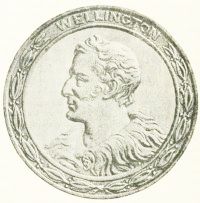
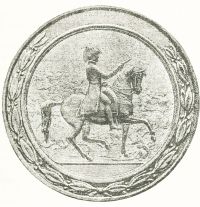
Wellington
These feelings and dispositions of the soldiery in the two most advanced of the Allied Armies were concentrated with remarkable intensity in the characters of their respective Chiefs.
With peculiar propriety may it be said of the illustrious Wellington, that he personified, as he ever has done, the pure ideal of the British soldier—the true character of his own followers. Resolute, yet cool, cautious and calculating in his proceedings; possessing a natural courage unshaken even under the most appalling dangers and difficulties; placing great yet not vain reliance upon physical and moral strength, as opposed to the force of numbers;—it was not surprising that he should have inspired with unbounded confidence, soldiers who could not but see in his character and conduct the reflection and stamp of their own qualities, the worth of which he so well knew, and which he had so often proved during the arduous struggle that had been brought to so brilliant and so glorious a conclusion. But besides these traits in his character, which so completely identified him with a British Army, there were others which peculiarly distinguished him as one of the greatest Captains that his own or any other nation ever produced, and which might well inspire confidence as to the result of the approaching contest, even opposed as he was to the hero of a hundred fights, with whom he was now, for the first time, to measure swords. The eagle glance with which he detected the object of every hostile movement and the promptitude with which he decided upon, and carried into effect, the measures necessary to counteract the Enemy's efforts; the lightning-like rapidity with which he conducted his attacks, founded as they frequently were upon the instantaneously discovered errors of his opponents; the noble and unexampled presence of mind with which he surveyed the battlefield, and with which he gave his orders and instructions; unaffected by merely temporary success, unembarrassed by sudden difficulties, and undismayed by unexpected danger; the many proofs which his operations in the Peninsula had afforded of his accurate knowledge, just conception, and skilful discrimination, of the true principles of the Science of Strategy—all tended to point him out as the individual best fitted by his abilities, his experience, and his character, to head the military array assembled to decide the all-important question whether the Star of Napoleon was to regain the ascendant, or to set in darkness; whether his iron despotism was again to erect its mighty head, or to be now struck down and crushed—finally and effectually crushed.
The character of the Commander of the Prussian Army in this memorable Campaign, the veteran Marshal Prince Blücher von Wahlstadt, was, in like manner, peculiarly adapted for concentrating within itself all those feelings and emotions already adverted to as animating this portion of the enemies of France—possessing, to a degree bordering on rashness, a high spirited daring in enterprise; distinguished, on critical occasions in the field, when the unrestrained feelings and nature of the ci-devant bold Hussar started forth in aid of the veteran Commander, by a personal display of chivalrous and impetuous bravery; ever vigilant for an opportunity of harassing his Enemy; and fixedly relentless in the pursuit, so long as he retained the mastery; qualities, which, in his own country, had acquired for him the sobriquet of Marschall Vorwärts—he was eminently fitted to be both the representative and the leader of the Prussians.