Front matter (continued 6)
Reading edition
Four hours afterwards (that is, at two o'clock on the morning of the 18th) he sent off another despatch to the Emperor, reporting that he had decided on marching upon either Corbaix or Wavre.
The retreat of the Prussian Army, after its defeat at Ligny on the 16th of June, was conducted with great skill, and executed in very good order. By detaining Thielemann's Corps upon the Field of Battle until the morning of the 17th, ample security was afforded to the line of retreat by Gembloux; and by not withdrawing Bülow's Corps from that town until Thielemann drew near to it, the distance between the main bodies of these two Corps became so limited as to present the ready means of opposing their combined force to a vigorous pursuit should such be attempted.
By the evening of the 17th, the entire Prussian Army (with the exception of the Ninth and Thirteenth Brigades, and the Reserve Cavalry of the Third Corps, which arrived by six o'clock on the following morning) had assembled in the immediate vicinity of Wavre—two Corps on the right, and the remaining two Corps on the left, bank of the Dyle—in perfect order, and fully prepared to resume the offensive. Upon the two lines of retreat, the Rear Guards were well disposed at Vieux Sart and Mont St Guibert; where they continued during that night, and whence they retired leisurely on the following day. On the Prussian Left, Patrols were despatched towards the main road leading from Namur to Louvain. On the Right, a Detachment was sent from Zieten's Corps to Limale, on the left bank of the Dyle, to cover the Flank, and Patrols were pushed higher up the river, to communicate with the Post of Mont St Guibert. Major Falkenhausen had been detached, during the day, to Seroulx for the purpose of reconnoitring the country in the vicinity of Genappe, and of the high road to Brussels; and he succeeded in discovering, from the wooded tracts beyond Seroulx, the advance of the French Army along the chaussée. Patrols were also detached towards Lasne, Couture, and Aywiers, to observe the Defiles along the rivulet of the Lasne.
Such were the dispositions of the defeated Prussians on the evening of the 17th, while the victorious French had not advanced beyond Gembloux. The former had fallen back, in good order, upon a line with, and a short distance from, the Anglo-Allied Army on their Right; while their opponents, though encountering no obstacle of importance, had made but little progress, and were widely diverging from, instead of closely co-operating with, the main Army from which they had been detached. These dispositions, so ably planned and so efficiently performed, were well calculated to facilitate the grand operation of the morrow, namely, Blücher's flank movement to the right, to effect a junction with Wellington.
The retreat to Wavre did not in any way incapacitate the Prussian Army for the resumption of actively offensive operations. With respect to its material, it so happened that the Park of Reserve Ammunition Waggons had, in the first instance, been directed upon Gembloux; and Colonel Röhl, who superintended the Ordnance Department of the Army, sent his Aide de Camp during the night of the 16th to conduct this Reserve to Wavre; whilst he himself hastened to the latter town, for the purpose of putting the whole of the Artillery, accordingly as it arrived there, again in a fit state for action. The supply of ammunition, however, was necessarily incomplete; but in order to prevent any failure in this respect, should some mishap occur to the Park of Reserve Ammunition Waggons, a Courier was despatched to Maestricht, with directions for the speedy transport of a supply of ammunition from thence to the Army, by means of the common waggons of the country. Similar Orders were conveyed to Cologne, Wesel, and Münster: and, by way of precaution, an express was sent to Liege for the removal of the Battering Train to Maestricht; as also for the destruction, in case of danger, of the iron foundry in the Arsenal of the former place.
Fortunately, however, the Reserve Ammunition Waggons reached Wavre safely at five o'clock in the afternoon of the 17th. The Corps and Batteries were furnished with a complete supply of ammunition, and the Army was thus placed in a perfectly efficient state for commencing another battle. This turn of affairs was most encouraging, and Blücher delayed not another moment in despatching to Wellington the reply to which allusion has already been made. (See page 285.)
As regards the influence which the defeat at Ligny exercised over the morale of the Prussian Army, its injurious effects were made manifest amongst the newly raised drafts from the Rhenish and Westphalian Provinces, and from the Duchy of Berg. Of these troops, 8,000 men betook themselves to a flight which admitted of no check until they reached Liege and Aix la Chapelle. Among the Rhenish troops, particularly those from Provinces which had formerly belonged to France, there were many old French soldiers; and although several of them fought with great bravery, others evinced a bad disposition, and there were instances in which they passed over to their former companions in arms. Such, however, was not the case with the troops from the other western districts of the Prussian State: there was scarcely a single man amongst the missing, who belonged to any of the old Westphalian Provinces, Mark, Cleve, Minden, and Ravensberg, whilst several came from that of Münster.
But the morale of the great mass of the Prussian Army continued unshaken. The spirit of the troops was neither tamed nor broken; and their enthusiasm, though damped, had not been subdued. Unbounded confidence was placed in the firm decision and restless energy of their aged and venerated Chief; who, though suffering from the effects of his fall, by which his whole frame had sustained a severe shock, evinced not the slightest apprehension of fatal consequences to the Campaign resulting from this defeat. His unbending nature led him to cast aside for the moment those purely political interests and theoretically strategical principles, by which a more cautious and less enterprising Commander might have been induced to secure the line of the Meuse, and to preserve his direct communications with the Prussian States, and thus afford but a doubtful and an inefficient support to his Ally. Placing full reliance on the resources of his own mind, and on the stern, warlike character of his troops; he devoted his whole energies to the attainment of the one grand object—that of crushing Napoleon by combining with Wellington. This confidence in himself and in his soldiers was strikingly and characteristically manifested in the concluding words of a General Order which he issued to the Army on the morning of the 17th. "I shall immediately lead you against the Enemy;—we shall beat him, because it is our duty to do so."
Towards midnight of the 17th, a communication reached Blücher from General Müffling (already mentioned as having been attached to the British Head Quarters) to the following effect. "The Anglo-Allied Army is posted with its Right upon Braine l'Alleud, its Centre upon Mont St Jean, and its Left near La Haye; having the Enemy in its front. The Duke awaits the attack, but calculates upon Prussian support."
This intelligence was forwarded, at midnight, to General Count Bülow, accompanied by the following Order:—"You will therefore, at daybreak, march with the Fourth Corps from Dion le Mont, through Wavre, taking the direction of Chapelle St Lambert, in which vicinity you will keep your force concealed as much as possible, in case the Enemy should not, by that time, be seriously engaged with the Duke of Wellington; but should it be otherwise, you will make a most vigorous attack upon the Enemy's Right Flank. The Second Corps will follow you as a direct Support: the First and Third Corps will also be held in readiness to move in the same direction if necessary. You will leave a Detachment in observation at Mont St Guibert; which, if pressed, will gradually fall back upon Wavre. All the Baggage Train, and everything not actually required in the Field of Action, will be sent to Louvain."
Instructions, in conformity with the above, were also forwarded to the Commanders of the other Corps; and a communication of these arrangements was despatched to General Müffling, with an explanation that the fatigue of the troops could not possibly admit of earlier support. This General was, at the same time, requested to forward timely intelligence of the attack upon the Duke, and of the nature of that attack, that measures might be adopted accordingly.
At five o'clock on the morning of the 18th, Pajol started from Mazy, with Soult's Cavalry Division and Teste's Infantry Division, marching by St Denis and Grand Lez, to Tourinnes; where he was to await further Orders. At about eight o'clock, Excelmans' Corps of Heavy Cavalry, consisting of eight Regiments of Dragoons, was put in motion; and at nine o'clock, Vandamme's and Gérard's Infantry Corps began their march along one and the same road, by Sart à Wallain, upon Wavre. The Left of this Column was protected, towards the Dyle, by the advance of Maurin's Division of Light Cavalry, under General Vallin.
It was about half past ten o'clock, when Excelmans' Advanced Guard came up with the Prussian Rear Guard, on the road to Wavre. He immediately formed his troops in position, resting their Left upon the wooded ravine near the Farm of La Plaquerie, and their Right in the direction of Neuf Sart. While his Skirmishers were engaged with those of the Enemy, he sent the Chef d'Escadron d'Estourmel, to inform Marshal Grouchy of what was going on in front, and also to make known to him that the Prussian Army had continued its retreat upon Wavre during a part of the night and that morning, for the purpose of forming a closer communication with the Duke of Wellington's forces.
The march of the Third and Fourth Corps was greatly retarded by the bad state of the roads, and frequent halts were occasioned by the narrowness and miry nature of the Defiles. Gérard, having preceded the Column, reached Sart à Wallain at eleven o'clock, where he found Grouchy breakfasting in the house of M. Hollaërt, a Notary. In about half an hour after his arrival, Colonel Simon Lorière, who was acting as his Chief of the Staff, suddenly heard, while walking in the garden of the house, a distant but violent cannonade, of which he immediately went to apprise his General. Grouchy repaired at once to the garden, accompanied by Gérard, Vandamme, Excelmans, and several other Officers. He immediately called for M. Hollaërt, and asked him in what part of the country he considered this tremendous cannonade to be going on. The latter, pointing to the Forest of Soignies, replied that it must be in the direction of Planchenoit, Mont St Jean, and that vicinity.
Gérard then declared his opinion to be in favour of the expediency of marching in the direction of the cannonade, in order to connect the movements of the detached force more closely with Napoleon's operations; and offered to lead his own Corps towards the Battle. This measure was opposed by the Marshal, as also by General Baltus, of the Artillery, who represented the difficulties of a march in which this Arm might be compromised. On the other hand, General Valaze, Commanding Engineer of Gérard's Corps, after having coincided in the opinion expressed by the latter, observed that he had three Companies of Sappers, by aid of which he could remove many obstacles. Gérard then gave his assurance that he could at all events move on with the gun carriages and limbers.
Grouchy, however, stated his determination to act in conformity with his instructions; which were, to pursue and attack the Prussians, and never to lose sight of them. It had just been intimated to him that his troops had come up with a Rear Guard of the Enemy's Infantry, and he did not consider his information was sufficient to warrant the conclusion that Blücher was drawn up, in expectation of being attacked by him at Wavre; or that he would continue his retreat upon Brussels; or, that if, in manœuvring to effect his junction with Wellington, he would do so in front, or in rear, of the Forest of Soignies.
He has since declared, that he did not deem it his duty to follow the counsel given by Gérard, but to attack the Prussians; that to effect the proposed movement with the whole of his forces would have been acting contrary to his Orders; that to have detached only a portion of those forces in the direction of the Forest of Soignies, would have been to separate the two Corps of his Army by a river, whose waters were swollen by the rain, and whose banks were swampy, and thus have rendered their mutual support impossible, however essential it might have become; finally, that a war of inspiration appertains alone to the General in Chief, and that his Lieutenants must confine themselves to that of execution. Hence the march to Wavre was continued.
Whilst proceeding to the Advanced Guard, Grouchy received the despatch, dated from the Farm of Caillou, the 18th of June, at ten o'clock in the morning, acquainting him that the Emperor was going to attack the Anglo-Allied Army, in its position at Waterloo; desiring him to direct his movements upon Wavre in such a manner as to draw his forces nearer to those of Napoleon, and, especially, to keep up a close communication with the latter.
The receipt of these instructions was not followed by any immediate change in Grouchy's dispositions. He despatched no Cavalry force—not even a single Patrol—to watch any movements that might be attempted, or actually then in course of execution, by the Prussians, towards the Field on which the Emperor had intimated to him his intention of attacking the force under Wellington; and hence it is almost needless to add, that he neglected to establish that close and active communication with the main Army which was so essentially important for the accomplishment of the object of the general plan of operations, and to which Napoleon had especially directed his attention in the before mentioned despatch. His sole aim seemed to be a direct advance upon Wavre; and this he carried into execution without at all detaching to, or in any way manœuvring by, his left. On the contrary, upon arriving in person at the position occupied by Excelmans, he desired the latter to move to his right, and take post at Dion le Mont; and the ground thus vacated was shortly afterwards taken up by Vallin's Light Cavalry Division.
At daybreak of the 18th of June, Bülow, in conformity with the Order which he had received during the previous night from Blücher, quitted his position near Dion le Mont, to march through Wavre to St Lambert. This was the commencement of the important flank movement of the Prussians in support of the Anglo-Allied Army in position in front of Waterloo; and every measure of precaution was adopted with a view to its being carried into effect with certainty and safety. The sun had not yet risen when Major Witowsky was despatched with a Detachment of the 2nd Silesian Hussars, to Maransart, for the purpose of closely reconnoitring the Defiles of the Lasne, which had already been patrolled the evening before, and to observe the country in front of those Defiles, in the direction of the Enemy's position. Major Falkenhausen, previously mentioned as having pushed a reconnaissance beyond Seroulx on the 17th, was now directed also to reconnoitre the Lasne. Scouring parties were sent out, which kept up the communication that had been opened the previous day with Lieutenant Colonel Ledebur at Mont St Guibert: the whole country between the Dyle and the Charleroi high road was carefully explored; and correct intelligence was continually sent to the rear concerning the French Army.
By means of this vigilant look out, the Prussians secured the important advantage of retarding the communications between the French Emperor and his Marshal, since it compelled the bearer of despatches to pursue a very circuitous route.
At half past nine o'clock, on the morning of the 18th, whilst Bülow's Corps was on the march to St Lambert, the following additional despatch was forwarded to General Müffling:—
Wavre, 18th June 1815, at half past nine o'clock.
"I request you will say to the Duke of Wellington, in my name, that even ill as I am, I shall, nevertheless, put myself at the head of my troops, for the purpose of immediately attacking the Enemy's Right Flank, should Napoleon undertake anything against the Duke. If, however, the day should pass over without a hostile attack, it is my opinion that we ought tomorrow, with our combined forces, to attack the French Army. I commission you to communicate this as the result of my inward conviction, and to represent to him that I consider this proposal to be the best and most suitable in our present position.
"Blücher."
The Prussians very soon discovered that the French had made no disposition whatever for the protection of their Right Flank. Major Witowsky had proceeded as far as Maransart before he fell in with an Enemy's Patrol; and Major Falkenhausen found the Defiles of the Lasne perfectly free and unobserved. Upon receiving this intelligence, Blücher decided upon supporting the Anglo-Allied Army, by directing the march of his whole force, or at least of three Corps, towards the Wood of Paris, and debouching from thence upon the Flank and Rear of the Enemy; and Major Lützow was immediately despatched for the purpose of narrowly watching, from the other side of the above Wood, the French movements directed against the position of the Anglo-Allied Army.
No report as yet had been received from the Rear Guard, concerning Grouchy's advance, and as Blücher's object was now to gain the Defiles of the Lasne without interruption, and to occupy in force the Wood of Paris, he determined to avail himself of the time and opportunity which offered for the projected movement. Being, however, uncertain as to the amount of Grouchy's force, the Prince deemed it advisable that Wavre should not be abandoned until the greater part of the Army had passed the Defiles of St Lambert; and with this view, he directed that as soon as Bülow's Corps should have proceeded beyond Wavre, Zieten's Corps was to commence its march by Fromont and Ohain to join the Left Wing of Wellington's Army near La Haye. Pirch's Corps was ordered to follow Bülow's in the direction of St Lambert; and Thielemann's Corps, after retaining possession of the Defile of Wavre sufficiently long to render the general movement of the Army secure, was then gradually to follow Zieten's Corps upon Ohain.
An unfortunate incident occurred during the passage of Bülow's Corps, through Wavre, which materially impeded the march of the troops. The Advanced Guard, consisting of the Fifteenth Brigade (under General Losthin), with the 2nd Silesian Hussars, and a twelve pounder Battery, had scarcely passed through the town when a fire broke out in the main street, and extended itself with great rapidity. This not only caused a suspension of the march of the main body of the Corps, but created much alarm, in consequence of the great number of ammunition waggons in the place. Every exertion was made to extinguish the fire. The 1st Battalion of the 14th Regiment, under Major Löwenfeld, and the 7th Pioneer Company, were ordered upon this duty; and after they had encountered considerable difficulty, their efforts were crowned with success.
In the mean time the Advanced Guard of Bülow's Corps had continued its march, and reached St Lambert by eleven o'clock. The Sixteenth, and then the Thirteenth, Brigade arrived much later; and the Fourteenth Brigade, which formed the Rear Guard, was a long way behind. The Advanced Guard did not wait the arrival of the other Brigades, but proceeded forthwith to cross the Defile of St Lambert. Having effected the passage, which was attended with great difficulty, in consequence of the soft and miry state of the valley, it halted in the Wood of Paris, where it continued a considerable time, waiting for the approach of the main body. Patrols, however, from the 2nd Silesian Hussars, were immediately sent forward to feel for the Anglo-Allied Left, and to reconnoitre the French Right.
Zieten's Corps (the First) commenced its march, upon the left bank of the Dyle, towards Ohain, about noon.
Whilst Bülow's Reserve Cavalry, following the Thirteenth Infantry Brigade, was passing through Wavre, French Cavalry had penetrated between the Rear Guard of this Corps, at Vieux Sart, and the Detachment under Lieutenant Colonel Ledebur at Mont St Guibert. The 2nd Pomeranian, and the 1st Silesian, Landwehr Cavalry were immediately detached from the Reserve Cavalry of the Corps, to aid in checking the advance of the Enemy.
The Prussian Lieutenant Colonel Ledebur, who was still at Mont St Guibert, having received intelligence of the approach of the French, decided on commencing his retreat towards Wavre. Lieutenant Colonel Sohr, who had fallen back early in the morning from Mont St Guibert, sent 150 Cavalry and two guns of Horse Artillery as a reinforcement to Ledebur. The latter now succeeded in forming a junction with the two Cavalry Regiments detached from the Reserve, as also, subsequently, with the Cavalry Brigade under Sohr, after a slight affair with the Third French Corps (Vandamme's), whilst making good his retreat to Auzel.
Pirch's Corps (the Second) broke up from its position between St Anne and Aisemont, on the right bank of the Dyle, about noon, for the purpose of passing the Defile of Wavre. The 1st Battalion of the 14th Regiment, which occupied this town, was relieved by a Battalion of the 30th Regiment, belonging to the Third Corps (Thielemann's). Pirch had just put his Corps in motion, with a view to cross the Dyle by the town of Wavre, when the approach of the Enemy was announced. The Defile was crowded with the troops; the progress of their march could not be otherwise than slow; and at this moment Lieutenant Colonel Sohr, whose Brigade formed the Rear Guard of the Corps, sent in word, that the Enemy presented a force of six Regiments of Cavalry, ten pieces of Artillery, and two strong Columns of Infantry.
The Wood of Sarats, close to the Farm of Auzel, was now occupied by some Battalions of the Eighth Brigade, the command of which had devolved upon Colonel Reckow. Pirch placed the whole of the Rear Guard under the Orders of General Brause, the Commander of the Seventh Brigade, and reinforced Lieutenant Colonel Sohr with the 11th Hussars and four pieces of Horse Artillery. Brause posted the remaining Battalions of the Eighth Brigade in rear of the Wood, and the three Regiments of Cavalry on the right, with the Foot Battery No. 12 in their front. The Seventh Brigade, deployed into line, remained in reserve.
Lieutenant Colonel Ledebur retired slowly before the Enemy, and formed a junction with the Eighth Brigade, under Colonel Reckow; who maintained his position until three o'clock in the afternoon, against the Advanced Guard of Vandamme's Corps. Between three and four o'clock, General Brause ordered the retreat. Lieutenant Colonel Sohr crossed the Bridge at the Mill of Bierge, which was occupied by two Companies of the 2nd Battalion of the 14th Regiment; and then followed the Reserve Cavalry of Pirch's Corps, to which his Brigade belonged, but which he did not overtake until he reached the Field of Waterloo. The Enemy did not advance with much vigour; the retreat was conducted with perfect order, and the Fusilier Battalion of the 1st Pomeranian Landwehr, under Major Krüger, distinguished itself on the occasion. After the passage of the river had been effected, the 1st Battalion of the Elbe Landwehr remained at Bierge until the Bridge was destroyed and the Mill set on fire. The 11th Hussars and the 2nd Battalion of the Elbe Landwehr were posted in observation of the passages across the Dyle, and did not rejoin the Corps before the following day.
Blücher had quitted Wavre before eleven o'clock in the forenoon, and repaired to the vicinity of Limale, in order to make himself acquainted with the nature of the country in the direction of St Lambert. Whilst here, he received intelligence of the approach of the Enemy towards Wavre. Colonel Clausewitz, Chief of the Staff of the Third Corps, was immediately made the bearer of an Order for Thielemann to defend the position at this place, in the event of the Enemy advancing in force; but, should the latter cross the Dyle higher up the stream, or not appear in great strength (a point concerning which nothing positive was then known), he was to leave only a few Battalions in position at Wavre, and to follow the main Army, with his Corps, as a Reserve, in the direction of Couture.
Grouchy's movements, on the 17th and 18th, form so striking a feature in the history of this Campaign, and exercised so important an influence upon the fate of the decisive Battle of Waterloo, that it becomes an essential point in the study of that history, to examine how far he complied with, and carried into effect, the instructions received from his Master, and to what degree his proceedings, consequent upon his ascertaining the direction of the Prussian retreat, coincided with the general plan and object of Napoleon's operations. On a reference to the account of his transactions during the 17th, given in the despatch written at ten o'clock on that night, it appears he was completely ignorant of the line by which the principal mass of the Prussian Army had retreated, namely, that of Tilly and Gentinnes, by Zieten's and Pirch's Corps, although his Cavalry had driven back the Prussian Detachment from the latter place to Mont St Guibert, but from whence it appears to have been withdrawn in the night. His attention seems to have been much less devoted to this quarter than it was to his Right, in which direction he detached as far as Perwès. The main body of his forces did not proceed further than Gembloux on the 17th, that is, about five miles from the Field of Ligny.
Upon a first consideration, we are strongly impressed by the striking contrast between this march, in pursuit of a defeated Army, which had commenced its retreat on the previous night, and which presented no check to the advance, and the march of Napoleon from the same Field, by Quatre Bras and Genappe, as far as La Belle Alliance, in front of the Waterloo position, a distance of about sixteen or seventeen miles; and this, too, in rear of a victorious Army, with a Cavalry Rear Guard boldly and successfully impeding the advance of its pursuers. It must, however, be taken into account, that in one most important respect Napoleon possessed a decided advantage over Grouchy—an advantage, the magnitude of which increased with every moment that elapsed after the wet weather had set in; for while the former moved the whole distance along a paved high road, the latter had to proceed entirely by cross roads, which may more properly be designated common field roads. It is to this particular point that both Grouchy and Gérard refer in justification of the late arrival of the Infantry at Gembloux. Nevertheless, Grouchy detached considerably to his Right, with his Cavalry, misled by the same idea which had prevailed with Napoleon, that Blücher had retreated upon the Meuse; and the very circumstance of his Dragoons having reached Perwès on the night of the 17th, proves that had he organised a more extended, more combined, and more energetic reconnaissance, with the sixty five Squadrons of Cavalry which had been placed under his orders, he might have connected his operations on the right of the Dyle with those of Napoleon on the left of that river, by occupying the line of Nil St Vincent, Corbaix, Mont St Guibert, and the Bridge of Moustier. The only check he would have experienced would have been at the Prussian Post of Mont St Guibert; which, however, in the case of an active reconnaissance, as above, might have been attacked by a strong Detachment in front, and turned by Corbaix on its left.
To show the connection which this disposition would have secured with Napoleon's movements, it is only necessary to state, that the Third Cavalry Division, under Lieutenant General Domon, had been detached from the Emperor's Column to reconnoitre the country between the Dyle and the high road to Brussels; and that the 4th Regiment of Chasseurs à Cheval pushed as far as the Bridge of Moustier, on which line its Skirmishers exchanged a few carabine shots with some Prussian Dragoons, who did not, however, appear willing to engage further with them. It was by means of this reconnaissance that Napoleon ascertained the retreat, through Tilly and Gentinnes, of the principal Prussian Column, consisting of Zieten's and Pirch's Corps, although the line by which they retired was undiscovered by Grouchy, in whose immediate sphere of operations it was situated.
But if such good grounds exist for inferring that, on the 17th, an earlier and a clearer insight into the Enemy's movements might have been obtained by the Corps detached in pursuit of the Prussians, and that when obtained, it would have rendered the communication with the operations of the main Army on the left of the Dyle, a matter not only important in the highest degree, but also perfectly practicable; and if a failure in this respect be attributable to the absence of sufficient energy and vigour on the part of Grouchy, how much more forcibly does it not expose the extraordinary, the unaccountable, dilatoriness of Napoleon himself during the whole of the precious morning of the 17th! How striking a view it unfolds of what might have been accomplished, had the bivouac at Ligny been broken up a few hours earlier! Then, Wellington's Army was still between Quatre Bras and the narrow Defile of Genappe, open to an attack in front by Ney, simultaneously with one in flank by the force collected at Marbais (a part of which might have been detached across the Genappe, towards the rear of the Anglo-Allied Army, by Villers la Ville and Bousseval, masked by the Wood of Berme); and the rearmost Corps of the Prussian Army (Thielemann's), which was retreating through Gembloux, might have been attacked with effect, by the superior force of all Arms under Grouchy.
As regards Grouchy's movements during the early part of the 18th, it is very remarkable, that although he had in his despatch, written at ten o'clock the previous night, communicated to Napoleon his surmises of an intended junction of a portion of Blücher's forces with those of Wellington, and his consequent intention of following the Prussians in the direction of Wavre, afin qu'ils ne puissent pas gagner Bruxelles, et de les séparer de Wellington, and although he must or ought to have been aware that Wavre was only twelve miles distant from Napoleon's main line of operations, whereas Gembloux was about fifteen miles distant from Wavre, he not only delayed his departure from Gembloux until between seven and eight o'clock in the morning, but manœuvred by his right; taking the more circuitous line, through Sart à Wallain, and rendering his operations still more dilatory by moving both Vandamme's and Gerard's Corps along one and the same road. Had he not, from want of sufficient vigilance, continued ignorant of the fact, that the principal Prussian Column, consisting of the First and Second Corps, had retired upon Wavre, at so short a distance from his left as by the line of Tilly, Gentinnes, and Mont St Guibert, there can be very little doubt that he would have marched upon the latter point, which the Prussians, aware of its importance, had occupied with a Rear Guard; but even with the amount of information which he possessed, and with the inference justly impressed upon his mind that a co-operation between Blücher and Wellington was projected, we are at a loss to account for his not having moved upon Mont St Guibert, and manœuvred by his left.
In his despatch, written at two o'clock in the morning, he mentioned to the Emperor his design of marching upon Corbaix or Wavre; a movement of which Napoleon, in his reply, expressed his approval; and if he had directed one of his Infantry Corps along the line of Corbaix and La Baraque, and the other by that of Mont St Guibert and Moustier, there can be no doubt that, even late as was the hour at which he started from Gembloux, he would, in a great measure, have fulfilled the expectations of his Imperial Master. In this case, he would naturally have so divided his Cavalry, that one portion would have scoured the country along the Front and Right of the Column marching by Corbaix and La Baraque, and the other portion would have been employed in a similar manner along the Front and Left of the Column moving upon Mont St Guibert and Moustier. Both at this point and at Ottignies, about eight hundred yards lower down the stream, there is a stone bridge across the Dyle. There is a direct road from Moustier to St Lambert, scarcely five miles distant, and another to the Field of Waterloo. The Cavalry in advance of the Left Column could not have failed to discover the Prussian troops in march to join the Left of Wellington; for they were then passing slowly, and with extreme difficulty, through the Defiles of St Lambert and Lasne. This discovery would have led to the Right Column being moved by its left, from La Baraque to Moustier; the Cavalry attached to it masking the movement as long as possible. The Left Column would then, in all probability, have followed its advanced Cavalry to St Lambert; and the Right Corps have either moved upon the same point as a reinforcement, or have diverged upon Lasne as a Support, upon which the former might have fallen back, if compelled to effect its retreat towards Planchenoit.
In this manner might Grouchy have so far realised the anxious expectation of Napoleon as to have fallen upon Bülow flagrante delicto, and have materially procrastinated the co-operation of Blücher with Wellington on the 18th of June; a co-operation which a contrary proceeding, originating in fatal tardiness of movement, and exhibiting useless manœuvring in a false direction, could not fail to render easy in execution and successful in result. But beyond such procrastination of the meditated junction of Blücher's and Wellington's forces, Grouchy could have effected nothing. The junction itself could not have been prevented. The tendency of Grouchy's movements had been too narrowly watched; the country between the Dyle and the Charleroi road to Brussels had been too vigilantly explored; and the movements, in succession, of the different Prussian Corps had been too nicely calculated and determined; to admit of the possibility of a failure, as regarded the arrival of a considerable portion of the Prussian forces on the Left of the Anglo-Allied Army.
Blücher had made so admirable a disposition of his four Corps d'Armée, that two of them could at any time have combined, and therefore have presented a superior force to Grouchy, at any point between Wavre and Planchenoit; whilst the remainder of the Army might have continued its march to the Field of Waterloo. Had Grouchy moved by St Guibert and Moustier upon St Lambert, Thielemann's Corps would then have been on the march towards Couture, according to his original instructions; and finding Bülow engaged with the Enemy, would have joined him. Grouchy might then have contrived to hold both these Corps at bay, and thus have reduced the co-operating Prussian force at Waterloo to the two Corps under Zieten and Pirch, besides considerably retarding that co-operation; since without having experienced the effects of any such interruption to the progress of the other Corps, as we have here supposed, these two Generals did not reach the Field of Battle until seven o'clock in the evening of the 18th.
Such is the extent of the advantage which, under the circumstances, Grouchy would have gained by a march from Gembloux upon St Lambert; a most important one, no doubt, as time for pushing the struggle with Wellington, with the whole force at his immediate disposal, before the arrival of the Prussians, was of the most vital consequence to Napoleon; and this advantage Grouchy entirely lost by his march upon Wavre—a march which enabled Blücher to appear with three, out of his four, Corps d'Armée, on the great and decisive Field of Action; and that in sufficient time to render the victory as complete as could reasonably be desired.
No exertions, however, on the part of Grouchy, after he broke up from Gembloux on the morning of the 18th, could have effectually frustrated the junction of Wellington and Blücher. Two great errors, for which that Marshal was not accountable, reduced the contemplated junction from a measure of calculation to one of certainty. The first and principal of these has already been adverted to at some length, and cannot be too closely kept in view—the fatal neglect of a vigorous pursuit of the defeated Prussians, on the night of the 16th and morning of the 17th, by a detached Corps; combined with the extraordinary delay in the attack upon Wellington at Quatre Bras, on the latter day. The second error arose from the want of a strong reconnaissance and vigilant look out on the right of the main French Army, on the morning of the 18th, followed up by the occupation of the Defiles of the Lasne.
It was nearly four o'clock when Vandamme's Corps arrived in front of the position which Thielemann was in the act of quitting, with a view to follow and support the remaining three Prussian Corps that were at that moment on the march towards the Field of Waterloo; and, with a fire that was opened from the French Batteries, commenced the Battle of Wavre, which will be described in its proper place in a subsequent Chapter.
CHAPTER IX.
IT rained incessantly during the night of the 17th, occasionally in torrents; whilst loud and frequent peals of thunder fell ominously on the ear of the toil-worn soldier, startling him from the fitful slumber, which was all the rest the chill and comfortless bivouac on the Field of Waterloo could afford him in that tempestuous night.
Scarcely had the morning dawned when the numerous groups, stretched around the smouldering remains of the bivouac fires, or couched in the hollows, or lying under such slender cover as the few trees and brushwood within range of the positions of their respective Regiments afforded, were seen gradually in motion; and as the eye of an observer wandered along the space which lay between the main bodies of the hostile Armies—a space varying in no greater width than from one thousand to fifteen hundred yards—the Officers in command of the several Picquets might be seen, on either side, withdrawing their Vedettes and Sentries from the very limited and almost conversational distance that had separated them from their opponents during the night, concentrating their Detachments, and establishing their Main Posts more within the immediate range of the respective positions occupied by the grand Armies.
As the morning advanced, the dense vapoury masses which had so long rolled slowly and heavily over the plain, gradually began, as if relieved by the constant discharge of their contents, to soar into a higher region, where, during the whole day, with little or but imperceptible motion, they hung spread out into a broad expansive vault, through which the rays of the sun were unable fully to penetrate, until just at the moment of its sinking from the scene of strife, when it shed the full blaze of its setting splendour upon the victorious advance of the Anglo-Allied Army. The drying and cleaning of firearms soon became general, and the continuous discharge of muskets, at rapid and irregular intervals, fell upon the ear like the rattle of a brisk and widely extended skirmish.
All at once, the scene became more animated and exciting. Drums, bugles, and trumpets were heard over the whole Field, sounding the "Assembly"; and never was the call to arms, in either Army, responded to with greater zeal, alacrity, and cheerfulness. While the Regimental inspections, tellings off, and preparatory arrangements of detail were proceeding, Staff Officers were seen galloping in various directions; and, shortly afterwards, the different Brigades, which, by their bivouacs had but faintly and irregularly traced the Line of Battle taken up by each Army, were moved and distributed in the precise order prescribed by the illustrious Chiefs who had on that day, and for the first and only time, met to measure swords.
The Field of Waterloo is intersected by two high roads (chaussées) conspicuous by their great width and uniformity, as also by the pavement which runs along the centre of each. These two roads, the eastern one leading from Charleroi and Genappe, and the western from Nivelles, form a junction at the Village of Mont St Jean, whence their continuance, in one main road, is directed upon the capital of Belgium.
In front of the above junction; and offering, as it were, a natural military position for the defence of this approach to Brussels, a gentle elevated ridge of ground is intersected, at right angles, by the Charleroi road, about 250 yards north of the Farm called La Haye Sainte, and follows a westerly direction until about midway between the two high roads: whence it takes a south-westerly course, and terminates abruptly at its point of intersection with the Nivelles road, about 450 yards north of Hougomont, a Country Seat, with Farm, Offices, Gardens, Orchards, and Wood. On the east side, the ridge extends itself perpendicularly from the Charleroi road until it reaches a point, distant about seven hundred yards, where, elevating itself into a Mound or Knoll, it overlooks the Hamlet of Papelotte; and thence, taking a north-easterly course, expands into an open plateau.
This ridge constituted the position of the First Line of the Duke of Wellington's Army, which Line is more distinctly defined by a road, entering on the east side, from Wavre, by Ohain, and winding along the summit of the ridge until it joins the Charleroi high road just above La Haye Sainte; from which point of junction a cross road proceeds along the remaining portion of the ridge, and thus connects the two high roads with each other.
The undulations of the ground in rear of this position were admirably adapted to the disposition of the Second Line and Reserves, presenting a gently inclined reverse slope along nearly the whole extent of the ridge, with fine open and convenient stations for Cavalry, perfectly concealed from the Enemy's observation.
The Right of the main position is bounded by a valley, which has its source very considerably in rear of the Centre of the French position, by which it is intersected; and thence, sweeping round the southern and western inclosures of Hougomont, proceeds in the direction of Merbe Braine. Into this valley a ravine directs its course in rear of, and parallel with, the principal portion of the Right Wing of the Anglo-Allied position, at a distance from the latter varying from 200 to 250 yards; and between this ravine, which is intersected by the Nivelles road, and Merbe Braine, rises a sort of plateau, upon which was posted a portion of the Second Corps, commanded by Lieutenant General Lord Hill, destined to act, as circumstances might require, either in reserve to the First Line, or en potence to it in repelling any attack upon that Flank of the Anglo-Allied Army.
Upon the extreme Left of the First or main Line was stationed Vivian's Light Cavalry Brigade, comprising the 10th and 18th Hussars, and the 1st Hussars of the King's German Legion. The two former Regiments were in Line, in rear of the Wavre road, and withdrawn a little from the crest of the ridge: the Right of the 10th resting upon a lane, which, leading up from Smohain, crossing over the position, and descending along its reverse slope, proceeds in the direction of the Village of Verd Cocou. The 1st Hussars of the King's German Legion were also in Line, and formed in reserve. The Left of the Brigade was completely en l'air, upon high, open, and flat ground; the main ridge widening considerably in that direction, as previously explained. A Picquet, consisting of a Squadron of the 10th Hussars (under Captain Taylor), occupied the Village of Smohain, down in the valley which, having its source a little to the westward of La Haye Sainte, takes an easterly and therefore parallel course with that part of the ridge which formed the Left Wing of the British position. The Advanced Post of this Picquet was on the further side of the Village, and its Vedettes formed a chain on the rising ground beyond, within half-carbine shot of some French Cavalry, standing dismounted in Close Columns. A party was detached from the Picquet as a Patrol on the road to Ohain.
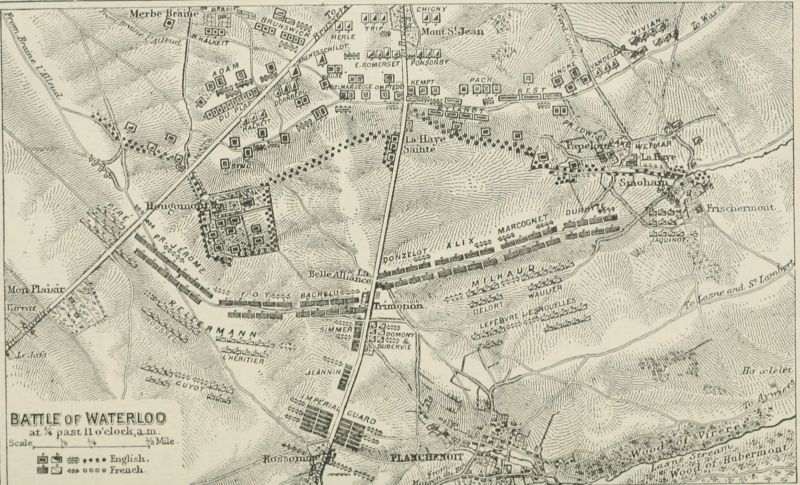
Battle of Waterloo at ¾ past 11 o'clock a.m.
The Village of Smohain, as also the Farms of La Haye and Papelotte, with adjacent houses and inclosures, were occupied by a portion of the Second Brigade of Perponcher's Division of the troops of the Netherlands. The Regiment of Orange Nassau, consisting of two Battalions, held Smohain and La Haye: while the Farm of Papelotte was occupied by the Light Company of the 3rd Battalion of the 2nd Regiment of Nassau, which, together with the 2nd Battalion of this Regiment, and four guns of Captain Byleveld's Dutch-Belgian Battery of Horse Artillery, were posted upon the exterior slope, immediately under the brow of the main ridge, and a little to the westward of the lane leading directly up the slope from the Farm of Papelotte.
The Advanced Posts of these troops were at the foot, and their Line of Sentries extended along the brow, of the opposite slope of the valley; this Line receded towards the western limit of the Hamlet of Papelotte, where it joined the general Line of Picquets along the bottom of the exterior slope of the position of the Anglo-Allied Left Wing.
On the right of Vivian's Brigade, and having its own Right resting upon a narrow lane, forming a slight hollow way, lined with hedges, stood Vandeleur's Brigade of Light Cavalry, consisting of the 11th, 12th, and 16th British Light Dragoons, in Columns of Squadrons, by Regiments, Left in front. The lane on which its Right rested descending the interior slope of the position, joined the other lane which led from Vivian's Right to Verd Cocou.
The extreme Left of the Infantry of the main Line of the position was formed by the Fifth Hanoverian Brigade, under Colonel Vincke, belonging to Picton's Division. It was formed in Columns of Battalions, those of Hameln and Hildesheim (under Majors Strube and Rheden) in First, and those of Peine and Gifhorn (under Major Count Ludolph von Westphalen, and Major Hammerstein) in Second, Line; and was posted somewhat under the crest of the ridge, upon the reverse slope, and in rear of the junction of a lane leading up from Papelotte, with the Wavre road.
On the immediate right of Vincke's Brigade, and having its own Right upon the Knoll which presents the highest and most commanding point along the position of the Left Wing of the Anglo-Allied Army, the Fourth Hanoverian Brigade, under Colonel Best, was drawn up. It formed part of the Sixth Division, and was composed of the Landwehr Battalions of Lüneburg, Verden, and Osterode, which were deployed in Front Line; and of Münden, which was in reserve. A Battery of Hanoverian Foot Artillery, under Captain Rettberg, was attached to this Brigade, and, from the peculiarly favourable circumstances of the ground, which formed a sort of natural fieldwork, was most advantageously placed.
Upon the exterior slope of that portion of the ridge which lies between the before mentioned Knoll and the Genappe high road, Bylandt's Brigade of Perponcher's Division of the troops of the Netherlands was deployed in Front Line. It consisted of the 27th Battalion of Dutch Light Infantry, the 7th Battalion of the Belgian Line, and of the 5th, 7th, and 8th Battalions of Dutch Militia. Of the above, the 5th Battalion of Dutch Militia was posted in reserve, along with the remaining four guns of Captain Byleveld's Battery of Horse Artillery attached to this Brigade, in rear of the straggling hedge which lines the Wavre road, between the Knoll and the Charleroi high road.
Upon the interior slope of the ridge, and at a distance of about two hundred yards from the Wavre road, was posted the Ninth Brigade of British Infantry, under Major General Sir Denis Pack, in a Line of Battalion Columns, at deploying intervals. It consisted of the 3rd Battalion 1st Royal Regiment, the 1st Battalion 42nd Royal Highlanders, 2nd Battalion 44th Regiment, and of the 92nd Highlanders. The Left Regiment, the 44th, was stationed on the Knoll, in rear of the Right of Best's Hanoverian Brigade; and on the right of the 44th stood, in succession, the 92nd, 42nd, and 1st Royals.
Upon the right, but more in advance, of Pack's Brigade, and at a short distance in rear of the hedge along the Wavre road, stood the Eighth Brigade of British Infantry, under Major General Sir James Kempt, also in Line of Battalion Columns, at deploying intervals, and comprising the 28th Regiment, the 32nd Regiment, the 1st Battalion 79th Highlanders, and the 1st Battalion 95th Rifles. The Right of the 32nd Regiment rested upon a high bank of the Charleroi road; on its left stood the 79th Highlanders, and the 28th formed the Left Regiment of the Brigade.
In the immediate front of the Right of the Brigade, and at a distance from the Wavre road of about 120 yards, there was a Knoll having on its right a large Sand Pit, adjoining the Charleroi road; and partially facing the small Garden in rear of La Haye Sainte. On the Allied side of the Knoll was a single hedge, extending about 150 yards from the Charleroi road in a direction parallel to the Wavre road. In the Sand Pit were posted two Companies of the 1st Battalion 95th British Rifles; the Knoll and hedge were occupied by another Company of the same Regiment. These Advanced Companies had placed an abatis across the high road, near that part of it which is joined by the hedgerow. The remaining Companies lined a portion of the Wavre road, commencing from the point of its intersection with the Charleroi road.
These two Brigades, namely, the Eighth and Ninth British, together with the Fifth Hanoverian Brigade, constituted the Fifth Division, under Lieutenant General Sir Thomas Picton.
Along the continuation of the ridge on the right of the great Charleroi road, the Third Division, commanded by Lieutenant General Sir Charles Alten, was disposed in the following order:—
The Second Brigade of the King's German Legion, commanded by Colonel Ompteda, which formed the Left of the Division, consisted of the 1st and 2nd Light Battalions (under Lieutenant Colonel von dem Bussche, and Major Baring), and of the 5th and 8th Line Battalions of the King's German Legion (under Lieutenant Colonels Linsingen and Schröder).
The 1st Light Battalion was formed in Column of Companies at quarter distance, Left in front. It stood a little in rear of the cross road which unites the great Nivelles road with that of Charleroi, on which last its Left Flank rested. To the right of this Column stood the 5th Line Battalion, formed in Column at quarter distance upon one of its centre Companies. In rear of these two Columns, and fronting the deploying interval between them, stood the 8th Line Battalion, in Second Line, in Column of Companies, at quarter distance, upon one of its centre Companies.
Alten
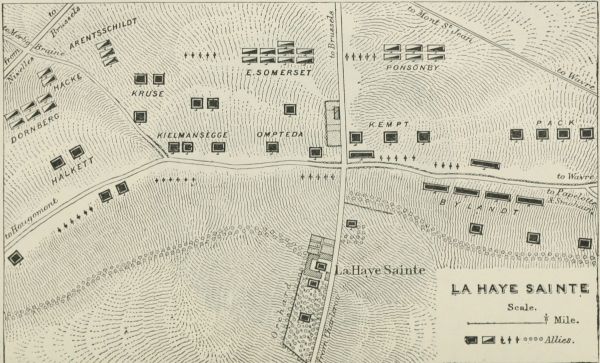
La Haye Sainte
The 2nd Light Battalion, under the command of Major Baring, occupied the Farm of La Haye Sainte.
The buildings of this Farm are so disposed as to form three sides of a square, the north side comprising the Farm House itself, with a portion of the stabling; the west side the remainder of the stables and cow houses; and the south side principally a large Barn: a brick wall, extending along the great road, unites the north and south buildings, and thus forms the fourth boundary of the large quadrangular farm yard.
On the south, or French, side of the Farm, and down in the valley, which here separates the Allied and French positions, lies an Orchard, about 240 yards long and 80 wide, having for its eastern boundary, the great road, in direct prolongation of the wall which incloses the farm yard on that side. This Orchard is inclosed within a hedgerow; as is also a Kitchen Garden, on the north side of the Farm, excepting the boundary of the latter along the road side, which is a continuation of the eastern wall.
A large gate and a doorway, the former almost facing the east end of the Barn, and the latter quite close to the east end of the dwelling house, lead from the yard into the great road; another gate, at the south end of the stabling which forms the western side, as also a large door from the west end of the Great Barn, lead both into a small narrow portion of the Orchard, whence there is an outlet into the open fields on the right. From the front door of the dwelling house, which faces the farm yard, there is a passage to the back or north side of the house, whence a door opens into the Kitchen Garden.
Since daybreak, the little garrison, amounting to scarcely 400 men, had been busily engaged in strengthening their Post to the fullest extent of the means within their reach, which, however, were extremely limited. Among the difficulties which they had to overcome, it may be remarked that, on the preceding evening, immediately after taking possession of the Farm, the soldiers had broken up the Great Barn door, on the west side, for firewood; and that, about the same period, the Carpenters of the Regiment were detached to Hougomont, in compliance with an Order received to that effect. Unfortunately, also, the mule laden with the Regimental trenching tools had been lost the day before, so that not even a hatchet was forthcoming. Loop holes were pierced through the walls; and a barricade was thrown across the high road, in prolongation of the south wall. The Battalion was composed of six Companies, of which Major Baring posted three in the Orchard, two in the Buildings, and one in the Garden.
On the right of Ompteda's Brigade stood the First Hanoverian Brigade, under Major General Count Kielmansegge, consisting of the Field Battalions of Bremen, Verden, Duke of York, Grubenhagen, and Lüneburg. The last mentioned Battalion was formed in Column, at quarter distance, upon one of its centre Companies; the head of the Column in line with, and at a deploying interval from, that of the Right Column of Ompteda's Brigade. Next, on the right, at the proper interval for deployment, stood the two Battalions Verden and Bremen, in Contiguous Columns of Companies, at quarter distance; the former Right in front, the latter Left in front. The two Battalions York and Grubenhagen were formed in Second Line, in rear of the centre of the interval between the Battalions Lüneburg and Verden, in Contiguous Columns of Companies, at quarter distance, York Right, and Grubenhagen Left, in front.
On the right of Kielmansegge's Hanoverian Brigade, was posted the Fifth British Brigade, commanded by Major General Sir Colin Halkett, and comprising the 2nd Battalion 30th, the 1st Battalion 33rd, 2nd Battalion 69th, and 2nd Battalion 73rd, British Regiments. Its position was more forward than that of the other portion of Alten's Division, with which its front was in an oblique direction, its right shoulders having been brought forward so as to preserve the parallelism between the general Line and the crest of the main ridge. The 2nd Battalions 73rd and 30th Regiments formed Contiguous Columns of Companies, at quarter distance, the former Right, the latter Left, in front; and at a deploying interval for two Battalions from the head of the Column formed by the Bremen Battalion. The other two Battalions of this Brigade, the 1st Battalion 33rd and 2nd Battalion 69th Regiments, were formed in Contiguous Columns of Companies, at quarter distance, in Second Line, and in right rear of the 73rd and 30th Regiments; the 33rd Right, and the 69th Left, in front.
In rear of the centre of the interval between the Right of Kielmansegge's, and the Left of Halkett's Brigade, was posted, in Second Line, the 1st Battalion of the 1st Regiment of Nassau, forming part of the Nassau Brigade, commanded by Major General Kruse. The Battalion was in Column on a central Company. The remainder of this Brigade, consisting of the 2nd and 3rd Battalions of the same Regiment, was formed in Contiguous Columns, in a Third Line, as a Reserve.
On the right of Halkett's Brigade, the First British Division, commanded by Major General Cooke, was posted. It consisted of the First and Second Brigades of Guards, and was disposed in the following manner:—
The First Brigade commanded by Major General Maitland, and comprising the 2nd and 3rd Battalions of the 1st Regiment of Foot Guards, formed the Left Brigade of the Division. The 3rd Battalion stood in Columns of Companies, at quarter distance, on the crest of the ridge; and between it and the head of the Right Column of Halkett's Brigade, there was a deploying interval for one Battalion. The 2nd Battalion was placed in Right Rear of the 3rd, also in Column of Companies, at quarter distance: it was on the reverse slope, and immediately under the crest of the ridge.
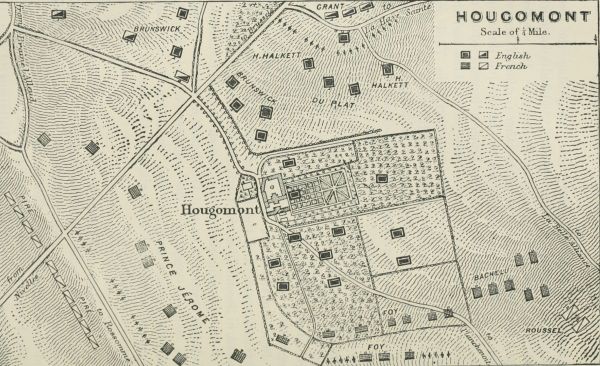
Hougomont
The Second Brigade, comprising the 2nd Battalion of the 2nd or Coldstream Regiment, and the 2nd Battalion of the 3rd Regiment of Foot Guards, and commanded by Major General Sir John Byng, was posted on the crest of the ridge, between the First Brigade and the Nivelles road. The 2nd Battalion 3rd Foot Guards was on the left, the 2nd Battalion of the Coldstream Guards on the right, and more in advance on the brow of the hill; and the disposition was such, that the four Battalions of the Division were placed en échiquier.
The Buildings of Hougomont, its Gardens and Orchards, were completely overlooked from the commanding ground occupied by the Second Brigade, which formed the Reserve to the troops therein posted, consisting (including those in the Wood) of the four Light Companies of the Division, the 1st Battalion of the 2nd Regiment of Nassau, a Company of Hanoverian Field Riflemen, and a Detachment of a hundred men from the Field Battalion Lüneburg of Kielmansegge's Brigade.
The principal dwelling house or Château of Hougomont was a substantial brick building, of a square form. Adjoining its north-east angle was the Farmer's House, the east end of which abutted on the Great Garden; and in the angle between this house and the Château was a narrow tower, of the same height as the latter, to which its interior served as a staircase. At the south-east corner of, and communicating with, the Château stood a very neat little Chapel.
On the north, or British, side of the Château, was a spacious Farm yard, bounded on the west by a large Barn and a Shed, and on the east by Cow Houses and Stabling adjoining the Garden. There was a continuation of the Stabling along the north side, and a gateway; and near the centre of the yard there was a drawwell of which the superstructure formed a dovecot.
On the south, or French, side of the Château, and inclosing the latter, was the Court yard; of which a Barn on the west, the Gardener's House, some Stables and other Offices on the south, and the Garden Wall on the east, formed the boundaries. There was a communication between the Court and the Farm yard, by means of a doorway in the small portion of wall connecting the Château with the great Barn; and through the whole length of the latter building there was also a carriage way leading from the one Court into the other. A gateway, passing through a portion of the Gardener's House, led out from the Court yard to the south, or French, side; and from this gate a narrow road conducted across the open space between the Buildings and the Wood, through which it took its course in the same direction until it gained the fields beyond the inclosures. There was also a pathway from this road, commencing at the corner of the little Garden, and traversing the Wood in the direction of the south-east angle of the general boundary of the inclosures, whence it continued towards La Belle Alliance.
The approach to Hougomont from the Nivelles road was lined, nearly as far as the Château, by fine tall elms: it conducted to the gate of the Farm yard facing the British Line; and, sweeping along the west side, it led also to the South Gate of the Court yard. On the east side of the Buildings was a large Garden, laid out with all the formality which characterises the Flemish style. It was inclosed on the south and east sides by a high brick wall, and on the north side, facing the British Line, by a hedge. Adjoining the east side of the Garden, but considerably wider and longer than the latter, was the Large Orchard, and along the north side was the smaller Orchard—the latter bounded by a hedge and hollow way, and the former inclosed within high and compact hedges, partially lined by a ditch on the inner side. A prolongation of the southern hedge of the Great Orchard formed the boundary of the Wood facing the south Garden Wall, and in the narrow space between these two boundaries was a row of apple trees, which, together with the hedge, served to conceal, in a great measure, the Garden Wall from the view of an Enemy, approaching through the Wood. There was a small Garden in front of the Gardener's house, formed by the continuation of the south Garden Wall until it met another wall issuing perpendicularly from the South Gateway leading out of the Court yard. There were two inclosures on the west side, of which one served as a Kitchen Garden.
The Wood extended in length, southwards, about 350 yards, and its greatest width was about 280 yards. It was bounded on the west by another Orchard; and on the east by two large inclosures, of which the one nearest the Great Orchard was a grass field fenced with hedges, and lined by a ditch on the inner side.
Although the site of the buildings of Hougomont was but slightly elevated above the valley, which, as already remarked, winds along the south and west inclosures, there was a gradual but uninterrupted ascent of the ground from thence as far as the eastern portion of the fence which divides the two inclosures, beyond the great Orchard; where it attained a height not much inferior to that of either the French or Allied Front Lines, between which it was centrically situated. On the south, or French, side of that hedge, the ground inclined at first gently, and then rapidly, into the valley; but on the west, throughout the extent of the Wood, and on the north of the Allied side, across the Great Orchard, the descent was everywhere very gradual.
Such was Hougomont—a decidedly important point in the Field of Battle, from its prominent position in the immediate front of the Right of the British line; and rendered ever memorable by the truly heroic and successful stand maintained throughout the day by the troops allotted for its defence.
From the first moment of the occupation of this Post, measures were concerted and adopted for strengthening the means of defence which it presented. During the night, the Garden Walls were pierced with numerous loopholes; and, in order to enable the men to fire down from the tops of the Walls upon their assailants, platforms constructed out of such materials as the place afforded were raised wherever the depth of the wall on the inner side rendered such a measure desirable. In many places, however, and especially on the eastern side, the ground formed embankments against the wall, sufficiently elevated to obviate the necessity of any additional aid for such purpose. The outer gates were closed up, with the exception of the one from the Farm yard, which faced the Anglo-Allied position, and which was left open in order to facilitate the communication with the latter. The different flanking fires which were offered by the relative situations of the Garden Walls, and the fences of the Orchards, Woods, and other inclosures, imparted to the Post a strength, of which, in the course of the action, due advantage was taken. In short, every precaution was adopted which the means at hand suggested for contributing to the security of the place; and the preparations that were in progress indicated, on the part of the troops stationed in this quarter, an intention to give the Enemy a warm reception, and a resolution to maintain a vigorous defence.
When, on the previous evening, the Light Companies of the Division were thrown into Hougomont, it was so arranged that those of the Second Brigade, under the command of Lieutenant Colonel Macdonell, should occupy the Buildings and the Gardens: and that those of the First Brigade, under Lieutenant Colonel Lord Saltoun, should hold the Great Orchard and the Wood; in which latter the Hanoverians and Nassauers were principally stationed.
The abrupt termination of the ridge along which the Allied Front Line was posted, at its point of junction with the Nivelles road, was in the direct rear of the buildings of Hougomont.
On the other side of the road, this termination presented a sudden and bold, though short, slope down into the long valley which, after sweeping by Hougomont, proceeds in the direction of Merbe Braine. A portion of the slope, including the summit, was covered with brushwood, and its base was bounded by a horse path, partially lined with a stunted hedge; forming, altogether, excellent cover for Light Infantry. On the other side of the valley, the ground ascends, at first abruptly, and then gradually, to the summit of that portion of the main ridge upon which the Left of the French Army rested; and from the point of junction of the Avenue conducting to Hougomont with the great Nivelles road, a narrow road leads directly up the opposite slope, and stretches across the ridge or plateau in the direction of Braine l'Alleud.
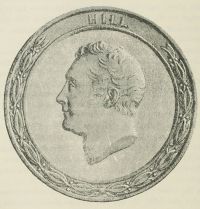
Hill
Along a portion of this road, principally consisting of a hollow way, were posted in advance, some Light Troops of the Anglo-Allied Army. They formed a part of the Fourth Brigade of the Fourth Division (under Colonel Mitchell), attached to the Second Corps, commanded by Lieutenant General Lord Hill. The Brigade consisted of the 3rd Battalion of the 14th British Regiment (under Lieutenant Colonel Tidy), of the 23rd Fusiliers (under Colonel Sir Henry Ellis), and of the 51st British Light Infantry (under Lieutenant Colonel Rice), which troops were disposed in the following manner.
Along that portion of the Hougomont Avenue which is nearest to the Nivelles road was extended the Light Company of the 23rd Regiment. On its right was an abatis, which had been thrown across the great road; and close upon the right of this artificial obstacle, a Company of the 51st Regiment was posted. Four more Companies of this Regiment, and the Light Company of the 14th, were extended along the hollow way alluded to as stretching across the ridge, on the extreme Left of the French position. The remainder of the 51st stood in Column of Support, about two hundred yards in rear of the hollow way. The 23rd Regiment was stationed on the left of the Nivelles road, on the reverse slope, and immediately under the crest of the main ridge, in rear of the Second Brigade of Guards. The 14th Regiment was posted in Column on the southern descent from the plateau, on which was assembled the Second British Division; and from the view which it possessed of the ground occupied by the 51st, it was well placed as a Reserve to the Light Infantry. In a ravine, descending from the immediate Right of the Skirmishers of the Brigade down into the valley, was posted a Squadron of the 15th British Hussars (under Captain Wodehouse), from which a Picquet was detached to the right of the abatis, as also an intermediate one for keeping up the communication; and some Vedettes were thrown out to the right, having in their front a continuation of the ravine, possessing a more marked and distinct character.
The troops posted upon the plateau already described as situated on the west of the Nivelles road and in front of the Village of Merbe Braine, and which, together with Colonel Mitchell's Brigade, constituted the extreme Right of the Anglo-Allied Army, under the command of Lord Hill, were available either as a Reserve to the main Line of Battle, or as a defence against any hostile attempt upon the Right Flank. They consisted of the main body of the Second Infantry Division, commanded by Lieutenant General Sir Henry Clinton. This was composed of the Third British Light Brigade, under Major General Sir Frederick Adam; of the First Brigade of the King's German Legion, under Colonel du Plat; and of the Third Hanoverian Brigade, under Colonel Halkett.
Adam's Brigade, consisting of the 52nd Regiment (under Colonel Sir John Colborne), of the 71st Regiment (under Colonel Reynell), of the 2nd Battalion of the 95th Regiment (under Lieutenant Colonel Norcott), and two Companies of the 3rd Battalion of the latter Corps (under Lieutenant Colonel Ross), was, previous to the commencement of the Battle, posted between the Village of Merbe Braine and the Nivelles road, near where the latter is intersected by the cross road leading to Braine l'Alleud: but as soon as the first attack was made upon Hougomont (with which the Battle opened), it was advanced beyond this cross road, and stood, in Battalion Columns of Companies, at quarter distance, on the plateau; whence it overlooked the Nivelles road, and had a full view of that portion of the main Front Line to which the troops of Clinton's Division formed a Reserve.
Du Plat's Brigade of the King's German Legion, consisting of the 1st Line Battalion (under Major Robertson), of the 2nd (under Major Müller), of the 3rd (under Lieutenant Colonel Wissell), and of the 4th (under Major Reh), stood in Open Column, near the foot of the slope descending towards the Nivelles road.
Halkett's Brigade, consisting of the Landwehr Battalions Bremervörde (under Lieutenant Colonel von der Schulenburg), Salzgitter (under Major Hammerstein), Osnabrück (under Major Count Münster), and Quackenbrück (under Major von dem Bussche Hünefeld), was posted in Contiguous Close Columns of Battalions, on the north side of the plateau, near the village of Merbe Braine.
The Second general Line of the Anglo-Allied Army consisted entirely of Cavalry, British and German. Posted partly on the reverse slope of the main ridge, and partly in the hollows in rear, it was entirely screened from the Enemy's observation. The Brigades were formed, for the most part, by Regiments, in Close Columns of Squadrons, at deploying intervals.
Commencing from the right, near to the Nivelles road, stood the Fifth Brigade, under Major General Sir Colquhoun Grant, consisting of the 7th and 15th Hussars, and of the 13th Light Dragoons (under Colonel Doherty.)
On the left of Grant's Brigade was posted the Third Brigade under Major General Sir William Dörnberg, consisting of the 23rd Light Dragoons, and of the 1st and 2nd Light Dragoons of the King's German Legion. The Cumberland Hanoverian Hussars (under Lieutenant Colonel Hake) were attached to, and formed in rear of, this Brigade. They properly belonged to Colonel Estorff's Hanoverian Cavalry Brigade: as did also the Prince Regent's Hussars (under Lieutenant Colonel Ferdinand Count Kielmansegge), and the Bremen and Verden Hussars (under Colonel August von dem Bussche); which Regiments were detached with the force at Hal.
Still more to the left, and in rear of the Right of Alten's Division, stood the 3rd Hussars of the King's German Legion, under Colonel Sir Frederick von Arentsschildt.
Immediately on the right of the Charleroi road, and in rear of Alten's Division, the First or Household Brigade, under Major General Lord Edward Somerset, was drawn up. It comprised the 1st and 2nd Life Guards, the Royal Horse Guards (Blue), and the 1st Dragoon Guards.
On the left of the Charleroi road, and in rear of Picton's Division, stood the Second Brigade, under Major General Sir William Ponsonby; consisting of the 1st Dragoons (Royals), the 2nd Dragoons (Scots Greys), and the 6th Dragoons (Inniskillings).
The Fourth and Sixth Brigades, under Major Generals Sir John Vandeleur and Sir Hussey Vivian, were posted upon the extreme Left of the main Line of the position, as previously explained.
The Reserves consisted of the Dutch-Belgian Cavalry Division, under Lieutenant General Baron Collaert; of the Brunswick Corps, comprising both Cavalry and Infantry, the command of which, since the fall of the Duke, had devolved upon Colonel Olfermann; and of the Tenth British Brigade, under Major General Sir John Lambert. The latter formed part of the Sixth Division, commanded by Lieutenant General the Hon. Sir Lowry Cole; and had only just reached the Field, after having performed forced marches from Ghent.
Collaert's Division was stationed in rear of the Centre, and within the angle formed by the junction of the high roads leading from Charleroi and Nivelles. It comprised the First Brigade, commanded by Major General Trip, and consisting of the 1st Dutch Carabiniers, the 2nd Belgian Carabiniers, and the 3rd Dutch Carabiniers; the Second Brigade, commanded by Major General Ghigny, and consisting of the 4th Dutch Dragoons, and the 8th Belgian Hussars; and the Third Brigade, commanded by Major General van Merlen, and consisting of the 5th Belgian Light Dragoons, and the 6th Dutch Hussars.
The Brunswick Corps was posted between the northern portion of the Village of Merbe Braine and the Nivelles road, on which its Left rested; and comprised the following troops:—a Regiment of Hussars, a Squadron of Lancers, the Advanced Guard Battalion (which was at this time detached to the right of Merbe Braine); a Light Infantry Brigade, under Lieutenant Colonel Buttlar, consisting of the Guard Battalion, and the 1st, 2nd, and 3rd Light Battalions; and an Infantry Brigade, under Lieutenant Colonel Specht, consisting of the 1st, 2nd, and 3rd Line Battalions.
Lambert's Brigade was posted near the Farm of Mont St Jean; and consisted of the 4th Regiment (under Lieutenant Colonel Brooke), of the 27th Regiment (under Major Hare), and of the 40th Regiment (under Major Heyland).
In order to afford greater security to the Right Flank of the Anglo-Allied Army, and also to keep open the communication with the detached forces near Hal, and at Tubize, namely, the Corps of Prince Frederick of Orange, and the Sixth British and Sixth Hanoverian Brigades, under Lieutenant General Sir Charles Colville; it was deemed essential to occupy the small town of Braine l'Alleud, about three quarters of a mile westward of Merbe Braine: and whence a road leads to Tubize, which is distant between eight and nine miles.
With this view, the Third Division of the Netherlands, commanded by Lieutenant General Baron Chassé, was placed under the orders of General Lord Hill; a part of whose Corps, as previously explained, formed the extreme Right of the Anglo-Allied position. The First Brigade, under Colonel Ditmers, occupied the town itself. It consisted of the 35th Battalion of Belgian Light Infantry, the 2nd Battalion of the Dutch Line, and of the 4th, 6th, 17th, and 19th Battalions of Dutch Militia. The 17th Battalion, detached a little to the left, kept up the communication with Clinton's British Division. The Second Brigade, under Major General d'Aubremé, occupied a good position about half a mile in advance of Braine l'Alleud, upon a height on which stood the Farm of Vieux Foriez.
It was at a very early hour of the 18th, that Lieutenant Colonel Torrens, Deputy Quartermaster General, reached Braine le Comte, and delivered to Sir Charles Colville the Order (see page 285), for his falling back upon Hal. That General immediately put in motion his two Brigades. These consisted of the Sixth British Brigade, under Major General Johnstone, and the Sixth Hanoverian Brigade, under Major General Sir James Lyon, accompanied by Major Brome's British Foot Battery. The remaining Brigade (the Fourth British, under Colonel Mitchell), as also the other Foot Battery, belonging to the Fourth Division (Captain Rettberg's Hanoverian), were on the Field of Waterloo. On reaching Tubize, Colville fell in with the Advance of Prince Frederick's Corps: and as that was the point of junction with the road leading by Braine le Château and Braine l'Alleud to the position in front of Waterloo; he halted there, and despatched Lieutenant Colonel Woodford, Assistant Quartermaster General to the Division, to report his proceedings to the Duke. His Grace expressed himself perfectly satisfied; and desired Lieutenant Colonel Woodford to remain upon the Field of Waterloo, in order that he might be prepared to return to Sir Charles Colville with any instructions which circumstances might induce the Duke to transmit to him.
The Artillery of the Anglo-Allied Army, commanded by Colonel Sir George Wood, was distributed in the following manner:—
On the extreme Left was a British Horse Battery[9] of six guns, under Lieutenant Colonel Sir Robert Gardiner, with Vivian's Hussar Brigade. Upon the exterior slope of the main ridge, and above the Hamlet of Papelotte, were four guns of Captain Byleveld's Dutch-Belgian Horse Battery, attached to Perponcher's Division. The remaining four guns of this Battery were on the crest of the main ridge, in rear of that Division. On the highest point of the position of the Left Wing, and in front of the Right of Best's Hanoverian Brigade, was posted Captain Rettberg's Hanoverian Foot Battery of six guns. In front of Kempt's Brigade stood Major Rogers's British Foot Battery of six guns. Major Lloyd's British, and Captain Cleeves's King's German, Foot Batteries, of six guns each, were with Alten's Division. Major Kuhlmann's King's German Horse Battery, and Captain Sandham's British Foot Battery, of six guns each, were attached to Cooke's Division. All the above Batteries were posted in Front Line; as was also Lieutenant Colonel Sir Hew Ross's British Horse Battery (from the Reserve), of six guns, which was posted on the height immediately in rear of La Haye Sainte, and near the intersection of the Wavre road with the Charleroi high road, in which latter two of its guns were stationed. Major Sympher's King's German Horse Battery, and Captain Bolton's British Foot Battery, of six guns each, were attached to Clinton's Division.
The remaining Horse Batteries were with the Cavalry. They were (exclusive of Lieutenant Colonel Sir Robert Gardiner's already mentioned) Major Bull's of six howitzers; Lieutenant Colonel Webber Smith's of six guns; Major Whinyates's of six guns, and provided with rockets; Captain Mercer's of six guns; and Major Ramsay's of six guns. Captain Petter's Dutch-Belgian Horse Battery of eight guns, was attached to Collaert's Cavalry Division. The Dutch-Belgian Horse Battery under Captain van der Smissen, and Foot Battery under Captain Lux, of eight guns each, were with Chassé's Division at Braine l'Alleud. The Brunswick Horse Battery, under Captain Heinemann; and Foot Battery, under Major Moll, of eight guns each, were with the Brunswick Corps. The British Horse Battery under Major Beane, and Foot Battery under Captain Sinclair (belonging to the Sixth Division), as also the Hanoverian Foot Battery under Captain Braun, all three having six guns each, were in reserve near Mont St Jean.
The whole of the Batteries were engaged in the Front Line, more or less, during the course of the Battle.
This disposition of Wellington's forces, so completely in accordance with the general features of the ground which he had selected with consummate judgment as the Field on which he was prepared to give battle to his imperial rival in the great art of war, was admirably calculated for either offensive or defensive measures. The opposite line of Heights, which the Enemy would naturally crown with the main Line of his forces, was fully within the effectual range of cannon shot; and no hostile movement could be made against any part of the position, that would remain undiscovered within the range of musketry. The formation of the ground in rear of the ridge, along the brow of which his Front Line was posted, was such as effectually to screen from the Enemy's observation any movements of the Supports and Reserves, preparatory to either a contemplated attack, or to the assembling of the necessary means of resistance at any threatened point. In rear of the main Front Line the ground was practicable for the movements of all Arms, the country was perfectly open, and the two high roads added still further to the facility of communication between the front and rear. The occupation of the Posts of Hougomont and La Haye Sainte presented important advantages in aid alike of offensive and defensive operations.
The Right Flank was rendered secure, not only by the position of Clinton's Division, commanding the valley skirting the Village of Merbe Braine, but also by the occupation of the Town of Braine l'Alleud, whence Chassé's Division could co-operate so as to render any attempt of the Enemy to turn that Flank a most hazardous experiment.
Although the Left of the main Front Line rested upon an open plain or elevated plateau, and was therefore completely en l'air: yet the Village of Smohain, the Farms of La Haye and Papelotte, together with the scattered houses and numerous enclosures on the abrupt slope descending into the valley in front, by being well garnished with Infantry, offered the means of protracted resistance; while Cavalry was at hand, on the high ground, to cover the latter if forced to retire, and to frustrate the complete development of the Enemy's disposition of attack. The latter description of force was also available in maintaining a vigilant look out for any direct flank attack; which, however, was the less to be apprehended in consequence of the preconcerted Prussian co-operation in that quarter.
The position also afforded ample security for a retreat. The two broad high roads uniting at a point in rear of the centre, greatly facilitated the retirement of unbroken masses upon Mont St Jean; while the Village itself, and the numerous buildings and inclosures which lined the great road as far as the Forest of Soignies, presented the ready means of securing the further retreat of those masses, which, it may be assumed, would have constituted a main Central Column.
On the right, the Villages of Merbe Braine, Le Mesnil, and L'Estraye, connected with Braine l'Alleud and with one another, as also with the Forest, by several cross roads, and intersected by numerous inclosures, were well calculated for the retirement of the extreme Right of the Army, by the advantages which they afforded for covering such retreat with Light Troops.
On the left, the ground was more open, but the distance between the position and the Forest was infinitely less, the latter stretching southward to the Village of Verd Cocou; and the troops retiring in this direction, being much closer to the high road, would have their Right in a great measure protected by the well defended retreat of the Central Column.
The Forest itself, consisting almost entirely of tall trees, unaccompanied by underwood, was passable for all Arms; it was intersected by numerous roads and lanes in every direction; and its southern extremity, adjoining the high road, was thickly skirted with houses and gardens, adding considerably to its capabilities for a vigorous stand against the further advance of an Enemy.
The retrograde march of the detached forces from Tubize and Hal upon Brussels, and their junction with the remainder of the Anglo-Allied Army in the position of Uccle, between that capital and the Forest of Soignies, will readily present itself to the minds of military men studying the dispositions and movements to which a retreat would have probably given rise; but this is a subject which, embracing as it naturally would, the consequent operations of the Prussians, opens a wide field for discussion, into which it is unnecessary to enter.
The general direction of the Front Line of the French Army was nearly parallel with that of the Anglo-Allies. The high road from Charleroi to Brussels, which intersected the Allied position near its Centre, also passed through the Centre of the French line. The point of this intersection was La Belle Alliance, a small Farm house and Inn; and the distance from the one position to the other, taken along the high road between these two points, was 1400 yards.
About two hundred yards in the French rear of this house is a summit, the altitude of which exceeds, by about thirteen feet, that of any point along the Anglo-Allied position. A ridge issuing from it, and extending in a north easterly direction towards Frischermont, formed the position of the Right Wing of the Front Line of the French Army.
On the west side, a road leading from the summit, descends rather rapidly as a hollow way down into and across the long valley that takes its course towards Hougomont, then ascends until it reaches another ridge, along which it winds round that Post, at a distance varying from 300 to about 440 yards, until it joins the Nivelles chaussée; and that winding road indicates pretty nearly the ground occupied by the Left Wing of the French Front Line.
The Right Wing of this Line consisted of the First Corps d'Armée, commanded by Lieutenant General Count d'Erlon, comprising four Divisions of Infantry, and one of Light Cavalry.
Its Left Division, which was the Second, commanded by Lieutenant General Baron Donzelot, rested its Left upon La Belle Alliance. The First Brigade of this Division, under General Baron Schmith, consisted of the 13th Regiment of Light Infantry and the 17th Regiment of the Line; the former comprising three, and the latter, two, Battalions. The Second Brigade, under General Aulard, consisted of the 19th and 51st Regiments of the Line, each comprising two Battalions. These Brigades were deployed in two Lines, the second at a distance of sixty yards in rear of the first.
On the right of the Second Division was the First, commanded by Lieutenant General Alix. Its First Brigade, under General Baron Quiot, consisted of the 54th and 55th Regiments of the Line, each comprising two Battalions. Its Second Brigade under General Baron Bourgeois, consisted of the 28th and 105th Regiments of the Line, each comprising two Battalions. The Brigades were deployed in two Lines, the second at a distance of sixty yards in rear of the first.
On the right of the First Division stood the Third, commanded by Lieutenant General Baron Marcognet. Its First Brigade, under General Noguès, consisted of the 21st and 46th Regiments of the Line; and its Second Brigade, under General Grenier, of the 25th and 45th Regiments of the Line; all four Regiments comprising two Battalions each. These two Brigades were, in like manner, deployed in two Lines, the second at a distance of sixty yards in rear of the first.
On the right of the Third Division, nearest to the extremity of the ridge, and immediately opposite the Farms of Papelotte and La Haye, was posted the Fourth Division, commanded by Lieutenant General Count Durutte. Its First Brigade, under General Chevalier Pegot, consisted of the 8th and 29th Regiments of the Line; and its Second Brigade, under General Brue, of the 85th and 95th Regiments of the Line; all four Regiments comprising two Battalions each. These two Brigades were also deployed in two Lines, the second at a distance of sixty yards in rear of the first.
The Cavalry attached to this Corps, which was the First Division, commanded by Lieutenant General Baron Jaquinot, was posted in a valley on the right of the Infantry: having in its front the Village of Smohain, which it held in observation, as also the Château of Frischermont, on the right of the valley; at the same time throwing out Patrols in the direction of Ohain. It was deployed in three Lines. Its First Brigade, under General Bruno, consisting of the 3rd and 7th Chasseurs; and its Second Brigade, under General Gobrecht, of the 3rd and 4th Lancers.
The Artillery attached to the Infantry Corps, consisting of five Batteries of eight guns each (including a Reserve Battery of eight twelve pounders), was ranged along the front of the different Divisions respectively; and the Battery of Horse Artillery—six guns—attached to the First Division of Cavalry, was posted on the right of the latter.
The Left Wing of the Front Line of the French Army was formed by the Second Corps, commanded by Lieutenant General Count Reille, comprising three Divisions of Infantry and one of Light Cavalry.
Its Right Division, which was the Fifth, commanded by Lieutenant General Baron Bachelu, rested its Right upon La Belle Alliance, and was ranged along the descent from thence down into the valley, which, more westward, winds past Hougomont. The First Brigade of this Division, under General Husson, consisted of the 2nd Regiment of Light Infantry and the 61st Regiment of the Line, the former comprising two, and the latter, three, Battalions; and the Second Brigade, under General Baron Campy, of the 72nd and 108th Regiments of the Line, the former comprising two, and the latter, three, Battalions. The Brigades were deployed in two Lines, the second at a distance of sixty yards in rear of the first.
On the Left of the Fifth Division, and upon the Height facing the southern boundary of Hougomont, stood the Ninth Division, commanded by Lieutenant General Count Foy. Its First Brigade, under General Baron Gauthier, consisted of the 92nd and 93rd Regiments of the Line, comprising two Battalions each. Its Second Brigade, under General Baron Jamin, consisted of the 4th Regiment of Light Infantry, and of the 100th Regiment of the Line, each comprising three Battalions. These two Brigades were, in like manner, deployed in two Lines, the second at a distance of sixty yards in rear of the first.
On the left of the Ninth Division, and along the ridge of the western boundary of Hougomont, stood the Sixth Division, commanded by Prince Jerome Napoleon. Its First Brigade, under General Baron Bauduin, consisted of the 1st Regiment of Light Infantry and of the 3rd Regiment of the Line, the former comprising three, and the latter two, Battalions. Its Second Brigade, under General Baron Soye, consisted of the 1st and 2nd Regiments of the Line, comprising three Battalions each. These two Brigades were also deployed in two Lines, the second at a distance of sixty yards in rear of the first.
On the left of the Infantry, was posted the Light Cavalry attached to the Corps, namely, the Second Cavalry Division, commanded by Lieutenant General Baron Piré. Its First Brigade, under General Baron Hubera, consisted of the 1st and 6th Chasseurs; and its Second Brigade, under General Mathieu, of the 5th and 6th Lancers. It stood across the Nivelles high road, in three deployed Lines, rather under the crest of the ridge, on its reverse slope; and threw out Picquets in the direction of Braine l'Alleud, as also more to its left, thus keeping up a vigilant look out around this Flank of the Army.
The Second general Line of the French Army was formed in the following manner:—
In the Centre, close along the west side of the Charleroi high road, stood the Sixth Corps, commanded by Lieutenant General Count Lobau. Only two of its Divisions, the Nineteenth and Twentieth, were present; the Twenty First was with the Army under Marshal Grouchy. Each of the two Divisions formed a Close Column of Battalions by Grand Divisions; the head of the Column of the Nineteenth Division being distant about a hundred yards in rear of the right of the Second Corps, and an interval of about two hundred yards was preserved between the rear of the Nineteenth Division and the head of the Column of the Twentieth Division.
The former was commanded by Lieutenant General Baron Simmer; and its First Brigade, under General Baron de Bellair, consisted of the 5th and 11th Regiments of the Line, the former comprising two, the latter, three, Battalions. Its Second Brigade, under General Simmer, consisted of the 27th and 84th Regiments of the Line, comprising two Battalions each.
The Twentieth Division was commanded by Lieutenant General Baron Jeannin: its First Brigade, under General Bony, consisted of the 5th Regiment of Light Infantry, and of the 10th Regiment of the Line; and its Second Brigade, under General Tromelin, of the 107th Regiment of the Line; all three Regiments comprising two Battalions each.
There were three Batteries of Foot Artillery, of eight guns each, attached to the Divisions, including one of reserve; as also a Horse Battery of six guns. They were posted on the Left Flank of the Corps.
On the right of these two Divisions of the Sixth Corps, and separated from them by the high road only, were stationed the Third Light Cavalry Division, commanded by Lieutenant General Baron Domon, and the Fifth Light Cavalry Division, commanded by Lieutenant General Baron Subervie (belonging to the First Cavalry Corps, commanded by General Count Pajol). They were formed in Close Column of Regiments by Squadrons. The First Brigade of the former, under General Baron Dommanget, consisted of the 4th and 9th Chasseurs; and the Second Brigade, under General Baron Vinot, of the 12th Chasseurs. The First Brigade of the Fifth Division, under General Count Colbert, consisted of the 1st and 2nd Lancers; and the Second Brigade, under General Merlin, of the 11th Chasseurs.
The two Batteries of Horse Artillery attached to these two Divisions, comprising six guns each, were posted on the Right Flank of the Column.
The Right Wing of the Second French general Line was composed of the Fourth Cavalry Corps, commanded by Lieutenant General Count Milhaud, which was posted on a parallel ridge, in rear of the two central Divisions of the First Infantry Corps, and distant from them about two hundred yards. It was deployed in two Lines, the second at a distance of sixty yards in rear of the first.
The Corps consisted of two Heavy Cavalry Divisions—the Thirteenth, commanded by Lieutenant General Wathier St Alphonse, and the Fourteenth, under Lieutenant General Baron Delort. The First Brigade of the Thirteenth Division, under General Dubois, consisted of the 1st and 4th Cuirassiers; the Second, under General Baron Travers, of the 7th and 12th Cuirassiers. The First Brigade of the Fourteenth Division, under General Baron Farine, consisted of the 5th and 10th Cuirassiers; and the Second, under General Baron Vial, of the 6th and 9th Cuirassiers.