Front matter (continued 7)
Reading edition
The two Batteries of Horse Artillery attached to this Corps, comprising six guns each, were stationed, one in the Centre, and the other on the Left Flank.
The Left Wing of the French Second general Line, composed of the Third Cavalry Corps, commanded by Lieutenant General Kellermann (Count de Valmy), was posted about two hundred yards in rear of the Centre of the Second Infantry Corps. It was deployed in two Lines, the second at a distance of sixty yards in rear of the first.
The Corps consisted of two Heavy Cavalry Divisions: the Eleventh, commanded by Lieutenant General Baron L'Heritier; and the Twelfth, under Lieutenant General Roussel d'Hurbal. The First Brigade of the Eleventh Division, under General Baron Picquet, consisted of the 2nd and 7th Dragoons; and the Second, under General Gniton, of the 8th and 11th Cuirassiers. The First Brigade of the Twelfth Division, under General Baron Blancard, consisted of the 1st and 2nd Carabiniers; and the Second, of the 2nd and 3rd Cuirassiers.
The two Batteries of Horse Artillery attached to this Corps, comprising six guns each, were posted one upon each Flank.
The Third general Line, forming the Grand Reserve of the whole Line of Battle, and comprising the entire force of the Imperial Guards, Cavalry and Infantry, under the command of Lieutenant General Count Drouot, was thus formed.
The Infantry of the Imperial Guard constituted the Centre of the Reserve. It consisted of four Regiments of Grenadiers, four Regiments of Chasseurs, two Regiments of Tirailleurs, and two Regiments of Voltigeurs; each Regiment divided into two Battalions. The 1st and 2nd Regiments of Grenadiers, and the 1st and 2nd of Chasseurs, formed the Old Guard, under Lieutenant General Count Friant; the 3rd and 4th Regiments of Grenadiers, and the 3rd and 4th of Chasseurs formed the Moyenne, or Middle, Guard, under Lieutenant General Count Morand; the four Regiments of Tirailleurs and Voltigeurs constituted the Young Guard under Lieutenant General Count Duhesme. This force was posted somewhat in advance of the Farm of Rossomme, in six Lines of four Battalions each, at a distance of twenty yards from one another, and so disposed that the Charleroi high road alone separated the two Right, from the two Left, Battalions of each Line. To each description of the Infantry of the Imperial Guard; the Old, the Middle, and the Young, Guard, two Batteries, of eight guns each, were attached. These were stationed on either Flank; and the Reserve Artillery of the Guard, consisting of twenty four guns, was posted in rear of these Lines.
The Right Wing of the Third Line, or Reserve, consisted of the Light Cavalry of the Imperial Guard, commanded by Lieutenant General Lefèbvre Desnouettes, namely, the Chasseurs and Lancers of the Guard. It was posted at a distance of about two hundred yards in rear of the Fourth Cavalry Corps and deployed in two Lines, the second at a distance of sixty yards in rear of the first. The two Batteries of Horse Artillery belonging to the Corps, comprising six guns each, were posted in its centre.
The Left Wing of the Third Line, or Reserve, consisted of the Heavy Cavalry of the Imperial Guard, commanded by Lieutenant General Count Guyot, namely, the Grenadiers and Dragoons of the Guard. It was stationed in rear of the Third Cavalry Corps, and deployed in two Lines, the second at a distance of sixty yards in rear of the first. Its two Batteries of Horse Artillery, comprising six guns each, were posted in the centre.
This admirable order of battle, at once grand, simple, and imposing, and presenting to its skilful designer the most ample means of sustaining, by an immediate and efficient support, any attack, from whatever point he might wish to direct it, and of possessing everywhere a respectable force at hand to oppose any attack upon himself, from whatever quarter it might be made, was no less remarkable for the regularity and precision with which the several masses, constituting thirteen distinct Columns, advanced to their destined stations, than for the unusual degree of warlike pomp and high martial bearing with which the Lines drew up in this mighty battle array. The movements throughout were executed under the cheering and spirit stirring sounds of bugles, drums, and trumpets, sending forth the long cherished national military airs of the Republic and of the Empire. The weather had cleared up a little, and to the Anglo-Allied Army, the crowning of the opposite Heights by the French Lines, with all its accompanying circumstances, presented a magnificent spectacle.
Napoleon has frequently been blamed for having thus consumed some very precious time in a mere ostentatious display of his forces. Public opinion, however, should not suffer itself to be too easily influenced by the apparent justness of such censure, and it would be ungenerous to the established renown of the French Leader not to attach due weight to the following circumstances. In the account of the Battle attributed to the Emperor's own dictation, one cause of delay in commencing offensive operations is represented to have been the soft and miry state of the ground after the excessive rain which had fallen during the night; in consequence of which it was found impossible to manœuvre the Artillery and the Cavalry, and it was considered advisable to wait until the ground had, in some degree, resumed its natural consistency. When, therefore, the manœuvring of these two Arms was pronounced to be practicable, though attended with some difficulty, which, however, it was added, would gradually disappear; the employment of the interval in an orderly and a deliberate formation of a well-defined order of battle, was a measure scarcely questionable at the moment, however much the subsequent course of events may have proved that it militated against the chances of success on the part of the French.
The additional impulse which this imposing spectacle was calculated to impart to the moral force of his troops, is also well worthy of consideration. His soldiers, as they contemplated the extended double Front Line of Infantry, disposed as if about to enfold the Enemy in a deadly embrace, and the fluttering of gay lance flags on either extremity, indicating that its Flanks were duly protected; as they glanced at the Second general Line, a double one of Cavalry, superbly mounted, and proudly mailed in glittering helmet and cuirass; and, as they scanned the well disposed Reserves and serried Centre; their reliance on their own strength and in the resources of their Leader was unbounded, their anticipations of success were heightened, and their eager longing for the contest was greatly augmented. And while adverting to the grand spectacle in a moral point of view, it would be well to consider whether it may not have also been designed to exert a powerful influence on that portion of the Anglo-Allied forces with which the Emperor was tampering, in the full expectation of seeing them again range themselves under his victorious Eagles: but which Wellington, with judicious foresight and prompt address, broke up as a united body, and distributed among his British troops; thus securing himself against the possible enactment of a scene similar to that which so powerfully contributed to Napoleon's disaster on the plains of Leipzig.
But supposing it to be admitted upon these grounds that the delay of the attack, having once been determined, was judiciously and advantageously employed, we ought also to consider whether the delay itself may not have been superinduced by motives of far higher import.
Although the miry state of the ground has been put forward as the ostensible cause, can we for a moment imagine that Napoleon was the man to have allowed himself to be deterred by such an obstacle from commencing the attack at an earlier hour; had he, at the moment, been sufficiently acquainted with the actual state of things to foresee that the delay, together with the possibility of a lengthened contest, and of the approach of aid to the British General from the Prussian side, tended to render his situation one of extreme peril?
May we not rather be justified in inferring, that his object was to gain time for the due execution and successful development of Grouchy's operations! The despatch which the Emperor had received from Grouchy, dated Gembloux, 17th June, at 10 P.M. (see page 300), clearly explained that General's intentions, which were, that should the mass of the Prussian forces retire upon Wavre, he would follow them in that direction, so as to prevent them from either reaching Brussels or forming a junction with Wellington; but that if, on the other hand, they should fall back upon Perwès, he would advance towards that town in pursuit of them. In the former case, Napoleon's delay was likely to facilitate the combined operation; because in order to prevent the junction with Wellington, Grouchy required sufficient time to throw himself between the Prussians and the Emperor: and, in the latter case, the delay would be immaterial, because then the Prussian co-operation with Wellington was not to be apprehended; and the battle with the Anglo-Allied Army would have to be fought by the Emperor, unsupported by Grouchy.
It may, perhaps, be argued that Napoleon, by commencing his attack much earlier, would not have been under the necessity of employing a considerable portion of his Reserve against the Prussians in defence of his Right Flank, at a time when he so urgently needed them for following up and strengthening his attacks upon the Duke of Wellington's line. There existed, however, no such striking disparity, in point of numbers, between Wellington's forces, and his own, as to warrant his throwing away a chance amounting, according to the information he had already received, almost to a certainty, of being enabled to bring his greatest mass to bear against each Army separately: and which would doubtless have been the case as regards the Anglo-Allied Army, had Grouchy, by the adoption of more vigorous and energetic measures, manœuvred in such a manner as to sufficiently impede the Prussian co-operation by posting one of his Corps so as to command the Defiles of St Lambert and Lasne, and holding the other in reserve, to be employed by either the Emperor or himself, according to circumstances.
Whether Napoleon was really actuated by any such motives, must remain a doubtful point. These remarks, however, are offered for the consideration of those who censure him for his delay in commencing the Battle of Waterloo.
The strength of the Anglo-Allied Army in the Field was as follows:—
Infantry. Cavalry. Artillery. Guns.
British 15,181 5,843 2,967 78
King's German Legion 3,301 1,991 526 18
Hanoverians 10,258 497 465 12
Brunswickers 4,586 866 510 16
Nassauers 2,880
Dutch-Belgians 13,402 3,205 1,177 32
——— ——— ——— ———
Total 49,608 12,402 5,645 156
GRAND TOTAL.
Infantry 49,608
Cavalry 12,402
Artillery 5,645
———
Total 67,655 men, and 156 guns.
The French Army consisted of:—
Infantry 47,579
Cavalry 13,792
Artillery 7,529
———
Total 68,900 men, and 246 guns.
The martial sounds already adverted to as having accompanied the march of the French Columns into position, had scarcely been wafted towards the Anglo-Allied Army, when mounted Officers were discerned galloping along the opposite Heights, and taking up the necessary alignments; and, presently, the simultaneous flashing of bayonets over dark masses, on various points, and the roll of drums, now become more distinctly audible, announced the arrival of the heads of the Columns destined to constitute the Front Line. As this gradually developed itself, and was seen extending on either side, from La Belle Alliance, and apparently almost overlapping both Flanks of the Allies, the scene became truly imposing and highly exciting. The two Armies were now fairly in presence of each other; and their mutual observation was governed by the most intense interest, and the most scrutinizing anxiety.
In a still greater degree did these feelings actuate their Commanders, while watching each other's preparatory movements, and minutely scanning the surface of the arena on which tactical skill, habitual prowess, physical strength, and moral courage, were to decide, not alone their own, but in all probability, the fate of Europe. Apart from national interests and considerations, and viewed solely in connection with the opposite characters of the two illustrious Chiefs; the approaching contest was contemplated with anxious solicitude by the whole military world. Need this create surprise when we reflect that the struggle was one for mastery between the far famed Conqueror of Italy, and the victorious Liberator of the Peninsula; between the triumphant Vanquisher of Eastern Europe, and the bold and successful Invader of the South of France! Never was the issue of a single Battle looked forward to as involving consequences of such vast importance—of such universal influence.
FOOTNOTES:
CHAPTER X.
WHILE the preparatory dispositions, alluded to in the preceding Chapter, were in progress, Napoleon ordered the following despatch to be forwarded to Grouchy:—
"En avant de la Ferme de Caillou, le 18 Juin, à 10 heures du matin. "In front of the Farm de Caillou, 18th June, at 10 o'clock in the morning.
"Monsieur le Maréchal, "Monsieur Marshal,
"L'Empereur a reçu votre dernier rapport daté de Gembloux. Vous ne parlez à sa Majesté que des deux Colonnes Prussiennes qui ont passé à Sauvenières et Sarra Walin; cependant des rapports disent qu'une troisième Colonne, qui était assez forte, a passé à Gery et Gentinnes, se dirrigeant sur Wavres. "The Emperor has received your last report dated from Gembloux. You only speak to His Majesty of the two Prussian Columns which have passed by Sauvenières and Sarra Walin; however the reports say that a third Column, which was pretty strong, has passed by Gery and Gentinnes, directing itself on Wavre.
"L'Empereur me charge de vous prévenir, qu'en ce moment S.M. va faire attaquer l'Armée Anglaise qui a pris position à Waterloo, près de la Forêt de Soignes; ainsi S.M. désire que vous dirigiez vos movemens sur Wavres, afin de vous rapprocher de nous, vous mettre en rapport d'opérations et lier les communications, poussant devant vous les Corps de l'Armée Prussienne qui ont pris cette direction et qui auraient pu s'arrêter à Wavres, ou vous devez arriver le plus tôt possible. "The Emperor charges me to inform you, that at this moment His Majesty is going to attack the English Army which has taken up a position at Waterloo, near the Forest of Soignies; so His Majesty desires that you would direct your movements on Wavre in such a manner as you may approach us, so as to put yourself in touch with the operations and to knit up the communications; pushing before you the Corps of the Prussian Army which has taken that direction, and which may have halted at Wavre, where you should arrive at the earliest possible moment.
Vous ferez suivre les Colonnes Ennemies qui ont pris sur votre droite par quelques Corps Légers, afin d'observer leur mouvements et ramasser leurs fuyards; instruisez moi immédiatement de vos dispositions et de votre marche, ainsi que des nouvelles que vous avez sur les Ennemis, et ne négligez pas de lier vos communications avec nous; l'Empereur désire avoir très souvent de vos nouvelles. You will cause the Enemy's Columns which have taken (the road) on your right to be followed by some Light Corps, in order to observe their movements and to collect their fugitives. Instruct me immediately of your dispositions and of your march, as well as of the news you may have of the Enemy, and do not neglect to knit up your communications with us. The Emperor desires to receive news from you very frequently.
"Le Major Général Duc de Dalmatie." "The Major General Duke de Dalmatia."
It will thus be seen that Grouchy's report, despatched from Gembloux on the previous night, was well calculated to inspire the Emperor with great confidence as to the result of his present plan of operations, notwithstanding the very little progress that had hitherto been made in that quarter; and which, as already remarked, must be ascribed principally to his own inactivity during the early part of the 17th. He approved of the movement upon Wavre, in pursuit of the great mass of the Prussian Army: but at the same time expressed his desire that it should be executed in such a manner as to draw the Detached Force more within the sphere of the operations of the main French Army; and above all, he enforced the necessity of maintaining a close communication with the latter.
Some time before the Battle commenced, a Prussian Patrol reached the Village of Smohain, in which was posted the Picquet of the 10th British Hussars, under Captain Taylor; whom the Officer accompanying the Patrol desired to report to the Duke of Wellington that General Count Bülow was at St Lambert, and advancing with his Corps d'Armée. Captain Taylor immediately despatched Lieutenant Lindsey, of the 10th, with the intelligence to Head Quarters, as directed. The Prussian Officer was certainly ignorant of the very slow progress made by the main body of Bülow's Corps; and the information which he thus conveyed to the Duke, before the Battle had commenced, naturally led the latter to calculate upon a much earlier arrival of the Prussians than could possibly take place: for, in point of fact, it was only Bülow's Advanced Guard which had then reached St Lambert.
The formation of the French Lines was scarcely completed when the magnificent and animating spectacle which they presented was heightened in an extraordinary degree by the passing of the Emperor along them, attended by a numerous and brilliant Staff. The troops hailed him with loud and fervent acclamations. There was depicted on their brows a deep rooted confidence in his ability, with such an Army, to chain victory to the car in which he had already advanced in triumph to within a few miles of the capital of Belgium. They exulted in the idea that they were now fairly ranged in battle array, under the Chief of their choice, and the idol of their devotion, against the Army of that nation which of all others had proved the most inveterate and the most enduring in its hostility to France; a nation which had not only by its wealth cemented and held together the great European league which had once precipitated that idol from the throne, but had also flung into the scale her own native strength and valour, by which the Fleets of the Empire had been destroyed, its Armies driven out of the Peninsula, and the sceptres of Spain and Portugal wrested from its grasp. They appeared as if excited by the assurance, that the hour had arrived in which the disasters of the Nile and Trafalgar, of Salamanca and Vittoria, were to be cast into the dark shade of oblivion, by the dazzling splendour of the triumph about to be achieved.
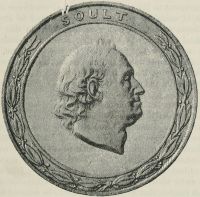
Soult
Never throughout the whole of his career had Napoleon received from his soldiers more unequivocal demonstrations of attachment to his person, of unlimited confidence in his power, of complete devotion to his cause, and of absolute submission to his will, than were manifested in this short and fatal Campaign by which that career was terminated. With an Army thus animated by one sentiment, and presenting in appearance and material all that his practised eye could desire, it may readily be conceived that he fully participated in the general confidence of a signal victory.
Wellington's dispositions remained as previously described. Shortly before the action commenced, he rode down to Hougomont, and, proceeding by the Lane which crosses the Wood in the direction of La Belle Alliance, remained a few minutes at the point where the Lane reaches the eastern boundary of the Wood. Having made his observations upon that portion of the Enemy's Line which came under his view, he ordered the Light Companies of the British Guards that were in the Wood to be relieved by the Nassau Battalion and the Hanoverian Light Infantry. The former were then withdrawn to the Great Orchard, where the Light Companies of the First Brigade remained, while those of the Second Brigade moved on, along the rear of the inclosures, to the Lane which passes between the right of the Buildings and the Kitchen Garden, and leads into the Wood on that side.
The Duke next rode up to the high ground on the Nivelles road, unaccompanied by his Staff, to reconnoitre the Enemy's Left. He then rode along to the Left of his own Line as far as La Haye. When the action began, he was in front of the Left of the First Brigade of Guards.
Napoleon, having completed the inspection of his troops, proceeded to take up his own station upon the Height in rear of La Belle Alliance, which afforded him a commanding view of the whole Field. The Infantry Brigades speedily formed Lines of Battalion Columns respectively. The state of the ground was reported practicable for the movements of Artillery. All was in perfect readiness.
The anxiously looked for moment had now arrived.
The Emperor sent an Order to Reille to begin the Battle by an attack upon Hougomont; and it was about half past eleven o'clock when, from the right of Prince Jerome's Division, a Column, advancing towards the south-western boundary of the Wood, rapidly extended itself into a strong line of Skirmishers. As they approached the Wood, a few straggling shots from behind the outermost trees and hedges gave warning that the defenders were prepared for resistance, and announced to both Armies that the Battle had actually commenced. The French, hastening their advance to obtain a better view of their opponents, began to single them out; and the shots from both sides, quickening in succession, speedily increased into a brisk and well sustained fire of musketry.
Jerome's supporting Columns had not advanced far when the Duke of Wellington, with his Staff, galloped up to the spot on which the Coldstream Guards were formed; and having directed his glass upon the French Columns, the guns of Captain Sandham's Foot Battery, attached to Cooke's Division, were ordered to the front. They instantly unlimbered and opened the cannonade from the Anglo-Allied position. The first discharge was from a howitzer, the shell of which burst over the head of a Column moving towards the Hougomont inclosures. The shots from the remaining guns in succession also took effect; and the Battery was soon in full play. It was immediately followed up by an equally well directed fire from Captain Cleeves's Foot Battery of the German Legion, in front of Alten's Division.
The Batteries of Reille's Corps now opened in their turn, to draw off the fire from their Columns. Napoleon sent an Order to Kellermann to push forward his twelve pieces of Horse Artillery into the Front Line, facing Hougomont. The intervals between the reports from the guns on either side rapidly diminished: in a brief space of time no intervals could be distinguished; and the cannonade, increasing in violence every moment, now thundered forth in one continual roar.
"——deep throated engines belch'd, whose roar Imbowel'd with outrageous noise the air."
The French Columns, as they moved towards Hougomont, were twice checked by the fire from the British Batteries; which, having been given with remarkable precision, appeared to cause considerable loss and disorder among them. At length they effected their advance. The French Skirmishers, followed by fresh Supports, had, in the mean time, made good their entrance into the Wood; and such was the boldness of their advance that they soon drove the Nassau Battalion and Hanoverian Riflemen before them. They were also pushing forward in considerable force across the inclosures adjoining the left of the Wood.
At this moment, Wellington gave Orders, in person, to Major Bull's British Howitzer Horse Battery, which had just been drawn up on that part of the main ridge which was immediately in rear of the Great Orchard of Hougomont, to dislodge the Enemy's Infantry from those inclosures by means of shells. This service, which, considering the proximity of the Allied troops in the Wood, was of a very delicate nature, was executed with admirable skill, and attended with the desired effect. The Enemy was forced to abandon the fields in front of the Great Orchard; from which the Light Companies of the First Brigade of Guards now moved on, as did also those of the Second Brigade, from the Lane and Kitchen Garden on the right, to relieve the Nassauers and Hanoverians in the Wood. They dashed forward with the most determined resolution, blazing away in the very faces of their opponents, whose further advance they completely checked; and then gallantly pressing on, they gradually succeeded in clearing the Wood of the French Skirmishers.
With the exception of the cannonade maintained between the French Left and the Anglo-Allied Right Wing, and which was gradually extending towards the opposite extremities of the hostile Lines, the action was as yet confined to the Post of Hougomont.
About this time, a body of French Cavalry, issuing from the low ground near Papelotte, approached that part of the Anglo-Allied Left Wing which was occupied by Best's Hanoverian Infantry Brigade, and Captain Rettberg's Hanoverian Foot Battery. It was a strong reconnaissance, made by the French to ascertain whether the summit on which the above Battery was posted had really been intrenched, its appearance, as viewed from the opposite Heights, having induced a supposition that such was the case. Best, expecting to be attacked, immediately formed his Brigade into Battalion Squares; but the French Cavalry speedily retired.
Jerome now moved down fresh Columns to reinforce his Skirmishers. They were directed more against the Allied Right of the Wood, while a part of Foy's Division was ordered to support the attack by a simultaneous advance against the front. The descent of Jerome's troops was observed from the position of the extreme Right of the Allied Second Line, which afforded a partial view up the valley on that side of Hougomont. Two guns were therefore detached, under Captain Napier, from Captain Bolton's Battery, to open a fire upon the advancing Columns; but they were instantly cannonaded by the Batteries on the French Extreme Left, particularly by the Horse Battery of Piré's Light Cavalry, on the Height intersected by the Nivelles road. The remaining guns of the Battery were brought into action, as were also those of Major Sympher's Hanoverian Horse Battery; and a vigorous fire was now maintained against both the attacking troops and the French guns. Lieutenant Colonel Webber Smith, whose British Horse Battery was also with Clinton's Division, but lower down the slope, commenced firing up the valley, across the Nivelles road, at one of Jerome's Columns; but on ascertaining that the latter was somewhat beyond the effectual range of his six pounders, he detached an Officer to the right of the Front Line in rear of Hougomont, to discover whether a more commanding position could be obtained for his Battery on that part of the Field.
In the mean time, Jerome's Skirmishers, having been very strongly reinforced, renewed their attack upon the Wood, in conjunction with Foy's Infantry on their right. The Light Companies of the British Guards presented a stout and desperate resistance, but were forced to yield to an overwhelming superiority of numbers. Retiring from tree to tree, and frequently hazarding a bold and obstinate stand, by which they suffered most severely, they at length withdrew from the unavailing contest: those of the Coldstream and 3rd Regiment seeking shelter partly in the Lane adjoining the right of the Château, and partly behind a Haystack which fronted the Wood near the south-west angle of the buildings; while those of the 1st Regiment fell back into the Great Orchard, on the left.
The French Skirmishers, finding themselves relieved for the moment from any immediate pressure upon their front, now rapidly advanced towards the Buildings and Garden. The hedge which lined the Wood on this side appeared to them, as it gradually presented itself to their view, to form also the boundary of the Great Garden. In the full confidence that this important post was now within their grasp, they rushed forward at the pas de charge to force an entrance. They were instantly and fatally undeceived. A deadly fire bursting forth from the loop holes and platforms along the Garden Wall, which was parallel to, and about thirty yards distant from, the hedge, laid prostrate the leading Files. Those which came up in rapid succession were staggered by the sudden and unexpected appearance of this little fortress. Not venturing upon an escalade, they were forced to take advantage of such cover as was afforded by the hedge and trees; whence they kept up a popping fire, though at fearful odds, with opponents so well concealed by the wall, as also by a row of apple trees which ran along its exterior.
The French Infantry were pushing forward through the Wood in support of this attack, when Major Bull's Horse Battery recommenced its fire; and a shower of howitzer shells fell amongst them, causing the greatest destruction and confusion in their ranks.
Again the defenders dashed forward from the Flanks, and regained a considerable portion of the Wood; whereupon Major Bull ceased firing in that direction, and pointed his guns on strong Columns of French Infantry in support, which he succeeded in causing to retrograde; notwithstanding the very galling fire to which he was himself at that time exposed, not only from the Batteries in his front, but also from Piré's Horse Battery on the French Height adjoining the Nivelles road, by which his own Battery was completely enfiladed.
The French that were in the Wood having rallied, and obtained a vast preponderance of force, now advanced in a most determined manner against the Light Infantry of the British Guards, and compelled the latter to retire to their former posts on the Flanks of the Château and Gardens. At the same time, Jerome's Light Troops were advancing rapidly, and in great force, against the right of the Buildings. That portion of the Light Companies of the Coldstream and 3rd Regiment of Guards which was outside the Farm made a gallant stand, under cover of the Haystack, and from the Lane before mentioned. The Haystack itself was set on fire by the French in one of their attacks, and was now in full blaze. These Guardsmen held their ground with the greatest bravery until they saw themselves completely outflanked, and in danger of being cut off from all retreat.
They then hastily withdrew into the great Court Yard by the Gate which faces the Allied position; and which they instantly closed and endeavoured to block up with ladders, posts, barrows, or whatever was nearest at hand. The French, however, succeeded in forcing the Gate; but the defenders betook themselves to the nearest cover, whence they poured a fire upon the intruders, and then rushing forward, a struggle ensued which was distinguished by the most intrepid courage on both sides. At length, Lieutenant Colonel Macdonell, Captain Wyndham, Ensigns Gooch and Hervey, and Sergeant Graham, of the Coldstream Guards, by dint of great personal strength and exertions, combined with extraordinary bravery and perseverance, succeeded in closing the Gate against their assailants. Those of the latter who had entered the Court Yard fell a sacrifice to their undaunted and conspicuous gallantry.
The remainder of the French Skirmishers, passing on by the Left and to the Rear of Hougomont, and, crossing the Avenue leading to it from the Nivelles road, and the adjacent rivulet, spread themselves over some broken ground partially covered with brushwood. They were now immediately under the position to which Lieutenant Colonel Smith had moved his Battery from its former station on the other side of the Nivelles road, and which was in front of the Extreme Right of the First Line of the Anglo-Allied Army. This Battery had just been hotly engaged with, and had suffered severely from, the Horse Battery posted in front of Piré's Light Cavalry Brigade; which had previously directed its fire upon Bull's guns, and which maintained the cannonade with Lieutenant Colonel Smith's Battery for the purpose of covering the advance of these Light Troops. Smith had succeeded in silencing the fire of his opponent; when the French Skirmishers, taking advantage of both the broken ground and the high corn beyond it, suddenly opened upon his Battery a popping fire so destructive in its effects, that in a few moments several of the Gunners and horses were killed, and so much damage was sustained by the limbers, that it became absolutely necessary to withdraw the guns into a little hollow way that led from the rear of the Battery into the Nivelles road, and in which it remained some time for the purpose of refitting and getting into order.
This daring onset of the French Skirmishers was checked by the advance of four Companies of the Coldstream Regiment of Guards, under Lieutenant Colonel Woodford. They then fell back to the wall of the Farm yard, near which they collected a considerable force, when Colonel Woodford charged them. They gave way immediately, and withdrew from the contest; which afforded Colonel Woodford an opportunity of entering the Farm with a part of the reinforcement by the side door in the Lane. The remainder of the detached force occupied the inclosures between the Château and the Nivelles road.
During this advance of the French Skirmishers against the extreme Right of the Allied Front Line, the troops which formed their Support attempted again to force open the rear Gate of Hougomont. The individuals before mentioned as having closed the Gate, were, at the time, occupied in rendering it more secure by placing against it some pieces of ash timber that lay in the yard. The French failing in their endeavours to push in the Gate, a brave Grenadier volunteered to climb over and open it from the inside. Captain Wyndham, on perceiving the latter at the top of the gate, instantly desired Sergeant Graham, whose musket he was holding whilst the latter was bringing forward another piece of timber, to drop the wood, take his firelock, and shoot the intruder. The Order was instantly obeyed; and the intrepid assailant, who, for any useful result, ought to have been accompanied by a score of his comrades, fell beneath Graham's deadly aim. It was at this moment that the French Skirmishers who had advanced against the main position, were falling back upon their Support; and the whole of these troops were driven off by the advance of the four Companies of the Coldstream Guards, detached from the main position, as previously described.
In the mean time, the French Infantry in the Wood, finding their advance against the Garden so suddenly checked, endeavoured to turn it by its Left. With this view they were debouching through a large gap in the fence, forming an outlet from the Wood into the Orchard; when Lieutenant Colonel Lord Saltoun, seizing the favourable opportunity, made a most gallant charge upon the head of the Column with the Light Companies of the First Brigade of Guards, and succeeded in driving the Enemy back into the Wood.
Shortly afterwards, a large body of the Enemy's Light Troops began to advance stealthily along the eastern hedge of the Hougomont inclosures, communicating at the same time with the Infantry in the Wood on their Left. This was immediately followed by a direct front attack upon the Orchard; which compelled Lord Saltoun gradually to withdraw his greatly reduced force, from tree to tree, until he reached the hollow way in rear of that inclosure.
The Light Troops in front of Alten's Division, having perceived the French creeping along the hedge so as to turn the Left Flank of Hougomont, were on the point of forming to oppose them; but on the latter being pointed out to the Prince of Orange, who had just come to the front to make his observations, he coolly remarked:—"No, don't stir—the Duke is sure to see that movement, and will take some step to counteract it." He had scarcely spoken, when two Companies of the 3rd Regiment of British Guards, detached from the Allied Line, were seen advancing along the same hedge, in an opposite direction, to meet them.
Lord Saltoun being thus reinforced upon his Left, and the French Skirmishers in his front having become exposed to a sharp flanking fire from the Guards lining the eastern Garden Wall, he resumed the offensive; cleared the Orchard of the Enemy, and reoccupied its front hedge: while the Detachment on the Left drove the French along the outer hedge, and down into the hollow whence they had debouched; and then joined the troops in the Great Orchard. The front Hedge of the Orchard, the front Wall of the Garden, with the Lane and Avenue on the right, constituted at this time the Outer Line of the defence of Hougomont.
During the progress of the contest of Hougomont, Ney had been occupied in making his preparatory dispositions for carrying into execution Napoleon's intended grand attack upon the Centre and Left of the Anglo-Allied line. The troops destined for this service consisted of the whole of d'Erlon's Corps d'Armée, and of Roussel's Division of Kellermann's Cavalry Corps. Their advance was to be covered and supported by no less than ten Batteries, which were now brought forward and posted along a ridge that intervened between the French Right and the Allied Left Wing, affording the guns a range of from six hundred to eight hundred yards of the Duke's Line. These Batteries consisted of the three twelve-pounder Batteries of the First, Second, and Sixth Corps, drawn up with their Left close upon the Charleroi road; of the four Divisional Foot Batteries; of the Horse Battery belonging to Jaquinot's Light Cavalry Brigade; and of the two Horse Batteries of Milhaud's Corps of Cuirassiers, which stood in Second Line, in rear of d'Erlon's Corps—altogether seventy four guns.
This imposing force of Infantry, Cavalry, and Artillery, exclusive of the ample Cavalry Reserves at hand, was not more than commensurate with the importance of the object which Napoleon had in view. His aim was not only to turn the Allied Left, but also to force the Centre of the position; and, by gaining possession of the Farms of La Haye Sainte and Mont St Jean, to cut off Wellington's main line of communication by the high road to Brussels, and, at the same time, to prevent any contemplated junction of the Prussian and Anglo-Allied Armies.
This appeared to him preferable to any plan of operation against the Allied Right, where the skilful dispositions made by the Duke would require such a plan to embrace the attack and repulse of the troops occupying Braine l'Alleud, and the Post of Vieux Foriez, as well as the forcing of the position, en potence, held by Lord Hill; a consideration which, combined with a knowledge of the existence of a considerable body of Allied troops near Hal, and the fear of allowing himself to be induced into too great an extension of his own force towards his Left, caused him to resign all idea of attempting any movement of importance in that quarter.
He felt, moreover, that even a successful attack upon the Right would, in all probability, induce the Duke to fall back upon the Prussians; and thus effect that junction which it was his great object to frustrate: whereas, an attack upon the Anglo-Allied Left, which was not so strong, if successful, held out to him the prospect of his being enabled, by aid of the presumed vigorous co-operation on the part of Grouchy, and the momentarily expected arrival of a portion of that Marshal's forces on his own Right, to defeat both Armies in detail.
The Batteries had been regularly posted and fully prepared for action, and the Infantry Columns had advanced to the inner brow of the intervening ridge, when Ney sent word to the Emperor that the preliminary arrangements were completed, and that he only waited His Majesty's Orders to commence the attack. Napoleon immediately took a general view of the Field of Battle, and continuing his observations beyond his Right, in order to discover, if possible, any indication of the approach either of Grouchy or of a hostile force, he perceived in the direction of St Lambert an indistinct mass, having the appearance of a body of troops; and pointing out the object to Soult, who was near him at the time, asked his opinion; whereupon the Marshal observed, that he really conceived it to be a Column on the march, and that there was great reason to believe it was a Detachment from Grouchy. All the Staff directed their telescopes upon the point indicated; and, as the atmosphere was not very clear, different opinions were entertained: some asserting that what had been taken for troops were trees; others that they were Columns in position; whilst several agreed with Soult, that they were troops on the march.
In this state of uncertainty and suspense, the Emperor sent for General Domon, and desired him to proceed instantly with a strong reconnoitring party to the right, and procure correct intelligence; to put himself quickly in communication with the troops approaching from St Lambert; to effect a junction with them, if they belonged to Marshal Grouchy, and to impede their advance if they proved to be Enemies. At the same time, the two Light Cavalry Divisions of Domon and Subervie proceeded some distance in the direction of the Wood of Paris; and were then drawn up en potence to the Right of the French Army.
Not long after Domon's departure, Napoleon's impatience to ascertain the precise character of the distant Column was relieved by the arrival of an Officer of Chasseurs with a Prussian Hussar, who had just been taken prisoner; and who was the bearer of a letter, addressed by the Prussian General Bülow to the Duke of Wellington, to acquaint the latter with his arrival at St Lambert. The prisoner stated that the Column which was perceptible in the vicinity of this Village, was the Advanced Guard of Bülow's Corps, which had not been engaged at Ligny; that he had been in the morning at Wavre; that the three other Prussian Corps were stationed close to that town, and had passed the previous night there, without perceiving any indication of an Enemy in their front; and that a Patrol of his own Regiment had advanced, during the night, as far as two leagues from Wavre without encountering any body of French troops.
Soult who had just at that moment written the following letter to Grouchy, in reply to his Second Report from Gembloux, immediately added a postscript, referring to the above intelligence, and sent off the despatch, accompanied by the intercepted communication and the Hussar's report.
"Du champ de Bataille de Waterloo, le 18, à une heure après midi. "On the Field of Battle at Waterloo, the 18th, at one o'clock in the afternoon.
"Monsieur le Maréchal, "Monsieur Marshal,
"Vous avez écrit ce matin, à deux heures, à l'Empereur que vous marcheriez sur Sart à Wallain; donc votre projet était de vous porter à Corbaix ou à Wavres: ce mouvement est conforme aux dispositions qui vous ont été communiquées: cependant l'Empereur m'ordonne de vous dire que vous devez toujours manœuvrer dans notre direction; c'est à vous à voir le point où nous sommes pour vous régler en conséquence et pour lier nos communications, ainsi que pour être toujours en mesure pour tomber sur quelques troupes Ennemies qui chercheraient à inquiéter notre Droite, et les écraser. En ce moment la bataille est engagée sur la ligna de Waterloo. Le Centre de l'Armée Anglaise est à Mont Saint Jean, ainsi manœuvrez pour joindre notre Droite. "You wrote at two o'clock this morning to the Emperor that you would march on Sart à Wallain; consequently your plan was to proceed to Corbaix or to Wavre. This movement is in accordance with the dispositions which have been communicated to you: however the Emperor orders me to say to you that you ought always to manœuvre in our direction. It is for you to consider our present position in order to guide yourself accordingly, and to knit up our communications in such a way as to be always within limits to fall upon some of the Enemy's troops which would endeavour to annoy our Right, and to crush them. At this moment the Battle has commenced on the line of Waterloo. The Centre of the English Army is at Mont St Jean, so manœuvre to join our Right.
"Le Duc de Dalmatie. "The Duke of Dalmatia.
"P.S.—Une lettre qu'on vient d'intercepter porte que le Général Bülow doit attaquer notre Flanc. Nous croyons apercevoir ce Corps sur les Hauteurs de Saint Lambert; ainsi ne perdez pas un instant pour vous rapprocher de nous et nous joindre, et pour écraser Bülow que vous prendrez en flagrant délit." "P.S.—A letter which has just been intercepted states that General Bülow is about to attack our Flank. We believe we see this Corps on the Heights of Saint Lambert; therefore lose not an instant in coming nearer to us and joining us, and in crushing Bülow whom you will take in the very act."
The above letter is of much historical importance. Although conveying Napoleon's approval of Grouchy's movement upon either Corbaix or Wavre, it clearly indicates the commencement of that anxiety and uneasiness of mind which the Emperor experienced through the fear of even the possibility of a want of just conception on the part of the Marshal, of the true spirit in which the combination of his movements with those of the main Army should be carried on. He draws the Marshal's attention to the necessity of his manœuvring so as to prevent the execution of any hostile design against the Right Flank of the main Army, which is then engaged with Wellington's forces, and names Mont St Jean, the Centre of the Duke's position, as a guiding point. This anxiety was naturally augmented very considerably by the discovery of Bülow's troops, and the postscript accordingly enjoins still more urgently the necessity of a close and active co-operation.
Very shortly after the Officer who was the bearer of this despatch had started, a message was sent in by General Domon to the effect that his Scouts had fallen in with Detachments from the Enemy in the direction of St Lambert; and that he had just sent out Patrols towards other points to obtain intelligence of Marshal Grouchy, and to communicate with him, if practicable.
It is to be observed, however, that the troops discovered by the French Cavalry did not belong to Bülow's main body, but merely to his Advanced Guard. The former was the mass first seen from La Belle Alliance, when it was moving across the Heights of St Lambert, on the right or opposite bank of the Lasne; but as explained in a preceding Chapter, it encountered great obstruction and much delay during its march towards the Field: whilst the latter, awaiting its arrival, rested concealed in the Wood of Paris, near Lasne.
Thus it appears that both Commanders were deceived as to the proximity of any considerable body of Prussians at this period of the day. Nevertheless, the conviction of such a proximity, while it imparted increased confidence to Wellington, in regard to the speedy execution of the plan of combined operation which he had preconcerted with Blücher, compelled Napoleon to employ additional vigilance and circumspection upon his Right Flank.
Great, however, as was the necessity for such vigilance; the measures that were adopted were lamentably deficient in energy, vigour, and judgement. Considering that the main body of Bülow's Corps was on the point of entering the Defile of St Lambert, in which it had to overcome the greatest difficulties; it appears unaccountable that the Officer employed in reconnoitring and patroling beyond the extreme Right of the French Army should not have urged the occupation of the Wood of Paris with a detached body of Infantry, with a view to impede Bülow's advance, and compel him to take a more circuitous route. In this manner the Prussian co-operation might have been so far obstructed or delayed as to secure to Napoleon the power of advancing against Wellington with almost the entire of his force; and of thus, perhaps, accomplishing his grand object of defeating both Armies in detail.
No disposition of this kind was made; but, in place of it, Domon's and Subervie's Light Cavalry Divisions were moved to the right, en potence to the Front Line, their Picquets not extending beyond the plateau in front of the Wood of Paris. Whether this culpable neglect arose from the want of due penetration and foresight on the part of General Domon; or from this Officer having been instructed not to act as if in command of a detached Corps, but only to take up a position, within a prescribed distance, en potence to the general Front Line; or, from an over confident expectation on the part of Napoleon of approaching aid from Grouchy; are points not easily determined: but there can be no doubt that the error of not occupying the Wood of Paris with a strong body of Infantry, flanked and supported by the Cavalry, was fatal to the development of Napoleon's original design. One Infantry Division, combined with Domon's and Subervie's Cavalry Divisions, would have sufficed for obstructing the debouching of Bülow's Corps from the almost impassable Defile of St Lambert; and compelling it to move by its right, into the line of march of Zieten's Corps, which did not reach the field before seven o'clock in the evening. To move by its left, along the deep and miry valley of the Lasne, would have been impracticable so long as the Wood of Paris and its vicinity continued to be occupied by the French.
In short, the importance of seizing upon the means that presented themselves for materially retarding, if not of completely frustrating, the co-operation of the principal portion of the Prussian forces, was of so vital a nature, that the French Emperor would have been justified in detaching the whole of Lobau's Corps, along with the Cavalry already mentioned, under an experienced and enterprising General, such as Lobau himself, to operate against the Prussians whilst these were occupied in passing the Defiles which led to his Right Flank. None of those troops were engaged with the Anglo-Allied Army during any part of the day; so that, without diminishing the numbers actually opposed to the latter, they might have been detached in the manner suggested: instead of remaining, as was the case, drawn up en potence on the immediate Field of Action, to be attacked by the Prussians, who were permitted to pass the Defiles without interruption, to collect their forces under cover of the Wood of Paris, to debouch from the latter successively and at their leisure, and to organise their movements of attack in perfect security, and with the most systematic order and regularity.
CHAPTER XI.
NAPOLEON, having taken the precaution of posting a Cavalry Corps of Observation upon his Right Flank, no longer delayed sending the Order to Ney for the commencement of the Grand Attack upon the Centre and Left Wing of the Anglo-Allied Army. About the same time, Wellington, considering that some of the Battalions along the Right Wing of his Front Line were too much exposed to the Enemy's cannonade, which had from the commencement been principally directed against them, and which was now conducted with increased vigour, withdrew them more under shelter of the crest of the ridge. It might then be about half past one, or perhaps a quarter before two o'clock.
The simultaneous advance of d'Erlon's four Divisions of Infantry, amounting to more than 16,000 men, was grand and imposing. As the heads of the Columns cleared their own line of Batteries ranged along the crest of the intervening ridge, and as the points on which they were directed for attack opened out to their view, loud and reiterated shouts arose from their ranks of "Vive l'Empereur!" which, as the masses began to descend the exterior slope of their position, were suddenly drowned in the roar produced by the discharge of seventy four pieces of French cannon over their heads. The effects of the latter upon Picton's Division, and upon Bylandt's Dutch-Belgian Brigade, which, as before stated, was deployed upon the exterior slope of the Anglo-Allied position, were severely felt.
Light Troops now issued forth from each Column, and soon spread out into a line of Skirmishers extending the whole length of the valley. As Donzelot's Division, which was on the left, approached La Haye Sainte, one of its Brigades moved out to attack that Farm, while the other continued its advance on the right of the Charleroi road; and it was not long before a sharp fire of musketry along and around the hedges of the Orchard of La Haye Sainte announced the first resistance to d'Erlon's formidable advance. Shortly afterwards a dropping fire commenced among the hedges and inclosures of Papelotte, La Haye, and Smohain; which were occupied by the Nassau Battalions under Prince Bernhard of Saxe Weimar. The Right Brigade of Durutte's Division was thrown out against the troops defending these inclosures; while the Left Brigade continued to advance across the valley, so as to form a Support to Marcognet's Division on its left, and, at the same time, to connect this attack with the advance of the latter against the main Front Line of the Allied Right Wing.
Durutte's Skirmishers pressed boldly forward against those of Prince Bernhard's Brigade; and it was not long before they succeeded in gaining possession of the Farm House of Papelotte, driving out the Light Company of the 3rd Battalion of the 2nd Regiment of Nassau, commanded by Captain Rettberg; but the latter, on being reinforced with four additional Companies, resumed the offensive, and gallantly retook the Farm. The contest in this quarter was now limited to a persistent skirmish; which extended itself along La Haye and Smohain, occupied by the Regiment of Orange Nassau. With this tiraillade on either Flank of d'Erlon's Corps, the central Columns pursued their onward course, and began to ascend the exterior slope of the Allied position.
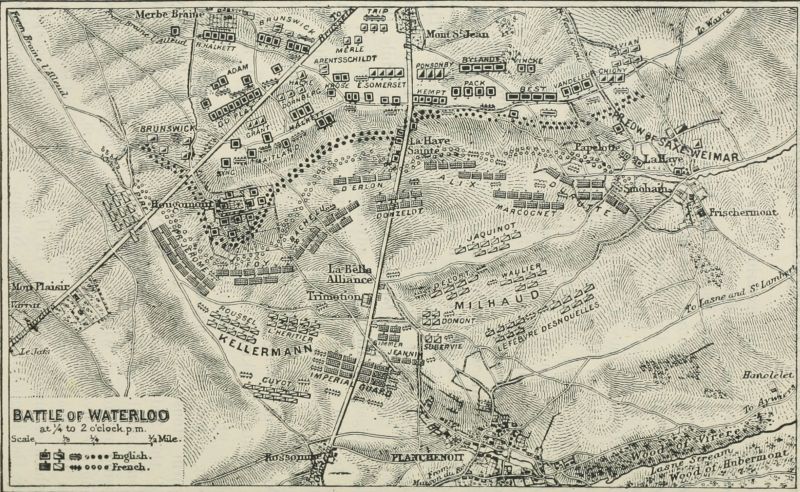
Battle of Waterloo
Immediately on the departure of d'Erlon's Corps from the French position, Bachelu's Infantry Division, which constituted the Right of Reille's Corps, was moved forward to the immediate Height between La Belle Alliance and La Haye Sainte (where it is intersected by the hollow way formed by the Charleroi road), in order to maintain that point, to be at hand as a Reserve to the attacking force, and to keep up the connection between the Right and Left Wings of the Front Line of the French Army.
The three central Columns continued their Advance up the exterior slope of the Allied position. The nature of the ground still admitted of the play of the French Batteries over their heads, and great was the havoc produced by this fire upon Picton's devoted ranks. As the heads of the Columns neared the deployed Line of Bylandt's Brigade, the shouts of "Vive l'Empereur!" were renewed. The Skirmishers in advance had scarcely opened their fire upon the Brigade, in order to prepare for, and give increased effect to, the succeeding charge of the Columns; when the Dutch-Belgians, who had already evinced a considerable degree of unsteadiness, began firing in their turn, but with very little effect: immediately after which they commenced a hurried retreat, not partially and promiscuously, but collectively and simultaneously—so much so, that the movement carried with it the appearance of its having resulted from a word of command. The disorder of these troops rapidly augmented; but, on their reaching the straggling hedge along the crest of the position, an endeavour was made to rally them upon the 5th Battalion of Dutch Militia. This attempt, however, notwithstanding the most strenuous and praiseworthy exertions on the part of the Officers, completely failed. The reserve Battalion and the Artillerymen of Captain Byleveld's Battery, though they seemed to stem the torrent for a moment, were quickly swept away by its accumulating force. As they rushed past the British Columns, hissings, hootings, and execrations were indignantly heaped upon them; and one portion, in its eagerness to get away, nearly ran over the Grenadier Company of the 28th British Regiment, the men of which were so enraged, that it was with difficulty they could be prevented from firing upon the fugitives. Some of the men of the 1st, or Royal Scots, were also desirous of shooting them. Nothing seemed to restrain their flight, which ceased only when they found themselves completely across and covered by the main ridge along which the Anglo-Allied Army was drawn up. Here they continued, comparatively under shelter, during the remainder of the battle, as a Reserve; in which capacity alone, considering their losses and their crippled state, they could now be rendered serviceable.
Picton, who had been calmly watching the French movements, and whose quick and practised eye detected the increasing unsteadiness and wavering disposition of the Dutch-Belgians, appeared to expect but a feeble resistance on their part; and upon his Aide de Camp, Captain Tyler,[10] remarking to him that he was sure they would run, he said, "Never mind; they shall have a taste of it, at all events." He had certainly not anticipated the possibility of their retiring so precipitately as they did the moment the French came within musket range of their ranks.
Now, however, that these troops had completely cleared away to the rear, and left him no other means wherewith to brave the coming storm than could be afforded by the shattered remnants of Kempt's and Pack's Brigades which had survived the sanguinary Fight of Quatre Bras, Picton immediately deployed his force, and assumed an attitude of patient but determined resistance. When the disparity in relative numbers of the assailants and defenders is considered, the attempt to make head with such odds, against the advancing masses of an Enemy elated by his triumphant progress, was, it must be admitted, a daring and critical undertaking. Each Brigade presented a thin two deep Line. Their united strength did not amount to more than about 3,000 men; whilst of the French force, the central attacking Columns alone, which were now advancing directly upon these two Brigades, consisted of nearly 12,000 men. Picton had, moreover, no Infantry Reserve whatever, from which he could obtain support in case of success, or upon which he could fall back in case of disaster.
He was not, however, one to be daunted by the approach of heavy Columns, formidable as they might appear in point of numbers, when he could meet them with a well trained British Line, though it should be but two deep, and present but a fourth of the numerical force of its opponents. It is true, that nearly all the Regiments in Kempt's and Pack's Brigades had lost half their numbers in the Battle of the 16th; but Picton well knew that they had not lost that indomitable spirit, which, under his guidance, had immortalised them on that memorable Field of Battle. There, he had triumphantly led them both in Line against heavy Columns of Infantry, and in Squares against charging Squadrons of Cavalry. What, then, might not be achieved by such innate valour—by such consummate discipline? The entire confidence which he reposed in his men was warmly reciprocated on their part. With such a Chief to lead them, they would have bravely confronted the whole French Army, had it been moving in mass against them. The flight of the panic-stricken Dutch-Belgians produced no effect upon them beyond that of exciting their derision and contempt.
The 28th, 32nd, and 79th Regiments of Kempt's Brigade, when deployed, occupied a Line parallel to, and about fifty yards distant from, the hedge along the Wavre road, its Right resting on a high bank lining the Charleroi road, and its Left terminating at a point in rear of that part of the Wavre road which begins to incline for a short distance towards the left rear. In their right front, immediately overlooking the intersection of the Charleroi and Wavre roads, stood (as before stated) the Reserve of the 1st Battalion 95th Rifles; they had two Companies, under Major Leach, posted in the Sand Pit adjoining the left of the Charleroi road; and one Company, under Captain Johnston, at the hedge on the Knoll in rear of the Sand Pit. Their Commanding Officer Colonel Sir Andrew Barnard, and Lieutenant Colonel Cameron, were with these Advanced Companies, watching the Enemy's movements.
Pack's Line was in left rear of Kempt's Brigade, and about 150 yards distant from the Wavre road. Its Left rested upon the Knoll between the Wavre road and a small coppice on the reverse slope of the position; but the Centre and Right extended across a considerable hollow which occurs on the right of that coppice. The front of the interval between the two Brigades became, after the retreat of the Dutch-Belgians, completely exposed and uncovered.
The French Left central attacking Column had continued its advance in a direction contiguous to, and parallel with, the high road, until the Skirmishers in front were suddenly checked by the Companies of the 95th British Rifles posted in the Sand Pit; which obstacle had hitherto been in a great measure concealed from their view by the particular formation of the ground, combined with the height of the intervening corn. Influenced by the discovery of this impediment, and by the appearance of the abatis upon the high road, the Column inclined to the right so as to clear the Sand Pit; and as their Skirmishers were pressing on in that direction, the Companies of the 95th became turned, and were forced to fall back upon the other Company stationed along the little hedge in rear of the Pit. So vigorous and effective was the fire maintained from this hedge by the British Riflemen, both upon the Skirmishers and upon the Column itself, that the latter was induced to swerve still further to the right, out of its original direction.
The retreat of Bylandt's Brigade having removed all impediment to the advance of the central attacking Columns, the three Companies of the 95th soon found themselves outflanked by the French Skirmishers, and gradually retired upon their Reserve. The Light Companies of the other Regiments of Kempt's Brigade, which had moved out to skirmish, fell back in like manner, accordingly as the French Columns advanced. With a view to secure the Left Flank of the attacking force, and at the same time to connect the movements with those on the opposite side of the high road, the French presented a strong Line, or rather a mass, of Skirmishers, in the interval between that road and the Left central Column.
As the Columns now rapidly approached the crest of the Anglo-Allied position, the greater part of the Batteries along the French ridge—that is, all those which had been cannonading that portion of the Line embraced by the attack—gradually suspended their fire. The partial cessation of their thunder was immediately succeeded by loud and reiterated shouts from the Columns of "Vive l'Empereur!"; whilst at short intervals were heard the cheering exhortations of "En avant! en avant!" mingled with the continued roll of drums beating the pas de charge.
The Left central Column was advancing in a direction which would have brought it in immediate contact with the Right of the 28th British Regiment and the Left of the 79th Highlanders, and had arrived within about forty yards of the hedge lining the edge of the Wavre road, when Picton moved forward Kempt's Brigade close to the hedge; where it was joined by its Light Companies, who came running in, followed by some of the most daring of the French Skirmishers, who, however, were quickly driven back. Suddenly the Column halted, and commenced a deployment to its right, the rear Battalions moving out rapidly to disengage their front.
Picton, seizing upon the favourable moment, ordered the Brigade to fire a volley into the deploying mass; and its brief but full and condensed report had scarcely died away, when his voice was heard loudly calling "Charge! charge! Hurrah!" Answering with a tremendous shout, his devoted followers burst through the nearest of the two hedges that lined the Wavre road. In doing this their order Was in some degree broken; and, when making their way through the further hedge, a fire was poured into them by such of their opponents as had their front uncovered. The Enemy's Skirmishers that had previously fallen back upon the Flanks of the Column instantly darted forward; and by their rapid and close telling fire assisted in the endeavour to augment the apparent disorder of Kempt's line. The 79th Highlanders suffered greatly, and experienced some delay in clearing the hedges. The Ensign (Birtwhistle) carrying the Regimental Colour of the 32nd, was severely wounded. Lieutenant Belcher, who commanded the left centre subdivision, took the Colour from him. In the next moment it was seized by a French Officer, whose horse had just been shot under him. A struggle ensued between him and Lieutenant Belcher; but, while the former was attempting to draw his sword, the covering Colour Sergeant (named Switzer) gave him a thrust in the breast with his halbert, and the right hand man of the subdivision (named Lacy) shot him, just as Brevet Major Toole, commanding the right centre subdivision, called out, though too late (for the French Officer fell dead at Lieutenant Belcher's feet), "Save the brave fellow!" The delay in crossing the hedges was but momentary; order was speedily restored: and then, levelling their bayonets, the Brigade disclosed to view the glorious sight of a British Line of Infantry at the charge.
It was during this brief struggle that a severe and irreparable blow was inflicted upon the entire British Army, and a whole nation plunged into grief and mourning for the loss of a Chief; the brilliancy of whose career had so excited her admiration, and the fame of whose exploits had so exalted her pride. The truly brave and noble Picton was struck by a musket ball on the right temple. His death, which was instantaneous, was first observed by the Earl of Uxbridge's Aide de Camp, Captain Horace Seymour; whom he was, at the moment, desiring to rally the Highlanders. Captain Seymour, whose horse was just then falling, immediately called the attention of Picton's Aide de Camp, Captain Tyler, to the fact of the General having been wounded; and, in the next moment, the hero's lifeless corpse was, with the assistance of a private soldier of the nearest Regiment, borne from off his charger by that Officer. Thus fell the gallant soldier, who, as the Leader of the Third or "Fighting Division" in the Peninsular War, had already acquired an imperishable renown in the history of the British Army. As his life was spent in fighting the battles of his country, his death was an end suited to his stirring career. His brave spirit passed away amidst the roar and din of the bloody conflict, and his eyes closed on his last of Fields in the very moment of the advance of his troops to victory.
The French Column, surprised in the midst of its attempted deployment, and appalled by the bold and determined onset of Kempt's Line, appeared as if struck by a panic, fell into irremediable confusion, and fled with precipitation from its pursuers. Just as the British Brigade bore down the slope, its front was partially crossed from the right by French Cuirassiers, followed by the 2nd British Life Guards; the former, dashing in amongst their own thickly scattered Infantry Skirmishers; who threw themselves down to allow both fugitives and pursuers to ride over them, and then, in many cases, rose up and fired after the latter. But although the greater part of the Cuirassiers turned about and boldly faced their opponents, whereby several isolated individual contests occurred; the 2nd Life Guards soon obtained the mastery, and compelled them to resume their flight: whilst the 95th Rifles speedily closed upon the disordered mass of Infantry through which this portion of the Cavalry had passed, and amongst which the greatest confusion and consternation prevailed. Many flew wildly they scarcely knew whither; others delivered themselves up; and several were seized as prisoners.
On its right, the Brigade was supported in the charge by the 1st Light Battalion of the King's German Legion; which crossed over for that purpose from the opposite side of the high road.
Immediately after passing through the hedge, the extreme Left of the 28th Regiment had unexpectedly found itself almost in contact with a well formed French Column still advancing against the Allied position. The Right Wing of the Regiment was too deeply engaged with the Column directly before it to admit of its attention being drawn off to any other quarter; but the Left Wing, having a clearer front, boldly brought forward its right shoulders, thus detaching itself from the Right Wing, and fired into the Left Flank of the advancing Column at the very moment when the head of the latter was charged by the Right Regiment (the Royals) of Ponsonby's Brigade of Heavy Cavalry. Kempt, becoming aware of the prolongation of the French attack along the Line to his left, and of the consequently exposed state of this Flank; and possessing no Infantry Support or Reserve of any kind, felt himself under the necessity of restraining his men from further pursuit, and ordered the Brigade to halt and reform. The Left Wing of the 28th, however, having its whole attention fixed upon the Column charged by the Royals, followed these Dragoons some distance down the slope, and assisted them in securing a great number of prisoners; after which it fell back, and rejoined the Right Wing of the Regiment. The 95th Rifles continued advancing, and driving the French Skirmishers before them beyond the Knoll by the Sand Pit.
From this extremely gallant and most decisive attack by Kempt's Brigade, we must proceed to describe the no less brilliant charges performed by both Somerset's and Ponsonby's Cavalry Brigades; but to afford a more ready comprehension of this period of the action, it will be necessary, in the first instance, to revert, to the attack and defence of La Haye Sainte.
The French Skirmishers thrown out by the Left Brigade of Donzelot's Division advanced boldly and resolutely against the Orchard of La Haye Sainte. The first shot tore away the bridle of Major Baring's horse close to his hand, and the second killed Major Bösewiel, the next in command. The three Companies of the 2nd Light Battalion of the King's German Legion, which, as before stated, were posted in the Orchard, together with two Companies of the 1st Light Battalion of the King's German Legion under Captains Wynecken and Goeden, and a Company of Hanoverian Riflemen under Major Spörken, which were extended on the right of the Farm, presented a gallant resistance to the Enemy; but the latter continued to press forward with superior force, and the main body of the French Brigade having formed two Columns of Attack, which were rapidly advancing, one into the Orchard, and the other towards the Buildings, Major Baring fell back with his men upon the Barn.
At this moment, Colonel Klencke reached the Farm with the Lüneburg Field Battalion; which Wellington, on observing the French advance, had detached from the Left of Kielmansegge's Brigade as a reinforcement to the troops of La Haye Sainte. Baring immediately endeavoured to recover the Orchard; and had already made the Enemy give way, when he perceived a strong Line of Cuirassiers forming in right front of the inclosure. At the same time, Lieutenant Meyer came to report to him that the Enemy had surrounded the Garden in which his Company was posted, and that it had become no longer tenable. Baring ordered him to fall back into the Buildings, and to assist in their defence. The Skirmishers upon the right, on the sudden appearance of the Cavalry, ran in upon the Orchard to collect together: but coming in contact with the newly arrived Hanoverians, the latter got into disorder; and the effect produced by the sight of the advancing Line of Cuirassiers in their front, as also by the shouts of the French Infantry gaining possession of the Garden in their rear, was such, that notwithstanding all Baring's exertions to halt and collect his men, the whole of these troops betook themselves to an indiscriminate flight towards the main position of the Allied Army, a course which they seemed to imagine constituted their only chance of safety.
They were speedily undeceived. The Cavalry overtook them in the midst of their confused retreat, rode over, sabred, and still further dispersed them; whilst, to add to the severity of their loss, they became exposed, after the Cavalry had passed on, to a flank fire from the Enemy's Infantry lining the hedge of the Garden. A portion of them succeeded in gaining the main position; whilst the remainder, securing themselves in the Buildings, augmented the little garrison under Lieutenants Carey and Græme, and Ensign Frank, who bravely and successfully maintained possession in defiance of the vigorous attacks on the part of the French Light Troops. The Lüneburg Hanoverian Battalion, however, suffered most severely: many were killed and wounded; among the latter was the Commanding Officer, Lieutenant Colonel Klencke, and among the prisoners taken was Major Dachenhausen. Some on the left saved themselves by a precipitate retreat into the high road. The few that were collected together again during the remainder of the day constituted but a very insignificant portion of the original strength of the Battalion.
The Earl of Uxbridge, on perceiving the advance of the French Cavalry by La Haye Sainte, on the British right of the Charleroi road (the same alluded to as having dispersed the Hanoverian Lüneburg Battalion and Baring's Skirmishers of the Legion), as also the approach of the Infantry Columns which constituted the attack upon the Allied Left Wing on the opposite side of that road, decided upon a simultaneous charge by the Heavy Cavalry Brigades of Lord Edward Somerset and Sir William Ponsonby; the former against the Enemy's Cavalry, the latter against his masses of Infantry. The resolution was scarcely formed when he proceeded to carry it into instant execution. Riding up to Lord Edward Somerset, he ordered him to prepare to form Line, keeping the Blues in support: and galloping on to Ponsonby's Brigade on the opposite side of the high road, he ordered that Officer to wheel into Line as soon as he saw the other Brigade do so, and to hold the Scots Greys in support. He then returned to the Household Brigade, and immediately put the whole in motion.
As this was the first grand attack made by the French on that day in fair open Field, Lord Uxbridge felt very desirous, in meeting it, to establish, if possible, the superior prowess of the British Cavalry; and thus to inspire it with confidence, and cause it to be held in respect by its opponents. He, therefore, with a view to excite the courage and heighten the enthusiasm of his followers, led the advance in person, placing himself in front of the Left of Somerset's Brigade, so as to be at about the centre of the Line when the Brigades should unite, on the continuation of the advance, in front of the Allied position. Nobly and faithfully did these brave Dragoons fulfil his anxious expectations.
For the purpose of ensuring efficient support to his Cavalry attacks, Lord Uxbridge had, before the commencement of the Battle, intimated to the Generals of Brigade that as he could not be present everywhere to give Orders, he expected they would always take upon themselves to conform to, and support, offensive movements in their front; and having on this occasion Light Cavalry Brigades on either Flank of the charging force, he felt in a great degree justified in placing himself in Front Line, particularly as he had assigned to each of the advancing Brigades its own immediate Support.
Though greatly palliated by the adoption of these precautionary measures, this was perhaps not altogether a prudent act on the part of the Commander of the entire Cavalry of an Army; since, in the charge of an extended Line of Cavalry against an Enemy close at hand, the carrière once begun, the Leader becomes so completely identified and mixed up with that Line itself, that his virtual command is rapidly limited to that of a Squadron Officer; whereas, when accompanying a Second Line, he is enabled to draw off, or reinforce, as circumstances may render expedient. His eager desire, however, to render this first charge a brilliant affair, combined with his own chivalric nature, led him to assume the post of honour and of danger, in order to animate by his example as a bold and determined soldier. At the same time, he trusted to the dispositions he had already made, and to the alertness of his Brigadiers, for due support to his attack; but which, from fortuitous circumstances, as will be seen by the sequel, was not forthcoming at the moment it was most urgently required.
The French Line of Cavalry, as it advanced, presented an imposing appearance. These veteran warriors bore with them an air of confident superiority and anticipated triumph, joined with a sort of gaieté de cœur, inspired no doubt by the reflection that they were about to encounter and overthrow their most implacable Enemies, the British. Their advance, like that of the Infantry on their right, had been to a certain extent triumphant; and, as the flight of the Dutch-Belgians had led that Infantry to imagine that victory was already within its grasp, so the dispersion of the Hanoverians was hailed by these Dragoons as a happy prelude to their grand attack. They had now ascended the brow of the ridge on which the Anglo-Allied Infantry was posted, prepared for their reception: a vigorous fire was opened upon them by the four guns of Ross's British Horse Battery on the right of the high road, as also by Lloyd's British Foot Battery still further to the right; but a few seconds sufficed to restore the order of their advance: in the next moment their trumpets sounded the charge; when, amidst shouts of "Vive l'Empereur!" this gallant Line, glittering in all the splendour reflected from burnished helmet and cuirass, rushed on to the attack.
On the other hand, the British Household Brigade, presenting a beautiful Line, and animated by an equal degree of enthusiasm, had already been put into charging speed; and just as the Cuirassiers came close upon the Squares, and received a fire from their front faces, the two Lines dashed into each other with indescribable impetuosity. The shock was terrific.
The British, in order to close as much as possible upon the Cuirassiers, whose swords were much longer, and whose bodies were encased in steel, whilst their own were without such defence, seemed for a moment striving to wedge themselves in between the horses of their infuriated antagonists. Swords gleamed high in air with the suddenness and rapidity of the lightning flash, now clashing violently together, and now clanging heavily upon resisting armour; whilst with the din of the battle shock were mingled the shouts and yells of the combatants. Riders vainly struggling for mastery quickly fell under the deadly thrust or the well delivered cut. Horses, plunging and rearing, staggered to the earth, or broke wildly from their ranks. But desperate and bloody as was the struggle, it was of brief duration. The physical superiority of the British, aided by transcendant valour, was speedily made manifest; and the Cuirassiers, notwithstanding their most gallant and resolute resistance, were driven down from off the ridge, which they had ascended only a few minutes before with all the pride and confidence of men accustomed and determined to overcome every obstacle. This first collision at the charge did not occur, however, throughout the entire extent of the opposing Lines. Somerset's Line was not parallel to that of the Cuirassiers, and as its Right was thrown somewhat forward, this came first in contact with the Enemy, and the collision, in consequence of the rapidity of the charge on both sides, followed in instantaneous succession in the direction of the Allied Left until intercepted in its further progress by a natural obstruction consisting of the hollow way through which the cross roads lead into the Charleroi road. The Cuirassiers on the right of the French Line were suddenly thrown out of their speed by coming unexpectedly on this hollow way, into which they consequently descended abruptly and confusedly; and as they began to urge their horses up the opposite bank, they beheld the 2nd British Life Guards, which formed the Left of Somerset's Brigade, in full speed towards them. All idea of resistance, in such a situation, was abandoned as hopeless. They immediately filed away down this hollow way to their right, and struck across the Charleroi road into the field in front of the 95th British Rifles; followed by the 2nd Life Guards, who were in equal disorder from having to pick their way as they best could down the steep banks adjoining the intersection of the two roads.
These Cuirassiers, after having rushed in upon the French Infantry Skirmishers thickly and confusedly congregated in that quarter, reined in their steeds, and fronting their pursuers, engaged them individually in hand to hand combat. They were soon, however, made sensible of their inferiority in this species of contest, and either submitted to the victors, or fled with precipitation; whilst at the same time, Kempt's Brigade was charging gloriously down the exterior slope of the Allied position, and closing upon the Infantry with which these horsemen had become intermingled, in the manner previously described.
No sooner did Ponsonby perceive the Household Cavalry in motion, than in pursuance of the Orders he had received, he led on his own Brigade; but not being sufficiently aware of the state of affairs on the opposite side of the Wavre road, and not wishing to launch his Line against the Enemy's masses until the favourable moment had arrived, he commanded a temporary halt, and rode up to the hedge in order that he might, by personal observation, ensure the correct timing of the charge. He was accompanied by Colonel Muter, commanding the Inniskilling Dragoons; whom he desired to return and place himself in front of the Centre Squadron, and to order and conduct the movement, the moment he should observe him hold up his cocked hat as a signal.
It is necessary to remark that the Scots Greys, who stood in support some short time previously to this advance, just where the Enemy's round shot, after passing over the ridge in front, descended in quick succession and occasioned some losses in their ranks, were ordered to some lower ground in left rear of the other two Regiments; which new position they had scarcely reached when the latter were advanced as above, and the Greys immediately conformed to this movement.
During the advance of Alix's French Division (the First), its rear Brigade, which consisted of the 54th and 55th Regiments, inclined to its right, moved out of the mass, and formed two Columns, of two Battalions each, in support, en échelon to the leading Brigade, consisting of the 28th and 105th Regiments. In like manner, the rear Brigade of Marcognet's Division (the Third), consisting of the 21st and 46th Regiments, broke into two Columns, of two Battalions each, in support, en échelon to, but more immediately in rear of, the leading Brigade, consisting of the 25th and 45th Regiments.
While Kempt's Brigade was bravely charging down the slope on the right, the heads of the leading Brigades of Alix's and Marcognet's Divisions, with conspicuous gallantry, and amidst shouts of triumph, crowned the crest of the Allied position on the left, crossing the Wavre road and the straggling hedge, by which their order had been in some degree disturbed. Alix's leading Brigade, having passed clear of Kempt's Left, found itself unopposed by Infantry, in its front; but the head of Marcognet's Column, after passing close by the right of Captain Rettberg's Hanoverian Foot Battery, from which it had received a very destructive fire, during its advance, beheld a short but compact line of Highlanders directly in its front.
This was the remnant of the 92nd Regiment which had so gallantly fought, and so greatly suffered, at Quatre Bras. It did not at that moment consist of more than 230 men, whilst the opposing Column numbered about 2,000. Pack, who was in front of the 92nd, on seeing the head of the French Column making its way through the hedge, resolved in his own mind that not a moment must be allowed to it for observation and reflection, as otherwise the French would succeed in establishing themselves in great force on the summit of the British position. He instantly decided upon a measure, which, in daring and determination, was fully commensurate with the emergency of the occasion. Addressing himself to the Highlanders, he said, in an energetic tone, "92nd, you must charge—all in front of you have given way!" With loud cheers, and under the animating sounds of their native pibroch, the 92nd moved steadily on with the noble mien and gallant bearing of men bent upon upholding, at any sacrifice, the honour and glory of their country. That portion of the French Column which had by this time crossed the hedge was in perfect order, and presented a bold and determined front. As the 92nd approached the Column, it received from it a fire; which, however, it did not return, but continued to advance steadily until it had arrived within twenty or thirty yards distance, when the head of the French Column appeared panic struck, and facing about in the greatest confusion, endeavoured to escape; the Highlanders, at the same moment, throwing into the mass a concentrated fire, most destructive in its effects. The 92nd immediately charged; but at this very moment Ponsonby's Brigade came up.
Colonel Muter had just before perceived the raised cocked hat, when he instantly ordered and conducted the advance of the Brigade. It will be recollected that the Scots Greys had been ordered to support the Royals and Inniskillings; but having as was before explained, moved down into lower ground on the left, to get more under cover from the Enemy's cannonade, and subsequently advanced in left rear of those two Regiments, they beheld in their direct front the head of Marcognet's Division establishing itself on the height. Their course from that moment was obvious. They soon got up into Line, or nearly so, with the remainder of the Brigade, and joined in the general charge.
Upon Ponsonby's Brigade coming up with the Infantry, it passed through the latter as well, and as quickly as it could: in some instances intervals were made for the Dragoons by the wheeling of companies; in others, by that of subdivisions or of sections: but generally the passage was effected in rather an irregular manner; and under the circumstances this was unavoidable. Of the remaining Regiments of Pack's Brigade, the 44th, which formed the Left, having its front covered by Best's Hanoverians, remained in support, on the summit or Knoll immediately above, and on the left of, the hollow in which the rest of the Brigade had been posted. The 1st Royal Scots, and the 42nd Highlanders on the right of the 92nd, moved forward immediately after the advance by the latter, and crossing the hedge, assisted Ponsonby's Cavalry in securing prisoners.
As the Scots Greys passed through, and mingled with, the Highlanders; the enthusiasm of both Corps was extraordinary. They mutually cheered. "Scotland for ever!" was their war shout. The smoke in which the head of the French Column was enshrouded had not cleared away, when the Greys dashed into the mass. So eager was the desire, so strong the determination, of the Highlanders to aid their compatriots in completing the work so gloriously begun, that many were seen holding on by the stirrups of the horsemen; while all rushed forward, leaving none but the disabled in their rear. The leading portion of the Column soon yielded to this infuriated onset; the remainder, which was yet in the act of ascending the exterior slope, appalled by the sudden appearance of Cavalry at a moment when, judging by the sound of musketry fire in front, they had naturally concluded that it was with Infantry alone they had to contend, were hurled back in confusion by the impetus of the shock. The Dragoons, having the advantage of the descent, appeared to mow down the mass; which, bending under the pressure, quickly spread itself outwards in all directions. Yet, in that mass were many gallant spirits, who could not be brought to yield without a struggle; and these fought bravely to the death: not that they served to impede, but only to mark more strongly the course of the impetuous torrent as it swept wildly past them, presenting to the eye of the artistic observer those streaks which, arising incidentally from such partial and individual contests, invariably characterize the track of a charge of Cavalry.
Within that mass too, was borne the Imperial Eagle of the 45th Regiment, proudly displaying on its banner the names of Austerlitz, Jena, Friedland, Essling, and Wagram—Fields in which this Regiment had covered itself with glory, and acquired the distinguished title of "The Invincibles." A devoted band encircled the sacred Standard, which attracted the observation, and excited the ambition of a daring and adventurous soldier, named Ewart, a Sergeant of the Greys. After a desperate struggle, evincing on his part great physical strength combined with extraordinary dexterity, he succeeded in capturing the cherished trophy. The gallant fellow was directed to proceed with it to Brussels, where he was received with acclamations by thousands who came forward to welcome and congratulate him.
Without pausing for a moment to reform, those of the Greys who had forced their way through, or on either Flank of, the mass, rushed boldly onward against the leading supporting Column of Marcognet's right Brigade. This body of men, lost in amazement at the suddenness, the wildness, of the charge; and its terrific effects upon their countrymen on the higher ground in front, had either not taken advantage of the very few moments that had intervened, by preparing an effectual resistance to Cavalry; or, if they attempted the necessary formation, did so when there was no longer time for its completion. Their outer Files certainly opened a fire which proved very destructive to their assailants; but to such a degree had the impetus of the charge been augmented by the rapidly increasing descent of the slope, that these brave Dragoons possessed as little of the power as of the will to check their speed, and they plunged down into the mass with a force that was truly irresistible. Its foremost ranks driven back with irrepressible violence, the entire Column tottered for a moment, and then sank under the overpowering wave. Hundreds were crushed to rise no more; and hundreds rose again but to surrender to the victors; who speedily swept their prisoners to the rear, while the Highlanders secured those taken from the leading Column.
Along the remainder of the Line, the charge of the "Union Brigade" was equally brilliant and successful. On the right, the Royal Dragoons, by inclining somewhat to their left, during the advance, brought their Centre Squadron to bear upon the head of the leading Column of Alix's Division, which had crossed the hedges lining the Wavre road, and being unchecked, was rapidly advancing across the crest of the ridge. Suddenly its loud shouts of triumph ceased as it perceived the close approach of Cavalry up the interior slope of the Anglo-Allied position. Whether it was actuated by a consciousness of danger from the disorder necessarily occasioned in its rear by the passage through the banked up hedges, by a dread of being caught in the midst of any attempt to assume a formation better adapted for effective resistance, or of being entirely cut off from all support, it is difficult to decide, but the head of this Column certainly appeared to be seized with a panic. Having thrown out an irregular and scattering fire, which served only to bring down about twenty of the Dragoons; it instantly faced about, and endeavoured to regain the opposite side of the hedges. The Royals, however, were slashing in amongst them before this object could be effected. The rear ranks of the Column, still pressing forward, and unconscious of the obstruction in front, now met those that were hurled back upon them down the exterior slope by the charge of the Royals, who continued pressing forward against both Front and Flanks of the mass. The whole was in a moment so jammed together as to have become perfectly helpless, Men tried in vain to use their muskets, which were either jerked out of their hands, or discharged at random, in the attempt. Gradually, a scattering flight from the rear loosened the unmanageable mass, which now rolled back helplessly along its downward course. Many brave spirits, hitherto pent up in the midst of the throng, appeared disposed to hazard a defiance; and amongst these the swords of the Royals dealt fearful havoc: many threw down their arms, and gave themselves up in despair; and these were hurried off by the conquerors to the rear of the British Line.
The 28th French Regiment, which formed a direct Support to the 105th Regiment, comprising the Column thus attacked, though astounded by the scene before it, and almost driven back by the panic stricken fugitives, still retained a considerable semblance of order.
Amidst the crowd that was now precipitating itself on this supporting Column, to seek its shelter and protection, was an Officer, the bearer of the Eagle of the 105th Regiment. This Standard, on which were inscribed the victories of Jena, Eylau, Eckmühl, Essling, and Wagram, was accompanied at the moment by a party apparently forming a guard for its defence. Captain Clark, commanding the Centre Squadron of the Royals, on discovering the group, instantly gave the Order, "Right shoulders forward—attack the Colour!" and led directly upon the Eagle himself. On reaching it, he ran his sword through the body of the Standard Bearer who immediately fell, and the Eagle dropped across the head of Captain Clark's horse. He endeavoured to catch it with his left hand, but could only touch the fringe of the Colour, and it would probably have fallen to the ground, and have been lost in the confusion of the moment, had it not been saved by Corporal Stiles; who, having been Standard Coverer, and therefore posted immediately in rear of the Squadron Leader, came up at the instant, on Captain Clark's left, and caught the Colour as it struck, in falling, against his own horse's neck.
So great were the confusion and dismay created in the second Column by the rush towards it of the disorganised remnant of the leading body, mixed up as it were with the Dragoons still pressing eagerly forward, as also by the signal overthrow of the Columns on their right by the Inniskillings, that the entire mass speedily yielded to the pressure, and commenced a disorderly flight, pursued by the Royals to the foot of the valley by which the two positions were divided.