Front matter (continued 11)
Reading edition
The Sixth Corps, the Imperial Guard, and part of the Cavalry, retreated upon Charleroi, whither Napoleon himself proceeded; after having sent his brother Jerome to Marchiennes, with Orders to rally the troops between Avesnes and Maubeuge.
In the mean time, Gneisenau continued his wild nocturnal chase, which was truly Lützow's wilde verwegene Jagd. His followers, however, having been on the march or in action, since daybreak, were becoming weary, especially the Infantry: besides which, several, impelled by hunger, stopped on the way to plunder provision waggons; so that their numbers had greatly diminished.
But Gneisenau, who was the life and soul of the pursuit, and who seemed bent on pushing forward whilst a man and horse remained, now had recourse to a stratagem, which, as regarded its effect upon the Enemy, fully compensated for the exhaustion of his Infantry. Observing that the fugitives always took alarm at the sound of the drum, which announced the presence even of Infantry thus far in pursuit, and close upon their rear; he ordered the last remaining Drummer, who was unable to proceed further on foot, to mount one of the horses that had been disengaged from Napoleon's travelling carriage, and then to keep up with the Cavalry, and beat the drum without intermission.
In this manner Gneisenau passed through Quatre Bras, which had been abandoned on his approach; and even the Heights of Frasne were left free to him; whilst the affrighted Foe, completely scattered and dispersed, endeavoured to escape by Gosselies, Marchiennes, and Charleroi. Upon reaching the Inn of à l'Empereur on the high road beyond Frasne, this favoured companion of Blücher halted his followers, who then consisted but of a few Squadrons and a party of the 15th Regiment, and allowed them to take rest; satisfied with having thus, by mere beat of drum and shouts of triumph, succeeded in scaring the remnant of the French Army across the Sambre.
Such was the termination of this ever memorable Battle—a Battle, remarkable for the spectacle it afforded, on the one hand, of a bravery the most noble and undaunted; of a passive endurance, the most calm, dignified, and sublime; of a loyalty and patriotism, the most stern and inflexible: and on the other, of a gallantry in assault the most daring and reckless; of a devotion to their Chief, the most zealous and unbounded; and, lastly, of a physical overthrow and moral annihilation unexampled in the history of modern warfare. Such was the consummation of a victory, the most brilliant in its development, the most decisive in its operation, and the most comprehensive in its result, of any that had occurred since the commencement of that Revolution which it was thus the instrument of bringing to the termination so long and so ardently desired by the suffering and indignant nations of Europe.
From the contemplation of the triumph, the glory, and the result, of such a Battle: we are impelled to turn our thoughts upon the melancholy spectacle of the awfully severe losses sustained by both the victors and the vanquished; whose heroic exertions and noble endurance could not but be attended with immense sacrifice.
The following Table shows the losses sustained by the troops composing the Anglo-Allied Army:—
KILLED. WOUNDED. MISSING.
Officers NonCom. Officers, Trumpeters, Drummers, and Privates. Horses. Officers NonCom. Officers, Trumpeters, Drummers, and Privates. Horses. Officers NonCom. Officers, Trumpeters, Drummers, and Privates. Horses.
British 85 1334 1319 365 4560 719 10 582 708
King's German Legion 27 335 194 77 932 144 1 217 54
Hanoverians 18 276 — 63 1035 — 3 207 —
Brunswickers 7 147 77 26 430 — — 50 —
Nassauers 5 249 — 19 370 — — — —
——— ——— ——— ——— ——— ——— ——— ——— ———
Total 142 2341 1590 550 7327 863 14 1056 762
If to this loss be added that of the Dutch-Belgian troops—about 4,000—the total number of Noncommissioned Officers, Trumpeters, Drummers, and Privates, killed, wounded and missing, amounted to 14,728.
The losses of the Prussian Army in the Battle were as follows:—
KILLED. WOUNDED. MISSING.
Officers NonCom. Officers, Trumpeters, Drummers, and Privates. Horses. Officers NonCom. Officers, Trumpeters, Drummers, and Privates. Horses. Officers NonCom. Officers, Trumpeters, Drummers, and Privates. Horses.
Zieten's Corps — 34 18 8 164 21 — 111 2
Pirch's " 1 36 9 3 192 7 4 93 9
Bülow's " 21 1133 259 151 3869 328 35 1143 89
——— ——— ——— ——— ——— ——— ——— ——— ———
Total 22 1203 286 162 4225 356 39 1347 100
Total Under Officers, Trumpeters, Drummers, and Privates, killed, wounded, and missing, 6,775.
In the absence of all returns it is difficult to estimate the losses of the French Army. They were, however, immense; besides which, the whole of their Artillery, Ammunition Waggons, and Baggage, fell into the possession of the victors. Of the French Generals, Michel and Duhesme were killed; Prince Jerome, Friant, and several others were wounded; and Lobau, Compans, and Cambronne, were taken prisoners.
The minuteness of detail with which the foregoing History of the Battle of Waterloo has been written, the gradual development which has been presented of the motives and dispositions of the Commanders, and the circumstantial description which has been afforded of the movements of the troops engaged—of the working, as it were, of the machinery in the hands of the three most renowned Captains of the Age—obviate the necessity of further comment upon those points; but it would be unjust to the honour, the fame, and the glory, of the actors in that memorable scene, to omit putting forth certain important considerations which are essential to enable an impartial public, and an unprejudiced posterity, to arrive at correct and satisfactory conclusions upon other points, hitherto involved in doubt and obscurity.
These refer chiefly to the relative numerical strength of the Combatants, the relative proportions in which the troops of the Anglo-Allied Army were actively engaged with the Enemy, the conduct of these troops respectively while so engaged, and lastly the extent of the actual share taken in the Battle by the Prussians.
The most simple, and at the same time most rational, mode of computing the relative strength of Armies is by placing in juxtaposition their respective numbers of Battalions, Squadrons, and guns. According to this rule, the Anglo-Allied and French Armies, as they stood in front of each other at the commencement of the Battle, were constituted as follows:—
Battalions. Squadrons. Guns.
Anglo-Allied Army 73 98 140
French 103 127 246
Napoleon having, about one o'clock, detached the Light Cavalry Divisions of Domon and Subervie as a Corps of Observation upon his Right Flank; the opposed forces, from that hour until about six o'clock, stood as follows:—
Battalions. Squadrons. Guns.
Anglo-Allied Army 73 98 140
French 103 106 234
During this period of the Battle, the Anglo-Allied Army was thus composed:—
Battalions. Squadrons. Guns.
British 26 49 78
King's German Legion 8 16 18
Hanoverians. 18 — 12
Brunswickers 8 5 16
Nassauers 3 — —
Dutch-Belgians 10 28 16
— — —
Total 73 98 140
Almost all these Battalions were at one time or another in the Front Line, and all conducted themselves in the most courageous and exemplary manner, with the exception of five of the Dutch-Belgian Battalions, which hastily retreated as the French approached, when making their first grand attack upon the Anglo-Allied Centre and Left Wing, and took no further active part in the Battle. The remainder of the above ten Battalions in the service of the King of the Netherlands, were three Battalions forming the 2nd Regiment of the Nassau Contingent, and two Battalions of Orange Nassau, under Prince Bernhard of Saxe Weimar, and occupied the houses and inclosures in the valley in front of the extreme Left of the Allied Line. These troops behaved extremely well.
Of the Squadrons above mentioned, a large proportion, nearly one third, consisted of the Dutch-Belgian Cavalry; but although their numbers serve to augment the amount of the Anglo-Allied Cavalry on paper, the actual value of their services in the Battle was by no means commensurate with their display of strength: and hence it was that the brunt of the Cavalry contest devolved almost exclusively upon the British and German Dragoons. The same observation applies in an equal degree to the Artillery.
About six o'clock, the relative strength of the contending forces was altered, on the part of the French Army, by the detaching of Lobau's Corps and the Young Guard to oppose the Prussians; and on that of the Anglo-Allied Army, though somewhat later, by the bringing into the Field of Chassé's Dutch-Belgian Division; so that they stood about that time as follows:—
Battalions. Squadrons. Guns.
Anglo-Allied Army 85 98 156
French Army 80 106 186
Of the assistance derived by the Duke of Wellington from this augmentation of the twelve Dutch-Belgian Battalions, a sufficient estimate may be deduced from the foregoing History of the Battle—one half of them were with great difficulty prevented from abandoning the Field, although, at the moment, they were not in contact with, nor did they even see, the Enemy; and the other half only joined the Front Line (on the left of Maitland's Brigade) at the time of the General Advance.
Whatever may have been the cause of the comparative supineness of the Dutch-Belgian troops; whether produced by dislike entertained towards recent political arrangements, which alienated each party from its native country, without, securing to either its national independence; or, by predilections imbibed for the Chief against whose arms they were now opposed, and in whose ranks they had formerly served: the fact of such supineness is too well attested to admit of any doubt respecting the value to be attached to their co-operation in the great struggle so courageously and resolutely sustained by the remainder of the Anglo-Allied Army; and becomes a most important point for consideration in any calculation of the relative strength of the Combatants, when taken into conjunction with the actual proportion of the entire Dutch-Belgian force brought into the Field to that of each of the Allies, as appears by the following table:—
Amount of the Effective Strength of the Anglo-Allied Army at the Battle of Waterloo.
Infantry. Cavalry. Artillery. Total Men. Guns.
British 15,181 5,843 2,967 23,991 78
King's German Legion 3,301 1,997 526 5,824 18
Hanoverians 10,258 497 465 11,220 12
Brunswickers 4,586 866 510 5,962 16
Nassauers 2,880 — — 2,880 —
Dutch-Belgians 13,205 3,205 1,177 17,784 32
——— ——— ——— ——— ———
Total 49,608 12,408 5,645 67,661 156
Hence it appears that the Dutch-Belgian Contingent, compared with the British troops alone, consisted, in Infantry, as 13,402 to 15,181; in Cavalry, as 3,205 to 5,843; and, in guns, as 32 to 78.
It is needless now to speculate upon what might have been the result, had this large proportion of force been replaced by a corresponding number of either British or German troops. The fact testifies abundantly, in addition to what has been already related, as to the heroic firmness and enduring courage with which the brave British and Germans stood the brunt of that remarkable contest; and this, too, be it remembered, with unquestionably the finest Army which even Napoleon had ever collected together, formed exclusively of one nation—of that nation whose legions had at one time subjugated nearly the whole of Europe—imbued with inveterate hatred against its foes, cherishing the most enthusiastic devotion to its Chief, and filled with the ardent desire of restoring the fallen glory of the Empire.
Of the conduct of the British Infantry, of its heroic valour, its indomitable resistance, its proud defiance, and its admirable discipline, the History of the Battle affords abundant testimony: further comment is superfluous.
The superior prowess of the British Cavalry also shone most conspicuously on this great day. The combined charge of the two Heavy Brigades against the French Cavalry and Infantry which attacked the Centre and Left Wing of the Anglo-Allied Army between one and two o'clock, whether we regard the brilliancy of its execution, or the magnitude of its success, is perhaps without a parallel in the last War: and when we consider the preponderance of the Enemy in this Arm, the frequency of his charges, and the masses with which he advanced, it is impossible to advert to the heroism of Britain's Cavalry, without at the same time according the praise so pre-eminently due to the skill of the noble and gallant Chief who was the life and soul of its movements throughout the arduous and desperate struggle; and who so judiciously economised its strength, that when at the critical moment its services were required for securing the victory, he was enabled to bring forward two fresh Brigades, which fulfilled those services in a style the most brilliant that can be conceived, and with a success which commanded the admiration of all who witnessed it.
The British Artillery, which had to contend against an immense preponderance of metal, evinced during the whole day, a degree of bravery, zeal, activity, and intelligence, which can never be surpassed; and nobly sustained its long and honourably acquired pre-eminence.
Of the troops of the King's German Legion, whether Cavalry, Infantry, or Artillery, it is impossible to speak in terms of too high praise; suffice it to remark that their conduct was, in every respect, on a par with that of the British.
Of the four Hanoverian Infantry Brigades, that of Kielmansegge, and a part of Halkett's, were the most actively engaged: Best's stood almost the entire day on the extreme Left of the Front Line of the Anglo-Allied Infantry; and Vincke's in Reserve in front of Mont St Jean. They had been but recently and hastily raised; and yet the manner in which such raw soldiers withstood, as Kielmansegge's Brigade did, for so great a length of time, the most furious assaults made by the gallant and well disciplined troops of France, would have conferred honour on long tried veterans.
The Brunswickers, who were also composed of young soldiers, performed a glorious part in the Battle; and amply avenged the death of their Prince. Some of their Battalions were much shaken at the moment Alten's Division was driven back a short distance; but they speedily rallied, and resumed their lost ground. Altogether, their bravery, which was frequently called into action; and their endurance, which was severely tested, merited the strongest commendation.
The troops constituting the Nassau Brigade under Kruse (or more properly the 1st Regiment of the Nassau Contingent), were attached to Alten's Division. They were consequently often in the thick of the fight; and though, on the occasion above alluded to, they were thrown into disorder and driven in by a furious onset of the Enemy, they conducted themselves generally throughout the day with great steadiness and bravery.
It is impossible to allude in terms of adequate praise to the services of that most important branch of the Army, the General Staff; the Officers of which distinguished themselves no less by the zeal, the daring, and the activity, with which they carried into execution the commands of their respective Chiefs, than by the alacrity and intelligence which they evinced in catching and imparting the true spirit of their instructions. The constant exposure to which their peculiar duties necessarily subjected them could not but entail upon them severe losses. Few indeed were those who escaped unhurt throughout this arduous conflict.
The co-operation of the Prussians in this Battle has been gradually developed and fully detailed. That the communications which Wellington received from Blücher led him to expect that co-operation at a much earlier period, is beyond a doubt; but setting aside all consideration of the causes of the delay which attended the arrival of the Prussian forces, it is equally doubtless that the tardiness of that co-operation had a more decided influence on the general result of the Battle than if they had reached the Field at an earlier period.
For, supposing the Prussians to have arrived in force before the French had become so seriously and desperately engaged with the Anglo-Allied Army, Napoleon was too much a Master of his art to have risked a decisive Battle with the combined forces of his antagonists. In this case he would, in all probability, have fallen back upon his frontier, have called in all available Reserves from the interior, and by means of his Triple Line of Fortresses, as well as by skilful manœuvring, have endeavoured to separate once more the opposing Armies, and to obtain another chance of beating them in detail. As it happened, however, he was too deeply involved in the contest with Wellington; he had suffered too severely in his repeated attacks, to admit of a retreat, under such circumstances, being looked upon, even by his friends in Paris, in any other light than that of a defeat: and he knew too well that with a defeat, however it might be produced, would vanish the only tie which yet bound him to the nation—the implied belief in his invincibility, and the firm reliance on his ability to re-establish and maintain the military glory of France. It is to this conviction alone that we can attribute the desperate resolve with which he risked the fate of the Empire and his own political existence upon the issue of his final attack upon Wellington's Line, at a moment when the Armies opposed to him had effected their junction; and which, by calling the whole of his force into requisition, deprived him of an adequate Reserve, by aid of which he might have succeeded in effecting an orderly and honourable retreat.
Had the Prussians succeeded in driving the French out of Planchenoit half an hour earlier: such a circumstance, combined with the General Advance of the Anglo-Allied Line, would no doubt have caused the whole of Lobau's Corps, and perhaps also d'Erlon's, to lay down their arms and surrender at discretion; since their retreat towards Maison du Roi would thus have been cut off, whilst the British Advance would have frustrated any attempt to retire across the Charleroi road. On the other hand, a similar result might have ensued, at least as regards Lobau's Corps, had that General Advance occurred half an hour earlier; while the French Right was engaged with the Prussians at a greater distance from the Charleroi road.
In the former case, however, the final attack was judiciously delayed until, by the arrival of the additional force which was fast approaching, such a simultaneous attack could be made along the whole of the French Right as would insure most decided success: and in the latter case, the final attack could not have been made at a more opportune moment, and with a greater prospect of success, than immediately after the signal defeat of the French Imperial Guard upon the Anglo-Allied position. Indeed, contingencies of this kind might be brought forward with reference to any Battle whatever; and when it is considered that there exists no example in modern warfare of so complete a victory, the result must appear as glorious, as decisive, and as comprehensive, as the most stern and rigid calculator of the chances of Battle could have desired.
As regards the actual share which the Prussians had in the Battle, it may be truly affirmed that the contest maintained between Bülow's Corps and Lobau's troops in conjunction with a portion of the Imperial Guard, was most obstinate and sanguinary. In the Three successive struggles for the possession of Planchenoit, especially, the deadly animosity mutually cherished by the troops of both nations, was fearfully exemplified; and the losses sustained by the Prussians in the comparatively brief period during which they were engaged, afforded ample proof of the value of their co-operation. It is undeniably true that the blow which decided the victory was that given by Wellington, when, after having completely defeated the grand attack by the French Imperial Guard, he instantly followed up that defeat by boldly attacking and penetrating the Centre of the Enemy's Lines, and sustaining this movement by the General Advance of his whole Army; but it is at the same time, equally true, that the powerful diversion effected by the Prussians diminished the strength of those French Lines by the Corps of Lobau which had not hitherto fired a single shot in this Campaign, by twelve Battalions of the Imperial Guard which had suffered scarcely any loss at Ligny, and, finally, by eighteen Squadrons of Cavalry.
The vigorous attack which was made by Bülow upon Lobau's Line, simultaneously with the last assault upon Planchenoit, contributed most materially to the general and fatal panic which seized upon the whole of the French Army. The Prussians too, by the energetic pursuit which they kept up during the night, under the guidance of the indefatigable Gneisenau, rendered the victory still more complete and decisive; and effectually deprived the Enemy of every opportunity of recovering himself on the Belgian side of the frontier.
In short, both Armies admirably and honourably performed the parts respectively assigned to them—the one holding its defensive position with unparalleled bravery and unmitigated perseverance until the moment when its Chief, having defeated the last desperate attempt of his opponent to force his Line, leads it on to victory; the other operating a powerful diversion, by which the effect of that Advance is made still more decisive; and rendering the victory complete by a harassing and vigorous pursuit—and thus was consummated the tactical solution of the plan which had been, with so much skill and foresight, strategically preconcerted by the Allied Commanders.
The Duke, when writing his Despatch descriptive of the Battle, in which he stated that his own Army "never, upon any occasion, conducted itself better," was not unmindful of the important aid he had derived from the Prussians. "I should not," he said, "do justice to my own feelings, or to Marshal Blücher and the Prussian Army, if I did not attribute the successful result of this arduous day to the cordial and timely assistance I received from them. The operation of General Bülow upon the Enemy's Flank was a most decisive one; and, even if I had not found myself in a situation to make the attack which produced the final result, it would have forced the Enemy to retire if his attacks should have failed, and would have prevented him from taking advantage of them if they should unfortunately have succeeded."
On the other hand, the Prince, although, as is manifest upon a perusal of a similar despatch on his part, he was not aware of the circumstances under which Wellington had attacked the very Centre of the French Lines, and had pushed his Advanced Brigades along the rear of those troops to which he himself had been exposed, nevertheless did ample justice to the bravery of the British Army, which, he remarked, "fought with a valour which it is impossible to surpass."
Long may Great Britain and Prussia cherish that mutual amity which was engendered by the zealous and successful co-operation of the Armies of these two great nations in bringing to so prompt and satisfactory a termination a War which (originating in the reassumption of the throne of France by that ambitious soldier and extraordinary man who had once already overrun the Continent with his legions, subjugating Emperors and Kings to the influence of his mighty will) threatened once more to involve the nations in all the calamities and horrors which before had followed in the train of his triumphant but desolating career. The general Peace, which was the ultimate result of their united efforts, still happily continues; and on every successive anniversary do the British and German troops commemorate their glorious and crowning victory; and Europe, grateful for the lasting and inestimable blessings conferred upon her, emblazons forth in the pages of her history, the heroic deeds of the defenders of her liberty and independence.
——"thou fatal Waterloo! Millions of tongues record thee, and anew Their children's lips shall echo them, and say— Here where the sword united nations drew, Our countrymen were warring on that day! And this is much, and all which will not pass away."
Battle of Wavre
CHAPTER XVI.
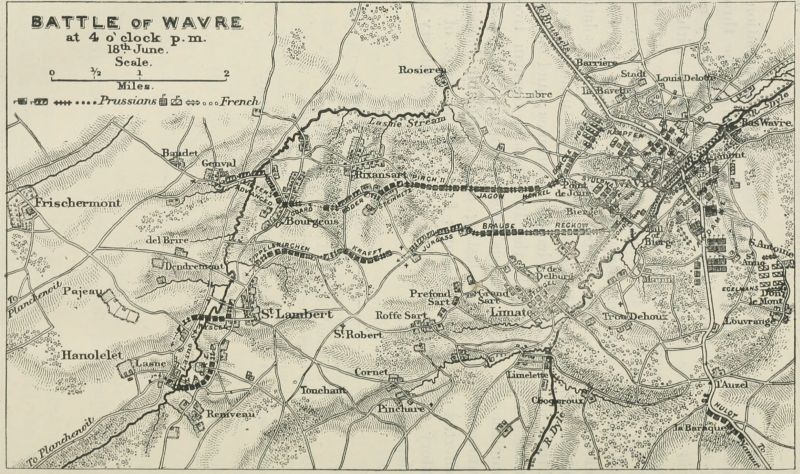
IT was explained at the conclusion of the Eighth Chapter that Thielemann, who had been ordered by Blücher to defend the position of Wavre in the event of the Enemy advancing in force, or, if otherwise, to follow the main Army in the direction of Couture, was on the point of fulfilling the instructions appertaining to the latter contingency, when Vandamme's Corps arrived in front of that position, about four o'clock in the afternoon, and its Artillery immediately opened a cannonade upon the Prussian troops.
All the Brigades (the Ninth, Tenth, Eleventh, and Twelfth) of Thielemann's Corps, had, at that time, received the Order to commence the general movement to the right. A Detachment of only two Battalions (the Fusilier Battalions of the 30th Regiment and of the 1st Kurmark Landwehr), under Colonel Zepelin, from the Ninth Brigade, which had not yet crossed the Dyle, was to be left in occupation of Wavre. The Twelfth Brigade was already in full line of march, and the Eleventh had been just put in motion.
When General Borcke, who commanded the Ninth Brigade, fell back upon Wavre, for the purpose of carrying out his instructions, he found the Bridge already barricaded, and therefore proceeded with his Brigade to Bas Wavre: and having crossed the Dyle at this point, left a Detachment there, consisting of the Sharpshooters of the Fusilier Battalion of the 8th Regiment, and of those of the 1st Battalion of the 30th Regiment, under Major Ditfurth; whom he directed to destroy the Bridge immediately. He then detached the 2nd Battalion of the 30th Regiment and his two Squadrons of the Kurmark Landwehr Cavalry, as a reinforcement to Colonel Zepelin at Wavre; and, with the remainder of his Brigade, continued his march.
In the mean time, French Tirailleurs were observed extending along the opposite Heights; and, in their rear, considerable masses of the Enemy's troops appeared advancing. It soon became manifest that they contemplated forcing the passage of the river.
Thielemann, judging by the want of vigour displayed in the French pursuit; and by the Enemy not having attempted to secure the passage of the Dyle at Moustier, Limelette, and Limale, that it was only a weak Detachment of the Enemy that was advancing upon Wavre, confining itself to the design of creating some little uneasiness by its movement along this road to Brussels, had hitherto been of opinion that the occupation of Wavre by a few Battalions, as directed by Blücher, would be quite sufficient: but he now plainly saw that the moment had arrived which required him, in pursuance of his instructions, to maintain the position at Wavre; and he accordingly ordered the halt of his whole Corps for this purpose.
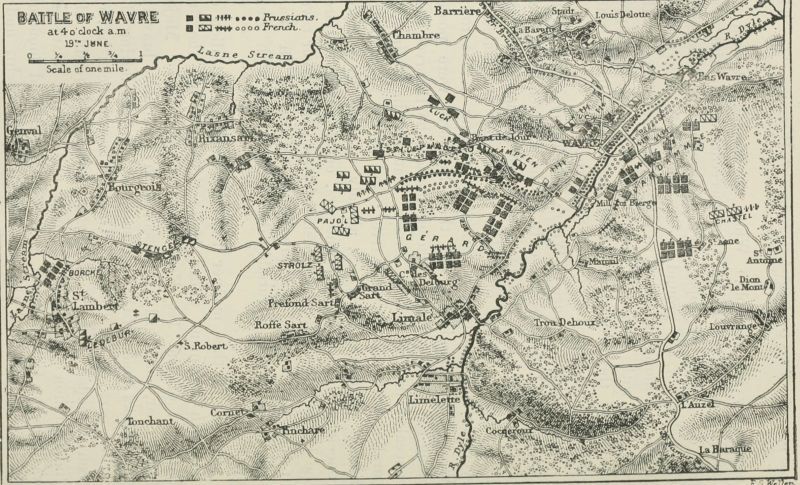
The town of Wavre is situated on the left bank of the Dyle: having a suburb on the opposite side of the river, with which it is connected by two stone Bridges; the principal one leading towards the middle, and a small one towards the upper end, of the Town. Higher up the stream, at the Mill of Bierge, at Limale, and at Limelette; as also below the town at Bas Wavre, there are wooden Bridges. The river is not deep, but at the period of the Battle it was swollen by the recent heavy rain. The low range of Heights on either side of the Valley is covered in many places with wood. The Heights on the right bank are generally more elevated, but those on the left have steeper declivities, and offer a greater command of the river and its passages. The shortest road from Namur to Brussels passes through the town, besides which there are numerous cross roads practicable for the movement of all Arms. The great number of hollow ways forms a prominent feature in the vicinity; and these, being in a miry state from the rain, were unfavourable to the progress of troops passing through them.
The position was thus occupied:—the Twelfth Brigade (Colonel Stülpnagel), with the Horse Battery No. 20, was posted on the Height in rear of Bierge. The Bridge in front of this Village was barricaded, and the Mill occupied for the defence of the Bridge. The Tenth Brigade (Colonel Kämpfen) stood upon the Height in rear of Wavre, its Right resting on a Wood which lay between it and the Twelfth Brigade. The Eleventh Brigade (Colonel Luck) was formed across the Brussels road. The Reserve Cavalry was drawn up, near La Bavette, in Columns of Squadrons. The Artillery was distributed along the Heights. The Horse Battery No. 18 remained in reserve.
That part of the town of Wavre which lies on the right bank, or, more properly, the suburb, was occupied by Light Troops only. The great Bridge was barricaded as well as time and circumstances would admit. The houses adjoining the left bank of the river were hastily loopholed. The smaller Bridge was left perfectly open. A Detachment of two Companies of Light Infantry, under Major Bornstädt was detached to reinforce the troops at the Bridge of Bas Wavre.
Thielemann intended that the Ninth Brigade should be posted in rear of this general disposition of his troops, so that its services might be made available according as circumstances might require; but through some misunderstanding in the transmission of the Order, General Borcke was induced, after having moved along the Brussels road until near La Bavette, thence to turn off to his left, and continue his march, according to his original instructions, in the direction of Fromont, Bourgeois, and St Lambert, towards Couture; being under the impression that the whole Corps had already commenced this march, in pursuance of the general plan, and that his Brigade was destined to cover the movement. The departure of the Brigade was not immediately discovered; and thus, by this misunderstanding, Thielemann's force suffered an unexpected reduction of six Battalions and the Foot Battery No. 18; and consisted, therefore, of only 15,200 men; with which number he had now to contend against Marshal Grouchy's force, amounting altogether to 33,765 men.
Thielemann's position was certainly a very favourable one, and the occupation of it was arranged with great skill. As it was impossible to foresee in what manner the attack upon it would be conducted; whether it would be directed against one particular Bridge, or against all the Bridges, with the design of carrying the whole Line by storm: Thielemann limited the occupation of the town and of the line of the river to the number of Light Troops which might be sufficient for sustaining any sudden assault; taking care to have Supports close at hand for that purpose: but disposing his Reserves, which comprised his main force, so that they might become available at any point which might be pressed; or, should the Enemy develop greatly superior numbers, as was subsequently the case, serve to guard against any flank attack.
As before explained, it was Vandamme's Corps which arrived in front of Wavre between three and four o'clock. Two Batteries, of which one consisted of twelve pounders, were drawn up on the right of the road overlooking the valley, and opened the cannonade. These were subsequently reinforced by a third Battery, posted on the left of the road. Excelmans' Cavalry Corps was posted in right rear of Vandamme. Gérard, with the Fourth French Corps, was still in the rear on the march; and Pajol, with his Light Cavalry, had only just passed through Tourrines, situated scarcely half way between Gembloux and Wavre. Marshal Grouchy sent word to both these Officers to accelerate their march.
Whilst the French Skirmishers were gradually forcing back the Prussian Light Troops into the valley, Grouchy, hearing a powerful cannonade in the distance to his left, rode off a little way in that direction; and concluding that Napoleon was closely engaged with Wellington, conceived that as he had now reached the Prussians, he would best fulfil his instructions by vigorously attacking them, so as to prevent their detaching reinforcements to the Anglo-Allied Army. He was quite ignorant as to the strength of the Enemy in his front, and was in doubt whether the whole Prussian Army was before him, or merely a strong Detachment. Of the fact that three Prussian Corps were on the march to co-operate with Wellington's forces, he of course knew nothing. In this state of uncertainty, and with his troops aux prises with the Prussians, he was fearful of detaching to his left; since by so doing, he would expose himself to the risk of his main force becoming overpowered by superior numbers, and his Detachment cut off.
Independently of other considerations which might have assisted in dissuading Grouchy from detaching a portion of his force at this period, such as the length of time his troops had been upon the march, along bad and miry roads; he was perfectly justified, under all the circumstances of his then position, in adopting this course of proceeding. And even if he had been fully cognisant of the actual disposition of the Prussian Army, he could at this time have rendered no essential service to Napoleon; the opportunity for doing so had been suffered to pass by, as was fully explained in Chapter VIII.
His total ignorance, however, of Blücher's proceedings, and of all that was then taking place between Wavre and the Field of Waterloo, afforded undeniable proof of his having completely failed in acting up to the spirit of the instructions he had received, not to lose sight of the Prussians, and in exercising that degree of enterprise, energy, and decision, which Napoleon had so naturally anticipated from a General of Grouchy's note and experience; especially when entrusted with so important a command, under such highly critical circumstances.
A message having reached Grouchy from Pajol, communicating his having fallen into the Marshal's line of operation, he directed that General to move upon Limale. His Right Flank, however, continued to be protected by the 17th Dragoons, detached from General Berton's Cavalry Brigade (of Excelmans' Corps) en reconnaissance, towards the high road leading from Namur to Louvain.
In the mean time, a vigorous cannonade was maintained between Vandamme's and the Prussian Batteries across that part of the valley in which lay the town of Wavre. Under cover of the French guns, the Skirmishers pressed down upon that portion of the town situated upon the right bank of the river, and of which they soon gained possession; the Prussians having previously decided upon not making any effort to retain it. On reaching the river, however, they were met by a most destructive fire of musketry from the opposite houses and the Bridge. The contest now became desperate, and the defence of the Dyle was obstinately maintained by the Prussians. The Skirmishers rapidly extended on either Flank along both banks of the river from Bierge as far as Bas Wavre. All the Prussian Brigades pushed forward their Sharpshooters. Those of the 4th Kurmark Landwehr took up the Line between the Town and Bas Wavre, those of the 3rd Kurmark Landwehr took post in the Town, between the two Bridges; on the right of the latter stood the Sharpshooters of the Tenth Brigade; and those of the Twelfth Brigade formed the Right Wing of the whole Line at Bierge.
This tiraillade had continued about an hour, when General Hulot's Division of Gérard's Corps d'Armée reached the Field; and received Orders to take possession of the Mill at Bierge, and to cross the Dyle at that point. A Battalion of Vandamme's Corps was at the time vainly attempting to effect a passage. Upon the Height opposite Bierge were several guns of the Third Corps, endeavouring to keep down the fire from the Prussian Batteries on the other side of the valley.
Grouchy desired Gérard to relieve the Battalion attacking the Mill at Bierge by one of his own Corps; whereupon the latter directed General Hulot to push forward with a Battalion of the 9th Light Infantry for that purpose. The Battalion descended into the valley, covered by the fire from the guns on the Height. Its advance was much impeded by the swampy nature of the ground at the foot of the declivity, and by the numerous broad and deep drains by which the valley is intersected: and its order was still further deranged by the fire from the Artillery on the opposite Heights, as also by that of the Prussian Skirmishers posted along the left bank of the river, and strongly occupying the Mill. The banks of the river at this part, more particularly the left bank, are mostly lined with trees; which tended still further to increase the means of resistance on the part of the Prussians to the advance of the French troops. The latter on reaching the Mill, and relieving Vandamme's troops, made an attack; but without success.
Grouchy was on the point of ordering this attack to be renewed, when he received, between six and seven o'clock, Soult's despatch, addressed to him from the Field of Waterloo at one o'clock in the afternoon: and desiring him to manœuvre always in that direction, to maintain a close communication with the main Army, and to lose not a moment in joining the latter, and attacking Bülow's Corps d'Armée; which, it added, could then be seen upon the Heights of St Lambert.
The circumstances in which Grouchy found himself at the time this despatch reached him, held out no prospect of his being able to fulfil, even partially, the instructions which it contained. Vandamme's efforts to force the Bridges of Wavre, and to capture the Town, were completely frustrated by the most gallant defence maintained on the part of the Prussians. The issue of the attack upon the Mill of Bierge appeared very doubtful. Neither the main body of Gérard's Corps, nor General Teste's Division of the Sixth Corps, nor even Pajol's Light Cavalry, had as yet arrived.
Grouchy, becoming impatient, rode hastily towards La Baraque, accompanied by Gérard, to meet the first mentioned force; and on coming up with the Columns, directed their march upon Limale, his object now being to turn the Right of Thielemann's position, and to prevent the retreat of the latter upon Brussels, and at the same time open his direct road to St Lambert. This he might succeed in effecting; but it is sufficiently evident from the above view of his position, at so late an hour of the day, that any important diversion on his part in favour of Napoleon, was quite out of the question.
On returning with Gérard to Wavre, Grouchy found that notwithstanding the furious assaults that were made in rapid succession upon the Bridges, supported by the vigorous cannonade from the Heights, and the incessant fusillade along the banks of the river, no further progress was effected. As if determined that the passage should be forced, he dismounted from his horse, and placing himself at the head of a Battalion, led on another attack upon the Mill of Bierge. But the bravery of the troops, though so strongly excited by the noble example of the Marshal, could avail nothing against the indomitable resistance of the Prussian defenders of this important Post. Gérard, who had accompanied the Marshal in this attack, fell severely wounded by a shot which struck him in the breast.
Grouchy now decided upon leaving Vandamme's Corps and Excelmans' Cavalry in front of Wavre and Bierge; and proceeding himself with that portion of Gérard's troops which was at hand, along the right bank of the Dyle, towards Limale, and uniting them to the remainder of the Corps which had been ordered to march in the direction of that point from La Baraque. This movement occupied considerable time, in consequence of the difficulties opposed to the march of troops along the side of the river. At length, having, arrived in front of Limale, and formed a junction with Pajol's Cavalry, preparations were made for an attack.
Limale was at that time occupied by Lieutenant Colonel Stengel with the three Battalions of the 19th Prussian Regiment, two Squadrons of the 6th Uhlans, and one Squadron of the Westphalian Landwehr Cavalry. It was the Detachment left by Zieten for the purpose of covering the Left Flank of the Third Corps d'Armée. It had unaccountably neglected to adopt any measures for barricading the Bridge; the defence of which, if conducted with the same energy and resolution by which that of the Bridges lower down the stream had been distinguished, might have been the means of preventing the French from crossing the Dyle at all on that day.
Pajol, having reconnoitred the place and discovered his neglect, succeeded in gaining possession of the Bridge by means of a brisk Cavalry attack. Hulot's Infantry Division of Gérard's Corps reached it shortly afterwards; and it was soon made manifest to Lieutenant Colonel Stengel that he was attacked by a force much superior to his own. Nevertheless he continued to fall gradually back, in good order, until Thielemann pushed forward the Twelfth Brigade to his support. Three Battalions of the Tenth Brigade moved into the position thus vacated by the Twelfth: and a general movement was made to the right by all the troops that could be spared from the defence of Wavre and Bierge. The 4th Kurmark Landwehr, belonging to the Eleventh Brigade, crossed the Brussels road. The Reserve Cavalry was ordered to move upon Limale, in support of the Twelfth Brigade.
When Colonel Stülpnagel was ordered to move his Brigade (the Twelfth) upon Limale, he left three Battalions for the defence of Bierge. With the remaining six Battalions he came up close to the Enemy, who was posted on a Height in advance of Limale, his Left thrown considerably forward and covered by his Cavalry, and his Right resting upon some houses which he had occupied with Infantry. This Line, which was perpendicular to the direction of the original position of the Prussians, had been taken up with great skill by Grouchy, notwithstanding the difficulties with which the movement had been attended. His troops had to ascend the Heights during the obscurity of the night, in rear of Limale, by a narrow, rugged road, in the immediate proximity of the Prussians, whose fire reached the head of the Defile: and he was fully occupied until a very late hour, in posting the Battalions in their proper places, as they filed out of the road, on reaching the Height; whilst, in the mean time, Pajol's Light Cavalry pushed rapidly round by the left.
Colonel Stülpnagel posted the Fusilier Battalion of the 5th Kurmark Landwehr, and his Battery, in reserve, in rear of the small Wood on the right of Bierge, and advanced to the attack, late as it was, with his five remaining Battalions, having Lieutenant Colonel Stengel with his Detachment on the right. The darkness of the night prevented the Prussians from correctly ascertaining the position and strength of the French; but nevertheless it was decided that an attempt should be made to regain Limale, and drive back the Enemy across the Dyle.
The attack was thus formed. Two Battalions in front, closely followed by the remaining three Battalions. Both the Brigade Squadrons joined the three Squadrons under Lieutenant Colonel Stengel; and the whole of the Reserve Cavalry formed in support. In this movement, however, the mutual connection of the advancing troops was greatly impeded by the darkness of the night. The two Battalions in Front Line were on the point of passing a hollow way when they received a volley from two French Battalions on the opposite side, by which their further advance was checked. The three Battalions of the Second Line had inclined too much to the left, where they became engaged with French Tirailleurs. Lieutenant Colonel Stengel's Detachment, in attempting to push forward, was checked by the French Cavalry; and as the latter made a disposition which menaced his Right Flank, that Officer fell back with his Detachment as far as the Wood near Point du Jour.
The decided failure of the attack induced Colonel Stülpnagel to withdraw all his troops to the Wood, leaving only the 1st Battalion of the 6th Kurmark Landwehr in support of the chain of Advanced Posts. The Reserve Cavalry bivouacked in rear of the Wood. Thus ended the contest on this part of the Field. The Prussian and French Picquets were so close to one another during the night, that the Patrols were constantly clashing, and the whole Line kept upon the qui vive.
Upon the Prussian Left, the conflict for the possession of the town and Bridges of Wavre continued to be carried on with unabated fury on both sides until late in the night. Vandamme devoted the whole of his Corps to the attack; constantly pushing forward fresh troops to relieve those who had failed in their attempts to dislodge the Prussians. The latter, who exhibited on this occasion an extraordinary degree of bravery and resolution, succeeded in repelling no less than thirteen different assaults; and even dislodged, in five instances, the French from the houses they occupied, from the commencement, on the right bank of the Dyle. At one time the French had already gained possession of the great Bridge and some houses on the left bank, when they were driven back again to their own side of the river by the Prussian Reserves—these having advanced to the relief of their comrades. The struggle was desperate, and apparently interminable. When the French attacked the houses nearest the Bridge they succeeded in bursting open the doors, and by superiority of numbers, in possessing themselves of the ground floors. But even this did not induce the heroic defenders to relax their exertions; on the contrary, with increased fury, they defended the upper storeys of the houses, and held out most gallantly until relieved by the arrival of their Supports.
This brilliant defence of Wavre was distinguished, on the part of the Prussians, not only by the unflinching bravery of the troops, but also by the judicious disposal of the Reserves; by means of which the Enemy was foiled in every attempt to gain a permanent footing in the town. While the Skirmishers and their Supports were posted along the Dyle and the adjacent houses, the Reserves were concealed in the nearest streets, that lay in a direction parallel with that of the river: and at the moment the French Columns of Attack, already crippled by the fire concentrated from the Skirmishers, endeavoured to force the Bridge; these Reserves rushed forward from their cover in the side streets, and presenting themselves in mass before the Enemy, invariably drove them back with great slaughter.
It was in this manner that the Fusilier Battalion of the 30th Regiment, under Major Sprenger, and the 3rd Battalion of the 1st Kurmark Landwehr, under Major Bornstädt, constantly repulsed, with admirable bravery, the attacks made with such superior numbers during the earlier part of the contest. One of these attacks having been attended with a somewhat favourable result, the 2nd Battalion of the 30th Regiment, under Major Beaufort, was brought forward; and, at a similarly critical moment, the 1st Battalion of the 4th Kurmark Landwehr, under Major Grolman, came up; when both Battalions succeeded in compelling the Enemy to retire.
These Battalions then took post in the streets lying parallel with the river, in the manner before explained; and, with heroic courage, overcame every renewed attempt on the part of the French to establish themselves in the town. When, finally, it is considered that from four o'clock until night, four Prussian Battalions successfully maintained their ground against a whole Corps d'Armée, with which they were constantly and desperately engaged during the whole of that period; the merits of Colonel Zepelin and his brave troops are beyond all praise, and present one of the brightest examples of the defence of a town and of the passage of a river, recorded in military history.
Battle of Wavre
Both the Bridges of Wavre remained in the possession of the Prussians, and the smaller one was barricaded during the night.
At a late hour, as the fire on both sides began to slacken, the combatants bivouacked on their respective sides of the river. Upon the Prussian extreme Left at Bas Wavre, the French had only shown one Battalion. This occupied an isolated building, and was supported by two Squadrons and a piece of artillery. Several unsuccessful attempts were made to gain the Bridge; which, at nightfall, continued in the possession of the Prussians.
Grouchy was occupied late in the night in making his preparations for renewing the attack on the following morning. General Teste's Division of the Sixth Corps having at length arrived, his Left Wing, which was thus considerably reinforced, bivouacked upon the Height westward of Bierge; separated by this Village and the Dyle from his Right Wing which lay in front of Wavre. He had not yet received any intelligence of Napoleon's signal defeat at Waterloo; and was therefore resolved upon following up, at daybreak, the advantages he had already gained, by forcing back the Prussian Right Flank.
Thielemann, on the contrary, having despatched an Officer of Marwitz's Cavalry Brigade en reconnaissance to the right, ascertained through this means that the Allied Armies had gained a complete victory; and he therefore fully expected that Grouchy would be compelled to effect an immediate retreat.
With the first dawn of the 19th of June, Colonel Stengel, whose Detachment was posted on the extreme Right of Thielemann's Corps, took upon himself to march off by St Lambert, to join his Corps d'Armée (the First); the grounds for which proceeding remain to the present time as unaccountable as his neglect on the previous day to secure the Bridge of Limale. In consequence of this movement, the Twelfth Brigade was necessitated to extend its Line too much to the right and to retain a Reserve of only three weak Battalions upon the road leading through the Wood to Point du Jour. The Wood to the right was occupied by a Battalion and two Companies from each of the remaining Regiments of the Twelfth Brigade. The Left Wing of this Line, which rested upon Bierge, was formed by six Battalions of the Tenth Brigade.
Colonel Luck, commanding the Eleventh Brigade, was directed to support this Division, which was much too weak, with the three Battalions of the 3rd Kurmark Landwehr; but to leave the two Battalions of the 4th Kurmark Landwehr, as also the Brigade Squadrons, in rear of Wavre, in a hollow near the Windmill, where they served to cover the twelve pounder Battery No. 7.
The Mill of Bierge was occupied by two Battalions of the Twelfth Brigade: Wavre and Bas Wavre were held by the same troops which defended those points on the previous day. The barricades and preparations for defence were rendered more complete.
Lieutenant Colonel Ledebur, whose Detachment, consisting of the 10th Hussars, a Squadron of Landwehr Cavalry, and two guns from the Horse Battery No. 12, had formed on the 18th the Advance of the Rear Guard which Thielemann's Corps was considered to constitute, having reached St Lambert before Grouchy's attack became so decided, remained there during the night.
Early on the 19th, Grouchy sent off three Cavalry Regiments to his left to watch these troops. They showed no indication of an intention to attack; and when, later in the day, they retired and disappeared from Ledebur's view, the latter passed the Defile, for the purpose of proceeding to join his Corps d'Armée (the Fourth), which, however, he did not reach before the 20th.
This, as well as Colonel Stengel's Detachment, thus withdrew from the Field, without any apparent necessity, reducing Thielemann's numbers, already too weak, and taking up a line of march, along which their services were comparatively useless.
Thielemann, concluding from the account that he had received of the defeat of Napoleon, that the French would commence a retreat, renewed the combat at daybreak by an attack with his Cavalry. Colonel Marwitz was sent forward, with the 8th Uhlans and two Squadrons of the 6th Kurmark Landwehr Cavalry, towards the plateau above Limale, occupied by Grouchy's Left Wing: whilst General Hobe followed this movement with the 5th and 7th Uhlans, and formed up on the left of the Advanced Cavalry. The 5th Uhlans were immediately afterwards advantageously posted in a hollow in support of Colonel Marwitz.
The Horse Battery No. 20, subsequently reinforced by the Foot Battery No. 18, opened a cannonade upon the Enemy's Columns at the plateau; which displayed a great superiority of numbers, and were supported by a considerable force of Cavalry. The preponderating number of guns in the Enemy's Line answered the fire of the Prussians with great vigour; and as the intervening space was very limited, the numbers of killed and wounded were very great. The Prussian Artillery lost five guns on this occasion.
Grouchy delayed not a moment in making dispositions for an attack on his part. His force on this side of the Field consisted of the three Divisions of Gérard's Corps, and of Teste's Division of the Sixth Corps. The latter and two of the former were posted in Front Line; the remaining Division, in Reserve. He formed three Columns of Attack. That on the right consisted of Teste's Division, and was directed upon Bierge; the central Column was put in motion against the Prussian Centre; and that on the left against the Right of the Prussian formation.
The head of each Column was accompanied by a Battery, and preceded by a swarm of Skirmishers. At the same time, Pajol put his Cavalry in motion, and threatened to turn the Prussian Right.
Thielemann resolved upon not only offering to the Enemy a vigorous opposition; but also upon assuming the offensive himself, and immediately gave the necessary Orders for that purpose. He also reinforced his Right with two more Companies, and his Left with an additional Battalion.
It was soon made manifest, however, that this attack failed to check the forward movement of the Enemy. The ten Prussian Battalions were forced to give way to the advance of twenty two French Battalions, which were followed by six more in support. The French gained possession of that part of the Wood of Rixansart which was on the right of the Prussian position, and drove back the Twelfth Brigade. The Battalions of the latter collected again immediately in rear of the Wood, under the protection of the three before mentioned Battalions of the Eleventh Brigade and of a Battery of fifteen guns.
General Teste's Division had in the mean time attacked Bierge, which was bravely defended by the two Battalions of the Kurmark Landwehr. Whilst the engagement continued at this point, Thielemann took up a second position in rear of the first, with four Battalions of the Tenth Brigade, and occupied the small Wood in rear of Bierge. The Prussian Cavalry Brigade, under Colonels Marwitz and Count Lottum, comprising twelve Squadrons, secured the right towards Chambre.
About eight o'clock, just as this position had been taken up, Thielemann received, through General Pirch, the decisive and authentic intelligence that a great victory had been gained by the Allies on the previous day, as also a communication of the fact of the Second Corps d'Armée having marched to intercept Grouchy's retreat upon the Sambre. Advantage was immediately taken of these joyful tidings to raise the spirits of the troops, and to excite them to a renewed attack. With loud cheers the Prussian Batteries advanced to the attack; which was attended with complete success, and even the Wood of Rixansart was again taken.
The Enemy appeared irresolute, and as if impressed with the idea that Thielemann had received reinforcements; but observing that no further progress was made, he renewed the attack on his part, and retook the Wood of Rixansart.
It was not until about this time—towards nine o'clock—that Teste's Division gained possession of the Village of Bierge; on which occasion General Penne, an Officer of considerable distinction in the French Army, was killed. The French were prevented for some time from debouching from the place, by the determined opposition of the Tirailleurs of the 31st Prussian Regiment, under Major Natzmer.
Thielemann had now done all which could possibly have been expected from any General under similar circumstances—with a force not equal to one half of that of the Enemy, he had endeavoured, whenever an opportunity offered, and in defiance of superior numbers, to force back the French Left Wing upon the Dyle; but now that he had failed in effecting this object, and that Bierge, the key of his position, had been taken from him, whilst the French Left was pressing forward with increased numbers to gain the Brussels road, he saw very plainly that to attempt to maintain his ground any longer would be to expose himself to the imminent risk of total overthrow, and that no other course was left to him but to order a general retreat.
It was about ten o'clock in the morning when the Prussian troops began to retire from the Field. The Town of Wavre had not been attacked on the 19th, and Colonel Zepelin abandoned it without being much pressed upon his line of retreat. Colonel Marwitz was ordered to form the Rear Guard, which was furnished from the 7th and 8th Uhlans, and the 3rd and 6th Kurmark Landwehr Cavalry. It was accompanied by three Batteries of Horse, and one of Foot, Artillery. With these troops Colonel Marwitz took Post, at first, in front of the Brussels road; placing three Batteries on his Left, and the remaining one in Reserve. Thielemann gave the Rear Guard an express Order not to march off until Wavre had been completely evacuated.
In the mean time, Gérard's Corps d'Armée had crossed the Dyle both at Bierge and at Wavre. The two Battalions of the 4th Kurmark Landwehr, which had been posted in the hollow in rear of the Town, for the protection of the twelve pounder Battery, became closely pressed in consequence of this movement. One of the Battalions under Major Schmade had advanced against an Enemy's Column near the Brussels road; when it unexpectedly received the fire of three French Battalions, which were pushing forward under cover of an eminence, and followed by some Cavalry. The Battalion succeeded in reaching the small Wood near La Bavette; and as the Enemy attempted to turn the latter, it suddenly attacked and drove him back, after which it came up with the Rear Guard. The other Battalion, commanded by Major Schwerin, attacked a French Battalion which was advancing against it, threw it back in confusion, and then continued its retreat. The gallantry and steadiness displayed in this affair by the Kurmark Landwehr acquired for the latter great and well merited renown.
The French Cavalry debouched from the Wood of Rixansart and drew up, with its Left resting upon Chambre. Vandamme now advanced the Columns of his Corps towards the Heights of La Bavette, and pushed forward some Cavalry along the high road. The latter, however, was driven back by Colonel Marwitz.
It has been explained that General Borcke, instead of posting his remaining six Battalions in rear of the position at Wavre, as intended by Thielemann, proceeded on his march to Couture, by St Lambert. This place he reached about nightfall, when he despatched an Officer to Blücher to report his arrival. The latter, in reply, desired him to bivouac on the spot where he was, and to await further Orders on the following morning. The Brigade was still in its bivouac at seven o'clock the next morning, when Colonel Stengel passed through St Lambert with his Detachment. The latter informed General Borcke that he had defended the Bridge of Limale, and had been followed by the Enemy's troops.
Borcke, on hearing this, immediately broke up his bivouac, and decided upon securing the Wood which extends from St Rober as far as Rixansart. He deployed two Battalions of the 8th Regiment along the edge of the Wood, and held the remaining four Battalions of his Brigade, then with him, in reserve. Perceiving French Cavalry, at the time of their first attack, marching into the Wood of Rixansart for the purpose of advancing through it upon Chambre; he opened a fire upon them from his Battery, with the hope of checking their movement. The only effect it produced was that of their detaching three Regiments of Cavalry towards his Brigade. These, however, contented themselves with watching his movements. It is curious that the Ninth Brigade, as if bent upon continuing the blunder committed the previous day of detaching itself from its Corps, should not have attempted, with its six Battalions, to effect a more important diversion upon the Enemy's extreme Left, from which it was not more than three thousand paces distant. It was then eight o'clock, and the Battle was maintained until about eleven; and yet General Borcke allowed the three Cavalry Regiments to move off and join the remainder of the French Cavalry, towards ten o'clock, at Chambre, without even attempting to molest their movement.
Thielemann effected his retreat, in several Columns, by Ottenburg and St Achtenrode; at which latter place (about half way to Louvain) he took up a position. The French Cavalry followed as far as the Brussels road, and the Infantry occupied the Heights of La Bavette.
Between Wavre and Louvain the country assumes a new character, being covered with hedges, hollow ways, ditches, and gardens, and is altogether much intersected. From Ottenburg as far as St Achtenrode, there is almost one continued defile. In this, Cavalry cannot act with advantage; and it was therefore fortunate for the Prussian Cavalry that it was followed but slowly by the French.
The loss experienced by Thielemann's Corps d'Armée in this Battle of the 18th and 19th of June, amounted to 2,476 men. No returns whatever of the losses sustained by Grouchy's Army are forthcoming, but they could not have been less than those of the Prussians.
Such was the Battle of Wavre; a Battle the result of which was of no advantage to Napoleon on the 18th, and of positive disadvantage to him on the 19th. On the former day it did not prevent the march of the great mass of the Prussian Army towards the Field of Waterloo; and, on the 19th, the continuance of the contest, while Napoleon was in full flight, exposed this, the only remaining intact, portion of the French Army, to the imminent risk of being completely cut off from all retreat. Nor can this defeat of Thielemann be looked upon as having shed additional lustre upon the French arms, when it is considered how long and successfully the Prussians battled against them with less than half their strength.
The errors which led to the circumstance of the force under Grouchy—constituting, as Napoleon himself has been pleased to term it, the Right Wing of the French Army—becoming exclusively occupied in attacking a single Corps of the Prussian Army; whilst the remaining three Corps of the latter were wending their way unmolested towards the decisive Field of Battle, have already been sufficiently discussed: and now that their result has been fully exhibited, it is scarcely necessary to draw attention to the proof which the latter affords of the entire ignorance of each other's proceedings which characterised the conduct of Napoleon and Grouchy, great Generals as they were, in this memorable Campaign. The former received intelligence, before he began the Battle with Wellington, that the Right Wing was to follow the Prussians to Wavre, and to act in such a manner as to prevent these from detaching towards the Anglo-Allied Army; and therefore felt satisfied that his general plan of operations was in successful progress. But in less than two hours from the commencement of the Battle, the fatal consequence of both Generals having unaccountably neglected to maintain a vigilant reconnaissance and an uninterrupted communication, was made manifest; and the first intimation Napoleon received of the advance of the Prussians towards La Belle Alliance was the distant view which he himself had, from his own Field, of Bülow's Corps descending the Heights of St Lambert, at about one o'clock.
The leading principle of the French Emperor's plan was to endeavour, by all means in his power, to beat the Armies opposed to him in detail. It was therefore incumbent on him, in order to insure the success of that plan, to adopt such precautionary measures as should procure for him the earliest and the clearest information concerning the movements of his Enemies. If he found it necessary temporarily to divide his force, and act upon two lines; those measures became still more indispensable, and at the same time admitted the greater facility of execution. Several reconnoitring parties, both upon the Flanks of the Army and in front of the interval between the two lines of operation, under the guidance of experienced, active and intelligent Officers, would have obtained for both Generals that insight into the movements and designs of their opponents which was so essential for the attainment of their common object: whilst parties detached from each Wing, for the sole purpose of maintaining a close and direct communication between them, would have afforded the ready means of regulating each other's proceedings according to the circumstances under which they might have found themselves respectively placed.
That there should have been so total a disregard of any measure of the kind appears almost incredible; yet such was the fact; and hence it came to pass that the despatch sent to Grouchy, at one o'clock, from the Heights in rear of La Belle Alliance did not reach him until seven in the evening; at which time, as before explained, it was too late to admit of the instructions it conveyed being fulfilled: and hence, also, Grouchy was left battling with his entire force—not less than a third of the whole French Army—against a single incomplete Prussian Corps, under Thielemann, from daybreak until about eleven o'clock in the forenoon of the 19th, when he was first made acquainted with the fact that during the whole of that time the Army under Napoleon, having been most signally defeated and completely scattered on the preceding evening, was flying across the frontier in the wildest confusion.
On receiving this latter intelligence, Grouchy's first idea was to march against the rear of the main body of the Prussian Army: but, calculating that his force was not adequate for such an enterprise, that the victorious Allies might detach to intercept his retreat, and that he should be closely followed by that portion of the Prussians which he had just defeated; he decided on retiring upon Namur, where he would regulate his further operations according to the intelligence he might gain in that quarter concerning the real state of affairs.
Part of France
CHAPTER XVII.
IT would be difficult to discover, in the whole history of the Wars of modern times, an instance in which so fine, so splendid, an Army as that of Napoleon, one composed almost exclusively of veterans, all men of one nation, entirely devoted to their Chief, and most enthusiastic in his cause, became so suddenly panic stricken, so completely disorganised, and so thoroughly scattered, as was the French Army when it lost the Battle of Waterloo. A defeated Army usually covers its retreat by a Rear Guard, but here there was nothing of the kind: and hence that Army cannot be said to have retreated; but truly to have fled, from the Field of Battle. No attempt to rally was made on the Belgian soil, and it was not until some of the scattered fragments of the immense wreck had been borne across the French frontier that their partial junction on different points indicated the revival of at least some portion of that mighty mass of warriors; who, but three days before, had marched across this same frontier in all the pride of strength, and in all the assurance of victory.
The rearmost of the fugitives having reached the Sambre, at Charleroi, Marchienne, and Châtelet, by daybreak of the 19th, indulged themselves with the hope that they might then enjoy a short rest from the fatigues which the relentless pursuit by the Prussians had entailed upon them during the night; but their fancied security was quickly disturbed by the appearance of a few Prussian Cavalry, judiciously thrown forward towards the Sambre from the Advanced Guard at Gosselies. They resumed their flight, taking the direction of Beaumont and Philippeville.
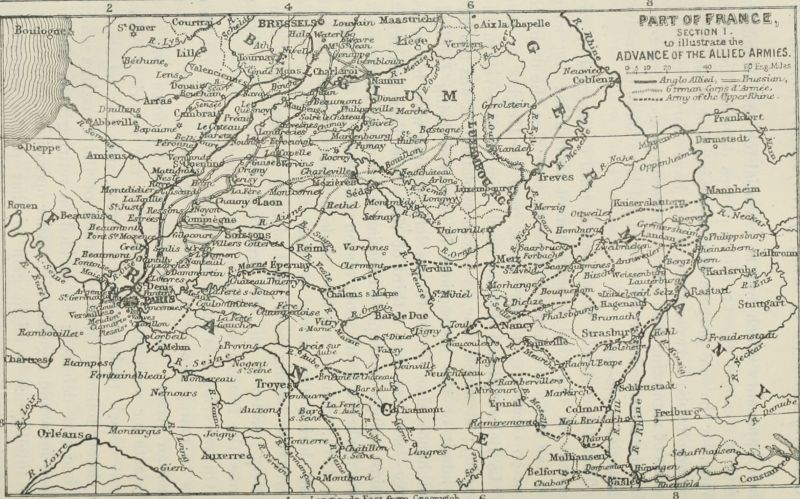
It had been arranged by Wellington and Blücher, on the Field of Waterloo, that the Prussian Army, not having been so much crippled and exhausted by the Battle, should undertake the further pursuit, and proceed by Charleroi towards Avesnes and Laon; whilst the Anglo-Allied Army, after remaining during the night on the Field, should advance by Nivelles and Binche towards Peronne.
On the following morning, the pursuing Cavalry belonging to the First, Fourth, and partly to the Second, Prussian Corps d'Armée, reached the vicinity of Frasne and Mellet.
The Fourth Corps marched at daybreak from Genappe, where it collected together the Brigades which had been so much broken up by the continued pursuit. The 8th Prussian Hussars, under Major Colomb, were detached from this Corps towards Wavre, to observe Marshal Grouchy. They were supported by the 1st Pomeranian Landwehr Cavalry; and, shortly afterwards, the 2nd Silesian Landwehr Cavalry, under Lieutenant Colonel Schill, also followed in the same direction.
After some hours' rest, the Fourth Corps d'Armée marched to Fontaine l'Evêque, where it bivouacked. It had received Orders to communicate from this place with Mons. The Advanced Guard, under General Sydow, was pushed forward, as far as Lermes, on the road to Thuin; it being intended that this Corps should proceed by the road to Maubeuge, along the Sambre.
The First Corps d'Armée, which had from the beginning followed the Fourth as a Reserve, now advanced in pursuit of the Enemy by the direct road to Charleroi. The Light Cavalry at the head of the Column reached the passages of the Sambre at Châtelet, Charleroi, and Marchienne, without meeting any sort of opposition or impediment; nor did it perceive any thing of the Enemy on the other side of the river. The Corps halted for the night at Charleroi: having its Advanced Guard at Marchienne, and its Outposts occupying the line from Montigny by Louveral as far as Châtelet. Detachments from the Reserve Cavalry were sent in the direction of Fleurus, to secure the Corps from any molestation on the part of Grouchy; of whose proceedings nothing positive was then known at the Prussian Head Quarters.
It was not until nearly five o'clock in the evening of the 19th, that General Borcke, whose Brigade, the Ninth, was still in the vicinity of St Lambert, discovered the retreat of Grouchy's troops. He immediately communicated the fact to General Thielemann, who ordered him to cross the Dyle the next day (the 20th) and march upon Namur. The French Rear Guard of Gérard's Corps d'Armée continued to occupy Limale until nightfall. Thielemann remained posted, during the night of the 19th, at St Achtenrode; having his Advanced Guard at Ottenburg.
On the evening of the 18 th, Pirch received Orders to march from the Field of Waterloo with his Corps d'Armée (the Second) in the direction of Namur; for the purpose of turning Marshal Grouchy's Left Flank and intercepting his retreat upon the Sambre.
Pirch made this movement during the night, passing through Maransart, where he was joined by his Seventh Brigade; and crossing the Genappe rivulet at Bousseval, as also, subsequently, the Dyle, on his way to Mellery: which place he reached at eleven o'clock in the forenoon of the following day. His Corps was much divided on this occasion. He had with him the Sixth, Seventh, and Eighth Infantry Brigades, and twenty four Squadrons of Cavalry: but the Fifth Infantry Brigade, and the remaining fourteen Squadrons, were with that portion of the Prussian Army which was pursuing the Enemy along the high road to Charleroi. The Corps being greatly fatigued by the night march and its exertions on the previous day, Pirch ordered the troops to bivouac and to betake themselves to rest.
During this march, Lieutenant Colonel Sohr had pushed on with his Cavalry Brigade, as an Advanced Guard; and now he was required to gain intelligence concerning the Enemy's movements, and to seek a communication with Thielemann. He found the Defile of Mont St Guibert strongly occupied by the Enemy, but could obtain no information respecting Thielemann's Corps.
When it is considered how very near to Mellery Gérard's Corps d'Armée must have passed, in order to fall into the Namur road at Sombref; it seems extraordinary that Pirch, who reached that place at eleven o'clock in the forenoon of the 19th,—the same hour at which Grouchy, then beyond Wavre, received the first intimation of the defeat of Napoleon,—should have permitted Gérard to continue his retreat unmolested. His troops required rest, it is true; but had he maintained a good look out in the direction of Gembloux, he would, in all probability, after the lapse of a few hours, have been enabled to fulfil his instructions so far as to have completely intercepted the retreat of a considerable portion of Grouchy's Army. That part of the Enemy's force which Lieutenant Colonel Sohr observed at Mont St Guibert, was probably the Advanced Guard only of Gérard's Corps d'Armée; since its Rear Guard remained at the Bridge of Limale until nightfall. Taking all the circumstances into consideration, more especially the express object of the detached movement of the Second Prussian Corps d'Armée, it must be admitted that, on this occasion, there was a want of due vigilance on the part of General Pirch.
It was on the 19th, also, that Prince Blücher issued, whilst at Genappe, a Proclamation to his Army; in which he thanked the troops for their conduct during the recent struggle.
At daybreak of the 19th, that portion of the Duke of Wellington's Army which had fought the Battle of Waterloo, broke up from its bivouac, and began to move along the high road to Nivelles. Those troops which had been posted in front of Hal during the 18th, consisting of Stedman's Dutch-Belgian Division, Anthing's Dutch-Belgian Indian Brigade, and Colonel Estorff's Hanoverian Cavalry Brigade, under Prince Frederick of the Netherlands; as also of Johnstone's British Infantry Brigade, and Lyon's Hanoverian Infantry Brigade, under Lieutenant General Sir Charles Colville, were likewise directed to march upon Nivelles. The Army occupied Nivelles and the surrounding villages during the night of the 19th; in the course of which the Duke arrived from Brussels, and established his Head Quarters in the town.
An hour's rest was all that the harassing pursuit by the Prussians permitted Napoleon to enjoy at Charleroi; and he was compelled to fly across the Sambre, without the slightest chance of being enabled to check that pursuit on the Belgian side of the frontier.
The following inscription, which has been cut over the centre of the archway of the Charleroi gate, is singularly appropriate to the flight of Napoleon on this memorable occasion:
"ABIIT. EXCESSIT. EVASIT. ERVPIT."
The circumstances, however, under which the flight of Cataline here described, and that of Napoleon, took place, form a strange contrast. The former, subdued in the Senate by the indignant philippics and burning eloquence of Cicero, escaped from Rome to the rebel camp of Manlius, to take up arms against his native city for the purpose of satisfying the cravings of his profligate ambition; and the latter, defeated in the battle field, fled to the capital, in the vain hope of obtaining from the Senate of his country further means of waging war against the legitimate Sovereign.
From Charleroi, Napoleon proceeded to Philippeville; whence he hoped to be able to communicate more readily with Grouchy. He continued here four hours; which he employed in expediting Orders to Generals Rapp, Lecourbe, and Lamarque, to advance with their respective Corps d'Armée by forced marches to Paris: and also to the commandants of fortresses, to defend themselves to the last extremity. He desired Soult to collect together all the troops that might arrive at this point, and conduct them to Laon; for which place he himself started with post horses, at two o'clock in the afternoon.
The general disposition of the respective Armies on the evening of the 19th, was as follows:—
The Anglo-Allied Army, which constituted the Right Wing of the advancing forces, was at Nivelles and its vicinity.
The Duke of Wellington's Head Quarters were at Nivelles.
Of the Prussian Army, which formed the Left Wing, its First Corps d'Armée was at Charleroi;
Second Corps on the march to Mellery;
Third Corps at St Achtenrode;
Fourth Corps at Fontaine l'Evêque;
Fifth Brigade of the Second Corps at Anderlues, near Fontaine l'Evêque.
Prince Blücher's Head Quarters were at Gosselies.
The disorganized force of the main French Army was in the vicinity of Beaumont, Philippeville, and Avesnes.
Napoleon was posting towards Laon.
The detached portion of the French Army under Grouchy was on the march to Namur.
The Duke of Wellington, in whose character the highest military talents of the Warrior were so intimately blended with the most comprehensive views of the Statesman, did not allow the dazzling allurements which beset the path of a Conqueror to divert him for a single moment from that fixedness of purpose, or to dim that penetrating foresight which so peculiarly distinguished his proceedings on all great occasions of a similar nature, involving the peace, the honour, and the security of not only his own Sovereign and Country, but also of all the Allied Powers, in whose interests he was so actively engaged. He did not view the great Battle he had gained in the light of an event to be followed up by an irruption into the Enemy's country, conducted in such a manner as to humble to the dust the national pride of the French people; and to impose upon them the whole weight and burthen of the oppressions, ravages, and horrors which generally follow in the train of a victorious and lawless soldiery over the face of an Enemy's country. His sole aim was directed to the carrying out of the great object of the War, which comprised not only the annihilation of the power of Napoleon and of the adherents to his cause, but also the Restoration of the legitimate Sovereign to the Throne of France. With the latter Sovereign he had been in constant communication, devising means for his protection during his temporary exile in the Netherlands; and now that the Armies were on the point of crossing the frontier, counselling him to hasten forward and show himself in the midst of his people: in order that by identifying his cause with the common object of the Allied Powers he might avail himself of all the influence and advantages to be derived from the recent victory; and become, as it were, a participator in the brilliant successes which attended their arms on the glorious 18th of June.
In proof of the sincerity of his intentions, and as a first step towards securing the good will, if not the friendly disposition, of the French people, more especially of the Legitimists and the well and peaceably disposed; the Duke issued the following General Order to the whole of the troops under his command:—
Nivelles, 20th June, 1815.
General Order.
1. As the Army is about to enter the French territory, the troops of the Nations, which are at present under the command of Field Marshal the Duke of Wellington, are desired to recollect that their respective Sovereigns are the Allies of His Majesty the King of France; and that France ought, therefore, to be treated as a friendly country. It is therefore required that nothing should be taken, either by Officers or soldiers, for which payment be not made. The Commissaries of the Army will provide for the wants of the troops in the usual manner; and it is not permitted either to soldiers or Officers to extort contributions. The Commissaries will be authorised either by the Field Marshal, or by the Generals who command the troops of the respective Nations, in cases where their provisions are not supplied by an English Commissary, to make the proper requisitions, for which regular receipts will be given; and it must be strictly understood that they will themselves be held responsible for whatever they obtain in way of requisition from the inhabitants of France, in the same manner in which they would be esteemed accountable for purchases made for their own Government in the several dominions to which they belong.
2. The Field Marshal takes this opportunity of returning to the Army his thanks for their conduct in the glorious action fought on the 18th instant, and he will not fail to report his sense of their conduct in the terms which it deserves to their several Sovereigns.
Wellington.
On the same day, the Duke, in consequence of a report received by him from Lieutenant General Lecoq, and of a previous communication made to him by the King of Saxony, consented to take command of the Saxon Corps d'Armée, amounting to nearly 17,000 men. He directed the above General to march these troops to Antwerp, and there await further Orders.
The Anglo-Allied Army marched this day to Binche and Mons. The British Cavalry moved into villages between Roeulx and Mons. Vivian's Hussar Brigade took the Outpost duties on the Sambre. The Hanoverian Cavalry furnished Outposts towards Maubeuge. The Duke fixed his Head Quarters at Binche.
Blücher, having secured the passage of the Sambre in the neighbourhood of Charleroi, continued his pursuit of the Enemy, and crossed the French frontier on the 20th. He directed Zieten to march the First Corps d'Armée from Charleroi to Beaumont, to throw forward his Advanced Guard as far as Solre le Château, to detach a Party of Observation to the left towards Florenne, and to watch the road from Philippeville to Beaumont.
As the First Corps d'Armée advanced, it discovered at every step fresh proofs of the extreme disorder in which the French Army had retreated; and found twelve pieces of Artillery which they had hitherto contrived to save from the great wreck at Waterloo, but had now abandoned to their pursuers. On arriving at Beaumont, the Corps took up a bivouac. Its Advanced Guard, under General Jagow, consisting of the Third Infantry Brigade, the 1st Silesian Hussars, and a Horse Battery, reached Solre le Château upon the road to Avesnes.
The Prince, at the same time, ordered Bülow to move the Fourth Corps d'Armée as far as Colleret, where the road to Thuin intersects the high road from Beaumont to Maubeuge, and to push on the Advanced Guard to Beaufort. Bülow accordingly directed General Sydow to proceed with an Advanced Guard, consisting of a Cavalry Brigade, a Horse Battery, and two Battalions of Infantry, which had the day before reached Lermes on the road to Thuin, and to ascertain very particularly whether the French had established themselves on the Sambre, to secure the Bridges both here and at Lobbes, and further, to restore these passages, should they have been destroyed by the Enemy. Another Detachment, under Colonel Eicke, consisting of two Fusilier Battalions, the two Squadrons attached to the Thirteenth Brigade, and of the 2nd Silesian Hussars, was sent forward to take possession, in the first instance, of the passages of the Sambre, and then to join General Sydow; who, proceeding by Colleret towards Beaufort, was to form both Detachments into an Advanced Guard on reaching the latter place. In the mean time, the mass of the Fourth Corps, headed by the Reserve Cavalry under Prince William of Prussia, followed in one Column.
The progress made by this portion of the Prussian Army on the 20th was not so rapid as was desirable. Considerable delay arose in consequence of the degree of caution imparted to the movements by the impression which Bülow entertained that the Enemy would defend the passages, and endeavour to maintain himself along the opposite side of the river. Hence the Advanced Guard of the Corps only reached Ferrière la Petite; part of the main body proceeded as far as Montignies, and the remainder with the Reserve Artillery, did not get farther than the Bridges across the Sambre.
The Fifth Brigade (belonging to the Second Corps d'Armée) had started at daybreak from its bivouac at Anderlues, near Fontaine l'Evêque; and directed its march, by Binche, upon Villers, towards Maubeuge. The Brigade was reinforced by one hundred Dragoons under Major Busch, and half a Horse Battery; which Detachment arrived at Villers at five o'clock in the afternoon. This Cavalry was employed in observing the Fortress of Maubeuge, from the Mons road, as far as the Sambre; and the Brigade bivouacked at Villers. A Hanoverian Regiment of Hussars also observed the Fortress on the right of the Prussian Cavalry upon the Bavay road.
The Left Wing of the Prussian Army, comprising the Third, and part of the Second, Corps d'Armée, came into collision with the Enemy this day, when pursuing that part of the French Army which was under Grouchy. Thielemann, having learned that the latter had commenced his retreat upon Gembloux, marched at five o'clock in the morning from St Achtenrode to Wavre; where he further ascertained that already on the afternoon of the 19th, the French had effected their retreat across the Dyle, leaving only a Rear Guard on the left bank of the river.
Grouchy, when he decided on retiring upon Namur, ordered General Bonnemains to move on rapidly, by Gembloux, with the 4th and 12th Dragoons, as an Advanced Guard, and to reach that town as soon as possible, and secure the passage of the Sambre. They were followed by the remainder of Excelmans' Cavalry, and the Reserve Artillery, together with the wounded. The Infantry was put in motion in two Columns: the one, consisting of the Third Corps d'Armée, proceeding by Gembloux; and the other, comprising the Fourth Corps, passing more to the right, and falling into the Namur road in rear of Sombref. The Light Cavalry was principally with the Rear Guard. To deceive Thielemann, Grouchy left his Rear Guard in Wavre and Limale, with Cavalry Picquets thrown out towards the Prussians, until near evening; when it followed the main body to Namur.
Thielemann, having placed the whole of his Cavalry, with eight pieces of Horse Artillery, at the head of his Column, now ordered them to move on at a trot, for the purpose of overtaking the Enemy; but it was not until they had passed Gembloux that they discovered the Rear of Grouchy's force, consisting of a few Regiments of Cavalry. These, however, now made so rapid a retreat, that it was impossible to bring them to action.
At length, on arriving near the Village of Fallize, within about three miles from Namur, the Prussians found Vandamme's Rear Guard posted on the brow of the declivity at the foot of which lay the town, in the valley of the Meuse. It presented about two Battalions of Infantry, three Regiments of Cavalry, and four guns; and was formed to cover the retreat of the French troops.
The Prussian Battery immediately opened a fire; during which Colonel Marwitz, moving out to the right, with the First Cavalry Brigade, and Count Lottum to the left, with the Second, turned the Enemy in both Flanks. The latter brought forward a Reserve of Cavalry, when the 8th Prussian Uhlans, under Colonel Count Dohna, at the head of the Column that turned the Enemy's Left, made a most gallant attack upon the French Dragoons; who met it with a volley from their carbines, but were overthrown. The 7th Uhlans and a Squadron of the 12th Hussars also charged on this occasion, and captured three pieces of French Horse Artillery, which were in the act of moving off, as also fifty Cavalry horses. The Enemy's Infantry now threw itself into the adjacent Wood, with which the declivities that here lead down into the valley of the Meuse are covered, and thus succeeded in preventing the Prussians from following up their success.
At this moment, intelligence was received that General Pirch was pursuing the Enemy with the Second Corps d'Armée upon the high road leading from Sombref to Namur; whereupon the Cavalry of the Third Corps was moved into this direction. A French Column, consisting of about twelve Battalions and two Batteries, but without any Cavalry, was perceived marching along that road. They belonged to Gérard's Corps d'Armée, which had effected its retreat by Limale, through Mont St Guibert. Upon the Height on which the Château of Flavinnes is situated was posted a Detachment from Vandamme's Corps, consisting of from four to five Battalions with a Battery, and a Regiment of Cavalry, for the purpose of receiving Gérard's Column as it fell back, and of protecting its retreat. As the Enemy continued its retrograde march in Close Column and in good order; it was not deemed advisable to undertake an attack with the two Prussian Cavalry Brigades of the Third Corps, which were much fatigued: but the Horse Battery was drawn up, and discharged several rounds of shell and grape at the French troops during their retreat upon the town. The latter, therefore, quitted the high road, and moved along the adjacent Heights until they reached the Battalions which had been drawn up in support, and which now opposed the further advance of Pirch's Corps d'Armée.
At this time, Thielemann's Cavalry withdrew, leaving the further pursuit of the Enemy to the latter Corps—to the movements of which it is now necessary to recur.
It was not until five o'clock in the morning of the 20th that Pirch received intelligence that the Enemy was retiring by Gembloux upon Namur. Lieutenant Colonel Sohr was immediately detached, in all haste, to Gembloux with his Cavalry Brigade, a Battery of Horse Artillery, and the Fusilier Battalions of the 9th, 14th, and 23rd Regiments, as an Advanced Guard. On approaching that town, Lieutenant Colonel Sohr ascertained that Thielemann's Cavalry was pursuing the Enemy along the high road from Gembloux to Namur. He therefore decided upon marching by the narrow road on the right of the chaussée leading from Sombref, in full trot, covered by the Wood, to overtake the French troops in retreat. At Temploux, the latter presented a force of two Battalions, some Cavalry, and four pieces of Artillery in position, prepared to cover the retreating Column. Lieutenant Colonel Sohr immediately attacked with both the Regiments of Hussars, supported by the Battery of Horse Artillery; and defeated this portion of the Enemy's forces. It was at this moment, too, that a cannonade was opened upon the latter by the Horse Battery, before mentioned, of Thielemann's Corps; whereupon it fell back upon the favourable position taken up near Flavinnes, and in which the Enemy appeared determined to make a stand.
Pirch immediately ordered the attack, and directed that it should be supported by Major General Krafft with the Sixth Brigade, which had closely followed the Advanced Guard, and had come up with the latter at four o'clock in the afternoon. Three Columns of Attack were formed. The First consisted of the 1st Battalion of the 9th Regiment, the Fusilier Battalion of the 26th Regiment, and the 1st Battalion of the 1st Elbe Landwehr. It was under the command of Major Schmidt, and detached to the left of the road, to drive back the Enemy's troops posted in the Wood and upon the Heights. The Second consisted of the 1st and 2nd Battalions of the 26th Regiment, and the 2nd Battalion of the 9th Regiment, under Colonel Reuss, and of the 2nd and 3rd Battalions of the Elbe Landwehr, under Colonel Bismark. This Column, which advanced partly on the right, and partly on the left, of the road, was supported by the Battery No 5, and led by Major General Krafft in person. The Third Column comprised the Fusilier Battalions which had constituted the Infantry of the Advanced Guard; and was detached more to the right, towards the Sambre, to support the general advance upon Namur.
General Krafft, after having kept up a fire, for a short time, upon the Enemy with his Artillery, ordered the attack with his Infantry. Colonel Reuss threw out his Skirmishers, who were quickly followed by the Columns of Attack. The Enemy, after some little resistance, was fairly driven into Namur by a charge with bayonets, and suffered much loss.
In the mean time, Major Schmidt, with his Column of three Battalions, had turned the Enemy's Right Flank on the Louvain road; and the French were now limited to the defence of the suburb, which, however, was maintained with great obstinacy. The Prussian Columns of Attack, advancing at the pas de charge, drove the Enemy out of the suburb, and endeavoured to gain possession of the Gates of the town. Colonel Zastrow, the second in command of the Sixth Brigade, wished to burst open the Gate which leads to the Louvain road; but was repulsed by a most murderous fire of musketry and grape, directed upon the assailants from the walls of the town.
On repeating the attempt, the Prussian Battalions fought with distinguished bravery, but with a great sacrifice of life. Colonel Zastrow was killed at their head; Colonel Bismark also fell; Colonel Reuss was wounded; and the Sixth Brigade alone lost forty four Officers, and 1,274 Under Officers and Privates.
The main body of Grouchy's Army was at this time in full retreat upon Dinant, along the Defile of the Meuse. The troops left in Namur, to keep the Prussians at bay as long as possible, consisted of General Teste's Division. They carefully barricaded all the Gates, lined the walls facing the Prussians, and made a most gallant resistance. The Officers, finding that their men continued so perfectly steady as not to require their attention, armed themselves with the muskets of the wounded, and assisted in maintaining the fire from the walls. The greatest order prevailed in the Town. The wounded, the provisions, and ammunition, had already been removed; and were on the line of march.
General Pirch was well aware that the French defended the town solely for the purpose of covering their retreat, and had therefore no intention of undertaking any serious attack; he simply wished to possess himself of the suburbs, and to hold the Enemy in check by detaching troops to the Porte de Fer and the St Nicholas Gate. He thought that a demonstration against the latter Gate would raise apprehensions in the minds of the French respecting the security of the Bridge over the Sambre.
With this view, he ordered General Brause to relieve, with the Seventh Brigade, the troops then engaged; and together with the Advanced Guard under Lieutenant Colonel Sohr, to blockade the Town. At the same time he directed the remainder of the Corps to bivouac near Temploux.
General Brause proceeded to post the Fusilier Battalion of the 22nd Regiment in the direction of the Porte de Fer, and the Fusilier Battalion of the 2nd Elbe Landwehr towards the Brussels Gate. The main body of the Seventh Brigade, under Colonel Schon, was stationed in rear of the suburb. The first mentioned Battalion stood, under cover, at four hundred paces distance from the Porte de Fer, having its Tirailleurs in the Avenue near the Gate. Just as General Brause rode up to examine its formation, an alarm was spread in front that the Enemy was making a sortie. The General desired the Commanding Officer, Major Jochens, to lead his Battalion quickly against the defenders, to overthrow them, and then, if possible, to penetrate into the town along with the retreating troops. As Major Jochens approached the Gate, he found in its immediate vicinity the Tirailleurs of the Sixth Brigade, still maintaining the contest in that quarter. The attacking Column and the Tirailleurs now rushed towards the Gate and the walls; which the French, probably not deeming themselves strong enough to resist this pressure, abandoned in the greatest haste.