Front matter (continued 14)
Reading edition
In the evening, the French, after having reformed, and collected their defeated force at Issy, made an attempt to regain possession of Moulineau; but the attack failed, and they were driven back upon Issy. Here they were reinforced: fifteen Battalions were posted in and about Issy, supported by numerous guns and Cavalry: their Light Infantry occupying the vineyards in front of the Village. About half past ten o'clock in the night, however, the Prussians, who kept a sharp look out, heard these troops marching off; and perceived that their departure was conducted in rather a disorderly manner. Instant advantage was taken of this circumstance, and a part of the First and Second Prussian Brigades attacked the French; who fled back upon the suburb of Vaugirard in such confusion that Paris might have been entered at this moment, if more force had been at hand.
During the night, Zieten posted his Corps in the following manner:—His Right upon the Height of Clamord, his Centre upon that of Meudon, and his Left in Moulineau; Sèvres still occupied; the Advanced Guard in Issy, in the rear of which Village was the Reserve Cavalry in support.
Whilst Zieten's Corps had been thus successfully effecting its movement against the south side of the capital; Thielemann's, which formed the Right Column, proceeded towards Plessis Piquet, and pushed forward its Advanced Guard to the Heights of Chatillon, which it reached late in the evening. Bülow's Corps, acting as a Reserve, occupied Versailles and its vicinity during the night.
During the whole of this day, the troops of the Anglo-Allied Army continued in position in front of the fortified lines on the north side of Paris. The Duke having established a Bridge at Argenteuil, Detachments were sent across the Seine: and these, having secured the Villages of Asnières, Courbevoie, and Suresnes on the left bank of the Seine, opened a communication with the Prussians.
The Allied Commanders had thus succeeded in shutting up the French forces within their lines. Wellington was perfectly prepared to attack the north side of Paris, if circumstances should render such a step necessary; or if a favourable opportunity should present itself: whilst Blücher, having secured a strong position in front of the south side, which was mostly open and defenceless, was equally ready to storm the capital with his collected force. The effect of this well conceived and successfully executed plan of operation was to divide the Enemy's attention between two opposite points of the town. Should he attempt to assail the one Army with his principal force, he would immediately find himself attacked by the other Army; without possessing the means wherewith to carry on the contest with both simultaneously. On the other hand, should a general and formidable assault be made by those Armies, on the opposite points, at the same time; the necessary division of his forces, in arranging his plan of defence, would render his situation still more desperate.
The Provisional Government, fully alive to this state of things, and duly aware of the approach of the Bavarian, Russian, and Austrian Armies, clearly saw the inutility of further resistance to the Allies, and instructed the Commissioners to wait upon the Duke of Wellington, and report to his Grace the fact of Napoleon having quitted Paris on the 29th to embark for the United States, and to press the point of a Suspension of Hostilities.
To this representation the Duke replied that the great obstacle to the Armistice having thus been removed, there remained only the question as to the terms; which he thought should be the halting of the Anglo-Allied and Prussian Armies in their present positions, the withdrawal of the French Army from Paris across the Loire, and the placing of the capital in the keeping of the National Guards until the King should order otherwise. He offered, if they agreed to these terms, to endeavour to prevail on Prince Blücher to halt his troops, and send an Officer to settle the details; but, at the same time, he told them distinctly that he would not consent to suspend hostilities so long as a French soldier remained in Paris.
Having received this explicit declaration on the part of his Grace, the Commissioners withdrew.
The following were the positions of the respective Armies during the night of the 2nd of July:—
The troops of the Anglo-Allied Army continued in position in front of the lines of St Denis. Detachments were at Asnières, Courbevoie, and Suresnes, on the left hank of the Seine.
The First Prussian Corps d'Armée had its Right on the Height of Clamard, its Centre on that of Meudon, its Left at Moulineau, and its Advanced Guard at Issy; in rear of which point was the Reserve Cavalry of the Corps.
Of the Third Corps, the Ninth Brigade was at Chatillon, the Tenth and Eleventh Brigades were in front of Vélizy, the Twelfth Brigade was at Chatenay and Sceaux. The Reserve Cavalry of the Corps bivouacked about Plessis Piquet.
Of the Fourth Corps, the Sixteenth Brigade was at Montreail, in advance of Versailles; the Thirteenth Brigade bivouacked near Viroflay; the Fourteenth Brigade bivouacked at Le Chesnay Bel Air, not far from Rocquencourt. The Reserve Cavalry of the Corps was partly in front of Versailles, and partly on the left of Montreail.
The troops composing the Right Wing of the French Army occupied the lines on the right bank of the Seine, whence they were watching the British. Some troops were posted in the Bois de Boulogne, and several Posts were established along both banks of the river.
The Left Wing extended from the Seine as far as the Orleans road. It held Vaugirard strongly occupied, the main body was posted between the Barrières de l'Ecole Militaire and de l'Enfer.
At three o'clock on the morning of the 3rd of July, Vandamme advanced in two Columns from Vaugirard to the attack of Issy. Between Vaugirard and the Seine, he had a considerable force of Cavalry, the front of which was flanked by a Battery advantageously posted near Auteuil on the right bank of the river. The action commenced with a brisk cannonade: the French having brought twenty pieces of cannon against the front of the Village, which was then vigorously assailed by his Infantry. The Prussians had constructed some barricades, and other defences, during the night; but these did not protect them from the sharp fire of case shot which was poured upon them by the French Batteries, the guns of which enfiladed the streets. The 12th and 24th Prussian Regiments, and the 2nd Westphalian Landwehr, supported by a half Battery of twelve pounders, fought with great bravery. There was much loss on both sides. At length the French withdrew; but only to advance again, considerably reinforced.
The Second Prussian Brigade was immediately ordered to join the First, and the whole of the troops of the First Corps stood to their arms. Zieten sent a request to Prince Blücher for the support of two Brigades of Bülow's Corps; and, at the same time, begged Thielemann to advance (in conformity with instructions conveyed to him from Head Quarters) from Chatillon, and threaten the Enemy's Left Flank.
In the mean time, the French renewed their attack upon Issy; which, however, again proved unsuccessful. This was followed by a heavy cannonade and by further assaults, without any decided advantage having been gained over the defenders. The French did not appear disposed to venture upon a more general attack, which would have offered them a much greater chance of forcing back the Prussian Advanced Guard; probably considering that, if unsuccessful, it might end in the suburbs of Paris being easily carried by storm: and hence, after four hours' continued but fruitless attempts upon Zieten's Advanced Position, they fell back upon Paris; the Prussian Tirailleurs following them until they came within a very short distance of the Barriers.
At a Council of War, which had been held during the previous night in Paris, it was decided that the defence of the capital was not practicable against the Allied Armies. Nevertheless, Davoust was desirous that another attempt should be made on the Prussian Army: but now that this had failed in the manner described, that the two Allied Armies were in full communication with each other, and that a British Corps was likewise moving upon the left of the Seine towards Neuilly, a Capitulation was determined upon.
Accordingly, at seven o'clock in the morning, the fire on the part of the French suddenly ceased; and General Revest was deputed to pass over to Zieten's Corps, which of all the Allied troops was the nearest to the capital, for the purpose of offering a Capitulation, and requesting an immediate Armistice. Blücher, however, required from Marshal Davoust, the Commander in Chief of the French Army, a negotiator possessing greater powers, before he would finally agree to a Suspension of Hostilities; and indicated the Palace of St Cloud as the place where the negotiations should be carried on, to which point he then removed his Head Quarters.
During the contest at Issy, the Detachments on the left of the First Prussian Corps, under Captain Krensky, were engaged rather sharply with the Enemy between St Cloud and Neuilly; which ended in the French being driven back upon the Bridge at the latter place, towards which point also a body of British troops was advancing. Thus Zieten's Corps, the same that had opened the Campaign with the actions along the Sambre, had the honour of closing it with those at Issy and Neuilly on the Seine.
Officers, furnished with full powers by their respective Chiefs, soon met at St Cloud; whither the Duke of Wellington had already repaired in person to join Prince Blücher; and the result of their deliberations was the following:—
Military Convention.
This day, the 3rd of July 1815, the Commissioners named by the Commanders in Chief of the respective Armies; that is to say, the Baron Bignon, holding the Portfolio of Foreign Affairs; the Count Guilleminot, Chief of the General Staff of the French Army; the Count de Bondy, Prefect of the Department of the Seine; being furnished with the full powers of his Excellency the Marshal Prince of Eckmühl, Commander in Chief of the French Army, on one side: and Major General Baron Müffling, furnished with the full powers of his Highness the Field Marshal Prince Blücher, Commander in Chief of the Prussian Army; and Colonel Hervey, furnished with the full powers of his Excellency the Duke of Wellington, Commander in Chief of the English Army, on the other side, have agreed to the following Articles.
Article I. There shall be a Suspension of Arms between the Allied Armies commanded by his Highness the Prince Blücher and his Grace the Duke of Wellington, and the French Army under the walls of Paris.
Article II. The French Army shall put itself in march tomorrow, to take up a position beyond the Loire. Paris shall be completely evacuated in three days; and the movement behind the Loire shall be effected within eight days.
Article III. The French Army shall take with it all its matériel, Field Artillery, Military Chest, horses, and property of Regiments, without exception. All persons belonging to the Depôts shall also be removed, as well as those belonging to the different Branches of Administration which appertain to the Army.
Article IV. The Sick and Wounded, and the Medical Officers whom it may be necessary to leave with them, are placed under the special protection of the Commanders in Chief of the English and Prussian Armies.
Article V. The Military, and those holding employments to whom the foregoing Article relates, shall be at liberty, immediately after their recovery, to rejoin the Corps to which they belong.
Article VI. The wives and children of all individuals belonging to the French Army shall be at liberty to remain in Paris. The wives shall be allowed to quit Paris for the purpose of rejoining the Army, and to carry with them their property and that of their husbands.
Article VII. The Officers of the Line employed with the Fédérés, or with the Tirailleurs of the National Guard, may either join the Army, or return to their homes or the places of their birth.
Article VIII. Tomorrow, the 4th of July, at mid day, St Denis, St Ouen, Clichy, and Neuilly shall be given up. The day after tomorrow, the 5th, at the same hour, Montmartre shall be given up. The third day, the 6th, all the Barriers shall be given up.
Article IX. The duty of the City of Paris shall continue to be done by the National Guard, and by the Corps of the Municipal Gensd'armerie.
Article X. The Commanders in Chief of the English and Prussian Armies engage to respect, and to make those under their command respect, the actual authorities, so long as they shall exist.
Article XI. Public property, with the exception of that which relates to War, whether it belongs to the Government, or depends upon the Municipal Authority, shall be respected; and the Allied Powers will not interfere in any manner with its administration and management.
Article XII. Private persons and property shall be equally respected. The inhabitants, and in general all individuals who shall be in the capital, shall continue to enjoy their rights and liberties, without being disturbed or called to account, either as to the situations which they hold, or may have held, or as to their conduct or political opinions.
Article XIII. The foreign troops shall not interpose any obstacles to the provisioning of the capital; and will protect, on the contrary, the arrival and the free circulation of the articles which are destined for it.
Article XIV. The present Convention shall be observed, and shall serve to regulate the mutual relations until the conclusion of Peace. In case of rupture, it must be denounced in the usual forms at least ten days beforehand.
Article XV. If any difficulties arise in the execution of any one of the Articles of the present Convention, the interpretation of it shall be made in favour of the French Army and of the City of Paris.
Article XVI. The present Convention is declared common to all the Allied Armies, provided it be ratified by the Powers on which these Armies are dependant.
Article XVII. The Ratifications shall be exchanged tomorrow, the 4th of July, at six o'clock in the morning, at the Bridge of Neuilly.
Article XVIII. Commissioners shall be named by the respective parties in order to watch over the execution of the present Convention.
Done and signed at St Cloud, in triplicate, by the Commissioners above named, the day and year before mentioned.
The Baron Bignon. The Count Guilleminot. The Count de Bondy. The Baron de Müffling. F.B. Hervey, Colonel.
Approved and ratified the present Suspension of Arms, at Paris, the 3rd of July 1815.
The Marshal Prince of Eckmühl.
Afterwards approved by Prince Blücher and the Duke of Wellington; and the Ratifications exchanged on the 4th of July.
The terms of the Convention were literally fulfilled.
On the 4th, the French Army, commanded by Marshal Davoust, quitted Paris; and proceeded on its march to the Loire: and the Anglo-Allied troops occupied St Denis, St Ouen, Clichy, and Neuilly. On the 5th, the latter took possession of Montmartre. On the 6th, they occupied the Barriers of Paris, upon the right of the Seine; and the Prussians those upon the left bank. On the 7th, the two Allied Armies entered Paris: the Chamber of Peers, having received from the Provisional Government a notification of the course of events, terminated its sittings; the Chamber of Deputies protested, but in vain. Their President (Lanjuinais) quitted his Chair; and on the following day, the doors were closed, and the approaches guarded by foreign troops.
On the 8th, the French King, Louis XVIII., made his public entry into his capital, amidst the acclamations of the people, and again occupied the palace of his ancestors.
It was also on the 8th that Napoleon Buonaparte embarked, at Rochefort, on board the French Frigate La Saale; and proceeded, accompanied by La Méduse, in which was his suite, to the roads of the Isle of Aix, with the intention of setting sail to America.
On the 10th, the wind became favourable: but a British Fleet made its appearance; and Napoleon, seeing the difficulty of eluding the vigilance of its Cruisers, resolved, after having previously communicated with Captain Maitland, upon placing himself under his protection on board the Bellerophon, which vessel he accordingly reached on the 15th. On the following day, Captain Maitland sailed for England; and arrived at Torbay, with his illustrious charge, on the 24th. The Ex-Emperor was not permitted to land; and the British Government having decided upon sending him to the Island of St Helena, he was removed to the Northumberland Man of War, under Rear Admiral Sir George Cockburn, in which ship he sailed for that distant rock; the final abode on earth of the man whose extraordinary career marks the most stirring and eventful period in the history of Europe.
The Convention of Paris constituted a basis for the resumption of negotiations for the General Peace which, a few months before, had been so unexpectedly interrupted. The celebrated Statesmen of that remarkable period—Castlereagh, Nesselrode, Metternich, Hardenberg, and Talleyrand—aided by distinguished Representatives of the minor European States, now perceived the importance of establishing a more closely cemented Alliance; reconciling the clashing interests of emulative Governments, securing the rights of the legitimate Sovereign of France, and consolidating the re-established order of things in that country.
The mere engagement of the French Government to a Treaty of Peace and grateful amity was not considered a sufficient guarantee for the long desired repose of Europe. France, which dictated laws according to her own desires and interests to the entire Continent, was now, in her turn, to be subjected to the most severe conditions. In order to guarantee her compliance with the demands required of her by the wants and necessities of the nations panting for that peace which was to relieve their exhausted means, and to avert the dangers of internal dissensions; she was destined to witness the occupation of her Frontier Fortresses by a vast Army, comprising contingent forces from the Allied Powers, and requiring to be maintained upon a full War Establishment at her expense: whilst, at the same time, heavy contributions were laid upon her for the purpose of indemnifying the Sovereigns who had been compelled again to take up arms against her.
But, notwithstanding these reverses and indemnities, France herself is, perhaps, the country that has most benefited by that General Peace which was established on the ruins of her Empire. The rational form of Government which was secured to her by an enlarged Constitutional Charter has gradually introduced among her people the most salutary reforms, and the most liberal institutions; the stimulus given to her industry by the cessation of harassing wars, of persecuting conscriptions, and of vexatious imposts, rapidly obtained for her a commercial prosperity to which she had long been a stranger; whilst an unusual period of tranquillity has so completely renovated and invigorated her resources, both moral and physical, as to place her again in the rank of the highest Powers.
Now that the nation has completely recovered from the effects of the convulsive throes which attended its dissolution as an Empire, and has assumed the calm and dignified attitude of repose; in its resuscitated strength it contemplates the past in a more rational and philosophic spirit, balancing the evil with the good. If the public mind of France dwell for a time upon the tyrannical exercise of Napoleon's power upon the people; the sadness of the reflection is palliated by his flattering, though personally ambitious, desire to render France the Arbitress of Europe: if it perceive the rights of the citizens subverted for the furtherance of his designs, the impression thus produced vanishes at the contemplation of the Code Napoleon: if it appear shocked by the general perversion of labour from its natural sphere to purely military purposes; it is again soothed by the grandeur in design, and utility in effect, of mighty enterprises, conferring employment on myriads of artists and artisans: if it be disposed to disapprove of the spoliation authorized in foreign States; it is speedily flattered by the grand idea of rendering Paris the centre of civilization and of the arts: and finally, if it feel pained and subdued by a contemplation of the disasters of Moscow, Vittoria, Leipzic, and Waterloo; it revives and rejoices in recounting the glorious triumphs of Marengo, Austerlitz, Jena, and Wagram.
If one country more than any other required a lasting Peace to enable her to recover from the effects of the immense sacrifices she had made, in life and treasure—sacrifices which proved, beyond doubt, the Salvation of Europe—that country was Great Britain. Through the intelligence of her Statesmen, the freedom of her Constitution, the enterprise of her merchants, the industry of her artisans, and the bravery of her naval and military defenders; she continues to maintain her lofty position in the scale of nations, and even to extend her Empire and her sway to the furthermost points of the earth. But to whom is she mainly indebted for this proud pre-eminence, this unparalleled grandeur? To such a question every Briton, no matter what may be the direction of his political feelings or party prejudices, will unhesitatingly reply—to the rare talent, the untiring zeal, and practised skill of her Chief who led, as also to the inflexible courage, extraordinary endurance, and the perfect discipline of her sons who fought, her last and ever memorable struggle on the Continent of Europe—the Battle of Waterloo. It was upon the solid foundation thus obtained that was raised that well cemented superstructure, the solemn Compact of Sovereigns and States, constituting the General Peace of 1815: and although, as time rolls on, symptoms of decay may be traced in some portions of the edifice, still it stands a monument of the downfall of an insatiable ambition aiming at universal dominion; and continues to this day the surest guarantee of the preservation of that equitable Balance of Power which can alone secure the permanence of the tranquillity and prosperity of Europe.
SUPPLEMENT.
THE Battle of Waterloo, followed as it was by the advance of the Anglo-Allied and Prussian Armies upon Paris, was so decisive in its effects, and so comprehensive in its results, that the great object of the War—the destruction of the power of Napoleon and the restoration of the legitimate Sovereign—was attained while the Armies of the Upper Rhine and of Italy were but commencing their invasion of the French territory. Had the successes attendant upon the exertions of Wellington and Blücher assumed a less decisive character, and, more especially, had reverses taken the place of those successes; the operations of the Armies advancing from the Rhine and across the Alps would have acquired an immense importance in the history of the War: but the brilliant course of events in the north of France materially diminished the interest excited by the military transactions in other parts of the kingdom. Upon this ground it has been considered, that to enter into any very detailed account of the movements and dispositions of the Allies, on the eastern frontier, is unnecessary; and that the completion of the present Work will be sufficiently accomplished by the addition of a simple outline of the daily progress and attendant circumstances of the advance of each Army into the interior of the country.
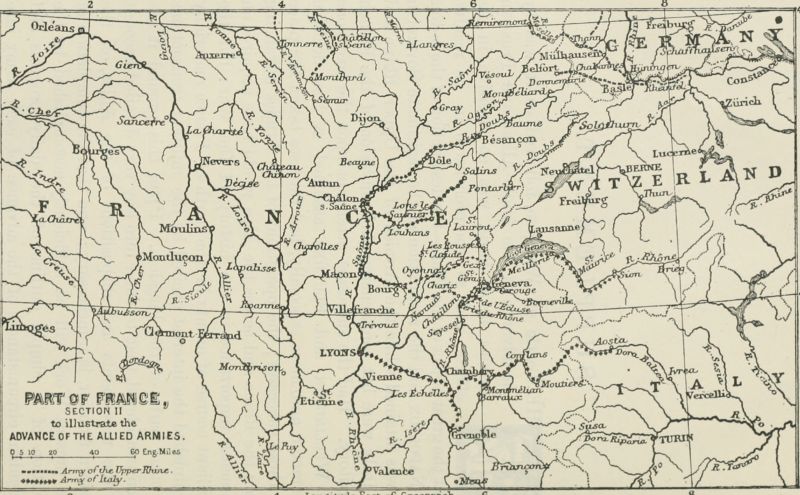
Part of France
Operations of the German Corps d'Armée.
This Corps, which was composed of contingent forces supplied by the petty Princes of North Germany, was assembled, in the middle of April, in the vicinity of Coblentz. It amounted to 26,200 men, divided into thirty Battalions, twelve Squadrons, and two and a half Batteries; and was placed under the command of General Count Kleist von Nollendorf. At a somewhat later period it crossed the Rhine at Coblentz and Neuwied, and took up a position on the Moselle and the Sarre; its Right communicating with the Third Prussian Corps d'Armée, and its Left with the Bavarian troops at Zweibrücken. Its Advanced Posts extended along the French frontier from Arlon to Mertzig. Its Head Quarters were at Trier, on the Moselle.
In this position it remained until the 16th of June, when its Commander, General von Engelhard (in the absence of Count Kleist, who was ill), advanced from Trier to Arlon; which it reached on the 19th. Here it continued until the 21st, when it received an Order from Prince Blücher to move into France by Bastogne and Neufchâteau; and to gain possession of the Fortresses of Sedan and Bouillon. On the 22nd, the Corps commenced its march, in two Columns: the one by Neufchâteau, upon Sedan; the other by Recogne, upon Bouillon. Sedan, after a few days' bombardment, capitulated on the 25th of June. An attempt was made to take Bouillon by a coup de main; but its garrison was strong enough to frustrate this project. The place was not considered of sufficient importance to render a regular siege expedient, and it was therefore simply invested, from the 25th of June, until the 21st of August; when it was blockaded at all points by troops of the Netherlands, under Prince Frederick of Orange.
On the 28th of June, Lieutenant General von Hacke, who had been appointed to the command of the German Corps, directed the Advanced Guard to move upon Charleville, which lies under the guns of the Fortress of Mézières, and to carry the place by storm. The capture was successfully made by some Hessian Battalions, and tended greatly to facilitate the siege of Mézières. Moveable Columns were detached to observe the Fortresses of Montmédy, Laon, and Rheims. The last named place was taken by capitulation on the 8th of July; and the garrison, amounting to 4,000 men, retired behind the Loire.
Lieutenant General von Hacke finding that, notwithstanding his vigorous bombardment of Mézières, which he commenced on the 27th of June, his summons to surrender was unheeded by the Commandant, General Lemoine, undertook a regular siege of the place, and opened trenches on the 2nd of August. On the 13th, the French garrison gave up the Town and retired into the Citadel, which surrendered on the 1st of September.
The efforts of the Corps were now directed upon Montmédy, around which Fortress it had succeeded in placing twelve Batteries in position by the 13th of September. After an obstinate resistance, the garrison concluded a convention on the 20th of September; by which it was to retire, with arms and baggage, behind the Loire.
After the capture of Montmédy, the German Corps d'Armée went into cantonments in the Department of the Ardennes; whence it returned home in the month of November.
Operations of the Army of the Upper Rhine, under the command of Field Marshal His Highness Prince Schwartzenberg.
This Army consisted of four Corps d'Armée, and Reserves; composed of troops of Austria, Bavaria, Würtemberg, Saxony, of Hesse Darmstadt, and of the petty Princes.
Its strength was as follows:—
Battalions. Squadrons. Batteries.
First Corps d'Armée 24,400 men, in 26 16 8
Second " 34,350 " 36 26 11
Third " 43,814 " 44 32 9
Fourth " 57,040 " 46 66 15
Austrian Reserve Corps 44,800 " 38 86 10
Blockade Corps 33,314 " 38 8 6
Saxon Corps d'Armée 16,774 " 18 10 6
———— ———— ———— ———— ————
Total 254,492 men, in 246 244 65
According to the general plan of operations projected by Prince Schwartzenberg, this Army was to cross the Rhine in two Columns. The Right Column, consisting of the Third Corps, under Field Marshal the Crown Prince of Würtemberg; and of the Fourth Corps, or the Bavarian Army, under Field Marshal Prince Wrède, was to cross the Rhine between Germersheim and Mannheim. The Left Column, consisting of the First Corps, under the Master General of the Ordnance, Count Colloredo, and of the Second Corps, under General Prince Hohenzollern Heckingen, together with the Austrian Reserve Corps; the whole being commanded by General the Archduke Ferdinand, was to cross the Rhine between Basle and Rheinfelden. The Column formed by the Right Wing was to be supported by the Russian Army, under Field Marshal Count Barclay de Tolly, which was expected to be collected at Kaiserslautern by the 1st of July. The object of the operations, in the first instance, was the concentration of the Army of the Upper Rhine and the Russian Army at Nancy.
As soon as Prince Schwartzenberg was made acquainted with the commencement of hostilities in Belgium, he gave his Orders for the advance of his Army. The Fourth, or Bavarian, Corps d'Armée was directed immediately to cross the Sarre: and, by turning the Vosgian Mountains, to cut off the French Corps under General Rapp, collected in the environs of Strasburg, from its base of operations; and to intercept its communications with the interior of France.
A Russian Corps, under General Count Lambert, forming the Advance of the Army of Count Barclay de Tolly, was united to the Corps d'Armée of Prince Wrède; who was to employ it principally in keeping up the communication with the North German Corps d'Armée, under Lieutenant General von Hacke.
Fourth Corps d'Armée, Prince Wrède.
On the 19th of June, the Bavarian Army crossed the Rhine at Mannheim and Oppenheim, and advanced towards the Sarre. On the 20th, some trifling affairs of Advanced Posts occurred near Landau and Dahn. On the 23rd, the Army having approached the Sarre, proceeded, in two Columns, to take possession of the passages across the River at Saarbrück and Saargemünd.
The Right Column, under Lieutenant General Count Beckers, attacked Saarbrück; where it was opposed by the French General Meriage. The Bavarians carried the suburb and the Bridge, and penetrated into the Town along with the retiring French; of whom they made four Officers and seventy men prisoners, and killed and wounded one hundred men: suffering a loss, on their own part, of three Officers and from fifty to sixty men killed and wounded. Count Beckers occupied the Town, posted his Division on the Heights towards Forbach: and detached Patrols along the road to Metz, as far as St Avold; and to the right along the Sarre, as far as Saarlouis.
The Left Column, consisting of the First Infantry Division, under Lieutenant General Baron von Ragliovich, and of the First Cavalry Division, under His Royal Highness Prince Charles of Bavaria, advanced against Saargemünd; at which point the French had constructed a tête de pont on the right bank of the river. After some resistance, this was taken possession of by the Bavarians; whereupon Baron von Ragliovich marched through the Town, and took up a position on the opposite Heights, commanding the roads leading to Bouquenom and Lüneville.
The Fourth Infantry Division, under Lieutenant General Baron Zollern, advanced towards the Fortress of Bitsch; which, however, the French Commandant, General Kreutzer, refused to surrender.
The Russian Corps, under Count Lambert, attached to the Right Wing of Prince Wrède's Army, advanced as far as Ottweiler and Ramstein.
On the 24th, Prince Wrède occupied Bouquenom; and detached the Cavalry Division under Prince Charles towards Pfalzburg, to observe this place. His Second, Third, and Fourth Divisions, and the Reserve, were collected at Saargemünd. The Russian troops under Count Lambert occupied Saarbrück; having previously detached the Cavalry, under Lieutenant General Czernitscheff, as far as St Avold.
On the 26th, Prince Wrède's Head Quarters were at Morhenge; and, on the 27th, his Advanced Posts penetrated as far as Nancy, where he established his Head Quarters on the 28th. From St Dieuze the Prince detached to the left, in order to discover the march of General Rapp; who, however, was still on the Rhine, and whose retreat had thus become cut off by the occupation of Nancy.
Prince Wrède halted at Nancy, to await the arrival of the Austrian and Russian Corps d'Armée. Upon his right, Lieutenant General Czernitscheff crossed the Moselle, on the 29th, within sight of Metz; and carried by storm, on the 3rd of July, the Town of Chalons sur Marne. The garrison of this place had promised to make no resistance, and yet fired upon the Russian Advanced Guard; whereupon the Cavalry immediately dismounted, scaled the ramparts, broke open the gates, sabred a part of the garrison, made the remainder prisoners, including the French General Rigault, and pillaged the town.
After remaining four days in the vicinity of Nancy and Lüneville, Prince Wrède received an Order from Prince Schwartzenberg to move at once upon Paris, with the Fourth, or Bavarian Corps; which was destined to become the Advanced Guard of the Army of the Upper Rhine. This Order was given in consequence of the desire expressed by the Duke of Wellington and Prince Blücher, that the Army of the Upper Rhine should afford immediate support to their operations in front of Paris. On the 5th of July, the main body of the Bavarian Army reached Chalons; in the vicinity of which it remained during the 6th. On this day, its Advanced Posts communicated, by Epernay, with the Prussian Army. On the 7th, Prince Wrède received intelligence of the Convention of Paris; and, at the same time, directions to move towards the Loire. On the 8th, Lieutenant General Czernitscheff fell in with the Enemy between St Prix and Montmirail; and drove him across the Morin, towards the Seine. Previously to the arrival of the Corps at Château Thierry; the French garrison had abandoned the place, leaving behind it several pieces of cannon, with ammunition. On the 10th of July, the Bavarian Army took up a position between the Seine and the Marne; and Prince Wrède's Head Quarters were at La Ferté sous Jouarre.
Third Corps d'Armée, Crown Prince of Würtemberg.
On the 22nd of June, a portion of the Third Corps d'Armée, under the Crown Prince of Würtemberg, took possession of the intrenchments of Germersheim, on the left bank of the Rhine. Lieutenant Field Marshal Count Wallmoden was posted, with ten Battalions and four Squadrons, in observation of the Fortress of Landau, and the line of the Queich. The main body of the Corps stood between Bruchsal and Philipsburg. On the 23d, the Corps crossed the Rhine at Germersheim, and passed the line of the Queich without opposition.
The Crown Prince was directed to proceed by Weissenburg and Hagenau, with a view to complete, in conjunction with the Fourth Corps d'Armée, the plan of intercepting the retreat of General Rapp.
On the 24th, the Corps advanced to Bergzabern and Nieder Ottersbach; at both of which points it fell in with the Enemy, and drove him back. Count Wallmoden left a small Detachment to observe Landau; and advanced, with the remainder of his force, as far as Rheinzabern. On the 25th, the Crown Prince ordered the advance towards the lines of Weissenburg, in two Columns. The first Column assembled at Bergzabern, and the second moved forward by Nieder Ottersbach. Count Wallmoden was directed to advance upon Lauterburg. The Crown Prince advanced his Corps still further along the Hagenau road. His Advanced Guard pushed on to Inglesheim, and the main body of the Corps reached the lines of Weissenburg; which the French abandoned in the night, and fell back upon the Forest of Hagenau, occupying the large Village of Surburg. On the 26th, the Crown Prince attacked and defeated the Enemy at the last mentioned place, with his Right Column; whilst the Left Column, under Count Wallmoden, was equally successful in an attack which it made upon the French General Rothenburg, posted, with 6,000 Infantry and a Regiment of Cavalry, at Selz. On the following day, General Rapp fell back upon the Defile of Brümath; but this he quitted in the night, and took up a favourable position in the rear of the Suffel, near Strasburg. His force comprised twenty four Battalions of Infantry, four Regiments of Cavalry, and a numerous Artillery, and amounted to nearly 24,000 men.
The Crown Prince of Würtemberg, whose force amounted altogether to more than 40,000 men, succeeded, on the 28th, after a smart action, in forcing General Rapp to retire within the Fortress of Strasburg. The loss of the Third Corps on this occasion amounted to 75 Officers, and 2,050 men, killed and wounded. That of the French was about 3,000 men.
Austrian Reserve Corps, Archduke Ferdinand.
The Third Corps remained in front of Strasburg until the 4th of July; when it was relieved by the arrival of the Second Austrian Corps, under Prince Hohenzollern, from the vicinity of Colmar. At this last point the Advanced Guard of the Austrian Reserve Corps, under Lieutenant Field Marshal Stutterheim, moved upon Remiremont, and the main body upon St Marie aux Mines. The Austrian Reserve Corps itself reached Raon l'Etape; whence it subsequently moved (on the 10th) to Neufchâteau. The Third Corps, under the Crown Prince of Würtemberg, marched into the vicinity of Molsheim.
On the 7th of July, the Crown Prince reached Lüneville; but instead of proceeding to Nancy, according to its original destination, the Corps, on the 9th, took the road to Neufchâteau. The advance was in two Columns; the one upon Bayon, and the other upon Rembervillers. These two Columns moved respectively, the one, by Vaucouleurs, Joinville, Brienne le Château, Troyes, and Auxonne; and the other, by Neufchâteau, Chaumont, Bar sur Aube, Vendoeuvres, Bar sur Seine, and Chatillon: at which points (Auxonne and Chatillon) they halted on the 18th. On the 21st, the Corps entered into cantonments between Montbard and Tonnerre.
First and Second Corps—Count Colloredo and Prince von Hohenzollern.—Reserve Corps, Archduke Ferdinand.
The First and Second Austrian Corps d'Armée and the Reserve Corps, forming the Left Wing of the Army of the Upper Rhine, crossed this river at Rheinfelden and Basle in the night of the 25th of June. On the 26th, the First, under Count Colloredo, was directed upon Belfort and Montbelliard; and, on the same day, the Austrians invested the Fortress of Huningen. The Advanced Guard of the First Corps had an affair with a French Detachment of 3,000 men belonging to the Corps of General Lecourbe, and repulsed it as far as Donnemarie. On the 28th, the First Corps fell in with the Enemy near Chabannes, between Donnemarie and Belfort, when the French force, amounting to 8,000 Infantry and 500 Cavalry, was driven back upon Belfort. Major General von Scheither of the First Corps was detached against Montbelliard, a town fortified and defended by a citadel. After having maintained a most destructive fire against the place, the Austrian troops carried it by storm; with a loss, however, of 25 Officers and 1,000 men, killed and wounded.
With the exception of a few sorties of little consequence, General Rapp remained very quiet in the Fortress of Strasburg. The news of the capture of Paris by the British and Prussian troops led to a Suspension of Hostilities; which was concluded on the 24th of July, and extended to the Fortress of Strasburg, Landau, Lutzelstein, Huningen, Schlettstadt, Lichtenberg, Pfalzburg, Neuf Brisac, and Belfort.
The Russian Army.
The main body of the Russian Army, commanded by Field Marshal Count Barclay de Tolly, and amounting to 167,950 men, crossed the Rhine at Mannheim, on the 25th of June; and followed the Army of the Upper Rhine. The greater portion of it reached Paris and its vicinity by the middle of July.
Operations of the Army of Italy.
The Army of Italy, composed of Austrian and Sardinian troops, and amounting to 60,000 men, was under the command of General Baron Frimont. It was destined to act against the Army of the Alps, under Marshal Suchet, posted in the vicinity of Chambery and Grenoble. It is uncertain what was the amount of force under Suchet, it having been estimated from 13,000 to 20,000 men; but the Corps of Observation on the Var, in the vicinity of Antibes and Toulon, under Marshal Brune, amounted to 10,000, and was not occupied with any Enemy in its front.
Baron Frimont's Army was divided into two Corps: the one under Lieutenant Field Marshal Radivojevich, was to advance by the Valais towards Lyons; and the other, which was in Piedmont, under Lieutenant Field Marshal Count Bubna, was to penetrate into the south of France, through Savoy.
Marshal Suchet had received Orders from Napoleon to commence operations on the 14th of June; and by rapid marches to secure the mountain Passes in the Valais and in Savoy, and close them against the Austrians. On the 15th, his troops advanced at all points for the purpose of gaining the frontier from Montmeilian, as far as Geneva; which he invested. Thence he purposed to obtain possession of the important Passes of Meillerie and St Maurice; and in this way to check the advance of the Austrian Columns from the Valais. At Meillerie the French were met and driven back by the Advanced Guard of the Austrian Right Column, on the 21st of June. By means of forced marches the whole of this Column, which Baron Frimont himself accompanied, reached the Arve on the 27th of June.
The Left Column, under Count Bubna, crossed Mount Cenis on the 24th and 25th of June. On the 28th, it was sharply opposed by the French at Conflans; of which place, however, the Austrians succeeded in gaining possession.
In order to secure the passage of the Arve the Advanced Guard of the Right Column detached, on the 27th, to Bonneville, on its left; but the French, who had already fortified this place, maintained a stout resistance. In the mean time, however, the Austrians gained possession of the passage at Carrouge; by which means the French were placed under the necessity of evacuating Bonneville, and abandoning the Valley of the Arve. The Column now passed Geneva, and drove the Enemy from the Heights of Grand Saconex and from St Genix. On the 29th, this part of the Army moved towards the Jura; and, on the 1st July, it made its dispositions for attacking the redoubts and intrenchments which the French had thrown up to defend the Passes. The most vigorous assault was made upon the Pass of Les Rousses; but the Austrians were driven back. Reserves were then brought up; and the French having quitted their intrenchments to meet the latter, and a good opportunity having offered for a flank attack upon them with Cavalry and Artillery, the Pass was captured by the Austrians: and the French were compelled to abandon both it and the other Passes of the Jura. The Austrian Advanced Guard pursued the Enemy, and reached, in the evening, St Claude, on the road leading to the left from Gex; and St Laurent, in the original direction of the attack, beyond Les Rousses.
In the mean time, the Austrian Reserve Corps, under Lieutenant Field Marshal Meerville, was directed to advance, and to throw back the French upon the Rhone. The latter, in retreating, destroyed the Bridge of Seyselle; and, by holding the Fort of l'Ecluse, closed the road from Geneva to Lyons. A redoubt had been constructed in front of the Fort, and completely commanded the approach. It was gallantly stormed and carried by the Regiment of Esterhazy. The Fort itself was now turned by the Reserve Corps along the left bank of the Rhone, with the design of forcing the passage at the Perte du Rhone. Here the French had constructed a tête de pont; which, however, they were forced to abandon in consequence of a movement made by the First Corps under Lieutenant Field Marshal Radivojevich. On retiring, they destroyed the very beautiful stone bridge then existing; and thus rendered it necessary for the Austrians to construct temporary bridges over the extremely narrow space between the rocks which confine the stream at this remarkable spot. The Advanced Guard of the Reserve Corps, under General Count Hardegg, first crossed the Rhone, and found the Enemy posted at Charix, in rear of Chatillon, on the road to Nantua. Count Hardegg immediately attacked him; and, after encountering an obstinate resistance, forced him to retire.
The troops of the First Austrian Corps, which, in the mean time, were left in front of the Fort l'Ecluse, had commenced a bombardment; and this, after twenty six hours' duration, considerably damaged the Fort. A powder magazine exploded, which caused a general conflagration; to escape which the garrison rushed out, and surrendered at discretion to the Austrians: and thus, in three days, the high road from Geneva to Lyons was opened to the Army of Italy.
On the 3rd July, General Bogdan, with the Advanced Guard of the First Austrian Corps, having been reinforced by Lieutenant Field Marshal Radivojevich, attacked the Enemy with much impetuosity at Ojanax, beyond St Claude; where the French General Maransin had taken up a favourable position, with 2,000 men. The Austrians turned his Left Flank, and forced him to retire. The Corps reached Bourg en Bresse on the 9th July.
On the 10th July, a Detachment, under Major General von Pflüger, was pushed on to Maçon on the Saône; and gained possession of the tête de pont constructed there, and of the place itself.
On the 7th July, the Second Corps, under Count Bubna, reached Echelles. A Detachment, consisting principally of Sardinian troops, under Lieutenant General Count Latour, had been directed to observe Grenoble; in front of which its Advanced Guard arrived on the 4th July. On the 6th, the suburbs were attacked; and the communication between this place and Lyons was cut off. The garrison, consisting of eight Battalions of the National Guard, offered to capitulate on the 9th, on the condition of being permitted to return to their homes. That a vigorous defence might have been maintained was evident from the fact of the Austrians having found in the place fifty four guns and eight mortars, and large quantities of provisions.
Count Bubna's Corps and the Reserve Corps, by simultaneous movements, assembled together in front of Lyons on the 9th. An Armistice was solicited by the garrison on the 11th July, and granted upon condition that Lyons and the Intrenched Camp should be evacuated; and that Marshal Suchet should retire with his Corps behind the Loire, keeping his Advanced Posts within a stipulated line of demarcation.
Having secured possession of the line of the Rhone as far down as its junction with the Isère, as also of that part of the Saône between Maçon and Lyons; the Army of Italy now proceeded towards the upper line of the latter river, leaving the Second Corps, under Count Bubna, at Lyons, in front of Marshal Suchet. The First Corps marched upon Chalons sur Saône, in order to gain the tête de pont at that point. At this time, the Fourth Division of the Army, under the French General Lecourbe, was at Salins, between Dôle and Pontarlier: and as Besançon had not yet been invested, Baron Frimont detached a part of the Reserve Corps, under General Hecht, to Salins; whilst General Fölseis, detached from the First Corps towards Dôle. The Advanced Guard of the First Corps had arrived in front of the tête de pont at Chalons, and had completed its dispositions for attack; when the place surrendered. By the advance, at the same time, of Hecht upon Salins, and of Fölseis from Dôle upon Besançon; the retreat of the French General Laplane was completely cut off. This led to a Convention which stipulated the dissolution of the National Guards, the surrender of all the Officers, and the abandonment of one of the Forts of Salins to the Austrians.
On the 20th, the First Corps d'Armée advanced from Chalons sur Saône as far as Autun; and Besançon having in the mean time been occupied by the Austrian troops of the Army of the Upper Rhine, a junction was effected with the latter by the Army of Italy by Dijon.
The Sardinian General d'Osasca, who had been detached to Nice, concluded on the 9th of July an Armistice with Marshal Brune, who commanded the Army of the Var, in front of the Maritime Alps; and thus terminated all hostilities on that side of France.
The foregoing Outline will suffice to show the nature, extent, and interconnection of the operations of the Allied Armies which invaded France along her eastern and south-eastern frontier; and at the same time afford a clear proof that amongst the more immediate consequences of the decisive Battle of Waterloo and speedy capture of Paris must be ranked that of their having been the means of averting the more general and protracted warfare which would probably have taken place, had a different result in Belgium emboldened the French to act with vigour and effect in other parts of the country.
The reduction of the Fortresses left in rear of the British and Prussian Armies, adjoining their main line of operations, and which was confided to Prince Augustus of Prussia, with the Second Prussian Corps d'Armée, assisted by the British Battering Train, was effected in the following manner:—
Maubeuge— siege commenced 8th July, capitulated 12th July.
Landrecies do. 19th do., do. 21st do.
Marienberg do. 27th do., do. 28th do.
Philippeville do. 7th August, do. 8th August.
Rocroy do. 15th do., do. 16th do.
Prince Augustus had made every preparation for commencing the siege of Charlemont and its connecting Forts, the two Givets and the Mont d'Hours, on the 8th of September, when the Commandant, General Burcke, foreseeing that the occupation of the detached Forts would divide his force too much, entered into negotiations, and surrendered those works on the 10th, withdrawing his troops into Charlemont; the bombardment of which was to have opened on the 23rd of September: but, on the 20th, Prince Augustus received information from Paris that hostilities were to cease throughout the whole of France.
APPENDIX.
[Captain Siborne also included in this Appendix a number of State Papers, Military Orders, and Statistical Returns, in French and English; of which a List will be found at pages 42 to 44. These are omitted in this Fourth Edition, simply from want of space.—E.A.]
VI.
Effective Strength and Composition of the Anglo-Allied Army under the Command of Field Marshal the Duke of Wellington.
First Corps.—His Royal Highness the Prince of Orange.
First Division, Major General Cooke.
Men.
First British Brigade, {2nd Battalion 1st Guards 976
Major General Maitland. {3rd do. do. 1021
Second British Brigade, {2nd do. Coldstream Guards 1003
Major General Sir John Byng. {2nd do. 3rd Guards. 1061
———
4061
Artillery, {Captain Sandham's British Foot Battery.
Lieutenant Colonel Adye. {Major Kuhlmann's Horse Battery, K.G. Legion.
Third Division, Lieutenant General Sir Charles Alten.
{2nd Battalion 30th Regiment 615
Fifth British Brigade, {33rd Regiment. 561
Major General Sir Colin Halkett. {2nd Battalion 69th Regiment 516
{2nd do. 73rd do. 562
{1st Light Battalion. 423
Second Brigade K.G. Legion, {2nd do. do. 337
Colonel von Ompteda. {5th Line do. 379
{8th do. do. 388
{Field Battalion Bremen 512
{Do. do. Verden 533
First Hanoverian Brigade, {Do. do. York. 607
Major General Count Kielmansegge. {Do. do. Lüneburg. 595
{Do. do. Grubenhagen 621
{Do. Jäger Corps 321
———
6,970
Artillery, {Major Lloyd's British Foot Battery.
Lieutenant Colonel Williamson. {Captain Cleeves's Foot Battery, K.G. Legion
Second Dutch-Belgian Division, Lieutenant General Baron de Perponcher
{7th Regiment of the Line 701
{27th Jäger Battalion 809
First Brigade, {5th Militia Battalion 482
Major General Count de Bylandt. {7th do. do. 875
{8th do. do. 566
Second Brigade, {2nd Regiment of Nassau, 3 Battalions 2709
H.S.H. The Prince Bernhard of Saxe Weimar. {Regiment of Orange Nassau, 2 do. 1591
———
7,533
Artillery, {Captain Byleveld's Horse Battery.
Major van Opstal. {Captain Stievenaar's Foot Battery.
Third Dutch-Belgian Division, Lieutenant General Baron Chassé.
{2nd Regiment of the Line 471
{35th Jäger Battalion 605
First Brigade, {4th Militia Battalion 519
Major General Ditmers. {6th do. do. 492
{17th do. do. 534
{19th do. do. 467
{3rd Regiment of the Line 629
{12th do. do. 431
Second Brigade, {13th do. do. 664
Major General d'Aubremé. {36th Jäger Battalion 633
{3rd Militia Battalion 592
{10th do. do. 632
———
6,669
Artillery, {Captain Krahmer's Horse Battery.
Major van der Smissen. {Captain Lux's Foot Battery.
———
Total First Corps, men 25,233
and guns 56
Second Corps.—Lieutenant General Lord Hill
Second Division, Lieutenant General Sir H. Clinton.
{1st Battalion 52nd Regiment 1038
Third British Brigade, {1st do. 71st do. 810
Major General Adam. {2nd do. 95th do. 585
{3rd do. 95th do. 188
{1st Line Battalion 411
First Brigade K.G. Legion, {2nd do. do. 437
Colonel du Plat. {3rd do. do. 494
{4th do. do. 416
{Landwehr Battalion Bremervörde 632
Third Hanoverian Brigade, { Do. do. Osnabrück 612
Colonel Halkett. { Do. do. Quackenbrück 588
{ Do. do. Salzgitter 622
———
6,833
Artillery, {Captain Bolton's British Foot Battery.
Lieutenant Colonel Gold. {Major Sympher's Horse Battery, K.G. Legion.
Fourth Division, Lieutenant General Sir Charles Colville.
{3rd Battalion 14th Regiment 571
Fourth British Brigade, {1st do. 23rd do. 647
Colonel Mitchell. {51st Regiment 549
{2nd Battalion 35th Regiment 570
Sixth British Brigade, {1st do. 54th do. 541
Major General Johnstone. {2nd do. 59th do. 461
{1st do. 91st do. 824
{Field Battalion Lauenburg 553
{ do. do. Calenberg 634
Sixth Hanoverian Brigade, {Landwehr Battalion Nienburg 625
Major General Sir James Lyon. { do. do. Hoya 629
{ do. do. Bentheim 688
———
7,212
Artillery, {Major Brome's British Foot Battery.
Lieutenant Colonel Hawker. {Captain von Rettberg's Hanoverian Foot Battery.
First Dutch-Belgian Division, Lieutenant General Stedmann.
{4th Regiment of the Line
{6th do. do.
First Brigade, {16th Jäger Battalion
Major General Hauw. {9th Militia do.
{14th do. do.
{15th do. do.
} {6,389
{1st Regiment of the Line
{18th Jäger Battalion
Second Brigade, {1st Militia do.
Major General Eerens. {2nd do. do.
{18th do. do.
Artillery, Captain Wynands's Foot Battery.
{5th Regiment, 2 Battalions
Dutch-Belgian Indian Brigade, {Flankers
Lieutenant General Anthing. {10th Jäger Battalion
{3,583
{11th do. do.
Artillery, Captain Riesz's Foot Battery.
Detachments from 6th and 7th Line Battalions of the K.G. Legion, distributed among the other Battalions, and 2 Orderlies from Foreign Battalions 16
———
Total Second Corps, men 24,033
and guns 40
Reserve.
Fifth Division, Lieutenant General Sir Thomas Picton.
{1st Battalion 28th Regiment 557
Eighth British Brigade, {1st do. 32nd do. 662
Major General Sir James Kempt. {1st do. 79th do. 703
{1st do. 95th do. 549
{3rd do. 1st do. 604
Ninth British Brigade, {1st do. 42nd do. 526
Major General Sir Denis Pack. {2nd do. 44th do. 455
{1st do. 92nd do. 588
{Landwehr Battalion Hameln 669
Fifth Hanoverian Brigade, { do. do. Gifhorn 617
Colonel von Vincke. { Do. do. Hildesheim 617
{ do. do. Peine 611
———
7,158
Artillery, {Major Rogers's British Foot Battery.
Major Heisse {Captain Braun's Hanoverian Foot Battery.
Sixth Division, Lieutenant General Hon. Sir L. Cole.
{1st Battalion 4th Regiment 669
Tenth British Brigade, {1st do. 27th do. 698
Major General Sir John Lambert. {1st do. 40th do. 761
{2nd do. 81st do. 439
{Landwehr Battalion Verden 621
Fourth Hanoverian Brigade, { do. do. Lüneburg 624
Colonel Best. { do. do. Osterode 677
{ do. do. Münden 660
———
5,149
Artillery, {Major Unett's British Foot Battery.
Lieutenant Colonel Brückmann. {Captain Sinclair's do. do.
{Lieutenant Colonel Sir Hew Ross's Horse Battery.
British Reserve Artillery, {Major Beane's Horse Battery.
Major Drummond. {Major Morisson's Foot Battery.
{Captain Hutchesson's Foot Battery.
{Captain Ilbert's do. do.
Seventh Division.
{2nd Battalion 25th Regiment 388
Seventh British Brigade. {2nd do. 37th do. 491
{2nd do. 78th do. 337
{13th Veteran Battalion 683
British Garrison Troops. {1st Foreign do. 595
{2nd Garrison do. 739
———
3,233
Brunswick Corps, H.S.H. The Duke of Brunswick.
Major von Rauschenplatt. Advanced Guard Battalion 672
{Guard Battalion 672
Light Brigade, {1st Light Battalion 672
Lieutenant Colonel von Buttlar. {2nd do. do. 672
{3rd do. do. 672
{1st Line do. 672
Line Brigade, {2nd do. do. 672
Lieutenant Colonel von Specht. {3rd do. do. 672
———
5,376
Artillery, {Captain Heinemann's Horse Battery.
Major Mahn. {Major Moll's Foot Battery.
Hanoverian Reserve Corps, Lieutenant General von der Decken.
First Brigade, {Field Battalion Hoya
Lieutenant Colonel von Bennigsen. {Landwehr Battalion Mölln
{ do. do. Bremerlehe
{Landwehr Battalion Nordheim
Second Brigade, { do. do. Ahlefeldt
Lieutenant Colonel von Beaulieu. { do. do. Springe
{Landwehr Battalion Otterndorf
Third Brigade, { do. do. Zelle
Lieutenant Colonel Bodecker. { do. do. Ratzeburg
{Landwehr Battalion Hanover
Fourth Brigade, { do. do. Uelzen
Lieutenant Colonel Wissel. { do. do. Neustadt
{ do. do. Diepholz
———
9,000
Nassau Contingent, General von Kruse.
1st Regiment—3 Battalions 2,880
———
Total Reserve, men 32,796
and guns 64
Cavalry.
British, and King's German Legion.
{1st Life Guards 228
First Brigade, {2nd do. 231
Major General Lord E. Somerset. {Royal Horse Guards (Blue) 237
{1st Dragoon Guards. 530
{1st, or Royal, Dragoons 394
Second Brigade, {2nd Dragoons (Scots Greys) 391
Major General Sir W. Ponsonby. {6th (or Inniskilling) Dragoons. 396
{1st Light Dragoons, K.G. Legion 462
Third Brigade, {2nd do. do. do. 419
Major General Sir W. Dörnberg. {23rd Light Dragoons. 387
{11th do. do. 390
Fourth Brigade, {12th do. do. 388
Major General Sir J. Vandeleur. {16th do. do. 393
{2nd Hussars, K.G. Legion 564
Fifth Brigade, {7th do. 380
Major General Sir Colq. Grant. {15th do. 392
{1st do. K.G. Legion. 493
Sixth Brigade, {10th do. 390
Major General Sir H. Vivian. {18th do. 396
Seventh Brigade, {3rd do. K.G. Legion 622
Colonel Sir F.V. Arentsschildt. {13th Light Dragoons. 390
{1. Major Bull's (Howitzers).
{2. Lieutenant Colonel Webber Smith's.
British Horse Batteries, {3. Lieutenant Colonel Sir Robert Gardiner's.
attached to the Cavalry. {4. Captain Whinyates's (with Rockets).
{5. Captain Mercer's.
{6. Captain Ramsay's.
Hanoverian.
{Prince Regent's Hussars 596
First Brigade, {Bremen and Verden Hussars 589
Colonel von Estorff. {Cumberland Hussars. 497
Brunswick Cavalry. {Regiment of Hussars. 690
{Squadron of Uhlans. 232
Dutch-Belgian.
{1st Dutch Carabiniers 446
First Brigade, {2nd Belgian do. 399
Major General Trip. {3rd Dutch do. 392
Second Brigade, {4th Dutch Light Dragoons. 647
Major General de Ghigny. {8th Belgian Hussars. 439
Third Brigade, {5th do. Light Dragoons 441
Major General van Merlen. {6th Dutch Hussars. 641
Artillery, {Captain Petter's Half Horse Battery.
{Captain Gey's Half Horse Battery.
———
men 14,482
and guns 44
Artillery.
Guns. Men.
British.
7 Foot Batteries of 6 guns each 42}
3 do, do. 4 do. (18 prs) 12} 3,630
8 Horse do. 6 do. 48 1,400
King's German Legion.
1 Foot Battery of 6 guns 6}
2 Horse Batteries of 6 guns each 12} 526
Hanoverian.
2 Foot Batteries of 6 guns each 12 465
Brunswick.
1 Foot Battery of 8 guns 8}
1 Horse do. 8 do. 8} 510
Dutch-Belgian.
4 Foot Batteries of 8 guns each 32 968
3 Horse do. 8 do. 24 667
—— ———
204 8,166
Engineers, Sappers and Miners, Waggon Train, and Staff Corps 1,240
Total Strength.
Infantry 82,062
Cavalry 14,482
Artillery 8,166
Engineers, Waggon Train, &c. 1,240
———
Grand Total. men 105,950
and guns 204
VIII.
Effective Strength and Composition of the Prussian Army under the Command of Field Marshal Prince Blücher von Wahlstadt.
First Corps d'Armée.—Lieutenant General von Zieten.
First Brigade, General von Steinmetz. Batts. Men.
12th and 24th Regiments of the Line. }
1st Westphalian Landwehr Regiment. } 9½ 8,647
1st and 3rd Silesian Rifle Companies }
Second Brigade, General von Pirch II.
6th and 28th Regiments of the Line }
2nd Westphalian Landwehr Regiment. } 9 7,666
Third Brigade, General von Jagow.
7th and 29th Regiments of the Line }
3rd Westphalian Landwehr Regiment. } 9½ 6,853
2nd and 4th Silesian Rifle Companies. }
Fourth Brigade, General von Henkel.
19th Regiment of the Line }
4th Westphalian Landwehr Regiment } 6 4,721
———
27,887
Reserve Cavalry of the First Corps.—Lieutenant General von Röder.
Brigade of General von Treskow. Squad.
Brandenburg Dragoons (No. 5) 4 }
1st West Prussian Dragoons (No. 2) 4 }
Brandenburg Uhlans 4 }
} 1,925
Brigade of Lieutenant Colonel von Lützow. }
6th Uhlans 4 }
1st and 2nd Kurmark Landwehr Regiments. 8 }
1st Silesian Hussars 4 }
1st Westphalian Landwehr Regiment. 4 }
Reserve Artillery of the First Corps.—Colonel von Lehmann.
12 pounder Foot Batteries Nos. 2, 6, and 9 }
6 do. do. Nos. 1, 3, 7, 8, and 15 }
Howitzer Battery No. 1 } 1,019
Horse Batteries Nos. 2, 7, and 10 }
———
Total—34 Battalions, 32 Squadrons, 12 Batteries men 30,831
and guns 96
Second Corps d'Armée.—General von Pirch I.
Fifth Brigade, General von Tippelskirchen. Batts. Men.
2nd and 25th Regiments of the Line }
5th Westphalian Landwehr Regiment } 9 6,851
Sixth Brigade, General von Krafft.
9th and 26th Regiments of the Line }
1st Elbe Landwehr Regiment } 9 6,469
Seventh Brigade, General von Brause.
14th and 22nd Regiments of the Line }
2nd Elbe Landwehr Regiment } 9 6,224
Eighth Brigade, Colonel von Langen. }
21st and 23rd Regiments of the Line }
3rd Elbe Landwehr Regiment } 9 6,292
———
25,836
Reserve Cavalry of the Second Corps.—General von Jürgass.
Brigade of Colonel von Thümen. Squad.
Silesian Uhlans 4 }
6th Neumark Dragoons 4 }
11th Hussars 4 }
Brigade of Colonel Count Schulenburg. }
1st Queen's Dragoons 4 }
4th Kurmark Landwehr Regiment 4 }
} 4,468
Brigade of Lieutenant Colonel von Sohr }
3rd Brandenburg Hussars 4 }
5th Pomeranian Hussars 4 }
5th Kurmark Landwehr Regiment 4 }
Elbe Landwehr Regiment 4 }
Reserve Artillery of the Second Corps.—Colonel von Röhl.
12 pounder Foot Batteries Nos. 4 and 8 }
6 do. do. Nos. 5,10,12,34 and 37 } 1,454
Horse Batteries No. 5, 6, and 14 }
———
Total—36 Battalions, 36 Squadrons, 10 Batteries men 31,758
and guns 80
Third Corps d'Armée.—Lieutenant General von Thielemann.
Ninth Brigade, General von Borcke. Batts. Men.
8th and 36th Regiments of the Line }
1st Kurmark Landwehr Regiment } 9 6,752
Tenth Brigade, Colonel von Kämpfen.
27th Regiment of the Line }
2nd Kurmark Landwehr Regiment } 6 4,045
Eleventh Brigade, Colonel von Luck.
3rd and 4th Kurmark Landwehr Regiments. } 6 3,634
Twelfth Brigade, Colonel von Stülpnagel.
31st Regiment of the Line }
5th and 6th Kurmark Landwehr Regiments } 9 6,180
———
20,611
Reserve Cavalry of the Third Corps.—General von Hobe.
Brigade of Colonel von der Marwitz. Squad.
7th Uhlans 3 }
8th do. 4 }
9th Hussars 3 }
} 2,405
Brigade of Colonel Count Lottum. }
5th Uhlans 3 }
7th Dragoons 5 }
3rd Kurmark Landwehr Regiment 4 }
6th do. do. do. 4 }
Reserve Artillery of the Third Corps.—Colonel von Mohnhaupt.
12 pounder Foot Battery No. 7 }
6 do. do. Nos. 18 and 35 } 964
Horse Batteries Nos. 18, 19, and 20 }
———
Total—30 Battalions, 24 Squadrons, 6 Batteries men 23,980
and guns 48
Fourth Corps d'Armée.—General Count Bülow von Dennewitz.
Thirteenth Brigade, Lieutenant General von Hacke. Batts. Men.
10th Regiment of the Line }
2nd and 3rd Neumark Landwehr Regiments. } 9 6,385
Fourteenth Brigade, General von Ryssel.
11th Regiment of the Line }
1st and 2nd Pomeranian Landwehr Regiments } 9 6,953
Fifteenth Brigade, General von Losthin.
18th Regiment of the Line }
3rd and 4th Silesian Landwehr Regiments } 9 5,881
Sixteenth Brigade, Colonel von Hiller.
15th Regiment of the Line }
1st and 2nd Silesian Landwehr Regiments } 9 6,162
———
25,381
Reserve Cavalry of the Fourth Corps.—General, Prince William of Prussia.
Brigade of General von Sydow. Squad.
1st West Prussian Uhlans 4 }
2nd Silesian Hussars 4 }
8th Hussars 3 }
Brigade of Colonel Count Schwerin. }
10th Hussars 4 } 3,081
1st and 2nd Neumark Landwehr Regiments 8 }
1st and 2nd Pomeranian Landwehr Regiments 8 }
Brigade of Lieutenant Colonel von Watzdorf. }
1st, 2nd, and 3rd Silesian Landwehr Regiments 12 }
Reserve Artillery of the Fourth Corps.—Lieutenant Colonel von Bardeleben.
12 pounder Foot Batteries Nos. 3, 5, and 13 }
6 do. do. Nos. 2, 11, 13, 14, & 21 } 1,866
Horse Batteries Nos. 1, 11, and 12 }
———
Total—36 Battalions, 43 Squadrons, 11 Batteries men 30,328
and guns 88
Total Strength.
Infantry. Cavalry. Artillery. Guns.
First Corps d'Armée 27,817 1,925 1,019 96
Second do. 25,836 4,468 1,454 80
Third do. 20,611 2,405 964 48
Fourth do. 25,381 3,081 1,866 88
——— ——— ——— ———
99,715 11,879 5,303 312
Grand Total—116,897 men and 312 guns.
IX.
Effective Strength and Composition of the French Army, under the Command of Napoleon Buonaparte.
Imperial Guard.—Marshal Mortier, Duke of Treviso.
(On the 16th June.) Batt. Men.
Lieutenant General Count Friant.
1st and 2nd Regiments of Grenadiers 4 2,294
Lieutenant General Count Roguet.
3rd and 4th Regiments of Grenadiers 3 1,623
Lieutenant General Count Morand.
1st and 2nd Regiments of Chasseurs 4 2,402
Lieutenant General Count Michel.
3rd and 4th Regiments of Chasseurs 4 2,069
Lieutenant General Count Duhesme.
1st and 3rd Regiments of Tirailleurs 4 2,043
Lieutenant General Count Barrois.
1st and 3rd Regiments of Voltigeurs 4 2,123
Lieutenant General Lefèbvre Desnouettes. Squad.
Lancers and Chasseurs à Cheval 19 1,971
Lieutenant General Count Guyot.
Dragoons and Grenadiers à Cheval 13 1,517
Gendarmerie d'élite 102
Lieutenant General Desvaux de St Maurice.
9 Foot Batteries }
4 Horse do } 2,995
Marines (104) }
Engineers 109
———
Total—23 Battalions 32 Squadrons, 13 Batteries men 19,428
and guns 96
First Corps d'Armée.—Lieutenant General Count d'Erlon.
(On the 10th June.) Batt. Men
First Division, Lieuyenant General Alix }
54th, 55th, 28th, and 105th Regiments of the Line 8}
Second Division, Lieutenant General Baron Donzelot }
13th (Light), 17th, 19th, and 51st Regiments of the Line 9}
Third Division, Lieutenant General Baron Marcognet. } 16,200
21st, 46th, 25th, and 45th Regiments of the Line. 8}
Fourth Division, Lieutenant General Count Durutte. }
8th, 29th, 85th, and 95th Regiments of the Line. 8}
First Cavalry Division, Lieutenant General Baron Jaquinot. Squad.
3rd and 7th Chasseurs 6}
3rd and 4th Lancers 5} 1,400
Artillery.
5 Foot Batteries }
1 Horse Battery } 1,066
Engineers 330
———
Total—33 Battalions, 11 Squadrons, 6 Batteries men 18,996
and guns 46
Second Corps d'Armée.—Lieutenant General Count Reille.
(On the 10th June.) Batt. Men
Fifth Division, Lieutenant General Baron Bachelu. }
2nd (Light), 61st, 72nd, and 108th Regiments of the Line 11}
Sixth Division, Prince Jerome Napoleon. }
1st (Light), 1st, 2nd, and 3rd Regiments of the Line 11}
Seventh Division, Lieutenant General Count Girard. } 19,750
11th (Light) and 82nd Regiments of the Line, and 12th Light Infantry 8}
Ninth Division, Lieutenant General Count Foy. }
4th (Light), 92nd, 93rd, and 100th Regiments of the Line 10}
Second Cavalry Division, Lieutenant General Baron Piré. Squad.
1st and 6th Chasseurs 8}
5th and 6th Lancers 7} 1,729
Artillery.
5 Foot Batteries }
1 Horse Battery } 1,385
Engineers 409
———
Total—40 Battalions, 15 Squadrons, 6 Batteries men 23,273
and guns 46
Third Corps d'Armée.—Lieutenant General Count Vandamme.
(On the 10th June.) Batt. Men
Eighth Division, Lieutenant General Baron Lefol. }
15th (Light), 23rd, 37th, and 64th Regiments of the Line 11}
Tenth Division, Lieutenant General Baron Habert. }
34th, 88th, 22nd, and 70th Regiments of the Line 12} 14,508
Eleventh Division, Lieutenant General Berthezene. }
12th, 56th, 33rd, and 86th Regiments of the Line 8}
Third Cavalry Division, Lieutenant General Baron Domon. Squad.
4th and 9th Chasseurs 5}
12th Chasseurs 4} 932
Artillery.
4 Foot Batteries }
1 Horse Battery } 936
Engineers 146
———
Total—31 Battalions, 9 Squadrons, 5 Batteries men 16,522
and guns 38
Fourth Corps d'Armée.—Lieutenant General Count Gérard.
(On the 31st May.) Batt. Men
Twelfth Division, Lieutenant General Baron Pecheux. }
30th, 96th, and 63rd Regiments of the Line. 10}
Thirteenth Division, Lieutenant General Baron Vichery. }
59th, 76th, 48th, and 69th Regiments of the Line 8} 12,589
Fourteenth Division, Lieutenant General Hulot. }
9th (Light), 111th, 44th, and 50th Regiments of the Line 8}
Seventh Cavalry Division, Lieutenant General Maurin. Squad.
6th Hussars 3}
8th Chasseurs 3} 758
Reserve Cavalry Division, Lieutenant General Baron Jaquinot.
6th, 11th, 15th, and 16th Dragoons 16 1,608
Artillery.
4 Foot Batteries }
1 Horse Battery } 1,538
Engineers 201
———
Total—26 Battalions, 22 Squadrons, 5 Batteries men 16,694
and guns 38
Sixth Corps d'Armée.—Lieutenant General Count Lobau.
(On the 10th June.) Batt. Men
Nineteenth Division, Lieutenant General Baron Simmer. }
5th, 11th, 27th, and 84th Regiments of the Line 9}
Twentieth Division, Lieutenant General Baron Jeannin. }
5th (Light), 16th, 47th, and 107th Regiments of the Line 6} 8,152
Twenty First Division, Lieutenant General Baron Teste. }
8th (Light), 40th, 65th, and 75th Regiments of the Line 5}
Artillery.
4 Foot Batteries }
1 Horse Battery } 743
Engineers 891
———
Total—20 Battalions, 5 Batteries men 9,084
and guns 38
Reserve Cavalry.—Marshal Grouchy.
First Corps—Lieutenant General Count Pajol.
(In June.) Squad. Men
Fourth Cavalry Division, Lieutenant General Baron Soult }
1st, 4th, and 5th Hussars 12}
Fifth Cavalry Division, Lieutenant General Baron Subervie. } 2,324
1st and 2nd Lancers 8}
11th Chasseurs 4}
Artillery.
2 Horse Batteries 317
Second Corps-Lieutenant General Count Excelmans.
(In June.) Squad. Men
Ninth Cavalry Division, Lieutenant General Strolz. }
5th, 13th, 15th, and 20th Dragoons 16}
Tenth Cavalry Division, Lieutenant General Baron Chastel. } 2,817
4th, 12th, 14th, and 17th Dragoons 15}
Artillery.
2 Horse Batteries 246
Third Corps—Lieutenant General Kellermann (Count de Valmy).
(In June.) Squad. Men
Eleventh Cavalry Division, Lieutenant General Baron L'Heritier. }
2nd and 7th Dragoons 7}
8th and 11th Cuirassiers 5}
Twelfth Cavalry Division, Lieutenant General Roussel d'Hurbal. } 3,245
1st and 2nd Carabiniers 6}
2nd and 3rd Cuirassiers 6}
Artillery.
2 Horse Batteries 309
Fourth Corps—Lieutenant General Count Milhaud
(On the 9th June) Squad. Men
Thirteenth Cavalry Division, Lieutenant General Wathier. }
1st, 4th, 7th, and 12th Cuirassiers 11}
Fourteenth Cavalry Division, Lieutenant General Baron Delort. } 2,556
5th, 6th, 9th, and 10th Cuirassiers 13}
Artillery.
2 Horse Batteries 313
———
Total—103 Squadrons, 8 Batteries men 12,127
and guns 48
Total Strength.
Infantry. Cavalry. Artillery. Engineers, &c. Guns.
Imperial Guard 12,554 3,590 3,175 109 96
First Corps d'Armée 16,200 11,400 1,066 330 46
Second do. do. 19,750 1,729 1,385 409 46
Third do. do. 14,508 932 936 146 38
Fourth do. do. 12,589 2,366 1,538 201 38
Sixth do. do. 8,152 — 743 189 38
Four Corps of Reserve Cavalry — 10,942 1,185 — 48
——— ——— ——— —— ——
83,753 20,959 10,028 1,384 350
Grand Total—116,124 men and 350 guns.
XXXII.
List of Officers of the King's German Legion who were present at the Defence of La Haye Sainte.
2nd Light Battalion. Majors—G. Baring; A. Bösewiel, killed. Captains—E. Holtzermann, taken prisoner; W. Schaumann, killed. Lieutenants—F. Kessler, wounded; C. Meyer; O. Lindam, wounded; B. Riefkugel, wounded; A. Tobin, taken prisoner; T. Carey, wounded; E. Biedermann; D. Græme, wounded; S. Earl. Ensigns—F. von Robertson, killed; G. Frank, wounded; W. Smith; L. Baring. Lieutenant and Adjutant—W. Timmann, wounded. Surgeon—G. Heise.
1st Light Battalion. Captains—von Gilsa, wounded; von Marschalck, killed. Lieutenant—Kuntze. Ensign—Baumgarten.
Skirmishers of 5th Line Battalion. Captain—von Wurmb, killed. Lieutenants—Witte, wounded; Schläger. Ensign—Walther, wounded.
XXXV.
List of British Officers who were present at the Defence of Hougomont.
2nd Battalion of Coldstream, or 2nd, Regiment of Foot Guards. Major—A.G. Woodford, Colonel. Captains and Lieutenant Colonels—J. Macdonell, wounded; D. Mackinnon, wounded; Hon. J. Walpole; H. Dawkins; Hon. E. Acheson; H. Wyndham, wounded. Lieutenants and Captains—G. Bowles; T. Sowerby; W.L. Walton; W.G. Baynes; C.A.F. Bentinck, Adjutant; J.S. Cowell; E. Sumner, wounded; J.L. Blackman, killed; B. Lord Hotham; Hon. R. Moore, wounded; T. Chaplin. Ensigns—Hon. J. Forbes; H. Gooch; A. Cuyler; M. Beaufoy; H.F. Griffiths, wounded; J. Montague, wounded; G.R. Buckley; J. Hervey; H. Vane; F.J. Douglass; R. Bowen; A. Gordon; Hon. W. Forbes; C. Short. Adjutant—C.A.F. Bentinck. Quarter Master—B. Selway. Surgeon—W. Whymper. Assistant Surgeons—G. Smith; W. Hunter.
2nd Battalion of the 3rd Regiment of Foot Guards. Major—F. Hepburn. Lieutenant Colonel. Captains and Lieutenant Colonels—H.W. Rooke; W.C. Master; D. Mercer; C. Dashwood, wounded; F. Home; E. Bowater, wounded; C. West, wounded. Lieutenants and Captains—W. Stothert, Adjutant; W. Drummond; R.B. Hesketh, wounded; H. Hawkins; R.H. Wigston; Hon. J.B. Rodney; C.J. Barnet; J.W. Moorhouse; E.B. Fairfield; G. Evelyn, wounded; Hon. H. Forbes, killed; J. Elrington; H.B. Montgomerie, wounded; T. Crawford, killed; J. Ashton, killed. Ensigns—C. Lake, wounded; Hon. E. Stopford; B. Drummond; G.D. Standen; D. Baird, wounded; W. James; W.F. Hamilton; Hon. G. Anson; T. Wedgewood; W. Butler; A.C. Cochrane; J. Prendergast; C. Simpson, wounded; H.S. Blane; H. Montague. Adjutant—W. Stothert, Captain, wounded. Quarter Master—J. Skuce. Surgeon—S. Good. Assistant Surgeons—J.R. Warde; F. G. Hanrott.
1st Regiment of Foot Guards. Captains and Lieutenant Colonels—Lord Saltoun; C.P. Ellis, wounded.[13]
FOOTNOTES:
XLI.
List of Officers of the British Army who were present in the Actions on the 16th, 17th, and 18th of June 1815, including those posted near Hal on the 18th; and distinguishing such as were Killed, Wounded or Missing.[14]
Staff.
Commander in Chief—Field Marshal His Grace the Duke of Wellington, K.G., G.C.B., &c.
Military Secretary—Lieutenant Colonel Lord FitzRoy Somerset, 1st Foot Guards, w.
Aides de Camp—Lieutenant Colonels, J. Fremantle, 2nd Foot Guards; C.F. Canning, 3rd Foot Guards, k.; Hon. Sir Alex. Gordon, 3rd Foot Guards, k.; Lieutenant Lord George Lennox, 9th Light Dragoons; Hereditary Prince of Nassau Usingen. Extra Aides de Camp—Lieutenant Colonel Hon. Henry Percy, 14th Light Dragoons; Captain Lord Arthur Hill, half pay; Lieutenant Hon. George Cathcart, 6th Dragoon Guards.
General H.R.H. The Prince of Orange, w. Aides de Camp—Lieutenant Colonel Tripp, 60th Foot; Captains, Lord John Somerset, half pay; Hon. Francis Russell, half pay. Extra Aides de Camp—Captain Earl of March, 52nd Foot; Lieutenant H. Webster, 9th Light Dragoons.
Lieutenant General the Earl of Uxbridge, G.C.B., w.; Aides de Camp—Major W. Thornhill, 7th Hussars, w.; Captain H. Seymour, 60th Foot, w. Extra Aides de Camp—Captains T. Wildman, 7th Hussars, w.; J. Fraser, 7th Hussars, w.
Lieutenant General Lord Hill, G.C.B. Aides de Camp—Major R. Egerton, 34th Foot; Lieutenant Colonel C. Hill, Royal Horse Guards, w.;
Major C.H. Churchill, 1st Foot Guards; Captain D. Mackworth, 7th Foot. Extra Aide de Camp—Captain Hon. O. Bridgeman, 1st Foot Guards, w.
Lieutenant General Sir Thomas Picton, G.C.B., k.; Aides de Camp—Captains, J. Tyler, 93rd Foot, w.; N. Chambers, 1st Foot Guards, k. Extra Aide de Camp—Captain B. Price, half pay.
Lieutenant General Sir Henry Clinton, G.C.B. Aide de Camp—Captain F. Dawkins, 1st Foot Guards.
Lieutenant General C. Count Alten, K.C.B., w. Aide de Camp—Lieutenant W. Havelock, 43rd Foot, w.; Major Ch. Heise, 2nd Battalion King's German Legion.
Lieutenant General Sir Charles Colville, G.C.B. Aides de Camp—Captain J. Jackson, 37th Foot; Lieutenant F.W. Frankland, 2nd Foot. Extra Aide de Camp—Captain Lord James Hay, 1st Foot Guards.
Major General V. Count Alten. Aide de Camp—Lieutenant Baron Estorff, 2nd Dragoons, King's German Legion.
Major General Sir John Vandeleur, K.C.B. Aide de Camp—Captain W. Armstrong, 19th Light Dragoons. Major of Brigade—Major M. Childers, 11th Light Dragoons.
Major General Cooke, w.; Aide de Camp—Captain G. Desbrowe, 1st Foot Guards. Extra Aide de Camp—Ensign A. Cuyler, 2nd Foot Guards.
Major General Sir James Kempt, K.C.B., w.; Aide de Camp-Captain Hon. Charles Gore, half pay. Major of Brigade—Captain C. Eeles, 95th Foot.
Major General Hon. Sir W. Ponsonby, K.C.B., k.; Aide de Camp—Lieutenant B. Christie, 5th Dragoon Guards. Extra Aide de Camp—Major D. Evans, 5th West India Regiment. Major of Brigade—Major Reignolds, 2nd Dragoons, k.
Major General Sir John Byng, K.C.B. Aide de Camp—Captain H. Dumaresq, 9th Foot, w. Major of Brigade—Captain W. Stothert, 3rd Foot Guards, w.
Major General Sir Denis Pack, K.C.B., w.; Aide de Camp—Major E. L'Estrange, 71st Foot, k. Major of Brigade—Captain C. Smith, 93rd Foot, k.
Major General Lord E. Somerset, K.C.B. Aide de Camp—Lieutenant H. Somerset, 18th Hussars. Major of Brigade—Major H. G. Smith, 25th Foot, k.
Major General Sir Colquhoun Grant, K.C.B., w.; Aide de Camp—Lieutenant R. Mansfield, 15th. Hussars, w. Extra Aide de Camp—Captain W. Moray, 17th Light Dragoons, w. Major of Brigade—Captain Jones, half pay.
Major General Sir James Lyon, K.C.B. Aide de Camp—Lieutenant J. M'Glashan, 2nd Light Battalion, King's German Legion. Major of Brigade—Captain Richter, 1st Ceylon Regiment.
Major General P. Maitland, Aide de Camp—Ensign Lord Hay, 1st Foot Guards, k. Extra Aide de Camp—Cornet Lord William P. Lennox, Royal Horse Guards. Major of Brigade—Captain J. Gunthorpe, 1st Foot Guards.
Major General G. Johnstone, Aide de Camp—Captain C.G. Gray, 25th Foot. Major of Brigade—Captain S. Holmes, 78th Foot.
Major General F. Adam, w.; Aide de Camp—Lieutenant R.P. Campbell, 7th Foot. Extra Aide de Camp—Captain C. Yorke, 52nd Foot. Major of Brigade—Major Hunter Blair, 91st Foot, w.
Major General Sir Colin Halkett, K.C.B. w.; Aides de Camp—Captains, H. Marschalk, 1st Light Battalion, King's German Legion, k.; A. Holme, 2nd Light Battalion, King's German Legion. Major of Brigade—Captain W. Crofton, 54th Foot, k.
Major General Sir Hussey Vivian, K.C.B. Aide de Camp—Captain E. Keane, 7th Hussars. Extra Aide de Camp—Lieutenant C. A. Fitzroy, Royal Horse Guards. Major of Brigade—Captain T.N. Harris, half pay, w.
Adjutant General—Major General Sir Edward Barnes, K.C.B., w. Aide de Camp—Major A. Hamilton, 4th West India Regiment, w. Departmental Adjutant General—Colonel Sir John Elley, K.C.B., Royal Horse Guards, w.
Assistant Adjutants General—Lieutenant Colonels, S. Waters, Unattached, w.; Sir George H. Berkeley, K.C.B., 35th Foot, w.; Sir Guy Campbell, Bart., 6th Foot; Sir Noel Hill, K.C.B., 1st Foot Guards; D. Barclay, 1st Foot Guards; H. Rooke, 3rd Foot Guards; E. Currie, 90th Foot, k.; Majors, A. Wylly, 7th Foot; G. Evatt, 55th Foot; W. Darling, half pay; F. Breymann, 2nd Light Battalion, King's German Legion.
Deputy Assistant Adjutants General—Captains, Hon. E.S. Erskine, 60th Foot, w.; Lord Charles Fitzroy, 1st Foot Guards; C. Bentinck, 2nd Foot Guards; L. Grant, 78th Foot; H. Blanckley, 23rd Foot; Hon. W. Curzon, 69th Foot, k. Lieutenants, J. Hamilton, 46th Foot, w.; J. Harford, 7th Royal Veteran Battalion; E. Gerstlacher, 3rd Hussars, King's German Legion; J. Rooke, half pay.
Deputy Judge Advocate—Lieutenant Colonel S. Goodman, half pay.
Deputy Quarter Master General—Colonel Sir William Delancey, K.C.B., k.
Assistant Quarter Masters General—Colonels, Hon. A. Abercromby, 2nd Foot Guards, w.; F.B. Hervey, 14th Light Dragoons. Lieutenant Colonels, R. Torrens, 1st West India Regiment; Sir Charles Broke, K.C.B., Permanent; Sir Jeremiah Dickson, K.C.B., Permanent; Lord Greenock, Permanent; J. Woodford, 1st Foot Guards; C. Grant, 11th Foot; Sir William Gomm, K.C.B., 2nd Foot Guards; Sir Henry Bradford, K.C.B., 1st Foot Guards, w.; Sir George Scovell, K.C.B., half pay; D. Kelly, 73rd Foot. Majors, W. Campbell, 23rd Foot; Hon. George L. Dawson, 1st Dragoon Guards, w.; E. Beckwith, 95th Foot, w.; J. Shaw, 43rd Foot; J. Jessop, 43rd Foot, w.
Deputy Assistant Quarter Masters General—Captains, E. Fitzgerald, 25th Foot, w.; T. Wright, Royal Staff Corps, w.; H. McLeod, 35th Foot, w.; J. Mitchell, 25th Foot, w.; W. Moore, 1st Foot Guards; G. Hillier, 74th Foot; J. Fraser, 90th Foot; W. Cameron, 1st Foot Guards; F. Read, Royal Staff Corps. Lieutenants, P. Barrailler, 33rd Foot; B. Jackson, Royal Staff Corps; A. Brauns, Royal Staff Corps.
Commandant at Head Quarters—Colonel Sir Colin Campbell, K.C.B., 2nd Foot Guards.
Cavalry.
1st Life Guards. Major—S. Ferrier, Lieutenant Colonel, k. Captains—J. Whale, w.; M. Lind, k.; E. Kelly, w.; J. Berger, Major. Lieutenants—G. Randall; W. Mayne; H. Wyatt. Sub Lieutenants—W. S. Kichardson, w.; S. Cox, w.; W. Wombwell; G. Storey. Surgeon—R. Gough. Assistant Surgeon—J.H. James. Veterinary Surgeon—F. Dalton.
2nd Life Guards. Major—Hon. E.P. Lygon, Lieutenant Colonel. Captains—W. Boyce, Major; R. Fitzgerald, Lieutenant Colonel, k.; Hon. H.E. Irby; J.P.M. Kenyon. Lieutenants—R. Meares; W. Elliott; S. Waymouth, w. and m.; C. Barton. Sub Lieutenants—A. Kenyon; T. Martin; A. M'Innes; J. Clues, Adjutant. Surgeon—S. Broughton. Assistant Surgeon—T. Drinkwater. Veterinary Surgeon—J. Field.
Royal Horse Guards, Blue. Lieutenant Colonels—Sir John Elley, Colonel, w.; Sir R.C. Hill, w. Major—R.C. Packe, k. Captains—J. Thoyts; W.R. Clayton; C. Hill, Lieutenant Colonel, w.; W.T. Drake. Lieutenants—J.B. Riddlesden; W.C. Shawe, w.; E.W. Bouverie, w.; H.E. Boates; T.B. Tathwell; G. Smith; Hon. G.J. Watson. Cornets—J. K. Picard; J. Arnold. Surgeon—D. Slow. Veterinary Surgeon—J. Seddall. Troop Quarter Masters—T. Varley, w.; P. Watmough; T. Hardy; J. Varley, w.; T. Troy.
1st (or King's) Dragoon Guards. Lieutenant Colonel—W. Fuller, Colonel, k. Captains—H. Graham, Major, k.; M. Turner, w.; J.F. Naylor, w.; W. Elton; J.D. Brughurst, Major, k.; J.P. Sweeny, w.; R. Wallace; T.N. Quicke; G.E. Battersby, k. Lieutenants—J. Leatham; W. Sterling; R. Babington; F. Brooke, k.; R.T. Hamley; T.C. Brander; T. Shelver, Adjutant, k.; E. Hamill; W.D.A. Irvine, w.; J.E. Greaves; J.N. Hibbert. Cornets—G. Quicke; J.F. Middleton; Hon. H.B. Bernard, k.; W.W. Huntley. Paymaster—J. Webster. Surgeon—J. Going. Assistant Surgeons—W. M'Auley; Robert Pearson.
1st Royal Dragoons. Lieutenant Colonel—A.B. Clifton. Major—P. Dorville, Lieutenant Colonel. Captains—C.E. Radclyffe, Major, w.; A.K. Clark, w.; P. Phipps; R. Heathcote; E.C. Windsor, k.; C. L. Methuin; C. Foster, k. Lieutenants—H.R. Carden; G. Gunning, w.; T.R. Keily, w.; S. Trafford, w.; S. Windawe, w.; C. Bridges; C. Ommaney, w.; C. Blois, w.; S. Goodenough, w.; R. Magniac, k. Cornets—W. Sturges; J.C. Sykes, k. Adjutant Cornet—T. Shipley, k. Quarter Master—W. Waddel. Surgeon—G. Steed. Assistant Surgeon—T. Prosser.
2nd, or Royal North British, Dragoons (Scots Greys). Lieutenant Colonel—J.J. Hamilton, Colonel, k. Major—J.B. Clarke, Lieutenant Colonel, w.; T.P. Hankin, Lieutenant Colonel, w. Captains—E. Cheney, Major; J. Poole, w.; R. Vernon, Major, w.; T. Reignolds, k.; C.L. Barnard, k.; E. Payne. Lieutenants—John Mills, w.; F. Stupart, w.; G.H. Falconer; J Wemyss; J. Carruthers, w.; A. Hamilton; T. Truther, k.; J. Gape; C. Wyndham, w.; J.R.T. Graham; H. M'Millan. Cornets—E. Westby, k.; F.C. Kinchant, k.; L. Shuldam, k.; W. Crawford. Paymaster—W. Dawson. Quarter Master—J. Lennox. Surgeon—R. Dunn. Assistant Surgeon—J. Alexander. Veterinary Surgeon—J. Trigg.
6th, or Inniskilling, Dragoons. Lieutenant Colonel—J. Muter, Colonel, w. Majors—F.S. Miller, Lieutenant Colonel, w.; H. Madox. Captains—W.F. Browne, w.; W.F. Hadden; Hon. S. Douglass, w.; E. Holbech; T. Mackay. Lieutenants—T. Biddulph; A.S. Willett; J. Linton; H.W. Petre; A. Hassard, w.; F. Johnson; R. Down; B. Barry; P. Ruffo, m.; M. Dames. Cornet—J.D. Allingham. Adjutant—M. M'Cluskey, k. Regimental Quarter Master—J. Kerr. Surgeon—J. Bolton. Assistant Surgeons—W.H. Rickatts; W. Campbell. Veterinary Surgeon—R. Vincent. Paymaster—W. Armstrong.
7th Light Dragoons. Colonel—Earl of Uxbridge, Lieutenant General, w. Lieutenant Colonel—Sir Edward Kerrison, Colonel. Majors—Edward Hodge, k.; W. Thornhill, w.; Captains—W. Verner, w.; T. W. Robbins, w.; E. Keane; P.A. Heyliger, w.; T. Wildman; J.J. Frazer, w.; J.D. Elphinstone, w.; E. Wildman, w. Lieutenants—S. O'Grady; W. Shirley; W. Grenfell; R. Douglass, w.; R. Uniacke; J. R. Gordon, w.; Henry Lord Paget; J. Daniel; E.J. Peters, w.; J. Wildman; F. Beatty, w.; S. Rice; F. Towers. Paymaster—T. Feltom. Lieutenant Adjutant—A. Meyers, w.; Quarter Master—J. Greenwood. Surgeon—D. Irwin. Assistant Surgeons—R.A. Chermside; J. Moffat. Veterinary Surgeon—R. Dorville.
10th Hussars. Lieutenant Colonels—George Quentin, Colonel, w.; Lord Robert Manners. Major—Hon. F. Howard, k.; Captains—T. W. Taylor, Major; H.C. Stapleton; J. Grey, w.; J. Gurwood, w.; C. Wood, w.; H. Floyd; A. Shakespeare. Lieutenants—J.W. Parsons; C. Gunning, k.; W.S. Smith; H.J. Burn; R. Arnold, w.; W. Cartwright; J.C. Wallington; E. Hodgson; W.C. Hamilton; A. Bacon, w.; W.H.B. Lindsey. Paymaster—J. Tallon. Lieutenant and Adjutant—J. Hardman. Assistant Surgeon—G.S. Jenks. Veterinary Surgeon—H.C. Sannerman.
11th Light Dragoons. Lieutenant Colonel—J.W. Sleigh. Major—A. Money, Lieutenant Colonel. Captains—J. Bouchier; B. Lutyens, Major; M. Childers, Major; J.A. Schreiber; J. Jenkins; T. Binney; J. Duberley. Lieutenants—G. Sicker; F. Wood, w.; W. Smith; R. Coles, w.; B. Lye; E. Phelips, k.; J.R. Rotton; J.S. Moore, w.; B. Des Voeux; R. Millingan, w. Cornets—B.P. Browne; H. Orme; G. Schreiber, w.; H.R. Bullock; P.H. James. Paymaster—D. Lutyens Adjutant—G. Sicker. Quarter Master—J. Hall. Surgeon—J. O'Meally. Assistant Surgeon—H. Steel.
12th, or Prince of Wales's, Light Dragoons. Lieutenant Colonel—Hon. F.C. Ponsonby, Colonel, w.; Major—J.P. Bridger. Captains—S. Stawell; G.F. Erskine; E.W.T. Sandys, w.; H. Wallace; A. Barton; H. Andrews. Lieutenants—W. Heydon; J. Chatterton; J. Vandeleur; W. Hay; W.H. Dowbiggen, w.; A. Goldsmid; J.D. Calderwood; L.J. Bertie, k.; T. Reed. Cornets—J.E. Lockhart k.; J.H. Slade. Adjutant—J. Griffiths.
13th Light Dragoons. Lieutenant Colonel—P. Doherty, Colonel. Major—S. Boyse, Lieutenant Colonel, w.; Captains—B. Lawrence, Major; J. Doherty, w.; J. Macalister, Major; M. Bowers; J. Gubbins, k.; C. Gregorie; F. Goulbourn; J. Moss; G. Doherty, w.; J.H. Drought; C.R. Bowers, w.; A.T. Maclean; J. Geale, w.; R. Nesbitt; G. Pym, w.; W. Turner; J. Mill, w.; G.H. Pack, w.; H. Acton; J. Wallace; J.E. Irving, w.; J. Wakefield. Paymaster—A. Strange. Quarter Master—W. Minchin. Surgeon—T.G. Logan. Assistant Surgeon—A. Armstrong. Veterinary Surgeon—J. Coustant.
15th Hussars. Lieutenant Colonel—L.C. Dalrymple, w.; Major—E. Griffith, k.; Captains—J. Thackwell, w.; S. Hancox; J. Whiteford, w.; P. Wodehouse; F.C. Philips; W. Booth; J. Buckley, w.; J. Carr. Lieutenants—E. Barrett; J. Sherwood, k.; W. Bellairs; H. Lane; W. Byam, w.; E. Byam, w.; G.A.F. Dawkins, w.; H. Dixon; J.J. Douglass; W. Stewart. Paymaster—J.C. Cocksedge. Lieutenant and Adjutant—J. Griffith. Surgeon—T. Cartan. Assistant Surgeons—S. Jeyes; W. Gibney. Veterinary Surgeon—C. Dalwig.
16th Light Dragoons. Lieutenant Colonel—James Hay, w.; Majors—Hon. H.B. Lygon; G.H. Murray. Captains—J.H. Belli, Major; C. Swetenham; R. Weyland, w.; W. Persse; J.P. Buchanan, k.; W. Tomkinson; C. King. Lieutenants—J. Barra; W. Osten, w.; T. Wheeler; G. Baker; R. Beauchamp; N.D. Crichton, w.; E.B. Lloyd; W. Nepean; J.A. Richardson; J. Luard; W. Harris; Hon. C.T. Monckton. Cornets—W. Beckwith; W. Polhill; G. Nugent. Paymaster—G. Neyland. Lieutenant and Adjutant—J. Barra. Quarter Master—J. Harrison. Surgeon—J. Robinson. Assistant Surgeon—J.M. Mallock. Veterinary Surgeon—J. Jones.
18th Light Dragoons. Lieutenant Colonel—Hon. H. Murray. Captains—A. Kennedy; R. Croker; R. Ellis; J. Grant, Major; G. Luard; J.R.L. Lloyd. Lieutenants—C. Heste, w.; T. Dunkin; J. Waldie; G. Woodberry; Hon. L.C. Dawson; M. French; T. Prior; R. Coote; J.T. Macbell; D. M'Duffie; H. Somerset; W.H. Rowlls; J.R. Gordon; C.C. Moller; W. Monins. Paymaster—W. Deane. Lieutenant and Adjutant—H. Duperier, w.; Surgeon—W. Chambers. Assistant Surgeons—L. Pulsford; J. Quincey. Veterinary Surgeon—D. Pilcher.
23rd Light Dragoons. Lieutenant Colonel—Earl of Portarlington, Colonel. Majors—J.M. Sutcliffe, w.; P.A. Latour. Captains—C.W. Dance, w.; P.Z. Cox; J. Martin; T. Gerrard, Major, w.; R. M'Neil; H. Grove, Major; J.M. Wallace. Lieutenants—G. Dodwell; A. Bolton; S. Coxen, k.; C. Tudor; J. Banner; J. Lewis; C. Bacon; B. Disney, w.; R. Johnson; T.B. Wall, w.; G.W. Blathwayte. Cornet—W. Hemmings. Paymaster—T. Dillow. Lieutenant and Adjutant—H. Hill; Quarter Master—J. Grouchley. Surgeon—S. Steele. Assistant Surgeon—H. Cowen. Veterinary Surgeon—J. Ship.
Infantry.
1st Regiment Foot Guards (2nd and 3rd Battalions). Majors—H. Askew, Colonel, w.; Hon. W. Stuart, w.; Captains and Lieutenant Colonels—Hon. H. Townsend, w.; R.H. Cooke, w.; E. Stables, k.; Sir F. D'Oyly, K.C.B., k.; L.G. Jones; H. D'Oyly, w.; G. Fead, w.; C. Thomas, k.; Lord Saltoun; J. Reeve; W. Miller, w.; Hon. J. Stanhope; J.G. Woodford; C. Colquett; W.H. Milnes, w.; Sir H.W. Bradford, K.C.B., w.; Sir T.N. Hill, K.C.B.; Sir D. Barclay, K.C.B.; Sir U. Burgh, K.C.B.; Lord F. Somerset, K.C.B. Lieutenants and Captains—R. Adair, w.; T. Streatfield, w.; J.H. Davis; Lord James Hay, k.; E. Grose, k.; J. Gunthorpe, Adjutant; Hon. R. Clements, w.; Lord C. Fitzroy; J.H. Hutchinson; R. Ellison; H.W. Powell; George Desbrowe; W.G. Cameron; Lonsdale Boldero; R.W. Phillimore; C.P. Ellis, w.; J. Simpson, w.; A.F. Viscount Bury; E. Clive; W.F. Johnstone; E.F. Luttrell, w.; T. Brown, k.; E.P. Buckley; F. Dawkins; J. Nixon; C.F.R. Lascelles, w.; W.G. Moore; S.W. Burgess, w. Ensigns—R. Batty, w.; R. Master; W. Barton, w.; Hon. H.S.V. Vernon; E. Pardoe, k.; J. Butler; T.R. Swinburne; C. J. Vyner; F.D. Swan; J.P. Dirom, Lieutenant; J.F.M. Erskine; R. Bruce, w.; Hon. T.S. Bathurst; Hon. E.A. Edgcumbe; G. Fludyer, w.; W.F. Tinling; A. Greville; G.T. Jacob; D. Cameron; L. Hurd; F. Norton; H. Lascelles; G. Mure; G. Allen; T.E. Croft, w.; Hon. S.S.P. Barrington, k.; J. St. John; D. Tighe; J. Talbot. Adjutant—C: Allix, Captain. Quarter Master—R. Colquhoun. Surgeons—W. Curtis; W. Watson. Assistant Surgeons—J. Harrison; A. Armstrong; J. Gardner; F. Gilder.
Coldstream, or 2nd Regiment, Foot Guards (2nd Battalion). Major—A. G. Woodford, Colonel. Captains and Lieutenant Colonels—J. Macdonell, Lieutenant Colonel, w.; D. MacKinnon, Lieutenant Colonel, w.; Hon. J. Walpole; H. Dawkins; H.A. Abercromby, k.; Sir C. Campbell, K.C.B.; Hon. E. Acheson; Sir W. Gomm, K.C.B.; H. Wyndham, w. Lieutenants and Captains—G. Bowles; T. Sowerby; J. Fremantle, Lieutenant Colonel; W.L. Walton; W.G. Baynes; C. A.F. Bentinck, Adjutant; J.S. Cowell; E. Sumner, w.; J.L. Blackman, k.; Lord Hotham; Hon. R. Moore, w.; T. Chaplin. Ensigns—Hon. J. Forbes; H. Gooch; A. Cuyler; M. Beaufoy; H.F. Griffiths, w.; John Montagu, w.; G.R. Buckley; J. Hervey; H. Vane; F.J. Douglas; R. Bowen; A. Gordon; Hon. W. Forbes; C. Short. Adjutant—C.A.F. Bentinck, Captain. Quarter Master—B. Selway. Surgeon—W. Whymper. Assistant Surgeons—G. Smith; W. Hunter.
3rd Foot Guards (2nd Battalion). Major—F. Hepburn, Colonel. Captains and Lieutenant Colonels—H.W. Rooke; D. Mercer; Hon. Sir A. Gordon, k.; C. Dashwood, w.; F. Home; C.F. Canning, k.; E. Bowater, w.; C. West, w. Lieutenants and Captains—W. Stothert, Adjutant; W. Drummond; R.B. Hesketh, w.; H. Hawkins; R.H. Wigston; C.J. Barnet; J.W. Moorhouse; E.B. Fairfield; G. Evelyn, w.; Hon. H. Forbes, k.; J. Elrington; H.B. Montgomerie, w.; T. Crawford, k.; J. Ashton, k. Ensigns—C. Lake, w.; Hon. E. Stopford; B. Drummond; G.D. Standen; D. Baird, w.; W.F. Hamilton; W. James; Hon. G. Anson; T. Wedgewood; W. Butler; A.C. Cochrane; J. Prendergast; C. Simpson, w.; H.S. Blane; H. Montague. Adjutant—W. Stothert, Captain, w. Quarter Master—J. Skuce. Surgeon—S. Good. Assistant Surgeons—J.R. Warde; F.G. Hanrott.
1st Regiment Foot, or Royal Scots (3rd Battalion). Major—Colin Campbell, Lieutenant Colonel, w.; Captains—L. Arquimbau, Major, w.; R. Macdonald, Major, w.; H. Massy, Major, w.; W. Buckley, k.; W. Gordon; R. Dudgeon, w. Lieutenants—A. Morrison, w.; J. Armstrong, k.; J.E.O. Neil, k.; W.J. Rea, w.; J. Ingram, w.; W. Clarke, w.; G.C. Johnstone; T. Gordon; A. Cameron, Adjutant, w.; J. Stoyte, w.; R.H. Scott, w.; G. Lane, w.; J. Symes, w.; J. Alstone, w.; W.G. Young, k.; J. Mann, w.; W. Dobbs, w.; J.F.W. Millar, w.; G. Stewart, w.; J.L. Black, w. Ensigns—A. Glen; C. Mudie; J.G. Kennedy, k.; C. Lewis; C. Graham, w.; T. Stephens, w.; J. MacKay, w.; A. Robertson, k.; W. Anderson, k.; L.M. Cooper, w.; W. Thomas. Paymaster—J.C. Thompson. Adjutant—A. Cameron, w.; Quarter Master—T. Griffith, w.; Surgeon—W. Galliers. Assistant Surgeons—W. Finnie; T. Bolton.
4th Regiment Foot (King's Own). Lieutenant Colonel—F. Brooke. Captains—G.D. Wilson, Major, w.; C.J. Edgell, w.; W.L. Wood; J. W. Fletcher; H.T. Shaw; R. Erskine; D.S. Craig; E.S. Kirwan; J. Browne, w. Lieutenants—G. Vincent; B. Martin; G. Richardson, w.; P. Boulby; H. Boyd, w.; G.H. Hearne; B. Collins, w.; W. Squire, w.; J. Bushel; R. Mulholland; W. Lonsdale; E. Boulby; W. Clarke; W. Richardson, Adjutant; F. Field; W. Reddock; A. Gerard, w.; J. L. Fernandez; W. Blagrave; C. Levinge. Ensigns—W. Taylor; E. Newton; W.H. Matthews, w.; J.E.H. Holland; I. Beer. Paymaster—J. Lansdale. Quarter Master—T. Richards. Surgeon—F. Burton. Assistant Surgeons—W. Morrah; J. French.
14th Regiment Foot (3rd Battalion). Majors—F.S. Tidy, Lieutenant Colonel; J. Keightley. Captains—G. Marley, Major; T. Ramsay; W. Turnor; W. Ross; R. Adams; C. Wilson; J.L. White; W. Hewett. Lieutenants—W. Akenside; C.M. Brannan; L. Beachcroft; W. Buckle, Adjutant; G. Baldwin; J. Nickson; L. Westwood; D. Slocock; J.C. Hartley; H. Boldero. Ensigns—W. Reed; J. Mackenzie; F.R. Fane; R.B. Newenham; C. Frazer; A.T.E. Adamson; W. Keowen; J.M. Wood; A. Ormsby, w. (24th); J.R. Smith; A. Cooper, w.; J. Bowlby; J.P. Matthews; R.J. Stackpoole; R.B. Holmes; Hon. G.T. Keppel. Paymaster—R. Mitton. Quarter Master—A. Ross. Assistant Surgeons—A. Shannon; Henry Terry.
23rd Regiment Foot (Royal Welsh Fusiliers). Lieutenant Colonel—Sir H.W. Ellis, K.C.B., Colonel, w.; Majors—T. Dalmer, Lieutenant Colonel; J.H.E. Hill, Lieutenant Colonel, w. Captains—J. Hawtyn, Major, k.; P. Brown, Major; F. Dalmer, Major; H. Wynne; T. Strangeway; W. Campbell, Major; C. Jolliffe, k.; T. Farmer, k.; H. Johnson, w.; H.S. Blanckley. First Lieutenants—F. O'Flaherty; J. Milne; W. Walley; E.M. Brown; F.L.G. Cowel; G. Hensham, k.; R. Smith; H. Palmer; J.W. Harris; J. Enoch, Adjutant; G. Philips; J. Macdonald; G. Fielding; R.P. Holmes; C. Fryer; W.A. Griffiths, w.; J. Clyde, w.; A.A. Brice; A.D. Sidley w.; A. Clayhills; E. Methold. Second Lieutenants—T. Lilly; G. Dunn; G. Stainforth; G. FitzGibbon; W. Leebody, k. (24th); T. Towers; T. Allan. Paymaster—R. Julian. Lieutenant and Adjutant—J. Enoch. Quarter Master—G. Sidley. Surgeon—J. Dunn. Assistant Surgeons—T. Smith; J. Williams.
27th (Inniskilling) Regiment Foot. Captains—J. Hare, Major, w.; J. Tucker, w.; G. Holmes, k. Lieutenants—G. Macdonald, w.; W. Henderson, w.; R. Handcock, w.; E.W. Drewe, w.; J. Betty; W.F. Fortescue, w.; W. Talbot; J. Millar, w.; C. Manley, w.; T. Craddock, w. Ensigns—W. Kater; T. Handcock, w.; T. Smith, w.; S. Ireland. k.; J. Ditmas, w. Quarter Master—T. Taylor. Assistant Surgeons—T. Mostyn; G. Fitz Gerald.
28th Regiment Foot. Lieutenant Colonels—Sir Charles Philip Belson, K.C.B., Colonel; B. Nixon, w.; Majors—W.P. Meacham, k.; W. Irving, w.; R. Llewellyn, w.; Captains—C. Cadell; R. Kelly, w.; J. Bowles, w.; T. English, w.; C. Teulon, w. Lieutenants—J.H. Crumner; J.F. Wilkinson, w.; M. Semple; R.P. Gilbert, w.; R.P. Eason, w.; W. Irwin, w.; H. Hilliard, w.; S. Moore; J. Coen, w.; C.B. Carruthers, w.; J.T. Clarke, w.; J.W. Shelton, w.; J. Deares, w.; E.E. Hill; G. Ingram, w.; T.W. Colleton; J. Parry. Ensigns—R. T. Stewart; W. Serjeantson; R. Martin; J. Simpkin; W. Mountsteven, w.; W. Lynam. Lieutenant and Adjutant—T. Bridgeland, w.; Paymaster—J. Dewes. Quarter Master—R. Reynolds. Assistant Surgeon—P.H. Lavens.
30th Regiment Foot (2nd Battalion). Lieutenant Colonel—A. Hamilton, w. Majors—N.W. Bailey, w.; C.A. Vigoureux, w.; T.W. Chambers, k.; Captains—A. M'Nab, k.; R. Howard; A. Gore, w.; M. Ryan; D. Sinclair-Finneane. Lieutenants—B.W. Nicholson; J. Gowan; R. Mayne; M. Andrews; R. Heaviside; R.C. Elliot, w.; A.W. Freear; J. Rumley, w.; R. Daniells, w.; P. Neville; J. Roe, w.; T.O. Halloran; R. Hughes, w.; P. Lockwood, w.; J. Pratt, w.; H. Beere, k.; E. Prendergast, k.; W.O. Warren, w.; T. Moneypenny, w.; R. Harrison; J. Roe; F. Tincombe. Ensigns—R.N. Rogers; J. James, k.; E. Macready; J. Bullen, k. Paymaster—H.B. Wray. Lieutenant and Adjutant—M. Andrews, w.; Quarter Master—Williamson. Surgeon—J.G. Elkington. Assistant Surgeons—J. Evans; P. Clarke.
32nd Regiment Foot. Majors—J. Hicks, Lieutenant Colonel; F. Calvert. Captains—C. Hames, Major; H.R. Lewen; W.H. Toole, Major, w.; J. Crowe, w.; J. Boyce, k.; T. Cassan, k.; E. Whitty, k.; H. Harrison, w.; C. Wallett, w.; S. Cane. Lieutenants—H.W. Brookes, w.; G. Barr, w.; M.W. Meighan, w.; S.H. Lawrence, w.; T. Butler; J. Boase, w.; T. Ross Lewin, w.; H. Butterworth, w.; J.S. M'Culloch; J.R. Colthurst, w.; B. Hill; J. Harvey; J. Robinson, w.; G. Brock; R.T. Belcher; J. Fitzgerald, w.; T.J. Horan, w.; E. Stephens, w.; H. Quill, w.; J. Jagoe, w.; G. Small; B.R. O'Connor; H. Newton; J. Peyton. Ensigns—J. Lucas; J. M'Conchy; H. Metcalf, w.; J. Birtwhistle, w.; A. Stuart, w.; G. Brown; W. Bennet, w.; C. Dallas, w.; Lieutenant and Adjutant—D. Davis, w.; Paymaster—T. Hart. Quarter Master—W. Stevens. Surgeon—W. Buchanan. Assistant Surgeons—R. Lawder; H. M'Clintock.
33rd Regiment Foot (2nd Battalion). Lieutenant Colonel—W.K. Elphinstone. Majors—G. Colclough; E. Parkinson, w.; Captains—W. M'Intyre, w.; C. Knight, w.; J. Haigh, k.; J.M. Harty, w.; R. Gore; J. Longden. Lieutenants—T. Reid, w.; G. Barrs; H.R. Buck, k.; A.H. Trevor; J. Boyce, k.; A. Gore, k.; J. Hart; J. Markland, w.; T.H. Patterson; R. Westmore, w.; T.D. Haigh, w.; G. Whannel; J.G. Ogle, w.; S.A. Pagan, w.; E. Clabon; J. Lynam; J. Archibald; J. Forlong, w.; J. Cameron, w. Ensigns—H. Bain, w.; J. Alderson, w.; J.A. Howard, w.; A. Watson; C. Smith; W. Hodson; G. Blackall; G. Drury, w.; W.H. Grote. Paymaster—E. Stoddart. Adjutant—W. Thain, w. Quarter Master—J. Fazakerly. Surgeon—R. Learer. Assistant Surgeons—W. Fry; D. Finlayson.
35th Regiment Foot (2nd Battalion). Majors—C. Macalister; J. Slessor, Lieutenant Colonel. Captains—C.W. Wall; W. Rawson; H. Rutherford; T. M'Niell; R. Cameron; N. Dromgoole. Lieutenants—S. S. Scarfe; J.W. Amos; J. Osbourne; T. M'Donough; R. Thobourne; W. Farrant; A. Barnwell; J. Hildebrant; P. Murdock; J. Wilder; N.R. Tompkins; E. Shewell; W. Rainsford; G. Wilkins; J. Middleton. Ensigns—J.M. Bliss; W.L. Hedding; J. Hewetson; W. Macalister; J.B. Wyatt; Lord S. Ker; N. M'Donnell; R. Pottenger; A.D. Hamilton; J. Thomas. Paymaster—W. Bury. Adjutant—C. S. Brearey. Quarter Master—R. Foot. Surgeon—C.S. Doyle. Assistant Surgeons—W. Keoghoe; J. Purcell.
40th Regiment Foot. Majors—A.R. Heyland, k.; F. Browne. Captains—S. Stretton, Major; R. Turton; C. Ellis, w.; J.H. Barnet, w.; R. Philips; W. Fisher, k.; E.C. Bowen; P. Bishop; J.D. Franklyn; W. Kelly. Lieutenants—J. Thoreau; M. Chadwick; R. Moore, w.; W.O. Sandwith; J. Butler; H. Millar; J. Richardson; J. Anthony, w.; C. Gorman; J. Mill, w.;—Glynne; W. Neilly; R. Hudson; H. Wilkinson; J. Foulkes; T. Campbell, w.; H.B. Wray; R. Jones; Hon. M. Browne, w.; D. M'Donald; F. Fort; G. Hibbert; R. Rudd. Ensigns—H. Helmsley; J.L. Wall; W. Clerke; G. Atkinson; R. Thornhill; J. Murphy; W.J. M'Carthy. Paymaster—F.H. Durand. Adjutant—W. Manning, Lieutenant. Surgeon—W. James. Assistant Surgeons—W. Barry; G. Scott.