Front matter (continued 8)
Reading edition
The Inniskillings, forming the Centre Regiment of the Brigade, did not come quite so soon into contact with the French Infantry as did the Flank Regiments. The Columns in their immediate front were the two formed by the 54th and 55th French Regiments, of two Battalions each; which, as previously explained, advanced in support, and in right rear, of Alix's leading Brigade. Only the Left, and part of the Centre, Squadron of the Inniskillings had to pass through British Infantry as they advanced; the front of the Right Squadron was clear. The Irish "hurrah!" loud, wild, and shrill, rent the air as the Inniskillings, bursting through the hedge and bounding over the road, dashed boldly down the slope towards the French Columns, which were about a hundred yards distant; an interval that imparted an additional impetus to their charge, and assisted in securing for it a result equally brilliant with that obtained by the other two Regiments. The Right and Centre Squadrons bore down upon the 55th French Regiment; while the Left Squadron alone charged the 54th Regiment. These two Columns, like those on their right and left, were not allowed time to recover from their astonishment at the unexpected, sudden, and vehement charge of Cavalry launched against them. A feeble and irregular fire was the only attempt they made to avert the impending danger. In the next instant the Dragoons were amongst them, plying their swords with fearful swiftness and dexterity, and cleaving their way into the midst of the masses; which, rolling back, and scattering outwards, presented an extraordinary scene of confusion. In addition to the destruction effected by this Regiment, the number of prisoners which it secured was immense.
The Household Brigade continued its charge down the slope on the right, and partly on the left, of La Haye Sainte, with the most distinguished gallantry and success; and bringing their right shoulders forward, the 1st Life Guards pressed severely on the rear of the Cuirassiers, as a very considerable portion of them rushed tumultuously towards that part of the high road beyond the Orchard of La Haye Sainte which lies between high banks, and which was thus completely choked up with the fugitives. Many of those who found their retreat so seriously impeded, again faced their opponents, and a desperate hand to hand contest ensued; which, however, was suddenly terminated by a destructive fire poured down upon the 1st Life Guards, from the top of the banks, by the Light Troops of Bachelu's Division that crowned the Heights through which the road has been excavated. The King's Dragoon Guards, leaving this struggle on their right, and rattling across the pavé, boldly ascended the Enemy's position. They were joined on their left, by the 2nd Life Guards, whose course had been by the left of La Haye Sainte. With these were now mingled Royals and Inniskillings, while further to the left were the Greys—the whole Line, without even any semblance of regularity, madly pursuing their wild career, as if intoxicated with the excess of triumph.
Then it was that Lord Uxbridge, who had so gallantly led the charge in person, and incited all by his example, eagerly sought for the Support on which he had confidently calculated; when, to his great surprise and mortification, he discovered that there was none at hand. Ponsonby's own immediate Support, which Lord Uxbridge himself had ordered to be formed by the Greys, had necessarily been employed in Front Line on the left, in the manner described; a fact of which, from his own position as Leader of that Line, he had been quite unaware. The direct Support of Somerset's Brigade, consisting of the Blues, had, during the charge, come up with, and joined, the Front Line. The Regiment was kept well in hand; and, by its comparatively good order, facilitated the drawing off of the remainder of that Brigade from further pursuit. But it was on the left of the high road, in rear of Ponsonby's Line, that support was most needed. His Lordship could not account for the circumstance of neither of the Light Cavalry Brigades, posted on the extreme Left, having come up in support of Ponsonby's advance, in conformity with the general instructions conveyed to his Brigadiers on the subject of affording mutual support. The fact is, that Vandeleur's Brigade, which was the nearest, was then in motion for the purpose of affording its aid; but its progress was unfortunately impeded by its having previously to make a retrograde movement in order to pass a hollow way which separated it from the troops on the right. In vain did Lord Uxbridge sound to halt and rally—neither voice nor trumpet was heeded.
In a few seconds more, the Advanced Line was seen crowning the Enemy's position. The King's Dragoon Guards were suddenly exposed to a severe fire from the Batteries and from Bachelu's Columns of Infantry on their right; and perceiving a strong and well formed body of Cuirassiers on the point of advancing from the hollow beyond the ridge they had so rashly ascended, they, with such of the Royals and Inniskillings as had joined them, at length commenced a hasty retreat. The Greys, along with many of the Royals and Inniskillings, dashed in amongst the Batteries, and then, wheeling sharply to their left, rode along the line of cannon in that direction, sabring the Gunners and stabbing the horses, until they became sensible of the approach of a body of French Lancers moving down obliquely from the left upon the arena of this memorable conflict. They now fell back; but, with their horses blown and exhausted, it was not long before they were overtaken by the Lancers. These formed the Advance of Jacquinot's Light Cavalry Brigade, which had been unaccountably remiss in not having afforded a prompt and close Support to the attacking Columns of Infantry.
Both the British Heavy Cavalry Brigades were now in full retreat. Somerset's regained the position without any serious molestation: but Ponsonby's Dragoons, particularly the Greys, who were upon the extreme Left, suffered severely from Jaquinot's Lancers and Chasseurs, the greater part of them being in a state of the utmost confusion and exhaustion; whilst the latter were infinitely superior in numerical force, were in good order, and mounted on horses perfectly fresh. On their right the Lancers charged in Open Column; the remainder, extending in open Lancer order towards their left, rapidly spread over the plain, darting upon the stragglers and wounded of the British Cavalry who came within their reach; and, at the same time, giving confidence to such of their own scattered Infantry as were still retreating in disorder and confusion.
At length, the Support so greatly needed by Ponsonby's Brigade arrived upon its Left Flank. Vandeleur, having passed the hollow way and ravine which intercepted his progress towards the scene of action, had reached that part of the crest of the position occupied by Best's Hanoverian Brigade, through which it now advanced to the front in Open Column of divisions. The 12th Light Dragoons, being the leading Regiment, moved quickly down the slope: the 16th Regiment remained higher up the acclivity; while the 11th were drawn up in reserve upon the brow of the hill. The 12th and 16th wheeled into Line to their right. Lieutenant Colonel the Hon. Frederick Ponsonby, who commanded the 12th, perceiving the confusion that prevailed amidst the French Infantry in the valley, as also the extremely critical situation of a great number of scattered red coated Dragoons nearly on the crest of the French position, instantly charged a mass of unsteady Infantry which intervened between him and these Dragoons. This Infantry comprised the rearmost supporting Column of Marcognet's Division, and was the only one of the attacking Columns yet intact. It was now destined to share their fate. Already alarmed by the disorder into which the entire of the Infantry on its left had been thrown, and now attacked so suddenly and unexpectedly on its right, it was penetrated by the charge of the 12th.
These Dragoons having forced their way through the Column, whereby their order was naturally much broken, came upon the Right Flank of the Lancers who were in pursuit of Ponsonby's Brigade. Quickening their speed, they dashed in amongst the French Cavalry, and acting almost perpendicularly upon their Flank, they "rolled up" such as were immediately in their front. The 16th Light Dragoons, with Vandeleur at their head, very gallantly charged obliquely upon the front of the Lancers, whose further advance was completely checked by this double attack. On their extreme Right, the 16th rather clashed with some of the retiring Dragoons: but the two Regiments, carrying every thing before them, succeeded in driving the French Light Cavalry down again to the foot of the valley; which they had been ordered, previously to their charge, not to pass.
Some few of both the 12th and 16th did, nevertheless, madly rush up the opposite Height; where, by this time, fresh troops had arrived, who made them suffer for their temerity.
Ghigny's Dutch-Belgian Light Cavalry Brigade, which had, at the commencement of this Cavalry attack, crossed the Charleroi road, came up, in the mean time, to the brow of the main position, on the left of Vandeleur's Brigade. One of its Regiments, the 4th Light Dragoons, went down the slope, following the 12th Light Dragoons; and after experiencing the effects of a brisk fire which was kept up by Durutte's Skirmishers from behind a bank and hedge, low down the slope, and from which the 12th Light Dragoons had previously suffered, it assisted in completing the dispersion of the French Infantry. The other Regiment (the 8th Hussars) remained a few minutes upon the Height, and then advanced to draw off the retiring Cavalry.
Vivian, who had come forward in person from the extreme Left, and proceeded some way down the slope for the purpose of making his observations, upon perceiving Ponsonby's Brigade charging in disorder up the French Heights, immediately sent back word for the 10th and 18th British Hussars to move through the hollow way to their right, leaving the remaining Regiment of his Brigade, the 1st Hussars of the King's German Legion, to keep a look out to the left. Very shortly afterwards, two guns detached in advance from his Horse Battery, drew up on the brow of the main ridge; but had scarcely opened a fire when a well directed shot from one of the French Batteries passed through the ammunition boxes of one of the limbers, causing an explosion, which drew forth a shout of triumph on the part of the French Artillerymen.
The charge of Vandeleur's Brigade having succeeded, without the active aid of even its own immediate Support, the 11th Light Dragoons; the further advance of the 10th and 18th Hussars was not required, but they continued in their new position, on the right of the lane leading to Verd Cocou, and the two guns rejoined their Battery.
Major Whinyates's Rocket Troop, having been brought up to the crest of the main ridge, from its previous position in reserve near Mont St Jean, its Rocket Sections were moved down to the foot of the exterior slope, whence they discharged several rockets at the French troops then formed, or in the act of reforming, upon the opposite heights. Immediately after the execution of this service, which was gallantly and skilfully conducted, the Troop rejoined its guns on the crest of the position.
In the general mêlée which resulted from the charge of the British Heavy Dragoons, and the overthrow of such masses of Infantry, augmented as it was by the subsequent charges of, firstly, the French Lancers, and, then, the two Regiments of British Light Cavalry, severe losses were sustained on both sides; and the British Army was deprived of some of its brightest ornaments.
The gallant Leader of the "Union Brigade," when endeavouring to return to the Allied position, after using the most strenuous but fruitless exertions to restrain his men in their wild pursuit, and to withdraw them from a contest in which they had already gained undying fame, became a sacrifice to his chivalrous and patriotic zeal. Intercepted by a party of the Lancers in the soft ground of a newly ploughed field, out of which his exhausted steed had not the power to extricate itself, he fell beneath their deadly thrusts. Sir William Ponsonby had highly distinguished himself as a Cavalry Officer in Spain; and, independently of his merits as a soldier, which were justly appreciated by the whole Service, his amiable disposition and private virtues endeared him to all his brother Officers.
His equally gallant namesake, Colonel the Hon. Frederick Ponsonby, immediately after his brilliant charge with the 12th Light Dragoons, first through a Column of Infantry, and then upon the Right Flank of the Lancers, was endeavouring to withdraw his Regiment from further pursuit, when he was disabled in both arms, and carried by his horse up to the crest of the French position; where, receiving a sabre cut, he was struck senseless to the ground; and it was very generally supposed at the time that he had been left dead on the field.
Lieutenant Colonel Hay, who commanded the 16th Light Dragoons, was desperately and dangerously wounded. Colonel Hamilton, the Commanding Officer of the Scots Greys, after gallantly leading his Regiment through the Enemy's Columns, across the valley, and up the opposite Heights, was last seen far in advance; where it is presumed, from his never having again appeared, he fell in the midst of the French lines, a sacrifice to his distinguished but indiscreet valour. Colonel Fuller, who commanded the 1st, or King's, Dragoon Guards, was killed when pursuing the Cuirassiers: he boldly led his Regiment up the French Height immediately upon the Allied Left of the Charleroi road. In addition to the above mentioned, the British Cavalry engaged in this affair sustained a very heavy loss in both Officers and men.
With the exception of the bodies of the slain; of such of the wounded as were too far from their respective Lines to be removed; of loose horses, some wildly careering about, others quietly grazing, and many staggering, plunging, or convulsively pawing the ground around them, from the agony of their wounds; the arena of this terrible conflict, which had ceased but a few minutes before, was now perfectly clear. The retiring crowds of French Infantry had disappeared behind the foremost ridge of their position, to collect and reform their scattered remnants.
The British Cavalry were similarly employed—Somerset's Brigade on the right of the Charleroi road, near the Orchard of the Farm of Mont St Jean; Ponsonby's on the opposite side of the road, in rear of a coppice bordering the hollow below that Farm; and Vandeleur's on the interior slope of the position, more to the right than where it had been posted during the earlier part of the day.
Pack's and Best's Brigades closed to their right upon Kempt's, so as to fill up the interval occasioned by the retreat of Bylandt's Dutch-Belgian Brigade; and the Knoll in front of Kempt's Brigade was again occupied by three Companies of the 95th Regiment; as was also the Farm of La Haye Sainte by the 2nd Light Battalion King's German Legion, reinforced by two Companies of the 1st Light Battalion of that Corps.
Major General Sir John Lambert's Infantry Brigade, which had been kept in reserve near Mont St Jean, was put in motion at the time Ponsonby's Dragoons advanced to the charge; and it was now placed on the left of the Charleroi road, in Column, at quarter distance, in rear and in support of the Fifth Division.
The importance of the result of this signal defeat of the French attack was fully commensurate with the glory by which its achievement was distinguished. The object of that attack, which was to force the Centre and Left Wing of the Anglo-Allied Army and to establish a very considerable body of troops in the vicinity of Mont St Jean, was completely frustrated: 3,000 prisoners were taken; two Eagles were captured; and between thirty and forty pieces of cannon were put hors de combat for the greater part of the remainder of the day.
Thus terminated one of the grandest scenes which distinguished the mighty drama enacted on the ever memorable plains of Waterloo; a scene presenting in bold relief, genuine British valour crowned with resplendent triumph; a scene, which should be indelibly impressed upon the minds as well of living British warriors as of their successors in ages yet unborn.
Britons! before other scenes are disclosed to your view, take one retrospective glance at this glorious, this instructive, spectacle. Let your imagination carry you to the rear of that celebrated position, and a little to the left of the Charleroi road. Behold, in the foreground, on the right, a British Line of Cavalry advancing to the charge, exulting in the consciousness of its innate courage, indomitable spirit, and strength of arm. Whilst you are admiring the beautiful order and perfect steadiness of their advance, your eyes are suddenly attracted by the glittering splendour of a Line of horsemen in burnished coats of mail, rising above the brow, and now crowning the summit of the ridge. They are the far famed Cuirassiers of France, led on by a Kellermann; gallant spirits that have hitherto overcome the finest troops that could be brought against them, and have grown grey in glory. Trumpets sound the charge; in the next instant your ears catch the low thundering noise of their horses' hoofs, and your breathless excitement is wound to the highest pitch as the adverse Lines clash together with a shock which, at the moment, you expect must end in their mutual annihilation. Observe the British, how they seem to doubt, for a second, in what manner to deal with their opponents. Now they urge their powerful steeds into the intervals between the necks of those of the Cuirassiers. Swords, brandished high in air, gleam fitfully in rapid succession throughout the Lines, here clashing together, there clanging against helmets and cuirass which ring under their redoubled strokes. See! the struggle is but a moment doubtful—the Cuirassiers, seemingly encumbered by their coats of mail, are yielding to superior strength, dexterity, and bravery combined—men and horses reel and stagger to the earth—gaps open out in their Line—numbers are backing out—others are fairly turning round—their whole Line now bends, and breaks asunder into fragments—in the next moment they appear, as if by a miracle, to be swept from off the crest of the position, and being closely and hotly pursued by the victors, the whole rushing down the other side of the ridge, are snatched from your view.
Your attention is now irresistibly drawn to that part of the foreground immediately facing you; where you have barely time to catch sight of a Line of British Infantry just as it forces its way through the hedge that runs along the crest of the ridge, to charge a Column advancing up the other side. At the moment the shouts that proclaim its triumph reach your ear, you are struck by the majestic advance, close to your left, of another Line of British horsemen. These halt just under the brow of the ridge. In their Left Front your eye now also embraces a Line of British Infantry; whilst at the same time you see the heads of two hostile Columns, issuing through the hedge, and crowning the ridge amidst shouts of "Vive l'Empereur!" The one nearest to you, finding no immediate opposition to its further advance, is rapidly establishing itself on the Height: the other is instantly met by a small but daring band of Scotch Highlanders. A struggle ensues; the furthest Column is concealed from your view by the smoke in which it is suddenly enshrouded; but at the very moment when doubts arise in your mind as to the result, the Cavalry rushes forward, and, passing through intervals opened out for it by the Infantry, which immediately follows in pursuit, charges both these heads of Columns, cutting them up, as it were, root and branch; and then bounding through the hedge, the whole disappear as if by magic. Now let your imagination, keeping pace with the intensity of feeling excited by such a scene, carry you up to the summit of the ridge.
Behold, at once, the glorious spectacle spread out before you! The Dragoons are in the midst of the Enemy's Columns—the furious impetuosity of their onslaught overcomes all resistance—the terror stricken masses, paralyzed by this sudden apparition of Cavalry amongst them, have neither time nor resolution to form Squares, and limit their defence to a feeble, hasty, straggling fire from their ill cemented edges—a flight, commencing from the rearmost ranks, is rapidly augmented by the outward scattering occasioned by the continually increasing pressure upon the front—the entire slope is soon covered with the dispersed elements of the previously attacking force—parties of Infantry are hurrying over the brow of the ridge to aid others of the Cavalry in securing the prisoners—3,000 of these are swept to the rear, and two Eagles are gloriously captured.
From the momentary contemplation of these trophies, your eyes instinctively revert to the course of the victors, whom you now perceive in the middle distance of the view—a broken Line of daring horsemen, rushing up the opposite Heights. Their intoxicating triumph admits of no restraint. They heed not the trumpet's call to halt and rally; but plunging wildly amidst the formidable Line of Batteries ranged along the French position, they commence sabring the Gunners, stabbing the horses, and seem to clear the ground of every living being. But physical efforts, however powerfully developed and sustained, have their limit: exhausted nature yields at length; and their fiery steeds, subdued, not by force but by exhaustion, retire with lagging faltering pace. You look in vain for a Support—there is none—but your eye is suddenly caught by the fluttering lance flags of a Column of the Enemy's Cavalry, approaching from the left, and you become nervously alive to the danger that awaits the valiant band of heroes, who are only now made sensible of the necessity of retiring to collect and rally their scattered numbers. Seeing no Support ready to receive them, and becoming aware of the near approach of hostile Cavalry, they make a last and desperate effort. Those who are best mounted, and whose horses are least blown, succeed in regaining the Allied position unmolested; but a very considerable number are overtaken by the Lancers, with whom they now contend under a fearful disadvantage in point of speed and order.
But mark! a rescue is at hand—a gallant line of friendly Cavalry throws itself against the Right Flank of the Lancers, the further portion, or Left, of that Line first dashing through and scattering an unsteady mass of Infantry, the sole remaining Column out of the entire attacking force that has yet kept together. The tide of destruction now sets in strongly against the Lancers. Their pursuit is checked. The Heavy Dragoons are relieved from the pressure. A mêlée ensues; but you are not kept long in suspense; for in another moment this newly arrived force, making good its way, succeeds in driving the Lancers in confusion down to the foot of the valley. The arena in your front is speedily cleared of both friends and foes—the discharge of rockets, which now attracts your attention, appears like a display of fireworks in celebration of the glorious triumph—the affair has terminated.
But stay to witness the concluding part of the scene. Observe the splendidly attired group entering upon the right, just above La Haye Sainte. It is headed by one whom you cannot for a moment mistake—the illustrious Wellington. Lord Uxbridge, returning from his brilliant charge, now joins the Duke, while the whole Corps Diplomatique et Militaire express in the strongest terms their admiration of the grand military spectacle of which they have been spectators. Among them are representatives of nearly all the continental nations, so that this glorious triumph of your valiant countrymen may be said to have been achieved in the face of congregated Europe. Honour, imperishable honour, to every British soldier engaged in that never to be forgotten fight! When Britain again puts forth her strength in battle, may her Sovereign's Guards inherit the same heroic spirit which animated those of George, Prince Regent, and inspire them with the desire to maintain in all their pristine purity and freshness the laurels transmitted to them from the Field of Waterloo; and when the soldiers of the three United Kingdoms shall again be found fighting side by side against the common Enemy, may they prove to the world that they have not degenerated from the men of the "Union Brigade,"[11] who by their heroic deeds on that great day, so faithfully represented the military virtues of the British Empire!
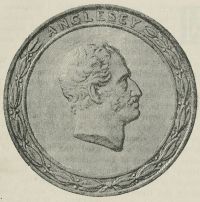
Anglesey
FOOTNOTES:
CHAPTER XII.
MUCH as the attention of both Commanders had been absorbed by the contest described in the last Chapter, the attack and defence of Hougomont had nevertheless been renewed and maintained with unabated vigour.
The assailants, who continued in possession of the Wood, having been strengthened by powerful reinforcements from both Jerome's and Foy's Divisions, now opened so rapid and indiscriminate a fire upon the Garden Wall that it might almost be supposed they entertained the hope of battering it down with their shower of bullets. They failed to make any impression upon the little garrison; though they obtained partial successes on the Flanks, which again were counteracted on the part of the defenders by the aid of Detachments from the main body of Byng's Brigade of Guards, as also by the natural advantages of the localities. Thus, upon the right, a retreat of the Guards from the hedge which lines the Avenue and road leading to the Château, if followed up by the French, would draw upon the latter a murderous fire from the banks, brushwood, and other cover, in rear of the Avenue, together with a flank fire from behind the Buildings: and, upon the left, if they succeeded in forcing back the defenders from the front to the rear hedge of the Orchard, their Left Flank became exposed to a severe fire from the troops lining the eastern Garden Wall, while they suffered at the same time from the new fire directed against their front by the retreating party, formed under cover of the hollow way by which that rear hedge is bounded.
It was about two o'clock when Byng, perceiving the increased pressure upon the troops in the Orchard, and the great diminution which had taken place in their numbers, desired Colonel Hepburn, who commanded the 2nd Battalion of the 3rd Foot Guards, to move down the slope with the remainder of his men as a reinforcement. Colonel Hepburn on reaching the hollow way found it occupied by Lord Saltoun with a very small force; and his Lordship having scarcely a man remaining of his own Battalion, gave over to the Colonel the command of that part of Hougomont, and rejoined Maitland's Brigade.
After a short time, Hepburn and his Battalion made a sudden and vigorous rush into the Great Orchard from the hollow way in its rear. The French Skirmishers gave way; and, as they crowded together while retreating through the gap that leads into the Wood, they suffered severely from the concentrated fire poured upon them by the Guards; who quickly established themselves along the front hedge of the Orchard.
This happened nearly at the same time in which the French were repulsed in their grand attack upon the Centre and Left of the Duke of Wellington's Line. It might be about half past two o'clock.
The Battle was then limited to a general cannonade, the roar of which was incessant; and its effects, now that the range on both sides had been very accurately obtained, were most galling and destructive to the troops posted along the interior slope of either position.
Alten's Light Troops again spread themselves out to the front as soon as Kellermann's Cuirassiers had been swept from off the exterior slope of the Anglo-Allied position. They had not been out long before their attention was directed to a heavy Column of Infantry, apparently advancing from the vicinity of La Belle Alliance towards La Haye Sainte. It was Bachelu's Division, which had fallen back a little after the failure of d'Erlon's attack, to which it had acted as a Reserve. Lieutenant Colonel Vigoureux, of the 30th British Regiment, who commanded these Light Troops of Alten's Division, immediately threw them forward to meet the Column. They poured a well concentrated and most galling fire upon the mass; which immediately brought its right shoulders forward, and took the direction of Hougomont, either in consequence of that fire, or in accordance with Orders previously given.
The ground over which it wound its course descended sufficiently to render the movement indistinct to the British Batteries on the position; but the circumstance having been communicated to Captain Cleeves, whose Foot Battery of the King's German Legion was posted on the most commanding point of the ridge on the right of the Charleroi road, this Officer lost not a moment in making his arrangements. He permitted the Column to continue its march unmolested until it reached a point immediately in his front, on which he had directed his guns so as to concentrate upon the mass, at the proper moment, the whole fire of his Battery. The Column continued its march, and had cleared more than two-thirds of the distance between La Belle Alliance and Hougomont, when, having well entered within Captain Cleeves's line of fire, three rounds from each gun were thrown into it with astonishing rapidity, and awful effect. In a moment the greater portion of the Column appeared to be dispersed, and flying back in confusion towards the lower ground for shelter; leaving an immense number of dead and dying to attest the fatal accuracy of the fire from the Battery.
As no hostile force of either Cavalry or Infantry appeared in its immediate vicinity, Bachelu soon succeeded in rallying his Division and renewing the advance. A similar result followed; whereupon all further attempt to effect the contemplated movement was abandoned: and thus a most serious flank attack upon Hougomont was completely frustrated by the skilfully managed fire of a single Battery.
Bachelu now took post again, upon the right of Foy, leaving a considerable interval between his Division and the Charleroi road.
Foiled in his varied and repeated attacks upon Hougomont, Napoleon had now recourse to incendiary projectiles. For this purpose he had ordered a Battery of Howitzers to be formed, from which shells were thrown so as to descend into the Buildings. The Great Barn, the outhouses on the north side of the Château, the Farmer's House, and finally the Château itself, were speedily set on fire. Dense volumes of smoke, enveloping the whole Post and its defenders, were wafted slowly towards the Anglo-Allied Line; the roofs of the Buildings soon fell in; and, shortly before three o'clock, the flames burst forth with great brilliancy. Many of the wounded had been carried, or had crawled, into the Buildings; but although their comrades entertained the most distressing apprehensions for their safety, the stern sense of duty and of honour prescribed that of the Post itself as paramount to every other consideration. Invested as the place was by an Enemy so overwhelmingly superior in numbers, and so unceasingly on the alert to seize upon any advantage that might offer; not a man could be spared to assist in extricating the sufferers from their perilous situation. Obedience to the natural dictates of humanity was necessarily sacrificed to that which was due to the severe demands of discipline. Thus several perished in the flames.
Others, who had contrived to crawl into the open Courts, could scarcely breathe in the scorching and suffocating atmosphere. Many who had sought shelter, or had been laid, in the Chapel, and whose terrors were excited as they heard the crashing fall of burning timbers, or the frequent explosion of shells around them, at length beheld the flames penetrating the door of the sanctuary. The prayers that had been fervently, though silently, offered up from that holy place, had surely been accepted—the fire, reaching the feet of the wooden image of the Saviour of Mankind, that stood above the entrance, seemed to feel the sacred presence; for here its progress terminated; and this, without the aid of human efforts.
The conflagration did not occasion a moment's relaxation in the heroic exertions of the brave defenders of Hougomont. The courage and devotedness of the men kept pace with the zeal and intelligence of their Officers; and no sooner did new difficulties arise than they were met and overcome by the most judicious arrangements, combined with the most consummate gallantry.
It was now about half past three o'clock. The Anglo-Allied Line continued compact and unshaken in its original position. Its Advanced Posts of La Haye Sainte and Hougomont had successfully resisted the most formidable assaults.
The Left Wing had sustained considerable loss in meeting and repelling the French Right Wing, but the losses endured by the latter in that attack were infinitely more severe: whole Columns of Infantry had been completely overthrown and dispersed; Squadrons of the most splendid and most devoted Cavalry had shared a similar fate; whilst from thirty to forty pieces of cannon had been rendered useless for nearly the remainder of the day. Hence, the French Emperor did not deem it advisable to renew, at least so soon, an attack upon the Left of the Anglo-Allied Army. He decided on forming a grand attack upon its Right and Centre: and since Reille's Infantry had already suffered very considerably in its assaults upon Hougomont, he determined upon employing his Cavalry for that purpose; more especially as the ground in front of that part of the Allied Line appeared well adapted for the movements of this description of force.
To gain possession of La Haye Sainte and Hougomont, as a preliminary step, was undoubtedly the most judicious course: but hitherto his endeavours to obtain that vantage ground had altogether failed, and he was now compelled to limit his plan; combining with the projected attack, renewed assaults against those Posts; which, even if again unsuccessful, would at least serve to divert in some degree, the Enemy's attention.
Napoleon also contemplated a more important diversion, by causing a demonstration to be made with Piré's Light Cavalry against Wellington's Right Flank.
In pursuance of this plan, renewed efforts were made by the attacking force against Hougomont; and two Columns from Donzelot's Division descended upon La Haye Sainte.
Meanwhile, Major Baring having applied for a reinforcement, two Companies were detached to his Post from the 1st Light Battalion of the King's German Legion. To these and a part of his own Battalion, he intrusted the defence of the Garden; and, abandoning altogether the Orchard, he placed the remainder of his force in the Buildings, distributing their defence among the three Officers who had so courageously maintained them during the previous attack.
The French Columns advanced against this Post with the most undaunted resolution and the most conspicuous gallantry. The well aimed bullets of the German rifles, though they told quickly and fearfully amidst their masses, arrested not their progress for a moment. They rushed close up to the walls; and, seizing the rifles as they protruded through the loop holes, endeavoured to wrest them from the hands of the defenders. They also made a most furious assault against the gates and doors, in defence of which many lives were sacrificed. The greatest struggle was at the western opening to the Large Barn, the door of which was wanting. The French, determined to make good an entrance, encountered the brave Germans equally resolute to prevent them. The foremost Frenchmen, dashing boldly on to force their way, were struck down by the deliberate fire from the rifles the instant they reached the threshold; and seventeen of their dead bodies already formed a rampart for those who continued to press forward to carry on the struggle.
It was nearly four o'clock when certain movements made by the Lancers on the French extreme Left, led the Duke to suspect an attack from that quarter; and which, considering the almost isolated position of his detached force at Braine l'Alleud and Vieux Foriez, might, if successful, be attended with very serious consequences to himself. He drew Lord Uxbridge's attention to that point; and the latter immediately despatched Grant, with the 13th Light Dragoons and the 15th Hussars of his Brigade to attack the Lancers, detaching at the same time the 2nd Light Dragoons of the King's German Legion from Dörnberg's Brigade, towards Braine l'Alleud, for the purpose both of facilitating the attack, by manœuvring on the left of the Lancers, and of watching the Enemy's dispositions in that direction.
The fire of Artillery along both Lines had been maintained with the utmost vigour. At this moment, however, a most furious cannonade was directed against that part of the Anglo-Allied Line which was situated between the two high roads. While some of the French Light Batteries took post in advance, others of the Imperial Guard, comprising twelve pounders, opened a fire from the Heights in rear of, and above, La Belle Alliance; and as the Batteries upon the main French Line were ranged along the arc of the chord formed by the Allied Line, the French Artillery was enabled by its very great numerical superiority in guns to concentrate an overwhelming fire upon any part of the Duke's position.
The Allied Infantry posted in Columns along the interior slope of the ridge, were entirely screened from the observation of the French, who could not distinguish any portion of their Enemies beyond the devoted British and German Artillerymen at their guns; which, despite the severity of the fire from their opponents, were worked with the most admirable coolness and intrepidity, and with a precision beyond all praise.
The thunder of the Artillery continued pealing forth in an uninterrupted roll, and the scene became awfully grand. The guns having once obtained the required range, were fired without intermission. Instantaneous flashes met the eye, all along the Heights, succeeded by volumes of smoke bounding forth along the ground in front, and enveloping the Batteries in clouds. The earth trembled beneath the dread concussion. The oldest soldiers had never witnessed a cannonade conducted with such fury, with such desperation.
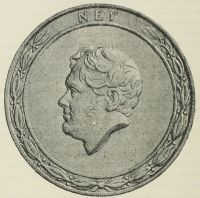
Ney
The Allied Columns of Infantry were lying down upon the ground to shelter themselves as much as possible from the iron shower that fell fast and heavily—round shot, tearing frightful rents directly through their masses, or ploughing up the earth beside them; shells, bursting in the midst of the serried Columns, and scattering destruction in their fall, or previously burying themselves in the soft loose soil to be again forced upwards in eruptions of iron, mud, and stones, that fell among them like volcanic fragments.
During this terrible conflict of Artillery, Ney was making his preparatory dispositions with the Cavalry which Napoleon had desired him to launch against the Anglo-Allied Right Wing.
He first formed for attack, Milhaud's Corps of Cuirassiers, consisting of twenty four Squadrons; and directed Lefèbvre Desnouette's Light Cavalry Division of the Guard, comprising seven Squadrons of Lancers and twelve Squadrons of Chasseurs, to follow and support—in all forty three Squadrons—constituting a magnificent array of gallant horsemen. As they began to advance, the First Line, of Cuirassiers, shone in burnished steel, relieved by black horse hair crested helmets; next came the Red Lancers of the Guard, in their gaudy uniform, and mounted on richly caparisoned steeds, their fluttering lance flags heightening the brilliancy of their display; whilst the Third Line, comprising the Chasseurs of the Guard, in their rich costume of green and gold, with fur trimmed pelisses à la hussard, and black bearskin shakos, completed the gorgeous, yet harmonious, colouring of this military spectacle. Though formed in successive Lines of Columns in the hollow space on the immediate left of La Haye Sainte, where they were sheltered in some degree from the cannonade that raged so furiously above them, the Rear Lines obliqued to the left on the advance, and became echelonned to the First Line, so as to present a general front extending from the Charleroi road on their right to the Hougomont inclosures on their left.
As they ascended the ridge, the French Artillery suspended their fire; and the Allied Batteries commenced pouring a destructive shower of grape shot amidst their devoted ranks. Fiercely and fatally did this iron hail rattle against the helmed and steel clad Cuirassiers, here glancing off, there penetrating the armour; wounding or laying prostrate many a gallant warrior at the very moment when the brightest visions of glory had opened on his ardent imagination. This iron sleet, however, caused no perceptible check to their progress; and, with shouts of "Vive l'Empereur!" they accelerated their pace until, having arrived within about forty yards of the guns, they received the last and well prepared discharge. Its effects were terrific: but though their order was somewhat broken, their courage was not shaken. The charge was sounded; a cheer followed; and, in the next instant, they rushed up to the very cannon's mouth.
In accordance with previous instructions given by the Duke of Wellington himself, the Artillerymen withdrew, upon the close approach of the Cavalry, and sought shelter either beside, or in rear of, the Infantry Squares; or, where occasion required, they threw themselves under the projecting bayonets of the outer kneeling ranks for protection. The Cuirassiers, on crowning the crest of the ridge; and finding themselves so unexpectedly in possession of a Line of Batteries, shouted loudly forth their triumph; and, then renewing their onward charge, were, in a moment, lost to the view of the Lancers and Chasseurs of the Guard. These troops, carried away by the enthusiasm of the moment and the eager desire to share in the fancied victory, advanced with the same fiery impetuosity, and the whole force was now fairly across the ridge.
The Allied Infantry, distributed in chequered Squares along the interior slope, were fully prepared to meet the attack. Some little apprehension had been entertained for the safety of the Right of the Front Line, where the Brunswickers, who, as before remarked, were mostly young, raw troops, had taken up the ground previously occupied by Byng's Brigade of Guards, which had been entirely absorbed by the defence of Hougomont, with the exception of two Companies which, with the Colours, had been withdrawn, as a Reserve, to a more sheltered position on the right of the Nivelles road. As the French Cavalry advanced, the 23rd British Regiment of Infantry was led up to the Front Line, and into an interval between the Brunswick Squares. This Regiment had nearly reached the brow of the ridge when it was suddenly ordered to halt and prepare to receive Cavalry; and the Chasseurs of the Guard appearing the next moment in its front, a fire from this face was opened so hastily that scarcely a shot could have told upon the Enemy. It instantly recovered this somewhat nervous precipitation, and presented a bold and determined stand; as did also the Brunswickers, who acted on this occasion in a manner that would have reflected credit on the most experienced veterans.
The cannonade had necessarily ceased along the Right Wing of the Anglo-Allied Front Line, and along the French Batteries to which it was opposed. Hence the vehement cheering on the part of the French Cavalry became the more distinctly audible and the more highly exciting. A sullen silence was maintained throughout the Allied Squares, which were all at the "prepare,"—front ranks kneeling, and the second at the charge,—thus forming a chevaux de frise, over which the rear ranks were ready to fire, as occasion might demand.
As the Cavalry now rushed down upon the Squares, the front faces of the latter opened their fire when the former had approached within about thirty paces of them. The effect of this fire was to create disorder and confusion in the leading Squadron or Half Squadron (as the case might be), which would then open out from the centre, and obliquing to the right and left respectively, pass on by the Flanks of the Square attacked, to the fire from which it would consequently become completely exposed. The succeeding repeated the manœuvre of the leading divisions; and their disorder became greater and greater as the continually augmenting obstacles in their front, the upset riders and horses, increased in multitude.
Here, as at Quatre Bras, the French Cavalry did not rush to the shock against a single British Square. The horsemen of the leading divisions who escaped the opposing fire, failed to maintain the direction of their speed with unabated vigour, and to dash against the Square, heedless of personal danger, and intent only upon securing the sole chance that offered for the success of their immediate followers. That portion of the Cavalry which passed through the intervals between the foremost Squares, directed their advance upon those that were in rear; and the Squares being generally en échiquier, the opening out and dividing of the attacking Squadrons in the manner described, soon commingled the horsemen of different Regiments, and added considerably to the disorder already caused by the dropping fire which assailed them in all directions.
The Anglo-Allied Cavalry, having the advantage of perfect order, now advanced to the charge; and after encountering some little resistance on different points, speedily succeeded in relieving the Squares from the presence of the Enemy, whom they pursued over the crest of the ridge and down the exterior slope.
No sooner was Ney's Cavalry driven from the position, than the Allied Artillerymen flew from their shelter to their guns, and the French Batteries recommenced their fire. The former dealt destruction amidst the retiring masses as soon as, and wherever, they were uncovered by the Allied Cavalry; but some of the British Regiments, giving too much rein to their ardour, carried their pursuit rather too far; particularly the 23rd British Light Dragoons; who, having attacked the Flank of a Column of Cuirassiers whilst the latter was advancing against the 1st Regiment of Dutch Carabiniers, by which it was then attacked in front—Trip himself leading—drove both the Cuirassiers and a body of Lancers across the hollow on the right of La Haye Sainte, back upon their own Batteries on the Heights beyond, and thus created confusion amongst the French Gunners; who, however, made them pay for their temerity as they withdrew again towards their own position.
Towards the Allied Right, the Lancers, pursued by the 1st Light Dragoons of the King's German Legion, instantly reformed, and, resuming their charge, became themselves the pursuers; but on advancing over the ridge, they were not only exposed again to the fire from the Squares, but were at the same time most unexpectedly assailed by a brisk discharge of round shot from Captain Bolton's British Foot Battery, which had just been rapidly advanced to its left front, and very judiciously posted on some favourable ground close to, and on the right of, the Nivelles road, and in direct rear of the main ridge. Its fire was directed with great precision at the French Cavalry in the intervals between the Squares in its front, and by its valuable assistance the Enemy was soon compelled to retire again across the ridge.
It will be readily conceived that such assistance was most essential, when it is recollected that, at this time, the 7th Hussars, the 1st Light Dragoons of the King's German Legion, the Brunswick Hussars, and the Squadron of Brunswick Lancers, were the only Cavalry Regiments posted in rear of that portion of the Front Line extending from the Nivelles road on the right, to the position of Halkett's British Infantry Brigade on the left, in rear of which latter stood the 23rd Light Dragoons. The manner in which those Regiments charged and repelled the French Cavalry opposed to them, merits the highest commendation.
The French Cavalry evinced the greatest alacrity, nay, impatience, in again getting into order—actuated, no doubt, by a sense of shame and indignation at finding its efforts frustrated, and its valour fruitless; although in possession of the Enemy's guns, and at liberty to act at its own discretion against his Squares.
The advance was speedily renewed; but evidently conducted with more caution, though not with less enthusiasm. Again did this brilliant array of horsemen boldly face the iron shower of grape, and gallantly crown the crest of the Anglo-Allied Right Wing. But now, instead of attacking indiscriminately as before, one portion was allotted to that service; whilst the remainder was kept in more compact order to stem the onset of the Allied Cavalry, by which, on the former occasion, they had been so signally repulsed. The charges were repeated against the Squares, in the same style, and upon the same system, as before; and with an equally fruitless result. This portion of the attacking force became gradually exhausted and out of order: but the remainder appeared well formed up, and moving forward to charge the Second Line comprising Allied Cavalry; which, however, did not wait for the attack, but instantly advanced to meet it. The latter consisted of Somerset's Brigade on the left (greatly diminished by the effects of its former charge, on the occasion of the French attack of the Allied Left and Centre); of the 23rd British Light Dragoons, in rear of Halkett's British Infantry Brigade; of Trip's Dutch-Belgian Carabinier Brigade, in rear of the 23rd; of the Brunswick Hussars and Lancers, more to the right; of the 1st Light Dragoons of the King's German Legion, close to the Nivelles road; and of the 7th British Hussars, on the interior slope of that portion of the ridge which was immediately in left rear of Hougomont—a force scarcely amounting to half the number of Squadrons with which the French Cavalry had commenced this attack.
The charge was executed under great excitement, and with the utmost steadiness and gallantry. The struggle was desperate and sanguinary: but the French Cavalry, assailed in front by the same description of force, and on their flanks by the fire from the Squares, at length went about; and were followed, as before, over the ridge and down the exterior slope.
In rear of the Right of the Anglo-Allied Line, where, as previously observed, the Cavalry was then so very weak in numbers, the 1st Light Dragoons of the King's German Legion had deployed into Line, in order to occupy more ground and show a greater front. As the French Lancers were attacking the Squares, and advancing through the intervals between them, notwithstanding the renewed fire from Bolton's Battery, the Regiment hastened forward to charge them.
The Germans had not proceeded far when it was discovered that a body of the Enemy's Cavalry had penetrated to the open space on their left. With great presence of mind and admirable promptitude, Major Reizenstein, who perceived the danger to which the Regiment was exposed by the already meditated attack upon its Left Flank, drew off a great part of it, and, with a right-shoulder-forward movement, advanced to meet these new assailants who were now coming on at full speed. The mutual impetuosity of the charge, and violence of the shock, were terrific. The two Lines dashed at and through each other, and those of the horsemen that were yet firm in their saddles, wheeling sharply round, again rushed to the fierce encounter with the most resolute bravery; and the dispersed riders, after rapidly exchanging cuts and thrusts, en passant, sought out their respective Corps.
As the Cavalry retired, the Infantry that had attacked La Haye Sainte desisted from their fruitless endeavours to force the gallant little garrison. Not long afterwards, Major Baring, on finding that the ammunition of his men had, by the constant firing, been reduced to less than one half, became apprehensive of its speedy exhaustion; and despatched an Officer to request a supply, which was promised to him. In the mean time, the Germans set about diligently repairing the injuries they had sustained, and making the best preparation in their power to meet the next attack.
Upon the first advance of the French Cavalry, by the Allied left of Hougomont, a body of Infantry Skirmishers crept along the boundary hedge of the Great Orchard on that side, and by thus turning the Flank of the 3rd Guards, who were at the same time assailed with renewed vigour in front, compelled them to retire into the hollow way in rear of the inclosure; but, as the Cavalry withdrew, so did the Light Troops on the left of the Orchard, and Lieutenant Colonel Hepburn, advancing his men from their cover, drove back the French Skirmishers in the Orchard, and again occupied its front hedge.
The contest at this time, between the Allied Left, and the French Right, Wing was limited to a continued cannonade, with Light Troops skirmishing in the valley which separated the two positions. The Nassau troops, under Prince Bernhard of Saxe Weimar, maintained their ground with great spirit along the Villages and inclosures upon the extreme Left of the Anglo-Allied Army.
Grant, who, it will be recollected, had been detached with the 13th Light Dragoons and the 15th Hussars, to attack the 5th and 6th French Lancers, upon the extreme Left of the French Line, in consequence of certain menacing dispositions on their part, was first made aware that these had been merely a diversion to draw off a portion of the Allied Cavalry from the real point of attack, by the shouts which suddenly proceeded from their ranks; when, on turning round to ascertain the cause, he perceived the French in possession of the Batteries along the crest of the position, and charging the Squares posted on the interior slope. Observing a repetition of the attack, and the want of Cavalry on that part of the position which he had quitted; he most judiciously took upon himself to return to it with both Regiments: and, as will appear in the sequel, he arrived there at a most critical moment, when his absence might have produced the most fatal consequences. As a precautionary measure, the Right Squadron of the 15th Hussars, under Captain Wodehouse, was left in its original position, to observe the extreme Left of the French line; and the 2nd Light Dragoons of the King's German Legion continued to keep a look out between that point and Braine l'Alleud.
Napoleon, perceiving the necessity of affording an immediate Support to Ney's attack, sent an Order to Kellermann to advance for that purpose, with his Corps of Heavy Cavalry, consisting of the two Divisions commanded by L'Heritier and Roussel d'Urbal, and comprising (at the commencement of the Battle) seven Squadrons of Dragoons, eleven Squadrons of Cuirassiers, and six Squadrons of Carabiniers. In the mean time, Ney, with a similar object in view, had ordered forward Guyot's Heavy Cavalry Division of the Guard, comprising six Squadrons of Horse Grenadiers, and seven Squadrons of Dragoons. These thirty-seven Squadrons, combined with the force which had already attacked, and which had originally consisted of forty-three Squadrons, constituted a stupendous array of Cavalry, in comparison with that which was then posted in rear of the Right Wing of the Anglo-Allied Army; and which received no accession beyond the five Squadrons that Grant was in the act of withdrawing, as before explained, from the extreme Right.
Guyot's Division of the Guard having been placed by Napoleon at Ney's disposal, when he first desired him to form the grand Cavalry attack, the Marshal was entitled to employ it if he thought proper; but it is doubtful whether Napoleon, after having sent forward Kellermann's Corps, was desirous that the combined force should be thus prematurely engaged, since it would deprive him of his only Cavalry Reserve. Still, when we consider the limited extent of the Field of Battle, and the consequent facility with which he might have either suspended the employment of the Heavy Cavalry of the Guard, or countermanded Kellermann's advance, it is reasonable to infer that the French Emperor was not altogether displeased with the grand experiment which was about to be made, and which encouraged the most sanguine expectations of a glorious triumph.
The coming attack was, like the former one, preceded by a violent cannonade. As before, the French Batteries concentrated their fire upon the Allied Artillery and Squares. The entire space immediately in rear of the crest of the ridge that marked the Front Line of the Duke's Right Wing, was again assailed with a tempest of shot and shell. Again were whole Files torn away, and compact Sections rent asunder.
But the extraordinary skill and the untiring energies of the British and German Gunners, combined with the heroic forbearance and the admirable steadiness of the Squares, fully impressed upon the mind of Wellington the conviction that, however formidable and disproportionate the force that his powerful adversary could wield against him, it might yet be made to suffer an exhaustion, moral as well as physical, that would render it totally unavailable and helpless at the moment when its extremest tension and fullest application would be so urgently required to extricate the Emperor from that perilous crisis which, by his Grace's masterly arrangements, was gradually approaching its consummation. To act exclusively on the defensive, to maintain his ground in defiance of every assault and every stratagem; and yet to harass and weaken his Enemy to the extent of his power, constituted the grand point on which hinged the practical development of those arrangements. A defeat and dispersion of his Army before the arrival of the Prussian troops, would lead to new measures, to additional sacrifices—perhaps to irretrievable disasters. But his resolve was fixed and irrevocable; for he knew that he could fearlessly rely upon the devotion, the endurance, and the valour of his British and German soldiers. And this implicit confidence was nobly reciprocated; for as the troops remarked the serenity of his countenance and demeanour when rectifying any confusion or disorder, or felt as if spellbound by the magic influence of a few simple and homely words from his lips, they entertained no doubts as to the result of their glorious exertions.
When the tremendous Cavalry force, which Ney had thus assembled, moved forward to the attack, the whole space between La Haye Sainte and Hougomont appeared one moving glittering mass; and, as it approached the Anglo-Allied position, undulating with the conformation of the ground, it resembled a sea in agitation. Upon reaching the crest of the ridge and regaining temporary possession of the Batteries, its very shouts sounded on the distant ear like the ominous roar of breakers thundering on the shore. Like waves following in quick succession, the whole mass now appeared to roll over the ridge; and as the light curling smoke arose from the fire which was opened by the Squares, and by which the latter sought to stem the current of the advancing host, it resembled the foam and spray thrown up by the mighty waters as they dash on isolated rocks and beetling crags; and, as the mass separated and rushed in every direction, completely covering the interior slope, it bore the appearance of innumerable eddies and counter currents, threatening to overwhelm and engulf the obstructions by which its onward course had been opposed. The storm continued to rage with the greatest violence; and the devoted Squares seemed lost in the midst of the tumultuous onset. In vain did the maddening mass chafe and fret away its strength against these impregnable barriers; which, based upon the sacred principles of honour, discipline, and duty, and cemented by the ties of patriotism and the impulse of national glory, stood proudly unmoved and inaccessible. Disorder and confusion, produced by the commingling of Corps, and by the scattering fire from the faces of the chequered Squares, gradually led to the retreat of parties of horsemen across the ridge; these were followed by broken Squadrons, and, at length, the retrograde movement became general.
Then the Allied Dragoons, who had been judiciously kept in readiness to act at the favourable moment, darted forward to complete the disorganisation and overthrow of the now receding waves of the French Cavalry.
The Allied Artillery had barely time to fire a few rounds into the retiring masses, when the Enemy's formidable Support rapidly advanced to renew the attack; and, as if it had been made aware that the Right of the Anglo-Allied Line was the weakest part, from the want of a sufficient Cavalry Support, its efforts appeared particularly directed to that point. A body of Heavy Dragoons was drawn up in Line, and advanced up the ridge leaving the Hougomont inclosures immediately on its left.
At this moment, however, Grant had most opportunely returned with the 13th Light Dragoons and 15th Hussars from the extreme Right; and instantly forming the 13th, which was the leading Regiment, in Line to the front, moved it up to the crest of the ridge, over which it gallantly charged and routed the French Dragoons, driving them about three hundred yards down to the low ground near the north-east angle of the Great Orchard of Hougomont. The 15th Hussars were also formed to the front, on the left of the 13th Light Dragoons, and charged a mass of Cuirassiers, which was driven back a like distance, upon large bodies of Cavalry. As these were observed commencing offensive operations, both in front and on the flank, the two Regiments, first the 13th, and then the 15th; were compelled to retreat to the main position, and take post in rear of the Squares; but this they did with so much order and regularity that their presence and example imparted new life and confidence to the young Brunswickers; whose steadiness, on the Right of the Line, had been severely tested in the course of the grand Cavalry attack.
Notwithstanding these reverses, and the decided failure of their former attempts, the French horsemen most gallantly and resolutely renewed their advance, and again plunged in masses amidst the Allied Squares. Failing in their direct attack, they rode through the intervals between the Squares in all directions, exhibiting extraordinary coolness and intrepidity. Some of the most daring approached close up to the ranks, to draw forth the fire from a Square; and thus secure a better chance of success for the Squadron prepared to seize the advantage and to charge. Small parties of desperate fellows would endeavour to force an opening at some weak point, by cutting aside the bayonets and firing at the defenders with their pistols. But the Squares were proof against every assault and every stratagem.
More Cavalry crossed over the summit of the ridge; and the greater part of the interior slope occupied by the Allied Right Wing seemed covered with horsemen of all kinds—Cuirassiers, Lancers, Carabiniers, Chasseurs, Dragoons, and Horse Grenadiers. The French, enraged at their want of success, brandishing their swords, and exciting one another by shouts of "Vive l'Empereur!" reiterated their attacks with redoubled but fruitless vigour. Like the majestic oaks of the forest, which are poetically said to strike their roots deeper and more tenaciously into the earth as the fury of the storm increases, so stood the Anglo-Allied Squares, grand in the imposing attitude of their strength, and bidding defiance to the tempestuous elements by which they were assailed on every side.
At length, the attack evinced symptoms of exhaustion; the charges became less frequent and less vigorous; disorder and confusion were rapidly augmenting; the spirit of enthusiasm and the confidence of superiority were quickly yielding to the feeling of despondency and the sense of hopelessness. The Anglo-Allied Cavalry again advanced, and once more swept the mingled host, comprising every description of mounted troops, from off the ground on which they had so fruitlessly frittered away their strength.
On this occasion, a body of Cuirassiers, having been intercepted in its direct line of retreat by a party of British Light Dragoons, was induced to surrender; but taking advantage of the weakness of their escort, they suddenly broke away, and galloped down the Nivelles road, by which they hoped to return to the French Lines. They were fatally deceived. As they passed the high bank, covered with brushwood, on the right of the road, where a Detachment of the 51st Regiment was stationed as one of the Supports to the Light Troops extended in front of the extreme Right, they were fired upon, though but partially, in consequence of their close pursuit by the Light Dragoons. This attracted the attention of Captain Ross of that Regiment, who was posted with his Company more in advance, and close to the abatis which had been thrown across the road near the head of the Avenue leading to Hougomont. Captain Ross, being thus prepared, also fired upon the Cuirassiers; whereupon their Commanding Officer, finding all further retreat effectually cut off by the abatis, surrendered to Captain Ross, declaring that he would not give himself up to the Dragoons. At this spot eighty of the Cuirassiers and twelve of their horses were killed; and the remainder, about sixty, were dismounted, taken, or dispersed.
Shortly before this, Ney, perceiving the ill success of his Cavalry attacks, determined on combining them with such Infantry as he had at his disposal. Between d'Erlon's and Reille's Corps there was now a great interval, and the only troops of which he could make use for the above object, consisted of Bachelu's Division, on the right of the latter, as Donzelot's Division, on the left of the former, was still required for the attack upon La Haye Sainte, which he now ordered to be vigorously renewed, whilst he advanced a heavy Column of Bachelu's Infantry towards the Centre of the Allied Right Wing.
Wellington, who had, from the first, anticipated that the attacks of Cavalry would be followed up by others, in which that Arm would be combined with Infantry, was fully prepared to meet this contingency, having as soon as he had ascertained that the Enemy was not disposed to attempt any serious movement against his Right Flank, despatched an Order to Chassé to evacuate Braine l'Alleud and its vicinity, and to proceed with his Dutch-Belgian Division, towards the principal scene of action, along the low ground through Merbe Braine. By this means, his Grace, who contemplated reinforcing his First Line with troops from his Second, would be enabled to supply their place in the latter with others of equal strength. Chassé's movement, executed with much judgement, was in a great measure, if not entirely, concealed from the Enemy's observation; and was very skilfully covered by the 2nd Light Dragoons of the King's German Legion, who continued hovering near the Left Flank of the French Army.
In the mean time, the attack upon La Haye Sainte had been renewed with the same fury as before. Major Baring on perceiving the advance of the Enemy's Columns, sent an Officer to the position with this intelligence, and repeated his request for ammunition. The Light Company of the 5th Line Battalion of the King's German Legion was sent to his assistance; but the supply of ammunition, of which he stood so much in need, was not forthcoming: and he therefore, after waiting half an hour longer, during which the contest was uninterrupted, despatched another Officer on the same errand. This application proved equally unsuccessful. He received, however, a reinforcement of two Flank Companies from the 1st Regiment of Nassau.
The great struggle was again at the open entrance to the Barn; and the French, finding all their efforts to force an entrance so obstinately and successfully frustrated, had recourse to the expedient of setting the place on fire. A thick smoke was soon observed issuing from the Barn. The greatest consternation pervaded the little garrison; for although there was a pond in the yard, there were no means at hand for conveying the water to the point of danger. Major Baring, whose anxiety was extreme, glancing his eye at the large camp kettles borne by the recently arrived Nassauers, instantly pulled one from off a man's back: several Officers followed his example, and filling the kettles with water, carried them in the face of almost certain death, to the fire. The men hesitated not a moment. Every kettle was instantly applied to the same good office, and the fire was fortunately extinguished; though at the sacrifice of many a brave soldier. Several of the men, although covered with wounds, rejected all persuasion to retire. Their constant reply was, "So long as our Officers fight, and we can stand, we will not stir from the spot." At length the Enemy, wearied out by this most resolute and gallant defence, once more withdrew.
At the commencement of this attack, while one portion of the Enemy's force was principally directed against the western entrance of the Great Barn; the other, leaving the Buildings on its right, advanced higher up the slope, as if intending either to penetrate the Farm by the Garden, or to cut off its communication with the main position.
The Prince of Orange, conceiving this to be a favourable opportunity for attacking the French Column, ordered the 5th and 8th Line Battalions of Ompteda's Brigade of the King's German Legion to deploy and advance. The Line was quickly formed; and the Battalions, bounding across the narrow sunken road, rushed forward, at a charging pace, driving the Enemy before them. But a body of Cuirassiers, that had unsuccessfully charged the Left Squares of Kielmansegge's Hanoverian Brigade, whilst those Battalions were advancing, came upon the Right Flank of the latter, unexpectedly for both parties. The 5th Line Battalion, which was on the right, having been supported in sufficient time by Somerset's Heavy Cavalry Brigade, suffered little loss; but the 8th Line Battalion—being on the left, and more in advance, in the act of charging when the Cuirassiers appeared—was completely surprised, and its Right Wing cut down and dispersed. The Commanding Officer of the Battalion, Colonel Schröder, was mortally wounded: several other Officers fell: Ensign de Moreau, who carried and defended the King's Colour, having been severely wounded, as also the Serjeant who afterwards held it, the Enemy succeeded in carrying off the prize. Major Petersdorf, the next in command, collected the scattered remnant of the Battalion, and posted it in rear of the hollow way.
The moment the Anglo-Allied Right Wing became cleared of the presence of the French Cavalry, it was again exposed to a furious cannonade. Several of the guns along the main ridge were by this time disabled. Major Bull, who had been obliged at an earlier period to withdraw his Howitzer Battery to the Second Line for the purpose of repairing casualties and completing ammunition, advanced again to his former post in the Front Line, along with Major Ramsay's Horse Battery, during the Second general Charge of the French Cavalry. These Batteries suffered severely from Piré's guns, stationed on the extreme Left of the French Line. Bull directed Lieutenant Louis to turn his two right guns towards them, and it was not long before this Officer succeeded in silencing them; a service which, as they enfiladed the Allied Right Flank, was of considerable advantage, during the remainder of the Battle, to all the Batteries and troops in this part of the Field.
The Duke, considering that a reinforcement of Artillery was particularly required in front of Cooke's Division and the Brunswick Infantry against which the Enemy was evidently preparing fresh attacks, ordered up Lieutenant Colonel Dickson's British Horse Battery, commanded by Major Mercer, and Major Sympher's Horse Battery of the King's German Legion, into the Front Line: the former, to the left of Lieutenant Colonel Smith's Horse Battery, in front of the Brunswickers; and the latter further to the left.
Major Mercer's Battery had barely time to get into action, when a heavy Column of Cavalry, composed of Horse Grenadiers and Cuirassiers, was seen ascending the ridge, and advancing at a rapid rate directly towards the spot upon which it had taken post. The guns, which were nine pounders, were each loaded with a round and a case shot; and were run close up to a bank of two or three feet in height, which descended from the narrow cross road along the ridge, and which thus formed a sort of genouillère to the Battery. In front, the summit of the ridge consisted of a flat surface, of forty or fifty yards in width, whence the ground descended rapidly towards the plain that divided the two Armies. The Column continued to advance until it came quite close upon these guns, the muzzles of which were nearly on a level with the cross road; when it suddenly recoiled from the very destructive fire with which it was received. The horsemen of the leading Squadrons faced about, and endeavoured to force their way to the rear; confusion ensued, and the whole mass broke into a disorderly crowd. Several minutes elapsed ere they succeeded in quitting the summit of the ridge, during which the fire from the Battery was incessant; and, from the shortness of the distance, the size of the objects, and the elevation of the ground on which they stood, the consequent carnage was truly frightful. Many, instead of seeking safety in retreat, dashed through the intervals between the guns, and surrendered: but the greater part, rendered desperate at finding themselves held, as it were, in front of the Battery, actually fought their way through their own ranks; and, in the struggle, blows were exchanged on all sides. At length, the wreck of this formidable Column gained shelter under the slope of the ridge, leaving the summit encumbered with its killed and wounded.
About the same time, a strong Column of French Infantry, supported by Cavalry, was advancing against the Centre of the Anglo-Allied Right Wing. Whilst the opposed Batteries were concentrating upon it a vigorous fire, Lord Uxbridge brought forward Somerset's Heavy Cavalry Brigade from its position on the right of the Charleroi road, for the purpose of attacking this Column; and also ordered up, in support, Trip's Dutch-Belgian Carabinier Brigade. The attack was made with great gallantry by the Household Cavalry, which succeeded in checking the advance of the Enemy; but, having been so much reduced in numbers, it was unable to penetrate the Column, which received it with a heavy fire. As Somerset retired; the French Cavalry by which the Column had been supported, prepared to advance.
Trip's Dutch-Belgian Cavalry was now at hand. Uxbridge, pleased with their fine appearance, and desirous of exciting in them a courageous enthusiasm, placed himself conspicuously in their front, and ordering the "Charge," led them towards the Enemy. He had proceeded but a very short distance, when his Aide de Camp, Captain Horace Seymour, galloped close up to him, and made him aware that not a single man of them was following him. Turning round his horse, he instantly rode up to Trip, and addressed himself to this Officer with great warmth. Then, appealing to the Brigade in terms the most exhorting and encouraging, and inciting them by gestures the most animated and significant, he repeated the Order to charge, and again led the way in person. But this attempt was equally abortive; and Uxbridge, exasperated and indignant, rode away from the Brigade, leaving it to adopt any course which its Commander might think proper: and as the French Cavalry, to which this hesitation was but too manifest, was now advancing rapidly to the attack, the Dutch-Belgians went about, and retired in such haste and disorder that the two Right Squadrons of the 3rd Hussars of the King's German Legion experienced the greatest difficulty in maintaining their ground, and avoiding being carried along to the rear by these horsemen in the wildness of their flight.
The 3rd Hussars had just moved up into the Second Line, in rear of Kruse's Nassau Brigade, when this occurred; and the Left Squadron, being free from any interruption of the kind, gallantly charged and completely overthrew that portion of the Cuirassiers which was in its immediate front. As soon as the other two Squadrons had recovered their order, which had been so unexpectedly disturbed by the fugitive Dutch-Belgians, the whole Regiment advanced to the crest of the position; where it received from Lord Uxbridge, in person, the Order to charge a Line of French Cavalry, distant about 150 yards, and consisting of about three Squadrons of Cuirassiers and three Squadrons of Heavy Dragoons. Commencing the charge with a steady trot, and then plunging into a gallop, they broke through the Enemy's Line, which was advancing at a short trot, or almost at a walk; but became so completely turned and hemmed in upon their flanks and rear, that a vast proportion of them was cut off. The remainder, dispersed, and pursued by the French Cavalry, rode back to the Infantry Squares, in rear of which the Regiment reformed. Here the great loss which it had suffered in these two attacks become manifest. It was reduced to between sixty and seventy Files, which were formed into two Squadrons, and posted in rear of Kielmansegge's Hanoverian Brigade.
About this time, the Earl of Uxbridge, on examining the state of his Cavalry, perceived the Cumberland Regiment of Hanoverian Hussars at some distance in the rear, on the Brussels road. He immediately ordered them forward; and on their coming up, he posted them where they were by no means much exposed, but where they would at least appear to fill a gap occasioned by the severe losses experienced by Somerset's and Ponsonby's Brigades: for the manner of their Commanding Officer, whilst being thus posted, rendered his Lordship doubtful of their continuing there if attacked.
That he had reason to apprehend something of this kind, was subsequently proved; for Colonel Hake, on finding the shot flying about him a little, took himself and his Regiment out of the Field: on discovering which, Lord Uxbridge despatched his Aide de Camp, Captain Horace Seymour, with an Order for his return. When Captain Seymour delivered this Order, the Colonel remarked that he had no confidence in his men, that they were Volunteers, and that their horses were their own property. The Regiment continued moving to the rear; notwithstanding Captain Seymour's repeating the Order to halt, and asking the Second in Command to save the honour and character of the Corps, by placing himself at its head and fronting the men. Finding his remonstrances produced no effect, he laid hold of the bridle of the Colonel's horse, and commented upon his conduct in terms such as no man of honour could have been expected to listen to unmoved. This Officer, however, appeared perfectly callous to any sense of shame; and far more disposed to submit to those attacks upon his honour than he had been to receive those of the Enemy upon his person and his Regiment. Upon rejoining the Earl of Uxbridge and relating what had passed; Captain Seymour was again directed to proceed to the Commanding Officer, and to desire that, if he persevered in refusing to resume his position in the Line, he would, at least, form the Regiment across the high road, out of fire. But even this Order was disregarded, and the Corps went altogether to the rear, spreading alarm and confusion all the way to Brussels.
In front of the Right of the Anglo-Allied Line, the French Column of Horse Grenadiers and Cuirassiers, which had met with so disastrous a repulse from Major Mercer's Horse Battery, was reformed for another attack; to meet which the British Gunners were fully prepared: for the French horsemen had not retired so far down the hill but that the high caps of the Horse Grenadiers of the leading Squadrons, were visible above the brow of the exterior slope. The second attempt was preluded by a cloud of Skirmishers, who, advancing to within a very short distance of the front of the Battery, did considerable mischief to the Gunners with their carbines and pistols; but their intention being evidently to draw forth their fire, no notice was taken of them.
Then the Column again ascended the ridge, and advanced to attack the Battery; but on this occasion their pace scarcely exceeded a walk, or at most a gentle trot, too many obstacles lying in their way to admit of more rapid movement without confusion. Experience having shown the Gunners the destructive effects of a close fire, they allowed the leading Squadrons to attain about half the distance between the brow of the slope and the narrow road in their front before they commenced. The result, as may be readily imagined, was precisely similar to that of the former attack, which has already been detailed. Again the French horsemen fell into confusion, and again for several minutes were they exposed to a deliberate and an unerring fire of case shot, within a distance of not more than twenty yards, so that the pile of killed and wounded, left on the ground immediately in front of the Battery, before great, was now enormous.
Other Batteries along this part of the position were equally successful in repelling the attacks of the Enemy's Cuirassiers, who were assembling in considerable numbers at the foot of the exterior slope, close to the Hougomont inclosures, apparently with the object of cutting off the direct communication with that Post, and forcing the Right of the Allied Front Line. The moment seemed favourable for such a project. Several of the Allied guns had by this time become completely disabled; the 2nd Battalion of the 3rd British Guards, awfully reduced, had been driven into the hollow way in rear of the Orchards of Hougomont; the young Brunswick Infantry had suffered severe losses; and the supporting Cavalry had become greatly exhausted by its repeated charges.
But Wellington, foreseeing the probability of a serious attempt upon this weakened point of his Line, and perceiving the approach of Chassé's Division (see page 458), supplied the required remedy by desiring Lord Hill to bring forward troops from the Second Line. The zeal, intelligence, and activity which had ever characterized the Hero of Almaraz and Arroyo del Molino when carrying out the designs of the Chief under whom he had acquired a lasting fame, seemed but to wait this summons to the more immediate scene of action, to appear again in all their accustomed vigour. He immediately put in motion du Plat's Infantry Brigade of the King's German Legion. As the latter advanced across the Nivelles road, from its left, the 2nd Line Battalion became the leading Column. It was followed by the 4th, then by the 3rd, and lastly by the 1st Line Battalion. As the 2nd approached the crest of the ridge, several Gunners ran in upon it for shelter from the Enemy's Cuirassiers, whose main body was now advancing against this Battalion. The four Light Companies of the Brigade, however, had just posted themselves close to the three small trees near this part of the crest of the ridge; and being armed with rifles, they delivered so destructive a fire into the Cavalry as to compel it to withdraw.
Some of the Allied Cavalry then moved forward in pursuit, and du Plat's Brigade continued its advance until the 2nd Line Battalion had approached close to the hedge of the Great Orchard of Hougomont, whence a dropping fire was opened upon the Germans by the French Skirmishers. The Dragoons made a sudden and rapid retreat through the intervals of the Columns, in left front of which a fresh Line of hostile Cavalry now presented itself. Captain Sympher, who, with his Horse Battery of the Legion, had accompanied du Plat's advance, instantly unlimbered; and poured round shot through the intervals of the Columns, the latter maintaining, at the same time, a very effective independent file fire. The Cuirassiers gallantly advanced, notwithstanding this formidable resistance. They first became exposed to a flank fire from the left face of the 4th Line Battalion Square, and then again to that from the left face of the 3rd Line Battalion: nevertheless, they resolutely attacked the Battery, the Gunners of which either flew to the last mentioned Square for protection, or sought shelter under the carriages. At length, after having suffered severe losses by the unremitting fire from the nearest Squares, the French Cavalry retired in disorder; receiving a renewed discharge from the Battery, which was again in full play.
When du Plat's Brigade moved down the slope, the 2nd and 3rd Light, and 2nd Line, Battalions of the Brunswickers, advanced a short distance over the crest of the ridge, in left rear of the former. Here they became exposed to a destructive fire of both artillery and musketry, the latter from the French Skirmishers that had crept from along the eastern hedge of Hougomont, close under the brow of that part of the Anglo-Allied position. They withstood this heavy fire, as also the subsequent charges of Cavalry, with great steadiness and courage; but as soon as the French horsemen were driven back by a portion of the Allied Cavalry (consisting of the 23rd British Light Dragoons, the 1st Light Dragoons of the King's German Legion, and the Brunswick Hussars and Lancers), the above mentioned Battalions withdrew from their exposed situation to the interior slope.
The French Skirmishers, who had, during this last attack by their Cavalry, pushed forward a very considerable force through the Great Orchard of Hougomont, and along its eastern boundary, now concentrated a most galling fire upon the Squares of the Legionary Brigade, whose Commander, du Plat, was mortally wounded; several Officers fell, and all those that were mounted had their horses shot under them. The fire ceased; and in the next moment the Cuirassiers, having rallied, renewed their charge: but with no greater success than before; and a third charge proved equally ineffectual against the determined bravery and patient endurance of the soldiers of the Legion.
About the time that du Plat's Brigade moved into the First Line, a considerable body of French Cuirassiers, which still remained in the hollow westward of La Haye Sainte, exposed to a fire from one or two of the Allied Batteries, advanced at a walk, to make another effort to break the Right Centre of Wellington's Line. This proved as unsuccessful as the previous attacks. The Squares, reserving their fire until the close approach of the hostile Cavalry, and then directing it against the latter in the most cool and deliberate manner, which the absence of all impetus in an attack at a walk enabled them to do with unerring effect, soon compelled the shattered Squadrons once more to withdraw from a contest which the unexampled steadiness of the Allied Infantry had rendered almost hopeless on their part.
The French Cavalry that attacked the Squares of du Plat's Brigade, immediately in rear of Hougomont, had no sooner been driven off by the gallant resistance of the Germans, than the Skirmishers, who, as before observed, had advanced in such numbers along the eastern inclosures of that Post, crept close up under the brow of that part of the ridge on the interior slope of which was posted the main body of the Brunswick Infantry.
At this time, however, Lord Hill was bringing forward Adam's British Light Infantry Brigade, having directed it to cross the Nivelles road, and to advance in Columns up the slope, in rear of the Brunswickers. (The Brigade had, some time before, been moved from the plateau on the right, close to the edge of the Nivelles road, in which position it had continued in immediate reserve.) Suddenly the summit in its front was crowded with the French Skirmishers, who were almost as quickly concealed by the smoke from the rattling fire which they opened upon the Allied Artillery and the Squares. The Gunners, whose numbers were fearfully diminished, were speedily driven back from their crippled Batteries upon the nearest Infantry; upon which the concentration of this galling fire threatened the most serious consequences.
But succour was at hand. Wellington, in the midst of the shower of bullets, had galloped to the front of Adam's Brigade, ordered it to form Line, four deep; and then, pointing to the daring Skirmishers on the Height, called out, with perfect coolness and unaffected assurance, "Drive those fellows away!" With loud cheers, the Brigade moved rapidly up the slope, eager to obey the Duke's command. From the want of sufficient space, the 52nd Regiment was not formed in Line with, but in rear of, the 71st and 2nd Battalion of the 95th Regiment, to which it consequently served as a Support. The French Skirmishers began to give way as the firm and intrepid front of the Brigade presented itself to their view. Adam continued his advance, driving the French Infantry before him. On crossing the ridge, the Brigade brought forward its right shoulders, and, when halted, it stood in a slight hollow; which, commencing in front of the right of the position occupied by Maitland's Brigade of Guards, descends towards the north-east angle of the Great Orchard of Hougomont. At the former point the 2nd Battalion of the 95th Regiment formed the Left; and at the latter, the 71st Regiment with the two Companies of the 3rd Battalion of the 95th Regiment formed the Right, of this Line. The Enemy's Cavalry having been perceived preparing for attack, the Battalions of the Brigade formed Squares: and as the interval between the 71st and the 2nd Battalion 95th Regiment, in this new position, was larger than was desirable; Colonel Sir John Colborne moved down the 52nd Regiment, in Squares of Wings of Battalions, to fill up the space; which he reached just in time to throw a most effective oblique fire upon the Cavalry which was in the act of attacking the 71st Regiment.
The French Carabiniers and Horse Grenadiers of the Guard made some gallant attacks upon the Brigade. They generally advanced by their right of the Hougomont inclosures, then fell upon the 71st Regiment, by which their charge was invariably broken; when such portions of them as continued in any degree of order, rushed onward in apparent infatuation upon the Right Wing Square of the 52nd Regiment; from the front and right faces of which they received a close, well directed fire, which completed their disorder and confusion.
In one of these attacks, Major Eeles, whose Company of the 3rd Battalion 95th Rifles was attached to the 71st Regiment, upon observing the approach of the Carabiniers towards the right angle of the front face of the Square, moved his Company to the right, in line with the rear face, and, placing himself in its front, prevented his men from firing until the Carabiniers approached within thirty or forty yards of the Square; when he ordered a volley, which, combined with a cross fire from the 71st, brought down so many horses and men to the ground, at the same moment, that the further progress of the charge was most effectually frustrated. In an instant, one half of the attacking force was on the ground; some few men and horses were killed; more were wounded; but by far the greater part were thrown down over the dead, the dying, and the wounded. These, after a short interval, began to extricate themselves from the mass, and made the best of their way back to their Supports; some on horseback but most of them on foot.
Adam's Brigade, by means of the advanced position which it thus occupied, along the space between the Hougomont inclosures and the right front of Maitland's Brigade, presented an effectual barrier to the advance of the French Cavalry against that portion of the Allied Front Line which was situated upon the right of the latter point. In the intervals between the charges of Cavalry, it suffered severely from the Enemy's Artillery; more particularly the 71st Regiment, and 2nd Battalion 95th Rifles, the position of these Regiments being somewhat more exposed than that of the 52nd.
Halkett's Hanoverian Brigade had moved from its present position, near Merbe Braine, into the space within the angle formed by the Nivelles road and the hollow way which leads from the Right of the Front Line down into the low ground below Hougomont; and it was shortly after Adam moved into his forward position, that Halkett advanced, with the Landwehr Battalions Osnabrück and Salzgitter, and took post on the exterior slope of the main ridge, in rear of du Plat's Brigade.
It was now about six o'clock. The formidable attacks made by the French along the entire Line of the Anglo-Allied Army had been productive of no positive advantage; the Advanced Posts of Hougomont and La Haye Sainte had successfully resisted the furious assaults which had hitherto been directed against them: and the forward position taken up by Adam's British Brigade, made it manifest to the French Emperor that, notwithstanding the gallantry, enthusiasm, and devotion displayed in those attacks by the finest troops he had ever assembled together, headed, too, by Generals of the highest celebrity; still greater efforts, and still greater sacrifices must be made if he hoped to drive the British lion from the position which it yet proudly retained with so firm a footing, before the Prussian eagle, which for some time past had hovered over, and was at this moment darting at, his extreme Right, should alight, in the plenitude of its force, to satiate its thirst for vengeance in the fierce and sanguinary struggle.
Napoleon sent an Order to Ney to renew the attack upon the Centre. To execute this with effect, however, fresh Infantry was requisite; and the Marshal had none at his disposal. He therefore despatched his first Aide de Camp, Colonel Heymès, to represent to the Emperor the exhausted condition of his troops: half of which were placed hors de combat, and the other half overcome by fatigue, and failing in ammunition; and to request he would send him reinforcements. At this moment, however, Lobau's Corps and the Young Guard were required for the security of the French Right Flank against the offensive operations of the Prussians; consequently, the Battalions of the Old Guard, which constituted the only remaining Reserve of Infantry, could not be spared. To Ney's demand for fresh troops, Napoleon therefore replied,—"Ou voulez vous que j'en prenne? Voulez vous que j'en fusse?"
Ney, on being made acquainted with the manner in which his request had been received, saw very plainly that the Battle was far from being gained: and darted off to animate, by his presence, the attack which was now renewed upon La Haye Sainte; and which was covered by a vigorous fire from the French Artillery against that portion of the Anglo-Allied Line immediately in rear of this Post, in order to disturb any attempt to relieve or assist its defenders.
The united remains of Somerset's and Ponsonby's Brigades, which were on the reverse slope, behind Ompteda's Brigade of the King's German Legion, and which were extended in Single File for the purpose of making a show of force, suffered much from this cannonade. On perceiving its effects, Lord Uxbridge sent an Aide de Camp to recommend Lord Edward Somerset to withdraw his men from the range of the Enemy's guns. The latter sent back word that, were he to do so, the Dutch-Belgian Cavalry, who were in support, would immediately move off the Field! Somerset retained his position until the end of the Battle.