SECTION VII Central Europe Campaign
Reading edition
The Central Europe Campaign began on 22 March 1945 with units of the First U. S. Army across the Rhine in the Remagen area. On the night of 22–23 March elements of the Third U. S. Army crossed the river at Oppenheim. As the First and Third Armies crossed the Rhine the Fifteenth U. S. Army took over the area west of the river from Bonn to Neuss. On 26 March the Seventh U. S. Army crossed the Rhine north and south of Worms and, after meeting stiff resistance on the river bank, broke through the enemy and quickly expanded the bridgehead. The Ninth U. S. Army crossed the river south of Wesel while the British Second Army crossed north of the city. Elements of the First Allied Airborne Army dropped east of the Rhine and linked up with the ground troops east of the river. In many respects this was the most successful airborne operation that had been carried out up to this time.
After the Allies were firmly established east of the Rhine the great German industrial area of the Ruhr was encircled and the defending troops captured. The advance through Germany was rapid and met with little opposition except in scattered areas. The Russians drove into Germany from the east and enemy troops in trying to escape capture by the Russians surrendered by the thousands to the western Allies. As the U. S., British, and Canadian troops in the north reached the line where it was expected they would meet the Russian forces, they halted. The Third and Seventh U. S. Armies continued their drives into Czechoslovakia and Austria where a junction was also made with the Russians.
On 2 May 1945 the German forces in Italy surrendered. Two days later elements of the Seventh U. S. Army met those of the Fifth U. S. Army, coming from Italy, at the Brenner Pass. On 9 May 1945 the surrender of all the German forces became effective, marking the end of the war in Europe.
GERMANY
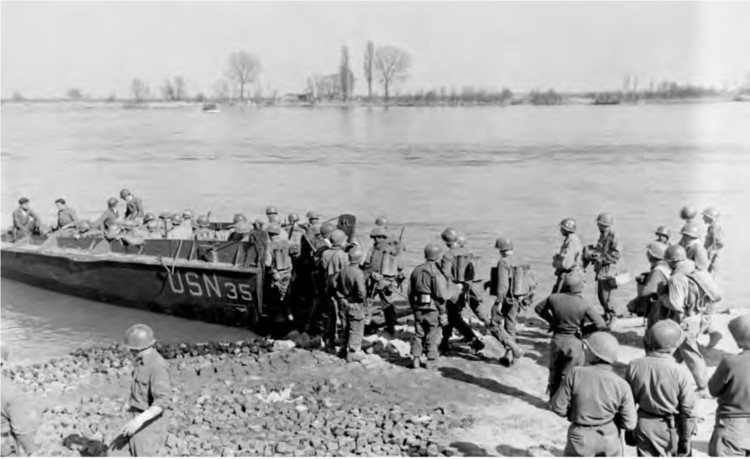
TROOPS LOADING INTO AN LCVP to cross the Rhine (top). Engineers constructing a ponton treadway bridge over the Rhine (bottom). A steel treadway bridge was completed by 1800 on 23 March 1945, and the following day a heavy ponton bridge was completed. By noon on 25 March a second treadway bridge was completed. The crossing of the Rhine in the Third Army area gained complete tactical surprise and the enemy offered only scattered resistance. By the evening of 24 March three divisions held a bridgehead ten miles wide and nine miles deep. These divisions were closely followed by two more, making a total of five on the east bank of the Rhine.
GERMANY
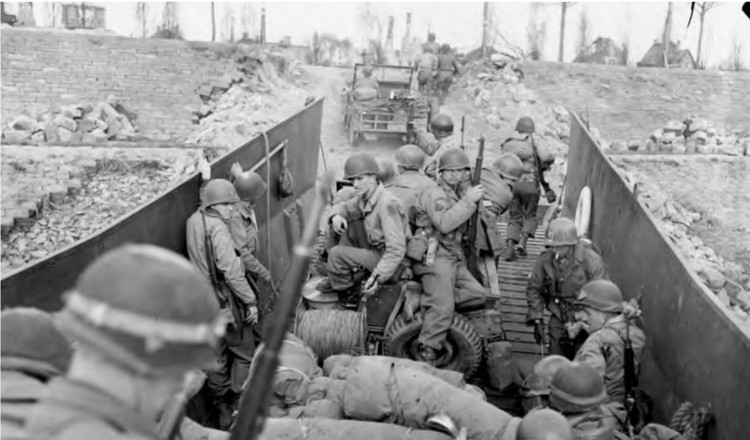
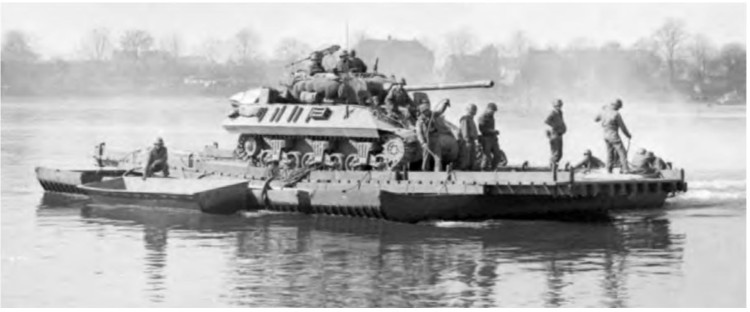
INFANTRYMEN BOARDING AN LCVP to cross the Rhine (top). An assault boat raft ferrying a 90-mm. gun motor carriage M36 across the Rhine (bottom). Troops of the Third U. S. Army first crossed the Rhine at Oppenheim on the night of 22–23 March. Utilizing assault rafts and attacking without artillery or aerial preparation, six battalions were across the river before daybreak with a loss of only twenty-eight men killed and wounded. Following the assault boats were landing craft and DUKW’s. The LCVP’s were manned by naval personnel who arrived at the river an hour after the assault began.
GERMANY
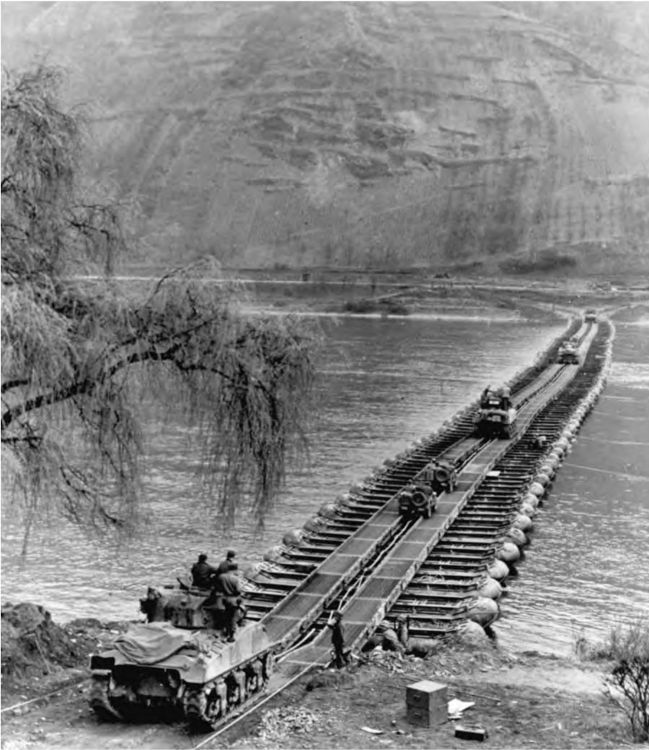
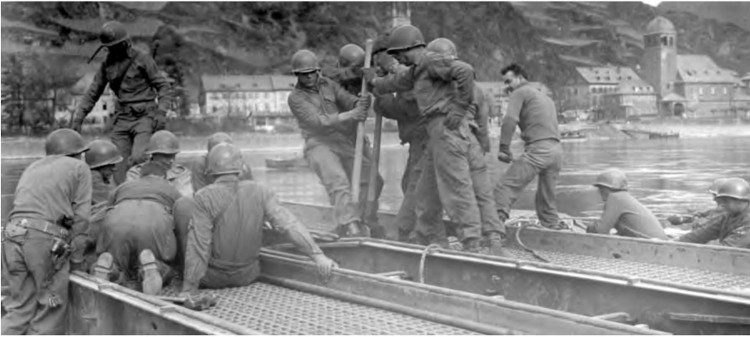
JEEPS AND TANKS CROSSING THE RHINE at Boppard, Germany. On 24 March 1945 a crossing in the rugged Rhine gorge north of Boppard was made and by 25 March a bridgehead eight miles wide and three miles deep was held. A treadway bridge was constructed at Boppard.
GERMANY
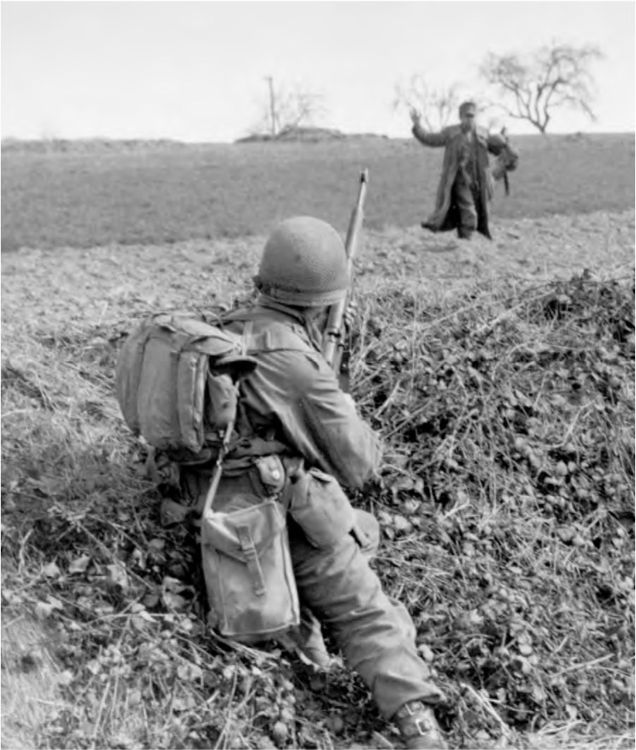
AN INFANTRYMAN COVERS A GERMAN as he surrenders. In the First Army area an attack from the Remagen bridgehead was carried out, and preparations were made to advance to the Kassel area.
GERMANY
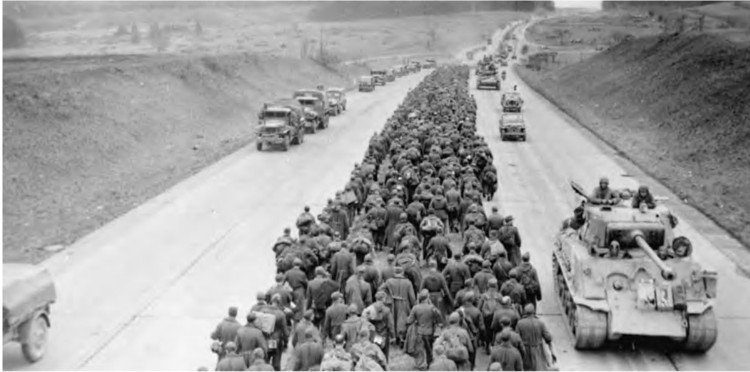
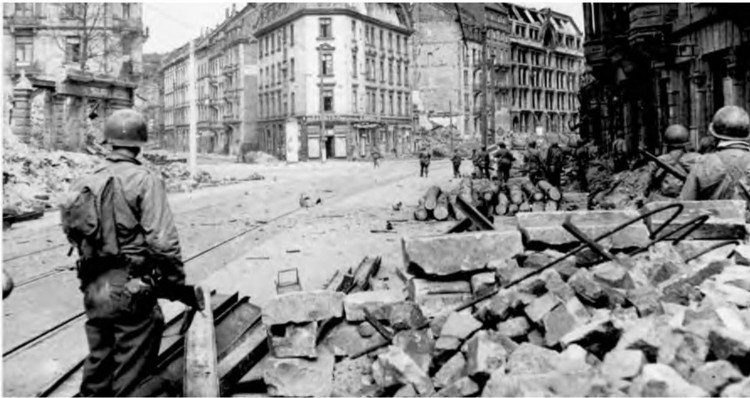
ARMORED TROOPS MOVING TO THE FRONT as prisoners are marched along the autobahn to the rear (top). Infantrymen entering Frankfurt (bottom). The bridgeheads along the Rhine were expanded and on 26 March Third Army troops entered Frankfurt. The advance moved northward toward Kassel. The Fifteenth Army was instructed to take over the west bank of the Rhine from Bonn to Neuss by 1 April, to assume command of the division which was guarding the Brittany ports, and to be prepared to occupy, organize, and govern the Rhine provinces as the 12th Army Group attacks progressed eastward.
GERMANY
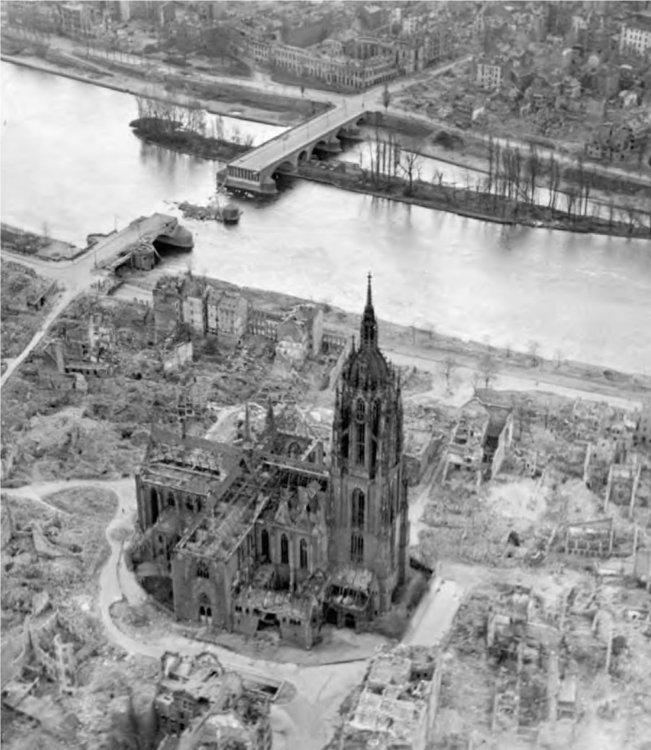
FRANKFURT ON THE MAIN RIVER, showing the Frankfurt cathedral. By 28 March Frankfurt had been half cleared of enemy troops and Hanau completely cleared. Part of a large enemy pocket west of Wiesbaden had been mopped up and contact was made between the First and Third U. S. Army troops.
GERMANY
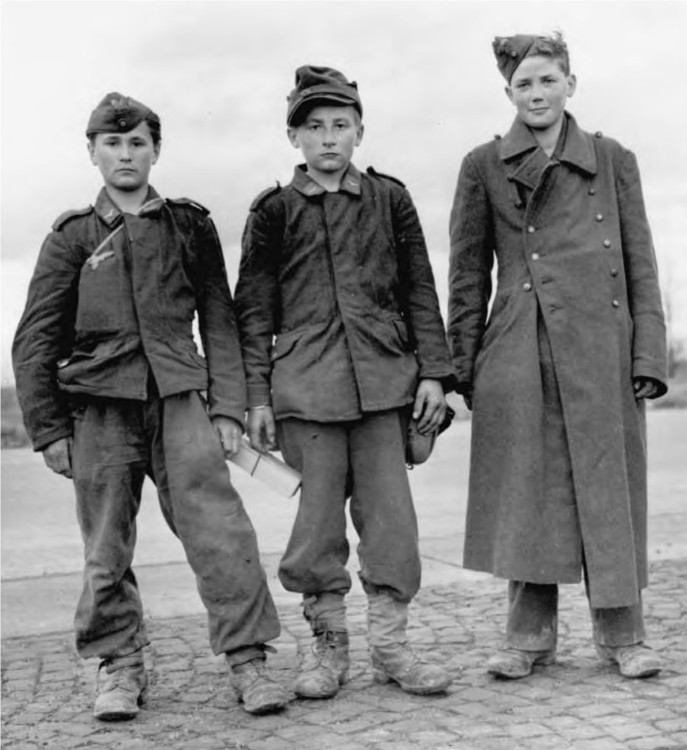
CAPTURED FOURTEEN-YEAR-OLD BOYS who were members of the “Air Guard.” On 28 March First Army troops were closing up along the upper Lahn River. Infantry divisions quickly followed the armored spearheads to mop up enemy pockets of bypassed troops and to clear the areas which had been taken in the rapid advances. In six days the shallow Remagen foothold had been expanded to a lodgement area sixty-five miles deep. The advance to Kassel continued.
GERMANY
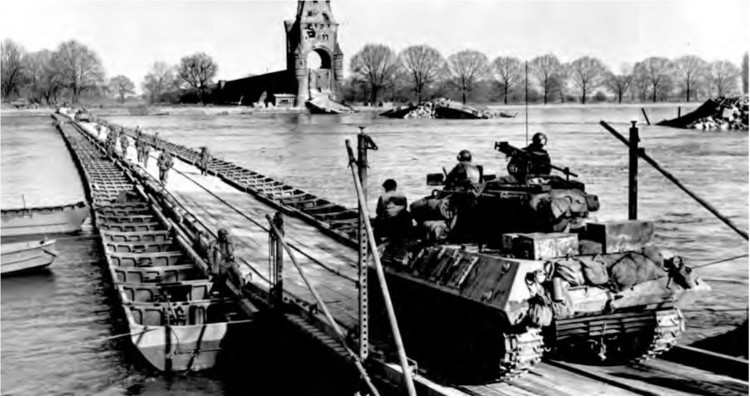
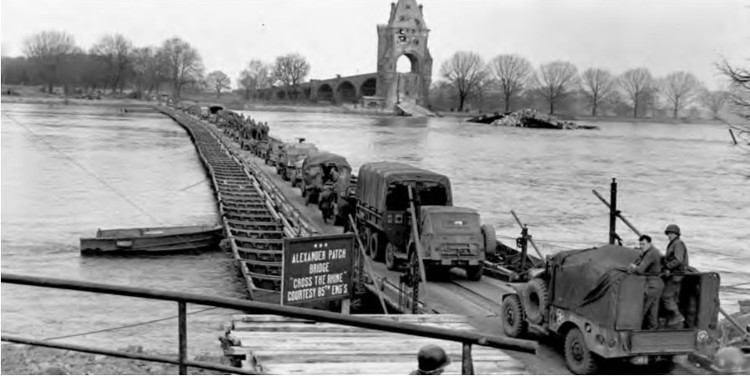
CROSSING THE RHINE NEAR WORMS, GERMANY. U. S. Seventh Army troops crossed the Rhine near Worms at 0230 on 26 March. These forces met small arms and scattered mortar fire while crossing and, after landing on the east bank of the river, met stiff enemy resistance north of Worms. South of Worms the troops reached the far shore with little opposition but as they moved eastward the resistance increased. Two panzer counterattacks were turned back during that morning. By evening of 26 March the bridgehead had been expanded to an area of fifteen miles wide and seven miles deep.
GERMANY
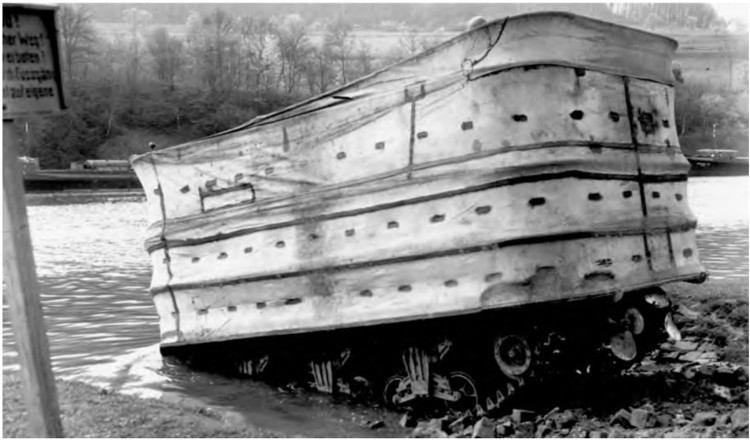
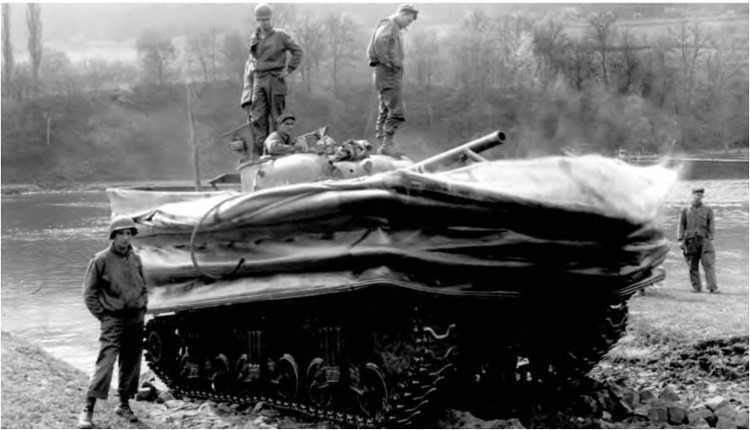
A DUPLEX-DRIVE TANK (DD tank), with its flotation device raised, entering the water (top); flotation device after being lowered (bottom). The canvas flotation device made the tank vulnerable to mines and objects floating in the water.
GERMANY
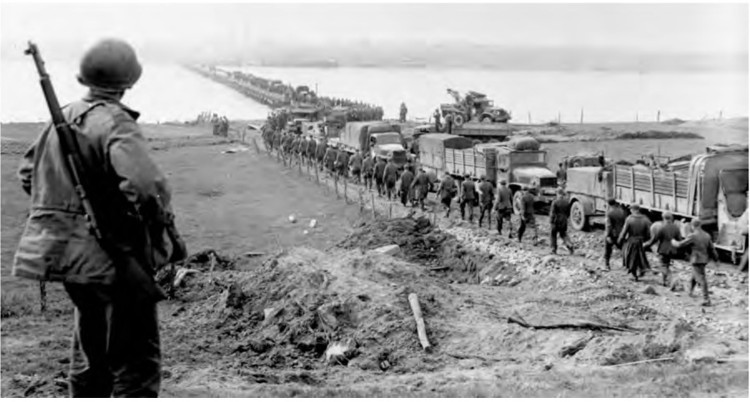
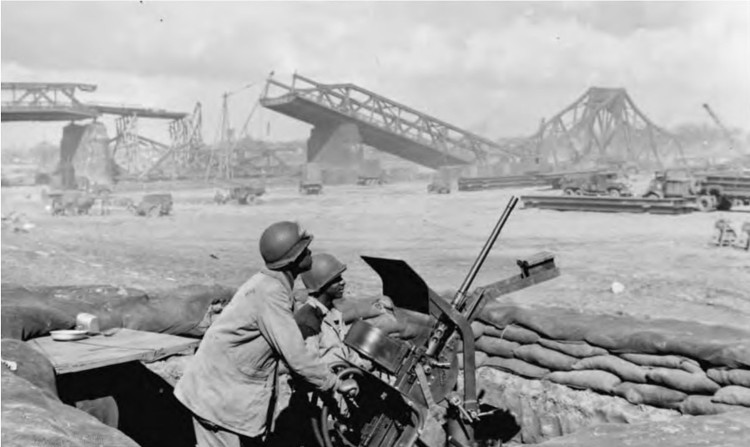
GERMAN PRISONERS being marched westward across the Rhine as troops of the Ninth Army move eastward into Germany (top). Enlisted men at their .50-caliber Browning machine gun HB M2, alert for enemy aircraft (bottom). The Ninth Army was to attack south of Wesel with its main bridging area at Rheinberg.
FRANCE
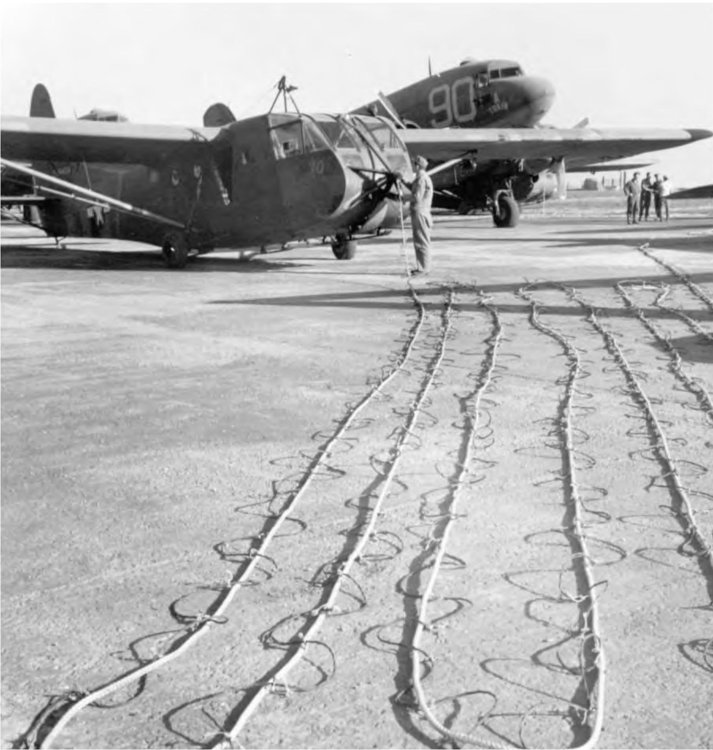
TOW ROPE BEING ATTACHED TO A GLIDER as the First Allied Airborne Army prepares to take off for landings east of the Rhine in the 21 Army Group area. The mission of this army was to break up the enemy defenses north of Wesel and deepen the bridgehead to facilitate the link-up with the ground forces. The airborne troops took off from bases in England and France and converged near Brussels. The troops began landing on 24 March 1945 at 1000 and during the next three hours some 14,000 troops were transported to the battle area by over 1,700 aircraft and 1,300 gliders.
FRANCE
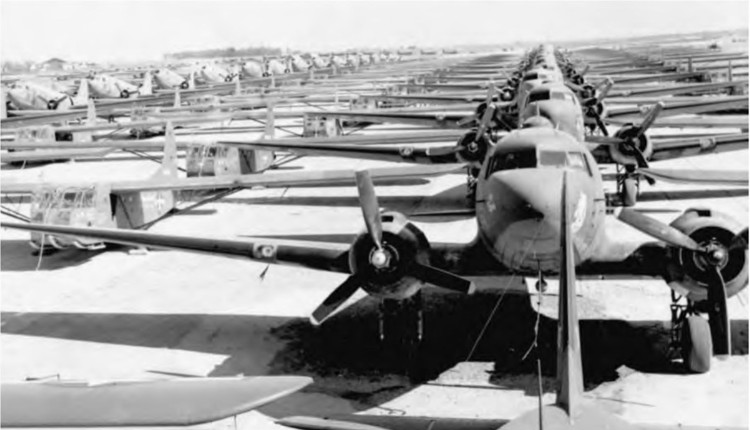
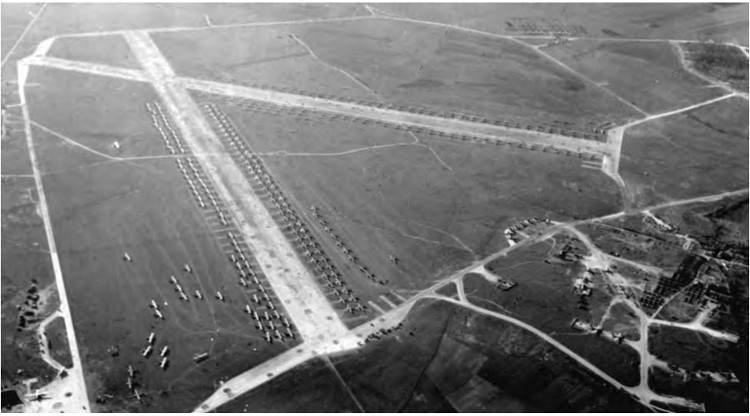
PLANES AND GLIDERS loaded and waiting to take off for the landings east of the Rhine (top). Aerial view of planes and gliders before the take-off (bottom). Losses were comparatively light for an operation of this size. Under 4 percent of the gliders were destroyed and fifty-five aircraft were lost.
GERMANY
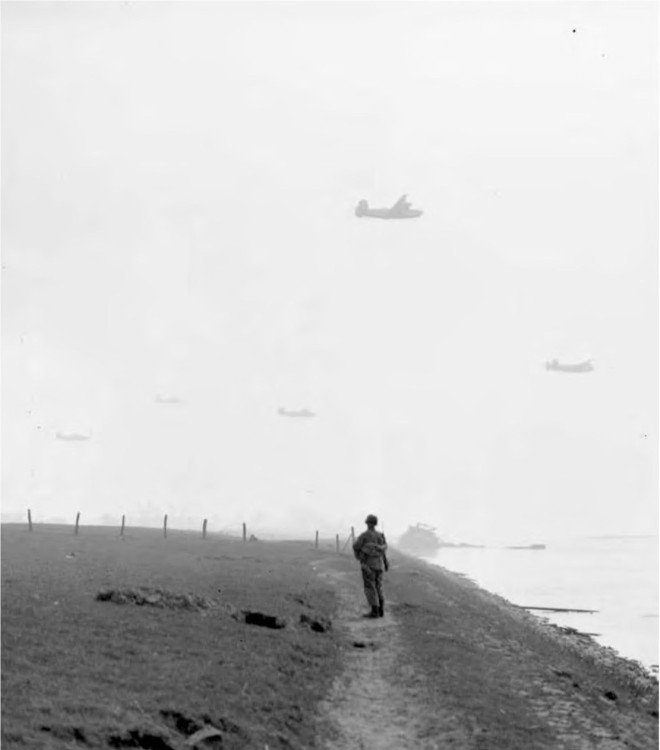
LIBERATORS OVER THE RHINE shortly before they dropped supplies to the airborne troops which landed east of the Rhine. Immediately after the glider landings, a resupply mission was flown in very low by 250 Liberators of the Eighth U. S. Air Force. It met heavy flak and fourteen planes were shot down, but 85 percent of the supplies were accurately dropped.
GERMANY
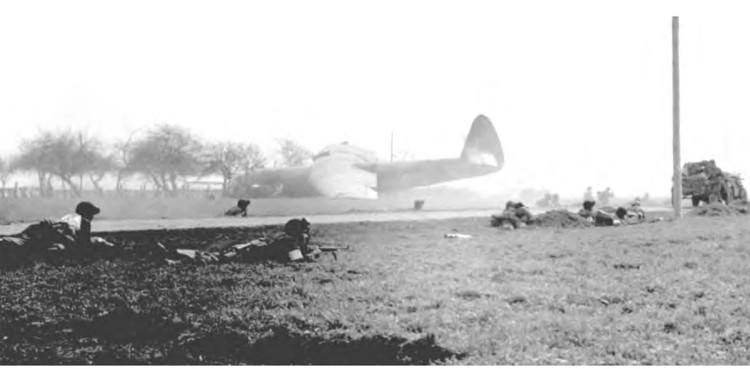
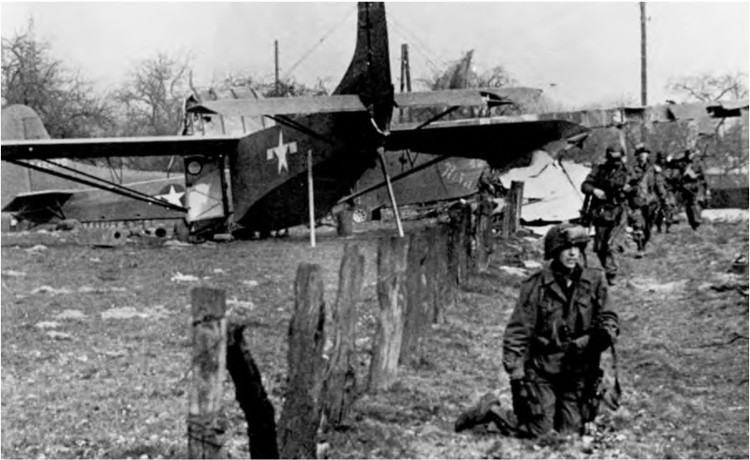
MEMBERS OF FIRST ALLIED AIRBORNE ARMY after landing near Wesel. On the ground the airborne forces met with varying resistance. Bridges over the Issel were seized and 3,500 prisoners were taken. This airborne operation was the most successful carried out to this time. The attack had achieved surprise and the airborne troops reorganized quickly after landing. Ninth Army troops held a bridgehead nine miles wide and three miles deep by the end of the day (24 March).
GERMANY
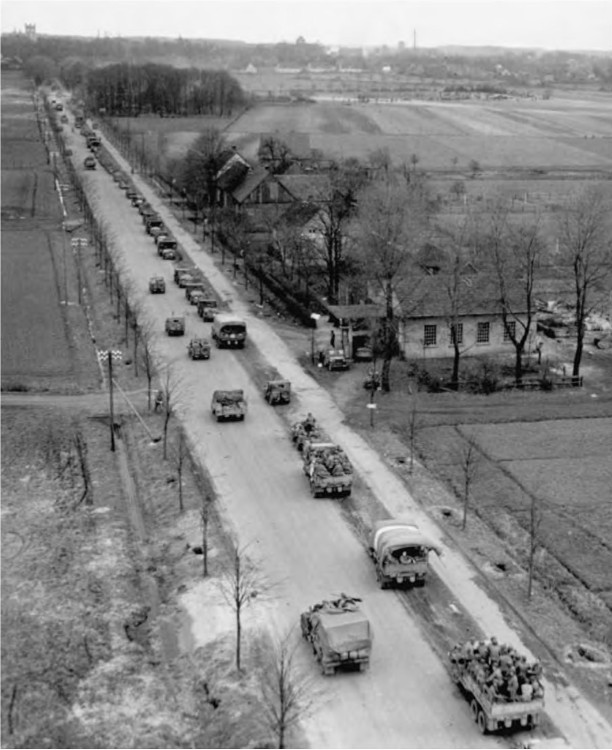
A NINTH ARMY CONVOY on the highway leading to Muenster, Germany.
GERMANY
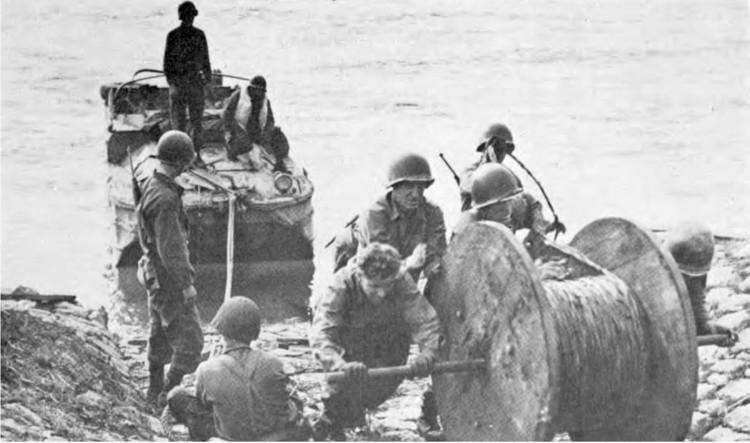
SIGNALMEN ROLL A REEL ASHORE on the east bank of the Rhine after laying a submarine cable on the bottom of the river from a DUKW (top). Destroyed equipment left behind by the retreating enemy (bottom). On 25 March the First Army broke out of their Remagen bridgehead, the Third Army reached the Main River, and contact was made between the British Second Army and the Canadian First Army.
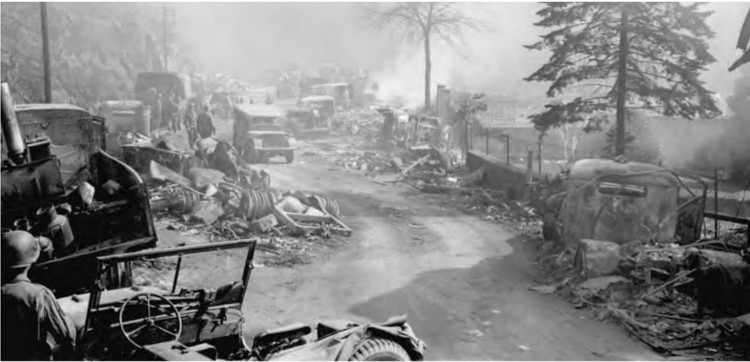
GERMANY
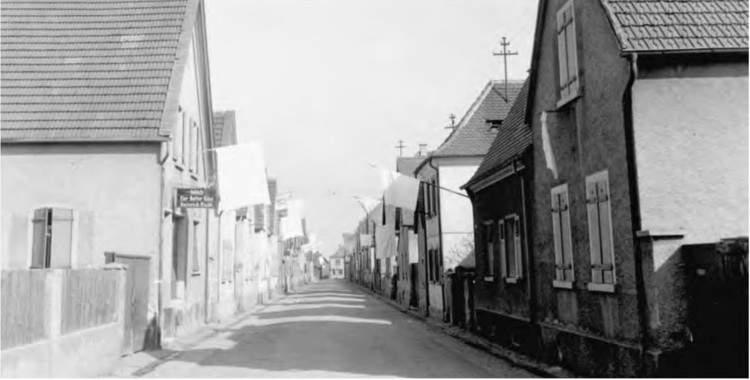
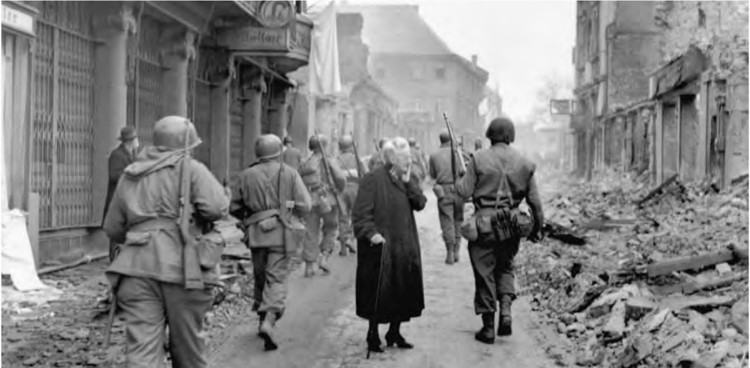
WHITE FLAGS OF SURRENDER hang from buildings in a deserted street of a German town (top). As infantry troops march through a town, an old woman looks at a demolished building (bottom). During the advance into Germany many towns surrendered to the Allied troops and the buildings remained undamaged. However, in some towns enemy troops offered resistance and fighting and shelling ensued. In one week five Allied armies were on the east bank of the Rhine and twenty-four bridges had been constructed to replace those which were knocked out. During this period the Allied casualties were much lighter than had been expected. The last German line of defense had been shattered.
GERMANY
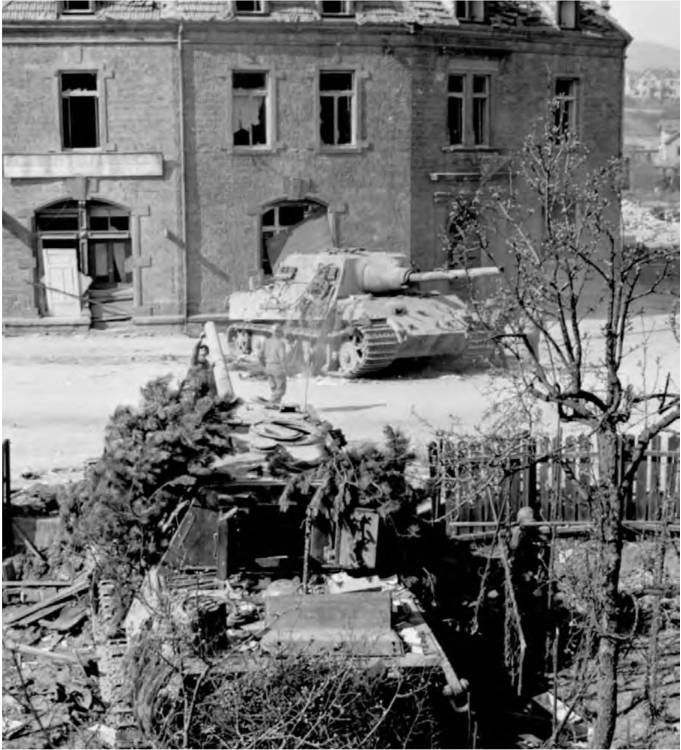
TWO KNOCKED-OUT GERMAN SELF-PROPELLED GUNS (Pz. Jaeg. Tiger with 12.8-cm. PJK 44). This vehicle, called a Jaegdtiger, was the most formidable self-propelled antitank gun used by the Germans during the war. It consisted of a 12.8-cm. PJK 44 (L/55) (less muzzle brake) mounted on a Tiger B chassis. The gun could penetrate 6 to 8 inches of armor at 1,000 yards. Weight of the vehicle was 77 tons.
GERMANY
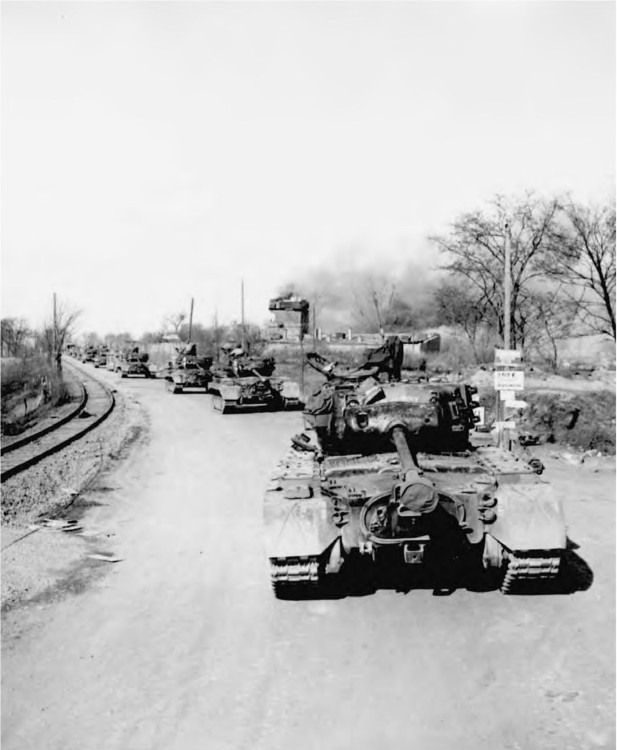
MEDIUM TANKS M26 moving through Wesel on the way to the front.
GERMANY
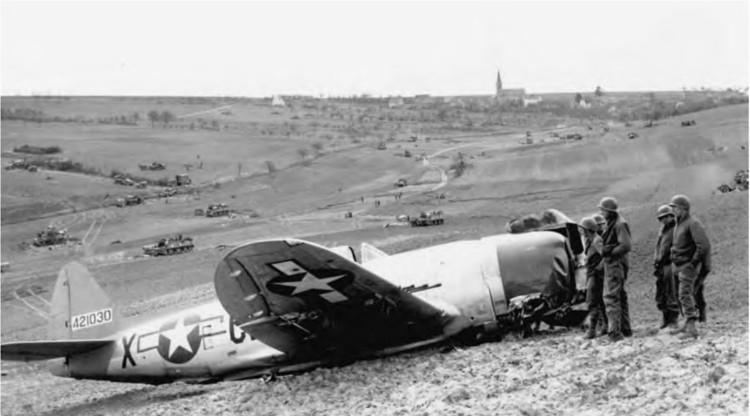
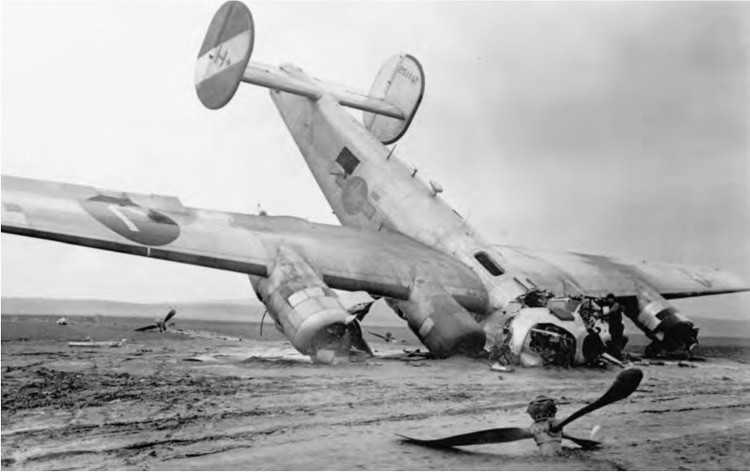
P-47 FORCED DOWN OVER GERMANY (top). B-24 which crash-landed in Germany (bottom).
GERMANY
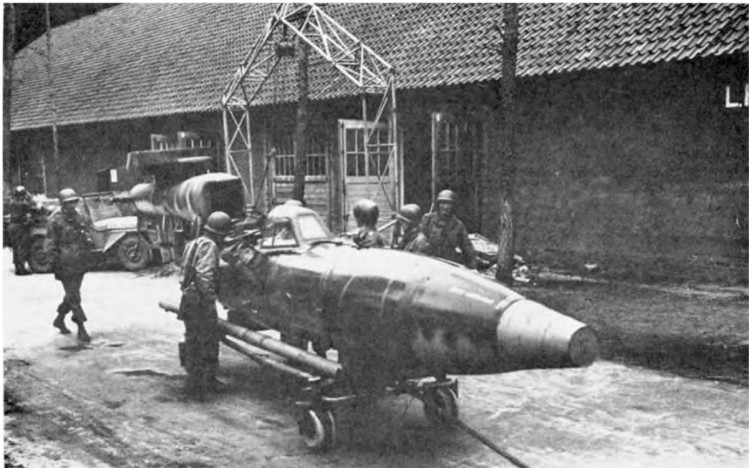
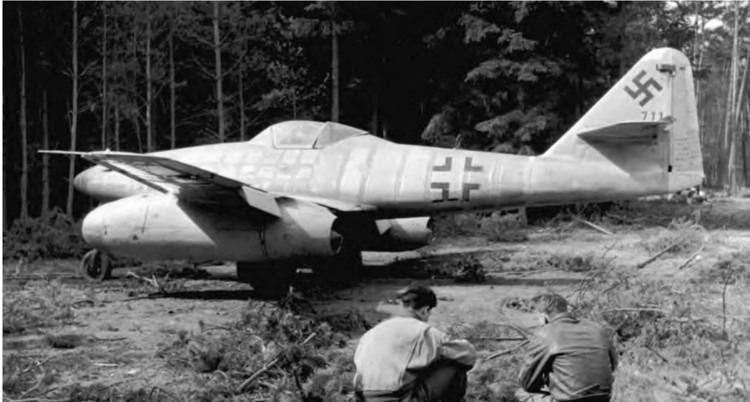
GERMAN V-BOMB found by the U. S. troops as they overran Germany (top). An enemy jetpropelled fighter plane (bottom).
GERMANY
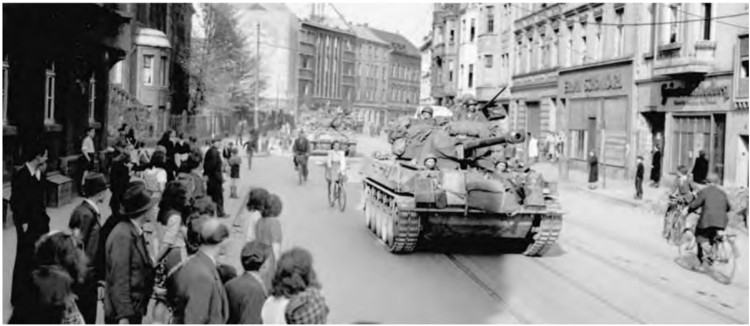
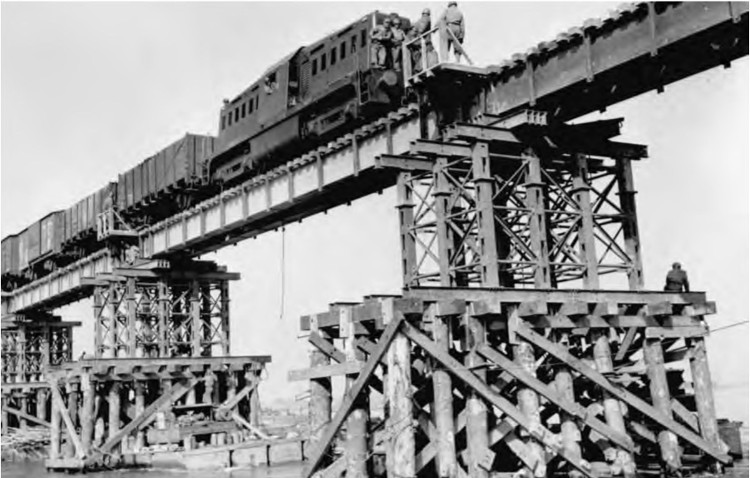
CIVILIANS WATCHING U. S. TROOPS as they advance through Duesseldorf (top). A transportation corps train moving over a bridge which was constructed across the Rhine at Wesel by the engineers (bottom). With all three Allied army groups established on the east bank of the Rhine plans were made to encircle the Ruhr. By 1 April 1945 a trap was closed which formed a 4,000-mile square pocket and included the Ruhr industrial area.
GERMANY
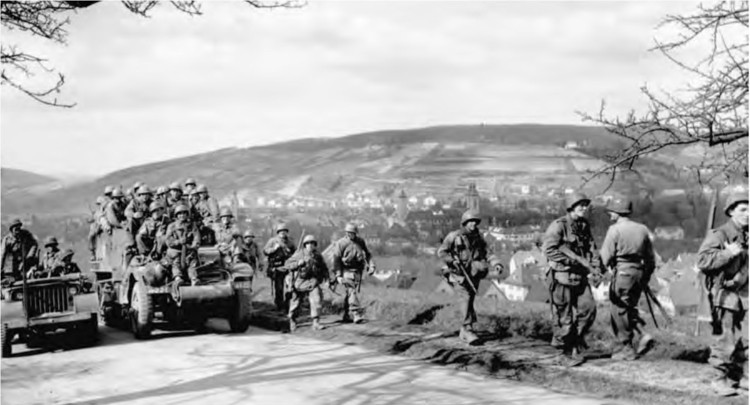
SEVENTH ARMY TROOPS ADVANCING after capturing the town of Mergentheim (top). Engineers operating an assault ferry across the Neckar River in Heilbronn (bottom). On 28 March the Seventh Army launched its attack out of the Worms bridgehead. The assault was halted on 4 April when strong resistance was encountered at Heilbronn. On 31 March the French First Army crossed the Rhine at Speyer and Germersheim and on 4 April captured Karlsruhe.
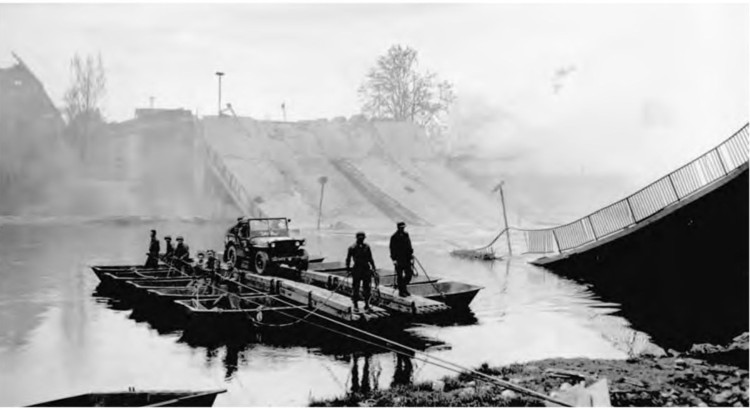
GERMANY
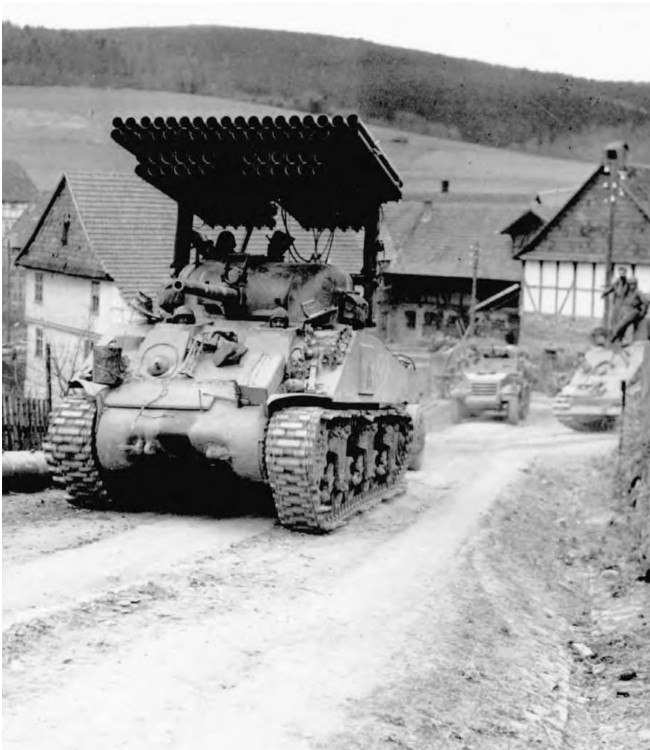
4.5-INCH MULTIPLE ROCKET LAUNCHER T34 mounted on a medium tank. The Germans stubbornly defended the industrial area of the Ruhr even though an army group was caught in the trap with little hope of escape. On the Allied flanks, advances were made as the enemy began to disintegrate.
GERMANY
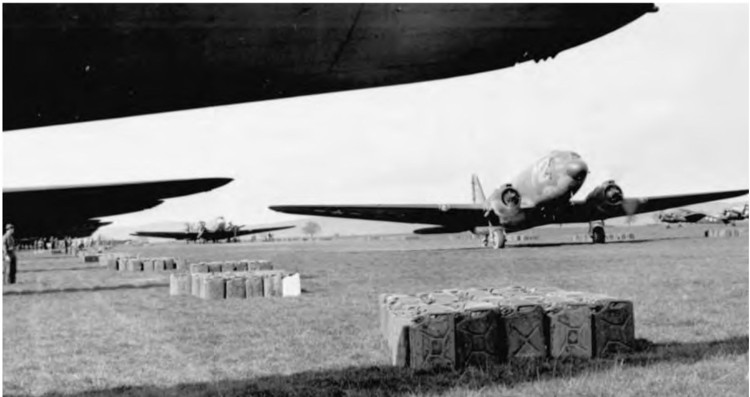
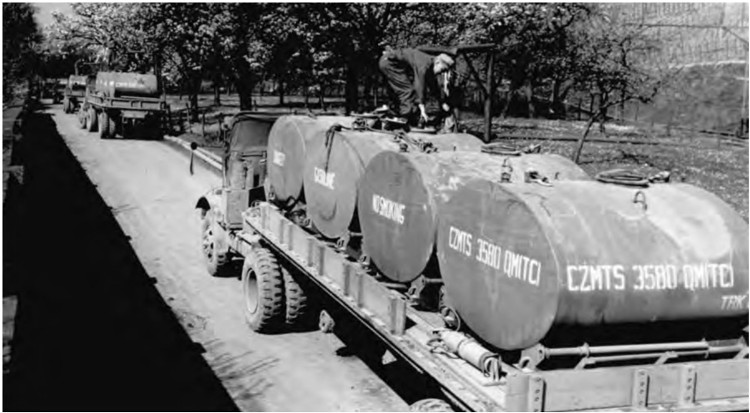
C-47 TRANSPORT, carrying gasoline, lands on an airstrip in Germany (top). Ten-ton semitrailers in Germany with four 750-gallon skid tanks loaded with gasoline (bottom). The versatility of these tanks made it possible to use them on a number of different types of vehicles. During the last months of the war the rapid advances of all the Allied troops made fuel supply a difficult problem. Fuel was transported by every available means to assure the troops an adequate supply.
GERMANY
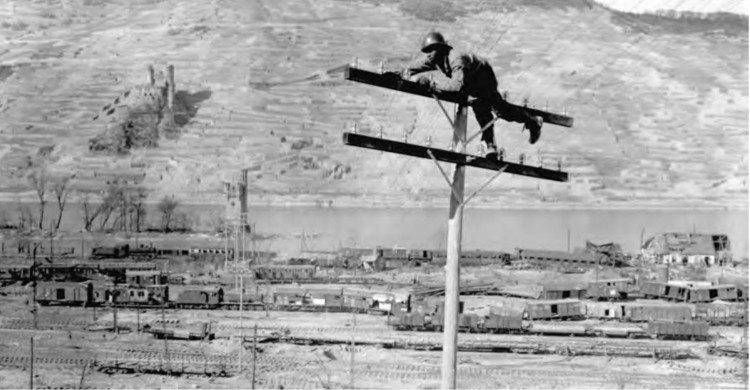
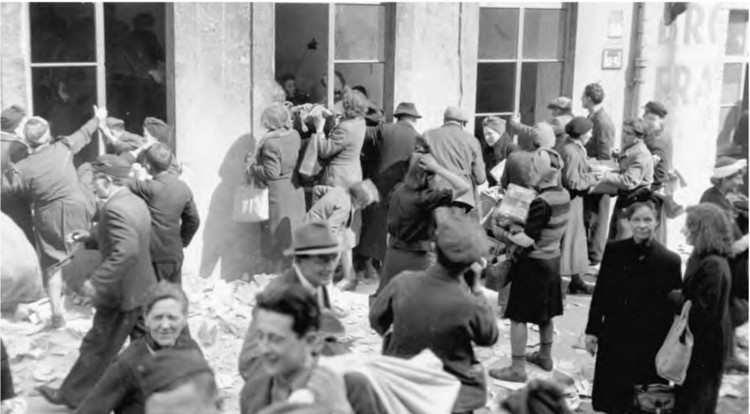
LINEMAN of a Signal Corps construction battalion fastening wire to an insulator on the top of a telephone pole at Bingen on the Rhine (top). Liberated slave laborers help themselves to food and supplies in a store in Hannover (bottom). With the liberation of the slave laborers who had worked in German factories many problems arose, and Allied Military Government offices were established as quickly as possible to cope with them.
GERMANY
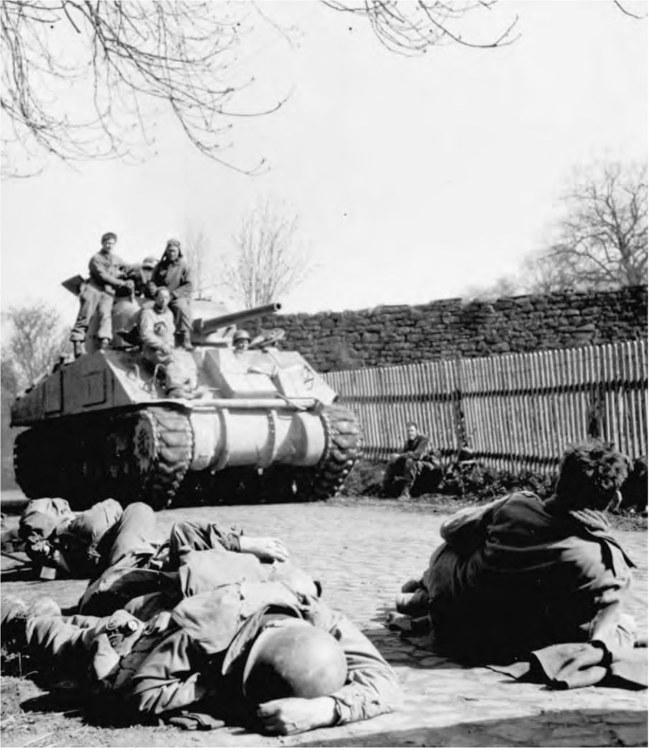
INFANTRYMEN AND TANKERS take time out for a short rest during their rapid advance. On 4 April the Ninth Army was to start an attack southward and the First U. S. Army was to drive to the north. While these two armies were eliminating the Ruhr pocket, the Fifteenth Army was to hold the line on the Rhine.
GERMANY
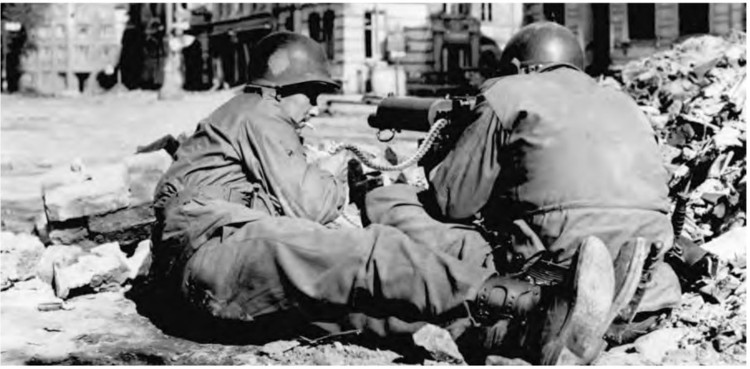
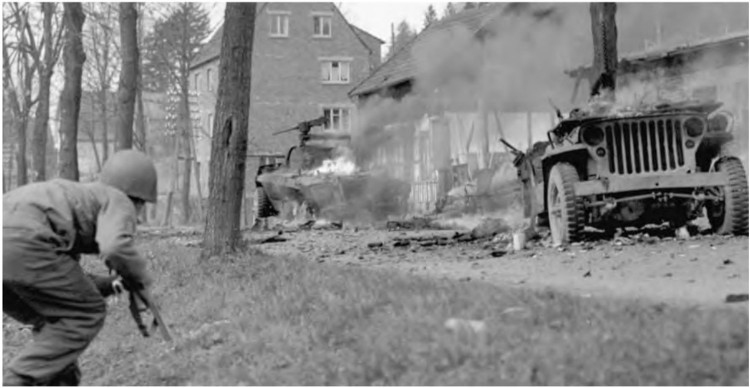
MACHINE GUNNERS of a First Army division covering a road intersection (top). Infantryman passes burning U. S. vehicles that were ambushed by enemy troops (bottom). During the first fighting in the Ruhr the enemy showed spirit. On 4 April ten counterattacks were launched in an attempt to break out of the pocket. Heavy fighting continued in many towns with the civilians fighting alongside German soldiers. Dug-in self-propelled guns supported the German infantry. The line was drawn tighter by the Allies and on 10 April Essen, home of the great Krupp armament works, was cleared by the U. S. assaulting troops. By 13 April the mopping-up stage had been reached.
GERMANY
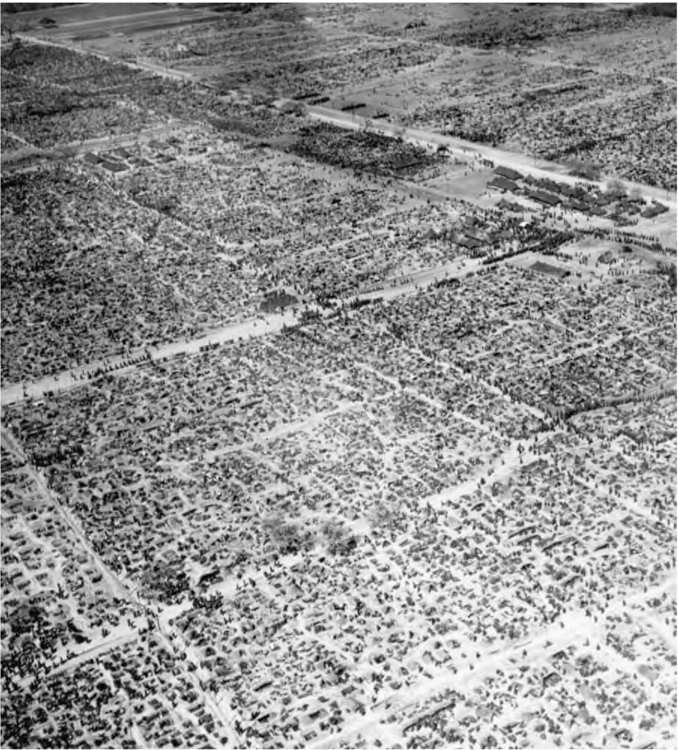
PRISONER OF WAR ENCLOSURE. On 14 April the Ruhr pocket was split in two, and prisoners arrived in such large numbers that Allied facilities were taxed to the limit. On 16 April the eastern half of the pocket collapsed and two days later the pocket ceased to exist. There were 325,000 prisoners, including 30 generals, counted as they were taken. This represented twenty-one divisions as well as many nondivisional units.
GERMANY
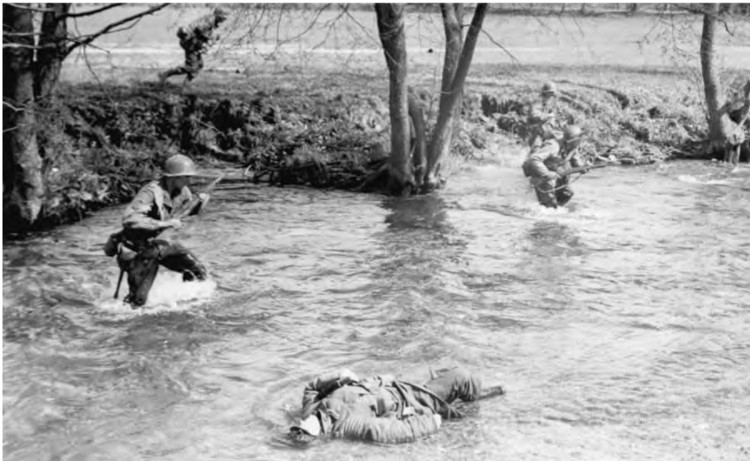
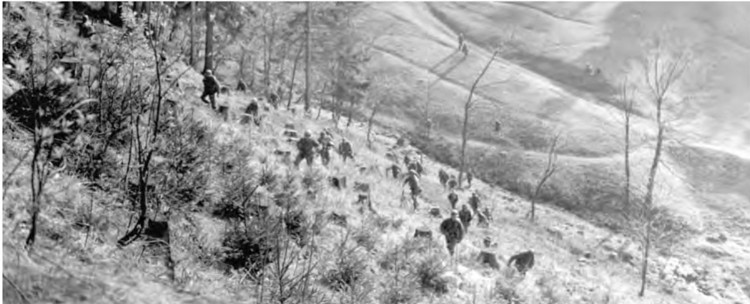
INFANTRYMEN PASS A DEAD GERMAN as they cross a stream (top). Third Army troops climbing a steep hill in the mountainous region (bottom). On 10 April the Ninth, First, and Third Armies resumed the attack to the east with twenty-two divisions. Only in the Harz Mountains was any serious organized resistance encountered. The Germans had hurriedly assembled about 10,000 men to form an army which was initially to break through into the Ruhr pocket. When that failed it was to break through to the Thuringian pocket. This also failed and the small army which represented the last of the German manpower was encircled by the U. S. forces.
GERMANY
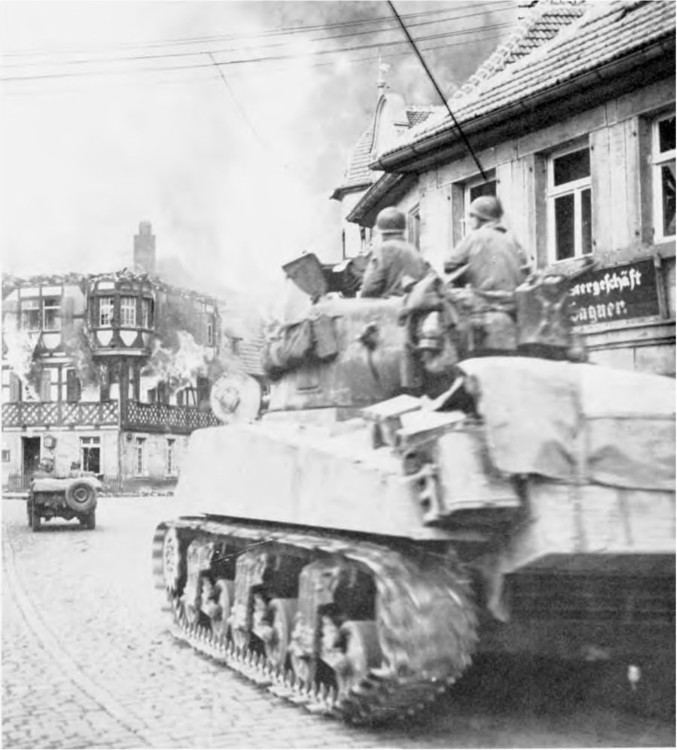
VEHICLES OF AN ARMORED DIVISION passing through a burning German town. On 18 April the three armies were along the Elbe River-Mulde River-Chemnitz-Plauen-Bayreuth line which was a restraining line established because of the probability of contact with the Russian troops advancing from the east. In the north the 21 Army Group was advancing on Bremen and the Elbe between Wittenberge and Hamburg.
GERMANY
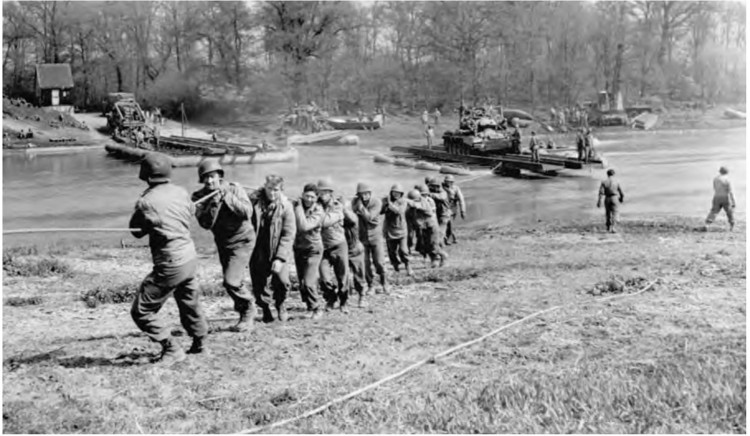
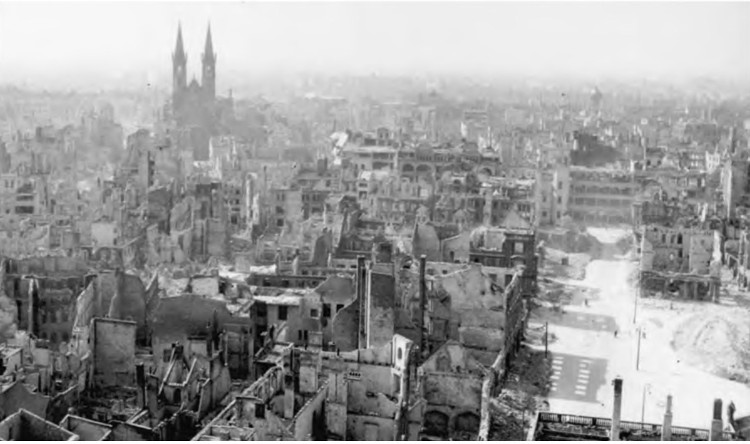
ENGINEERS, building a bridge across the Saale River, pull a tank across on one of the ponton sections (top). Magdeburg, showing the results of bombing (bottom).
GERMANY
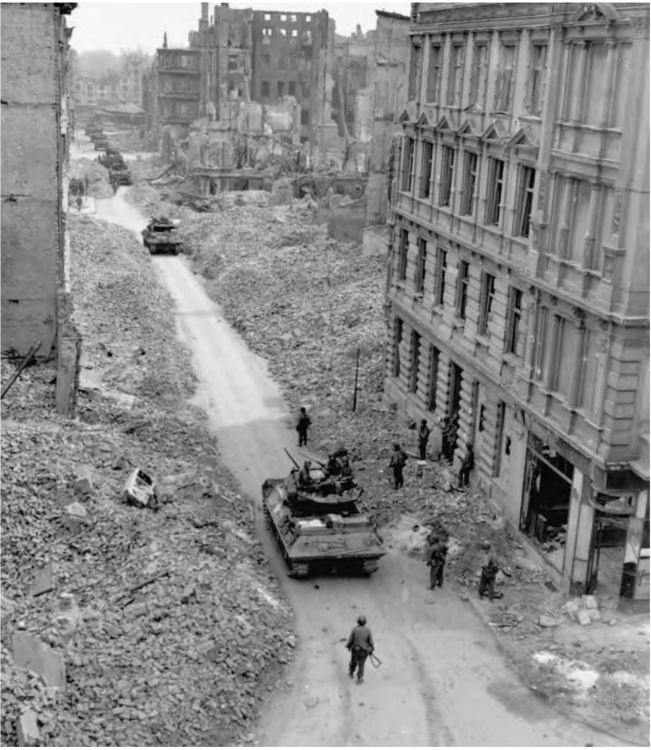
TANK DESTROYERS moving through the destroyed town of Magdeburg. Scenes such as this were found in many German cities by the advancing Allied forces. Most of the buildings were reduced to rubble by aerial attacks and artillery shelling, and many streets had to be cleared before the troops and vehicles could pass.
GERMANY
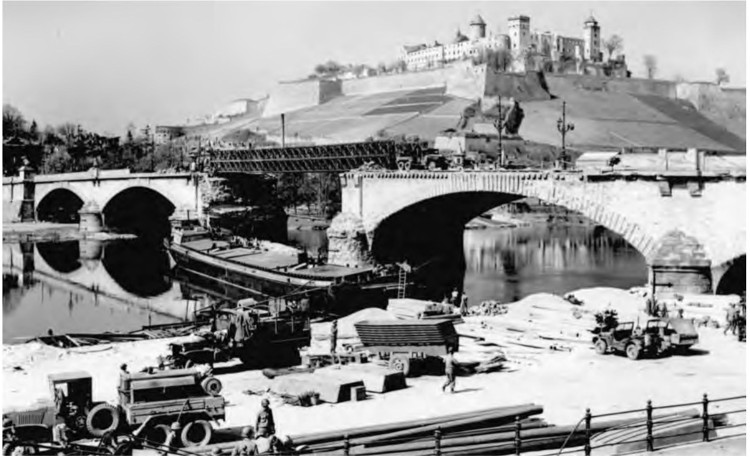
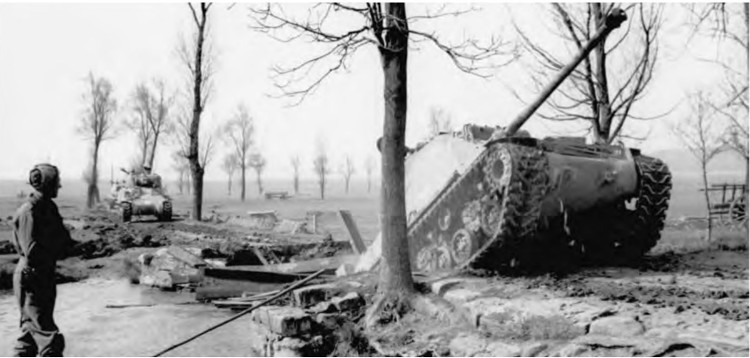
TRAFFIC MOVING ACROSS THE MAIN RIVER at Wuerzburg (top). A medium tank climbing the bank of a small stream after breaking through the light wooden bridge (bottom). There was little activity in the 6th Army Group between 4 and 18 April except on the northern portion of the army area where the Third Army right flank was covered. On 5 April Wuerzburg was cleared after three days of heavy fighting.
GERMANY
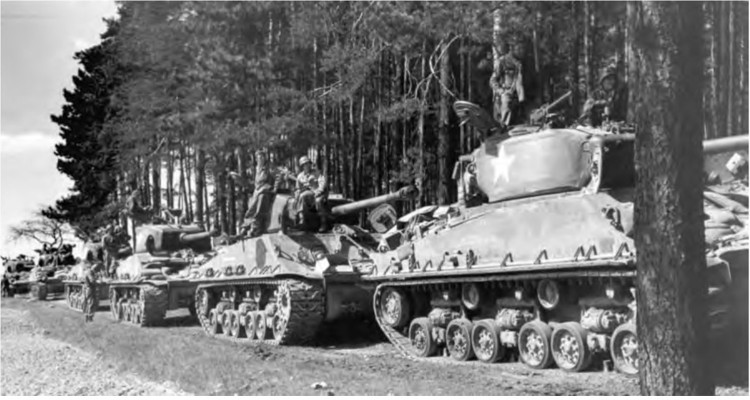
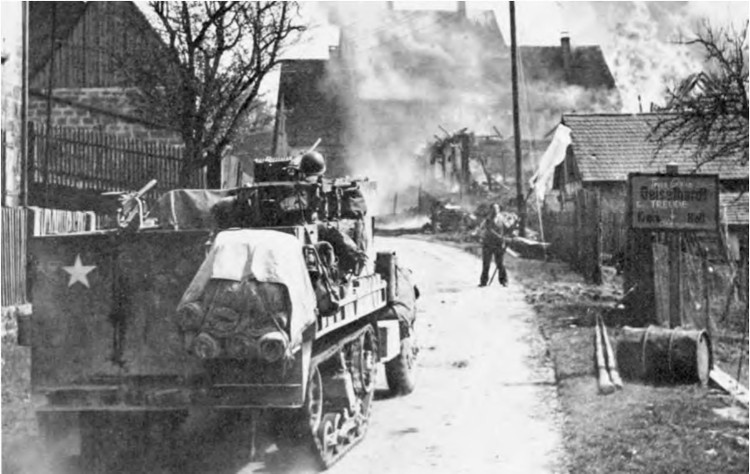
AN ARMORED COMBAT COMMAND moving toward Nuernberg (top). A German civilian, waving a white flag in surrender, comes toward a half-track which is about to enter Geisselhardt after shelling buildings in that town (bottom).
GERMANY
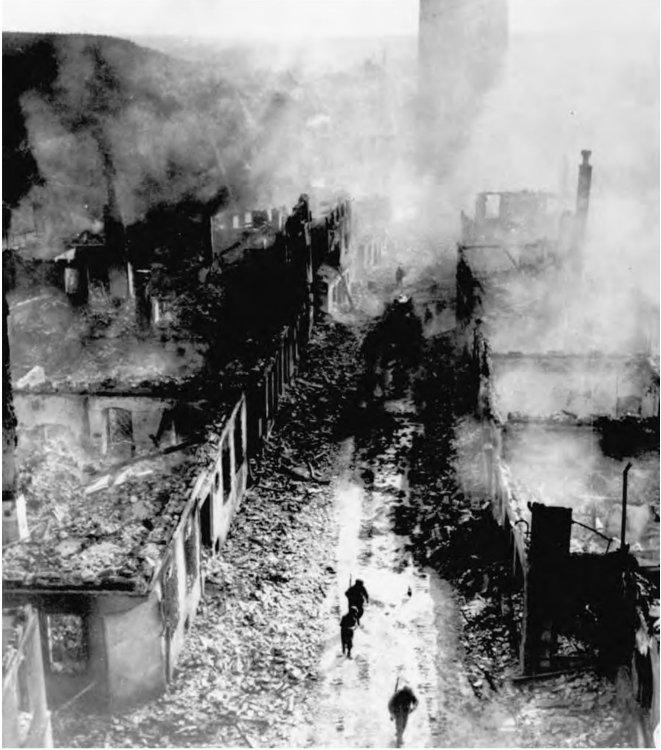
INFANTRYMEN MOVING DOWN A STREET in Waldenburg during the Seventh Army advance. The French First Army cleared Baden-Baden and Pforzheim and by 15 April Kehl was cleared and preparations for crossing the Rhine at Strasbourg were made.
GERMANY
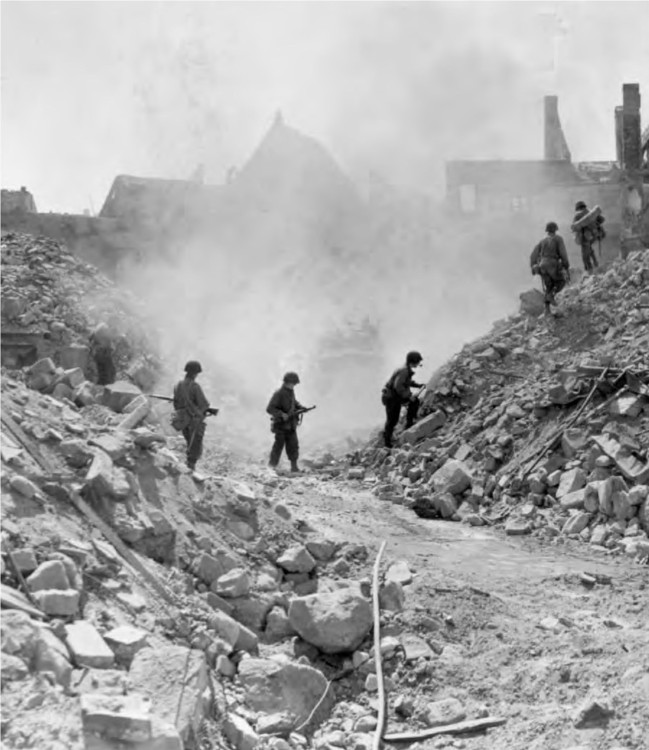
INFANTRYMEN CLIMBING OVER RUBBLE as they clear snipers out of Nuernberg. By 18 April part of the Seventh Army was in the battle for Nuernberg. Other troops of that army were halted for nine days around Heilbronn and along the Neckar and Jagst Rivers.
GERMANY
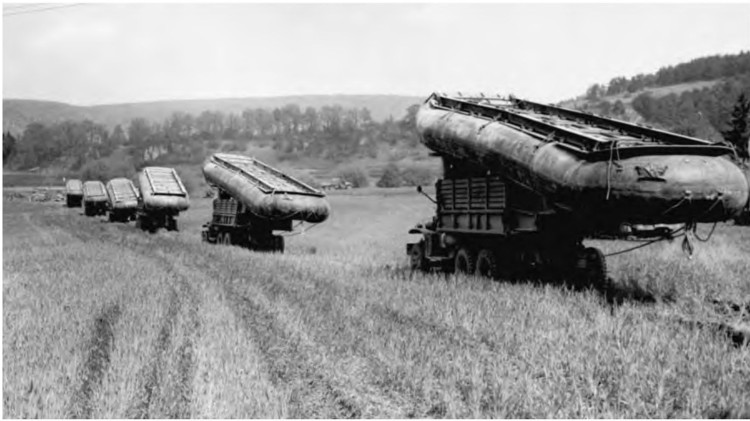
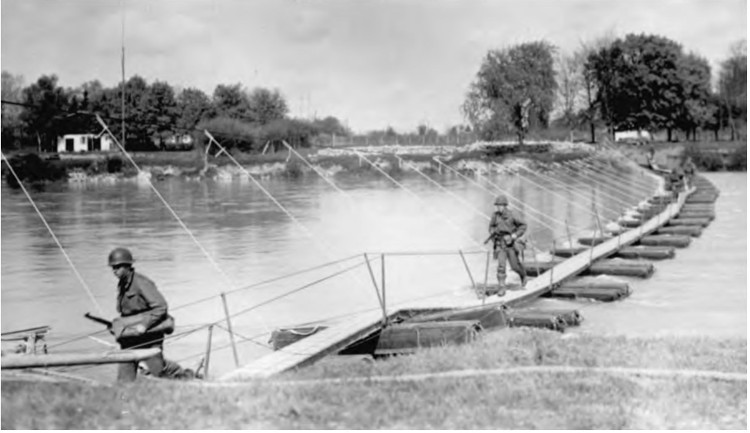
ENGINEERS MOVING PONTONS TO THE DANUBE to start bridging operations (top). Infantrymen crossing the Danube over a footbridge (bottom). The Third Army advanced down the Danube while the First and Ninth Armies held in place, having reached the line where the meeting with the Russians was to take place.
GERMANY
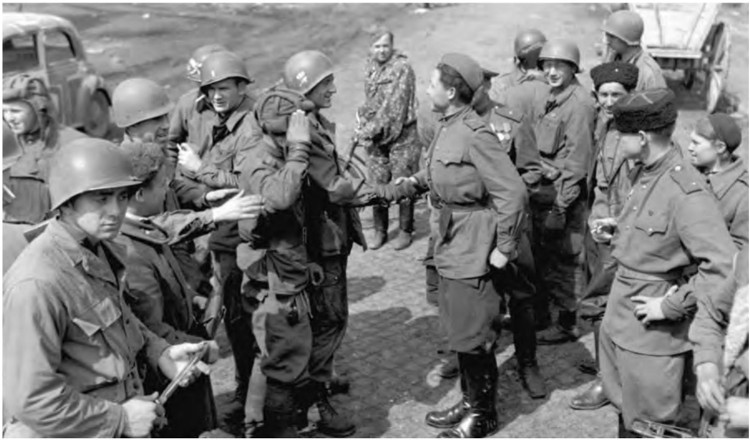
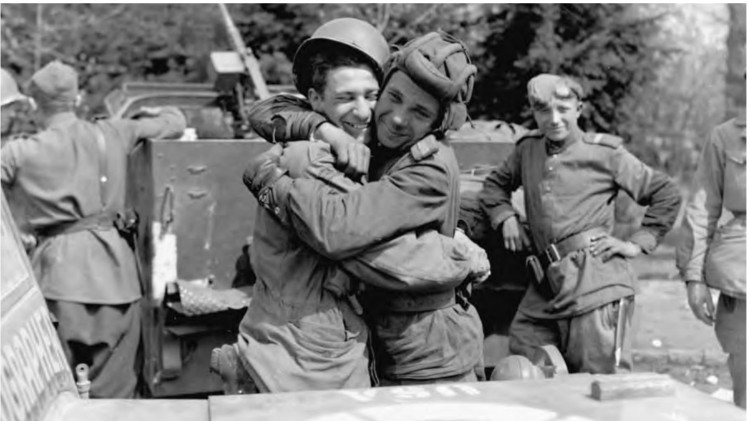
U. S. OFFICERS AND ENLISTED MEN MEET RUSSIAN TROOPS in Germany. On 30 April a division of the Ninth U. S. Army made contact with the Russians at Apollensdorf. Troops of the First U. S. Army had met Russian troops earlier.
GERMANY
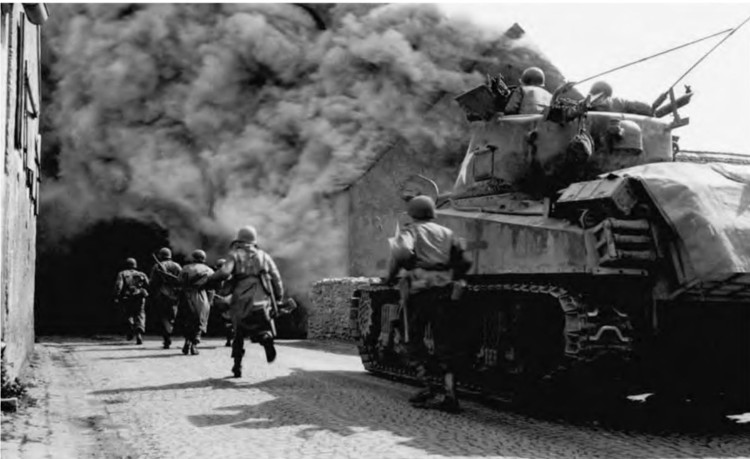
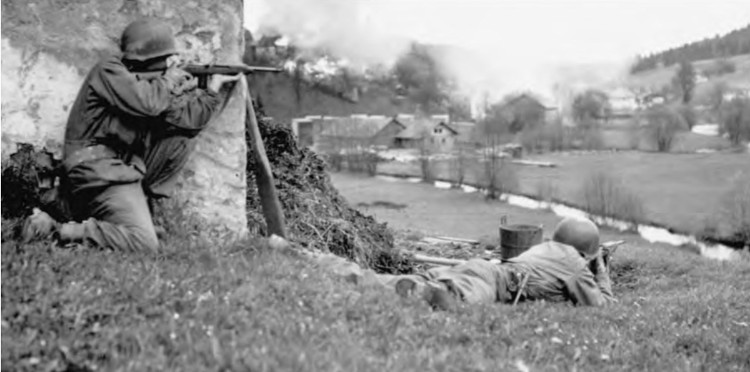
MEN OF AN ARMORED DIVISION running through the smoke-filled streets of a German town (top). Firing on an Austrian town across the German border (bottom). Most of Czechoslovakia and a large portion of Austria was left for the Russians to occupy, but the advancing troops of the Third U. S. Army entered both these countries during the last days of the war.
GERMANY
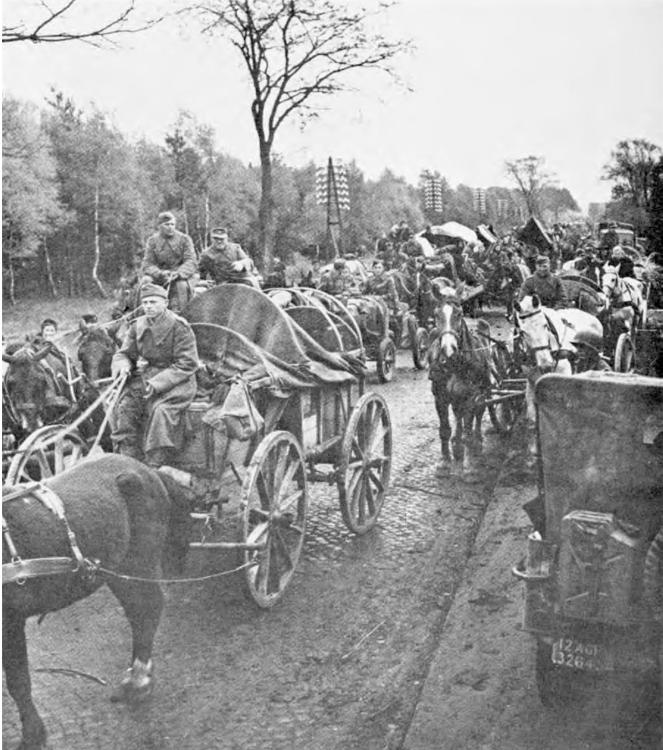
GERMAN SOLDIERS. The First and Ninth Armies, during the latter part of April and early May 1945, handled thousands of German soldiers and civilians who were trying to escape the advancing Russians by crossing the Elbe River into the American zone.
GERMANY
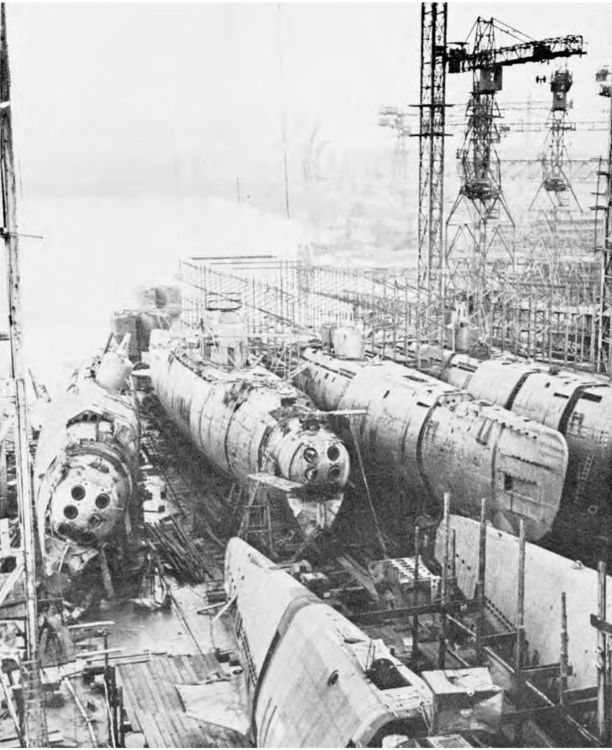
CAPTURED U-BOATS in a submarine construction and repair yard in Bremen harbor. Over forty submarines were found by the Allies in this yard.
FRANCE
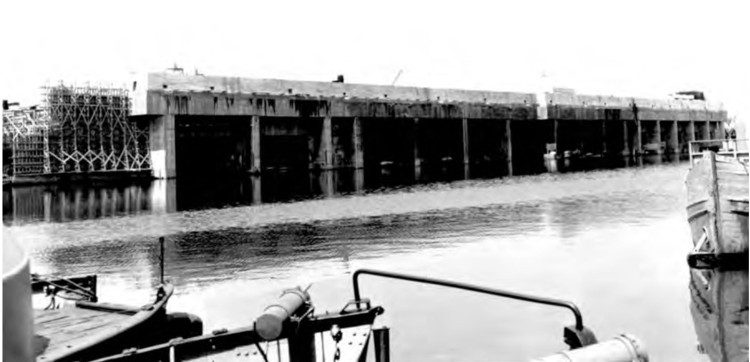
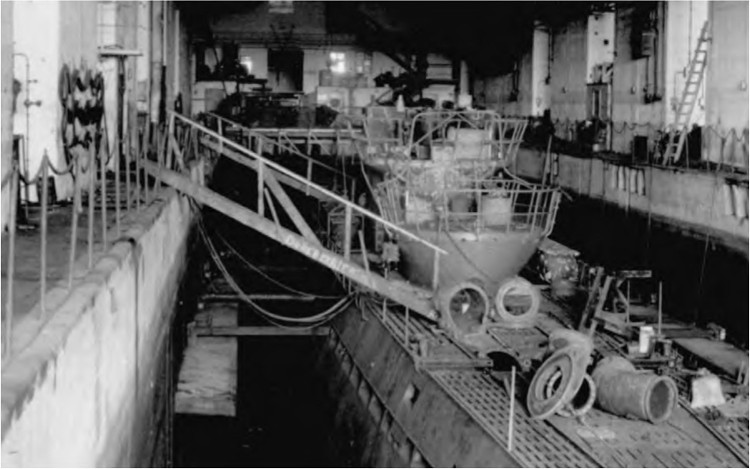
SUBMARINE PENS AT SAINT-NAZAIRE, on the Brittany peninsula. No attempt was made to capture these U-boat pens as the Allies advanced through France and Germany, but they were surrounded and contained until the end of the war.
AUSTRIA
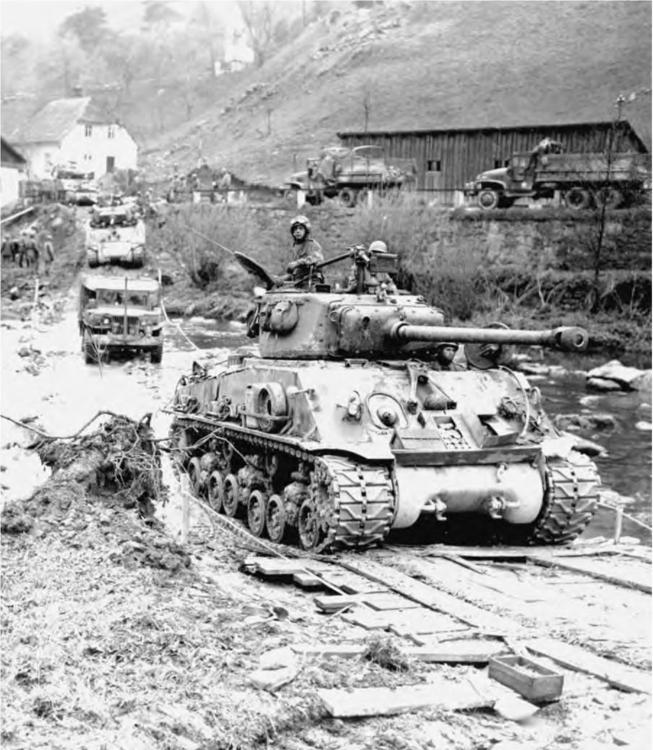
TANKS AND TRUCKS of a Third Army armored division fording a stream during their advance into Austria. In the foreground is a medium tank M 4A 3 (76-mm. long-barrel gun with muzzle brake) with horizontal volute spring suspension and an improved, wider track measuring twenty-three inches.
AUSTRIA
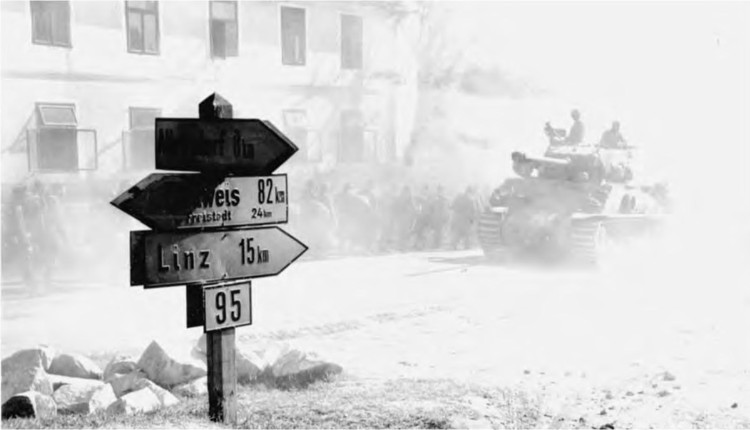
MOVING INTO AUSTRIA.
GERMANY
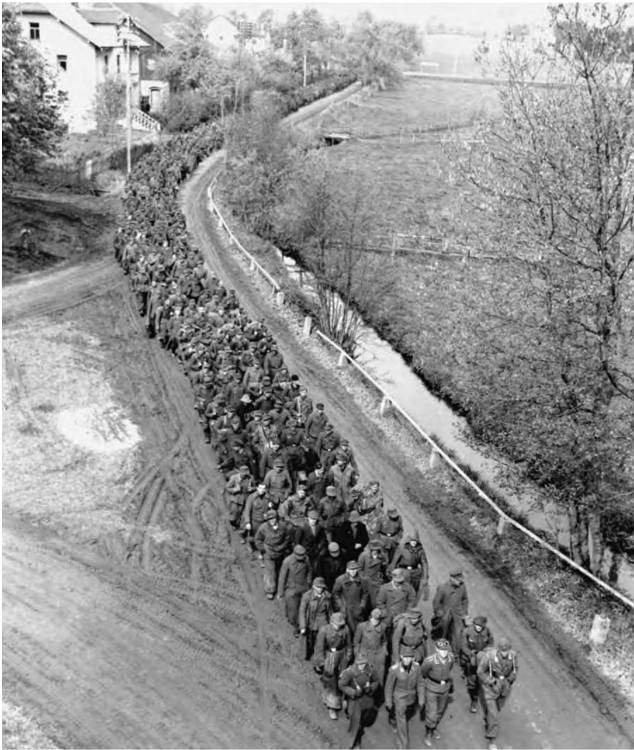
GERMAN PRISONERS being marched to the prisoner of war enclosure by Third Army military police. During the period from 22 April to 7 May the Third Army took more than 200,000 prisoners while suffering less than 2,400 casualties.
AUSTRIA
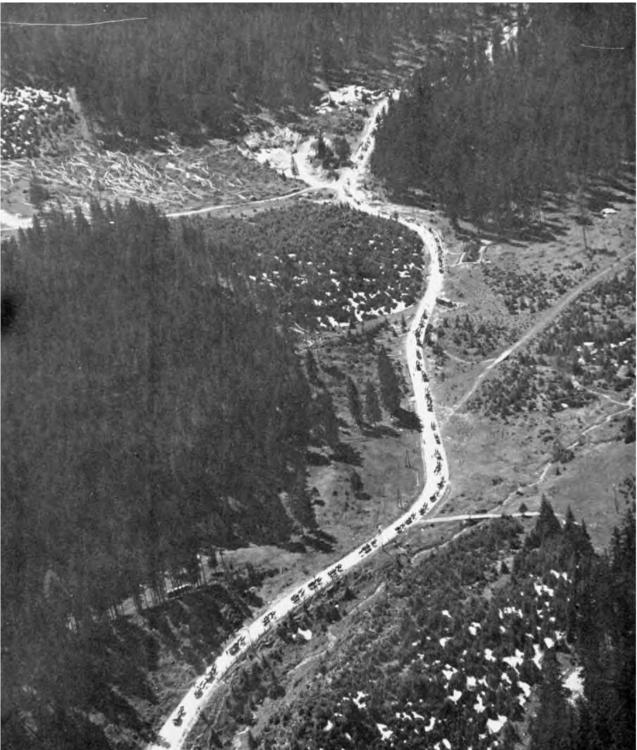
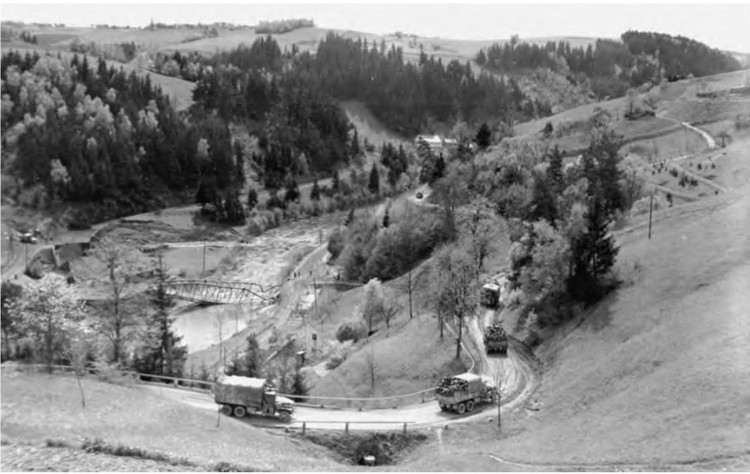
A GERMAN HORSE-DRAWN CONVOY moves along a winding mountain road in Austria to surrender. From 1 April 1945 until the end of the war the three armies of the U. S. 12th Army Group took over 1,800,000 prisoners.
GERMANY
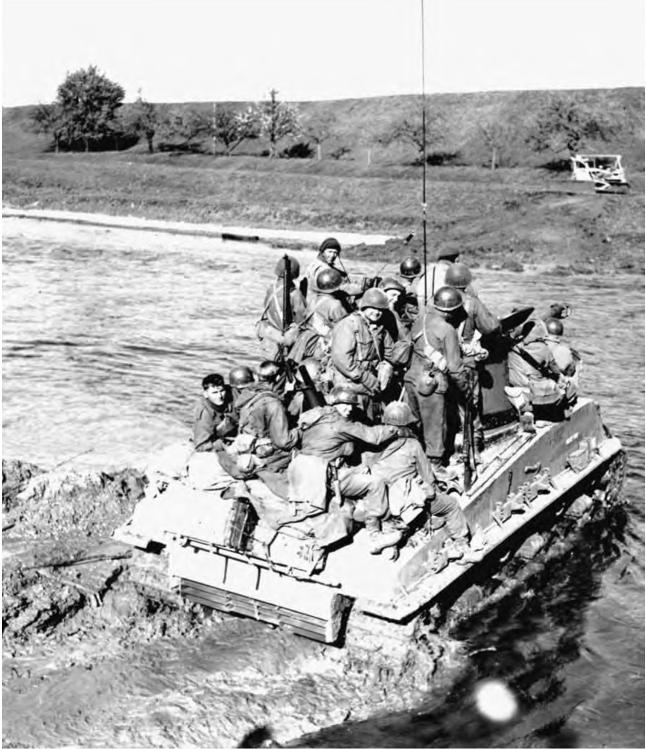
SOLDIERS CROSSING THE DANUBE (Seventh Army). The two armies of 6th Army Group launched a drive into southern Germany, the area where the remaining German forces supposedly were to make a determined stand.
GERMANY
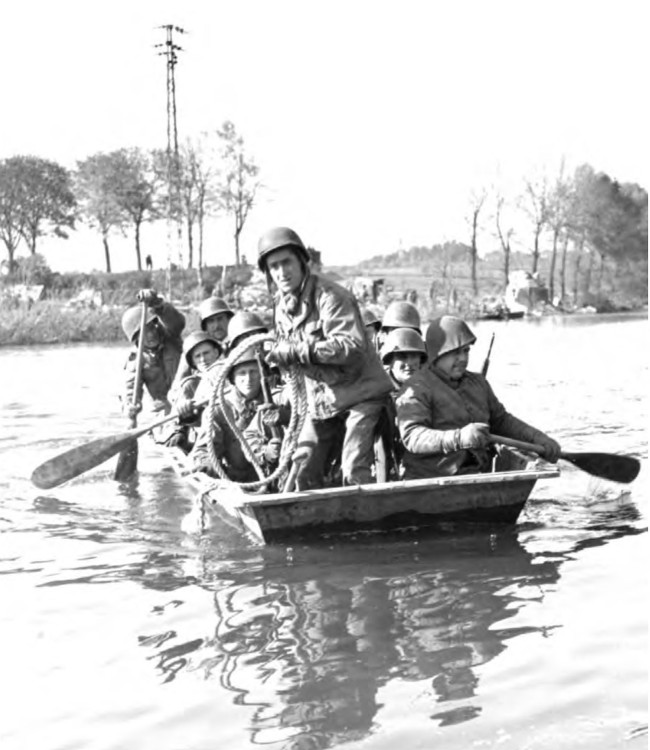
AN ASSAULT BOAT crossing the Danube. Seventh Army men met no opposition here. In the Black Forest and the Schwaebische Alps troops of the Seventh Army met some opposition and there was some fighting as two German armies were trapped and destroyed.
GERMANY
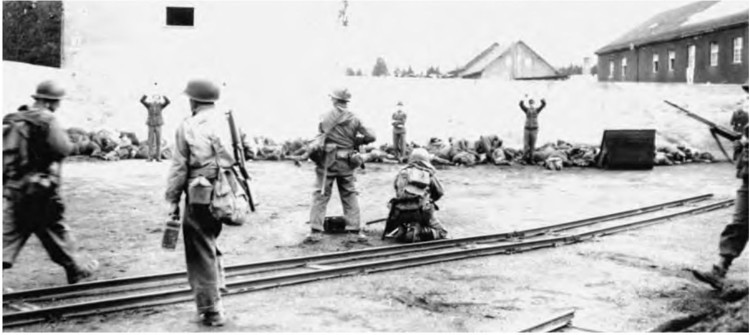
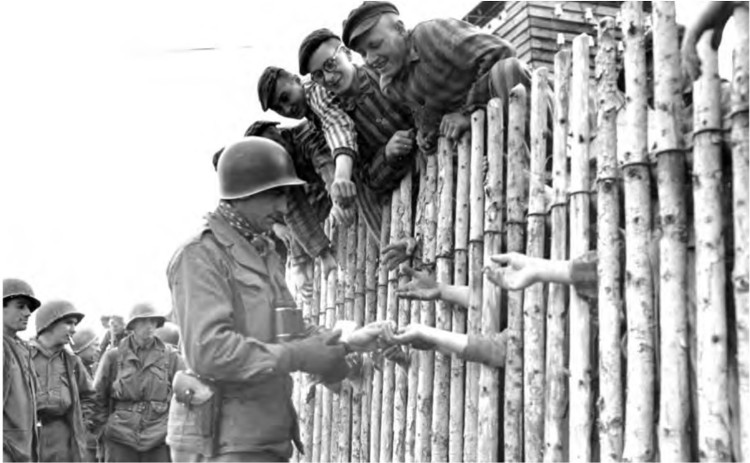
CAPTURING GUARDS AT DACHAU, ten miles northwest of Munich (top). A few of the guards of the concentration camp remain standing with their arms raised while the majority lie on the ground, waiting to be taken prisoner. An enlisted man gives his cigarettes to inmates at Dachau (bottom). On 29 April troops of the U. S. Seventh Army captured Dachau and released over 30,000 prisoners of many nationalities.
AUSTRIA
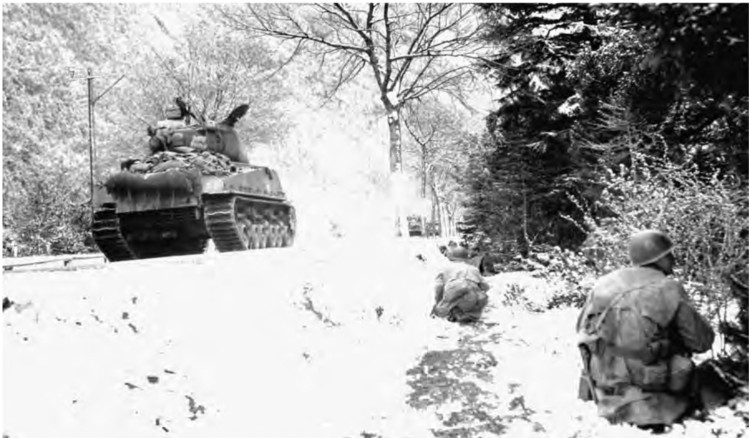
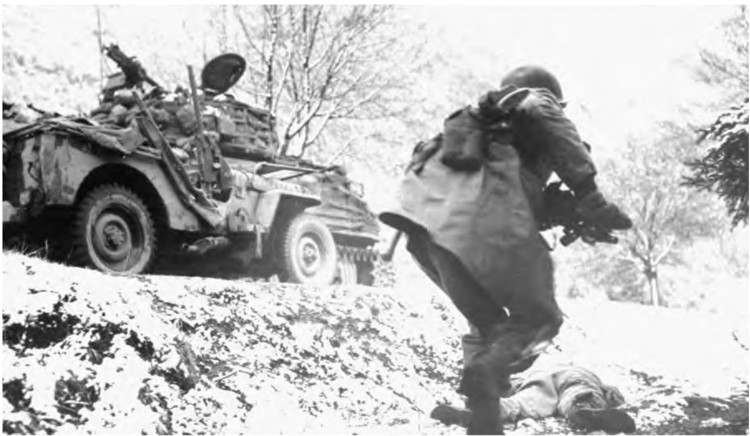
TROOPS TAKING COVER as members of a German officer candidate school fire on them. These enemy troops offered the Seventh Army considerable resistance before they were taken. In this area snow remained on the ground until late spring.
AUSTRIA
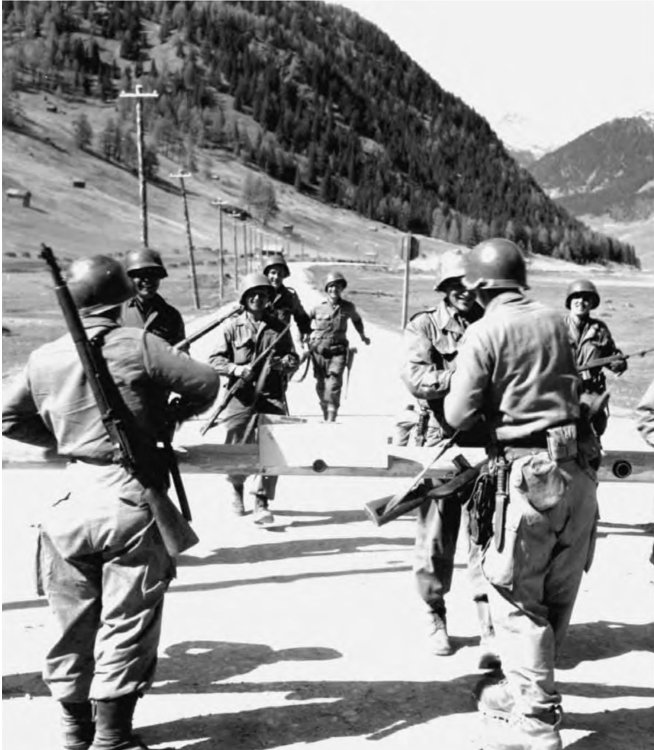
SEVENTH AND FIFTH ARMY TROOPS MEET at Nauders, Austria. On 4 May, Seventh U. S. Army troops captured the town of Brenner in the Brenner Pass, and a few hours later contact was made with elements of the Fifth U. S. Army which had fought its way up the Italian peninsula. On the same day Berchtesgaden was entered.
GERMANY
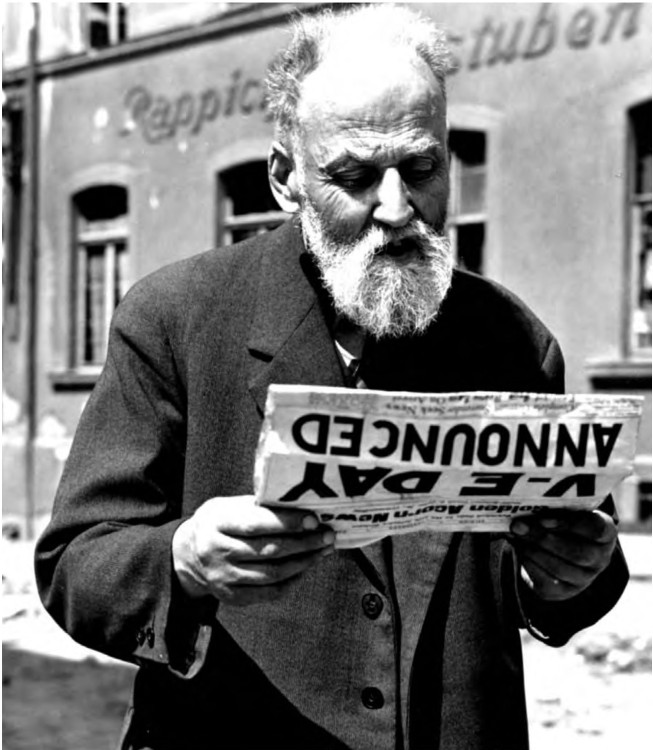
A GERMAN CIVILIAN reading of the surrender of the German forces in a division newspaper. On 7 May 1945 the Germans signed the surrender terms which were to become effective at 0001, 9 May 1945; 8 May, however, was designated as V-E Day (Victory in Europe). In some remote areas fighting continued until 11 May.
GERMANY
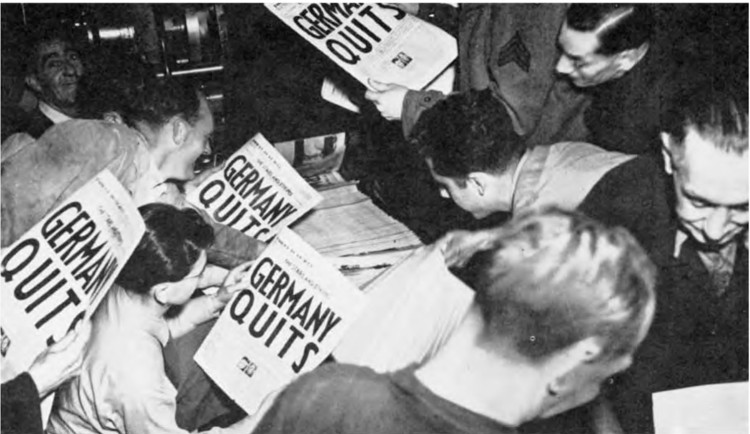
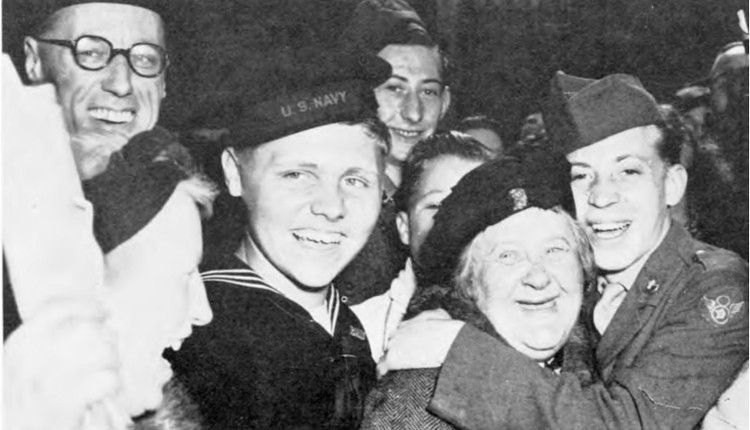
MEMBERS OF THE STARS AND STRIPES STAFF grab copies of the extra edition as they come off the press, proclaiming V-E Day (top). U. S. sailor and soldier celebrate V-E Day in London (bottom).
FRANCE
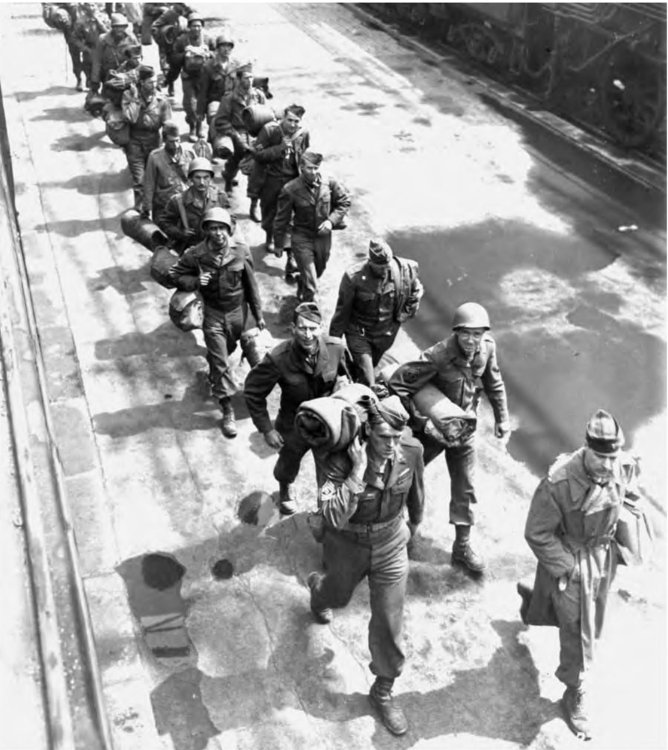
MEN MARCHING TO THE DOCKS AT LE HAVRE to board a ship that will take them home to be discharged under the new point system. Men with the highest numbers of points were sent home first for discharge. These numbers were determined by the total number of months of service, total number of months overseas, number of awards and decorations, and the number of dependents.
FRANCE
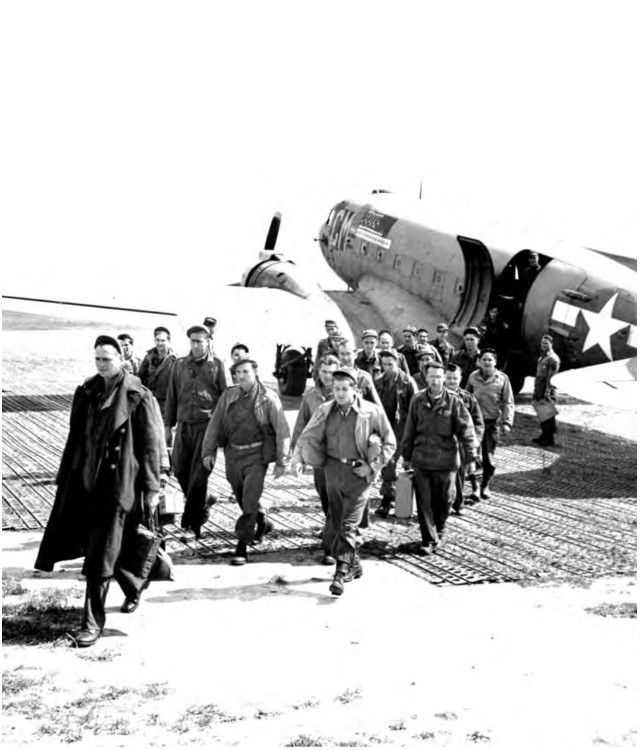
U. S. LIBERATED PRISONERS OF WAR leave a plane at Reims on the first lap of their journey back to the United States.
ENGLAND
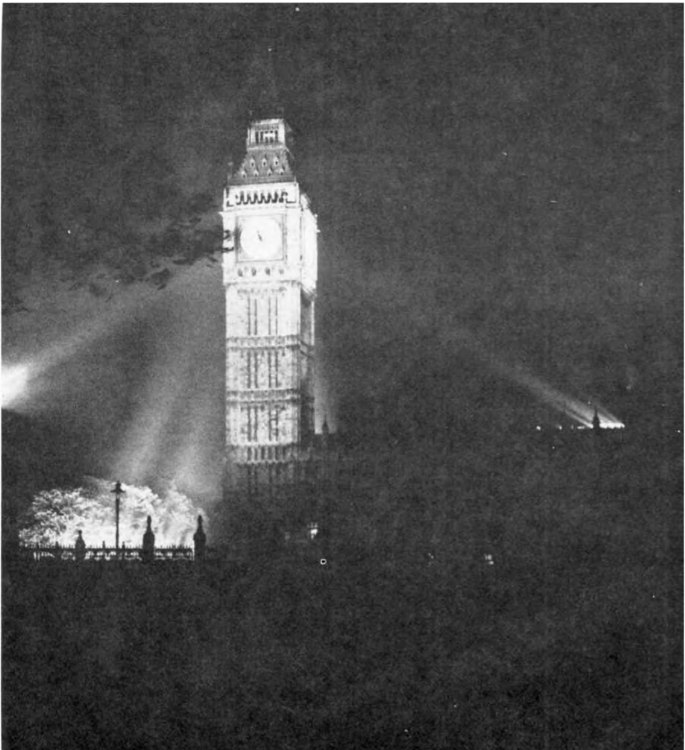
FLOODLIGHTS ILLUMINATE BIG BEN on the Houses of Parliament as the lights go on again in London on V-E night after being blacked out during the war years. Early in May 1945 there were approximately 4,500,000 troops under the command of the supreme commander in Europe. Casualties for the western Allies numbered over 800,000. At the end of the war there were nine Allied armies, totaling ninety-three divisions, on the Continent.