SECTION V Ardennes-Alsace Campaign
Reading edition
In mid-December 1944 the Allies stopped along the German border, but continued to attack in the Saar and Roer regions, while they concentrated the majority of their strength for an attack in the north. The Germans, taking advantage of their continuous front along the West Wall, planned a counterattack to strike the Allies in one of the weakest portions of the line—the Ardennes sector. The ultimate goals of this German operation were to capture the port city of Antwerp, sever the major Allied supply lines emanating from that port, and destroy the Allied forces north of the Antwerp-Brussels-Bastogne line.
Early on the morning of 16 December the German armies struck the Allied troops located in Belgium and Luxembourg. The Allies holding this portion of the line were too thinly dispersed to offer any great resistance against the powerful enemy attack and were forced to fall back. While the defenders fought the Germans, Allied armies shifted their drives and troops were rushed to the Ardennes to reinforce the hard hit units along the front from Monschau to Echternach. After severe fighting during late December 1944 and early January 1945 the Germans were defeated and by 25 January the Allies were once more ready to move toward Germany through the West Wall defenses. During the Ardennes-Alsace Campaign winter set in and the cold weather and snow-covered terrain made operations and living conditions extremely difficult.
During this period the British forces in the north eliminated the Germans in the Roermond triangle and captured the enemy bridgehead west of the Roer River. The U. S. and French troops of the 6th Army Group fought a determined enemy in Lorraine and Alsace and by 25 January had driven the attacking Germans back across the Moder River.
The Ardennes-Alsace Campaign, which delayed the Rhineland Campaign for six weeks, secured no major terrain objectives for either side. The Germans, who had employed some of their best remaining units, lost nearly 250,000 men, 600 tanks and assault guns, and about 1,600 airplanes. The Allies suffered 72,000 casualties.
On 6 January 1945 the Fifteenth U. S. Army became operational on the Continent and was assigned to the 12th Army Group, taking over many of that army group’s responsibilities in the rear areas.
BELGIUM
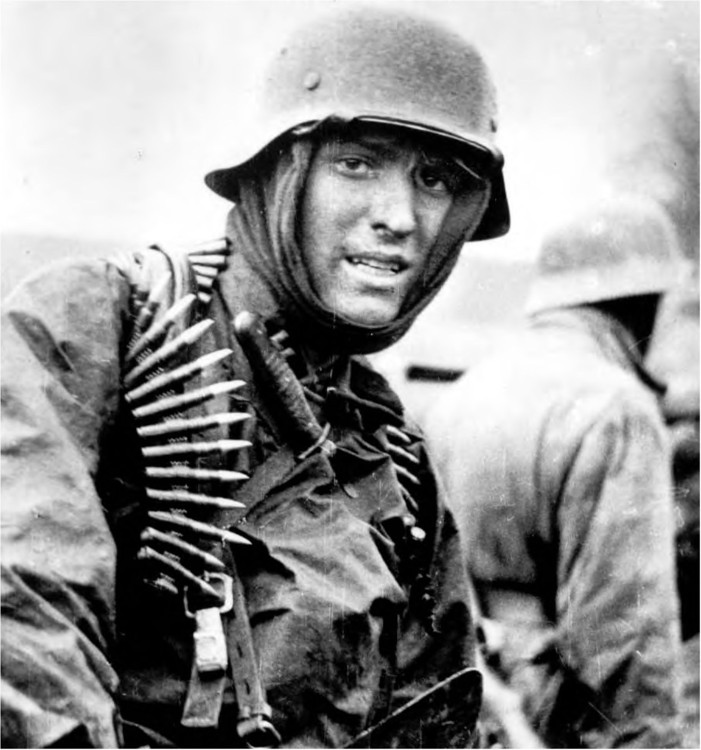
GERMAN SOLDIER WITH AMMUNITION BELTS moves forward during the enemy counterattack in the Ardennes. German morale was higher than at any time since the Allies had landed, partly because the individual soldier had been propagandized into believing that this was the opportunity to destroy the Allied troops in the west. At 0530 on 16 December 1944 three German armies attacked on a 50-mile front in eastern Belgium and northern Luxembourg. This battle was popularly known as the Battle of the Bulge.
BELGIUM
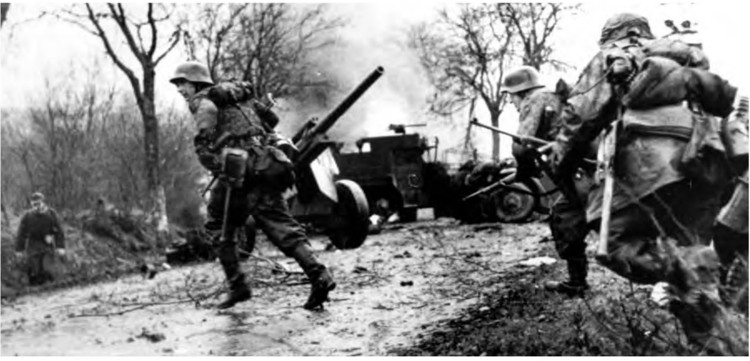
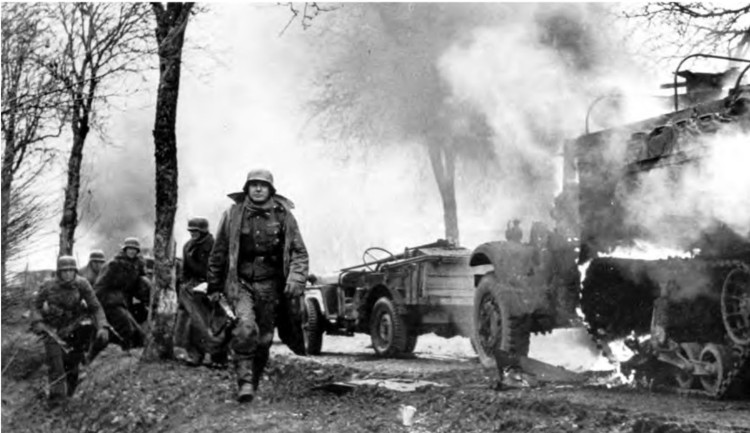
ENEMY TROOPS PASS BURNING U. S. EQUIPMENT. The initial German attacks, following a heavy artillery preparation, were launched all along the front, roughly from Monschau to Echternach. The first objective was to secure the high ground of the Hohe Venn but the drive by the enemy met with stiff resistance and he was forced to commit his armor before noon on 16 December. Further attacks in the northern sector were no more successful and by night the Germans were still fighting at the approaches to the Elsenborn Ridge.
BELGIUM
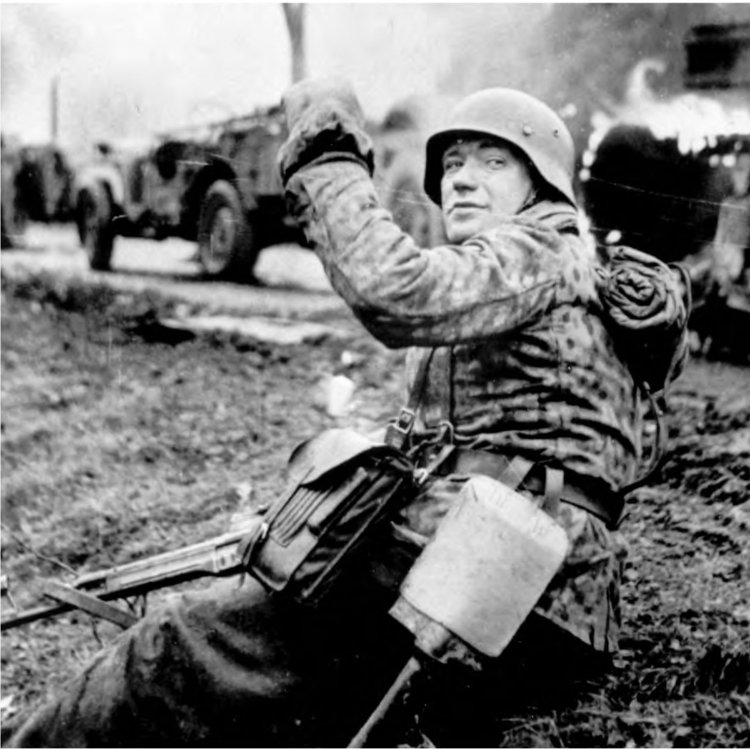
A GERMAN SOLDIER waving members of his unit forward. Spurred on by expressions of the German commanders such as “Forward to and over the Meuse” and “We gamble everything now—we cannot fail,” enemy troops drove forward in a determined effort to defeat the Allies. South of the Elsenborn Ridge in the vicinity of the Losheim Gap U. S. troops were overwhelmed and forced to withdraw. By evening the enemy, though blocked in the north, had broken through the thinly held American line and drove toward Stavelot and Huy, the first objective on the Meuse River. Still further to the south in the Echternach area, the U. S. forces stopped the enemy after he had made limited gains. The Allied situation along the front was extremely grave.
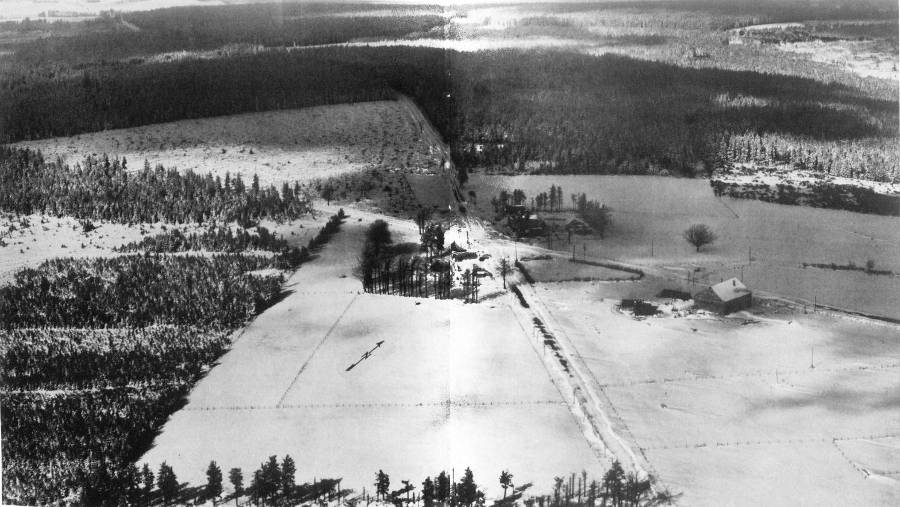
TYPICAL ARDENNES TERRAIN. The rough, wooded tableland of the Ardennes in eastern Belgium and northern Luxembourg is broken by many small streams which become serious obstacles during periods of heavy rain or thaw. The Ardennes contains a fair primary but poor secondary road system. Because of the rough terrain the main centers of the road net assumed great importance during the Battle of the Bulge. Heavy snow made infantry maneuver difficult and seriously limited tank movement.
BELGIUM
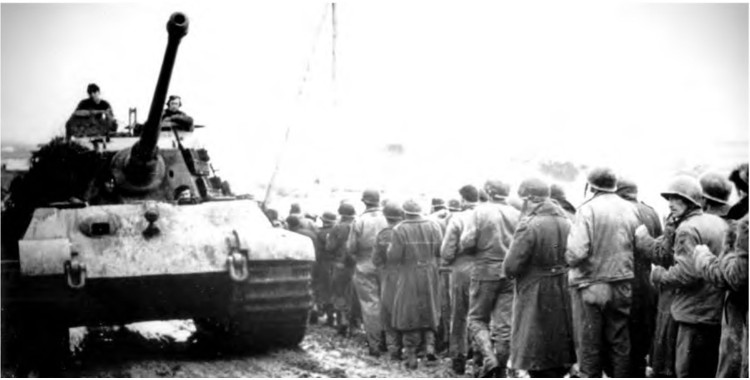
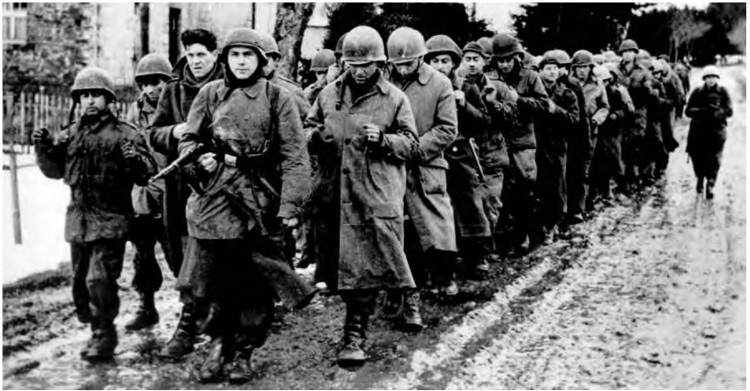
GERMAN “KING TIGER” OR “TIGER ROYAL” heavy tank passing a line of captured U. S. soldiers being marched to the rear (top). U. S. prisoners of the enemy taken during the early fighting in the Battle of the Bulge (bottom). Two U. S. regiments near Saint-Vith were surrounded and most of the men were taken prisoner before U. S. reinforcements could arrive on the scene. The enemy attacks on Elsenborn Ridge were stopped by these U. S. reinforcements on 17 December, but this help came too late to save from capture the men shown above and those of an artillery battery who were caught by an enemy armored column south of Malmédy.
BELGIUM
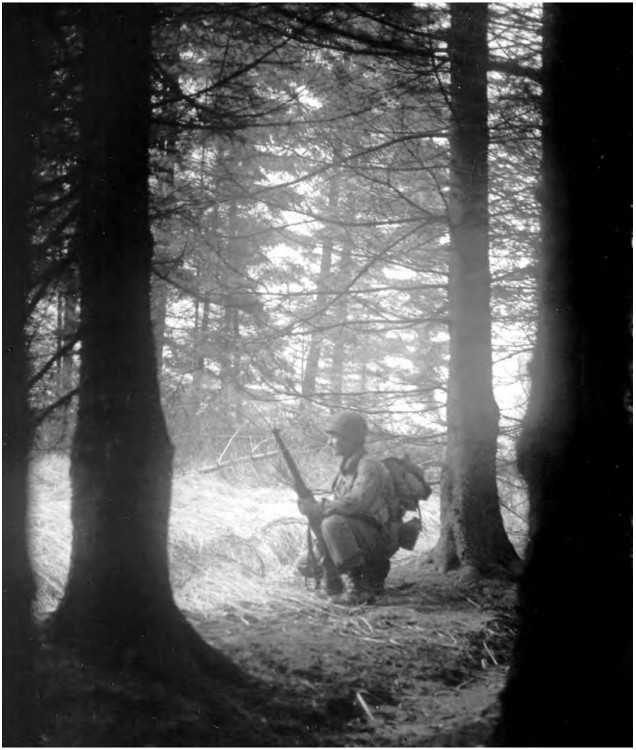
AN INFANTRYMAN PAUSING IN HIS ADVANCE through the forest. During the first ten days of the battle confusion reigned as hastily shifted troops arrived to reinforce the efforts of the isolated units attempting to halt the enemy attack.
BELGIUM
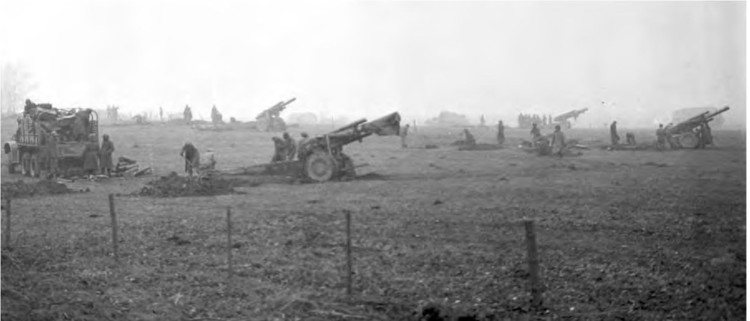
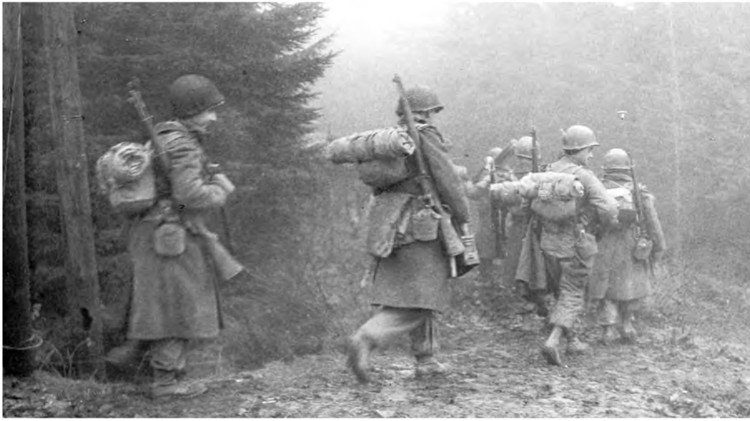
A BATTERY OF 155-MM. HOWITZERS M1 being emplaced (top). Members of an airborne division moving up through the forest (bottom). On 18 December German patrols passed through a gap between Malmédy and Saint-Vith and continued as far west as Werbomont. Other enemy troops tried to push north through Stavelot but were stopped by a blown bridge over the Ambleve River and by an improvised task force consisting of U. S. infantrymen, engineers, and tank destroyers. Engineer demolitions and effective use for the first time of the new proximity fuze by artillery strengthened the north shoulder of the growing salient. During the first week of the Battle of the Bulge most planes were grounded because of extremely poor flying weather.
BELGIUM
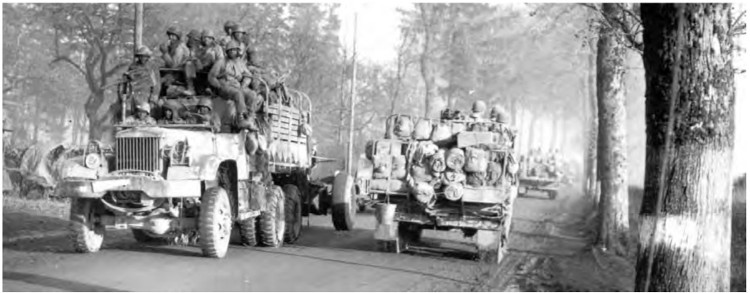
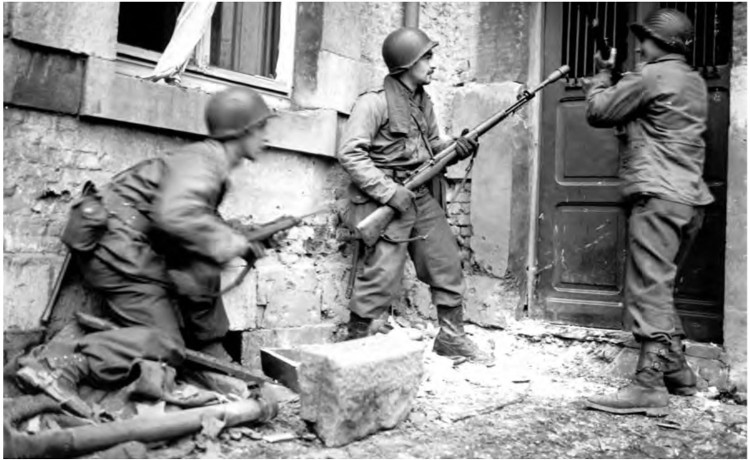
BATTLE-WEARY TROOPS being relieved of front-line duty as reinforcements arrive to take over (top). Infantrymen batter down the door of a house where German snipers are holding out in the town of Stavelot (bottom). On 19 December the north and south flanks continued to hold, and road centers of Saint-Vith and Bastogne were still occupied by U. S. troops though almost surrounded by the enemy. The enemy captured Stoumont but the U. S. forces strengthened the line between Malmédy and Stavelot and with additional reinforcements began to attack the enemy east of Stoumont. To the south the enemy took up blocking positions south of the Sauer River with some troops as far west as the Arlon-Bastogne highway.
GERMANY
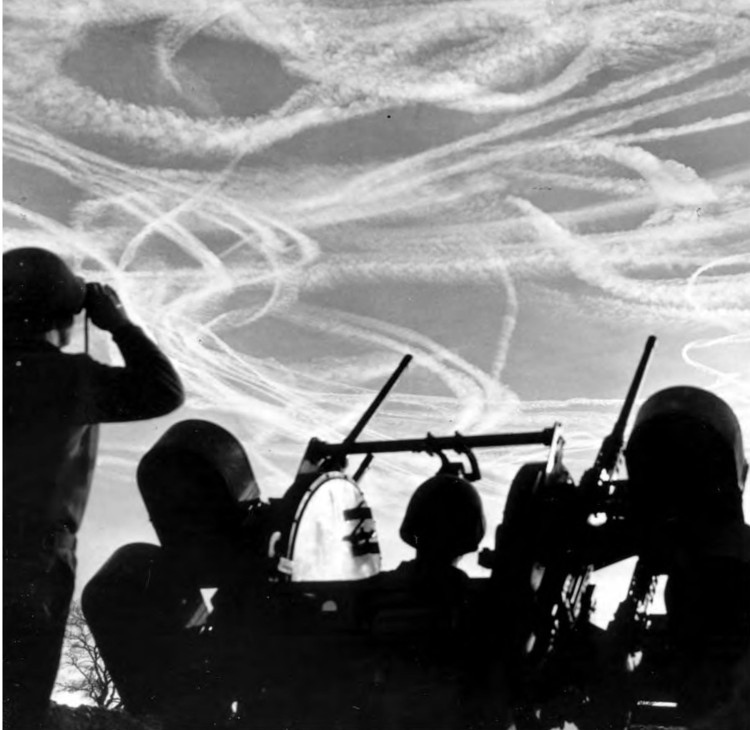
CREW OF A MULTIPLE GUN MOTOR CARRIAGE M16 waiting to fire on an enemy plane as vapor trails fill the sky. On 20 December control of the First and Ninth U. S. Armies passed to the 21 Army Group, while the Third U. S. Army and a corps of the First Army remained under 12th Army Group control. On 23 December the weather cleared sufficiently for planes of the Eighth and Ninth U. S. Air Forces and the British Bomber Command to begin a large-scale aerial assault on German positions and installations. The German planes which were sent up in greater strength than at any other time since the invasion were no match for the Allies. On Christmas Day the First U. S. Army launched an attack and made contact with the British forces in the northern section of the front. For the first time since 16 December a continuous Allied front was established.
BELGIUM
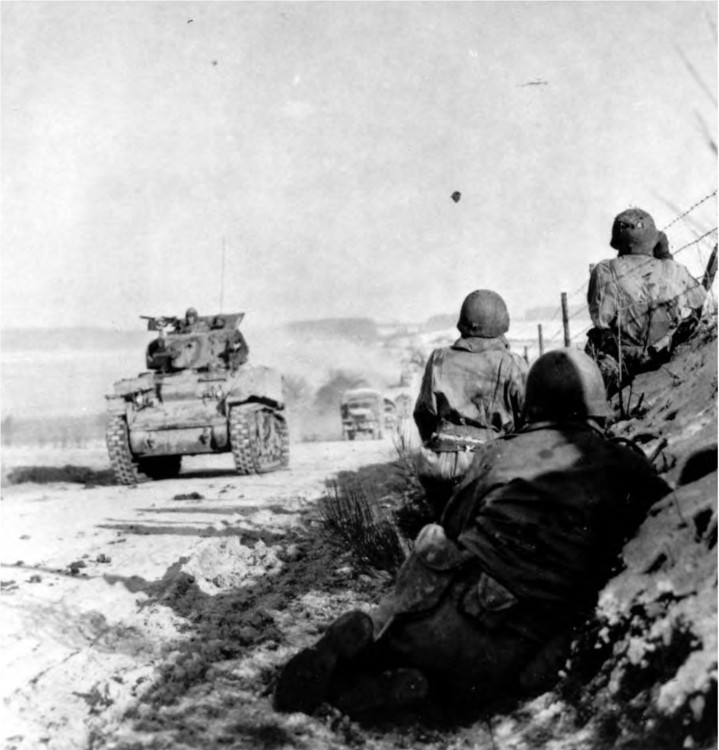
PART OF AN ARMORED DIVISION of the Third Army moving into the Ardennes. At the beginning of the Battle of the Bulge Third Army was regrouping for an attack on the West Wall in the Saar area. On 18 December an armored division was turned north toward the Ardennes sector and was followed by an infantry division the next day. The 6th Army Group was turned north to take over the area held by Third Army, which during a period of six days broke off its general attack in the Saar region, turned left, moved more than a 100 miles over unknown winter roads, and mounted an attack with six divisions.
BELGIUM
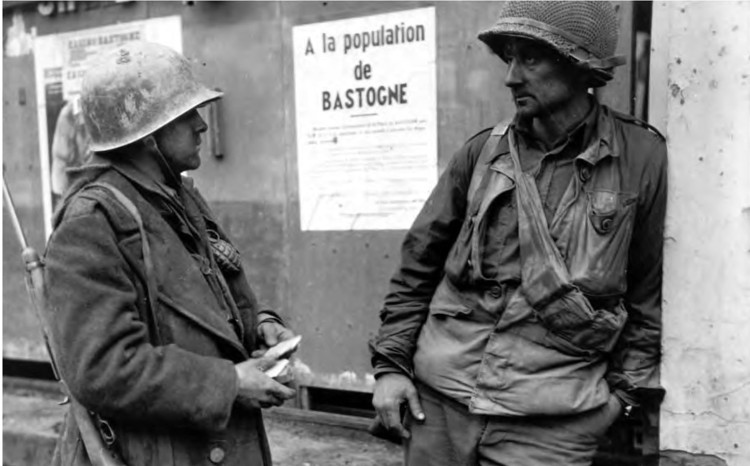
C-47’s CARRYING SUPPLIES to surrounded U. S. troops in Bastogne (top). Infantrymen in Bastogne (bottom). While Third Army was advancing to relieve the armored and airborne troops in Bastogne, the battle for the city was being waged. The enemy surrounding the city numbered 45,000 while within Bastogne there were about 18,000 U. S. troops. The commander of the troops in the city refused to surrender to the Germans and continued to hold out against all attacks. The defenders, cut off from their sources, were supplied by airdrops during this period. On 24 December over 100 tons of supplies were dropped.
BELGIUM
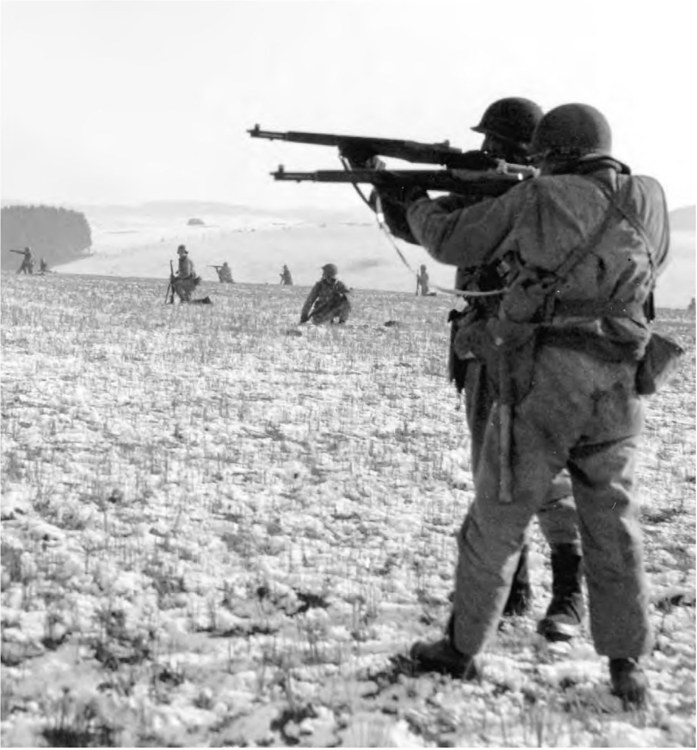
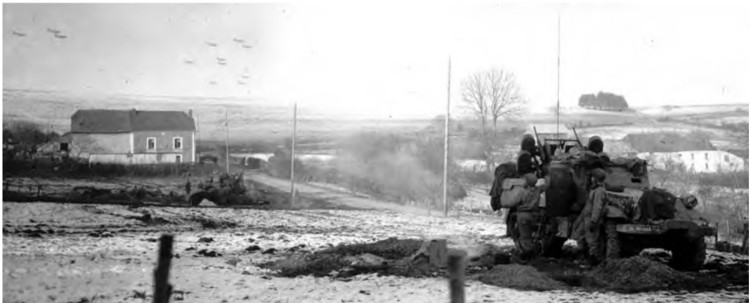
INFANTRYMEN FIRE AT GERMAN TROOPS in the advance to relieve the surrounded paratroopers in Bastogne. In foreground a platoon leader indicates the target to a rifleman by actually firing on the target. In Bastogne the defenders were badly in need of relief, they were attacked nightly by German aircraft, supplies were critically low in spite of the airdrops, and the wounded could not be given proper attention because of the shortage of medical supplies. After an advance which had been slow, U. S. relief troops entered Bastogne at 1645 on 26 December 1944.
BELGIUM
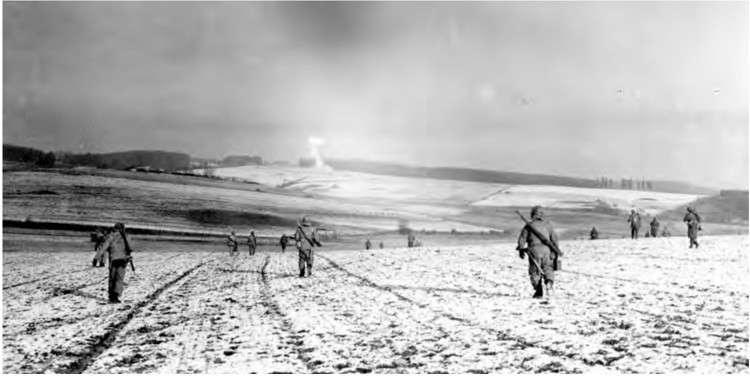
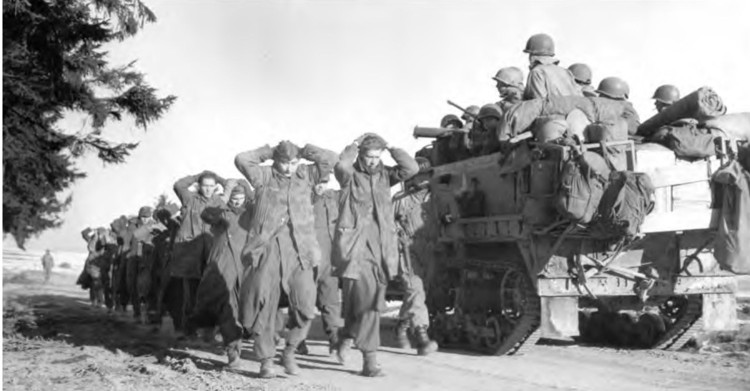
INFANTRYMEN ADVANCE ON BASTOGNE (top). Prisoners taken during the advance on Bastogne being evacuated (bottom). With the arrival of U. S. relief troops were forty truckloads of supplies which were delivered during the night of 26 December. 625 wounded men were evacuated from the area and the battle continued since the enemy had shifted a large portion of his attacking troops in this area. On the night of 26 December when the German advance was halted the Third Army, consisting of eight divisions and parts of two other battered divisions, faced elements of eleven German divisions between the Meuse and the Moselle.
BELGIUM
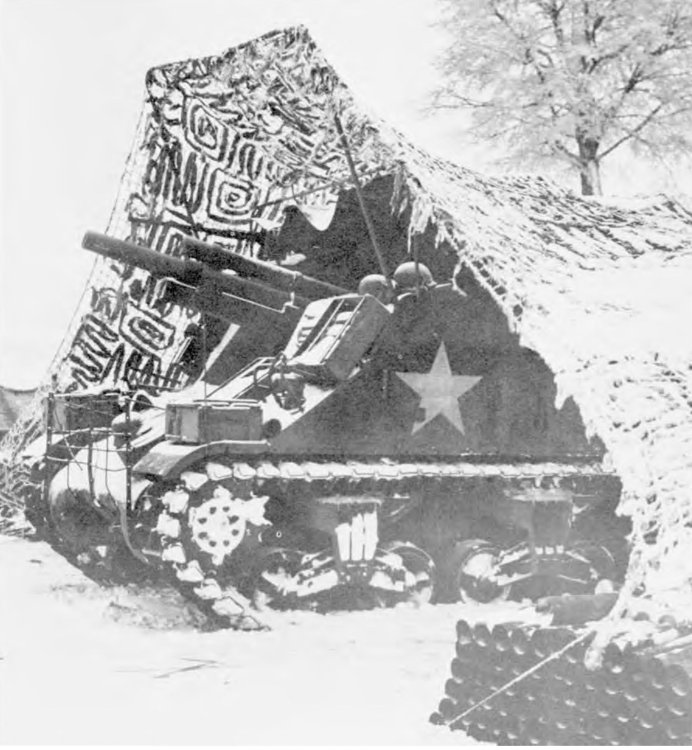
105-MM. HOWITZER MOTOR CARRIAGE M7 of an armored unit on the alert near Bastogne. By 27 December more than thirty-five corps artillery battalions were firing approximately 19,000 rounds of ammunition daily in support of the Third Army. By the end of the year that army was supported by over 1,000 guns of 105-mm. caliber or larger. Christmas night the Third Army’s artillery began using the new proximity fuze, which proved particularly effective in interdicting road junctions and harassing enemy positions.
BELGIUM
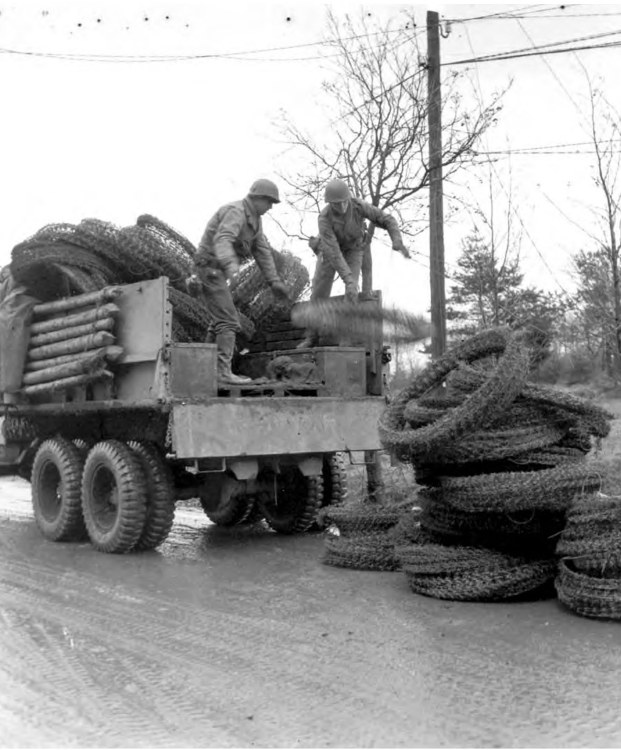
ENGINEERS UNLOADING BARBED WIRE which was used in defensive measures against counterattacks.
BELGIUM
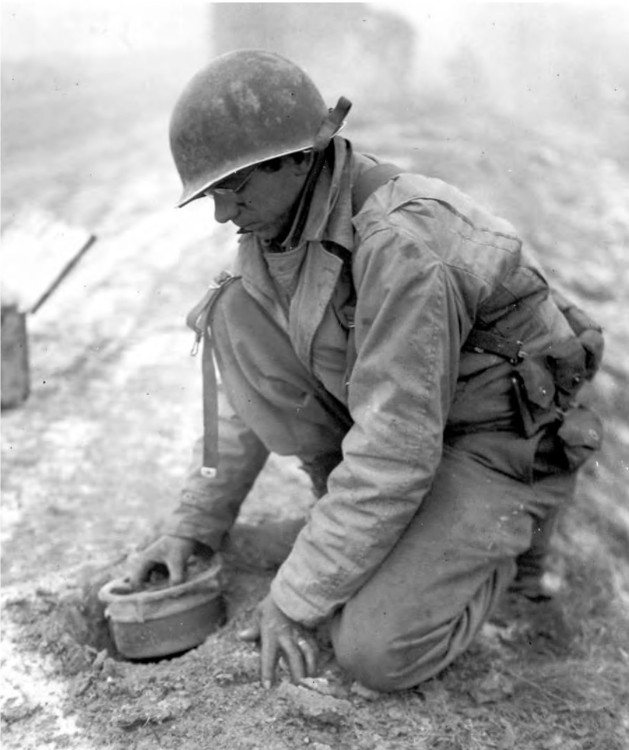
ENGINEER PLANTING AN ANTITANK MINE on the shoulder of a road as a defensive measure during the fighting in the Ardennes.
BELGIUM
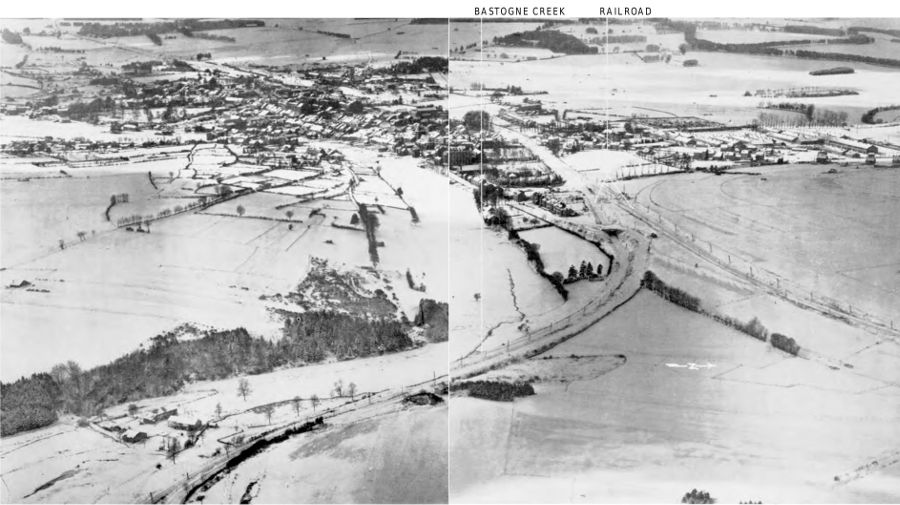
BASTOGNE AND THE SURROUNDING AREA. Although the corridor which had been opened to Bastogne remained in U. S. hands it was far from secure as it was less than 300 yards wide in some places. The Germans were passing to the defensive in other sectors and concentrating on their attacks in the Bastogne area. The mission of the Third Army was to widen the corridor, push attacks on Saint-Vith, and at the same time reinforce its attacking units. During this period of the fighting in Europe adverse weather conditions added greatly to the problems, and the snow-and sleet-covered roads hampered the movement of troops.
BELGIUM
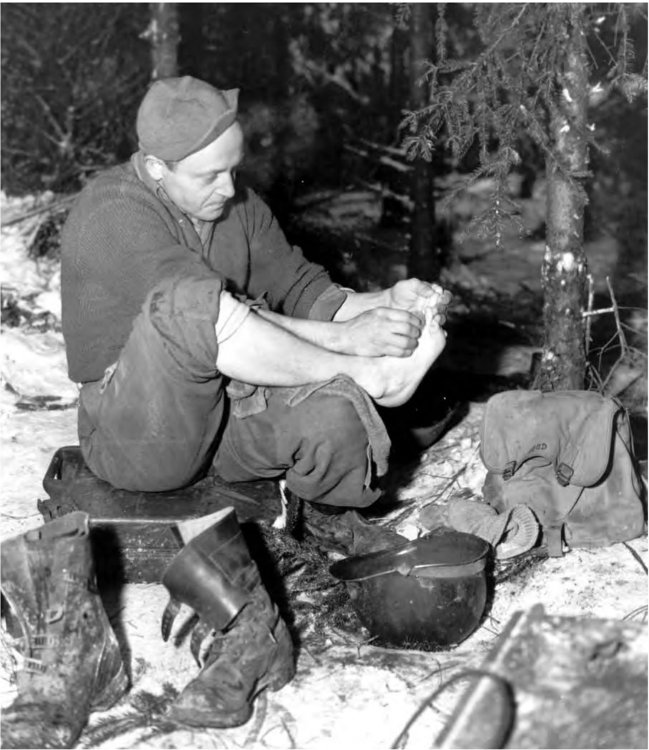
SOLDIER TAKES TIME OUT TO WASH HIS FEET and put on dry socks. The cold weather combined with the snow and dampness caused many cases of trench foot during this period. It was difficult when wearing the regular leather shoes to keep one’s feet dry and warm, but frequent washing and changing of socks helped.
LUXEMBOURG
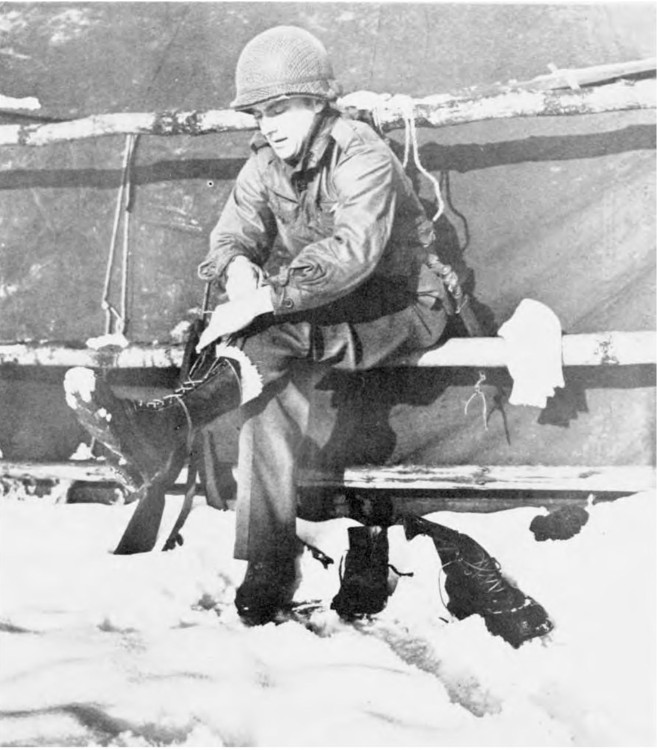
AN ENLISTED MAN PUTS ON A NEW PAIR OF SHOEPACS. The shoepac, which was supplied to as many of the troops as possible at this time, helped to overcome the heavy incidence of trench foot among the U. S. troops fighting in cold and extremely wet climates. This shoe was rubber-bottomed with a leather top and was worn with a heavy ski sock and felt innersole.
BELGIUM
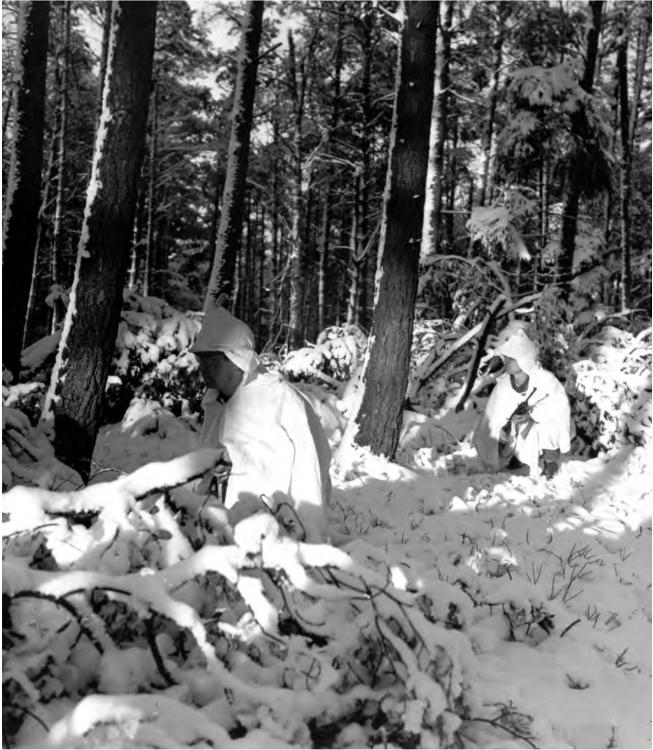
INFANTRYMEN WEARING SNOW CAPES over their normal clothing. Snow caught the U. S. troops without adequate camouflage, and strenuous efforts were made to improvise white suits out of mattress covers and linen collected from the civilians.
LUXEMBOURG
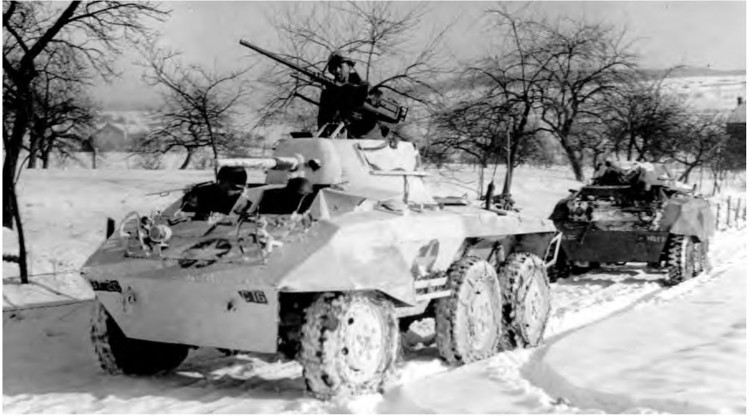
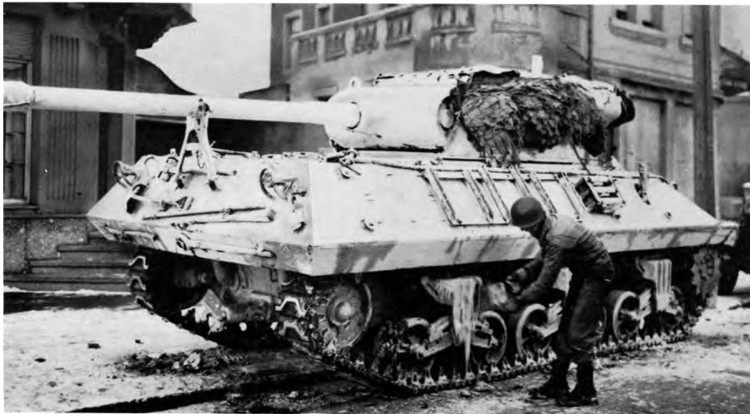
CAMOUFLAGED LIGHT ARMORED CAR M 8 and one that has not been painted white, showing the effectiveness of snow camouflaging (top). A crew member of a 90-mm. gun motor carriage M 36 throwing paint on the bogie wheels after painting the vehicle (bottom). Tanks, vehicles, and guns were camouflaged with white paint.
LUXEMBOURG
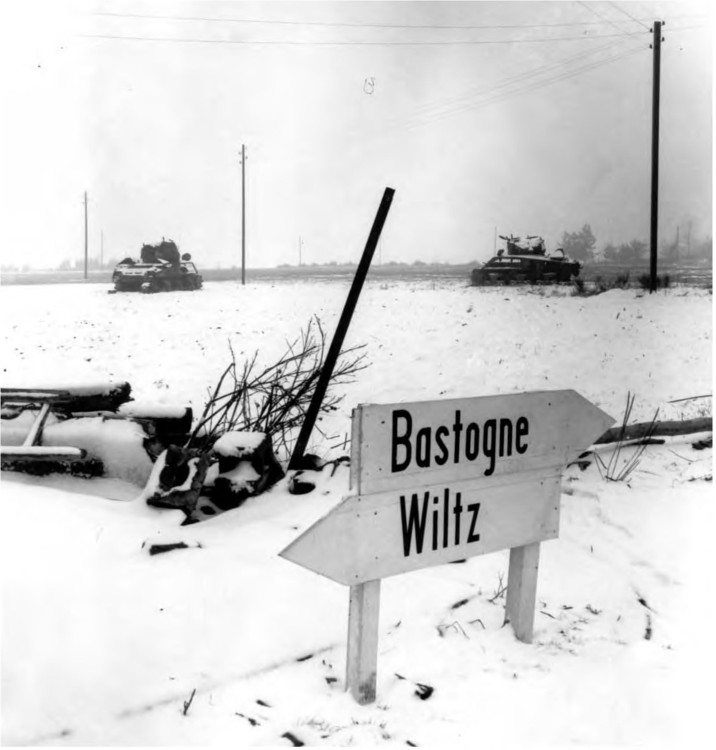
KNOCKED-OUT U. S. MEDIUM TANKS. During the last few days of December 1944 the main effort in Third Army zone was concentrated in the vicinity of Bastogne, while the situation in the rest of the army area remained static. Armored and infantry attacks achieved small gains during which many German counterattacks were made. Echternach was re-entered on 29 December and all enemy forces south of the Sauer River were cleared. The armored divisions continued to advance. One, in repulsing several counterattacks, suffered heavy casualties. On 3 January 1945 the last German attack was made on Bastogne. It was unsuccessful.
FRANCE
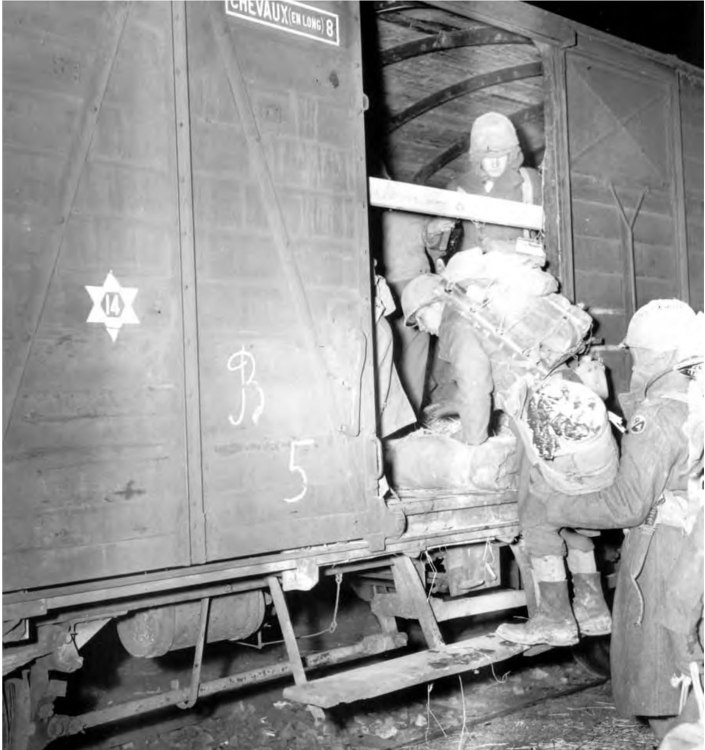
MEN OF AN INFANTRY DIVISION climbing into box cars to move from the Brittany Peninsula to the U. S. Third Army zone. On 9 January 1945 a new attack was started after fresh troops had been brought into the battle area. The Germans offered fierce resistance in order to keep open their escape route to the east. On 16 January elements of an armored division of Third Army contacted those from First Army, closing the German salient just one month after the enemy had launched his counteroffensive in the Ardennes.
BELGIUM
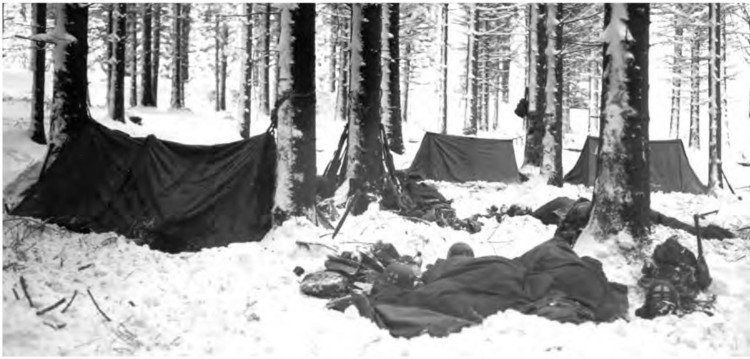
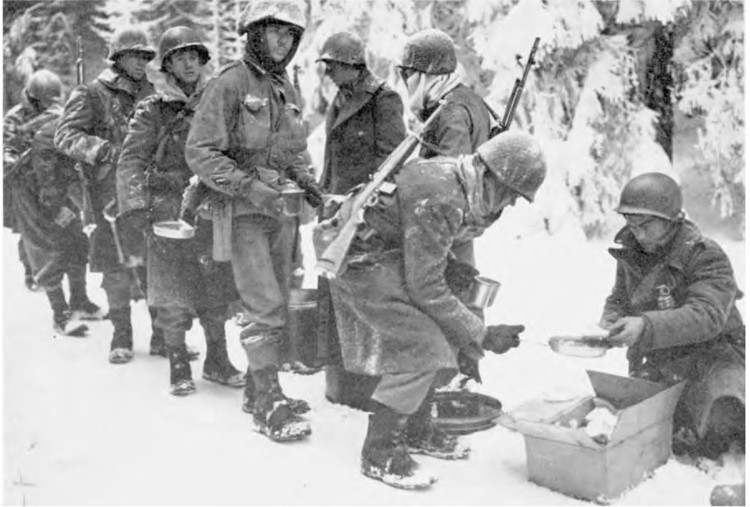
INFANTRYMEN BIVOUACKING IN THE WOODS (top); field mess (bottom). Living conditions during the best of times were not too pleasant for the combat soldier, but during the winter the hardships were greatly increased.
LUXEMBOURG
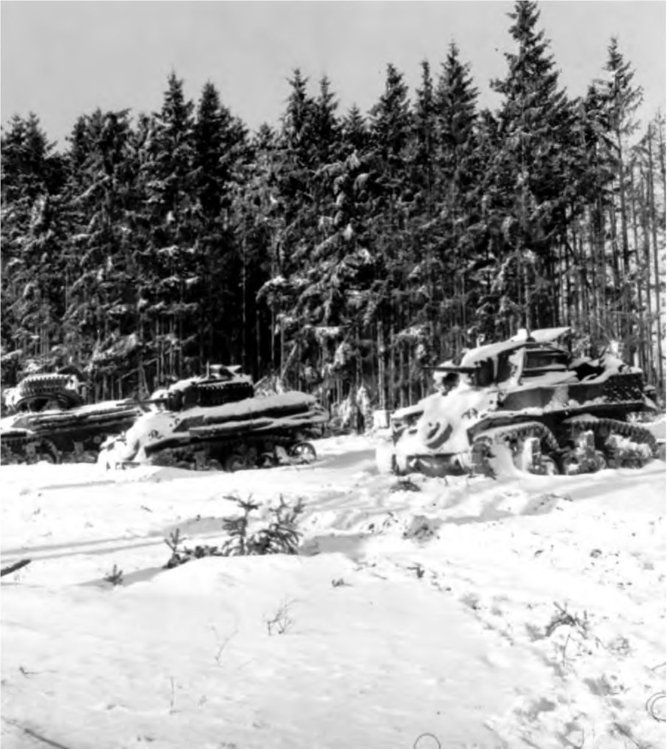
U. S. LIGHT TANKS which were captured by the enemy during the Battle of the Bulge. Some of the more serious U. S. losses during this period were 1,284 machine guns, 542 mortars, 1,344 jeeps, and 237 tanks. Not all of these losses were the result of units being overrun—there was some evidence of unnecessary abandonment of equipment, particularly among inexperienced troops.
BELGIUM
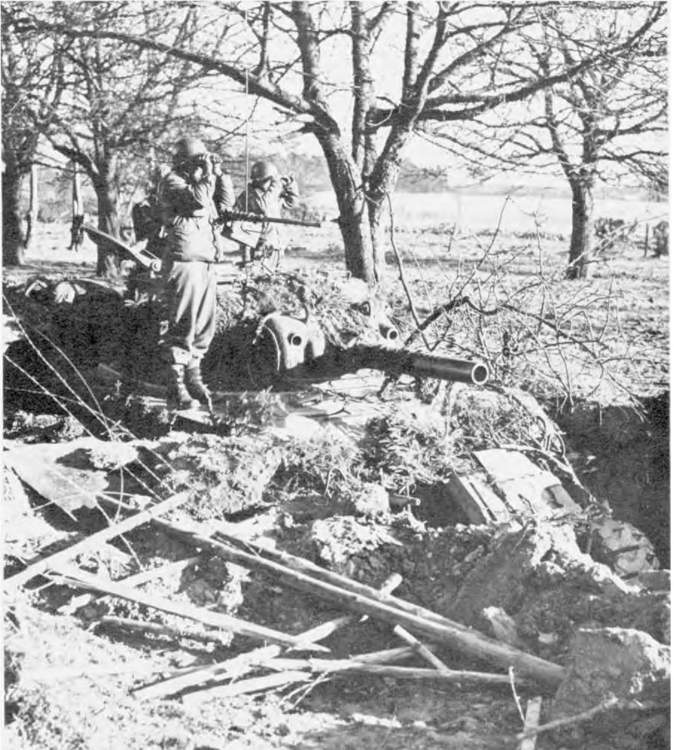
MEMBERS OF AN ARMORED UNIT STAND GUARD beside their dug-in medium tank near Manhay, Belgium. From 27 December 1944 to 2 January 1945 the First U. S. Army was reorganizing and preparing to attack the Hotton-Houffalize axis. Heavy fighting continued all along the First Army front and by 30 December the important traffic centers of Marche, Hotton, and Manhay were secured.
BELGIUM
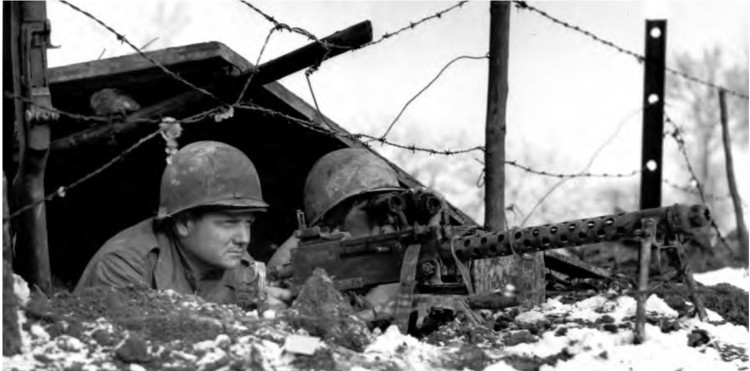
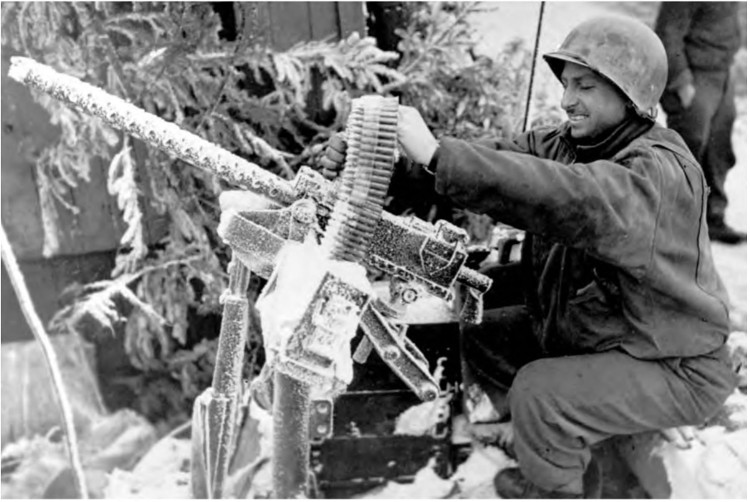
AIRBORNE INFANTRY MEN on the alert man their .30-caliber machine gun (top). A member of a cavalry reconnaissance squadron checks his .30-caliber machine gun (bottom).
BELGIUM
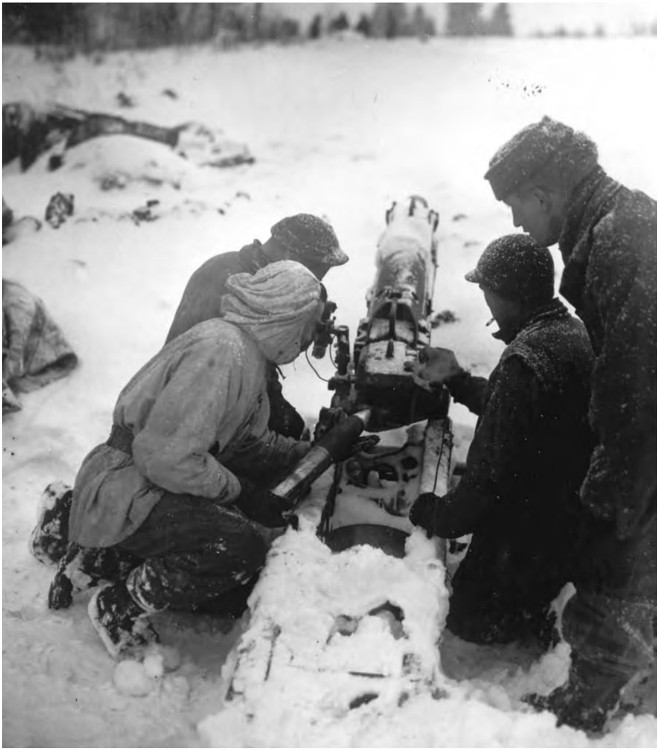
AIRBORNE TROOPS LOADING A SHELL into a 75-mm. pack howitzer M8. Between 16 December and 27 December First army artillery units fired more ammunition than at any other time during the war except during the Normandy Campaign. An average of 800 weapons fired over 750,000 shells.
GERMANY AND BELGIUM
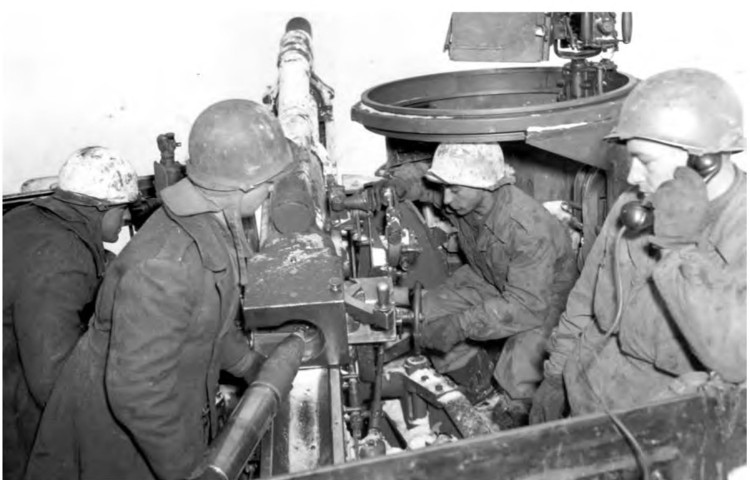
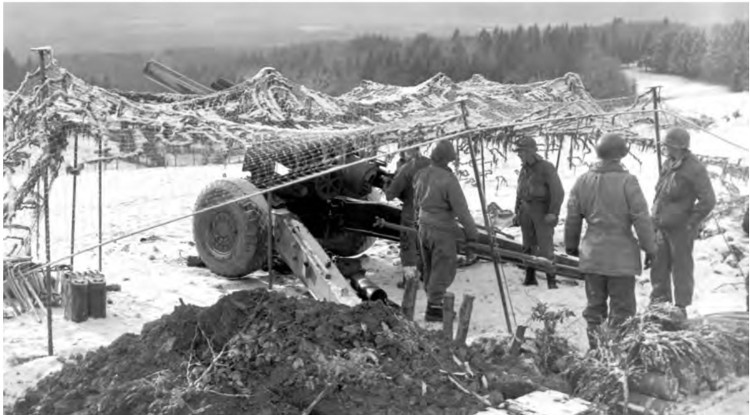
LOADING A 105-M M. SHELL into the howitzer of a Priest (top); snow on the camouflage net over a 155-mm. howitzer M1 helps conceal its position (bottom).
BELGIUM
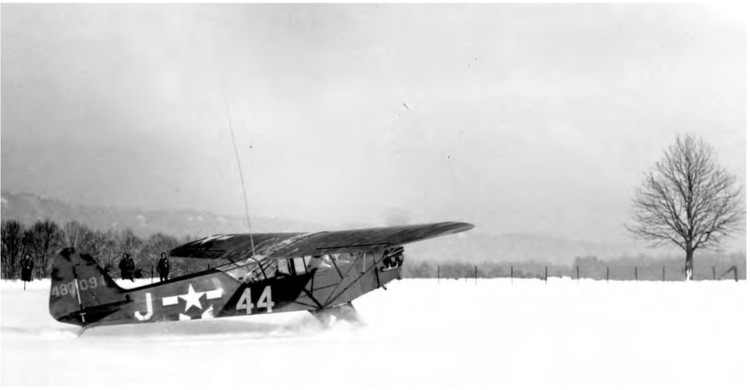
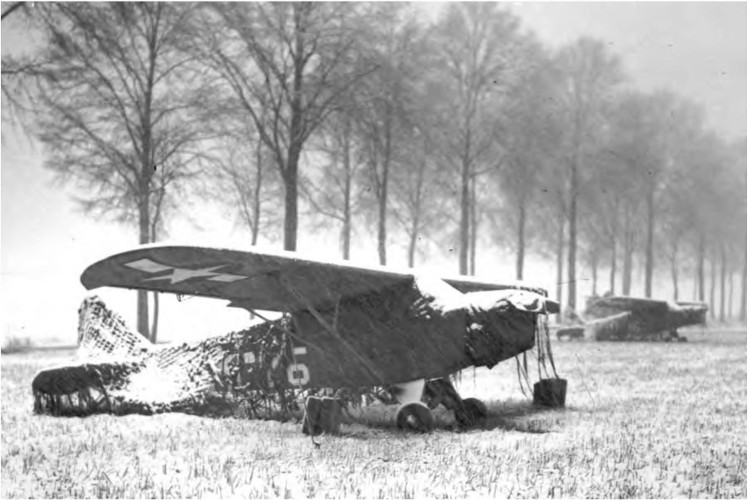
AN ARTILLERY PLANE with newly attached skis taking off (top); observation planes grounded during the bad weather (bottom).
GERMANY
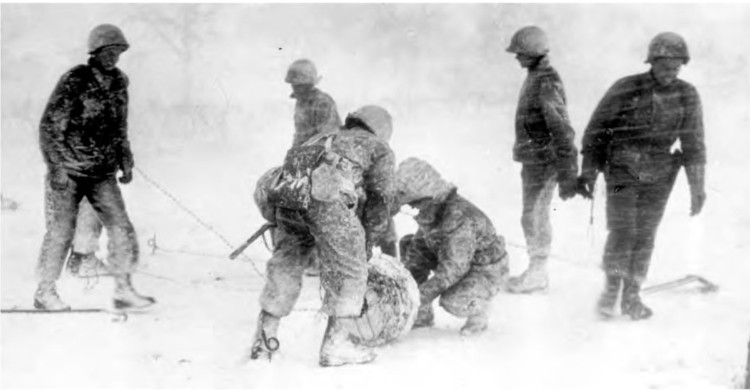
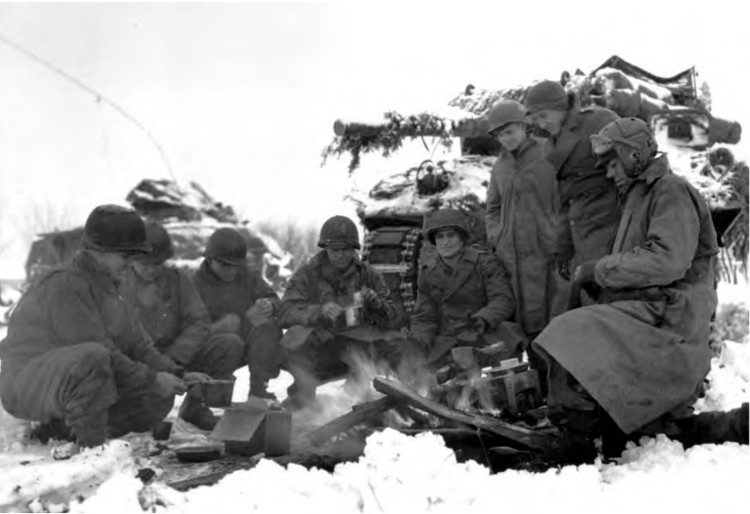
MEN STRINGING BARBED WIRE DURING A BLIZZARD (top); tank crews keeping warm as they eat their rations (bottom).
BELGIUM
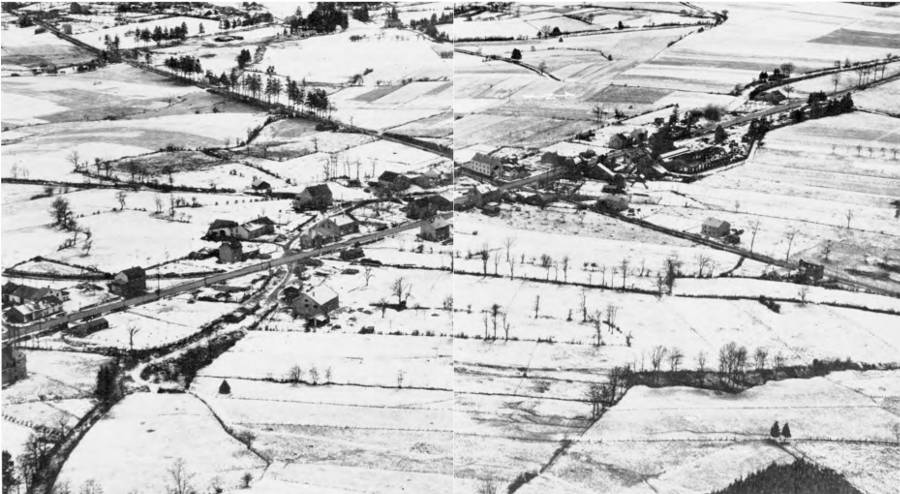
MANHAY, BELGIUM. On 3 January 1945 an attack was launched west of Manhay in the First Army zone. Visibility was reduced to 200 yards and the temperature was near zero. The few roads were coated with ice and the snow off the roads was waist deep making it extremely difficult to maneuver. During the first day advances of almost 4,000 yards were made before a heavy snowfall halted the assault. On 5 January the attack was resumed and the La Roche-Vielsalm road was cut. La Roche was captured by the British on 10 January. The British troops were then withdrawn to regroup for the Rhineland Campaign. The Germans began to withdraw from the tip of the salient after becoming convinced that they had lost in their attempt to halt the Allies.
BELGIUM
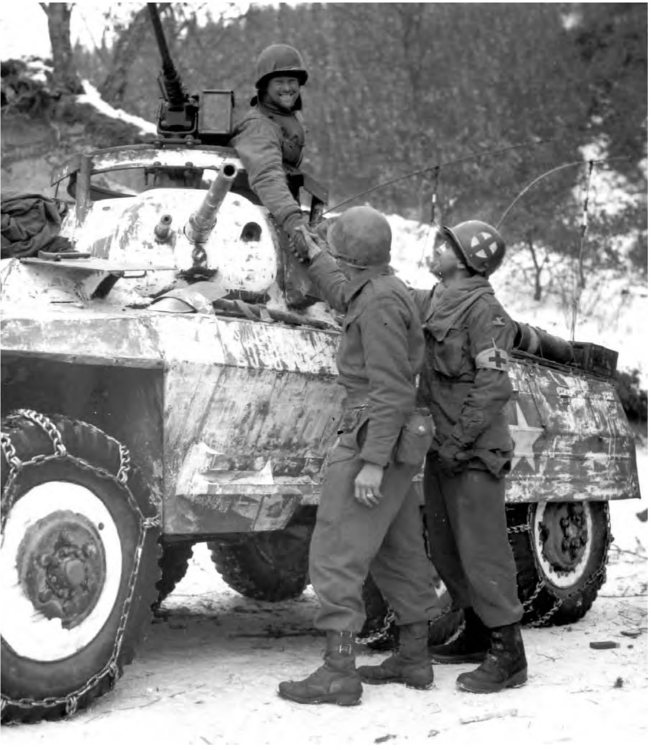
ELEMENTS OF THE FIRST AND THIRD ARMIES made contact at Houffalize on 16 January. While the U. S. units were still understrength, replacements to the theater had increased. Despite heavy fighting and poor living conditions, morale was high.
BELGIUM
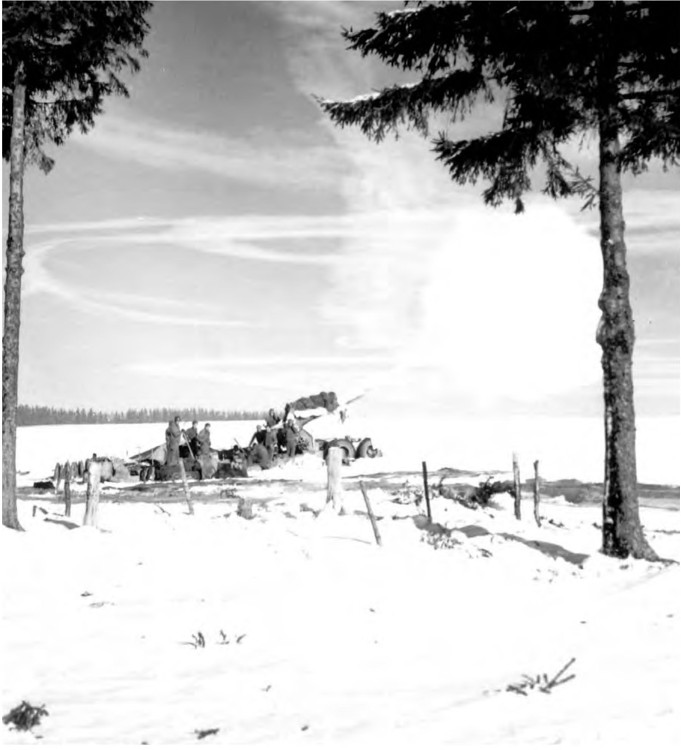
155-MM. GUN M1A1, with its barrel camouflaged by white cloth, firing in the Ardennes. The junction of First and Third Armies at Houffalize marked the achievement of tactical victory in the Ardennes. On 17 January the First Army reverted to 12th Army Group, but the Ninth U. S. Army remained under 21 Army Group. With the enemy withdrawing from the Ardennes the Allies resumed their advance toward the Rhine.
BELGIUM
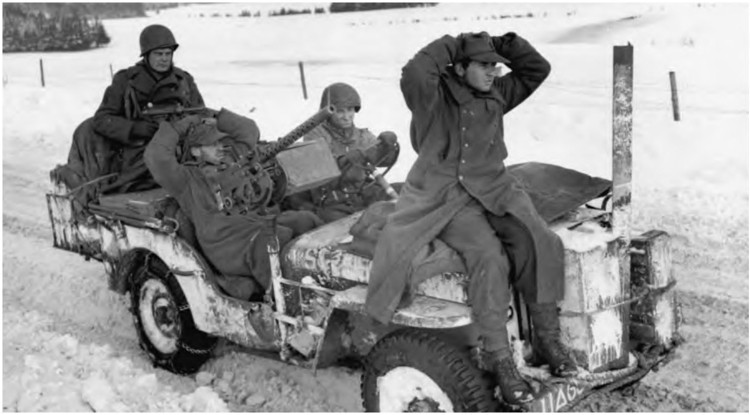
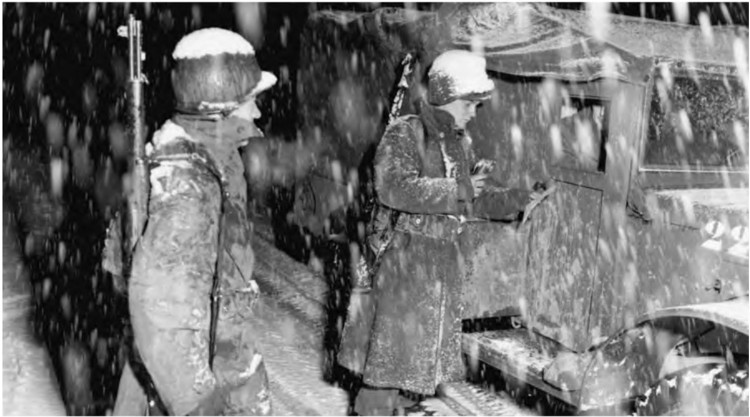
TWO GERMAN PRISONERS BEING BROUGHT IN (top). Papers of a U. S. vehicle driver being checked by a guard at a road intersection (bottom). During the fighting in the Ardennes some German paratroopers were dropped behind the U. S. lines. Others dressed in U. S. uniforms and driving U. S. vehicles were operating behind the American lines.
GERMANY
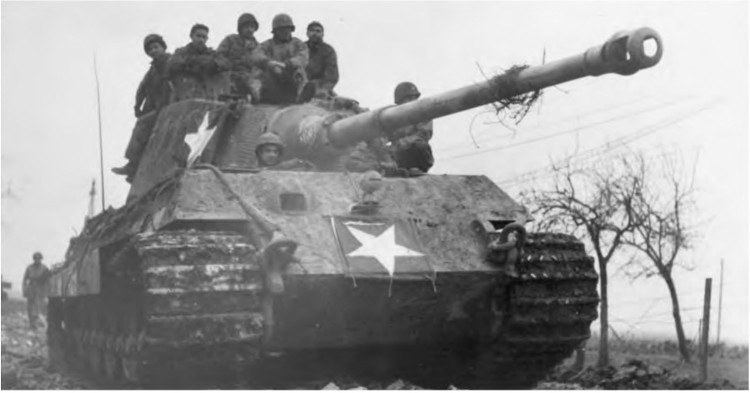
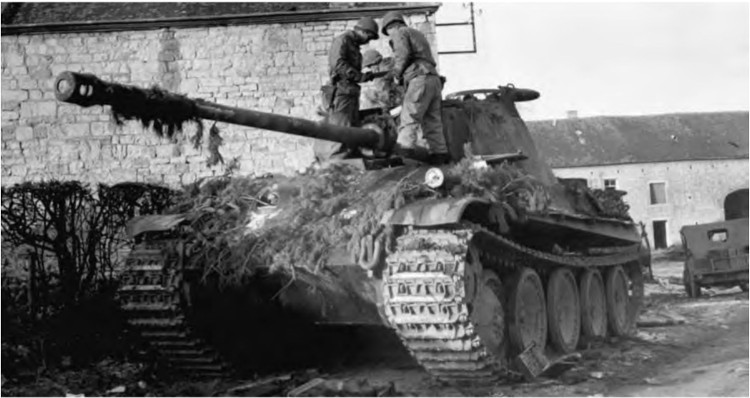
“KING TIGER” OR “ROYAL TIGER” (Pz. Kpfw. VI (B) “Tiger” with 8.8-cm. Kw. K. 43) (top). This tank, weighing 75 tons and designed for defensive warfare or for penetrating strong lines of defense, made its appearance in combat in 1944. It had heavy frontal armor and an 88-mm. gun which could traverse 360 degrees. Germany heavy tank, the Panther (Pz. Kpfw. with 7.5-cm. Kw. K, 42-L/70) (bottom). This tank, introduced in 1942, weighed 47 tons and had sloping frontal armor and a 75-mm. high-velocity gun.
FRANCE
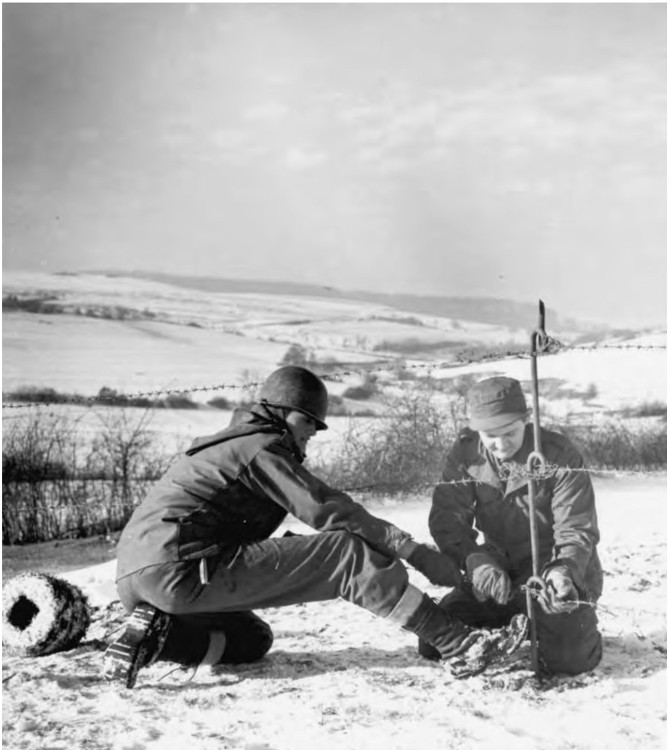
BARBED WIRE BEING STRUNG as a defensive measure in the event of another enemy counterattack. In mid-January the enemy was still able to maintain a cohesive line, but the critical situation on the Russian front made necessary the shifting of troops to the eastern front while withdrawing to the security of the West Wall all committed troops facing the western Allies.
FRANCE
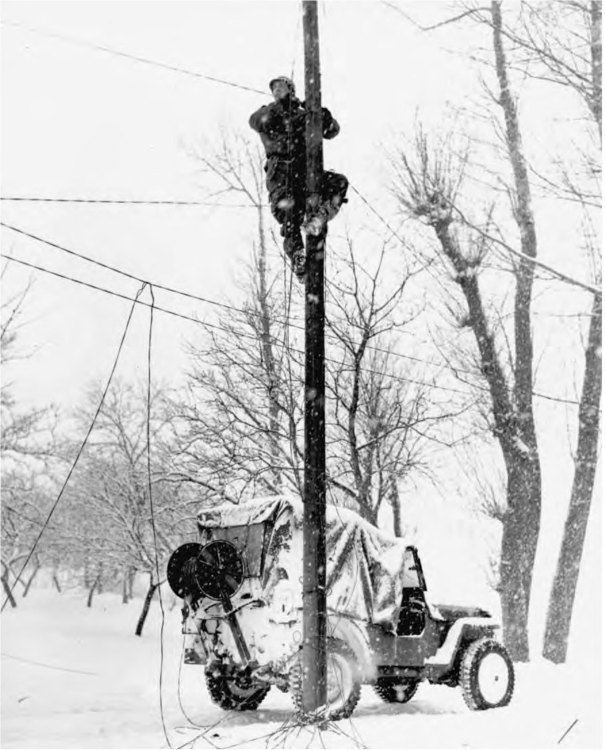
A SIGNAL CORPS LINEMAN repairing damaged telephone lines.
FRANCE
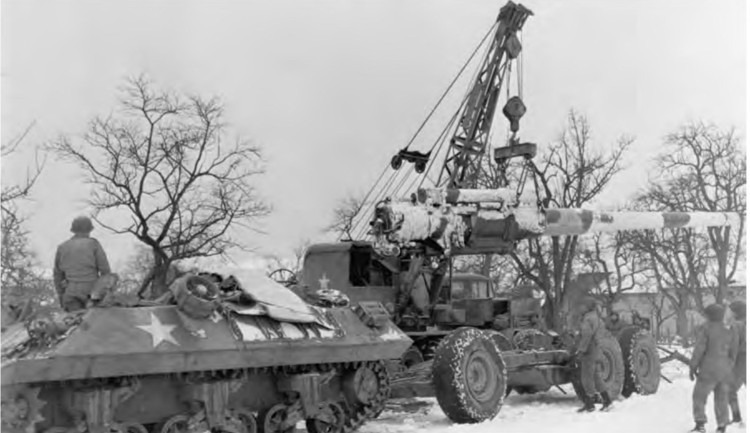
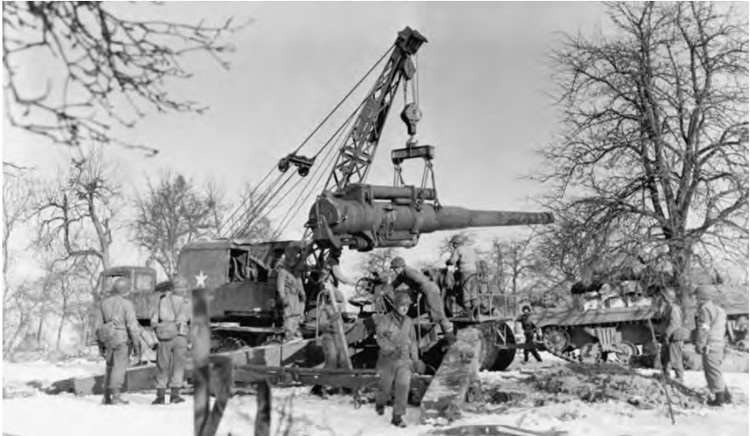
A TRUCK-MOUNTED CRANE swinging the barrel of an 8-inch gun from its transport wagon (top), and placing it on its carriage (bottom). The gun and cradle were transported on one vehicle and the carriage on another.
FRANCE
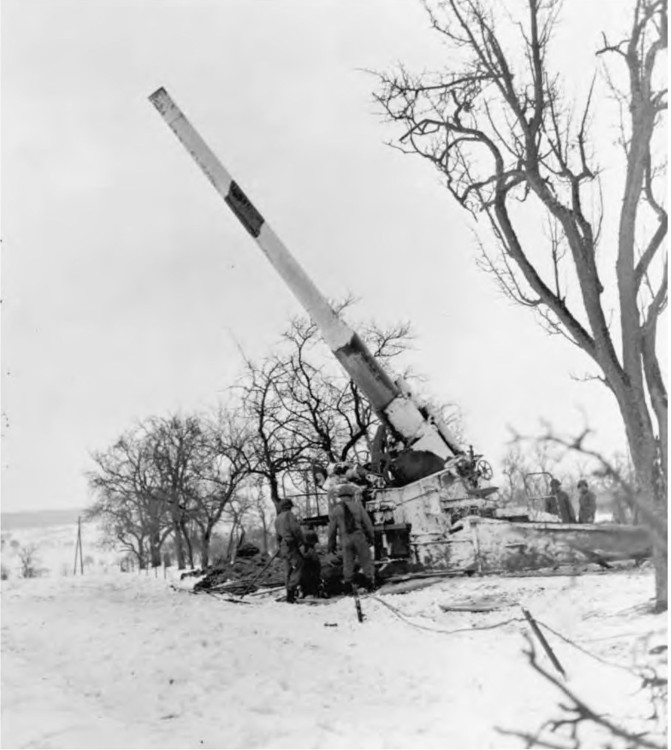
A CAMOUFLAGED 8-INCH GUN M1 located in the southern portion of the Third Army zone. This gun was capable of firing a 240-pound projectile a distance of 20 miles. The troops left in this area were placed on the defensive during the fighting in the Ardennes sector. Heavy artillery in the area fired on enemy installations in the triangle of the Moselle and Saar Rivers and West Wall fortifications.
BELGIUM
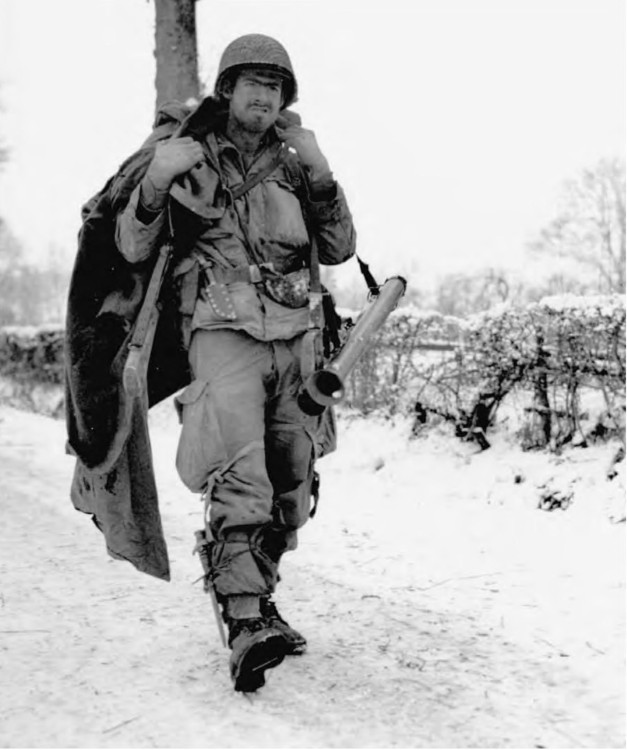
A MEMBER OF A GLIDER REGIMENT, armed with a rifle and a rocket launcher, returning from a three-hour tour of guard duty.
BELGIUM
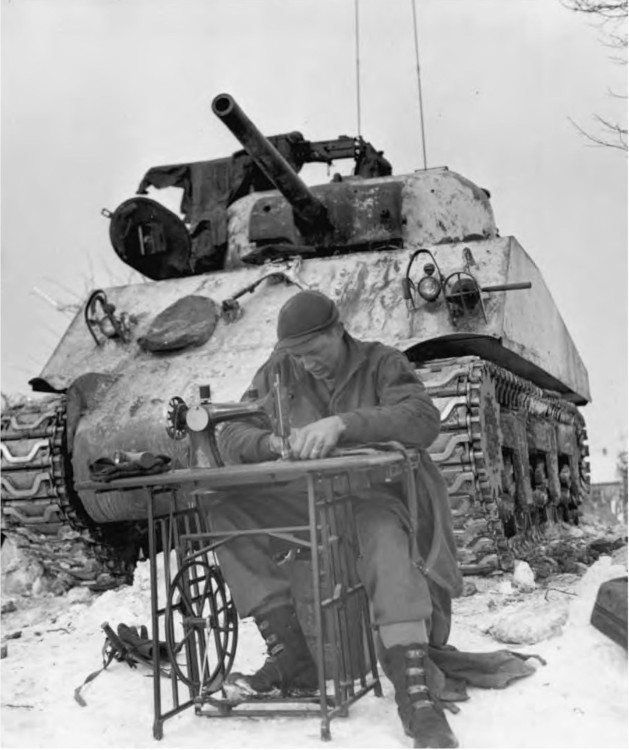
A TANKER SEWS HIS CLOTHING on an old sewing machine in front of his M4A3 medium tank.
BELGIUM
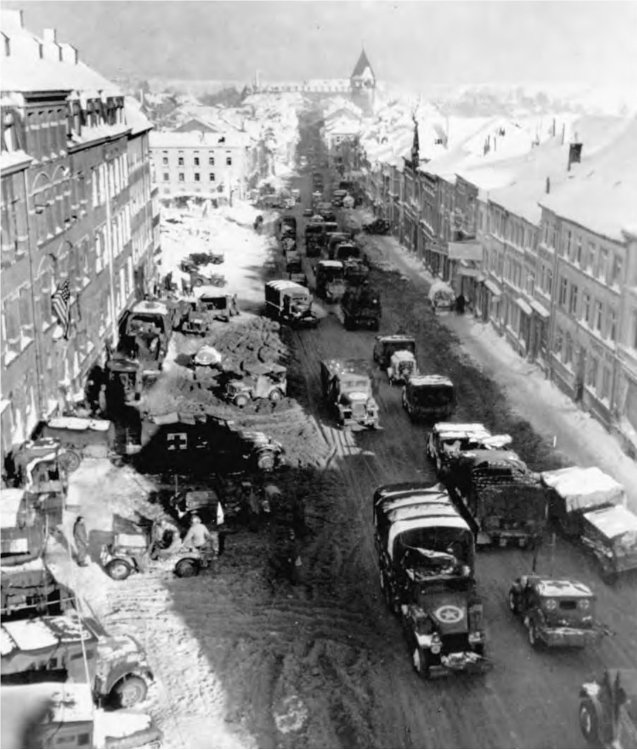
SUPPLIES MOVING THROUGH BASTOGNE, 22 January 1945, on their way to the front-line troops. By the first of the year material losses in the Battle of the Bulge had been replaced and the combat units were again prepared to move forward.
LUXEMBOURG
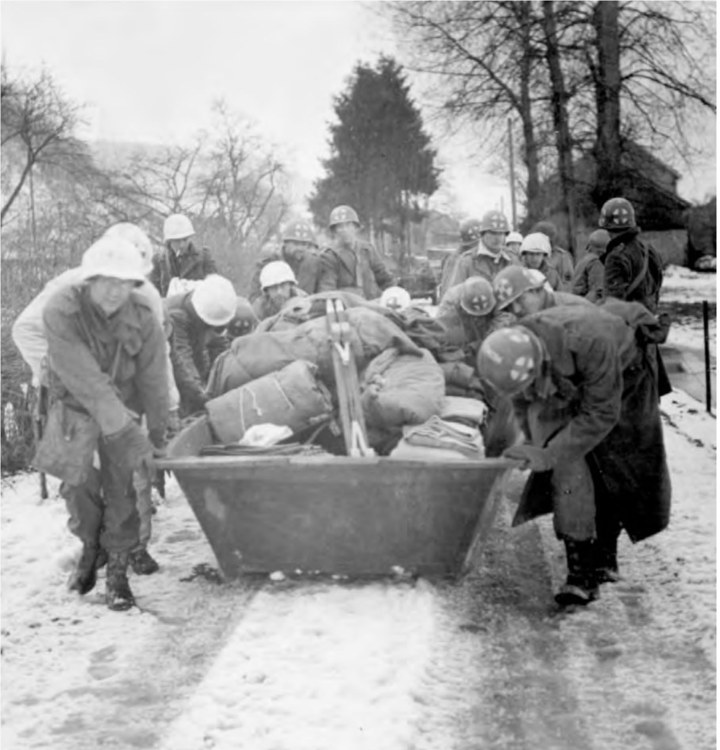
MEDICAL AID MEN dragging a boatload of medical supplies down a snow and ice covered road to the banks of a stream they are to cross. From 17 to 24 January the Third Army continued to attack through Houffalize and reached the northern tip of Luxembourg on 24 January. In an advance to the east bridgeheads north of Clervaux on the Clerf River were secured on 23 January. During this period most of the area between the Sauer and the Our Rivers was cleared of enemy resistance. In a hurried effort to withdraw as many vehicles as possible the enemy lost over 1,700 vehicles to planes of the U. S. XIX Tactical Air Command.
BELGIUM
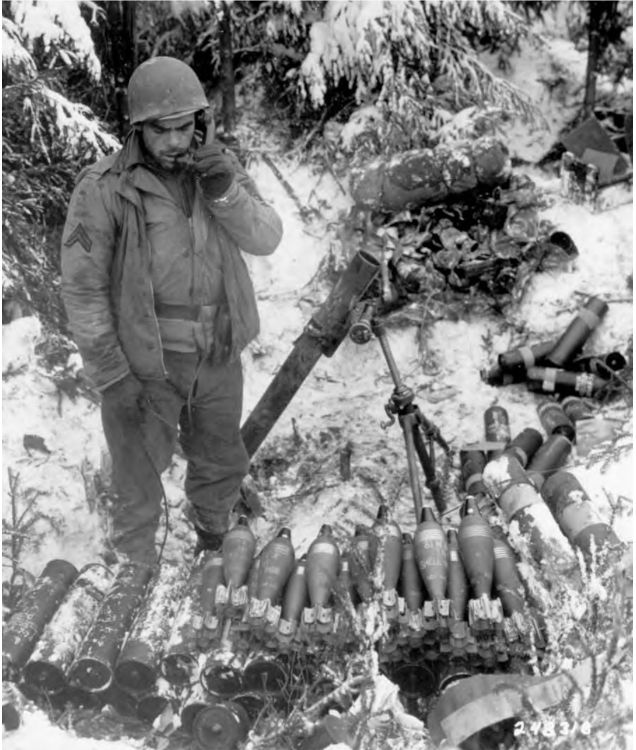
A MEMBER OF AN 81-MM. MORTAR CREW listening to firing orders from a battalion command post.
BELGIUM
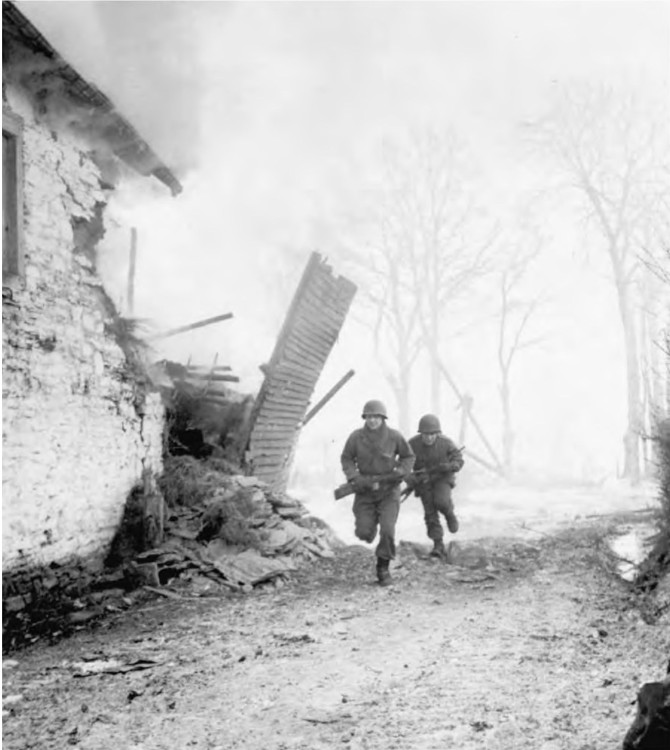
INFANTRYMEN ADVANCING UNDER ENEMY SHELL FIRE. On 15 January 1945, on the left of the First Army zone, an attack was begun from the Butgenbach-Malmédy positions. By 19 January First Army had secured the defiles southwest of Butgenbach. The attack launched toward Saint-Vith continued to gain ground, and on 23 January Saint-Vith was recaptured.
BELGIUM
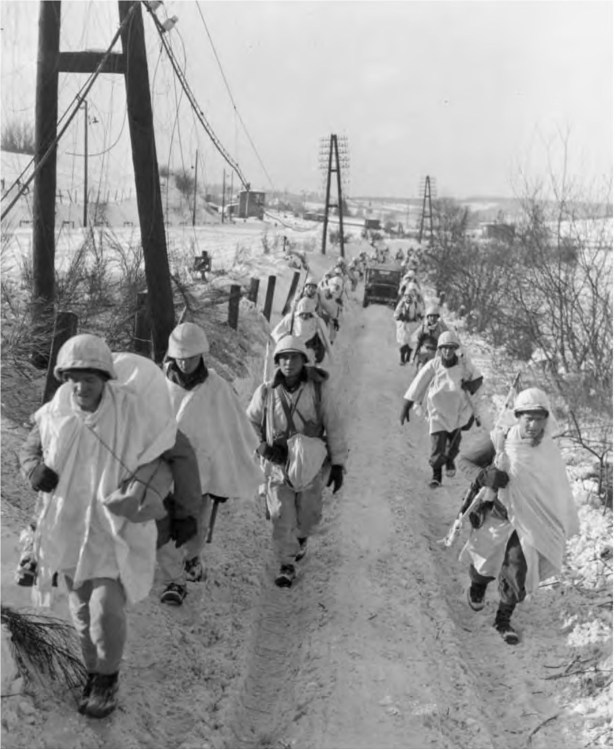
FIRST ARMY TROOPS, wearing snow camouflage capes, advance.
BELGIUM
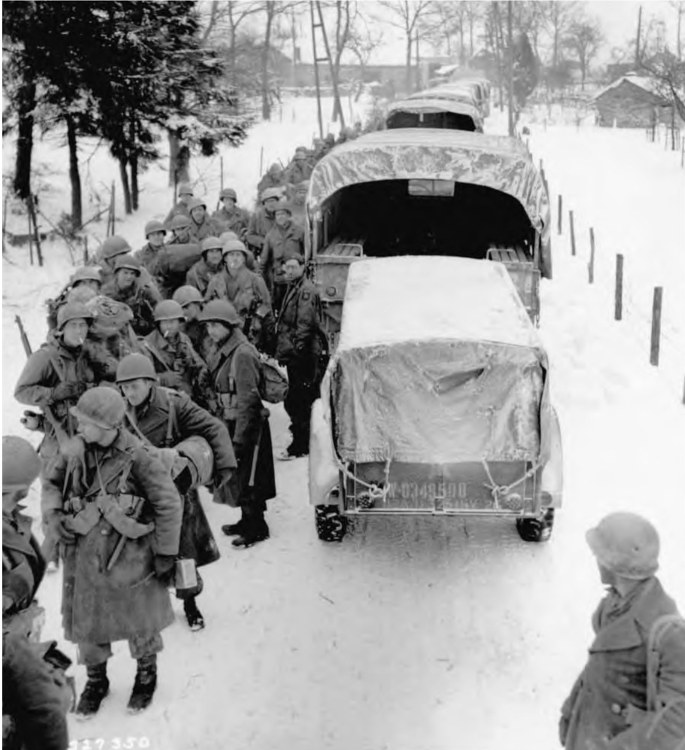
MEN OF AN AIRBORNE UNIT preparing to board trucks which will take them to a rest area after being relieved at the front. On 24 January the First and Third Armies’ boundary was shifted north in the general line Saint-Vith-Losheim-Ahr River and attacks were to be renewed on the Saint-Vith-Bonn axis. First Army was to breach the West Wall and secure the high ground in the vicinity of Blankenheim, while Third Army was to attack with its left wing to cover the First Army.
GERMANY
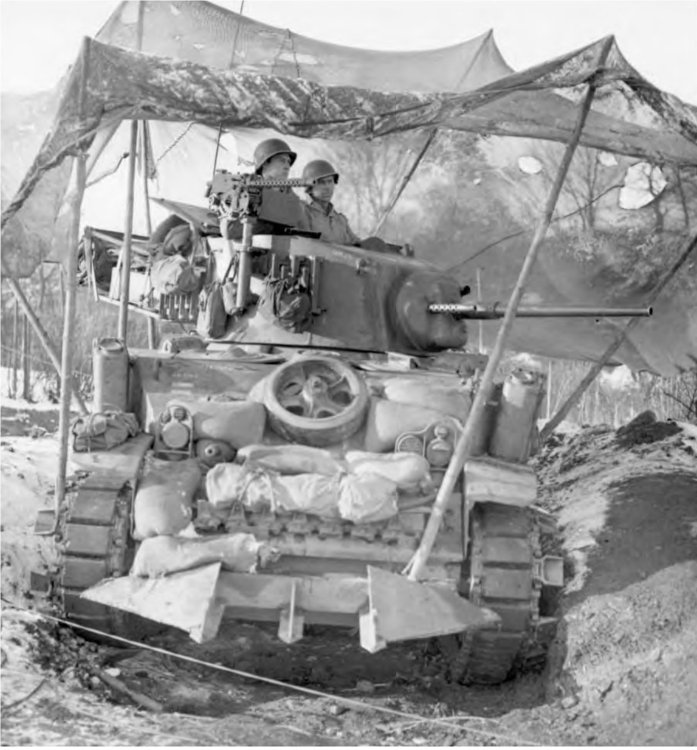
AN M5 LIGHT TANK guarding a road in the U. S. Ninth Army area, 22 January. With the collapse of the German salient in the Ardennes, preparations were made for the offensive to the Rhine by 21 Army Group. The Germans held the triangle south of Roermond between the Meuse and Roer Rivers. This was a serious threat to the left flank of the Ninth Army and had to be eliminated before the army could advance across the Roer to the Rhine plain. The task of eliminating this salient was assigned to the British Second Army and by 26 January was completed.
FRANCE
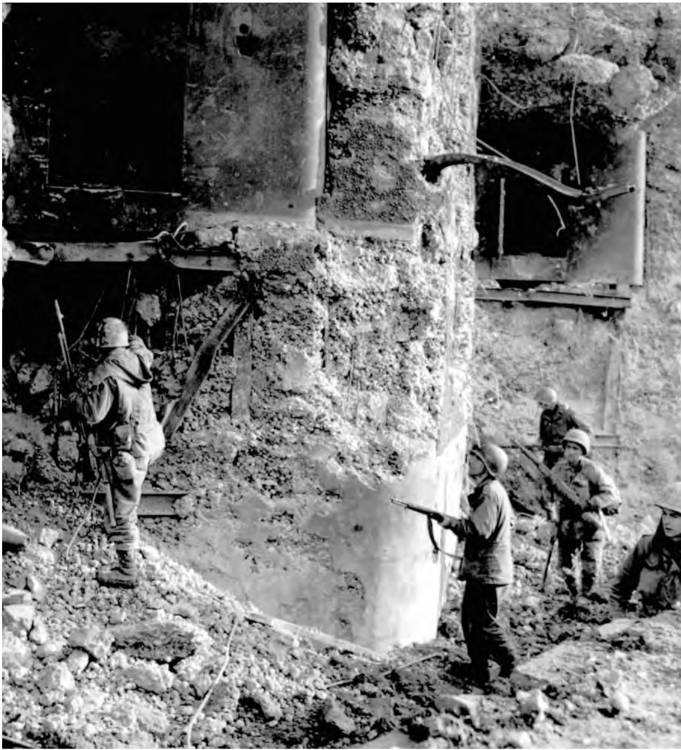
SEVENTH ARMY TROOPS entering a fortress of the Maginot Line, near Bitche, France, which had been taken in the December fighting. Reduction of the strongly defended forts of the Maginot Line was halted when the Ardennes fighting began. The new Seventh Army front included the three following areas: the Saare Valley in Lorraine; the low Vosges mountains; and the northern Alsace plain between the mountains and the Rhine.
FRANCE
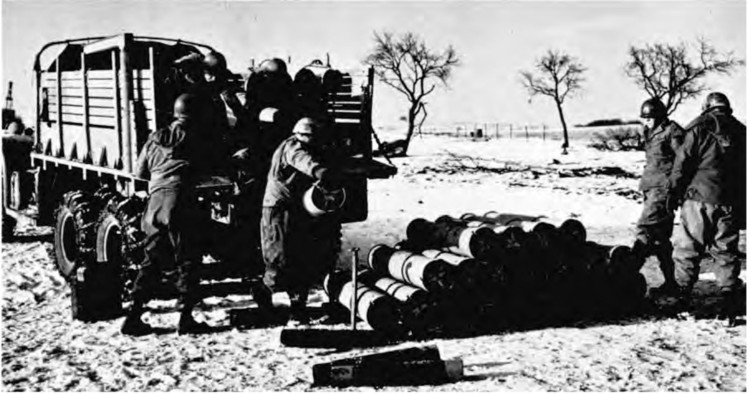
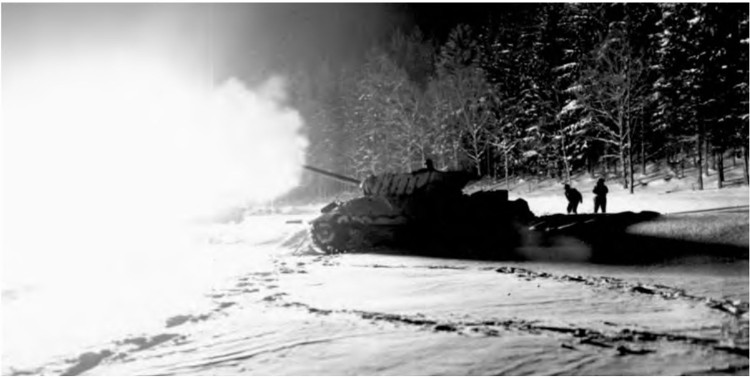
MEMBERS OF A SEVENTH ARMY ARTILLERY UNIT unloading powder charges for their 240-mm. howitzer (top); 3-inch gun motor carriage firing on enemy positions at night (bottom). On 20 December 1944 the 6th Army Group abandoned its offensive and relieved the Third Army in the region westward to Saarlautern to defend against any enemy penetration in Alsace-Lorraine. The offensive was stopped even though many pillboxes in the West Wall had been taken, and during the last ten days of December the Seventh Army regrouped its forces and deployed its troops.
FRANCE
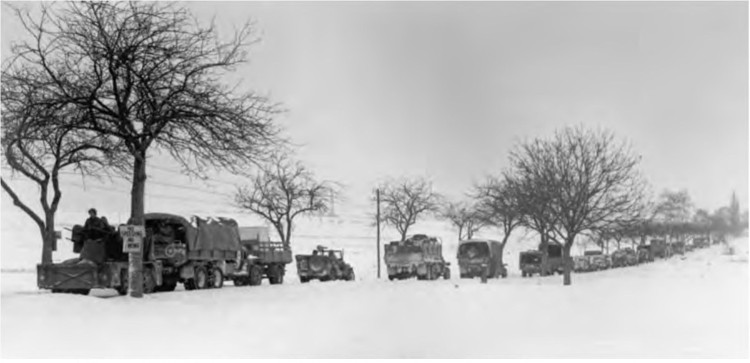
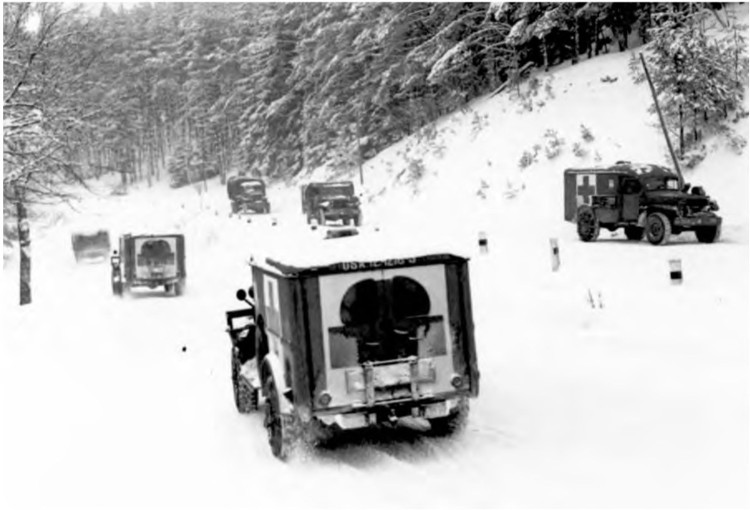
CONVOY MOVING UP in the Seventh Army area during the fighting in Alsace (top); vehicles moving over snow-covered roads through the Vosges mountains (bottom).
FRANCE
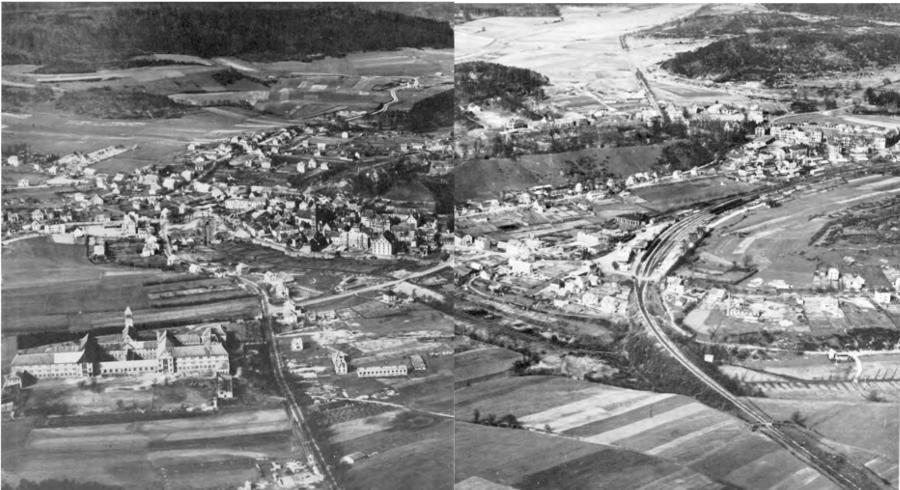
BITCHE, FRANCE. The Seventh Army prepared an alternate main line of resistance along the old Maginot Line (Sarreguemines-Bitche-Lembach-Hatten-Sessenheim) and a final defensive position along the eastern slope of the Vosges. On 1 January 1945 the Germans attacked in the area between Sarre and Rohrbach and drove ten miles into the U. S. lines, where the appearance of powerful armored reserves of the U. S. forces and Allied counterattacks caused the enemy to curtail its operation. Another New Year’s Day attack by the Germans in the Bitche area was a more serious threat. After stubborn fighting on the part of the Allied troops the attack spent itself on 7 January. In the Bitche salient the fighting continued until 20 January before becoming stabilized.
FRANCE
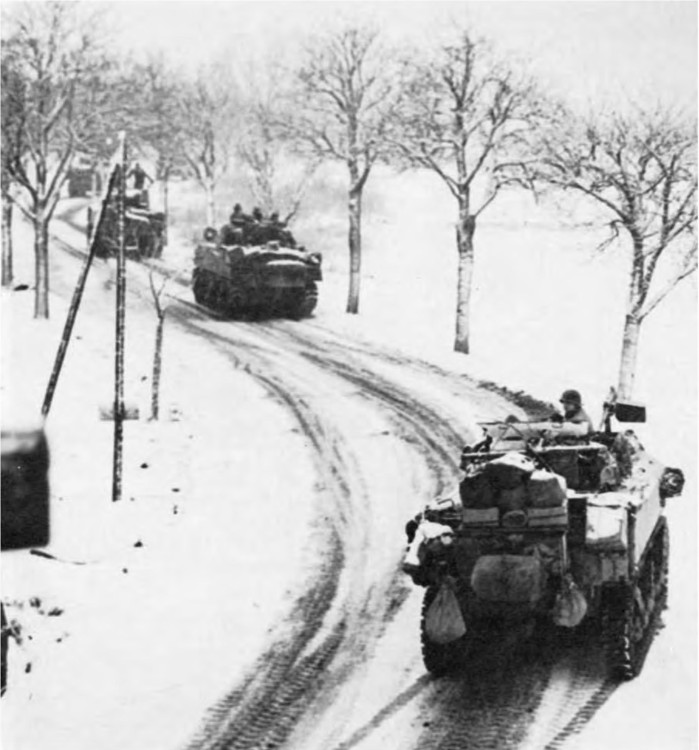
TANKS OF AN ARMORED UNIT moving along a slippery road during a heavy snowstorm. In other 6th Army Group areas there was action along the front. As U. S. troops withdrew to the Maginot Line so that French troops could take over this portion of the front, the Germans followed closely. French troops in the Strasbourg area contained an enemy attack from the Colmar pocket. There was heavy activity in the U. S. zone near Hatten where the enemy, after suffering heavy losses, failed to break through the U. S. troops.
FRANCE
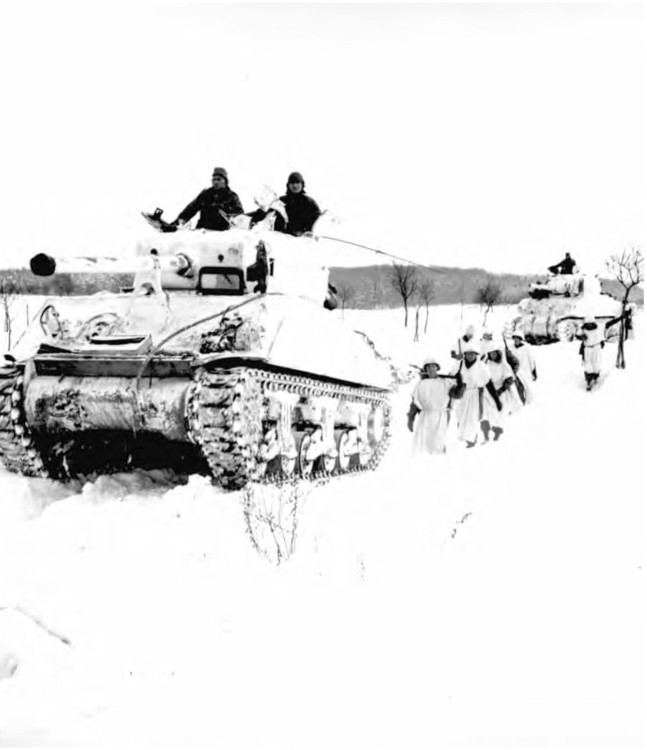
CAMOUFLAGED TANKS and infantrymen, wearing snow camouflage capes, moving over a snow-covered field. Toward the end of January a heavy snowfall slowed operations and on 25 January the enemy struck his final blow near Haguenau, France. On 26 January the Germans were driven back across the Moder River.
FRANCE
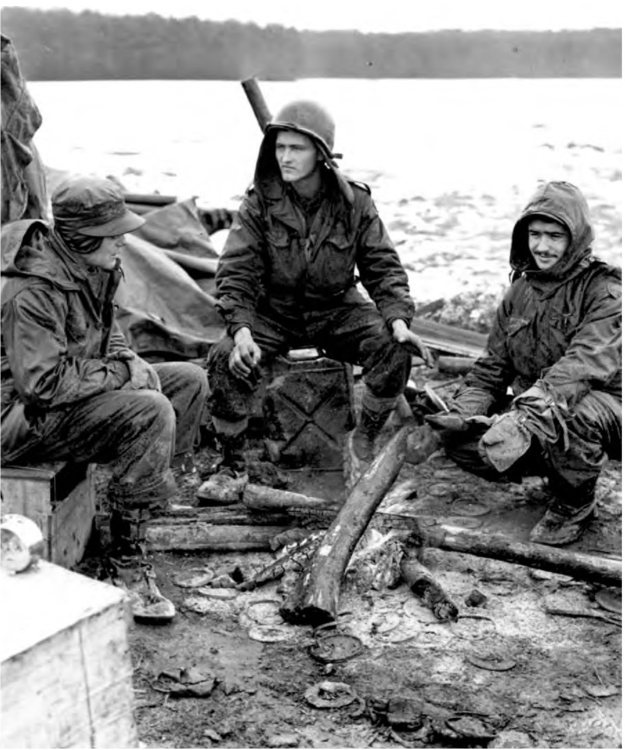
MEMBERS OF A CANNON COMPANY near Haguenau keep warm as best they can.
RHINELAND CAMPAIGN 26 January 1945–21 March 1945
RHINELAND
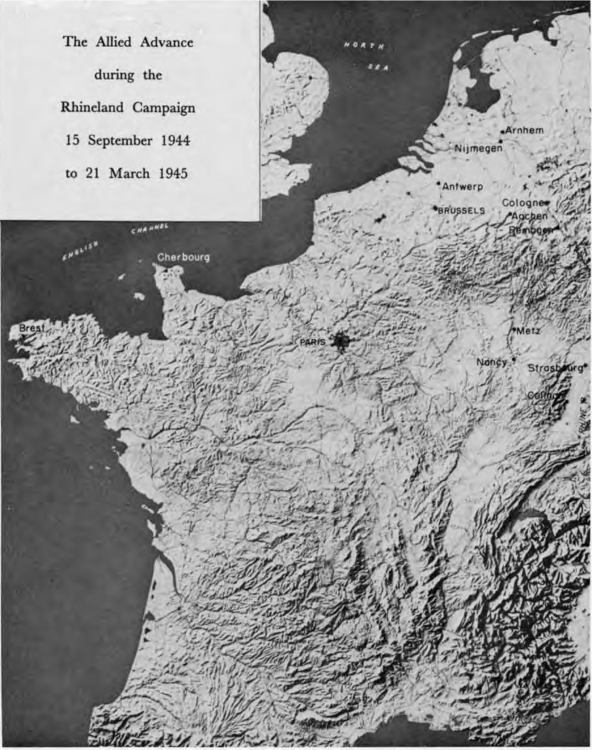
The Allied Advance during the Rhineland Campaign 15 September 1944 to 21 March 1945