SECTION III Northern France Campaign[2]
Reading edition
SECTION III Northern France Campaign[2]
On 25 July 1944 the Allied forces fighting in Normandy were able to begin the offensive to break out of Normandy and carry to the German frontier. Preceding the ground attack planes of the Allied air forces dropped more than 3,390 tons of bombs on enemy positions on a narrow front in the vicinity of Saint-Lô. The air attack’s crushing power and its paralyzing effect on the German forces opened the way for a rapid and powerful drive by Allied armored and infantry units. Cities were captured in quick succession and the enemy troops were forced to flee in a disorderly retreat.
The armored spearheads led the way out the Brittany Peninsula which was quickly occupied, with the exception of the fortresses of the port cities which were to continue to fight until after the German borders had been reached. While part of the U. S. forces were overrunning the Brittany Peninsula, the major portion turned toward the east in the direction of Paris, and British and Canadian troops moved southward from Caen along the road to Falaise. The battle of the Falaise-Argentan pocket was a disastrous defeat for the German forces who were trying to prevent the Allies from moving eastward. During the fighting in this area elements of two German armies were so disorganized and destroyed that their effectiveness was greatly impaired.
Paris surrendered on 25 August and by the 27th all enemy resistance ceased there. The advance continued toward the eastern borders of France, where the Allies stopped their rapid drive, and though a few further advances were made, 14 September 1944 found them consolidating their positions along the Moselle River and northward in Belgium and Holland. The major port cities of Le Havre and Antwerp, which were badly needed by the Allies as ports of entry for men and materials, were captured.
INTRODUCTION
During the Northern France Campaign the expanding Allied forces reorganized. The Supreme Headquarters, Allied Expeditionary Force, moved to the Continent of Europe. The 21 Army Group was made up of the British Second and the Canadian First Armies. The 12th Army Group, composed of the First and Third U. S. Armies, became operational. In August 1944 Allied forces invaded southern France and moved northward to join those in northern France. This force, made up of the U. S. Seventh and French First Armies, made a junction with the northern group on 11 September. Also during this period the U. S. Ninth Army became operational and took over the reduction of the Brittany fortresses.
FRANCE
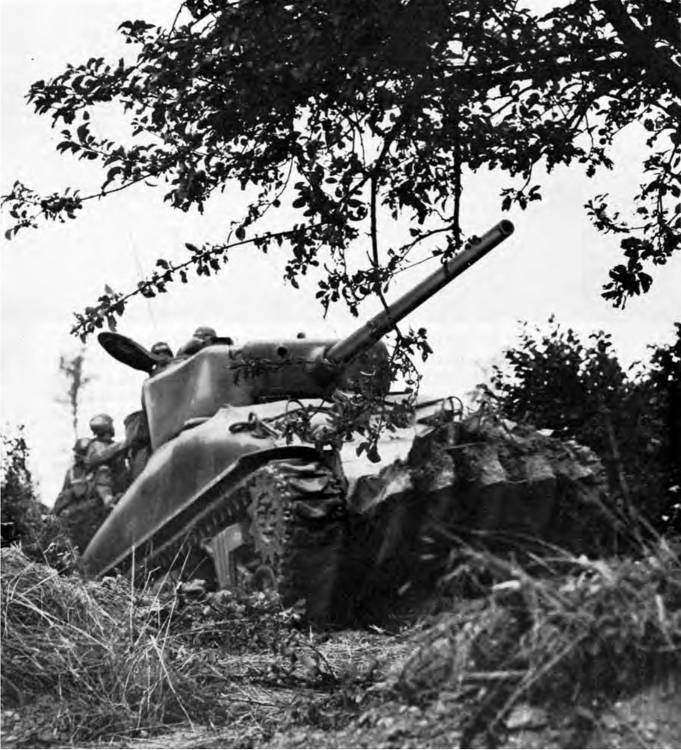
MEDIUM TANK M4A1, equipped with a hedgerow cutter, breaking through a hedgerow. The build-up was continuing generally as anticipated and the destruction of the enemy forces progressed. On 23 July 1944 the Canadian First Army became operational on the left flank of the Allied line. The Third U. S. Army had begun moving to the Cotentin Peninsula on 5 July and was proceeding on the right flank of the Allied line.
FRANCE
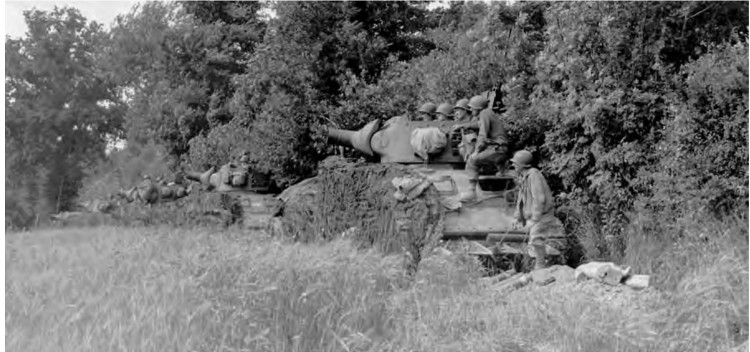
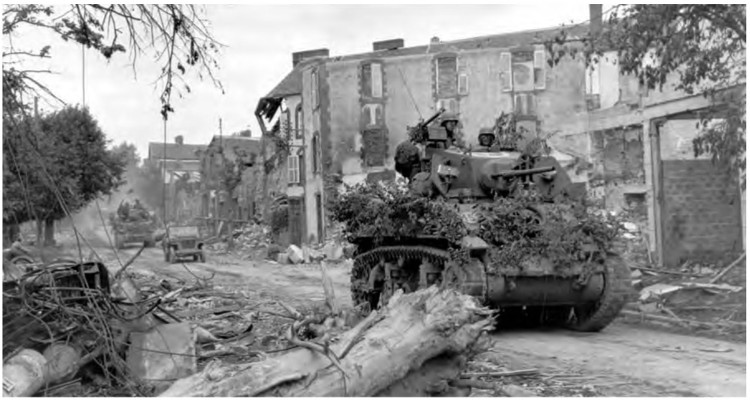
75-MM. HOWITZER MOTOR CARRIAGES M8, partially concealed by a hedgerow, preparing to fire on enemy positions near Marigny (top). M5 light tanks pass through the streets of Coutances (bottom). The first attack was launched on a narrow front across the Périers road west of Saint-Lô. This attack was supported by heavy artillery and aerial bombardment. While the spearhead units advanced in the direction of Coutances, the rest of the First U. S. Army was to exert strong pressure and harass any attempted enemy withdrawal. Marigny was taken on 26 July and, though the enemy resisted stubbornly while trying to keep a corridor open for the withdrawing German forces, Coutances fell on 28 July.
FRANCE
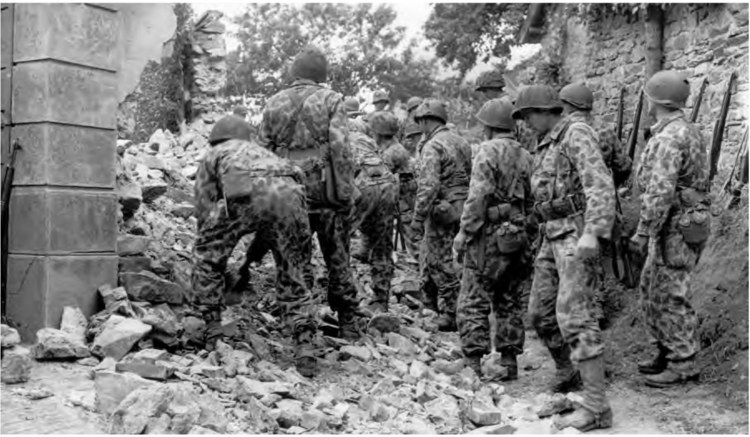
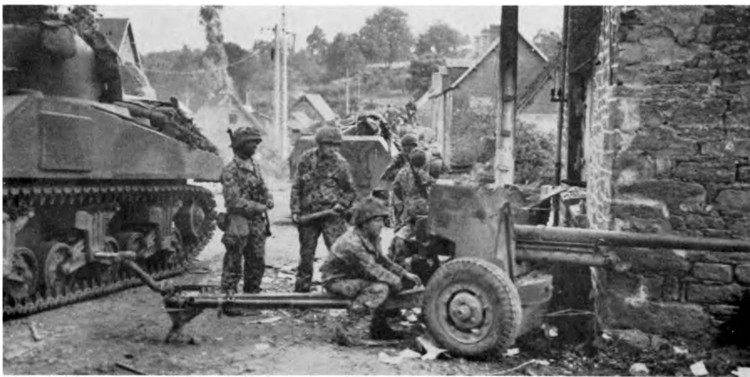
ENGINEERS WEARING CAMOUFLAGE SUITS clean out a street in Canisy (top). Infantry troops set up a 57-mm. antitank gun M1 (bottom). Advances south from Saint-Lô reached Tessy-sur-Vire on 28 July, while another attack farther east met with severe resistance in the vicinity of Forêt de Cerisy. In the British-Canadian sector the advance had been halted by a strong enemy belt of antitank guns, dug-in tanks, and mortars.
FRANCE
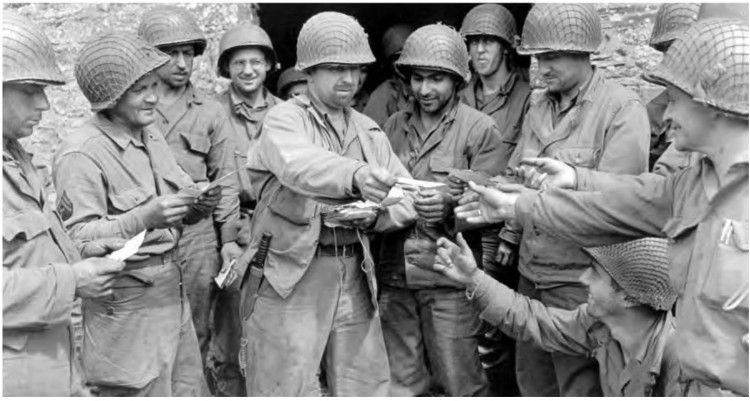
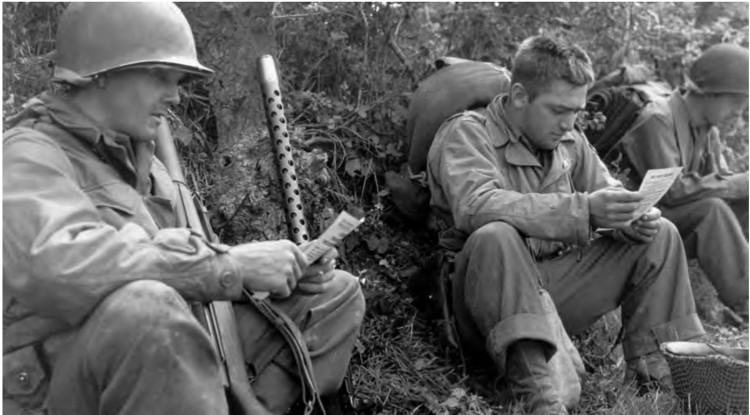
MAIL CALL AT THE FRONT (top). The receiving of mail was always an important morale factor and every effort was made to get it to the men as quickly as possible. Infantrymen reading German propaganda leaflets during a rest period (bottom). German planes dropped propaganda leaflets in an attempt to discourage the Allies in their advances. These had little effect on the troops and the advances continued with all possible speed.
FRANCE
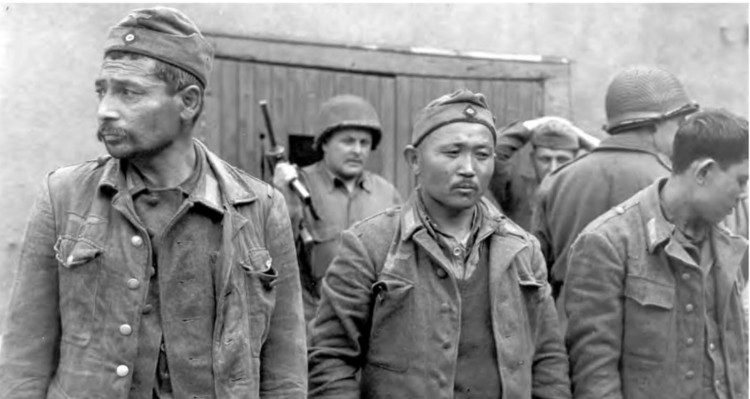
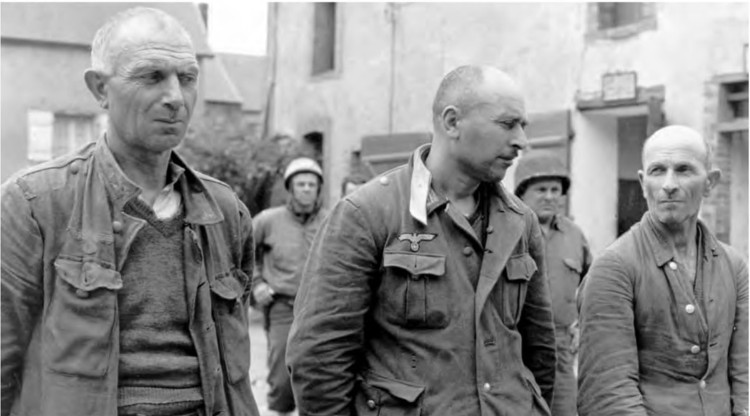
PRISONERS TAKEN BY THE ALLIES during the early part of August. Many of the men of the enemy forces were non-Germanic, some were Russians or members of Russian units who had been captured by the Germans on the eastern front and sent to Normandy as part of the enemy defense units. As the enemy retreat began to degenerate into a disorderly rout many prisoners were taken, and on 28 July 4,500 were captured.
FRANCE
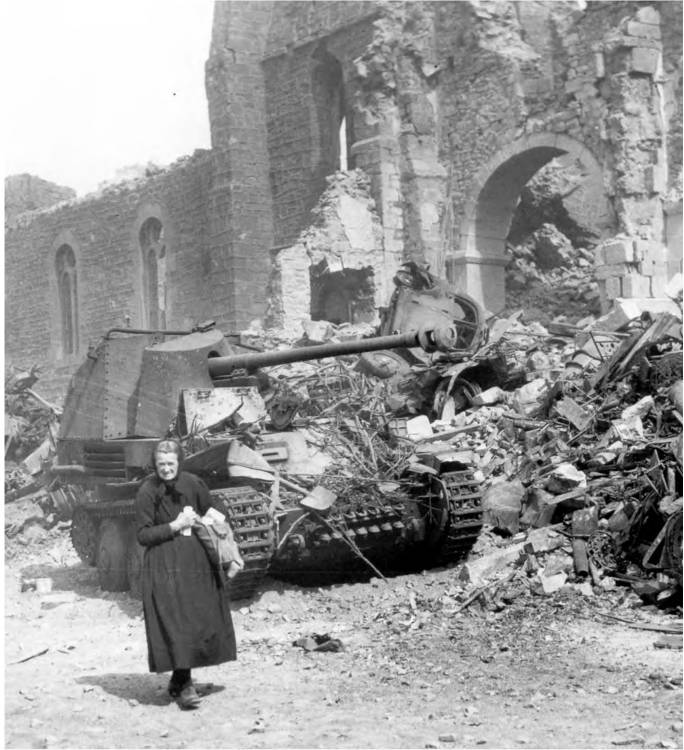
FRENCH WOMAN, returning to her home after the German withdrawal, passes a knocked out self-propelled antitank gun (Pz. Jaeg. 38 with 7.5-cm. Pak. 40/3). Many of the civilians left their homes and towns during the fighting and returned afterwards, often to find that they had lost their homes during the artillery shelling and aerial bombing. However, in some cases the civilian population stayed in the towns during the fighting.
FRANCE
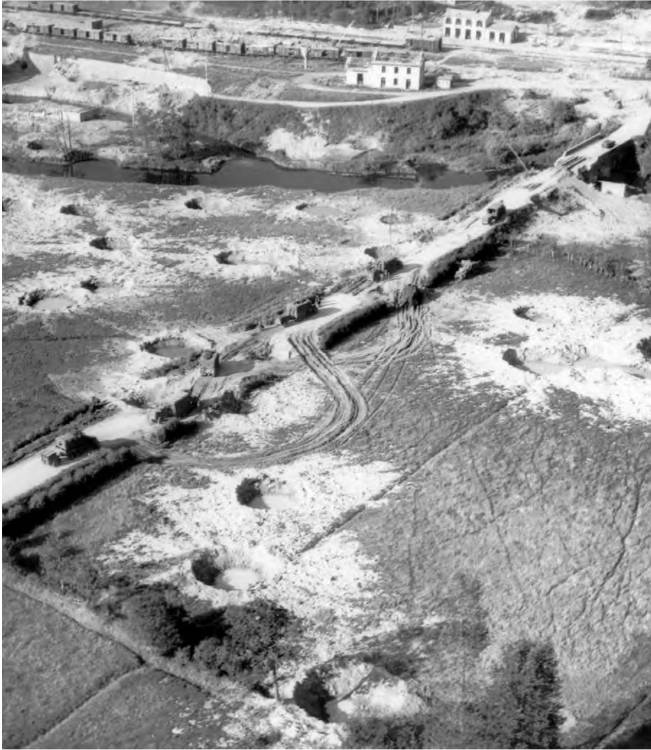
MOTOR COLUMN ADVANCING ALONG A ROAD near Coutances. On 29 July U. S. armored divisions trapped an enemy column about seven miles southeast of Coutances. Fighter bombers came in and attacked the closely jammed columns of vehicles destroying 137 tanks and over 500 other vehicles.
FRANCE
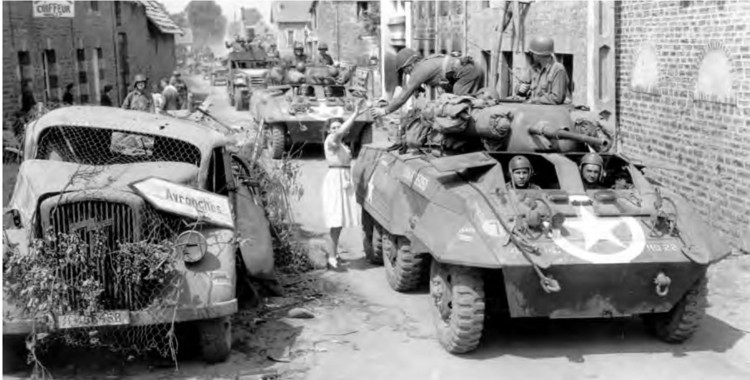
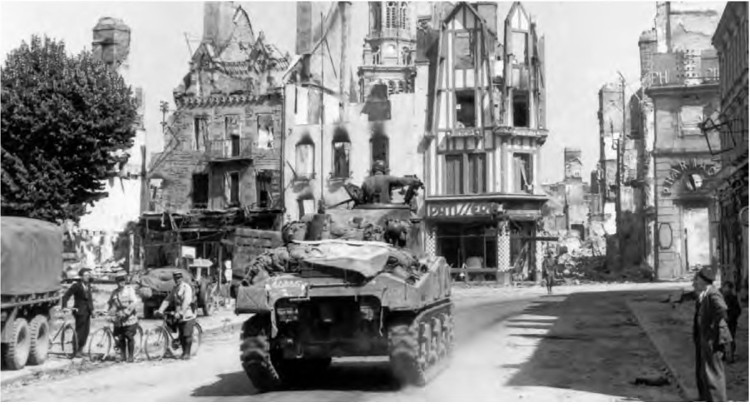
AN ARMORED COLUMN led by a light armored car M8 stops for a few minutes during its advance to Avranches (top). An M4 medium tank moving through a street in Avranches (bottom). On 30 July an armored division closely followed by an infantry division closed in on Cranville. Another armored division entered Avranches and secured two bridges across the Sée River. The break-through was completed by 31 July, the area between Granville and Avranches was cleared of enemy pockets of resistance, and the U. S. forces struck southward in the direction of Villedieu.
FRANCE
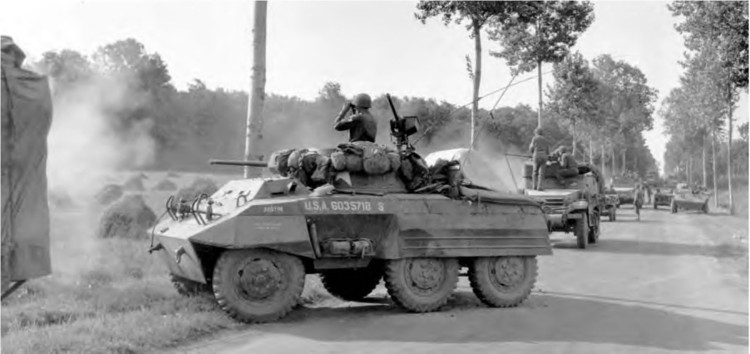
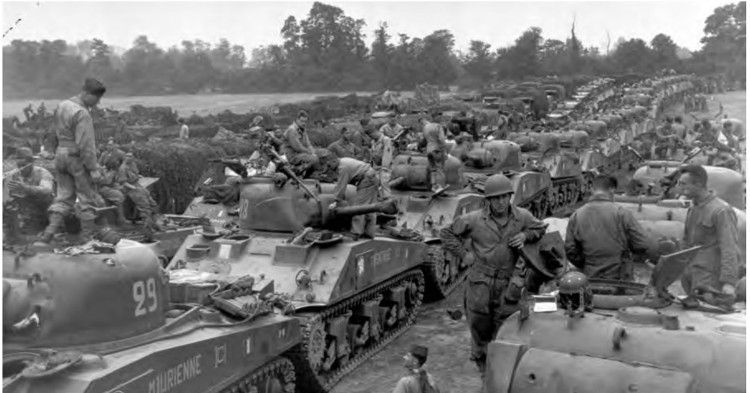
ARMORED VEHICLES FIRING ON ENEMY TROOPS during the advance southward (top). Tanks and trucks of a French armored division in the assembly area after landing and before starting south to join the U. S. forces (bottom). On 1 August 1944, as the U. S. forces poured around the crumpled German flank at Avranches, a major revision was effected in the organization of the Allied forces. The Third U. S. Army became operational and at the same time the 12th Army Group headquarters also became operational and assumed command of the First and Third U. S. Armies. The 21 Army Group was at this time made up of the British Second and the Canadian First Armies.
FRANCE
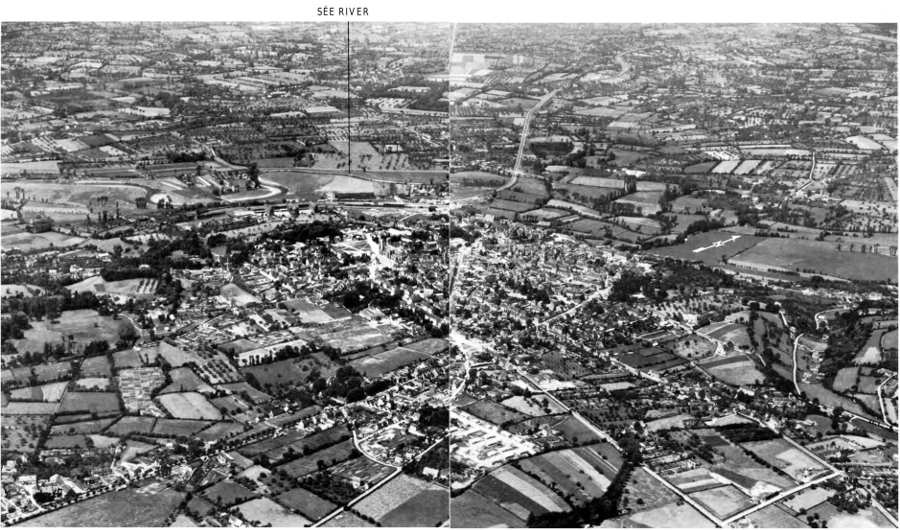
AVRANCHES AND THE SURROUNDING COUNTRY. After the fall of the city the Allied drive gained momentum and the advancing troops swept out of Normandy. Turning toward the east and the west in two attacks, the Allies drove to the German frontier and the tip of the Brittany Peninsula.
FRANCE
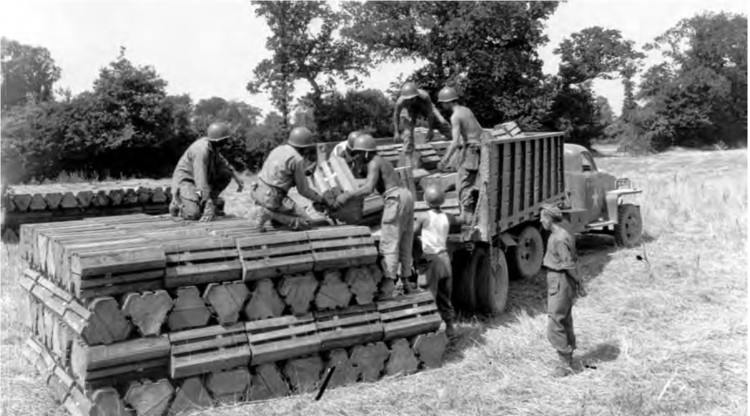
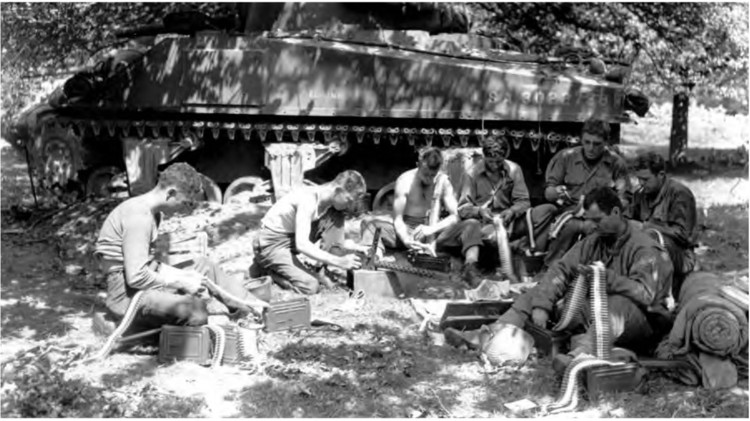
AMMUNITION BEING UNLOADED at an Ordnance dump after it had been brought inland from the beach (top). During the advance of the Allies south following the breakout from Normandy a maximum effort was required to keep all the using units supplied with ammunition. Tankers of an armored unit reloading their .30-caliber ammunition belts during the drive southward (bottom).
FRANCE
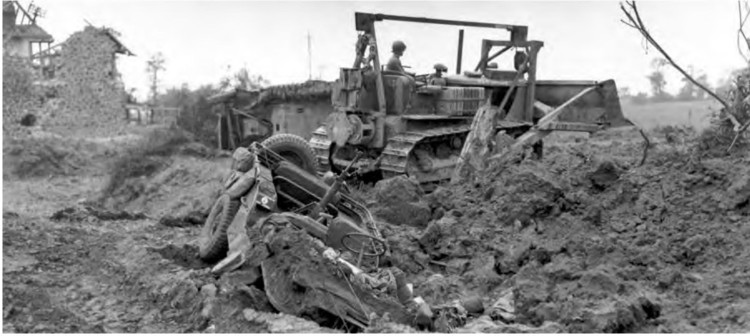
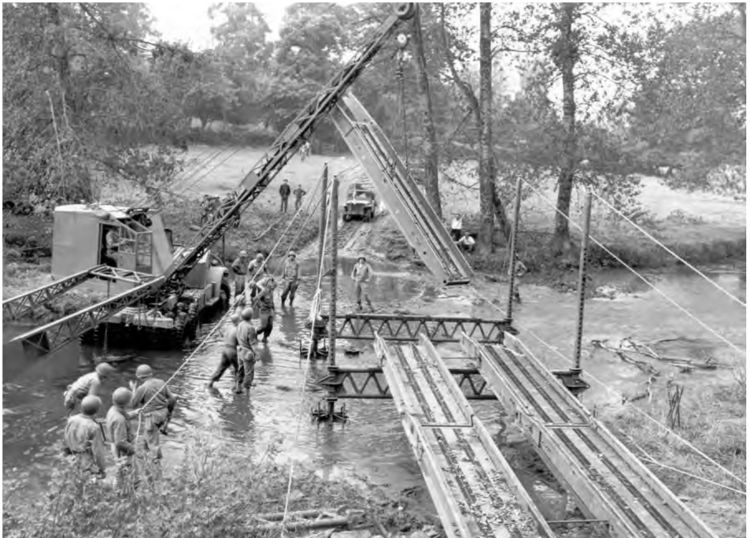
A BULLDOZER (tractor, earth moving crawler, diesel) pulling a jeep from a crater (top). Engineers using a truck-mounted revolving crane swing a section of a treadway bridge into place over the Vire River near Pontfarcy (bottom).
FRANCE
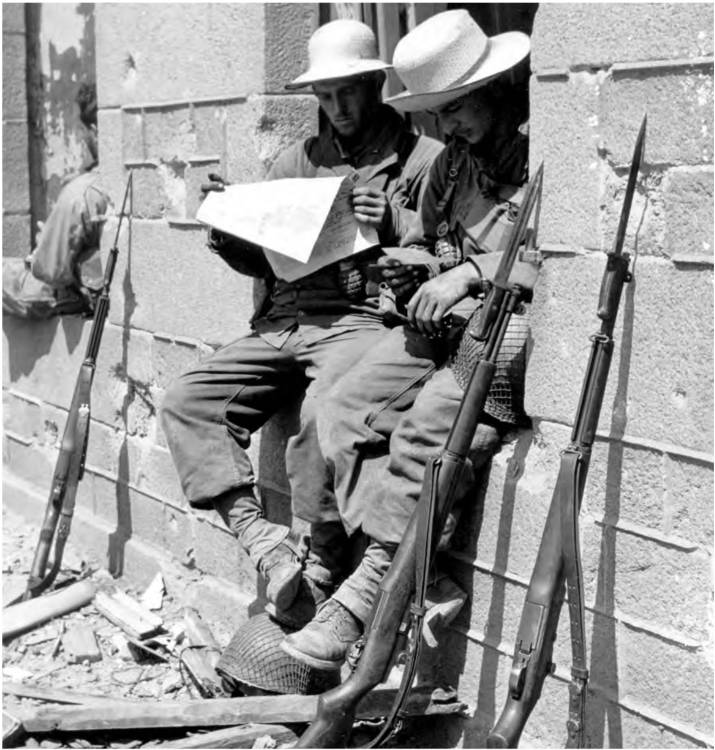
INFANTRYMEN TAKING A BREAK, their M1’s leaning against the wall of a destroyed building. The Third U. S. Army drove southward from Avranches on 1 August with the mission of clearing the Brittany Peninsula and securing the ports. The attacks were spearheaded by armored divisions against only scattered opposition and by 3 August Loudéac was reached, infantrymen were closing in on the fortress of Saint-Malo, armored units were striking toward Vannes and Nantes, and Rennes had been captured. The 21st Army Group and First U. S. Army met dogged enemy resistance, but Mortain was occupied by the latter.
FRANCE
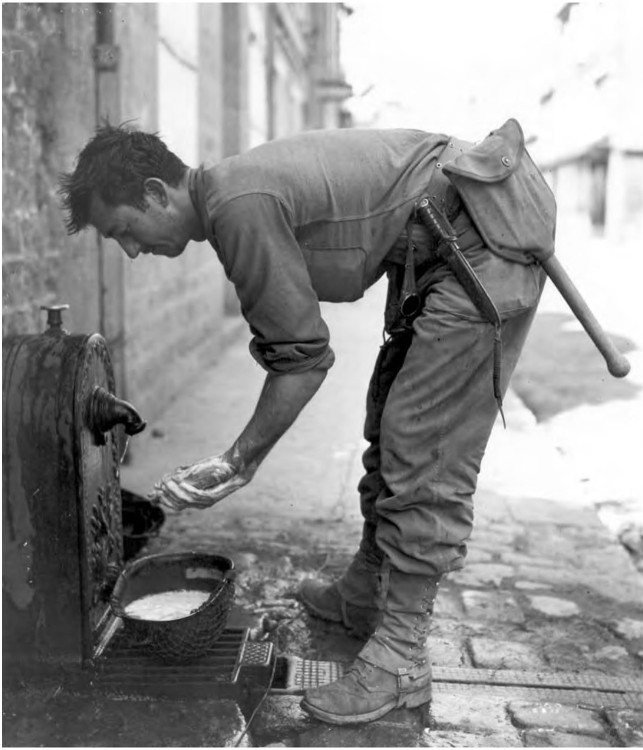
AN INFANTRYMAN USING HIS HELMET AS A BASIN while washing at a town pump. The weather during this period was hot and dry; inland from the coast there was little fog. The advancing men took every opportunity during the rapid advances to stop for a quick wash.
FRANCE
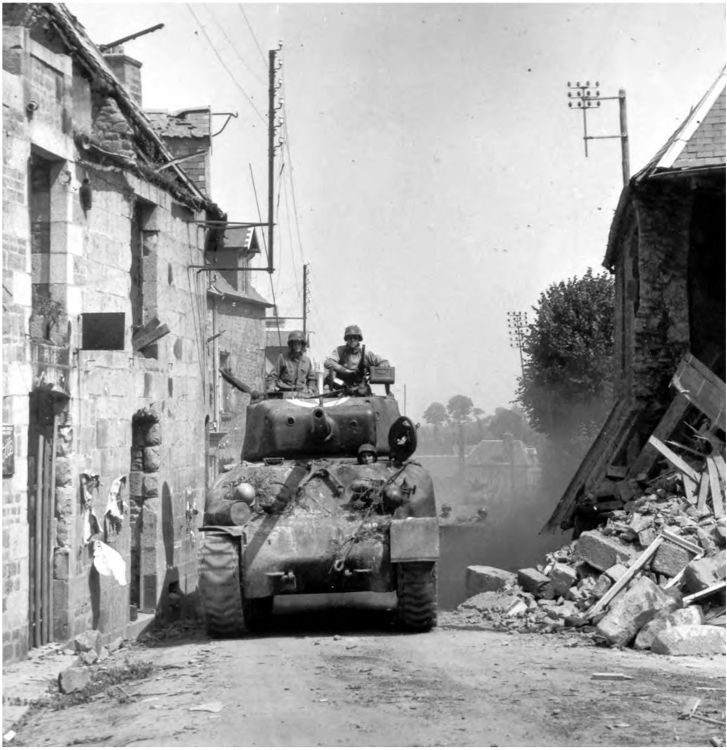
AN M4A1 MEDIUM TANK rolls through a battered French village. After the rapid advances through the Brittany Peninsula, U. S. forces were left in front of the main port cities to contain the enemy. The Third U. S. Army turned eastward driving with strong armored forces on the general axis of Laval-Le Mans-Chartres. The terrain that would be encountered in a drive to the Seine would be favorable for the use of armor, and the weather was expected to be good. On 4 August Mayenne was captured and contact with First U. S. Army units was established. During the next five days the drive to the east continued for a distance of 85 miles and the cities of Angers and Le Mans were taken.
FRANCE
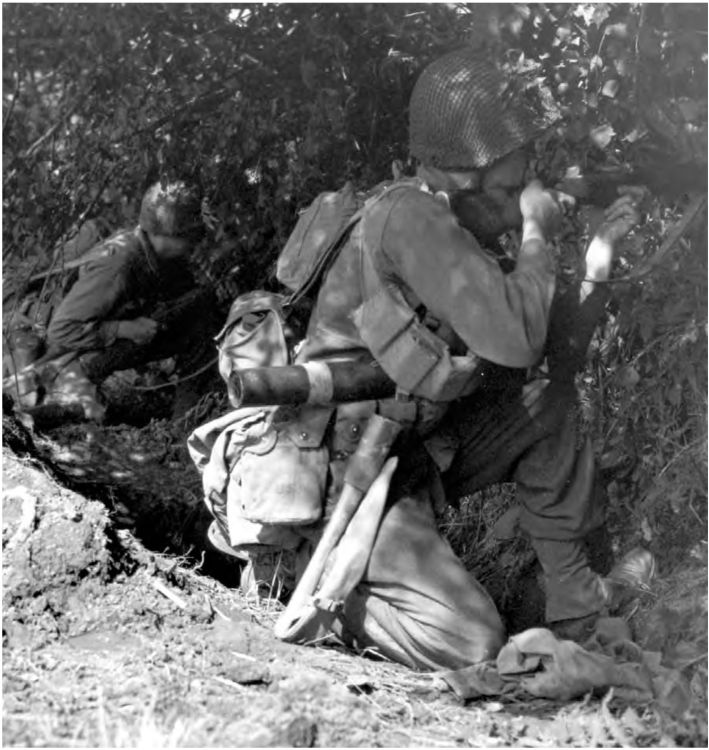
INFANTRYMEN FIGHTING IN HEDGEROWS near Mortain. Shortly after midnight on 7 August a German counterattack struck the U. S. infantry division in the area of Mortain. By morning, when the enemy had penetrated the First Army line some three or four miles, Allied aircraft equipped with rockets attacked the enemy. Three U. S. divisions were quickly shifted to the area and for the next three days a fierce battle raged as the Germans tried to cut the corridor through which the Third Army was advancing onto the plains of western France. On 11 August, Mortain was re-entered by the First Army.
FRANCE
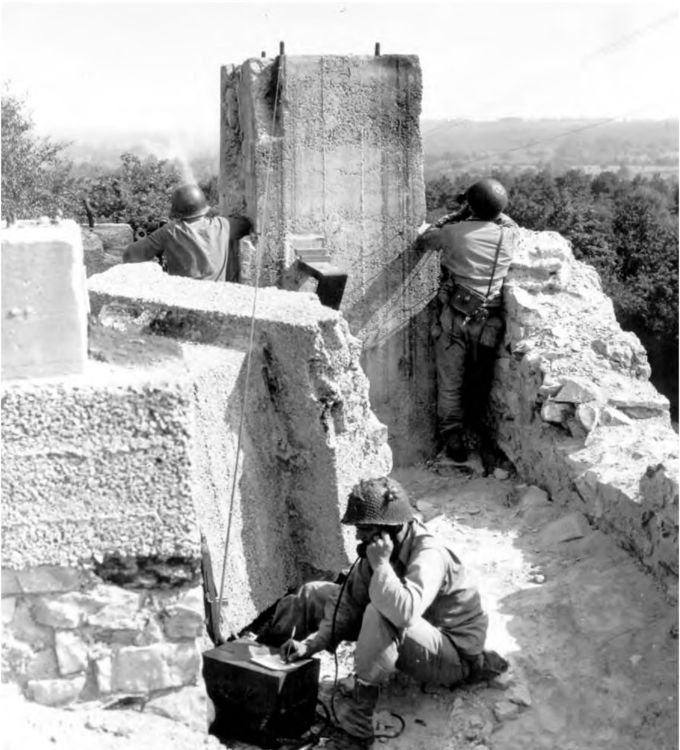
U. S. ARTILLERY OBSERVATION POST near Barenton, between Mortain and Domfront. After the failure of the German counterattack in the vicinity of Mortain the only alternative for the enemy was to retreat, and a gradual withdrawal was made toward the Seine River. During this period two simultaneous battles were fought: one by First Army troops and those of 21 Army Group around the Falaise-Argentan pocket, the other by the Third Army which was driving hard to the Seine River.
FRANCE
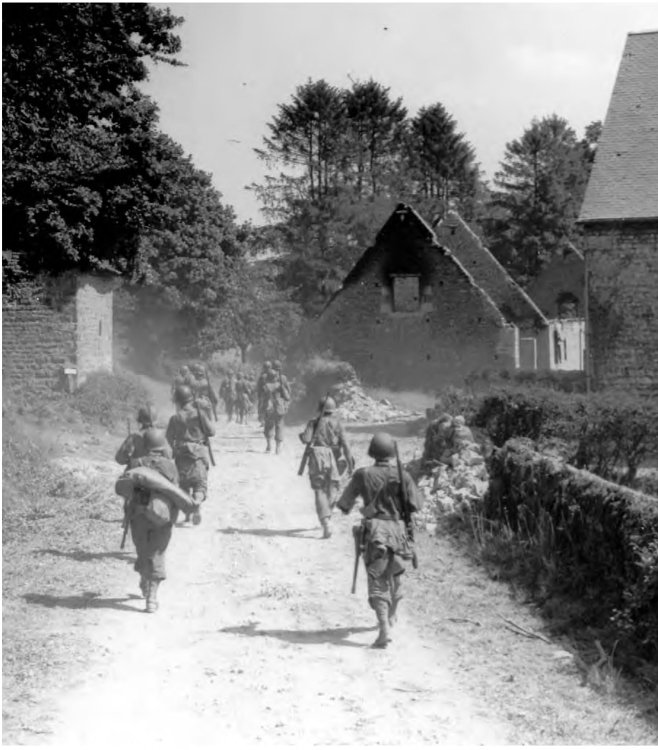
INFANTRYMEN OF THE FIRST ARMY advancing in the vicinity of Sourdeval against the withdrawing enemy forces. The Canadian First Army advancing southward along the Caen-Falaise road was to join forces with the U. S. troops advancing eastward. The Germans put up a strong defense against the Allied troops advancing to encircle them.
FRANCE
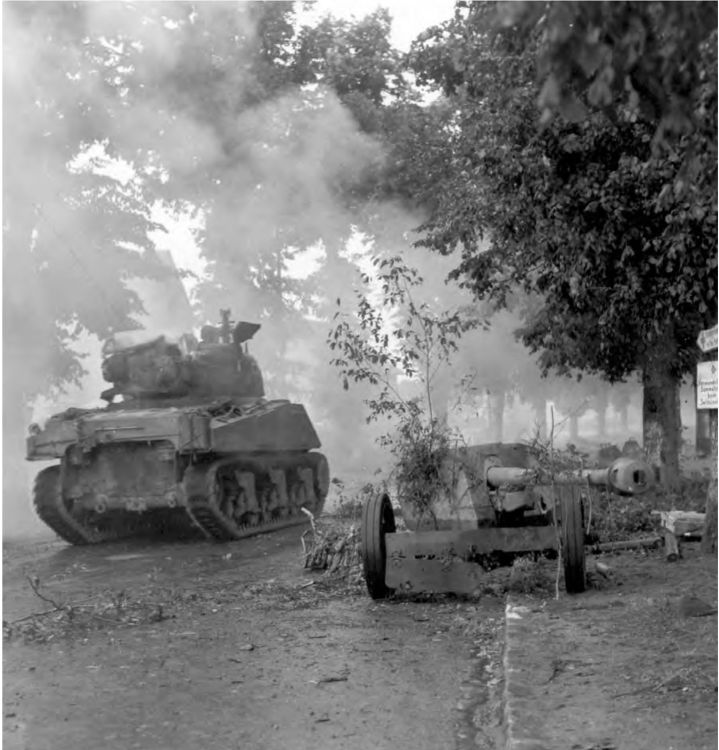
AN M 4 MEDIUM TANK, rolling into Dreux, passes a German antitank gun (7.5-cm. Pak. 40). On 14 August the Third Army was ordered to leave sufficient forces to hold Argentan and to take advantage of the enemy’s disorganization by continuing the main advance to the east. Advances were made against Dreux, Chartres, and Orléans. On 15 August Dreux was captured and on 17 August the First Army took over at Argentan. On 18 August the Third Army forces swung north to seize crossings of the Seine River below Paris and to begin the deep encirclement of the German troops south of the river.
FRANCE
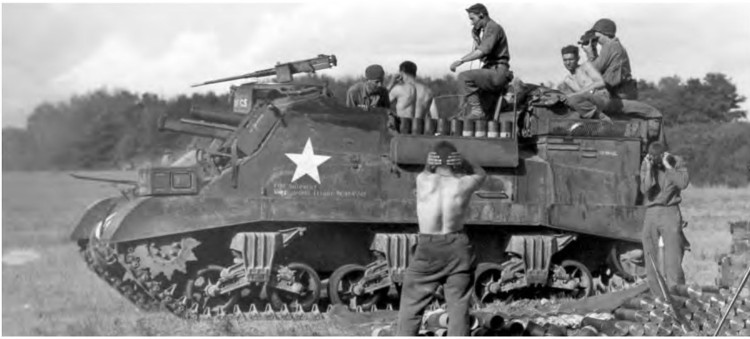
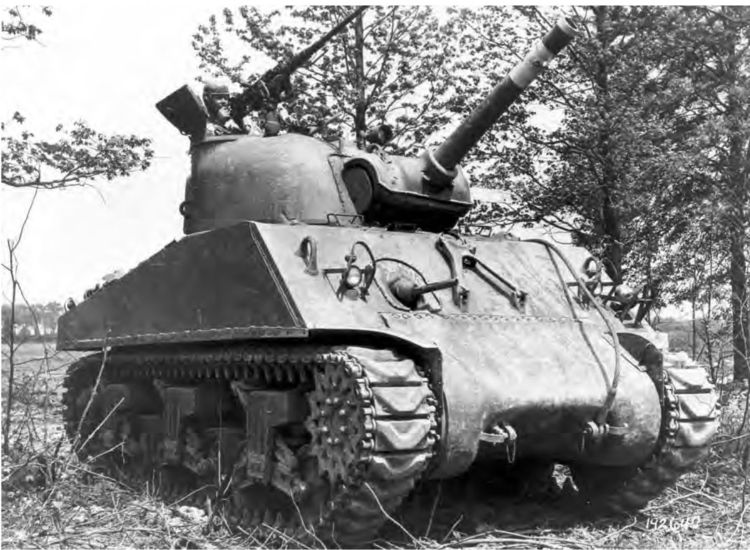
TWO TYPES OF U. S. TRACKED VEHICLES, each mounting a 105-mm. howitzer. 105-mm. howitzer motor carriage M7 (top); medium tank M4A3 with 105-mm. howitzer (bottom).
FRANCE
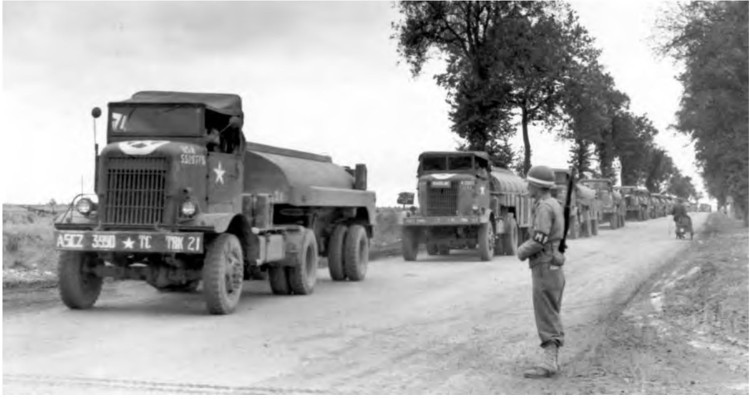
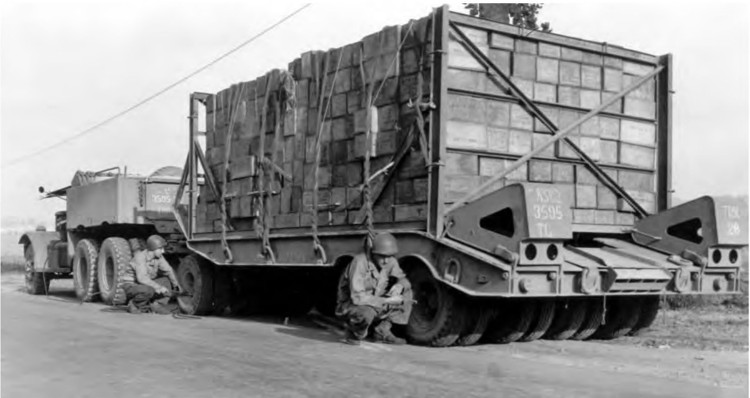
CONVOY CARRYING GASOLINE ALONG RED BALL HIGHWAY. These are 4–5-ton trucks (tractors) towing 2,000-gallon semitrailers (top). A 12-ton truck towing a 45-ton trailer loaded with ammunition, stops along Red Ball Highway (bottom). With the resistance offered by the retreating enemy at a minimum during this period, fuel was a more vital requisite than ammunition. Approximately a million gallons of gasoline were needed at the front every day to enable the armored columns to maintain their headlong rate of advance.
FRANCE
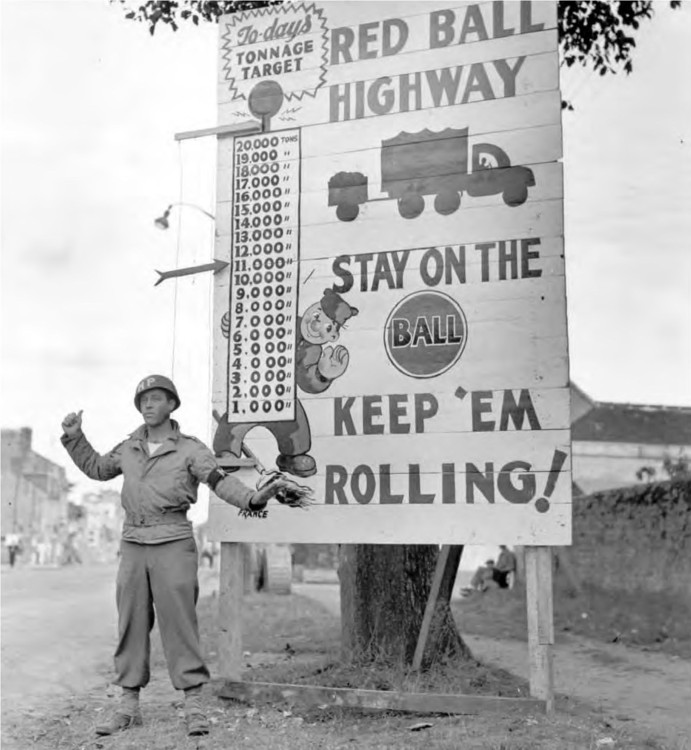
MILITARY POLICEMAN DIRECTS TRAFFIC ON RED BALL HIGHWAY. The three essential supplies were food, ammunition, and gasoline, and to get these to the armored spearheads as quickly as possible a system known as the Red Ball Express was instituted. By this, a circular one-way traffic route was established across France from the beachheads to the fighting zone and back again. All civilian and local military traffic was prohibited the use of the Red Ball Highway, and along it the convoys swept at high speed day and night.
FRANCE
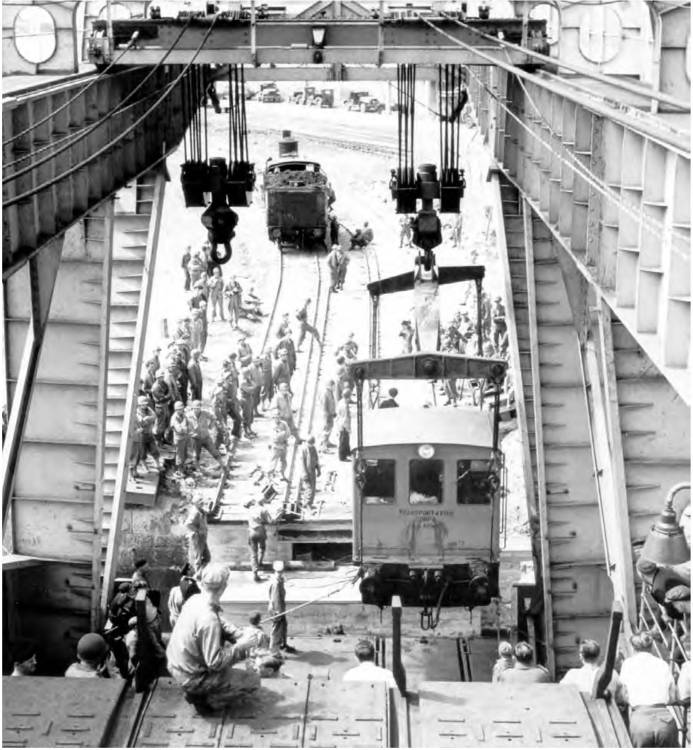
RAILROAD EQUIPMENT BEING UNLOADED FROM A SEATRAIN at Cherbourg. Motor convoys could not handle the vast quantities of supplies needed to maintain the Allied fighting forces and it was necessary to supplement these convoys with rail transportation. The first scheduled run was made between Cherbourg and Carentan on 11 July 1944, using mostly salvaged French equipment. As soon as the Cherbourg port facilities were sufficiently restored, equipment was brought over from England and put into service.
FRANCE
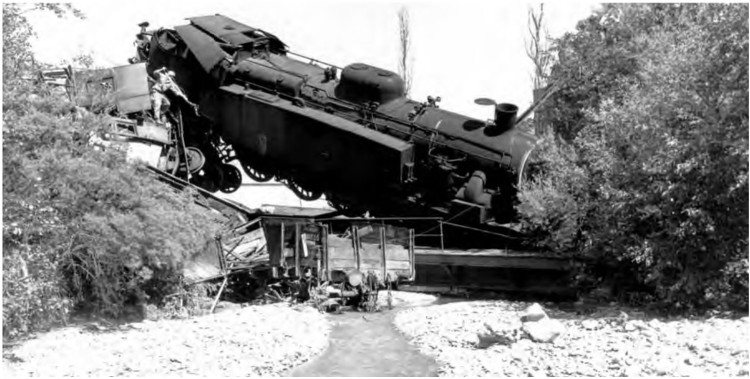
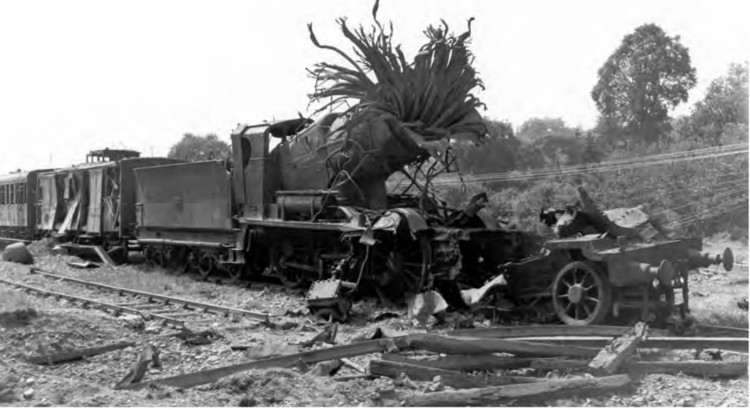
DESTROYED RAILROAD EQUIPMENT. So greatly had the French railroads suffered that over 900 locomotives and a third of the rolling stock used had to be supplied from Allied sources in England. In addition to replacing locomotives and cars, bridges had to be constructed, wrecked trains had to be cleared, and tracks had to be replaced. Damage by Allied bombings at every major junction and marshalling yard had to be repaired. These tasks fell to men of the Corps of Engineers and the Transportation Corps.
FRANCE
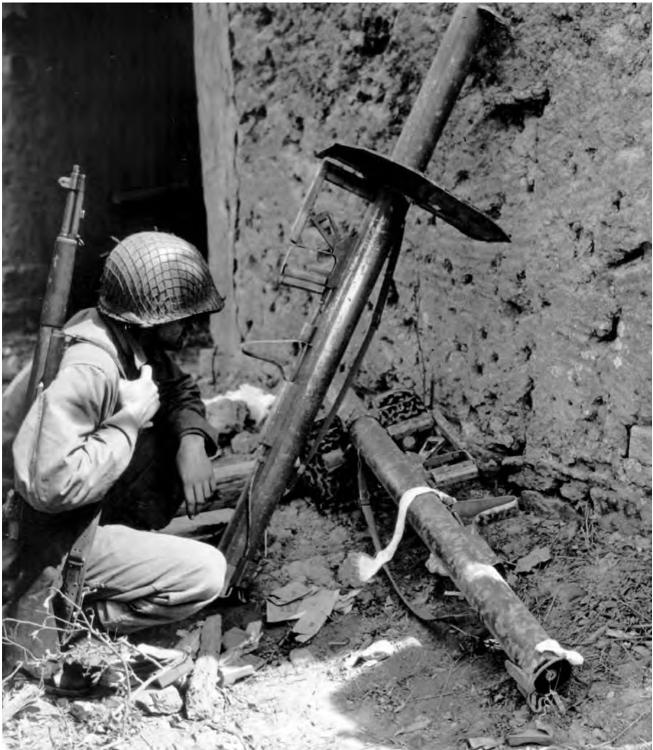
AN INFANTRYMAN ARMED WITH AN M 1 RIFLE looks at two German rocket launchers left behind by the enemy (8.8-cm. Racketenpanzerbuchse). The German weapon was of larger caliber and was heavier than the U. S. rocket launcher but similar in appearance and operation.
FRANCE
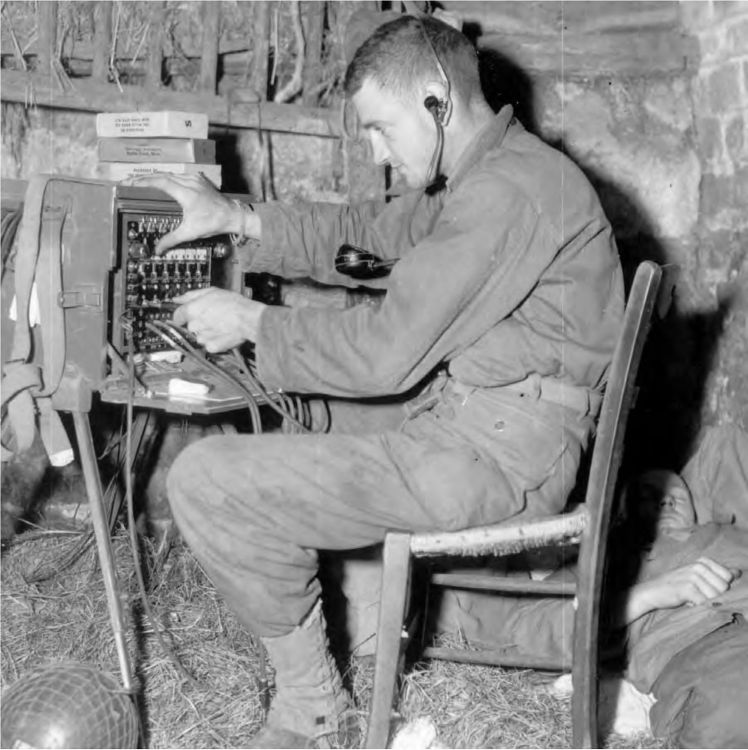
SIGNAL CORPS MAN OPERATING A SWITCHBOARD BD71. This small switchboard weighed approximately fifty pounds, had six lines, and was used with headset HS30, ear plugs, and chest set microphone. The set was generally used by regiments and smaller units. When the break-through came at the end of July 1944 the speed of the advances imposed a heavy strain on the communications personnel. Spearhead units relied mostly on radio communications, but a line net of great complexity was required in the rear areas to cope with the amount of traffic involved. Civilian communications were of limited value because of the lack of maintenance during the years of war destruction, and within four months of D Day the Allies laid over 100,000 circuit miles of telephone line.
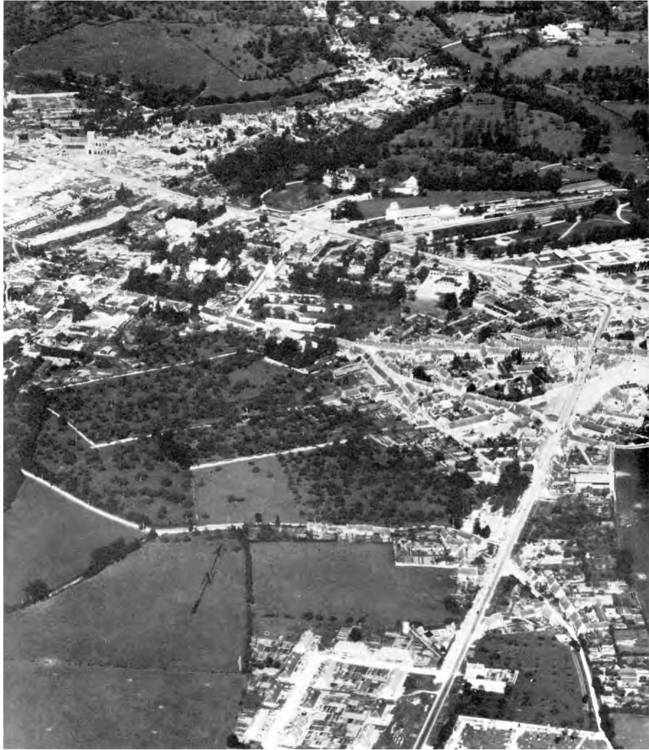
A PORTION OF THE CITY OF FALAISE which was occupied on 17 August by Canadian First Army troops who had pushed down the Caen-Falaise road. This city on the northeast corner of the Falaise pocket was on the north corner of the encirclement in which the German troops were trapped.
FRANCE
A PORTION OF THE CITY OF ARGENTAN, the southeast corner of the Falaise pocket. On 12 August the Third Army armored divisions were at Argentan and Ecouché with infantry divisions in support. The enemy struggled to escape from the pocket through the gap between Falaise and Argentan and concentrated on removing his armored units, leaving the infantry to hold off the Allies. A considerable part of eight armored divisions managed to escape from the closing Allied pincers but left behind a great proportion of their equipment. On 20 August the trap was closed on more than seven infantry divisions and parts of two armored divisions. By 22 August the enemy in the pocket had been eliminated.
FRANCE
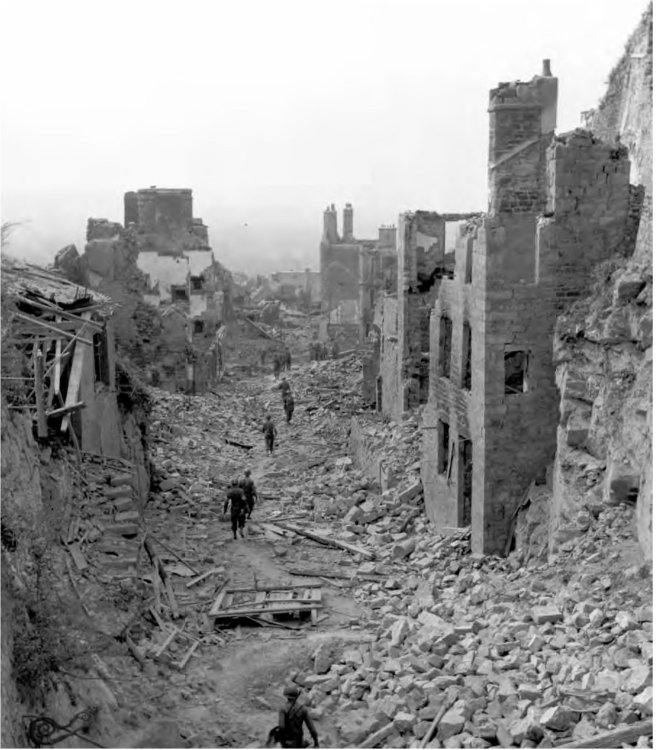
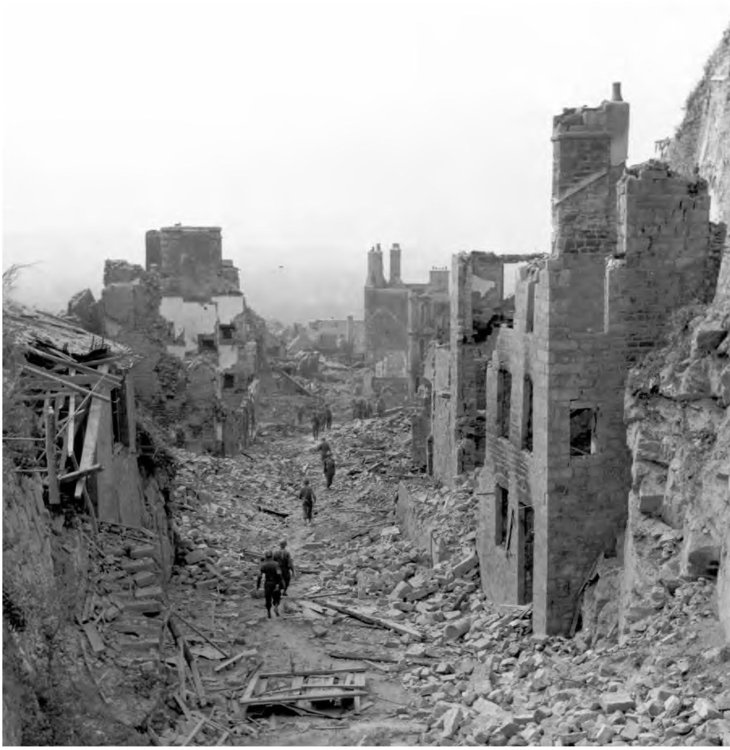
INFANTRYMEN PICKING THEIR WAY THROUGH DEBRIS and rubble in Domfront in pursuit of the fleeing enemy. When the Falaise-Argentan pocket was closed, Allied divisions inside the pocket pressed in on the remnants of the German divisions.
FRANCE
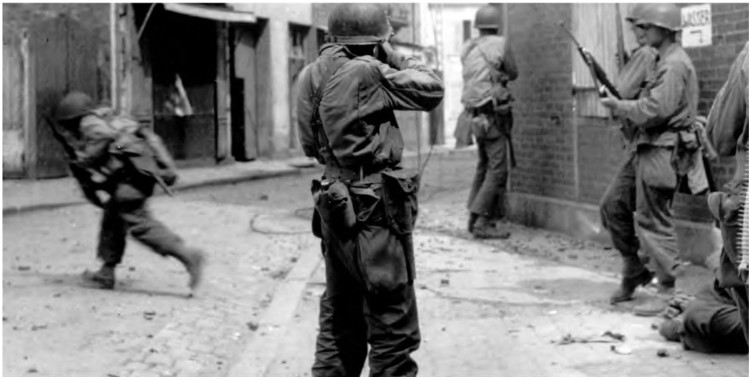
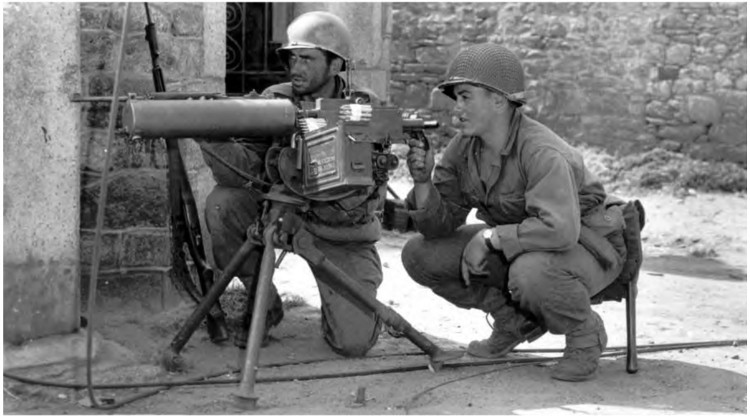
INFANTRYMEN FIRING ON THE ENEMY during the house-to-house fighting in Saint-Malo (top). Infantrymen prepare to fire on enemy positions in Saint-Malo with their .30-caliber Browning machine gun M1917A1 (bottom). During the rapid advances to the east, the fighting on the Brittany Peninsula was still going on. On 17 August the last Germans in the citadel of Saint-Malo had been captured, and the U. S. division taking the city was moved to the southeast to cover the Loire flank west of Tours.
FRANCE
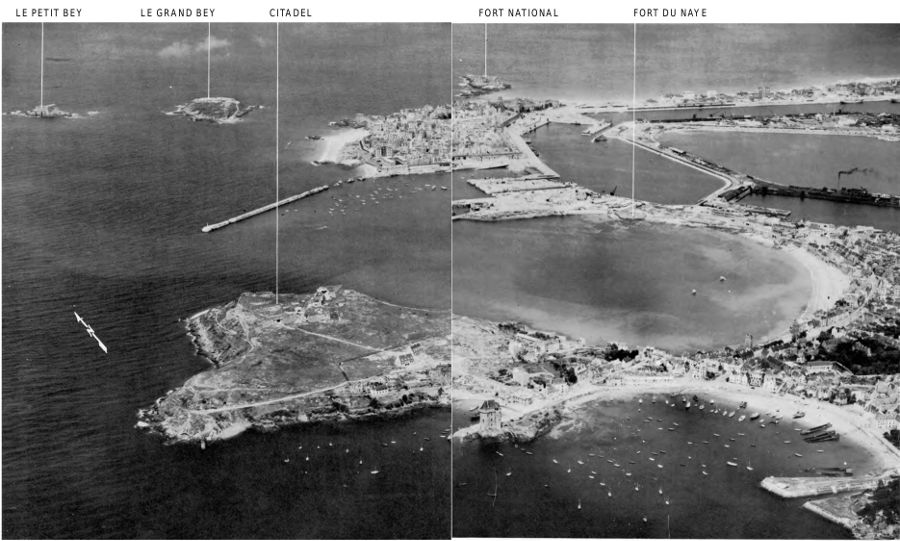
THE HARBOR AT SAINT-MALO. In the strongly defended forts in and around the harbor stubborn groups of Germans held out against the U. S. attacking forces.
FRANCE
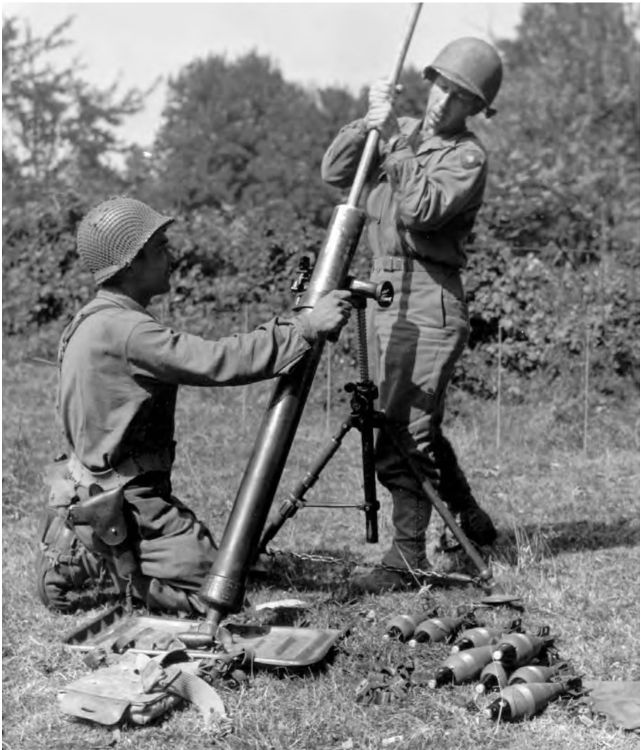
SWABBING OUT THE BARREL OF AN 81-MM. MORTAR M 1 before firing. During the battle of the Falaise-Argentan pocket U. S. artillery poured shells of all calibers into the pocket, and Allied aircraft hammered the Germans relentlessly.
FRANCE
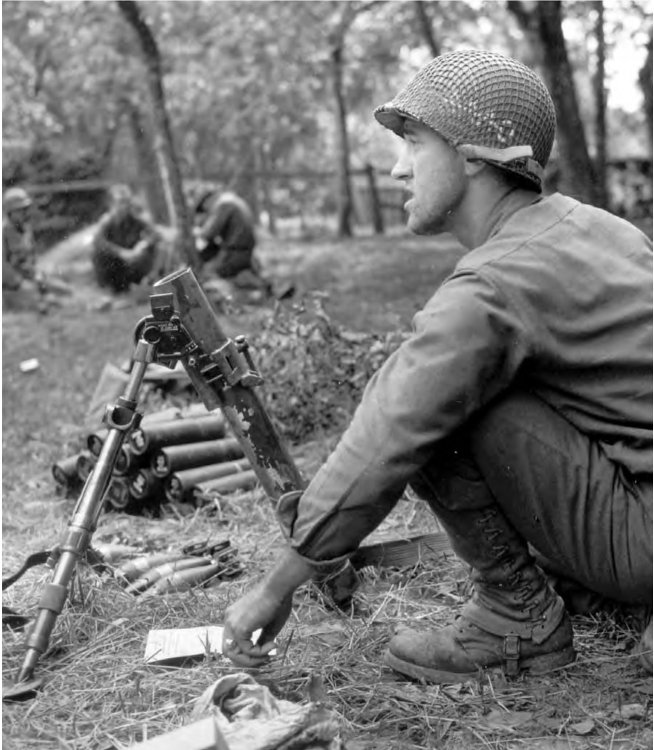
PREPARING TO FIRE A 60-MM. MORTAR M2. The intense artillery fire and aerial bombing littered the countryside with all types of German vehicles and equipment. German commanders were able to control only small groups of their troops, so great was the confusion.
FRANCE
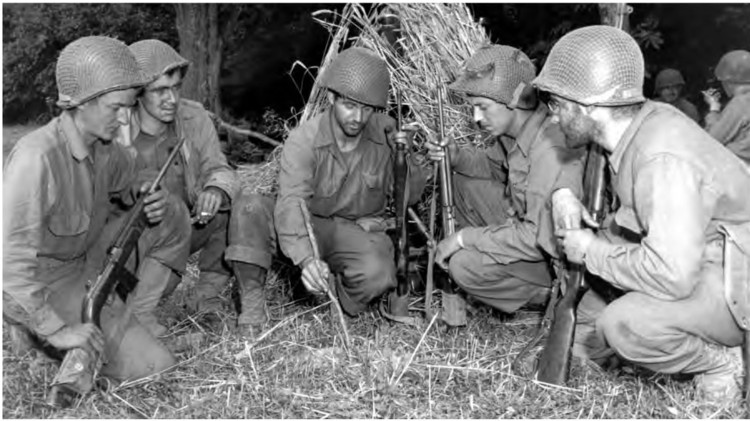
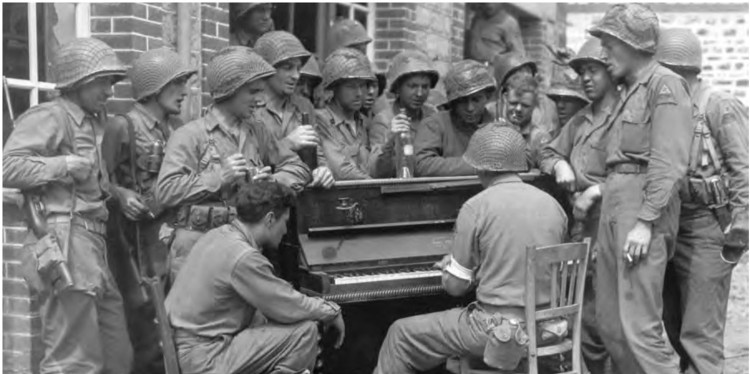
INFANTRYMEN, ARMED WITH CARBINES M1 AND RIFLE M1, discuss the action in which they have taken part (top). Engineers of an armored division relax in a French town during the advance of the U. S. troops (bottom). In the battle of the Falaise-Argentan pocket the Allies did not accomplish the utter destruction of the German forces in Normandy, but the enemy troops were broken as an effective fighting force and the way across France was open. During this period enemy losses included 70,000 killed and captured.
FRANCE
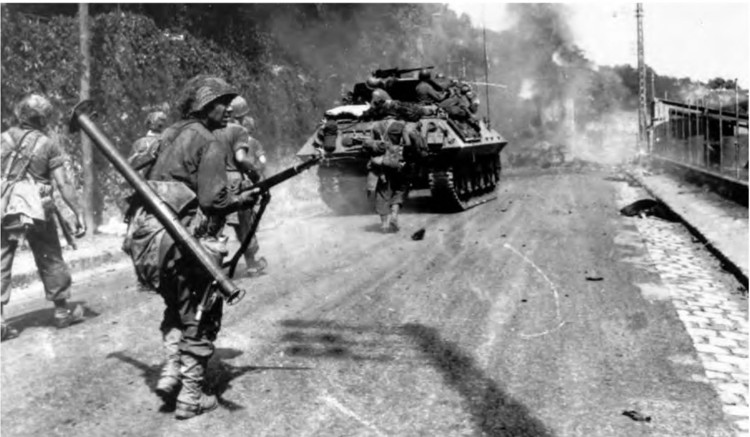
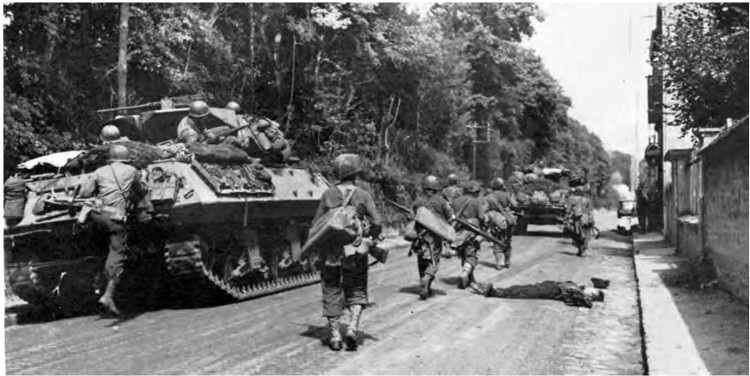
MEN AND VEHICLES ADVANCING TOWARD PARIS (3-inch gun motor carriage M10). Mopping-up the Falaise-Argentan pocket was assigned to troops of the 21 Army Group, while the First Army forces moved eastward. The Third Army was again moving eastward, and by the evening of 25 August the Allies held most of the Seine River west of Paris. On 15 August the Seventh U. S. Army invaded southern France and moved northward to join forces with the Allies in northern France.
FRANCE
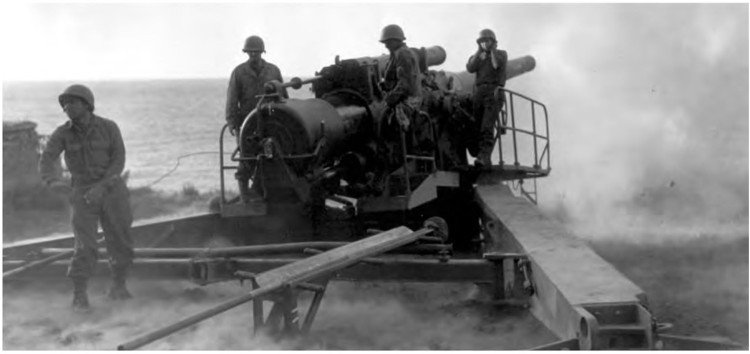
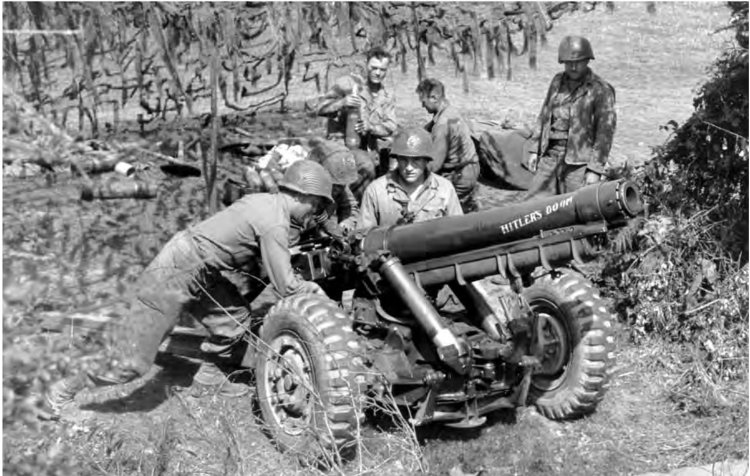
240-MM. HOWITZER M1 FIRING on one of the Brittany fortresses (top). Cannoneers sight their 105-mm. howitzer M3, from a camouflaged position, during the seige of Brest (bottom). By 25 August only the three fortresses of Brest, Lorient, and Saint-Nazaire still offered resistance. A co-ordinated attack was launched on Brest by three infantry divisions supported by artillery of all calibers.
FRANCE
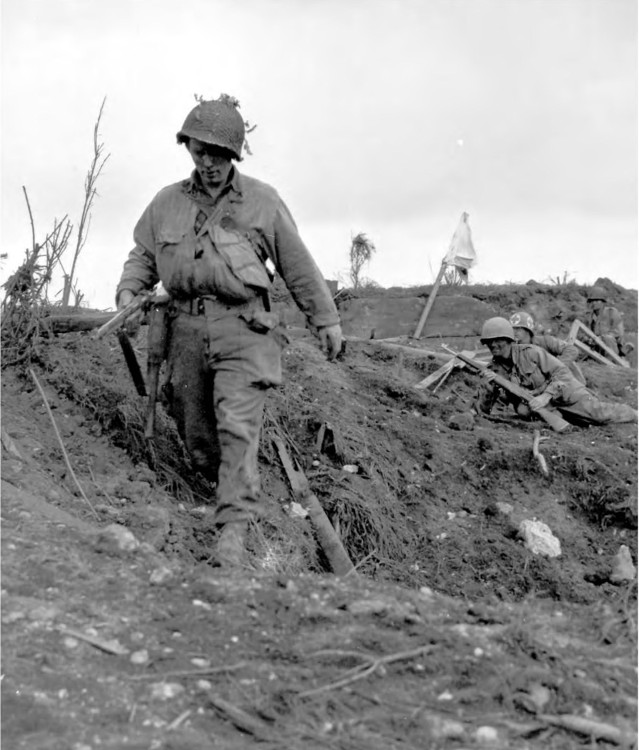
INFANTRYMEN AND AID MEN ADVANCE ON BREST. In this area the Germans blew up pillboxes to avoid their capture and some of the U. S. attackers were killed or wounded in the blasts.
FRANCE
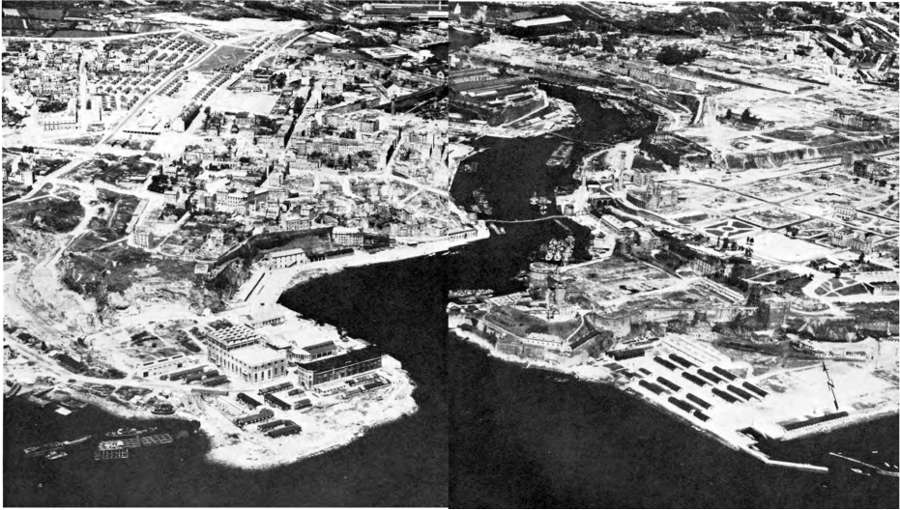
A PORTION OF THE HARBOR AT BREST. This city on the Atlantic Ocean, with its good docks and harbors, was desirable as a supply port of entry. The enemy forces held out here until 18 September 1944, at which time the Allies had moved so far to the east that the distance from Brest to the front lines was too great to make Brest an important landing point. Also the port was so badly damaged during the fighting that it became practically useless.
FRANCE
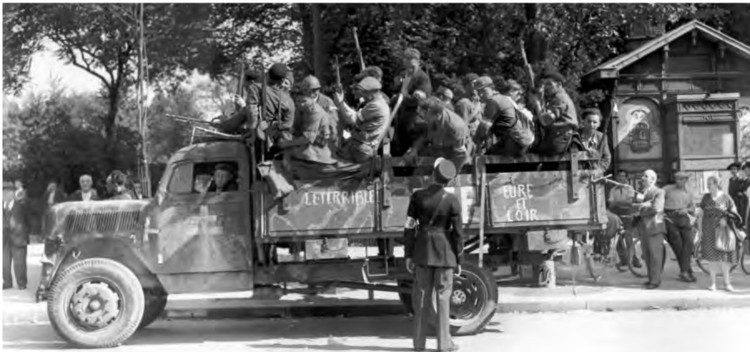
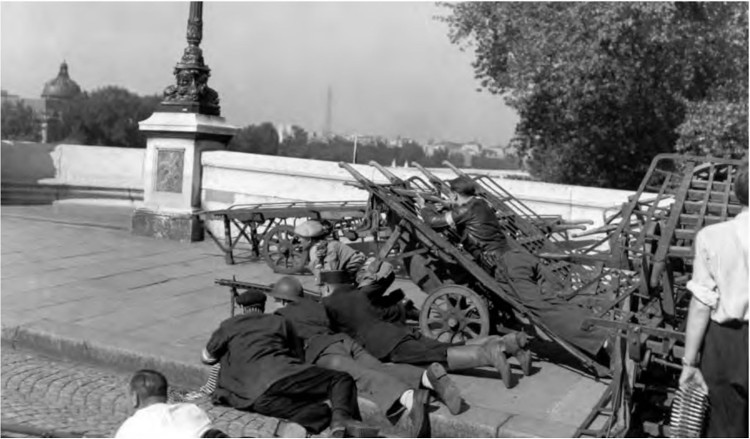
MEMBERS OF THE FRENCH RESISTANCE FIGHTING in the streets of Paris. The Allies had originally intended to bypass Paris so as to avoid its destruction in an assault. On 19 August 1944 fighting between the Germans and the French Forces of the Interior broke out in the city. The French were soon in need of relief, because of the shortage of ammunition, and Allied forces were shifted to take the city. Meeting with little resistance, a French armored division and a U. S. infantry division entered the city and by noon on 25 August the German commander formally surrendered.
FRANCE
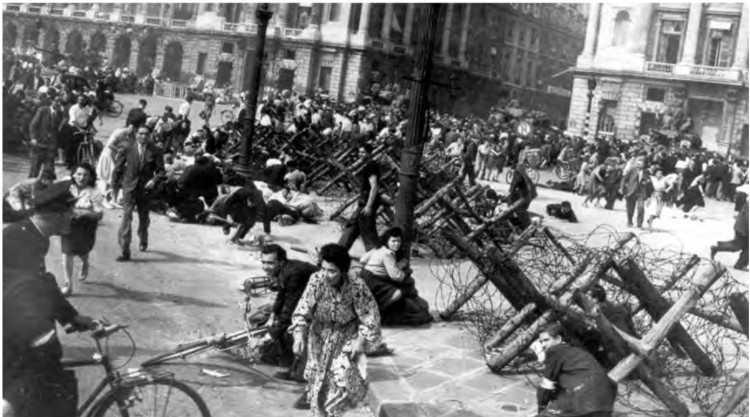
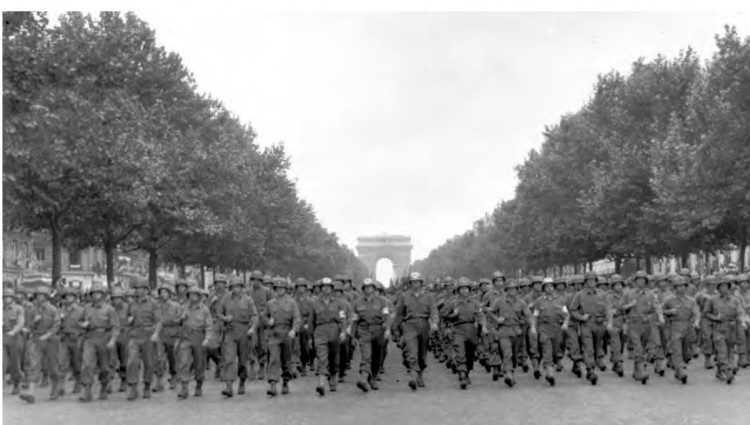
PARISIANS SCATTER as a German sniper fires at them during the celebration of the Allied entry into Paris (top). U. S. troops march down the Champs Elysées during a victory parade in Paris (bottom). The last German resistance ceased in Paris on 27 August, and the next day the city was turned over to a French general who was to be the military governor.
FRANCE
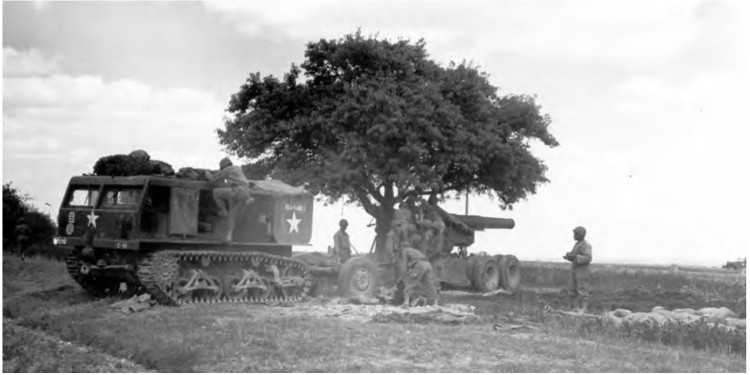
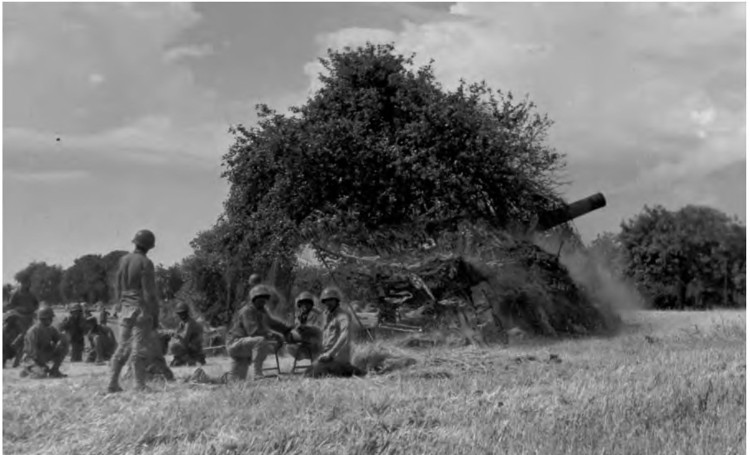
AN 8-INCH GUN M1 BEING TOWED INTO POSITION by a high-speed 18-ton M4 tractor (top). The crew of an 8-inch howitzer fires on the enemy across the Seine River (bottom). The Canadian First Army cleaned up the enemy pockets west of the Seine by 31 August, and the U. S. forces regrouped to pursue the enemy east of the river and begin their drive toward Germany.
FRANCE
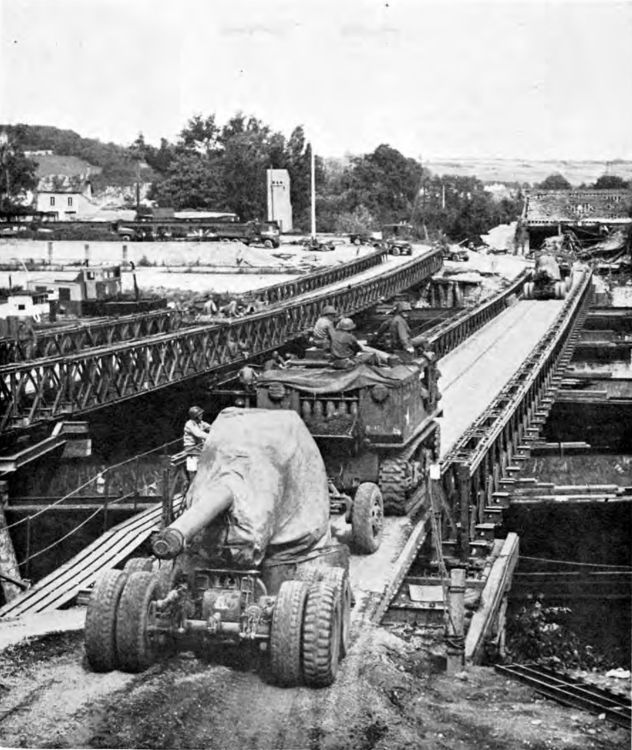
TOWED 155-MM. GUNS M 1 CROSS A BAILEY BRIDGE over the Seine. U. S. troops advanced northeast from the Seine River bridgeheads to take Reims and Châlons-sur-Marne.
FRANCE
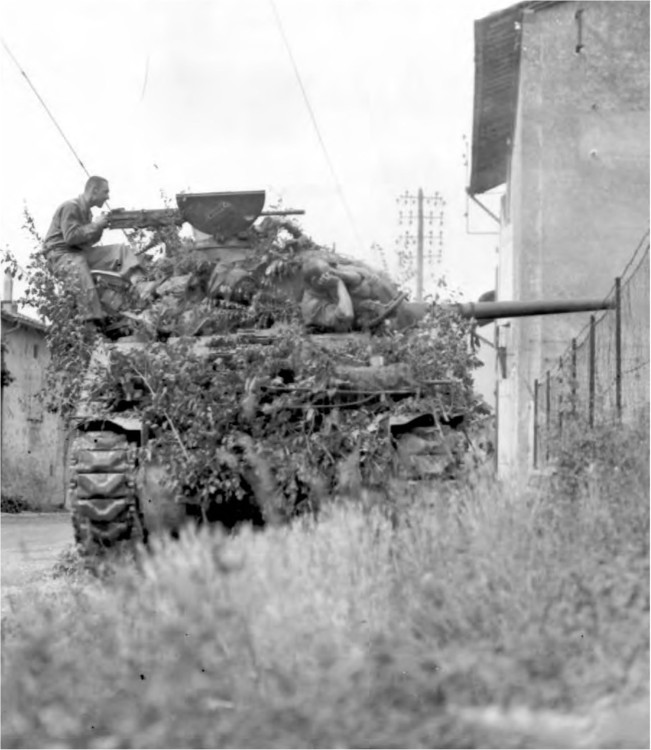
3-INCH GUN AND .50-CALIBER MACHINE GUN of an M10 tank destroyer fire on enemy troops trying to destroy a Marne River bridge. On 26 August Château-Thierry was captured. On 28 August Châlons-sur-Marne was taken and the following day Reims fell.
FRANCE
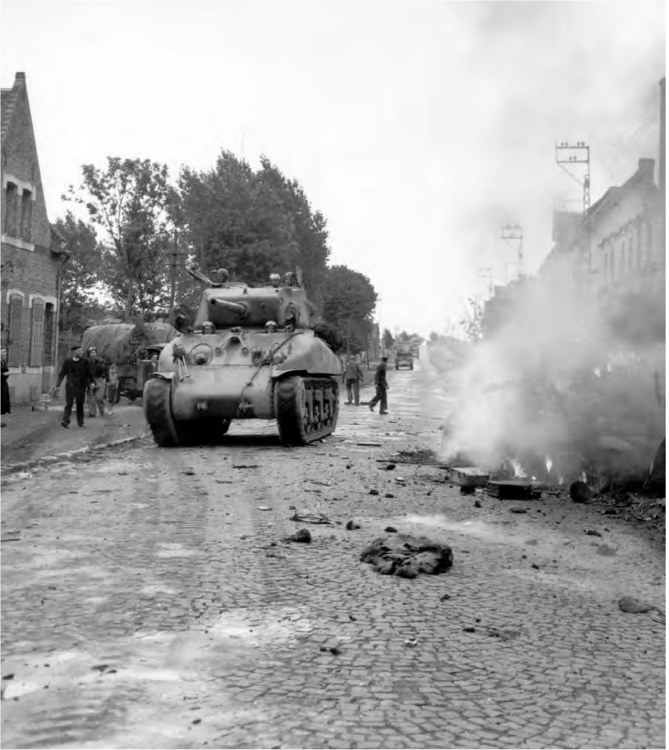
AN M4A1 TANK passes a burning German vehicle. By 30 August Saint-Dizier was reached and on 31 August the ground east of the Meuse River near Commercy was seized while Verdun was captured and the Meuse River crossed in that area. At the end of August the drives of the First and Third U. S. Armies were slowed down by lack of fuel.
FRANCE
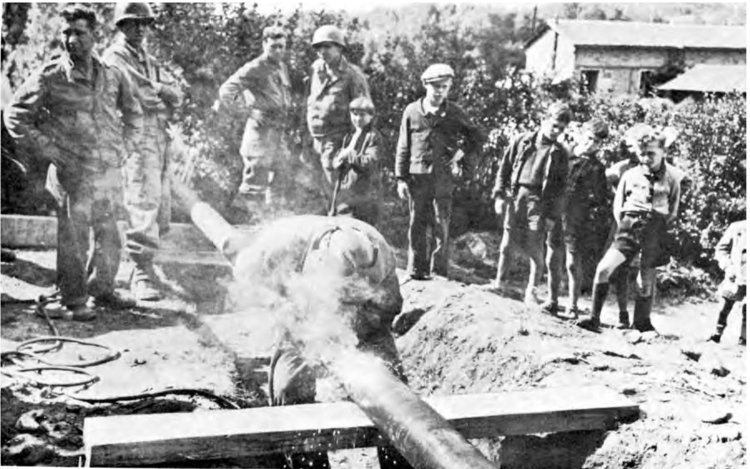
ENGINEERS LAYING A GASOLINE PIPELINE in France. In an effort to transport fuel to the front-line units of the Allies, three fuel pipelines were laid across France. This also relieved the road traffic which became more and more congested as the number of Allied troops in France increased.
FRANCE
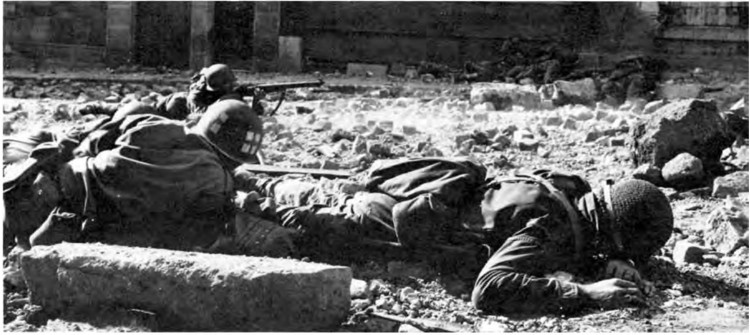
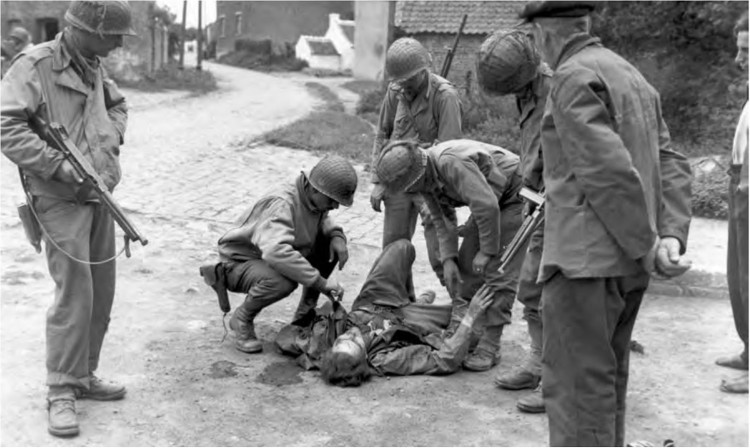
MEDICAL AID MEN MOVE UP UNDER FIRE to give first aid to a wounded infantryman (top). A wounded German is given medical aid by U. S. soldiers (bottom), by 3 September first army troops had cleared most of the army’s zone south of the Belgian border. On that day the remnants of twenty disorganized divisions were trapped before they could reach the Belgian border and 25,000 men were quickly liquidated. The British entered Brussels on 3 September and were also closing in on Le Havre, one of the major port cities on the coast.
BELGIUM
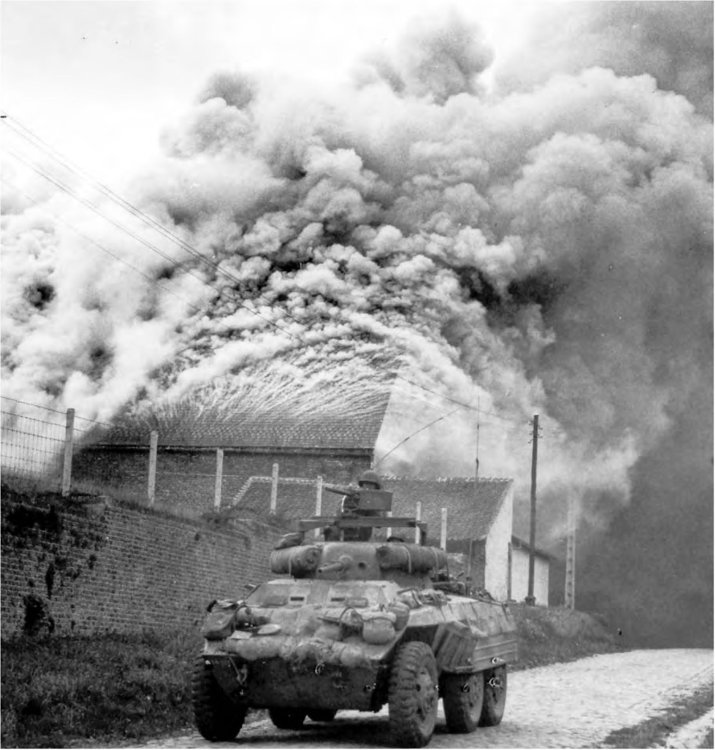
A LIGHT ARMORED CAR M8 ENTERING BELGIUM. On 1 September 1944, Supreme Headquarters, Allied Expeditionary Force (SHAEF), was established at Versailles and assumed the active direction of the 12th and 21 Army Groups. During this period the main problem was that of supplying the racing armored columns since the only points of entry were the beaches and Cherbourg, a distance too far removed from the Allied forces advancing to the German frontier. By early September supply trucks were traveling 600 to 900 miles in round trips to carry fuel, ammunition, and rations to the combat units.
BELGIUM
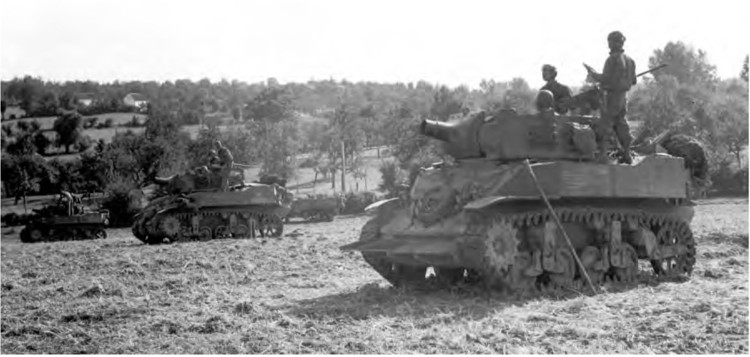
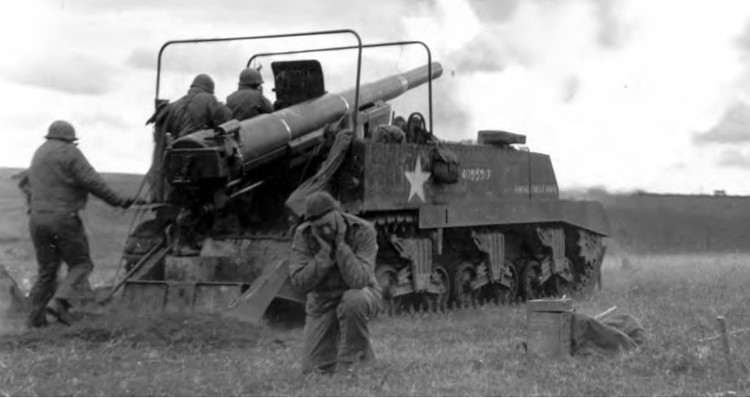
75-MM. HOWITZER MOTOR CARRIAGES M8 in Belgium (top). 155-mm. gun motor carriage M12 firing in Belgium (bottom). In spite of the shortage of supplies the pursuit of the enemy continued between 4 and 14 September 1944, with the greatest Allied gains being made on the northern front. On 4 September the British forces captured the port city of Antwerp, one of the greatest prizes of the war. On 12 September the city of Le Havre surrendered. These two cities were of extreme importance because of their port facilities and their nearness to the battle front. In both harbors the enemy had carried out measures to render the ports useless, but they were not too badly damaged to prevent repair.
FRANCE
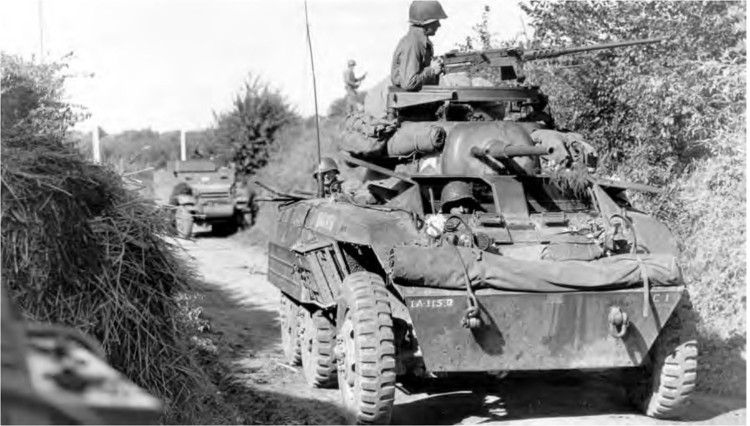
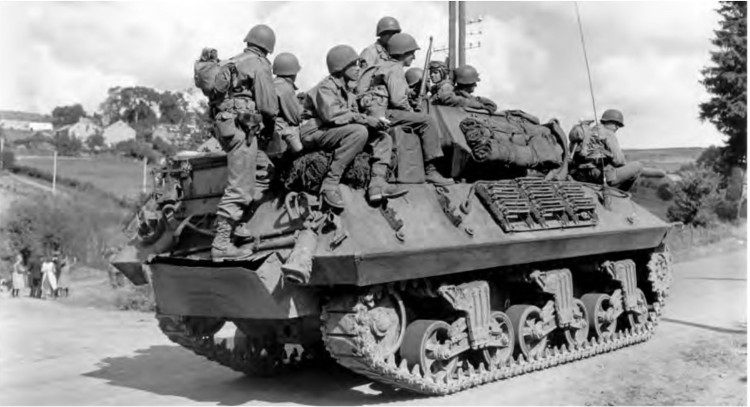
LIGHT ARMORED CAR M8 of a reconnaissance unit stops during its drive through Belgium toward the border of the Netherlands (top). Advancing infantrymen ride on a 3-inch gun motor carriage M10 (bottom). By 14 September 1944 the sustained drive of the First Army had stopped and the Germans were fighting on their own soil for the first time in many years.
FRANCE
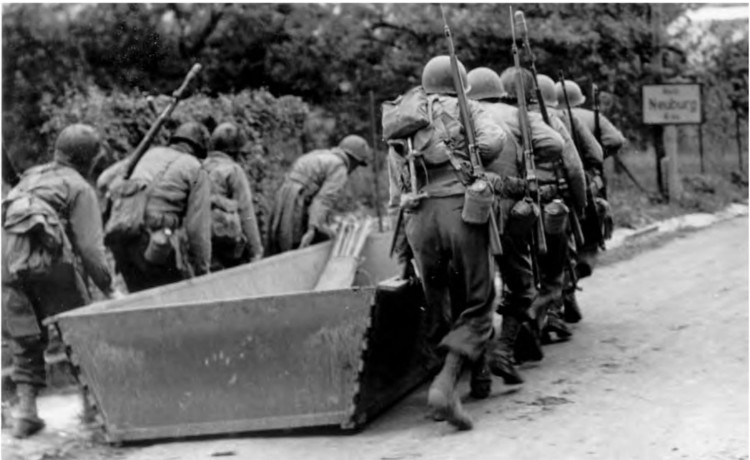
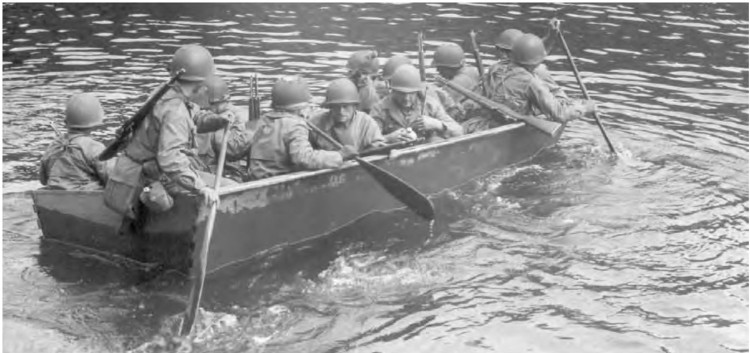
INFANTRYMEN MOVING AN ASSAULT BOAT down to the banks of the Moselle River at Dornot (top); crossing the Moselle (bottom). Efforts to obtain enough gasoline were generally unavailing and most of the units of the Third Army were halted at the Moselle. On 5 September a crossing was made north of Nancy while on 8 September another was made below Metz. The Germans made numerous counterattacks and occupied the forts around Metz, determined to hold the line in this area.
GERMANY
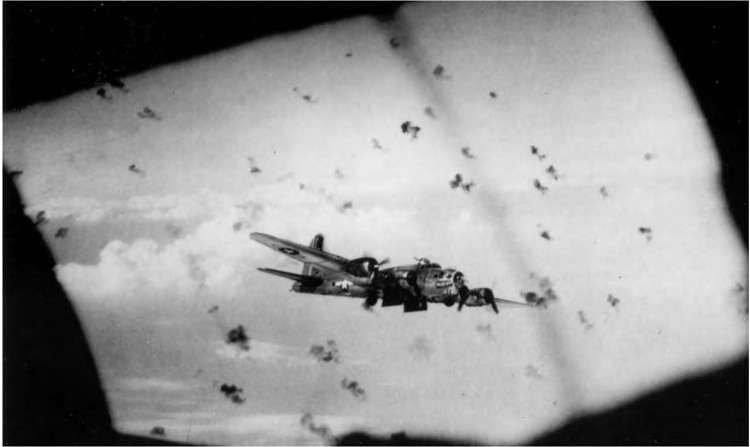
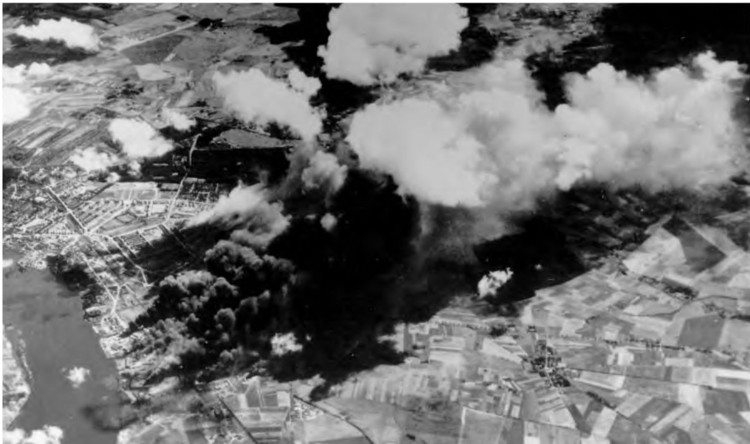
BOEING B-17 FLYING THROUGH HEAVY FLAK over Germany en route to a target (top). The Heinkel aircraft factory during an air attack (bottom).
GERMANY
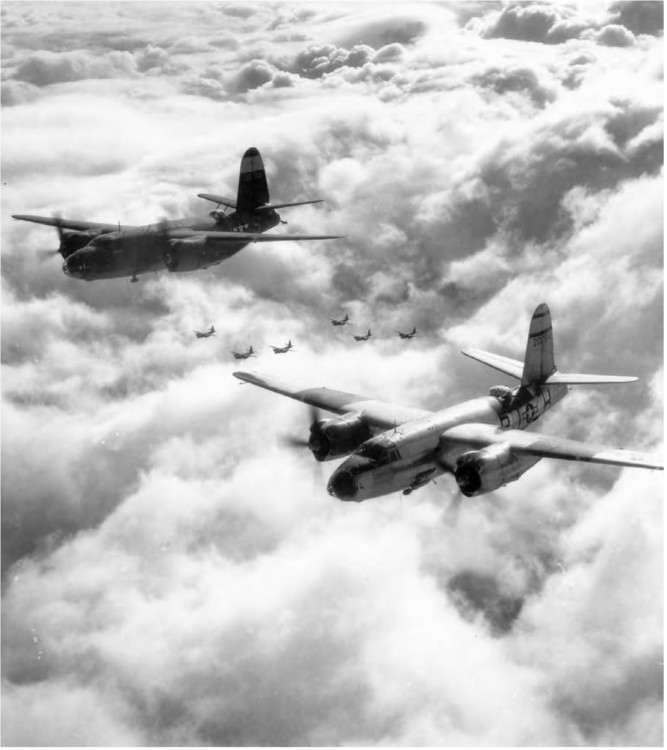
MARTIN B-26’S RETURNING FROM A MISSION along the German border in support of the Third Army’s ground attack. The medium bomber in the upper foreground of the above picture had operated in the ETO for some time, as is shown by the dark-painted fuselage. The plane in the lower foreground has an unpainted fuselage which enabled it to attain higher speeds.
FRANCE
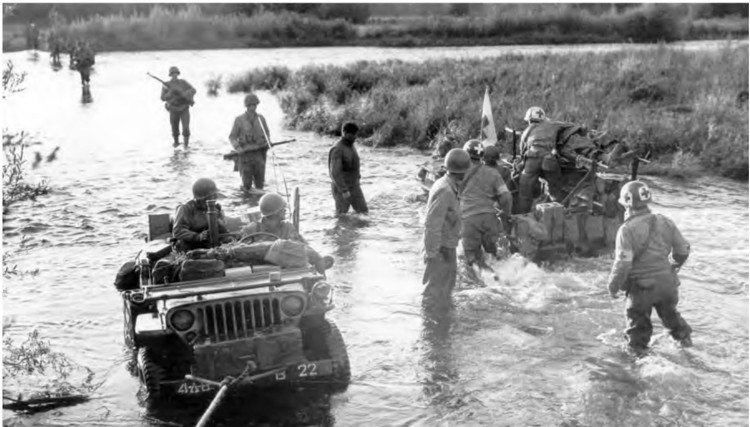
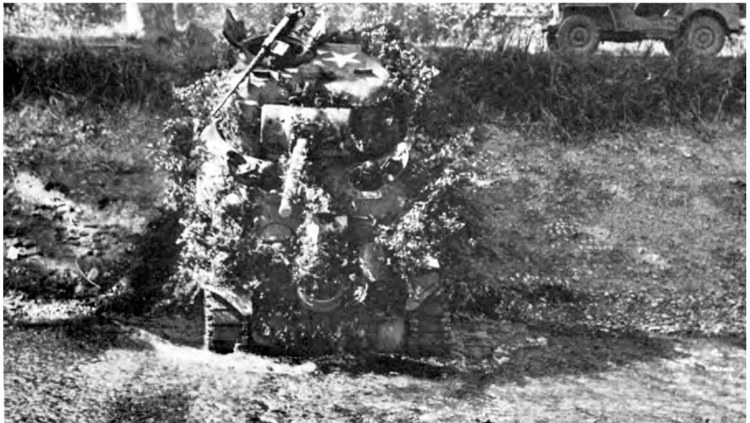
INFANTRY MEN CROSS THE MOSELLE as a ¼-ton truck carries wounded men to the rear (top). M4A1 medium tank fording a canal (bottom). On 10 September an attack was launched to secure bridgeheads over the Moselle below Epinal, which was reached on 14 September. The city of Nancy fell on 15 September.
FRANCE
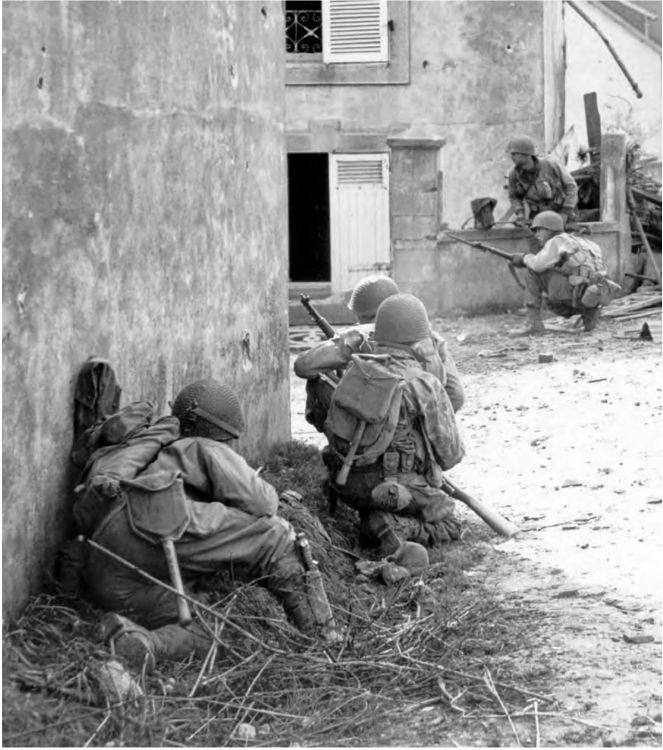
INFANTRYMEN ADVANCING in the outskirts of Brest. While the Third Army was battling a determined enemy on the Moselle, U. S. forces were still trying to reduce the fortress of Brest. On 5 September the Ninth U. S. Army became operational in France and assumed the task of eliminating the remaining fortresses on the Brittany Peninsula.
FRANCE
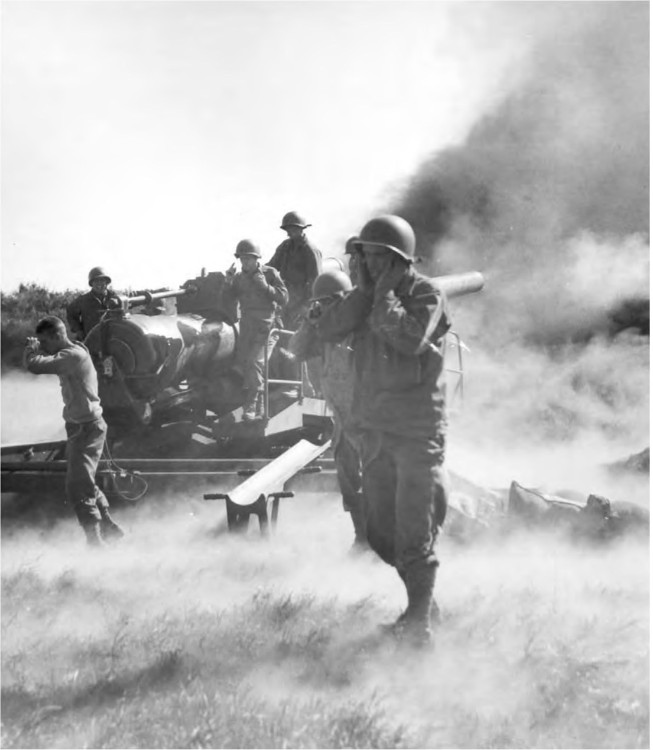
AN 8-INCH GUN M1 FIRING ON GERMAN INSTALLATIONS in Brest. Artillery units attacking Brest were reinforced, mostly with medium and heavy caliber guns and, after sufficient ammunition had been accumulated, a strong attack was launched on 8 September by three infantry divisions.
FRANCE
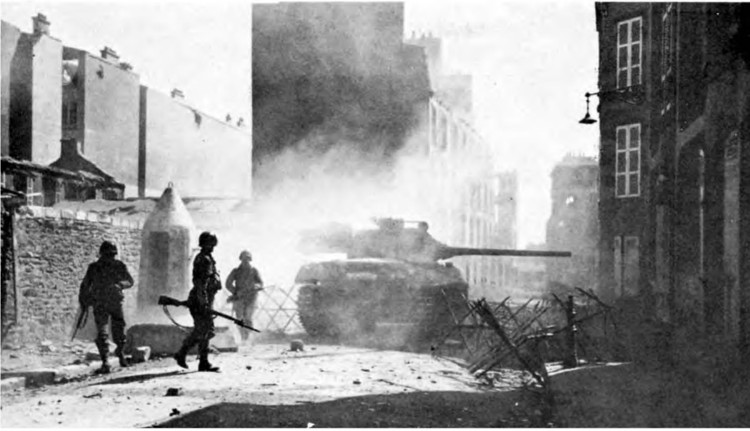
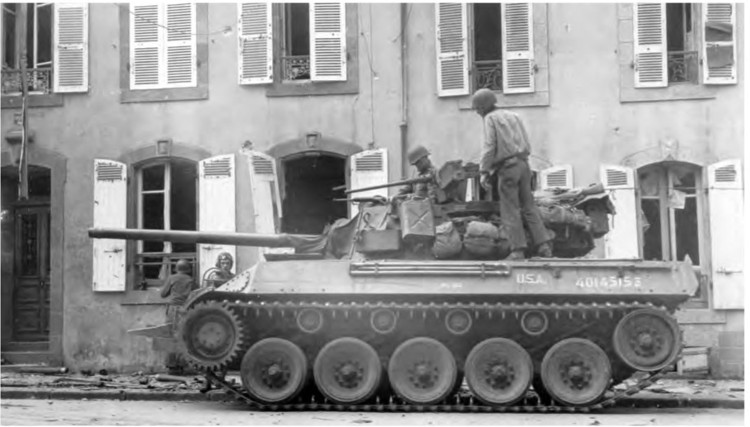
90-MM. GUN MOTOR CARRIAGE M36 firing at an enemy pillbox in Brest (top). 76-mm. gun motor carriage M18 guarding a street intersection in Brest (bottom). On 14 September the fortress of Brest was still for the most part in German hands, despite all efforts to reduce the strongly fortified positions.
FRANCE
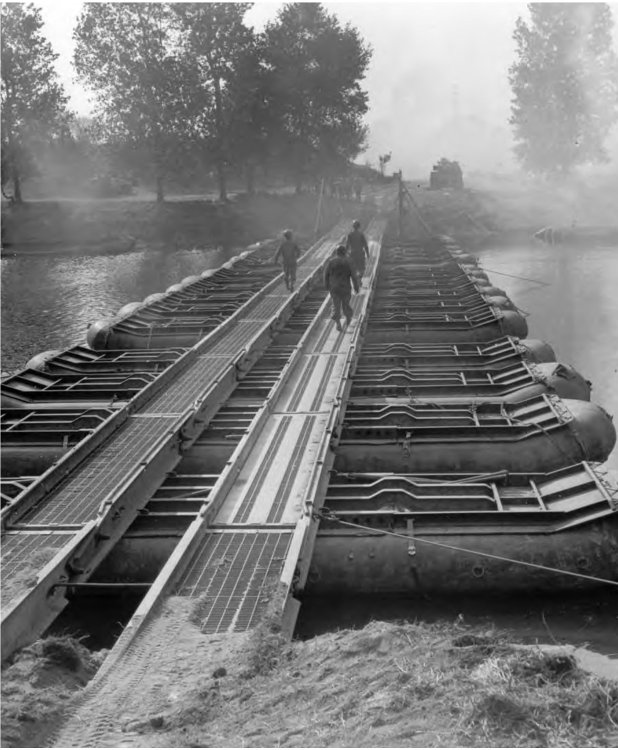
NEWLY CONSTRUCTED TREADWAY PONTON BRIDGE over the Moselle River.
RHINELAND CAMPAIGN 15 September 1944–15 December 1944
RHINELAND
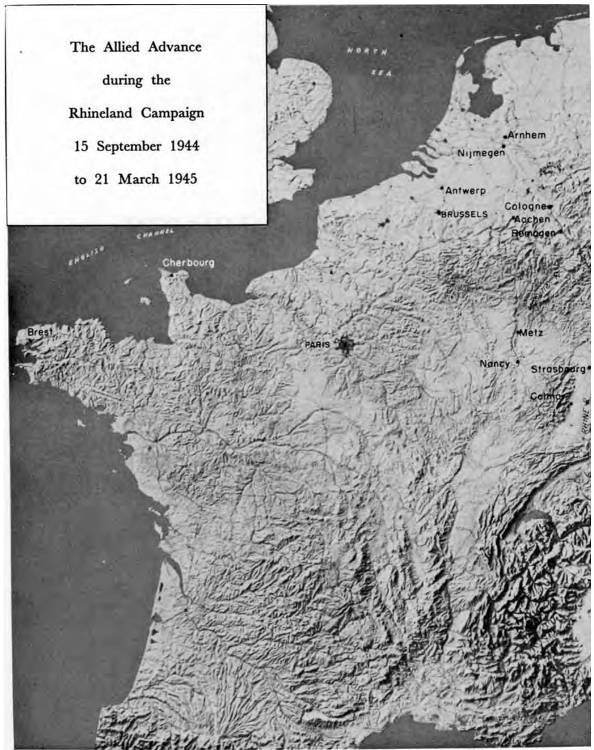
The Allied Advance during the Rhineland Campaign 15 September 1944 to 21 March 1945