SECTION VI Rhineland Campaign 26 January–21 March 1945
Reading edition
At the successful conclusion of the Ardennes-Alsace Campaign the Allies again turned their attention to the Rhineland. Between 26 January and 21 March a major objective was achieved: the German troops which tried to halt the advance were cut off and destroyed, thus eliminating future enemy action west of the Rhine.
When the Rhineland Campaign ended the Allied Expeditionary Force numbered over 4,000,000 men organized into a well-balanced military machine, with combat elements ready to strike the final blow against the disintegrating enemy forces. On 21 March 1945 the First U. S. Army held a bridgehead across the Rhine about twenty miles wide and eight miles deep and had six divisions on the eastern bank of the river, while the remaining Allied troops were prepared to cross in their respective zones.
BELGIUM
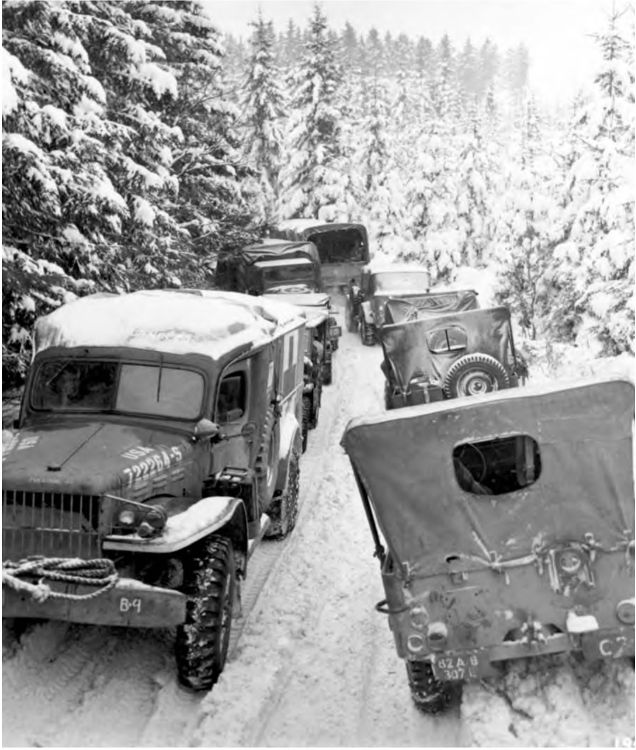
DEEP SNOW SLOWED MILITARY TRAFFIC. With the completion of the Ardennes-Alsace Campaign the Allies again began their advance to the Rhine after having been delayed for six weeks.
GERMANY AND FRANCE
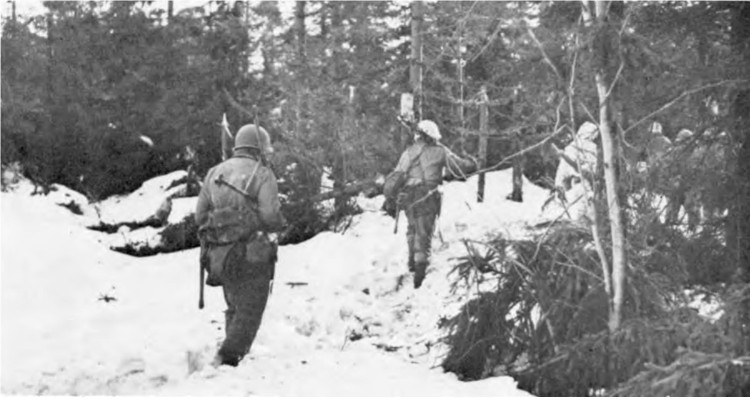
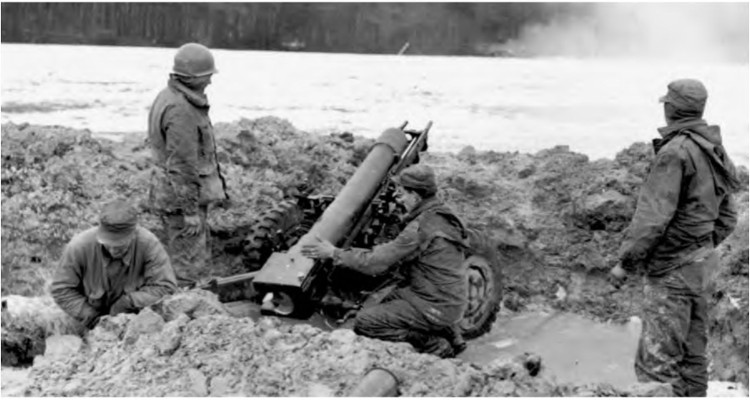
RIFLEMEN moving through snow-covered, wooded terrain (top). A 105-mm. howitzer M3 firing in support of the infantry advance (bottom). On 24 January the First U. S. Army was to begin an attack to breach the West Wall and secure the high ground in the vicinity of Blankenheim, while part of the Third Army was to attack with its left wing to cover the First Army. The rest of the Third Army front was to begin an aggressive defense.
BELGIUM AND GERMANY
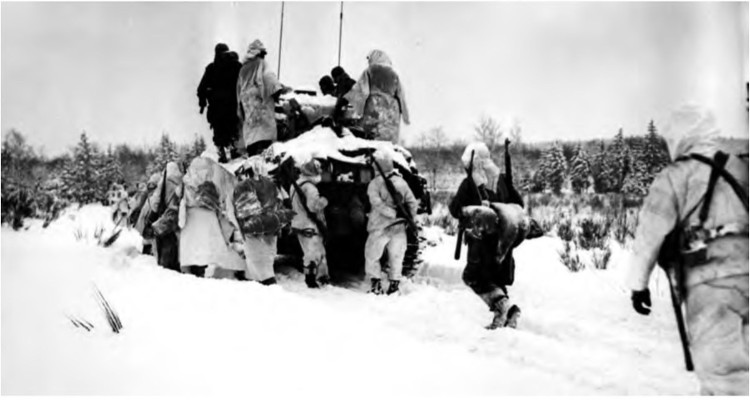
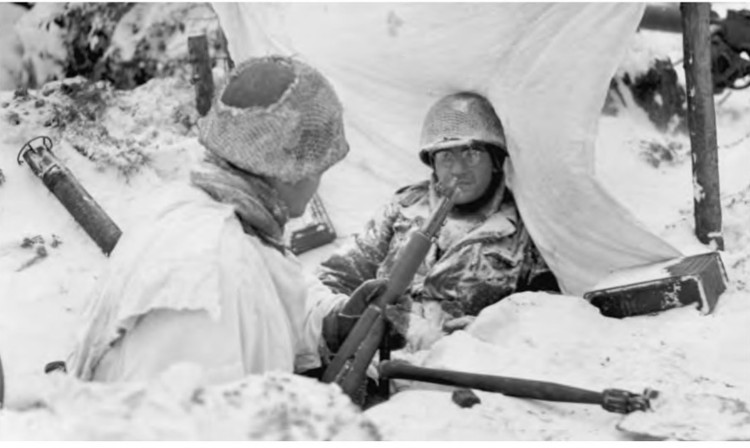
ADVANCING THROUGH THE SNOW, men wearing camouflage suits blend in with the snow-covered ground, while those without white suits stand out plainly (top). Infantrymen waiting in their snow-covered foxhole for an artillery barrage which will start an offensive (bottom). On 7 February 1945 the attack was halted with both the First and Third Armies deep in the enemy’s fortified zone.
BELGIUM
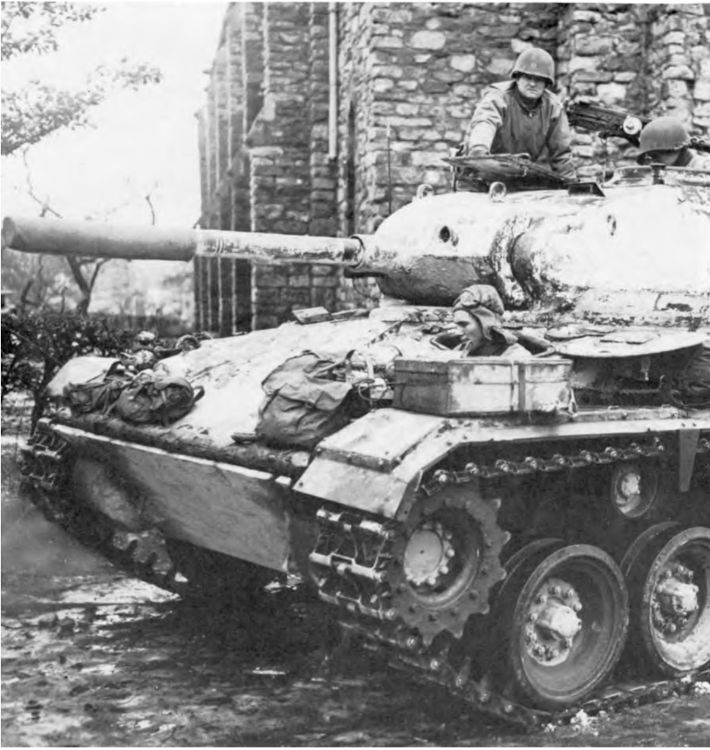
FRONT OF AN M24 LIGHT TANK showing its 75-mm. gun, newer type track, and torsion bar suspension. When the offensive halted attention was given to attacking the Roer dams. The enemy took advantage of the wooded country, deep valleys, many streams, poor roads, and the fortifications of the West Wall in an effort to halt the advance. Bitter fighting developed but by 2 February the U. S. forces had reached a point within two miles of Schleiden. On 8 February the Canadian First Army struck the German forces west of the Rhine, the first of a series of attacks that were to destroy the enemy.
FRANCE
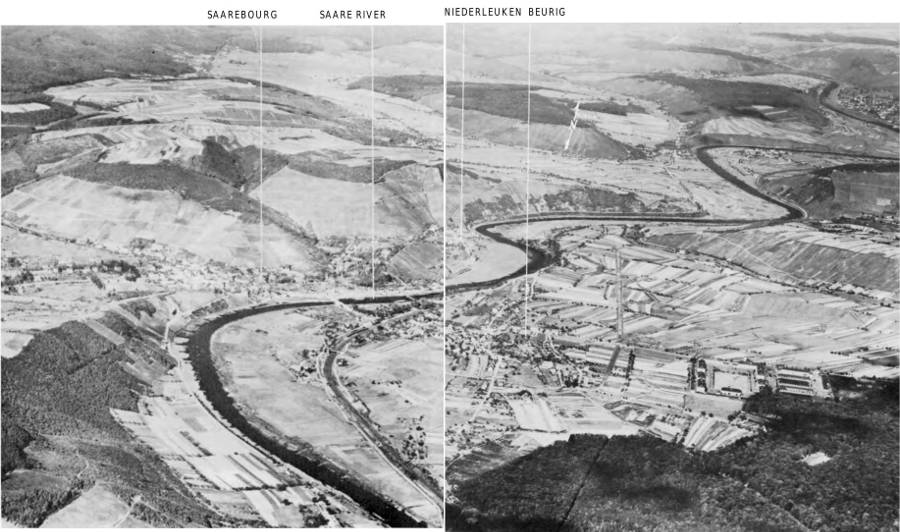
SAAREBOURG AND THE SARRE RIVER AREA. This picture is typical of the rolling, wooded country, broken by river and deep valleys, through which Allied troops advanced during the fighting along the German frontier. The area was important during the Lorraine campaign since the enemy forces might join the German troops striking northwest from the Colmar pocket, or at least threaten the rear of the U. S. Seventh Army.
FRANCE
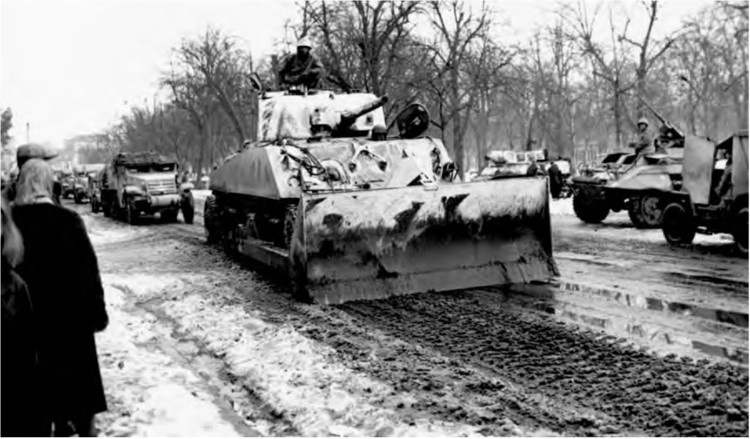
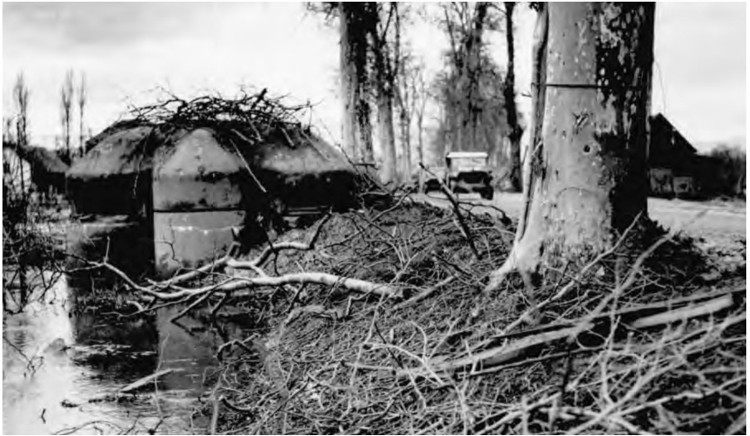
AN M4 MEDIUM TANK-DOZER cleaning a street in Colmar (top). German pillboxes along a road leading to the Colmar plain (bottom).
GERMANY
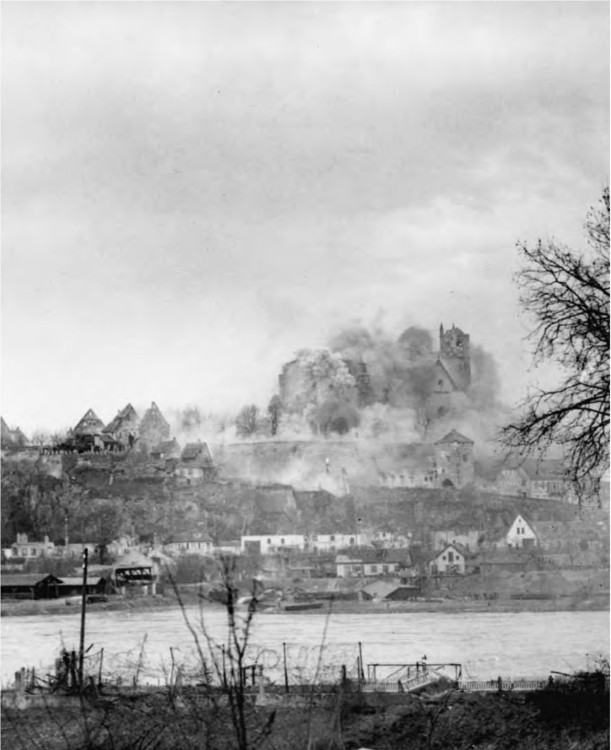
THE TOWN OF BREISACH, Germany, during a heavy artillery shelling.
GERMANY
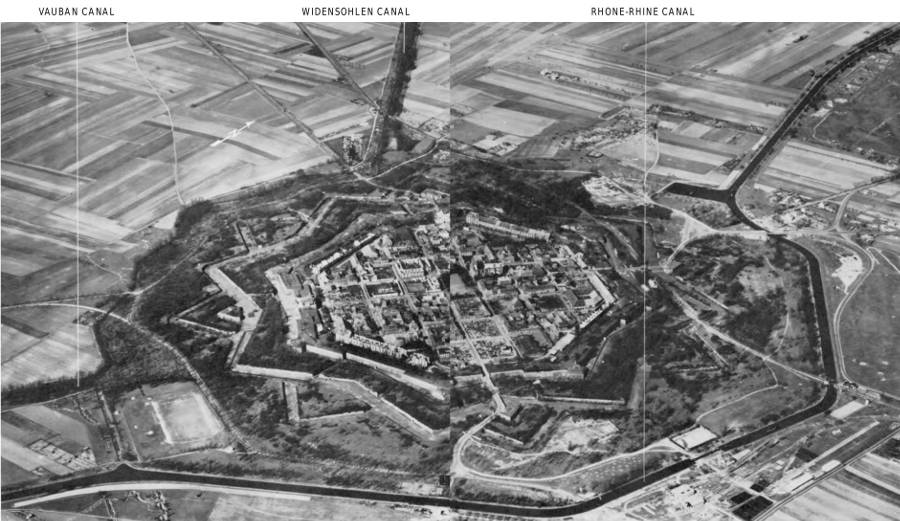
NEUF BRISACH, FRANCE. On 20 January 1945 U. S. and French troops of the 6th Army Group began an offensive converging in the direction of Breisach, Germany, on the eastern bank of the Rhine. This operation was aimed at the total reduction of the Colmar pocket west of the Rhine. On 1 February the U. S. forces had advanced to within three miles of Neuf Brisach while on the same day the French troops closed up to the Rhine. By 9 February the Colmar pocket had been eliminated.
GERMANY
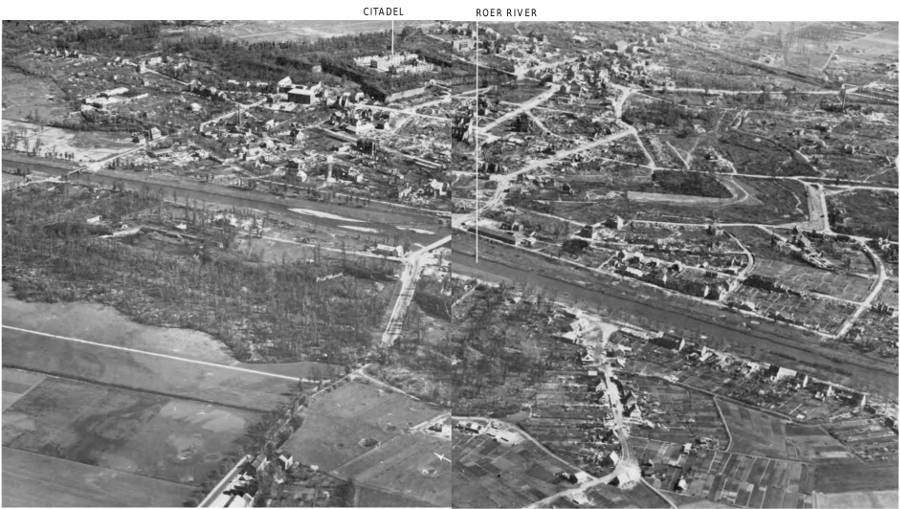
THE ROER RIVER AT JUELICH, GERMANY. The U. S. Ninth Army’s assault northeast from Juelich was to be the first of a series of U. S. drives to the Rhine. This attack was to begin on 10 February 1945. On 9 February the Germans blew open the discharge valves of the dams in the Schmidt area and although the area was cleared of enemy troops by the evening of 10 February, it was too late to stop the flooding of the area. The Roer River attained a width of 400-1,200 yards, a high water condition which was to last for two weeks, and prevented the scheduled U. S. attack.
FRANCE
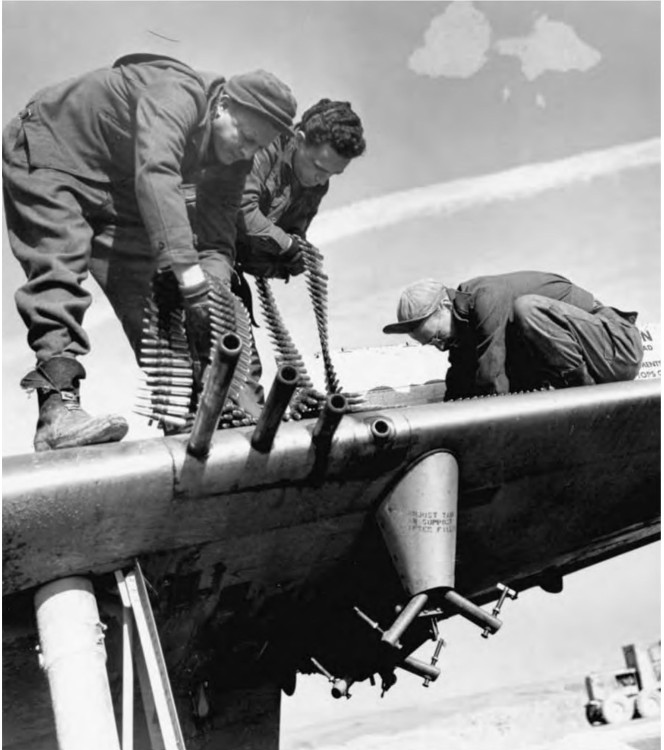
LOADING .50-CALIBER AMMUNITION into the wing of a P-47 Thunderbolt fighter plane. On 22 February one of the greatest aerial operations of the war was carried out by nearly 9,000 aircraft taking off from bases in England, France, the Netherlands, Belgium, and Italy. The targets, the German transportation facilities, covered an area of over a quarter of a million square miles.
GERMANY
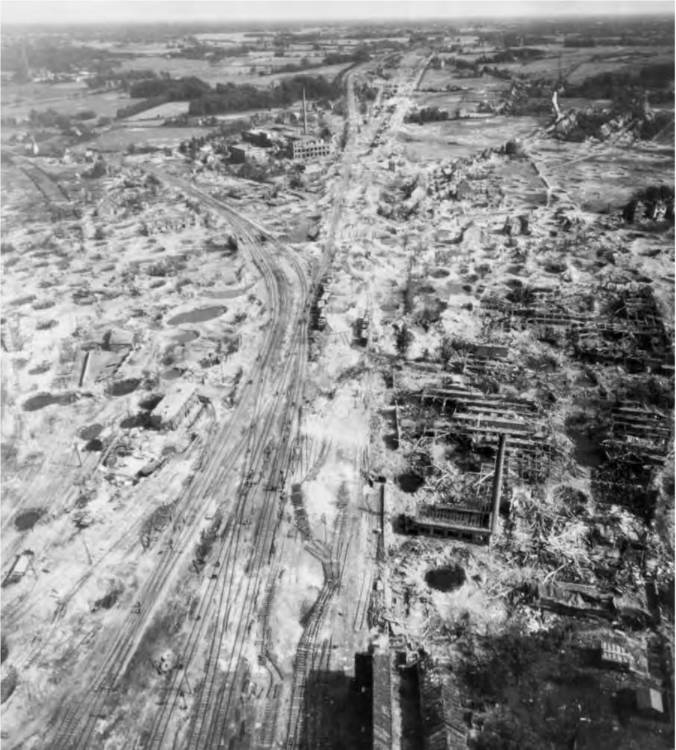
DESTROYED RAILYARD AT RHEINE, Germany, on the main line leading from Berlin and Hannover into the Netherlands. One of the most important targets of this attack was the German railway system. The enemy’s attempts at defense were completely ineffective as the bombs hit control points, railroad yards, roundhouses, and bridges. The attack so seriously crippled traffic that the railroad system did not recover during the war.
GERMANY
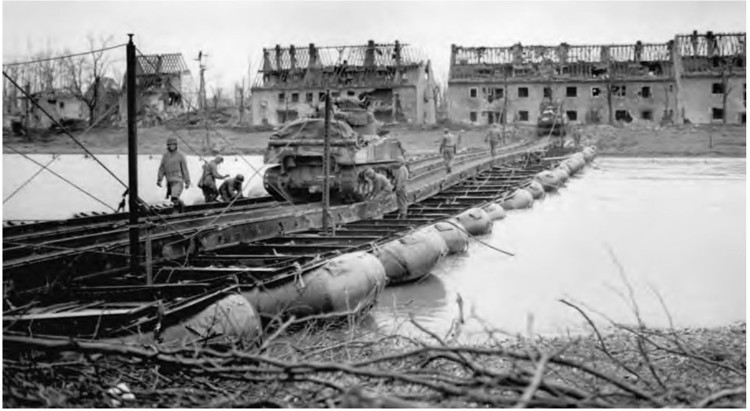
ROER RIVER TREADWAY PONTON BRIDGES. Early on the morning of 23 February the Ninth Army jumped off after a heavy artillery preparation. Covering the right flank was a corps of the First Army. Because the enemy was surprised by this attack only moderate opposition was encountered and by the end of the first day bridgeheads two to four miles deep were held, infantry troops were east of the Roer River, and seven bridges were being completed under a heavy screen of smoke.
GERMANY
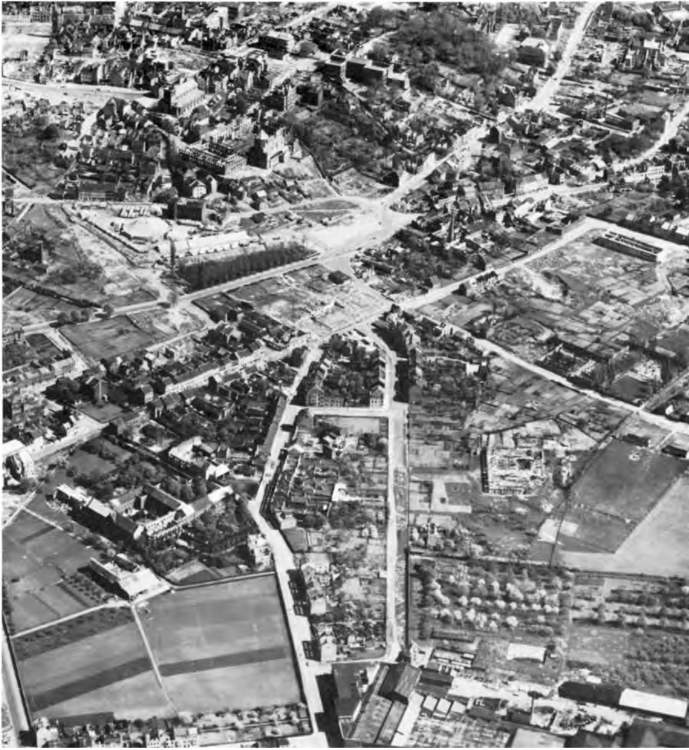
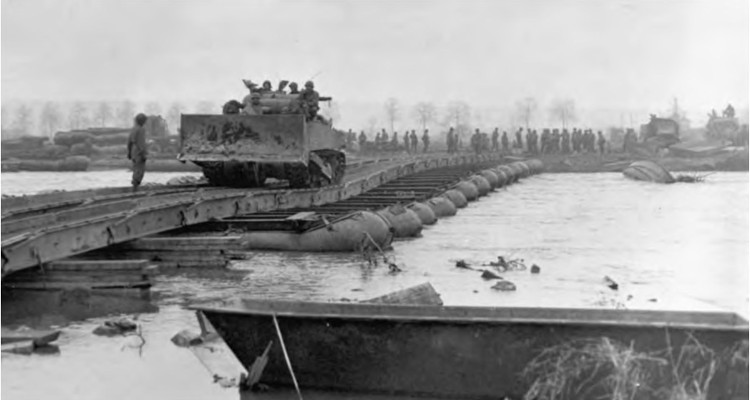
A PORTION OF MUENCHEN-GLADBACH. After crossing the Roer the U. S. units advanced to within seven miles of the Rhine and closed in on Muenchen-Gladbach by 28 February. On 1 March one infantry regiment cleared the city which had a population of 170,000 and was the largest German city captured up to that time. Located twelve miles from the Rhine, it was one of the approaches to the Ruhr. On 3 March contact was made with the British and by 5 March the U. S. Ninth Army had closed up along the Rhine on its entire front.
GERMANY
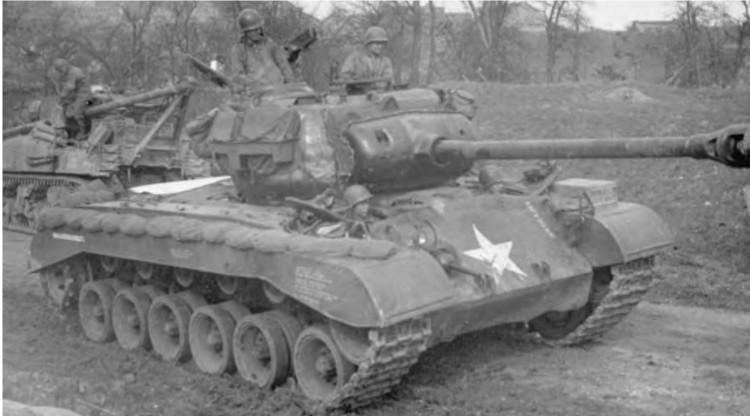
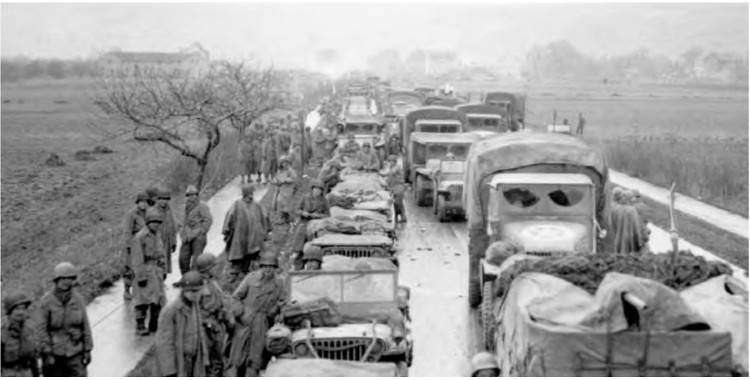
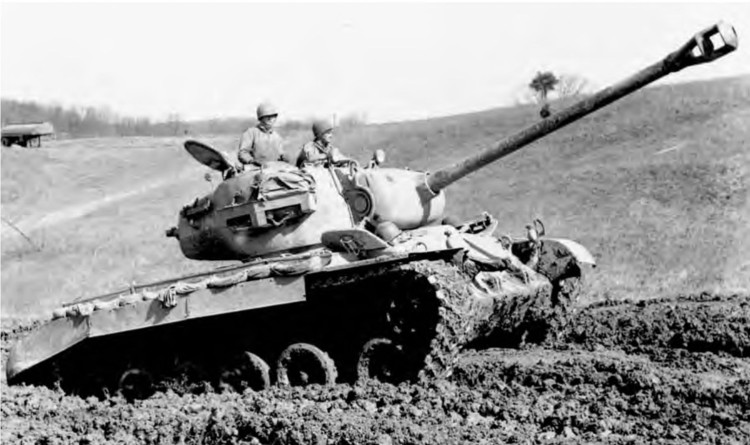
MEDIUM TANK M26 WITH A 90-MM. GUN equipped with a muzzle brake, introduced in combat early in 1945 (top). Both the light tank M24 and the medium tank M26 used a torsion bar type suspension which replaced the volute spring suspension of earlier models. Troops of the U. S. First Army approaching the Rhine (bottom). In the First Army area an attack was launched on 23 February simultaneously with that of the Ninth Army in the north. By 5 March First Army troops had secured all their initial objectives west of the Rhine.
FRANCE AND GERMANY
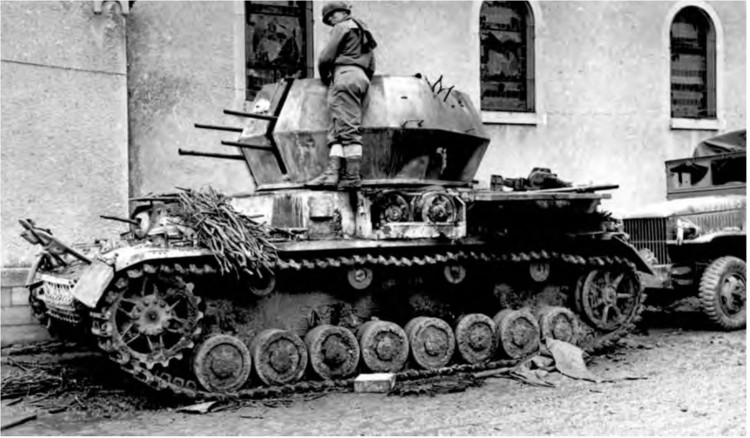
A GERMAN ANTIAIRCRAFT GUN on medium tank chassis (Pz. Kpfw. IV with 2-cm. Flakvierling 38) (top). German 380-mm. rocket projector on Tiger E chassis (Sturmmorser) (bottom). The German insistence on holding west of the Rhine cost two enemy armies large quantities of material and heavy losses in manpower.
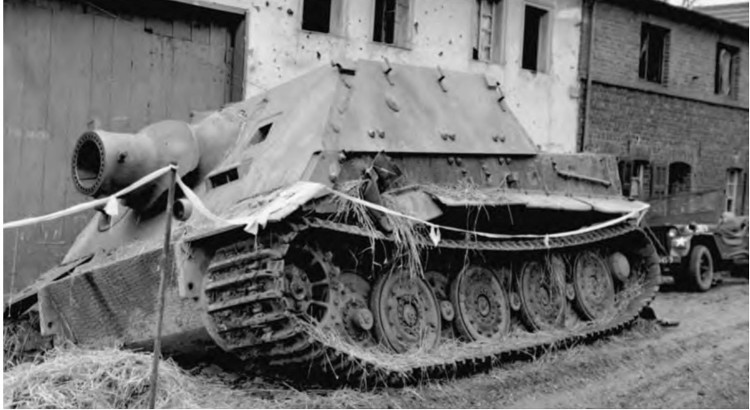
GERMANY
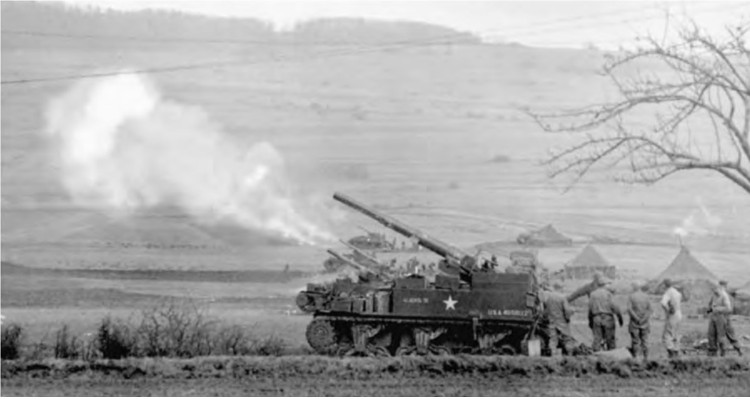
155-MM. MOTOR GUN CARRIAGE M12 firing on enemy installations (top). Infantrymen searching for snipers in Pruem, Germany (bottom). In the Third Army area probing attacks toward the West Wall were resumed on 7 February 1945. Self-propelled 155-mm. guns proved particularly effective in knocking out pillboxes, and by 12 February Pruem was cleared.
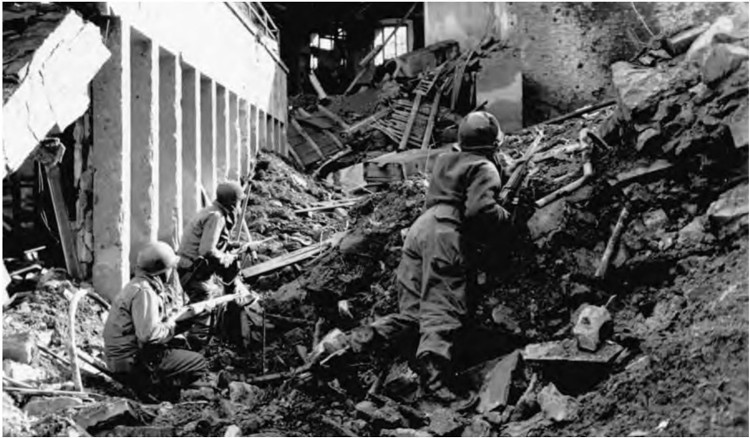
GERMANY AND BELGIUM
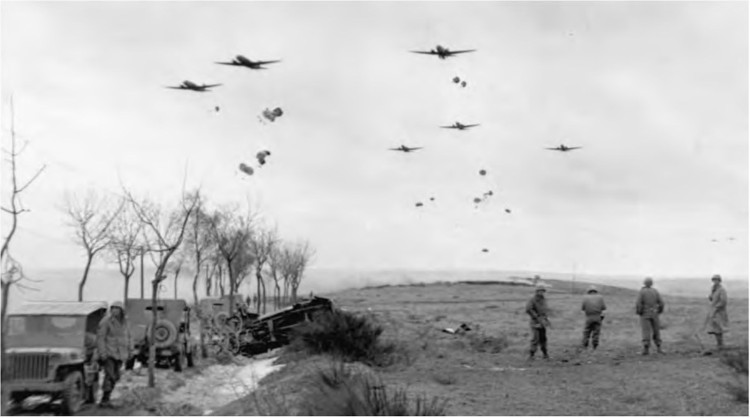
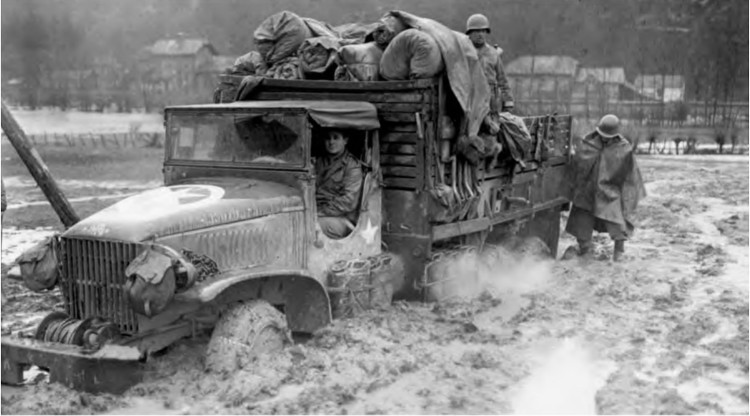
C-47’s DROPPING SUPPLIES TO INFANTRY TROOPS (top). 2?-ton truck bogged down in the mud (bottom). Weather and terrain placed a heavy burden on engineer troops maintaining the roads. As the ground began to thaw one of the main supply lines became impassable for a time. Over 190 plane loads of rations, gasoline, and ammunition were dropped to one division to maintain its attack.
LUXEMBOURG
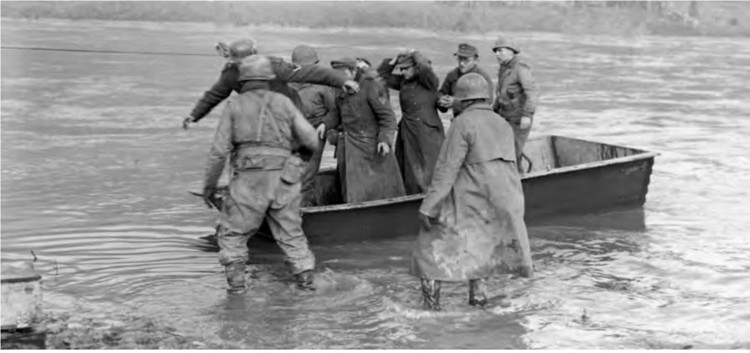
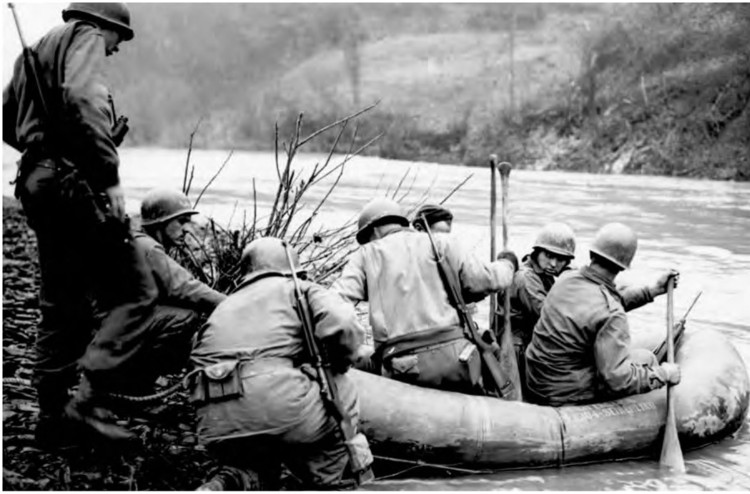
INFANTRYMEN MOVING PRISONERS to the rear across a river near Echternach (top). Assault troops crossing the Our River (bottom). Bridgeheads were secured over the Our and Vianden was cleared by 20 February. Between Vianden and Echternach troops pushed into the West Wall.
GERMANY
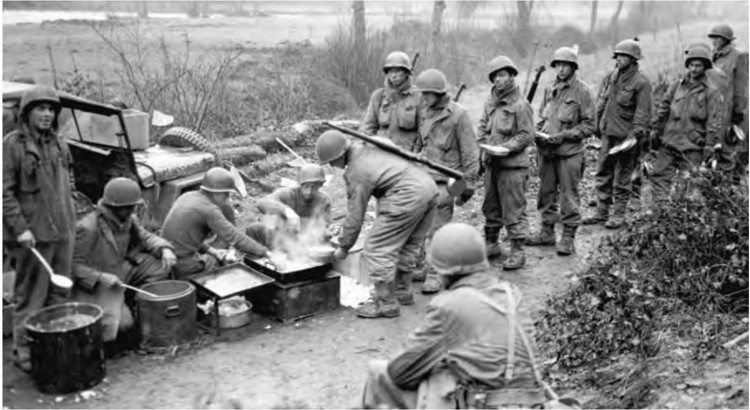
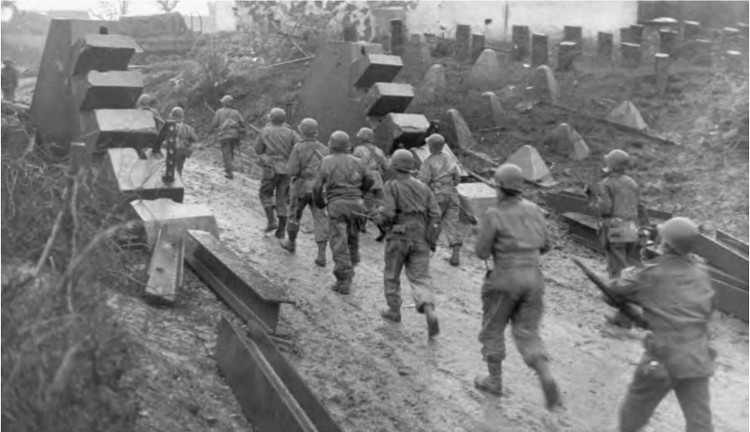
FRIED EGGS BEING SERVED FOR BREAKFAST, a special treat for the men stationed near the West Wall (top). Troops moving through dragon’s teeth of the West Wall fortifications (bottom). By 23 February two corps of the Third Army had fought their way through the West Wall to the Pruem River.
GERMANY
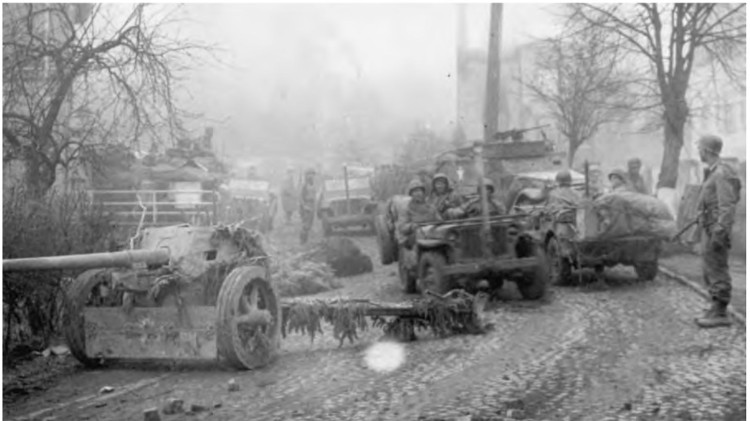
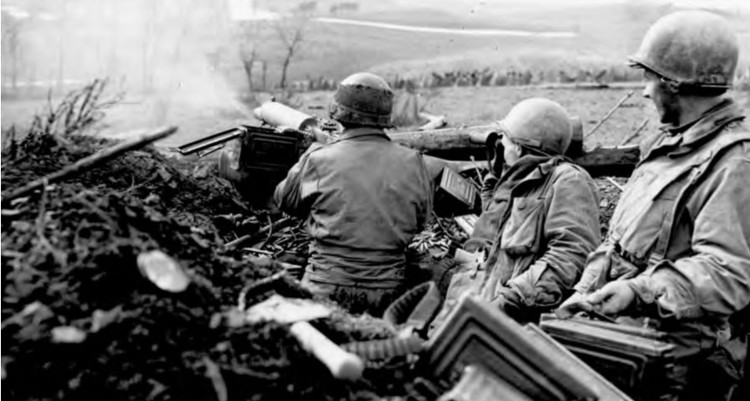
CAVALRY RECONNAISSANCE TROOPS passing a German 75-mm. antitank gun in the outskirts of Saarburg, Germany (top). Firing a .30-caliber machine gun M1917A1 (bottom). On 21 February Saarburg was cleared by one task force of the Third Army, while a part of an armored division drove north and cleared the tip of the Saar-Moselle triangle the next day.
BELGIUM
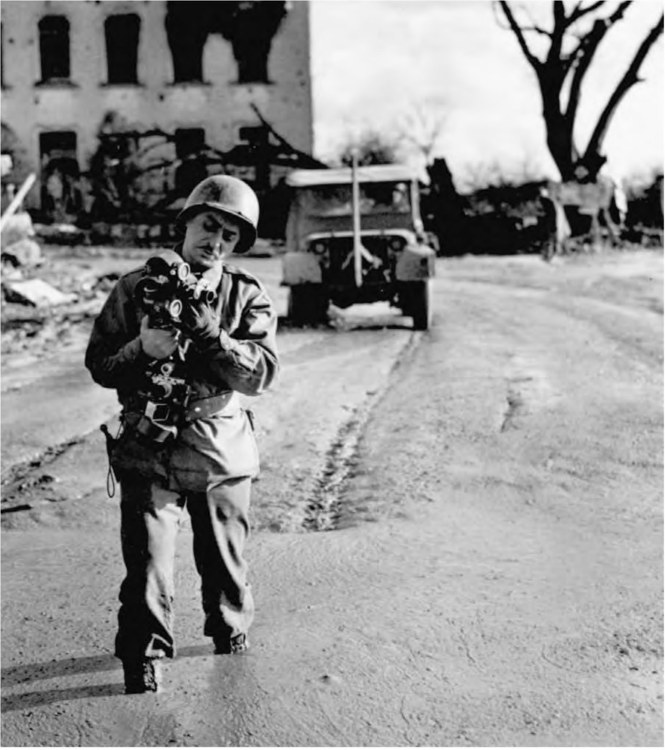
A SIGNAL CORPS MOTION PICTURE CAMERAMAN wading through the mud of the February thaws while photographing the activities of a military unit. By the end of February the Third Army was advancing toward Trier and Bitburg. By 5 March 1945 Trier was captured and preparations were being made for the final drive to the Rhine.
GERMANY
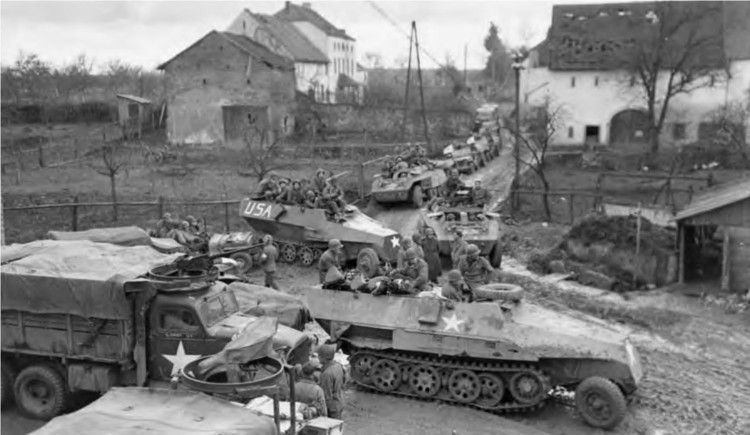
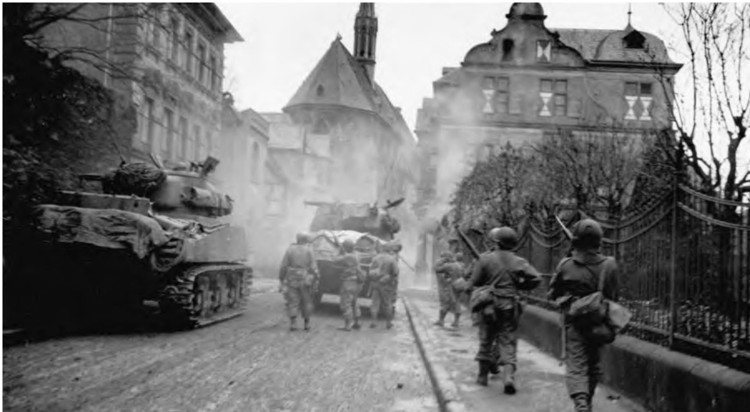
TROOPS OF THIRD ARMY waiting for the order which would start a drive to the Rhine. The two armored vehicles are German armored personnel carriers (top). Tanks and infantry entering Andernach (bottom). The Rhine city of Andernach was captured on 9 March and contact was made with U. S. First Army units the next day.
GERMANY
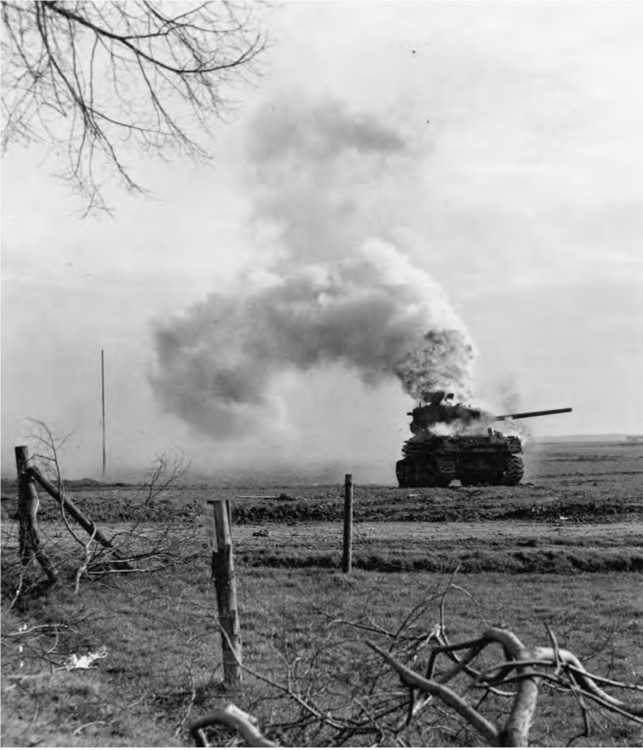
A MEDIUM TANK of an armored division of the U. S. First Army knocked out by enemy artillery fire. During the first week of March the First Army advanced toward the Rhine with parts of its forces while others launched a strong attack from Euskirchen to converge on the Third Army area in the vicinity of Ahrweiler.
GERMANY
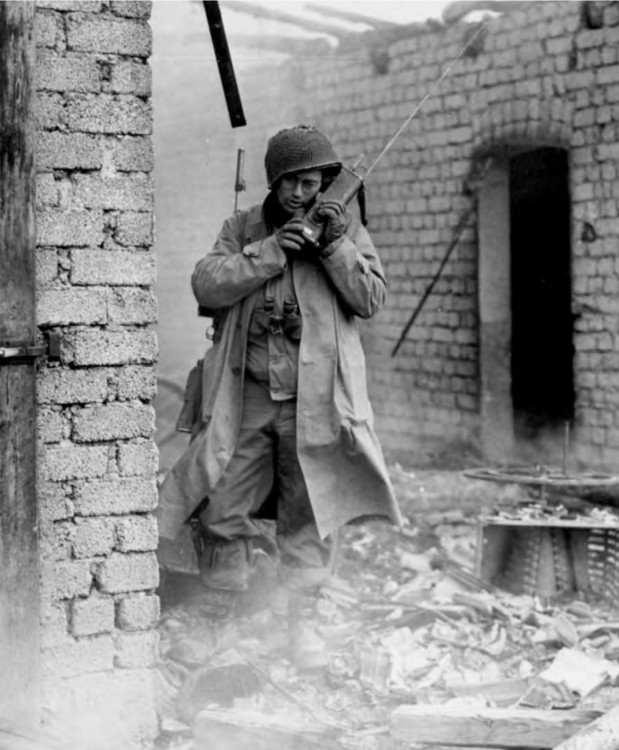
HANDIE-TALKIE. An infantryman, armed with a carbine equipped with a grenade launcher M8, using a handie-talkie radio SCR 536.
GERMANY
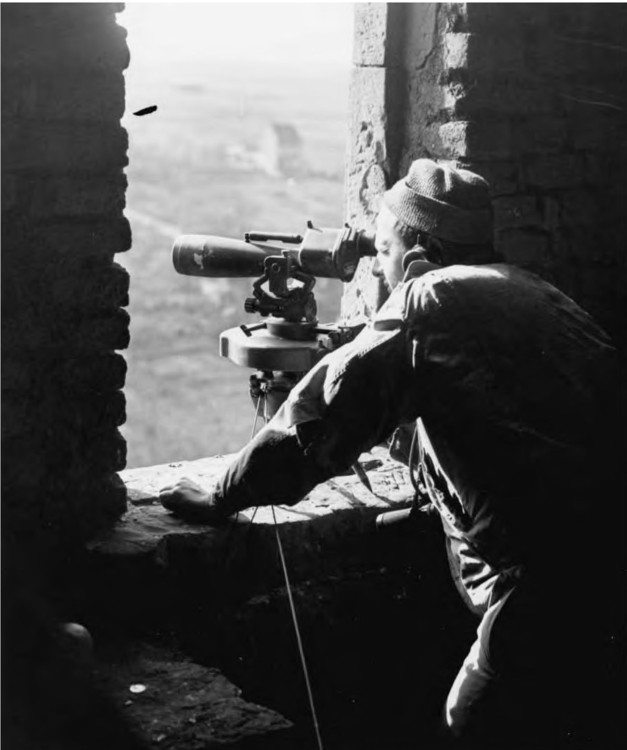
AN ARTILLERYMAN DIRECTS FIRE, using an azimuth instrument M1 for spotting and observing.
GERMANY
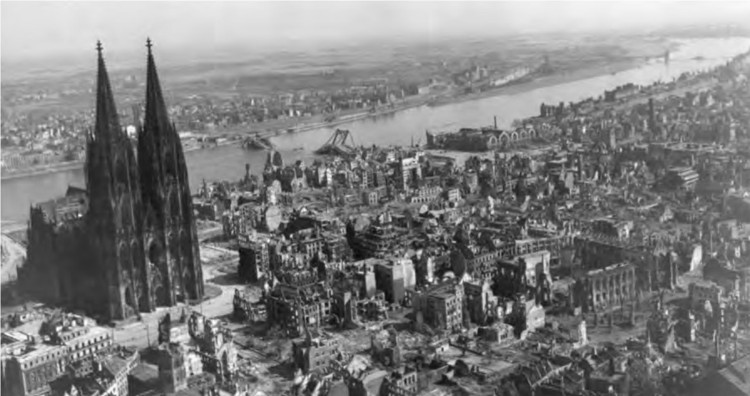
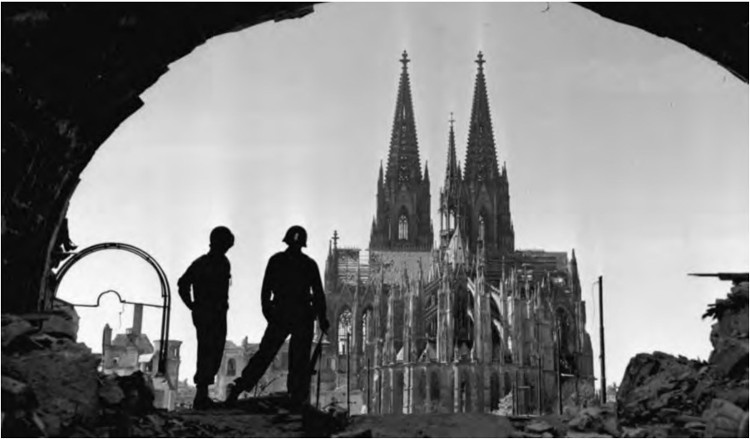
THE CITY OF COLOGNE on the banks of the Rhine. U. S. First Army forces took Cologne on 7 March. The enemy had withdrawn most of the veteran troops who had defended the city and left its Volkssturm troops to be battered by the advancing U. S. soldiers. By 9 March the First Army zone was cleared of enemy troops west of the Rhine.
GERMANY
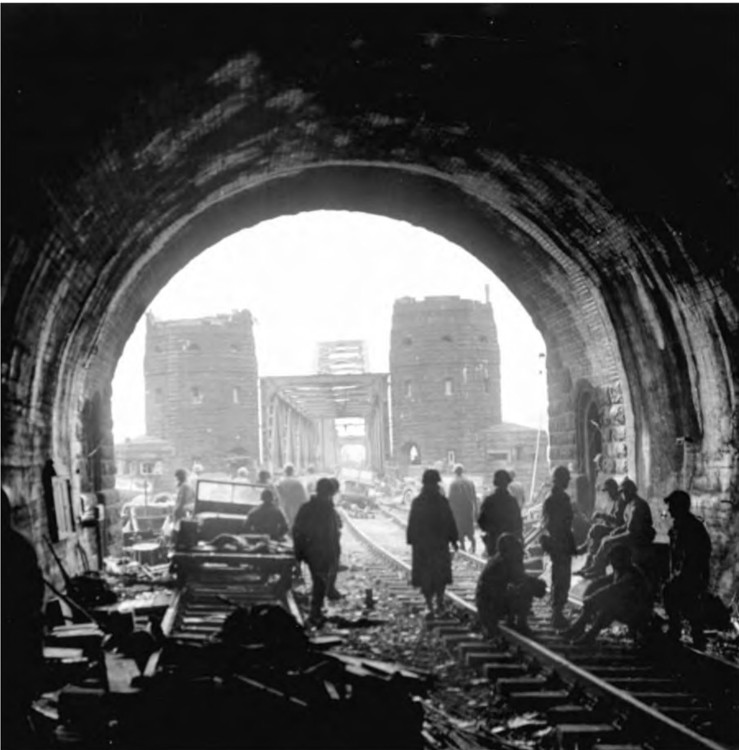
FIRST ARMY MEN AND EQUIPMENT crossing the Ludendorf railroad bridge which became known as the Remagen Bridge. This was the only bridge across the Rhine which was left intact. The attention of the First Army was focused at Remagen during the critical days of securing a bridgehead over the Rhine. The capture of this bridge was an unexpected windfall, because the retreating enemy troops had placed charges and were to blow the bridge at 1600 on 7 March. The first U. S. troops reached the bridge at 1550 and as the first charges began to explode army engineers cut the wires to the others. Thus the bridge, while damaged, was still intact and enabled the U. S. forces to cross the river.
GERMANY
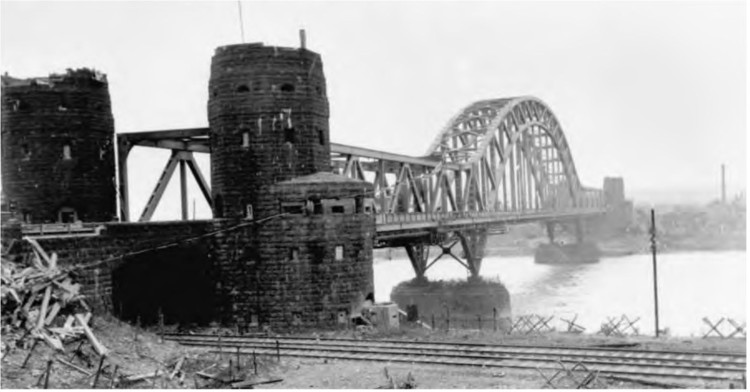
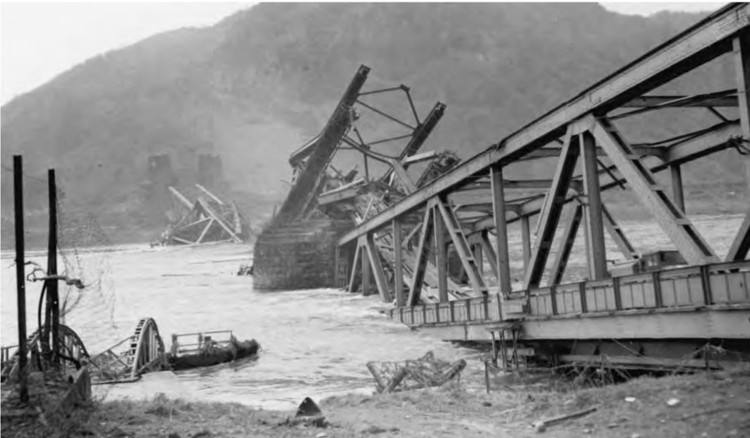
THE LUDENDORF BRIDGE four hours before it collapsed (top). The bridge after it fell into the Rhine (bottom). After capturing the bridge troops were rushed across in pursuit of the retreating Germans while the engineers set to work to repair the damage. Enemy planes made repeated attacks on the bridge and it was shelled by long-range artillery. At 1430 on 17 March the bridge buckled and fell into the river only a few hours before the repairs would have been completed.
GERMANY
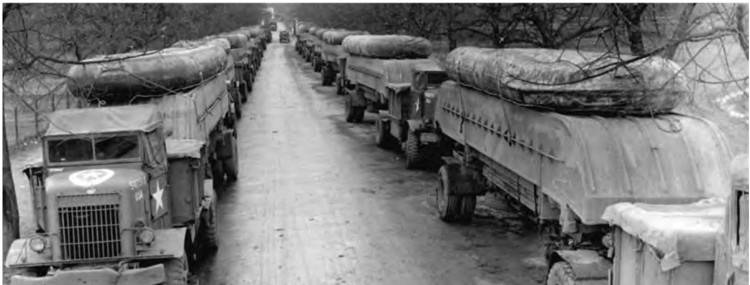
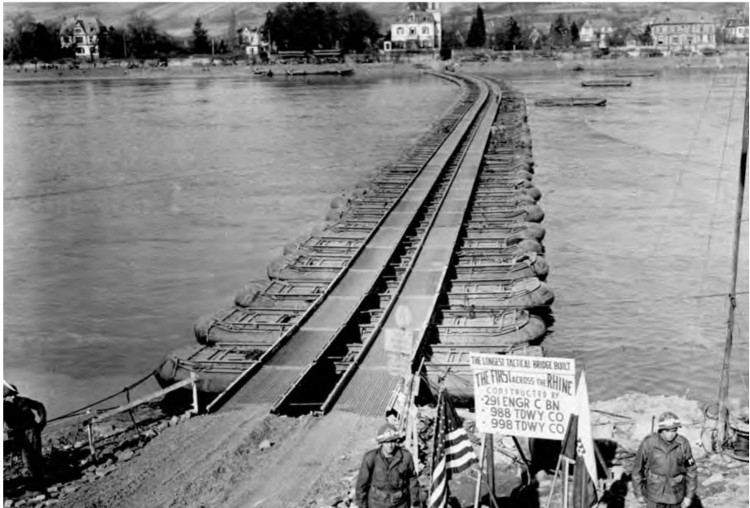
PONTON BOATS AND FLOATS being moved to the Rhine in the Remagen area (top). Treadway bridge across the Rhine near Remagen (bottom). During the period 11–16 March the bridgehead was expanded north and south and all attacks gained ground despite the arrival of enemy reinforcements. Treadway and heavy ponton bridges were built across the river. As the Rhineland Campaign came to an end, six divisions were east of the Rhine and six more were ready to cross in the First Army zone.
GERMANY
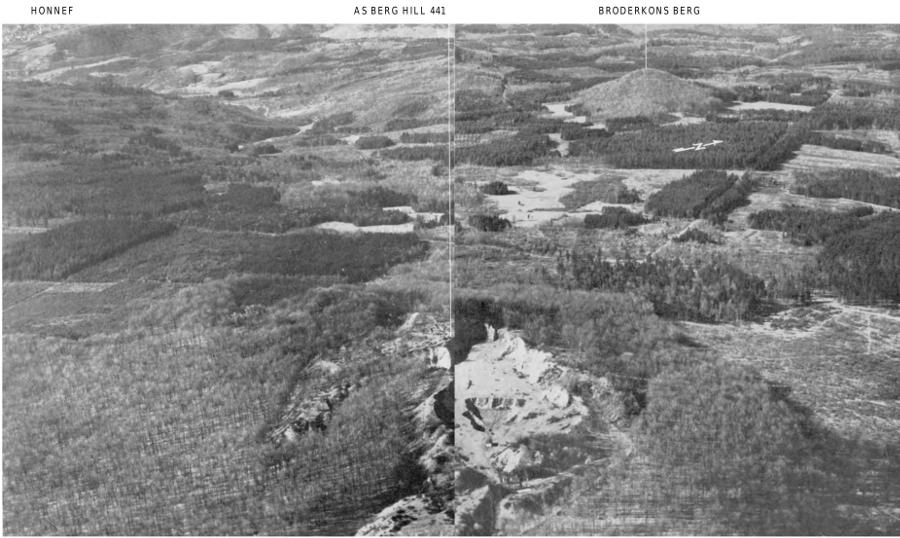
ROLLING, WOODED AREA EAST OF THE RHINE, typical of that encountered by the Allied troops in their advance into Germany. A small portion of Honnef, between Bonn and Remagen, may be seen in the extreme upper left portion of picture.
GERMANY
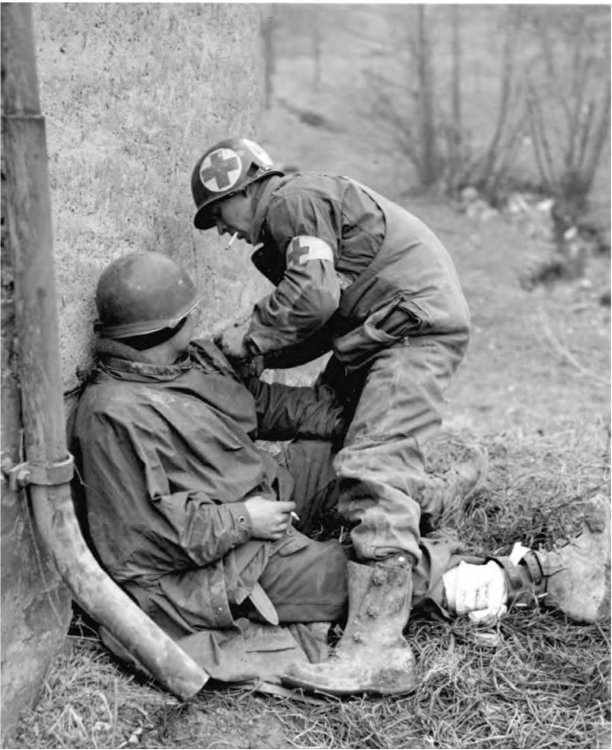
MEDICAL AID MAN dressing the wounds of an infantryman.
GERMANY
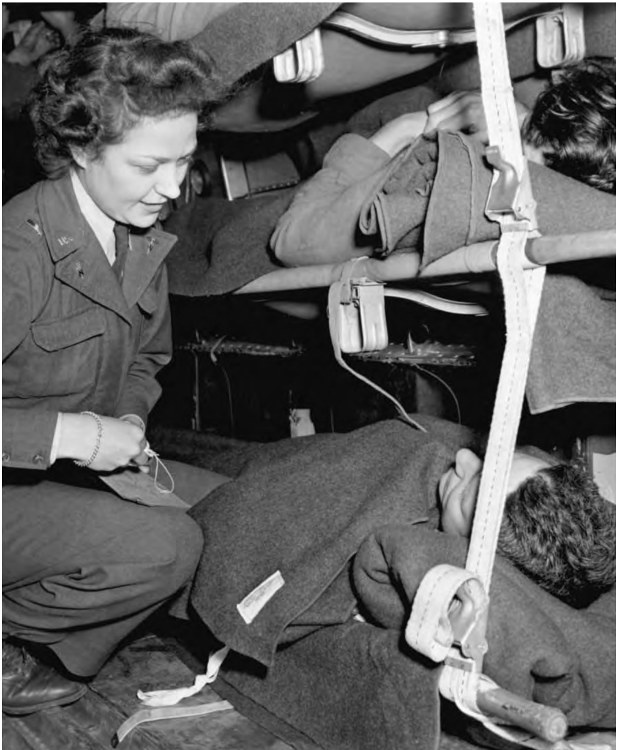
WOUNDED SOLDIERS being evacuated by air to hospitals in Paris and London.
GERMANY
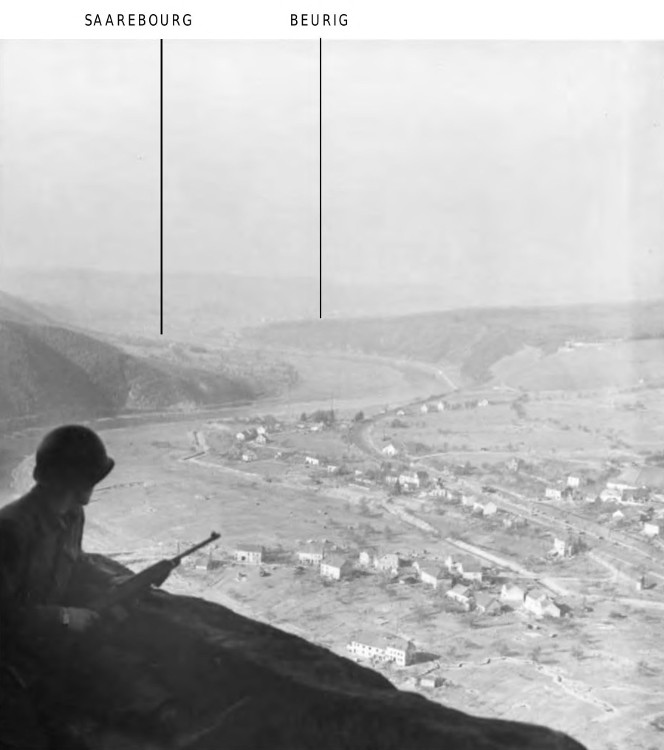
AN ENLISTED MAN looking across the Saar River valley between Serrig and Saarburg. The village of Serrig is in the foreground. In this area the forward edge of the West Wall, over two miles deep, followed the eastern bank of the Saar River. An antitank ditch skirting the southwestern side of the village of Serrig and a communication trench in the lower right hand corner are visible. U. S. vehicles may also be seen dispersed through the area.
GERMANY
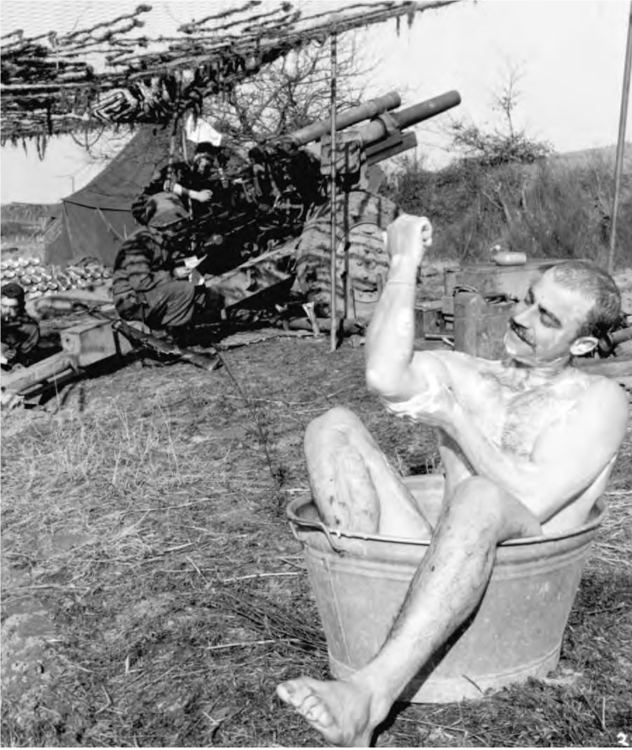
SPRING CLEAN-UP. An artilleryman takes time out for a bath during a warm spring afternoon while other members of the 105-mm. howitzer crew remain near their piece.
GERMANY
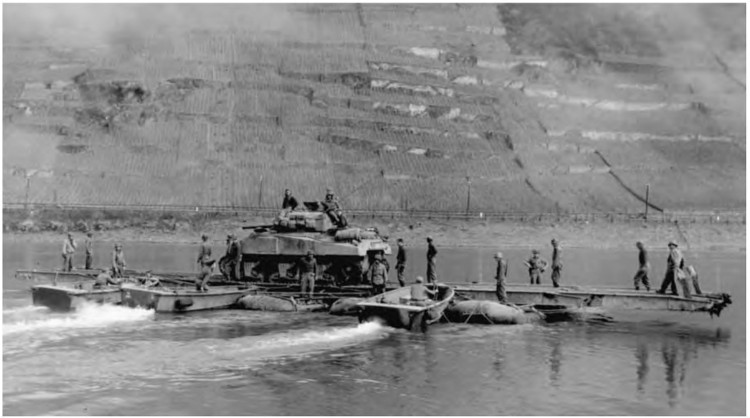
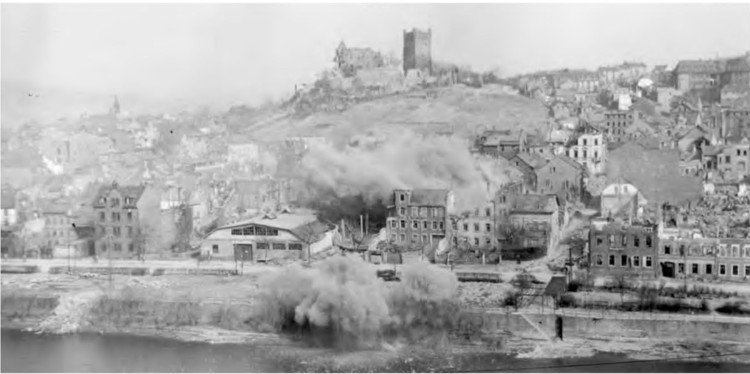
A MEDIUM TANK being ferried across the Moselle River (top). Artillery shelling Bingen (bottom). From 11 to 13 March the Third Army cleaned out the Germans who remained north of the Moselle. The Third Army next regrouped its forces and started an attack toward Bingen and Bad Kreuznach to prevent the enemy from retreating across the Rhine. The attack was then to continue southeast to secure a crossing site somewhere between Mainz and Worms. At the same time a drive to Kaiserslautern was to begin and Coblenz was to be reduced.
GERMANY
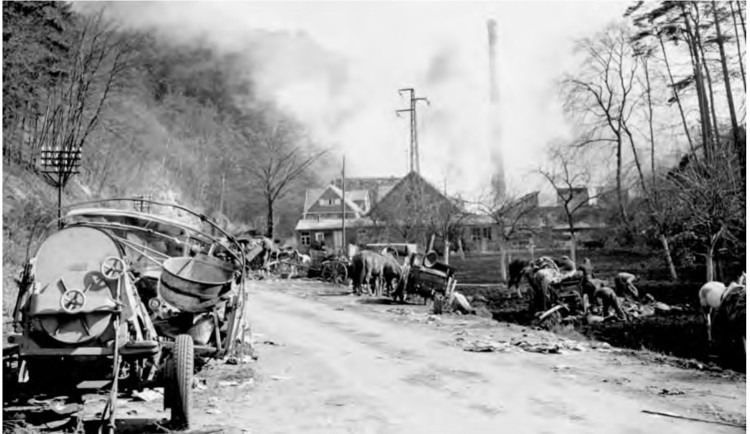
ENEMY EQUIPMENT destroyed during the U. S. advance (top). Infantrymen moving on the double past a fire started by enemy shelling (bottom).
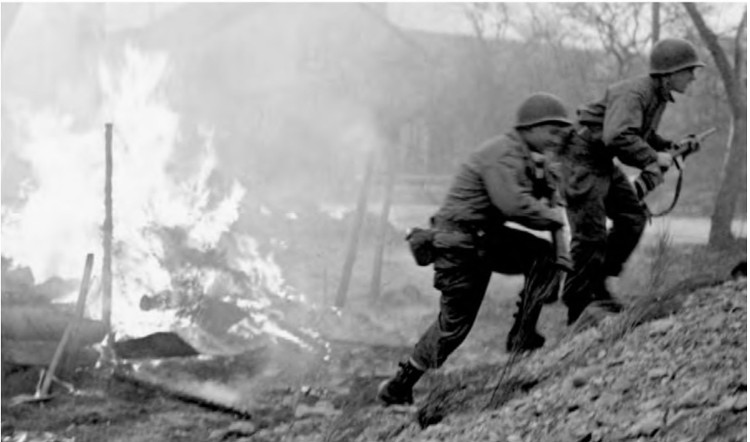
GERMANY
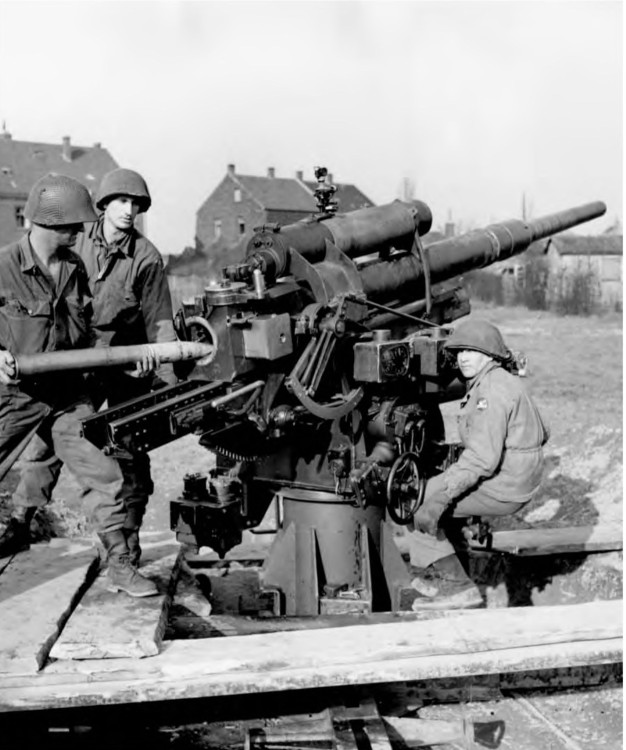
A THREE-MAN ARTILLERY CREW preparing to fire a multipurpose 88-mm. gun captured in Germany.
FRANCE AND GERMANY
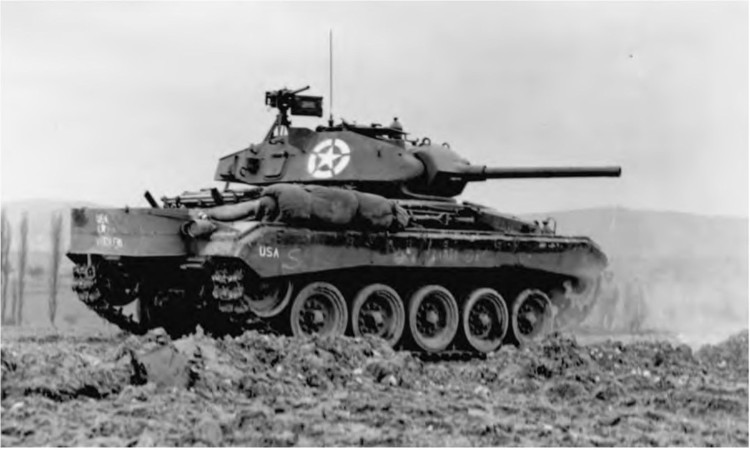
LIGHT TANK M24 firing (top); medium tank M26 crossing a muddy field (bottom).
GERMANY
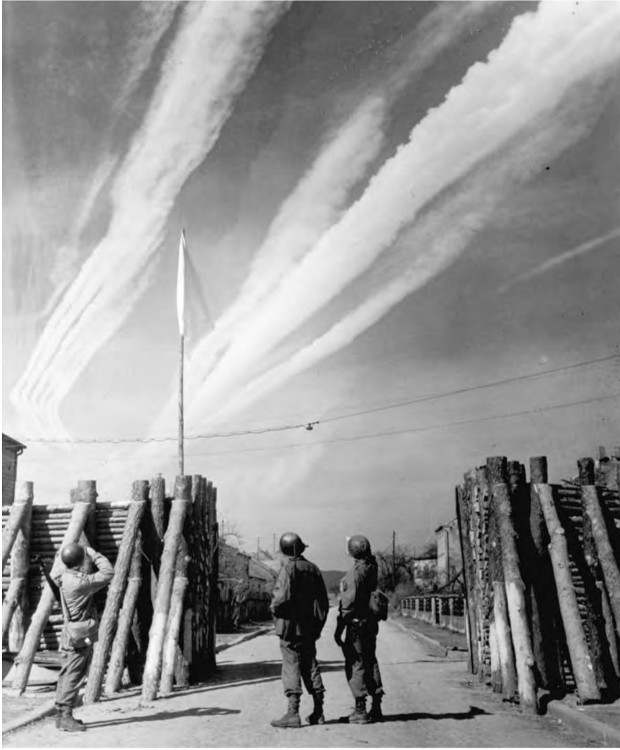
SOLDIERS WATCHING VAPOR TRAILS left by bombers on their way to bomb Germany.
FRANCE
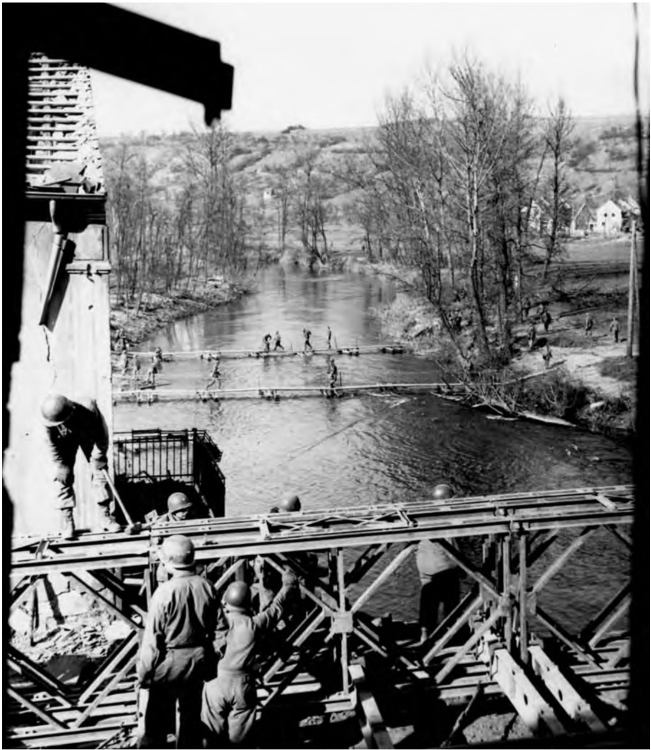
INFANTRY MEN USING FOOTBRIDGES to cross a river while engineers complete a Bailey bridge. On 15 March three corps of the Seventh Army began attacks, one in the heart of the important Saar industrial area around Saarbruecken, the second driving toward Zweibruecken and Bitche, and the third from the Moder River.
GERMANY
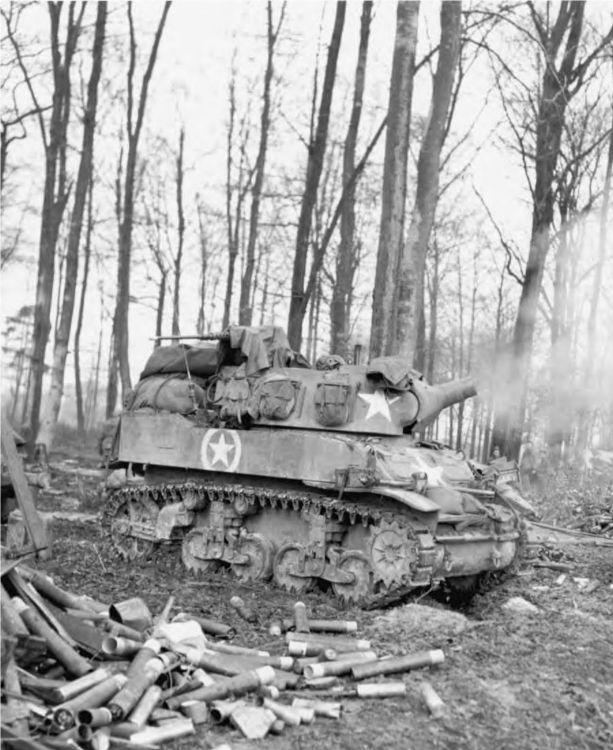
75-MM. HOWITZER motor carriage M8 firing on enemy positions.
FRANCE
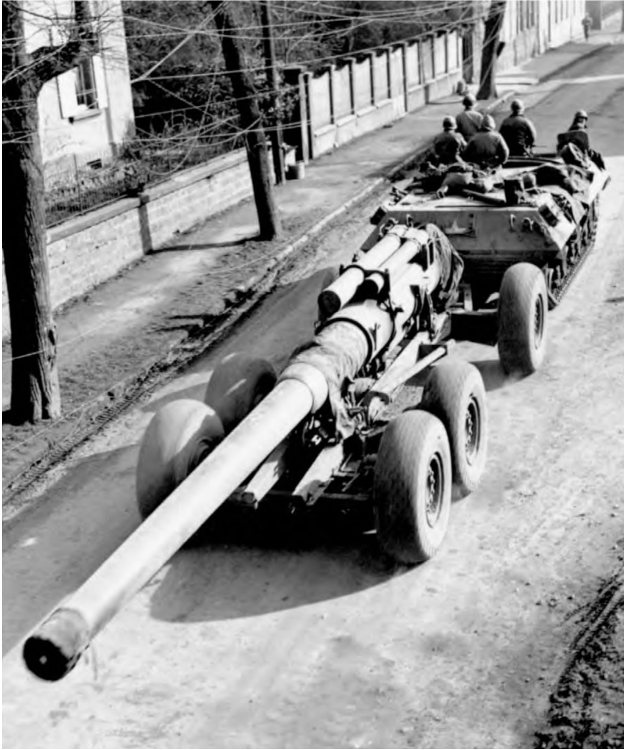
TUBE AND RECOIL MECHANISM OF AN 8-INCH GUN M 1 on the way to the front.
FRANCE
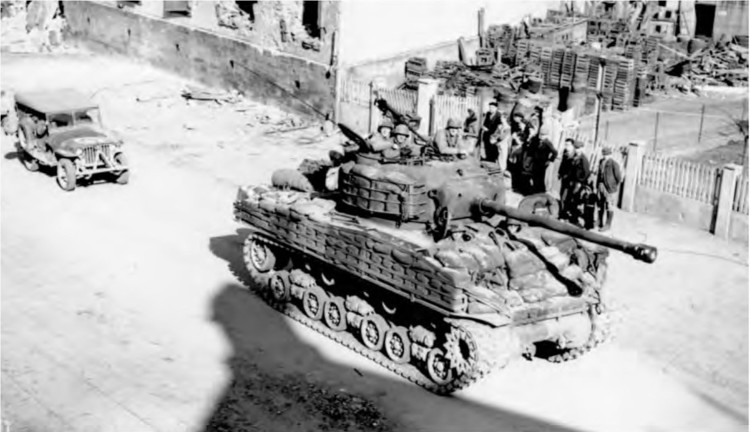
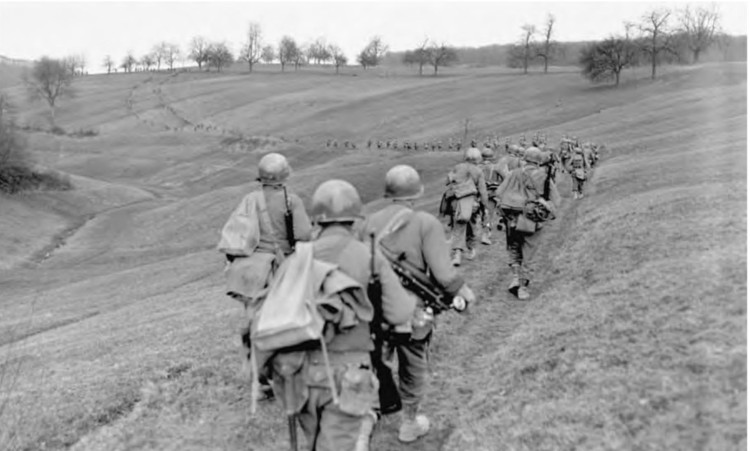
SEVENTH ARMY TROOPS ENTERING BITCHE (top). Infantrymen marching cross-country on their way to Germany (bottom).
GERMANY
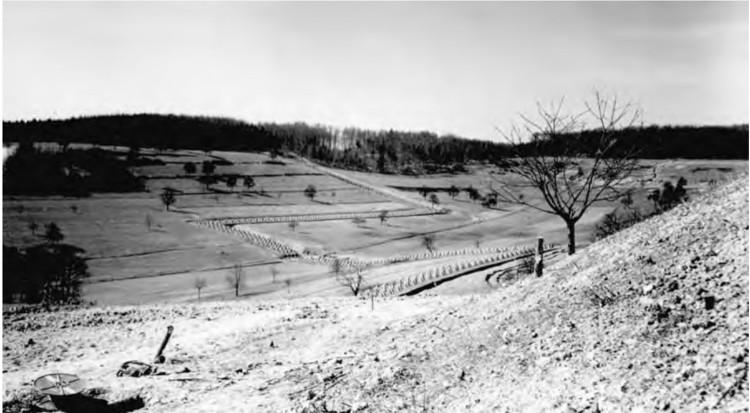
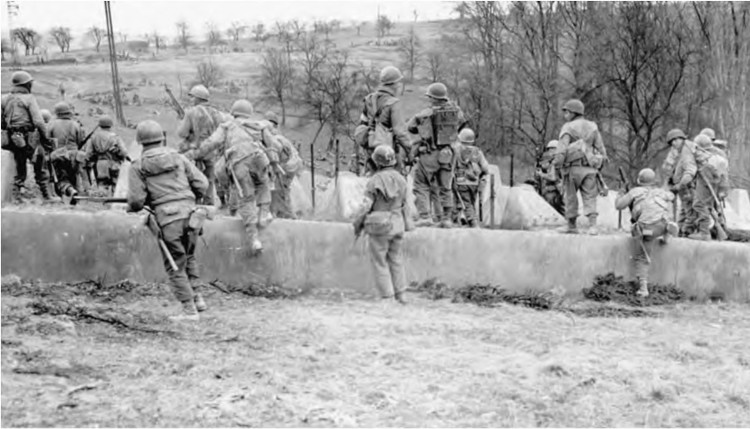
DRAGON’S TEETH, part of the West Wall defenses (top). Infantrymen climbing over obstacles as they advanced through the West Wall into Germany (bottom). The advance of the Seventh Army through the dense mine fields and fortification of the West Wall was necessarily slow.
GERMANY
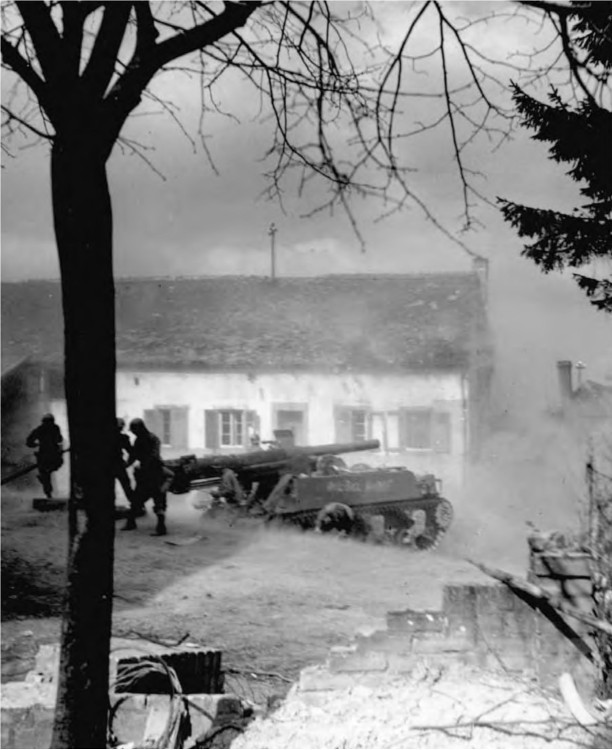
155-MM. MOTOR GUN CARRIAGE M12 FIRING.
FRANCE AND GERMANY
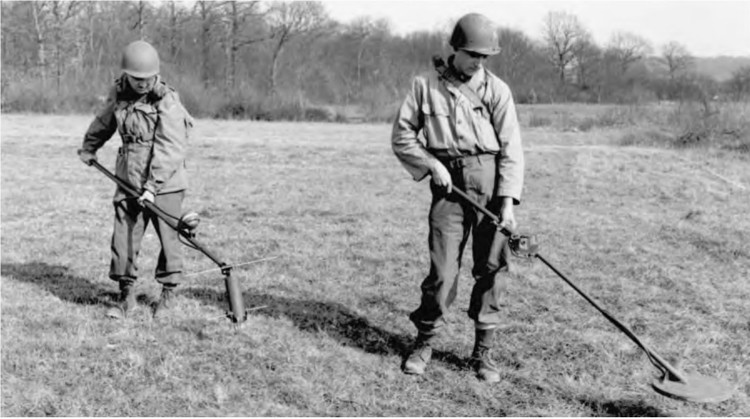
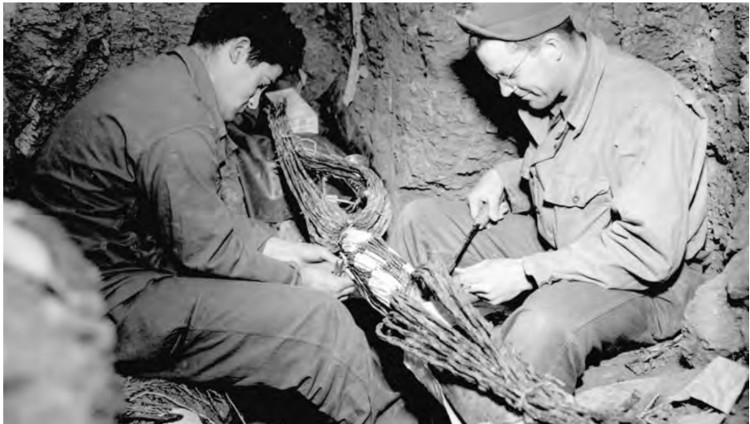
TWO TYPES OF MINE DETECTORS. At left, AN/PRS-1 type; at right, SCR 625 (top). Mine detectors were developed by the Signal Corps primarily for use by Engineer troops. Signal Corps repairmen splicing wires of an underground cable which was damaged by artillery fire (bottom).
GERMANY AND FRANCE
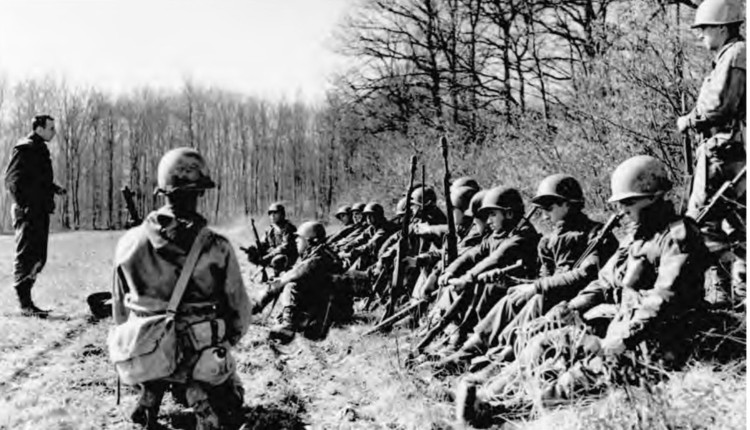
INFANTRY PLATOON BEING BRIEFED before making an assault (top). Soldiers taking a ten-minute break during a march to the front lines (bottom).
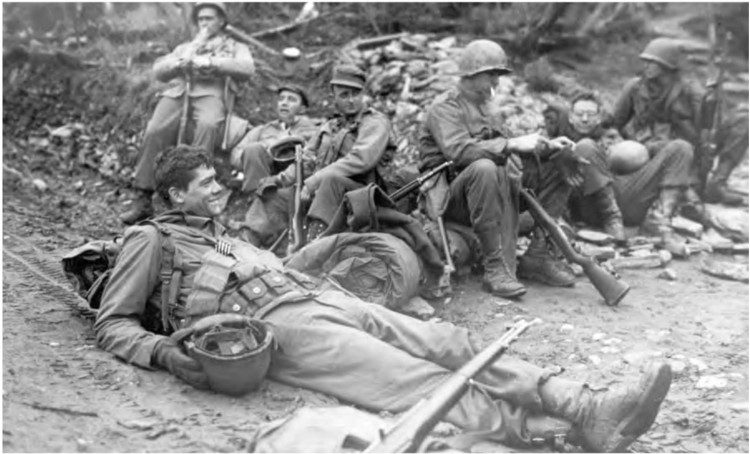
CENTRAL EUROPE CAMPAIGN
CENTRAL EUROPE
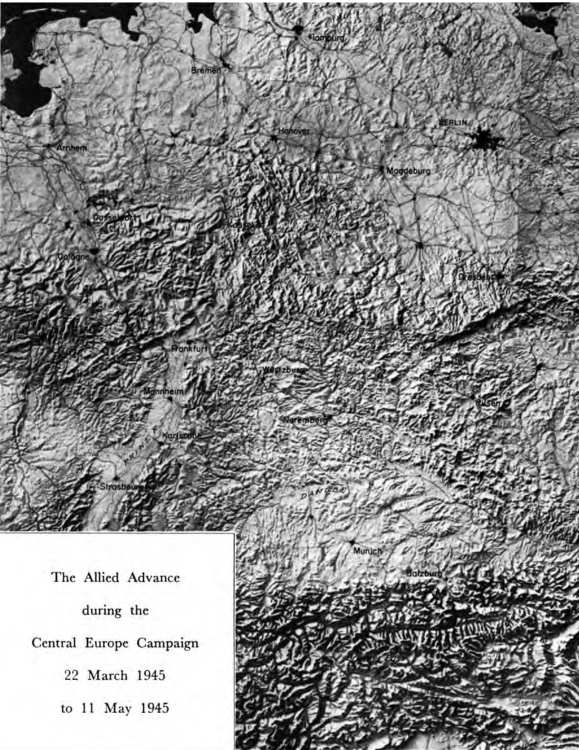
The Allied Advance during the Central Europe Campaign 22 March 1945 to 11 May 1945