SECTION II Normandy Campaign
Reading edition
On 6 June 1944 the Allied military forces invaded northern France. After long study of the German strength, including coastal defenses and the disposition of enemy troops, the Allied commanders selected the beaches along the Bay of the Seine for the assault landings. The two beaches to be used by troops of the First U. S. Army were given the names of Utah and Omaha. Those on which the British and Canadians of the British Second Army were to land were named Gold, Sword, and Juno. The assault began at 0200 on 6 June when airborne troops were dropped behind the beaches with the mission of securing exits from the beaches. Planes of the Allied air force bombed the coastal defenses and shortly after sunrise the Navy began shelling the beach defenses. At 0630 the first troops landed on the beaches of Normandy. The sea was rough and the assault forces met varying degrees of enemy opposition, but the beachheads were secured and the assault and follow-up troops moved on to accomplish their missions. The U. S. forces landing on Utah Beach moved northwest to clear the northern portion of the Cotentin Peninsula and capture the port of Cherbourg. Those landing on Omaha Beach advanced southward toward Saint-Lô. The troops of the British Second Army were to advance in a southeast direction from Caen.
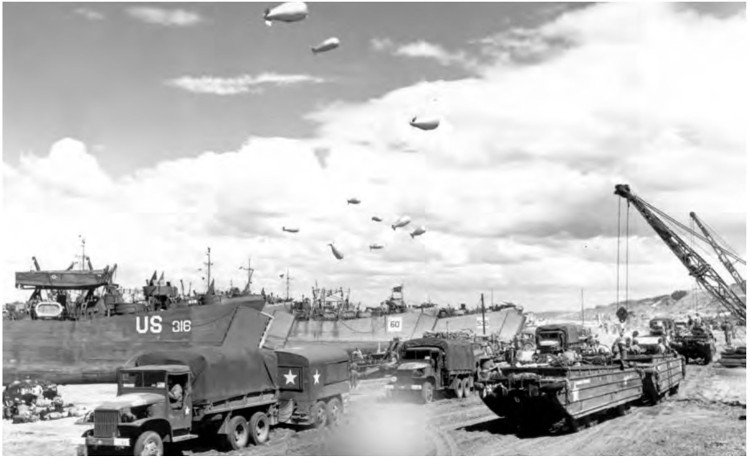
The enormous build-up of men and material began immediately after the assault. This operation was made most difficult because of the lack of port facilities, but before the invasion plans had been made for the construction of artificial harbors. The plans were quickly put into effect and the harbors were almost completed when a summer gale struck the Channel coast destroying most of the construction work. By using amphibian trucks and Rhino ferries, and by drying out LST’s, the build-up over open beaches progressed much faster than was anticipated and men and supplies were poured into France in ever increasing numbers.
While the beachheads were expanded and the build-up continued, the infantry and armored units fought their way through the hedgerow country toward their objectives. The fighting was slow and costly as enemy opposition stiffened in an unsuccessful attempt to prevent the Allied advance. With the capture of Cherbourg and Saint-Lô the initial missions of the U. S. forces were completed and the forces were then assembled in preparation for the drives south and west from the beachhead toward Avranches and the Brittany Peninsula. The British forces were to push southward from Caen exploiting in the direction of Paris and the Seine Basin. These attacks were scheduled to begin on 19 July 1944 but because of bad weather the supporting aerial assault was delayed and the breakout of Normandy did not get under way until 25 July.
ENGLAND
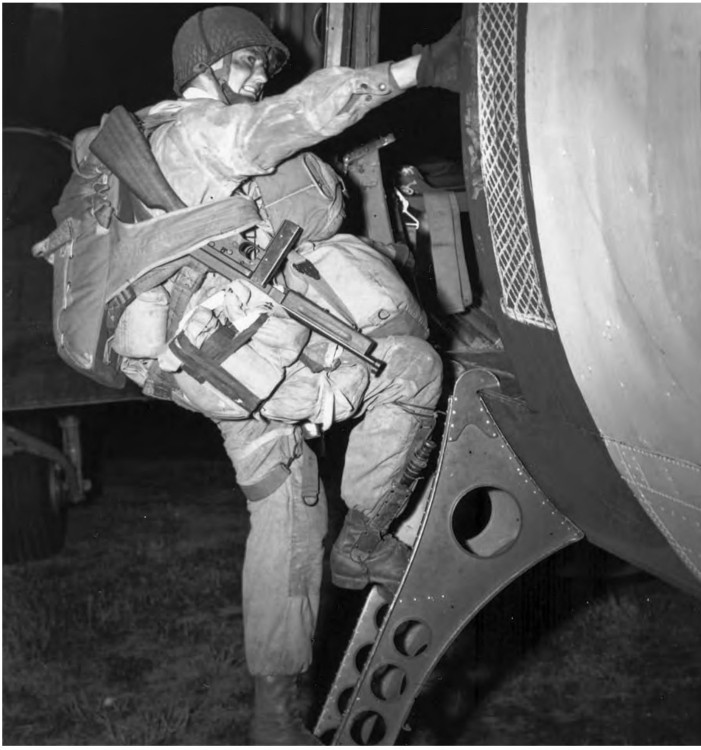
FULLY EQUIPPED PARATROOPER, armed with a Thompson submachine gun M1, climbing into a transport plane to go to France as the invasion of Normandy gets under way. At approximately 0200, 6 June 1944, men of two U. S. airborne divisions, as well as elements of a British airborne division, were dropped in vital areas to the rear of German coastal defenses guarding the Normandy beaches from Cherbourg to Caen. By dawn 1,136 heavy bombers of the RAF Bomber Command had dropped 5,853 tons of bombs on selected coastal batteries lining the Bay of the Seine between Cherbourg and Le Havre.
FRANCE
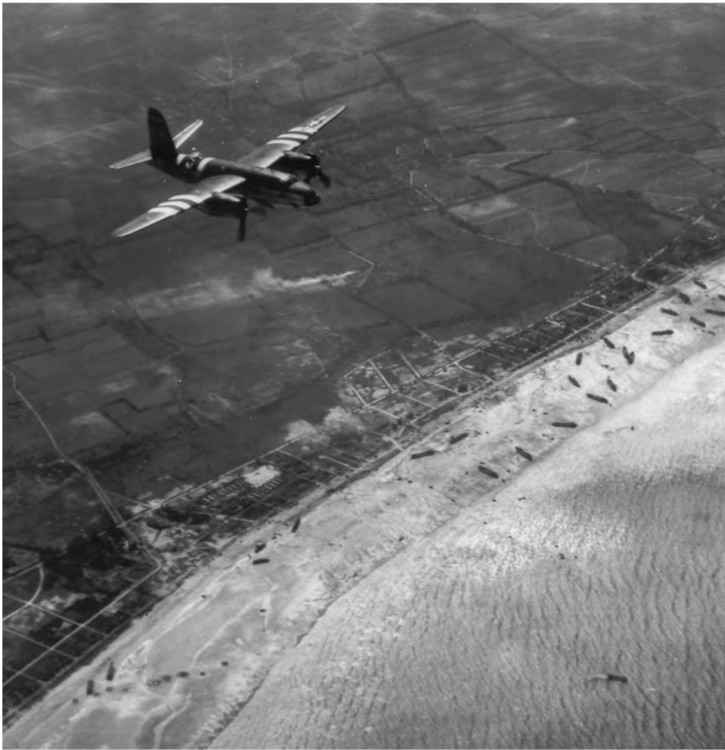
A MARTIN B-26 MEDIUM BOMBER flying over one of the invasion beaches, early on D-Day morning. All planes which supported the invasion operations, with the exception of the four-motored bombers, were painted with three white and two black stripes for identification purposes. At dawn on D-Day the U. S. Air Forces took up the air attacks and in the half hour before the touchdown of the assault forces (from 0600 to 0630) 1,365 heavy bombers dropped 2,746 tons of high explosives on the shore defenses. This was followed by attacks by medium bombers, light bombers, and fighter bombers. During the 24 hours of 6 June Allied aircraft flew 13,000 sorties, and during the first 8 hours alone dropped 10,000 tons of bombs.
FRANCE
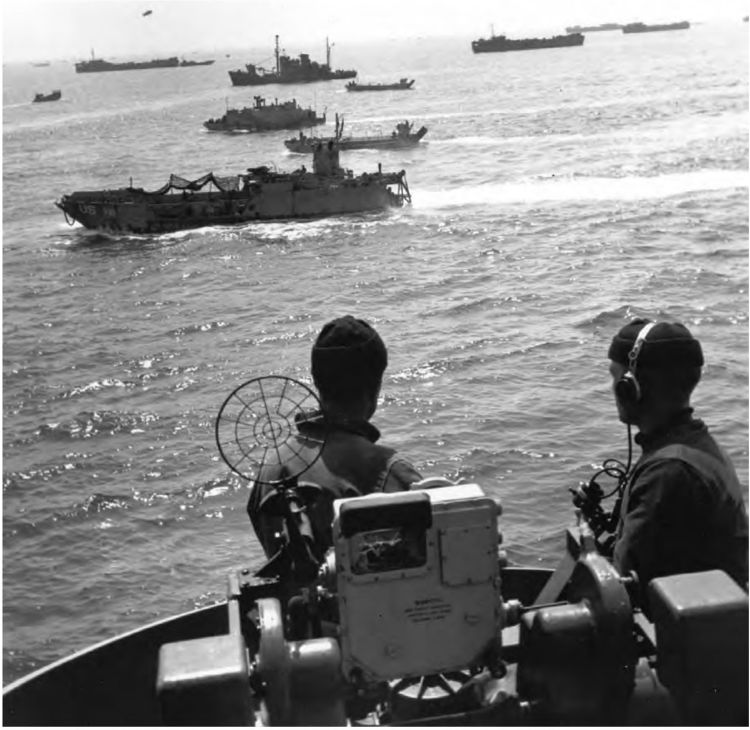
GUN CREW ALERT aboard the cruiser USS Augusta, as landing craft approach the coast of France during the invasion, 6 June 1944. The three landing craft nearest the Augusta are an L C T(6), an L B V, and an L B K. While the Allied air forces were bombing installations along the invasion beaches the Allied sea armada drew in toward the coast, preceded by its flotillas of mine sweepers. Bad weather conditions and high seas had driven the enemy surface patrol craft into their harbors, and the 100-mile movement across the English Channel was unopposed. By 0300 the ships had anchored in the transport areas some thirteen miles off their assigned beaches, and the loading of troops into landing craft and the forming of the assault waves for the dash to the beaches began. At 0550 the heavy naval support squadrons began a 45-minute bombardment which quickly silenced the major coast-defense batteries.
FRANCE
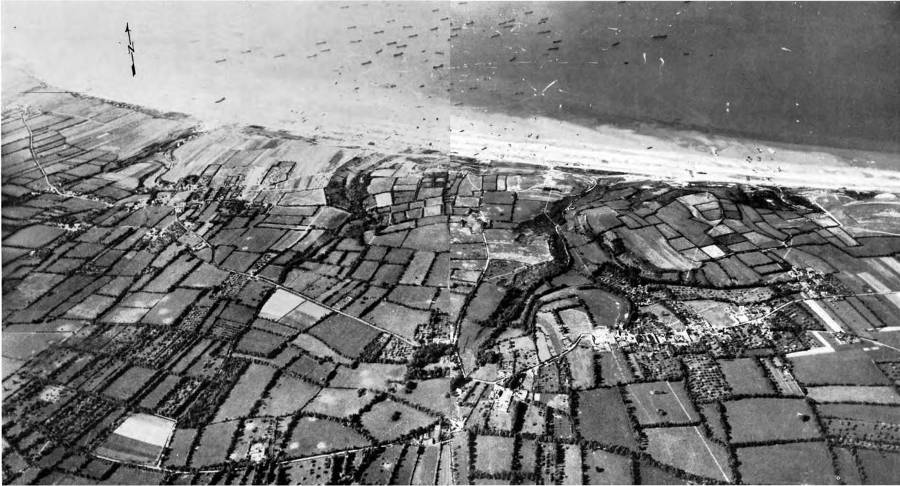
OMAHA BEACH ON 6 JUNE 1944. From Grandcamp, cliffs extend eastward to Arromanches-les-Bains with only two breaks, one in the Vierville-Colleville region which was the V Corps area. The Aure River behind Omaha Beach is a serious obstacle for a distance of ten miles from its mouth, near Isigny. Between the Vire and Orne Rivers the area is covered to a depth of forty miles inland by bocage (land divided into small fields by hedges, banks, and sunken roads). Observation was limited, and vehicle movement was restricted to the roads. The highlands that extend across the invasion front, with a depth up to twenty-five miles, are broken with steep hills and narrow valleys. Although narrow, the roads in this area are generally good. Vital initial objectives were the towns of Carentan, Saint-Lô, Bayeux, and Caen.
FRANCE
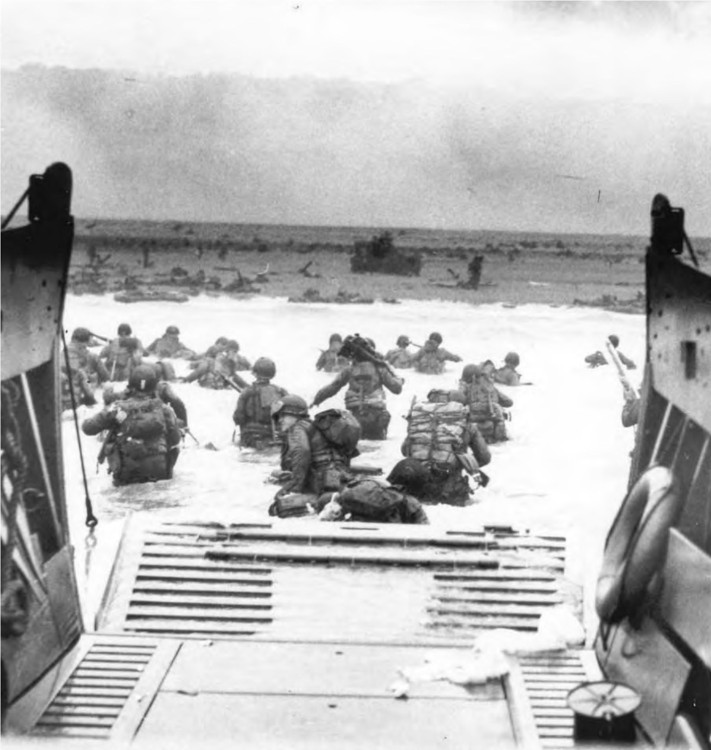
U. S. TROOPS WADING ASHORE FROM AN L C V P at Omaha Beach during the assault. Elements of two U. S. infantry divisions, with engineer troops and tanks of an armored unit, made the first landings. The beaches selected for these landings were about 7,000 yards in length. From the beach the ground curves upward and is backed by bluffs that merge into the cliffs at either end of the sector. H Hour was at 0630 6 June. The mission of V Corps was to secure a beachhead in the area between the Vire River and Port-en-Bessin, from which troops would push southward toward Caumont and Saint-Lô, conforming to the advance of British Second Army to the east.
FRANCE
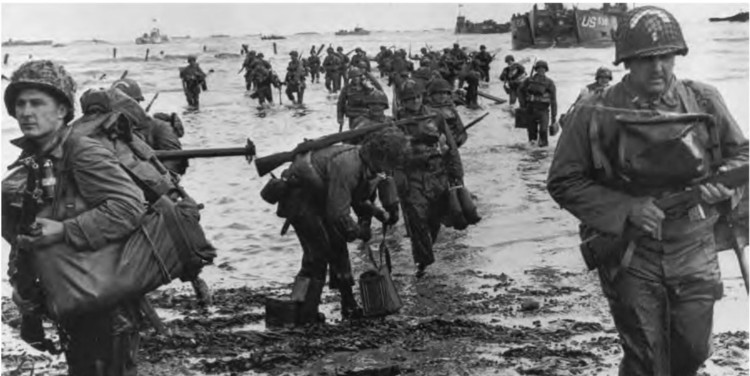
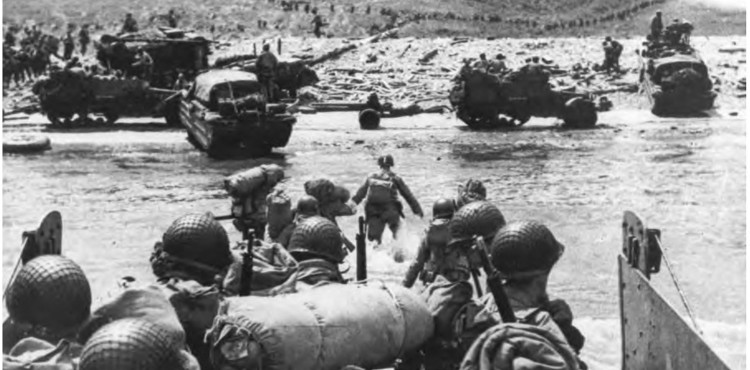
INFANTRYMEN WADING ASHORE FROM AN LCT(6) (top). Troops leaving an LCVP to wade ashore (bottom). Half-tracks and 2½-ton amphibian trucks can be seen on the beach, and in the background men marching in columns start southward toward the bluffs. On the shelf the enemy strung barbed wire and planted mines. Lanes had to be cleared through these obstacles before the infantry could advance. Beyond this strip containing obstacles, the enemy laid out firing positions to cover the tidal flat and the beach with direct fire, both plunging and grazing, from all types of weapons. The men landing were fired upon from these positions, which for the most part had escaped destruction during the prelanding bombardment.
FRANCE
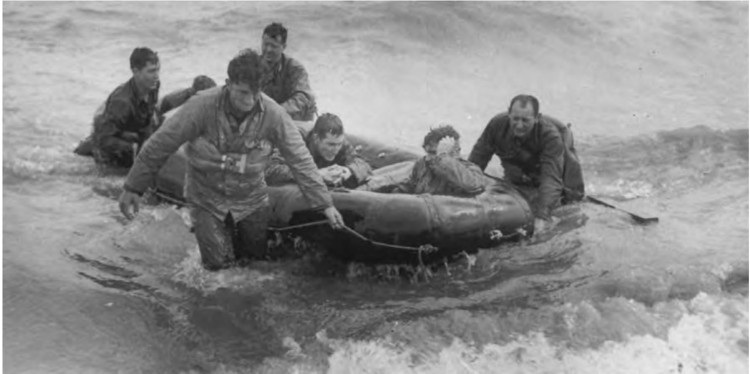
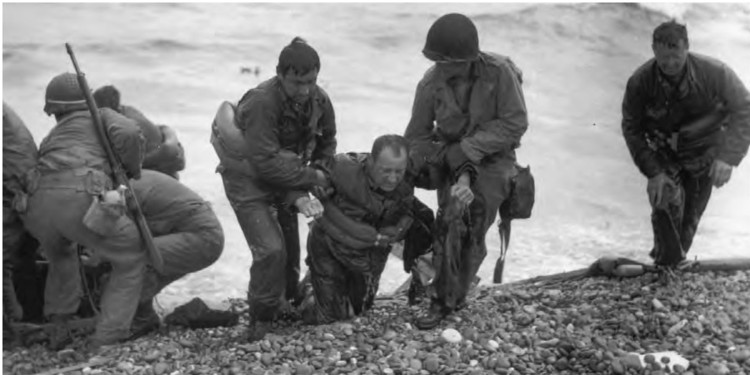
SURVIVORS OF AN LCVP which sank off Omaha Beach coming ashore in an LCR(S). The high seas added to the difficulties in getting ashore. Landing craft were in some instances hurled onto the beaches by the waves and some of the smaller ones were swamped before reaching shore. Others were flung upon and holed by the mined underwater obstacles. Some of the assault troops were swept off their feet while wading through the breakers. Of these some were drowned and those who reached the beach were often near exhaustion. Because of the rough seas many of the men were seasick during the crossing and arrived on the beach with their combat efficiency temporarily impaired by the experience.
FRANCE
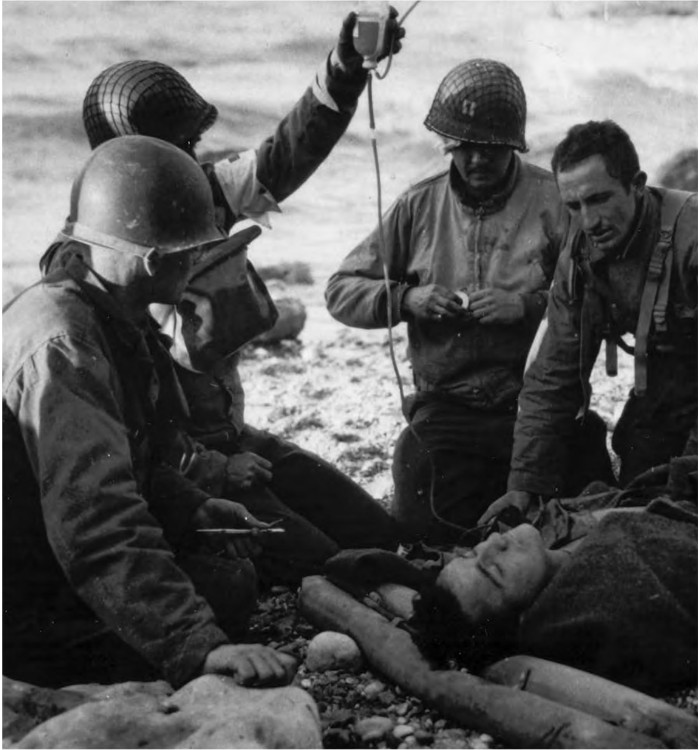
ARMY MEDICS ADMINISTERING BLOOD PLASMA to a survivor of a sunken landing craft on Omaha Beach. D-Day casualties for the V Corps were in the neighborhood of 3,000 killed, wounded, and missing. The two assaulting regimental combat teams lost about 1,000 men each. The highest proportionate losses were taken by units that landed in the first few hours, including engineers, tank troops, and artillerymen. The D-Day casualties of V Corps were much higher than those suffered by VII Corps, where the assaulting seaborne division lost 197 men, including 60 lost at sea.
FRANCE
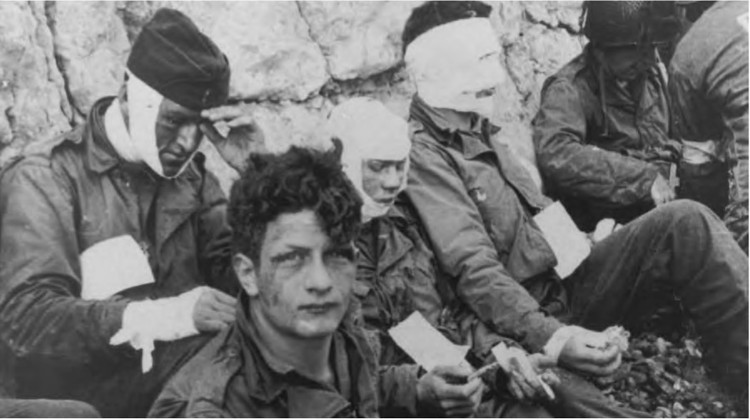
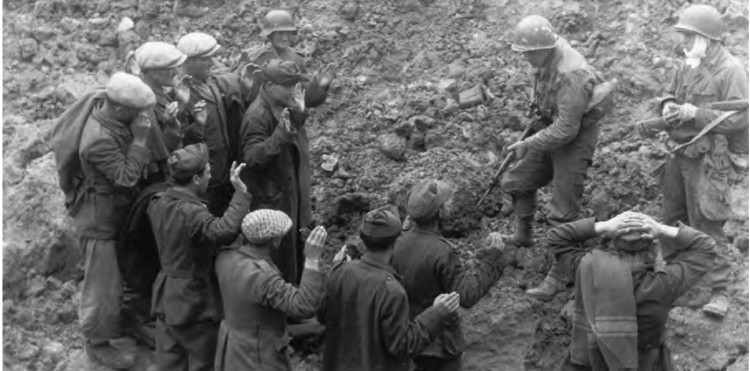
WOUNDED U. S. TROOPS OF V CORPS, waiting to be evacuated, take shelter under the cliffs near the beach in the Colleville area (top). Some German troops and laborers rounded up on Omaha Beach (bottom). The assault troops reached the line of the Bayeux-Carentan road on 7 June. The following day U. S. forces established contact with the British on the American left flank. On 9 June U. S. divisions advanced rapidly south and west reaching the Caumont-Forêt de Cerisy-Isigny line by 11 June.
FRANCE
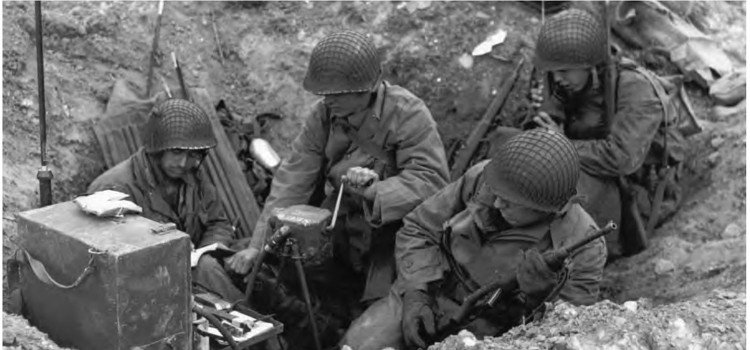
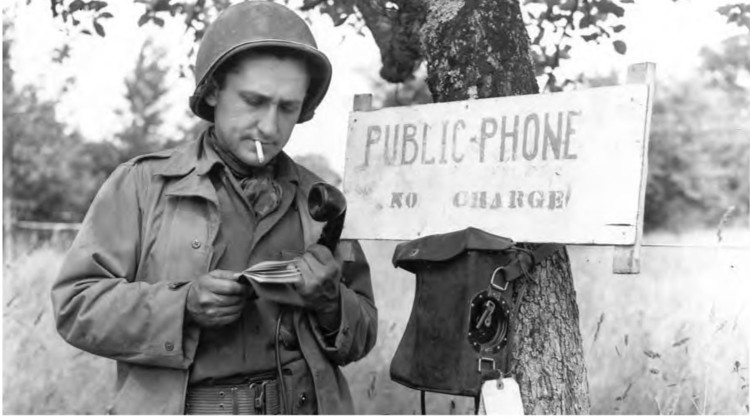
MEMBERS OF A SHORE FIRE CONTROL GROUP operating Signal Corps radios. Man at left is operating an SCR 284, while the second man operates the hand generator GN 45; man at right is using a hand-held radio set, “handie-talkie” SCR 536 (top). An enlisted man looks up a number before placing a telephone call on a field telephone EE 8 (bottom). The function of the Signal Corps was to furnish radio, wire, and messenger communications. Often Signal Corps personnel went inland, sometimes ahead of the infantry, to observe and correct the fire from the naval guns offshore.
FRANCE
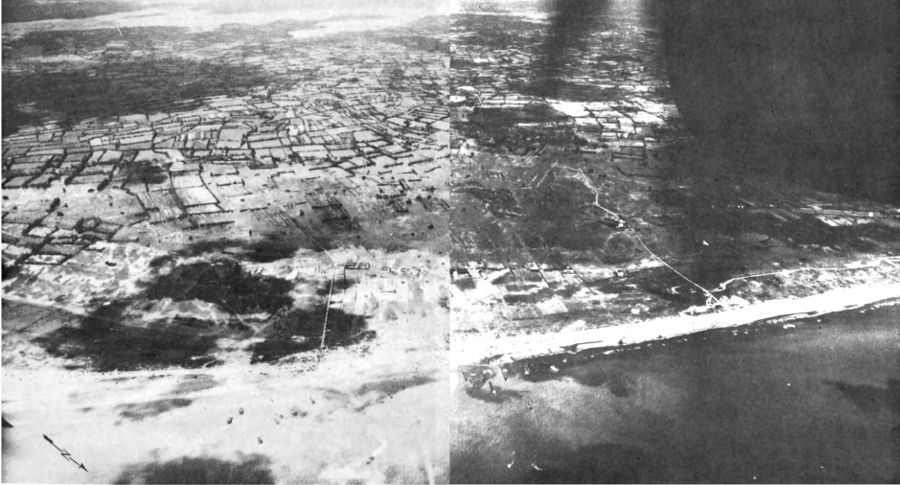
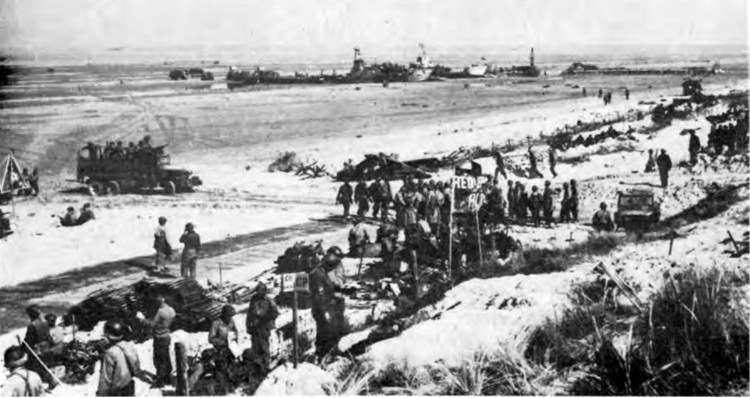
UTAH BEACH, 6 JUNE 1944. In the VII Corps zone the smooth and shallow beaches in the vicinity of Saint-Martin-de-Varreville are backed by sand dunes that extend inland 150 to 1,000 yards. Behind the sand dunes the low ground had been inundated for a width of one to two miles, restricting travel from the beaches to four easily defended causeways. Farther inland the Merderet River, running parallel to the coast, and the Douve River, from which the ground rises northward to the hills around Cherbourg, restrict traffic to the established roads. Sainte-Mère-Eglise, Saint-Sauveur, and Barneville are key points on the road nets leading to Cherbourg. Southeast of Utah Beach the Douve and Vire Rivers flow into the shallow, muddy Carentan estuary which marked the boundary between VII and V Corps.
FRANCE
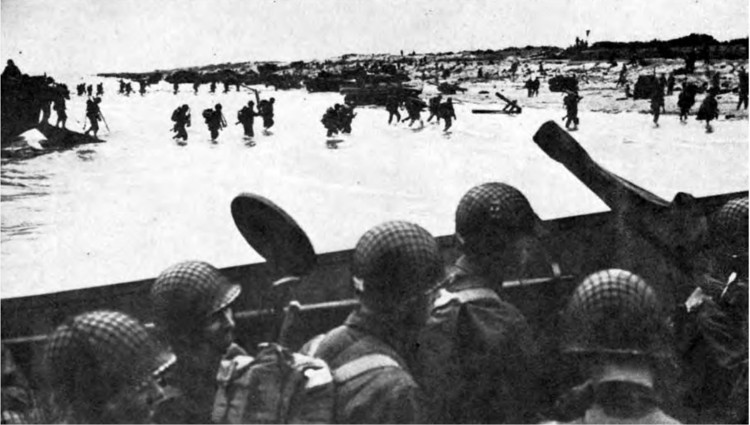
ASSAULT TROOPS LANDING ON UTAH BEACH ON D-DAY (top). Men and equipment along Utah Beach on D Day (bottom). The mission of VII Corps was to assault Utah Beach on 6 June 1944 at H Hour, 0630, and to capture Cherbourg with a minimum delay. The troops, landing just west of the Vire estuary, encountered less opposition than any other Allied forces on D Day.
FRANCE
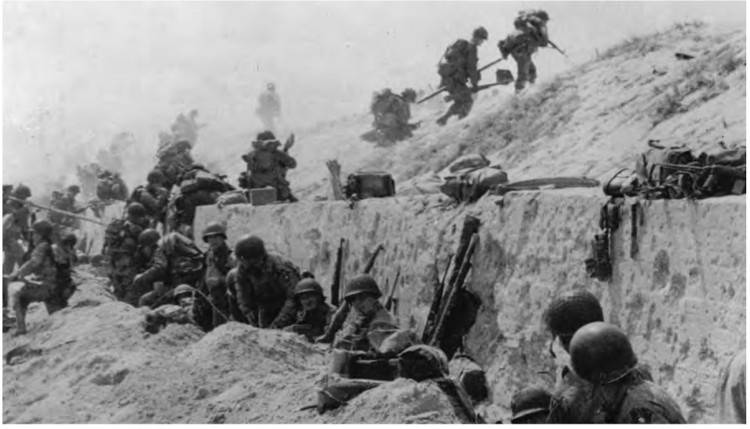
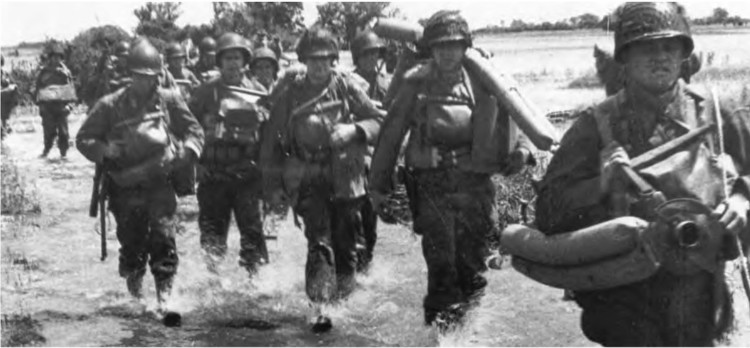
INFANTRYMEN RESTING ALONG THE SEA WALL and beginning to move inland, 6 June (top). Advancing southward through the inundated low ground (bottom). Fortunately, the first elements landed considerably south of the designated beaches in areas less thickly obstructed and where enemy shore defenses were less formidable than those opposite the intended landing beaches. While airborne troops seized the causeways through the inundated low ground to prevent enemy reinforcements from reaching the beach, the seaborne assault troops struck northwest toward Montebourg, on the road to Cherbourg.
FRANCE
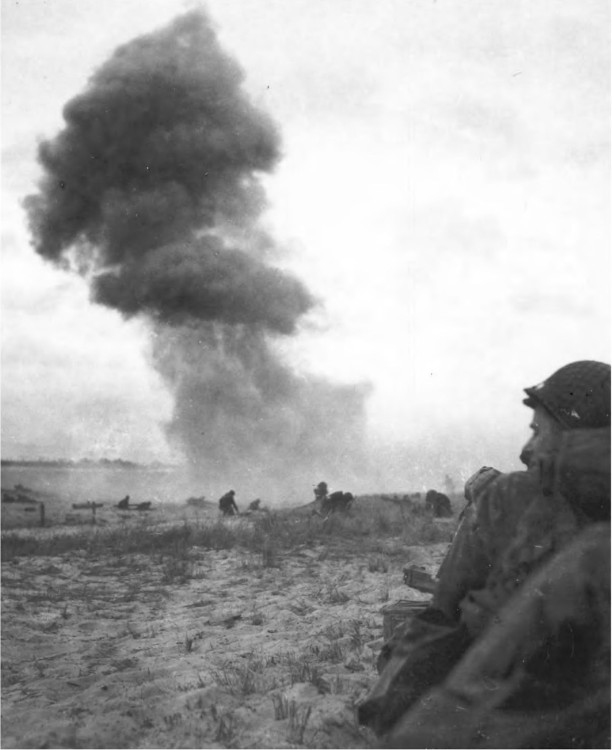
AN ENEMY SHELL HITS THE BEACH where U. S. troops are advancing.
FRANCE
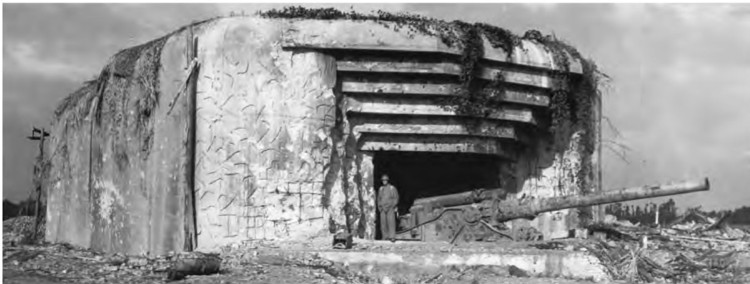
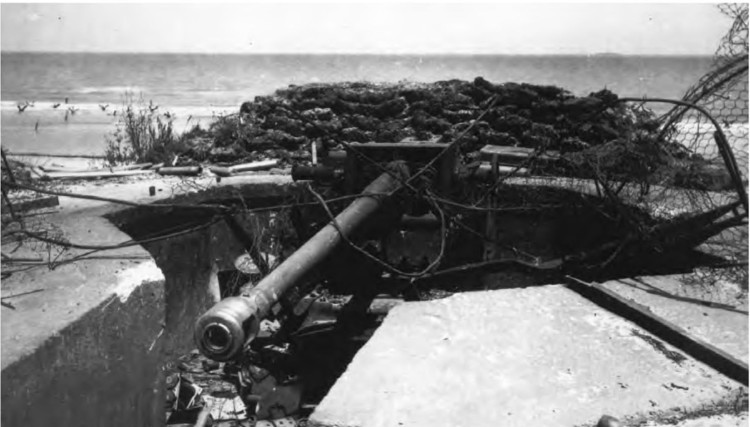
GERMAN CASEMATED FORTIFICATION inland from the beach (top); destroyed enemy gun emplacement (bottom). During 1943 the Germans had developed heavy frontal defenses at all the principal harbors from Den Helder to Brest. As the invasion threat grew, Cherbourg and Le Havre were further strengthened, while heavy guns were installed to block the entrance of the Bay of the Seine. Between the ports stretched a line of concrete defense positions and coastal and flak batteries. A program of casemating the coastal guns and strengthening the defense posts was still in progress on 6 June. The beaches were mined and obstacles were placed in the water offshore and on the beaches, but there was no secondary defense line behind the coastal defenses which the Germans thought would stop the invading troops.
FRANCE
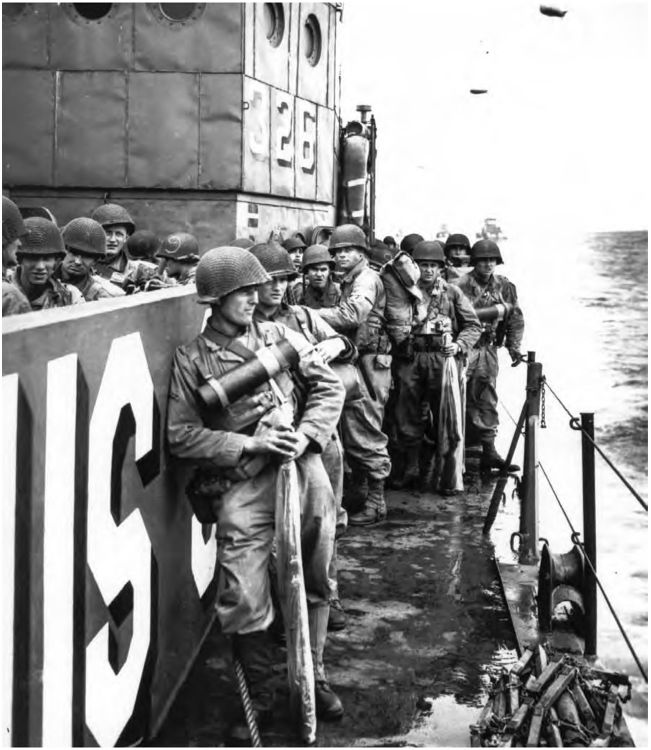
MEMBERS OF THE FOLLOW-UP DIVISION aboard an LCI(L) headed for Utah Beach on D Day. Other LCI’s in the background have barrage balloons flying overhead. These balloons were attached by cables to ships crossing the Channel so as to keep low-flying enemy strafing planes away from the craft.
FRANCE
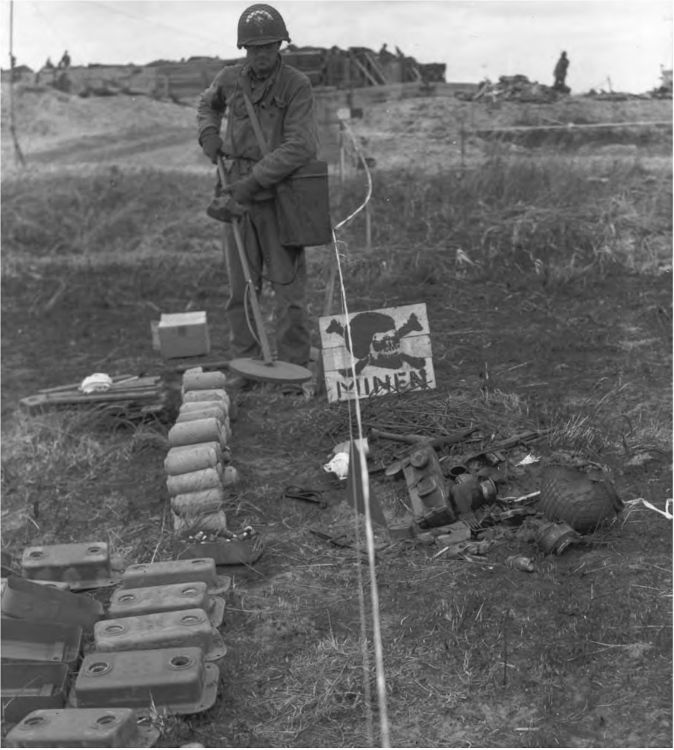
A MEMBER OF AN ENGINEER UNIT using a mine detector SCR 625. The ground outlined with white tape had not been cleared of enemy mines and enemy signs were used to mark the mined areas. Army and Navy demolition teams, following the assault infantry, found the beach less thickly obstructed than expected, and Utah Beach was cleared in an hour. Engineers prepared exits from the beach by clearing lanes through the mine fields.
FRANCE
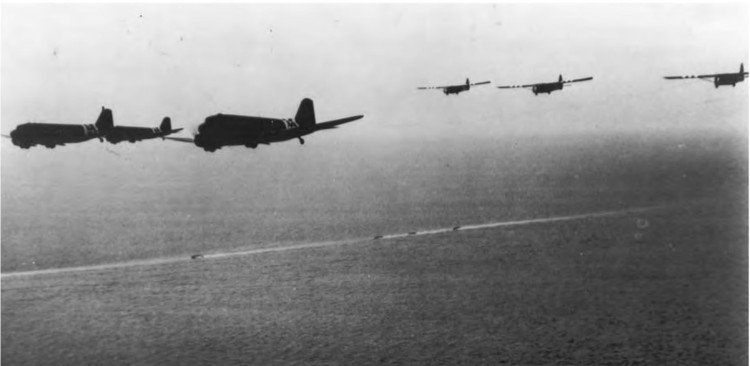
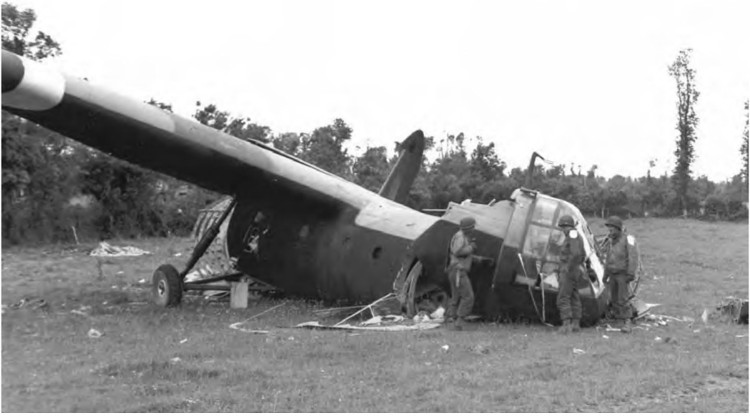
GLIDERS BEING TOWED BY C-47 TRANSPORTS over the English Channel carrying reinforcements for the airborne divisions, 7 June (top). A British Horsa glider wrecked while landing (bottom). Six thousand six hundred men of one of the two U. S. airborne divisions were scattered over an area 25 miles by 15 miles in extent, and 60 percent of their equipment was lost. In general, however, these men accomplished their mission successfully. Other gliders were flown in on 6 June but suffered considerable casualties. (CG4A WACO.)
FRANCE
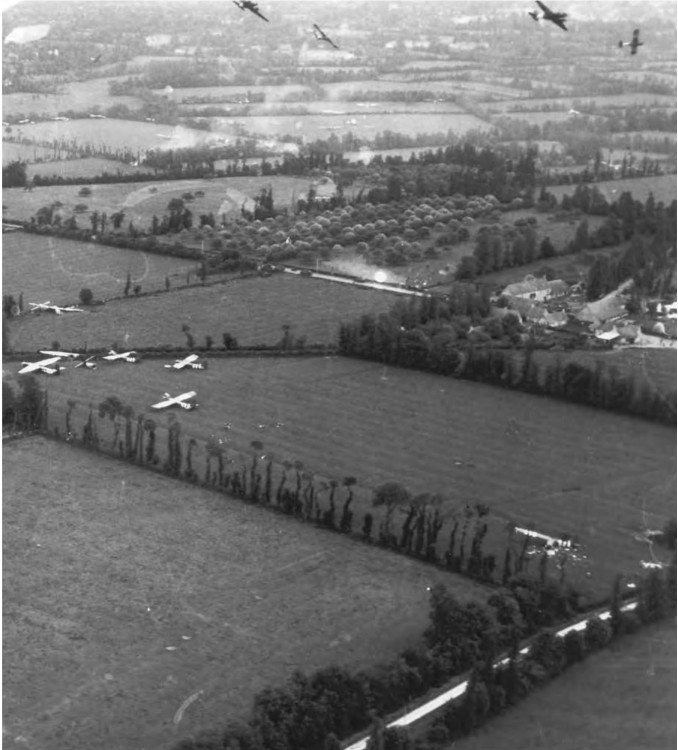
GLIDERS AND TOW PLANES CIRCLING before the gliders are cut loose for a landing, 7 June. On the ground are gliders which landed the previous day, many which were wrecked in landing. While one airborne division of the U. S. forces held the exits to Utah Beach and stuck southward toward Carentan, the other airborne division, despite heavy shelling in the Sainte-Mére-Eglise area, also established contact with the infantry troops pushing inland from Utah Beach early on 7 June.
FRANCE
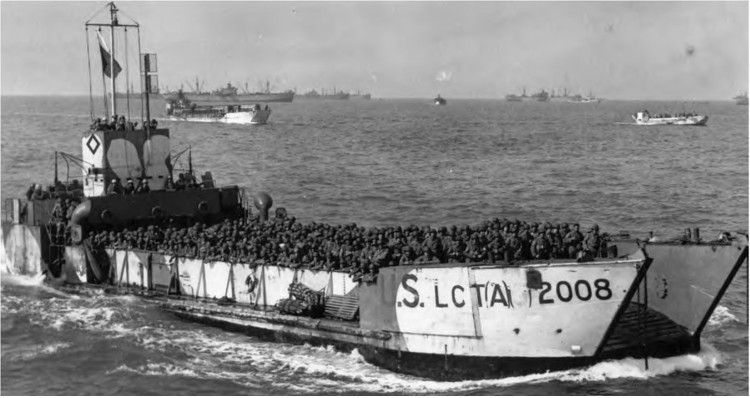
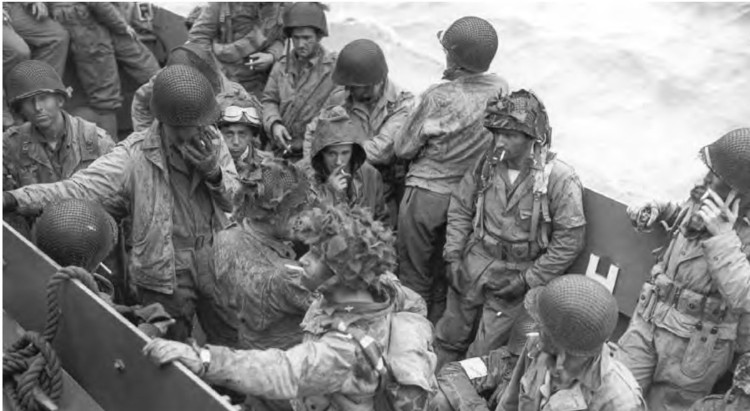
AN LCT(5) LOADED WITH REINFORCEMENTS moving toward the beach on 7 June. In left center is an LCT(R); at right center is an LBV. In the background supply ships wait to discharge their cargoes (top). U. S. Air Force glider pilots in an LCVP on their way to a larger ship which will take them back to England (bottom). After landing their gliders the pilots made their way to the beach to await shipping to return them to their bases.
FRANCE
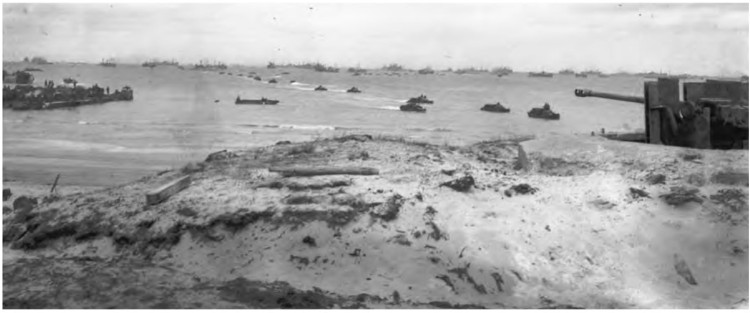
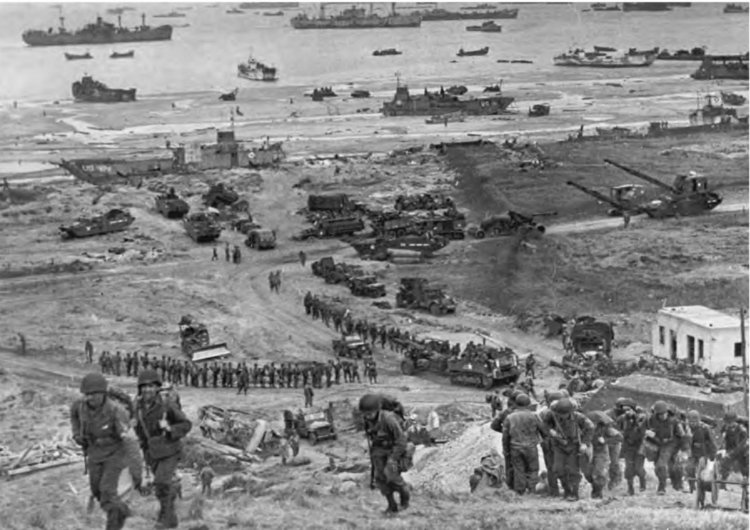
AMPHIBIAN TRUCKS (DUKW’s) bring supplies ashore on Utah Beach, 8 June (top). Men and supplies come ashore; on the beach are LCT’s (bottom). Between 7 and 12 June the Allies concentrated their efforts on joining the beachheads into one uninterrupted lodgement area and on bringing in men and supplies.
FRANCE
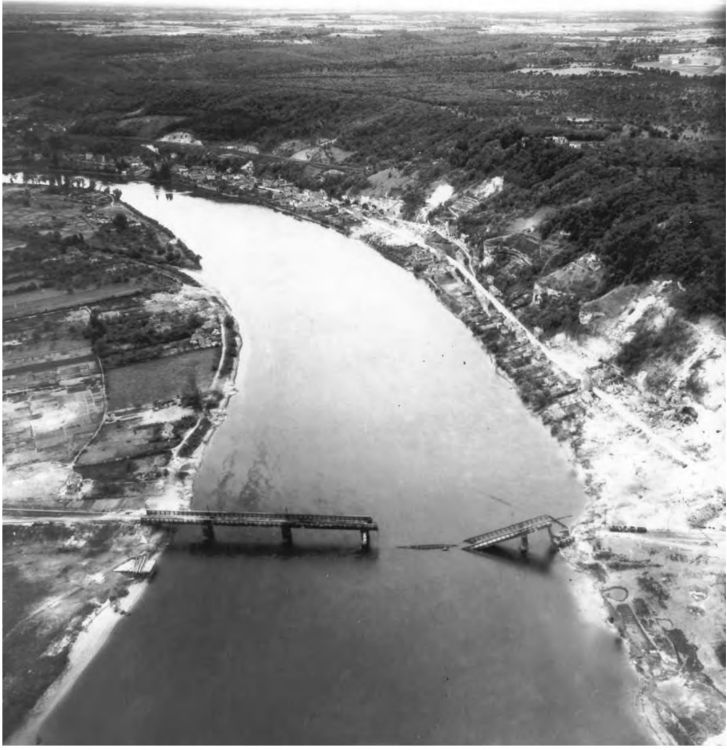
A RAILROAD BRIDGE ACROSS THE SEINE destroyed by bombers of the Allied air force. Even though hampered by poor flying weather during the first week after D Day, the Allied air force bombed bridges across the Seine and Loire Rivers. This seriously hindered the movement of enemy troops and supplies, and trains had to be constantly rerouted in an attempt to reinforce the Germans trying to hold the assault forces in the area of the beachheads.
FRANCE
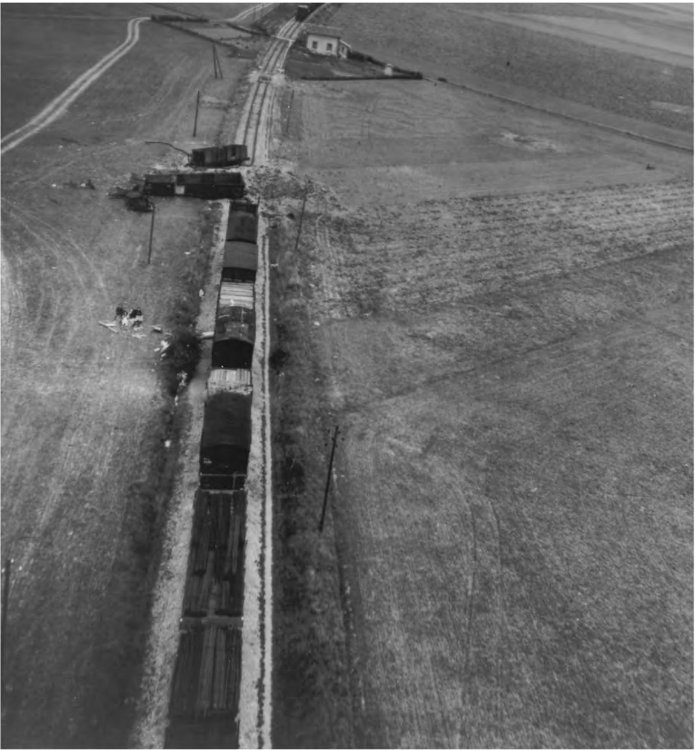
WRECKED TRAIN. Three trains were held up on this single track, in the vicinity of Chartres, when fighter bombers knocked cars off the track. With the track thus blocked the movement of trains was stopped and much of the undamaged rolling stock later fell into Allied hands. Within an arc extending from the Pas-de-Calais through Paris to the Brittany Peninsula, 16,000 tons of bombs were dropped on coastal batteries, 4,000 tons on airfields, and 8,500 tons on railway targets between 6 and 11 June.
FRANCE
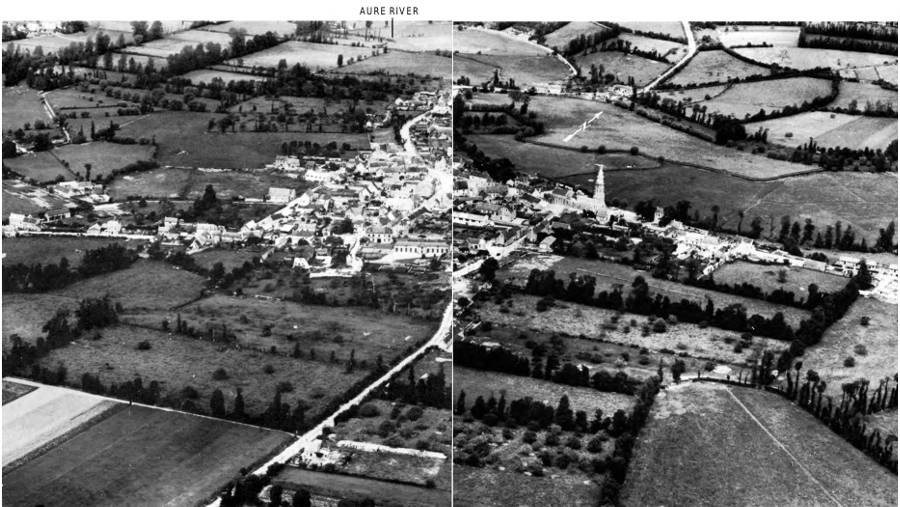
TRÉVIÈRES AND THE SURROUNDING AREA showing the bocage type of terrain. U. S. forces advancing inland from the Omaha beachhead were checked by the enemy in the Formigny-Trévières area on 7 June. Formigny was cleared on 8 June. On the same day the U. S. troops held their positions north and east of Trévières and patrolled the outskirts of the town. The town was shelled by navy guns in the late afternoon. The approach to Trévières from the high ground just north of the Aure River was strongly defended and the enemy forces continued to hold out in this area until 10 June when the attacking U. S. forces outflanked and captured the town. The fall of Trévières marked the end of enemy resistance north of the Forêt de Cerisy.
FRANCE
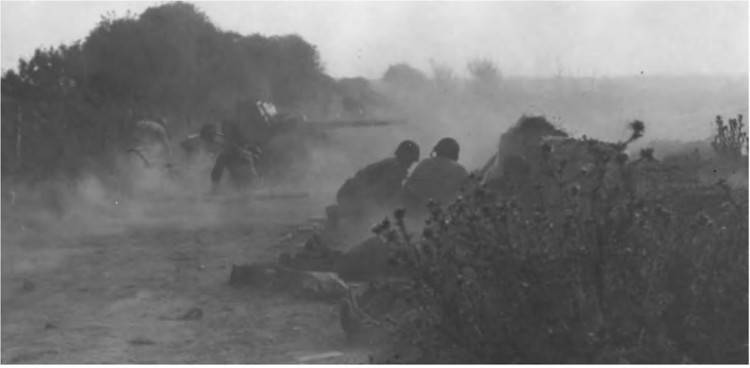
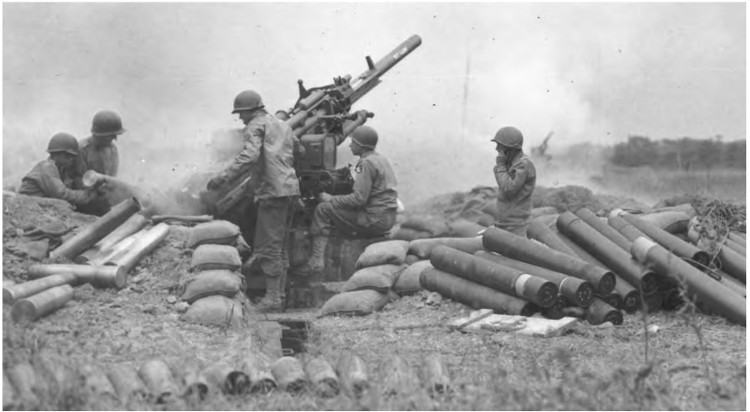
U. S. GUN CREW FIRING A 3-INCH ANTITANK GUN M5 at a house in which enemy troops are holding out (top). In the advance of the Allies from Utah Beach toward Cherbourg the enemy was often cut off in small groups and surrounded. The enemy groups in many cases would refuse to surrender, even though they were cut off from their own forces, and had to be eliminated one group at a time. A 90-mm. gun M1 of an antiaircraft battery firing near Vierville (bottom). Though enemy air attacks were not a serious threat to the Allies and very little opposition was encountered, antiaircraft batteries were always on the alert.
FRANCE
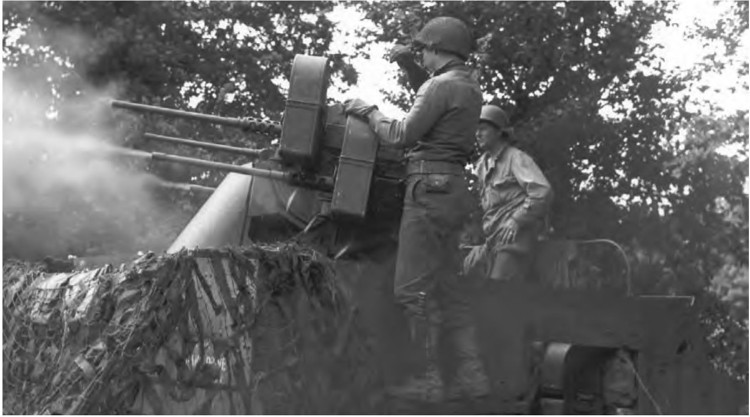
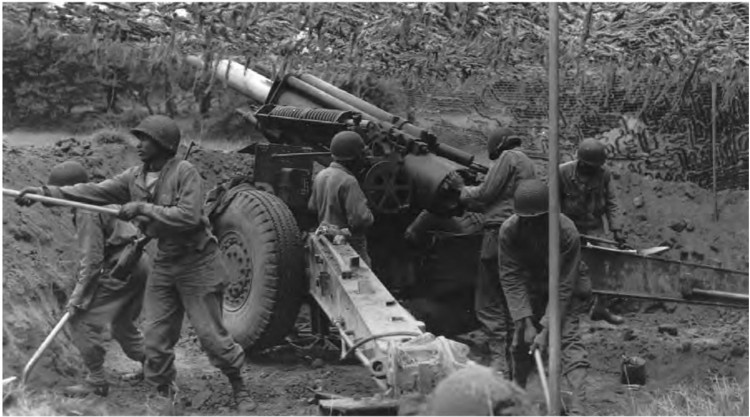
MULTIPLE GUN MOTOR CARRIAGE M16 with its four .50-caliber machine guns firing at the enemy in support of an infantry advance (top). This vehicle was a weapon of an antiaircraft artillery unit, but the lack of enemy air activity in Normandy made possible its use in other roles. U. S. artillerymen emplacing a 155-mm. howitzer M1 in a camouflaged position (bottom).
FRANCE
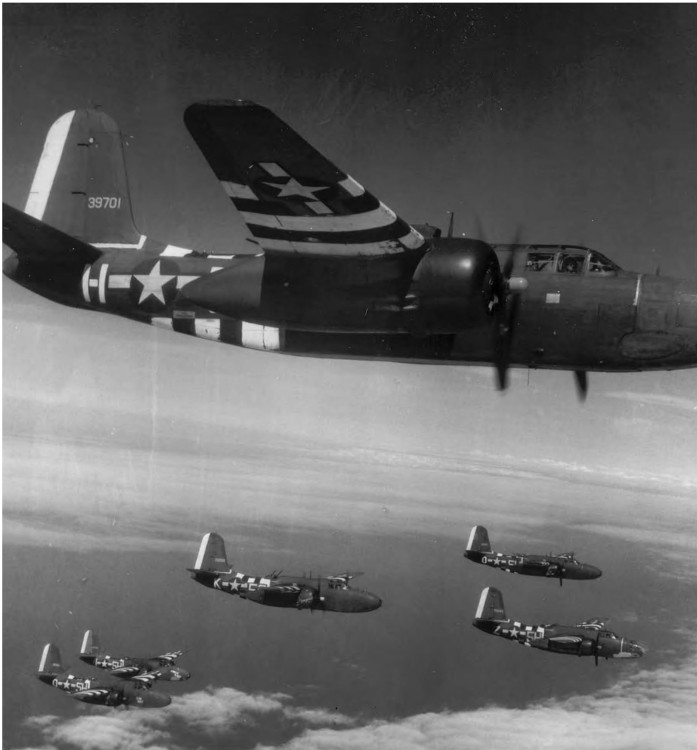
FORMATION OF DOUGLAS A-20’s over France. The infantry and armored attacks were, when possible, preceded by concentrated air attacks. Employing carpet bombing methods, thousands of tons of bombs were dropped. Fragmentation bombs were used to break enemy resistance without causing extensive cratering which would hinder the advance of tanks. Although these attacks were temporary in effect, the results greatly aided the initial ground attack. Casualties to the enemy were few, but he was stunned by the weight of the bombing and considerable confusion ensued.
FRANCE
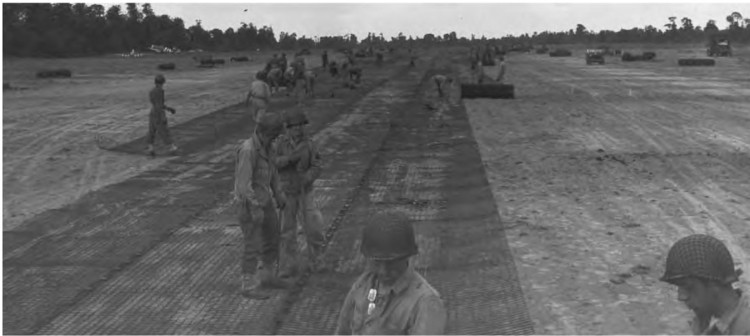
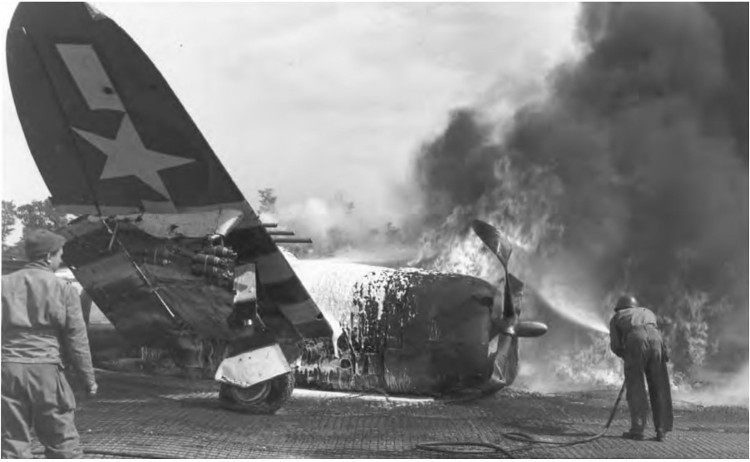
ENGINEERS LAYING WIRE MATTING in the construction of a landing strip near Sainte-Mère-Eglise (top). A Republic P-47 Thunderbolt bursting into flames after crash landing on the strip; still attached to underside of the wing are rockets which were not fired (bottom). An important factor in insuring the success of the Allied close-support operations lay in the establishment of landing strips in Normandy, from which fighter planes could operate. Work began as soon as a footing was obtained on shore and by 9 June planes were operating from these strips.
FRANCE
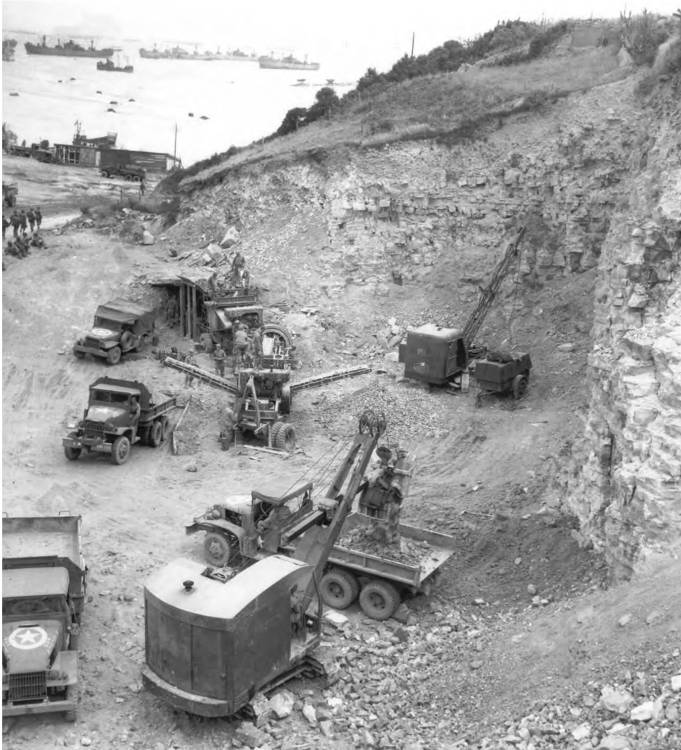
A QUARRY NEAR OMAHA BEACH used by engineer units to supply rock and stone for the construction of roads. The tremendous amount of traffic on the roads in Normandy, as men and supplies were brought into France over the beaches required the services of many engineer units to keep the roads in good repair. Most of the roads leading to the beaches were not hard surfaced but were constructed of rock and gravel.
FRANCE
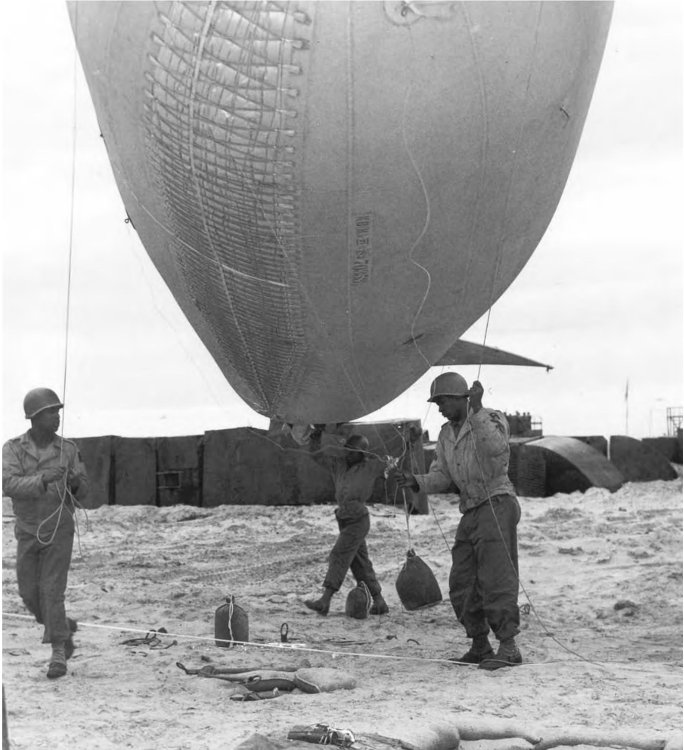
ENLISTED MEN PREPARE TO LAUNCH A BARRAGE BALLOON over one of the beaches in Normandy. Balloons were attached to cables and by means of winches could be raised or lowered to the desired altitude. These balloons were used to protect ships and beach installations from low-flying enemy aircraft. When the balloons were in position the enemy would not fly low over the beaches for fear of running into the cables which kept the balloons in place.
FRANCE
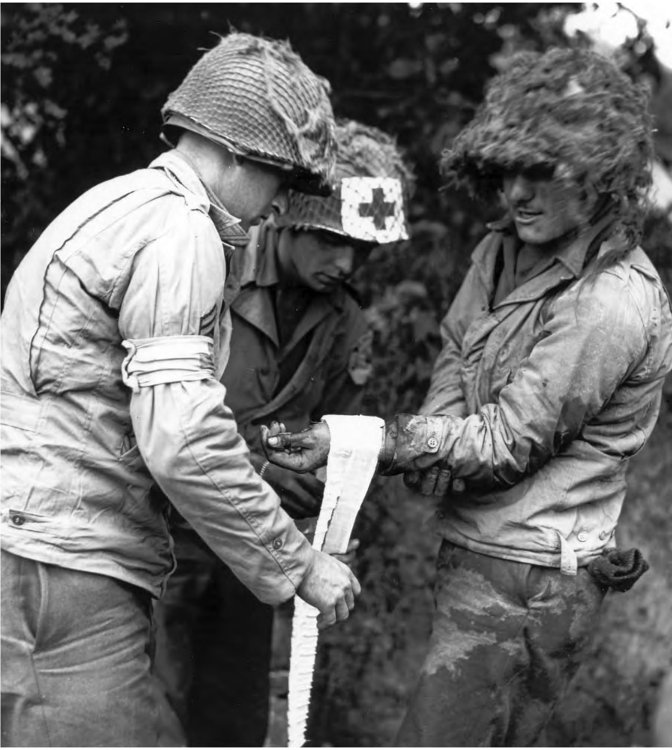
MEDICAL CORPS MEN TREATING AN ENLISTED MAN for a wrist wound. When casualties entered a battalion aid station within a few hundred yards of the front, they were immediately screened and sorted. Wounds were redressed, and perhaps morphine or other drugs were given when available. Those whose wounds permitted were evacuated to the rear, while those whose wounds did not permit further evacuation were held, treated, given plasma, and then moved farther back.
FRANCE
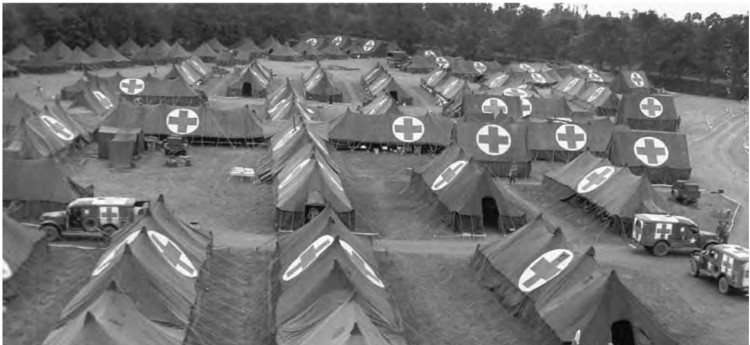
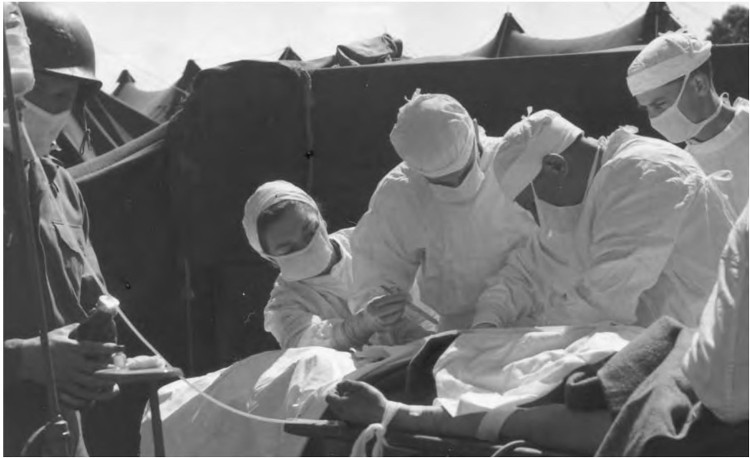
AN EVACUATION HOSPITAL with a 750-bed capacity, Normandy, 24 July (top). Army surgeons perform an operation out-of-doors (bottom). In World War II the number of deaths per hundred casualties was one half of that during World War I. Responsible for this reduction was the surgical skill and painstaking care rendered by personnel of the Medical Corps aided by better surgery, the sulfa drugs, penicillin, plasma, and whole blood.
FRANCE
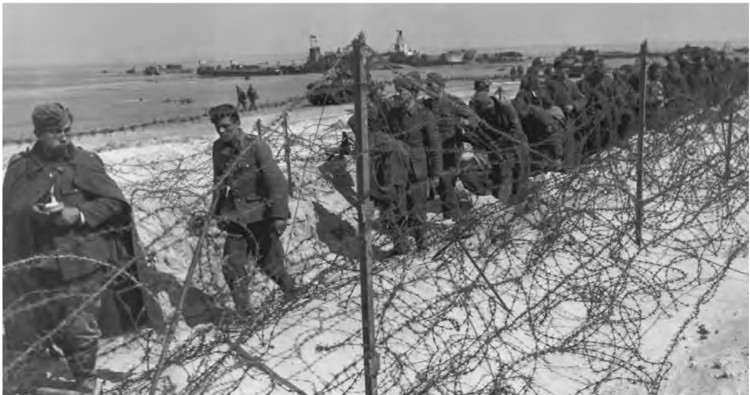
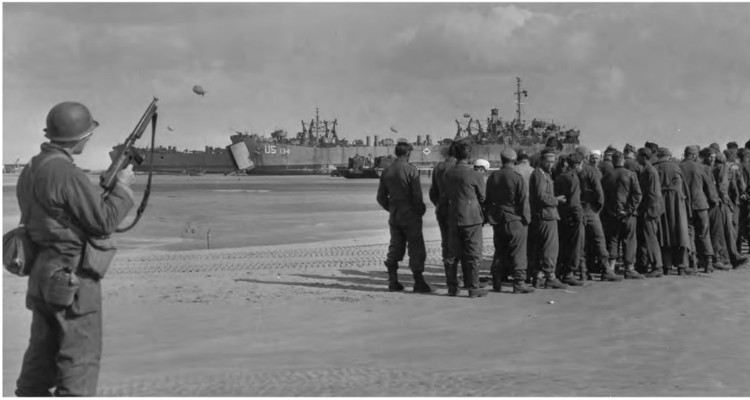
ENEMY PRISONERS, taken during the first days of fighting, awaiting transportation to England. During the first week following the invasion landings the Germans lost some 10,000 men as prisoners. The enemy forces that manned the static beach defenses were largely Russians and other non-Germans, but were under German officers. Of the German troops, many companies were found to be composed of men either under 20 or over 45 years of age. Many of these were of low medical categories and their morale was not of the best.
FRANCE
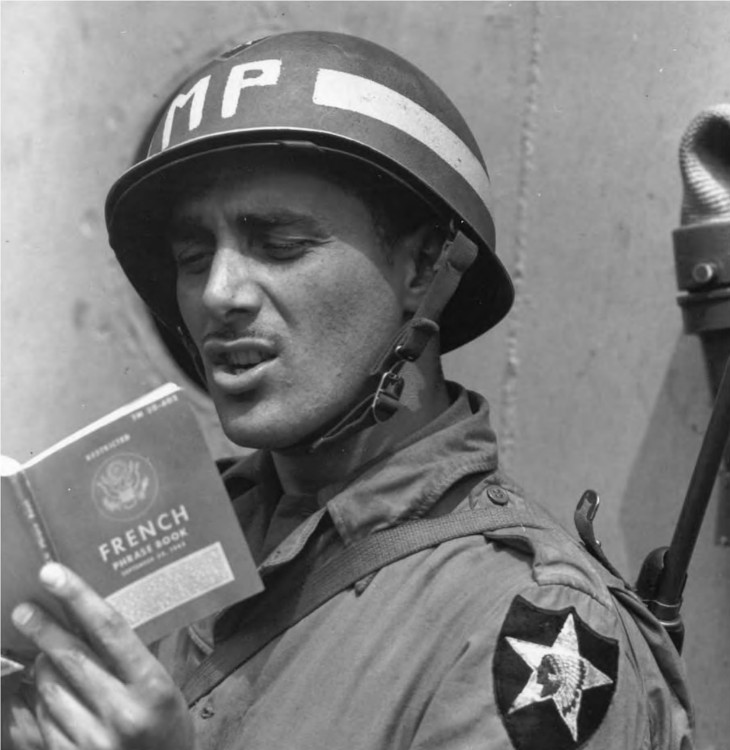
A MILITARY POLICEMAN studying French aboard a transport while waiting for the landing craft which will carry him to the beach in Normandy. In addition to handling informational and recreational activities of all kinds, the Special Services Division of the Army Service Forces distributed pocket-sized soldier guides to the customs and languages of the countries where members of the armed forces served. The Army, recognizing that the strain created by war must be counteracted by healthy diversional activities, arranged motion pictures and USO shows, and distributed books, magazines, and athletic and other recreational equipment to members and units of the armed forces.
FRANCE
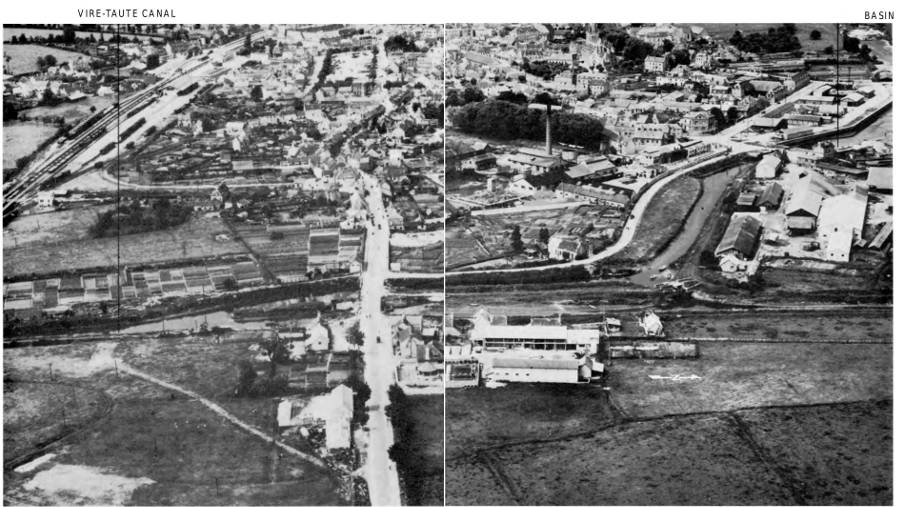
CARENTAN. The approach to Carentan from the east is blocked by the Vire-Taute Canal. U. S. forces advancing to secure the bridge on the road from Isigny met with enemy resistance from the houses and hedgerows on the east bank and it was not until midnight of 10 June that the enemy was driven out and defensive positions were established by U. S. troops. Other U. S. troops moved along the Bassin à Flot and crossed the canal on 12 June, moving rapidly into the center of Carentan which by then was ringed by attacking troops. This trap was closed too late to capture most of the German defenders, who escaped to the south during the night of 11–12 June.
FRANCE
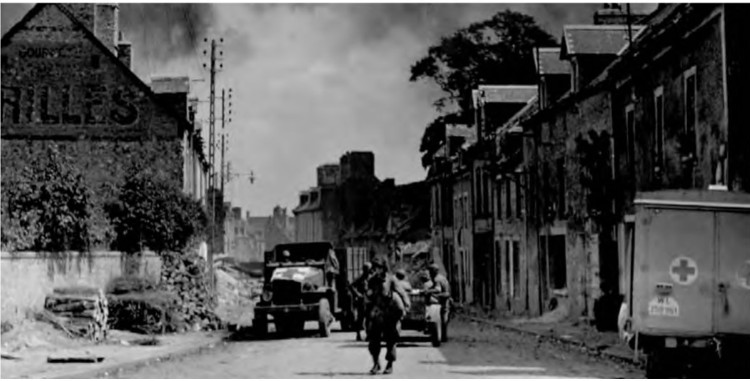
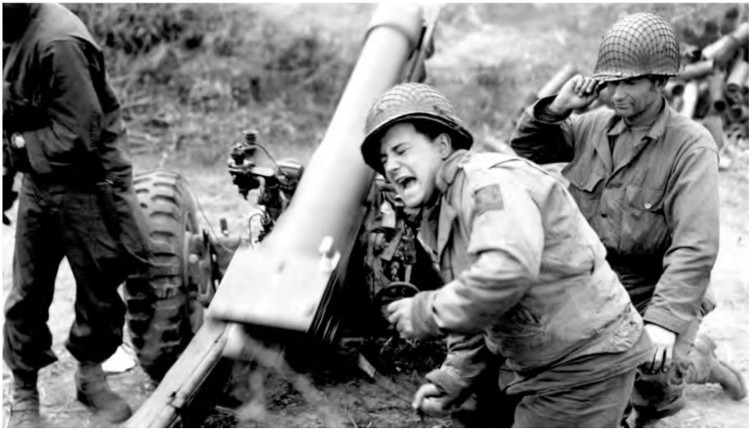
U. S. TROOPS MOVING INTO CARENTAN, 12 June (top). A 105-mm. howitzer M3 firing at enemy positions during the fighting at Carentan (bottom). During the night of 11–12 June, Carentan was set ablaze by artillery and naval gunfire, and early on the morning of 12 June U. S. troops entered the town. Its fall marked the effective junction of the two U. S. beachheads and the linking up of the two corps of the First U. S. Army.
FRANCE
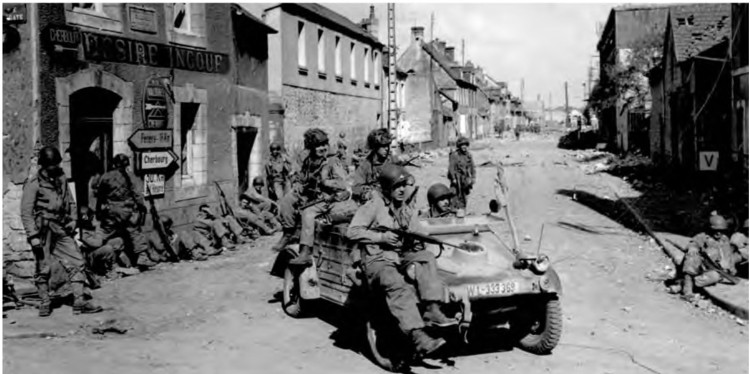
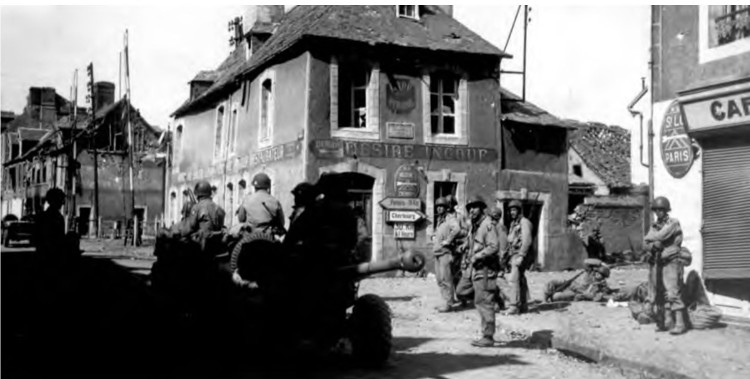
U. S. PARATROOPERS PATROLLING THE STREETS OF CARENTAN in a captured German Volkswagen (1. Pkw. K. 1 (typ 82)) (top). Airborne troops in a jeep towing a British 6-pounder Mark III antitank gun in Carentan (bottom). The enemy counterattacks against the U. S. forces in Carentan were unsuccessful in their attempts to recapture the city, but were persistent enough to limit the U. S. advance to gains measured in hundreds of yards. However, on 17 June 1944 U. S. troops reached the west coast in the vicinity of Barneville, cutting the German forces into two groups, one south of the Carentan-Barneville line, the other in the Cherbourg area.
FRANCE
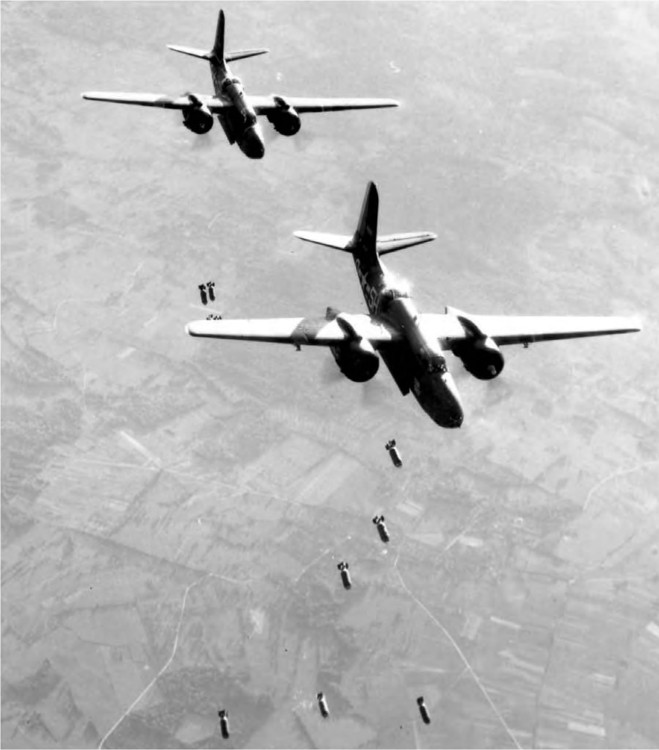
DOUGLAS A-20’S DROPPING BOMBS on a probable flying bomb launching site. The first flying bombs fell on England during the night of 12–13 June 1944, and the regular attacks began three days later. The smallness, the effective nature of camouflage, the comparative mobility, and the ease with which the V-1 launching sites could be repaired made effective bombing attacks on them difficult.
FRANCE
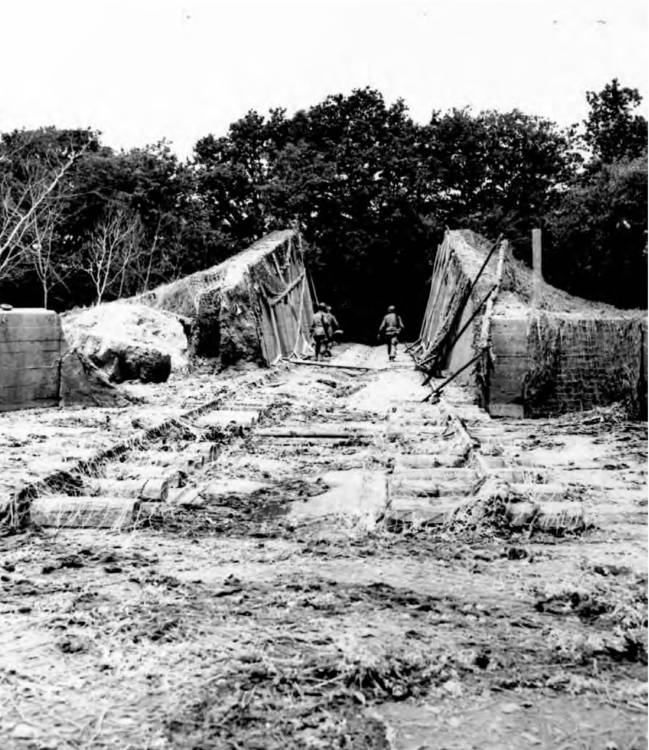
PART OF A GERMAN ROCKET INSTALLATION captured by U. S. troops. Many of these flying bomb sites were captured by the Allies as they advanced. Although the air force had destroyed some by bombing, most of the sites were taken by advancing troops and destroyed.
FRANCE
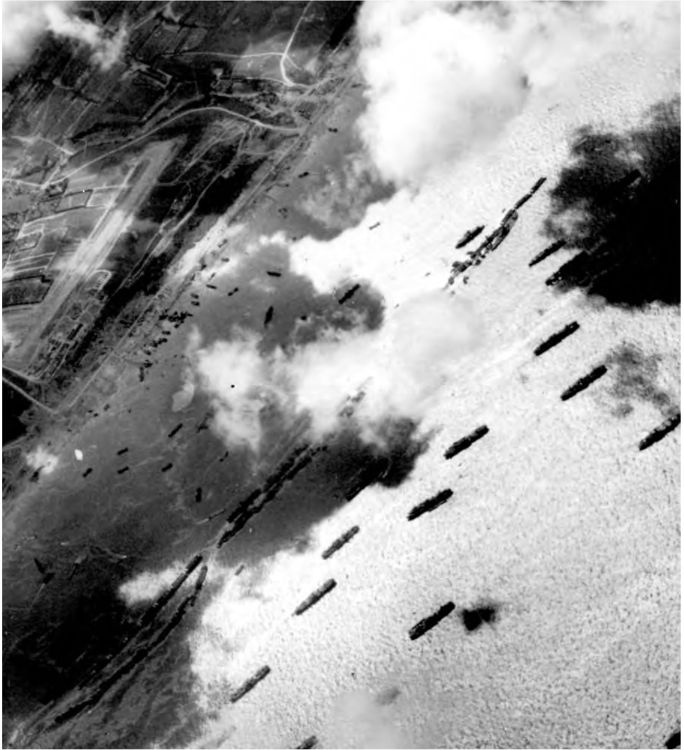
A PORTION OF THE ARTIFICIAL HARBOR AT OMAHA BEACH. This harbor was in the Saint-Laurent-sur-Mer area of Omaha Beach and was known as “Mulberry A.” Breakwaters were formed by sinking ships and concrete caissons, and steel bridging formed causeways to the beach. The harbor, construction on which began on 7 June 1944, was designed to provide moorings for seven Liberty ships and twelve coasters at one time. By 19 June it was 90 percent completed.
FRANCE
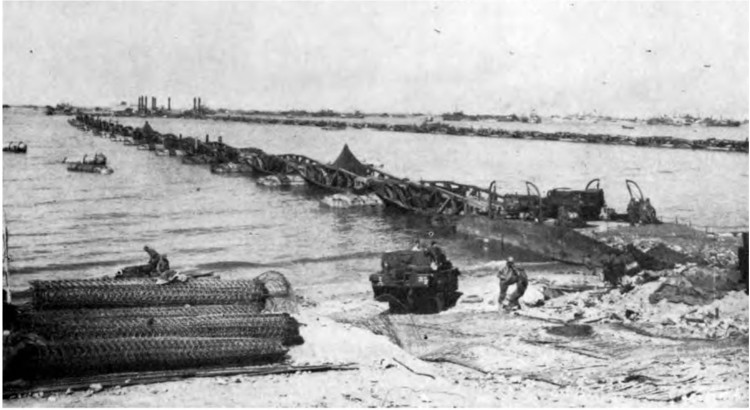
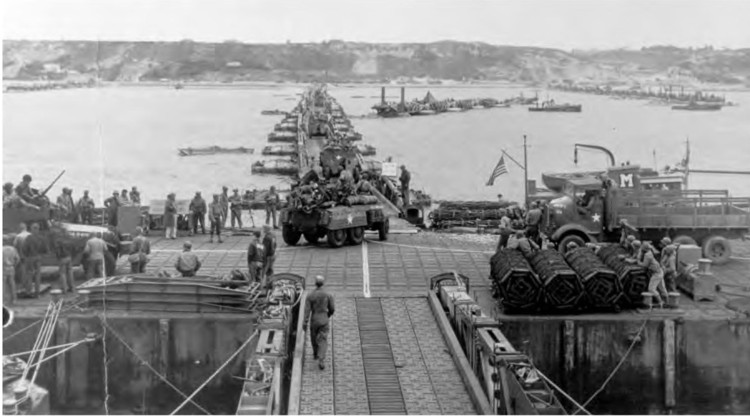
ENGINEERS LAYING STEEL MATTING on Omaha Beach at the exits of the causeway which extend to the piers of the artificial harbor (top). Vehicles moving from one of the piers over the causeway to the shore (bottom). These floating causeways to the beach rose and fell with the tide. The artificial harbors were constructed to facilitate the unloading of the large numbers of men and material.
FRANCE
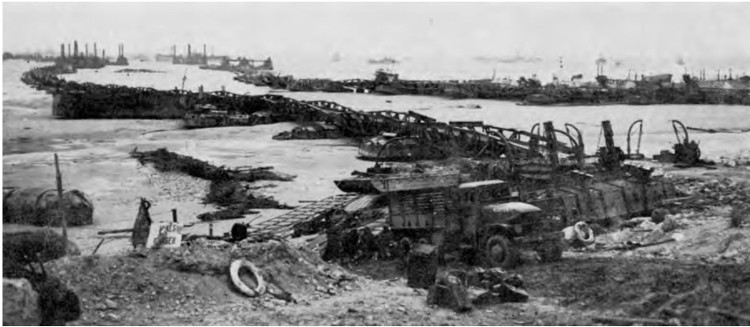
DAMAGE TO THE ARTIFICIAL HARBOR AND LANDING CRAFT caused by the storm. The greatest detriment to the Allied build-up was not the enemy, but the weather. From 19–22 June 1944 one of the worst summer gales in Channel history hit the Bay of the Seine. Unloading operations were virtually stopped, the floating steel caissons broke free and sank, the concrete caissons moved or were broken up, and the beach was strewn with hundreds of stranded and damaged craft. The line of sunken ships remained fairly well intact, but as a whole the artificial harbor was destroyed and useless.
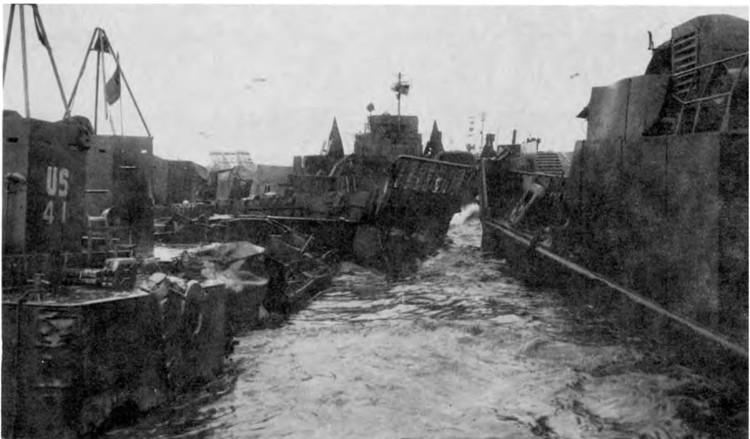
FRANCE
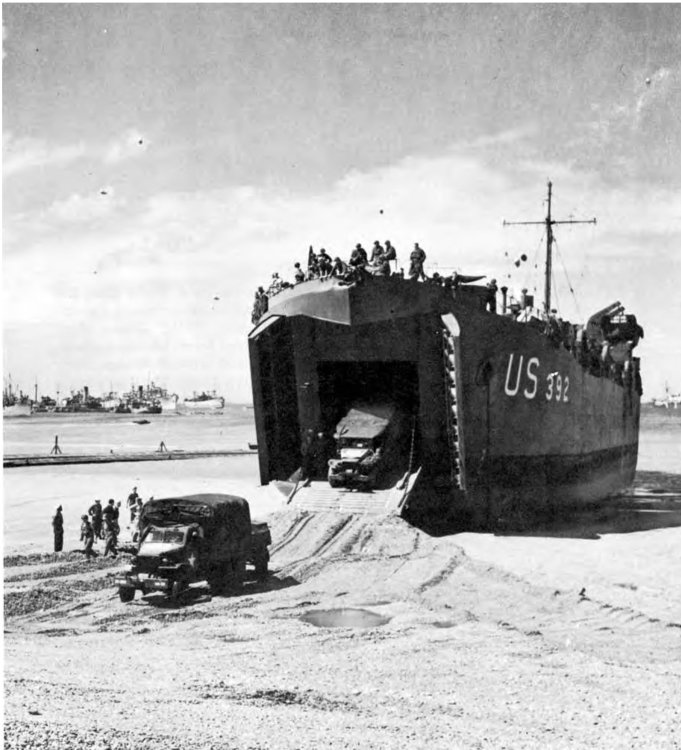
A TRUCK ON THE BEACH (2½-ton) and one starting down the ramp of an LST (1½-ton). After the storm wrecked the artificial harbors emergency measures, such as using 2½-ton amphibian trucks to bring men and supplies ashore and “drying out” landing ships and coasters, were employed. By “drying out” the vessels (as in picture) and unloading directly on the beaches, unloading operations were carried out.
FRANCE
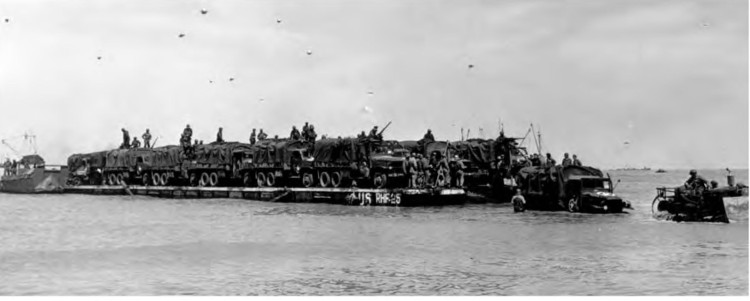
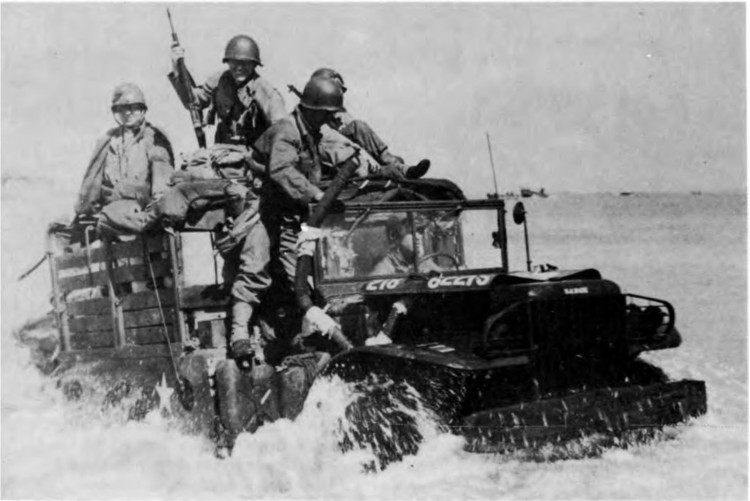
TRUCKS FULLY LOADED with men and supplies leaving a Rhino ferry and being helped ashore by a bulldozer (top). A ¾-ton weapons carrier rolling through the surf toward the beach under its own power (bottom). All the vehicles which made these landings through the surf had been waterproofed before leaving England. Since they were able to travel only a short distance on land under their own power when waterproofed, the waterproofing material was removed soon after the vehicles landed.
FRANCE
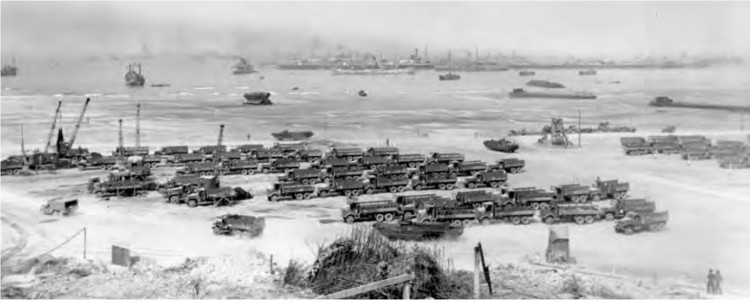
TRUCKS AND AMPHIBIAN TRUCKS (each is a 2½-ton truck) on a beach in Normandy. In spite of the damage caused by the storm, by 26 June Omaha Beach was discharging 122 percent of its planned cargo capacity. By this time 268,718 men, 40,191 vehicles, and 125,812 tons of cargo had been discharged over Omaha Beach alone. By 1 July the Allied commanders were not as much worried about a German counterattack that would threaten the beachhead as about the possibility that the enemy might bring in sufficient reserves to create a stalemate in Normandy. More room was needed by the Allies to bring in men and supplies to support a sustained drive toward the Seine.
FRANCE
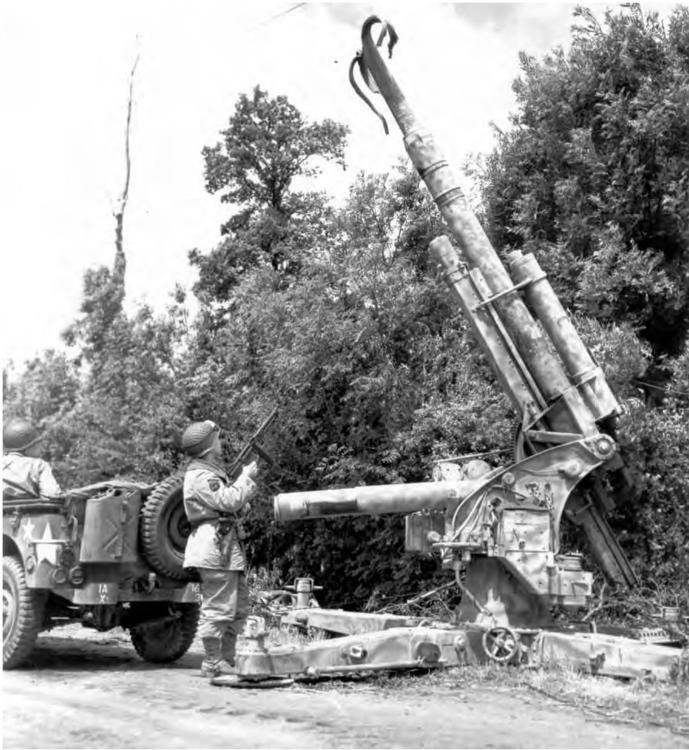
UNIT ADVANCING TOWARD CHERBOURG stops to inspect a German multipurpose gun (8.8-cm. Flak). When the enemy retreated from the vicinity of Montebourg he destroyed the gun by splaying the barrel. This multipurpose weapon emerged as the most publicized artillery piece of the German Army during the North African campaign. It was primarily an antiaircraft gun adaptable to antitank and general artillery use. In its role as an antitank gun it was fitted with a shield. In its mobile form it was towed on four wheels, usually with an 8-ton half-tracked tractor.
FRANCE
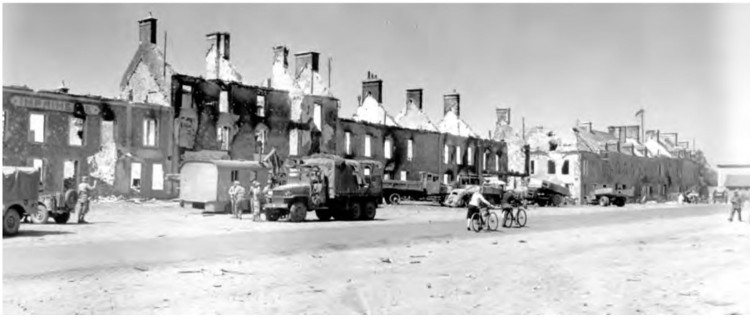
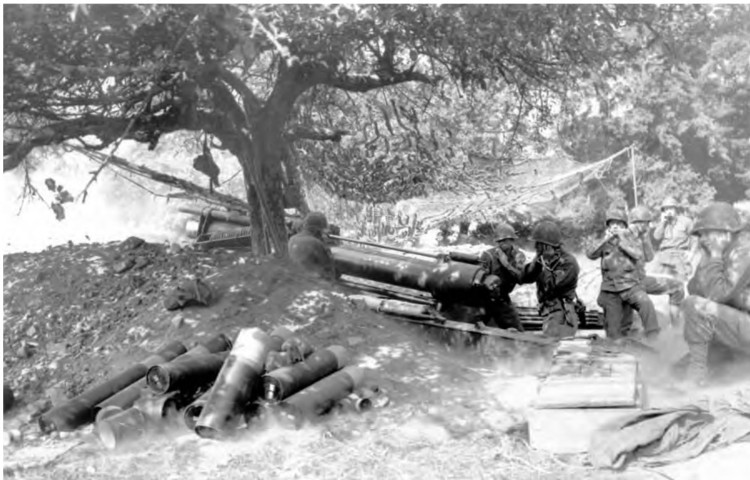
RESULTS OF ARTILLERY FIRE AND BOMBINGS in Montebourg (top). A 155-mm. howitzer M 1 firing on the defenses of the city of Cherbourg (bottom). On 19 June Montebourg fell to the U. S. forces and Valognes was taken the following day. The advance on Cherbourg was continued by three U. S. infantry divisions. An attack on Cherbourg was launched on the afternoon of 22 June, after an 80-minute air and artillery bombardment of the outer defenses, but the enemy at first fought back with determination.
FRANCE
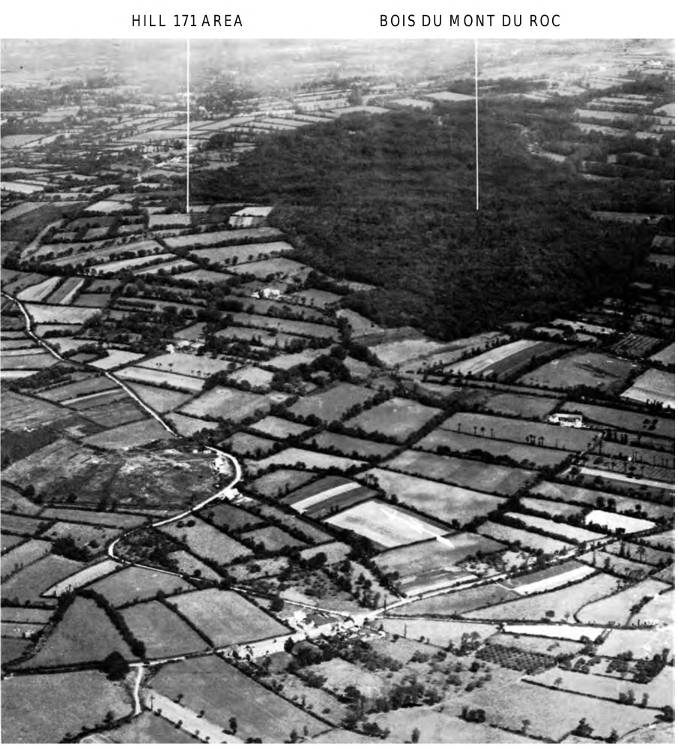
THE BOIS DU MONT DU ROC AREA. On 22–23 June the U. S. troops launched an attack from the valley to seize Hill 171. The critical enemy defense areas at Flottemanville-Hague and Hill 171 were closely pressed and before dark on 23 June the area of Hill 171 was reached and 400 enemy prisoners were taken. The Flottemanville-Hague defenses were bombed by Allied planes and the defenses were taken by the ground forces shortly thereafter. The enemy’s fortified line protecting Cherbourg was then broken and the U. S. troops were ready for the final drive to the city.
FRANCE
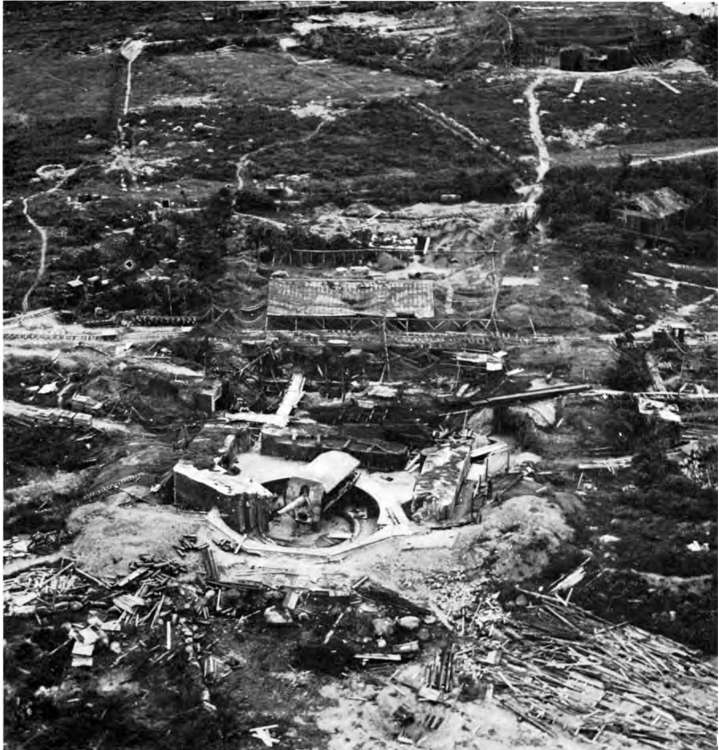
FORTIFICATIONS AROUND CHERBOURG DAMAGED by Allied shelling and bombardment. The German defenders refused to surrender the city to the attacking U. S. forces, and on 22 June a co-ordinated attack was launched by the attackers, supported by aircraft of the tactical air forces and heavy artillery fire. However, no real break-through was achieved by this bombardment and the U. S. troops resorted to the methodical reduction of the strong points. It was not until 24 June that the main defenses cracked, and the next day the three attacking infantry divisions, supported by heavy naval bombardment, reached the outskirts of the city.
FRANCE
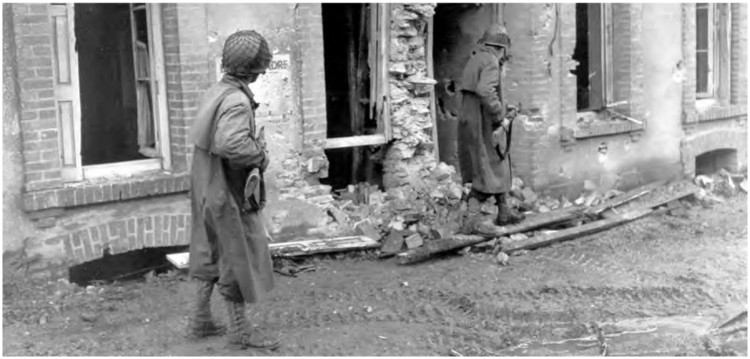
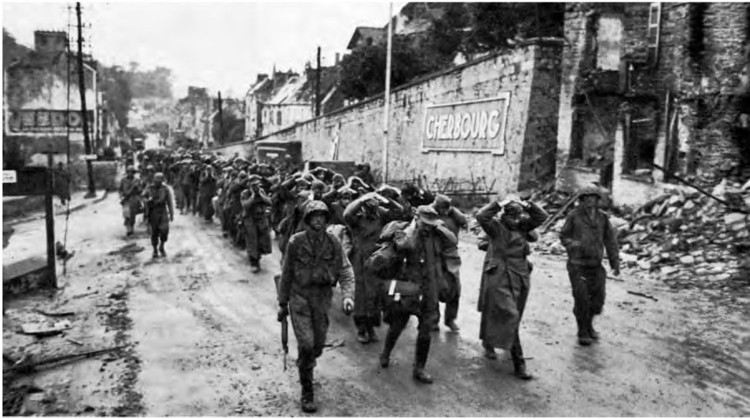
TWO U. S. INFANTRYMEN ROUTING A SNIPER during street fighting in Cherbourg (top). German prisoners taken in Cherbourg (bottom). By 25 June U. S. forces were fighting in the streets of the city while the Germans demolished the port facilities. At 1500 on 26 June the German commanders surrendered. The Arsenal held out until the following morning and fanatical groups had to be eliminated one by one. A certain number of the enemy still remained to be rounded up in the northwest corner of the Cotentin Peninsula, but on 1 July all resistance in the northern Cotentin came to an end.
FRANCE
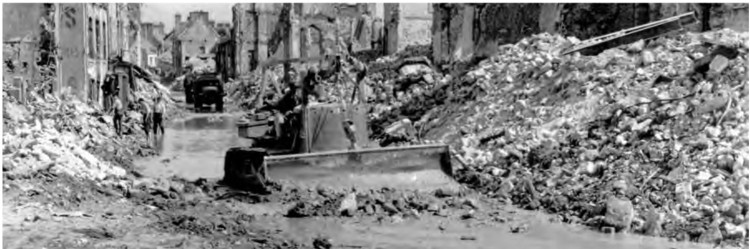
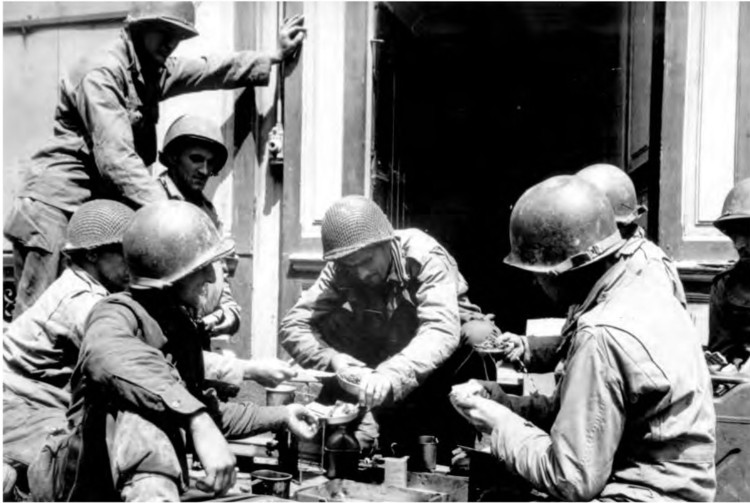
A MEMBER OF AN ENGINEER UNIT, operating a bulldozer, clears a street in Cherbourg (top). Members of an Engineer unit stationed in Cherbourg take time out to prepare a meal in the doorway of a house (bottom). C and K rations were generally issued to troops in combat. Where there was more time for the preparation of food, troops were given the “10 in 1” ration which contained more variety than the C and K rations. When units were more permanently settled regular messes were set up, but during the early days on the Continent just after the invasion, and while the supply situation was still critical, troops resorted to eating rations that could be more easily transported and prepared.
FRANCE
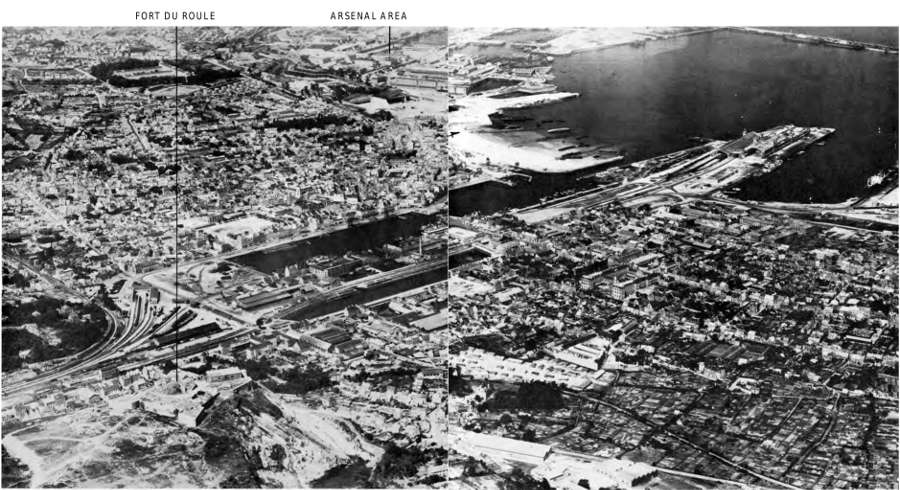
A PORTION OF CHERBOURG showing the inner harbor and docks. Fort du Roule, built high and secure into a steep rock promontory which stands immediately back of the city, dominated the entire harbor area. It was primarily a coastal fortress but was also defended against a ground attack. The P-47’s which bombed the fort did little damage to the subterranean tunnels housing the big guns. The fort was finally taken by infantry troops armed with machine guns, mortars, grenades, pole charges, and rifles. The fort surrendered in sections and it was not until late on 25 June that the complete surrender was accomplished. After the rest of the city had been taken the Arsenal still held out. This structure, partially protected by a moat, was high-walled and well-armed. On 27 June the Arsenal surrendered bringing to an end all organized resistance in the city. With the fall of the city every effort was made to clear the harbor and repair docking facilities as quickly as possible.
FRANCE
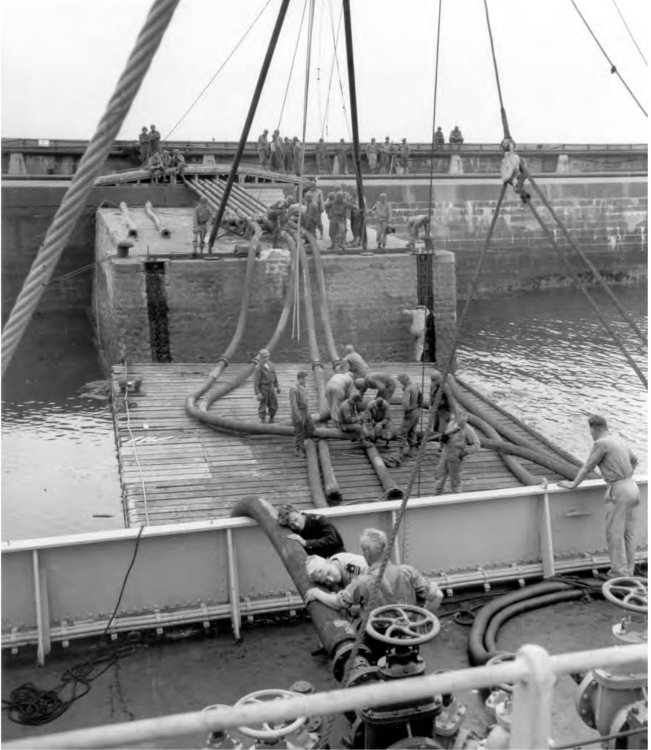
THE FIRST SHIP-TO-SHORE GASOLINE LINE, put in operation at Cherbourg. During the assault phase the Allied forces relied on canned gasoline, but by 3 July bulk supply was being introduced by ship-to-shore pipeline which brought in part of the large quantities of gasoline necessary to the Allied forces.
FRANCE
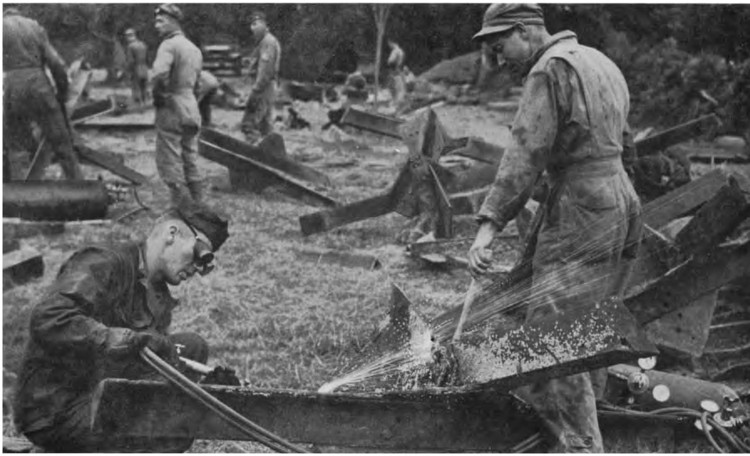
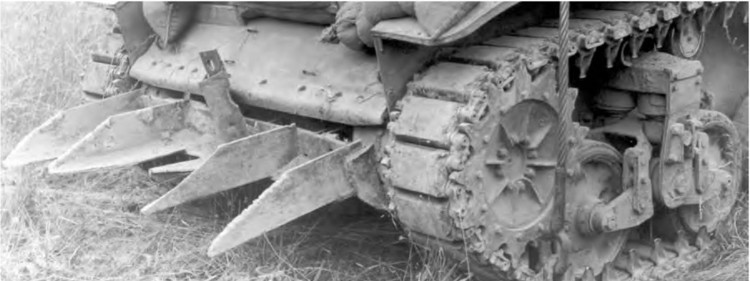
ORDNANCE MEN CUTTING ANGLE-IRON with acetylene torches (top). An M5 light tank equipped with a hedgerow cutter (bottom). During the fighting in Normandy armored vehicles found the hedgerows a serious obstacle which they could neither cross over nor break through. An enlisted man of an Ordnance unit in Normandy devised the method of attaching to the front of tanks rake-like cutters improvised from heavy angle-iron salvaged from the underwater beach obstacles which the Germans had placed to wreck landing craft. During a period of 48 hours maintenance companies of the Ordnance Department turned out 300 of these cutters, which enabled the tanks to open passageways through the hedgerows of Normandy, and play an important part in the advance leading to the break-through at Saint-Lô.
FRANCE
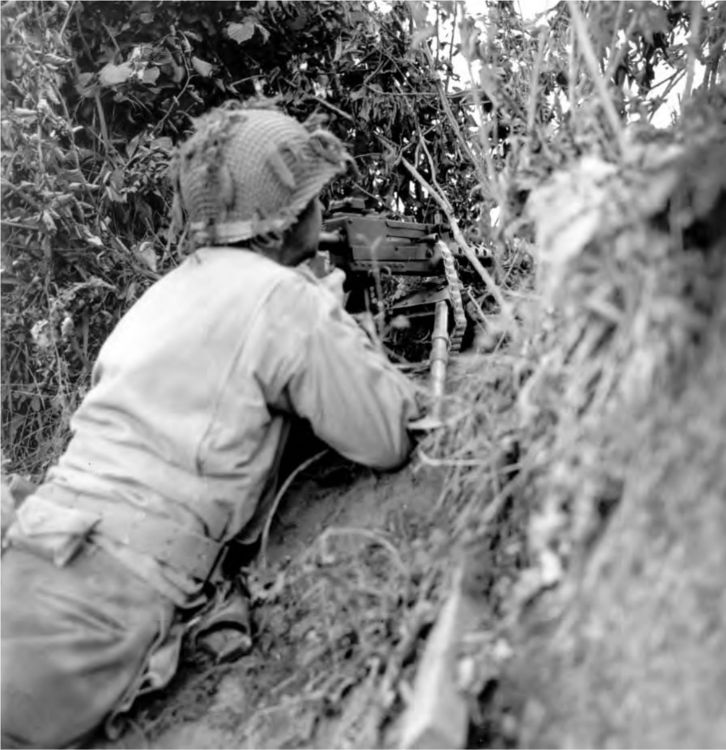
.30-CALIBER BROWNING MACHINE GUN M1919A4 being fired through an opening in a hedgerow by an infantryman. The July offensive, one of the most difficult and bloody phases of the Normandy Campaign and known as the Battle of the Hedgerows, was conducted from 7 to 20 July 1944. Four U. S. Army corps, ultimately employing twelve divisions, were involved in the effort. German reinforcements stiffened, particularly in the hills protecting Saint-Lô, and the U. S. forces in the Cotentin Peninsula fought their way southward, alongside the U. S. troops east of the Vire River, to win ground for mounting the attack which was to break through the German defenses at the end of the month of July.
FRANCE
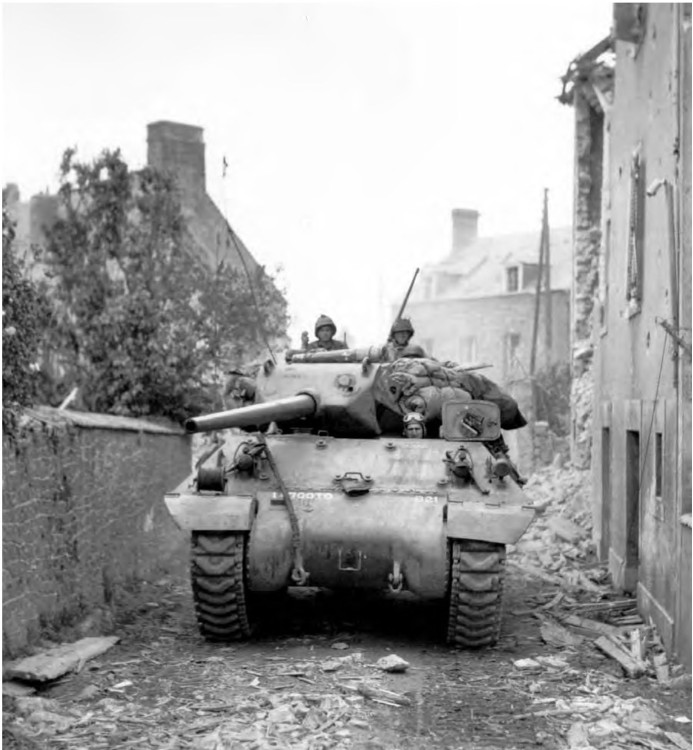
A 3-INCH GUN MOTOR CARRIAGE M10 moving along a road near Saint-Fromond. While the British Second Army battled furiously against enemy armored strength to the east, the First U. S. Army struggled forward on both sides of the Vire River in their drive on Saint-Lô. The advance was laborious because of the nature of the terrain and the poor weather conditions. The enemy rallied to prevent any break-through to Saint-Lô, and the British redoubled their efforts in the Caen area where the Germans had most of their 900 tanks.
FRANCE
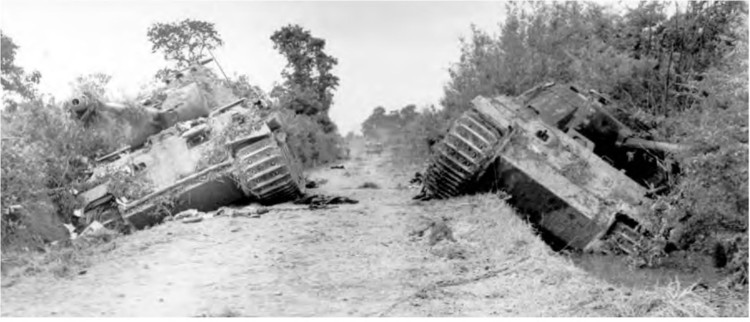
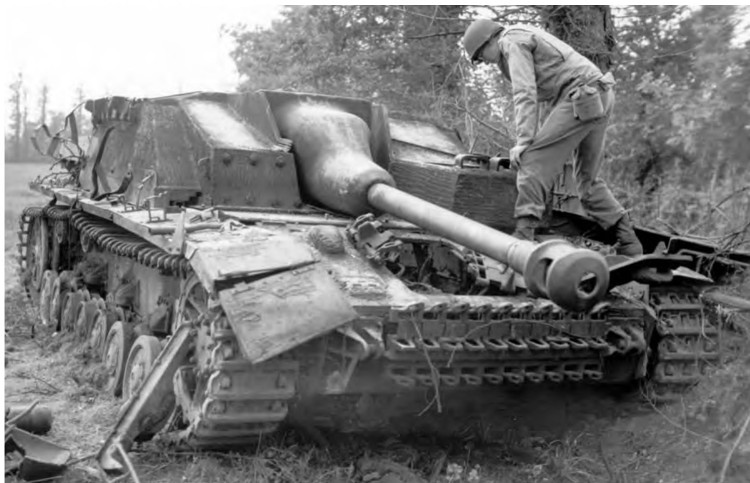
TWO GERMAN PANTHERS, heavy tanks (Pz. Kpfw.-7.5-cm. Kw. K. 42-L/70), knocked out on a road near Le Désert (top). A damaged German self-propelled assault gun (Stu. G. IV with Stu. K. 40-L/48) near Périers (bottom). During the fighting in the Saint-Lô area the German forces included two corps with elements of no less than twelve divisions, including two armored divisions. The losses sustained by the enemy armored units removed the possibility of a further large-scale counterattack west of the Vire River.
FRANCE
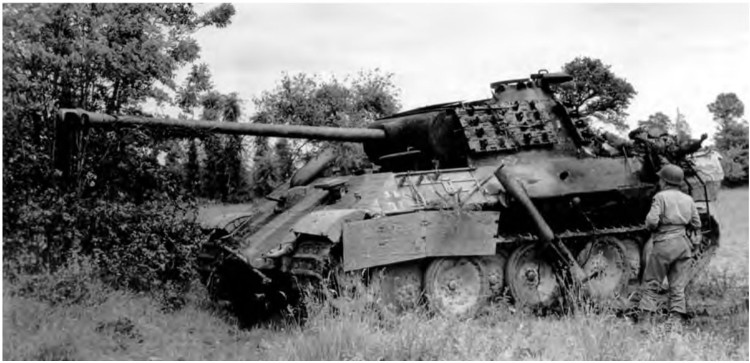
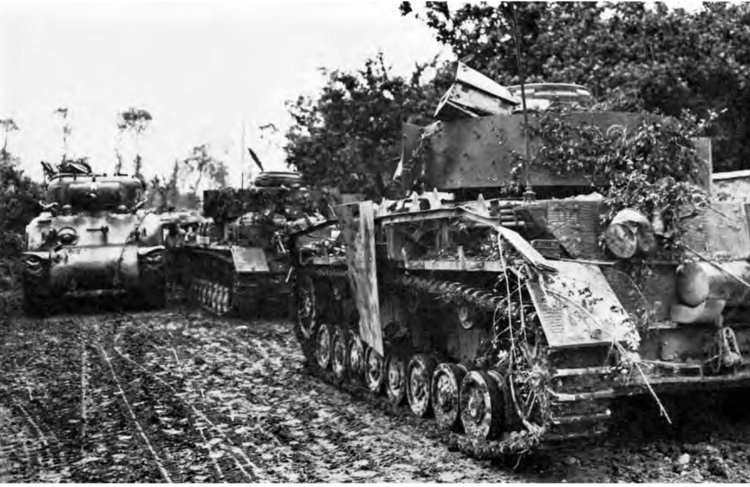
GERMAN PANTHER (top). U. S. medium tanks M4A1 pass German medium tanks (Pz. Kpfw. IV) which were knocked out in the July fighting near Saint-Lô (bottom). In hedgerow fighting tanks were expected to give great assistance, by their fire power, in dealing with hedgerow strong points but there was always the problem of getting them through the embankments fast enough to maintain their support to the infantry.
FRANCE
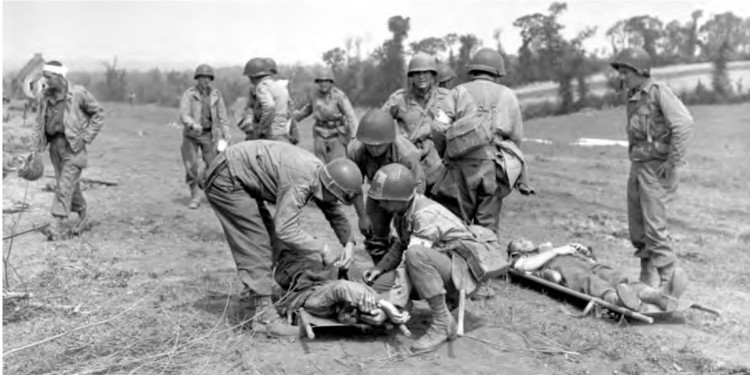
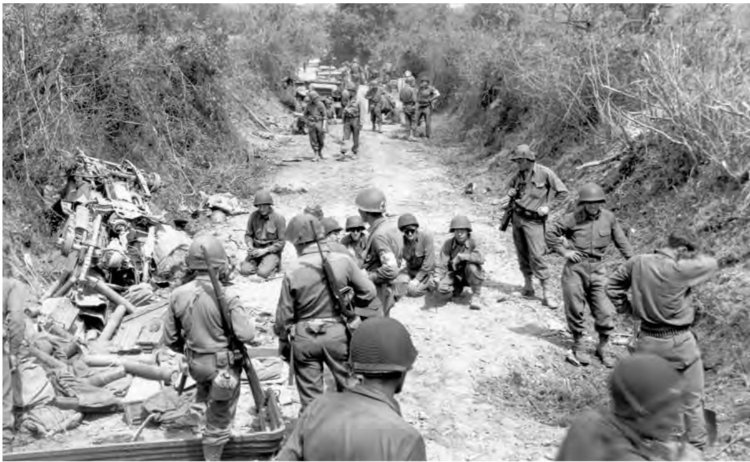
ARMY MEDICAL AID MEN preparing to evacuate wounded (top). U. S. troops along a sunken road during the advance to Saint-Lô (bottom). The U. S. losses during this campaign totaled nearly 11,000 killed, wounded, and missing. The Germans, as a result of the action, were prevented from regrouping and wore down their last immediate reserves for use against a break-through.
FRANCE
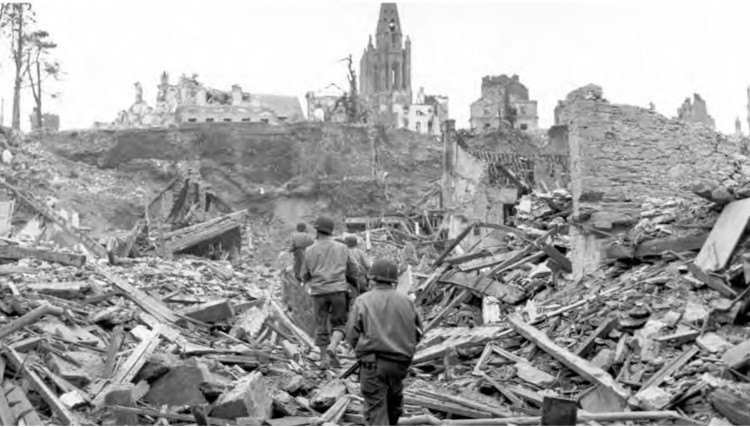
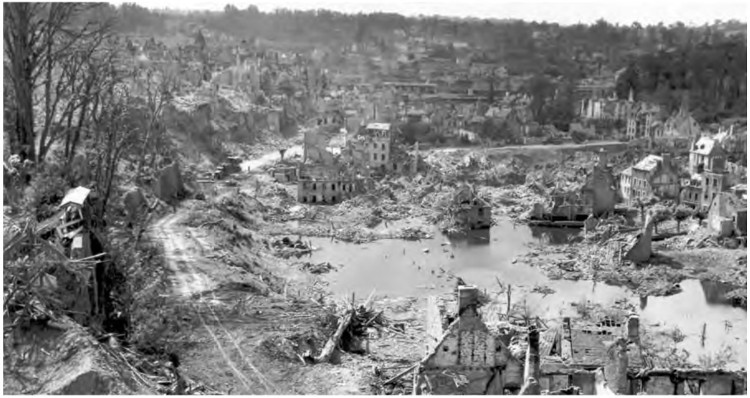
AN INFANTRY PATROL picking its way through the blasted ruins of Saint-Lô (top). Allied and German shelling and Allied aerial bombing reduced Saint-Lô to ruins (bottom). The original objectives of the July offensive were not attained except for the capture of Saint-Lô on 18 July 1944 and the high ground suitable for launching the break-through attempt. The ground won was sufficient to give the troops more room and better jump-off positions which they needed to break out of Normandy.
FRANCE
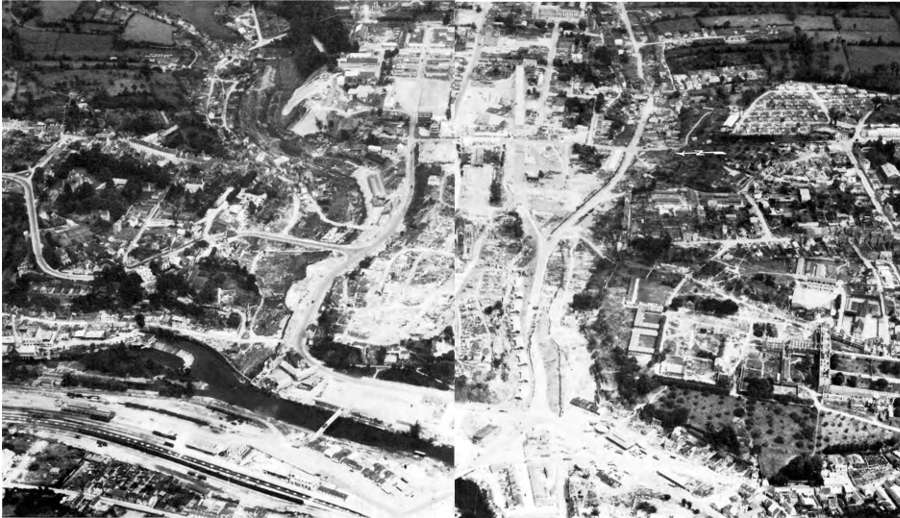
SAINT-LÔ IN RUINS after the capture of the city by the U. S. forces. It was shelled both by the attacking Allied forces who needed the area to stage troops who were to break out of the hedgerow country of Normandy, and by the enemy forces who were trying to prevent the U. S. troops from taking the city.
FRANCE
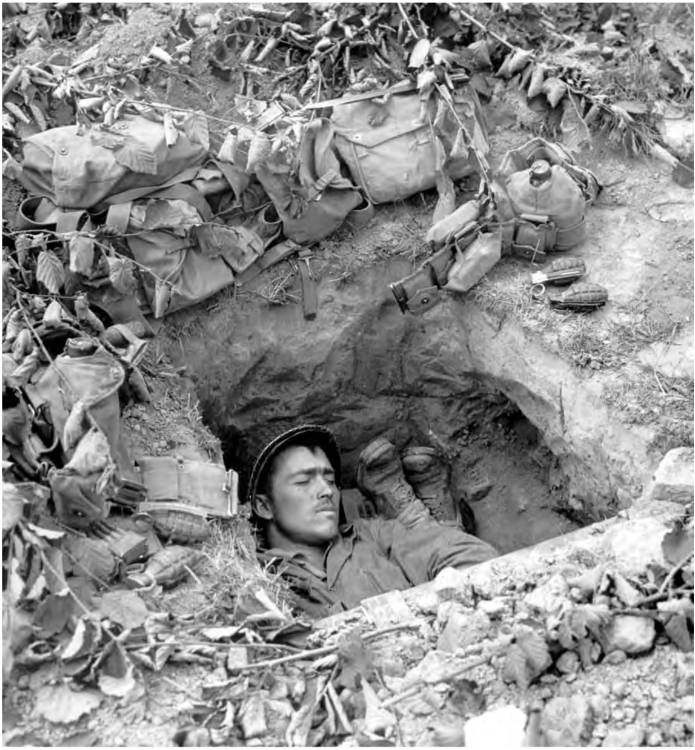
INFANTRYMEN RESTING IN THEIR FOXHOLE. Rain, which continued for 6 days, delayed the air bombardment and in turn the advance of the First Army which had scheduled an attack for 19 July 1944. During this period the men were compelled to huddle in their foxholes under the dripping hedgerows in conditions of extreme discomfort, while the enemy, also entrenched behind the natural defenses of the country, was alert to every movement. The low-lying country became a sea of mud, stopping further tank operations during this period.
FRANCE
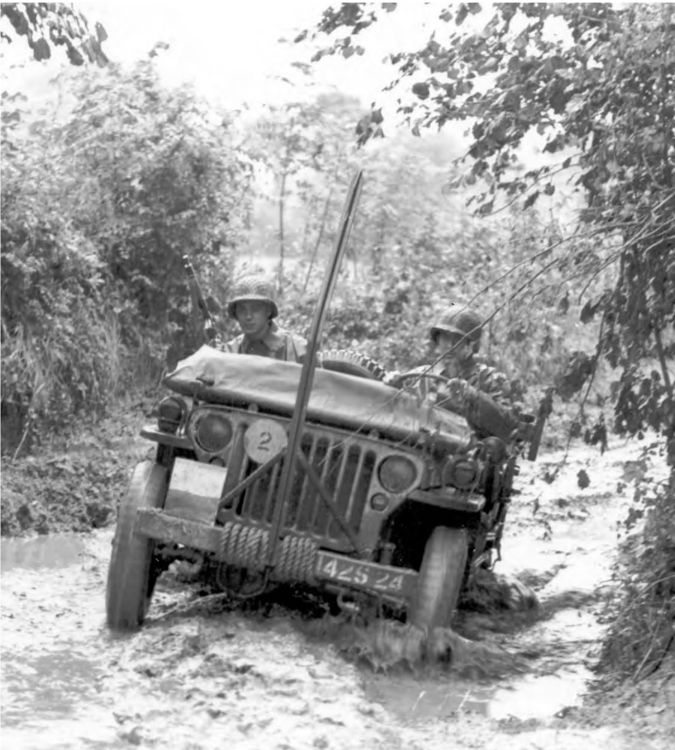
JEEP SPLASHING THROUGH A FLOODED ROAD IN NORMANDY. The rains, which held up the advance, flooded the dirt roads which by this time were in a bad state of repair from the heavy traffic and shelling. On the front of the jeep is an iron bar used to cut thin strands of wire that the enemy strung across the roads level with the heads of the occupants of vehicles, which traveled with tops and windshields down.
FRANCE
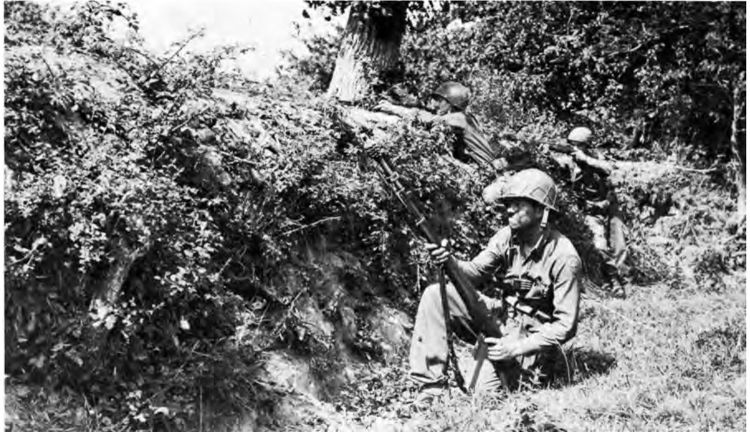
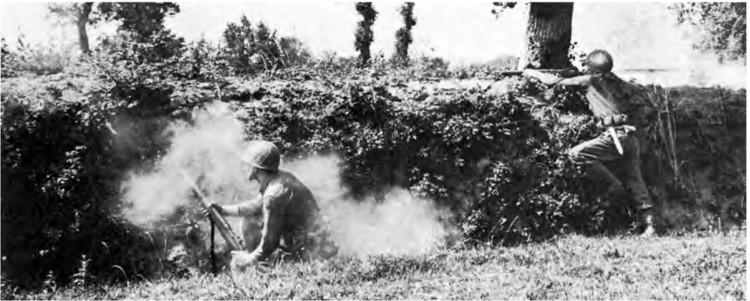
INFANTRYMEN FIRING FROM A HEDGEROW. The man in the foreground is shown about to fire a fragmentation grenade using a U. S. rifle .30-calibre M1 with a grenade launcher M7 (top). Grenade has just been fired (bottom). The terrain through which the Allied troops fought was favorable to the defense. In the close bocage countryside, dotted with woods and orchards and with fields divided by tree-topped embankments where armor could not well be employed, the infantry had to wage a grim struggle from hedgerow to hedgerow and from bank to bank, harassed by snipers and machine gun posts. On 24 July the troops of the U. S. First Army were waiting for the weather to clear sufficiently for an air attack before they attempted to break out of Normandy in the area of the Périers-Lessay-Saint-Lô road.
NORTHERN FRANCE CAMPAIGN
NORTHERN FRANCE
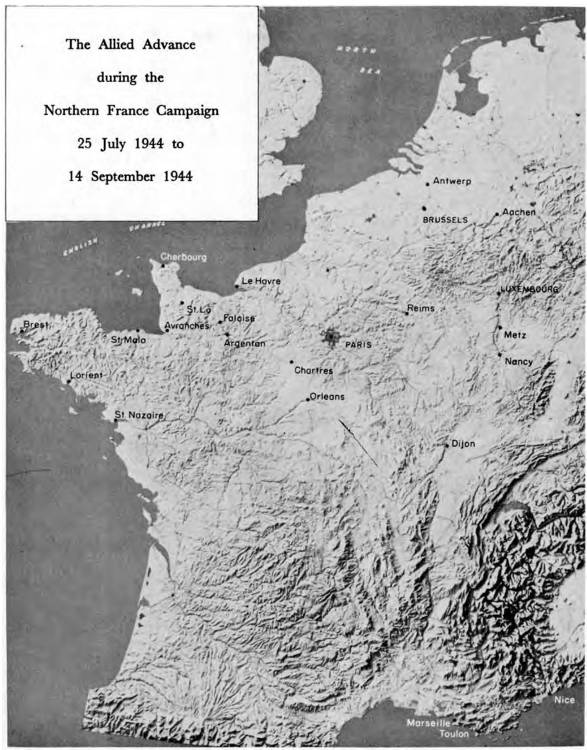
The Allied Advance during the Northern France Campaign 25 July 1944 to 14 September 1944