Chapter IX · THE TODA GODS
Reading edition
The ceremonies which have been described in the last five chapters make up a large part of the ritual of the Toda religion, but there is one important feature of this ritual which has so far been left on one side, or only cursorily mentioned, because its full consideration only becomes possible after an account has been given of the Toda gods.
In describing the ritual of the dairy and the various ceremonies connected with the buffaloes, it has been mentioned that at certain times the prayer of the dairy or the prayer of the village is used. In these prayers there are references to various incidents in the lives of the gods, and many of the clauses would be unintelligible without a knowledge of these lives. It therefore becomes necessary to consider this branch of Toda mythology before dealing with the prayers in detail.
The typical Toda god is a being who is distinctly anthropomorphic and is called a teu. In the legends he lives much the same kind of life as the mortal Toda, having his dairies and his buffaloes. The sacred dairies and the sacred buffaloes of the Todas are still regarded as being in some measure the property of the gods, and the dairymen are looked upon as their priests. The gods hold councils and consult with one another just as do the Todas, and they are believed to be swayed by the same motives and to think in the same way as the Todas themselves.
At the present time most of the gods are believed to inhabit the summits of the hills, but they are not seen by mortals. Before the Todas were created, the gods lived on the Nilgiri Hills alone, and then it is believed that there followed a period during which gods and men inhabited the hills together. The gods ruled the men, ordained how they should live and originated the various customs of the people. The Todas can now give no definite account of their beliefs about the transition from this state of things to that which now exists.
Each clan of the Todas has a deity especially connected with it. This deity is called the nòdrodchi of the clan, and is believed to have been the ruler of the clan when gods and men lived together. I am doubtful whether there is at the present time any belief that the nòdrodchi exerts an influence over the clan with which he is connected.
There was no department of Toda lore which gave me greater difficulty than the study of the beliefs about the gods. There was no doubt that two gods stood out pre-eminent among the rest. One was a male deity whose name was Ön, and the other a female deity, Teikirzi. A simple question which I had the greatest difficulty in settling was the relation of these deities to one another. According to one account they were brother and sister; according to another, father and daughter. It seemed quite certain they were not husband and wife, and most probable that they were brother and sister. Others of the gods were believed to be related to one another, but on such points as this I found it almost impossible to obtain trustworthy information. It may have been reticence which made the difficulty, but I do not think so, and am inclined to think that the Todas have now only vague ideas about the histories of their more ancient gods, and have nothing like the definite traditions which they possess about deities of obviously more recent origin.
Sometimes there were discrepancies between different accounts which I could not clear up, and in such cases I give the account which seems to me to be the most trustworthy.
Pithi
This god is the earliest of whom any tradition is preserved. His name is Pithi or Püthi, and he is often called Pithioteu. He was born near the sacred dairy of Anto in a cave which had the same shape as the ordinary Toda hut. According to one account, Pithi created Todas and buffaloes, but there seemed to be little doubt that this is not the correct tradition, which assigns the act of creation to his son Ön. There is a suggestive resemblance between the name of this god and the Sanscrit word for earth, Prithivi, which is in common use in Southern India.
Ön
Ön was the son of Pithi. He created the buffaloes and the Todas and became the ruler of Amnòdr, the world of the dead, where he now lives.
One day Ön went with his wife Pinârkûrs to Mêdrpem (the top of the Kundahs). There he put up an iron bar which stretched from one end of the pem to the other. Ön stood at one end of the bar and brought forth buffaloes from the earth, 1,600 in number. Then Pinarkurs tried to produce buffaloes and she stood at the other end of the bar and produced 1,800 buffaloes.
The descendants of the buffaloes created by Ön became sacred buffaloes, while the descendants of those created by his wife are the ordinary buffaloes.
When Ön saw that his son was in Amnòdr he did not like to leave him there alone and decided to go away to the same place. So he called together all the people and the buffaloes and the trees to come and bid him farewell. All the people came except a man of Kwòdrdoni named Arsankutan. He and his family did not come. All the buffaloes came except the arsaiir, the buffaloes of the Kwòdrdoni ti. Some trees also failed to come. Ön blessed all the people, buffaloes and trees present, but said that because Arsankutan had not come he and his people should die by sorcery at the hands of the Kurumbas, and that because the arsaiir had not come they should be killed by tigers, and that the trees which had not come should bear bitter fruit. Since that time the Todas have feared the Kurumbas, and buffaloes have been killed by tigers. All the Todas and all the buffaloes appear to have suffered for the evil deeds of Arsankutan and the arsaiir.
Then Ön went away to Amnòdr, taking the buffaloes and the palol of the Nòdrs ti with him, and since that time Ön has ruled over Amnòdr, which is sometimes called Önnòdr after him.
Teikirzi
This goddess is perhaps the most important of the Toda deities. She is said to have been the sister, and probably the elder sister, of Ön. I could learn very little about the story of her life, but nearly all the customs of the Todas were referred to her, and it seemed clear that when Ön left this world Teikirzi became the ruler or nòdrodchi of the Todas. Whenever I tried to obtain from the Todas an explanation of any ceremony or custom I nearly always received the reply, which was regarded as final, that it had been so ordained by Teikirzi.
It seems doubtful whether Teikirzi dwells in any special hill like other Toda deities, though there is a hill near Nòdrs especially connected with her. I was told that she lives everywhere in this world, and in answer to a question it was said even that her influence extends to London, where she dwells as she dwells everywhere else.
She is regarded as the ruler or nòdrodchi of all the Todas, and this world is often spoken of as Eikirzinòdr. At the same time Teikirzi is especially connected with Nòdrs, and she is the special nòdrodchi of this clan.
Five customs, or sets of customs, are ascribed especially to Teikirzi. These are:—
(i) Madol pâkht kwadrt vai, “Who divided and gave madol (clans).” Teikirzi is also said to have divided the Todas into their two chief divisions.
(ii) Ir pâkht kwadrt vai, “Who divided and gave buffaloes.”
Below Nòdrs, near a swamp called Keikudr, there is a small stream which at the present time Todas will not cross at a certain spot, and Teikirzi stood in this stream. According to one account she beat the water with a wand, saying “Ir padri ma” (“May buffaloes spring”), and buffaloes sprang out of the stream; but it seemed to be more generally accepted that she only divided the buffaloes on this spot by touching each animal on the back with a wand and saying the name of the clan to which it was to belong. The first portion went to Nòdrs, the second to Kuudr, the third to Kars, and the fourth to Taradr. Up to this point she used a wand of kid wood (kidkurs). For the next clan, that of Keadr, the kidkurs was put away and she used a wand of tavat wood, and several other kinds of wand were used. Teikirzi was also said to have ordained at the same time that wursulir should be milked by Teivaliol and to have settled the general regulations concerning the different kinds of buffalo.
(iii) Püliol pâkht kwadrt vai, “Who divided and gave püliol.”
Teikirzi is said to have ordained that certain people should be the püliol of a man, and that püliol should not marry one another (see Chap. XXI).
(iv) Ir patz id vai, “Buffalo catch who said.” Teikirzi ordained that buffaloes should be caught at the funeral ceremonies (see Chap. XV).
(v) Kwarzam pep ostht ad vai, “Who told the kwarzam and gave pep.”
Teikirzi gave to each village its kwarzam, or sacred name, and settled the method of making new pep.
The name of Teikirzi occurs frequently in other legends. One story not mentioned elsewhere is the following:—
When Teikirzi was living at Nòdrs the people of Mysore came to fight her, but as they approached, the woods made a great noise. When the Mysore people heard the noise they stopped, and then Teikirzi cursed them and said, “Let them become stones,” and they were turned into stones, which are still to be seen below Nòdrs.
Teipakh, or Tirshti
I know very little about the life-history of this deity, but he is very widely mentioned in the prayers and incantations of the Todas, and is one of their most important gods. He was the brother of Teikirzi, and differs from most other Toda deities in being a river god, Teipakh being the Toda name of the Paikara river.
Teipakh is the nòdrodchi of the Piedr and Kusharf clans.
Although there was considerable agreement that Teipakh and Tirshti were one and the same god, there was some doubt about it, and, according to one account, Tirshti was only another name for Teikirzi.
Anto
I am very doubtful about the name and identity of this god. There seemed to be little doubt that he had the same name as the chief dairy of the Nòdrs ti and was the chief deity connected with this dairy. According to one account he was the son of Ön, but it is possible that the two deities were identical, Anto being Önteu. His name was sometimes pronounced Anteu or perhaps more correctly Änto or Änteu.
I have only a few incidents from the life of Anto. He once rolled a huge stone with the hair of his head from Nelkòdr in the Wainad to the top of a hill called Katthvai near the dairy of Anto. The god now lives near this dairy, resting his head on a spot called Ködrs, and stretching his legs on a spot called Tudrs. These places are about two furlongs apart so that Anto is evidently a god of a large size.
Anto is said to have made buffaloes, and the buffalo which founded the ti mad of Makars (see p. 116) was one of his creation. The fact that Anto created buffaloes increases the probability of his identity with Ön, but this is far from conclusive for there were undoubtedly several independent creations of these animals.
Kulinkars
This deity is the nòdrodchi of the Kars clan. His original name appears to have been Kulin, and this was changed to Kulinkars. He is also called Teikhars. He inhabits a hill near Makurti Peak, which is so steep and rocky that “no man has ever climbed it.”
The following story is told of Kulinkars or Teikhars:—He once knocked on the ground and so made two buffaloes. He then told the monsoon (kwadr) to drive the buffaloes to the place to which they were to go, saying, “you must push them on.” As the buffaloes were being driven on by the monsoon, a tiger went after them. When they reached a certain hill, the hill divided into two and the buffaloes went between the two parts, but still the tiger followed them. Then the buffaloes came to Kwaradr and went into the pen, and the tiger also went into the pen. When the buffaloes saw that the tiger had come into the pen, they kicked it and it died. Then one of the buffaloes said to the other, “You stay here in the pen; I am going to Tarsòdr.” Then the monsoon drove on this buffalo to Tarsòdr, which is one of the dairies of the Pan ti. The descendants of the buffalo which stayed in the pen are the pasthir of Kwaradr and the descendants of the other are among the buffaloes of the Pan ti.
Kulinkars was connected with the erkumptthpimi ceremony (see Chap. XIII) and was the mokhthodvaiol or paramour of Nòtirzi. His relation to Nòtirzi is said to have been the origin of the mokhthoditi custom (see Chap. XXII), but I was not able to obtain any detailed account of this part of the history of the god.
Kulinkars has a son called Teikhidap, who lives on Makurti Peak, and the proper Toda name for this hill is Teikhidap.
Nòtirzi
I have no details of the history of this female deity. She is the nòdrodchi of the two important clans of Melgars and Kuudr, and lives on the hill now known as Snowdon, the Toda name of the hill being the same as that of the goddess. This hill is especially sacred, and any Toda who visits it has to salute with hand to forehead (kaimukhti) in all directions. Like her mokhthodvaiol, Kulinkars, Nòtirzi is connected with the erkumptthpimi ceremony. She is said to have had a son called Tikuteithi or Teukuteithi. It is possible that this is the same as Teikuteidi, who appears in the story of Kwoten (see p. 193), but they are more probably two different deities.
A stone which is said to have been thrown by this goddess from her hill is shown close to the village of Pòln, under the tree known to English visitors to the Nilgiris as the ‘umbrella tree.’
Korateu or Kuzkarv
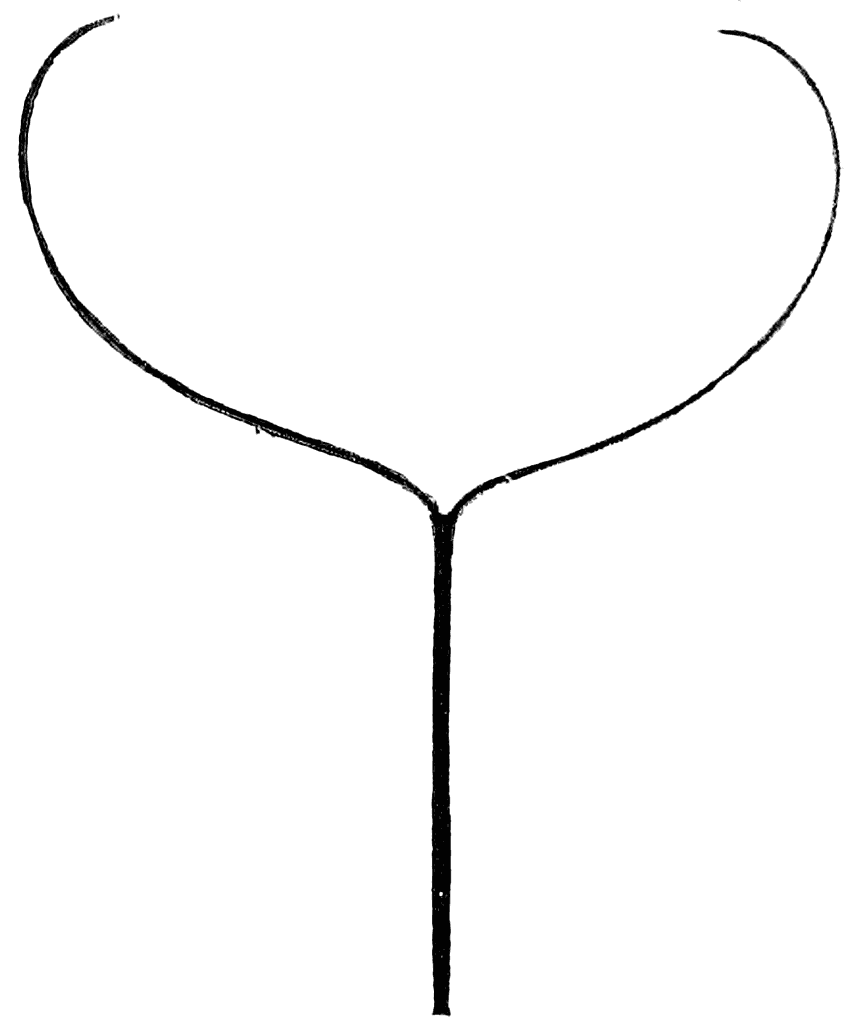
FIG. 35.—IMITATION BUFFALO HORNS.
At this time Korateu was not recognised as a teu, and when the gods held council he was not summoned as a member. This made him very angry.
Near Korateu there was a wood in which there stood a tree of the kind called mòrs (Michelia nilagirica) which was about 80 feet high. Korateu ordered that honey bees (peshtein) should come to the tree, and after a time there were about 300 nests, which made the tree bend down with their weight. One day about twenty men came to collect honey, Todas, Irulas, and Kurumbas. The Todas made a fire under the tree, while the Irulas and Kurumbas climbed and collected honey from the nests. When they had collected the honey from all except three or four nests, the tree became so light that it sprang back and killed the Irulas and Kurumbas, and the Todas went home.
At this time Korateu was unmarried and he carried a stick of iron. One day a Kurumba woman came to the mòrs tree in search of honey. Korateu knocked her on the head with the iron stick and at once she became pregnant. That evening she gave birth to a daughter, who was very beautiful, and Korateu decided to marry the child and sent away the mother that night. (According to another version, the child was so beautiful that the mother was frightened and went away to her own village, and Korateu fed the child with milk and fruit and honey, and when she grew up he married her.)
Soon after the death of the Irulas and Kurumbas a sambhar calf came to Korateu, who caught it, tamed it, and kept it for a month. Then certain Todas went to Korateu and asked him for a place. Korateu gave them a place and said that it should be called Keradr. The people of Keradr then asked for buffaloes. So Korateu gave them the sambhar calf and said that it should become buffaloes for them, and he ordered that the buffaloes should be called miniapir, and that the calves should be called mâvelkar—i.e., calf from a sambhar. This was the origin of Keradr and of its wursulir, which are still called miniapir, and they are the only buffaloes of the Todas which were made from sambhar.
After these things had happened the gods recognised that Korateu was a teu, and calling him asked him who he was. He answered that he was the son of Teikirzi, and the manmokh or sister’s son of Teipakh. He was then admitted as one of the gods and now lives on the hill Korateu, but still sometimes sits in the lap of Teipakh. He is the nòdrodchi of the Keradr and Keadr clans, and the chief villages of these clans are near his hill. He is called Kuzkarv when mentioned in prayer.
Another god, called Etepi, is said to be the same god as Korateu. It appeared, however, that Korateu lived on one hill and Etepi on another, and I could not ascertain the true relation of the deities to one another.
Azo-mazo is mentioned in the prayer of the Kars ti as two deities, Azo and Mazo.
Puzi and Kurindo
I am very doubtful as to the identity of Puzi. According to some accounts Puzi or Purzi was merely another name for Teikirzi; according to other accounts Puzi was a male deity and the husband of Teikirzi. In the following story Puzi is a female deity, inhabiting a hill near Nòdrs. She gave birth to a son called Kurindo. As soon as Kurindo was born he became fire. Puzi did not approve of this, as it seemed to show that the boy was too powerful, so she took a leaf of the kind called kwagal, pounded it and mixed it with water and sprinkled it on the fire. The fire then turned back again into a boy who was bent to one side.
Puzi said, “I will put you on a hill opposite to me.” So she put him on the hill called Mopuvthut, near the village of Naters, and in order to make the hill higher she put three baskets of earth on the top, so that her son might be seen by everybody.
When Kurindo was on his hill he thought to himself, “My mother has treated me badly; she sprinkled me with water and quenched my power, and she has made me bent to one side; I do not like to be opposite to her.” So he went away to a hill near Kanòdrs. This was before the time of Kwoten and before the Kamasòdrolam had run away (see p. 195). While Kurindo was living on this hill a strange tribe came to the hills, so Kurindo again moved and went away to the hill of Arsnur on the Mysore side, where he still lives.
There is a hill called Puthi on which a fire is lighted at certain times (see p. 291) and the god inhabiting this hill was, according to one account, the husband of Teikirzi. It is possible that Puthi and Puzi are the same, but I think it more probable that they are two separate gods, each having his own hill, Puthi being the husband of Teikirzi, and Puzi being the deity of this legend.
The following legends differ from the preceding in that they appear almost certainly to record the lives of deified men. The first legend deals with three men of different clans, but the sons of three sisters. The second deals with the life of Kwoto, and professes to be the history of a being of miraculous birth who came to be accepted by the gods, not only as one of their number, but as superior to themselves. These two legends were known far more thoroughly and universally than any of the preceding. It seems most probable that they are records of men who really lived, and that the life of each has become a nucleus round which have grown various miraculous and portentous incidents.
Kwoten, Teikuteidi, and Elnâkhum
There were once three men, the children of three sisters. The eldest was Kwoten, who belonged to Pan, the second was Teikuteidi, who belonged to Taradr, and the youngest was Elnâkhum of Nòdrs. (According to one account the father of Kwoten was Purten, and his mother was Tiköni of Keradr. They lived at Pan and Kiursi, and Kwoten was born at Pan. Purten died when Kwoten was thirty years old and Tiköni died six years later.)
Kwoten had a wife called Kwoterpani. She did not like her husband, but preferred a man of Kanòdrs called Parden. One day Kwoten took his wife to a place called Timukhtar (near the spot where Sandy Nullah toll-bar now stands). He gave her only the loin-cloth called tadrp to wear, hoping that she would be cold and uncomfortable and would sleep with him, but she refused. Kwoten then took her to Kûdrîdjpül near Mulòrs, where there was a large wood. In this wood there was a tree of the kind called külmän, into which Kwoten climbed and made a bed. Below him, about three feet above the ground, he made a small bed for his wife, and under the tree, close to his wife’s bed, he tied a big male buffalo. He did this because he thought a tiger might come to take the buffalo during the night when his wife would be frightened and would climb up the tree to his bed. During the night a tiger came and took away the buffalo, but even this did not induce the woman to go to her husband. Next morning Kwoten took his wife to Pòlâdri, which belonged to the Panol. This village was near Miuni, and there Kwoten became a palikartmokh. One day Kwoten was in the dairy and his wife in the hut when Parden came from Kanòdrs. Kwoten’s wife knew that her husband was in the dairy, and endeavoured to prevent Parden from going into the hut by giving him buttermilk. Kwoten found that Parden had come, and sharpened a big knife to kill him, and when he came out of the dairy, Parden ran away towards Kanòdrs and Kwoten followed with the knife.
Kwoten’s sister had married a Kars man and was living with him at Nasmiòdr, and at this time Kwoten’s mother was staying at this place. As Parden ran away, pursued by Kwoten, they had to pass Nasmiòdr, and Kwoten’s mother saw them, and said, “How is it that my son does not catch Parden?” Then she cursed Parden, saying “On sati udairnùdr, Kârkaḍith mul uḍith pâtmâ”—viz., “If I have reverence to the village, may he be checked by the tree with thorns in the Kark wood.” When Parden reached a stone now called Pardenkars, Kwoten caught him up and tried to kill him, but the knife struck the stone instead and split it into two pieces. Then Parden ran on to the wood called Kark, where he was caught by a tree with thorns (brambles) so that Kwoten was able to kill him.
When the news of the death of Parden reached Kanòdrs all the people were very much afraid, and all ran away except one old man and his wife. As the people were going, they sent a message to the Kotas at Tizgudr. Two Kotas took a grain pounder (wask) and went to Pòladri. When Kwoten was told that the Kotas were coming he went and hid himself. The Kotas came and stood near the village and were told that Kwoten had gone away. Then they told Kwoten’s wife, who at this time was pregnant by Parden, to come out of the hut. She came out and went to the Kotas, who asked her where Kwoten was. She said she did not know, whereupon the Kotas were vexed, and pierced her belly with the pounder, so that she died. Her funeral took place at Tadendari, and that of Parden at Arâdr.
The people of Kanòdrs ran away to a place called Penasmalpet, near Malmathapenpet, and are known as the Kamasòdrolam. They have never been seen since, but the Todas have heard from various wandering tribes that they still exist and that they live on a hill from which they can see Kanòdrs, and that when the Kamasòdrolam see a fire at Kanòdrs they shave their heads and make a special kind of food called ashkkarthpimi.
While sitting there one day an eagle (kashk) sat on her head, and she became pregnant, and went back to the village and gave birth to a son. When Kwoten heard of this he wished to kill the child and set out to do so. The old woman’s daughter, who had married a Kars man, sent her husband to warn her parents that Kwoten was coming to kill them. The Kars man met Kwoten and ran away from him towards Kanòdrs, followed by Kwoten’s dog. When he came to a hill above the village he called out that Kwoten was coming. When the old man heard him, he cursed Kwoten and those with him; the latter became stones and Kwoten himself (according to the story as told by the Kanòdrs people) was stung by honey bees and died. The people of Kanòdrs are descended from the son born to the old woman. If this old woman was not a Toda, as her name and that of her village suggest, this would seem to point to a tradition that the people of Kanòdrs are descended from an ancestor of a different race from the other Todas (see p. 640).
Owing to the behaviour of Kwoten to the Kanòdrs people there has ever since been karaivichi (trouble) between the people of Pan and Kanòdrs. They do not intermarry and no Kanòdrs man may go to one of the chief villages (etudmad) of the Pan people nor may a Pan man go to an etudmad of Kanòdrs.
According to the above account Kwoten died after being cursed by the old man, but this is only a feature of the story as told by the Kanòdrs people, and in the account given by others Kwoten had many other adventures and finished his life in this world in a very different manner. He married a second wife, who, like the first, objected to her husband and preferred a man of Keradr, whose name was Keradrkutan. Kwoten lived with this wife at Kazhuradr, near Isharadr. At that time women wore the garment called än, which is dark grey like the tuni of the palol, and is now only used as a funeral garment.
Keradrkutan used frequently to come to Kazhuradr, and this vexed Kwoten, who told his wife to have nothing to do with the man. She encouraged Keradrkutan, however, and this vexed Kwoten so much that he took off her än and brought a thorny bush called peshteinmul and beat her all over with the bush, so that she became covered with blood. Kwoten at this time wore the garment called tuni, which he then took off, dipped it in water, and rubbed it all over his wife so that she became the colour of tuni, and then he gave her back her än and went to his dairy. While he was in the dairy Keradrkutan came stealthily to the village. When the woman saw Keradrkutan she cried very bitterly and said, “Kwoten has beaten me very severely so that I shall die; come and see me.” When Keradrkutan went into the hut, the woman died.
Before this time, when Kwoten was one day beating his wife, she abused him, saying, “Talrs ti oditha vai, Kòlrs kûv oditha vai; en puspad”—“You have no ti, you have no Kotas: why do you beat me?” This was to reproach Kwoten because the Pan people had no ti buffaloes and had no Kotas to make things for them. So Kwoten went and complained to his brother Teikuteidi. Teikuteidi was very sorry, and in order to remove the reproach he persuaded Elnâkhum of Nòdrs to give certain buffaloes of the kind called unir from the Nòdrs ti. Elnâkhum gave a two-year-old calf (pòl) and a one-year-old calf (kar), and also two bells (mani) to put on their necks. The two bells were called Tarskingg and Takhingg. The calves were then standing at Kuladrtho and were taken by Kwoten to the tars poh of Pan. He tied the two bells to one of the calves called Kazhi. These bells ought properly to have been tied to the buffalo called Enmars which remained behind at Kuladrtho. Then Enmars went to Anto and complained as follows:—
i.e., “I will not come to your presence with naked neck and ear.” Anto told him not to grieve because he had lost the mani, and that instead
Melgarsol Melgars man teirpülk pül of Anto to mudâ mâ in front go may nî pud you come Antosh at Anto pep ûn pep drink
i.e., “When you go to Anto, a Melgars man shall go in front of you to the pül of Anto; when you come to Anto you shall drink pep.” To this day, when the buffaloes of the Nòdrs ti go in procession to Anto a Melgars man goes in front and the buffalo called Enmars drinks pep at Anto. At the same time Anto prophesied to Enmars that a misfortune would befall Teikuteidi, saying
“wûrâdr “whole year nols day Teikuteidi tan himself ennâth without numbering piriedkin, I will divide, at vokh!” go away!”
Kwoten was responsible for various features of the organisation of the Pan people. He divided them into two parts, the Panol and Kuirsiol, and also divided the ti into two parts, the wars ti, which was to belong to the Panol, and the tars ti to the Kuirsiol. He settled that the palol of the ti should be chosen from the people of Keadr. When there is a funeral in any clan a palol belonging to that clan must give up his office; hence, in order that his ti should never be without a palol, Kwoten separated the people of Keadr into two divisions, the Keadrol and the Kwaradrol, so that a member of one division might be palol if a member of the other division died. This was the origin of the division of the Keadr people into the Keadrol and the Kwaradrol.
One day Kwoten went to the wars ti of Pan and took buttermilk and slept there, and he did the same at the arsaiir ti of Kwòdrdoni, and since that day the people of Pan have had the privilege of taking buttermilk and sleeping at the places of each ti.
Kwoten also made two teiks (stones or wooden posts at which buffaloes are killed at the funerals), the parsteiks for the Panol and the kirshteiks for the Kuirsiol.
It is owing to the example of Kwoten that the Todas now take meals in Kurumba villages. Before his time they had never done so, but Kwoten one day went to a Kurumba village and took food, and since that time all Todas have done so.
Kwoten was also the first Toda to go to a Kota village. He wanted one day to go to Mitur in the Wainad, and as it was getting dark and he was still on his way, he went to the Kota village of Kulgadi (Gudalur). He sat on their tün, or bed, got new pots and food from them, and, taking both to the stream called Marspa or Marsva, he cooked and ate the food there, and then, returning to the village, slept on a Kota tün. Since that time Todas have gone to that village, and have done as Kwoten did, but they will not go to any other Kota village.
“Nòdr udoi “Country (God) if there is kwudrpedrshai; Naraian sami kaipedrshai.” you will die; Naraian will kill you.”
In spite of this warning, Kwoten persisted in going on, and finally they came to Terkosh, who said to Kwoten, “Do not come near me, I am a teu.” Kwoten paid no heed to this, but said, “You are a beautiful woman,” and went and lay with her. Then Terkosh went away to her hill at Pòni, where she is now, and to this day the Kurumbas go there once a year and offer plantains to her and light lamps in her honour.
Kwoten and Terkosh are now living on two hills near Pòni, which face one another, and Erten has also become a teu and lives on a smaller hill near those of Kwoten and Terkosh. Whenever a Toda sees Kwoten’s hill for the first time, he lies down on his right side and sings twice the following words: “Seizâr zon, Kwoten âr zon, Seizâr zon, Terkosh âr zon.” I could not discover the meaning of these words, and fancy that the Todas themselves do not know exactly what they mean. It is possible that âr is the word meaning six.
The history and fate of Teikuteidi, the second brother of Kwoten, has been given in the story of Kwoten. He belonged to Taradr, and according to one account the kugvalir of that place were sent to him. Very little is related about the third brother, Elnâkhum. He had 1,800 buffaloes, but though he had so many, he was always going to other Todas and saying “I have nothing to milk; lend me a buffalo to milk,” and all his life he used to beg. It is owing to his example that the Todas have begged ever since, and are not ashamed to do so even when they are rich.
Elnâkhum is said to have built the long wall which still exists at the village of Nòdrs.
The story of Kwoten reads very much like that of a man who really lived and was deified after his death. The minute detail with which several of the natural incidents of his life are known might be held to point in this direction, but perhaps more important is the fact that his ring can still be seen, and that his spear was, according to Breeks, in existence not long ago. It looks as if Kwoten was a man who raised Pan from a comparatively insignificant position among the Todas to be one of their chief clans, and was the means of introducing several innovations in Toda custom. It is probable that he was deified after his death, and that some of the incidents of his life have acquired miraculous characters.
Kwoto or Meilitars
One day Kwoto went into the buffalo pen and played there with the buffalo-dung, so that he was covered with the dust of the dung. His father rebuked him and was blowing on him to get rid of the dust when the boy changed into a kite and flew away. The next day he resumed human form, but from that time he only stayed in the village at times, and at other times stayed in the woods. This went on for about eight days, and then he refused to take food from the village and became a companion of the gods.
At this time the gods used to hold councils on the slopes below a hill called Tikalmudri. The place where they sat was called Pòlkab. When the gods were holding council at Pòlkab, Kwoto went and sat on the top of the hill Tikalmudri. Then the gods said to one another, “How is it that he sits on the top of the hill while we sit below? It is not at all good.” They consulted together and decided to kill him. So three or four of the gods went to Kwoto and said in a cunning way, “We will show you your country” (i.e., the place which should belong to him; each of the gods had his appointed place). So they took him to a steep precipice called Teipâper, and having deceived him that they would show him his country, they threw him down. Kwoto, however, was not killed, but took the form of a kite and flew back to Tikalmudri. Then all the gods were surprised that he was not dead, but decided to try and kill him again, and they took him to the hill Kòdrtho, near Nidrsi, and threw him down. (The hill Kòdrtho was inhabited by the god Kòdrtho.) Kwoto was not killed, but pulled up a bamboo tree with its roots, and flew back and struck Kòdrtho on the head, and Kòdrtho’s head split into three pieces. One of these pieces is now the well-known hill, the Drug, seen from Coonoor, while the other two pieces are eminences on the ridge running out to the Drug.
Kwoto then returned to Tikalmudri. The gods said, “We cannot kill him; he has some power; let us try his power.” So they gave him the following task:
“Peivoi Low tirikvâ, turn pîdâr high pîrichvâ?” fill?
i.e., “Can he turn the low stream and fill the high stream?” (According to another account the words in which the task was given were, “Alvoi tiriki, Kalvoi pîrsvôka,” i.e., “Can he turn the stream Alvoi and fill the stream Kalvoi?”)
Kwoto then took a huge stone, which may still be seen near Kanòdrs, and put it in the stream so that it flowed upwards. Then the stream begged Kwoto, “We are going upwards according to your order, but it is very difficult for us; we wish to be allowed to go our ordinary way.” So Kwoto took away the stone and the stream resumed its natural course.
The gods saw what Kwoto had done and decided to try his power in another way, so they said:
“Kânêr Sun ât, tie, kutei stone kurs chain ütia?” can he do?
Then Meilitars put back the sun in its proper place.
(According to another version, the task of tying the sun was given in the words:
“Kânêr Male buffalo ât, tie, pîrsagun sun patrôkâ?” can he catch?
The sun was said to have been at this time sitting on the back of a male buffalo, and Kwoto was told to tie the buffalo and catch the sun. According to this account Kwoto first used an iron chain, kabantagars, which was melted by the heat of the sun. Next he tried a bronze (?) chain called kuchtagars, which also melted. Then he used a stone chain, or karstagars, which did not melt, and he succeeded in tying the sun with this. (This version of the story corresponds with that given by Breeks.)
Kwoto or Meilitars was closely connected with two clans, those of Melgars and Kanòdrs. It is said to be owing to the fact that Kwoto was a Melgars man that Melgars people have the special privileges and duties which are peculiar to that clan. At any rate, this is the view held by the people of Melgars. At Kanòdrs, the name of Kwoto occupies a prominent place in the prayer of the dairy, and several of the special features of the ritual of the Kanòdrs dairy are said to exist in consequence of the many wonderful things which Kwoto had done in its neighbourhood. When new buttermilk has to be made for Kanòdrs, it is made at a place called Kautarmad, far away, because Kwoto made new buttermilk there, and in the ceremony at this place earth is taken from certain places from which Kwoto took it.
Kwoto or Meilitars is the hero of several stories, in none of which does he play a very creditable rôle.
At the present time the people of Keradr have no ti. Once they had a ti which they lost through the action of Kwoto, who went one day to their dairy at Tîkîrs, near Mòdr, and, hiding the kaltmokh in the wood, took his place. When the palol milks, it is the duty of the kaltmokh to let out the calves and send them to the palol. Kwoto did not do this properly, but sent more calves than were required, so the palol became angry and took his stick (kwoinörtpet) to beat the supposed kaltmokh, but the stroke missed and fell on the palol himself.
After giving mûvòmad to the palol and kaltmokh, Kwoto sent them into the air, together with the dairy and the buffaloes and everything belonging to the ti, and they all went in the air to Kupars, near Pan; they stayed there for some time and then disappeared, and now nothing can be seen of them, but if people go near Kupars, they hear the voices of the palol and kaltmokh when they are talking to one another.
Since that time the people of Keradr have been without a ti.
Another story in which Kwoto played a prominent part is connected with the custom of eating flesh. I received several versions of this story and was unable to satisfy myself which was correct.
According to one account Kwoto once went to Mitur in the Wainad, where Kurumbas live. Kwoto played with these people, and one day caught and killed a wild buffalo. He said to the Kurumbas, “I have killed this buffalo; let us eat its flesh”; and he gave to each a portion. The Kurumbas ate their portions, but Kwoto only pretended to eat; he held out his putkuli in front of him and instead of eating dropped his portions inside the cloak. When the Kurumbas had finished, Kwoto got up and all saw on the place where he had been sitting the flesh which he had pretended to eat. Then the Kurumbas were angry and went to beat Kwoto with sticks, asking why he had not eaten the flesh, and they insisted that Kwoto should eat some of it. Kwoto ran away, and when the Kurumbas pursued him he pretended that he was lame and consented to eat some of the flesh of the buffalo. He also told them that he was a god and said that he would dance before them, and did so like a lame man. He told the Kurumbas that whenever he came in the future, he would dance to the Kurumbas first and then to the Todas; and now the Kwoto teuol, or diviner (see Chap. XII), when he dances, does so first to the Kurumbas, and when he dances before them he does so as if he were lame.
After this Kwoto disappeared and since that time has not been seen. He is said to live in a temple at Mitur, but “wherever there is a god, there also is Kwoto, or Meilitars.”
According to another account, this story was told of the people called Panins (Panyas), but in this version Kurumbas were also said to be present, though it was the Panins who were made to eat the flesh.
According to a third account, obtained, however, from an untrustworthy informant, Kwoto practised this deception on the gods themselves, and made them eat the flesh of a calf while only pretending to eat himself. This was said to have been the starting-point of the erkumptthpimi ceremony, and Kwoto was said to have killed the calf with the same formalities as are now used in this ceremony. All other Todas strenuously denied that Kwoto made the gods eat flesh. There was, however, so much reticence about the erkumptthpimi ceremony and its history, that I am not confident that Kwoto was not in some way connected with its origin, and that the version of my untrustworthy informant may in this case have been correct.
Other Gods
There are very many other deities. Of the following I can give little more than the names.
Atiato is the nòdrodchi of the Kwòdrdoni clan and also of Pedrkars. He lives near the chief villages of these clans, and has a temple of which the priest is said to be an Irula, and Todas sometimes give to this god offerings of clarified butter.
Konto or Konteu is the nòdrodchi of the Panol, and lives on the hill Konto, to which fire is set by the palol of the Kars or Pan ti (see Chap. XIII).
Kòdrtho is the nòdrodchi of Nidrsi. He played a part in the history of Kwoto, and according to some accounts he was the mun, or maternal uncle, of this god.
Near the source of the Paikara river, there is a cave in which there is a pool called Alvoi. Sometimes this pool gives forth a loud bubbling noise, and this is believed to be due to a teu dipping himself in the water. The name of the god is Alvoi Kalvoi, Kalvoi, situated at some distance from the pool, being a hill on which the god usually lives.
There are other gods about whose histories I have no information. Tiligush is the nòdrodchi of Päm and Karadr of Taradr. Pòrzo inhabits a hill near Nòdrs, and Karzo, a hill near Kars, and the names of other gods, such as Kaladrvan, Teikhun, Peigwa, Karmunteu, Kondilteu and Mundilteu, are mentioned in the prayers of the ti dairies.
In addition to these, who are certainly true Toda gods, the Todas also pay respect to the gods of the other tribes on the Nilgiris, while occasionally the names of Hindu gods are mentioned in their ceremonies. If a Toda be asked if he worships one of these gods, he will almost certainly assent, but at the same time he distinguishes them from his own gods. The only deity who seemed to be confused with their own gods by some of the Todas was Petkon, whose Badaga name was said to be Betakarasami. Breeks calls him Betikhan, and states that he is a hunting god; and according to some Todas Petkon was a son of Teikirzi.