Chapter XXX · THE ORIGIN AND HISTORY OF THE TODAS
Reading edition
I have now given the whole of the material which I have collected on the institutions of the Todas. In describing these institutions I have discussed various general problems suggested by their nature, but I have said little about the points of resemblance or difference between the customs of the Todas and those of other peoples either in India or elsewhere. It remains in this last chapter to see how far the evidence which I have given throws any light on the very difficult questions: Who are the Todas? How do they come to be living on the Nilgiri Hills?
The evidence which might be available for our inquiry is of three kinds: records of the Todas in the past, traditions preserved by the Todas, and, lastly, evidence derived from the comparative study of physical and psychical characters, language, beliefs, and institutions.
The evidence coming under the first two heads is of the scantiest. Our earliest record of the Todas is contained in a Portuguese manuscript now in the British Museum. It records the visit of a Portuguese priest named Finicio to the Nilgiri Hills in 1602. This manuscript was partially translated and published by Thomas Whitehouse in a book dealing with the Syrian church of Malabar, under the title “Lingerings of Light in a Dark Land.” As the translation given by Whitehouse is incomplete, I had the manuscript retranslated, and it was then found that several interesting details had been omitted, and that there were several errors in the translation. The new translation is given on pp. 721–730.
The account given by Finicio is very superficial, being the result of only two days’ intercourse, but it is sufficient to show that there has probably been little change in the Todas and their surroundings in the three centuries which elapsed between his visit and mine. I have referred in the general body of the work to several of the points in which his account either corroborates or differs from my own. Perhaps the most important feature of his story is that it shows the relation between the Todas and Badagas three centuries ago to have been very much what it is at the present day, and shows clearly that this relation between the two tribes is of longer standing than has usually been supposed. Finicio’s account is, however, so brief and superficial that it helps us little in our search for evidence on the evolution of Toda society. We know from it that the institution of the ti was in existence, and the scanty evidence goes to show that the life of the palol was much what it is now, but there is nothing to tell us whether the ritual had then reached the high pitch of development which it now shows, nothing to tell us whether since that time there has been development or degeneration.
From 1602 to 1812 we have, so far as I am aware, no record of the Todas. In the latter year William Keys, Assistant Revenue Surveyor, reported the existence of the Todas, or Thothavurs, and other tribes in a letter to the Collector of Coimbatore. His account gives little information about the Todas, except that they kept buffaloes and held it a sacred and inviolable custom to keep their heads uncovered. In 1819 “a Subscriber” wrote an account of the Nilgiri tribes which was published in the Madras Courier. Beyond a description of their appearance, the only information given about the Todas or Todevies is that it is against the custom to wear either turban or sandal, that they permit hair and beard to grow long, and that the Badagas pay a few handfuls of grain from each field as acknowledgment that they received their land from the Todas. In 1820 Lieutenant Macpherson reported the practices of polyandry and infanticide, and in the following year Captain B. S. Ward described the marriage customs more fully, and gave some account of the dairies and priesthood. In 1826 the Rev. James Hough addressed a number of letters to the Bengal Hurkaru, giving an account of the Nilgiris and their inhabitants, and these letters were republished in a book in 1829. A more elaborate and most excellent account of the Todas was given by Captain Harkness in 1832, in a work entitled A Description of a Singular Aboriginal Race Inhabiting the Summit of the Neilgherry Hills, and since that time very many of those who have visited the Nilgiri Hills have had something to say about the Todas and their ways. As I have already pointed out, these records from the earlier part of last century differ but little from my own, and do not furnish us with any evidence that Toda customs underwent any great change during that century.
As regards the evidence from Toda tradition, we are in no better case. Several writers have stated that the Todas believe that they came to the Nilgiris from elsewhere, but whenever I made any inquiries on this point I was assured that they had always been on the Nilgiri Hills, the first Toda having been created on the Kundahs in the manner already described.
It seems most probable that those who have ascribed such traditions to the Todas have been misled by the account of the Kamasòdrolam. These are the people who are believed to have been driven away from Kanòdrs by Kwoten (see p. 195). The Todas have a very sincere belief in the existence of these people, and when I showed one man the frontispiece in Marshall’s book, representing a Toda village and its inhabitants, something unfamiliar in the arrangement of the scene made the man think that it must be a picture of the Kamasòdrolam. Any Toda who is asked whether there are other Todas and where they live will at once think of the Kamasòdrolam and will tell of these people, and the story might easily be mistaken for a tradition of their origin.
The Todas are also said to believe in their descent from Ravan, and I was told by one man that they were descended from the Pandavas, but I have little doubt that such beliefs are only recent additions to their mythology.
In studying the origin and history of the Todas we have thus no record earlier than three centuries ago, and no traditions of any value, and we are altogether thrown back on the evidence furnished by the manners and customs of the people, their language, and their physical characteristics.
On the social side these resemblances are perhaps closer than on the religious side. The system of kinship is very similar to that of other parts of Southern India, and, so far as my knowledge goes, to that of India generally. The marriage regulation that the children of brother and sister should marry is found throughout Southern India and probably throughout the Dravidian population of India. The practice of polyandry probably exists scattered here and there throughout India, and has undoubtedly existed in recent times in Malabar. The practice of the mokhthoditi union between man and woman has also close analogies in Malabar.
On the religious side the high development of the dairy ritual, so far as I know, stands alone, but the customs connected with birth and death have many resemblances to practices followed in other parts of India, though this resemblance is general only and usually breaks down on going into detail.
Thus in Brahmanic ritual there are several ceremonies prescribed at different stages of pregnancy, and some Indian tribes or castes have pregnancy ceremonies peculiar to themselves, but I do not know of any tribe or caste except that of the Todas in which giving a bow and arrow forms the essential feature of a pregnancy ceremony, though it is not uncommon for this weapon to play a part in marriage rites, and in Coorg a little imitation bow and arrow is put into the hand of a newly born boy.
Similarly, seclusion after childbirth is common in India, and in the Brahmanic ceremony of Jatakarma water is poured over the heads of mother and child by the priest. In some cases from Mysore (see p. 705) there is a still closer resemblance to Toda custom, but there are some features of the Toda ceremonial for which I can find no parallel.
While there is thus a general resemblance between many of the manners and customs of the Todas and those existing in various parts of the Indian peninsula, there is one district which possesses customs and institutions which seem to stand in a much closer relation to those of the Todas than is the case elsewhere.
The social and religious customs of the west coast, and especially of Malabar, not only bear a general resemblance to the customs of the Todas, but this resemblance in some cases persists when followed into detail. The similarity would probably become still more obvious if we knew more of the customs of the less civilised inhabitants of this district of India.
Polyandry is not the only marriage institution in which there is a resemblance between the Todas and the people of Malabar. The mokhthodvaiol of a Toda woman seems to be very much like the consort of a Nair woman, and when these consorts are, as they usually are, Nambutiris or Malabar Brahmans—i.e., belong to a different caste—the resemblance to the mokhthoditi custom becomes very close.
The act of giving clothing as part of the marriage ceremony is found generally throughout India, but it seems to be a much more prominent and essential feature of marriage in Malabar than elsewhere.
Among the funeral ceremonies of the Todas there is one in which a cloth is laid on the body of the deceased. The essential feature of this ceremony is that a cloth is given by a man belonging to the clan of the deceased to those who have married into the clan, the cloth being then placed on the corpse by the wives of these men. The whole ceremony seems to be essentially a transaction between clans which have intermarried and evidently stands in a close relation to the regulation of marriage, and it is therefore of great interest not only that a cloth should play so prominent a part, but also that the word used for the cloth which gives the name to the ceremony should be kach, the same word as is used sometimes in Malabar for the cloth so important in the marriage ceremonies.
The resemblance between the Todas and Nairs in this direction goes, however, one step further. Among the funeral ceremonies of the Nairs there is one called potavekkuka, in which new cotton cloths are placed on the corpse by the senior members of the deceased’s Tarawad (corresponding to clan), followed by all the other members, sons-in-law, daughters-in-law, and other relatives. The details of the ceremony differ in the two communities; among the Nairs the placing of cloths is the duty of a wide circle of relatives, but the resemblance between the customs is sufficiently close to make it highly probable that we have to do with two developments of one custom.
The Nairs collect pieces of unburnt bones from the ashes fourteen days after the cremation, but they either throw them into the nearest river or take them to some sacred place, thus following a frequent Indian practice.
I have now enumerated a number of points in which there is a close resemblance between the customs of the Todas and those of the people of Malabar. In some cases, as in that of the cloth ceremony of the funeral, the resemblance is so close that we seem almost bound to seek its explanation either in identity of origin or in borrowing. We may be confident that if there has been any borrowing from the inhabitants of Malabar, it has not been recent, and we may also be fairly confident that the physical barrier in the past must have prevented any but the most infrequent intercourse between the inhabitants of the Nilgiri plateau and those of Malabar. If we attach any significance to the resemblances I have indicated, the conclusion seems almost inevitable that the Todas at some time lived in Malabar and migrated to the Nilgiri Hills, and it remains to inquire whether there are any other facts in favour of this view.
On one line of evidence I cannot speak with any authority, but I strongly suspect that there is a very close resemblance between the Toda language and Malayalam.
The Todas believe that their dead travel towards the West and are able to describe the paths by which they pass. Here, again, there is some reason to think that people may preserve in their beliefs about the passing to the next world a tradition of the route by which their ancestors travelled from a former home, and this may be so in the case of the Todas.
Another fact linking the Todas with Malabar is the use of the tall pole called tadri in the funeral ceremonies. This pole is procured for the Todas from the Malabar side of the hills by the Kurumbas, and I was told that suitable poles only grew in Malabar, and the pole is adorned with cowries which are also probably of Malabar origin. Other objects burnt at the funeral, such as the boxes called pettei and the umbrella called miturkwadr, are also procured from Malabar. The use of objects in funeral ceremonies which are procured from Malabar is suggestive, though, taken alone, it would have little significance.
A fact which would perhaps be regarded by most as more important is that there is now a settlement of the Todas at Gudalur in the Wainad, on one of the routes from Malabar to the Nilgiris. It seems clear that at one time the settlement was larger than it is at present, and it is tempting to suppose that we have here evidence of the route of the Toda migration. There are, however, facts which make it improbable that this clue is of any value. If the villages about Gudalur had been survivals of the migration they would almost certainly have been sacred villages, but it was quite clear that they had no sanctity whatever and were not even saluted when seen from a distance. Unfortunately I did not visit Kavidi, the only village which remains, and if I had done so I might have discovered some evidence of sanctity and antiquity, but from what I was told it is very unlikely that any such evidence exists. This absence of sanctity is further in agreement with the traditions of the Todas, who say that the settlement at Gudalur is recent. There are, however, other facts which point to an ancient connexion of the Todas with this district. Some of the buffaloes of the most sacred and ancient Nòdrs ti are said to have come from Perithi in the Wainad, and the Taradrol, in many ways an exceptional Toda clan, are said to have their own future world or Amnòdr at this place.
It will thus be seen that, in addition to the points of similarity in custom and belief, there are definite facts pointing to connexion with Malabar, and if we suppose that the Todas migrated from this district we have next to conjecture the path by which they travelled. If any importance is attached to the belief in the paths taken by the dead, we should regard it as the most probable view that the Todas travelled over the Kundahs, the two divisions of the people travelling by slightly different routes. The Toda tradition that men were created on the Kundahs is perhaps in favour of this route, which would seem to correspond with the road to the Nilgiris known as the Sisipara Ghat. If, on the other hand, we attach importance to the settlement at Kavidi, the route followed would be that through Gudalur. At the present time the latter road is far the easier of the two, and, if the Todas had travelled during the last few years, it would have been the natural road by which to come, but it does not appear that there was any essential difference in the difficulties of the two routes before the roads were made. The evidence in favour of either route is very scanty, but if the Todas came from Malabar it is probable that they came by one or other of these paths.
There are two other districts which have some claim to be considered as possible places from which the Todas may have migrated—viz., Mysore and Coorg.
The other district which has customs especially resembling those of the Todas is Coorg. Among the people of Coorg cloth-giving appears at one time to have formed the essential marriage ceremony, and there still exist what are called ‘cloth-marriages’ in which a man becomes the husband of a woman merely by giving her a cloth. There is also some evidence that polyandry has been practised in Coorg, and I have already referred to the resemblance between the pursütpimi ceremony of the Todas and the Coorg custom of giving a little bow and arrow to a newly born boy. The bow is made of a stick of the castor-oil plant and for the arrow the leaf-stalk of the same plant is used. In Coorg the imitation bow and arrow is put into the hand of the newly born child, but this custom is not widely removed from that of the Todas in which the bow and arrow is put into the hand of the mother shortly before the child is born.
The Todas know the people of Coorg, which they call Kwûrg, and have a tradition of an invasion of their hills by these people, but it is very improbable that there has been any direct borrowing, and it seems more likely that some of the customs of the Todas and Coorgs have had a common source.
The resemblance with the customs of Coorg are perhaps more striking than with those of Mysore, and the former region is much more likely to have been influenced by Malabar than the latter. The links with Coorg do not weaken, and perhaps even strengthen, the conclusion that the Todas owe much to Malabar.
In the table on the following page I give the chief measurements in centimeters for Todas, Nairs, and Nambutiris.
The identification of the Todas with Nairs or Nambutiris would still leave their racial affinities somewhat indeterminate. The Nambutiris are often supposed to be Aryan invaders of Malabar, and, owing to the cause already mentioned, the Nairs are so largely of Nambutiri blood that, if the Nambutiris are Aryan, the Nairs must also be strongly Aryanised even if they were originally of pure Dravidian descent.
If future research should show that the Todas are an offshoot of one of the races now existing in Malabar, and if any definite conclusion can be drawn as to the time during which they have been on the Nilgiri Hills, physical anthropologists will be provided with a most interesting example of the influence of environment on the physical characters of a race. Few greater contrasts of environment could be found in a country than that existing between Malabar and the Nilgiris, and it is possible that the Todas may furnish a striking example of the influence of environment on physical characters.
In endeavouring to link the Todas with Malabar I have naturally dwelt on the points of resemblance rather than on the points of difference. The differences are, however, very great. The general manner of life of the two peoples is now wholly different, while on the religious side I may point to the wide prevalence of snake worship in Malabar, especially among the Nambutiris.
The hypothesis that the Todas are derived from one or more of the races of Malabar would not be tenable for a moment except on the assumption that the migration took place very long ago, and that the culture of Malabar has undergone great changes since the migration. As to the length of time during which the Todas have been on the Nilgiris, we can only offer the vaguest surmises. We know that three centuries ago the Todas were living on the Nilgiris, apparently in much the same state as at the present day. The appearance of some of their sacred stones suggests great antiquity, especially the well-worn polished appearance of the neurzülnkars, which, if the accounts are right, are only rubbed a few times in the year.
On the other hand, the history of Malabar is highly conjectural. The two great positive landmarks in its history are the beginning and end of the rule of the Perumal princes. The date of the first Perumal is put at about the time of Christ, or somewhat later, and it is tempting to surmise that the Todas may have been driven or have retired from Malabar in consequence of the political changes which took place at this time. The last Perumal probably reigned about a thousand years ago, but there does not appear to have been any political upheaval at the time, the last prince having his period of office prolonged beyond the usual twelve years, and having then divided his dominions among his family and retainers.
If we assume that the Todas came from Malabar, the date of their migration would be of great interest in relation to the possibility of Christian or Jewish influences on the Toda religion. There are ancient settlements of both Christians and Jews in Malabar. Tradition assigns the starting-point of the native Christian settlements in Malabar to St. Thomas; but, leaving this on one side, there seems to be no doubt that both Christians and Jews were well established in Malabar more than a thousand years ago. An ancient document is still preserved by the Jews of Cochin, which was given to their leader by the Perumal of the day, and this document can be dated about 750 A.D. A similar document preserved by the Nestorian Christians can be dated 774 A.D.
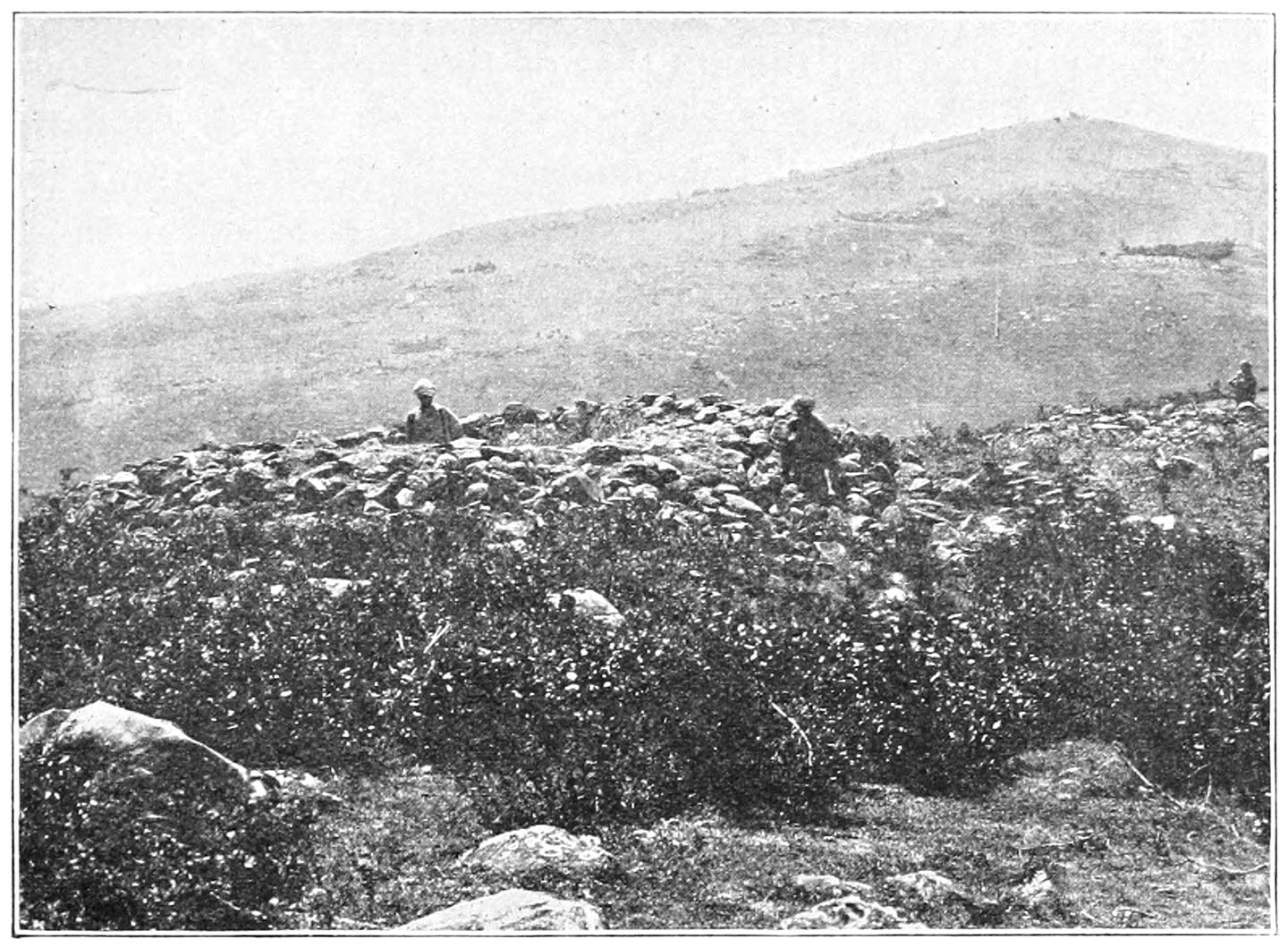
FIG. 75 (from Breeks).—A CAIRN ON THE NILGIRI HILLS.
If the Todas left Malabar at the beginning of the Perumal rule, Jewish or Christian influences can be excluded, but if at a later period such influences may have been present, though it is very improbable that they were important; for, unless the Todas have changed very much, they would have been very unlikely to have borrowed from religious settlers of an alien race. Still, in considering the strange resemblance between the Hebrew and Toda versions of the Creation, this possible influence should be borne in mind.
I have so far said nothing of the archæological evidence which may possibly help in the settlement of the vexed questions which I have raised in the preceding pages. Our knowledge of the history of the Todas would be very materially advanced if we knew whether the cairns, barrows and other ancient remains which are found on the Nilgiri Hills are Toda monuments. In the cairns and barrows there are found objects which suggest a Toda origin, such as figures of buffaloes with bells round their necks (see Fig. 76, 9), but the vast majority of the finds are utterly unlike anything now possessed by the Todas. They include pottery of many designs, the lids of the vessels being often adorned with the figures of animals. Many other animal figures have also been found, and though that of the buffalo often occurs, figures of the horse (see Fig. 76, 10), sheep, camel, elephant, leopard (?), pig (?), and low-country bullock with hump are all found. Such figures can only have been made by those well acquainted with the low country, and none of these animals are ever mentioned in Toda legends.
Metal work is also found in the cairns and barrows; bronze vases, basins and saucers (Fig. 76, 1, 2, 3), iron razors, styles or pins (?), and daggers (Fig. 76, 8), while iron spear-heads (Fig. 76, 4, 7, 13) are frequently met with.
In addition to the more elaborate cairns, cromlechs and barrows found on the Nilgiri Hills, Breeks, to whom we owe most of our knowledge on this subject, found what he took to be ancient examples of the azaram or circle of stones within which the Toda buries the ashes of his dead at the end of the second funeral. In such azaram in the district between Kotagiri and Kwòdrdoni, Breeks found bronze bracelets and rings, iron spear-heads, a chisel, a knife and an iron implement in something of the style found in Malabar and differing from those usually found in the cairns.
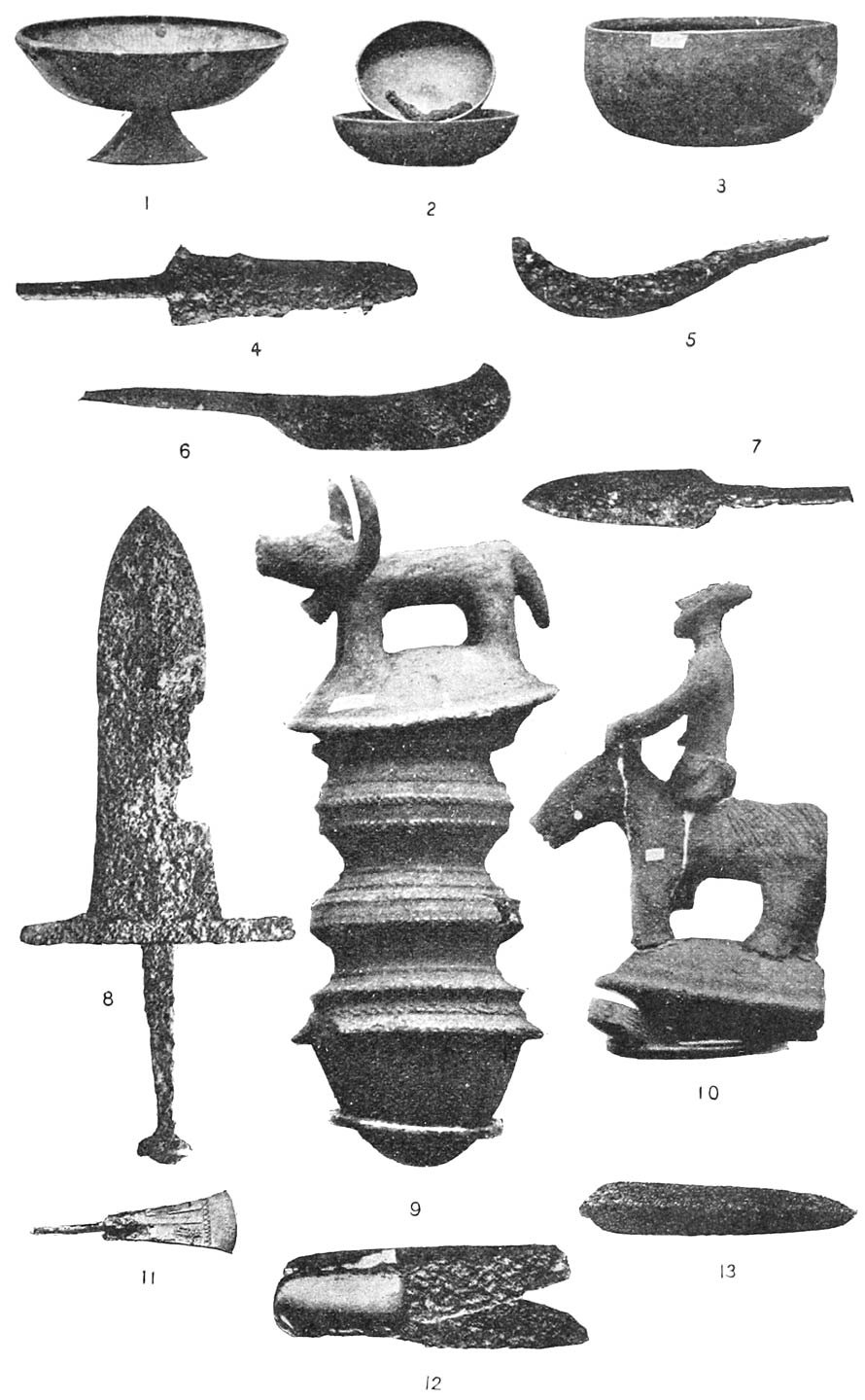
FIG. 76—VARIOUS OBJECTS FOUND IN THE NILGIRI CAIRNS, TAKEN FROM BREEKS.
As regards the cairns, Breeks points out that though the figures of many animals occur in addition to that of the buffalo, most of the animals are so badly imitated that it is difficult to identify them, while the figures of the buffaloes are singularly characteristic and often very spirited.
The only implements found by Breeks which might be agricultural were shears and sickles (Fig. 76, 12, 5), and he recalls the kafkati burnt by the Todas with their dead, which is a curved knife, different, however, in shape from the sickles often found in the cairns.
On the other hand, very few of the human figures found in the cairns resemble the Todas in any way; the women have the low-country top-knot instead of the Toda curls, and they carry chatties on their heads, which would never be done by a Toda woman at the present time, whatever she may have done in the past.
In dealing with the religion of the Todas, I have advanced the view that the ritual and beliefs of the people furnish us with an example of a religion in a state of decadence. It seems probable that the Todas once had a religious cult of a distinctly higher order than that they now possess, and if I am right in supposing that the Todas came from Malabar, it might follow that they brought their highly developed religion with them, and that although certain features of the religion may have undergone great development, the general result of the long isolation has been to produce degeneration. The study of the religion suggests that we have in the Todas an example of a people who show us the remnants of a higher culture.
If we could accept the view that the cairns, barrows, and cromlechs of the Nilgiri Hills were the work of the ancestors of the Todas, we should have at once abundant further evidence that the Todas have degenerated from a higher culture. We should have an example of a people who once used, even if they did not make, pottery, showing artistic aptitudes of a fairly high order which they have now entirely lost. The Toda now procures his pottery from another race, and, so long as this is of the kind prescribed by custom, he is wholly indifferent to its æsthetic aspect. I doubt if there exists anywhere in the world a people so devoid of æsthetic arts, and if the Nilgiri monuments are the work of their ancestors, the movement backwards in this department of life must have been very great.
The use of the bow and arrow and the club in ceremonial furnishes us with another example of material objects which have wholly disappeared from the active life of the Todas, and here again it is easy to see why the disappearance has taken place, for on the Nilgiris the Todas have had no enemies, either human or feral. This disuse of weapons has indeed so obvious an explanation that it cannot be treated as an instance of degeneration; and while the origin of the cairns remains doubtful, the only evidence of degeneration of culture is shown by the religion; and though it seems to me that the evidence here, especially that derived from the nature of the prayers, is conclusive, it may not be so regarded by all.
In the preceding lines I have put forward for consideration the tentative hypothesis that the Todas may furnish us with an example of a people who once have possessed a higher culture of which some features have undergone degeneration. If we combine this hypothesis with that advanced earlier, that the Todas came from Malabar, we may suppose that the Todas brought the higher culture with them from this district, and if this were so, the original culture of the Todas may have been on much the same general level as that of the dominant castes of Malabar at the present day. On this hypothesis, it seems to me most likely that in their new home the religion of the Todas underwent a very special development, its ritual coming to centre more and more round the buffalo, because in their very simple environment this was the most accessible object of veneration. I think there is little doubt that the extraordinary development of the ritual of the dairy must have taken place since the Todas have been on the Nilgiris; and, as I have already pointed out, it seems to me most probable that the degeneration of the religion has been largely a consequence of the extreme development of this ritual aspect of their religion.
The whole of this last chapter is, I am afraid, open to the charge of being highly conjectural. It has, however, seemed to me desirable to raise some of the problems suggested by the existence of the Todas. In the settlement of these problems much further research is necessary, and I have somewhat reluctantly dealt so largely with the conjectural topics of the chapter, because they seem to point clearly to two lines of research in which further work is necessary. One is the archæology of the Nilgiris, which would, I believe, now well repay further investigation; the other is a detailed inquiry into the more popular customs of Malabar and especially of its less known peoples, such as the Hill Arrians, of whom I have just written. It is in the hope that further interest may be awakened in these lines of inquiry that I have devoted so much space to the hypotheses and surmises of this final chapter.
If further research should show that the Todas are derived from ancient races of Malabar, it is possible that the existence of this strange people may help to illuminate the many dark places which exist in our knowledge of the connexion between the Aryan and Dravidian cultures. It is even possible that the Todas may give us a glimpse of what the culture of Malabar may have been before the introduction of Brahmanism, a culture from which many features would have disappeared, while others would have undergone special development; and, if this were the case, the complex dairy ritual of the Todas would be the most striking instance of the development, a development, however, carrying with it the germs of that degeneration from which the Toda religion now seems to be suffering.