The Cycle of Life
Reading edition
The fact that these mythical happenings and magical practices do not agree with his actual knowledge in no way disturbs the Tinguian. It is doubtful if he is conscious of a conflict; and should it be brought to his attention, he would explain it by reference to the tales of former times, or to the activities of superior beings. Like man in civilized society, he seldom rationalizes about the well-known facts—religious or otherwise—generally held by his group to be true.
It is thought that, when a mortal woman conceives, an anito woman likewise becomes pregnant, and the two give birth at the same time. Otherwise, the lives of the two children do not seem to be closely related, though, as we shall see later, the mothers follow the same procedure for a time after delivery (cf. p. 268).
Except for the district about Manabo, it is not customary to make any offerings or to cause any changes in the daily life of the pregnant woman until the time of her delivery is near at hand. In Manabo a family gathering is held about a month before the anticipated event, at which time the woman eats a small chicken, while her relatives look on. After completing this meal, she places two bundles of grass, some bark and beads in a small basket and ties it beside the window. The significance of the act is not clear to the people, but it is “an old custom, and is pleasing to the spirits.”
While the medium has been busy with the immediate family, friends and relatives have been preparing the flesh for food, which is now served. No part is reserved, except the boiled entrails which are placed in a wooden dish and set among other gifts intended for the superior beings.
The small pots and other objects used as offerings are placed on the sacred blanket in one corner of the room, where they remain until the child is born, “so that all the spirits may know that Gīpas has been held.” A portion of the slaughtered animals and some small present are given to the mediums, who then depart.
In San Juan a cloth is placed on the floor, and on it are laid betel-nuts, four beads, and a lead sinker. These are divided with the head-axe in the same manner as the pig, but the medium retains for her own use the share given to the spirits.
In the better class of dwellings, constructed of boards, there is generally a small section in one corner, where the flooring is of bamboo; and it is here that the delivery takes place, but in the ordinary dwellings there is no specified location.
If the child is apparently still-born, the midwife places a Chinese dish close to its ear, and strikes against it several times with a lead sinker. If this fails to gain a response, the body is wrapped in a cloth, and is soon buried beneath the house. There is no belief here, as is common in many other parts of the Philippines, that the spirits of unborn or still-born children form the chief recruits for the army of evil spirits.
The after-birth is placed in a small jar together with bamboo leaves, “so that the child will grow like that lusty plant,” and is then Page 263intrusted to an old man, usually a relative. He must exercise the greatest care in his mission, for should he squint, while the jar is in his possession, the child will be likewise afflicted. If it is desired that the infant shall become a great hunter, the jar is hung in the jungle; if he is to be an expert swimmer and a successful fisherman, it is placed in the river; but ill fortune is in store for the baby if the pot is buried, for he will always be afraid to climb a tree or to ascend a mountain.
When the child has been washed, it is placed on an inverted rice-winnower, Page 264and an old man or woman gives it the name it is to bear. The winnower is raised a few inches above the ground, and the woman asks the child its name, then drops it. Again she raises it, pronounces the name, and lets it fall. A third time it is raised and dropped, with the injunction, “When your mother sends you, you go,” or “You must not be lazy.” If it is a boy, it may be instructed, “When your father sends you to plow, you go.”
Among the Tinguian of Ilocos Norte it is customary for the person who is giving the name to wave a burning torch beneath the winnower, meanwhile saying, if to a boy, “Here is your light when you go to fight. Here is your light when you go to other towns.” If the child is a girl, she says, “Here is your light when you go to sell things.”
On the fifth day the mother makes a ring out of old cloth, rice stalks, and a vine, and puts it on her head; over her shoulders is an old blanket, while in one hand she holds a reed staff, which “helps her in her weakness, and protects her from evil beings.” She carries a coconut shell filled with ashes, a basket and a jar, and thus equipped she goes to the village spring. Arriving there, she cleans the dishes “as a sign that her weakness has passed, and that she can now care for herself;” then she sets fire to a piece of bark, and leaves it burning beside the water, as a further sign of her recovery. When she returns to the dwelling, the cleansed dishes and the staff are placed above the spot, where she and the baby sleep. Page 266
On the 29th day the fire is extinguished, and the bamboo frame is fastened under the floor of the house, below the mother's mat, “so that all can see that the family has followed the custom.” As the frame is carried out, the mother calls to the anito mother (cf. p. 261) to throw out her fire.
“Those who live in the same town go to raid, to take heads. After they arrive, those who live in the same town, ‘We go and dance with the heads,’ said the people, who live in the same town, ‘because they make a celebration, those who went to kill.’ ‘When the sun goes down, you come to join us,’ said the mother and baby (to her husband who goes to the celebration). After that the sun truly went down; she went truly to join her husband; after that they were not (there), the mother and the baby (i.e., when the father arrived where they had agreed to meet, the mother and child were not there).
“He saw their hats lying on the ground. He looked down; the mother and the baby were in (the ground), which ground swallowed them. ‘Why (are) the mother and the baby in the ground? How can I get them?’ When he raises the mother and the baby, they go (back) into the ground. After that Kabonīyan above, looking down (said), ‘What can you do? The spirits of Ībal in Daem are the cause of their trouble. It is better that you go to the home of your parents-in-law, and you go and prepare the things needed in Ībal,’ said Kabonīyan.
“They went truly and prepared; after that they brought (the things) to the gate. After that the mother and child came out of the ground. ‘After this when there is a happening like this, of which you Īpogau are in danger, you do like this (i. e., make the Ībal ceremony); and I alone, Kabonīyan am the one you summon,’ said Kabonīyan.
“After that they got well because they came up, the mother and the baby.”
When the chant is finished, the animal is slaughtered, and food is prepared both for guests and spirits. Following the instructions of Kabonīyan, the latter is placed at the entrance to the village; after which it is possible that this powerful spirit will visit the gathering in the person of the medium, and give further instructions for the care of the infant.
In the village of Lakub the writer witnessed a variation of this ceremony which, it is said, is also followed in case the pregnancy is not progressing favorably. A piece of banana stalk, wrought into the form of a child, and wearing a bark head-band, was placed on the mat beside the medium. She, acting for a spirit, seized the miniature shield and bow and arrow which hung above the baby, and attempted to shoot the figure. Immediately two old women came to the rescue of the image, and after a sharp tussel compelled the spirit to desist. They then secured the weapons, and in their turn tried to shoot the figure, which was now defended in vain by the medium. It was later explained that, in the first place, the figure represented the child, and Page 268had the spirit succeeded in shooting it, the babe would have died; later, it impersonated the child of the spirit, and when that being saw its own offspring in danger, it immediately departed from the village. Several other spirits then entered the body of the medium, and after receiving food and drink, gave friendly advice.
At the conclusion of the meal, a wreath of vines is substituted for the intestines, which are hung beside the fire. This concludes the ceremony; but, as the mother and child reach the ladder of their home, the people above sprinkle them with water, meanwhile calling out eight times, “You are in a heavy storm.” The significance of this sprinkling is not known, but the custom is widespread, and is evidently very ancient. Page 269
In the mountain village of Likuan, a man who wears a very large hat takes the child to a nearby saloko. As he returns, he is sprinkled by a medium, who says, “You are wet from the rain; in what place did you get wet?” He replies, “Yes, we are wet from the rain; we were wet in Inakban (a town of the spirits);” then placing two small baskets in the saloko, he carries the child into the dwelling. Soon the father appears and goes about inquiring for his wife and child; suddenly spying the baskets, he seizes them and takes them into the house, saying, “Here are the mother and the child.”
The following morning, the women place rice cakes and betel-nuts, ready to chew, in leaves, and tie them to a bamboo stalk with many branches. This is then planted beside the spring, “so that the child will grow and be strong like the bamboo.” The sight of all these good things is also pleasing to the spirits, and they will thus be inclined to grant to the child many favors.
Within the dwelling food and presents are offered to the good spirits, and all who have participated in the anito driving are feasted.
Next morning, a wash, said to be particularly distasteful to the evil anito, is prepared. It consists of water in which are placed lemon, bamboo, and atis leaves, a cigar stub, and ashes from burned rice straw. The family wash in this mixture, and are then fully protected against any evil spirits, which may still remain after the terrifying events of the previous night.
Childhood.—When outside the house, small babies are always carried by their mothers or older sisters (Plate XV). The little one either sits astride its mother's hip or fits against the small of the back, and is held in place by her arm or by a blanket which passes over one shoulder. From this position the infant is readily shifted, so that it can nurse whenever it is hungry. There are no regular periods for feeding, neither is there a definite time for weaning. Most children continue to nurse until quite large, or until they are displaced by newcomers. However, they are given some solid food, such as rice, while very young, and soon they are allowed to suck sugar-cane and sweet potatoes. It is also a common thing to see a mother take the pipe from her mouth, and place it in that of her nursing infant. They thus acquire the habit of using tobacco at a very early age, and continue it through life, but apparently without evil effects. Weaning is accomplished by rubbing the breasts with powdered chile peppers, or plants with sour flavor.
A crib or sleeping basket is made out of bamboo or rattan, and this is attached to the center of a long bamboo pole, which is suspended across one corner of the room (Fig. 1, No. 2). The pole bends with each movement of the child, and thus it rocks itself to sleep. Another device in which small children are kept is known as galong-galong. This consists of a board seat attached to a strip of split rattan at each corner. Sliding up and down on these strips are vertical and horizontal pieces of reed or bamboo, which form an open box-like frame (Fig. 1, No. 1). The reeds are raised, the child is put in, and then they are slipped back in place. This device is suspended from a rafter, at such a height that it can serve either as a swing or walker, as desired.
When the mother goes to the village spring or to the river, she Page 271carries her baby with her, and invariably gives it a bath in the cold water. This she applies with her hand or a coconut shell, and frequently she ends the process by dipping the small body into the water. Apparently, the children do not enjoy the ordeal any more than European youngsters; but this early dislike for the water is soon overcome, and they go to the streams to paddle and play, and quickly become excellent swimmers. They learn that certain sluggish fish hide beneath large rocks; and oftentimes a whole troop of naked youngsters may be seen going up stream, carefully feeling under the stones, and occasionally shouting with glee, as a slippery trophy is drawn out with the bare hands. They also gather shell fish and shrimps, and their catch often adds variety to the family meal.
Figure 1.
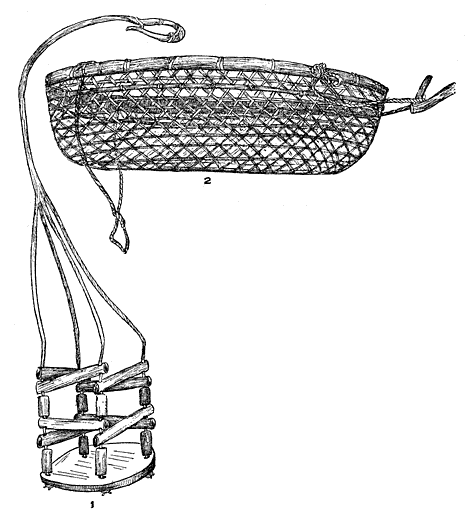
Child's Cradle and Jumper.
Children are seldom punished or scolded. All the family exhibit real affection for the youngsters, and find time to devote to them. A man is never too old or too busy to take up and amuse or caress the babies. Kissing seems to be unknown, but a similar sign of affection is given by placing the lips to the face and drawing the breath in suddenly. A mother is often heard singing to her babes, but the songs are usually improvised, and generally consist of a single sentence repeated over and over. Page 272Aside from the daily bath, the child has little to disturb it during the first five or six years of its life. It has no birthdays, its hair is never cut, unless it be that it is trimmed over the eyes to form bangs, and it wears clothing only on very special occasions. The children are by no means innocent in sexual matters; but absolute familiarity with nudity has removed all curiosity and false modesty, and the relations between the sexes are no freer than in civilized communities.
When garments are put on, they are identical with those worn by the elders. At all ages the people will discard their clothing without any sense of shame, whenever the occasion demands; as, for instance, the fording of a stream, or when a number of both sexes happen to be bathing at the same time in the village pool. This does not lead to immodesty or lewdness, and a person who is careless about the acts, which are not considered proper in Tinguian society, is an object of scorn quite as much as he would be in a more advanced community.
The first toys generally consist of pigs, carabao, or horses made by sticking bamboo legs into a sweet potato or mango. A more elaborate plaything is an imitation snake made of short bamboo strips fastened together with cords at top, center, and bottom. When this is held near the middle by the thumb and forefinger, it winds and curls about as if alive.
Stilts of bamboo, similar to those used in America, are sometimes used by the older children, but the more popular local variety is made by fastening cords through the tops of half coconut shells. The youth holds a cord in each hand, stands on the shells with the lines passing between the first two toes, and then walks.
Flat boards with cords attached become “carabao sleds,” and in these immense loads of imaginary rice are hauled to the granaries. A similar device serves as a harrow, while a stick is converted into a “plough” or “horse,” as is desired. Imitation carabao yokes are much prized, and the children pass many hours serving as draught animals or drivers. The bull-roarer, made by putting a thin piece of bamboo on a cord and whirling it about the head, makes a pleasing noise, and is excellent to use in frightening stray horses. Blow-guns, made out of bamboo or the hollow tubes of plants, vie in popularity with a pop-gun of similar construction. A wad of leaves is driven through with a plunger, and gives a sharp report, as it is expelled.
Tops are among the prized possessions of the boys. They are spun, or are wound with cord, and are thrown overhand at those of other players, with the intention of splitting or marking them.
Quite as popular, with the small girls, are tiny pestles with which they industriously pound rice chaff, in imitation of their mothers. Page 273
While still mere babies, the boys begin to play with toy knives made of wood, but by the time they are seven or eight years of age, they are permitted to carry long bolos, and before puberty they are expert with the weapons used by the tribe (Plate XI). In the mountain regions in particular, it is a common occurrence for groups of youngsters, armed with reed spears and palm-bark shields, to carry on mock battles. They also learn to make traps and nets, and oftentimes they return to the village with a good catch of small birds.
Full grown dogs are seldom friendly or considered as pets; but puppies, small chickens, parrakeets, pigs, and baby carabao make excellent playfellows, and suffer accordingly. From the day of its birth, the young carabao is taken possession of by the children, who will fondle and tease it, ride on its back, or slide off over its head or tail. Soon they gain confidence, and find similar amusements with the full grown animals. These huge beasts are often surly or vicious, especially around white men, but they recognize their masters in the little brown folk, and submit meekly to their antics. In fact, the greater part of the care of these animals is entrusted to young boys.
When not engaged in some of the amusements already mentioned, it is probable that the youngster is one of the group of naked little savages, which races through the village on the way to the swimming hole, or climbs tall trees from the top of which sleeping pigs can be easily bombarded. Should the children be so fortunate as to possess a tin can, secured from some visiting traveller, they quickly convert it into a drum or gansa, and forthwith start a celebration. All can dance and sing, play on nose flutes, bamboo guitars, or Jew's harps.
In addition to songs of their own composition, there are other songs, which are heard whenever the children are at play. They make a swing by tying ropes to a carabao yoke, and attach it to a limb; then, as they swing, they sing:
“Pull swing. My swing is a snake. Do not writhe like a snake. My swing is a big snake. Do not turn and twist. My swing is a lizard. Do not tremble or shake.”
When a group gathers under a house to pop corn in the burning rice chaff, they chant:
When the smoke blows toward a part of the children, the others sing over and over:
“Deep water here; high land there.”
Page 274
A favorite game is played by a number of children. Part stand on the edge of a bank, part below. Those above sing, “Jump down, where the big stone is, the big stone which swallows people. Big stone, which swallows people, where are you?” To this the children below reply, “I am here. I am the big rock which swallows men. Come down here.” As those on the bank jump down, they are piled upon, and a free-for-all tussel ensues. In the midst of this, one of the players suddenly sings out, “I am a deer in—, I am very fat.” With this he starts off on a run, and the rest of the party, now suddenly transformed into dogs, take up the chase, yelping and barking. When the deer becomes tired, he makes for the water, where he is considered safe; but if he is caught, he is rolled and bitten by the dogs.
As the children grow older, they begin more and more to take their place in the village life. The little girl becomes the chief guardian of a new arrival in the family; and with the little one strapped on her back, she romps and plays, while the baby enjoys it all or sleeps serenely (Plate XII). The boy also assists his father and mother in the fields, but still he finds some time for games of a more definite character than those just described. Probably the most popular of these is known as agbita or līpī. Page 275
This is played with the large disk-shaped seeds of the līpī plant (Ilocano līpai). Each player puts two disks in line, then all go to a distance and shoot toward them. The shooter is held between the thumb and first finger of the left hand, and is propelled forward by the index finger of the right. The one whose seed goes the farthest gets first shot, and the others follow in order. All seeds knocked down belong to the player, and if any are still in line after each has had his turn, the leader shoots again. When each boy has had two shots, or when all the disks are down, a new line is made; and he whose seed lies at the greatest distance shoots first.
Another common game is patpatinglad, which has certain resemblances to cricket. A small cylinder-shaped missel, called papa-anak (“little duck”), about four inches long, is set in a shallow groove, so that one end stands free; it is then struck and batted with a bamboo stock—papa-ina (“mother duck”). The lad who has driven his missel the farthest is the winner, and hence has the privilege of batting away the papa-anak of the other players, so that they will have to chase them. If he likes, he may take hold of the feet of a looser and compel him to walk on his hands to secure this missel. A loser is sometimes taken by the head and feet, and is swung in a circle,
A game frequently seen in the lowland valleys is also common to the Ilocano children, who call it San Pedro. Lines are drawn on the ground to enclose a space about thirty feet square (see diagram Fig. 2). The boys at d try to run between the lines, and at the same time evade the guards a, b, and c. Guard a can run along line 1, or 4 as far as 2. Guard b must stay on line 2; and c must keep on 3. When the runners are captured, they become the guards.
Figure 2.
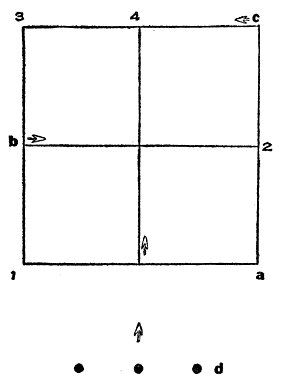
Diagram of a Game.
From the preceding paragraphs it may be surmized that the youth is quite untrained and untaught. It is true that he spends no time in a class-room; he passes through no initiation at the time of puberty, neither are there ceremonies or observances of any kind which reveal to him the secret knowledge of the tribe, yet he quickly learns his place Page 276in society, and at an early age begins to absorb its customs and beliefs. He sits about the village fires in the evenings, and listens to the tales of long ago, or hears the elders discuss the problems of their daily life. During the hot midday hours, he lounges in the field-houses, while his parents relate the fate of lazy children; or tell of punishments sent by the spirits on those who fail to follow the customs of the ancestors, or give heed to the omens. He attends the ceremonies, where he not only learns the details of these important events, but with his own eyes sees the bodies of the mediums possessed by superior beings, and thus the close relationship of the spirit world to his people is forcibly brought to his notice. He is never debarred from the dances or other activities; in fact, he is encouraged to take part in them or to imitate his elders. Soon custom gathers him into its net, and unless he is the exceptional individual, or comes in intimate contact with outsiders, he never escapes.
It has already been seen that he begins very early to take an active part in the village life, but it is many years before he assumes a position of importance in the group. It is only when age and experience have gained for him the respect of his fellows that he begins to have a voice in the more weighty affairs of Tinguian life.
Engagement and Marriage.—Since there are no clans or other groupings to limit the number of families in which unions may be contracted, the only impediments are former marriage ties or blood relationship. Cousins may not marry, neither is a man allowed to wed his step-sister, his wife's sister, or her mother.
Engagement takes place while the children are very young, sometimes while they are still babes-in-arms; but usually the contract is made when they are six or eight years of age.
On the appointed day, friends and relatives gather at the girl's home and, after several hours of feasting and drinking, settle down to the real business on hand. A large pig is slaughtered, and its liver is carefully examined; for, should the omens be unfavorable, it would be useless to continue the negotiations further at that time (cf. p. 307). If the signs are good, the happy crowd forms a circle, and then begins a long and noisy discussion of the price which the girl should bring. Theoretically, the payment is made in horses, carabao, jars, blankets, and rice, but as each article is considered as having a value of five pesos ($2.50), the money is frequently substituted, especially by people in poor circumstances.
A portion of the agreed price is paid at once, and is distributed between the girl's parents and her relatives, who thus become vitally interested in the successful termination of the match; for should it fail of consummation, they must return the gifts received. The balance of the payment is often delayed for a considerable time, and it not infrequently happens that there is still a balance due when the man dies. In such a case no division of his property can be made until the marriage agreement is settled in full.
The completion of the list is the signal for great rejoicing; liquor circulates freely, the men sing daleng (cf. p. 440), and tadek (cf. p. 440) is danced far into the night.
In the yard where the dancing takes place, three inverted rice-mortars are placed one above the other, “to serve as a table for the spirits who always attend.” A dish of liquor is placed on it, while at its side is a spear decorated with a man's belt.
These engagement-parties are the great social affairs of the year, and friends will journey long distances to be present, but the betrothed couple is seldom in evidence, and in many instances the groom is absent.
Following their engagement the children live with their parents until such a time as they are considered old enough to maintain their own home. If the lad comes from a well-to-do family, it is probable that the final ceremony will take place before either of the couple reaches puberty; but, if the groom must earn a living, the marriage may be delayed until he is eighteen or nineteen years old (Plate XIII).
The groom carries with him a small part of the marriage payment and a valuable jar; these he presents to his parents-in-law, and from that time on he may never call them or their near relatives by name. Should he do so, “he will have boils and the first child will be insane.”
Throughout that day the doors and windows are kept tightly closed; for should the young people see birds or chickens having intercourse, they are apt to become insane, and their first born have sore or crossed eyes.
A common occurrence in Ba-ak and the San Juan district is for the parents of the girl to spread rows of baskets, Chinese plates or jars on the floor and to offer them to the groom. Before he can accept them, he must make a return gift of money, beads, and the like for each one. It is explained by the elders that, when the young people see all the gifts spread out on the floor, they will appreciate the expense involved, and will be less likely to separate.
If at any time the relatives of the girl have reason to doubt the husband's affection, they go to his home, and hold a gathering known as nagkakaló-nan. They place a pig, a jar, and a number of baskets on the floor; and the husband is obliged to exchange money and other gifts for them, if he desires to convince the people of his continued love. After the pig has been served as food, the old men deliberate; and should they decide that the relatives have erred, they assess the Page 281whole cost of the gathering to the plaintiffs, and return the gifts. If the charge is sustained, the relatives recover the price of the pig, and retain the articles received in exchange for the baskets and dishes.
Divorce is not uncommon, and is effected by a council similar to that just described. An attempt to reconcile the couple is made, but if that fails, the old men decide who is at fault, and assess the expenses of the gathering to that one. If blame attaches to the husband, he must complete any part of the marriage price still due; but if the woman is guilty, her parents and relatives must return the gifts distributed at the time of the engagement. The chief causes for divorce are cruelty or laziness on the part of the man, or unfaithfulness of the woman.
Small children are generally left with the mother, but when they are old enough to decide, they may choose between their parents. However, the father must aid in the support of his offspring, and they share in his property when he dies. Either party to a divorce may remarry at any time.
The Tinguian recognize only one wife, but a man may have as many concubines (pota), as he can secure. The pota lives in a house of her own, but she is held somewhat in contempt by the other woman, and is seldom seen in the social gatherings or in other homes. Her children belong to the father, and she has no right of appeal to the old men, except in cases of cruelty. Men with concubines do not suffer in the estimation of their fellows, but are considered clever to have won two or three women.
The pota is generally faithful to one man, and prostitution is almost unknown. Unfaithfulness on the part of a betrothed girl, or wife, or even a pota is almost certain to cause serious trouble, and is likely to end in a murder.
The early pledging and marriage of the children has reduced illicit sexual intercourse to a minimum; nevertheless, it sometimes happens that an unbetrothed girl, not a pota, is found to be pregnant. In such a case the man is expected to make a gift of about one hundred pesos to the girl's people, and he must support the child when finally it comes into his keeping. Neither party to such an occurrence loses standing in the community unless the father should fail to redeem the child. Should this happen, he would be a subject of ridicule in the community, and a fine might also result. The usual outcome of such an illicit union is that the girl becomes the pota of her child's father.
The methods of cajoling the spirits, of overcoming magic, and thwarting evil designs are discussed in another chapter (cf. pp. 295 et seq.). If all these fail, and the patient dies, the family and relatives at once don old garments, and enter on a period of mourning, while friends and relatives assist in the disposal of the corpse.
The corpse is dressed in its best garments, beads and silver wire surround its neck, while above and about it are many valuable blankets, belts, clouts, woven skirts, and the like, which the spirit is to take with him to the ancestors in Maglawa, his future home. A live chicken is placed behind the chair as an offering, but following the funeral it becomes the property of the friend, who removes the poles from the house. The flesh of a small pig is also offered to the spirits, while the intestines are hung just outside the door, until the body is buried. In the yard at the north-east corner of the house stands an inverted rice-mortar on which is a dish of basi,—an offering to the spirit Al-lot, who in return prevents the people from becoming angry.
The needs of the spirit of the deceased are looked after by the members of the family. It is their duty to place two small jars of liquor near to the corpse and to bring food to it, when the others are eating.
Burial in most of the valley towns is beneath the house, “as it is much easier to defend the body against evil spirits, and the grave is also protected against the rain.” In Manabo and many mountain villages, however, burial is in the yard. It is customary to open a grave already occupied by several of the relatives of the deceased.
Toward noon of the last day, some of the men begin clearing away the bamboo, which protects the old burial, and to remove the dirt.
Figure 3.
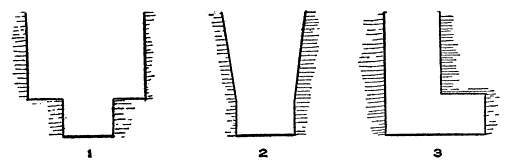
Cross Sections Showing Types of Graves.
When the grave is ready, the fact is announced in the dwelling, and is the signal for renewed lamentation. The wife and near relatives throw themselves on the corpse, caressing it and crying wildly. Whatever there may have been of duty or respect in the wailing of the first two days, this parting burst of sorrow is genuine. Tears stand in the eyes of many, while others cease their wailing and sob convulsively. After a time an old woman brings in some oldot seeds, each strung on a thread, and fastens one on the wrist of each person, as a protection against the evil spirit Akop, who, having been defeated in his designs against the widow, may seek to vent his anger on others.
That night the men spend about an hour in the house of mourning, singing sang-sangit, a song in which they praise the dead man, encourage the widow, and bespeak the welfare of the family. The wailers still remain in the dwelling to protect the widow, and a male relative is detailed to see that the fire at the foot of the ladder is kept burning brightly.
At the conclusion of the anointing, the old men discuss the disposal of the property and other matters of importance in connection with the death.
About twenty years ago, a great number of people in Patok died of cholera; and since then the people of that village have held a Layog in their honor each November, to the expense of which all contribute. As this is just before the rice-harvest, a time when all the people wear their best garments, it is customary for the old men to allow bereaved families to participate in this ceremony and then release them from mourning.
To the writer, the facts of Tinguian life and beliefs suggest a somewhat different explanation. We have seen how strong individuals may be affected by magical practices. The close connection between an individual, his garments, or even his name, must be considered to apply with quite as much force to the helpless infant and the afterbirth. So strong is this bond, that even unintentional acts may injure the babe. Evil spirits are always near; and, unless great precautions are taken, they will injure adults if they can get them at a disadvantage, particularly when they are asleep. The child is not able to protect itself from these beings; therefore the adults perform such acts, as they think will secure the good will and help of friendly spirits, while they bribe or buy up those who might otherwise be hostile; and lastly they make use of such magical objects and ceremonies, as will compel the evil spirits to leave the infant alone. As the child grows in size and strength, he is less in need of protection; and at an early age he is treated like the other younger members of the community. Naming follows almost immediately after birth, while puberty and initiation ceremonies are entirely lacking. Apparently then, a child is considered as being fully alive at birth, and at no time does he undergo any rites or ceremonies which make him more a part of the community than he was on the first day he saw the light.