Personal Adornment, Dances, and Musical Instruments
Reading edition
The dress of the man is the clout (ba-al), either of beaten bark or of cloth, and a woven belt (balikᴇs) in which he keeps small articles (Plates LXXV–LXXVI). On special occasions he wears a long-sleeved jacket (bado), open in front, and in a few instances, trousers. Both these garments are recent acquisitions, and the latter, in particular, are not in favor, except where Ilocano influence is very strong. The man is not inclined to adorn himself with brass and gold, neither does he use tattooing to any extent, as do his Kalinga and Igorot neighbors. Some have small patterns on an arm or thigh, but these are usually property marks with which he brands his animals or other possessions. Tattooing as an evidence of a successful head-hunt is not found in this region, nor are there other marks or garments to identify the warriors.
The hair is worn long, and is parted straight down the middle; the two strands are twisted, crossed in the back, then carried to the forehead, where they are again crossed, and the ends are fastened by intertwining on each side of the head. A bark band (ayabong) holds the hair in place, but at times it is replaced by a cloth or a narrow ring of interwoven grass and rattan. Round bamboo hats, with low dome-shaped tops, are commonly worn (Plate XLV), but these are sometimes displaced by hats which go to a sharp peak, or by those made of a gourd or of wood.
The woman's hair is parted in the middle, and is combed straight down to the nape of the neck, where it is caught by strings of beads; these are crossed in the back and encircle the head; the strand of hair is then twisted and a loop formed which is carried to the left side, where it is again caught under the beads, near to or above the ear. Most of the Tinguian have luxuriant heads of hair, but, nevertheless, switches are commonly used by both sexes. The hair is often washed with the ashes of rice-straw, or with the bark of the gogo tree (Entada purseta), and is moistened with coconut oil.
Most of the women have their ears pierced, but in the valley towns only a small proportion wear earrings. In the mountain sections heavy ornaments of gold or copper are worn, the weight often drawing the lobe of the ear far down on the neck.
When at work, the woman discards all clothing from the upper portion of her body, but at other times wears a short-sleeved jacket which reaches to her waist (Plate LXXVII). The waist is cut so low in the neck that the head can pass through. There is no shoulder seam. A straight piece set over the shoulder extends down in square, both front and back, to a line about even with the breast, where it is sewed to the garment proper. A narrow skirt (dingwa), with colored border, extends from the waist to the knees. It is held in place by drawing it tightly and then tucking one corner under the upper edge, or by pressing it beneath the girdle (Plate LXXVIII).
When a girl becomes a woman, she dons a girdle (palingtan) of braided grass or rattan which fits over the hips, and to which a clout is attached (Plate LXXX). As a rule, the girdle and clout are not removed when bathing, as are the other garments.
The woman seldom wears a hat, except when she is working in the fields, where sunshades large enough to protect the entire body are used (Plate LIV). Frequently a cloth or a skirt is twisted about the head as a protection against the sun.
On chilly mornings one often sees the people covered from head to ankles with their sleeping blankets, or a woman may draw a particularly wide skirt about her body just below the armpits so that she is protected from her breasts to the knees. Page 437
While both sexes are proud of heavy heads of hair, they do not look with equal favor on face and body hairs. These are plucked out either by grasping them between a knife blade and the thumb nail, or with a bamboo device known as īming. This consists of a section of bamboo split into several strips at one end. A hair is placed in one end of the slits, and the bamboo is bent into a half circle, causing it to take a firm hold, when it is jerked outwards.
Prized necklaces (paliget) made of small strands of twisted silver wire, are placed on the neck of a corpse, and on some occasions are worn by the living. During dances the hair is adorned with notched chicken feathers attached to sticks, while circlets made of boar's tusks are placed on the arms.
Dances.—Two dances, one ceremonial, the other suitable for all occasions, are very popular.
The da-eng is sacred in character, is danced only at night and then under the direction of the mediums. It is, however, in great favor, Page 438and often so many of the younger people wish to take part that double lines, or two or more groups, may be dancing at the same time. It sometimes happens, when the basi has been flowing freely, that the participants become so boisterous and the pace so fast that spectators are run down or the dancers are piled in a heap, from which they emerge laughing and shouting.
Another instrument of great importance in the legends is the nose flute (kalaleng). This is a long reed with holes cut in the side, to be stopped by the fingers in producing the notes. The player closes one nostril with a bit of cotton, and then forces the air from the other into a small hole cut in the end of the tube. The instrument is popular with the men, and often one can hear the plaintive note of the nose flute far into the night (Plate LXXXII).
Figure 26.
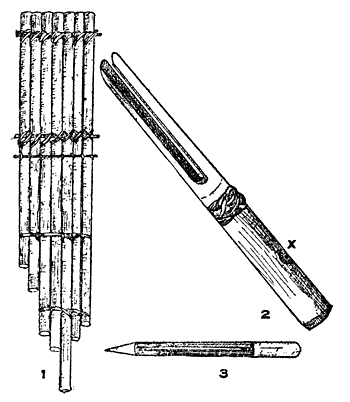
Musical Instruments.
The mouth flute (tulali) is similar to that found in civilized lands, but is constructed from a reed.
A peculiar device used solely by the women is the bunkaka (Fig. 26, No. 2). This consists of a bamboo tube with one end cut away so Page 440as to leave only two thin vibrating strips. These, when struck against the palm of the left hand, give out a note which can be changed by placing a finger over the opening at x.
A Jew's harp is constructed like a netting needle, but with a tongue of bamboo cut so that it will vibrate when struck, or when a cord attached to the end is jerked sharply (Fig. 26, No. 3). If made of bamboo, the instrument is known as kolibau; if brass, agiweng. It is often mentioned in the tales, and to-day is played by nearly all the men.
Bamboo guitars (kuliteng) are made by cutting narrow strips throughout the length of a section of bamboo, but not detaching them at the ends. They are raised and tuned by inserting small wedges of wood at the ends. Small sections of thin bamboo are sometimes fitted over two strings, and are beaten with sticks, or the strings can be fingered like a guitar (Plate LXXXIII).