Warfare, Hunting, and Fishing
Reading edition
Head-hunting and warfare are practically synonymous. To-day both are suffering a rapid decline, and a head is seldom taken in the valley of the Abra. In the mountain district old feuds are still maintained, and sometimes lead to a killing, and here too the ancient funerary rites are still carried out in their entirety on rare occasions. However, this peaceful condition is not of long standing. In every village the older men tell with pride of their youthful exploits, of the raids they indulged in, the heads they captured; and they are still held in high esteem as men “who fought in the villages of their enemies.”
During the time of our stay in Abra, the villages of the Buklok valley were on bad terms with the people of the neighboring Ikmin valley, and were openly hostile to the Igorot on the eastern side of the mountain range. Manabo and Abang were likewise hostile to their Igorot neighbors, and the latter village was surrounded with a double bamboo stockade, to guard against a surprise attack. Manabo at this time anticipated trouble with the warriors of Balatok and Besao, as a result of their having killed six men from those towns. The victims had ostensibly come down to the Abra river to fish, but, judging by previous experience, the Tinguian believed them to be in search of heads, and acted accordingly. This feud is of old standing and appears to have grown out of a dispute over the hunting grounds on Mt. Posoey, the great peak which rises only a few miles from Manabo. There have been many clashes between the rival hunters, the most serious of which occurred in 1889, when the Tinguian had twenty-nine of their number killed, and lost twenty-five heads to the Igorot of Besao.
The people of Agsimo and Balantai suffered defeat in a raid carried on against Dagara in 1907, and at the time of our visit a number of the warriors still bore open wounds received in that fight. In the same year at least three unsuccessful attacks, probably by lone warriors, were made against individuals of Lagangilang, Likuan, and Lakub.
Accounts of earlier travelers offer undoubted proof that head-hunting was rampant a generation ago; while the folk-tales feature the taking of heads as one of the most important events in Tinguian life. Page 370
The first incentive for head-taking is in connection with funeral rites. According to ancient custom it was necessary, following the death of an adult, for the men of the village to go out on a headhunt, and until they had done so, the relatives of the deceased were barred from wearing good clothing, from taking part in any pastimes or festivals, and their food was of the poorest and meanest quality. To remove this ban, the warriors would don white head-bands, arm themselves, and sally forth either to attack a hostile village or to ambush an unsuspecting foe. Neighboring villages were, out of necessity, usually on good terms, but friendly relations seldom extended beyond the second or third settlement, a distance of ten or fifteen miles. Beyond these limits most of the people were considered enemies and subject to attack.
The raids following a death were usually carried out as a village affair, and many warriors participated, but it seems that by far the greater number of heads were secured by individuals or couples, who would lie in ambush near to the trails, or to the places, where the women had to pass in carrying water from the streams to the village.
While the Tinguian always chose to attack from ambush, yet he did not hesitate to fight in the open when occasion demanded it. For a distance of fifteen or twenty feet he depended on his spear, but for close quarters he relied on his shield and head-axe. An examination of Plate XLIV will show that the shield has three prongs at the top. These the warrior seeks to slip between the legs of his enemy to trip him up, then one stroke downward with the axe, and the opponent is put out of the fight. The two lower prongs are meant to be slipped about the neck. One more stroke of the head-axe, and the victor takes his trophy and starts for home, while the relatives of the dead man seek to secure the remains to carry them back to their village. As the loss of a head reflects on the whole party, and in a like manner its acquisition adds distinction to the victors, a hot fight usually develops over a man who is stricken down, and only ceases when the enemy is beaten off, or has been successful in getting away with the trophy.
Upon their return to the village, the warriors were formerly met at the gate by their relatives, who held two ladders in A shape, thus forming a pathway over which each had to climb. Once inside the town, the heads were placed on a bamboo spike known as sagang (cf. p. 310), or in the saloko (cf. p. 310), and for three days were exhibited beside the gate. In the meantime messages were sent to friendly villages to invite the people to the celebration.
Figure 7.
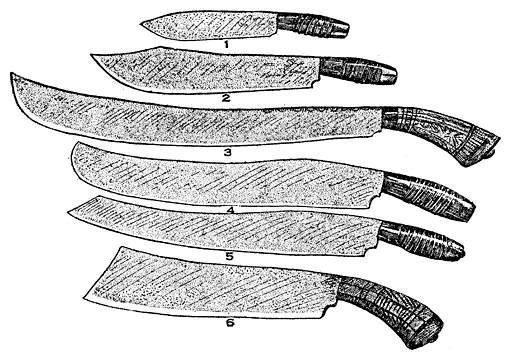
Types of Knives.
Bolos, or long knives, are carried at the side suspended from the belt, and upon occasion may be used as weapons. However, they are generally considered as tools (Fig. 7).
The Head-Axe, aliwa or gaman (see Fig. 8).—The axes made by the Tinguian and Kalinga are identical, probably due to the fact that the center of distribution, as well as the best iron work of this region, is found in Balbalasang—a town of mixed Tinguian and Kalinga blood. The blade is long and slender with a crescent-shape cutting Page 374edge on one end, and a long projecting spine on the other. This projection is strictly utilitarian. It is driven into the ground so as to support the blade upright, when it is desired to have both hands free to draw meat or other articles over the cutting edge. It is also driven into the soil, and acts as a support when its owner is climbing steep or slippery banks.
Figure 8.
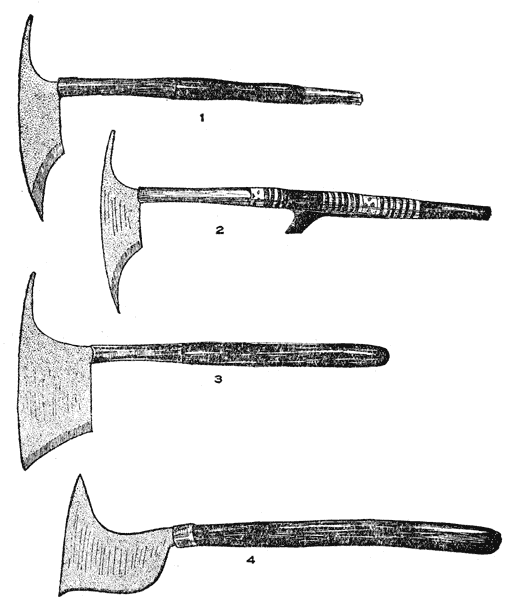
Head-Axes.
The blade fits into a long steel ferrule which, in turn, slips onto a wooden handle. The latter may be straight or plain, but commonly Page 375it has a short projection midway of its length, which serves as a finger-hold and as a hook for attachment to the belt. Quite frequently the handle is decorated with thin circles or bands of brass, while ornamental designs sometimes appear on the blade.
Figure 9.
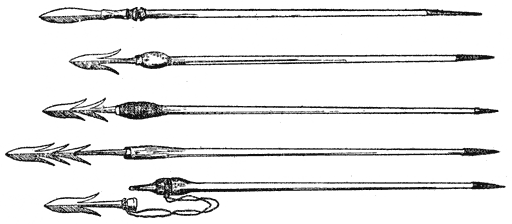
Spears.
The Spear, pīka.—The various types of spears used by the Tinguian are shown in Fig. 9.
A considerable part of these are made in the villages along the upper reaches of the Buklok river and in Balbalasang, but many come into Abra through trade with the Igorot and Kalinga. They are used Page 376for hunting and fighting, and are intended both as thrusting and throwing weapons. In the lowlands the older type of spear-head is a modified leaf shape, attached to a ferrule which slips over the shaft. In the mountains, heads with two or more barbs are set into the handles, and are held in place by means of wooden wedges and by metal rings which surround the ends of the shafts. A metal end or shoe covers the butt end of the weapon, thus converting it into an excellent staff for mountain climbing.
Occasionally a hunting spear is fitted with a detachable head, which will pull out of the socket when an animal is struck. The shaft is attached to the point by means of a heavy line, and as this drags through the undergrowth, it becomes entangled and thus delays the flight of the game.
Shields, kalásag.—Mention has already been made of the typical Tinguian-Kalinga shield (cf. p. 373). While this is the common type of the region (Fig. 10, Nos. 1–1a), others, which approach those of the Bontoc Igorot, are frequently used (Fig. 10, No. 2). As a rule, these come from Balatok, Lubuagan, Guinaan and the villages along the Malokbot river, all of which are strongly influenced in blood and culture by the Igorot. In the latter shields we find the prongs at the top and bottom, but they are no longer of sufficient size and opening to be of practical value. The clue to their origin is probably afforded us in their use by the Tinguian.
Across the top and bottom of each shield, near to the prongs, are two or three braided bands which appear to be ornamental, or to strengthen the weapon. Their real use, however, is to hold the soga, the pointed bamboo sticks which are planted in the grass to delay pursuers. A half dozen or more of these are usually to be found under the braiding at the back of the shield.
All shields are of very light wood, and can easily be pierced by a spear. They are intended to be used in deflecting missels rather than actually to stop them. To aid in this purpose, there is a hand grip cut into the center of the back. This is large enough to admit the first three fingers, while the thumb and little finger are left outside to tilt the shield to the proper angle.
Figure 10.
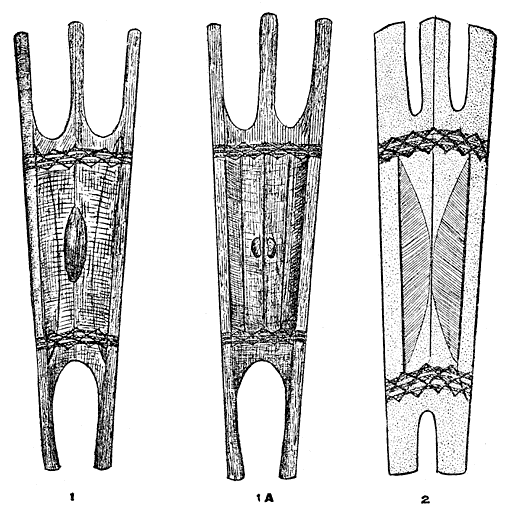
Shields.
Hunting (Plates XLV–XLVI).—Hunting must be considered more in the nature of a sport than as a necessity, for, while a considerable amount of game is taken each year, it is not enough to furnish an important part of the food supply. As we have already noted, a great part of the country occupied by this tribe is devoid of forests. Dense growths do occur in some valleys and ravines, and a few of Page 377the mountains, like Posoey, are heavily forested, but for the most part the western slopes of the Cordillera Central are covered with rank cogon grass. In the ravines and on the wooded slopes are deer, pig, wild carabao, and wild chickens, and during the dry season of the year it is no uncommon thing to see a considerable number of men leaving the village at daybreak with their dogs, spears, and nets. The customary method of hunting the larger animals is to stretch long nets across the runway of the game. A number of the hunters, armed with spears, conceal themselves near by, while the balance of the party take the dogs to a distance and then, spreading out fan-shape, will converge on the net, beating the brush and shouting in order to stir up the game. The dogs, sullen, half-starved brutes, take little interest Page 378in the chase until an animal is started, then they begin to bay, and the whole pack is in pursuit. As the quarry rushes into the net, the concealed hunters fall upon it and spear it to death, at the same time fighting back the hungry dogs which would quickly devour it. Sometimes an animal escapes from the net, but if wounded, it is almost certain to fall a prey to the pack. Many deer are taken by this method in the course of a year. Sometimes a wild pig is netted, and on exceedingly rare occasions a carabao. However, the wild carabao is a dangerous animal, and hunters will not attack it unless it is so entangled in the nets that it is practically helpless. Still hunting for deer, near to the feeding grounds, yields a few animals each year, and during the period when the lumboy (Eugenia jambolana Lam.) are in fruit, the hunters often hide themselves in the trees at night, and spear the pigs which come below them to feed.
Figure 11.
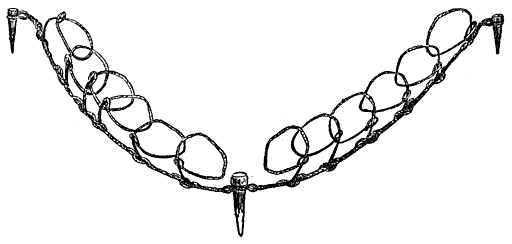
Chicken Snare.
Wild hogs are also secured by placing a close fence about a field. One or two small entrances are left open and inside of these, deep pits are dug, and are covered with brush. As the animal pushes in, it steps on the frail covering, and is hurled to the bottom of the pit, where it is easily dispatched with the spear.
Among the smaller game, the wild chicken is the most important. These fowls seldom fly, but seek safety by running through the underbrush. The Tinguian takes advantage of this trait, and stretches nets loosely in the probable runway of the birds, and then drives them toward it in the same manner, as he does the deer. As the fowl runs full speed into the loose net, it folds about him, and he is easily taken.
Another type of chicken snare consists of a single noose, which rests on two elevated strips of bamboo. The other end of the cord is attached to a bent limb, held down by means of a small trigger, which slips under a cross strip. The game is led onto the trap by scattering grain. The weight of the bird releases the trigger, the bent twig flies up, and the noose is drawn tightly.
Small birds are captured in considerable numbers by the boys who, for this purpose, make use of three types of snares. The first and most common is a simple slip noose made of human or horse hair attached to a stick. Several of these are driven into the ground close together, and grain is scattered between them. A second type of noose trap is shown in Fig. 12, No. 1. A Bamboo pole a with sharpened end has a spring b of the same material attached to its side. A cord from this passes through a small hole in the top of a, and then forms a slip noose. A small stick or trigger c is forced into the hole until firm enough to keep the line held taut, and the noose is spread on it. Bait is placed on the point of a in such a manner that the bird has to alight on c to secure it. Its weight releases the trigger, and the noose is drawn tightly around its legs. Another trap of this nature is illustrated by Fig. 12, No. 2. Here a branch is bent down and a line is attached. The trigger stick a slips outside b, and the pressure holds the free stick c in place against the crotch. Bait is so placed on d that a bird coming to secure it must stand inside the slip noose which is spread on c. The weight and movement of the victim releases the trigger, draws the line taut, and closes the noose about its legs.
Figure 12.
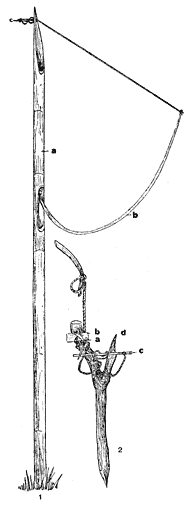
Bird Snares.
In the lowland villages, blowguns (salbalana) are used to a limited extent in hunting birds. Two long strips of palm wood are grooved and fitted together. Over these the intestines of a carabao are drawn, and the whole is wrapped tightly with cord and covered with beeswax. The guns vary from 12 to 16 feet in length, and are often excellently made, yet they are little better than toys, for the missels used are only clay balls. Poison darts are unknown in this region, and the Page 381weapon is confined to the villages near to the coast. This, together with the fact that the blowgun does not appear in the lore or ceremonies, suggests that it of recent introduction (Plate XLVII).
Locusts are considered excellent food, and when they are flying in great numbers, are taken by means of small nets. These are attached to poles, and are swung into the swarm. Sometimes nearly the whole village will unite in such a hunt, the catch being stored in large bottle-shaped baskets until needed.
Bats and rats are not eaten, but the latter are trapped and killed because of the grain they destroy and the injury they do to the houses and their contents. The most common trap is made from a section of bamboo in one side of which a spring is inserted. A line attached to this leads to a slip noose which fits inside the tube. Bait is attached to a trigger which, when disturbed, releases the spring and closes the loop around the intruder.
Fishing.—Mention has already been made of the capture of fish by the children. Older people likewise devote some time to fishing, but not to the extent of making it an occupation. Nearly every family has a collection of traps and lines, and at times quite a number of fish and eels are secured.
The common trap is shown in Fig. 13, No. 1. The entrance is made of sharp bamboo splints, which converge toward a small hole opening into the trap proper. The device is then placed in the water in such a way that fish coming downstream will be diverted into the opening. The current and the natural inclination of the fish to go into a dark hiding-place causes them to force their way into the trap, and once in they cannot emerge. The water escapes through the bamboo slits, but the fish can only be released by opening the small end of the trap.
Many of the women carry baskets attached to the belt at the hip. The tops of these baskets have funnel-shaped openings, and are immediately available for use as traps, if a good catch is in prospect (Fig. 13, No. 2). These are usually employed for shrimps and minnows. Eels are caught in long, round traps of rattan and bamboo. A frog is fastened in the far end of the tube, usually with a fish-hook. This is attached to a rattan spring, which is connected with the door of the trap. The eel enters and seizes the frog, but as it starts to back out, it releases the bent rattan, and the door is pulled shut.
Figure 13.
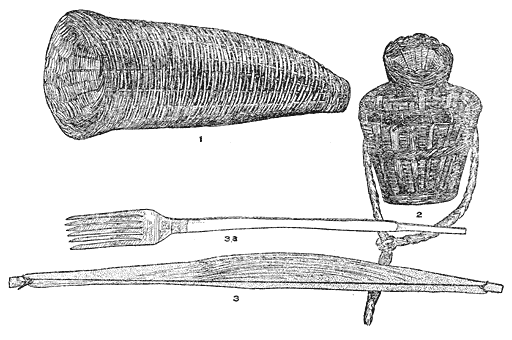
Fishing Devices.
Small hand nets, spread apart by means of sticks held in the hands, are used by women in scooping up small fish. Ordinarily, it is scooped away from the body, but if a fish takes refuge under a rock, the net Page 383is placed under the opposite side, and the stone is turned over with the foot.
The most effective fishing-device is a large throw net made cornucopia shape. The large net is open and weighted with many sinkers of lead. The man throws the net with a full arm sweeping motion, so that it spreads to its full extent, and all the sinkers strike the water at the same time. The splash causes all the fish inside the circle to dart inward, and as it sinks, the net settles over them. The fisherman draws in the cord attached to the small end, causing the sinkers to drag along to the bottom until directly beneath him, when their weight closes the net. It requires much skill and practice to throw this net properly, but once the art is mastered, the fisherman is very successful.
Blanket fishing similar to that in use by the neighboring Igorot is found here. A large blanket is weighed down with stones, and is placed in the river. After one or two hours have elapsed, a number of men form a wide circle around it. Often they drag between them a rope to which many corn husks are attached. As they advance toward the blanket, they turn the larger stones with their feet so that any fish hiding beneath them will be frightened away. The circle of men and corn husks causes the fish to go toward the blanket, and finally to take refuge under the stones piled upon it. When the blanket is reached, the men seize the corners and lift it out of the water on to the bank, where the stones are thrown out and the fish secured. A somewhat similar idea is found in the lama. Quantities of leaf branches are sunk into a still pool, and are left for a few days until the fish have come to use them as a hiding-place. A number of men make a close fence of bamboo sticks about them, then go inside, throw out the branches, and catch the fish with their hands or with the nets. Streams are often diverted from their course, for a time, and then returned, leaving the fish in the artificial channels stranded.
A curious method of fishing was seen in the Ikmin river. A hook was fastened in the end of a bamboo pole, and close to this a minnow was attached to a short line, to act as a lure. When the other fish approached the captive, the pole was jerked sharply, in an attempt to snag them. On one occasion the writer saw fifty fish taken by this method in less than an hour.
Short lines attached to sticks are often baited, and are set along the embankments of the flooded rice-fields. Small fish spears with detachable heads are also used in the rice lands, as well as in the clear pools. The only occasion when the bow and arrow is used in this region is when the rice fields are flooded. At such times a short Page 384bow and an arrow with fork-shaped head are employed (Fig. 13, Nos. 3–3a). A fish poison or stupifier is occasionally used. A small red berry known as baiyatin is crushed, and the powder is thrown into or just above quiet pools, where fish abound. Some of the fish become stupified and float on the surface, where they are quickly speared or scooped up. They are eaten without any ill effects. Page 385