Economic Life
Reading edition
Figure 14.
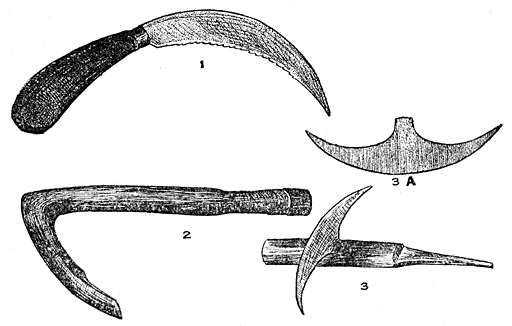
Grass Knife; Root Adze; Rice Cutter.
Page 386
After the clearing, the field is fenced in so as to protect it from deer, wild pigs, and carabao. The rudest type of protection consists of a barricade of brush, strengthened with forked sticks, in the crotches of which poles are laid. The more common method is to set bamboo tubes, at intervals, around the whole plot and to lash to them other tubes which have been split in half. A still better fence is made by cutting three holes, about a foot apart, through each upright and to insert smaller bamboo through these.
In the valley districts the planting sticks are cut as needed, but in the mountains, where the upland rice is more important, strong bamboo poles fitted with hardwood points are in general use. These implements, known as tᴇpon (Fig. 15, No. 1), are invariably carefully decorated with incised designs, and are preserved from year to year. Commonly, the divisions between the sections of the bamboo are knocked out and the tube used as a receptacle for the seed rice.
As the mountain fields need special protection, it is customary to build near them little elevated houses in which the workers may rest, and in which the watchers can live during the time the grain must be guarded. If the plots are near to a village, such a house seldom consists of more than a rude framework of poles, which support a grass roof, and to which a bamboo floor is lashed, two or three feet above the ground; but if the fields are at a distance, these structures are provided with sides, and are raised high on strong logs. Such high, well built houses are necessary, both to protect the occupants from surprise attacks of enemies, and to afford shelter against driving winds or rains. It is not an uncommon occurrence for a whole family to go to one of these isolated mountain dwellings and reside for a considerable period, particularly when the rice is approaching maturity.
These upland fields produce much smaller crops than do the wet lands, and as they are quickly exhausted, it is not customary to plant them to rice for more than two seasons. At the end of this time, they Page 387may be used for camotes (Convolvulus batatas), sugar-cane, or cotton, but in the majority of cases they are allowed to lie unused for several seasons, when the grass or undergrowth is again removed and the fields replanted.
The wet fields produce by far the greater part of the rice, and it is about them that most of the agricultural labors center. In the broad valleys, low embankments, of sufficient height to maintain the water at a depth of two or three inches, separate the fields. The lower plots are often of considerable length and width, some covering as much as an acre of ground, but as they begin to ascend the slopes, the walls rise higher, and the fields become narrower until they may be only a few feet in width. In the rugged mountain districts, the terraces often begin just above the flood water of the stream. At this point, a stone wall, four or five feet in height, is erected, and back of this the mountain side is cut away and filled in until it forms a step or terrace. Back of this another wall is raised, and the process is repeated until at last the terraces extend for two or three hundred feet up the mountain side (Plate XLIX). When the field is first made, top soil, enriched with vegetable growth, is laid on the surface, often to a depth of several inches, but from this time on no fertilizer, other than the decaying straw of the previous crop, is added, although the field is used continuously for many years.
Water is conducted to many of the fields by means of ditches, usually by diverting the flow of some of the numerous springs or streams but in a few instances, stone dams have been thrown across the rivers and the water carried for considerable distances by flumes and ditches. The highest terraces are first inundated to the desired depth, and then openings are made in the side walls—so as to allow the lower fields to be flooded. This method of irrigation provides for the maximum use of the water, and also supplies a constant current which prevents the formation of stagnant pools.
Some of the fields are situated too far up the mountain side to be reached by ditches, and in such cases the growth of the rice is entirely dependent on the rainfall; however, in normal years, the precipitation is sufficient to mature the crop.
At the beginning of the rainy season, some of the seed rice is sprouted in specially prepared beds in the villages. In such cases a small plot is surrounded with low dirt walls, the soil is enriched with manure, water is added, and the whole is worked until it becomes a thin mud, on which the rice is thickly sown. Around this bed, a bamboo frame is erected to keep out pigs and chickens, while from time to time Page 388water is poured on the growing shoots. The more common method of sprouting, however, is to select a piece of land, which will receive the full benefit of the rainfall and to break this with a plow drawn by a carabao.
Within a few days after the plowing, the soil is further broken by dragging it with a harrow, made by driving wooden pegs into a heavy board, or into large bamboo tubes (Fig. 15, No. 4). A worker stands on this, and is dragged about the field, leveling it, and at the same time pulling out sticks, roots, and any other matter of sufficient bulk to interfere with the planting.
Two types of sleds (Fig. 15, Nos. 5–6) are used in connection with the rice culture, as well as in general transportation. The first consists of rude wooden runners on which a bamboo flooring is laid. The second has narrow runners, which are hewn with considerable care, while sides of flattened bamboo convert the sled into an open box. The first type (pasagad) is used principally during the wet season for the transportation of plows, harrows, and the like, the wide runners slipping through the mud without becoming mired. The use of the latter (kalison) is restricted to the dry-season, when it is of particular advantage in moving the rice. Wheeled vehicles are not employed in any part of Page 390the Tinguian belt, although their use is now fairly common among the Ilocano.
Figure 15.
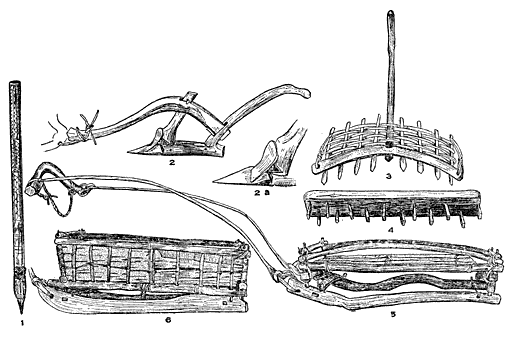
Agricultural Implements.
It requires a month or six weeks to make ready the fields, and in the meantime the rice in the seed beds has grown to a height of twelve or fourteen inches. The shoots are then pulled up by the roots, are tied into bundles, and the tops are cut off (Plate LI). The bundles are distributed about the fields at convenient distances, and the workers then transplant the young rice—three or four together—in the soft ooze, using the thumb and fore-finger of the right hand for that purpose (Plate LII). The preparation of the field is looked after by the men and boys, and oftentimes they aid in transplanting, but the latter is considered to be women's work, and is generally left to them.
The rice is set so thickly that when a plot is planted it presents to the eye a solid mass of green. It is hard to imagine a more beautiful sight than to look down on these fields, which rise in wave above wave of brilliant green, until at last they give way to the yellower billows of cogon grass which cover the mountain slopes.
The usual device employed in frightening both birds and animals is a bamboo pole cut into strips at the top, so that, as it is shaken, these strike together, producing a great clatter. Many of these poles are planted, and then all are connected by means of rattan lines which finally lead to the little watch house. Here a man or boy sits and occasionally gives the lines a sudden jerk, which sets up a clapping over Page 391the whole field (Plate LIII). A clever development of this device was seen by the writer in the Ikmin river valley. Here the stream flows swiftly and plunges headlong into pools every few yards. The rattan cord attached to the clappers is fastened to a small raft which is then set afloat in the pool. After a whirl in the eddy it is caught by the swift current, and is carried a few feet down stream, at the same time bending the clappers nearly to the ground; then as the raft enters calmer water, the tension is released, and it is thrown violently back into the pool from which it has just drifted; at the same time the clappers fly back into place with a great noise.
Another contrivance, used in keeping small birds from the fields, is a bird-like form cut from the bark of a banana or palm tree. Many of these are suspended by lines from bamboo poles, and, as the wind blows them to and fro, they appear like giant birds hovering over the rice.
A simple protection against deer is made by bending the white inner bark of bamboo into arches and planting these at intervals along possible places of entry, for it is said that these animals will not approach such a contrivance.
The granaries, or store-houses, of the Tinguian and Ilocano are identical (Plate LV), but, barring the Apayao, are different from any of the surrounding groups, except when their influence may have spread this peculiar type to a limited degree. It is worthy of note, however, that the granaries of some Sumatran groups are of similar design and construction. Such a store-house is raised high above the ground on four hard-wood poles; the framework is of bamboo, and the sides flare sharply from the floor to the grass roof. Within the framework is a closely woven matting of flattened bamboo, which is nearly water-tight; but to secure still further protection from moisture, and also to allow for free circulation of air, a rack is built in such a way that the rice is kept several inches from the outside walls. Just below the floor, each post supports a close-fitting pottery jar—without top or bottom—or a broad disk of wood, which effectually prevents the entrance of rodents.
The rice is now ready for cooking; the chaff is collected, and is used as food for the pigs and dogs, while the stalks are saved to be burned, for the ashes are commonly used in lieu of soap.
It is customary to pay laborers in rice; likewise the value of animals, beads, and the like are reckoned and paid in this medium. During the dry season rice is loaned, to be repaid after the harvest with interest of about fifty per cent.
In Part I of this volume a reconstruction of the early life of this people was attempted from their mythology. The results seemed to indicate that the tales reflect a time before the Tinguian possessed terraced rice-fields, when domestic work animals were still unknown, and the horse had not yet been introduced into the land. But it was also noted that we are not justified in considering these as recent events.
At this time, with the more complete data before us, it may be well Page 394to again subject the rice culture to careful scrutiny, in the hope that it may afford some clue as to the source from which it spread into this region. It is possible that the Tinguian may have brought it with them from their early home, which may be supposed to have been in southeastern Asia; they may have acquired it through contact with Chinese or Japanese traders, or through commercial relations with the islands to the south; or again it may have developed locally in the Tinguian, Igorot, and Ifugao territory.
It should be noted at the outset that highly developed terrace cultivation is found in Japan and China to the north; in parts of Borneo, in the Nias archipelago, in Java, Bali, Lombok, Sumatra, Burma, and India proper, and it is probable that all within this broad belt developed from a single origin.
The proof is not absolute, but, in view of the foregoing, the writer is inclined to the belief that the Igorot and the Tinguian brought their rice culture with them from the south, and that the latter received it from a source common to them and to the people of Java and Sumatra.
Magical Rites and Ceremonies Connected with the Rice.—The importance of rice to this people is nowhere better evidenced than in the numerous and, in some cases, elaborate rites with which its cultivation and care is attended. Some of these observances appear to be purely magical, while others are associated with the consulting of omens, acts of sacrifice, propitiation, and finally of thanksgiving. All are interwoven with tribal law and custom to such an extent that neglect, on the part of the individual, amounts to a crime against the community, and hence is punished with public indignation and ostracism.
The next anxiety is to secure a lusty growth of plants in the seed beds, and to accomplish this, sticks known as salogᴇgᴇy, are stuck in each plot. The surface of such a stick has been pared so that shavings stand out on it in opposite directions, for such a decoration “is pleasing Page 397to the spirits;” while a piece of charcoal, placed in the notched end, compels the new leaves to turn the dark green of sturdy plants. The first seeds to be planted must always be sowed by the wife of the owner, “so that they will be fertile and yield a good crop.”
A female pig is presented to the medium who, after reciting a proper dīam above it, stabs the animal and collects its blood. This is mixed with rice, and a part is at once deposited in the saloko, while the balance is placed on a head-axe, and is carried about the field. When the whole plot has been traversed, this rice and blood is scattered in all directions, while the spirits are besought to come and eat. A part of the company has meanwhile been cooking the flesh of the slain animal, but before any of it is served, a skirt (kīnomayan) is spread at the foot of the saloko, and on it are placed dishes of oil and of cooked rice.
After the meal has been eaten, the family gathers up the skirt and dishes, to return them to the village, but the other offerings remain.
After all the visiting spirits have been given food and drink, a small covered raft (taltalabong) is constructed, and in it are placed a live chick, a cooked rooster, and other articles of food. Four sturdy men carry this to the river and set it afloat, while the people shout and beat on gongs to drive away evil spirits who might wish to steal the raft and its contents. The purpose of this offering is to supply food to any spirits who may be unable to attend the ceremony.
In Lumaba, a town strongly influenced by the Igorot, the Ubaiya regularly precedes the rice planting, as well as the first use of a newly constructed field. While conforming, in general, to that already described, a part of the procedure is somewhat different. On the day before the ceremony, the men go to the mountains and gather lono stalks, one for each house and two for the town gate. The two reeds are placed crosswise of the entrance to the village and serve as a sign of taboo, and thereafter no one may enter until they are officially removed. To do so would necessitate the repetition of the ceremony, and the offender would be obliged to provide all the things necessary for it. Likewise, no one may wear a hat or prepare food during the period of taboo.
The next day is known as Bignas, and at dawn all the men arm themselves with bamboo poles. With these they beat about under the houses and throughout the town, in order to drive away any evil spirits who may be lurking about. Having effectively rid the town, they force the invisible beings ahead of them to the river, where they deposit the poles. They return to the village singing and shouting, and are met at the gate by the women, who hold ladders, one on each side of the entrance, so that they meet at the top and thus form a path by which the men may enter without breaking the interdict. At Page 400the guardian stones, they pause long enough to sacrifice a pig and a rooster, and offer blood and rice to the spirits, and then they proceed to the center of the village, where they dance tadek and da-eng until dusk. At nightfall a pig is killed, its flesh is divided among the people, and a lono stalk, after being dipped in the blood, is given to a member of each family. This is carried home, and is placed on the outside wall as a sign that the ceremony has been held.
If the sun is shining the following morning, the lakay will go outside the town to gather wood. Upon his return the people are again free to fish and hunt, but work is forbidden until evening. Should the sun fail to appear, all remain quietly in the village until the lakay can remove the taboo by his wood gathering.
The procedure at harvest time varies considerably in different districts, but the usual custom is for a woman, from each family, to go to the fields and cut alone until she has harvested one hundred bundles. During this time she may use no salt, but a little sand is placed in her food as a substitute. No outsider may enter the dwelling during this preliminary cutting. So strictly is this rule observed that the writer has been absolutely excluded from homes where, on other occasions, he was a welcome guest. In Lumaba and vicinity it is the custom to sacrifice a chicken two days before the harvest begins, and to cook its neck and intestines without salt. These are then divided into nine parts, are placed in dishes, and are carried to the spirit house in the field. At the end of the second day, the feathers of the fowl are stuck into the sides of the structure, and the spirits are entreated to grant a good harvest and health for the workers. The dishes are then returned to the village, and on the following morning the women may begin cutting.
Just before the new rice is placed in the granary, a jar of basi is placed in the center of the structure, and beside it a dish filled with oil and the dung of worms. Five bundles of palay are piled over these, and the whole is presented to the spirit, who will now allow the rice to multiply until it is as plentiful as the dung.
In Buneg and nearby villages, all of which are strongly influenced by immigrants from the Cagayan valley, a small clay house known as lablabon or adug is placed with the rice, and from time to time offerings are put in them for the spirit who multiplies the rice (Plate XXIX).
Certain restrictions always apply to the granary. It may never be opened after dark, for evil spirits are certain to enter, and the crop will vanish quickly. It can be opened only by a member of the family “whom the spirit knows;” and should another attempt to remove the grain, sickness or blindness will befall him. So rigorously is this enforced that a bride never opens her husband's granary until he has presented her with a string of beads, which she wears about her neck to identify her. It is further necessary that she receive a similar gift before she eats of his rice, otherwise she will become ill. However, this does not apply to others, even strangers being fed without this gift being made.
A custom which formerly prevailed, but is now falling into disuse, was for the bride and groom to visit the family fields, where the youth cut a little grass along the dividing ridges. He then took up a bit of earth on his head-axe, and both tasted of it, “so that the ground would yield them good harvests, and they would become wealthy,”
Next to rice the camote (Convolvulus batatas) is the most important food product. Occasionally it is raised in the gardens or rice terraces, but, as a rule, it is planted in hillside clearings from which one or two crops of rice have been removed. The tuber is cut into pieces, or runners from old plants are stuck into the ground, and the planting is complete. The vine soon becomes very sturdy, its large green leaves so carpeting the ground that it even competes successfully with the cogon grass. If allowed, the plants multiply by their runners far beyond the space originally allotted to them. The tubers, which are about the size of our sweet potatoes, are dug up as needed, to replace or supplement rice in the daily menu. Both roots and plants are also cooked and used as food for the pigs and dogs.
Corn, maīs, bukel, and red corn, gasīlan (Zea mays L.) seems to have been introduced into Abra in comparatively late times, for despite the fact that it is one of the most important crops, it has neither gathered to itself ceremonial procedure, nor has it acquired a place in the folk-lore. A considerable amount is raised in the village gardens, but generally it is planted by dibbling in the high land. When ripe, the ears are broken from the stalk, the husks are turned back, and several are tied together. These bunches are then placed over horizontal poles, raised several feet from the ground (Plate LVIII), and after being thoroughly dried, are hung from the house rafters. The common method of grinding is to place the corn on a large stone, over which a smaller Page 403stone is rocked until a fine flour is produced (Plate LIX). Stone disk grinders, imported from the coast, are also in use. These consist of grooved stones, the upper of which revolves on the lower. Grain is fed into an opening at the top as needed. Dried corn, popped in the embers of a fire, is much relished by the children.
Among the minor products are ginger, laya (Zingiber officinale Rosc.) and a small melon, locally known as melod, which is used as a sweetening. Sugar cane, onas (Saccharum), is raised in considerable quantity, and is used in making an intoxicating drink known as basi. It is also eaten raw in place of a sweetmeat, but is never converted into sugar. Nowadays the juice is extracted by passing the cane between two cylinders of wood with intermeshing teeth. Motive power is furnished by a carabao attached to a long sweep. This is doubtless a recent introduction, but it has entirely superseded any older method.
The cane is raised from cuttings which are set in mud-beds until ready to be transferred to the mountain-side clearings. These lands are prepared in the same manner as the upland rice fields already described. The men dig shallow holes and set each plant upright, while the women follow, filling the hole with water and then pressing earth in with fingers or toes.
Tobacco seeds are sprouted in beds similar to those used for the rice, and the same magical device is used to insure a lusty growth. The young plants are carefully watered and shaded until they reach a height of five or six inches. They are then transplanted to hillside clearings, or to unused rice fields, where they are set out about three Page 404to a foot. This transfer generally takes place near the beginning of the dry season, so that the crop will be sure to mature without the damaging effect of water on the leaves. The plants while lusty do not attain the size of those grown in the valley regions of the interior. As soon as the leaves begin to turn a dark yellow, they are cut off and are strung on slender bamboo sticks (Plate LX), which are then hung up in the house. When nearly dry, they are laid in piles, and are occasionally turned to prevent rust or mildew from forming.
A small amount of indigo, tayum (Indigofera tinctoria) is raised, generally in open spots near the villages. The plants receive little or no attention, yet still attain a height of about three feet. The leaves and branches are placed in water for a few days, and are then boiled, together with a little lime, the resultant liquor being used as a dye for cotton thread.
Among the larger cultivated plants and trees, the banana (Musa paradisiaca), coconut (Cocos nucifera), and bamboo (Bambusa sp.) are the most important.
At least twenty varieties of bananas are raised in Abra. The fruit of some of these is scarcely larger than the forefinger, while others are quite large. The common type bears a rather small, yellow fruit locally known as saba. In Manabo and several other villages, plantings covering three or four acres are to be found, but the usual plot is small, and is situated near to the house of the owner.
Suckers, which sprout from the roots of mature plants, are set out as needed, either to make new groves or to replace the old stalks, which are cut down after bearing. Both bud and fruit are eaten. The latter are cut on the stem while still green, and are hung in the house to ripen, in order to protect them from bats and fruit-feeding birds.
The coconut (nīog) is not raised in groves, as in the Christianized Page 405districts, but in many villages every house has two or three trees towering above it. Even the interior mountain settlements, like Lingey, Ba-ay, and Likuan, are hidden beneath these trees, thus incidentally disposing of the fable that “the coconut tree will not grow out of sight of the sea.” Young trees have to be protected by fences during the first two or three years of growth, or they will be uprooted by the pigs, but from that time on they require little or no care. They are not tapped for sap, as is customary in most parts of the Philippines, but notches are cut in the tree trunks in order to supply foothold for the fruit gatherer. The nuts are cut off with a knife as soon as ripe, else they may fall and cause death or injury to people below.
No other fruit serves the people in so many ways. The juice is relished as a drink, the meat as a food, the oil as a food and hair dressing; the shells serve as dishes and cups, or are carved into ladles, while the fibrous covering of the nut is converted into foot wipers, thread brushes, and the like.
The betel-nut, bwa (Areca catechu L.), is also found in some villages, particularly in the mountains. It is a tall, slender palm which yields the nut so prized throughout the Islands for chewing.
Mango-treees, mangga (Mangifera indica L.) appear here and there in valleys and on mountain sides, where the seeds have doubtless been carried by birds or travelers, but considerable groves are found in many districts. The fruit is picked before it is ripe, and is eaten as it becomes mellow.
Other trees and shrubs which are occasionally planted are: Atis (Anona squamosa L., an American plant) prized both for its fruit and bark—the latter being used in rope-making.
Atatawa (Jathropha multifida L.). Also found in a wild state. The fruit is used as a purgative. The Jathropha curcas L. is also used.
Daligan (Averrhoa carambola L.) or Coromandel gooseberry. The fruit is eaten without cooking.
Lanka (Artocarpus integrifola L.). Jackfruit.
Maling-kapas or kapas to insit (Ceiba pantadra Gaertn.), also known by the Ilocano as kapas sanglay. This so-called “Chinese cotton” is a small tree with few, but perfectly straight, branches, which radiate from the trunk in horizontal lines. It produces elliptical pods which burst open when ripe, exposing a silky white cotton. The fiber is too short for spinning, but is used as tinder and as stuffing for pillows.
Orange (lokban) and lime (lolokīsen) trees are greatly prized, but Page 406appear only occasionally. They receive no care, and consequently yield only inferior fruit.
The pias (Averrhoa bilimbi L.) is a garden tree which produces an acid fruit used in cooking.
Santol (Sandoricum indicum Cav.) trees are raised both for the fruit and for timber. It is said that house posts of this wood are not attacked by white ants.
Wild Plants and Trees.—Few of the wild growths have escaped the attention of this people, and many are used as food and medicine, as well as for fiber materials and bark cloth. Among those used for food, the following are the most important:—
Apang or sapang (Bixa orellana L.).
Alloseup (Antidesma ghesaembilla Gaertn.).
Bayabas, or lemon guava (Psidium guayava L.), an American shrub which now grows wild, and in great abundance, in the mountains.
Balatong (Phaseolus mungo L.). Only the seeds are used.
Damokes (Pithecolobium dulce Benth.), an American tree which now grows spontaneously in northern Luzon. The fruit is eaten, while the bark is sometimes used for tanning.
Ipako (Psophocarpus tetragonolobus D.C.), a herbaceous vine infrequently seen in the gardens. The young pods are used as a condiment.
Kochai (Alliuni tricoccum) or wild leek.
Katodai (Sesbania grandiflora P.). Only the flowers are eaten.
Kama-al (Allaeanthus luzonicus Blanco. Vill.).
Kalot (Dioscorea daemona Roxb.), a tuber, poisonous if eaten without special preparation. It is cut into small pieces, and is placed in running water for several days, after which it is cooked.
Kamatis (Lycopersicum esculentum Mill.), tiny tomatoes which are eaten raw or cooked.
Labok (Colocasia antiquorum Schott).
Longboy (Eugenia jambolana Lam.).
Olo (Cissus sp.), a low climbing herb, the stems and leaves of which are used in place of vinegar.
Palda (Phaseolus lunatus L.), civet bean.
Sili (Capsicum frutescens L.), small red peppers. The American chile. Used as a condiment.
Specimens of about twenty other food plants and trees were obtained, but their identification was impossible.
The wild growths used as medicines, or in the manufacture of string, rope, and bark cloth, will be mentioned under those headings. Page 407
Plants and Trees Used in the Treatment of Disease.—Most sickness is thought to be caused by spirits, either with evil intent or to punish some wrong-doing or oversight on the part of the people. To placate or bribe these superior beings, elaborate ceremonies are held, but in addition to these a number of simple remedies are made use of. The efficacy of some of these medicines is explained by the fact that certain leaves or infusions are distasteful to the spirits of disease, which, consequently, take their departure. Again, a trouble such as a tooth-ache is caused by a small worm which is gnawing at the tooth. To overcome this, the bark and leaves of the alem tree are thoroughly beaten, and are applied to the face. The worm smells the crushed leaves, and straightway enters the poultice which is then burned. The spirits which bring the cholera can be driven away by burning the leaves of sobosob (Blumea balsamifera), bangbangsit (Hyptis suavolens Poir.) and dala (?) beneath the house; likewise, the bark of the bani (?) keeps the bearers of constipation at a distance. Bangbangsit is also considered as a cure for stomachache, diarrhoea, and is an aid in bringing on menstruation. When used for these purposes, the root is boiled, and the liquor is drunk. The fresh leaves will also relieve a pain in the stomach if applied to it, while the fruit is eaten to cure diarrhoea. If the patient is already affected with cholera or dysentery, the leaves of the sobosob are placed in a jar of water at the mouth of which a clay ball is suspended, and the whole is then completely covered with banana leaves. The pot it placed over a fire, and the steam being unable to escape is absorbed by the clay. Later this is crushed, is mixed with water, and is swallowed by the patient. Lard burned to a crisp is likewise mixed with water, and is drunk to relieve diarrhoea.
Fever is a frequent ailment, and several medicines are employed against it. The most common is to crush the leaves of the dangla (Vitex negundo L.) in vinegar made from basi, and to add to this a fourth part of urine. The patient drinks a shell cup of the liquor, is washed in cold water, and then is briskly rubbed with fine salt. Young banana leaves are applied to the flesh, and over these blankets are placed. This is repeated twice daily until the fever is broken. Wild tomato leaves, pounded and applied to the abdomen, are also considered valuable in causing the patient to sweat. If the trouble is unusually severe, a hot bath is prepared by boiling the leaves of the lemon, atis (Anona squamosa L.), and toltolang (?) trees in water. After the patient has been bathed in this, he is wrapped in blankets. The same remedy is used to cure fits.
Snake bite is treated by chewing the bark of the alonen (Streblus Page 408asper Lour.), or kasabong (Argemone mexicana L.), or the root of the talabatab (Capparis micracantha D.C.), all of which cause vomiting.
The fruit of the soloyot (Corchorus olitorius L.), when baked and ground to a powder, likewise produces vomiting, and is used for any kind of poisoning.
To relieve the itch, the juice of the kabatiti (Luffa acutangula Roxb.), Bayabas (Psidium guajava L.) or lew-lew (Ficus haulili Blanco) is mixed with vinegar and soot, and is applied to the skin. The milky exudation of the kalinbwaya (Euphorbia nerüfolia L.) is also placed on the affected parts.
During the rainy season the people are greatly troubled with small blisters which form between the toes and quickly break down, leaving open sores. To “harden” the feet, they hold them over burning straw.
Certain other aids against disease are also employed. Cracked feet are treated with carabao dung; the nest of a small cave bird (nīdo) is crushed in water, and is drunk as a cure for coughs; while the flesh of the shell fish (kool) is applied to boils. A further cure for the itch is made by pounding a coconut shell into a fine powder. This is placed in a jar, over a hot fire, and a piece of iron is laid over the top. The “sweat” which collects on the iron is said to give instant relief.
An infected (“bad”) finger or limb is tightly bound “to keep the sickness from going up.”
Use of Betel-Nut, Tobacco, and Stimulants.—A study of the tales and ceremonies makes it evident that the betel-nut (bwa) was at one time extensively used. To-day it occupies an exceedingly important place in the religious rites, but is seldom chewed. When it is offered to the spirits, it is still prepared in the way that is universal throughout Malaysia. The nut of the areca palm (Areca catechu L.) is split into four pieces, fresh lime is spread on a piper leaf (Piper betel L.), this is wrapped about the piece of nut, and is ready for chewing. The areca palm grows well in this territory, and quite an extensive grove is to be found near the village of Bakaok, yet this is the only place where any number of the people are addicted to its use. Tobacco (tabáo), on the other hand, is in universal use, although it certainly was introduced after the arrival of the Spaniards. The leaf is dried, and is rolled into thin cigars which are placed in tiny pipes (Fig. 21). The cigar itself is never held in the lips, nor is the leaf chewed. Young and old of both sexes smoke frequently, but not a great deal at a time. After taking a few puffs, the pipe is stuck into the hair, or under the inner band of the hat, until again needed. Page 409
Domestic Animals.—Dogs, pigs, chickens, and carabao appear to have been long in the possession of this tribe. Horses, goats, and cattle are now owned by some of the people, but only the former are of sufficient number to be considered important.
The dogs (aso)are surly, ill-kept creatures of mongrel breed. They are seldom treated as pets, but are kept for hunting. Well-fed dogs are considered lazy, and hence they are fed only with a rice gruel, which seems to be neither fattening nor satisfactory. When in the village, the miserable creatures wander about under the houses, there to pick up and fight over morsels which may drop from above, or they lie in the ashes of the bonfires, the better to protect themselves from fleas Page 410and other enemies. When used in hunting, they are kept in leash until the game is started. When released, they follow the quarry at full cry, and if the game has been injured, they will seldom give up the chase. It is necessary for the hunters to follow the dogs closely and beat them off a slain animal, otherwise they will quickly devour it. They are always rewarded with a part of the intestines and some other portions, so that they may be keen for the next hunt.
Pigs (babuy) run at large throughout the villages or in the neighboring underbrush. They are fed at night close to the dwellings, and thus become at least half tame (Plate LXI). Many spend the hot hours of mid-day beneath the houses, from which they are occasionally driven by the irate housewives, when their squealing and fighting become unbearable. The domestic pigs are probably all descended from the wild stock with which they still constantly mix. Most of the young pigs are born with yellow stripes like the young of the wild, but they lose these marks in a short time. Castration of the young males is usually accomplished when the animals are about two months old.
Considerable numbers of chickens (manok) are raised. Nets or coops are arranged for them beneath the houses, but they run at large during the day time. Eggs are an important part of the food supply, but the fowls themselves are seldom killed or eaten, except in connection with the ceremonies. The domestic birds closely resemble the wild fowl of the neighborhood, and probably are descended from them. Except for a few strongly influenced settlements, cock-fighting has no hold upon this people.
The carabao or water buffalo (nuang) is the most prized and valuable animal possessed by this tribe. As a rule, it is handled and petted by the children from the time of its birth, and hence its taming and breaking is a matter of little moment. In the mountain region about Lakub, where most of the animals are allowed to run half wild, only the strongest are broken. The animal is driven into a A-shaped pen, and a heavy pole is fastened across its neck just behind the horns. It is thus prevented from using its strength, and is loaded or ridden until it becomes accustomed to the treatment. Carabao are used for drawing the sleds and for ploughing and harrowing in the lower fields. Should one be seriously injured, it would be killed and eaten; but strong animals are slaughtered only on very rare occasions. Wild carabao are fairly abundant in the mountains. They closely resemble the tame stock, and are generally considered to be derived from animals which have escaped. Page 411