Products of Industry
Reading edition
Iron-Working.—Little iron work is now done in the valley of the Abra for the competition of the Ilocano smiths of Santa and Narvacan, in Ilocos Sur, and the cheap products brought to the coast, and as far inland as Bangued, by Chinese traders, have swamped the native industry.
Forges are still found in many villages of eastern Abra, particularly those of the upper Buklok river, but the real center of the industry is in and around Balbalasang, on the eastern side of the mountain range.
We have in northern Luzon a situation similar to that found throughout the archipelago, namely, that the most flourishing smithies are usually those farthest removed from the coast traders. Where communication is easy and trade unrestricted, the native industry has vanished, or is on the wane. To-day the forges of the Bontoc Igorot, of the Tinguian-Kalinga border villages, and of Apayao, are turning out superior weapons, but elsewhere in the northwestern districts the pagan people have either lost the art, or make only very inferior articles.
The smithies are small structures with grass roofs, but no sides or floors (Plate LXII). At one end is a raised bamboo bench in front of which stands the forge. This consists of two upright wooden cylinders, usually logs hollowed out, known as po-opan. In each of these is a piston or plunger (doᴇydoyog) at the lower end of which is a wooden ring packed with corn husks and chicken feathers. When this is pushed downward in the cylinder, it compresses the air and forces it out of the small opening in the base, but when it is drawn up, the packing collapses and allows the plunger to be raised without effort. These pistons are worked so that one is rising, while the other is falling. The cylinders stand in a wooden block out of which bamboo tubes (toloñgon) conduct the air into a tube of fire clay (ībong), and this in turn carries it into the charcoal fire. There are no valves, as in the Chinese bellows, but the bamboo tubes fit loosely, and the fire is not drawn back. Near to the hearth is a stone anvil (dalisdīsan), while a heavy stone hammer, a small iron hammer, and iron pinchers complete the outfit.
The fire is lighted, and the operator sitting on the bench alternately raises and lowers the plungers in the cylinders until the fire burns brightly; then the smith puts metal into the coals and allows it to remain until it reaches a white heat. It is then removed and placed on the anvil, where his helper beats it out with the large hammer. This is a stone weighing twenty or more pounds, fitted inside the handles so that it can be used with both hands. As a rule, it is swung between the legs, and is allowed to strike the metal as it descends, but some of the men raise it above the shoulder and strike a much more powerful blow. If two pieces of metal are to be welded together, as is often the case when broken caldrons are used, they are laid, one overlapping the other, and are held together with damp fire-clay. In this condition they are placed in the fire and heated, and are then beaten together. It often takes several firings to bring about a perfect weld.
After the initial shaping, the smith completes the work with the small hammer, and the blade is ready for tempering. A bamboo tube of water is placed near by, and the blade is again inserted in the fire and brought to a white heat. Then the smith withdraws it and watches it intently until the white tone begins to turn to a greenish-yellow, when he plunges it into the water. The tempered blade is now smoothed down with sandstone, and is whetted to a keen edge. Head-axes, Page 414spear-heads, adzes, a few knives, and the metal ends for the spear-shafts are the principal products of the forge.
The blades are by no means of equal temper or perfection, but the smiths of the Tinguian-Kalinga border villages seldom turn out poor weapons, and as a result, their spears and head-axes have a wide distribution over northwestern Luzon.
In view of the wide distribution of this type of forge and method of iron-working; of its persistence in isolated communities, while it has vanished from the coast, or has been superseded by the Chinese methods of work; as well as of other details here described, the writer is of the opinion that the art has not been introduced into the Philippines through trade, but is a possession which many or all of the tribes brought with them from their ancient home, probably somewhere in southeastern Asia. The effects of trade, in historic times, are evident throughout the Christianized regions, in Chinese and European forges and in foreign types of utensils. Likewise the influence of the Mohammedanized tribes is very marked in the Sulu archipelago, the western coasts of Mindanao, and even among many of the pagan tribes of that island, but the isolated forges throughout Malaysia and the methods described by early explorers in this field, are practically identical with those just reviewed.
Every step in the manufacture of cloth is looked after by the women, who raise a limited amount of cotton in the upland fields, pick and dry the crop, and prepare it for weaving. The bolls are placed on racks, and are sun-dried, after which the husks are removed by hand.
The cleaned cotton is never bowed or otherwise separated with a vibrating string, as is the case in Java, India, and China, but the same result is obtained by placing it on a piece of carabao hide and beating it with two rattan sticks until it becomes soft and fluffy (Plate LXIV).
After the carding, the cotton is spun by placing it in a hollow cylinder of palm bark attached to a bamboo stick (tibtibᴇan). A bit of thread is twisted from the cotton at the bottom of the cylinder, and is attached to a spindle, which is rubbed rapidly against the naked thigh, and is then allowed to turn in shallow basket, or on a piece of hide. As it spins it twists out new thread and the arm of the operator rises higher and higher, until at last the spindle stops. The position of the extended arm is then altered, and the spindle again set in motion in order to wind up the new thread on the shaft. While the spinning is progressing, the free hand of the operator is passed rapidly up and down the thread, keeping the tension uniform and rubbing out any inequalities (Plate LXV). Page 416
Figure 16.
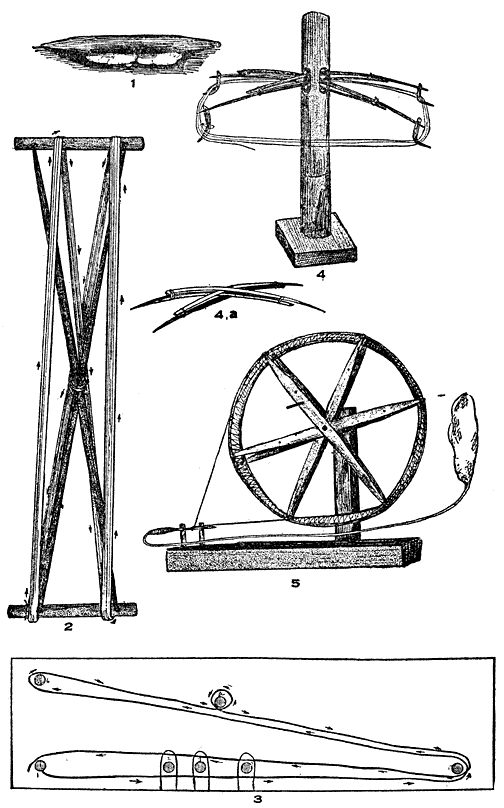
Devices Used in Spininng and Weaving.
Page 417
In many sections the spinning wheel used by the coast natives is beginning to replace the hand outfit (Fig. 16, No. 5). The mass of fiber is held in the left hand, and a thread from it is attached to a horizontal spindle, which is turned by a cord passing over a large wheel. This method is much more rapid than the hand device, but the thread is less uniform, and it is seldom utilized when a fine fabric is to be woven. Bamboo bobbins, consisting of small tubes, are also wound by attaching them to the spindle shaft, so that the thread is transferred by the revolution of the wheel.
The loom, while primitive, is far from simple in its operation. The warp is attached at both ends to sticks or rollers, the far one of which is fastened to a cross timber of the living room (Plate LXVI).
On this loom the woman produces head-bands, belt, and narrow strips of cloth which are made up into blankets and the like. These fabrics are often in several colors and exhibit many tasty and intricate designs, some of which will be described in the chapter on Decorative Art.
When large trees are used, the bark is slit lengthwise every six of eight inches, and the log is beaten with hard wood sticks. In a short time the covering loosens from the wood and is pulled off. The outside layer is worthless, but the remainder is cut into strips about a half inch in width, and is then split lengthwise into thin layers.
In rope-making three strips are laid side by side on the thigh or on a board, but with their ends at unequal distances (Fig. 17, No. 1). These are twisted together, toward the right, until a few inches have been turned, then the cord is put over one end of a double forked stick (sikwan), leaving an equal length on either side (Fig. 17, No. 3). The two halves are twisted together until the end of one strip of bark is reached; a new piece is laid on top of the others, and as they are turned, it becomes part of the twist. As other ends are met with, new strips are added in a like manner until all the bast desired has been made. It is then wound up on the forked stick until needed.
Figure 17.
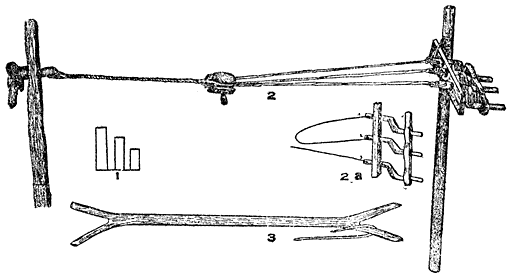
Rope-making Appliances.
The rope machine (agtatalian) consists of three wooden whirls, which constitute the forming device, and a single whirl for the traveler, while a grooved block serves to keep the strands apart (Fig. 17, No. 2). Three equal lengths of the prepared bast are measured, and an end is attached to each of the whirls of the forming machine (Fig. 17, No. 2a). However, only one cut is made in the bast, for strand 3. Page 420All are attached to the single whirl of the traveler, and the process begins. The operator at each end turns his whirl, or set of whirls, rapidly toward the right, the one with the traveler bracing his foot against the lower end, to keep the twisting bast under tension. A third operator guides the grooved piece of wood from the traveler toward the forming machine, as the three strands twist round each other into rope. The bast is known as gīnīsgīs, the rope as tali.
Vines, rattan, and strips of bamboo are likewise twisted together to form crude, but strong cordage.
The making of thread is described under spinning and weaving, but the cords used in snares and the like are prepared in a different manner. The operator squats on the ground, and taking a strip of fiber, places it on his thigh; then with open palm he rolls it toward the knee. The twisted bast is bent at the center; the thumb and forefinger of the left hand hold the loop, and the two strands are placed together. These are now rolled toward the knee as before, the hand giving extra pressure on the ulnar side, and then are rolled back toward the body with pressure on the radial side. When the end of a band is reached, a new one is rolled in, and the process is continued. A tie at the end keeps the cord from untwisting.
When very long strips of fiber are used, two men will work together. One holds the end of the loop, while the other twists each half of the strip in the same direction. Then placing them together on his thigh, he turns them, under pressure, in the opposite direction, thus making a cord.
Figure 18.
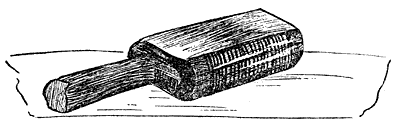
Bark Beater.
Bark Cloth.—Bark cloth is still in common use for men's headbands and for clouts. It is secured from the same trees as the rope material, but wider strips are taken, and it is customary to beat the bark thoroughly before it is removed from the wood. It is then split to the desired thickness, after which it is beaten with wooden or bone mallets (gīkai), which are generally grooved transversely (Fig. 18). The cloth produced is soft and pliable, but is not of the fineness of tapa, and it is always in comparatively narrow pieces. In no instance Page 421was the operator seen to beat two strips together to gain greater breadth or to repair breaks.
Basket Making.—In most districts the men are the basket weavers, but in some towns, especially of Ilocos Norte, the women are skilled in this industry (Plate LXVII). The materials used are rattan, which may be gathered at any time, or bamboo, which is cut only during the dry season and under the waning moon. It is firmly believed that boring insects will not injure bamboo cut at this time, and it is known that the dry period stalks are the strongest.
Five weaves are recognized by the Tinguian, but they are really variations of two—checkerwork and the diagonal or twilled.
The first and most simple is known as laga, the technic of which is the passing of each element of the weft under one and over one of the warp elements. Where the warp and weft are of uniform size, as in mats, it is impossible to distinguish the one from the other, but in many cases the weft is the smaller. Fish traps and storage baskets for mangoes and cotton are generally of this type (Fig. 19, Nos. 1 and 2).
A variation of the laga known as minmináta—“many eyes”—(Fig. 19, No. 3), is found in certain types of carrying baskets, the woven tops of hats, and the like. Here the warp is crossed, and the weft passes through it in regular order so as to produce hexagonal openings.
Figure 19.
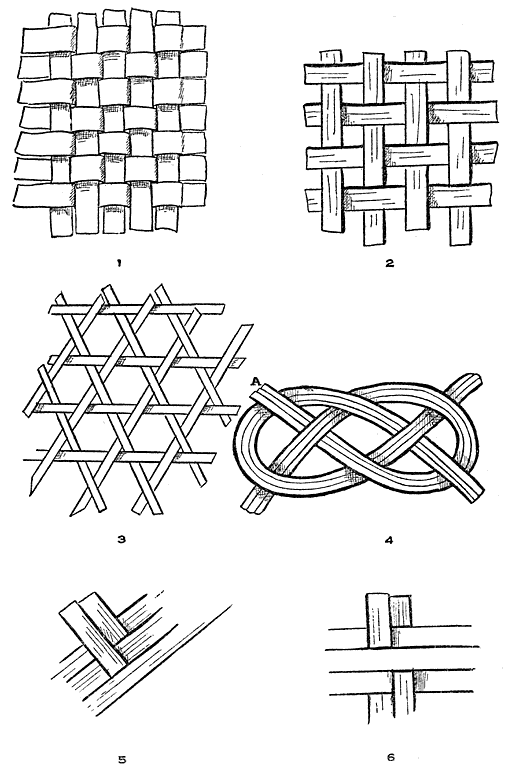
Basket Weaves.
The greater part of the baskets are in the diagonal or twilled weave, in which each element of the weft passes over two or more warp elements. Variations are numerous, either to produce certain Page 423effects or to accommodate designs. Of these the most common are
1 under 2 over 2 etc.
2 under 2 over 2 etc.
2 under 4 over 4 etc.
The weaver also frequently constructs the bottom with 2 over 4 under 4; then when the sides are made he changes to 1 over 2 under 2, until the center is reached; then 1 of the warp passes over 3 of the weft; for the balance the stitch is 1 over 2 under 2. This variation produces a chevron-like pattern which, in general, is known as binakol; but when it is desired to designate more closely, this name is applied to the weaving having an oblique effect (Fig. 19, No. 5), while the horizontal is known as dinapálig (Fig. 19, No. 6).
Types of Baskets:—Plates LXVIII and LXIX show the most common types of baskets made and used in this territory. Others of Igorot and Kalinga origin sometimes appear, but are seldom imitated by the local basket-makers.
Baskets 1 and 2 of Plate LXVIII are known as kaba, and are used principally to hold unthreshed rice, corn, and vegetables. Smaller baskets of the same form are for broken rice and cooked vegetables. The larger specimens are often made of rattan, while the smaller are usually of bamboo. Shallow bamboo baskets, pīdasen or alodan (Plate LXIX, No. 2) are used as eating dishes for cooked rice.
Clothing is put away in covered oval or rectangular baskets, opīgan (Plate LXIX, No. 4), while cotton is stored in long cylindrical baskets kolang (Plate LXVIII, No. 3).
The pasikeng or lagpi(Plate LXIX, No. 3), commonly called the “head basket,” is the chief basket of the men. It is made of rattan, and is supported on the back by means of bands which pass over the shoulders. In it are carried extra garments and all necessities for the trail. Recently some of the men have joined together two of these baskets by means of a wide, flat band, and this is fitted over the back of a horse or carabao,—an evident imitation of the saddle bags used by Spaniards and Americans. Men also carry small containers for their pipes and trinkets, or else make use of a traveling basket, such as is shown in Plate LXIX, No. 5.
Rice winnowers and sieves (Plate LVII) and the fish-traps shown in Fig. 13 conclude the list. No coiled baskets are made.
Aside from the decoration produced by variations in the weave, little ornamentation is found in the basketry from Abra, but the Tinguian of Ilocos Norte make and distribute large quantities of baskets with colored patterns. Colored vines are sometimes woven Page 424in, but the common method is to employ blackened bamboo, both in warp and weft.
The top of the basket is strengthened by two hoops of rattan or bamboo. One is placed outside, the other inside; on them is laid a small strip of the same material, and all three are sewed down by passing a thin strip of rattan through two holes punched in margin. This strip doubles on itself, encircles the rim, and after an interval again passes through two more holes, and so on around the entire basket. A square base, attached in the same manner as the rim, generally completes the basket. In the mountain districts near to Apayao, the bases of the smaller eating dishes are drawn in toward the center at four points, giving the effect of a four-pointed star.
Mats (ikamin).—Mats are used as beds, never as floor coverings. They are rectangular in form, usually about six feet long and three wide, and are undecorated. They are made from strips of pandanus in the laga weave (cf. p. 423).
Dyes.—In recent years analine dyes have come into favor in some villages, and a variety of colors appears in the articles made by their weavers, but the vegetable dyes used by the ancestors are still employed by most of the women. The commonest colors are blue, pink—“black red”—, red, and yellow.
Blue is ordinarily produced by placing the leaves and branches of the indigo plant, tayuni (Indigofera tinctoria)in water for a few days; then to boil them, together with a little lime. The thread is dipped in the liquid.
A yellow dye is produced by boiling the leaves of the Tamarindus indica L. in water until a strong liquor is obtained.
Bark head-bands are stained a purplish-red by applying a liquid Page 425secured through boiling kᴇlyan (Diospyros cunalon D.C.?) bark. For ceremonial purposes they are also colored yellow by applying the juice of the konig (Curcuma longa), but as this has a disagreeable odor, and the color is not permanent, it is not much used in every-day garments. Lemon juice is also applied to bark to give it a yellow hue.
Fish nets are colored brown by dipping them into a dye made by crushing the katakot vine in water, or by staining with the juice of the taotawa (Jatropha curcas L,).
The bamboo strips used in decorating basketry are blackened by holding them in the smoke of burning rice-straw. Black designs, such as appear in the ornamentation of lime holders and the like, are secured by rubbing oil and soot into incised lines, and then holding the object in the smoke of burning rice-straw.
Net Making.—Nets are used in fishing, in catching wild chickens and grasshoppers, and in hunting deer and pigs. The first three types are made of twine, but the fourth is of strong rope.
All net work is done by the man who, for this purpose, employs a mesh stick and a needle of bamboo or carabao horn (Fig. 20). The needle (No. 1) also serves as a shuttle, since it carries a considerable amount of thread between the tongue and notch. The size of the loop is determined by the width of the mesh stick or spreader (No. 2). The operator generally sits on a rice winnower or squats on the ground with a net suspended above him (Plate LXX). He forms the mesh by running the needle over and around the spreader, and up and through the loop above, thus forming a loop on the mesh stick. This is drawn tightly, the needle is again passed through, but without encircling the stick, and thus a knot is tied. This is repeated until a row of loops has been completed, when another series is started.
Figure 20.
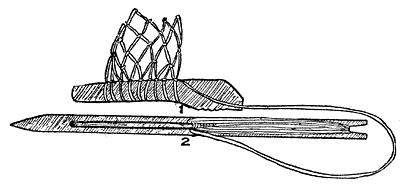
Net Needle and Mesh Stick.
Manufacture of Pottery.—In nearly every village there are two or three women who make jars and dishes, but the potters of Abang Page 426and Lakub are the only ones whose wares have a wide distribution.
The clay is dampened, and is carefully kneaded with the hands to remove lumps and gravel, and to reduce it to the proper consistency. A handful is taken from the mass, and is roughly modeled with the fingers to form the base of the pot. This is set on a wooden plate which, in turn, is placed in a rice winnower (Plate XXXVI). The plate takes the place of a potter's wheel, for it is turned with the right hand while with the left the woman shapes the clay, and smoothes it off with a dampened cloth. From time to time, she rolls out a coil of clay between the palms of her hands, lays it along the top of the vessel, and works and pinches it in. Further shaping and thinning is done with a wooden paddle and the dampened hand, and then the jar is allowed to dry slightly. Before the drying has progressed far enough to render the sides rigid, a smooth stone is placed inside, and the sides are tapped gently with a paddle until properly thinned and shaped.
After allowing a couple of days for drying, the potter rubs the jar inside and out with smooth stones or lipi seeds, so as to give it an even surface.
When several jars or dishes have been prepared, they are placed in carabao dung or other slow burning material and fired. This generally takes place at night, and the jars are left undisturbed until morning, when they are ready for service. Occasionally resin is rubbed over a jar while it is hot, thus giving it a glazed surface; this, however, is not common, as the resin quickly melts off the cooking utensils, while porous jars are preferred as water containers, since the seepage lowers the temperature of the contents.
Vessels made in Lakub are often decorated with incised patterns (Fig. 22, No. 8), but otherwise the Tinguian ware is plain. Chinese jars are found in every village, and are highly prized, but the native potters do not imitate them in form or decoration. Had Chinese blood or influence ever been strong in the region, we might expect to find the potter's wheel and traces of true glazing, but both are lacking.
Pipe Making.—Both men and women smoke pipes, consisting of a short reed handle and a small bowl. Men are the pipe makers, and often show considerable skill in the decoration of their product.
The common pipe-bowl is of clay, which has been carefully shaped with the fingers and a short bamboo spatula. Designs are incised, and the raised portions are further embellished by the addition of small pieces of brass wire (Fig. 21, Nos. 4–5). The bowls are baked in a slow fire, and the mouthpieces are added. Page 427
A second type of pipe, or cigar holder, is made of bamboo (Fig. 21, Nos. 1–3). Designs are incised in the sides, oil is applied, and the pipe is held in the smoke of burning rice-straw until the lines become permanently blackened (Fig. 22, Nos. 1–3).
Figure 21.
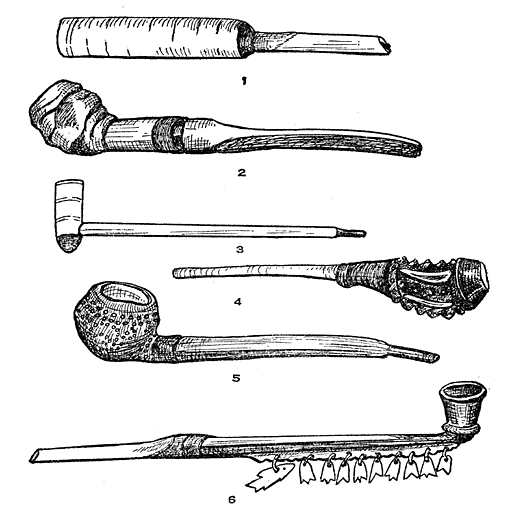
Tobacco-pipes.
In recent years, Ilocano jewelers have introduced silver pipes, made from coins. One Tinguian pipe maker has learned the trade, and does a lively business. He has further beautified his product by attaching pendants representing fish (Fig. 21, No. 6). Brass pipes of Igorot origin are sometimes seen, but are not made in this region.
Method of Drying Hides.—Hides of carabao, and sometimes of other animals, are stretched on bamboo frames and are sun-dried Page 428(Plate LV). Later they are placed in water containing tanbark, and are roughly cured. Such leather is used in the manufacture of the back straps used by the weavers, and in making sheathes for knives, but more commonly it is placed on the ground, and on it rice and cotton are beaten out. Page 429