VII.—Prehistoric Objects associated with the Swastika, found in both Hemispheres, and believed to have passed by Migration.
Reading edition
SPINDLE-WHORLS.
Spindle-whorls are first to be considered. These are essentially prehistoric utensils, and are to be found in every part of the world where the inhabitants were sufficiently cultured to make twisted threads or cords, whether for hunting or fishing, games, textile fabrics, or coverings, either for themselves, their tents, or other purposes. In western Asia, all of Europe, in the pueblos of North America, and among the aborigines—by whatever name they are called—of Mexico, Central America, and the north and west coast of South America, wherever the aborigines employed cord, cloth, or fiber, the spindle-whorl is found. Where they used skins for the coverings of themselves or their tents, the spindle-whorl may not be found. Thus, in the Eskimo land, and among certain of the North American savages, spindle-whorls are rarely if ever found.
The spindle-whorl was equally in use in Europe and Asia during the Neolithic Age as in the Bronze Age. It continued in use among the peasants in remote and outlying districts into modern times. During the Neolithic Age its materials were stone and terra cotta; during the Bronze Age they were almost exclusively terra cotta. They are found of both materials. Recently a Gallo-Roman tomb was opened at Clermont-Ferrand and found to contain the skeleton of a young woman, and with it her spindles and whorls.[312]
The existence of spindle-whorls in distant and widely separated countries affords a certain amount of presumptive evidence of migrations of peoples from one country to another, or of contact or communication between them. If the people did not themselves migrate and settle the new country, taking the spindle-whorls and other objects with them, then the spindle-whorl itself, or the knowledge of how to make and use it, must in some other way have gotten over to the new country.
This argument of migration, contact, or communication does not rest solely on the similarity of the whorls in the distant countries, but equally on the fact of spinning thread from the fiber; and this argument is reenforced by the similarity of the operation and of the tool or machine with which it was done. It has been said elsewhere that the probability of communication between widely separated peoples by migration or contact depended for its value as evidence, in some degree, upon the correspondence or similarity of the object considered, and that this value increased with the number of items of correspondence, the closeness of similarity, the extent of the occurrence, and the difficulty of its performance. So we pass to the similarity in size, appearance, mode of manufacture, and, finally, the use of the whorls of the two continents.
EUROPE.
Switzerland—Lake dwellings.—Figs. 345 and 346 show stone spindle-whorls from prehistoric Swiss lake dwellings. These are in the U. S. National Museum, and with them are dozens of others of the same kind and style from all other parts of Europe. Fig. 347 shows a stone spindle-whorl from Lund, Sweden. It is in the U. S. National Museum and was contributed by Professor Jillson. Figs. 348, 349, and 350 represent terra-cotta spindle-whorls from the Swiss lakes. These specimens were selected to show the different patterns, to illustrate their unlikeness instead of their likeness, to give an understanding of the various kinds of whorls rather than that they were all one kind, a fad which should be kept in mind during this argument.
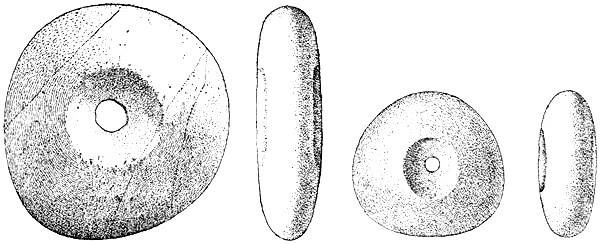
Figs. 345 and 346. STONE SPINDLE-WHORLS. Neolithic. Swiss lake dwellings. U. S. National Museum.
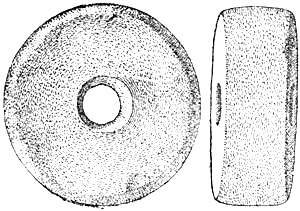
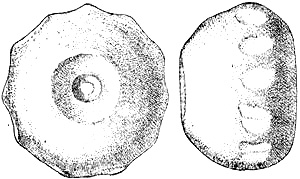
Fig. 347. STONE SPINDLE-WHORL. Neolithic. Lund, Sweden. Cat. No. 5281, U. S. N. M. Fig. 348. TERRA-COTTA SPINDLE-WHORL. Neolithic or Bronze Age. Swiss lake dwellings. Cat. No. 100642, U. S. N. M.
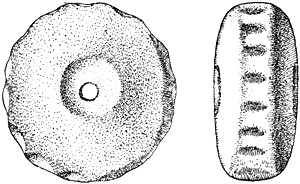
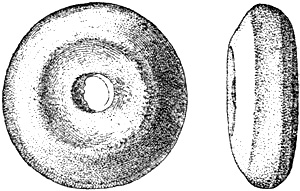
Fig. 349. TERRA-COTTA SPINDLE-WHORL. Neolithic or Bronze Age. Swiss lake dwellings. Cat. No. 190642, U. S. N. M. Fig. 350. TERRA-COTTA SPINDLE-WHORL. Swiss lake dwellings. Cat. No. 100647, U. S. N. M.
Italy.—Figs. 351, 352, and 353 show terra-cotta spindle-whorls from Orvieto, Italy, 78 miles north from Rome. Figs. 354 and 355 represent spindle-whorls from Corneto, Italy, 63 miles north from Rome. As remarked above, they have been chosen to represent the different kinds. There are thousands of these whorls found in Italy. In the Archæological Exposition at Turin, 1884, the number was so great that they were twined about the columns, thereby providing a place of storage as well as a place of display.
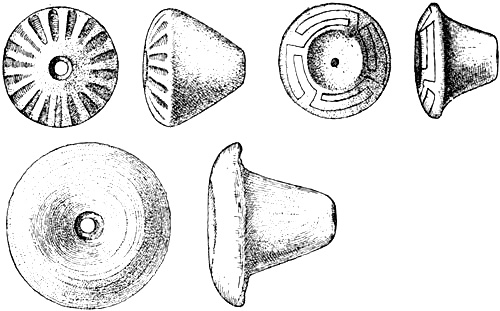
Figs. 351, 352, and 353. PREHISTORIC TERRA-COTTA SPINDLE-WHORLS. Orvieto, Italy. Cat. Nos. 101671, 101672, U. S. N. M.
Wurtemburg.—Dr. Charles Rau procured for, and there is now in, the U. S. National Museum a spindle (fig. 356) with its whorl which had been in use for spinning from 1860 to 1870, and which he obtained in Wurtemburg, Germany, from the woman who had used it.
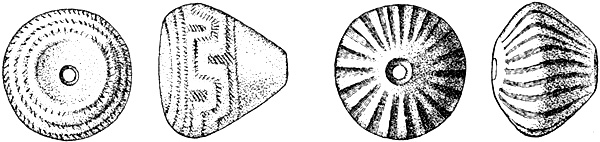
Figs. 354 and 355. PREHISTORIC SPINDLE-WHORLS. Corneto, Italy. Cat. No. 101773, U. S. N. M.
France.—The author has seen the French peasants in Brittany spinning their thread in the same way, and once took a photograph of one in the hamlet of Pont-Aven, Morbihan, but it failed in development. In 1893 Mr. Harle purchased at St. Gerons, Ardeche, a merchant’s entire stock of modern porcelain spindle-whorls. The manufactory was located at Martres-Tolosane, and the trade extended throughout the Pyrenees. He presented a series to the Société d’Anthropologie at Paris, July, 1893.[313]
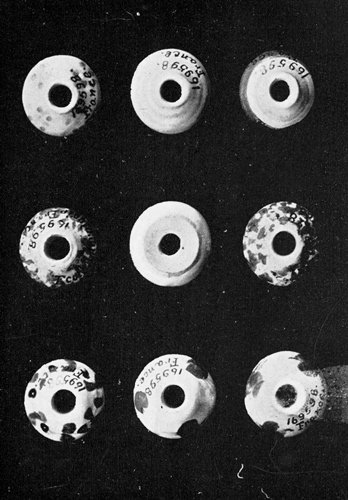
Plate 21. Spindle-whorls of Modern Porcelain from Southern France. Cat. No. 169598, U. S. N. M.
Fig. 356. MODERN SPINDLE AND WHORL USED FOR SPINNING THREAD. Wurtemburg, Germany.

The U. S. National Museum has lately received, through the kindness of the École d’Anthropologie, a series of nine of these porcelain whorls (pl. 21). The wheel and modern machines for spinning have penetrated this corner of the world, and these whorls are the last emblem of an industry dating slightly after the advent of man on earth and already old in that locality when Roland crossed the mountain pass near there and sounded his “Oliphant,” calling for help from Charlemagne. These are the death chant of the industry of hand spinning in that country.
NORTH AMERICA—PRE-COLUMBIAN TIMES.
The North American Indians employed rushes and animal skins as the principal coverings for themselves and their tents. They used sinews and thongs for thread and cord, and thus avoided largely the necessity for spinning fiber or making textiles; for these or possibly other reasons, we find few spindle-whorls among them compared with the number found in Europe. Yet the North American Indians made and used textile fabrics, and there are pieces of woven cloth from mounds in Ohio now in the Department of Prehistoric Anthropology, U. S. National Museum. The Pueblo Indians spun thread and wove cloth in pre-Columbian times, and those within the States of Colorado and Utah and the adjoining Territories of Arizona and New Mexico, particularly the Navajoes, have been long noted for their excellence in producing textile fabrics. Specimens of their looms and thread are on display in the National Museum and have been published in the reports. Special attention is called to that by Dr. Washington Matthews in the Third Annual Report of the Bureau of Ethnology, 1881-82. Dr. Matthews is of the opinion that the work of the Pueblo Indians antedated that of the Navajoes, that the latter learned the art from the former since the advent of the Spaniards; and he remarks that the pupils now excel their masters in the beauty and quality of their work. He declares that the art of weaving has been carried to greater perfection among the Navajoes than among any native tribe in America north of the Mexican boundary; while with none in the entire continent has it been less influenced by contact with Europeans. The superiority of the Navajo to the Pueblo work results not only from a constant advance of the weavers’ art among the former, but from a deterioration of it among the latter. This deterioration among the Pueblo Indians he attributes to their contact with the whites, their inclination being to purchase rather than to make woven fabrics, while these influences seem not to have affected the Navajoes. He represents a Navajo woman spinning (see pl. 22 of the present paper). She is seated, and apparently whorls the spindle by rubbing it on her leg. The spindle is of wood, as are all other spindles, but the whorl is also of wood. In this these people are peculiar and perhaps unique. The whorl, among most other savage or prehistoric peoples, as we have already seen, was of stone or clay. These wooden whorls are thinner and larger, but otherwise they are the same. An inspection of the plate will show that with it the spinning apparatus forms the same machine, accomplishes the same purpose, and does it in the same way. The sole difference is in the size and material of the whorl. The difference in material accounts for the difference in size. It is not improbable that the Indian discovered that the wooden whorl would serve as well as a stone or pottery one, and that it was easier made. The machine in the hands of the woman, as shown in the figure, is larger than usual, which may be accounted for by the thread of wool fiber used by the Navajo being thicker and occupying more space than the flaxen thread of prehistoric times; so it may have been discovered that a large whorl of wood served their purpose better than a small one of stone. Stone whorls of large size might be too heavy. Thus may be explained the change from small stone or pottery whorls to large wooden ones.
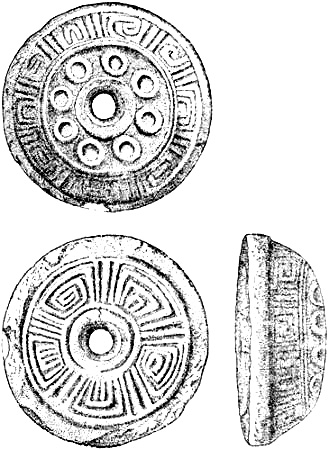
Fig. 357. TERRA-COTTA SPINDLE-WHORL WITH DESIGN SIMILAR TO SWASTIKA. Valley of Mexico. Cat. No. 27875, U. S. N. M.
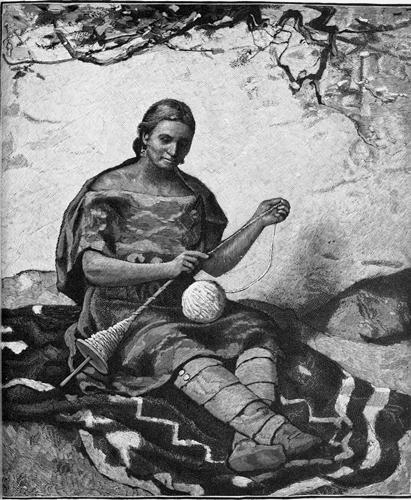
Plate 22. Navajo Woman Using Spindle and Whorl. Dr. Washington Matthews, Third Annual Report of the Bureau of Ethnology, 1881-82, Pl. XXXIV.
Mexico.—Fig. 357 represents the two sides and edge of a pottery terra-cotta spindle-whorl. It is the largest of a series of six (Cat. Nos. 27875-27880) from the valley of Mexico, sent to the U. S. National Museum by the Mexican National Museum in 1877. Fig. 358 also represents one of a series from Mexico, obtained by W. W. Blake, July, 1886 (Cat. Nos. 99051-99059). The National Museum possesses hundreds of these from Mexico, as well as the small ones from Peru.
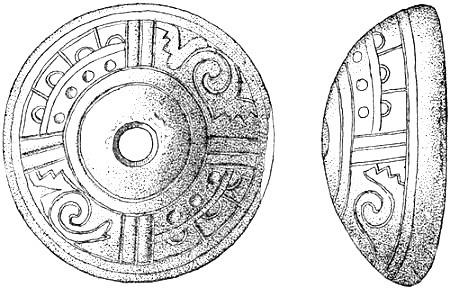
Fig. 358. MEXICAN TERRA-COTTA SPINDLE-WHORL WITH DESIGN SIMILAR TO SWASTIKA.
These specimens are chosen because they are the largest and most elaborately decorated. It will be perceived at a glance how the style of decoration lends itself to the Swastika. It consists mostly of geometric figures, chief of which is the Greek fret, the labyrinth, the circle, and the volute, but as in the color stamps (pp. 946-947) there is no Swastika.
CENTRAL AMERICA.
Nicaragua.—The specimen shown in fig. 359, from Omotepe Island, Lake Nicaragua, is one of a series of pottery spindle-whorls, bearing, however, great resemblance to those of stone. Fig. 360 shows a specimen from the same locality. It is of pottery and bears much resemblance in form to the earliest whorls found by Schliemann on the site of Troy on the hill of Hissarlik. Both these were collected by Dr. J. F. Bransford, and are in the U. S. National Museum. Fig. 361 shows a specimen from Granada, Nicaragua. It is of the common shape of the European prehistoric spindle-whorl. Its flat surface is decorated with a Greek cross in incised lines, two quarters of which are filled with hatch marks. Fig. 362 shows a terra-cotta spindle-whorl from Malacate, Nicaragua. It is cone-shaped. Both these specimens were collected by Dr. Earl Flint.
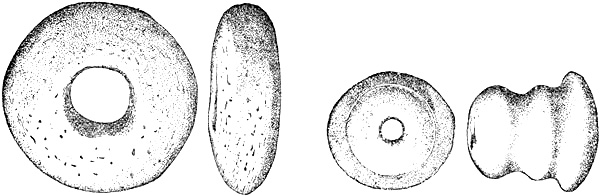
Figs. 359 and 360. TERRA-COTTA SPINDLE-WHORLS. Omotepe Island, Nicaragua. Cat. Nos. 28898, 28899, U. S. N. M.
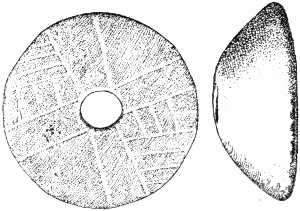
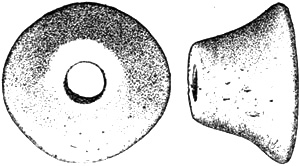
Fig. 361. TERRA-COTTA SPINDLE-WHORL. Granada, Nicaragua. Cat. No. 23295, U. S. N. M. Fig. 362. TERRA-COTTA SPINDLE-WHORL. Malacate, Nicaragua. Cat. No. 29009, U. S. N. M.
SOUTH AMERICA.
Fig. 363. SPINDLE-WHORL MADE OF GRAY CLAY AND DECORATED WITH ANNULAR NODES. Chiriqui. Sixth Annual Report of the Bureau of Ethnology, fig. 218.
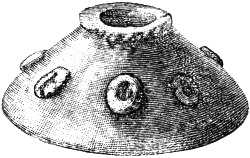
Chiriqui.—Figs. 363, 364, and 365 show terra-cotta spindle-whorls from Chiriqui, the most northern territory in South America and adjoining the Isthmus of Panama. They are engraved natural size, with ornamentation similar to that on the pottery of that country.
Colombia.—Fig. 366 shows a cone-shaped terra-cotta whorl from Manizales, Colombia, South America. It has a star-shaped design on the face and a three-line zigzag or chevron pattern.
Peru.—Plate 23 represents a series of spindles and whorls from Peru. They were furnished to the U. S. National Museum by I. V. Norton, of Plainville, N. Y. The whorls were originally considered to be beads, and were without further description. The spindles were not inserted in them as at present. The spindles, as well as whorls, are exceedingly small. Some of the whorls are decorated by incised lines in the clay, and many of the spindles are decorated in the middle with paint in different colors, in lines, scrolls, and chevrons. These are the only whorls from Peru which the U. S. National Museum has, though it possesses an extensive series of the spindles, several of which still have the spun thread wrapped upon them.
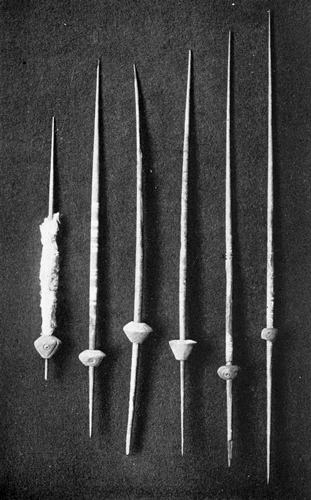
Plate 23. Series of Aboriginal Spindles and Whorls from Peru. Cat. No. 17510, U. S. N. M.
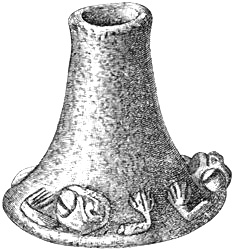
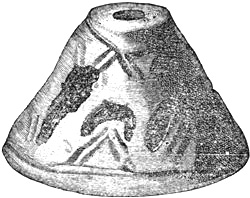
Fig. 364. SPINDLE-WHORL OF GRAY CLAY WITH FIGURES OF ANIMALS. Chiriqui. Sixth Annual Report of the Bureau of Ethnology, fig. 219. Fig. 365. SPINDLE-WHORL OF DARK CLAY WITH PERFORATIONS AND INCISED ORNAMENTS. Chiriqui. Sixth Annual Report of the Bureau of Ethnology, fig. 220.
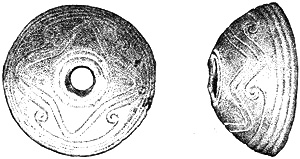
Fig. 366. TERRA-COTTA SPINDLE-WHORL. Manizales, Colombia. Cat. No. 16838, U. S. N. M.
There are certain distinguishing peculiarities to be remarked when comparing the spindle-whorls from the Western Hemisphere with those from the Eastern Hemisphere. There is greater diversity in size, form, and decoration in the American than in the European whorls. A series of European whorls from any given locality will afford a fair representation of those from almost every other locality. But it is different with the American specimens. Each section in America has a different style, not only different from the European specimens, but different from those of neighboring sections. Among the eighteen thousand whorls found by Dr. Schliemann on the hill of Hissarlik, there is scarcely one so large as those here shown from Mexico, while, on the other hand, there were only a few as small as the largest of the series from Peru. The difference in size and material in the Pueblo whorls has already been noticed. The ornamentation is also peculiar in that it adopts, not a particular style common to the utensil, but that it adopts the styles of the respective countries. The Mexican whorl has a Mexican style of ornamentation, etc. The Nicaragua specimens resemble the European more than any other from America in their forms and the almost entire absence of decoration.
The foregoing are the differences; but with all the number and extent of these differences the fact remains that the whorls of the two hemispheres are practically the same, and the differences are insignificant. In style, shape, and manner of use they are so similar in the two hemispheres as to be the same invention. The whorls, when put upon their spindles, form the same machine in both countries. They were intended for and they accomplish the same purpose, and the method of their performance is practically the same. While the similarity of the art of spinning and the mechanism (i. e., the spindle and whorl) by which it is accomplished may not prove conclusively that it migrated from the Eastern Hemisphere, nor yet show positive connection or communication between the two peoples, it goes a long way toward establishing such migration or communication. The similarity in the art and its mechanism appears to the author to show such resemblance with the like culture in the Eastern Hemisphere, and is so harmonious with the theory of migration or contact or communication, that if there shall be other objects found which either by their number or condition would prove to be a well-authenticated instance of migration from or contact or communication between the countries, the evidence of the similarity of the spindle-whorls would form a valuable addition to and largely increase the evidence to establish the main fact. Until that piece of well-authenticated evidence has been obtained, the question must, so far as concerns spindle-whorls, remain only a probability. The differences between them are of manner, and not of matter; in size and degree, but not in kind, and are not other or greater than might easily arise from local adaptation of an imported invention. Compare the Navajo spindle (pl. 22) with that from Wurtemburg, Germany (fig. 356), and these with the spindles and whorls from Peru (pl. 23). These facts are entirely in harmony with the possibility that the spindle and whorl, as a machine for spinning, was a single invention, and that its slight differentiations resulted from its employment by different peoples—the result of its intertribal migrations. For purposes of comparison, and to show the similarity of these objects in Europe, the author has introduced a series of spindle-whorls from Troy, Hissarlik (pls. 24 and 25). These belong to the U. S. National Museum, and form part of the valuable collection from Mme. Schliemann, the gift by her talented husband to the people of the United States as a token of his remembrance and grateful feelings toward them.
Plate 24.
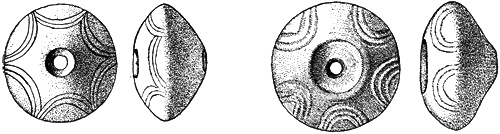
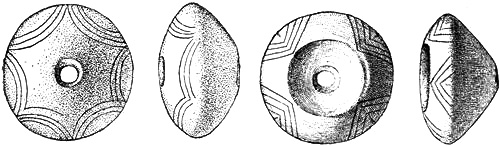
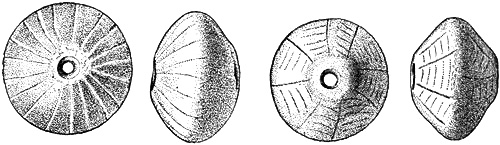
Selected Specimens of Spindle-whorls from the Third, Fourth, and Fifth Cities of Troy. U. S. National Museum.
Plate 25.
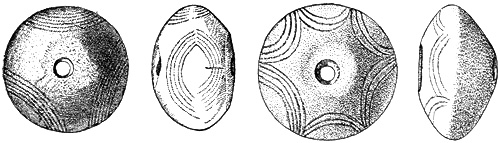
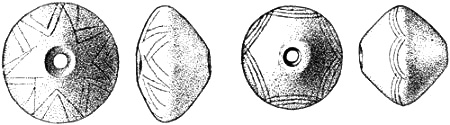
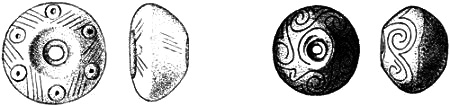
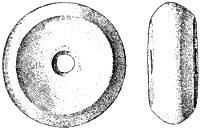
Selected Specimens of Spindle-whorls from the Third, Fourth, and Fifth Cities of Troy. U. S. National Museum.
BOBBINS.
EUROPE.
We have already seen how an increase in the number of correspondences between objects from distant countries increases the weight of their evidence in favor of contact or communication between the peoples. If it should be found upon comparison that the bobbins on which thread is to be wound, as well as the spindle-whorls with which it is made, had been in use during prehistoric times in the two hemispheres, it would add to the evidence of contact or communication. The U. S. National Museum possesses a series of these bobbins, as they are believed to have been, running from large to small, comprising about one dozen specimens from Italy, one from Corneto and the others from Bologna, in which places many prehistoric spindle whorls have been found (figs. 367 and 368). These are of the type Villanova. The end as well as the side view is represented. The former is one of the largest, the latter of middle size, with others smaller forming a graduating series. The latter is engraved on the end by dotted incisions in three parallel lines arranged in the form of a Greek cross. A similar bobbin from Bologna bears the sign of the Swastika on its end (fig. 193).[314] It was found by Count Gozzadini and forms part of his collection in Bologna.
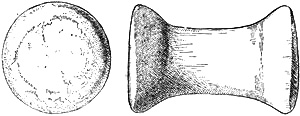
Fig. 367. BOBBIN OR SPOOL FOR WINDING THREAD (?). Type Villanova. Corneto, Italy. U. S. National Museum.
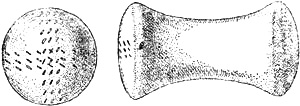
Fig. 368. TERRA-COTTA BOBBIN OR SPOOL FOR WINDING THREAD (?). Type Villanova. Bologna, Italy. Cat. No. 101771, U. S. N. M.
UNITED STATES.
The three following figures represent clay and stone bobbins, all from the State of Kentucky. Fig. 369 shows a bobbin elaborately decorated, from a mound near Maysville, Ky. It has a hole drilled longitudinally through the center. The end shows a cross of the Greek form with this hole in the center of the cross. Fig. 370 shows a similar object from Lexington, Ky., sent by the Kentucky University. It is of fine-grained sandstone, is drilled longitudinally through the center and decorated as shown. The end view shows a series of concentric circles with rows of dots in the intervals. Fig. 371 shows a similar object of fine-grained sandstone from Lewis County, Ky. It is also drilled longitudinally, and is decorated with rows of zigzag lines as shown. The end view represents four consecutive pentagons laid one on top of the other, which increase in size as they go outward, the hole through the bobbin being in the center of these pentagons, while the outside line is decorated with spikes or rays extending to the periphery of the bobbin, all of which is said to represent the sun. The specimen shown in fig. 372, of fine-grained sandstone, is from Maysville, Ky. The two ends are here represented because of the peculiarity of the decoration. In the center is the hole, next to it is a rude form of Greek cross which on one end is repeated as it goes farther from the center; on the other, the decoration consists of three concentric circles, one interval of which is divided by radiating lines at regular intervals, each forming a rectangle. Between the outer lines and the periphery are four radiating rays which, if completed all around, might form a sun symbol. Bobbins of clay have been lately discovered in Florida by Mr. Clarence B. Moore and noted by Professor Holmes.
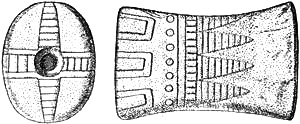
Fig. 369. BOBBIN (?) FROM A MOUND NEAR MAYSVILLE, KENTUCKY. Cat. No. 16748, U. S. N. M.
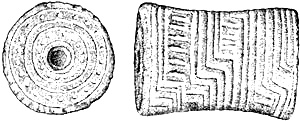
Fig. 370. BOBBIN (?) FROM LEXINGTON, KENTUCKY. Cat. No. 16691, U. S. N. M.
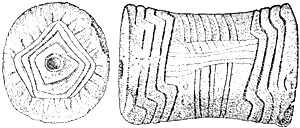
Fig. 371. BOBBIN (?) OF FINE-GRAINED SANDSTONE. Lewis County, Kentucky. Cat. No. 59681, U. S. N. M.
Thus we find some of the same objects which in Europe were made and used by prehistoric man and which bore the Swastika mark have migrated to America, also in prehistoric times, where they were put to the same use and served the same purpose. This is certainly no inconsiderable testimony in favor of the migration of the sign.