IV.—The Cross Among the American Indians.
Reading edition
DIFFERENT FORMS.
The foregoing specimens are sufficient evidence of the existence of the Swastika among the aboriginal North Americans during the mound-building period, and although there may be other specimens of the Swastika to be reported, yet we might properly continue this investigation for the purpose of determining if there be any related forms of the cross among the same peoples. This is done without any argument as to the use of these designs beyond that attributed to them. The illustrations and descriptions are mainly collected from objects in and reports of the U. S. National Museum and the Bureau of Ethnology.
THE CROSS ON OBJECTS OF SHELL AND COPPER.
The shell gorget presented in fig. 300 belongs to the collection of Mr. F. M. Perrine, and was obtained from a mound in Union County, Ill. It is a little more than three inches in diameter and has been ground to a uniform thickness of about one-twelfth of an inch. The surfaces are smooth and the margin carefully rounded and polished. Near the upper edge are two perforations, both well worn with cord-marks indicating suspension. The cross in the center of the concave face of the disk is quite simple and is made by four triangular perforations which separate the arms. The face of the cross is ornamented with six carelessly drawn incised lines interlacing in the center as shown in the figure, three extending along the arm to the right and three passing down the lower arm to the inclosing line. Nothing has been learned of the character of the interments with which this specimen was associated.[282] The incised lines of the specimen indicate the possible intention of the artist to make the Swastika. The design is evidently a cross and apparently unfinished.
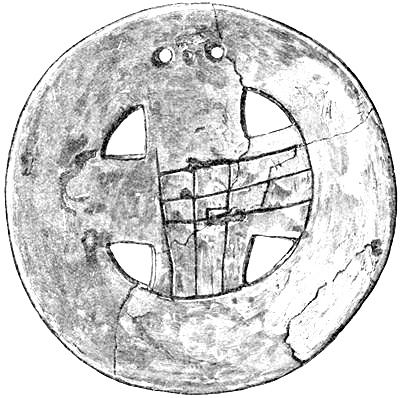
Fig. 300. ENGRAVED SHELL GORGET. Greek cross with incised lines resembling a Swastika. Union County, Ill.
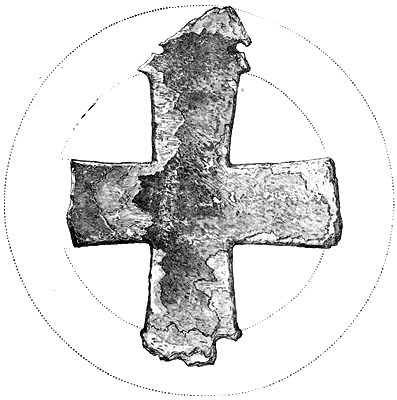
Fig. 301. ENGRAVED SHELL GORGET. Greek cross. Charleston, Mo. Second Annual Report of the Bureau of Ethnology, pl. LI, fig. 2.
The National Museum possesses a large shell cross (fig. 301) which, while quite plain as a cross, has been much damaged, the rim that formerly encircled it, as in the foregoing figure, having been broken away and lost. The perforations are still in evidence. The specimen is much decayed and came to the National Museum with a skull from a grave at Charleston, Mo.; beyond this there is no record. The specimen shown in fig. 302 is quoted as a “typical example of the cross of the mound-builder.” It was obtained from a mound on Lick Creek, Tennessee, and is in the Peabody Museum, Cambridge, Mass. While an elaborate description is given of it and figures are mentioned as “devices probably significant,” and “elementary or unfinished,” and more of the same, yet nowhere is suggested any relationship to the Swastika, nor even the possibility of its existence in America.
Fig. 302. SHELL GORGET WITH ENGRAVING OF GREEK CROSS AND INCHOATE SWASTIKA. Second Annual Report of the Bureau of Ethnology, pl. LII, fig. 3.
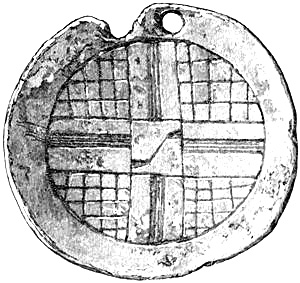
Fig. 303. FRAGMENT OF COPPER DISK WITH GREEK CROSS IN INNER CIRCLE. Ohio. American Museum of Natural History, New York City. Second Annual Report of the Bureau of Ethnology, pl. LII, fig. 4.
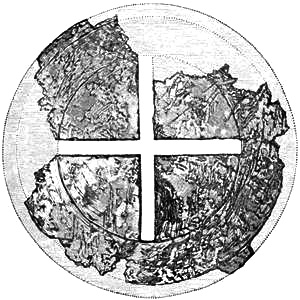
A large copper disk from an Ohio mound is represented in fig. 303. It is in the Natural History Museum of New York. It is eight inches in diameter, is very thin, and had suffered greatly from corrosion. A symmetrical cross, the arms of which are five inches in length, has been cut out of the center. Two concentric lines have been impressed in the plate, one near the margin and the other touching the ends of the cross. Fig. 304 shows a shell gorget from a mound on Lick Creek, Tennessee. It is much corroded and broken, yet it shows the cross plainly. There are sundry pits or dots made irregularly over the surface, some of which have perforated the shell. Pl. 19 represents a recapitulation of specimens of crosses, thirteen in number, “most of which have been obtained from the mounds or from ancient graves within the district occupied by the mound-builders. Eight are engraved upon shell gorgets, one is cut in stone, three are painted upon pottery, and four are executed upon copper. With two exceptions, they are inclosed in circles, and hence are symmetrical Greek crosses, the ends being rounded to conform to a circle.”[283] Figs. 7 and 9 of pl. 19 represent forms of the Latin cross, and are modern, having doubtless been introduced by European priests. Figs. 10 to 13 are representatives of the Swastika in some of its forms.
EXPLANATION OF PLATE 19.
1 2 3
4 5
6
7 9
8
10 11 12 13
Various Forms of Crosses in use among North American Indians, from Greek Cross to Swastika.
Fig. 1. Greek Cross.
2. Greek Cross.
3. Cross on Copper.
4. Cross on Shell.
5. Greek Cross.
6. Greek Cross.
7. Latin Cross (Copper).
8. Greek Cross.
9. Latin Cross (Copper).
10. Swastika on Shell.
11. Swastika on Shell.
12. Swastika on Pottery.
13. Swastika on Pottery.
Plate 19.
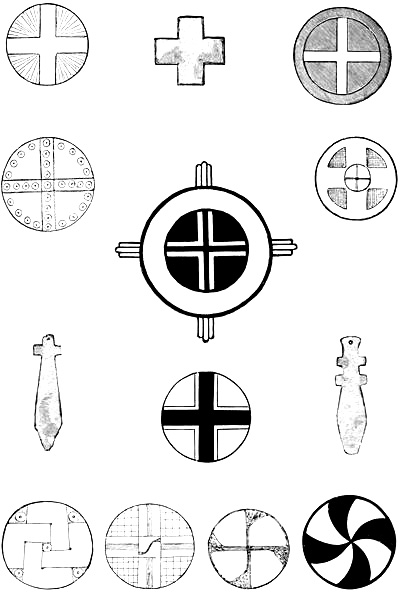
Various Forms of Crosses in use Among North American Indians, from Greek Cross to Swastika. Second Annual Report of the Bureau of Ethnology, 1880-81, Pl. LIII.
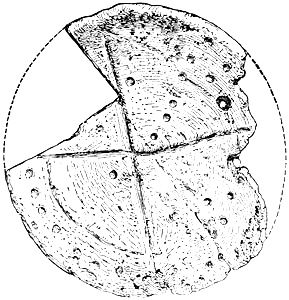
Fig. 304. ENGRAVED SHELL DISK GORGET. Rude cross with many dots. Lick Creek, Tenn. Second Annual Report of the Bureau of Ethnology, pl. 52, fig. 2.
Fig. 305. ENGRAVED SHELL WITH FIGURE OF GREEK CROSS. Caldwell County, N. C. Cat. No. 33169, U. S. N. M.
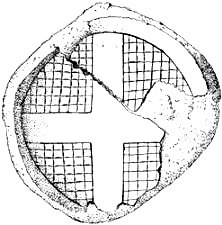
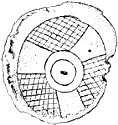
Fig. 306. ENGRAVED SHELL WITH THREE-ARMED CROSS (TRISKELION). Lick Creek, Tenn. Cat. No. 83170, U. S. N. M.
The U. S. National Museum possesses a small shell ornament (fig. 305) in the form of a cross, from Lenoir’s burial place, Fort Defiance, Caldwell County, N. C., collected by Dr. Spainhour and Mr. Rogan, the latter being an employé of the Bureau of Ethnology. It is in the form of a Greek cross, the four arms crossing at right angles and being of equal length. The arms are of the plain shell, while they are brought to view by the field being cross-hatched. The specimen has, unfortunately, been broken, and being fragile has been secured in a bed of plaster.
This and the foregoing specimens have been introduced into this paper that the facts of their existence may be presented for consideration, and to aid in the determination whether the cross had any peculiar or particular meaning. The questions involuntarily arise, Was it a symbol with a hidden meaning, religious or otherwise; was it the totem of a clan, the insignia of a ruler, the charm of a priesthood, or did it, with all the associated shell engravings, belong to the category of trinkets? Those questions may be partially answered in the section on the meanings given to the cross by the North American Indians (p. 933).
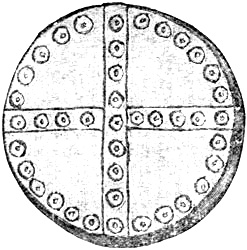
Fig. 307. DRILLED AND ENGRAVED SHELL OR “RUNTEE.” Dotted Greek cross and circle. Arizona.
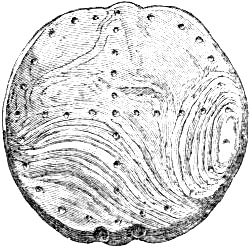
Fig. 308. DRILLED AND ENGRAVED SHELL OR “RUNTEE.” Dots and rings forming circle and Greek cross. Ohio.
There is also introduced, as bearing on the question, another shell ornament (fig. 306), the style, design, and workmanship of which has such resemblance to the foregoing that if they had not been (as they were) found together we would be compelled to admit their identity of origin, yet the latter specimen has but three arms instead of four. This might take it out of the category of crosses as a symbol of any religion of which we have knowledge. Many of the art objects in shell heretofore cited were more or less closely associated; they came from the same neighborhood and were the results of the same excavations, conducted by the same excavators. In determining the culture status of their makers, they must be taken together.
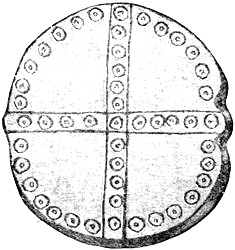
Fig. 309. DRILLED AND ENGRAVED SHELL OR “RUNTEE.” Dots and rings forming circle and Greek cross. New York.
When we consider the variety of the designs which were apparently without meaning except for ornamentation, like the circles, meanders, zigzags, chevrons, herringbones, ogees, frets, etc., and the representations of animals such as were used to decorate the pipes of the aborigines, not alone the bear, wolf, eagle, and others which might be a totem and represent a given clan, but others which, according to our knowledge and imagination, have never served for such a purpose, as the manatee, beaver, wildcat, heron, finch, sparrow, crow, raven, cormorant, duck, toucan, goose, turkey, buzzard, cardinal, parroquet, conies, lizard; when we further consider that the cross, whether Greek, Latin, or Swastika form, is utterly unlike any known or possible totem of clan, insignia of ruler, or potent charm of priesthood; when we consider these things, why should we feel ourselves compelled to accept those signs as symbols of a hidden meaning, simply because religious sects in different parts of the world and at different epochs of history have chosen them or some of them to represent their peculiar religious ideas? This question covers much space in geography and in time, as well as on paper. It is not answered here, because no answer can be given which would be accepted as satisfactory, but it may serve as a track or indication along which students and thinkers might pursue their investigations.
The U. S. National Museum possesses a necklace consisting of three shell ornaments, interspersed at regular intervals with about fifty small porcelain beads (fig. 307).[284] It was obtained by Capt. George M. Whipple from the Indians of New Mexico. These shell ornaments are similar to objects described by Beverly in his work on the “History of Virginia,” page 145, as “runtees” and “made of the conch shell; only the shape is flat as a cheese and drilled edgewise.” It is to be remarked that on its face as well as on figs. 308 and 309[284] appears a cross of the Greek form indicated by these peculiar indentations or drillings inclosed in a small circle. The specimen shown in fig. 308 is from an ancient grave in Upper Sandusky, Ohio, and that shown in fig. 309 from an Indian cemetery at Onondaga, N. Y. Similar specimens have been found in the same localities.
THE CROSS ON POTTERY.
Fig. 310 shows a small globular cup of dark ware from the vicinity of Charleston, Mo.; height, 2½ inches; width, 3½ inches. It has four large nodes or projections, and between them, painted red, are four ornamental circles, the outside one of which is scalloped or rayed, while the inside one bears the figure of a Greek cross. The specimen shown in fig. 311 (Cat. No. 47197, U. S. N. M.) is a medium-sized decorated olla with scalloped margin, from New Mexico, collected by Colonel Stevenson. It has two crosses—one Greek, the other Maltese—both inclosed in circles and forming centers of an elaborate, fanciful, shield-like decoration. In fig. 312 (Cat. No. 39518, U. S. N. M.) is shown a Cochiti painted water vessel, same collection, showing a Maltese cross.
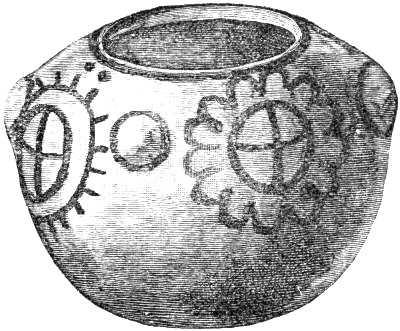
Fig. 310. POTTERY JAR WITH CROSSES, ENCIRCLING RAYS AND SCALLOPS. Third Annual Report of the Bureau of Ethnology, fig. 188.
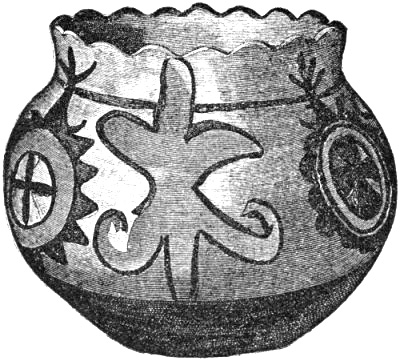
Fig. 311. OLLA DECORATED WITH GREEK AND MALTESE CROSSES. Second Annual Report of the Bureau of Ethnology, fig. 708.
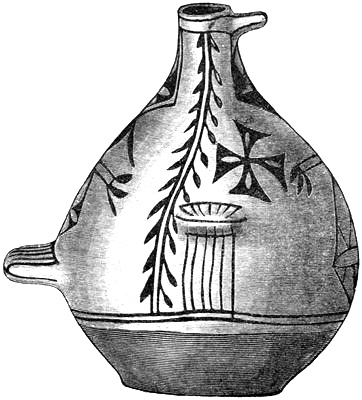
Fig. 312. POTTERY WATER VESSEL. Maltese cross. Second Annual Report of the Bureau of Ethnology, fig. 642.
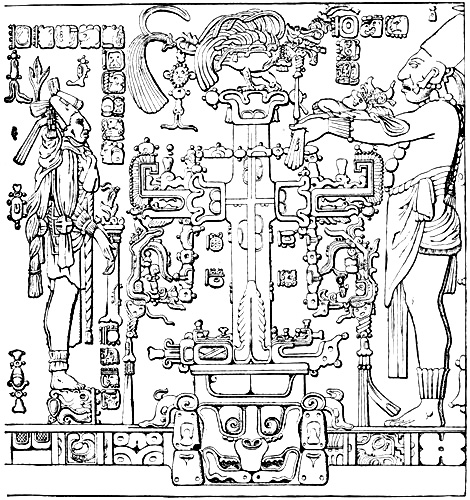
Plate 20. Palenque Cross, Foliated. Smithsonian Contributions to Knowledge, Vol. XXII, fig. 7.
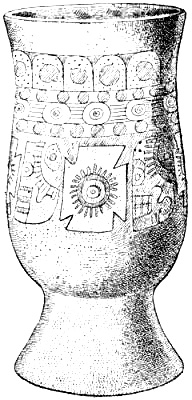
Dozens of other specimens are in the collections of the U. S. National Museum which would serve to illustrate the extended and extensive use of the cross in great variety of forms, so that no argument as to either the meaning or the extent of the cross can be based on the supposition that these are the only specimens. Fig. 313 (Cat. No. 132975, U. S. N. M.) shows a vase from Mexico, about 8 inches high, of fine red ware, highly polished, with an elaborate decoration. Its interest here is the Maltese cross represented on each side, with a point and concentric circles, from the outside of which are projecting rays. This may be the symbol of the sun, and if so, is shown in connection with the cross. This style of cross, with or without the sun symbol, is found in great numbers in Mexico—as, for example, the great cross, pl. 20, from the temple at Palenque.[285]
SYMBOLIC MEANINGS OF THE CROSS.
Fig. 313. POTTERY VASE FINELY DECORATED IN RED AND WHITE GLAZE. Maltese cross with sun symbol (?). Cat. No. 132975, U. S. N. M.
It would be an excellent thing to dissect and analyze the Swastika material we have found; to generalize and deduce from it a possible theory as to the origin, spread, and meaning of the Swastika and its related forms, and endeavor, by examination of its associated works, to discover if these were religious symbols or charms or mere decorations; and, following this, determine if possible whether the spread of these objects, whatever their meaning, was the result of migration, contact, or communication. Were they the result of similar, but independent, operations of the human mind, or were they but duplicate inventions, the result of parallelism in human thought? This investigation must necessarily be theoretical and speculative. The most that the author proposes is to suggest probabilities and point the way for further investigation. He may theorize and speculate, but recognizes what many persons seem not able to do—that speculation and theory are not to be substituted for cold facts. He may do no more than propound questions from which other men, by study, experience, philosophy, or psychology, may possibly evolve some general principle, or a theory pointing to a general principle, concerning the mode of extension and spread of culture among separate and independent peoples. When the facts shall have been gathered, marshaled, arranged side by side, and each aggregation of facts shall have been weighed, pro and con, and its fair value given “without prejudice or preconceived opinion,” then will be time enough to announce the final conclusion, and even then not dogmatically, but tentatively and subject to future discoveries.
Throughout this paper the author has sought but little more than to prepare material on the Swastika which can be utilized by those who come after him in the determination of the difficult and abstruse problems presented.
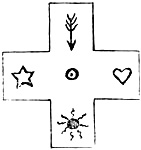
Fig. 314. GREEK CROSS REPRESENTING WINDS FROM CARDINAL POINTS. Dakota Indians. Tenth Annual Report of the Bureau of Ethnology, fig. 1255.
It is rare in the study of archæology and, indeed, in any science, that a person is able to assert a negative and say what does not exist. The present investigations are rendered much more comprehensive by the appearance of the extensive and valuable work of Col. Garrick Mallery in the Tenth Annual Report of the Bureau of Ethnology, on the subject of “Picture Writing of the American Indians.” It is a work of about 800 pages, with 1,300 illustrations, and is the result of many years of laborious study. It purports to be a history, more or less complete, of the picture writing, signs, symbols, totems, marks, and messages of the American Indian, whether pictographs or petroglyphs. A large portion of his work is devoted to ideography, conventional signs, syllabaries and alphabets, homorophs and symmorophs, and their respective means of interpretation. Among these he deals, not specifically with the Swastika, but in general terms with the cross. Therefore, by looking at Colonel Mallery’s work upon this chapter (p. 724), one is able to say negatively what has not been found.
Apropos of the meanings of the cross among the North American Indians Count Goblet d’Alviella says:[286]
It is nevertheless incontestable that the pre-Columbian cross of America is a “rose des vents,” representing the four directions whence comes the rain, or the cardinal points of the compass, etc., etc.
Colonel Mallery’s volume shows that it meant many other things as well.
The four winds.—The Greek cross is the form found by Colonel Mallery to be most common among the North American aborigines, possibly because it is the simplest. In this the four arms are equal in length, and the sign placed upright so that it stands on one foot and not on two, as does the St. Andrew’s cross. The Greek cross (fig. 314) represents, among the Dakotas, the four winds issuing out of the four caverns in which souls of men existed before the incarnation of the human body. All the medicine men—that is, conjurors and magicians—recollect their previous dreamy life in these places, and the instructions then received from the gods, demons, and sages; they recollect and describe their preexistent life, but only dream and speculate as to the future life beyond the grave. The top of the cross is the cold, all-conquering giant, the North Wind, most powerful of all. It is worn on the body nearest the head, the seat of intelligence and conquering devices. The left arm covers the heart; it is the East Wind, coming from the seat of life and love. The foot is the melting, burning South Wind, indicating, as it is worn, the seat of fiery passion. The right arm is the gentle West Wind, blowing from the spirit land, covering the lungs, from which the breath at last goes out gently, but into unknown night. The center of the cross is the earth and man, moved by the conflicting influences of gods and winds.
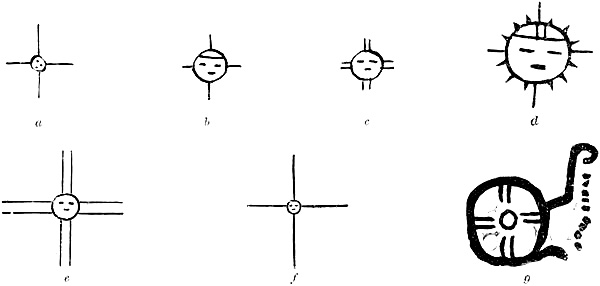
Fig. 315. THE CROSS IN CONNECTION WITH THE CIRCLE. Sun symbols (?). Tenth Annual Report of the Bureau of Ethnology, fig. 1118, 1120, 1126.
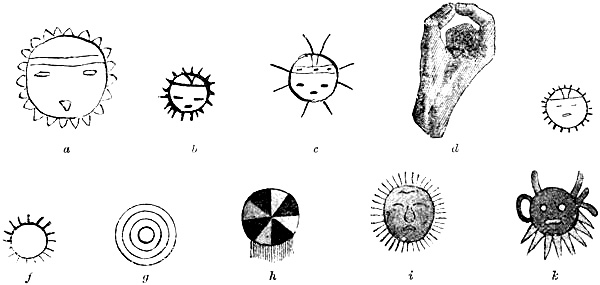
Fig. 316. FIGURES OF CIRCLES AND RAYS PROBABLY REPRESENTING SUN SYMBOLS. Tenth Annual Report of the Bureau of Ethnology, figs. 1118-1121, 1123.
Rev. John McLain, in his work on the “Blackfoot Sun-dance,” says:
On the sacred pole of the sun lodge of the Blood Indian is a bundle of small brushwood taken from the birch tree, which is placed in the form of a cross. This was an ancient symbol evidently referring to the four winds.

Fig. 317. FIGURES OF CROSSES AND CIRCLES REPRESENTING STAR SYMBOLS. Oakley Springs, Ariz. Tenth Annual Report of the Bureau of Ethnology, fig. 1129.
Sun and star symbols.—Great speculation has been made, both in Europe and America, over the relation between the Swastika and the sun, because the two signs have been associated by primitive peoples. Colonel Mallery gives the Indian signs for the sun, stars, and light.[287] These have been segregated, and it will be seen that the cross and circle are used indiscriminately for one and the other, and the fact of the two being found associated is no evidence of relationship in religious ideas (figs. 315-319).
Fig. 318. STAR SYMBOL. Circle and rays without cross. Oakley Springs, Ariz. Tenth Annual Report of the Bureau of Ethnology, fig. 1129.

Fig. 319. FIGURES OF CROSSES, CIRCLES, AND SQUARES REPRESENTING LODGES. Dakota Indians. Tenth Annual Report of the Bureau of Ethnology, fig. 1203.
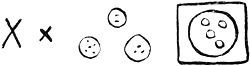
Fig. 320. LATIN CROSSES REPRESENTING THE DRAGON FLY. Dakota Indians.
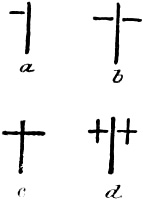
Dwellings.—Among the Hidatsa, the cross and the circle represent neither the sun nor any religious ideas, but merely lodges, houses, or dwellings. The crosses in fig. 319 represent Dakota lodges; the small circles signify earth lodges, the points representing the supporting poles. Buildings erected by civilized people were represented by small rectangular figures, while the circles with dots in a square represent earth lodges, the home of the Hidatsa.
Dragon fly (Susbeca).—Among some of the Indian tribes, the Dakotas among others, the Latin cross is found, i. e., upright with three members of equal length, and the fourth, the foot, much longer. The use of this symbol antedates the discovery of America, and is carried back in tradition and myth. This sign signifies the mosquito hawk or the dragon fly (fig. 320). It is called in that language the “Susbeca,” and is a supernatural being gifted with speech, warning man of danger, approaching his ear silently and at right angles, saying, “Tci,” “tci,” “tci,” an interjection equivalent to “Look out!” “You are surely going to destruction!” “Look out!” “Tci,” “tci,” “tci!” The adoption of the dragon fly as a mysterious and supernatural being is on account of its sudden appearance in numbers. In the still of the evening, when the shades of darkness come, then is heard in the meadows a sound as of crickets or frogs, but indistinct and prolonged; on the morrow the Susbeca will be hovering over it. It is the sound of their coming, but whence no one knows. The cross not only represents the shape of the insect, but also the angle of its approach. It is variously drawn, but usually as in fig. 320 a or b, and, in painting or embroidery, c, and sometimes d.
Fig. 321. DOUBLE CROSS OF SIX ARMS REPRESENTING THE DRAGON FLY. Moki Indians, Arizona. Tenth Annual Report of the Bureau of Ethnology, fig. 1165.
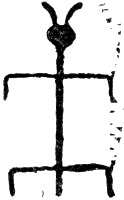
Fig. 321 is described in Keam’s MS. as follows:
This is a conventional design of dragon flies, and is often found among rock etchings throughout the plateau [Arizona]. The dragon flies have always been held in great veneration by the Mokis and their ancestors, as they have been often sent by Oman to reopen springs which Muingwa had destroyed and to confer other benefits upon the people.
This form of the figure, with little vertical lines added to the transverse lines, connects the Batolatci with the Ho-bo-bo emblems. The youth who was sacrificed and translated by Ho-bo-bo reappeared a long time afterwards, during a season of great drought, in the form of a gigantic dragon fly, who led the rain clouds over the lands of Ho-pi-tu, bringing plenteous rains.
Fig. 322. FIGURES OF CROSSES AS USED BY THE ESKIMO TO REPRESENT FLOCKS OF BIRDS. Tenth Annual Report of the Bureau of Ethnology, fig. 1228. Cat Nos. 44211 and 45020, U. S. N. M.
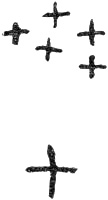
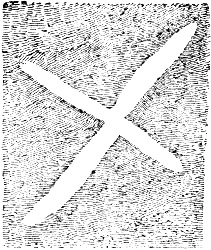
Fig. 323. PETROGLYPH FROM TULARE VALLEY, CALIFORNIA. Large white Greek cross. Tenth Annual Report of the Bureau of Ethnology, fig. 1229.
Midēᐟ or Shamans.—Colonel Mallery (or Dr. Hoffman) tells us (p. 726) that among the Ojibways of northern Minnesota the cross is one of the sacred symbols of the Society of Midēᐟ or Shamans and has special reference to the fourth degree. The building in which the initiation is carried on has its opening toward the four cardinal points. The cross is made of saplings, the upright poles approaching the height of four to six feet, the transverse arms being somewhat shorter, each being of the same length as the top; the upper parts are painted white or besmeared with white clay, over which are spread small spots of red, the latter suggesting the sacred shell of Midēᐟ, the symbol of the order. The lower arm of the pole is square, the side toward the east being painted white to denote the source of light and warmth; the face on the south is green, denoting the source of the thunder bird which brings the rains and vegetation; the surface toward the west is covered with vermilion, relating to the land of the setting sun, the abode of the dead; the north is painted black, as the direction from which comes affliction, cold, and hunger.
Flocks of birds.—Groups of small crosses on the sides of Eskimo bow drills represent flocks of birds (Cat. Nos. 45020 and 44211, U. S. N. M.). They are reproduced in fig. 322. Colonel Mallery’s fig. 28, page 67, represents a cross copied from the Najowe Valley group of colored pictographs, 40 miles west of Santa Barbara, Santa Barbara County, Cal. The cross measured 20 inches in length, the interior being painted black while the border is of a dark red tint. This design, as well as others in close connection, is painted on the walls of a shallow cave or rock shelter in the limestone formation. Fourteen miles west of Santa Barbara, on the summit of the Santa Ynez Mountains, is a cavern having a large opening west and north, in which are crosses of the Greek type, the interior portion being painted a dull earthy red, while the outside line is a faded-black tint. The cross measures nearly a foot in extent. At the Tulare Indian Agency, Cal., is an immense bowlder of granite. It has been split, and one of the lower quarters has been moved sufficiently to leave a passageway six feet wide and nearly ten feet high. The interior walls are well covered with large painted figures, while upon the ceilings are numerous forms of animals, birds, and insects. Among this latter group is a white cross about 18 inches in length (fig. 323), presenting a unique appearance, for the reason that it is the only petroglyph in that region to which the white coloring matter has been applied.
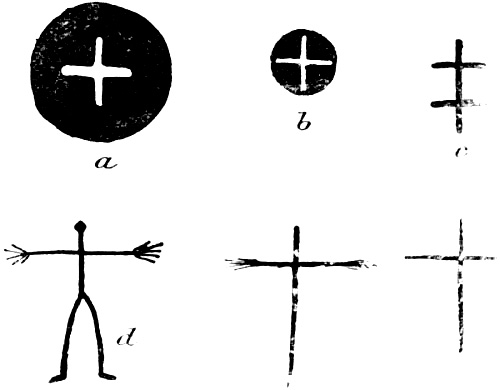
Fig. 324. PETROGLYPHS FROM OWEN’S VALLEY, CALIFORNIA. (a, b) Greek crosses, (c) double Latin cross, (d-f) Latin crosses representing human figures. Tenth Annual Report of the Bureau of Ethnology, fig. 1230.
An interesting example of rock sculpturing in groups is in Owens Valley, south of Benton, Cal. Among them are various forms of crosses, and circles containing crosses of simple and complex types. The most interesting in this connection are the groups in fig. 324, a and b. The larger one, a, occurs upon a large bowlder of tracite 16 miles south of Benton, at the “Chalk grave.” The circle is a depression about one inch in depth, the cross being in high relief. The small cross b, found three miles north from this is almost identical, the arms of the cross, however, extending to the rim of the circle. In this locality occurs also the cross, c, same figure, and some examples having more than two cross arms.
Fig. 325. CROSS IN ZIGZAG LINES REPRESENTING THE HUMAN FORM. Navajo Indians.
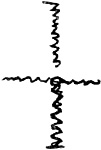
Human forms.—Other simple crosses represent the human form. Some of these are engraved or cut on the rocks of Owens Valley and are similar to those above described (fig. 324), but they have been eroded, so that beyond the mere cross they show slight relation to the human body (fig. 324, d, e, f). Col. James Stevenson, describing the Hasjelti ceremony of the Navajoes,[288] shows the form of a man drawn in the sand (fig. 325). Describing the character shown in fig. 326, Keam says: “The figure represents a woman. The breath is displayed in the interior.”[289]
Fig. 326. MALTESE CROSS(?) REPRESENTING A WOMAN. The figure in the center is intended to indicate the breath.
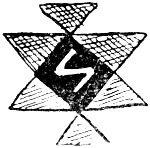
Fig. 327. MALTESE AND SAINT ANDREW’S CROSSES. Emblems of maidenhood. Moki Indians.
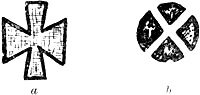
Maidenhood.—Concerning fig. 327 Keam, in his manuscript, says the Maltese cross was the emblem of a virgin, and is still so recognized by the Moki. It is a conventional development of the common emblem of maidenhood, wherein the maidens wear their hair arranged as in a disk three or four inches in diameter on each side of the head (fig. 327b). This discoidal arrangement of the hair is typical of the emblem of fructification worn by the virgin in the Muingwa festival. Sometimes the hair, instead of being worn in the complete discoidal form, is dressed upon two curving twigs, and presents the form of two semicircles upon each side of the head. The partition of these is sometimes horizontal, sometimes vertical. The combination of these styles (fig. 327 a and b) present the forms from which the Maltese cross was conventionalized.[290]
Fig. 328. CROSS WITH BIFURCATED FOOT. Used by the Innuits to represent a shaman or evil spirit.
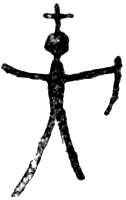
Shaman’s spirit.—Among the Kiatéxamut and Innuit tribes, a cross placed on the head, as in fig. 328, signified a shaman’s evil spirit or demon. This is an imaginary being under the control of the shaman to execute his wishes.[291]
Divers significations.—The figure of the cross among the North American Indians, says Colonel Mallery,[292] has many differing significations. It appears “as the tribal sign for Cheyenne” (p. 383); “as Dakota lodges” (p. 582); “as a symbol for trade or exchange” (p. 613); “as a conventional sign for prisoners” (p. 227); “for personal exploits while elsewhere it is used in simple enumeration” (p. 348). Although this device is used for a variety of meanings when it is employed ceremonially or in elaborate pictographs of the Indians both of North and South America, it represents the four winds. This view long ago was suggested as being the signification of many Mexican crosses, and it is sustained by Prof. Cyrus Thomas in his “Notes on Mayan Mexican Manuscript,”[293] where strong confirmatory evidence is produced by the arms of the crosses having the appearance of conventionalized wings similar to some representations of the thunder bird of the northern tribes; yet the same author, in his paper on the study of the “Troano Manuscript,”[294] gives fig. 329 as a symbol for wood, thus further showing the manifold concepts attached to the general form of the cross. Bandelier thinks that the cross so frequently used by the aborigines of Mexico and Central America were merely ornaments and not objects of worship, while the so-called crucifixes, like that on the Palenque tablet, were only the symbol of the “new fire,” or the close of the period of fifty-two years. He believes them to be representations of the fire drills more or less ornamented. Zamacois[295] says that the cross was used in the religion of various tribes of the peninsula of Yucatan, and that it represented the god of rain.
Fig. 329. ST. ANDREW’S CROSSES, USED AS A SYMBOL FOR WOOD. Tenth Annual Report of the Bureau of Ethnology, fig. 1233.
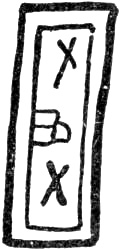
It is a favorite theory with Major Powell, Director of the Bureau of Ethnology, that the cross was an original invention of the North American Indian, possibly a sign common to all savages; that it represented, first, the four cardinal points, north, south, east, and west; and afterwards by accretion, seven points, north, south, east, west, zenith, nadir, and here.
Capt. John G. Bourke, in his paper on the “Medicine Men of the Apache”[296] discourses on their symbolism of the cross. He says it is related to the cardinal points, to the four winds, and is painted by warriors on their moccasins when going through a strange district to keep them from getting on a wrong trail. He notes how he saw, in October, 1884, a procession of Apache men and women bearing two crosses, 4 feet 10 inches long, appropriately decorated “in honor of Guzanutlí to induce her to send rain.”
Dr. Brinton[297] tells of the rain maker of the Lenni Lenape who first drew on the earth the figure of a cross. Captain Bourke quotes from Father Le Clerq[298] as to the veneration in which the cross was held by the Gaspesian Indians, also from Herrara to the same effect. Professor Holmes[299] makes some pertinent observations with regard to the meanings of the cross given by the American Indians:
Some very ingenious theories have been elaborated in attempting to account for the cross among American symbols. Brinton believes that the great importance attached to the points of the compass—the four quarters of the heavens—by savage peoples, has given rise to the sign of the cross. With others, the cross is a phallic symbol derived, by some obscure process of evolution, from the veneration accorded to the procreative principle in nature. It is also frequently associated with sun worship, and is recognized as a symbol of the sun—the four arms being remaining rays after a gradual process of elimination. Whatever is finally determined in reference to the origin of the cross as a religious symbol in America will probably result from exhaustive study of the history, language, and art of the ancient peoples, combined with a thorough knowledge of the religious conceptions of modern tribes, and when these sources of information are all exhausted it is probable that the writer who asserts more than a probability will overreach his proofs. * * * A study of the designs associated with the cross in these gorgets [figs. 302-304] is instructive, but does not lead to any definite result; in one case the cross is inscribed on the back of a great spider [figs. 275-278]; in another it is surrounded by a rectangular framework of lines, looped at the corners and guarded by four mysterious birds [figs. 263-266], while in others it is without attendant characters, but the workmanship is purely aboriginal. I have not seen a single example of engraving upon the shell that suggested a foreign hand, or a design, with the exception of this one [a cross], that could claim a European derivation. * * * Such delineations of the cross as we find embodied in ancient aboriginal art, represent only the final stages of its evolution, and it is not to be expected that its origin can be traced through them.
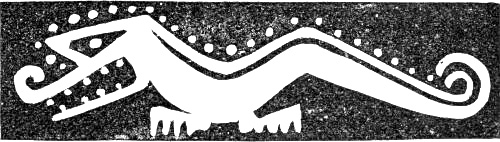
Fig. 330. GRAPHIC DELINEATION OF ALLIGATOR. From a vase of the lost color group. Chiriqui. Sixth Annual Report of the Bureau of Ethnology, fig. 257.
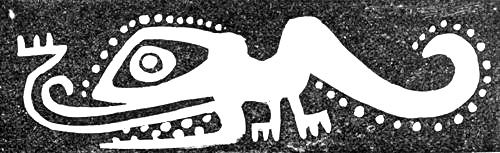
Fig. 331. GRAPHIC DELINEATION OF ALLIGATOR. From a vase of the lost color group. Chiriqui. Sixth Annual Report of the Bureau of Ethnology, fig. 258.
Continuing in his “Ancient Art in Chiriqui,”[300] presenting his “Series showing stages in the simplification of animal characters,” and “derivation of the alligator,” Professor Holmes elaborates the theory how the alligator was the original, and out of it, by evolution, grew the cross. His language and accompanying figures are quoted:
Of all the animal forms utilized by the Chiriquians, the alligator is the best suited to the purpose of this study, as it is presented most frequently and in the most varied forms. In figs. 257 and 258 [figs. 330 and 331 in the present paper] I reproduce drawings from the outer surface of a tripod bowl of the lost color group. Simple and formal as these figures are, the characteristic features of the creature—the sinuous body, the strong jaws, the upturned snout, the feet, and the scales—are forcibly expressed. It is not to be assumed that these examples represent the best delineative skill of the Chiriquian artist. The native painter must have executed very much superior work upon the more usual delineating surfaces, such as bark and skins. The examples here shown have already experienced decided changes through the constraints of the ceramic art, but are the most graphic delineations preserved to us. They are free-hand products, executed by mere decorators, perhaps by women, who were servile copyists of the forms employed by those skilled in sacred art.
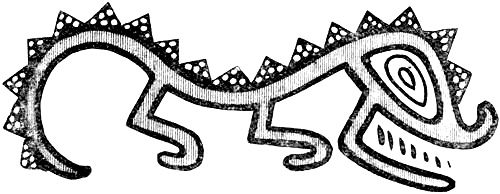
Fig. 332. CONVENTIONAL FIGURE OF ALLIGATOR. From a vessel of the lost color group. Chiriqui. Sixth Annual Report of the Bureau of Ethnology, fig. 259.
A third illustration from the same group of ware, given in fig. 259 [fig. 332 of the present paper] shows, in some respects, a higher degree of convention. * * *
Fig. 333. CONVENTIONAL FIGURE OF ALLIGATOR CROWDED INTO A SMALL GEOMETRICAL FIGURE. Chiriqui. Sixth Annual Report of the Bureau of Ethnology, fig. 265.
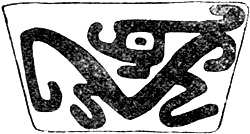
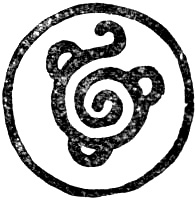
I shall now call attention to some important individualized or well-defined agencies of convention. First, and most potent, may be mentioned the enforced limits of the spaces to be decorated, which spaces take shape independently of the subject to be inserted. When the figures must occupy a narrow zone, they are elongated; when they must occupy a square, they are restricted longitudinally, and when they occupy a circle, they are of necessity coiled up. Fig. 265 [fig. 333 of the present paper] illustrates the effect produced by crowding the oblong figure into a short rectangular space. The head is turned back over the body and the tail is thrown down along the side of the space. In fig. 266 [fig. 334 of the present paper] the figure occupies a circle and is, in consequence, closely coiled up, giving the effect of a serpent rather than an alligator. * * *
Fig. 334. CONVENTIONAL FIGURE OF ALLIGATOR CROWDED INTO A CIRCLE. Chiriqui. Sixth Annual Report of the Bureau of Ethnology, fig. 266.
I present five series of figures designed to illustrate the stages through which life forms pass in descending from the realistic to highly specialized conventional shapes. In the first series (fig. 277) [fig. 335 of the present paper] we begin with a, a meager but graphic sketch of the alligator; the second figure, b, is hardly less characteristic, but is much simplified; in the third, c, we have still three leading features of the creature—the body line, the spots, and the stroke at the back of the head; and in the fourth, d, nothing remains but a compound yoke-like curve, standing for the body of the creature, and a single dot.
The figures of the second series (fig. 278) [fig. 336 of the present paper] are nearly all painted upon low, round nodes placed about the body of the alligator vases, and hence are inclosed in circles. The animal figure in the first example is coiled up like a serpent [fig. 334], but still preserves some of the well-known characters of the alligator. In the second example [fig. 336b] we have a double hook near the center of the space which takes the place of the body, but the dotted triangles are placed separately against the encircling line. In the next figure the body symbol is omitted and the three triangles remain to represent the animal. In the fourth there are four triangles, and the body device being restored in red takes the form of a cross. In the fifth two of the inclosing triangles are omitted and the idea is preserved by the simple dots. In the sixth the dots are placed within the bars of the cross, the triangles becoming mere interspaces, and in the seventh the dots form a line between the two encircling lines. This series could be filled up by other examples, thus showing by what infinitesimal steps the transformations take place. * * *
We learn by the series of steps illustrated in the annexed cuts that the alligator radical, under peculiar restraints and influences, assumes conventional forms that merge imperceptibly into these classic devices.

Fig. 335. SERIES OF FIGURES OF ALLIGATORS SHOWING STAGES OF SIMPLIFICATION. Chiriqui. Sixth Annual Report of the Bureau of Ethnology, fig. 277.
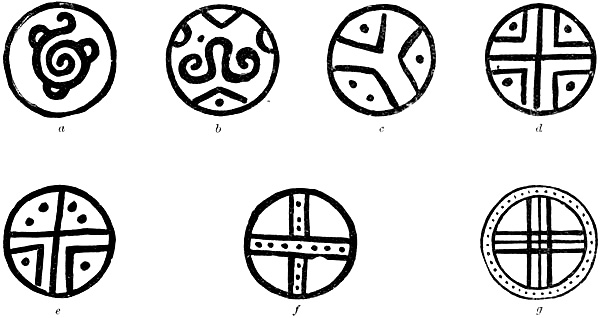
Fig. 336. SERIES SHOWING STAGES IN THE SIMPLIFICATION OF ANIMAL CHARACTERS, BEGINNING WITH THE ALLIGATOR AND ENDING WITH THE GREEK CROSS. Chiriqui. Sixth Annual Report of the Bureau of Ethnology, fig. 278.
Professor Holmes’s theory of the evolution of the cross from the alligator and its location in Chiriqui is opposed to that of Professor Goodyear, who, in his “Grammar of the Lotus,” ascribes the origin of the cross to the lotus and locates it in Egypt. I file what in law would be an “interpleader”—I admit my want of knowledge of the subject under discussion, and leave the question to these gentlemen.
INTRODUCTION OF THE CROSS INTO AMERICA.
Professor Holmes is, in the judgment of the author, correct when he insists upon the aboriginal character of the cross in America. We all understand how it is stated that the Spanish missionaries sought to deny this and to connect the apparition of St. Thomas with the appearance of the cross. Professor Holmes[301] says:
The first explorers were accompanied by Christian zealots who spared no effort to root out the native superstition and introduce a foreign religion of which the cross was the all-important symbol. This emblem was generally accepted by the savages as the only tangible feature of a new system of belief that was filled with subtleties too profound for their comprehension. As a result, the cross was at once introduced into the regalia of the natives, at first probably in a European form and material, attached to a string of beads in precisely the manner they had been accustomed to suspend their own trinkets and gorgets; but soon, no doubt, delineated or carved by their own hands upon tablets of stone and copper and shell in the place of their own peculiar conceptions.
There is sufficient evidence, and to spare, of the aboriginal use of the cross in some of its forms, without resorting to the uncertain and forced explanation of its introduction by Christian missionaries. It is possible that the priests and explorers were, like Colonel Mallery’s missionary, mistaken as to the interpretation given to the cross by the Indians. Dr. Hoffman, in his paper on the “Midēᐟwiwin or Grand Medicine Society of the Ojibwa,”[302] states the myth of the re-creation of the world “as thrown together in a mangled form by Hennepin.” Dr. Hoffman observes:
It is evident that the narrator has sufficiently distorted the traditions to make them conform as much as practicable to the Biblical story of the birth of Christ.
And on the same page he quotes from Pêre Marquette, who says:
“I was very glad to see a great cross set up in the middle of the village, adorned with several white skins, red girdles, bows, and arrows, which that good people offered to the Great Manitou to return him their thanks for the care he had taken of them during the winter, and that he had granted them a prosperous hunting.”
Marquette [comments Dr. Hoffman] was, without doubt, ignorant of the fact that the cross is the sacred post, and the symbol of the fourth degree of the Midēᐟwiwin, as is fully explained in connection with that grade of society. The erroneous conclusion that the cross was erected as an evidence of the adoption of Christianity and, possibly as a compliment to the visitor was a natural one on the part of the priest, but this same symbol of the Midēᐟ society had probably been erected and bedecked with barbaric emblems and weapons months before anything was known of him.
Most aboriginal objects bearing crosses are from localities along the Ohio River and through Kentucky and Tennessee, a locality which the early Christian missionaries never visited, and where the cross of Christ was rarely, if ever, displayed until after that territory became part of the United States. Per contra, the localities among the Indians in which the early missionaries most conducted their labors—that is to say, along the Great Lakes and throughout northern Illinois—produce the fewest number of aboriginal crosses. This was the country explored by Fathers Marquette, Lasalle, and Hennepin, and it was the scene of most of the Catholic missionary labors. Professor Holmes seems to have recognized this fact, for he says:[303]
The cross was undoubtedly used as a symbol by the prehistoric nations of the South, and, consequently, that it was probably also known in the North. A great majority of the relics associated with it in the ancient mounds and burial places are undoubtedly aboriginal. In the case of the shell gorgets, the tablets themselves belong to an American type, and are highly characteristic of the art of the Mississippi Valley. A majority of the designs engraved upon them are also characteristic of the same district.
The author agrees heartily with Professor Holmes’s argument in this matter, and his conclusion, when he says of these objects (p. 270):
The workmanship is purely aboriginal. I have not seen a single example of engraving upon shell that suggested a foreign hand or a design, with the exception of one (cross), that could claim a European derivation.
There have been numerous European or Catholic crosses, as well as many other objects of European manufacture or objects of civilized types, found among the Indians. There have been silver crosses found with images of the Virgin thereon, with Latin inscriptions, or of Roman letters; there have been glass beads, iron arrowheads, and divers other objects found in Indian graves which bore indubitable evidence of contact with the whites, and no one with any archæological experience need be deceived into the belief that these were aboriginal or pre-Columbian manufacture. As a general rule, the line of demarkation between objects of Indian manufacture and those made by the whites is definite, and no practiced eye will mistake the one for the other. There may be exceptions, as where the Indian has lived with the whites or a white man with the Indians, or where an object is made with intent to deceive. In such cases one may have more trouble in determining the origin of the object.
There were many Indians who died and were buried within a century past, whose graves might contain many objects of white man’s work. Black Hawk and Red Jacket are examples, and, possibly, King Philip. Indian graves have been opened in New England and New York containing the gun or firelock of the occupant of the grave buried with him, and that this was evidence of European contact there can be no doubt. So there have been hundreds, possibly thousands, of Indians buried since the Columbian discovery down to within the last decade whose graves contain white man’s tools or implements. But no person with any archæological experience need be deceived by these things. The theory that the Latin or Greek crosses or Swastikas shown on these gorgets, disks, and pottery furnish evidence of contact by the aborigines with Europeans in post-Columbian times is without foundation and inadmissible.
DECORATIVE FORMS NOT OF THE CROSS, BUT ALLIED TO THE SWASTIKA.
COLOR STAMPS FROM MEXICO AND VENEZUELA.
The aborigines of Mexico and Central and South America employed terra-cotta color stamps, which, being made into the proper pattern in the soft clay, were burned hard; then, being first coated with color, the stamp was pressed upon the object to be decorated, and so transferred its color, as in the mechanical operation of printing, thus giving the intended decoration. Patterns of these stamps are inserted in this paper in connection with the Swastika because of the resemblance—not in form, but in style. They are of geometric form, crosses, dots, circles (concentric and otherwise), lozenges, chevrons, fret, and labyrinth or meander. The style of this decoration lends itself easily to the Swastika; and yet, with the variety of patterns contained in the series of stamps belonging to the U. S. National Museum, shown in figs. 337 to 342, no Swastika appears; nor in the similar stamps belonging to other collections, notably that of Mr. A. E. Douglass, in the Metropolitan Museum of Natural History, Central Park, New York, are any Swastikas shown. Of the foregoing figures, all are from Tlaltelolco, Mexico (Blake collection), except fig. 339, which is from the Valley of Mexico, and was received from the Museo Nacional of Mexico.
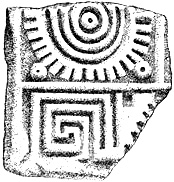
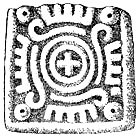
Fig. 337. Fig. 338.
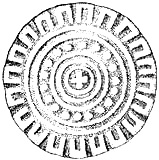
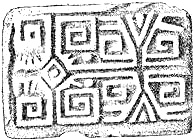
Fig. 339. Fig. 340.
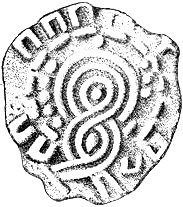
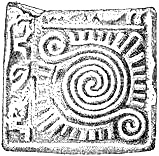
Fig. 341. Fig. 342.
TERRA-COTTA COLOR STAMPS WITH DESIGNS SIMILAR TO THE SWASTIKA. Mexico. Cat. Nos. 99124, 99127, 27887, 99115, 99118, 99122, U. S. N. M.
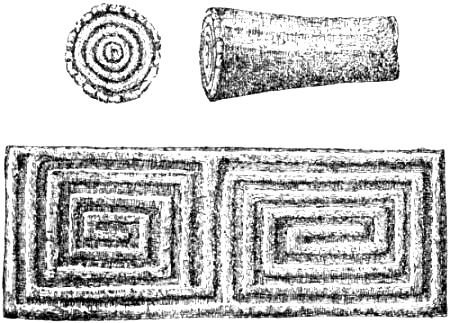
Fig. 343. TERRA-COTTA COLOR STAMPS WITH DESIGNS SIMILAR TO THE SWASTIKA. Piaroa Indians, Venezuela. Tenth Annual Report of the Bureau of Ethnology, fig. 982.
Marcano says:[304]
The present Piaroas of Venezuela are in the habit of painting their bodies by a process different from that of the North American Indian. They make stamps of wood, which, being colored (as types are with ink), they apply to their bodies. Fig. 982 shows examples of these stamps. [See fig. 343 of the present paper.] The designs are substantially the same as some petroglyphs. They either copied the models they found carved on the rocks by peoples who preceded them, or they knew the meaning and preserved the tradition. The former is the only tenable hypothesis. Painting is to the Piaroas both ornamentation and necessity. It serves, not only as a garment to protect them against insects, but becomes a fancy costume to grace their feasts and meetings.
These designs are not presented as Swastikas nor of any evolution or derivation from one. They show a style common enough to Central and South America, to the Antilles and the Canary Islands,[305] which might easily produce a Swastika. The aboriginal designer of these might, if we depend upon the theory of psychological similarity of culture among all peoples, at his next attempt make a Swastika. Yet, with the hundreds of similar patterns made during the centuries of aboriginal occupation and extending throughout the countries named, none of these seem ever to have produced a Swastika.