TABLE OF CONTENTS.
Reading edition
Page.
Preface763
I.—Definitions, Description, and Origin.
Different forms of the cross765
Names and definitions of the Swastika768
Symbolism and interpretation770
Origin and habitat791
II.—Dispersion of the Swastika.
Extreme Orient799
Japan799
Korea799
China799
Tibet802
India802
Classical Orient806
Babylonia, Assyria, Chaldea, and Persia806
Phenicia807
Lycaonia807
Armenia807
Caucasus808
Asia Minor—Troy (Hissarlik)809
First and Second Cities810
The Third or Burnt City811
The Fourth City813
The Fifth City818
The Sixth and Seventh Cities819
Leaden idol of Hissarlik829
Owl-shaped vases830
The age of Trojan cities832
Africa833
Egypt833
Naukratis834
Coptos (Achmim-Panopolis)834
Algeria838
Ashantee838
Classical Occident—Mediterranean839
Greece, Cyprus, Rhodes, Melos, and Thera839
Greek fret and Egyptian meander not the same as the Swastika839
Swastika in panels845
Swastikas with four arms crossing at right angles, ends bent to the right846
Swastikas with four arms crossing at right angles, ends bent to the left847
Swastikas with four arms crossing at other than right angles, the ends ogee and to the left848
Meander pattern, with ends bent to the right and left849
Swastikas of different kinds on the same object849
Europe854
Bronze age854
Etruria and Italy855
Swiss lake dwellings861
Germany and Austria862
Belgium863
Scandinavia864
Scotland and Ireland867
Gallo-Roman period869
France869
Anglo-Saxon period870
Britain870
Swastika on ancient coins871
Triskelion, Lycia871
Triskelion, Sicily873
Triskelion, Isle of Man874
Punch marks on Corinthian coins mistaken for Swastikas875
Swastika on ancient Hindu coins877
Swastika on coins in Mesembria and Gaza878
Swastika on Danish gold bracteates878
United States of America879
Pre-Columbian times879
Fains Island and Toco mounds, Tennessee879
Hopewell Mound, Chillicothe, Ross County, Ohio888
Mounds in Arkansas893
North American Indians894
Kansas894
Sacs895
Pueblos896
Navajoes897
Pimas901
Colonial patchwork901
Central America902
Nicaragua902
Yucatan902
Costa Rica903
South America903
Brazil903
Paraguay905
III.—Forms Allied To the Swastika.
Meanders, ogees, and spirals, bent to the left as well as to the right905
Aboriginal American engravings and paintings906
Designs on shell906
Ivory-billed woodpecker907
The triskele, triskelion, or triquetrum908
The spider913
The rattlesnake914
The human face and form914
Designs on pottery920
Designs on basketry924
IV.—The Cross Among the American Indians.
Different forms926
The cross on objects of shell and copper926
The cross on pottery931
Symbolic meanings of the cross933
The four winds934
Sun and star symbols936
Dwellings936
Dragon fly (Susbeca)936
Midēᐟ, or Shamans937
Flocks of birds937
Human forms938
Maidenhood939
Shaman’s spirit939
Divers significations939
Introduction of the cross into America944
Decorative forms not of the cross, but allied to the Swastika946
Color stamps from Mexico and Venezuela946
V.—Significance of the Swastika.948
VI.—The Migration of Symbols.
Migration of the Swastika952
Migration of classic symbols960
The sacred tree of the Assyrians960
The sacred cone of Mesopotamia960
The Crux ansata, the key of life961
The winged globe961
The caduceus962
The trisula963
The double-headed eagle on the escutcheon of Austria and Russia963
The lion rampant of Belgium963
Greek art and architecture964
The Greek fret965
VII.—Prehistoric Objects Associated with the Swastika, found in Both Hemispheres, and Believed to have passed by Migration.
Spindle whorls966
Europe967
Switzerland—Lake dwellings967
Italy968
Wurtemburg968
France968
North America—pre-Columbian times969
Mexico970
Central America971
Nicaragua971
South America972
Chiriqui972
Colombia972
Peru972
Bobbins975
Europe975
United States975
VIII.—Similar Prehistoric Arts, Industries, and Implements in Europe and America as Evidence of the Migration of Culture.977
Conclusion981
Bibliography984
List of Illustrations997
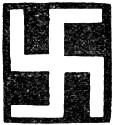
THE SWASTIKA,
THE EARLIEST KNOWN SYMBOL, AND ITS MIGRATIONS; WITH OBSERVATIONS ON THE MIGRATION OF CERTAIN INDUSTRIES IN PREHISTORIC TIMES.
By Thomas Wilson, Curator, Department of Prehistoric Anthropology, U. S. National Museum.