III.—Forms Allied to the Swastika.
Reading edition
MEANDERS, OGEES, AND SPIRALS, BENT TO THE LEFT AS WELL AS TO THE RIGHT.
There are certain forms related to the normal Swastika and greatly resembling it—meanders, ogees, the triskelion, tetraskelion, and five and six armed spirals or volutes. This has been mentioned above (page 768), and some of the varieties are shown in fig. 13. These related forms have been found in considerable numbers in America, and this investigation would be incomplete if they were omitted. It has been argued (p. 839) that the Swastika was not evolved from the meander, and this need not be reargued.
The cross with the arms bent or twisted in a spiral is one of these related forms. It is certain that in ancient, if not prehistoric, times the cross with extended spiral arms was frequently employed. This form appeared in intimate association with the square Swastikas which were turned indifferently to the right and left. This association of different yet related forms was so intimate, and they were used so indiscriminately as to justify the contention that the maker or designer recognized or admitted no perceptible or substantial difference between the square and spiral forms, whether they turned to the right or left, or whether they made a single or many turns, and that he classed them as the same sign or its equivalent. A Greek vase (fig. 174) shows five Swastikas, four of which are of different form (fig. 262). Curiously enough, the design of this Greek vase is painted maroon on a yellow ground, the style generally adopted in the vases from the mounds of Missouri and Arkansas, which mostly represent the spiral Swastika.
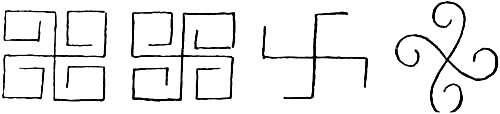
Fig. 262. DIFFERENT FORMS OF SWASTIKA FOR COMPARISON.
In Ireland a standing stone (fig. 215) has two forms of Swastika side by side. In one the arms are bent square at the corners, the other has curved or spiral arms, both turned to the right. These examples are so numerous that they would seem convincing in the absence of any other evidence (figs. 166 to 176).
ABORIGINAL AMERICAN ENGRAVINGS AND PAINTINGS.
These allied forms of Swastika appear on prehistoric objects from mounds and Indian graves in different parts of the country and in times of high antiquity as well as among modern tribes. This paper contains the results of the investigations in this direction.
DESIGNS ON SHELL.
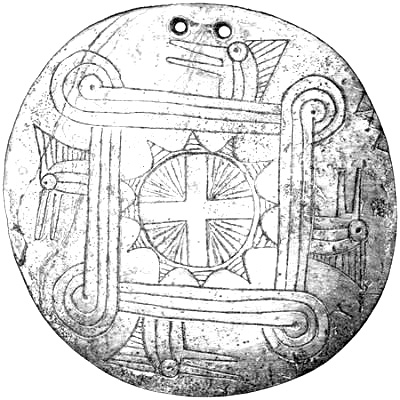
Fig. 263. SHELL GORGET. Cross, circle, sun’s rays(?), and heads of four ivory-billed woodpeckers(?) arranged to form a Swastika. Mississippi.
The Department of Prehistoric Anthropology in the U. S. National Museum, contains a considerable number of large shells of aboriginal workmanship. The shell most employed was that of the genus Fulgur, a marine shell found on the coast from Florida to the capes. The Unio was employed, as well as others. These marine shells were transported long distances inland. They have been found in mounds and Indian graves a thousand miles from their original habitat. They served as utensils as well as ornaments. In many specimens the whorl was cut out, the shells otherwise left entire, and they served as vessels for holding or carrying liquids. When intended for ornaments, they were cut into the desired form and engraved with the design; if to be used as gorgets, holes were drilled for suspension. Frequently they were smoothed on the outside and the design engraved thereon. The preference of the aborigines for the Fulgur shell may have been by reason of its larger size. Among the patterns employed for the decoration of these shells, the Swastika, in the form of spirals, volutes, or otherwise, appeared, although many others, such as the rattlesnake, birds, spiders, and human masks were employed. No detailed description of the patterns of this shellwork will be attempted, because figures will be required to give the needed information for the interpretation of the Swastika. Many of the cuts and some of the descriptions are taken from the annual reports of the Bureau of Ethnology and, so far as relates to shell, mostly from Mr. Holmes’s paper on “Art in Shell of the Ancient Americans.” I desire to express my thanks for all cuts obtained from the Bureau publications.
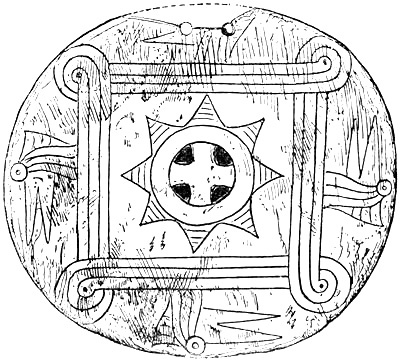
Fig. 264. SHELL GORGET FROM TENNESSEE. Square figure with ornamental corners and heads of ivory-billed woodpecker arranged to form a figure resembling the Swastika.
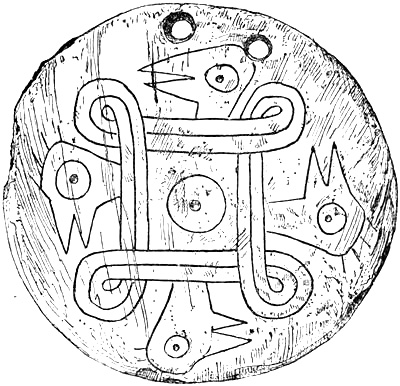
Fig. 265. SHELL GORGET FROM TENNESSEE. Square figure with ornamental corners and heads of ivory-billed woodpecker arranged to form a figure resembling the Swastika.
Ivory-billed woodpecker.—A series of gorgets in shell have been found ornamented with designs resembling the Swastika, which should be noticed. They combine the square and the cross, while the head and bill of the bird form the gamma indicative of the Swastika. Fig. 263, taken from the Second Annual Report of the Bureau of Ethnology, 1880-81 (pl. 58), shows one of these shell gorgets from Mississippi, which “was, in all probability, obtained from one of the multitude of ancient sepulchres that abound in the State of Mississippi.” The design is engraved on the convex side, the perforations are placed near the margin, and show much wear by the cord of suspension. In the center is a nearly symmetrical Greek cross inclosed in a circle of 1¼ inches. The spaces between the arms are emblazoned with radiating lines. Outside this circle are twelve small pointed or pyramidal rays. A square framework of four continuous parallel lines looped at the corners incloses this symbol; projecting from the center of each side of this square, opposite the arms of the cross, are four heads of birds representing the ivory-billed woodpecker, the heron, or the swan. The long, slender, and straight mandibles give the Swastika form to the object. Mr. Holmes says (p. 282) that he has been able to find six of these specimens, all of the type described, varying only in detail, workmanship, and finish.
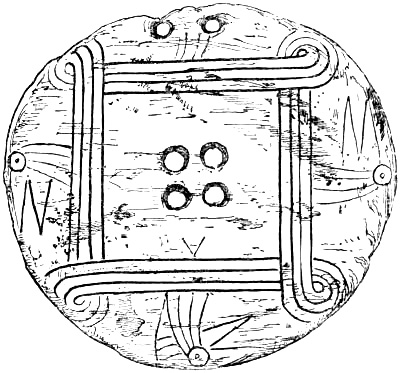
Fig. 266. SHELL GORGET FROM TENNESSEE. Square figure with ornamental corners and heads of ivory-billed woodpecker arranged to form a figure resembling the Swastika.
Figs. 264, 265, and 266,[267] represent three of these shell gorgets. The first was obtained by Professor Putnam from a stone grave, Cumberland River, Tennessee. It is about 2½ inches in diameter and, like the former, it has a Greek cross in the center. The second was obtained by Mr. Cross from a stone grave near Nashville, Tenn. The third is from a stone grave near Oldtown, Tenn. All these have been drilled for suspension and are much worn.
The triskele, triskelion, or triquetrum.—These are Greek and Latin terms for the spiral volute with three branches or arms. The coins of Lycia were in this form, made originally by the junction of three cocks’ heads and necks. The armorial bearings of the island of Sicily, in ancient times, consisted of three human legs joined at the thigh and flexed, sometimes booted and spurred (p. 873).
Aboriginal shell gorgets have been found in the mounds of Tennessee and the adjoining country, which were engraved with this design, though always in spiral form. There seems to have been no distinction in the direction of the volutes, they turning indifferently to the right or to the left. Because of their possible relation to the Swastika it has been deemed proper to introduce them.
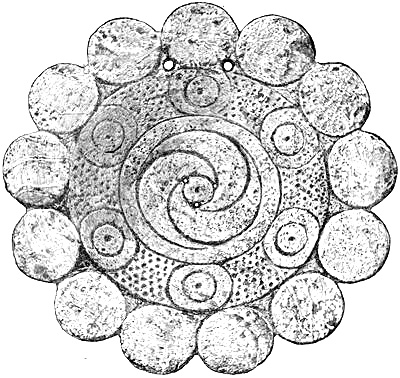
Fig. 267. SCALLOPED SHELL DISK (FULGUR) FROM A MOUND NEAR NASHVILLE, TENN. Three spiral volutes (triskelion).
Fig. 267[268] shows a Fulgur shell specimen obtained by Major Powell from a mound near Nashville, Tenn. It was found near the head of a skeleton. Its substance is well preserved; the surface was once highly polished, but now is pitted by erosion and discolored by age. The design is engraved on the concave surface as usual, and the lines are accurately drawn and clearly cut. The central circle is three-eighths of an inch in diameter and is surrounded by a zone one-half an inch in width, which contains a triskelion or triquetrum of three voluted lines beginning near the center of the shell on the circumference of the inner circle of three small equidistant perforations, and sweeping outward spirally to the left as shown in the figure, making upward of half a revolution. These lines are somewhat wider and more deeply engraved than the other lines of the design. In some specimens they are so deeply cut as to penetrate the disk, producing crescent-shaped perforations. Two medium-sized perforations for suspension have been made near the inner margin of one of the bosses next the dotted zone; these show abrasion by the cord of suspension. These perforations, as well as the three near the center, have been bored mainly from the convex side of the disk.
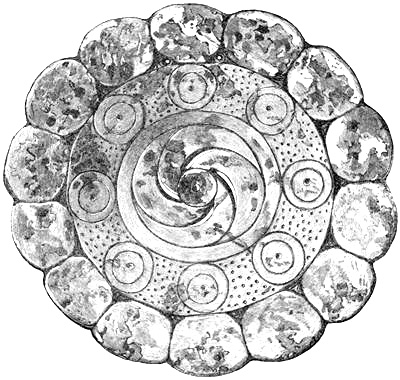
Fig. 268. SCALLOPED SHELL DISK FROM A MOUND NEAR NASHVILLE, TENN. Circles and dots and four spiral volutes (tetraskelion).
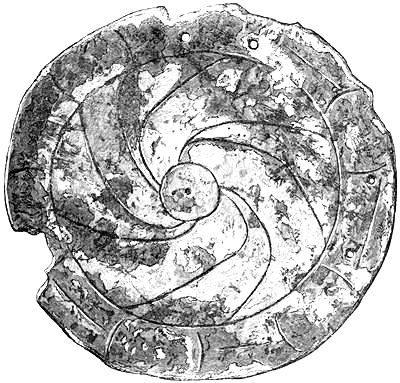
Fig. 269. SHELL DISK FROM BRAKEBILL MOUND, NEAR KNOXVILLE, TENN. Dot and circle in center and ogee Swastika (tetraskelion) marked but not completed.
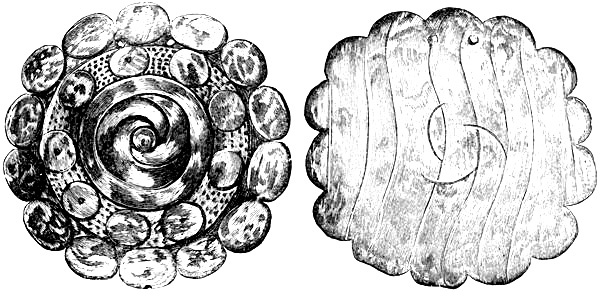
Figs. 270 and 271. ENGRAVED SHELL DISK. Obverse and reverse. Three-armed volute (triskelion).
Fig. 268[269] represents a well-preserved disk with four volute arms forming the tetraskelion, and thus allied to the Swastika. The volutes (to the right) are deeply cut and for about one-third their length penetrate the shell, producing four crescent-shaped perforations which show on the opposite side. This specimen is from a stone grave near Nashville, Tenn., and the original is in the Peabody Museum. Fig. 269[270] shows a specimen from the Brakebill mound, near Knoxville, Tenn. It has a dot in the center, with a circle five-eighths of an inch in diameter. There are four volute arms which start from the opposite sides of this circle, and in their spiral form extend to the right across the field, increasing in size as they approach the periphery. This is an interesting specimen of the tetraskelion or spiral Swastika, in that it is unfinished, the outline having been cut in the shell sufficient to indicate the form, but not perfected. Figs. 270 and 271 show obverse and reverse sides of the same shell. It comes from one of the stone graves of Tennessee, and is thus described by Dr. Joseph Jones, of New Orleans,[271] as a specimen of the deposit and original condition of these objects:
In a carefully constructed stone sarcophagus in which the face of the skeleton was looking toward the setting sun, a beautiful shell ornament was found resting upon the breastbone of the skeleton. This shell ornament is 4.4 inches in diameter, and it is ornamented on its concave surface with a small circle in the center and four concentric bands, differently figured, in relief. The first band is filled up by a triple volute; the second is plain, while the third is dotted and has nine small round bosses carved at unequal distances upon it. The outer band is made up of fourteen small elliptical bosses, the outer edges of which give to the object a scalloped rim. This ornament, on its concave figured surface, has been covered with red paint, much of which is still visible. The convex smooth surface is highly polished and plain, with the exception of the three concentric marks. The material out of which it is formed was evidently derived from a large flat seashell. * * * The form of the circles or “suns” carved upon the concave surface is similar to that of the paintings on the high rocky cliffs on the banks of the Cumberland and Harpeth rivers. * * * This ornament when found lay upon the breastbone with the concave surface uppermost, as if it had been worn in this position suspended around the neck, as the two holes for the thong or string were in that portion of the border which pointed directly to the chin or central portion of the jaw of the skeleton. The marks of the thong by which it was suspended are manifest upon both the anterior and posterior surfaces, and, in addition to this, the paint is worn off from the circular space bounded below by the two holes.
Fig. 272. ENGRAVED SHELL DISK. Tennessee. Three-armed volute (triskelion).
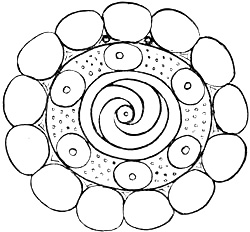
Fig. 273. ENGRAVED SHELL DISK. Tennessee. Three-armed volute (triskelion).
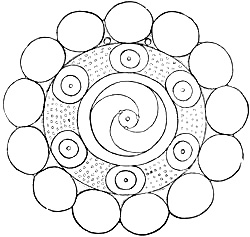
Fig. 271 represents the back or convex side of the disk shown in fig. 270. The long curved lines indicate the laminations of the shell, and the three crescent-shaped figures near the center are perforations resulting from the deep engraving of the three lines of the volute on the concave side. The stone grave in which this ornament was found occupied the summit of a mound on the banks of the Cumberland River, opposite Nashville, Tenn.
Fig. 274. ENGRAVED SHELL DISK. Tennessee. Three-armed volute (triskelion).
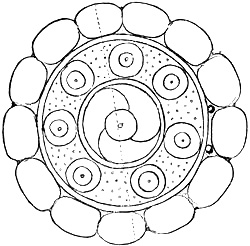
Fig. 275. ENGRAVED SHELL GORGET. Figure representing a spider; circles and Greek crosses.
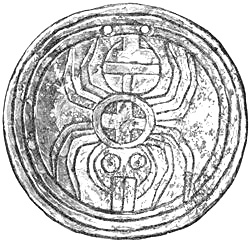
Figs. 272, 273, and 274 are other representations of shell carved in spirals, and may have greater or less relation to the Swastika.[272] They are inserted for comparison and without any expression of opinion. They are drawn in outline, and the spiral form is thus more easily seen.
Mr. Holmes[273] makes some observations upon these designs and gives his theory concerning their use:
I do not assume to interpret these designs; they are not to be interpreted. All I desire is to elevate these works from the category of trinkets to what I believe is their rightful place—the serious art of a people with great capacity for loftier works. What the gorgets themselves were, or of what particular value to their possessor, aside from simple ornaments, must be, in a measure, a matter of conjecture. They were hardly less than the totems of clans, the insignia of rulers, or the potent charms of the priesthood.
The spider.—The spider was represented on the shell gorgets. Figs. 275 to 278[274] present four of these gorgets, of which figs. 275 to 277 display the Greek cross in the center, surrounded by two concentric incised lines forming a circle which is the body of a spider. Fig. 276 shows the same spider and circle, and inside of it a cross much resembling the Swastika, in that the arms are turned at their extremities to the right and form, in an inchoate manner, the gamma. Fig. 278 represents the shell with the spider, and, though it contains no cross nor semblance of the Swastika, derives its value from having been taken from the same mound on Fains Island, Tennessee, as was the true Swastika. (See fig. 237.)
The rattlesnake.—The rattlesnake was a favorite design on these gorgets, affording, as it did, an opportunity for the aborigines to make a display of elegance of design, and of accuracy and fineness in execution. Fig. 279 is a specimen in which the snake is represented coiled, the head in the center, the mouth V-shaped in strong lines, the body in volute fashion; on the outside of the circle the tail is shown by its rattle. This specimen is represented three-fourths size, and comes from McMahon mound, Tennessee. Four others of similar design are also from Tennessee and the adjoining States, but the locality is more restricted than is the case with other shell disk ornaments.
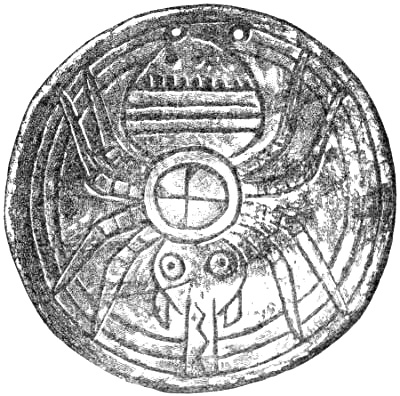
Fig. 276. ENGRAVED SHELL GORGET.
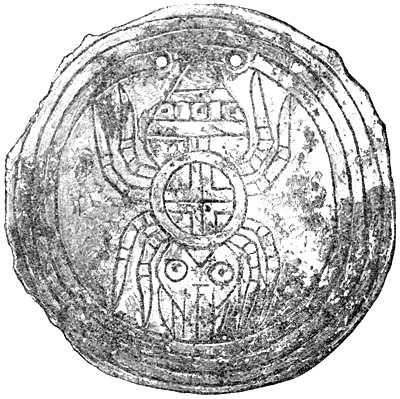
Fig. 277. ENGRAVED SHELL GORGET.
The human face and form.—These were also carved and wrought upon shells in the same general locality. The engraving is always on the convex side of the shell which has been reduced to a pear-shaped form.[275]
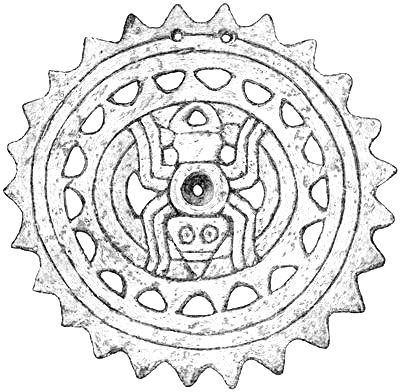
Fig. 278. ENGRAVED SHELL GORGET. Fains Island, Tennessee.
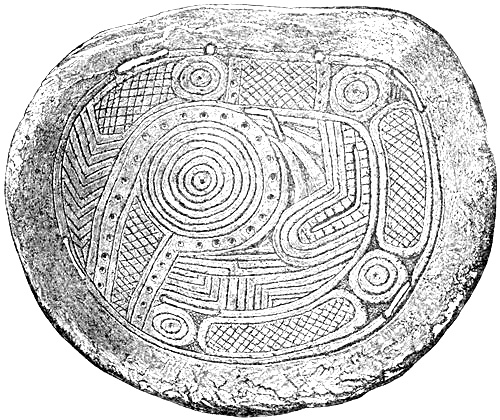
Fig. 279. ENGRAVED SHELL GORGET REPRESENTING A RATTLESNAKE. McMahon Mound, Tennessee. Second Annual Report of the Bureau of Ethnology, pl. LXIII.
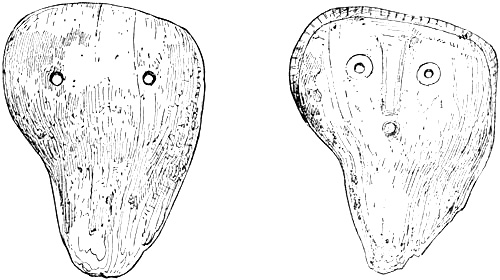
Figs. 280 and 281. ENGRAVED SHELLS WITH REPRESENTATIONS OF THE HUMAN FACE. McMahon Mound, Tennessee. Second Annual Report of the Bureau of Ethnology, pl. LXIX.
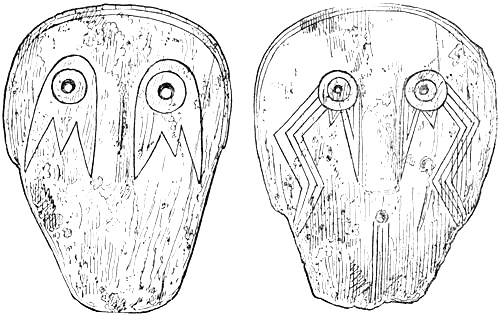
Figs. 282 and 283. ENGRAVED SHELLS WITH REPRESENTATIONS OF THE HUMAN FACE. Tennessee. Second Annual Report of the Bureau of Ethnology, pl. LXIX.
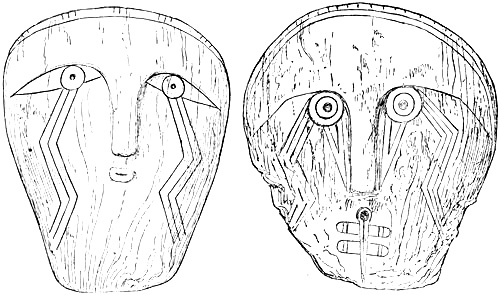
Figs. 284 and 285. ENGRAVED SHELLS WITH REPRESENTATIONS OF THE HUMAN FACE. Virginia. Second Annual Report of the Bureau of Ethnology, pl. LXIX.
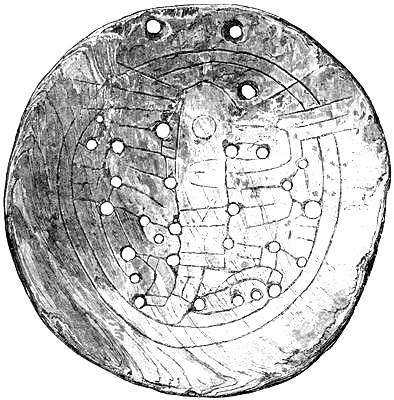
Fig. 286. ENGRAVED SHELL WITH REPRESENTATION OF A HUMAN FIGURE. McMahon Mound, Tennessee. Second Annual Report of the Bureau of Ethnology, pl. LXXI.
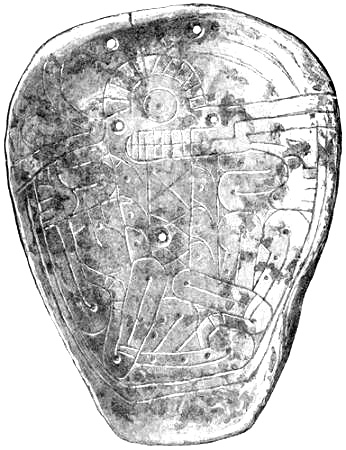
Fig. 287. ENGRAVED SHELL WITH REPRESENTATION OF A HUMAN FIGURE. Tennessee. Second Annual Report of the Bureau of Ethnology, pl. LXXII.
These human faces and forms (figs. 280-288), as well as the others, belong to the mound builders, and are found with their remains in the mounds. The figures are inserted, as is the rattlesnake, for comparison with the shell designs and work shown in the Buddha figure (pl. 10) and its associates. Slight inspection will show two styles, differing materially. To decide which was foreign and which domestic, which was imported and which indigenous, would be to decide the entire question of migration, and if done off-hand, would be presumptuous. To make a satisfactory decision will require a marshaling and consideration of evidence which belongs to the future. The specimens shown in figs. 280 to 285 are from Tennessee and Virginia. They are all masks, bearing representations of the human face. The first two are from the McMahon mound, Tennessee; that in fig. 282 from Brakebill mound, Tennessee, and that represented in fig. 283 from Lick Creek mound, Tennessee. The shell shown in fig. 284 is from Aquia Creek, Virginia, and that in fig. 285 is from a mound in Ely County, Va. The workmanship on these has no resemblance to that on the Buddha figure (pl. 10), nor does its style compare in any manner therewith.
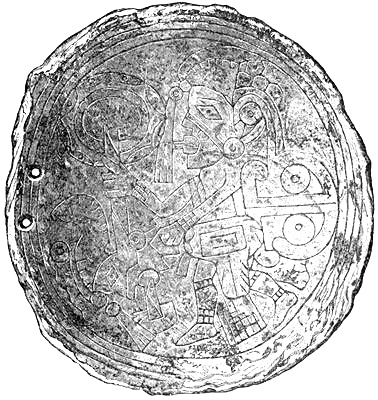
Fig. 288. ENGRAVED SHELL GORGET WITH REPRESENTATION OF A HUMAN FIGURE. Missouri. Second Annual Report of the Bureau of Ethnology, pl. LXXIII.
On the contrary, figs. 286 to 288, representing sketches (unfinished) of the human figure, from mounds in Tennessee and Missouri, have some resemblance in style of work, though not in design, to that of the Buddha and Swastika figures. The first step in execution, after the drawing by incised lines, seems to have been to drill holes through the shell at each corner and intersection. The work on the specimen shown in fig. 286 has progressed further than that on the specimens shown in figs. 287 and 288. It has twenty-eight holes drilled, all at corners or intersections. This is similar to the procedure in the Buddha statue (pl. 10). In fig. 287 the holes have not been drilled, but each member of the figure has been marked out and indicated by dots in the center, and circles or half circles incised around them in precisely the same manner as in both Swastikas (figs. 237 and 238), while fig. 288 continues the resemblance in style of drawing. It has the same peculiar garters or bracelets as the Buddha, the hand is the same as in the fighting figures (fig. 239), and the implement he holds resembles closely those in the copper figures (figs. 240 and 241).
DESIGNS ON POTTERY.
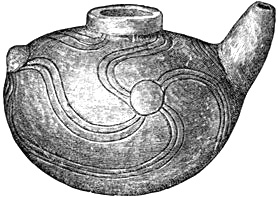
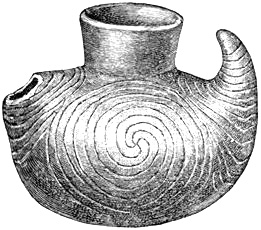
Fig. 289. POTTERY VESSEL. Four-armed volute, ogee Swastika (tetraskelion). Arkansas. ⅓ natural size. Fig. 290. POTTERY VESSEL. Four volutes resembling Swastika. Pecan Point, Ark. ⅓ natural size.
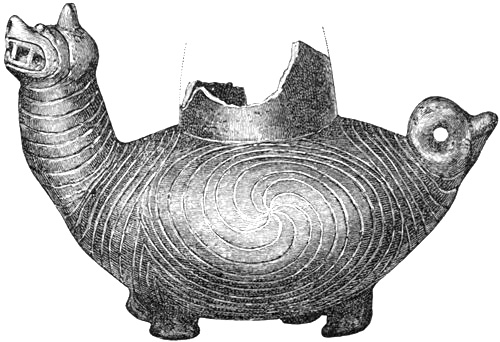
Fig. 291. POTTERY VESSEL MADE IN THE FORM OF AN ANIMAL. Spiral volutes, nine arms. Pecan Point, Ark. ⅓ natural size.
Fig. 292. POTTERY BOWL ORNAMENTED WITH MANY-ARMED VOLUTES. Arkansas. ⅓ natural size.
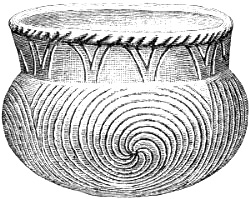
Fig. 293. POTTERY VASE ORNAMENTED WITH VOLUTES. Arkansas.
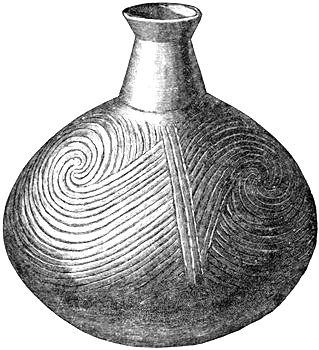
Spiral-volute designs resembling the Swastika in general effect are found on aboriginal mound pottery from the Mississippi Valley. The Fourth Annual Report of the Bureau of Ethnology, 1882-83,[276] shows many of these. Fig. 289 represents a teapot-shaped vessel from Arkansas, on the side of which, in incised lines, is shown the small circle which we saw on the shell disks, and springing from the four opposite sides are three incised lines, twisting spirally to the right, forming the four volutes of the Swastika (tetraskelion) and covering the entire side of the vessel. The same spiral form of the Swastika is given in fig. 290, a vessel of eccentric shape from Pecan Point, Ark. The decoration is in the form of two lines crossing each other and each arm then twisting to the right, forming volutes, the incised lines of which, though drawn close together and at equal distances, gradually expand until the ornament covers the entire side of the vase. It is questionable whether this or any of its kindred were ever intended to represent either the Swastika or any other specific form of the cross. One evidence of this is that these ornaments shade off indefinitely until they arrive at a form which was surely not intended to represent any form of the cross, whether Swastika or not. The line of separation is not now suggested by the author. An elaboration of the preceding forms, both of the vessel and its ornamentation, is shown by the vessel represented in fig. 291, which is fashioned to represent some grotesque beast with horns, expanding nostrils, and grinning mouth, yet which might serve as a teapot as well as the former two vessels. The decoration upon its side has six incised lines crossing each other in the center and expanding in volutes until they cover the entire side of the vessel, as in the other specimens. Fig. 292 shows a pot from Arkansas. Its body is decorated with incised lines arranged in much the same form as fig. 291, except that the lines make no attempt to form a cross. There are nine arms which spring from the central point and twist spirally about as volutes until they cover the field, which is one-third the body of the bowl. Two other designs of the same kind complete the circuit of the pot and form the decoration all around. Fig. 293[277] represents these volutes in incised lines of considerable fineness, close together, and in great numbers, forming a decoration on each of the sides of the vase, separated by three nearly perpendicular lines.
The spiral Swastika form appears painted upon the pottery from Arkansas. The specimen shown in fig. 294[278] is a tripod bottle. The decoration upon the side of the body consists of two lines forming the cross, and the four arms expand in volutes until the ornament covers one-third of the vessel, which, with the other two similar ornaments, extend around the circumference. This decoration is painted in red and white colors on a gray or yellowish ground. Fig. 295 shows a bowl from mound No. 2, Thorn’s farm, Taylor Shanty group, Mark Tree, Poinsett County, Ark. It is ten inches wide and six inches high. The clay of which it is made forms the body color—light gray. It has been painted red or maroon on the outside without any decoration, while on the inside is painted with the same color a five-armed cross, spirally arranged in volutes turning to the right. The center of the cross is at the bottom of the bowl, and the painted spiral lines extend over the bottom and up the sides to the rim of the bowl, the interior being entirely covered with the design. Another example of the same style of decoration is seen on the upper surface of an ancient vase from the province of Cibola.[279]
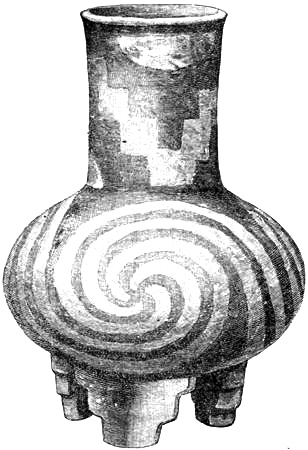
Fig. 294. TRIPOD POTTERY VASE. Four-armed volutes making spiral Swastika. Arkansas. ⅓ natural size.
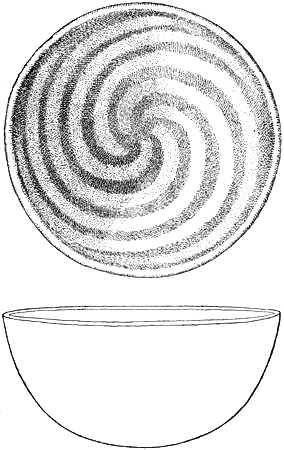
Fig. 295. POTTERY BOWL WITH FIVE-ARMED SPIRAL SWASTIKA ON THE BOTTOM. Poinsett County, Ark. Cat. No. 114035, U. S. N. M.
The specimen shown in fig. 296 is from the mound at Arkansas Post, in the county and State of Arkansas.[280] It represents a vase of black ware, painted a yellowish ground, with a red spiral scroll. Its diameter is 5½ inches. These spiral figures are not uncommon in the localities heretofore indicated as showing the normal Swastika. Figs. 297 and 298[281] show parallel incised lines of the same style as those forming the square in the bird gorgets already noted (figs. 263-267). Fig. 297 shows a bowl nine inches in diameter; its rim is ornamented with the heart and tail of a conventional bird, which probably served as handles. On the outside, just below the rim, are the four incised parallel lines mentioned. In the center of the side is represented a rolling under or twisting of the lines, as though it represented a ribbon. There are three on each quarter of the bowl, that next the head being plain. Fig. 298 represents a bottle 6½ inches in diameter, with parallel incised lines, three in number, with the same twisting or folding of the ribbon-like decoration. This twists to the left, while that of fig. 297 twists in the opposite direction. Both specimens are from the vicinity of Charleston, Mo.
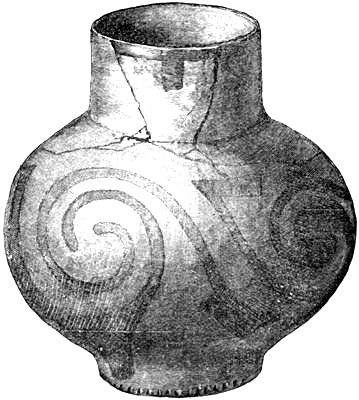
Fig. 296. VESSEL OF BLACK WARE. Spiral scroll. Arkansas.
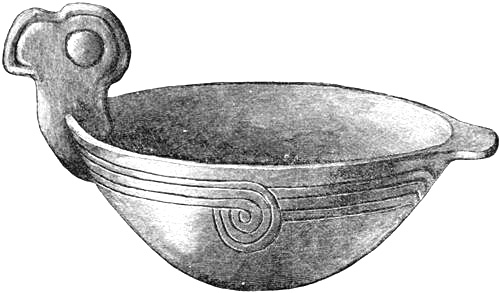
Fig. 297. BIRD-SHAPED POTTERY BOWL. Three parallel incised lines with ribbon fold. Charleston, Mo.
DESIGNS ON BASKETRY.
The volute form is particularly adapted to the decoration of basketry, of which fig. 299 is a specimen. These motifs were favorites with the Pueblo Indians of New Mexico and Arizona.
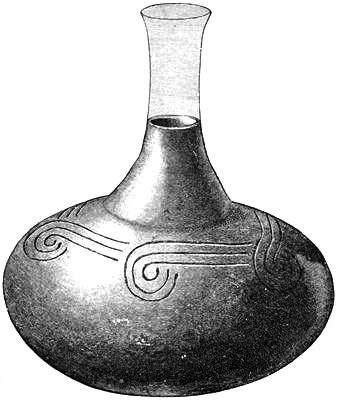
Fig. 298. POTTERY BOWL. Three parallel incised lines with ribbon fold. Charleston, Mo.
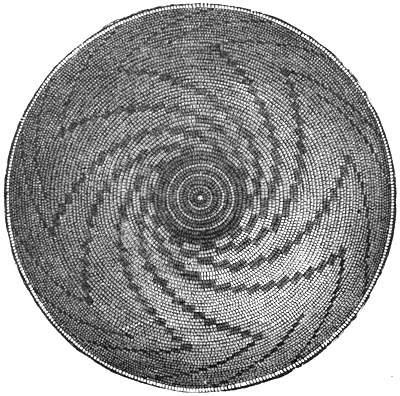
Fig. 299. BASKETWORK WITH MANY-ARMED VOLUTES. Fourth Annual Report of the Bureau of Ethnology, fig. 485.