II.—Dispersion of the Swastika. (continued 3)
Reading edition
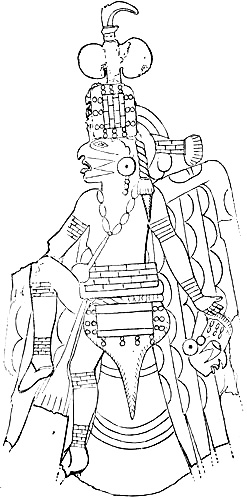
Fig. 240. COPPER PLATE. Entowah Mound, Georgia. Fifth Annual Report of the Bureau of Ethnology, fig. 42. Cat. No. 91113, U. S. N. M.
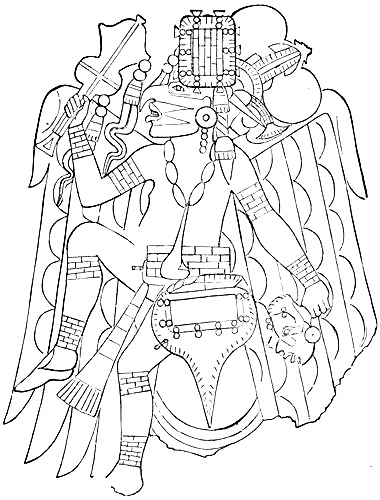
Fig. 241. COPPER PLATE. Repoussé work. Entowah Mound, Georgia. Cat. No. 91117, U. S. N. M.
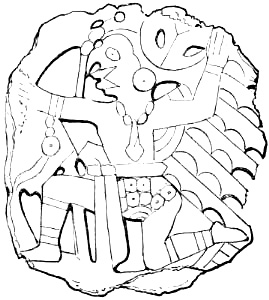
Fig. 242. ENGRAVED SHELL. Triangular breech-clout with dots and circles. Entowah Mound, Georgia. Cat. No. 91443, U. S. N. M.
Hopewell Mound, Chillicothe, Ross County, Ohio.—A later discovery of the Swastika belonging to the same period and the same general locality—that is, to the Ohio Valley—was that of Prof. Warren K. Moorehead, in the fall and winter of 1891-92, in his excavations of the Hopewell mound, seven miles northwest of Chillicothe, Ross County, Ohio.[254] The locality of this mound is well shown in Squier and Davis’s work on the “Monuments of the Mississippi Valley” (pl. 10, p. 26), under the name of “Clark’s Works,” here reproduced as pl. 11. It is the large irregular unnumbered triple mound just within the arc of the circle shown in the center of the plan. The excavation contemplated the destruction of the mound by cutting it down to the surrounding level and scattering the earth of which it was made over the surface; and this was done. Preparatory to this, a survey and ground plan was made (pl. 12). I assisted at this survey and can vouch for the general correctness. The mound was surrounded by parallel lines laid out at right angles and marked by stakes 50 feet apart. The mound was found to be 530 feet long and 250 feet wide. Squier and Davis reported its height at 32 feet, but the excavation of the trenches required but 18 and 16 feet to the original surface on which the mound was built. It was too large to be cut down as a whole, and for convenience it was decided by Mr. Moorehead to cut it down in trenches, commencing on the northeast. Nothing was found until, in opening trench 3, about five feet above the base of the mound, they struck a mass of thin worked copper objects, laid flat one atop the other, in a rectangular space, say three by four feet square. These objects are unique in American prehistoric archæology. Some of them bore a resemblance in form to the scalloped mica pieces found by Squier and Davis, and described by them in their “Ancient Monuments of the Mississippi Valley” (p. 240), and also those of the same material found by Professor Putnam in the Turner group of mounds in the valley of the Little Miami. They had been apparently laid between two layers of bark, whether for preservation or mere convenience of deposit, can only be guessed.
Larger Image
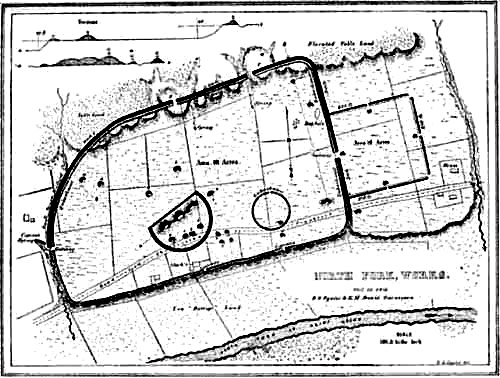
Plate 11. Plan of North Fork (Hopewell) Works. Ross County, Ohio. Smithsonian Contributions to Knowledge, Vol. I, Pl. X.
Larger Image
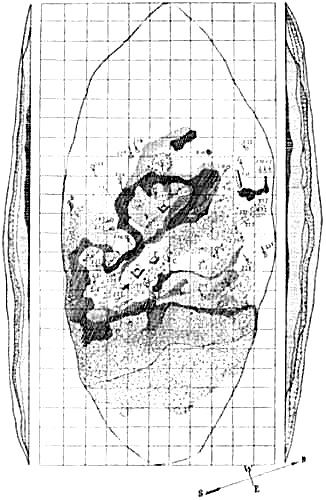
Plate 12. Plan of Hopewell Mound, in which Aboriginal Copper Swastikas were Found. Ross County, Ohio. Moorehead, “Primitive Man in Ohio,” Pl. XXXIV.
Fig. 243. COPPER PLATE SHOWING FIGURE OF EAGLE. Repoussé work. Union County, Ill. Cat. No. 91507, U. S. N. M.
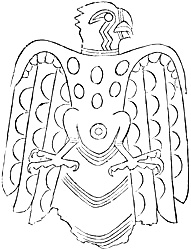
Fig. 244. SWASTIKA CROSS OF THIN COPPER. Hopewell Mound, Ross County, Ohio. ¼ natural size.
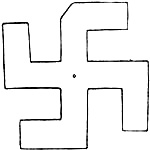
Fig. 245. FLAT RING OF THIN COPPER. Hopewell Mound, Ross County, Ohio. ⅕ natural size.
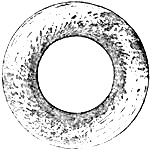
Fig. 246. STENCIL ORNAMENT OF THIN COPPER. Hopewell Mound, Ross County, Ohio. ⅛ natural size.
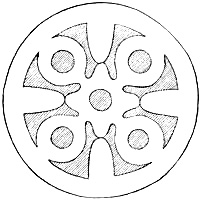
The following list of objects is given, to the end that the reader may see what was associated with these newly found copper Swastikas: Five Swastika crosses (fig. 244); a long mass of copper covered with wood on one side and with squares and five similar designs traceable on the reverse; smaller mass of copper; eighteen single copper rings; a number of double copper rings, one set of three and one set of two; five pan lids or hat-shaped rings; ten circular disks with holes in center, represented in fig. 245, originally placed in a pile and now oxidized together; also large circular, stencil-like ornaments, one (fig. 246) 7½ inches in diameter; another (fig. 247) somewhat in the shape of a St. Andrew’s cross, the extreme length over the arms being 8¾ inches.
About five feet below the deposit of sheet copper and 10 or 12 feet to the west, two skeletons lay together. They were covered with copper plates and fragments, copper hatchets, and pearl beads, shown in the list below, laid in rectangular form about seven feet in length and five feet in width, and so close as to frequently overlap.
There were also found sixty-six copper hatchets, ranging from 1½ to 22½ inches in length; twenty-three copper plates and fragments; one copper eagle; eleven semicircles, bars, etc.; two spool-shaped objects; four comb-shaped effigies; one wheel with peculiar circles and bars of copper; three long plates of copper; pearl and shell beads and teeth; a lot of extra fine pearls; a lot of wood, beads, and an unknown metal; a lot of bones; a human jaw, very large; a fragmentary fish resembling a sucker (fig. 248); one stool of copper with two legs; broken copper plates; one broken shell; bear and panther tusks; mica plates; forty fragmentary and entire copper stencils of squares, circles, diamonds, hearts, etc.; copper objects, saw-shaped; twenty ceremonial objects, rusted or oxidized copper; two diamond-shaped stencils, copper (fig. 249); four peculiar spool-shaped copper ornaments, perforated, showing repoussé work (fig. 250).
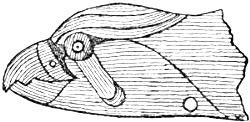
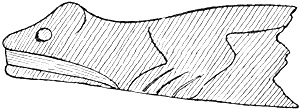
I made sketches of two or three of the bone carvings, for the purpose of showing the art of the people who constructed this monument, so that by comparison with that of other known peoples some knowledge may be obtained, or theory advanced, concerning the race or tribe to which they belonged and the epoch in which they lived. Fig. 251 shows an exquisite bone carving of a paroquet which belongs much farther south and not found in that locality in modern times. The design shown in fig. 252 suggests a Mississippi Kite, but the zoologists of the Museum, while unable to determine with exactitude its intended representation, chiefly from the mutilated condition of the fragment, report it more likely to be the head of the “leather-back” turtle. Fig. 253 probably represents an otter with a fish in his mouth.
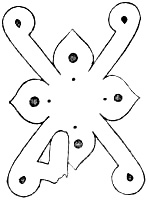
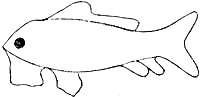
Fig. 247. STENCIL ORNAMENT OF THIN COPPER. Hopewell Mound, Ross County, Ohio. ¼ natural size. Fig. 248. FISH ORNAMENT OF THIN COPPER. Hopewell Mound, Ross County, Ohio. ⅙ natural size.
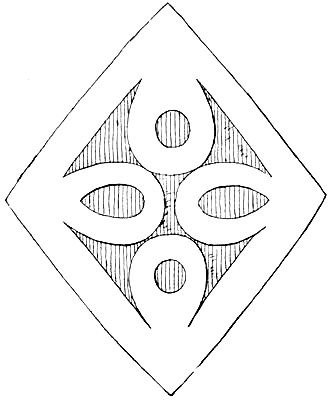
Fig. 249. LOZENGE-SHAPED STENCIL OF THIN COPPER. Hopewell Mound, Ross County, Ohio. ¼ natural size.
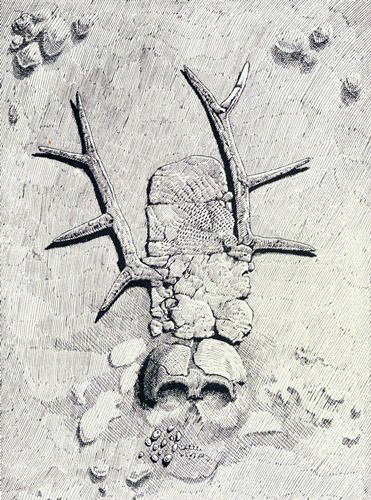
Plate 13. Human Skull with Copper-covered Horns. Hopewell Mound, Ross County, Ohio. Moorehead, “Primitive Man in Ohio,” frontispiece.
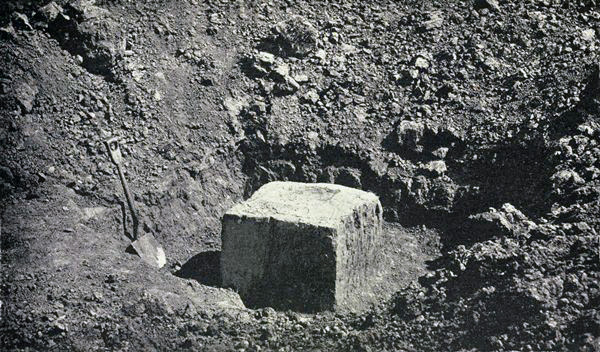
Plate 14. Prehistoric Altar. Hopewell Mound, Ross County, Ohio. Found near the copper Swastika shown in fig. 244. Moorehead, “Primitive Man in Ohio,” Fig. XXXVII. Cat. No. 148662, U. S. N. M.
In trench No. 3, 15 skeletons (numbered 264 to 278, inclusive), were found on the base line, all extended. Objects of coal, bone, shell, or stone, had been placed with nearly all of them. Nos. 265 and 266 were laid on blocks of burnt earth 3 inches higher than the base of the mound. One of the skeletons in this mound (No. 248) is shown in pl. 13. It was a most remarkable specimen, and forms the frontispiece of Prof. W. K. Moorehead’s volume “Primitive Man in Ohio,” where it is described (p. 195) as follows:
At his head were imitation elk horns, neatly made of wood and covered with sheet copper rolled into cylindrical forms over the prongs. The antlers were 22 inches high and 19 inches across from prong to prong. They fitted into a crown of copper bent to fit the head from occipital to upper jaw. Copper plates were upon the breast and stomach, also on the back. The copper preserved the bones and a few of the sinews. It also preserved traces of cloth similar to coffee sacking in texture, interwoven among the threads of which were 900 beautiful pearl beads, bear teeth split and cut, and hundreds of other beads, both pearl and shell. Copper spool-shaped objects and other implements covered the remains. A pipe of granite and a spearhead of agate were near the right shoulder. The pipe was of very fine workmanship and highly polished.
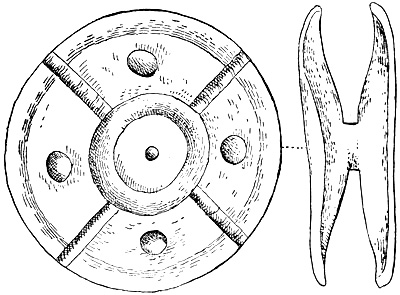
Fig. 250. SPOOL-SHAPED OBJECT OF COPPER. Repoussé and intaglio decoration. Hopewell Mound, Ross County, Ohio. Natural size.
While digging out skeletons 280 to 284, Professor Moorehead says they touched the edge of an altar (pl. 14). It was on the base line and 15 feet north of the copper find before described. On the 5th of January, 1892, the altar was uncovered, and the earth, charcoal, and objects within it put into five soap boxes and transported to headquarters, where the material was assorted in my presence and with my aid. The mass on the altar had been charred throughout. It contained, in part, mica ornaments, beads, spool-shaped objects, whale, bear, and panther teeth, flint knives, carved effigies of bone and stone, some of which were broken, while others were whole. There were stone tablets, slate ornaments, copper balls, fragments of cloth, rings of chlorite, quartz crystals perforated and grooved, and a few pieces of flint and obsidian, with several thousand pearls drilled for suspension. These objects were heaped in the cavity of the altar without any regularity. All were affected by heat, the copper being fused in many cases. The teeth and tusks were charred, split, and calcined. There were no ashes. All the fuel was charcoal, and from the appearance of the débris, especially the wood, earth, and bone, one might suppose that after the fire had started it had not been allowed to burn to ashes as if in the open air, but had been covered with earth, and so had smoldered out as in a charcoal pit.
Fig. 251. FRAGMENT OF ENGRAVED BONE REPRESENTING A PAROQUET. Hopewell Mound, Ross County, Ohio. Natural size.
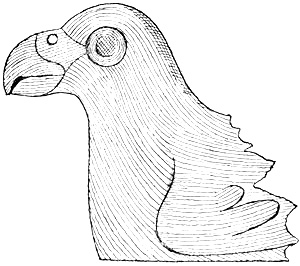
Fig. 252. FRAGMENT OF ENGRAVED BONE PROBABLY REPRESENTING A MISSISSIPPI KITE OR LEATHER-BACK TURTLE. Hopewell Mound, Ross County, Ohio. Natural size.
Evidence was found of an extended commerce with distant localities, so that if the Swastika existed in America it might be expected here. The principal objects were as follows: A number of large seashells (Fulgur) native to the southern Atlantic Coast 600 miles distant, many of them carved; several thousand pieces of mica from the mountains of Virginia or North Carolina, 200 or more miles distant; a thousand large blades of beautifully chipped objects in obsidian, which could not have been found nearer than the Rocky Mountains, 1,000 or 1,200 miles distant; four hundred pieces of wrought copper, believed to be from the Lake Superior region, 150 miles distant; fifty-three skeletons, the copper headdress (pl. 13) made in semblance of elk horns, 16 inches high, and other wonderful things. Those not described have no relation to the Swastika.
Fig. 253. FRAGMENT OF ENGRAVED BONE PROBABLY REPRESENTING AN OTTER WITH A FISH IN ITS MOUTH. Natural size.
These objects were all prehistoric. None of them bore the slightest evidence of contact with white civilization. The commoner objects would compare favorably with those found in other mounds by the same and other investigators. Much of it may be undetermined. It is strange to find so many objects brought such long distances, and we may not be able to explain the problem presented; but there is no authority for injecting any modern or European influence into it. By what people were these made? In what epoch? For what purpose? What did they represent? How did this ancient, curious, and widespread sign, a recognized symbol of religion of the Orient, find its way to the bottom of one of the mounds of antiquity in the Scioto Valley? These are questions easy to ask but difficult to answer. They form some of the riddles of the science of prehistoric anthropology.
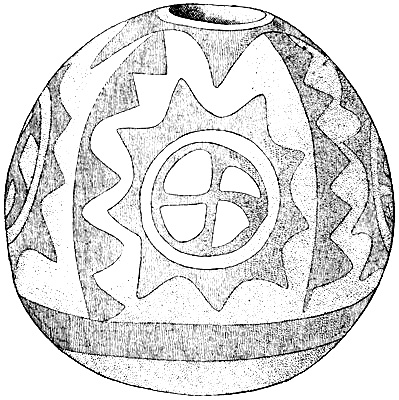
Fig. 254. WATER JUG WITH FIGURE OF SWASTIKA. Decoration, red on yellow ground. Poinsett County, Ark. Cat. No. 91230, U. S. N. M.
Mounds in Arkansas.—A water jug in the collection of the U. S. National Museum (fig. 254) was obtained in 1883 by P. W. Norris, of the Bureau of Ethnology, from a mound in Poinsett County, Ark. It is of yellow ground, natural color of clay, and decorated with light red paint. The paint is represented in the cut by the darkened surfaces. The four quarters of the jug are decorated alike, one side of which is shown in the cut. The center of the design is the Swastika with the arm crossing at right angles, the ends turned to the right, the effect being produced by an enlargement on the right side of each arm until they all join the circle. A similar water jug with a Swastika mark of the same type as the foregoing decorates Major Powell’s desk in the Bureau of Ethnology.
Marquis Nadaillac[255] describes and figures a grooved ax from Pemberton, N. J., on which some persons have recognized a Swastika, but which the Marquis doubts, while Dr. Abbott[256] denounces the inscription as a fraud.
NORTH AMERICAN INDIANS.
Fig. 255. KANSA INDIAN WAR CHART. Swastika sign for winds and wind songs. J. Owen Dorsey, American Naturalist, July, 1885, p. 670.
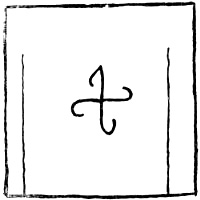
The Kansas.—The Rev. J. Owen Dorsey[257] describes the mourning customs of the Kansas Indians. In the course of his description he tells of a council of ceremony held among these Indians to decide if they should go on the warpath. Certain sacred songs were sung which had been arranged according to a chart, which Mr. Dorsey introduces as pl. 20, page 676. The outside edge of this chart bore twenty-seven ideographs, which suggest or determine the song or speech required. No. 1 was the sacred pipe; No. 2, the maker of all songs; No. 3, song of another old man who gives success to the hunters; No. 4 (fig. 255 in the present paper) is the Swastika sign, consisting of two ogee lines intersecting each other, the ends curved to the left. Of it, Mr. Dorsey says only the following:
Fig. 4. Tadje wayun, wind songs. The winds are deities; they are Bazanta (at the pines), the east wind; Ak′a, the south wind; A′k′a jiñga or A′k′uya, the west wind; and Hnia (toward the cold), the north wind. The warriors used to remove the hearts of slain foes, putting them in the fire as a sacrifice to the winds.
In the Eleventh Annual Report of the Bureau of Ethnology (p. 525) Mr. Dorsey repeats this statement concerning the names of the winds, and shows how, in their invocations, the Kansas began with the east wind and went around to the right in the order here given. His fig. 195 illustrates this, but the cross has straight arms. In response to my personal inquiry, Mr. Dorsey says the war chart[258] was drawn for him, with the Swastika as represented, by Pahanle-gaqle, the war captain, who had official charge of it and who copied it from one he had inherited from his father and his “father’s fathers”; and Mr. Dorsey assured me that there can be no mistake or misapprehension about this Indian’s intention to make the sign as there represented. Asked if the sign was common and to be seen in other cases or places, Mr. Dorsey replied that the Osage have a similar chart with the same and many other signs or pictographs—over a hundred—but except these, he knows of no similar signs. They are not in common use, but the chart and all it contains are sacred objects, the property of the two Kansas gentes, Black Eagle and Chicken Hawk, and not to be talked of nor shown outside of the gentes of the council lodge.[259]
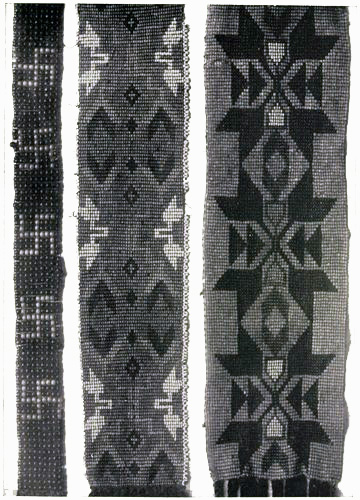
Plate 15. Ceremonial Bead Necklace with Swastika Ornamentation. Sac Indians, Cook County (Kansas) Reservation.
The Sac Indians.—Miss Mary A. Owen, of St. Joseph, Mo., sending some specimens of beadwork of the Indians (pl. 15) from the Kansas Reservation, two of which were garters and the third a necklace 13 inches long and 1 inch wide, in which the Swastikas represented are an inch square, writes, February 2, 1895, as follows:
The Indians call it [the Swastika] the “luck,” or “good luck.” It is used in necklaces and garters by the sun worshippers among the Kickapoos, Sacs, Pottawatomies, Iowas, and (I have been told) by the Winnebagoes. I have never seen it on a Winnebago. The women use the real Swastika and the Greek key pattern, in the silk patchwork of which they make sashes and skirt trimmings. As for their thinking it an emblem of fire or deity, I do not believe they entertain any such ideas, as some Swastika hunters have suggested to me. They call it “luck,” and say it is the same thing as two other patterns which I send in the mail with this. They say they “always” made that pattern. They must have made it for a long time, for you can not get such beads as compose it, in the stores of a city or in the supplies of the traders who import French beads for the red folk. Another thing. Beadwork is very strong, and this is beginning to look tattered, a sure sign that it has seen long service.
These sun worshippers—or, if you please, Swastika wearers—believe in the Great Spirit, who lives in the sun, who creates all things, and is the source of all power and beneficence. The ancestors are a sort of company of animal saints, who intercede for the people. There are many malicious little demons who thwart the ancestors and lead away the people at times and fill them with diseases, but no head devil. Black Wolf and certain ghosts of the unburied are the worst. Everybody has a secret fetish or “medicine,” besides such general “lucks” as Swastikas, bear skins, and otter and squirrel tails.
Of the other cult of the peoples I have mentioned, those who worship the sun as the deity and not the habitation, I know nothing. They are secret, suspicious, and gloomy, and do not wear the “luck.” I have never seen old people wear the “luck.”
Now, I have told you all I know, except that it [the Swastika] used in ancient times to be made in quill embroidery on herb bags.
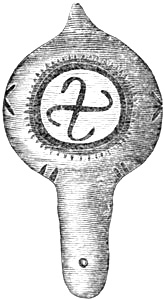
Fig. 256. DANCE RATTLE MADE OF A SMALL GOURD DECORATED IN BLACK, WHITE, AND RED. Ogee Swastika on each side. Second Annual Report of the Bureau of Ethnology, fig. 526. Cat. No. 42042, U. S. N. M.
Miss Owen spoke of other garters with Swastikas on them, but she said they were sacred, were used only during certain ceremonies, and she knew not if she could be able to get or even see them. During the prolongation of the preparation of this paper she wrote two or three times, telling of the promises made to her by the two Sac women who were the owners of these sacred garters, and how each time they had failed. Yet she did not give up hope. Accordingly, in the winter of 1896, the little box containing the sacred garters arrived. Miss Owen says the husbands of these two Sac women are Pottawatomies on the Cook County (Kans.) Reservation. They are sun worshippers. These garters have been sketched and figured in pl. 16.
The Pueblos.—The Pueblo country in Colorado, Utah, New Mexico, and Arizona, as is well known, is inhabited by various tribes of Indians speaking different languages, separated from one another and from all other tribes by differences of language, customs, and habit, but somewhat akin to each other in culture, and many things different from other tribes are peculiar to them. These have been called the “Pueblo Indians” because they live in pueblos or towns. Their present country includes the regions of the ancient cliff dwellers, of whom they are supposed to be the descendants. In those manifestations of culture wherein they are peculiar and different from other tribes they have come to be considered something superior. Any search for the Swastika in America which omitted these Indians would be fatally defective, and so here it is found. Without speculating how the knowledge of the Swastika came to them, whether by independent invention or brought from distant lands, it will be enough to show its knowledge among and its use by the peoples of this country.
In the Annual Report of the Bureau of Ethnology for the year 1880-81 (p. 394, fig. 562) is described a dance rattle made from a small gourd, ornamented in black, white, and red (fig. 256). The gourd has a Swastika on each side, with the ends bent, not square, but ogee (the tetraskelion). The U. S. National Museum possesses a large number of these dance rattles with Swastikas on their sides, obtained from the Pueblo Indians of New Mexico and Arizona. Some of them have the natural neck for a handle, as shown in the cut; others are without neck, and have a wooden stick inserted and passed through for a handle. Beans, pebbles, or similar objects are inside, and the shaking of the machine makes a rattling noise which marks time for the dance.
The Museum possesses a large series of pottery from the various pueblos of the Southwest; these are of the painted and decorated kind common to that civilization and country. Some of these pieces bear the Swastika mark; occasionally it is found outside, occasionally inside. It is more frequently of the ogee form, similar to that on the rattle from the same country (fig. 256). The larger proportion of these specimens comes from the pueblos of Santa Clara and St. Ildefonso.
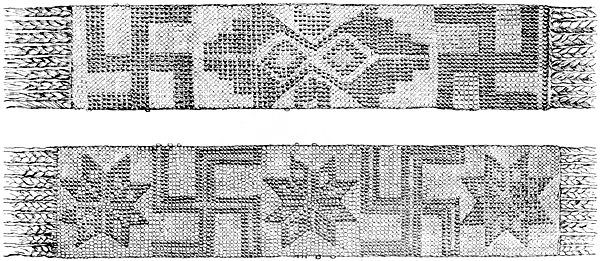
Plate 16. Ceremonial Bead Garters with Swastikas. Sac Indians, Cook County (Kansas) Reservation.
Dr. Schliemann reports:[260]
We also see a Swastika (turned to the left) scratched on two terra cotta bowls of the Pueblo Indians of New Mexico, preserved in the ethnological section of the Royal Museum at Berlin.
G. Nordenskiöld,[261] in the report of his excavations among the ruined pueblos of the Mesa Verde, made in southwestern Colorado during the summer of 1891, tells of the finding of numerous specimens of the Swastika. In pl. 23, fig. 1, he represents a large, shallow bowl in the refuse heap at the “Step House.” It was 50 centimeters in diameter, of rough execution, gray in color, and different in form and design from other vessels from the cliff houses. The Swastika sign (to the right) was in its center, and made by lines of small dots. His pl. 27, fig. 6, represents a bowl found in a grave (g on the plan) at “Step House.” Its decoration inside was of the usual type, but the only decoration on the outside consisted of a Swastika, with arms crossing at right angles and ends bent at the right, similar to fig. 9. His pl. 18, fig. 1, represented a large bowl found in Mug House. Its decoration consisted in part of a Swastika similar in form and style to the Etruscan gold “bulla,” fig. 188 in this paper. Certain specimens of pottery from the pueblos of Santa Clara and St. Ildefonso, deposited in the U. S. National Museum (Department of Ethnology), bear Swastika marks, chiefly of the ogee form.[262]
The Navajoes.—Dr. Washington Matthews, U. S. A., than whom no one has done better, more original, nor more accurate anthropologic work in America, whether historic or prehistoric, has kindly referred me to his memoir in the Fifth Annual Report of the Bureau of Ethnology, comprising 82 pages, with 9 plates and 9 figures, entitled “The Mountain Chant; a Navajo ceremony.” It is descriptive of one of a number of ceremonies practiced by the shamans or medicine men of the Navajo Indians, New Mexico. The ceremony is public, although it takes place during the night. It lasts for nine days and is called by the Indians “dsilyídje qaçàl”—literally, “chant toward (a place) within the mountains.” The word “dsilyi” may allude to mountains in general, to the Carrizo Mountains in particular, to the place in the mountains where the prophet (originator of these ceremonies) dwelt, or to his name, or to all of these combined. “Qaçàl” means a sacred song or a collection of sacred songs. Dr. Matthews describes at length the myth which is the foundation of this ceremony, which must be read to be appreciated, but may be summarized thus: An Indian family, consisting of father, mother, two sons, and two daughters, dwelt in ancient times near the Carrizo Mountains. They lived by hunting and trapping; but the place was desert, game scarce, and they moved up the river farther into the mountains. The father made incantations to enable his two sons to capture and kill game; he sent them hunting each day, directing them to go to the east, west, or north, but with the injunction not to the south. The elder son disobeyed this injunction, went to the south, was captured by a war party of Utes and taken to their home far to the south. He escaped by the aid of Yàybichy (Qastcèëlçi) and divers supernatural beings. His adventures in returning home form the body of the ceremony wherein these adventures are, in some degree, reproduced. Extensive preparations are made for the performance of the ceremony. Lodges are built and corrals made for the use of the performers and the convenience of their audience. The fête being organized, stories are told, speeches made, and sacred songs are sung (the latter are given by Dr. Matthews as “songs of sequence,” because they must be sung in a progressive series on four certain days of the ceremony). Mythological charts of dry sand of divers colors are made on the earth within the corrals after the manner of the Navajo and Pueblo Indians. These dry sand paintings are made after a given formula and intended to be repeated from year to year, although no copy is preserved, the artists depending only upon the memory of their shaman. One of these pictures or charts represents the fugitive’s escape from the Utes, his captors, down a precipice into a den or cave in which burnt a fire “on which was no wood.” Four pebbles lay on the ground together—a black pebble in the east, a blue one in the south, a yellow one in the west, and a white one in the north. From these flames issued. Around the fire lay four bears, colored and placed to correspond with the pebbles. When the strangers (Qastcèëlçi and the Navajo) approached the fire the bears asked them for tobacco, and when they replied they had none, the bears became angry and thrice more demanded it. When the Navajo fled from the Ute camp, he had furtively helped himself from one of the four bags of tobacco which the council was using. These, with a pipe, he had tied up in his skin robe; so when the fourth demand was made he filled the pipe and lighted it at the fire. He handed the pipe to the black bear, who, taking but one whiff, passed it to the blue bear and immediately fell senseless. The blue bear took two whiffs and passed the pipe, when he too fell over unconscious. The yellow bear succumbed after the third whiff, and the white bear in the north after the fourth whiff. Now the Navajo knocked the ashes and tobacco out of his pipe and rubbed the latter on the feet, legs, abdomen, chest, shoulders, forehead, and mouth of each of the bears in turn, and they were at once resuscitated. He replaced the pipe in the corner of his robe. When the bears recovered, they assigned to the Navajo a place on the east side of the fire where he might lie all night, and they brought out their stores of corn meal, tciltcin, and other berries, offering them to him to eat; but Qastcèëlçi warned him not to touch the food, and disappeared. So, hungry as he was, the Indian lay down supperless to sleep. When he awoke in the morning, the bears again offered food, which he again declined, saying he was not hungry. Then they showed him how to make the bear kethàwns, or sticks, to be sacrificed to the bear gods, and they drew from one corner of the cave a great sheet of cloud, which they unrolled, and on it were painted the forms of the “yays” of the cultivated plants.
Larger Image
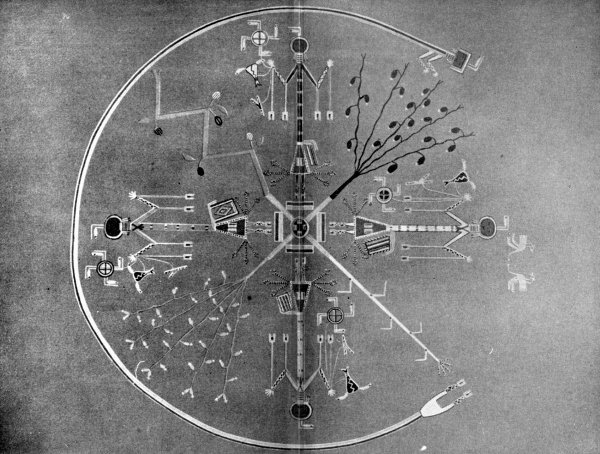
Plate 17. Navajo Dry Painting Containing Swastikas. Dr. Washington Matthews, “The Mountain Chant: A Navajo Ceremony,” Fifth Annual Report of the Bureau of Ethnology, 1883-84, Pl. XVII.
In Dr. Matthews’s memoir (marked third, but described on p. 447 as the second picture), is a representation of the painting which the prophet was believed to have seen at the home of the bears in the Carrizo Mountains. This is here reproduced as pl. 17. In the center of the figure is a bowl of water covered with black powder; the edge of the bowl is garnished with sunbeams, while outside of it and forming a rectangle are the four ca’bitlol of sunbeam rafts on which seem to stand four gods, or “yays,” with the plants under their special protection, which are painted the same color as the gods to which they belong. These plants are represented on their left hand, the hand being open and extended toward them. The body of the eastern god is white, so is the stalk of corn at his left in the southeast; the body of the southern god is blue, so is the beanstalk beside him in the southwest; the body of the western god is yellow, so is his pumpkin vine in the northwest; the body of the north god is black, so is the tobacco plant in the northeast. Each of the sacred plants grows from five white roots in the central waters and spreads outward to the periphery of the picture. The figures of the gods form a cross, the arms of which are directed to the four cardinal points; the plants form another cross, having a common center with the first, the arms extending to the intermediate points of the compass. The gods are shaped alike, but colored differently; they lie with their feet to the center and heads extended outward, one to each of the four cardinal points of the compass, the faces look forward, the arms half extended on either side, the hands raised to a level with the shoulders. They wear around their loins skirts of red sunlight adorned with sunbeams. They have ear pendants, bracelets, and armlets, blue and red, representing turquoise and coral, the prehistoric and emblematic jewels of the Navajo Indians. Their forearms and legs are black, showing in each a zigzag mark representing lightning on the black rain clouds. In the north god these colors are, for artistic reasons, reversed. The gods have, respectively, a rattle, a charm, and a basket, each attached to his right hand by strings. This basket, represented by concentric lines with a Greek cross in the center, all of the proper color corresponding with the god to whom each belongs, has extending from each of its quarters, arranged perpendicularly at right angles to each other, in the form of a cross, four white plumes of equal length, which at equal distances from the center are bent, all to the left, and all of the same length. Thus are formed in this chart four specimens of the Swastika, with the cross and circle at the intersection of the arms. The plumes have a small black spot at the tip end of each.
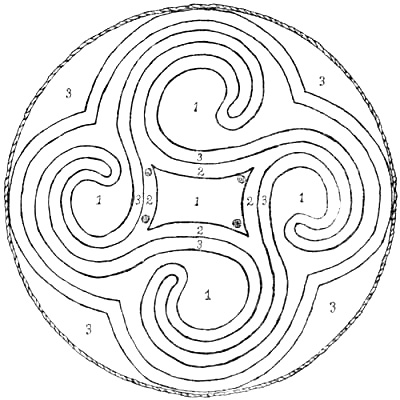
Fig. 257. WAR SHIELD USED BY THE PIMA INDIANS. Ogee Swastika (tetraskelion) in three colors: (1) blue, (2) red, (3) white. Cat. No. 27829, U. S. N. M.
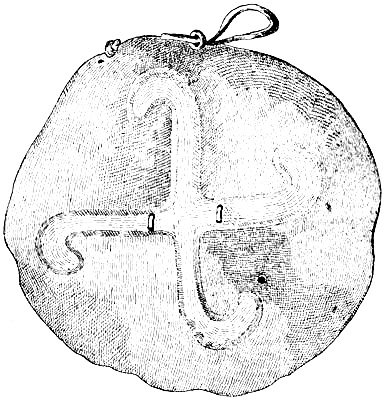
Fig. 258. WAR SHIELD WITH OGEE SWASTIKA IN CENTER. Pima Indians. The hole near the lower arm of the Swastika was made by an arrow. Property of Mr. F. W. Hodge.
Dr. Matthews informs me that he has no knowledge of any peculiar meaning attributed by these Indians to this Swastika symbol, and we now not whether it is intended as a religious symbol, a charm of blessing, or good luck, or whether it is only an ornament. We do not know whether it has any hidden, mysterious, or symbolic meaning; but there it is, a prehistoric or Oriental Swastika in all its purity and simplicity, appearing in one of the mystic ceremonies of the aborigines in the great American desert in the interior of the North American Continent.
The Pimas.—The U. S. National Museum possesses a shield (Cat. No. 27829) of bull hide, made by the Pima Indians. It is about 20 inches in diameter, and bears upon its face an ogee Swastika (tetraskelion), the ends bent to the right. The body and each arm is divided longitudinally into three stripes or bands indicated by colors, blue, red, and white, arranged alternately. The exterior part of the shield has a white ground, while the interior or center has a blue ground. This shield (fig. 257) is almost an exact reproduction of the Swastika from Mycenæ (fig. 161), from Ireland (fig. 216), and from Scandinavia (figs. 209 and 210). Fig. 258 shows another Pima shield of the same type. Its Swastika is, however, painted with a single color or possibly a mixture of two, red and white. It is ogee, and the ends bend to the left. This shield is the property of Mr. F. W. Hodge, of the Bureau of Ethnology. He obtained it from a Pima Indian in Arizona, who assured him that the hole at the end of the lower arm of the Swastika was made by an arrow shot at him by an Indian enemy.
COLONIAL PATCHWORK.
Fig. 259. COLONIAL PATCHWORK WITH FIGURES RESEMBLING SWASTIKAS. Scribner’s Magazine, September, 1894.
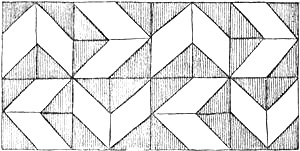
In Scribner’s Magazine for September, 1894, under the title of “Tapestry in the New World,” one of our popular writers has described, with many illustrations, the bedquilt patterns of our grandmothers’ time. One of these she interprets as the Swastika. This is, however, believed to be forced. The pattern in question is made of patches in the form of rhomboids and right-angled triangles sewed and grouped somewhat in the form of the Swastika (fig. 259). It is an invented combination of patchwork which formed a new pattern, and while it bears a slight resemblance to the Swastika, lacks its essential elements. It was not a symbol, and represents no idea beyond that of a pretty pattern. It stood for nothing sacred, nor for benediction, blessing, nor good luck. It was but an ornamental pattern which fortuitously had the resemblance of Swastika. It was not even in the form of a cross. The difference between it and the Swastika is about the same there would be between the idle and thoughtless boy who sporadically draws the cross on his slate, meaning nothing by it, or at most only to make an ornament, and the devout Christian who makes the same sign on entering the church, or the Indian who thus represents the four winds of heaven. He who made the Swastika recognizes an occult power for good and against evil, and he thereby invokes the power to secure prosperity. She who made the quilt pattern apparently knew nothing of the old-time Swastika, and was not endeavoring to reproduce it or anything like it. She only sought to make such an arrangement of rhomboidal and triangular quilt patches as would produce a new ornamental pattern.
CENTRAL AMERICA.
NICARAGUA.
Fig. 260. FRAGMENT OF THE FOOT OF A STONE METATE WITH FIGURE OF SWASTIKA. Nicaragua. Cat. No. 23726, U. S. N. M.
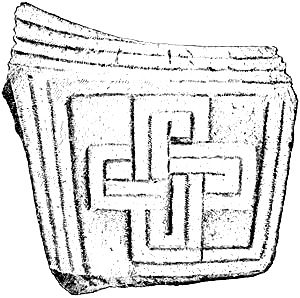
The specimen shown in fig. 260 (Cat. No. 23726, U. S. N. M.) is a fragment, the foot of a large stone metate from Zapatero, Granada, Nicaragua. The metate was chiseled or pecked out of the solid. A sunken panel is surrounded by moldings, in the center of which appears, from its outline, also by raised moldings, a figure, the outline of which is a Greek cross, but whose exterior is a Swastika. Its form as such is perfect, except that one bent arm is separated from its stem by a shallow groove.
“The Cross, Ancient and Modern,” by W. W. Blake, shows, in its fig. 57, a Swastika pure and simple, and is cited by its author as representing a cross found by Squier in Central America. The Mexican enthusiast, Orozco y Perra, claims at first glance that it shows Buddhist origin, but I have not been able as yet to verify the quotation.
YUCATAN.
Dr. Schliemann reports, in the Ethnological Museum at Berlin, a pottery bowl from Yucatan ornamented with a Swastika, the two main arms crossing at right angles, and he adds,[263] citing Le Plongeon, “Fouilles au Yucatan,” that “during the last excavations in Yucatan this sign was found several times on ancient pottery.”
Fig. 261. FRAGMENT OF STONE SLAB FROM THE ANCIENT MAYA CITY OF MAYAPAN. Ogee Swastika (tetraskelion). Proceedings of the American Antiquarian Society, April 21, 1881.
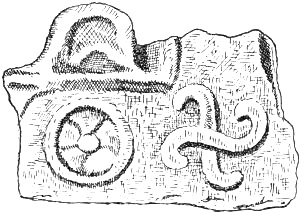
Le Plongeon discovered a fragment of a stone slab in the ancient Maya city of Mayapan, of which he published a description in the Proceedings of the American Antiquarian Society. It contains an ogee Swastika (tetraskelion), with ends curved to the left and an inverted U with a wheel (fig. 261). Le Plongeon believed it to be an Egyptian inscription, which he translated thus: The character, inverted U, stood for Ch or K; the wheel for the sun, Aa or Ra, and the Swastika for Ch or K, making the whole to be Chach or Kak, which, he says, is the word fire in the Maya language.[264]
COSTA RICA.
A fragment of a metate (Cat. No. 9693, U. S. N. M.) found on Lempa River, Costa Rica, by Capt. J. M. Dow, has on its bottom a Swastika similar to that on the metate from Nicaragua. Specimen No. 59182, U. S. M. N., is a fragment of a pottery vase from Las Huacas, Costa Rica, collected by Dr. J. F. Bransford. It is natural maroon body color, decorated with black paint. A band two inches wide is around the belly of the vase divided into panels of solid black alternated with fanciful geometric figures, crosses, circles, etc. One of these panels contains a partial Swastika figure. The two main arms cross at right angles in Greek form. It is a partial Swastika in that, while the two perpendicular arms bend at right angles, turning six times to the right; the two horizontal arms are solid black in color, as though the lines and spaces had run together.
SOUTH AMERICA.
BRAZIL.
The leaden idol (fig. 125) (Artemis Nana[265] of Chaldea, Sayce; statuettes of the Cyclades, Lenormant) found by Dr. Schliemann in the third, the burnt city of Hissarlik, Troy, was described (p. 829) with its Swastika on the triangular shield covering the pudendum, with the statement that it would be recalled in the chapter on Brazil.
The aboriginal women of Brazil wore a triangular shield or plaque over their private parts. These shields are made of terra cotta, quite thin, the edges rounded, and the whole piece rubbed smooth and polished. It is supported in place by cords around the body, which are attached by small holes in each angle of the triangle. The U. S. National Museum possesses several of these plaques from Brazil, and several were shown at the Chicago Exposition.
The consideration of the leaden idol of Hissarlik, with a Swastika, as though for good luck, recalled to the author similar plaques in his department from Brazil. Some are of common yellow ware, others were finer, were colored red and rubbed smooth and hard, but were without decoration. The specimen shown in pl. 18 (upper figure) was from Marajo, Brazil, collected by Mr. E. M. Brigham. It is of light gray, slip washed, and decorated with pale red or yellow paint in bands, lines, parallels, geometric figures. The specimen shown in the lower figure of the same plate, from the Caneotires River, Brazil, was collected by Prof. J. B. Steere. The body color, clay, and the decoration paint are much the same as the former. The ornamentation is principally by two light lines laid parallel and close so as to form a single line, and is of the same geometric character as the incised decoration ornament on other pieces from Marajo Island. Midway from top to bottom, near the outside edges, are two Swastikas. They are about five-eighths of an inch in size, are turned at right angles, one to the right and the other to the left. These may have been a charm signifying good fortune in bearing children. (See pp. 830-832.)
These specimens were submitted by the author to the Brazilian minister, Señor Mendonça, himself an archæologist and philologist of no small capacity, who recognized these objects as in use in ancient times among the aborigines of his country. The name by which they are known in the aboriginal language is Tambeao or Tamatiatang, according to the dialects of different provinces. The later dialect name for apron is reported as tunga, and the minister makes two remarks having a possible bearing on the migration of the race: (1) The similarity of tunga with the last syllable of the longer word, atang, and (2) that tunga is essentially an African word from the west coast. Whether this piece of dress so thoroughly savage, with a possible ceremonial meaning relating to sex or condition, with its wonderful similarity of names, might not have migrated in time of antiquity from the west coast of Africa to the promontory of Brazil on the east coast of America where the passage is narrowest, is one of those conundrums which the prehistoric anthropologist is constantly encountering and which he is usually unable to solve.
The purpose of these objects, beyond covering the private parts of the female sex, is not known. They may have been ceremonial, relating, under certain circumstances, to particular conditions of the sex, or they may have been only variations of the somewhat similar covers used by the male aborigine. They bear some resemblance to the Ceintures de Chasteté, specimens of which are privately shown at the Musée de Cluny at Paris. These are said to have been invented by Françoise de Carara, viguier imperial (provost) of Padua, Italy, near the end of the fourteenth century. He applied it to all the women of his seraglio. He was beheaded A. D. 1405, by a decree of the Senate of Venice, for his many acts of cruelty. The palace of St. Mark contained for a long time a box or case of these ceintures with their locks attached, which were represented as des pieces de conviction of this monster.[266] Voltaire describes his hero “qui tient sous la clef, la vertu de sa femme.”
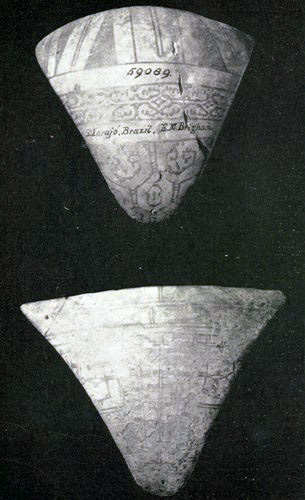
Plate 18. Folium Vitus (“Fig Leaves”). Terra-cotta covers, “tunga.” Aborigines of Brazil. Cat. Nos. 59089 and 36542, U. S. N. M.
Larger Image
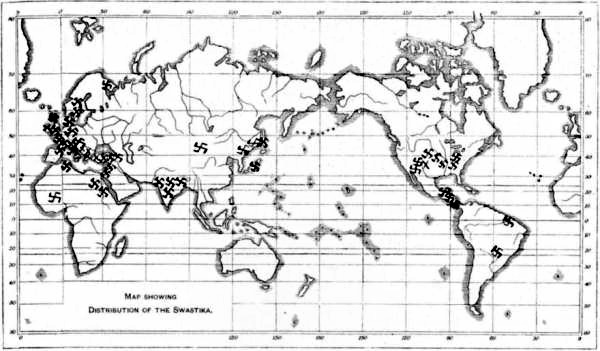
Map showing Distribution of the Swastika.
PARAGUAY.
Dr. Schliemann reports that a traveler of the Berlin Ethnological Museum obtained a pumpkin bottle from the tribe of Lenguas in Paraguay which bore the imprint of the Swastika scratched upon its surface, and that he had recently sent it to the Royal Museum at Berlin.