DAYS OF THE TUDORS (continued 7)
Reading edition
But a much greater and consolatory thought possesses us as we take a final glance at the grim citadels of destruction lazily floating on the now smiling strength of the watery expanse,—but compared with which in its tempestuous wrath, they are as the bubble that vanishes on its surface,—even the controlling power of that Mighty Ruler of both, of which the Royal Minstrel has with prophetic grandeur sung; strikingly paraphrased by His humbler disciple and lyrist, the gifted Apostle of Cornish revival, here aptly recalled,—
"The Lord is King: ye saints rejoice And ceaseless alleluias sing; The angry floods lift up their voice In vain,—for lo, the Lord is King!
All ocean's waves may swell and roar, They cannot break their sandy chain; Supreme in majesty and power, The Lord shall o'er them rule and reign.
Though war's devouring surges rise, Beyond their bounds they cannot go; The Lord is King above the skies, And rules the embattled host below.
'Tis God the Lord, whose mighty will Makes angry war's contentions cease, And bids the maddened world be still, And brings the joyous gift of peace."
Withdraw thine eyes aft, friend of mine, banish all further contemplation of the decaying sea-dragons, and look a-head where a very different spectacle awaits thee. Immediately to the left is the little, quiet, steep-streeted Cornish borough of Saltash, but now made notable by the presence of Brunel's stupendous iron railway-bridge, spanning the river before us, and thrusting itself into the bosom of the old town; one of the largest mechanical works of this, or any age, and exhibiting the strange engineering inversion of suspending the load beneath the arch, as the road-way is slung or supported below, instead of traversing above it. Its great height from the water, to a considerable extent, contracts to the eye its huge proportions, which may however in a measure be estimated, by observation of the railway-train slowly threading its way across, being scarcely seen, and but little heard from below, or recognized merely by a thin white line streaming back above the parapet, and a subdued rumble; and by noting also the Liliputian dimensions of some artizans, that look like a bevy of insects perched on one of the great tubes. The extraordinary construction it displays seems to suggest that here for once, Science with syren persuasion must have charmed the ear of Wealth to accede to her request—"provide me with the means required, and in return you shall be shewn what can be accomplished"—so lavish is the strength, and fantastic the form of the vast structure. On the river below this immense creation, the floating steam-bridge crawls across at short intervals, for passengers and vehicles. As we look at the two extraordinary methods of transit, the reflection arises that at only a few miles up the stream, an inexhaustible supply of granite may have been obtained and easily floated. With this enduring material a handsome bridge might have been erected, with arches sufficiently high for all useful purposes of navigation, and the roadway on it made wide enough for railway and ordinary purposes, and, what is so dear to the calculating proclivities of our race, it would undoubtedly have paid well also, in addition to its enormous convenience. But then the wisdom of our senators would not have been exemplified, nor the constructive ingenuity of the engineer glorified.
We emerge from the shadow of the great bridge, and pass another smart training-ship. Moored there we presume to justify the outrageous and apparently prohibitive stipulation of Parliament,—which required that a railway train should be carried through the air above the masthead of a fully rigged old-fashioned man-of-war,—for we never heard of another performing such a feat. Nor did our sagacious and far-seeing legislators probably dream of the advent of the squat iron-clads, with neither mast or sail, and hulls more under the water than above it, that now form the fleet of the present.
Leaving this the last trace of grisly war behind, we enter on a glorious stretch of the uncontaminated Tamar, and admire two or three barges with their grand, looming, picturesque sails,—like great-winged sea-birds,—slowly traversing the bright expanse. Here a prophetic echo from the lyre of the poet who dwelled at its source, crosses the mental ear, and finds fulfilment,—
"Fount of a rushing river! wild flowers wreathe The home where thy first waters sunlight claim; The lark sits hushed beside thee, while I breathe, Sweet Tamar spring! the music of thy name.
Fair is the future scenery of thy days, Thy course domestic and thy paths of pride; Depths that give back the soft-eyed violet's gaze, Shores where tall navies march to meet the tide."
Delightfully we career along, and our thoughts suggest what a spirit-cheering, buoyant—heart as well as boat—feeling of freedom fills the mind, when afloat in a trim craft with a full sail, and a fair wind. Pre-eminently so on the boundless sea, and in lesser degree, but most enjoyable also, on this broad reach of inland water. The busy succession of waves rising up and greeting with flickering salute the prow of our little vessel, as with easy rocking motion she speeds over their undulating succession. And the contented satisfaction, also, that we have the pleasant breeze, with its varying force for our untiring steed; no haunting thought disturbs, that some noble animal in slavery is running the sands of his life out the faster for our gratification,—nor the dread possibility of instant annihilation, that hovers continuously over the rushing transit of the iron trackway. Verily of all modes of movement, none equals for pleasantness the sailor's, nor does the phantom of a wild pitiless sky, lee shore, and foam-mantled rocks greatly alloy it.
Wild glory of the weltering shore, The clouds dark portent hangeth o'er, The rushing billows muffled roar.
Like storm-drenched bird, from out the west The labouring bark by strong winds pressed, Beats to the haven of her rest.
The seaman views the turmoil grim, And be his vessel tight and trim, The tempest wears no fears for him.
Starboard the helm, friend, for we have now fetched nearly a mile plus the bridge, and prepare to set thy foot for the first time on old Cornubia's shore, and make acquaintance with its inhabiters, a generous, independent liberty-loving race, who through the past centuries have "one and all" vigorously asserted their right to social and religious freedom. Yonder is Landulph church-tower peering up among the undulations of the shore,—this will be our first port of call, to visit the sanctuary nestling among the dwellings at its foot, and make note of sundry interesting associations—one specially unique—connected with it. We pull in our little craft, and having made fast to a place of safety among the seaweed-clad slaty ledges of rock, set off for our destination, and a few minutes' walk brings us to the door of the little edifice.
On entering, the first thing that arrests attention, is the large number of carved bench-ends with which the nave and south aisle are furnished. Although under any conditions these architectural features are most attractive to the antiquary, as displaying in their sculptured imagery, direct witness of the art of past existences, the examples here found, for quality of workmanship, reflect not the purer glory of the Plantagenet workman, nor the lavish wealth of the earlier Tudor. Their shallower and comparatively unstudied work, points to the era just before that crowned Dowsing,—who in relation to the church was dubbed Defender of her Faith, but whose truer and more congenial title should have been Destructor of her Works,—by his ravages among the religious establishments, gave the final quietus to the fast-dying spirit of ecclesiastical art. But even apart from his relentless savagery, its chief incentive had almost disappeared, for men were then fast learning the easier faith of word-service alone, unallied with the older self-denying, and more tangible offering of deeds. The real and the painstaking had given place to the less troublesome and quicker wrought,—rich deep-cut cusp, vine-leaf, rose, and blazoned shield were succeeded by coarse rustic allegory, ill-shaped animals and birds, tasteless initials and dates, and confused heraldry, interspersed with heathen masks and grotesques, elbowing the cross and sacred monogram—the last dying speech and confession of the expiring Gothic. Here the symbolism of the Passion seems to have been the old carvers' favourite subject, occurring in the greatest profusion, variety, and minuteness of detail,—a pertinent example of the lowest form of religious teaching, the objective (even now a favourite with some), designed by its pictured symbolism to impress, and in its way instruct the unlettered mind, a poor apology for the nobler and more comprehensive study of the sacred text. One or two of the panels are however more noteworthy, as preserving a flickering of the antient beauty of design, and these find record in our sketch-book.
A sprinkling of curiously imperfect and jumbled heraldry, apparently allusive to afore-time settlers in Landulph and important families located near, occupies many; on these we recognize the roses of Lower, the rudders of Willoughby de Broke, the saltires of Glanville, and the bells of Porter of Trematon, while on others occur the insignia of the See, and specially noticeable, those of the princely Courtenay,—the eagle on the bundle of sticks, feathers, and shields charged with the three torteaux, badges and arms of the last descendants of the first house of that illustrious descent,—armories almost ubiquitous, both within and without the church door in these western parts.
Here in Landulph this noble race owned considerable possessions, inherited through the marriage of Emmeline, daughter of Sir John Dauney (or De Alneto), with Sir Edward Courtenay, who died 1372, of whom Cleaveland records,—"he had sixteen manors, and died before his father the Earl, and had by his lady two sons, Edward who came to be Earl after his grandfather, and Sir Hugh of Haccombe, whose grandson Edward was restored to the Earldom of Devonshire upon the failure of the elder brother's issue." The effigies of Sir John Dauney, his daughter Emmeline and her husband Sir Edward Courtenay are found in the neighbouring church of Sheviocke. The property continued in the ownership of the Courtenays, until the cruel execution of Henry, Marquis of Exeter, by Henry VIII., when it was annexed to the Duchy of Cornwall.
And here an interesting circumstance may be noted, concerning the carved array of the symbolism of the Passion on the old seats before us, as we remember that these emblems appear to have been general favourites in Cornwall, and occur largely displayed in similar situations within many other churches in the county.
Cornwall has ever been distinguished for the earnest religious views of its inhabitants, and from the earliest times, its material record has survived. The large number of old Crosses strewn thickly over the wild moorlands or by the solitary wayside, in churchyard or village street, were set up as reminders to the passing foot, of the way to eternal life, and contemporary with them Holy Wells covered the bright springs in the valleys, and appealed with their simple imagery to those who came thither to draw, not to forget to thirst also for the living water that refreshes the soul; while Sainted Names numberless, the stories of whose devoted lives are lost in the mist of antiquity; all attest that olden deep spirit of religious influence and observance, not to be found in other regions of the west, and which continues almost undiminished down to the present hour.
It was this feeling which brought the hardy miners, and their half-brethren the Dartmoor peasantry, with their clubs and bows up to the gates of Exeter in sturdy remonstrance, and to leave their mangled bodies afterward on Clyst Heath, when the Mass they were accustomed to reverence was abolished from their sight in the rural sanctuaries where they worshipped, during the days of the sixth Edward. It was this that stirred their hearts, and sent their war-cry aloft, when their countryman Trelawney stood in peril of liberty and life at the hands of the sinister James. It was this unsatisfied yearning, stifled while under the religious torpor which had settled over the mid-Georgian era, that welcomed the evangelic cry of Wesley, when he breathed over their valley of dry bones, and devoted disciples by myriads sprang into new and spiritual existence, followed subsequently by the kindred and scarcely less-fruitful mission of O'Brien, the apostle of the north Devon hills; and later still with equal earnestness, their recognition and steadfast adhesion to the beneficent discipline of Father Matthew. The same earnest receptive spirit has continued in them through all the centuries. In emotive warmth of heart,—not altogether wanting in touch of chivalry,—home-loving clanship of nationality, and kinship of antient tongue, the Cornish hold much in common with the Welsh, Irish, and Scotch; qualities on crossing the Cheviots, Wrekin, or Dartmoor, lost altogether in the common-place, flavourless compromise called English character.
Slowly we wend our way through the nave, and observe in addition to the numerous carved bench-ends, the lower compartments of the antient rood-screen (its stair-turret still exists in the wall of the south aisle), all the upper portion having disappeared. The design of its tracery is similar, and from this we assume that the edifice was entirely refitted within, if not wholly rebuilt at the same era. But the majority of the benches have suffered curious treatment at the ingenious hands of the parish joiner, a generation or so since, when these old solid structures were transformed into pews, by grafting on them above slender deal continuations, furnished with doors. Then unfortunately the carved edging around their ends was nearly all cleared away, so as to form a panel at the base, and finished afterward by the whole being "neatly painted and grained" to acquire uniformity. The north aisle has a fine open-timbered waggon roof, the dividing arches between the nave and aisles are composed of granite—moor-stone as Polwhele delighted to designate it—ponderous and strong, and these, coupled with the old sturdy oak praying-benches beneath, convey a sense of reality and abidingness in work that contrasts strongly with our modern flimsy imitations.
"See now, along that pillared aisle The graven arches firm and fair; They bend their shoulders to the toil, And lift the hollow roof in air.
Huge, mighty, massive, hard, and strong, Were the choice stones they lifted then; The vision of their hope was long, They knew their God, those faithful men."
Having lingered a moment in the south aisle to note the badges of the royally descended Courtenay, our steps tend eastward to the memento that records an even more illustrious name than theirs, and that forms the unique association connected with this country church. But ere we reach it they are arrested a moment to observe the two large and singularly representative squires' pews of the Jacobean knight Sir Nicholas Lower, an olden resident of Clifton in Landulph, and of whom we shall have something further to say by and by. One was evidently intended for the use of the family, the other on the opposite side of the aisle, larger, raised and arranged as a sort of gallery, evidently intended to be occupied by his worship's servants and retainers. Both are elaborately decorated in their upper portions with carved panels displaying the armories of his descent and alliance, below they exhibit the linen pattern, and on the corners appears his crest sculptured in full relief. Immediately beyond is a large high-tomb, whose massive black marble table records that the bodies of the old knight and his dame repose below, while on the aisle wall immediately above the gallery-pew are two further inscribed brasses to their memories.
Now stay thy foot, and hearken! for we are standing not on princely, nay, nor royal, but even over imperial dust. Give thy thoughts wing, from these leaden skies and mist-hung coasts,—nor stay them until they have reached the sunny shores of the Bosphorus and the Golden Horn, the classic precincts and immortal traditions of that superlatively beautiful city that holds the keys of the two continents in her hands, and to the illustrious dynasty that erstwhile ruled her, and by whose name she is still designated. Then learn that a direct descendant of this distinguished race, an exile from his native clime, and almost an outcast on the face of the earth, found his last refuge in this life, under a friendly roof close by, and lies at rest,—not in marble sarcophagus under vaulted dome near the home of his royal ancestors,—but, equally well, beneath the simple pavement of this rustic sanctuary.
Resolve thy parable, you say. Read the inscription recorded on yonder unpretending brass plate:—
HERE LYETH THE BODY OF THEODORO PALEOLOGVS OF PESARO IN ITALYE; DESCENDED FROM YE IMPERYAIL LYNE OF YE LAST CHRISTIAN EMPERORS OF GREECE; BEING THE SONNE OF CAMILIO, YE SON'E OF PROSPER, THE SONNE OF THEODORO, THE SONNE OF IOHN, YE SONNE OF THOMAS, SECOND BROTHER TO CONSTANTINE PALEOLOGVS, THE 8TH OF THAT NAME, AND LAST OF YE LYNE YT RAYGNED IN CONSTANTINOPLE, VNTILL SVBDVED BY THE TVRKES; WHO MARRIED W'TH MARY, YE DAVGHTER OF WILLIAM BALLS OF HADLYE IN SOVFFOLKE, GENT: AND HAD ISSVE 5 CHILDREN THEODORO, IOHN, FERDINANDO, MARIA AND DOROTHY, AND DEPARTED THIS LIFE AT CLYFTON, YE 21TH OF IANVARY, 1636.
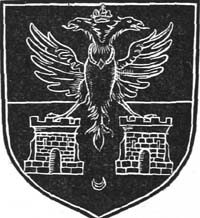
Over is the proud achievement of his race,—Per fess, a double-headed eagle displayed, collared, and with an imperial crown between the heads, standing on the castles of Europe and Asia, being the imperial arms of Greece, with crescent for difference.
Proceed we now to give such few particulars of the dynasty and life of this imperially descended exile as space permits. Thomas Paleologus, as the inscription informs us, was second brother to Constantine, last of the Christian Emperors of Greece. He succeeded his brother the Emperor John in 1448, and bravely defended his beautiful metropolis from the unclean foot of the invader, when Mahomet II. laid siege to it with an immense army; but being abandoned by the reigning princes of Christendom,—then too busy quarrelling among themselves to help him,—was unable to repel them, and died fighting like a hero in the breach 29 May, 1453. His death was followed by the capture of the royal city, which was forthwith handed over to all the horrors of pillage and outrage by the Moslem host. Thenceforward the unspeakable Turk, with his fanatic courage, his slavery, cruelty, and sensual sloth, settled himself within its delightful precincts, as the future capital of his dominions, and brought his unsavoury presence into the community of Christian nationalities, remaining only to become an unceasing source of sanguinary contention among them, his wretched and effete government being from time to time saved from summary extinction, only by the jealousy of his protectors. A notable and salutary change of circumstances and opinion notwithstanding, and in strong contrast to the apathy or fear with which the European potentates viewed the original triumphant entry and settlement of the disciples of Mahomet into the beautiful city of Constantine four centuries previously.
In the terrible conflict that resulted in the downfall of Constantinople, the carnage on both sides was immense. The Greeks fought with great determination, "the Turks lay dead by heaps upon the ground, yet other fresh men pressed on still in their places," so that at last the beleaguered defenders appear to have been borne down by their force of numbers. Together with this,
"it chanced Joannes Justinianus the Generall to lie wounded in the arme; who losing much blood, cowardly withdrew himselfe from the place of his charge, not leaving any to supplie his roome, and so got into the cittie by the gate called Romana, which hee had caused to be opened in the inner wall, pretending the cause of his departure to be for the binding up of his wound, but being indeed a man altogether discouraged. The souldiours there present dismayed with the departure of their Generall, and sore charged by the Janizaries, forsooke their stations, and in haste fled to the same gate, whereby Justinianus was entered, with the sight whereof, the other souldiours dismayed, ran thither by heapes also. But whilest they valiantly strive, all together to get in at once, they so wedged one another in the entrance of the gate, that few of so great a multitude, got in; in which, so great a presse and confusion of minds, eight hundred persons were there by them that followed, troden underfoot, or thrust to death. The emperor himselfe, for safegarde of his life flying with the rest, in that presse, as a man not regarded, miserably ended his dayes, together with the Greek empire. His dead bodie was shortly after found by the Turkes amongst the slaine, and knowne by his rich apparell; whose head being cut off, was forthwith presented to the Turkish tyrant; by whose commaundment it was afterwards thrust upon the point of a launce, and in great derision caried about as a trophee of his victorie, first in the campe, and afterwards up and downe the citie."[47]
Thus fell Constantinople, and thus perished Constantinus, the eighth of that name, its last Emperor,
"a prince of a mild and soft spirit fitter for the church than for the field, who hearing of the great preparation made by the Turkish king, first made such preparation as his owne small abilitie would extend unto, and then sent his embassadours unto other Christian princes earnestly craving their aid, and assistance in that his dangerous estate. But that labour was lost, and all his sute vaine; for they being at variance one with another, and having more care of private revenge, than how to repulse the common enemie of Christianitie, could not, or would not afoord him any helpe at all."
All the assistance the poor Emperor had, to resist the cloud of assailants then fast closing around the doomed city, was from "certaine ships and gallies" of the Levantine coast then by chance at Constantinople, among whom was
"Joannes Justinianus an adventurer of Genua, who had been scouring those seas, with two tall ships, and four hundred souldiours, where he was entertained by the emperour. And forasmuch as he was a man honourably descended and supposed to be of great courage and direction, was by the emperour appointed Generall of all his forces next unto himselfe. He also entertained six thousand Greekes; which with three thousand Venetians, Genowais, and others whom he made stay of, joined unto the cittizens, was all the weake strength he had to relie upon for the defence of his state and empire."
The appointment of the Venetian as chief commander was an unfortunate one, and he exhibited the usual cowardice and treachery when put to the test, which adventurers usually display, although nothing the besieged could have done would probably have eventually saved the city from the host of invaders surrounding it, it being a hopeless conflict with superior numbers. Those of the citizens whose patriotism inspired them to confront the enemy, fought with great heroism, but numbers of others appear to have held aloof, denying their emperor not only their personal assistance, but also of their substance to pay the mercenaries to fight for them, and "whoe in their turn refused any longer to goe to the walls than they were sure of their dayly pay!" The "wofull emperour," who appears to have done everything in his power for the defence of the royal city, was thus fighting under hopeless circumstances, and with the longest odds against him. Over the frightful cruelty and wickedness that followed in the three days' sack of Constantinople, after its capture, by the invaders, and their "abhominable and unspeakable filthinesse," let the hand of Time draw a veil.
At the period of the fall of Constantinople, Thomas and Demetrius Paleologi, brothers to the unfortunate Emperor Constantinus,
"governed a great part of Peloponesus, one of the most famous provinces of Græcia, and these two princes dismaied at their brothers disaster fortune, began so farre to despaire of their own estate; and upon the first brute thereof they were about presently to have fled by sea to Italy."
But they remained, and as misfortunes rarely come alone, their own subjects just at this juncture rose in arms against them, and in their extremity they sought for peace at Mahomet's hands, offering to become his tributaries; and the conqueror sent over one of his generals and an army and quieted the insurrection. As vassals to the Turk the two princes lived for a few years (but not in the greatest harmony with each other), and then hearing that "the Christian princes of the west were making great preparation against the Turke," refused further tribute to Mahomet, who thereupon re-entered Peloponnesus, with a "puissant army," and the Greek princes had to fly for their lives, the one to Mantinia, and the other to "the strong cittie of Epidaurus, now called Ragusa." Again they had to sue for peace, which Mahomet, after stripping them of almost all the little authority they had left, and imposing further tribute, granted. Not long after this Mahomet was himself disquieted by rumours of the Christian princes of the west being about to intervene and drive him out of Greece, and thinking probably there would be no settled peace for him in the Peloponnesus, while the Greek princes remained there with any semblance of power, and the brothers Paleologi being at variance between themselves, and the promised tribute also not forthcoming, availed himself of the opportunity to finally subdue it. He therefore marched into those parts with a large force, reducing the cities, laying waste the country, and cruelly putting to death thousands of its inhabitants. Demetrius fled to Sparta, but when Mahomet arrived there, he came out and "humbly submitted himself with all he had in his power," which so "pleased the Turkish tyrant, that hee courteously received him, and comforted him; neverthelesse, hee committed him to safe custodie, and carried him about with him as his prisoner." Thence after much ravage and slaughter the Moslem victor, "by the counsell of Demetrius,
'sent one of his captaines, with certaine companies of Greeke souldiours, unto the strong cittie of Epidaurus, to command them in the name of the prince, to deliver unto him the citie, with the prince, his wife, and daughter, that lay there. But the Governour trusting unto the strength of the citie, refused to deliver the same; yet suffred the princess with her daughter, to depart out of the citie, being willing to goe to her husband; whom the captaine having received, returned and presented them to Mahomet; by whose commandment they were sent into Beotia, there to attend his returne toward Constantinople, and an eunuch appointed to take charge of the young ladie who had so warmed Mahomet's affection, that he tooke her afterwards to his wife.'"
Thus far for Demetrius. What was Thomas Paleologus, the ancestor of our Theodorus, about this while? Something very different, and of much more honourable complexion. He was within and busy fortifying the city of Salmonica, to which came Zoganus-Bassa, one of Mahomet's commanders,
"but the castle was by the space of a whole yeare after valiantly defended against the Turkes left to besiege it, by Thomas the prince; and which for lacke of water was at length yielded unto him. Of whom (Prince Thomas) Mahomet afterwards gave this commendation, 'That in the great countrey of Peloponesus, hee had found many slaves, but never a man but him.'"
After its surrender, Prince Thomas, "seeing the miserable ruine of his countrey, and the state thereof utterly forlorne," took ship and sailed for Italy. He was well received by Pius II. at Rome, who during his life allowed him a considerable pension for the maintenance of his state. But what became of Demetrius? Mahomet—his campaign over—returned with great triumph toward Constantinople,
"carrying with him Demetrius the prince, with his wife and daughter; but after he was come to Hadrianople, and placed in his royal seat, he removed the eunuch from the fair young ladie, and took charge of her himselfe. As for Demetrius her father, hee gave unto him the citie of Ænum, with custome arising of the salt there made, as a pension to live upon."
Thus far for these brethren. Lysons adds, "it is probable that Theodore, the descendant of Prince Thomas, who lies buried at Landulph, sought an asylum in England in consequence of the hostility shewn towards the Greeks by Pope Paul V. and his successor Gregory XV."
PALEOLOGUS.
Imperial eagle! still with glance intent, Thy necks outstretched, and poising wings as yet, Claiming to rule o'er each vast continent, With feet upon their gateways firmly set; An empire's diadem hangs o'er thy brows, Yet rests on neither;—as if glory's aim Waited on fortune to inspire her vows, And ratify ambition's lofty claim;— But she smiled not,—death put the chaplet on Life's brave endeavour, and a hero's fate Awarded thee instead of victory won, The martyrs' halo, for the crown of state: When sank the Cross blood-stained in western sky, And in the east the Crescent flared on high.
Theodoro Paleologus appears to have married before coming to England, Eudoxia Comnena, and by her had a daughter called Theodora, born at Scio 6 July, 1594, and who was married 10 Oct., 1614, to Prince Demetrius Rhodocanakis, at the Greek church of SS. Peter and Paul, Naples. But he must have settled in England before 1600, for in that year, on May 1st, he wedded secondly at Cottingham, in the county of York, Mary, the daughter of William Balls of Hadleigh in Suffolk, gent. He appears to have sought public employment, military or civil, for among the State Papers, Domestic, Charles I., there is a letter from him to the Duke of Buckingham, dated Plymouth, 9 March, 1627-8, in which he thanks the Duke for the courtesy shewn him at Plymouth, and prays to be taken into his service. He further states that he is a gentleman, born of a good house, and in possession of accomplishments worthy of the name he bears, but unfortunate in the reverse of fortune experienced by his ancestors and himself; and that he has lived and shed his blood in war even from his youth, as the late Prince of Orange, and other noblemen, both English and French, have testified. He concludes by proffering himself both faithful and competent to serve the king, and ready to shew gratitude to the duke.[48] This was only eight years before his death, and when he was probably verging on old age.
Inheriting the military aptitude of their race, Theodoro, his eldest son, entered the service of the Parliament, as lieutenant in the regiment commanded by Lord St. John, in the army of the Earl of Essex. He was buried 3 May, 1644, in Westminster Abbey, and according to the Register of that edifice, "near the Lady St. John's tomb." But of the Lady St. John's monument, Dean Stanley says, "once in St. Michael's, now in St. Nicholas's Chapel,"—and further,—"in the Chapel of St. Andrew, close to the spot where now is the Nightingale monument, lies Theodore Paleologus."
Ferdinando chose the side of the King, and fought under Major Lower (probably a member of the Lower family of Clifton) at Naseby, 18 June, 1645, when Lower was killed, and it is supposed John Paleologus fell by his side. Ferdinando afterward emigrated to Barbados, where his maternal grandfather had an estate, and there he became proprietor of a plantation in the parish of St. John, and was for twenty years, 1649-69, surveyor of highways. He made his will in 1670, gives "to my loving wife, Rebecca Paleologus, the one half of my plantation, and to my son Theodorus the other moiety," to his sisters, "Mary Paleologus and Dorothy Arundel each twenty shillings sterling." He also names legacies of horses to Edward and Henry Walrond,—a Devonshire name, a Humphrey Walrond (query, of the Farringdon descent), being President of the island in 1660. He died about 1680, and was buried in the church of St. John's. Theodorus his son was a mariner on board the ship Charles II., and died at sea in 1693.[49]
"The Greeks," says Dean Stanley, "in their War of Independence, sent to enquire whether any of the family remained, and offered, if such were the case, to equip a ship and proclaim him for their lawful sovereign. It is said that a member of the family still remains." This would relate to the descendants of Ferdinando. How strange would have been the circumstance had such an undoubted descendant been discovered, and the imperial eagle again arisen like a phœnix from the ashes of time, and strove to consolidate the shifting fortunes of this heroic and struggling people.
Maria, the elder daughter mentioned on the monument, died unmarried in 1674. Dorothy her sister became the wife of William Arundell of St. Mellion in 1657, and deceased in 1681.
Theodoro Paleologus, as the inscription informs us, died at Clifton, an old manor house in Landulph. This was originally the seat of a younger branch of the Arundells of Trerice, and built by Thomas Arundell (son of Sir Thomas Arundell by Anne Moyle) about the year 1500. From the Arundells it passed to the Killigrews, and successively to Sir Nicholas Lower and Sir Reginald Mohun, who married the daughters of Sir Henry Killigrew. Lysons describes it in his time as still existing,—"with its halls, chapel, &c., but much dilapidated, and then occupied as a farm house." It has since been wholly pulled down and rebuilt as a modern farm residence.
At the date of Paleologus' decease, Clifton was evidently in the occupation of Sir Nicholas Lower, and it is probable the imperial refugee, with such of his family as remained with him, found a home under the roof-tree of the knight. Great friendship apparently existed between the Lowers and the Paleologi, as in his will Sir Nicholas orders "Item, I doe give unto Mrs. Maria Paleologus tenne pounds to be paied unto her within one quarter of a yeare after my decease,"—this was the eldest daughter; two of his sons fought under Major Lower, and the father was buried in the Clifton aisle, and close by him the testator was himself afterward laid.
Sir Nicholas Lower was a descendant of an old Cornish family, being the third son of Thomas Lower of St. Winnow by his wife Jane Reskymer; was knighted by Charles I., 1 June, 1619, and became Sheriff of Cornwall in 1632. He married Elizabeth, daughter of Sir Henry Killigrew, being her third husband, she having previously wedded Sir Jonathan Trelawney, of Pool in Menheniot in 1604, and Sir Thomas Reynell of East Ogwell, 1607.
Sir Nicholas, and his wife Elizabeth Killigrew, are both interred under a large high-tomb at the east end of the Clifton aisle of Landulph church. On the cover-stone, which is of black marble, and very massive, are the following inscriptions:—
HEERE LYES BVRIED THE BODYES OF SIR NICHOLAS LOWER OF CLIFTON IN LANDVLPH IN CORNEWALL KNIGHT WHO DEPARTED THIS LIFE XVII DAYE OF MAY. 1655.
And of Dame Elizabeth his wife who departed this Life the vi day of June 1638 aged 68 yeares and heere Expect a glorious Resurrection.
Arms,—A chevron between three roses, on the chevron a mullet for difference (Lower), impaling,—a double-headed eagle displayed within a bordure bezantée (Killigrew). Crest,—An unicorn's head couped, thereon a mullet.
In the east window of the aisle, above the tomb, are the arms of Lower alone, in painted glass,—Sable, a chevron between three roses argent, with two crests, one Lower, and the second, a wolf passant azure, langued and armed gules (Reskymer?).
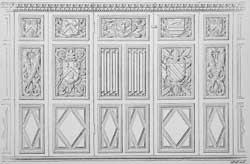
PART OF THE LOWER SEATS, LANDULPH CHURCH. View larger image
On the wall over the south Lower seat, are these further inscriptions on brasses,—
HERE LYETH BVRIED YE BODY OF SIR NICHOLAS LOWER OF CLIFTON KNIGHT, (DESCENDED OF THE HOVSE OF ST. WINOWE) THE SONNE OF THOMAS LOWER AND JANE HIS WIFE, ONE OF THE CO-HEYRES OF RESKYMER; WHO HAD ISSVE SIX SONNES, VIZ: SIR WILLIAM LOWER KNIGHT DECEASED IN CARMARTHENSHIRE, JOHN LOWER, THE SAID SR NICHOLAS LOWER, SIR FRANCIS LOWER KNIGHT, THOMAS LOWER DECEASED IN LONDON, AND ALEXANDER LOWER. HE MARRIED WITH ELIZABETH, ONE OF THE DAVGHTERS OF SR HENRY KILLEGRVE OF LONDON KNIGHT, DIED WITHOVT ISSVE, SVRRENDRINGE HIS SOVLE TO HIS REDEEMER AT CLIFTON, YE 17TH OF MAYE, ANNO DOMINI 1655.
and to his much-married spouse, who pre-deceased him nearly twenty years, the following quaint tribute to her memory:—
HEERE LYETH BVRIED THE BODY OF DAME ELIZABETH LOWER LATE WIFE VNTO SIR NICHOLAS LOWER OF CLIFTON, KT, DAVGHTER VNTO SR HENRY KILLIGREWE OF LONDON, KT, ANTIENTLY DESCENDED FROM YE HOVSE OF ARWENNICK IN CORNWALL, AND FROM YE YOVNGEST OF YE LEARNED DAVGHTERS OF SR ANTHONY COOKE, KT, A MAIDE OF HONOVR TO QVEENE ELIZABETH; WHO FOR TREW VERTVE, PIETY, AND LEARNING, CAME NOTHING SHORT (THAT I MAY MODESTLY SPEAKE) OF ANY OF HER ANCESTORS, AND FOR HER SINGVLAR COVRTESIE TO ALL, AND AMIABLE SVBIECTION TO HER HVSBAND (A VERTVE RARE AND HIGH) I THINKE CAN HARDLY BE MATCH'D, WHO DESERVES A FAR AMPLER CHARACTER THEN CAN BE CONTAINED IN SO NARROW A ROOME: SHE DYED AT CLIFTON IN CORNWALL, THE SIXT DAY OF JVNE IN THE YEARE OF OVR LORD, 1638, AND EXPECTS HEERE A GLORIOVS RESVRRECTION.
The two representative "squires' pews" we glanced at on our way down the aisle, and in which presumably the old knight, his dame, and their dependants performed their devotions, when they were in the flesh, and resident at Clifton, accompanied it may be by his imperially descended friend,—are situate a little above their last resting places. Some of the middle panels exhibit the linen pattern, a late example of this last remnant of pointed design. Alternating with these are several filled with floriated ornament, having in their centres shields, continued also on the cornice above, displaying the descent and alliances of Lower.
On the first seat,—1. A chevron between three roses (Lower). —2. Per fess, three pears in base, in chief a demi-lion rampant (Perrott).—3. Three castles (Kestell).—4. An annulet surmounted by a mullet.—5. Three chevrons ermine (Esse?).—6. A chevron engrailed, between three talbots passant (Carveth or Tregassawe).—7. A chevron between three trefoils, stems erazed.—8. Two bars, in chief three roundels.—9. A fess fretty.—10. A cross moline (Upton?).—11. A chevron between three birds.—12. A chevron between three boars' heads.—13. A chevron between three moors' heads affrontée, couped at the shoulders (Tregenna?).—14, as 1. On the second seat,—1. A double-headed eagle displayed, within a bordure bezantée (Killigrew).—2. Three bars, in chief a wolf passant (Reskymer).—3. Three bends(Bodrugan).—4. Three bends within a bordure bezantée (Valletort).—5. A bend, a label of three (Carminow).—6. A chevron, a label of three(Prideaux).—7. A crescent surmounted by a mullet (Denzell).—8. A boar passant, between three mullets (Trevarthian?).—9. A cross between four mullets (Flamank?).—10. A fess indented, between three mullets.—11. A stag's head (Trethurffe?).—12. A calf passant (Cavell).—13. Lower. The crest, an unicorn's head couped at the shoulders, in full relief at the corners, and the initials N.L. and E.L., together with the date 1631, is carved on the panels. Lower impaling Killigrew appears also on the brasses. The character of the carving is superior for the era, and its subjects heraldically interesting.
A few words further here concerning two immediate descendants of this,—at the time,—numerous Cornish race, who acquired some renown, the one in amusing, and the other in preserving this transitory life of ours. John Lower of Tremeer, brother to Sir Nicholas, had a son Sir William, a cavalier strongly attached to the royal cause. He was a dramatist, and retired to Holland during the Commonwealth that he might enjoy peaceful companionship with the muses. He was a great admirer of the French poets, particularly Corneille, and on their works built the plans of four out of the eight plays which he wrote. He also issued translations from the French, and edited a Journal of the movements of Charles II. while in exile. He subsequently possessed Clifton as heir-general of the family, on the decease without issue of Thomas Lower (the son of Sir William Lower, Sir Nicholas' brother), to whom Sir Nicholas left it. He died in 1662. Richard Lower, the other descendant, was a celebrated London physician, and the author among other works of a "Treatise on the Heart," which "attracted much notice, in consequence of the chapter on the transfusion of blood which the author had practised." He died in 1690, and was buried at St. Tudy.
Here we conclude such notices of the lives, deaths, and memorials of the Paleologi, and their friend the old knight at Clifton and his family as have been found available. Have you anything further to say of them, you ask, ere we leave the little sanctuary? What can there be said further—would be the obvious reply—concerning those whose lives, deaths, burial-places and memorials, have all been duly noticed and recorded? Well, for once, not even the fastness of the grave will be proof against some additional remembrances of the Paleologi.
Man's curiosity is unbounded and insatiable. No place or association is altogether safe from the intrusion of his prying eyes and ransacking fingers, if he thinks there is anything likely to be found therein calculated to gratify its longings, and he gets the chance, or has permission to make the search. In this particular he follows in the trail of death as being no respecter of persons, but with this ignoble difference to the great conqueror, that he waits until the life is gone before he seeks to assuage his morbid longings by an invasion of the bodies of his forefathers. It would be supposed the sanctity of death and the rest of the grave would naturally be privileged, but no, they have rather stimulated his curiosity, and so have found little or no consideration in his sight. The cunningly-embalmed Egyptian potentate in his burial fortress of the great pyramid,—his humble spice-wound subject in his rock-hewn sepulchre,—the Roman emperor in his grand mausoleum,—Greek hero in costly sarcophagus,—British chieftain in flint-piled barrow,—mediæval saint in shrine, and king, ecclesiastic or noble in their ponderous stone coffins,—all have in turn been subjected to this unfeeling scrutiny, and the poor dust and mouldering bones rummaged over by irreverent hands, very few indeed escaping violation, sometimes for hope of plunder, but usually for idle curiosity, and the indulgence of relic-hunting propensities. And yet, perhaps, there is scarcely anything the living heart would more shrink from contemplating, than the possibility of such indignity being offered to the frail decaying tenement it had beat in, after death; a sentiment shared in common by the greatest intellects and humblest minds,—but that does not avert the outrage.[50]
The ashes of the Paleologi have not escaped this common danger of being examined, the father's here on this bank of the Tamar, and by curious coincidence, the son's in the distant island of Barbados, but no indignity was offered the remains. At Landulph, toward the close of the last century, "when the vault was accidentally opened, the coffin of Paleologus was seen, a single oak coffin, and curiosity prompting to lift the lid, the body of Paleologus was discovered, and in so perfect a state, as to ascertain him to have been in stature much above the common height, his countenance of an oval form, much lengthened, and strongly marked by an aquiline nose, and a very white beard reaching low on the breast." A physiognomy and stature eminently representative of his imperial descent, and how remarkably preserved after the lapse of nearly two centuries. In 1831 a hurricane destroyed the church of St. John in Barbados. In a vault under the organ-loft was discovered "the leaden coffin of Ferdinando Paleologus, in the position adopted by the Greek church, which is the reverse of others. It was opened on the 3rd of May, 1844, and in it was found a skeleton of remarkable size, imbedded in quicklime, thus shewing, that although Ferdinando may have accommodated himself to the circumstances of his position, he died in the faith of his own church."[51] He thus appears to have been of commanding appearance as his father.
Before we leave the little edifice, a look into the tower, and a glance under the communion table. Two incidents attendant on the perils of access to Landulph's maritime position meet the eye. In the chancel a flat stone commemorates the fate of a former rector, "Edward Ameredith, who married Alice, the fourth daughter of William Kekewitch of Catchfrench in Cornewall, Esquire; 8th of May, 1661,—being drowned in passing the Ryuer." Within the tower a tablet erected a hundred years later is thus inscribed,—
Near this place Lies the Body of Fitz-Anthony Pennington, Bell-Founder, of the Parish of Lezant in Cornwall, who departed this Life, April 30, 1768. Ætatis suæ 38.
Tho' Boisterous Winds & Billows sore, Hath Tos'd me To and Fro, By God's Decree in spite of both, I rest now, here below.
At the top of the monument is incised a winged angel with a trumpet, supporting a man bearing a church bell; at the bottom a laver-pot flaming; both being emblems of his vocation. Fitz-Anthony Pennington, member of a noted family of bell-founders, was also unfortunately drowned. This occurred at Anthony passage,—a somewhat dangerous creek further down the river,—while conveying across a church bell intended to be set up at Landulph. The curious doggerel in praise and regulation of ringing, that is inscribed on a large wooden tablet opposite the monument, is said locally to be an effusion from his pen, but it has a much earlier date. The Penningtons were successively of Exeter, Lezant, and Stoke-Climsland, and itinerated as occasion required. They cast nearly five hundred bells for the churches in Devon and Cornwall, between the end of the seventeenth and the first quarter of the nineteenth centuries.
Imperialist or Republican? Such are the echoes that quest the mental ear from the opposite sides of the Tamar, as our little craft gets well out into mid-stream, and we make for the creek that runs inland on the shore immediately facing Landulph. Here dwelled an antient family, in Domesday survey called Alured Brito, afterward named from the place of their residence De Budockshed (since provincialized to Butshead or Budshead), and who continued there from the time of King John downward for fourteen generations, until about the middle of the sixteenth century, when the inheritance passed by a distaff to the possession of another old race (also having antecedents near), named Gorges. The venerable home of the Budocksheds has been destroyed, but two fine old barns—one of grand proportions—and a picturesque granite gateway, still remain to attest its aforetime importance. Winifred, one of the daughters and coheirs of Roger Budockshed, Esq. (who married Frances daughter of Sir Philip Champernowne of Modbury), the last possessor of that name of the mansion and manor; brought it to her husband Sir William Gorges, knt., a Vice-Admiral, Deputy of Ireland, and a Gentleman Pensioner of Queen Elizabeth. He was a scion of the wide-spreading Somersetshire family of that name, and had three sons,—Tristram, Arthur, and Edward. Dying in 1583, he left it to his son Tristram, who married Elizabeth daughter of Martin Cole of Cole-Anger. He had one son William, and four daughters, two of whom married Courtenays of the Landrake descent, and another Trelawney. William died without issue, and disinheriting his sisters, "conveyed Budoke-side," says Pole, "unto Sr Arthur his unkle, and hee hath lately sold it." Sir Arthur Gorges was of Chelsea, he disposed of the old possession to the Trevills, a family of prosperous Plymouth merchants. In the Budockshed aisle of the church is a handsome monument to them, which bears the following inscription:—
Here Lyeth Bvried the Body of Richard Trevill, Esqr., who died Avgvst the XXVI., 1648. Aged 73.
Here Lyeth Bvried the Bodyes of Richard Trevill, Esqr., Nephew and Heire of the Aforesaid Richard, who died April the 4th, 1662. Aged 51. And also of Mary his Wife, who died the XXV. day of Febrvary, 1663. Aged 57.
Here Lyeth Bvried the Body of Richard Trevill, Esq., Sonn of the said Richard and Mary, who died Janvary the XIX. 1665. Aged 19.
This Monvment was Erected by William Trevill, of Bvtshead, Esq., in the year of ovr Lord 1667, to Perpetuate ye memorie of his Worshipfull Predecessors and Relations here buried.
Arms,—Or, a cross sable, debruised by a bendlet azure (Trevill), impaling,—Argent, a chevron gules, between three birds (coots or moorcocks), sable.
On ledger-lines upon flat stones below, the first and second of the foregoing inscriptions are repeated, with the arms of Trevill sculptured. In their centres are these further notices:—
Also Here Lyeth The Body of William Trevill of Butshead, Esq., Father of Lethbridge Trevill, who departed this Life the 18th Day of May, 1680.
Also Here Lyeth the Body of Lethbridge Trevill, Son of William Trevill of Butshead, Esq., who departed this Life 27th of February, 1699.
The name of Trevill is still perpetuated in a street in Plymouth.
From the Trevills, by a distaff, it became the property of Brigadier-General Trelawney, whence it descended to his son Sir Harry Trelawney, Bart., aide-de-camp to the celebrated Duke of Marlborough. This gentleman "for many years led a retired life at Budshead, where he amused himself with planting and gardening, having been the first person who brought ornamental gardening to any perfection in the west of England. His gardens, which abounded with American and other exotic shrubs and plants, were much resorted to by the curious." (Lysons.) Some remains of his taste still exist, and an old yew garden, once having a fishpond in its centre, and one or two noble trees of unmistakably foreign origin, still hale and vigorous.
This genealogical recital brings us to "the middle of our song." William Gorges, the last local possessor of Budockshed, was cousin to the celebrated Sir Ferdinando Gorges, the Founder of the State of Maine, U.S.A., and for some years Governor of Plymouth. He was also identified with St. Budeaux, both by property and marriage; first, by being owner of the manor of Kinterbury in that parish, and secondly, one of his four wives having been Elizabeth, sister of William Gorges of Budockshed, and widow of Edward Courtenay. Sir Ferdinando, whose history and proceedings are largely interwoven with the stirring movements of his time, both of warlike character at home, and colonization and enterprise abroad, died 14 May, 1647, and was buried at Long-Ashton, near Bristol.
In the Budockshed aisle of the church of St. Budeaux, is a beautiful monument to the memory of that family and their immediate successors, the Gorges. It consists of a high-tomb, with pillars at the angles, the cover-stone of slate finely carved, and a reredos of exquisite Elizabethan design. On it are these arms,—1. Sable, three fusils in fess, between three stags' faces argent. Crest,—A moor's head affrontée proper (Budockshed).—2. Quarterly,—1 and 4. Lozengy or and azure, a chevron gules, a crescent for difference (Gorges).—2. and 3. Argent, a bull passant sable, within a bordure of the second bezantée (Cole).—3. Gorges, with crest,—a greyhound's head couped at the shoulders, and collared, with crescent for difference.—4. Gorges and Budockshed quarterly.—5. Budockshed, with crest. The original inscription, which was probably gilded on it, had disappeared, but the sculptured date, 1600, remains.
The monument had become greatly dilapidated, but was restored in 1881, and the following inscription then cut on it,—
Roger Budockshed, of Budockshed, Esquire, obiit 1576. Sir William Gorges, Knight, obiit 1583. Dame Winifred Gorges, ob: 1599. Tristram Gorges, of Budockshed, Esquire, ob: 1607. Mrs. Elizabeth Gorges, ob: 1607.
Restored 1881: chiefly at the expense of the Historical Society and Citizens of the State of Maine, U.S.A.; in memory of Sir Ferdinando Gorges, the first Proprietor and Governor of that Province, A.D. 1635; aided by some connections of the Gorges family in England.
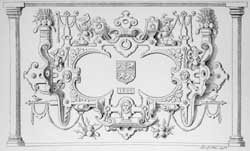
PANEL FROM THE GORGES TOMB. ST. BUDEAUX CHURCH. View larger image
Singularly coincident,—as with the Paleologi at Landulph, so with the second of the Gorges of Budockshed,—the recital of his life and burial does not end all we have to say of him. In speaking of "St. Buddocks," as Risdon calls it, he narrates the following:—
"The church of this parish once stood in a remote and unhealthy place by the river side, but Robert Budshed rebuilt it in a place more convenient, at his own cost; whereof (see the fate!) his own daughter first possessed the place for her burial; and in this church there is a tomb erected to the memory of Tristram Gorges and Elizabeth his wife, daughter of Cole, which about thirty years after his funeral was taken up by occasion of burying another of that tribe in his sepulture; in whose coffin digged up, the carcass was found with the flesh fallen on his ridge-bone like a jelly, there lying all his bones in order, as they that were eye-witnesses have delivered."[52]
Enow of death and his doings. Now for the lesson of reflection that the lives and aims of the principal characters in this little story of to-day's wandering suggest to us. We take a farewell view from the delightful acclivity on which the church of St. Budeaux is situate, with panorama of the wide-spreading Tamar and its ramifications at our feet, and the great Cornish hills retreating inimitably in the distance beyond;—then slowly retrace our steps down to the river's side at Budockshed, and are soon again afloat, half-drifting, half-sailing, making for our haven at Saltash passage. Another and strange dream of the vicissitudes of human life, finds its fulfilment in the one case over the grave of the imperial exile at rest among the peasantry of the hamlet in the little sanctuary yonder. Driven from his native clime,—bereft of all his kingly traditions,—the splendid empire he may have been born to rule the possession of the barbarian invader,—himself dependant on the bounty of a stranger,—and his royal name extinct,—such was the fate of Paleologus; conditions which instruct us, that the same inexorable law of mutability affects equally a dynasty, whether its residence be in a palace or a cottage. There is no station privileged against the misfortunes that afflict our common mortal conditions.
But what of the emigrant commemorated at St. Budeaux, Sir Ferdinando? He voluntarily left his English home to help found the magnificent commonwealth, that in a single century has absorbed a whole continent, in extent infinitely larger than the realms the Constantines in their fullest glory presided over, and whose existence was altogether unknown when their last representative lost his crown and his life. How different the errands of these men in their migrations from their native land. But no emperor rules the destinies of the nation he helped to found; the charm of simple and equal citizenship is the secret of its strength; and while the memorial of Paleologus is viewed with curious sympathy by the wayfarer, as being only the interesting reminder of an extinct rule,—the tomb of Gorges has been renovated by the descendants of those pioneers he helped to conduct across the broad Atlantic, and left with them the deathless heritage of liberty and progress.
Again we are enveloped in the gloom of the great bridge, another pleasant day's voyaging is ended, and as our foot touches the shore, a suggestive farewell thought follows us across the river, bearing on its wing the motto inscribed on the sun-dial over the porch of the church of St. Budeaux:—
"EX HOC MOMENTO PENDET ÆTERNITAS."
Upon this moment—here we part, Until the coming dawn arise And we are spared,—nay, do not start, The present moment as it flies Is all the dower Life gives the heart, All that the miser Time supplies.
Upon this moment—yon bridge vast, That spans the deep and darkling tide, To that frail link which joins at last Life to eternity so wide, Is as the gossamer, that's cast Across the green dell's dewy side.
Upon this moment—warm hands greet, Though glance be hid by shadows dim, Hark to those fisher children! sweet Singing their votive evening hymn,— Their dreams will be again to meet, All undisturbed by truth so grim.
No sword of Damocles infest Life's subtle thread of moments spun, This day is ours—with loving zest Cease not 'till all its work be done, Then fold thy hands, and take thy rest, And calmly wait to-morrow's sun.
RESURGAM View larger image
Portrait View larger image
INDEX.
A.
Abbotsbury Abbey Church, 145.
Alcester Church, Greville monument in, 29.
Aller Church, Bottreaux monument in, 148.
Ameredith, Edward, his epitaph, 202.
Anstis, Sir John, 5n.
Arms on Arundell monument in St. Columb Church, 68; of Astley, 73; Beauchamp, 31; Beaumont, 148; Bec or Beke, 23, 29, 30 ; Bigbury, 30; Bodrugan, 200; Bonville, 79; Bottreaux, 148; Broughton, 133; Budockshed, 204; Carminow, 168, 200; Carveth, 199; Cavell, 200; Champernowne, 16, 30; Cheney, 7, 8, 23, 29, 30, 123n, 128, 130, 133n; Cifrewast, 30, 141; Cole, 204; D'Aumarle, 30, 140; De Arches, 168; Denys, 83; Denzell, 200; Dinham, 168; Drake, 82; Echyngham, 81; Erleigh, 8; Esse, 199; Ferrers, 30; Fitz-James, 166; Fitz-Roger, 43; Flamank, 200; Forde, 41; Gorges, 204; Grenville, Greynville, 83, 140; Greville, 30; Grey, Marquis of Dorset, 73; Harington, 74, 79; Hastings, 59, 73; Kestell, 199; Killigrew, 198, 200; Latimer, 23, 29, 30; Lower, 198, 199; Maltravers, 30, 140; Newburgh, 166; Paleologus, 193; Paveley, 4, 8, 29, 30; Perrott, 199; Peyvre, 131, 133, 133n; Plantagenet, 74; Prideaux, 83, 200; Quincy, 73; Reskymer, 198, 200; Rogers, 81; Shaftesbury Abbey, 166; Shotisbrooke, 123n; Shurland, 128, 130; Stafford, 23, 30, 31, 74, 143, 146; Tregassawe, 199; Tregenna, 199; Trethurffe, 200; Trevarthian, 200; Trevill, 203; Ufford, 23, 29, 30; Upton, 199; Valence, 73; Valletort, 200; Widville, 74; Willoughby, 23, 30, 33; Earl of Wilts, 74.
Arundell family, 158.
Arundell, Elizabeth, 168; Humphrey, 170, executed, 171; Sir John, 67, 148, 159, 170, his epitaph, 69, his children, 160, his death, 165; Sir Matthew, 179; Sir Renfrey, 5n; Sir Thomas, 198; Sir Thomas, Lord, 163, 179, his house at Shaftesbury, 168, manors granted him by Lord Daubeney, 169, suspected of rebellion, 170, committed to the Tower, 171, released, 172, again imprisoned, 173, condemned to death, 175, executed, 177, his children, 178, his estates attainted and restored to his widow, 178, created Baron A. of Wardour, 180, his epitaph, 180, his descendants, 180; William, 197.
Arundell brass in St. Columb Church, 178.
Arundell inscription at Tisbury, 180.
Arundell tombs in Tisbury Church, 179.
Astley Church, presumed Bonville effigy in, 80.
Astley, Alice, 16.
Astley arms, 73.
Audley, Hugh de, 139n; Margaret, 139; Thomas, Lord, 75.
Axminster Church, 79.
B.
Balls, Mary, 192, 196.
Barry, Isabel, 152.
Barwick Church, 80.
Beauchamp Chapel, Salisbury, 127.
Beauchamp family, 25.
Beauchamp, Bishop, 127; Elizabeth, 24; John, 41; Richard, his arms, 31.
Beaufort, Margaret, 89.
Beaumont, Elizabeth, 147; Katharine, 42; Matilda, 47.
Beaumont arms, 148.
Bedyke, Isabel, 10.
Beer-Ferrers, 17; church, 19, arms in, 32.
Beke, Bec, Alice, 10; Anthony, 10.
Beke arms, 23, 29, 30.
Bigbury, Elizabeth, 16.
Bigbury arms, 30.
Blue Boar Inn, Salisbury, 109.
Blount, Charles, 25, 35; Elizabeth, 66; William, 67.
Bodrugan, Sir Henry, 18; Johanna, 41.
Bodrugan arms, 200.
Bodrugan Castle, 18.
Bohun, Mary de, 88.
Bonville, Anne, 62; Cicely, 25, 26, 51, 63, 159, her second marriage, 74, her will, 74, her numerous memorials, 78; John, 62; Margaret, 81; Nicholas, 40; Sir Nicholas, 83; Thomas, 5, 62; Sir William, Lord, his will, 43, birth and baptism, 44, dispute with Lady Brooke, 46, his family, 47, created a Baron, 47, duel with Earl of Devon, 49, custodian of Henry VI., 60, beheaded, 62, place of burial unknown, 62; William, 50, slain, with his son, at Wakefield, 61.
Bonville family, 40; extinction of, 63; illegitimate branch of, 63n.
Bonville arms, 79.
Bonville-Nonant monument in Broad-Clyst Church, 41.
Bosworth, Battle of, 123.
Bottreaux, Anne, 147; Margaret, 148; Reginald, 147, his epitaph in Aller Church, 148; Thomas, 25; William, 147.
Bottreaux arms, 148.
Bottreaux tomb in North-Cadbury Church, 147.
Bourchier, Sir Thomas, his epitaph, 152.
Brandon, Frances, 76.
Brienne, Elizabeth, 147.
Britford Church, Buckingham's monument in, 109, 117.
Broad-Clyst Church, monument in, 41.
Broke Chantry in Westbury Church, 6.
Broke and Suthwyke granted to Sir R. Radcliffe, 11.
Brooke Hall, 3, as described by Leland, 3, and by Aubrey, 4.
Broughton, Anne, 128, 132; Sir John, 131.
Broughton arms, 133.
Bruse, Giles, his epitaph, 134.
Bryanstone Church, Rogers epitaph in, 81.
Buckingham, Duke of—see Stafford.
Budockshed, Roger, 204; Winifred, 203.
Budockshed family, 202.
Budockshed aisle in St. Budeaux Church, 204, monument in, 204.
Budockshed arms, 204.
Butler, James, 147.
C.
Callington, 21.
Callington cross, 24.
Camoys, Matilda, 48.
Cardinham, Isolda, 16.
Carew, Sir Thomas, 42.
Carminow, Joan, 19; Matilda, 16, 20; Sir Ralph, his brass in Menheniot Church, 41; Sir Roger, 19.
Carminow arms, 168, 200.
Carrant, William, 10.
Carveth arms, 199.
Catesby, Richard, 56.
Cavell arms, 200.
Champernowne, Champernon, Alexander, 16; Sir Arthur, 82; Blanche, 9, 16; Frances, 203; Johanna, 41; John, 21; Sir Richard, 44; Roger, 21.
Champernowne family, 16.
Champernowne arms, 16, 30.
Charleton, Walter, 42.
Cheney, Agnes, her epitaph, 122n; Anne, 9, 10, her epitaph, 133; Cicely, 81; Sir Edmund, 148; Sir Henry, Lord, 129, 133n; Jane, her epitaph, 134; Sir John, Lord, 11, 121, 169, joins Buckingham's conspiracy, 123, his arms, 123n, overthrown at Bosworth, 124, created a Knight Banneret, K.G., and Baron, 125, his death, 127, succeeded by Sir Thomas, 127, his effigy, 127; Sir Ralph, 4, his tomb in Edington Church, 8; Sir Thomas, 127, 128, his children, 128, his epitaph, 132; Sir William, 42.
Cheney family, 4, 5, 121, 148.
Cheney arms, 7, 8, 23, 29, 30, 123n, 128, 130, 133n.
Cheney monument in Toddington Church, 132.
Chickett-Hall in Callington, 22.
Chidiock, Katharine, 148.
Cifrewast arms, 30, 141.
Clement, Richard, 70.
Clifton in Landulph, 197.
Cobham, Sir John, 42.
Cocks, Walter, 79.
Cole, Elizabeth, 203; William, 203.
Cole arms, 204.
Coleshill, Joanna, 5; Sir John, 5, 5n, his epitaph, 6n.
Collingbourn, Sir William, 2.
Constantinople, fall of, 194.
Constantinus VIII. slain, 193.
Conway, Sir John, 28.
Copestan, ——, 16.
Coplestone, Philip, 44, 63.
Courtenay, Edward, Sir Edward, 190, 204; Elizabeth, 48, 50, 81; Henry, 150; Hugh, Sir Hugh, 47, 190; John, 150; Thomas, 60, his sons, 149; Sir William, 48.
Courtenays, the, 11.
Courtenay estates forfeited and restored, 152.
Cralle, Elizabeth, 121.
Crips, Nicholas, 128.
Crukerne, Amy, 82.
Culpeper, Joyce, 162; Sir Thomas, 162.
D.
D'Aumarle, Elizabeth, 140; Margaret, 41.
D'Aumarle arms, 30, 140.
Daldich, Roger de, 40.
Daltery, Dautry, ——, 17; Sir Francis, 26.
Daubeney, Giles, Sir Giles, Lord, 11, 12, 15, 67, 123, 159,
governor of Calais, 13; Henry, 168; Katharine, 16, 44.
Dauney, Emmeline, 190.
De Arches arms, 168.
De la Mare, Peter, 140.
Denis, Dennis, Margaret le, 16; Philippa, 82.
Denys arms, 83.
Densloe, Elizabeth, 82.
Denton, Anne, 27.
Denzell arms, 200.
Devereux, Walter, 67.
Dinham, Sir John, 140,
his probable effigy, 140n; John, Lord, 152, 159; Katharine, 67.
Dinham arms, 168.
Dorrington manor, 165.
Dorset, Marquis of—see Grey.
Dorset aisle in Ottery Church, 78.
Drake, John, 81; Richard, portrait of, 83n; Robert, 81, his descendants, 82, his monument at Southleigh, 82.
Drake arms, 82.
E.
East-Coker Window, Arundell arms in, 181.
Echyngham, Anne de, 81.
Echyngham arms, 81.
Edgcumbe, Richard, 17, 18.
Edington Church, 8.
Edington, William de, 9.
Edward V., conspiracy against, 91.
Elliot, John, 44.
Erleigh arms, 8.
Esse arms, 199.
F.
Faringdon, John, 41.
Ferrers, Elizabeth, 43; Joan, 16, 22; Sir John, 17; Margery de, 19; Matilda de, 19; Reginald de, 19; Sir William de, 17, 19, his window and tomb, 20.
Ferrers family, 16.
Ferrers arms, 30.
Filliol, Sir William, 5.
Fitzalan, Henry, 75; John, 145; Catherine, 76; William, 24.
Fitzgerald, Gerald, 69.
Fitzjames family, 166; arms, 166.
Fitz-Roger, Elizabeth, 43, 44.
Fitz-Roger arms, 43.
Flamank arms, 200.
Fleming, Christopher, 16.
Forde, Hawise de la, 41.
Forde arms, 41.
Fortescue, Margaret, 129.
Fowell, Joan, 82.
Frome, Joan, 5.
Frost, William, 18.
Frowyke, Frideswide, 128.
Fulford, Sir Humphrey, 44.
G.
Gloucester, Richard, Duke of, his conspiracy, 90; proclaimed king, 98; Buckingham's conspiracy against, 99.
Gorges, Arthur, 203; Edward,203; Elizabeth, 204; Sir Ferdinando, 204; Leva, 43; Tristram, 203, 204; William, Sir William, 203, 204; Winifred, 204.
Gorges arms, 204.
Govys, John, 42.
Graville, ——, 17.
Grenville, Greynville, Alice, 140; Amy, 81; Katharine, 68, 159; William, 47, 139.
Grenville arms, 83, 140.
Greville, Blanche, 28; Catherine, 28; Edward, 27, 28, his arms, 30; Eleanor, 28; Lady Elizabeth, 169; Fulk, Sir Fulk, 27, 28, 31, his monument in Alcester Church, 29, his arms, 30, created Baron Brooke and Earl of Warwick, 31, murdered, 31; Margaret, 31; Mary, 28; Robert, 28.
Greville arms, 30.
Grey, Anne, 85, 178; Dorothy, 25; Sir Edward, 80; Elizabeth, 52, 159; Muriel, 74; Thomas and his children, 66; Thomas, Marquis of Dorset, 11, 123, his death, 73, his will, 73, his arms, 73, his descendants, 75; Thomas, second Marquis, his will, 75.
Gyvernay, Henry de, 79.
H.
Haccombe Church, 19.
Haccombe, Sir Stephen de, 19.
Hampton, Joan, 40.
Harington, Elizabeth, 50.
Harington arms, 74, 79.
Harris, William, 28.
Hastings, Anne, 52, 53; George, 111; Katharine, Lady, her will, 58; Sir William de, 51; William, Lord, 123, amours with Jane Shore, 54, loyal to Edward IV., 54, his children, 54, 58, beheaded, 57, his will, 58.
Hastings arms, 59, 73.
Haughton, Sir William, 5n.
Herbert, Henry, Lord, 76; Sir Walter, 111.
Hext, Thomas, 44.
Hill, Elizabeth, 5.
Hiwis, Emma, 5n.
Holland, Anne, 52, 66, 89.
Hooke Church, 33.
Hooke House, 141.
Hooper, William, 81.
Houndalre, Leonard, 42.
Howard, Lord Edward, 162; Katharine, 164, 168; Margaret, 161.
Hungerford, Mary, 53; Robert, Lord, 148; Walter, 11.
K.
Kekewich, Alice, 202.
Kemp, Thomas, 128.
Kestell arms, 199.
Keys, Martin, 76.
Killigrew, Elizabeth, 198; Sir Henry, 198.
Killigrew arms, 198, 200.
Kings-Carswell Church, effigies in, 140n.
Kirkham, Margaret, 5.
Knightstone in Ottery, 79.
L.
Lamborn, William, 5.
Landulph Church, 189, heraldry in, 190, inscriptions in, 202.
Latimer, Elizabeth, 10; John, Lord, 26n; Richard, Lord, 26n; William, Lord, 26n.
Latimer arms, 23, 29, 30.
Lewkenor, Sir Roger, 148.
Limington Church, 79.
Loddiswell Rectory, 168.
Lovel, Lord, his mysterious death, 126.
Lovell, Maud, 147.
Lower, John, 200; Major, 197; Sir Nicholas, 192, his descent, 198, his will, 198, his epitaph, 198, 199; Richard, 200; Thomas, 198, 200; Sir William, 200.
Lower arms, 198, 199.
M.
Maltravers, Elizabeth, 5, 140.
Maltravers arms, 30, 140.
Menheniot Church, Carminow brass in, 41.
Meriet, Agnes de, 41.
Minster Church, Sheppey, 132.
Mohun, Sir Reginald, 198.
Morley, Lord, 13.
Morton, Cardinal, 99, his birthplace, 115, his place of burial, 116, his tomb, 116, 123.
Moyle, Anne, 198.
N.
Nanfan, Sir John, 5n.
Neville, Anne, 31, 89; Elizabeth, 10; George, Sir George, 26n, 51, 60, 128; Katharine, 50, 60; Margaret, 26; Sir Thomas, 60.
Newburgh arms, 166.
Nonant, Sir Roger de, 41.
North-Bradley Church, Stafford Chapel in, 142.
North-Cadbury Church, Bottreaux tomb in, 147.
O.
Okebeare, Richard, 41.
Ottery Church, Dorset aisle in, 78.
P.
Paleologus, Dorothy, 197; Ferdinando, his will, 197, his children, 197, his coffin opened, 201; Maria, 197; Theodore, his epitaph, 192, his family, 193, seeks service in England, 196, his wives, 196, his sons, Theodoro, Ferdinand, and John, 197, his coffin opened, 201; Thomas and Demetrius, their subjection to the Turks, 195.
Paleologus arms, 193.
Paulet, John, 25.
Paveley, Alice, 7; Joan, 5, 7, 9.
Paveley family, 4, 9.
Paveley arms, 4, 8, 29, 30.
Payne, Stephen, his brass in Shaftesbury Church, 166.
Pennington, Fitz-Anthony, his epitaph, 202.
Perrott, Sir John, 128.
Perrott arms, 199.
Petre, Sir William, 81.
Peyvre, Mary, 128, 131.
Peyvre family, 130.
Peyvre arms, 131, 133, 133n.
Peyvre monument in Toddington Church, 131.
Pinhoe, Stretch's Chapel at, 5.
Plantagenet, Anne, 88.
Plantagenet arms, 74.
Plymouth, 183.
Pole, John, 84.
Pomeroy, Anne, 205n.
Powderham Church, arms of Courtenay and Bonville in, 65.
Poynings, Sir Hugh, 16.
Prideaux, Elizabeth, 81.
Prideaux arms, 83, 200.
Pyne, Elizabeth de, 40.
Q.
Quincy arms, 73.
R.
Radcliffe, Sir Richard, 11.
Radford murdered at Poughill, 149.
Ratcliffe, Robert, 111.
Read, Charles, 28.
Reskymer, Jane, 198.
Reskymer arms, 198, 200.
Reynell, Sir Thomas, 198.
Richard III., his death at Bosworth, 124.
Rivers, Earl, made prisoner at Northampton, 91; his execution, 94.
Roche, Elizabeth, 127.
Rodney, Alice, 41.
Rogers, John and Elizabeth, their epitaph, 81.
Rogers arms, 81.
Roos, Margaret, 148.
S.
Sachville, John, 41.
St. Budeaux Church, 204, rebuilt, 205.
St. Columb-Major Church, Arundell brass in, 67, 159, 178.
St. John, Eleanor, 75; Johanna, 43.
St. Loe, Sir John, 4.
Salisbury, 87.
Saltash, 187.
Saracen's Head Inn, Salisbury, 109.
Seaton Church, 79.
Seymour, Semar, Edward, 34; Lord Edward, 76; Walter, 34.
Shaftesbury Abbey, 165, arms of, 166; Church, 166.
Shareshull, William, 79.
Sherman, William, 79.
Shore, Jane, 54.
Shottisbroke, Eleanor de, 122.
Shottisbroke arms, 123n.
Shurland, Margaret de, 121.
Shurland arms, 128, 130.
Shute, 40, 84.
Shute House, Old, 65.
Shute Park, 64.
Skipwith, Alice, 10.
Slapton Priory, 168.
Southleigh Church, Willoughby tomb in, 35, 85; Drake monument in, 82.
Southleigh, architectural remains found at, 84.
Spilsby Church, Willoughby brass in, 10n.
Stafford, Alice, 5; Anne, 26; Edward, Duke of Buckingham beheaded, 111; Elizabeth, 25; Henry, Earl of Wilts, 74, 79, his arms, 74; Henry, Duke of Buckingham, 89, made Constable of England, 98, pressed by Morton to assume the crown, 101, failure of his conspiracy, 105, betrayed, arrested, and executed, 107, burial place unknown, 108, his monument in Britford Church, 109, his children, 111; Humphrey, 42, 111, 148; Sir Humphrey, Lord Stafford, his children, 147, created a Baron and Earl of Devon, 150, beheaded, 151, his will, 151; Archbp. John, his parentage, 141, his mother's monument and epitaph, 143, death and burial, 145, his tomb, 145, probably born at North-Bradley, 145, his arms, 146, his epitaph, 146.
Stafford family, 88, 139, 148.
Stafford arms, 23, 30, 31, 74, 143, 146.
Stafford chantry in Abbotsbury Church, 145.
Stanley, Sir William, 124.
Stokes, Adrian, 77.
Stothard, Charles Alfred, 33.
Strangeways, Thomas, 6, his children, 148.
Stretch, Cicely, 5, 42.
Stuckley, Sir Richard, 44.
Suffolk, Frances, Duchess of, her epitaph, 77.
Suthwyke, 137, 139.
Sutton, John, 67.
Sweating Sickness, the, 25n.
T.
Tailboys, Walter, 6, 148.
Tailboys family, 148.
Talbot, Elizabeth, 80; Sir Gilbert, 13; Sir Humphrey, 13.
Throgmorton, Anne, 78.
Tisbury, 155.
Tisbury Church, 157; Arundell tomb in, 179.
Tisbury Manor, 164.
Tiverton Castle, 150.
Toddington, Cheney mansion at, 130.
Toddington Church, monuments in, 131, 132.
Tothill, Jane, 82.
Tregassawe arms, 199.
Tregenna arms, 199.
Trelawney, Sir Harry, 204; Sir Jonathan, 198.
Tremoderet, or Tremedart, in Duloe, 5n.
Tresillian, Robert, 5.
Trethurffe arms, 200.
Trevarthian arms, 200.
Trevill, Lethbridge, his epitaph, 203; Richard, his epitaph, 203; William, his epitaph, 203.
Trevill arms, 203.
Tyrrell, Sir James, 13.
U.
Ufford arms, 23, 29, 30.
Upton arms, 199.
V.
Valence arms, 73.
Valletort arms, 200.
Verney, Sir Richard, 31.
Verney family, 32.
W.
Wake, Richard, 67.
Walrond, Edward, 197; Henry, 197; Humphrey, 197.
Walrond family, 79.
Wardour Castle, 169.
Ware Church, Bourchier epitaph in, 152.
Welby, Joan, 10.
Wentworth, Jane, 129.
West, Thomas, 44.
Westbury, 1, 6.
Westbury Church, Broke Chantry in, 6; as described by Aubrey, 7.
Weston, Sir Henry, 178.
Wibbery, Johanna, 43.
Widville, Elizabeth, 66,
conspiracy against, 90; Catherine, 74, 111; Bp. Lionel, his tomb, 110.
Widville arms, 74.
Willoughby, Anne, 25, 26, 35; Blanche, 26, place of burial unknown, 23; Edward, 25, 26; Elizabeth, 25, 26, 141; Henry, 75, 85, tomb in Southleigh Church, 35; John, Sir John, 6, 16; Margaret, 178, her brass in Spilsby Church, 10n; Nicholas, 35; Robert, 17; Sir Robert, first Lord Willoughby, 11, 169, custodian of Earl of Warwick, 12, created a Baron, 12, Lord High Admiral, 14, Commander of forces against Warbeck, 15, Steward of the Household, 15, his marriage, 16, obtains the manor of Trethewye, 19, his monument in Callington Church, 23, his arms, 23, 30; Robert, second Lord, 24, 67; William, Sir William, 34, 35.
Willoughby family, 10, connection with the west, 9.
Willoughby arms, 23, 30, 33.
Wiscombe, 39, 44, 81.
Wotton, Margaret, 75.
Wyke, John, 42.
Wyvil, Robert de, 139.
Z.
Zouch, Elizabeth, 165; Margaret, 10.
FOOTNOTES:
NOTE TO ILLUSTRATIONS.
The indent of the brass of Archbishop Stafford being greatly frayed and denuded, the original outlines have been restored in the illustration, after a close and careful examination of the stone itself.
In the incised figure of the Archbishop's Mother, the lines are fairly perfect, except those forming the hands and face. These have been completed from the faint indications that remain.
R. G.
CORRIGENDA.
Page 5. Footnote, line 1, for Tremedart, read Tremodart.
— 5. — — 9, for Lanberne, read Lanherne.
— 11. Text, — 19, for Richmond of York, read the Earl of Richmond.
— 37. — — 14, for interests, read interest.
— 39. — — 37, for incidents, read incident.
— 77. Inscription, — 16, for Mil, read Nil.
— 123. Text, — 9, for Thomas, read John.
— 143. Inscription, — 12, for venerandissimi, read venerabilissimi.
— 167. Poetry, — 27, for his board, read His board.
— 181. Text, — 12, for 1673 to 1678, read 1678 to 1683.
— 181. Quotation, — 29, for C.B., read K.B.
By the same Author, uniform with this volume, and fully illustrated:—