DAYS OF THE TUDORS (continued 3)
Reading edition
But this misery, sharp as it was, was mercifully of short duration. Six weeks only intervened, in which interval it is probable Lord Bonville retreated from Wakefield, with such of the discomfited army that remained unslain, back to join the Earl of Warwick, then waiting on the outskirts of London to effect a junction with the forces of Edward, Duke of York, who had just fought and won a decisive victory over Jasper and Owen Tudor, with a Lancastrian army at Mortimer's Cross, near Hereford.
Before however this could be accomplished, the energetic Margaret, flushed with success, and hurrying southward in hope to secure the metropolis, was upon him; and the furious battle of St. Albans on the 18 Feb., 1460-1, was the result. There she at first received a check, but by turning the position she fell on Warwick's army, and the combat was carried on over the undulating country, between St. Albans and Barnet, in which two thousand Yorkists are said to have perished. At nightfall, Warwick found himself beaten at all points, and made precipitate retreat, leaving the King, who was accompanying the army as a prisoner, behind.
It would require no seer to divine the vindictive thoughts of Margaret, on regaining possession of her captive husband, and the consummate danger environing those in whose custody she found him, whether for preservation or otherwise. The Queen and her son discovered the helpless man in his tent with one personal attendant only, Lord Montague his Chamberlain. But there were at least two other distinguished men near, who were said to have remained to guard him from the lawless soldiery, one was the brave Sir Thomas Kyriel, and the other Lord Bonville. Both could doubtless have fled with the rest of the fugitives, had they been so minded, but it is recorded, that out of chivalrous feelings, when urged by the King to remain by him and protect him, they did so, under the assurance from him that their lives should be preserved.
A fatally hazardous undertaking in those days of merciless reprisals, and so it turned out. Whatever the well-meaning King may have promised and perhaps really wished, his wife, the determined Margaret, was the "master of the situation," and the arbiter of their destiny; nor was she probably wanting in prompters calculated to urge her to wreak the worst vengeance upon her husband's guardians. However that may be, it is recorded, that as she turned from the battle-field in the evening, she left orders for their decapitation the next day, and the barbarous sentence was promptly carried out.
Weever says,—
"Sir Thomas Kiriell was beheaded with the Lord Bouvile the day after the second battell at St. Albons, in the raigne of king Henry the sixth: or slain in the battell according to John Harding.
'The Lords of the north southward came, To Sainct Albones, vpon fasting gang eve Wher then thei slewe the Lord Bouvile I leve And Sir Thomas Kyriell also of Kent, With mekell folke, that pitee was to se.'"
The old chronicler Hollingshed describing this unhappy transaction tells us with greater truth,—
"When the daie was closed, those that were about the king (in number a twenty thousand) hearing how euill their fellowes had sped, began utterlie to despair of the victorie, and so fell without anie long tarriance to running awaie. By reason whereof, the nobles that were about the king, perceiving how the game went, and withall saw no comfort in the king, but rather a good will and affection toward the contrarie part, they withdrew also, leauing the king accompanied by the Lord Bonneuille and Sir Thomas Kiriell of Kent, which vpon assurance of the king's promise, tarried with him and fled not. But their trust deceived them, for at the queenes departing from Saint Albons they were both beheaded, though contrarie to the mind and promise of her husband."
No record exists of Lord Bonville's burial place. At the first battle of St. Alban's, in 1455, the Abbot craved the bodies of the slain nobles from the victors, and buried them in the choir of the Abbey Church. But after this second engagement, Margaret's ill-paid, freebooting soldiers pillaged the town and abbey, so that probably those that perished were hastily interred near where they fell. This plundering the abbey "entirely changed the worthy Abbot Whethamstede's politics, and from being a zealous Lancastrian, he became a Yorkist."
Lord Bonville's ancestors in the direct line were mostly, if not all, buried in the choir of Newenham Abbey Church, near Axminster, of which hardly a trace now remains.
At the death of Lord Bonville, his brother Thomas of Tamerton-Foliot, was still alive, and survived until 11 Feb., 1467. He left one son John, who deceased in 1494, leaving a daughter Anne, married to Philip Coplestone. Some years anterior to this, the little child-heiress of Shute, Cicely Bonville, grown to woman's estate, was wedded,—and so, before the fifteenth century had closed, the antient and influential name of Bonville was extinct.[15]
It is with feelings of relief that we turn away, at least for a time, from these scenes of horror. The Wars of the Roses appear to us, we regret to say, to have been imbued with very little, if any, chivalry. They were in the main, only fought for the selfish purpose, lust of power, and as a consequence, were attended by the congenial sinister characteristics of cruelty, treachery, and revenge. It is noteworthy however, that notwithstanding so many of the common people shed their blood and lost their lives thus freely, and it may be added ignorantly, partly lured and partly compelled probably to take part in these conflicts, at the bidding of their superiors in station and wealth striving for the mastery, it was not upon them as a class the great social misfortunes of the war fell. As a general result, the engagements being over, their little houses and surroundings were scarcely ever ravaged or destroyed, the humble partizans in these sanguinary encounters, if victors, do not seem to have laid waste or appropriated their beaten neighbours' possessions, but simply kept their legions together, until their antagonists had time to rally, and again gather themselves in array for another trial of strength; an extraordinary, in its way, but by no means uncommon hallucination, that has first and last, in the world's history, cost millions of lives, wasted to determine the unmanly and degrading sentiment as to who should be a nation's master and rule over them;—a totally opposite aspiration to a people engaged fighting against a tyranny for liberty. But not thus comparatively scatheless, did the great actors in and promoters of this sanguinary drama, come off from the effects of the internecine strife. These men were desperate gamblers for high stakes, and the loss of the game to them was a fatal mischance, resulting in the deprivation of their lives, the confiscation of their estates, and occasionally—as with Bonville and the elder strain of Courtenay, extermination of their race also. No such terrible social quarrel ever convulsed England, nor heart-rending dissension so bitter, sown between the nearest and dearest relatives and friends, that the very commonest ties of humanity were outraged, dyed in blood, and trampled under foot, until at last the majority of the most illustrious families in the land were wrecked in misery and destruction.
Over such a relation as this, friend of mine, fraught with contingencies and evils so desperate, let us close the record for awhile.
Old Shute Park! A royally descending gift of demesne,—as such, sacred from the intrusion of despoiling hands, and therefore happily preserved to us undesecrated of Nature's abounding charms and native beauty.
Here we are, seated on one of its pleasant knolls, throned in luxuriant ferns, surrounded by magnificent trees, and a calm, sunny, summer evening. Overhead a congregation of noisy rooks are flapping about, quarrelling with us apparently for thus intruding on the solitude of their domain. Below, across the openings of a densely foliaged avenue, a shadowy train of flying horn and bounding hoof has passed noiseless as an apparition into the adjoining covert, where they presently assemble in timorous conclave, at safer distance, alert and watchful.
"Gold of the reddening sunset, backward thrown In largess on these old paternal trees, Thou with false hope or fear did'st never tease His heart that hoards thee; nor is childhood flown, From him, whose life no fairer boon hath known Than that which pleased him earliest, still should please: And who hath incomes safe from chance as these, Gone in a moment, yet for life his own?"
Such is the commentary Nature suggests, as we linger on this delightful acclivity. But what to us is the inspiration of the hour, whose minds are now busy in contemplation of the olden doings of her sons?
Look along that glade of venerable oaks, huge, gnarled, and twisted, the duration of whose lives may be reckoned by centuries, yet still hale, vigorous and leaf-arrayed, whose outward and visible aspect during the little cycle of mortal existence that at present looks upon them, has shewn no appreciable change, and will probably with unvarying regularity continue to display their perennial Spring garniture, to many succeeding generations, long after the eyes that now behold them have closed for ever.
Among them yonder is a veteran with a regal appellative—called after him, surnamed of Lackland,—"King John's Oak," with which monarch, tradition delivers it was in existence contemporary. And who is to say the legend is not correct, especially as every lineament of this aged grandee of the forest's appearance, goes to confirm it. Could a tongue be given thee, old tree, what a history mightest thou relate. Then, probably in the vigour of early youth, thou mayest have witnessed the first Bonville, that claimed the ownership of this acclivity, pass cross-bow in hand under thy branches. His influential descendant who lies at rest in the valley of the far distance, and his still more celebrated but unfortunate grandson—both, when in the flesh,—with little doubt thou hast seen. Aye, even the little Lady Cicely—the last hope of their unfortunate race,—may have toddled and prattled beneath thy shade, and afterward escorted by her noble husband, accompanied by his august relative, the moody and astute Henry VII., and followed by her fine family, rested beside or near thee, when that monarch and his host exercised their skill as bowmen in these delightful glades.
Then a season of desertion and gloom fell for a time over these erstwhile pleasant precincts; but when the star of the last Tudor sovereign was in the ascendant, then it again became thy destiny to welcome the new owner of this historic and time-honoured appanage, and thenceforward from time to time to greet each succeeding inheritor down to its genial possessor of the present hour. Here, may we not appropriately say,
"Beneath thy shadowing leafage dense What stories have been told;— Perchance of booty won and shared Beneath the starry cope,— Or beauty kept an evil tryste, Ensnared by love and hope,— Of old intrigues, And privy leagues, Of traitor lips that muttered plots, Of kin who fought and fell; Performed long generations since, If trees had tongues to tell."
Notwithstanding all the devices of man, for perpetuity of remembrance,—Nature, changing yet changeless, silent, unobtrusive and unobserved, often continues and preserves the clue that binds all our generations together, long after our own mortal schemes and efforts, though projected with the utmost care, have passed away; and carefully and lovingly bridges the void of Time, if not by actual record, by the even more true and gracious message of association.
And well it is so; in her tender keeping alone the memory of Bonville is now seemingly vested, for of their former existence, residence, or sepulture, otherwise not a vestige recalling their direct line, we believe, remains. On the capitals of the pillars of Powderham church, are shields displaying the torteaux of Courtenay, impaling the mullets of Bonville, allusive to the marriage of Sir William Courtenay, the Lord of Powderham, who died in 1485, with Margaret Bonville, daughter of the noble and unfortunate victim of St. Albans, and a further shield similarly charged, having relation to the same alliance, is found on the capital of a pillar in Stockland church. Beyond this, and until the girl-heiress of Shute had been many years married, if not in her widowhood,—mementos which in due time will engage our attention—no further trace has been discovered.
We descend from our pleasant elevation, and our steps lead us a short distance over to what is now called Old Shute. The church stands on a little acclivity to the left, but in addition to the tower, whose supporting arches are of Early English type, coeval probably with the first Bonville,—and were in being when the interesting christening ceremony, previously recorded, took place,—there is apparently little of the fabric that was in existence when the name was extinguished.
It is equally doubtful if any part of the present Old Shute House was erected by them. The portion of the main fabric remaining, as also the gate-house, are both of Elizabethan origin, and retain evidence of having been erected by William Pole, Esq. (whose initials W. P. occur in the spandrels of one of the doorways), who purchased the Bonville's confiscated inheritance here of Secretary Petre, to whom Queen Mary gave it, after the attainder and execution of the Duke of Suffolk, last male representative of the Bonville blood.
And the mention of the name of the Duke of Suffolk brings us back again to our little annals, and to Cicely, the girl-possessor of this antient inheritance and a vast accumulation of other family property, a baroness with the two titles of Bonville and Harington,—altogether an heiress of the first magnitude.
After her father, grandfather, and great-grandfather's untimely deaths, her mother the Lady Katharine, and her second husband Lord Hastings, were constituted, as we have mentioned, her legal guardians, and had custody of her estates until she was of age, which was fixed at the mature period of sixteen. But this was considered quite a marriageable age at that era; and which would have arrived at about 1476-7. We have also described how her stepfather Lord Hastings had the wardship of her future husband, and so it fell out that in due time "a convenient marriage was purveyed for her."
Thomas Grey was the eldest son of Sir John Grey of Groby, by his wife Elizabeth,—daughter of Richard Widville, afterward Earl Rivers,—who subsequently became Queen to Edward IV. Sir John Grey was killed fighting on the side of the Red Rose at the second battle of St. Albans, 18 Feb., 1460-1, the same engagement, after which Cicely's great-grandfather lost his head.
He was first created Earl of Huntingdon 4 Aug., 1471, a title he afterward relinquished on his being advanced to the Marquisate of Dorset, an honour which was performed with great state ceremony 18 April, 1475, "per cincturam gladii, et capæ honoris et dignitatis impositionem, the coronet being omitted. Upon which day he sate in his habit at the upper end of the table among the knights in St. Edward's chamber."
The rich girl-bride was his second wife, and presumably he was considerably her senior in years. His first wife was both of royal descent and alliance, being his step-father's niece, Anne daughter of the unfortunate Henry Holland, the last Duke of Exeter, found drowned between Calais and Dover in 1473,—by his wife Anne, daughter of Richard, Duke of York, and sister to Edward IV. There does not appear to have been any issue of this marriage.
By his second wife Cicely Bonville, the Marquis is said to have had the large family of fifteen (Leland makes it only fourteen) children, seven sons and eight daughters.
Of the sons, Thomas the eldest succeeded his father to the title.
Leonard, was in 1536 created Viscount Graney in the peerage of Ireland, and same year authorized to execute the office of Deputy of Ireland under Henry Fitzroy, Duke of Richmond, natural son of king Henry VIII., by Elizabeth daughter of Sir John Blount, and widow of Gilbert, Lord Talboys. In 1540 he was recalled, and the next year articles of high treason were exhibited against him, and although he had shewn the king good services formerly both in France and Ireland, was charged with a purpose to join Cardinal Pole and other the king's enemies, and to that end had left the king's ordnance in Galloway, and consented to the escape of his nephew Gerald (son of his sister Eleanor), and being brought to trial confessed all. He was thereupon beheaded on Tower Hill, and attainted by the Parliament then sitting.
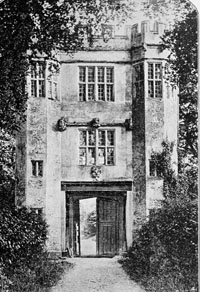
OLD SHUTE GATEWAY. View larger image
This nephew, he had consented to the escape of, was Gerald, his sister's eldest son, who subsequently became the eleventh Earl of Kildare. He was born in 1525, and at the time of his half-brother's execution about ten years of age. Henry VIII., "being very averse to his whole family, and offering large sums of money for his apprehension," the poor youth's peril was imminent, and his escapes almost marvellous, from the treachery that environed him, and plots laid to get possession of his person; besides disease and accidents of extraordinary nature that otherwise threatened his existence. But he contrived to keep safe until after the death of Henry VIII., when Edward VI. reinstated him in much of his forfeited property, and Queen Mary, at the intercession of Cardinal Pole, restored him, 13 May, 1554, to the titles of Baron Offaley and Earl of Kildare.
George was in holy orders. Edward and Anthony died young, and John, of whom we have no further account.
Of the daughters,—Dorothy married first, Robert, the second Lord Willoughby de Broke, and secondly, William Blount, seventh Lord Montjoy, who died in 1594.
Cicely married John Sutton, seventh Lord Dudley,—"a man of weak understanding, who became entangled in usurer's bonds, and at last became exposed to the charity of his friends for subsistence, and spending the remainder of his life in visits among them, was commonly called Lord Quondam."
Mary, as his first wife, to Walter Devereux, Lord Ferrers of Chartley, and Bourchier, created first Viscount Hereford, 1549, and K.G.
Margaret, as his second wife, to Richard Wake, of Hartwell, Northamptonshire, second son and heir of Roger Wake of Blisworth in the same county, who died 19 Henry VII., 1504.
Elizabeth, as his first wife, to Sir John Arundell of Lanherne, Cornwall. He was the eldest son of Sir Thomas Arundell, K.B., who died 1 Oct., 1485, by Katharine, third daughter of Sir John Dinham, and coheir to her brother John, Lord Dinham; their daughter Elizabeth was wife of Giles, Lord Daubeney, K.G. "Sir John Arundell was made a Knight of the Bath on the eve of All Saints, 31 October, 1494, Knight of the Garter, 1501, and Knight Banneret in the expedition to Terouenne and Tournay at the battle of 'the Spurs,' in 1513, Receiver of the Duchy of Cornwall in 1506, and Receiver General for life, 1509" (Dunkin). He died 36 Henry VIII., 1545. Their second son Thomas was ancestor of the Lords Arundel of Wardour.
Their splendid and originally richly enamelled brass still exists in the church of St. Columb-Major, Cornwall, in a fairly complete state, the knight bare-headed, but otherwise in complete armour, between his two wives (the second was Katharine, daughter of Sir Thomas Grenville), in gowns, mantles, and pedimental head-dresses. Below them were two smaller male figures, one partly perfect in armour, and underneath again, six female children, of whom two remain. The inscription, partly missing, is on a ledger-line,—
✠ John Arundell Knyght of ye Bath and Knyght Banneret Recey ... ye Duchye of Cornewall ffirst Ma ... Elizabeth Grey Daughter to the Lorde Marques Dorset & after Kateryn ye Daughter of Syr Thomas Gre ... ght of ffebruary the xxxvi yere of the raigne of Kyng Henry the Eyght ano domine 1545 and ye and ye yere of his age
There were formerly eight shields of arms; of these six remain quartered as follows,—
(1.) Baron, quarterly of six:—1. Arundell.—2. Dinham.—3. Arches.—4. Chideock.—5. Carminow.—6. Arundell;—impaling femme, quarterly of eight,—1. Grey.—2. Hastings.—3. Valence. 4. Ferrers of Groby.—5. Astley.—6. Widville.—7. Bonville.—8. Harington. For Sir John Arundell, and the Lady Elizabeth Grey, his first wife.
(2.) Baron, quarterly of six as before, impaling femme, quarterly of four:—1 and 4. Grenville.—2 and 3. Whitley. For Sir John Arundell and Katharine Grenville his second wife.
(3.) Baron, as before, impaling femme, quarterly of four:—1. Howard.—2. Brotherton.—3. Warren.—4. Mowbray. For Sir Thomas Arundell (second son of Sir John), and his wife Margaret Howard, daughter of Lord Edmund Howard, and sister of Queen Katharine Howard.
(4.) Baron, quarterly of four:—1 and 4. Edgcumbe.—2 and 3. Holland;—impaling femme, Arundell and other quartered coats as before. For Richard Edgcumbe and Elizabeth daughter of Sir John Arundell.
(5.) Baron, quarterly of eight:—1. Ratcliffe.—2. Fitz-Walter.—3. Burnell.—4. Botetourt.—5. Lucy.—6. Milton.—7. Mortimer of Norfolk.—8. Culcheth?;—impaling femme, Arundell with quartered coats as before. For Mary (daughter of Sir John Arundell and his second wife Katharine Grenville;) and her first husband, Robert Ratcliffe, Earl of Sussex.
(6.) Baron, quarterly of four:—1. Fitz-Alan.—2. Fitz-Alan of Bedale.—3. Widville.—4, quarterly, 1 and 4 Maltravers. 2 and 3 Clun;—impaling femme, Arundell, &c., as before. For Mary Arundell, as above, and her second husband, Henry Howard, Earl of Arundel.
Although, from his memorial brass, Sir John Arundell is presumably buried here, Weever, in his notice of St. Mary Woolnoth, London, gives this inscription as being found in that church for him,—
"HERE LIETH SIR JOHN ARUNDELL KNIGHT OF THE BATH, AND KNIGHT BANERET, RECEIVOR OF THE DUCHY ...................... GREY DAUGHTER TO THE LORD MARQUESE DORSET, WHO DIED 8 FEBR: THE 36 OF THE REIGNE OF KING HEN. THE 8."
Of the three remaining daughters of Cicely Bonville, Marchioness of Dorset, Eleanor married as his second wife Gerald Fitzgerald, ninth Earl of Kildare, for a considerable time Lord Deputy of Ireland during the reign of Henry VIII. In his prime, he is said to have been "one of the fairest men then living," and led a very eventful and troubled life, was greatly disliked by Wolsey, who twice got him cited to England and sent to the Tower on charges of maladministration, and on his third committal in 1534 to that fortress, he never emerged again alive. During his incarceration his son—"called 'Silken Thomas,' of tall stature, comely proportion, amiable countenance, flexible and kind nature, and endowed with many accomplishments and good qualities"—together with his five brothers, engaged in open insurrection in Ireland. The news of this so "oppressed him with grief," that it is said to have hastened his death, which took place in 1534. Six months afterward, the five brothers and their nephew, his son, "were all six condemned to suffer the punishment of traitors, and were accordingly executed at Tyburn, on 2 Feb., 1535-6,—being hanged up, cut down before they were dead and quartered." The Earl was buried in the Tower Chapel, and on digging a grave therein for Ralph, son of Sir Owen Hopton, Lieutenant of the Tower in 1580, his coffin was found with this inscription on it,—
HERE LYETH THE CORPES OF THE L. GERALD FITZ-GERALD, EARLE OF KYLDARE, WHO DECEASED THE 12TH OF DECEMBER, IN THE YEAR OF OUR LORD M.CCCCC.XXXIIII. ON WHOSE SOLE JESU HAVE MERCY
Of this Earl, Hollingshed relates that he was
"A wise, deep, and far reaching man; in war valiant and without rashness; and politic without treachery; such a suppressor of rebels in his government, as they durst not bear armour to the annoyance of any subject. He was so religiously addicted to the serving of God, as what time soever he travelled to any part of the Country, such as were of his chapel should be sure to follow him. He was also well affected to his wife, as he would not at any time buy a suit of apparel for himself, but he would suit her with the same stuff; which gentleness she recompensed with equal kindness; for after that he deceased in the Tower, she did not only ever after live a chaste and honourable widow, but also nightly before she went to bed, she would resort to his picture, and there, with a solemn congé she would bid her lord good night."
Not the least interesting, and almost romantic account, of one of the many of Cicely Bonville's daughters. The poet Earl of Surrey's 'Fair Geraldine' was one of this Earl's children.
Of the Marchioness's two remaining daughters, Anne was married to Richard Clement; and Bridget died young.
Leland, making note of this large family, remarks,—
"The sole doughtar of the Lorde Harington cawlid (Cecily) was maried to Thomas the first Marquese of Dorset that favorid the cummynge of Henry the vii, and he had by hir a 14 children, bothe men and wimen of excedinge goodly parsonage, of which the first sune lyvyd not longe, and then had Thomas the name of Lorde Harington, and aftar was the second Marquese of Dorset."
The Marquis of Dorset with Lord Hastings commanded the rear-guard at the battle of Tewkesbury, and after the engagement was over, and the young Prince Edward taken prisoner, who being introduced to Edward's presence, and interrogated, was brutally struck by him on the mouth with his gauntlet, and was thereupon dragged out of the king's presence and murdered by the attendant nobles, the Marquis of Dorset is said to have been among the savage conclave. Mercy and pity appear at the time to have fled from the earth.
Naturally all went well with the Marquis during the reign of his father-in-law, Edward IV., but at that king's death the machinations of Gloucester, Buckingham, and Hastings, the entrapping Earl Rivers, and getting possession of the persons of the young king and his brother, placed him in considerable peril. The Duke of York was under his custody in London, as Governor of the Tower, but on the approach of Gloucester to London, with the young king, the Marquis, together with the Duke of York, the Queen-Mother and her family at once took sanctuary at Westminster.
Events rapidly succeeded each other. Gloucester got first named Protector, a stepping-stone merely to his assumption of the Crown; the Earl Rivers and his companions, and Lord Hastings, were mercilessly disposed of; the young king and his brother sent to the Tower. Nothing now remained calculated to give Richard any cause for uneasiness, or lie in the way of his ambition, but the fact that these two poor boys, his nephews, were still alive. This difficulty did not exist long, and they perished under the influence of the same hideous resolve.
But the retribution was surely coming, if delayed for a time. Buckingham had retired in dudgeon to his castle at Brecknock, and his astute prisoner Morton, soon became the capturer of his gaoler, at least in mind, and then bade him adieu. Then followed the series of intrigues between Buckingham, the Countess of Richmond, and the Queen-Widow, with Sir Reginald Braye as ambassador, and Dr. Lewis as go-between, which ended in the unfortunate rising of Buckingham, so disastrously extinguished by the Severn flood. The Marquis of Dorset then appears to have quitted sanctuary, and gone into Yorkshire, presumably to raise forces, with the intention of joining the other contingents to be gathered in Kent under Sir Richard Guilford, and from the west under the Courtenays, Cheney, Daubeney, and others, the place of rendez-vous being at Salisbury. Before however this could be accomplished, or rather while measures were being taken in preparation, Buckingham's misfortune took place, and these, the other chief actors, fled for their lives, and were fortunate to escape and get across the channel to Brittany, and to the Earl of Richmond.
Richard promptly attainted the fugitives, and, says Rapin,—
"issued a Proclamation against Buckingham, and the Marquis of Dorset, with others of his adherents, whom he supposed to be in league with him. But as the Marquis had not appeared in arms, and so could not be styled a rebel, he made use of another pretence to involve him in the sentence. He said that having taken oath at his coronation to punish vice and wickedness, he was obliged to punish the Marquis of Dorset, notorious for his debaucheries, who had seduced and ravished several virgins, being guilty of sundry adulteries, &c. A reward of a thousand marks, or one hundred marks a year (in land), was promised to anyone who would bring the Marquis to justice, and sums in proportion for the rest that were named in the Proclamation."
They got safely across however, and so foiled the tender intentions of this amiable potentate. Richmond appeared soon after, returning from his fruitless voyage across the channel, and,
"when he arrived he heard of the Duke of Buckingham's death, and found the Marquis of Dorset, and other English gentlemen who had made their escape. They all swore allegiance to him, and he took his corporal oath on the same day, the 25th of December, that he would marry the Princess Elizabeth, when he had suppressed the usurper Richard, and was in the possession of the Crown."
Richard, however, who was kept well informed of all that went on abroad, had determined if possible to check-mate this scheme of Richmond, by marrying the lady himself,—
"and to that end did his utmost to ingratiate himself with her mother the Queen Elizabeth. He sent flattering messages to her in Sanctuary, promised to advance the Marquis of Dorset and all her relations, and won upon her so much by his fair speeches, that forgetting the many affronts he had cast upon the memory of her husband, on her own honour and the legitimacy of her children, and even the murder of her dear sons, she complyed with him, and promised to bring over her son, and all the late king's friends from the party of Richmond, and went so far as to deliver up her five daughters into his hand. She also wrote to her son the Marquis of Dorset, to leave Richmond and hasten to England where she had procured him a pardon, and provided all sorts of honours for him."
Then, of course, followed the "illness" of Richard's poor Queen, now completely in the way of these delicate arrangements, who hearing
"what was reported against her, believed it came from her husband, and thence concluding that her hour was drawing nigh, ran to him in a most sorrowful and deplorable condition, and demanded of him, 'what she had done to deserve death.' Richard answered her with fair words and false smiles bidding her 'be of good cheer for to his knowledge she had no other cause.' But whether her grief, as he designed it should, struck so to her heart, that it broke with the mortal wound, or he hastened her end, as was generally suspected, by poison, she died in a few days afterward."
Thus another victim was removed from this ghastly panorama of treachery and guilt. She was the daughter of the Earl of Warwick, the 'king-maker,' and, when Richard married her, widow of Prince Edward (heir to Henry VI.), so foully murdered after the battle of Tewkesbury. The Lady Katharine Bonville was her aunt, and Cicely Bonville, her daughter, was the poor Queen's cousin.
Richard's new matrimonial project did not go on so smoothly as he expected, his former Queen "was scarcely cold in her grave, before he made his addresses to the Princess Elizabeth, who held his pretended love in abhorrence, and the whole kingdom averse to so unnatural a marriage,"—she was his own niece. He therefore put off for a time further prosecuting his suit, and "deferred his courtship until he was better settled on the throne."
Richmond, who in his turn had full knowledge of all Richard's proceedings, was quite equal to the occasion, and determined to foil his rival both of wife and kingdom, which he successfully accomplished.
In the meantime the Queen-Mother, to oblige Richard, continued
"to write her son the Marquis of Dorset, to leave Richmond. The Marquis fearing the Earl would not succeed in his enterprise, gave way to his mother's persuasions, and King Richard's flattering promises, left the Earl, and stole away from Paris by night, intending to escape into Flanders. But as soon as the Earl had notice of his flight, he applied to the French Court to apprehend him in any part of his dominions, for both himself and his followers, were afraid of his discovering his designs if he got to England.
"Having obtained license to seize him, the Earl sent messengers every way in search of him, and among the rest Humphrey Cheney, Esq., who overtook him near Champaigne, and by arguments and fair promises prevailed with him to return.
"By the Marquis's disposition to leave him, the Earl began to doubt, that if he delayed his expedition to England longer, many more of his friends might grow cool in their zeal for him. So he earnestly solicited the French Court for aid, 'desiring so small a supply of men and money, that Charles could not in honour refuse him; yet for what he lent him, he would have hostages, that satisfaction should be made. The Earl made no scruple of that, so leaving the Lord Marquis of Dorset (whom he still mistrusted), and Sir John Bourchier, as his pledges at Paris, he departed for Rouen, where the few men the French king had lent him, and all the English that followed his future, rendezvous'd.'"
Rather an ignominious dénouement, but doubtless Richmond, quite estimated the quality of his man, and would not allow the Marquis to play any possible double game by taking him to England with the expedition. So he remained at Paris, in this kind of semi-imprisonment, until after the battle of Bosworth, Henry's coronation, and the end of the Parliament in 1485, when the king was possessed of some means to pay off his debt to the French king.
This being obtained, he sent across to Paris and redeemed the Marquis and Bourchier, and invited them over to England. On the 18 Jan. following, Henry married the Princess Elizabeth, half-sister to the Marquis. Soon after the king restored him to all his honours, called him to the Privy Council, and created him a Knight of the Garter, being the two hundred and fortieth in the succession of that noble Order.
Henry however still distrusted him, for on his pilgrimage to Walsingham in 1487,—
"being come to St. Edmunds-bury, he understood that Thomas, Marquis of Dorset, was hasting toward him, to purge himself of some accusations that had been made against him. But the King, though he kept an ear for him, yet was at the time so doubtful, that he sent the Earl of Oxford to meet him, and forthwith carry him to the Tower; with a fair message nevertheless, that he should bear that disgrace with patience, for that the King meant not his hurt, but only to preserve him from doing hurt, either to the King's service or to himself, and that the King should always be able (when he had cleared himself) to make him reparation."
Very wise of Henry, doubtless, and done in kindness to prevent his not too strong-minded brother-in-law getting into mischief. The Marquis remained in the Tower until after the coronation of the Queen,—when Henry, who had locked him up "rather upon suspicion of the time, than of the man, set him at liberty without examination, or other circumstance."
He was with the large army taken across the channel to France in 1492, in the flotilla under the command of Lord Willoughby de Broke, which was apparently designed, but really never intended, to assist the Emperor Maximilian. The Marquis also held a command in the royal forces in 1497, at the defeat of the Cornish insurgents on Black-Heath.
It is probable also he accompanied Henry into the west, at the suppression of Perkin Warbeck's attempt in October of the same year. Respecting this Mr. Davidson writes,—
"The king left Exeter on 3 November, and passed the night at the College of St. Mary, at Ottery, and on the next day proceeded to Newenham Abbey. At this place the king remained nearly a week until the 10th, when he resumed his progress to London. It is difficult indeed to imagine for what reason the king remained so long a time at Newenham at this period, unless he was engaged in making enquiry for such of the men of consideration in the Counties of Devon and Somerset as had taken part with the rebels, and in appointing the commissioners for detecting them. Among those commissioners the name of Sir Amias Paulet appears, whose residence in Somersetshire was at no great distance from this place. It may be conjectured also, that the king was entertained by the lord Marquis of Dorset, at his manor and mansion of Shute, which is nearly adjoining the Abbey demesnes, for this nobleman appears to have been on terms of familiar intercourse with his sovereign. The following items appear in the king's privy purse expenses;—'1492, 7 July. To my lord Marquis for a ring of gold, £100.—1495, March 20.—Loste at the buttes to my lord Marques £1.'"
Four years after Warbeck's rebellion, on the 10 April, 1501, the Marquis died; by his will, without date, he "bequeathed his body to be buried in his College at Astley, before the image of the Blessed Trinity, in the midst of his closet, within the same College; and that his executors should cause to be said for his soul, in every of the four orders of Friars in London, a hundred masses, and at the time of his burial, one hundred marks to be distributed in alms to the poor people."
On a boss over the organ-gallery in St. George's Chapel, Windsor, are the arms of the Marquis, quarterly of eight:—1. Barry of six argent and azure, in chief three torteaux (Grey).—2. Or, a maunche gules (Hastings).—3. Barry of ten argent and azure, an orle of martlets gules (Valence). Over these three quarterings a label of three points ermine—4. Gules, seven mascles, three, three, and one, or (Quincy).—5. Azure, a cinquefoil ermine (Astley).—6. Argent, a fess and a canton gules (Widville).—7. Sable, six mullets argent, pierced gules (Bonville).—8. Sable, a fret argent (Harington).
On his banner he bore the same quarterings. The "tenan," an unicorn ermine. His standard, per fess white and murrey. The badges are "bunches of daisies, tufted proper" (this from Widville). The motto, "A MA PUISSANCE" (Willement).
Cicely Bonville, Marchioness of Dorset, married secondly Henry Stafford, second son of Henry Stafford, second Duke of Buckingham (by his wife Catherine daughter of Richard Widville, Earl Rivers), who, rising in revolt against Richard III., was beheaded at Salisbury, 1483.
He was created Earl of Wiltshire by Henry VII., in 1509, and constituted a Knight of the Garter by the same monarch, being the two hundred and fifty-eighth on the roll of the Order.
The Marchioness of Dorset was his second wife. His first was Muriel, daughter of Sir Edward Grey,—created Viscount L'Isle, 1483,—brother to Sir John Grey, father of the Marquis of Dorset, and therefore cousin to the Marchioness's first husband. The Earl of Wiltshire left no issue by either of his wives. He died 6 March, 1523, when his title became extinct.
On a boss in the vaulting of the choir of St. George's Chapel, Windsor, is his badge, a Stafford knot argent, differenced by a crescent sable, and on a stall-plate below are his arms, quarterly:—1. France and England within a bordure argent (Plantagenet).—2. Bohun.—3. Stafford.—4. Bohun, Earl of Northampton; there are no supporters. The crest, in a ducal coronet, per pale sable and gules, a demi-swan argent, beaked gules, the wings endorsed. Motto, ""HUMBLE ET LOYAL" (Willement).
The carved escutcheon of this Earl, quartered as above, with crescent for difference, and encircled by the Garter, was found among the ruins of the Cluniac Priory of St. Mary Magdalene at Barnstaple, and is now preserved in a modern residence built on the site. The knot and crescent are found on the churches of Axminster, Ottery St. Mary, and Seaton, and will be further referred to.
We do not hear much more of the Marchioness, but she evidently stood very high in the Court of Henry VIII., for in September, 1533, at the christening of the Princess, afterward Queen Elizabeth, daughter of Queen Anne Boleyn, at Greenwich, Hall relates that "the old Marchioness of Dorset, widow," was one of the child's god-mothers, and in the grand procession the Marquis her son, bore the Salt, and she afterward made the infant-princess "a present of three gilt bowls pounced with a cover."
By her will, dated 6 March, 1528-9, 19 Henry VIII., she "bequeathed her body to be buried in the Chapel of Astley, in the tomb where her husband the late Lord Marquis lay, and a thousand masses to be said for her soul. That a goodly tomb should be made in the Chapel of Astley over the Lord Marquis her husband, and another for herself, and two priests daily to sing in the said Chapel of Astley by the space of eighty years, to pray for the soul of the said Lord Marquis and her own soul."
The exact date of her death does not appear to have been ascertained, but probably before, or by 1530, when she would have been about seventy years old.
With the death of Cicely Bonville—last of her name and race—the main personal interest of our little narrative ceases, and it is not intended, in bringing our story to its conclusion, to give a long detailed account of the two next succeeding generations of the Greys, which belongs rather to national history.
Thomas Grey, eldest son of Thomas Grey, first Marquis of Dorset, and Cicely Bonville, was summoned to Parliament in 1509, as Lord Ferrers of Groby, and in 1511, as the second Marquis of Dorset. He married first Eleanor, daughter of Oliver, Lord St. John, by whom he had no issue, and secondly Margaret, daughter of Sir Robert Wotton of Bocton in Kent, by whom he had Henry, his successor;—John, ancestor of the Earls of Stamford;—Elizabeth, married to Thomas, Lord Audley of Walden, K.G., Lord Chancellor to Henry VIII., who sat as High Steward at the trial of Henry Courtenay, Marquis of Exeter, and who died in 1544;—Catherine, to Henry Fitzalan, eighteenth and last Earl of Arundel of that family, Lord High Steward to Queen Elizabeth, and K.G., who died 1579;—and Anne, to Henry Willoughby of Wollaton, Nottinghamshire.
He appears to have enjoyed the favour and confidence of that dangerously uncertain despot Henry VIII., and in 1512 was constituted Commander-in-Chief of the expedition sent into Spain, designed as an augmentation of the forces of the Emperor Ferdinand in the invasion of Guienne, and with him were associated the second Lord Willoughby de Broke and other noblemen. In 1514, he was with Charles Brandon, Duke of Suffolk, in France at the jousts of St. Denis, and acquired considerable renown; as afterward at the meeting of Henry and Francis in 1521 on the Field of the Cloth of Gold. He was one of the lords who signed the celebrated letter to Pope Clement touching the king's divorce, and subscribed to the articles of impeachment against Cardinal Wolsey. Altogether a pliant and observant courtier probably, who carefully noted, studied, and complied with the errant phases of his grim master's will, the only safe way of getting on with him, and keeping his head on his shoulders, but, of course, requiring the aid of a not too-exacting conscience.
He made his will 1530, "ordered his body to be buried at Astley, near his father, and his executors to make and build a Chapel at Astley, according to the will of his father, with a goodly tomb over his father and mother, and where he himself resolved to be buried." Together with further bequests "to found an alms house for thirteen poor men, who were to have twelve pence a week, and a livery of black cotton yearly at a cost of four shillings, and three honest priests to pray for his soul, &c."
Relating to the burial of this nobleman, we append the following, given as a quotation by Burke,—
"The Collegiate church of Astley, founded by Thomas third Lord Astley, whose heiress-general married the ancestor of this Marquis, a most rare and beautiful piece of workmanship, having fallen down, a new chancel was erected by the parishioners. When on opening the vault where the body of the Marquis was laid, a large and long coffin of wood was found, which at the curious desire of some, being burst open, the body which had lain there for seventy-eight years, appeared perfect in every respect, neither perished nor hardened, but the flesh, in colour, proportion, and softness, alike to any corpse newly interred. The body was about five feet eight inches in length, the face broad and the hair yellow. All which seemed to be well preserved from the strong embalming thereof."
Henry Grey, third and last Marquis of Dorset, was constituted Lord High-Constable of England for three days at the coronation of Edward VI., 1547. In 1551 made Justice in Eyre of all the King's Forests, and in 1552 Warden of the East, West, and Middle Marches toward Scotland, and 11 October of the same year was created Duke of Suffolk, and installed Knight of the Garter.
He married first Katharine, daughter of William, Earl of Arundel, but by her had no issue.
Secondly, he espoused Frances, daughter of Charles Brandon, created Duke of Suffolk in 1514, and K.G.,—by his third wife the Princess Mary, second daughter of king Henry VII., widow of king Lewis XII., and so Queen-Dowager of France. The issue of this marriage was three daughters, Jane, Katharine, and Mary.
The Lady Jane Grey married the Lord Guilford Dudley, son of John Dudley, created Duke of Northumberland in 1551 and K.G.; by his wife Jane daughter of Sir Edward Guilford, knt. The Duke his father, was beheaded on Tower Hill 22 Aug., 1553.
The Lady Katharine Grey, married first Henry, Lord Herbert, eldest son of William, Earl of Pembroke, from whom she was divorced. Secondly she married Lord Edward Seymour, son of the Protector Somerset, who was beheaded on Tower Hill, 22 Jan., 1552. Lord Edward Seymour was created by Queen Elizabeth in 1559, Baron Beauchamp of Hache, and Earl of Hertford. But for marrying the Lady Katharine without the permission first obtained of the imperious and unfeeling Queen, they were both committed to the Tower. He was fined five thousand pounds, and endured nine years imprisonment. His wife bore him three sons during her captivity, and she died while still a prisoner in that fortress 26 Jan., 1567. He died at an advanced age in 1621.
The Lady Mary Grey married Martin Keys, Groom-Porter to Queen Elizabeth.
It is not necessary here to enter into the mournful circumstances of the deaths,—perhaps the most sad in English history—of the youthful Lady Jane Grey and her husband Lord Guilford Dudley,—they are fully known to all who have the slightest acquaintanceship with our national annals. The event occurred on 12 Feb., 1554.
The same remark will apply to the fate of the Duke of Suffolk, her father,—his participation in Wyatt's rising, the story of his fleeing from his pursuers, hiding in a hollow tree in his park at Astley, and betrayal (under circumstances somewhat similar to Henry Stafford, Duke of Buckingham), by Underwood, one of his own park-keepers to whom he had confided the secret of his life,—need only the outline of relation here, to give semblance of completion to our little history. He found his death also by the executioner's hand on Tower Hill, 23 Feb., 1554.
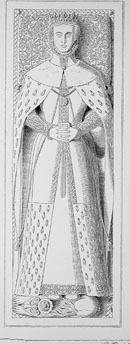
EFFIGY OF FRANCES BRANDON, DUCHESS OF SUFFOLK. Westminster Abbey View larger image
The Duchess of Suffolk, his widow, married secondly Adrian Stokes, Esq. She was buried in St. Edmund's Chapel in Westminster Abbey, where, on a high-tomb of the same costly material, reclines her effigy in alabaster, clad in the rich costume of the period, with a crowned lion at her feet. On one side of the tomb is this inscription,—
HERE LIETH THE LADIE FRANCES, DVCHES OF SOVTHFOLKE, DOVGHTER TO CHARLES BRANDON, DUKE OF SOVTHFOLKE, AND MARIE THE FRENCHE QVENE; FIRST WIFE TO HENRIE, DUKE OF SOVTHFOLKE, AND AFTER TO ADRIAN STOCK, ESQVIER.
and on the other the following,—
IN CLARISS: DOM: FRANCISCÆ SVFFOLCIÆ QVONDAM DVCISSÆ EPICEDION.
NIL DECVS AVT SPLENDOR, NIL REGIA NOMINA PROSVNT SPLENDIDA DIVITIIS, NIL JVVAT AMPLA DOMVS; OMNIA FLVXERVNT, VIRTVTIS SOLA REMANSIT GLORIA, TARTAREIS NON ABOLENDA ROGIS.
NVPTA DVCI PRIVS EST, VXOR POST ARMIGERI STOKES; FVNERE NVNC VALEAS CONSOCIATO DEUS.
Below in panels are sculptured the arms of France and England, Brandon and Stokes with numerous quarterings.
Of this lady says Dean Stanley,—
"She had thrown herself headlong into the Protestant cause. She had dressed up a cat in a rochet to irritate the bishops; and had insulted Gardiner, as she passed by the Tower, 'It is well for the lambs when the wolves are shut up.' Naturally in her own turn she had to fly after her husband's and her daughter's bloody death, and lived just long enough to see the betrothal of her daughter, Catherine Grey to the Earl of Hertford, and to enjoy the turn of fortune which restored her to the favour of Elizabeth, and allowed her sepulture beside her royal ancestors. The service was probably the first celebrated in English in the Abbey since Elizabeth's accession; and it was followed by the Communion service, in which the Dean (Dr. Bill) officiated, and Jewell preached the sermon. Could her Puritanical spirit have known the site of her tomb, she would have rejoiced in the thought, that it was the first to displace one of the venerated altars of the old Catholic saints."
The effigy, a very noble one, clasps a book, presumably intended for the Bible, in her hands, doubtless another evidence of her "Puritanical spirit," and which she probably deemed of more importance than the choicest relics of "saints" preserved in the "venerated altars" that teemed around.
Adrian Stokes, or Stock, Esq., who married the Duchess of Suffolk, 1 March, 1555, just twelve months after the Duke's death, is said to have acted as her Master of the Horse. In spite of this disparity of social position, and also of age (he being about seventeen, and the Duchess thirty-two years old at the date of their marriage), the union appears to have been a happy one (she only survived four years), for at her death in December, 1559, she left him in possession of large estates in Warwickshire and Leicestershire. In 1571 Stokes was returned to Parliament for Leicestershire, having under his charge the Lady Mary Grey, his step-daughter, and about that period, married secondly, Anne, widow of Sir Nicholas Throgmorton. He died without issue 30 Nov., 1586. He erected this fine monument to her memory.
His ward the Lady Mary Grey appears to have had no higher ambition in the selection of a husband, than her mother's second venture, having married, as previously related, Martin Keys, Groom-Porter to Queen Elizabeth. It may be, her step-father's social position was against anything better.
The memorials of Cicely Bonville, Marchioness of Dorset, are fairly numerous and interesting. "The walls of many churches," says Mr. Davidson, "in the neighbourhood of this lady's extensive possessions testify by the arms and devices of her family and connections, that she employed a part of her immense wealth by assisting in their erection."
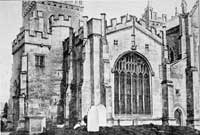
The most considerable of these, is the beautiful Chapel on the north side of the nave of the Collegiate Church of St. Mary, at Ottery, and known as the "Dorset aisle," which without doubt she built. It is of considerable size, and its fan-traceried vaulting very rich; on the pillars of the arcade are the arms of Bishop Oldham, and his rebus, an owl holding a label in its beak inscribed with the last syllable of the prelate's name, ham,—1504-19; and also of Bishop Vesey his successor, 1519-51. This shews that its erection occurred within those dates, after her marriage with the Earl of Wiltshire, but before her death, which took place about 1530. Studding the moulding under the parapet outside are the family badges, the Harington fret, Stafford knot, bull's-head of Hastings, and Bourchier knot, often repeated, while over the porch-entrance are the denuded remains of what was evidently the armorial achievement of this lady. There is a shield surrounded by the Garter, but the bearings are quite undecipherable, except the traces of a fret, the supporters appear to have been a lion on the dexter side, and on the sinister an antelope. Above the shield is a helmet, and remains of a crest. At the top and in the base of the panel is the Stafford knot, of large size, and on each side this device is repeated alternately with the mullet of Bonville.
These arms together with some other sculpture within the porch, appear to have been designedly mutilated, perhaps after the attainder and execution of the Duke of Suffolk, by order of Queen Mary, similarly to the manner the heraldic achievements of the Countess of Salisbury in her beautiful Chantry in the Priory Church of Christ Church, Hants, were commanded to be obliterated ("delete") by Henry VIII., after her savage beheading.
The outer armorial panel is supported by columns with a crocketted canopy, and figures of angels stand on the pillars; at their base are small shields with the merchant's mark and initial of Goodwyn of Plymtree, who held that manor of the Hastings family at the time. There are several of the original bench-ends within the Chapel; on one is a large double rose and on another pomegranates, but they are of comparatively plain character in carved detail.
At the meeting of Henry VIII. and Maximilian at Terouenne in 1515, Edward Stafford, Duke of Buckingham was "attired in purple satin, his apparel full of antelopes, and swans (of Bohun) of fine gold bullion, and full of spangles." Henry Stafford, Earl of Wiltshire, his brother, and second husband of Cicely Bonville, bore on his banner the swan (of Bohun) amid semée of Stafford knots, with the motto, "HUMBLE ET LOYAL."
Knightstone, in Ottery St. Mary, originally the inheritance of the Bittlesgate family, became the property of the Marchioness of Dorset in 1494, the remainder having previously been vested in William, Lord Bonville. On the attainder of her grandson, the Duke of Suffolk, in 1554, it was purchased by Mr. William Sherman, a merchant of Ottery, who died in 1583, and whose brass effigies are on the pavement of the south aisle of the church.
In the church of Limington near Ilchester, Somerset, two memorials are found, but whether they are to be considered mementoes of Cicely Bonville, or of her son the second Marquis, is not so clear. These consist of two finely carved bench-ends, in the chancel. They are of considerable height, having fleur-de-lys shaped finials on the top, and below occurs, on one the rose, and on the other the pomegranate, of Henry VIII. Then follows a large shield, quarterly,—1 and 4, six mullets pierced, three, two, one (Bonville).—2 and 3, a fret (Harington); and under this the initials W. C. joined by a cordon. Beneath are four roses, single and very thickly double, alternate.
The Bonvilles acquired considerable property in Limington, Somerset, of the representatives of the De Gyvernay family. The last of them Henry de Gyvernay died seized of the manor 35 Henry III., leaving a daughter Joan married to William de Shareshull. The very fine and well-preserved effigy in the uniquely-groined north transeptal Chantry, was probably placed to the memory of one of them (although the armour and appointments are comparatively late), and the other three earlier effigies on the floor doubtless represent preceding generations.
The initials W. C. on the bench-end evidently allude to Walter Cocks, incumbent of the parish, who was inducted in 1535, patron the Marquis of Dorset. This would be about five years after Cicely Bonville's death, and in the lifetime of her son, but the marshalling of the arms seems to allude more directly to his mother.
On escutcheons in the panels of the carved parapet of Axminster church are the Harington fret, and the Stafford knot, surmounted by a crescent; this last badge having allusion to Henry Stafford, Earl of Wiltshire, her second husband, he being the second son of Henry, Duke of Buckingham. "As the manor of Uphay in the parish belonged to her," remarks Mr. Davidson, "it is not surprising she should have contributed to the enlargement of the church at Axminster."
Among the shields shewing the descent of Walrond, that formerly had place on a screen in their Chantry in Seaton church, is one charged with the Stafford knot and crescent, probably included out of compliment by the squire of Bovey to his noble neighbour of Wiscombe. It also occurs over the tower door at Hawkchurch, together with the arms of Daubeney, and the Abbey of Cerne.
But the most interesting of all, is the presumed effigy of Cicely herself, in the portion remaining of the once beautiful church of Astley, in Warwickshire. This, for a long time fixed upright in the wall of the tower, at the west end of the choir, now reclines on a low tomb. The figure is of alabaster, with pyramidal head-dress, gown richly embroidered and gilt, and mantle, on which are traces of crimson colour, the head rests on a cushion originally guarded by angels. From her girdle are suspended an aumônière on the right side and a rosary on the left.
There are two other effigies, also in this church, sculptured in alabaster. One, a knight with hair polled, in full plate armour, and collar of S.S. His head rests on a helmet, and his feet on a lion. The other, a lady, has long flowing hair to the shoulders, on her head a coronet with traces of fleurs-de-lys and pearls, necklace, and wearing also the rare Yorkist collar of Suns and Roses, from which is suspended the Lion of March. The remains of angels support the cushions on which her head rests.
The ladies are much shorter in stature than the knight, and the probability is they all occupied separate tombs, which stood in the side chapels originally existing attached to the antient chancel, before it fell down and was rebuilt at the time the body of the second Marquis was discovered, at the end of the seventeenth century.
The knight is apparently the earlier effigy of the three, probably dating about 1480-90, the lady with the coronet next, or about contemporary, and the lady in the pyramidal head-dress considerably the latest, as shewn by her costume, which would accord very nearly with that worn at the era of Cicely Bonville's death.
Sir Edward Grey, uncle to Thomas Grey, first Marquis of Dorset, married Elizabeth, sister and heir of Thomas Talbot, Viscount L'Isle. 15 Edward IV. he was created Baron, and 1 Richard III. Viscount L'Isle, died in 1492, and bequeathed his body to be buried in the new chapel of Our Lady, begun to be built by himself in the College of Astley, where the body of his late wife Elizabeth lay interred. His daughter Muriel was the first wife of Henry Stafford, Earl of Wiltshire, second husband of Cicely Bonville. A guess may be hazarded that these figures represent Sir Edward Grey and his wife Elizabeth.
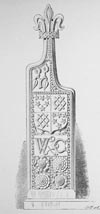
BENCH-END. LIMINGTON CHURCH, SOMERSET. Circa 1535. View larger image
Before we close our account of the Bonville and Grey memorials, we propose to include—from its uniqueness of example—another remembrance to a presumed second-cousin of the Lady Cicely, that we discovered among the fine series of bench-ends in a visit to the little church of Barwick, near Yeovil, on our way back from Limington. It is one of a pair in the chancel, almost alike, the only difference being—and here note the evident purpose conveyed in all mediæval symbolism—that one shield, the earliest in the succession is suspended by a guige from a hawthorn tree in blossom, and the later one from a hawthorn tree in fruit. The arms on the first are, dexter, quarterly of four:—1 and 4. On a chief a fleur-de-lys, in base a mullet pierced (Rogers).—2 and 3. Fretty, and a chief (Echyngham); impaling,—In chief quarterly, 1 and 4, six roundels, 2 and 3, three camels; in base, guttée (——?). On the second bench-end are Rogers and Echyngham, quarterly as before, impaling Courtenay and De Redvers quarterly.
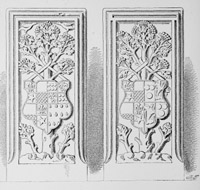
BENCH-ENDS. BARWICK CHURCH, SOMERSET. View larger image
"The family of Roger or Rogers," says Mr. Batten, "whose chief seat was at Bryanstone, Dorset, held Barwick for six generations, extending to the latter part of the reign of Queen Elizabeth." John Rogers married Anne, daughter of Thomas de Echyngham, Lord of Echyngham in Sussex. His grandson Sir John, married presumably—for singularly her name does not as yet appear to be identified in the pedigree—Elizabeth, daughter of Sir William Courtenay of Powderham, who died in 1512, by his wife Cicely, daughter of Sir John Cheney of Pinhoe.
Sir William Courtenay's mother was Margaret Bonville, daughter of Lord William Bonville, and so great-aunt to Cicely Bonville, and Elizabeth Rogers of the Barwick panel, was her second cousin.
They were buried at Bryanstone, and on the floor of the chancel of that church, without the rails, says Hutchins, "on the gravestone are the brass effigies of a man and a woman kneeling and their hands elevated. Over are the arms of Rogers and Echyngham quarterly, and under the woman, Rogers impaling Courtenay, and this inscription:—
Of your charitie pray for the soules of John Rogers esquyer and Elizabeth his wyfe which John decessed the day of in the ye'r mdc and Elizabeth decessed the first day of October in the ye'r of our Lord m dc xviii on whose soules J'hu have m'cy
on other bench-ends at Barwick are the initials W. H. and date 1533, probably for William Hooper, patron of the benefice at that time. The date of the Limington bench-ends is almost contemporary."
A round-about digression, you will say, gentle reader, but how interesting is it, thus in our little pilgrimage, to connect the relationship of these old sculptures, and make their personal history live again; verily, if there be any charm belonging to these researches into the past, herein it is found.
Of the early inheritances of the Bonvilles, Wiscombe, and Shute, on the attainder of the Duke of Suffolk both fell to the Crown, and Queen Mary granted them to her Secretary, Sir William Petre.
Wiscombe, toward the end of the sixteenth century, appears to have been the residence of Robert Drake, Esq., probably under grant from the descendants of Sir William Petre. He was the son of John Drake, Esq., of Ashe, Musbury, who died 4 Oct., 1558, by his wife Amy daughter of Roger Grenville, Esq., of Stow, who died 18 Feb., 1577-8. He married Elizabeth—daughter of Humphrey Prideaux of Theuborough, north Devon, who died 8 May, 1550, by his wife Joan daughter of Richard Fowell, of Fowells-combe, in south Devon,—by whom he left a large family.
William, the eldest son, was of Wiscombe. He married Philippa, sister of Sir Thomas Denys, died in 1619, leaving six children, of whom Thomas the eldest succeeded him at Wiscombe, and died in 1661.
Henry was of Childhay, an old picturesque seat in the parish of Broad-Winsor, Dorset. This he acquired by his marriage with Amy, daughter of John Crukerne, of Childhay, and widow of Sir Arthur Champernowne, of Modbury, Devon. He died in 1640.
Nicholas, a pensioner of James I., died 1640. He married Jane, daughter of William Tothill, "youngest of thirty-three children," she died 1622.
Robert, a colonel in the army, together with Humphrey his brother, a captain, were both killed at Ostend early in 1604.
Bernard, also described as of Wiscombe, married Elizabeth Densloe, and John, died without issue. Three of the daughters were named Gertrude, Ursula, and Amy.
The old historian, Westcote, thus refers to the untimely death of these soldier-brothers,—
"Wiscombe; where liveth a generous family of Drake; of which race there were lately two brothers, (besides others) Robert and Henry: (the sons of Robert:) the first, a colonel of much worth and esteem with the Prince of Orange in the Netherlands; and the other a captain: both taken away in the flower of their age: a great grief to their friends and loss to their country."
And Risdon, his contemporary, adds in almost similar words,—
"Here (Wiscombe) now inhabits a generous tribe of the Drakes, of which, besides other brothers, were Robert and Henry, the sons of Robert; the first a colonel in the Netherlands, of great esteem with the Prince of Orange and the States, of his valour, who in all his actions was said to make use of the spur of courage, and the reins of judgment; the other a captain, of much hope, both taken away in the flower of their age, in defence of Ostend, to the great grief of their friends, and loss of their country."
The monument of Robert Drake, the father of these unfortunate men,—and who was mercifully prevented by death from experiencing the great trial of their early decease,—occurs on the north side of the chancel of Southleigh church. It is of Ionic character with arabesque ornamentation, and bears the following inscription,—
ARMIGER AURATUS ROBERTUS NOMINE DRACUS HIC JACET ILLE PIUS PAUPERIBUSQUE BONUS SEPTE GNATOS FRUGI ET GNATAS QUINQUE VENUSTAS PARTURIIT CONJUX ELIZABETHA SIBI OBIIT 1600. MARCH 30.
Thus translated,—"An ennobled Esquire; Robert Drake by name, lies here, one who feared God and remembered the poor; his wife Elizabeth bore him seven thrifty sons and five comely daughters. Died 30 March, 1600."
Below are five shields:—1. A wyvern with wings displayed (Drake), impaling A chevron enhanced by a fleur-de-lys and charged with two roundels, between three crescents.—2. Grenville.—3. A chevron charged with a mullet, a label of three (Prideaux).—4. Ermine, three battle-axes in pale (Denys).—5. A fess between three fleurs-de-lys.
Robert Drake was the brother of Sir Bernard of Ashe, who died of jail fever in 1586, and of Richard Drake of Esher, who died in 1603.[16]
The Wiscombe estate appears to have remained in the possession of the Petre family, until disposed of by Lord Petre in 1794, to Mr. J. M. How.
Speaking of Wiscombe, Risdon says,—
"It some time belonged to the priory of Otterton, which was in the time of K. Hen. 3., by the prior granted unto sir Nicholas Bonvile, kt., which he made his dwelling, and had here a large park for deer, not long since disparked by the Lord Petre whose inheritance it now is."
And Westcote, albeit with no special genealogical accuracy, thus soliloquises,—
"This place is memorable for being the habitation of Lord Bonvile, an unfortunate man: (for unwise I dare not nor may not term him:) yet this may I say by the way, good fortune and wisdom, folly and ill-fortune or mischance, go masked, and that very often under one hood; yea, unmasked do so near resemble one the other, that they are hardly known or rightly distinguished (by those that look them directly in the face) each from other, and therefore one bears very often the other's faults, and on the contrary one steals away the other's praise and commendation; which is truly avered by Athenæus, when he saith,
'Longissime a sapientia sors dissidet Sed multa perfecit tamen simillima.'
Seldom the traitor, though much haste he make, Lame-footed vengeance fails to overtake.
The extreme mischief succeeded; first his only son was taken from him by untimely death, and his nephew (the third William, Lord Harrington by his mother's right,) slain at the battle of Wakefield; and immediately after (that his old age might want no kind of misery,) while he waited still and long expected better days, himself was taken (at the battle of St. Alban's,) prisoner, and having now run out his full and long course of nature, could not yet come to the grave in peace, but lost his head; leaving behind him for heir, Cicely, his grandson's daughter; a damsel of tender years, who brought a large and rich inheritance to Thomas Grey, Marquis of Dorset, half-brother, by the mother, to king Edward V."
Wiscombe, although disparked by the Petres, and all the old forest trees swept away; their successors in its possession have in comparatively late years planted the hill-sides of the estate with large breadths of the conifera; these have flourished with great luxuriance, and it would be difficult at present to find a more richly wooded landscape than it exhibits. The different habits of the trees, fringed and interspersed with those of the ordinary species, form a delightful contrast, especially when clothed in all the varying tints that give such charm to the
AUTUMNAL HOURS.
The quiet Autumn hours,—so cool and calm, When the bright sun hath stayed his blazing wheels, And o'er the earth there seems to steal a balm, Of peace full-satisfied, as the heart feels When after some strong fight, and conquest won, That brings no grief,—we rest and count the spoil, Rich with the crowned content of something done, Forgetful of the conflict and the toil.
How blessed comes each change;—with sobering tints, The fading flowers have to rich fruitage turned, The golden leaves lit with faint sunny glints, Flame mid the dews like patient martyrs burned,— The robin pipes his lay,—the bee speeds home,— And o'er the soul a sweet repose doth come.
Shute also became the property of Secretary Petre, "from whom," says the Antiquary, "my father had the howse and park, and dwelled theire duringe his lief, and left it unto mee, and my eldest son John Pole holdeth it from mee"; it is now held by his descendant, the ninth baronet.
Once more we are back in Southleigh churchyard in the Wiscombe valley, from which our footsteps originally set out to thread the mazes of our imperfectly told but eventful history. We look into the little church for traces of Bonville, but nothing is visible, reflecting their memory in this their earliest home. A few years since in clearing the foundations of an old picturesque cottage, not far from the church, some fragments of sculpture, of Perpendicular character, were found, being part of a cornice of rich vine-tracery, together with scrolls, and winged angels holding shields, canopies of niches, panelled shafting, the emblem of St. Luke, &c.,—the colours and gilding still fresh on them. These were apparently portions of the antient reredos, and from their rich character, were probably relics of the taste and munificence of the Bonvilles; or of their last descendant "that devout woman Cecilia, Marchioness of Dorset, Lady de Bonville, and Haryngton," the patron of numerous benefices in Devon, and other counties; and generous benefactor toward the ornamentation, repair, or additions to, the various parish churches in which her extensive possessions were situate. Pleasing remembrances, left to attest her memory, and which still stand out in grateful relief, long after the turbulent scenes of treachery and bloodshed amid which they found their existence, have passed away; for is it not written,—
"The meek shall inherit the land; And shall delight themselves in the abundance of peace."
EXTERIOR OF THE DORSET CHAPEL, OTTERY ST. MARY View larger image
One further circumstance, referable only to the realms of conjecture, but unique in its way, detains us a minute, as we turn to leave the village graveyard. Just outside the chancel is a high-tomb, commemorating the burial of Henry Willoughby, 28 Sept., 1616.[17] At its end is the grand escutcheon of Willoughby de Eresby, with crescent for difference. It has not yet been explained who he was, or how he found sepulchre here. We remember that Anne, younger daughter of Thomas Grey, second Marquis of Dorset, and so grand-daughter to Cicely Bonville, married Henry Willoughby, of Wollaton, Nottinghamshire, which would not be far from the home of the Willoughbies de Eresby in Lincolnshire. Is this the memorial of her husband? The date would accord with the presumption.
Here we conclude this desultory outline of the history of Bonville, and as our feet make homeward, many thoughts haunt us over the marvels—for they are nothing less—that fill its phases of human relation. In the middle of its recital, which concluded with the untimely death of Lord Bonville, we said it was a relief to turn aside from the atrocities mingled with the strife of the Roses. In its continuation, for a while, under the more settled rule of Tudor, there were comparatively fewer horrors to chronicle, but the union of the royal houses, emblemed by the rival flowers, was cemented with blood, its ghastly trail followed into the spirit of the new dynasty, and gathering strength as the three generations of Grey passed, culminated at length in a tragedy for size and importance unsurpassed in the annals of our national history. Its last representative, although a subject only, had wedded the grand-daughter of one, and cousin of another of the reigning Kings, and who had herself also been a Queen in her own right. Here the topmost pinnacle of alliance with the highest worldly station had been reached, but only to experience the fate of that often-witnessed terrific downfall, which follows the promptings engendered by the unsatisfied ambition of attaining to such dangerous altitude. Within three short years, three headless dukes—of foremost station in their native land, and allied to each other by ties of relationship—passed from the scaffold on Tower Hill to obscure and unmarked graves in the little Chapel of that fortress; and with them went also, after experiencing the same terrible ordeal, following her youthful husband, a young and guileless victim, almost the sole representative of the new stock, into which the last tender branch of the extinct house of Bonville had been engraffed.
Enough, sayest thou, friend of mine, of this harrowing relation;—quite so,—our story is ended. Life was indeed intended for happier results than these, and how much better the simple delights, enjoyments and pleasures of unenvied station, that in their possession are ever
"Forbade to wade through slaughter to a throne;"
and unsmote by the glamour of the basilisk Ambition, whose fascination lives on the ever unsatisfied desire for fame or station, until often, when too late and past recall, the illusion vanishes as the victim disappears over the verge of the unseen, treacherous precipice of irretrievable ruin.
The shadows grow deeper between the hedgerows as we saunter homeward, a dewy mist is settling down the valley, and a cheery glint salutes us here and there from the cottage windows as we pass along. Listen! What melody do we hear, with greeting so soft and soothing? Aye, artless as it is, that, which in this world, for sweetness knows no rival, even
A MOTHER'S SONG.
'Tis eve, and dusky twilight falls; Here is a home that men call poor, A glimmer lights its humble walls, A strain comes through its half-closed door; Sweet as from Sappho's soul might spring, Song, none but mother's voice may sing.
Look through the casement dim and old, A shadow fronts the ingle's glow, Whose arms a tiny form enfold, Sits gently rocking to and fro; With cadence measured to its swing, Comes song that mothers only sing.
Her tears fall on the baby's brow, Too full her heart with very joy, Hark! with her voice is blending now, The sleepy murmurs of her boy; Faint—fainter—hushed and slumbering, By song but mother's lips may sing.
Why bends, O friend, thy brow with thought, At glimpse of Paradise so fair? Doth memory fill thy heart unsought With echo, whose 'divine despair' Brings sadness past imagining? Song that thy mother used to sing!
O soft sweet voice, O simple strain, Where love ne'er bids the measure cease, Until the charm of its refrain, Lulls the complaining soul to peace; Come back again on angel wing, O song my mother used to sing!
It may not be, earth hath one heaven, Our childhood's days, a mother's care, When life is o'er, will other given Restore to us these joys so rare? Yes, and its pure delight shall bring, The songs our mothers used to sing.
MONUMENT TO HENRY STAFFORD, DUKE OF BUCKINGHAM, K G. Britford Church, near Salisbury. View larger image
UNDER THE HOOF OF THE WHITE BOAR.
The fair, busy, if not large city of New Sarum or Salisbury, has since its foundation, occupied an important place in our national history, resulting from the heritage of its natural position, which may be described as forming the Gate or Key to the peninsula of the West. Besides this, it is the inheritor of, and is associated with, some of the oldest traditions of the land before the pen of history has left record, the venerable fame of previous ages having descended and added distinguished interest to its surroundings, while the marvellous circle of Stonehenge finds its place close by, as also its own antient progenitor, the equally remarkable hill-fortressed city of Old Sarum,—circumstances that attest the importance in which the locality was regarded, wherein its city of to-day is situate.
Succeeding events have also added their witness to this distinction. The foundation and building of its beautiful and unique Cathedral, begun, completed, and finished in one harmonious design, without let or hindrance, and the afterward crowning it with the magnificent spire, the finest in the kingdom, and with very doubtful rivalry elsewhere,—its notable succession of bishops,—and the number of distinguished personages, who through the following centuries down to these present days, have held high rule as statesmen and administrators in our land, who have sought the privilege of having its name as an affix to their titles of honour, Longspée, Montacute, Nevill, and Cecil,—have interwoven and sustained the claim of its reputation into almost every period of our national annals.
Yet, notwithstanding the importance of its position, it is singular, no very important or striking incident connected with the national government, such as has made famous many other localities, has occurred within, or immediately near it. The reasons for this may not be far to seek. The sea coasts on either side of it offered facilities for martial transit or commercial enterprise, which Salisbury could not possess, and so the tide of action, as a rule, passed at a distance, but its great advantages as a central position for the purposes of rendez-vous, warlike or otherwise, have always been used and made available.
Lying on the high road between London and the Land's End, it has naturally received many royal visits, from that of the young king Henry III., at the consecration of the cathedral in 1225, downward, at divers times and on various errands, civil, military, or with darker and sanguinary intent to take vengeance on their enemies; and it is the result of one of these vindictive errands that brought a king to Salisbury, and the circumstances preceding and following it, that form the basis of our homely narrative.
Of the very antient and illustrious family of Stafford, whose origin is contemporary with the Conqueror, for the purposes of our little history the first we need mention is Thomas Stafford, fourth Baron and third Earl of that name, who lived in the reign of Richard II. He allied himself with a lady of direct royal descent, Anne Plantagenet, eldest daughter of Thomas of Woodstock, Duke of Gloucester, sixth son of king Edward III., by his wife Eleanor, eldest daughter and coheir of Humphrey de Bohun, the last Earl of Hereford, Essex, and Northampton, who died in 1372.
Mary, the other daughter and coheir of Humphrey de Bohun, Earl of Essex, &c., as aforesaid, was married to Henry Plantagenet, Earl of Derby, eldest son of John of Gaunt, Duke of Lancaster, fourth son of king Edward III., who was successively created Earl and Duke of Hereford, and ultimately ascended the throne as Henry IV., surnamed 'of Bolingbroke.'
In 1397 Richard II. caused his uncle Thomas of Woodstock, Duke of Gloucester, to be kidnapped by a company of armed men near Stratford, and conveyed to Calais, where he is said to have been privately strangled. To cover this crime it was given out the Duke had died from natural causes, and that before his death he had confessed himself guilty of treason toward the king, upon which all his estates were confiscated by the Parliament. Richard gave them to his cousin Henry, Earl of Derby (afterward Henry IV.), who had married the younger daughter Mary, and he thus became possessed of the whole of the Hereford estate, and of course most unjustly to the prejudice of the heirs of Thomas of Woodstock, whose daughter Anne was married to Thomas, Earl of Stafford.
These genealogical particulars, although somewhat dry, intricate, and well known, are very necessary, nevertheless, to keep in mind, as they are said to have exercised material influence on the ultimate issue of our story.
Thomas, Earl of Stafford, husband of Anne Plantagenet, died young, and without issue. He was succeeded in the Earldom by his brother William, who also died when a youth.
Both these brothers were succeeded by their next brother, Edmund Stafford, sixth Baron, and fifth Earl of Stafford. In the 22 Richard II., 1399, he had the king's special license to marry his eldest brother's widow, Anne Plantagenet, "which marriage of the said Thomas and Anne had never been consummated owing to the tender years of the Earl." He was also K.G., and was killed at the battle of Shrewsbury, fighting on the side of king Henry IV., in 1403.
He was succeeded by his son Humphrey, who was created Duke of Buckingham 14 Sept., 1444, with precedence before all dukes whatsoever, next to those of the blood royal. In 1450 Henry VI. made him Constable of Dover Castle, and Warden of the Cinque Ports, he was also a Knight of the Garter. He married the Lady Anne Nevill, daughter of Ralph, first Earl of Westmoreland, K.G., who died in 1425. He was faithfully attached to the Lancastrian interest, and was killed at the battle of Northampton on the 27 July, 1460, fighting under the banner of Henry VI. and the Red Rose.
Humphrey Stafford, his eldest son, Earl of Stafford, married Margaret, daughter of Edmund Beaufort, first Duke of Somerset, grandson of John of Gaunt, Duke of Lancaster, by Katharine Swynford, and who was killed on the side of the Red Rose at the first battle of St. Albans on 23 May, 1455. The Earl Humphrey was also slain in the same battle with his father-in-law.
He thus died before his father, leaving a son Henry, who succeeded his grandfather, the first Duke, who died in 1460, and this Henry, who was the second Duke of Buckingham, is the subject of our history.
It would be difficult to find among the antient nobility of England a man with a more illustrious ancestry, derived by two direct sources from the blood royal, and allied with Bohun, Nevill, Beauchamp, and Audley, all families of the first consequence and influence. It would be equally difficult to find a family more unfortunate.
The restless, troubled life of Henry Stafford, second Duke of Buckingham, and its importance, as bearing on one of the most noted epochs of English history, is a subject much too large to receive anything beyond a very imperfect outline here; and it has been necessarily more or less comprehensively treated, by all our national historians. The province of this little narrative will be rather in a local sense to gather together, and describe from such records and observation as may be available, the circumstances of the defection, betrayal, arrest, trial, death, probable burial-place, and presumed monument set up to the memory of this unfortunate man, the major portion of which appears to have occurred almost within reach of the shadow of the glorious spire before us.
His wardship was vested in the king Edward IV., and his tuition entrusted to the king's sister Anne, wife of the unfortunate Henry Holland, second Duke of Exeter, and five hundred marks per annum, out of the revenue of the lordships of Brecknock, Newport, &c., in Wales, set aside for his maintenance. Humphrey, his father, as we have seen, was slain at St. Albans in 1455, and at the death of his grandfather Humphrey, the first Duke, who fell at the battle of Northampton in 1460, he succeeded to the title. But very little is heard further of him during the reign of Edward IV.
At the death of Edward, however, he appears to have at once come to the front, as one of the most important personages in the kingdom. The widowed Queen-Mother Elizabeth Widville, during the king's lifetime, naturally had done the best that lay in her power for the advancement of her family; and it seems at the same time, not very discreetly, treated with contempt and indifference the older nobility of the kingdom. This treatment was naturally resented on their part, and Edward appears to have been fully cognizant of this antagonism, and was anxious, for the weal of his son, to dispel it. So, shortly before his death, he did his best to effect a reconciliation between them; this to a considerable extent was done, and the king believed it was sincere.
Immediately after Edward's decease, however, the Queen-Mother seems to have revived and accentuated this undesirable feeling, and also sought to exercise a controlling influence over the government of the kingdom in her son the young king's name. To this end she contrived, if not exactly to expel, at least to keep from the Court and presence of her son, among others, three of the most important of the antient nobility, who had been highly in favour with her late husband, and who were fully aware of her schemes and antipathy to them, while at the same time they were also thoroughly loyal to the interests of her son, or presumably so. These were Henry, Duke of Buckingham, William, Lord Hastings, and Thomas, Lord Stanley. This antipathy was the more strange also as regarded two of them, as they were almost members of the Queen-Mother's family, for Buckingham was her brother-in-law, being married to her sister Katharine; and Hastings was father-in-law to her son's—Thomas Grey, the Marquis of Dorset's—wife, he having married the widow of the last Bonville, the mother of Cicely. But family relationships, however near, do not appear to have carried much weight in those days, where restless, thirsty ambition intervened.
At the juncture of Edward's death, the Duke of Gloucester was at York on the king's business, and young Edward V. was at Ludlow Castle under the guardianship of his uncle, the Earl Rivers. The king's younger brother, the Duke of York, was with the Queen-Mother in the Tower, that fortress being under the command of the Marquis of Dorset, her son. She had already got into hot water with the Council, and affronted both Hastings and Buckingham, and she had sent a despatch to her brother in Wales, to bring the young King to London with a large armed escort of at least two thousand men. Gloucester, it is related, being aware of this state of affairs, and the disaffection of Hastings and Buckingham, sent privately for them to meet him and discuss the situation; but Dugdale says, that Buckingham, on hearing of the death of Edward,—
"speedily despatched one Pershall, his trusty servant in all haste unto Richard Duke of Gloucester, then in the north, and that Pershall being privately admitted to speak to him, in the dead of night, told him that his master had sent him to offer him his service, and that he would wait on him with a thousand good fellows if need were,"
at any rate the three met, and were all well in agreement as to their hatred of the Queen-Mother, and desired to remove both herself and family from the position of influence they had acquired. Gloucester made due note of this, carefully veiling his own ultimate purpose. But the advance of the young King and an armed host under the command of Rivers, was to be baulked if possible, and for this purpose Hastings was despatched to London, to convey the assurance of his and his companion's loyalty, and to represent that it would be most impolitic to have a large military escort accompanying the young King. The Queen-Mother believing this counsel to be all genuine and well-meant, desired her brother to bring the King with only a comparatively small guard, or such a retinue as befitted him.
Gloucester and Buckingham, with a force of nine hundred armed men, arrived at Northampton from York a few days before the King and his uncle Rivers reached that town. They went out to meet the King, and saluted him very respectfully, at the same time saying that as Northampton was very full of strangers just then, it would be advisable for the King's comfort, if himself and his retinue proceeded to Stony-Stratford, twelve miles further on, and nearer London. This being agreed on, it was proposed to the Earl, "in a free and easy manner," that he should return with Gloucester and pass the night at Northampton, which "kind invitation" Rivers unsuspectingly complied with.
The evening appears to have been spent in conviviality and mutual protestations of good faith toward each other, and subsequently the Earl retired to his lodgings at an Inn. Guards were at once placed over him, and every precaution taken to prevent any communication between Northampton and Stony-Stratford. The victim was securely caged.
At day-break the next morning Gloucester and Buckingham were on horseback, ready to depart. Rivers was still in bed, and being wakened by his servant was told of this circumstance, but that no one was suffered to go out of the Inn. The Earl thereon hastily dressed himself, and desired to know the reason of this proceeding; and meeting with the Dukes, asked why they kept the keys of the Inn, and thus sought to make him a prisoner there. He found them in a very different frame of mind from the previous evening, they immediately began to upbraid and quarrel with him, told him he sought to alienate the King's affections from his uncle Gloucester, and others the King's faithful subjects, and that they should take care to prevent the like practices in future. The Earl returned a calm answer to this accusation, but they refused to hear him, gave him into custody, and mounting their horses, rode off to Stony-Stratford.
Here they found the young King ready to pursue his journey, and after paying him their respects, remounted to escort him. But before they had left the town, they quarrelled with Lord Richard Grey, charging him and the Marquis of Dorset (who was in London) with allegations similar to those they had preferred against Earl Rivers. The poor young King was greatly distressed at this position of affairs, and said he could say nothing as to the Marquis of Dorset, but as for the others he could answer for their conduct, as they had been continually with him. To this Buckingham replied, that they had carefully concealed their designs from him, which however were not the less certain. Lord Grey, with Sir Thomas Vaughan and Sir Richard Hawke, who were in attendance on the King, were at once arrested, and together with Earl Rivers, either on the same day or the next, were sent northward in custody of several persons, and finally incarcerated in Pontefract Castle, whose Governor was Sir Richard Ratcliffe, a partisan of Gloucester. The young King himself was re-conducted back to Northampton, practically as much a prisoner as his uncle and half-brother, and reserved ultimately for a similarly cruel fate. Thus the first act of this atrocious tragedy was completed.
The news of this coup-de-main having reached the Queen-Mother, she was greatly terrified, for she saw at a glance its full significance, and she immediately with her son the Duke of York, her other children, the Marquis of Dorset, and the rest of her family, took sanctuary at Westminster, as their only available refuge.
Lord Hastings, who was in London, had intelligence of these proceedings the same night. Although he excessively disliked the Queen-Mother, yet he was thoroughly loyal to the young King and the other children of Edward IV., his former friend and patron, and although he was privy to the plot for the seizing of Rivers and Grey, yet he appears to have had no further wish than to prevent the Queen-Mother directing the government. On receipt of the news, he at once proceeded to acquaint Rotherham, the Archbishop, and quieted his alarm by assuring him the King was in no danger, and all these steps were devised for the welfare of the kingdom. Rotherham repaired immediately to the Queen-Mother, whom he found at Westminster, "in a disconsolate condition, sitting upon the ground, lamenting her own and her children's fate, while her domestics were busy in carrying such goods as were necessary into the Sanctuary." The Archbishop conveyed Hastings' intelligence to her as to the safety of the King, and did his best to comfort her, and gave her every possible assurance of his own fidelity, telling her, among other things, that, even supposing it possible they might put the King to death, he would at once crown the Duke of York. But the Queen-Mother was slow to believe in anything but of the worst import. The good prelate, in company with many others, had failed to gauge the ultimate depths of Gloucester's design.
In the meanwhile the citizens of London, like the Queen-Mother, greatly alarmed at this sudden turn of affairs, were beginning to arm themselves, in view of possible contingencies. Hastings, who had great influence with the citizens, contrived to keep them quiet, while plausible stories as to the hostile designs of the imprisoned Rivers and his companions were circulated, and all suspicion and distrust being allayed, immediately thereupon the King, attended by the Dukes of Gloucester and Buckingham, arrived; and escorted by a large concourse of nobility and others, Gloucester riding before him bare-headed, made a triumphal entry into the city, and was lodged in the Bishop's palace. These rejoicings over, Gloucester called a Council together of his own friends and partisans, and thereat he was constituted "Protector of the King, and kingdom." So the second act of the tragedy reached its conclusion.
Gloucester's first step was to take the Great Seal from Archbishop Rotherham, and give it to John Russell, Bishop of Lincoln, the Duke of Buckingham and Lord Hastings were confirmed in their places, and the other positions of influence filled up by his own partisans. The next step was to get possession of the Duke of York, the young King's brother, then in Sanctuary with his mother.
Gloucester proposed this course at a Council, and suggested that a proper representative should be sent to the Queen-Mother, requesting her to deliver up the young prince to their custody, and suggesting that Cardinal Bourchier, Archbishop of Canterbury (who was related both to him and Buckingham), was the fittest person to be entrusted with the errand, and added, that if the Queen-Mother refused to listen to the message of the Cardinal, he saw no reason why they should not obtain him by force, if necessary. The Cardinal readily undertook the negociation, but he would not hear for an instant of daring to violate the Sanctuary,—"such an attempt would certainly draw down the just vengeance of God on the whole kingdom." To this objection Buckingham vehemently replied, backing up the views of Gloucester, that if the Queen-Mother refused to give up her son freely, they should take him by force out of Sanctuary; and this course was agreed to at the Council, notwithstanding the remonstrances of the ecclesiastics present.