DAYS OF THE TUDORS (continued 2)
Reading edition
Sir Fulke, the grandson of Lady Elizabeth, was really the heir through her to the barony of Broke, but at that time, it did not appear to be a point clear in law, that after an honour had been for some time in abeyance in the female line, it could be afterward claimed by the heir. He was greatly in favour at the Court of Elizabeth, who rewarded him liberally, and he obtained from king James I., in the second year of his reign, a grant of Warwick Castle and its dependencies, then in a ruinous state, which he gradually re-edified and restored at great cost, and, January 29, in the eighteenth year of the same reign was advanced to the title of Baron Brooke, of Beauchamp's-Court, a dignity further enhanced to an Earldom of the same name 7 July, 1746, followed by that of the Earldom of Warwick 13 Nov., 1759. Sir Fulke, the first Lord Brooke, was unfortunately murdered at his house in London, by one Haywood his servant, who hearing Lord Brooke had not included him for a legacy in his will, as he had his other servants, Lord Brooke not considering him entitled to it, resented the omission, and after angry expostulations, stabbed him in the back, in his bedchamber. The assassin then rushed into another chamber, locked the door, and destroyed himself. Lord Brooke lingered a few days, and expired 30 Sep., 1638.
It was to the descendants of Margaret Greville, sister to Sir Fulke the first Lord Brooke, and grand-daughter of the Lady Elizabeth, that the title of Willoughby de Broke, was destined to be restored. She married Sir Richard Verney, of Compton-Murdack in Warwickshire, the then representative of that very antient and distinguished family. Sir Richard died 7 Aug., 1630, and Lady Margaret 26 March, 1631. They had issue four sons and four daughters. Sir Greville ob: 1642, the eldest son of Sir Richard, had also four sons,—Greville, the eldest; John, who died young; Richard, of Belton; and George. This descent of Greville (the eldest son of Sir Greville) became extinct on the death of his son William in 1683, leaving no issue.
The succession was now vested in Richard of Belton in the county of Rutland, third son of Sir Greville. He was a person of considerable culture and influence, and Sheriff and Knight of the shire for Warwick. As descendant through the heiress of Greville, from Robert Willoughby, Baron of Broke, he laid claim to that title, which was allowed him in Parliament 13 February, 1695,—8 William III., and on the twenty-fifth of that month, had summons by writ to the house of peers, and on the twenty-seventh took his seat accordingly as the third Baron Willoughby de Broke,—the original title being granted 12 August, 1492,—7 Henry VII. He married two wives, lived to the great age of ninety, and was buried at Compton-Verney, Warwickshire. The title is still held by his descendants.
Here ends our direct genealogical and biographical details, and we retrace our steps to the church of Beer-Ferrers, where the second Lord Willoughby de Broke was buried. We have described such remembrances as remain there to the families of Ferrers and Champernowne, and it now becomes our province to make note of the memorials that exist to their successors the Willoughbys.
The first traces that meet the eye are on the bosses of the roof of the south porch—whereon are shields charged with the arms of Ferrers, Cheney, Latimer, &c.; and a glance within the church shews us a pleasing array of bench-ends, of well designed tracery and uniform design, except the two easternmost, which are ornamented with shields of arms, referable to their presumed donor. On one is the achievement of Willoughby de Broke, similar to the escutcheon on the tomb at Callington, on the other the bend and horse-shoes of Ferrers, here made four in number, and saltierwise across them, are five rudders,—that descended to and was adopted by Willoughby. Both porch and bench-ends are of late fifteenth century work. We pass into the north transept, and there on the north side of the position of the antient altar once therein, and standing at right angles from the wall, is a large high-tomb of Purbeck marble. The massive cover stone is plain, but around its edge is a deeply sunk indent in which was originally the inscription either on brass or painted within it. Below in panels are shields with classic wreaths around them, boldly sculptured,—there are no charges on the escutcheons, and they appear to have been originally covered with brasses, on which the charges were emblazoned.
The era may be referred to the first half of the sixteenth century, and with great probability it may be considered to be the tomb of Robert, the second Lord Willoughby de Broke, who died in 1522.
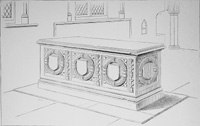
TOMB OF THE SECOND LORD WILLOUGHBY DE BROKE, BEER-FERRERS. View larger image
Before we leave the sacred edifice, a chastened thought creeps over us, as we take a last look at the fine old glass in the east window. Just seventy years a-past, a gifted student in the pursuit we also at humbler distance love, made pilgrimage here, and was engaged in making a drawing of its interesting painted story, when death suddenly stayed the work of the artist, snapping the very pencil in his fingers, and instantly translated him, from picturing the earthly image of the Founder of these courts below, into his immortal presence in the great temple above, and the company of all those who "have died in His faith and fear." Gratefully we note, appreciative minds have placed a small brass in the pavement, where, on the 28 May, 1821, Charles Alfred Stothard met with his sad, and to mortal sight, untimely end. His cunning fingers are mouldering in the dust below, and moss and decay are stealthily obliterating his record outside, but the fidelity and truth of his works remain bright and undimmed, forming his best and most enduring monument,—for
"It is the gods that die, not God; It is the arts that perish, not Art; And beauties may disappear, but Beauty herself Is immortal."
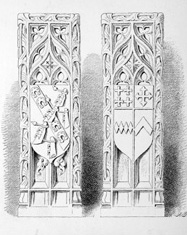
BENCH-ENDS, BEER-FERRERS CHURCH, DEVON. View larger image
The arms proper of Willoughby appear to be Or, fretty azure, and with regard to the badge of the rudder, although it has been questioned, still the evidence of investigation goes far to prove it to be by ancestral descent, the peculiarity of this family. Leland makes special note of their appearance at Broke-Hall, and also in Westbury church. It first occurs in connection with Cheney on the tomb at Edington, also with Willoughby at Callington, is well marked on the bench-end at Beer-Ferrers, and again—out of compliment—appears in similar situation in Landulph church, on the opposite side of the river. It is found in Lychet-Matraver's church in east Dorset, on the font and over the windows, accompanied by the golden fret of Matravers; here it follows Elizabeth, sister of Lord Willoughby de Broke, who married William Fitz-Alan, Earl of Arundel, Baron Matravers of Lychet, and lord of the place, who died in 1543. The church was evidently rebuilt about that time, and displays the characteristics of late, almost debased Perpendicular.
Another memory concerning Willoughby de Broke yet remains for us to chronicle, and we must spirit you away, gentle reader, from Tamar's oozy marge to the dry undulating chalk hills of central Dorset, and invite you to enter the well-cared-for little church of Hooke. Descending to him through his grandmother Anne Cheney, as representative of the families of Stafford and Matravers of Hooke, Lord Willoughby de Broke held large properties in this and the adjoining parishes, eleven manors (as enumerated by Hutchins), and where also he had a seat, of which, says Coker, "Humphrey Stafford who married Matraver's heir, was the great builder of it," then the residence of the Marquis of Winchester, descendant of the Willoughbies; "but his successors have not thought so well of it, wherefore it is like to run to decay." On its site now stands a modern mansion, with a few antient vestiges interwoven, and around it is a fair-sized park. It was in Hooke church that the first Lord Willoughby de Broke by will endowed the priest for twenty years to pray for his soul; and within the edifice, on the south side, is a small chantry, which opens to the church by an arch of late character, richly decorated with a course of quatrefoil panels having in their centres shields, and edged on each side with a string-course of foliage. There are no bearings on the shields. Here, doubtless, the masses pro bono statu of the deceased nobleman's soul were regularly sung and said for the time specified. No memorial to Willoughby is visible in the chantry, excepting a small brass, that probably had its original station within it, but is now affixed to the opposite wall, which records the following,—
Of yor charyte pray for the soule of Edmond Semar late se'v'nt to Robt wylughby knyght late lord Broke whiche Edmond decessed ye xiii day of Ianuary the yer of or lord m ve xxiii on whose soule Ihu haue mercy amen
William Willoughby succeeded to the Arch-Presbytery of Beer-Ferrers 21 April, 1533,—patron Walter Seymour, by virtue of grant from Lord de Broke. He died 1565, and the Arch-Presbytery expired with him. Both probably were members of the same family.
A review of the life of the first Lord Willoughby de Broke exhibits no salient features, beyond those associated with the social distinctions and worldly prosperity, usually conferred on and accompanying the faithful subserviency, that follows in the wake of a conqueror. His public functions scarcely reached in importance those exercised by his companion at Court and in arms, and fellow west-countryman Giles, Lord Daubeney; but in the main they were much alike; each served Henry as a military commander, both on sea and land, abroad and at home, were the envoys entrusted to negociate his crafty, vacillating, compromising policy in missions to foreign potentates, and held respectively the highest positions at his court, the one as Lord Chamberlain, and the other as Lord Steward of his Household. Although the Edgcumbe episode seems to pourtray him in his younger years as a daring and lawless marauder on his neighbour's peace and possessions, large allowance must be made for the disorganized state of society in that distracted age, where every man essayed to be a law unto himself, and might became right, in a very large sense of the word. In after years—like Lord Daubeney—when Henry was firmly seated on the throne, and order largely restored, Lord Willoughby de Broke was probably a careful and cautious courtier, steering clear of the intrigues that stalked about Henry's court (and infested the Tudor dynasty to its close), one who studied the mercenary, selfish policy of his royal master, and made himself generally useful as opportunity and circumstance occurred, and in return was rewarded with honours, accompanied by grants of his neighbour's confiscated lands, which cost the generous monarch he served, nothing to bestow. His name, somewhat prominent from the functions he exercised, helps to fill up the middle distance of the picture, that environs the advent of the first Tudor king.
Concerning the history of the subsequent possession of the antient home of the Willoughbies de Broke,—Charles Blount, the fifth Lord Montjoy, who married Anne the daughter of Robert, the second Lord Willoughby de Broke by his second marriage, had in her right, livery of the manor, 31 Henry VIII., 1539. He was of eccentric turn, served in the rear guard of the army sent to France in 1544, and by his will made at that time, he ordered a stone to be set over his grave in case he was there slain, with the following epitaph, as a memento to his children, to keep themselves worthy of so much honour as to be called forward to die in the cause of their king and country—
"Willingly have I sought And willingly have I found, The fatal end that wrought Thither as dutie bound:
Discharged I am of that I ought To my countrey by honest wound; My soul departyd Christ hath bought; The end of man is ground."
and further devised some extensive charitable bequests. He died in 1545, and was buried in the church of St. Mary Aldermary, London (Weever)—his grandson Charles Blount, eighth baron (raised to the dignity of Earl of Devonshire, and K.G. in 1603),—sold Broke Hall and Manor to William Jones, of Edington, Wilts, gent, in 1599.
Yet one more remembrance of the Willoughbies and of the same house as the Lords Willoughby de Broke, waits notice, and our little chronicle concerning them is concluded. In Southleigh churchyard in east Devon, close to the chancel end of the church is a high-tomb, erected evidently to a person of some position; on the end panel is incised the grand achievement of Willoughby de Eresby, as on the tomb at Callington, and with the crescent for difference, shewing that he was of the same descent. The form of the letters in the inscription is of an extraordinary uncouth kind, and tell us
HERE LIETH THE BODY OF HENRY WILLOUGHBY WHO DYED THE 28 DAY OF SEPTR. 1616.
but we have been hitherto unable satisfactorily to place him in the Willoughby pedigree; the following however may be added.
Sir William Willoughby, second son of Sir John Willoughby of Broke, and brother to Robert, Lord Willoughby de Broke, was of Toners-Piddle near Bere-Regis, Dorset, and by his will dated 28 November, 1512, proved 13 February, 1512-13, ordered his body to be buried in the church of St. John the Baptist at Bere-Regis. He endowed a Chantry at Edington in Wilts, and gave to the Abbey of Milton in Dorset fifty marks. Nicholas Willoughby his son was also of Toners-Piddle, where, says Hutchins, "he held this manor and advowson, and four hundred acres of (plough) land, two hundred of mead, three hundred of wood, and two thousand of furze and heath, there and in Snelling and Chilborough, of Lewis Mordant as of his manor of Duntish, in free socage and by fealty." In 1546 Robina his widow instituted John Brikill to the rectory. By his will dated 15 May, 1542, he ordered his body to be buried in the church of Bere-Regis, as did also Leonard Willoughby his son. "At the upper end of the north aisle," Hutchins remarks, "are two altar tombs of grey marble, but the brass plates, effigies, escutcheons, and inscriptions gone; perhaps they belong to the family of the Willoughbies." In 1653 Sir Robert Willoughby and Elizabeth his wife sold the capital mansion-house, farm, and advowson of Toners-Piddle to Robert Lewen. Toners-Piddle church "was re-built in 1759, the little aisle of the Willoughbies was not re-erected. There were no inscriptions in it, that family generally burying at Bere." Christopher Willoughby, another son of Sir William, married Isabel daughter of Nicholas Weeks of Dodington, Gloucester, and he had a son named Henry, who married Jane daughter of Dauntsey of Lavington, Wilts.
Richard Willoughby, third son of Sir John Willoughby of Broke, was of Silton, Dorset, having married Isabel daughter of John Bedyke of that place, who brought the manor to her husband. He died 1523, she 1524, and both by their wills ordered their bodies to be buried in the church of St. Nicholas there. They left several descendants.
Henry Willoughby's tomb at Southleigh has been carefully and substantially repaired by a representative of the family.
Back to Beer-Ferrers again our thoughts return, and recall the memory of our last visit to the antient home, successively of Ferrers, Champernowne, and Willoughby, names all now extinct, that had relationship there. Evening is creeping on, as we leave the little jetty and find ourselves afloat, slowly making way out into the Tamar proper. How many a story speaks to us of the past, from its dim cliffy banks, that history and tradition have preserved, how many more, silent and forgotten, are lost for ever. Such the doom and fate of human life, little episodes on the stream of time, successive and evanescent as the wavelets that rise and die against the bosom of our little craft. Of Willoughby de Broke, a larger remembrance remains, but it only points in a fuller sense to an often recurring issue of human life, graphically summed up concerning them by the quaint old historian Westcote,—"but this family fading in his very blossom, soon came to his period."
TAMAR'S FLOW.
O Tamar's flow! lowly I bend mine ear, And listen to thy lisp that greets the shore, Bearing Tradition's burthen soft and clear, From the dim portals of the never more;— Two voices spell me from thy mingled tide, One, mighty ocean's whisper, murmurous, deep, Telling of ventures glorious, that hide Within its billowy bosom rocked in sleep;— The other, rippling from thy crystal fount, A tinkle sweet of elves, and fays, and flowers, Legends borne down from woodland, vale, and mount, Departed homes, and haunted shrines and towers;— Flow on,—until this trancèd ear shall be, But one more memory that is merged in thee!
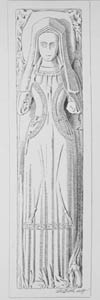
Effigy, Presumed To Represent CICELY BONVILLE, MARCHIONESS OF DORSET. Astley Church, Warwickshire—circa 1530-5 View larger image
EXTINCT, FOR THE WHITE ROSE.
Leaving the antient town of Colyton by its south-western approach, the broad turnpike-road that leads over the hill to Sidmouth, at about half-a-mile's distance up its ascent, a turn to the right takes us into the trackway of a winding and somewhat narrow Devonshire lane. A pleasant prospect opens across the valley below, through which the Coly sparkles along with sinuous course, and immediately in the mid-distance appears the old ruinous cradle of the Courtenay family, Colcombe Castle, grey-walled, ivy-clad, and orchard environed. Beyond and just under the further fir-topped hill-line, another grey dot strugglingly emerges from among the dense garnishing of foliage that surrounds it, and shews us what remains of old Shute House, while to its left, across the far valley, rises the beautiful tree-crested acclivity of Shute Park; localities of special importance pertinent to the interest of our little narrative, to be referred to by and by. In front a delightful and typical Devonian landscape extends itself. Sprinkled over with the deserted homes of the olden lesser squirearchy, the antient lords of the vale, and picturesquely varied alternate with copse, plantations, and well-timbered hedgerow, the two valleys of the Coly and the Brinkly bifurcate just at this point, meeting under the shadow of the remarkable pyramid-shaped hill, Waddon Pen, and then stretch away, variously broken into lesser knoll and vale, until lost in the misty outline of the high, far-distant curtain of the Farway hills, with their tiny clumps of trees that just break the even contour, and stand like sentinels on the rampart-appearanced outline against the grey sky. They recall also for the moment to the historic memory, the burthen of a pleasant story, connected with its breezy, and comparatively unfrequented altitude, one of the numberless traditions that throng the hills and vales of the olden region of the Danmonii.
A rest for awhile on the parapet of the bridge spanning the little Morganhayes brook, hastening to join the Coly a few fields' distance below; a rivulet whose banks at Spring time are almost fairy-land with abundance of some of our finest wild flowers, broad stretches of daffodils, myriads of white-starred anemones, gleams of pale primroses and bleached lady-smocks, and sheen of golden-cups in their succession, but specially, when uncertain April brings her tears and sunshine, the haunt of the most gorgeous of them all
THE MEADOW RANUNCULUS.
Close by the rippling streams' translucent marge, Ranunculus of gold, Bright to the sun in constellation large, Thy glowing stars unfold
'Mid all the wealth Spring scatters without stint, By meadow, bank or stream, Gay daffodil, or king-cup's myriad glint, Spread like a golden dream;—
She brings no rival whose attractions may With thee in all compare, Brave thy full beauty in its strong array, And matchless clusters dare.
No, nor sweet Summer when adown the land Her flower-sprent steps incline, Bearing the sceptred iris in her hand,— The glory still is thine.
Continuing our pilgrimage, about a mile's distance further brings us to a bridge spanning another small stream, also flowing down to meet the Coly below at a place appropriately named Bournehayne, and immediately at the entrance of the little village of Southleigh. Passing under the shadow of some fine old yews, our steps lead up a little acclivity to the left, into the churchyard. There we halt for a minute to scan the Willoughby tomb, with its grand escutcheon and uncouth caligraphy, and then look inside the little sanctuary, where, owing to the necessity of almost entire rebuilding, only one monument of importance remains, preserved in the chancel, to be further referred to in the course of our little story. On the porch threshold the eye is arrested momentarily by an almost obliterated seventeenth-century flat stone, bearing the still-traceable yeoman-gentleman name of Starre of Beer, and the fragment of another leaning against a grave near, of contemporary date, inscribed with the patronymic of Clode—a name still existent in the parish,—and whose earthly calling is described as 'goldsmith,' a strange vocation to find chronicled here in this rural vale, and the memorial probably of one who practised the craft in busier scenes elsewhere, and returned to his native parish, when he finally laid down burnisher and graver, to find his last resting-place.
Down a small meadow below the church, to the rill we crossed on entering the hamlet, and our path inclines along its banks up the valley through which it flows, and a right pleasant vale it is, flanked on the left by extensive plantations of almost every species of useful conifer, which stretch down, exhibiting great luxuriance of growth, their different habits finely contrasting, and adding the great charm of variety; while the opposite ascent is also picturesquely wooded with ordinary foliage. So we leisurely continue a full mile or more, when the valley somewhat expands. Here some fine trees are scattered park-like in appearance around, with a small modern mansion in their midst, and this brings us to our present destination.
Who would imagine, viewing the peace and retirement of this delightful rural solitude, so far removed from the ken and the movements of busy, anxious, restless, ambitious man, and where only the voice of the thrush, the flicker of the butterfly, the hum of the bee, the rustle of the coney, the song of the lark, the bleating of the flock, or the low of the kine, is seen or heard, that a story of wondrous historic interest and significance "take hys begynnyng" from this spot? Yet an apt symbol of how small and comparatively unknown beginnings, at times end in being engrafted into the largest results, lies close beside us. Who shall predict the ultimate destiny of the humble ripple of water that sparkles along at our feet? Down through this valley it hastens to the Coly, then on to join the larger Axe, thence to mingle with the salt tide and be merged in the blue expanse of the Channel, and finally be found adding its tiny tribute to the grandeur of the great Atlantic.
As of the stream, so of the story that has origin here on its banks, and from him who was one of the earliest settlers thereon, back in the twilight of the days of the early Plantagenets, when a country gentleman with no recorded pretension to influence or fame, beyond the inalienable witness of Norman descent, betrayed by his name, to this place found his way and fixed his abode. After sundry generations the descendants of his race, although still holding their original home here, travelled far afield, away from the quietude and peace of these sylvan scenes, lured into the dangerous path of ambition, and became prominent actors in the great, stirring, troublous drama of mediæval English history, as active and devoted partizans in the contending factions, fighting to the death amid the strife of its kings, and shedding their blood unstintedly in the conflict. Then followed the great but dangerous honour of kinship with royalty and its fatal glamour, culminating at last in their aspiration to the possession of the crown itself, with the result, finally, of laying one of their last and most guileless representatives, headless on the steps of the throne to which they laid claim. A relation of real incidents that needs no garnishing of romance to enhance its extraordinary interest.
Wiscombe,—Wescombe, probably originally West-combe, is the name given to these historic precincts. The very earliest mention of its ownership assigns it as among the possessions of the Abbey of St. Michael de Monte, in periculo maris, in Normandy, and was at the beginning of the thirteenth century held of its Abbot by Roger de Daldich, of the family of Daldich of East-Budleigh. After awhile came a change of ownership, and then we get the first mention of the name of the family, the outline of whose succeeding generations we propose to attempt, albeit imperfectly, to chronicle. A story, nevertheless, of surpassing interest, even among the crowd of great traditions that form the historic heritage of the famed county of Devon.
This was, according to Pole, its grant, or sale, with the reservation of twenty shillings yearly rent, "about ye middest of the raigne of kinge Henry III.," by the aforesaid Abbot and Roger de Daldich to Nicholas de Bonville, evidently a gentleman of that era, and whose name—de bonne ville—'of the fair or good village'—unmistakably pointed to the original birthplace of his family, as being found in the land immediately beyond the southern sea, from which his ancestor doubtless also migrated in the train of the Conqueror.
All we know of the life of this Nicholas de Bonville, presumably the first of his name as possessor of Wiscombe, is that he married a lady named Amicia, and it was probably he, who in accordance with the religious custom of the age, was the donor of a rent-charge at 'Tuddesheye,' now Studhayes, in Kilmington, to the Abbey of Newenham, in the adjoining valley of the Axe, and in its Conventual church was buried, as described by Mr. Davidson, "lastly against the north wall of the choir, lay Sir Nicholas Bonville, a benefactor to the abbey who died in 1266."[11] He left a son named William.
But according to another account of the early generations of Bonville, the first recorded was Nicholas Bonville who was living in 1199. To him his son William Bonville (not Nicholas), who married Amicia, did homage for lands in Somerset, 6 Feb., 1265, and was succeeded by his son William, who married Joan, a widow.[12]
William Bonville wedded a lady named Joan,—in a list of the Guild Merchants of the antient borough of Totnes, dated 1260, and still preserved, the third name that occurs is Will's de Boneuille, but whether to be identified with an owner of Wiscombe of that name, may not be determined, but the era accords. Of him we learn nothing further beyond the date of his death 2 Edward I., 1273; and that he was succeeded by his son Nicholas.
Nicholas de Bonville was styled also "of Shute," by right of his wife Elizabeth de Pyne, of whom and her dower a few words.
The first recorded owners of Shute, and from whom it received its name, were Sir Lucas and Sir Robert de Schete, who held it early in the reign of Henry III. From them it passed to Sir Robert and Sir Thomas de Pyne, of the "antient progeny" of Pyne in east Devon. Sir Thomas who was Sheriff of Devon 56 Henry III., and successively 6, 9, and 10 Edward I., at his death left two daughters coheiresses. One of these distaffs, Matilda (otherwise Hawise), wedded Nicholas de Bonville of Wiscombe, to whom she brought Shute as her portion. "In this place (Shute) the famylye of Bonvill," says Pole, "made their principall dwellinge, which had (longe before this Nicholas had the mansion howse, and mannor of Shute) divers lands within Shute, namely Sir Nicholas Bonvill (his grandfather) had Leggeshayes, and other lands their, his dwellinge beinge at yt tyme at Wiscombe." The policy of this marriage is therefore apparent. Himself and wife appear to have both died the same year, 23 Edward I., 1295. They left a son and heir named Nicholas, and another son John, who married Joan, daughter of Waryn Hampton of Musbury, and she married secondly John Sachville, and thirdly John Faringdon of Faringdon.
Sir Nicholas Bonville of Shute and Wiscombe, married Johanna, daughter of Sir Henry Champernon of Clyst-Champernon (who died in 1320), by his wife Johanna daughter of Henry Bodrugan. He was two years old only at his father's death, but the date of his own decease does not appear. There were four children, of whom Sir William was the eldest son and successor.
Alexander, the second son, married Hawise, daughter of Henry de la Forde in Musbury, and had a son Nicholas, styled "of Forde," whose daughter Edith, married Richard Okebeare, through whose descendant, Pole, afterward of Shute, was the representative, before he purchased the Bonville's forfeited inheritance, and through whom they quarter the arms of de la Forde; Sable, a poppy with roots and fruit or, and Bonville.
Isabel, who married Sir Roger de Nonant of Broad-Clyst, and last of that name; they left two daughters, Alice who married John Beauchamp of Ryme, and Eleanor. The beautiful monument with effigy in Broad-Clyst church is supposed to represent this knight, who reclines in a recess on the south side of the chancel, and is clad in plate armour with bascinet, mail-gorget, surcoat, and ornamented baudrick. The feet rest on a lion, the head on a tilting helmet, and angels are at the shoulders. A richly foliated canopy of screen-like character fronts the figure on the side toward the church.
Anne, the second daughter became a nun at Wherwell.
Sir William Bonville, of Shute, "a very sweet and noble seat, adorned in those days (as it still is) with a fair park and large demesnes," the first prominent representative of this family, and who added greatly to its social status, was a wealthy and munificent man. He married first Margaret, daughter and coheiress of Sir William d'Aumarle of Woodbury, Devon, who died 15 Nov., 1361, by his wife Agnes de Meriet, daughter of George de Meriet, of Merriot, Somerset. By her he had four sons, and two daughters. She died 13 May, 1399.
Early in the succeeding century Sir William married secondly Alice (whose surname has not been recovered), widow of Sir John Rodney, who died 19 Dec, 1400. Sir William Bonville was her fifth spouse, for she had wedded three husbands previous to Sir John Rodney. Firstly, John Fitz-Roger, lord of the manor of Chewton-Mendip, Somerset; by whom she had a daughter, Elizabeth, who married John Bonville, her last husband's eldest son by his first wife; secondly, she married Sir Edmond de Clyvedon, of Clyvedon, Somerset, who died 13 Jany., 1375-6; and thirdly, as his second wife, Sir Ralph Carminow of Menheniot, Cornwall, who deceased 9 Oct., 1386. Sir Ralph who is said to have been "by a brase of Greyhounds pulled over a Cliff and died," was buried in Menheniot church, where there is a small brass,—probably the earliest remaining in Cornwall—to his memory, thus inscribed,—
Orate pro anima domini Radulphi Carmynow militis, cuius anime propicietur deus Amen.
Lady Alice Bonville survived all her husbands nearly twenty years, and died 27 March, 1426.
A glance at the numerous ventures of this much-married lady will give the uninitiated in the study of genealogy some idea of the difficulties which beset it, in sifting, tracing, and separating the tangle of relationship that wove together the leading families of the west during the fourteenth, fifteenth, and sixteenth centuries. It was the custom to marry very early in life, often at fifteen or sixteen, and that short widowhoods and remarriage almost invariably followed decease on either side, and not uncommonly resulting further also, in the children of the previous marriages matching together, a "matter of mere attorneyship," probably in many cases entered into to consolidate the family estates.
Beside his "mansion howse" at Shute, which was his principal residence, Sir William, as was usual, had a town house or hotel, in the parish of the Holy Trinity, Exeter. On 17 April, 1404, Bishop Stafford licensed John Govys rector of Holy Trinity, as the parish church was being rebuilt at the time, "ut in aula infra mansum domini Willelmi Bonevyle, militis, infra parochiam dicte ecclesie Sancte Trinitatis situatum, divina possis celebrare, ac per presbiteros ydoneos facere celebrari, necnon parochianis tuis quibuscumque Sacramenta et Sacramentalia conferre et ministrare valeas."
Of Sir William's sons, Richard the eldest died without issue before 1397. John the second son became his father's heir and successor.
Thomas Bonville, third son, married Cicely, daughter of Sir John Stretche of Sampford-Arundell, Somerset, who died 6 Aug., 1390, by his wife Katharine daughter of Sir John Beaumont, of Sherwill, North Devon. They had two sons, William who died 28 Aug., 1412, and John in 1426. Both were styled "of Merriot, Somerset," property that descended to them through their great-grandmother, and died without issue. He, Thomas, died about 1401, and his widow soon after married Sir William Cheney of Broke, Wilts, and died 18 Oct., 1430.[13]
William, the fourth son, died without issue; we hear nothing of him beyond his being a witness to his stepmother's will.
Katharine, the eldest daughter, married first Sir John Cobham, of Blackborough, Devon, by whom she had a daughter Elizabeth, married to Walter Charleton. Secondly she married John Wyke of Nynehead-Florey, Somerset, and thirdly Humphry Stafford of Grafton, Worcestershire. She died 1 Aug., 1416.
Elizabeth, second daughter, married about 1390, Sir Thomas Carew of Ottery-Mohun, who died 25 Jan., 1431. She died 8 Feb., 1450-1.
Sir William who was Sheriff of Devon 13 Richard II., 1400, died on 14 Feb., 1407-8, and was buried before the great Cross in the choir of Newenham Abbey Church. Beside him was afterward laid Alice his second wife. This was during the abbacy of Leonard Houndalre, who presided over the Community 1402-13.
He bequeaths by his will,—a very long document written in French,—and made
"on the Saturday next before the feast of the Assumption of our Lady, 1404, my body to be buried before the High Cross of the church of Newenham; to Alice my consort my mansion at Exeter for her life, all my books, vestments with other apparel belonging to my chapel, all kinds of necessaries belonging to my hall, chambers, pantry, buttery, kitchen and fish-pond, within my manor of Shute, and all other chattels on my manors of Wescombe, &c., &c., elsewhere, 100 marks in money, and the half of my silver vessels, &c.; 100 marks, to assist in making and repairing the bridges and roads that are weak and fallen within my lordships of Devon and Somerset; to alienate by mortmain 50 marks of land and of rent per year for a Maison Dieu in Combestreet at Exeter, for 12 poor men and women to be lodged there always, also 300 marks to the said Maison Dieu in honour of God, and to sustain the said house, and the aforesaid poor men and women, all my rents in Exeter, except my mansion;—to Dame Anne Bonville, nun of Wherwell, 10 marks, a hanapp (drinking cup) with silver cover, and my best hoppelond (great coat) with the fur. To William my son 200 marks to assist him in getting married; to Thomas son of John Bonville £20 in money; to John son of Thomas Bonville to assist him in getting married 100 marks. To my daughter Dame Katharine Cobham £20; to my daughter Dame Elizabeth Carew, £20. I devise that all my debts be duly and fully paid, and if any offences or extortions by me have been committed against any persons I will that they be restored to them, according to the greatness of the offence; 24 torches of wax, and 24 poor men be clothed the day of the interment of my body, and to other poor people coming on the day of my burial £10, that each who comes may have one penny; and that my mansion and my retinue be kept just as it is for one quarter of a year after my death. Appoints Alice my consort, and six clerks executors; Monsieur Thomas Brooke and John Strecch, surveyors; nothing to be done without the counsel and assent of the said surveyors."
There is also included a very large number of religious bequests to pray for the good estate of his soul, at various places, and legacies in money and kind, to the poor on his extensive estates.
John Bonville, son and heir of Sir William and Margaret d'Aumarle, married Elizabeth, only child and heiress of John Fitz-Roger, daughter of the first husband of his father's second wife. She was heiress-general to the Fitz-Rogers and brought the manor of Chewton-Mendip, near Wells, Somerset, and much other property into the family. In the south aisle of the chancel of Chewton-Mendip church, on a high-tomb are the recumbent effigies of a knight and lady,—the knight in chain and plate armour, with bascinet, mail-gorget, baudrick and spurs. On his surcoat are embroidered three lions rampant, the arms of Fitz-Roger. The lady is in long robe, wimple and cover-chief. The armour and costume are assignable to this era. John Bonville had two sons, William eldest and heir, Thomas, and one daughter Isabel.
Thomas the second son, who was Sheriff of Cornwall, married first Johanna eldest daughter of Hugh de St. John, eldest son of Thomas de Poynings, Lord St. John of Basing, by his wife Elizabeth daughter of Martyn Ferrers of Beer-Ferrers. By her he had one son John. Secondly, he married Leva, daughter and heir of John Gorges of Tamerton-Foliot, Devon, and widow of John Wibbery. She died 16 Dec, 1461. Thomas died 11 Feb., 1467.
John Bonville son of Thomas, married first Johanna Wibbery daughter of his father's second wife, by her first husband John Wibbery. By her he had two daughters, Anne married to Philip Coplestone, and Joanne married to John Elliot of Coteland. Secondly, he married Katharine, by whom he had two daughters, Florence who married first Sir Humphry Fulford, K.B., and secondly, Thomas Hext; and Elizabeth who married Thomas West, Lord Delawarr. John Bonville died 24 Aug., 1494.
Isabel, only daughter of John Bonville, son and heir of William Bonville, married Sir Richard Champernowne of Modbury, son of Sir Richard Champernowne, who died 26 Feb., 1418-19, and Katharine daughter of Sir Giles Daubeney, and who were both buried at Dodbrooke, near Kingsbridge.
John Bonville, her father, died in the lifetime of his father, 21 Oct., 1396, and Elizabeth Fitz-Roger, his widow, married secondly Sir Richard Stuckley of Trent, Somerset.
Leland thus speaks of the "maner places" of the Bonvilles, Wiscombe, and Shute:—
"on the west part, over an hille byyond Seton is Wiscombe, a fair maner place, sumtyme the Lord Bonvilles; now longging to the Marquise of Dorsete. The parkes and maner places of Wischum and Shoute abowte Axminster in Devonshire were the Lord Bonevilles, and after a knightes of that name or ever they came to the Marquis of Dorsetes hand."
In Sir William Bonville, the eldest son of John Bonville and Elizabeth Fitz-Roger, we reach the most celebrated individual of his race, and practically the last male in the direct line, as his son and grandson died in his lifetime. His father having died in 1396, when he was quite a child, and his mother being married again to Richard Stuckley, it is probable the boy was in the custody of his grandfather at Shute up to his death in 1407, and subsequently in the guardianship of his step-grandmother the Lady Alice until his coming of age, and taking possession of his large property in 1414, which year his mother died, but his step-grandmother lived twelve years afterward, dying in 1426.
The particulars as to the birth and baptism of this wealthy and unfortunate man, as they were deposed to by the witnesses appearing before the escheator at the enquiry held to make proofs as to his coming of age, are very homely and interesting.[14] This was taken at Honiton on "Tuesday, All Hallow's Eve, in the first year of the reign of King Henry the Fifth after the Conquest, before Henry Foleford, the Lord the King's Escheator in the county of Devon." Numerous witnesses were examined, and John Cokesdene and two others deposed,—
"that William the son of John, is of the age of 21 years and upwards, having been born at Shute, on the last day of August in the 16th year of the reign of the Lord Richard, late King of England, the Second after the Conquest (1393), and baptized in the parish church of the same vill on the same day about the hour of vespers. And this they well know to be true, as they the said jurors were, on the said last day of August, together elected at Honiton, on a certain 'Love Day' to make peace between two of their neighbours, and on that very day there came there a certain Lady Katharine, widow of Sir John Cobham, knight, and then wife of John Wyke of Nynhyde, an aunt of the said William the son of John, proposing to drive to Shute, thinking that she should be Godmother to the said infant, and met there a certain Edward Dygher, servant to the said Sir William Bonevile, who was reputed to be half-witted in consequence of his being loquacious and jocular, and who asked her whither she was going. Who answering quickly said: 'Fool, to Shute to see my nephew made a Christian,' to which the said Edward replied, with a grin, in his mother tongue, 'Kate, Kate, ther to by myn pate comystow to late,' meaning thereby that the baptism of the child was already over. Whereupon she mounted upon her horse in a passion, and rode home in deep anger, vowing that she would not see her sister, to wit the said child's mother, for the next six months, albeit she should be in extremis and die."
Thus much for the Lady Katharine's appearance, her disappointment and displeasure at not being able to be present at the child's baptism, although she had adjournied so far for that purpose, and her immediate return. Then a certain John Prentys and two others testify that
"all the matters as to the said Lady Katharine are true, inasmuch as the whole took place in the said John Prentys' house, where they themselves were present at the time, and saw and heard all."
Then comes an interesting testimony shewing the lord of Shute still kept full interest in the older home of the family at Wiscombe, and at the date of his grandson's birth was engaged near there in a business transaction with squire Walrond of Bovey, living thereby. Richard Lutrell and John Prustes relate,—
"on that day Sir William Bonevile was at his manor of Southleigh busy in setting up certain boundary marks between a parcel of his own land called Borcombe to the same manor belonging, and the land of one William Walrond, on which occasion the aforesaid Richard and John were present at the special request of the said Sir William Bonevile. And then and there came Andrew Ryden, a servant of the same Sir William, and told his master that his son John had a son born to him, upon hearing which the said Sir William rejoicing exceedingly lifted up his hands, and thanked God, and immediately mounting upon his horse rode home."
Following this is the evidence of those who witnessed the ceremony of the christening in the little church on that summer evening, William Hodesfelde, and Richard Damarle, probably a relative of the child's grandmother. They also speak of the grandfather's delight and the present he made his grandson thereon, and say,
"they were present in the said church on that day at the time of the solemnization of the baptism of the said William the son of John, to hear vespers, and as soon as the ceremony was over there came one Walter Walsche, the said William Bonevile's bailiff of his manor of Stapyldon in the county of Somerset, and told his master that he had well and finally completed the autumn gathering, both of his said manor of Stapyldon and his manor of Sokke, and had brought with him 400 lambs of that year's produce of the manor of Sokke aforesaid, of which said lambs the said William Bonevile immediately gave 200 to the said infant then and there baptized."
Finally we get the information as to who were the child's sponsors and of the high ecclesiastic who was one of them, and doubtless came across specially from Newenham Abbey to perform the ceremony, making his distinguished godson a commensurate present. Thomas Bowyer and Ralph Northampton remember
"that they were personally present in the said church, and saw there three long torches burning, and two silver basins, with two silver ewers full of water, John Legge then Abbot of Newenham and Sir William Bonevile being the godfathers and Agnes Bygode the godmother of the same child, upon whom the said Abbot there bestowed a silver gilt cup of the value, as it was said, of 100 shillings, with 40 shillings in money told, contained in the same, which as it appeared to them was the most beautiful they had ever beheld in a like case."
Poor child! The lambs bleating outside, and the glittering gift cup,—"the most beautiful they had ever beheld,"—and filled with silver pieces! The costly christening vessels and flaming torches, the abbot in his robes, the knights and ladies in their splendid apparel, the clustering parishioners gathered round, curiously and respectfully to witness the baptism of the heir, and the solemn evening twilight softly stealing through the casements of the little sanctuary. What a suggestive picture of country wealth and peace thus surrounding the first hours of the child, and what a contrast to the scene that was destined to environ that child's last hours, of whose bitterness, what seer, had he been then present, would have been bold enough to predicate? When crushed by misfortune, his son and grandson having fallen by the sword before his eyes a few weeks previously, and although bowed by age, yet still attracted by the glamour of the deadly conflict,—far away from these happy precincts, with a captive king in his keeping as a ransom, but powerless to save him,—he stood an unfriended prisoner alone in the hands of a relentless enemy, surrounded by the ghastly wrecks of a battlefield, and then hastily perished amid the ghastlier paraphernalia of the scaffold, the axe and block, the executioner in his mask and the jeering soldiery. With what boundless mercy are the ultimate issues of these lives of ours hidden from us!
Being in possession of his large property, it was not likely that a young man of his distinguished station, in those stirring times should long remain "with idle hands at home." Accordingly we find him three years afterward, in 1418, employed in the military service of his country, for "being then a knight" he proceeded to France in the retinue of Thomas, Duke of Clarence, brother to Henry V., in that king's expedition to Normandy. In the first year of Henry VI., 1422, he served the office of Sheriff of Devon.
In 1428 we get an interesting incident recorded, of amenities passing between Sir William and his neighbour the Lady Joan Brooke, widow of Sir Thomas Brooke, of Weycroft, near Axminster, and Holditch Court, Thorncombe, "on the 14th April of that year Nicholas Wysbeche, Abbot of Newenham," says Mr. Davidson,
"was appointed with five of his neighbours a mediator in a dispute between Sir William Bonville of Shute, and Joan widow of Sir Thomas Brooke, arising from the obstruction of several public roads and paths in the formation and enclosure of the park at Weycroft by the lady and her son. The transcript of an instrument has been preserved which recites the circumstances of the case at great length, and concludes with an award, which as the abbot was nominated by the lady Brooke, does credit to his justice as an umpire, as well as to his hospitality; for after deciding on every point in favour of Sir William Bonville, and directing all the ways in question to be thrown open to the public, that the knight and the lady should ride amicably together to Newenham Abbey on a day appointed, where they should exchange a kiss in token of peace and friendship and dine together at the abbot's table. The deed is dated at Axminster 13 August, 1428."
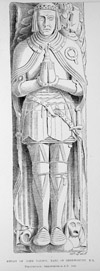
EFFIGY OF JOHN TALBOT, EARL OF SHREWSBURY, K. G. Whitchurch, Shropshire—A.D. 1453. View larger image
The brass effigies of Sir Thomas and his lady are in Thorncombe church, still very perfect.
Amicably and pleasantly settled, and justly too withal by the good Abbot Wysbeche, and with proper regard to the rights of way exercised by the public at large, which seem to have been duly cared for and protected by the lord of Shute.
Nearly fourteen years now elapse before we hear further of him, and then in 1442, he appears to have held a maritime command, and "sailed from Plymouth to Bordeaux with twenty-five ships and four thousand men," and the year following was employed on land service, being "retained by indenture to serve the king a whole year with twenty men at arms, and six hundred archers, and was made Seneschal of Acquitaine."
In 1449, he was commissioned "to serve the king upon the sea, for the cleansing of robbers and pirates," and the same year he held Taunton Castle, but was compelled to surrender it to the Duke of York. In 1450 a letter was sent to him amongst others, by the king requesting help for the preservation of Lower Normandy from the French.
Doubtless in consideration of these military and other services, actively and faithfully rendered to Henry VI., he was by that king raised to the honour of the peerage, by writ of summons dated 23 September, 1449,—26 Henry VI.,—to Parliament by the title of Baron Bonville of Chewton (from Chewton-Mendip in Somerset), where he inherited a large property, derived from his mother as heiress of the Fitz-Rogers. He was also created a Knight of The Garter, being the one hundred and eighteenth in the succession of that noble Order.
In 1453 he was ordered to France with a force sent for the relief of Guienne. While there it is probable he was a participator in the engagement wherein the gallant Talbot, Earl of Shrewsbury, lost his life. The same year "in consideration of his further services he was constituted Governor of the Castle of Exeter, and the year following, 1454, made Lieutenant of Acquitaine."
From this partial relation of his public services, our thoughts wander for a time, to the domestic surroundings of his home life.
Lord Bonville married first a lady named Margaret, but who she was the labours of investigators have as yet failed to discover. By her he had one son, William, and two daughters,—Philippa, who married William Grenville, brother to Sir John, and second son of Sir Theobald Grenville, by Margaret daughter of Sir Hugh Courtenay of Haccombe, by his third wife Matilda daughter of Sir John Beaumont, and was thus grandson to Earl Hugh and Margaret Bohun of Colcombe,—and Margaret, second daughter, who married Sir William Courtenay of Powderham, Sheriff of Devon in 1483, and who died in 1485.
Lord Bonville wedded secondly, Elizabeth, daughter of Edward Courtenay, third Earl of Devon, known as "the blind Earl," who died in 1419, and was presumably buried at Ford Abbey; by his wife Matilda, daughter of Thomas Lord Camoys. She was then the widow of Sir John Harington, fourth Baron Harington of Aldingham in the County of Lancaster, and who died 11 Feb., 1417-18. She died 28 October, 1471, thus surviving her second husband ten years, and her first husband fifty-three years!—and was probably buried with her first husband in Porlock church, where they founded a perpetual Chantry, and where their splendid tomb still exists, with effigies recumbent; moved probably from its antient position, and now much shorn by time and ill usage of its original glory, but still displaying ample evidence of the taste and skill of the mediæval craftsman. By his second marriage Lord Bonville left no issue.
The figures on the monument at Porlock are sculptured in alabaster, and Lady Harington-Bonville wears cote-hardie and gown, with mantle over, fastened across the breast by cordon and tassels. Around the hips is a rich cincture, and a double chain with dependant jewel encircles the neck. The head-dress is horned, the hair secured in a reticulated caul splendidly embroidered, and with jewelled ornaments filling the interstices. Just over the brow is a band-coronet, studded with pearls and crested by fleurs-de-lys, and her fingers are ornamented with rings. Angels support the cushions on which her head rests, and an animal, probably intended for a boar, as allusive to her family, is at her feet. Lord Harington is in plate armour, orle around his bascinet, plate gorget, large epaulières with deeply scolloped terminations, diagonally placed sword-belt with sword, rich baudrick across the hips with anelace, small tuilles, gauntlets, and about his neck a chain of ornamented link-work, with the usual trefoil clasp and small pendant. The head reclines on a helmet with crest of a lion's head couped at the shoulders, and angels were originally on each side supporting it. The feet rest on a lion. The armour is of an interesting character, and of later date than that worn at the death of the knight, being referable to what was in use about the middle of the fifteenth century, accounted for by the appearance of his wife by his side, who survived him more than half a century. There is a fine canopy over the effigies.
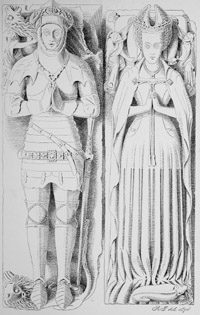
EFFIGIES OF ELIZABETH COURTENAY, LADY BONVILLE, and her First Husband, JOHN, Fourth BARON HARINGTON OF ALDINGHAM, Porlock Church, Somerset.—A.D. 1417-71. View larger image
We broke off our little personal history in the year 1454, when presumably Lord Bonville had returned from Aquitaine, of which province he had been made Lieutenant. The next glimpse we get of him is in the year following, and the incident, that brings him before us, is quite in keeping with the belligerent spirit of the times, and which seems to have invaded both public and private life at this turbulent and lawless era. The old historian, Westcote, gives a succinct outline of this remarkable quarrel,
"In this parish (Colyton) are yet remaining the two antient seats of two illustrious families, Colcombe of Courtenay, Earl of Devonshire, and Shute alias Sheet, of the Lord Bonvile; each of them having their parks and large lati-funds (broad-acres), but seldom any good neighbourhood, familiarity, or friendship between them. This emulation increased at length to a quarrel, and eagerly taken a both sides, about a couple of dogs, or hounds, if you will, which could not by any mediation of friends, or intercession of their equals, be qualified or appeased, until it was valiantly tried in a single combat (which is now by a fitter word termed a duel,) upon Clist-Heath, which manfully and constantly performed by both parties, and after they had well tried one the other's strength and valour, and with their sharp swords, they at last lovingly agreed and embraced each other, and ever after there continued great love and amity between them."
Shute was antiently part of Colyton, its church being a dependant chapelry,—it now forms a distinct parish.
A very singular spectacle, this valiant performance, between these noble neighbours, and ending according to the gossiping topographer in genuine three-volume style. Dugdale says, Lord Bonville had the best of the encounter, and Prince, after narrating the bellicose transaction and "the great love and amity" said to have existed between the combatants afterward, naïvely adds, "which I can hardly believe for a reason, which hereafter may be observed in reference to this Lord." Cleaveland however gives probably the truer version of its cause, observing
"But Hollingshed and others do say, that several men on both sides were slain in the quarrel, and that the Lord Bonvile prevailed and went to Exeter, and had the gates opened to him. And this is most likely to be true, for there was a great animosity between those two great men, before this quarrel happened, they being engaged in different parties; the Earl of Devonshire was zealous for the house of Lancaster, and the Lord Bonvile for the house of York, and the civil war between these houses did then begin to break out, and no wonder the city of Exeter opened its gates, to the Lord Bonvile, for the Duke of York had at that time all the power in his hands, and no doubt the city favoured those of the prevailing side. But whoever had the better of it in this quarrel, both the Earl of Devonshire and Lord Bonvile were great sufferers by that bloody and unnatural war, for the Earl's three sons, successively Earls of Devon, lost their lives for that quarrel for the house of Lancaster, and it is said by some the Earl himself came to an untimely end by it. And the Lord Bonvile lost both his son and grandson in the battle of Wakefield, and the Lord himself was put to death after the second battle of St. Alban's. The Earl's family became extinct as to the first branch of that illustrious house, and the Lord Bonvile's became wholly extinct."
A large and melancholy history in a few lines, and a pertinent illustration of the effects and horrors of civil war, but this new position of affairs requires careful scrutiny, as far as the slender means at disposal afford.
Up to 1454, at least, Lord Bonville's allegiance must have been true to the interests of the king, Henry VI. He had been employed, as would be usual with men of his position and military aptitude, in the warlike expeditions of the time abroad, and in the command of the forces on land and sea, at home. In this respect he was evidently esteemed an able and trusted servant, and the king had rewarded these services by conferring on him a peerage, and investing him with the order of the Garter, two of the highest honours at the sovereign's disposal, and it would be presumable, in view of the foregoing, that Lord Bonville's sympathies would naturally be on the side of Henry VI., and the cause of the Red Rose, in the bitter conflict then just beginning to be developed.
Although we have no direct testimony to the contrary in the earlier stages of the warfare, as to Lord Bonville's then actually throwing in his lot with the partizans of the White Rose, still the inferential evidence remaining seems to point to it. The quarrel between Courtenay and himself, although said to be over a couple of dogs,—if it really happened as described,—had its basis probably in the absorbing social questions that then stirred men's hearts to the deepest. A strange and fierce development of ill-feeling, such as is related, between neighbours and almost relatives of such distinguished station, could scarcely arise except over some very weighty cause. Lord Bonville was then married to the aunt of the Earl Thomas Courtenay he is said to have fought with, and it is also fairly presumable they were close neighbours, living within a mile of each other, the one at Shute and the other at Colcombe. The Earl of Devon had married Margaret Beaufort daughter of John, Earl of Somerset, and grand-daughter of John of Gaunt, Duke of Lancaster; three of their children were buried at Colyton, and the beautiful monument in the church is considered to be the memorial of his wife, the Countess Margaret herself, so the Earl and his family must have been in residence there about that time.
Beyond this encounter, presumably begotten through the combatants holding opposite views in the contending factions, we have no direct evidence for four or five years as to Lord Bonville's active participation in the fortunes of the White Rose.
Before proceeding further, we had better resume our notes as to the family relationships following in Lord Bonville's domestic circle, and their possible influence eventually on him.
William Bonville, Lord Bonville's only son by his first wife, was probably born about 1416-17, soon after which date his father wedded his second wife, Elizabeth Courtenay, widow of John, fourth Lord Harington.
He married about 1440, Elizabeth sole daughter and heir of William, fifth and last Lord Harington of Aldingham, who died 3 March, 1458, brother and heir to his stepmother's first husband. One son, William, was the issue of this marriage; the mother appears to have died in the lifetime of her father, Lord Harington, for at the inq. post mortem following his death, held April, 1458, this grandson William, son of his daughter Elizabeth, was found his next heir, and then aged 16 years. The above William Bonville, the father, fell at the battle of Wakefield, 31 Dec., 1460, fighting on the side of the White Rose. Between the date of his wife's father's death in March, 1458, and his own decease in Dec., 1460, he would by courtesy bear the title of Lord Harington, jure uxoris.
William Bonville, only son of the foregoing William Bonville, jure uxoris Lord Harington, and grandson of Lord Bonville, was born about 1441-2.
He made a distinguished match indeed, having married Katharine, fifth daughter of Sir Richard Nevill, K.G., eldest son of Sir Ralph Nevill, K.G., the first Earl of Westmoreland, who died in 1425, by his second wife the Lady Joan Beaufort, daughter of John of Gaunt, Duke of Lancaster, and Katharine Swynford.
Her mother was the Lady Alice Montacute, daughter and heir of Sir Thomas de Montacute, K.G., Earl of Salisbury, Baron Montacute and Monthermer, who died 1428,—by his wife the Lady Elizabeth Plantagenet, daughter of Thomas, and sister of Edmund, Earl of Kent; and in her father Sir Richard Nevill, was revived in 1442 the title of Earl of Salisbury, and the Baronies of Montacute and Monthermer.
Thus the Lady Katharine Bonville was sister to Richard Nevill, the "great Earl of Warwick, the king-maker," and aunt to his daughters, the Lady Isabel who married George Plantagenet, Duke of Clarence, brother to Edward IV., drowned in a butt of malmsey in the Tower, whose son Edward was cruelly beheaded by Henry VII., and whose daughter Margaret, the aged Countess of Salisbury was remorselessly butchered by Henry VIII.; and also to the Lady Anne, married first to Edward, Prince of Wales, son of Henry VI.,—so foully slain by Edward IV. and Richard, Duke of Gloucester, or by their orders, immediately after the battle of Tewkesbury,—and to whom, as that poor prince's widow, Gloucester, afterward king Richard III., was subsequently married.
The Lady Katharine Bonville was also sister to George Nevill, Bishop of Exeter, between 1455-65,—and afterward Archbishop of York and Lord Chancellor. Of this prelate the only remaining remembrance of his ten years' supervision of the diocese appears on the shield in the east window of Branscombe church.
William Bonville, her husband, only son of William Bonville, Lord Harington jure uxoris,—and grandson of Lord William Bonville, K.G.,—also fell with his father at the battle of Wakefield, fighting on the side of York and the White Rose, and when he could have been scarcely twenty years of age.
He left one infant daughter, Cecilia or Cicely Bonville, at her father's untimely death probably under a year old.
Lady Katharine Bonville married secondly Sir William de Hastings, the first Lord Hastings of Ashby-de-la-Zouch. He was the eldest son and heir of Sir Leonard de Hastings, who died in 1456, by his wife Alice, daughter of Thomas, Lord Camoys. The career of this prominent man, and his tragic death, form one of the most remarkable episodes in English history, is strangely, but directly interwoven with our little narrative, and the relation of which, however well worn, could not be passed over here.
He acted a conspicuous part in the political events of the time, was a devoted Yorkist, to whom Edward IV. was greatly attached, and who literally heaped appointments, honours, and possessions upon him. He was constituted at various times, Master of the Mint (coining, during his term of office, the first new gold piece, value eight shillings and four pence, called the "Noble"), Steward of numerous Royal manors, and Ranger of Royal Forests,—Constable of Leicester, Nottingham, and several other Castles,—Captain of Calais and its dependencies, Chamberlain of the Exchequer, Lord Chamberlain of the Household, and Chamberlain of Wales. On 26 July, 1461,—1 Edward IV.,—he was created by patent Baron Hastings of Ashby-de-la-Zouch, and afterward invested with the dignity of the Garter.
Then comes a curious and special bit of family history, strongly reflecting the habits and policy of the age, that has a most interesting bearing on our annals. On 14 April, 1464, he entered "into an agreement with Dame Elizabeth Grey, late wife of Sir John Grey, knt., son and heir of Edward Grey, late Lord Ferrers, that he should have the wardship of her son Thomas (afterward Marquis of Dorset), on whose part it was stipulated, that he should, within five or six years afterward, marry the eldest daughter of Lord Hastings that might then be living."
A monstrous arrangement, thus to betroth young people, mere children often, nolens volens, but a very common one at the period. Now it so happened that the mother of Thomas Grey became Queen to Edward IV., and Lord Hastings had married the Lady Katharine Bonville, whose only child by her first husband was Cicely. It is true that by Lord Hastings she subsequently had another daughter, Anne, who married George Talbot, Earl of Shrewsbury, but Cicely Bonville was one of the greatest heiresses in England, which the young man's mother, the Queen, and her husband, Edward IV., were quite aware of. Thomas Grey, however, Lord Hastings' ward, who must have been considerably older than Cicely, does not seem to have waited for her, but married first, Anne daughter of Henry Holland, Duke of Exeter,—she however appears to have died sufficiently in time for him to marry Cicely. Lord and Lady Hastings had been legally constituted the guardians of Cicely, together with the custody of her estates, and her coming of age was fixed at sixteen years. Immediately after this, which would be about 1476-7, she appears to have been married to the Marquis, but at the time the "arrangement" for her marriage was entered into by her step-father, Lord Hastings, she could not have been more than four or five years old.
Thus one nice little family compact was negociated, and contained the secret of Cicely's alliance, which altogether turned out to be happy enough. The agreement of marriage with the eldest daughter of Lord Hastings was thus construed to include his wife's also, if that was not really intended to be the essence of the contract in the first instance. The step-son of the king was to be married to the step-daughter of his friend and favourite, a rich heiress in her own right and also to the titles of Bonville and Harington.
The ward, or guardianship, of fatherless or orphan children of noble parentage, was a trust practically vested in the king, or crown, and by him was usually given to some Court favourite, being eagerly sought after as a rule, because it generally conferred the almost absolute control both of the ward's property and future destiny, and of wedding him or her, if desirable, to a child of the guardian nominated. Lord Hastings, from his position and influence, appears to have acquired and exercised this questionable position to the utmost, as will be seen.
For this was only one of the wardships obtained by Lord Hastings, because he had sons as well as daughters to be wedded. He further procured the wardship of Mary, only daughter of Sir Thomas Hungerford, who was tried and beheaded at Salisbury, 8 Edward IV., and entered into an agreement with her mother and step-father, that Edward his son and heir should in due time take her to wife, and in the event of Edward's death, then George or Richard, the younger brothers. Edward Hastings however lived to marry Mary Hungerford, sole heiress of the elder descent, and to the baronial titles of Hungerford, Bottreaux, Molyns, and Moels, which were afterward revived in his person by Henry VII.
We have mentioned Lord Hastings had one daughter also, by his wife Katharine Neville-Bonville, named Anne, and she had to be provided for. The Marquis of Dorset had been allotted to his step-daughter Cicely Bonville, and therefore from a clause in his will we learn that he had yet another "ward and marriage to him granted," in the person of George Talbot, Earl of Shrewsbury, and if George should die, then the contract was to extend to his next brother Thomas. But George lived to marry the young lady. So these family compacts were arranged and went merrily forward. Property, honours, and influence, appear to have been the sole objects of these unnatural arrangements; love and natural predilection not considered at all, and nowhere, being evidently not deemed of the least importance,—marriage being treated in all respects as a "matter of mere attorneyship." And do not these transactions afford a clue to the amours and intrigues that infested the age? The vengeful results of outraged hearts, and the sure outcome.
Shakspeare well describes this 'brokerage' of marriageable maidens, in the fourth act of the third part of Henry VI.—
Hastings. 'Tis better using France than trusting France: Let us be back'd with God, and with the seas, Which he hath given for fence impregnable, And with their helps only defend ourselves; In them, and in ourselves, our safety lies.
Clarence. For this one speech, Lord Hastings well deserves To have the heir of the Lord Hungerford.
King Edward. Ay, what of that? it was my will, and grant; And, for this once, my will shall stand for law.
Gloucester. And yet, methinks, your grace hath not done well, To give the heir and daughter of Lord Scales Unto the brother of your loving bride; She better would have fitted me, or Clarence: But in your bride you bury brotherhood.
Clarence. Or else you would not have bestow'd the heir Of the Lord Bonville on your new wife's son, And leave your brothers to go speed elsewhere.
King Edward. Alas, poor Clarence! is it for a wife That thou art malcontent? I will provide thee.
Clarence. In choosing for yourself, you show'd your judgment; Which being shallow, you shall give me leave To play the broker in mine own behalf; And, to that end, I shortly mind to leave you.
In 1470 Hastings accompanied Edward IV. in his hasty flight from Lynn, in Norfolk, to Holland, when he also so narrowly escaped capture by the Easterlings, and the king had nothing beyond his "gown lined with martens" to pay the captain of the ship for his voyage. He also returned with that monarch, when he landed at Ravenspur, to reclaim the kingdom,—the place where Henry of Bolingbroke, a century and a half previously, had disembarked to dethrone Richard II. Although his wife's brother was the 'king-maker,' and engaged in the opposite interest, Hastings remained loyal to Edward IV., and at the battle of Barnet, on April 14, which ended so disastrously for Warwick, was one of the king's principal commanders. So also he took active part in the decisive action at Tewkesbury on 4th of May following. Then comes the darkest episode in this nobleman's career. The Queen Margaret and her son, the Prince Edward, were made prisoners, and the royal youth was ushered into Edward's presence, who, flushed with success, ungenerously asked him "How he dared to invade his dominions," to which question, the answer was proudly but perhaps imprudently given, "To claim my father's crown and mine own inheritance." Stung probably by the conscious truth and nobleness of the reply, Edward unmanfully struck the youth on the mouth with his gauntlet, whereon the Dukes of Clarence and Gloucester, the Lords Hastings and Dorset, taking this as a signal for further violence, hurried the prince away from Edward's presence, and despatched him with their swords. Pity evaporates over any misfortunes that may overtake men guilty of such deeds as this. In 1474 he got leave from the king to 'unpark' some seven thousand acres at Ashby-de-la-Zouch, and elsewhere, and to 'fortify' his mansions on his different manors, specially the magnificent castle he erected at Ashby. He was in the retinue of Edward at the inglorious peace of Pecquigny, and got his share of the spoil, "his French Majesty at one time making him a present of plate valued at ten thousand marks." He is said to have refused at first to accept the pension awarded him on this occasion by the king of France, but "after some courteous and friendly correspondence" consented to receive it in a left-handed way, refusing to give any receipt for it, saying, "put it (the gold) here into my sleeve, for other acknowledgment you get none from me, for no man shall say, that king Edward's Lord Chamberlain hath been pensioner to the French king, nor that my acquittances be found in his Chamber of Accounts." So these 'great' men magnanimously salved their qualms of conscience, and satisfied the questions of their pride; and it is further added, his pension was ever after paid without further acquittance.
Then came his amour, or rather passion, for the beautiful Jane Wainstead, afterward Jane Shore. It is related he was smitten by her charms while still under her father's roof, and his attentions aroused the suspicions of her father, who thereupon, to save his daughter, got her suitably married to Mr. Matthew Shore, the goldsmith of Lombard Street. Hastings not to be baffled, followed his prey after her marriage, until on an occasion, when he attempted to pass the boundary of honour, he got indignantly discharged and interdicted all future communication. Thereon he is said, out of revenge, to have sent the royal spoiler on the track, with a success but too well known. Hastings' old affection however appears to have survived, and at Edward's death he took her,—all sullied in reputation as she was,—under his protection, until the day of his own death, his acquaintanceship with her being made a chief accusation against him by the relentless Gloucester.
Although so devoted to the king, Edward IV., he was by no means friendly disposed toward his Queen, Elizabeth Woodville, and at king Edward's death this dislike evidently greatly increased, which was in great measure the Queen's fault, as she manifested considerable antipathy toward the older nobility, being much wrapt up in the welfare of her own family, but recently ennobled. Doubtless Hastings and others saw this, and it had its due influence on them; but he was perfectly loyal to the king's children. Almost immediately after Edward's decease Hastings and Buckingham were sent for to confer with Gloucester at Northampton, the young king being then with his uncle and governor the Earl Rivers at Ludlow Castle, and his brother, the Duke of York, with the Queen-mother in London. At this meeting was urged the danger of the Queen-mother's influence, the necessity of removing the young princes from her control, the advisability of Gloucester's assuming the Protectorate, and the securing and, if necessary, destroying the persons of the Rivers and Grey families as dangerous to the common peace. All this the well-pleased and astute Gloucester cleverly managed, and Hastings was sent on to London to pacify the city, where he had great influence, and when the citizens in alarm at hearing of the apprehension of Rivers and others, the young king's attendants, and that they had been sent northwards toward Pontefract, he deceived them with the assurance that they were simply transported thither for conspiring against Gloucester and Buckingham, and would be duly put on their trial; and Gloucester completed the illusion by bringing the young king with much ceremony to London. Soon after, Hastings "readily gave his assent" to the execution of the Earl Rivers and others in custody at Pontefract, although still ignorant of Gloucester's final design, and still more so of the grim fate that was hanging over his own head, for it was also agreed on by those in the secret, that he himself,—whose interest for the young king was well known,—should be gained over in harmony with the project, or dispatched out of the way, if necessary.
Although Hastings does not seem to have seen through Gloucester's designs, his companion and friend Lord Stanley, "a man of deep penetration," appears to have comprehended the whole situation, and spoke his mind fully thereon to his colleagues, then assembling day by day making preparations for the young king's coronation, of which council Hastings was a member with others, the young king's friends, but Hastings, it is related, still doubted Gloucester's plotting, and also that the other council, sitting under Gloucester's presidency at Crosby Place, were engaged in no design against the young king, and that he would "pawn his life" if anything detrimental to the youthful monarch were transacted there, he should be instantly informed of it by a trusty member thereof, devoted to the king's interests; moreover he was still prepossessed of Gloucester, and believed his council were only desirous of humbling the Queen's party, whom he, Hastings, so greatly disliked.
This 'trusty member' was none other than Richard Catesby, "a lawyer, who had, through Lord Hastings' means, been placed in a position of considerable trust, in the counties of Northampton and Leicester, where Hastings' property lay," and this man, his friend and confidant as he supposed he was, eventually betrayed him. Stanley's fears, it seems, were greatly modified or allayed by Hastings' assertions, and they quietly proceeded with their arrangements for the coronation, while Gloucester was carefully doing all he could to prevent it, and secretly and busily laying his dark plans for a very different issue. Catesby, who had become the creature of Gloucester, unknown to Hastings, was despatched by Gloucester to sound Hastings, "with all the caution imaginable," most carefully guarding the grand secret. The part was well played, and Hastings, not distrusting Catesby, told him of Stanley's suspicions, and that for himself, rather than the late king's children should be deprived of their rights, he would see ruin and destruction overtake Gloucester and Buckingham, and that he would employ every means in his power, even to his very life, to prevent its succeeding.
All this intelligence Catesby carefully transmitted to Gloucester. Its receipt appears to have greatly embarrassed him, as Gloucester greatly desired to secure Hastings' adherence, knowing the importance his assistance would afford. Wishing therefore to be perfectly assured of the attitude Hastings was likely to assume, and to a considerable extent fearing his influence if exerted for the king, Gloucester sent Catesby to him a second time, with instructions to get as complete an answer as possible. Catesby appears to have spoken plainly in this second interview of Gloucester's designs, and to have received similar answer to that given at their first parlance, and he left Hastings with the knowledge that he had discovered Gloucester's intentions, and also revealed to him his own treachery. Gloucester in due time was made acquainted with the fact that in Hastings he had, under the circumstances, now only an adversary to deal with. The Protector's mind was soon made up, and Hastings' death resolved on; no one was to stand between him and the throne, and live.
On June 15, 1483, Gloucester called a council at the Tower, ostensibly to finish the preparations for the king's coronation. Rapin, from information condensed from the various old chroniclers, thus circumstantially describes the final scene,—
"The Protector came himself at nine o'clock in the morning with a cheerful countenance, courteously saluting the lords, as if he had nothing in his mind that gave him the least uneasiness. After that he went out and desired the council to continue their deliberations in his absence.
"About an hour after, he returned with an angry countenance, knitting his brows, and biting his lips, and shewing all possible signs of perturbation of mind. Remaining some time without speaking, he broke silence with these words,—My Lords, what punishment do they deserve who have plotted against my life?' The Lords not immediately answering, Lord Hastings replied, 'Whoever is guilty of that crime ought to be punished as a traitor.' The Duke answered, 'It is that sorceress my sister-in-law, with her accomplices.' These words astonished many of the council who favoured the Queen, being afraid this accusation concerned them. But the Lord Hastings was far from any such fear. All knew he was a sworn enemy to the Queen, and consequently there was no likelihood of his joining her in such a design. Besides, he had lately approved of the order sent to Pontefract to behead the lords prisoners, who were to be executed that very day.
"After a short pause the Protector, unbuttoning his left sleeve, shewed the Council his arm, dried and withered, saying with extreme emotion, 'See what that sorceress, and Shore's wife have done by their witchcrafts. They have reduced my arm as you see, and my whole body would fain have been the same, if by God's mercy their infamous plot had not been discovered.' These words caused a greater surprise than the former, the whole Council knowing the Duke's arm had long been in that condition; besides, if the Queen had framed such a project, Jane Shore would have been the last person she would have imparted it to, since of all women she most hated her.
"The Lord Hastings who, since Edward's death, had kept Jane Shore, perceiving she was involved in the accusation, could not forbear to shew how much he doubted her being guilty by saying, 'If they had committed such a crime they deserved to be punished.'
"Then the Protector raising his voice said, 'What, dost thou answer me with 'Ifs' and 'Ands,' as if I forged this accusation? I tell thee they have conspired my death, and thou thyself art accessory to the crime.' As he ended these words he struck the table twice with his fist, and immediately the room was filled with armed men.
"As soon as they were in, the Protector turning to Lord Hastings said to him, 'I arrest thee for High Treason.' 'Who, me, my Lord,' answered Hastings. 'Yes, thee traitor,' replied the Protector. At the same time he delivered him to the custody of the soldiers.
"During the bustle one of the soldiers would have cleft the Lord Stanley's skull, with a battle-axe. But he avoided part of the blow by sinking under the table, however he was dangerously wounded. Probably the soldier had orders to kill him as it were by chance, under pretence that he would have defended the Lord Hastings. It is not hard to guess why the Protector desired to be rid of him. Having missed his aim, Stanley was arrested with the Archbishop of York, and the Bishop of Ely, it being the Protector's interest to put it out of their power to hurt him, whom he knew to be zealously affected for the young king.
"As for the Lord Hastings, he would scarce give him time to make confession to the next priest that came, swearing 'By St. Paul,—he would not dine until his head was struck off.' Accordingly he was beheaded upon a log that was found on the green before the Tower Chapel, the time fixed by the Protector being too short to erect a scaffold."
So miserably and brutally perished the Lady Katharine Bonville's second husband, one of the chief friends and favourites of Edward IV., through the remorseless malice aforethought of that king's brother, the Duke of Gloucester. Lord Hastings was a prominent, it may be said, representative character of that age of intrigue and unscrupulous ambition. Although loyal to Edward and his sons, he was a "sworn enemy" to Queen Elizabeth Woodville, notwithstanding his wife's daughter, Cicely Bonville, was married to her eldest son, and he is said to have "greatly contributed" to the execution of the prisoners at Pontefract, Anthony, Earl Rivers, and Richard, Lord Grey, the Queen's brothers, and near relatives of his step-daughter Cicely Bonville's husband, the Marquis of Dorset; by a most remarkable retribution he was awarded a similar fate to theirs, said to have occurred on the same day, and at the same hour. His hands too are reputed to have been imbrued with the blood of Margaret of Anjou's unfortunate youthful son. His amour with Jane Shore was made the handle of Gloucester's accusation, and sudden and cruel as his fate was, it was perhaps merciful as compared with the suffering that was reserved for her. While Hastings, her protector, lived, her position was one of comparative safety, but at his death none dared befriend her, and true to the hideous completeness of the part Gloucester was acting, she was to be the next victim. Then the poor, frail, beautiful and withal amiable creature,—Edward used to call her the 'holiest' of his three mistresses, the other two being respectively the 'wittiest' and the 'merriest'—one to whom a king, and 'the handsomest man in Europe' to boot, had paid court, amid unstinted opulence and luxury, was dragged forth and exposed to the gibes, jeers, and insults of a vulgar mob, with studied opprobrium publicly disgraced, and finally with contumely driven away to eke out the remainder of her days in the most abject poverty, misery, and distress. The purist,—forgetful his mother was a woman,—may say the degradation was deserved; but there is no human shortcoming that gives justification for unmanliness, the most detestable of all crimes.
By his wife Katharine, widow of William Bonville, and daughter of Richard Nevill, Earl of Salisbury, Lord Hastings had issue four sons:—1. Edward, eldest son and heir; he married Mary, grand-daughter and heiress of Robert, Baron Hungerford, Bottreaux, Molyns, and Moels, and in right of his wife was summoned to Parliament, though still a minor, in 1483, by the title of Baron Hastings of Hungerford; he died in 1507.—2. Sir Richard.—3. Sir William.—4. Sir George; and one daughter, Anne, married to George Talbot, fourth Earl of Shrewsbury.
Lord Hastings made his will 27 June, 1481, bequeaths his body to be buried in the "Chapel of Seynt George at Wyndesore," and "that there be ordeigned a tumbe convenient for me by myne executors, and for the costs of the same I bequeath c marks." After many religious bequests,—"also when George, Erle of Shrewsbury, whose warde and marriage to be, me is granted, &c.,—hath married Anne my daughter, I woll that if the same Erle should die, which God defend, &c., that then Thomas brother of the said Erle take to wife, her the same Anne, &c.,"—gives to "Kateryn myn entirely beloved wyff," sundry manors and constitutes her one of his executors, and "ordaynes John, Lord Dynham," a contemporary of west-country fame, as one of the surveyors.
Katharine, Lady Hastings, made her will 22 Nov., 1503, and orders her body "to be buried in our Lady Chapell, within the parish church of Ashby-de-la-Zouch," gives numerous religious bequests, and "where I owe unto Cecilie, Marquesse Dorset, certain summes of money which I borrowed of her at diverse times, I woll that the said Cecilie in full contentation of all summes of money as I owe unto her, have my bed of arres, tittor, tester, and counterpane, which she late borrowed of me; and over that I woll that she have my tabulet of gold that she now hath in her hands for a pledge, and three curtains of blew sarcionet, and three quishons of counterfeit arres with imagery of women, a long quishon, and two short of blew velvet, also two carpets;" and "makes and ordaines Cercell, Marquis Dorset, widow," one of her executors. She died in 1504.
Lord Hastings was buried in the Chantry erected by his widow, and dedicated to St. Stephen, in the north arcade of the choir of St. George's Chapel at Windsor Castle. The screen that separates it from the aisle, is of three stories, the two upper of open work with tracery. Above is a cornice with Tudor flower cresting, and in the centre, an open-vizored helmet with mantling, supporting the Hastings' crest, from out a ducal coronet, a bull's head affrontée, couped at the shoulders. Below are the arms of Hastings, a maunch sable, and this device with the Garter appears in a series below. The screen was originally richly painted and gilded. There is no monument within it, and probably there never was such. In general design the Hastings' Chantry has much in common with Canon Oxenbridge's, on the opposite side of the choir.
To return to Lord Bonville. We have thus traced as clearly and succinctly as may be, this somewhat tangled genealogy of their descents, and its bloodstained surroundings, to clear the ground, and get a more comprehensive view of the circumstances that may have had their influence on the last years of Lord Bonville's life, and also to afford some reason as to when, and why, he finally transferred his influence and allegiance from the Red to the White Rose.
Our last glimpse of him was in 1455, when he was said to have "valiantly performed" the duel on Clyst-Heath, with Thomas Courtenay, Earl of Devon, the real basis of which quarrel it is inferred, but not authenticated, was his presumed sympathy then with the cause of the White Rose, and so raised the anger of his antagonist, who was warmly interested on the side of the Red.
Apart from this rather apochryphal incident, there does not appear to be any direct evidence of his identification, at least actively, with the cause of York for the next five years. There were reasons why perhaps this might not be so. He was then married to his second wife, a Courtenay, the member of a family strongly identified with the fortunes of the Red Rose. She was the widow of a wealthy peer, and her present husband's son was married to the heiress of her first husband's house, in the person of her niece, the only daughter of his brother; and there does not appear to be any evidence as to which way the Haringtons leant toward the impending struggle, that may have influenced him. Lord Bonville may from conviction have passively inclined toward the interest of York, but no mention is made of his being at the first battle of St. Albans (which took place the same year as the duel on Clyst-Heath) 22 May, 1455, nor as to his being in any way concerned with the fluctuating aspects of the strife during the next four years, up to and including the battle of Bloreheath, which occurred 23 Sep., 1459.
But about 1458-9 a new and very powerful factor found admission into Lord Bonville's family, in the marriage of his grandson with Katharine Nevill, the sister of the king-maker, Richard, Earl of Warwick, the central point around which the hopes of the White Rose concentrated, while her other brother George Nevill presided over the diocese of Exeter. It is difficult to estimate the important influence this relationship would naturally exercise on the Bonvilles, especially if already inclined that way, and doubtless it did add considerable weight to turn the scale promptly, and as it turned out irremediably, on the side of York, as immediate events shew.
Taking the foregoing speculations and surmises, however, only for what they are worth, by the middle of the year 1460, there could be no doubt as to the side Lord Bonville had taken, whether by the "subtile insinuations" of his grandson's wife's family or otherwise. The battle of Northampton took place 10 July, 1460, and the unfortunate half-demented Henry VI. being taken prisoner, we are told by Prince, with probable correctness, the king was, "among others, committed to the care and custody of the Lord Bonvil."
Doubtless afterward, Lord Bonville, accompanied by his son and grandson, found distinguished places in the retinue of the king-maker, in their triumphal march back to London, escorting the captive monarch in the train.
Short spell of success and victory, soon to be followed by a terrible nemesis! The scared but determined Margaret of Anjou, and her son Edward had escaped into Scotland, and presently the dark war-clouds were again gathering north and south for another sanguinary conflict. Six months of preparation brought the combatants together, and on the 31 Dec., in the same year, the frightful and merciless battle of Wakefield shattered, for the time, the hopes of York to the centre.
Among the nobles fighting on the side of Queen Margaret, was Lord Bonville's neighbour and old antagonist, Thomas Courtenay, Earl of Devon; and on the other, arrayed in the cause of York, were the three generations of the Bonvilles, two of whom were destined never to come out of that fearful conflict alive. Whether in the thick of the battle, or in the pursuit that followed, may not be related, but both son and grandson perished, and Prince intensifies its horror by relating "that both were slain before his (the grandfather—Lord Bonville's) face."
In the carnage fell also Richard, Duke of York, whose head Margaret, in womanish revenge, then caused to be struck off and displayed over one of the gates of York, decorated with a paper crown; while immediately after, his second son, the Earl of Rutland, a beautiful boy of thirteen was stabbed to the heart by the savage Clifford. Eleven years intervened of ceaseless anxiety, and then at Tewkesbury, Margaret's own son Edward shared a similar dreadful fate at the hands of his captors.
In the pursuit that followed the battle of Wakefield, during the night, the Earl of Salisbury—the Lady Katharine Bonville's father—was captured, taken to Pontefract Castle, and the next day beheaded. The brother also, Sir Thomas Nevill, was killed in the engagement,—so that she lost husband, father, and brother in the fight; misfortunes almost greater than Lord Bonville's.
Thus died in the prime of life William Bonville (Lord Harington), the father,—and also before he had scarcely emerged from his teens, William Bonville the son. Probably both found common sepulture on the battle-field, or unrecorded graves in some sanctuary near. The Earl of Salisbury's body, and that of his son Thomas, were subsequently conveyed to Bisham Abbey in Berkshire, and there interred, with others of their ancestors and kindred.
It would be supposed that the aged Lord Bonville, satiated and stunned with these accumulated horrors, would have quietly withdrawn from the desperate dangers of further participation in these conflicts, and devoted the remainder of his declining days to a more peaceful life, and the preservation and guardianship of his baby great-grand-daughter, the last green branch of his antient stock, the infant Cecily. But no, his very name was now practically extinguished, his son and grandson were not, and the iron of misfortune had probably entered and seared his soul. Determined and perhaps reckless of the future on thus seeing all his hope and ambition blasted, he still followed on, for good or for evil, to the bitter end, regardless of consequence, the fortune of the cause he had espoused, and for which he had sacrificed so much. Who may enter into, or estimate fully the feelings that convulsed the stricken heart of this old man, under such an avalanche of misery?