DAYS OF THE TUDORS (continued 6)
Reading edition
"THE TRANSEPT OF THE MARTYRDOM."
Stranger, who through these dim sepulchral aisles, Strayest in silence 'mid the mighty dead, Lo, History's tongue here Time's fleet ear beguiles, Great memories rise at every footstep's tread;— Entombed in peace, repose, life's tumult o'er, Two famous prelates from the distant west, One, Suthwyke's son,—though graven found no more, Hear thou his erstwhile record, and request;—
Whose dust concealeth thou, O ponderous stone? Marble declare;—John Stafford was his name;— In whose seat sat he?—on the Primate's throne, Illustrious there, from Bath with mitred fame:— For Chief so great, pray, now from life laid down, The Virgin born may grant him golden crown."
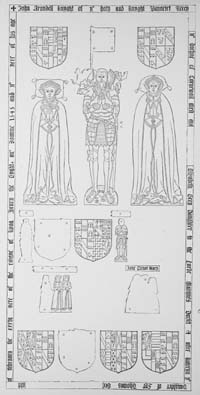
BRASS OF SIR JOHN ARUNDELL, ST. COLUMB-MAJOR. View larger image
"THEY DID CAST HIM."
A pleasantly representative English look has the irregular, disjointed, yet withal eminently picturesque little town of Tisbury, viewed from the acclivity of the railway station.
On the one side a group of cottages, and fine trees planted high on the shoulder of the hill, shews well against the distant sky-line, and patches of houses—broken in their midst by the principal hostelry of the place, staringly obtrusive in the most modern brick and white, perched at the top of the straggling street that leads up to it,—carry the eye across to the further fringe of the elevation on the other side, where an ecclesiastical looking edifice, gabled and pinnacled, cuts into the ether and balances the picture.
Low in the valley on the extreme right, some very old, and, evidently from this distance, unmistakably important buildings are gathered together, attesting the presence of the chief domicile of the place in days of yore, and still retaining much of their antient consequence with old gateway, great kitchen, and turreted chimney, and vast barn two hundred feet long, with roof arched and high as a cathedral,—the antient Grange, or Place, and country seat of the Abbess of Shaftesbury.
Thus much for the mid-distance of the scene; an equally representative, and in some peculiarities unique fore-ground is at our feet.
Centrally almost, comes the Church—large, substantial, and well-windowed—with a curious, but now-a-day unfortunately very common, half-antient half-modern look, exhibiting a low massive tower rising from its centre, capped with a pseudo-classic lantern, pierced with four large, circular, winking clock-face apertures. It stands in a well-kept churchyard, ornamented by some noble yew trees, and around two sides of it runs a road, skirted with low antient buildings, picturesquely gabled and chimnied, and dating from Tudor times.
Immediately on the right of the church, and jostling, almost vulgarly invading the sacred precincts of the churchyard, which it adjoins, rises the obtrusive bulk of a huge brewery, with accompanying chimney stalk, as big as the church itself, and almost as venerable looking,[36] a pertinent illustration of the contiguity, so often sarcastically associated in one of our modern political cries.
On the left of the church, but at further distance, and pleasantly situated on an acclivity, is an immense well-built union workhouse, larger than either.
Strange company these, materially and metaphorically, and eminently characteristic of our modern civilization, the brewery and the workhouse, with the church between them, and suggestive of many thoughts;—of clamorous interest too even in this little town, in this passing hour, as announcements in large letters attest that meet the eye of the wayfaring man, tarrying here about.
But leaving these present-day regions of noisy morality, and all "burning questions" akin, to other disciples, be the purpose of our quiet enjoyment to-day of a fairer and more gracious kind, as we note peradventure the career, and seek it may be the association and historic companionship of one who trod the troubled path of life in the past, and endeavour—however imperfectly—to brighten his memory for a season.
A short leisurely stroll from the station leads us by the great shrine dedicated to the Bacchus of our modern Briton, and we halt in front of the gate opening to the path leading to the north porch of the large church immediately before us. But ere we enter, we pause to take a momentary glance at the long line of semi-ecclesiastical, almshouse-looking buildings with Tudor gables and high chimnies that skirt the opposite side of the road, and from one of which the civil custodian of the church, in response to our enquiries, emerges.
From him we learn that the house he dwells in was probably antiently the Priest's dwelling, who was perhaps a monk appointed by the Abbess of Shaftesbury to whom a large part of the manor of Tisbury belonged, if not also the patronage of the benefice. In making some excavations behind it a few years since, the skeletons of several persons were found, on one skull the hair remained very perfect, but subsided to dust the instant it was uncovered, as if shrinking from the sacrilege of the intrusive eye and curiosity of the present. The building may also have been a Cell attached to Shaftesbury Abbey, and this spot the last resting-place of the solitary religious, once resident within it.
The pavement of the path through the churchyard leading to the church is also strongly representative of modern destructive notions, and exhibits,—although it traverses what we should regard from its associations as sacred precincts,—a true example of the now-a-day "way of the world." It is floored with the older memorial stones of the departed that rest, now un-named, around, and the tear-wrought memories they were charged to perpetuate, callously trod under the foot of man, and in sure process of ruthless obliteration. "They are only very old stones," said our cicerone in answer to our protest,—"families all gone and no one to look after them,"—exactly so, thought we with a half-sigh mingling with the echo of the Ploughman's line, ringing a presaging knell over the fate of our possible memory, when, as here, some day and perhaps
"—no distant date, Stern Ruin's ploughshare drives elate,"
and this outrage on the memories of the departed, not the best preparation altogether for entrance into the temple of Him, whose love knoweth no change, and whose remembrance faileth not for the children of men, more enduring than Job's yearning for graven words with iron pen in the rock for ever, or even as vigorous Toplady puts it in glorious anticipation,—
"My name from the palms of His hands, Eternity will not erase."
Inside, the church has a somewhat desolate look,[37] and no antient memorial catches the eye, except two small brass effigies of a Franklin or Merchant of Henry the Seventh's days, in long tunic with scrip buckled to his waist, and his wife with pointed head-dress and embroidered girdle, riven from their sepulchral stone and nailed to the wall; an early denizen it may be of the grand old domicile of Place. A noticeable and somewhat unique feature however must not be forgotten,—the cover of the font, pyramidal in shape, of oak panelled and crocketted, and richly gilded. There were formerly two screens across the transepts, but they have disappeared. There are fine roofs to the side aisles, on the bosses are the Sacred Names, and the date 1595. A curious circumstance here may be mentioned, the tower has three times been struck by lightning, once in 1762, again in 1795, and also of late years,—and this doubtless accounts for the incongruous style of its lantern-shape upper storey.
But the chief historic association of the church, and what has led our wandering feet here to furnish a text to hang our little story on, is found in the chancel, though very little comparatively is to be seen there even, by the uninitiated as things at present are, to give direction to his thoughts.
Tisbury tells of Arundell! Such is the first suggestive thought to him of the west-country that cometh to that little rural town, and specially in this chancel, beneath whose pavement the dust of the earlier members of one of its most distinguished descents is at rest. But the home-land of that antient race, so happily and allusively named after our gentle summer visitant,—the graceful-flighted "chimney-haunting" swallow,—is not here.
Not on the boundless arid chalk plains, on whose rocky skirt the swallow of the west has with kindred instinct migrated, seek we his parent nest. In the dusky twilight of our national history we trace probably his earliest haunts, chronicled in the great accompt of the Norman Conqueror, as then holding considerable possessions amid the rich plains of Somerset and breezy uplands of Dorset. Then we hear of him nestling in a green combe in leafy Devon, and anon occupying a "coigne of 'vantage" on the southern fringe of tor-crested Dartmoor, and where his name still clings though its possessor has long since fled. From thence in the days of the earlier Plantagenet kings, he winged his flight across the deep-banked Tamar into far Cornubia, where the soft mists of the Atlantic and warm southern sunshine alternate, bathe the granite bastions that defend her valleys, and there finally settled Arundell, there built he his parent nest and reared his "procreant cradle," and thenceforward he and his for centuries flourished and multiplied in great honour and ample estate, until his name for power and influence was styled the Great, and it became a household word in the county of his adoption.
But wealth and honour, not even when allied with teeming descendants scattered around and settled in divers descents seemingly to defend it, can perpetuate a race,
"There is no armour against fate,"
and to the mutation and decay, impartially entailed on human destiny, both peer and peasant alike are equally doomed.
So, in Cornwall, for centuries, the generations of Arundell succeeded each other at Lanherne and Trerice, the great twin stems of this noble stirpe, and spread and rooted themselves, in divers offshoots located near. But gradually that name, although surnamed the Great, and their descendants, one after another, dwindled away under the breath of Time, until its sound became an echo and a tradition only, in the regions of its olden home, and finally became extinct.
In 1701, the Great Arundell of Lanherne (from them the dormant Arundells beneath our feet were descended), last of his name of the elder house, died, and a distaff only followed him to his grave. She was wedded and the mother of a son,—but his name was not Arundell,—but on him his grandfather settled all his estates, and the heritage of his antient name.
Again the succession was denied, daughters only were born to him, and distaff succeeded distaff. One of them sleeps below, presumably in life a happy and unique fate befell her, as by her marriage with Lord Arundell was united the two descents of Lanherne and Wardour, and her name will probably recur to our thoughts again before our little story ends.
Seventy years—just a spell of human life—later, in 1773, the final representative of the almost equally distinguished descent of Trerice (they had been ennobled by Charles II. in 1664), John, fourth and last Baron Arundell of Trerice, passed to that bourne, from which no traveller, however distinguished, returns. It is curious that both he, and his noble wife—who was a sister of the Earl of Strafford and pre-deceased him—both found their sepulchre far eastward of their native home, and repose in the chancel of the church of Sturminster-Marshall in Dorset, not very far from this.
But to return to Arundell of Tisbury—yet we must still digress for a time—and to this chancel, where, beginning three centuries ago, and descending from him of whom we propose to have something to say, lie the ashes of the ancestors of the green branch of this antient stock located not far off, still nobly upholding its olden name and fame, although in its earlier days it had to struggle fiercely through some of the direst vicissitudes that environ human life, to perpetuate its existence.
To translate our thoughts, once more, for a short time to Cornwall, and recall the then representative of the Lanherne descent, Sir John Arundell, knt., a man great at the Courts of king Henry VII. and his bluff son Henry VIII. From both those monarchs he received distinguished marks of favour, being successively nominated a Knight of the Bath, a Knight of the Garter, and also for his valour at Térouenne and Tournay at the celebrated "battle of the Spurs" created a Knight-Banneret.
He was well descended. On his father's side of the family escutcheon, among other venerable Cornish bearings, was displayed the blue field and golden bend of the antient Carminow,—insignia for dignity rivalling the blazon of the distinguished Scrope,—and quartered also with it, there appeared, in happy alliance with the swallows of Arundell, the garland of kindred martlets that fringe the shield of the olden race of Chidiock in Dorset. His well-born mother was a daughter of Sir John Dinham of Hartland, a noble Devonian name of that era, her brother, to whom she was coheir, being John, Lord Dinham, so created by king Edward IV., 28 February, 1466, also like her husband included within the circle of the Garter, and holding high office under Henry VII.; she could also claim the blood of illustrious Courtenays among her ancestors.
Sir John Arundell by marriage allied himself with families of great influence, his first wife being the Lady Elizabeth, daughter of Thomas Grey, Lord Marquis of Dorset, step-son to Edward IV., and half-brother to the Queen of Henry VII.,—her mother being the last descendant and sole heiress to a great but unfortunate Devonshire name, Cicely Bonville. Secondly, he wedded Katharine, daughter of Sir Thomas Grenville, a knightly and warlike race of the first renown in north Cornwall, and sister of Jane, who was married to his kinsman the other Sir John Arundell of Trerice. His aunt, his father's sister Elizabeth, was married to Sir Giles, who was afterward created Lord Daubeney, and K.G.,—a man like himself of high rank at the Court of Henry VII.
In 1506 he was appointed Receiver of the Duchy of Cornwall, a position of great honour and influence in his native county, and in 1509 the office was confirmed to him for life.
Thus by birth, alliance, honours, appointments, and possessions, he seems to have been amply qualified to sustain the appellation bestowed on his ancestor, that of being designated the Great Arundell of the West.
He died in 1544-5, and a superb brass exhibiting the effigies of himself and two wives, his children, and elaborate armorial insignia, still exists in the church of St. Columb Major, in Cornwall, but whether he was buried there, or in St. Mary Woolnoth in London, there is some doubt,—but the balance of testimony inclines toward St. Columb.[38]
Take breath, friend of mine, after the shadow of this great and much honoured Tudor magnate has passed across the screen of the past, dimly lit by the illumination of your thoughts,—for a broad and striking glimpse follows in his wake, of what we are sometimes apt to term the "good old times" opens upon us, as we rapidly picture the chief events that characterized the days of Thomas Arundell his second son, and the first of Wardour, and glance at his companions at the Courts of Henry VIII. and Edward VI., together with those of his immediate descendants in the succeeding reigns of the two last Tudor sovereigns.
If those eventful times were not "good" in the large acceptance of the term, there was a large infusion of stern unflinching reality within them. The influence of strong mental power meets us everywhere, men aspired to be men,—sons of Anak in their resolutions,—and the views they took and combated for, were to them no myths,—nor did the almost absolute certainty of the fate of the martyr's stake, the headsman's block, or the confiscator's hand, if the enterprise should fail, deter or daunt an inflexible and often relentless purpose, dictated perhaps by the call of religious sentiment, or animated by the promptings of high personal ambition alone, or cast it may be, in the mould of real or imaginary patriotic duty.
Contrasted with such, our puny doings of the present offer suggestive difference to the life-poised movements carried out by the deep-souled resolves that sustained the doings of the men, who passed through the grim ordeal of the blood-gripped days of Wolsey and Somerset,—some episodes of which, occurring during the reign of Henry VIII. and his son the boy-king, we propose lightly to glance at,—when the 'shapings' of the history of our native land lay in rather grander purpose than the now-a-day trivialities and companionship ravings of our modern political 'stump.'
Sir John Arundell, of Lanherne, who died in 1545, by his first wife the Lady Elizabeth Grey, left two sons,—Sir John the elder, a country gentleman located at the old family seat of Lanherne, and Sir Thomas, ancestor of the Wardour descent, and the subject of our little story.
Sir Thomas, born probably about 1500, was as a younger son sent early a-field to seek his fortune, and for that purpose introduced, it may be by his father, to the precincts of the Court of Henry VIII., where afterward he appears to have spent much of his time amid its phantasmagoria of pleasures and horrors, ecclesiastical, military, and civil.
Beginning, if not exactly with actual attendance at the Court itself, but doubtless intended as a stepping-stone to it, we first hear of him as attached to the service of the next potential person of the realm, the subtle and ambitious Wolsey, in whose retinue he was appointed as one of the Gentlemen of the Privy Chamber to my Lord Legate and Cardinal, with whom he was on friendly terms, and who probably brought him into notice.
The pompous semi-royal state in which this notable ecclesiastic lived and moved, even in that extravagant age, is almost incredible. His setting off to France on one of his diplomatic journeys is thus described,—
"Then marched he from his own house at Westminster, through all London, over London Bridge, having before him a great number of gentlemen, three in a rank, with velvet coats, and the most part of them with chains of gold about their necks; and all his yeomen followed him with noblemen's and gentlemen's servants, all in orange tawny coats, with the cardinal's hat and T and C, for Thomas Cardinal, embroidered upon all the coats, as well of his own servants, as all the rest of the gentlemen's servants; and his sumpter mules, which were twenty or more in number. And when all his carriages and carts, and other of his train were passed before, he rode like a Cardinal very sumptuously with the rest of his train, on his own mule, with a spare mule and a spare horse trapped in crimson following him. And before him he had his two great crosses of silver, his two great pillars of silver, the King's broad seal of England, and his Cardinal's hat, and a gentleman carrying his cloak-bag, which was made of scarlet, embroidered with gold. Thus passed he forth through London, and every day on his journey he was thus furnished, having his harbingers in every place before, which prepared lodgings for him and his train."
All this was not much beyond the state this proud churchman ordinarily assumed, and it leaves little room to wonder why Henry VIII. and Wolsey could not exist together, nor of church and state being straightway at issue, nor why not long afterward the knock of a heart-broken monk at the gate of the Abbey of Leicester was the knell of his own order in England.
Wolsey passed out of his troubled existence in November, 1530, and in the year following, 1531, an event took place that at once placed Sir Thomas among the foremost men of that era, this was his marriage with a scion of the noble house of Norfolk,—Margaret, eldest daughter of Lord Edmund Howard.
He was the third son of Thomas Howard, second Duke of Norfolk, K.G., who died 21 May, 1524, by his first wife Elizabeth, daughter and coheir of Sir Frederick Tilney.
Concerning this Duke a few words. "On May 13, 13 Henry VIII., 1521," says Collins,—
"he performed the office of Lord High Steward on the trial of Edward, Duke of Buckingham, and gave sentence of death on him, whereat he was so much concerned, as to shed tears."
Then he further continues,—
"In 14 Henry VIII. (the next year) he—the Duke—obtained a grant in special tail, and to his son, Thomas, Earl of Surrey, of the manors of Welles, Shyringham-Stafford, Bannyngham, Warham, and Weveton in the County of Suffolk, with the advowsons of their churches; part of the possessions of the before specified Edward, Duke of Buckingham, attainted."
This Duke of Buckingham was the son of the ill-fated personage of our little narrative, executed at Salisbury;[39]—he fell, it is related, like his father, by domestic treachery, and the enmity of Wolsey, on a most frivolous charge, and at his trial thus made answer to the "tears" of the Lord High Steward,—
"My Lord of Norfolk,—you have said as a traitor should be said to; but I was never any. I nothing malign you, for what you have done to me, but the eternal God forgive you my death. I shall never sue to the king for life, though he be a gracious prince; and more grace may come from him than I desire, and so I desire you and all my fellows to pray for me."
Such is the recorded reply of the doomed, high-souled captive, to the "tears" of his fellow duke, and condemning judge; whose sincerity of grief on the occasion may be estimated by the subsequent fact of his soliciting for the gift of a large portion of the victim's possessions the year following. But the Dukes of Norfolk of those days appear to have been among the most unscrupulous men of that era. Then we learn with almost incredulous surprise that Thomas, the third Duke of Norfolk, and son of the Lord High Steward, who presided at Buckingham's trial, married the victim's daughter Elizabeth;—their son was the accomplished and ill-fated Earl of Surrey, beheaded twenty-five years afterward in the same reign, and on equally flimsy pretence.
To resume. Lord Edmund Howard married Joyce, daughter of Sir Thomas Culpeper of Hollingbourne, Kent. He is described as being
"Marshal of the Horse, in the battle of Flodden-field, 5 Henry VIII. when he, and his elder brother the Lord Thomas Howard leading the van-guard, this Lord Edmund was in some distress, through the singular valour of the Earls of Lennox and Argyle; but the Lord Dacres coming to his succour with one Heron, the fight was renewed and the Scots vanquished. In 12 Henry VIII., on that famous interview which that King had with Francis I. of France, where all feats of arms were performed between Ardres and Guisnes for thirty days, he was one of the challengers on the part of England."
On the occasion of his marriage, and to give his son position befitting his rank as a country gentleman, his father, Sir John Arundell, settled on Sir Thomas and his wife, partly in jointure, a dozen or so manors in the Counties of Dorset and Somerset. In 1532, and again in 1533, he filled the office of Sheriff of Dorset.
But it was the alliance itself with the influential family of Howard, destined immediately afterward to be so closely related to the crown itself, and in perilous nearness to the grim and capricious Henry, that must have given him considerable importance, advanced him to the front rank among the courtiers, and afforded him ample opportunity to promote his position and interests, both as to honours and wealth.
These were not slow of arriving. In May, 1533, Henry VIII. was wedded to 'sweet' ill-fated Anne Boleyn. This brought Sir Thomas into his first direct relationship with that king, to whom, through his wife, he now stood in the position of cousin, the new Queen being the daughter of her aunt Elizabeth (sister of Lord Edmund Howard), wife of Sir Thomas Boleyn, K.G.—afterward created Viscount Rochford, and Earl of Wiltshire and Ormond.
Our next glimpse of him is within the royal precincts, and being the recipient of an honour, amid the company of some of the most distinguished men at Court, on the occasion of the crowning of that unfortunate Queen. Among the "Knights of the Bathe, made at the coronation of the most excellent Princesse Queen Anne the 25 yere of the reign of Kinge Henry the Eight on Whitsonday the last day of May, 1533; (when) shee was crown'd at Westminster,"—twelfth on the list occurs the name of Sir Thomas Arundell.
Just three years afterward and on the 19th of the same month of May, 1536, Queen Anne Boleyn was from the Tower, "a little before noon, led down to the green, where the young grass and the first daisies of summer were freshly bursting into sunshine. A single cannon stood loaded on the battlements, the motionless cannoneer was ready, with smoking linstock at his side; and when the crawling hand upon the dial of the great Tower clock touched the mid-day hour, the cannon would tell London that all was over. The Yeomen of the Guard were there, and a crowd of citizens; the Lord Mayor too, and the deputies of the guilds, and the sheriffs, and the aldermen; they were come to see a spectacle which England had never seen before,—a head which had worn the crown falling under the sword of the executioner."[40]
But there was a much more interested listener for the fatal boom of that cannon than any heart-struck citizen of London, as we learn further, "An old tradition strongly depicts the impatience with which Henry expected her death. On the fatal morning he went to hunt in Epping Forest, and while he was at breakfast his attendants observed he was anxious and thoughtful. But at last they heard the report of a distant gun—a preconcerted signal. 'Ah! it is done,' cried he, starting up—'the business is done! Uncouple the dogs, and let us follow the sport.' In the evening he returned gaily from the chase, and on the following morning he married Anne's maid of honour, Jane Seymour, who on Whitsunday, the 29th, clad in royal habiliments appeared in public as Queen."[41]
So perished poor Queen Anne Boleyn, niece to Sir Thomas. A fortnight or so before her death, on her arrival at the Tower, she agonizedly asked of Cromwell, "I pray you tell me where my Lord Rochford ys? and I told her I saw hym afore dyner in the Cort. O wher is my swete brother? I said I left hym at York Place: and so I dyd." Never to see him again—he was beheaded on Tower Hill two days previous to her own execution.
This fresh marriage of the king with Jane Seymour, the sister of the man with whom Sir Thomas was eventually implicated and suffered, continues incidentally, pertinent interest to our little story. Queen Jane Seymour, although she escaped the wretched fate of her immediate predecessor and successor in the royal preference, fell a victim to an even more painful death, at the birth of her son, which took place 12 October, 1537.
At the ceremonial of the christening of the infant prince Sir Thomas was present, and also, as a matter of course, the child's uncle, Sir Edward Seymour (afterward Duke of Somerset and Lord Protector), on that occasion one of the most honoured guests. Little wot these men as they gazed on, and took part in the splendid ceremony, that those helpless, motherless, baby hands were destined at some future and not very distant day to sign their death warrants, which consigned them to the scaffold, and both for alleged participation in the same offence.
Henry VIII. having become tired of, and also got divorced from Anne of Cleves, and Cromwell, the promoter of the distasteful marriage, having been summarily disposed of by the usual method of the axe, another event in the king's matrimonial projects was about to happen, which brought Sir Thomas into still closer relationship with him. Henry had this time set his eyes on Katharine Howard, a daughter of Lord Edmund Howard, cousin to the unfortunate Anne Boleyn, and sister to Elizabeth, wife of Sir Thomas Arundell. She was proclaimed Queen 8 August, 1540, but the king had been privately married to her some time before. Thus the knight now stood in the double capacity of being by marriage both cousin and brother-in-law to his most august and cruelly inclined sovereign, by whom Sir Thomas was made 'Chancellor' to the new Queen.
This relationship to Henry must have given him great influence, and as the spoliation of the Abbeys and Monastic institutions was then busily going forward, he would have good opportunity of advancing his suit, or claims for a portion of the large landed possessions of these institutions then being distributed with lavish hand. In this distribution Sir Thomas appears at different times to have acquired by grant and purchase a considerable share. Concerning this a short notice presently.
Queen Katharine Howard at the time of her marriage with Henry could not have been more than twenty years of age. Two short years only passed by, and then a fearful charge of similar nature to that which had sent her hapless cousin to the block, was alleged against herself, and on the 13 February, 1542, after almost unexampled mental suffering, she perished in like manner on the Tower green. With her died also, and by the same means, Jane, Lady Rochford, the wife of Queen Anne Boleyn's brother George. All three of these headless women were laid side by side in the Tower Chapel.
Thus was severed by like circumstances, in each case equally deplorable, the living tie that had connected Sir Thomas Arundell with his dread sovereign. He appears, however, to have been endowed with the rare faculty of keeping himself clear of the difficulties that would naturally arise amid such mournful conditions, and to have enjoyed apparently the friendship, if not the confidence of the grim king, and which does not appear to have been afterward disturbed. This was manifest by what followed.
In 1541,—which must have been during the lifetime of Katharine Howard, and while she was Henry's Queen,—Sir Thomas purchased of the king for £761—14—10, the Manor and Grange of Tisbury, late the property of the Abbey of Shaftesbury, and advowson of the living, the manor and advowson of Dorrington in Wilts, and sundry other lands.
In 1545,—this was also the year his father, Sir John Arundell, died,—King Henry VIII., by letters patent, granted to him a large number of manors, late the possessions of the Abbey of Shaftesbury, in the counties of Wilts, Dorset, and Somerset (including also probably the site of the Abbey), and other property in London.
The Benedictine Abbey, or Nunnery of Shaftesbury, was one of the most antient religious foundations in the west of England, and existed probably before the time of King Alfred, who was a great benefactor, and one of its principal Founders, about A.D. 888. "It was first dedicated," says Hutchins,
"to the Blessed Virgin Mary, but it lost that name, at least for several ages, upon the translation hither of the body of St. Edward the Martyr, who was murdered at Corfe-Castle 18 March, 978, and first clandestinely buried at Wareham, whence, according to Leland, he was next year, or as others on better grounds say, three years afterwards removed to this abbey by Elpher, or Alpher, duke of Mercia. This unfortunate king being esteemed a martyr, and canonized a saint, his shrine was much resorted to by superstitious pilgrims, and persons of all ranks and qualities, and even by some of our kings, particularly Canute who died here. On account of the burial of St. Edward, the abbey and the church received their names from him; and the abbess was styled Abbess of St. Edward, and the very town almost lost its old name, and was called for some time Burgus Sancti Edwardi, and Edwardstowe."
Upwards of thirty abbesses from the foundation, presided over this important community, to its surrender by Elizabeth Zouch, its last Abbess, to the King Henry VIII., 23 March, 1539, when there were fifty-five nuns within it.
"It was one of the largest and best endowed nunneries in England, except Syon in Middlesex, its revenues at the suppression being estimated at between eleven and fourteen hundred pounds per annum. This occasioned a proverb, mentioned by Fuller in his Church History,—'That if the Abbot of Glastonbury might marry the Abbess of Shaftesbury, their heir would have more land than the King of England.' The abbess was of such quality, that she was one of the four who held of the king by an entire barony, and had by tenure privilege of being summoned to parliament, &c., though upon account of their sex it was omitted. They had writs directed to them, to send their quota of soldiers into the field, in proportion to their knight's fees. The three others were those of Barking in Essex, St. Mary in Winchester, and Wilton."
Thus much for the Abbess, her wealth, importance and high station; the buildings of the Abbey, and Abbey church, appear to have been of commensurate grandeur, but, continues Hutchins,—
"There now remain not the least vestiges of it. It seems to have stood parallel with Holy Trinity churchyard, which anciently belonged to it, at the east end of the abbey, on Park-Hill, as appears by bones and coffins found there. It was the glory and ornament of the town, the mother church, and almost the only place of sepulture, there being but one ancient in any of the present churches, which is in St. Peter's, and seems to have been removed hence. It was a most magnificent building, if we may judge from the traditions the townsmen retain of its largeness and height, and from the spire, which Camden and others, derive the name of the town. By its great height, and advantageous situation on the top of the hill, it must have had a very fine effect, and been seen over a great part of the counties of Dorset and Somerset. It is greatly to be lamented it was not left standing and made parochial, being so great an ornament to the town and county.
"The arms of the Monastery were, Azure, a cross between four martlets or,—Dr. Tanner in his Notitia Monastica says they were, Azure, on a pale sable, cotised argent, three roses or. The former are in Wolveton house, and are those commonly given to King Alfred."
The fine buildings of the Abbey having been demolished, St. Peter's church in Shaftesbury appears to be the only building of any size,—and this not very large,—of antient date now left remaining, and is the "mother, principal and presentative" church of the place. Hutchins enumerates nearly a dozen little churches and numerous chantries that once had their station at Shaftesbury, clustering around the Monastery, the major portion of which seem now to have disappeared. St. Peter's is of late character, and very plain architectural detail, erected probably toward the end of the reign of Henry VII. The single ornamental portion is the cornice or frieze toward the street, temp. Henry VIII., on which appears the double rose, portcullis, pomegranate, arms of the See of Winchester, some other local coats, a merchant's mark, &c.
Within, on the altar step, is the only monumental remembrance left of the Abbey, and apparently removed hither from it, a large blue stone, having in the centre a small brass plate, now almost obliterated, with this inscription as copied by Hutchins,—
Sub isto saxo tumulat' corpus Steph'i Payne, armiger', fil' et hered' Nichi' Payne, arm', quond' seneschali hujus monasterii, gui obiit xiiij die mens' Decembris: Anno D'ni m.ccccc.viij: cujus a'ie p'piciet' altissimus De'. Amen.
The indents of four shields, two at the top and two at the bottom of the stone, are visible.
Stephen Payne held the office of Seneschal to the Abbess, which probably meant her Steward or Bailiff for the Abbey property. Of him, says Hutchins,—
"Here (Shaftesbury) was another freehold held 2 Henry VIII., 1511, by Stephen Payne at his death; namely—seven messuages, three gardens in Shaston, of the Abbess; forty acres of land in Bellchalwel of the Earl of Northumberland; and seventy-eight acres of land in the hundred of Alcester, of the Abbot of Evesham, by rent of five shillings."
In the chancel window are two escutcheons;—1. Azure, a dolphin embowed or (Fitzjames of Lewston), impaling, Bendy of eight or and azure, within a bordure of the first (Newburgh of Winfrith), the shield encircled by a riband, but the inscription destroyed.
"The ancient family of Fitzjames," continues Hutchins,
"was formerly seated at Redlynch. Sir John Fitzjames, knt., son of James Fitzjames, married Alice, daughter of John Newburgh of East Lullworth, Esq., and was father to Sir John; Richard, bishop successively of Rochester, Chichester and London; and Aldred, ancestor of the Lewston line. The elder branch has been long extinct, but produced many eminent men. Sir John Fitzjames was lord chief justice of the king's bench thirteen years; died 30 Henry VIII., 1539."
On the other are,—quarterly, 1 and 4, Argent, a barrulet gules, between four bars gemelles wavy azure; 2 and 3, Argent, a chevron gules, between three castles sable.
Two further escutcheons display, one the emblem of the Trinity with customary legends, and the other—what is seldom seen in painted glass, being usually found sculptured on the frieze, or on the capitals of the pillars, at or over the entrance to chantry or chancel,—the imagery of
THE FIVE WOUNDS.
Look at yon carven shield, Above the chantry door, No blazoned pride bedecks its field, But emblems five sprent o'er.
There are His pierced feet,— There are His mangled hands,— And wounded heart,—whose latest beat Ceased at love's sweet commands.
"Fyve wellys"—there symbolled trace, Hushing this mortal strife,— "Of pitty, merci, comfort, gracy, And everlastingh lyffe."
The shepherd monk of old, Well his vocation knew, Set it o'er gateway of the fold, That all his flock may view.
Ere ranged in order close, They gathered round his board, Signs of His sorrows, sufferings, woes, With thankfulness adored.
Seen with unseen allied,— Trusting their happy fate, Should some day see them glorified, Keystone of heaven's gate.
Wayfarer of to-day, The same tale runs for thee, As in the ages far away, And for all time to be.
As Sir Thomas Arundell did not get the royal grant until two years after the dissolution of the Abbey, it is probable the work of destruction on the fine building was considerably advanced, as but little time as a rule was allowed to elapse before the demolition commenced, anything that could be turned into money, such as the bells, lead, &c., sold, and the walls pulled down and carried away for building purposes.
Respecting this we further learn from Hutchins,—
"Tradition says, that one Arundell, steward to the Earl of Pembroke, in the beginning of Queen Elizabeth's reign, built a large house in the town for himself, out of the Abbey materials. This seems to have been the same which Mr. Coker speaks of, when he says, 'The greatest ornament of the town is a fair turretted house of the Lord Arundell of Wardour.' But it is most probable it was built by Sir Thomas Arundell, or his son Sir Matthew, out of the ruins of the Abbey. It stands in Bymport Street, and has been a public house, it is now almost pulled down. In 1747, on the chimney piece were these arms,—1. Arundell, with crescent for difference.—2. Quarterly, 1 and 4, Gules, four lozenges ermine (Dinham), 2 and 3, Gules, three arches conjoined, argent (De Arches).—3. Chidiock.—4. Sable (azure), a bend, with label of three points or, for difference (Carminow)."
This was not all the property Sir Thomas appears to have had assigned him at the dissolution of religious houses. In 1547, Henry VIII. granted him the house and site of the Priory (or College) of Slapton in South Devon, "except all the lead upon the said College other than the gutters, and the lead in the windows; except all the bells and ornaments"—the rectory, also that of Loddiswell, and three other manors in Devon, Somerset, and Cornwall. Although his wife's sister Queen Katharine had been executed four years previously, he is described as 'Chancellor' to her.
Associated with Sir Thomas Arundell at the Court of Henry VIII., and also in his country possessions in the west, was his relative Henry Daubeney, Earl of Bridgwater, a most unfortunate man. He was the son of Giles, Lord Daubeney, K.G., a trusted servant and soldier to Henry VII.; the old seat and possessions of the family being at South-Petherton, and later at Barrington Court near that town. Lord Daubeney married Elizabeth, sister of Sir Thomas Arundell, K.B., of Lanherne,—the father of Sir John Arundell, who was the father of the Sir Thomas of our narrative,—Henry Daubeney, Earl of Bridgwater, his only son, would therefore be Sir John's cousin.
But not only by kinship on his father's side, but also by a similar relationship on his wife's, was the Earl closely connected with Sir Thomas. Lord Bridgwater married secondly, Katharine Howard, daughter of Thomas, second Duke of Norfolk, by his second wife Agnes Tilney. She was therefore aunt to Sir Thomas' wife, being her mother's half-sister.
The Countess of Bridgwater was greatly persecuted during the trial of her niece Queen Katharine Howard, and almost every means was resorted to to implicate her with that unfortunate woman. The Earl, her husband, plunged into the vortex of expensive frivolities that surrounded the Court of Henry VIII., and it is related irretrievably crippled, if not finally ruined himself by extravagant display at the Field of the Cloth of Gold. He died without issue, in seclusion and comparative penury at the little rural parish of South-Perrott, near Crewkerne, and was there buried 12 April, 1548,—his wife survived him, and was interred in the Norfolk Chantry in Lambeth church, 11 May, 1554.[42]
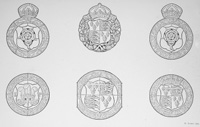
REGAL HERALDRY, TEMP. HENRY VIII., COWIC, EXETER. View larger image
It was this double tie of relationship that doubtless led to the important transactions with regard to the sale or transfer of a large portion of the Earl's landed possessions to Sir Thomas Arundell, when from time to time he had necessity; or it may be by family arrangement to protect himself and wife from forfeiture, in those days of peril and consequent attainder and confiscation.
In 1536-8-9 Henry, Lord Daubeney, conveyed to his nephew, Sir Thomas Arundell, his manors of Tollard-Royal, Farnham, Long-Crichell, Kershall, Goorsley, and Hampreston, with advowsons, &c., and Shaston, Wimborne-Minster, Gussage-All-Saints, Tarrant-Gunville, and Stubhampton, in the counties of Wilts and Dorset, with a clause "that if Henry, Lord Daubeney, should die without heirs to his body, the same should remain to the use of the said Sir Thomas Arundell and his heirs for ever." In 1542 the Earl conveyed the manor of South-Petherton to him. This included the manor and park of Barrington, and the forest of Roche (Neroche?) the advowson, Chantry, and free Chapel of South-Petherton, and of the Hundred, and lands at Yarcombe, &c.
And this leads us to his last and most important purchase, that of the Castle and Park of Wardour, on 4 July, 1 Edward VI., 1547.
Wardour Castle and its olden inhabiters have a special interest interwoven in our little narratives, three or four of the subjects of them, having successively, either occupied or possessed it.
About the year 1495 the Earl of Ormond granted a lease of it to the giant Sir John, afterward Lord Cheney, K.G.,—the "unhorsed at Bosworth,"—and it is not at all improbable that he may have died there, as he was buried at the not very far-distant cathedral of Salisbury.
Then on the 4 July, 14 Henry VII., 1499, three years after Lord Cheney's death, Thomas, Earl of Ormond, sold the Castle of Wardour to Robert, the first Lord Willoughby de Broke, "our Steward of Household," and according to one account, he is said to have died there, although his monument is found and he is probably buried at Callington, in far-distant Cornwall.
Lord Willoughby de Broke and his descendants appear to have retained possession of it until 1547, when his ultimate heiress Lady Elizabeth Greville and her husband Sir Fulke disposed of it to Sir Thomas Arundell.
Thus much, as a short notice of the principal landed possessions acquired by Sir Thomas Arundell. Some by gift of his father, others by arrangement with his uncle Lord Bridgwater, or by purchase from different possessors, and a further large portion partly by purchase,—if it may be so-called,—and partly probably by free grant from the King, Henry VIII., the whole of which in the aggregate would constitute Sir Thomas a wealthy man, and a west-country magnate of leading position.
A curious circumstance becomes noticeable here. The sale and grants of property acquired under Henry VIII. were the despoiled possessions of the Church, the property of the suppressed and dismantled Abbey of Shaftesbury, and dissolved Priory or College of Slapton. Yet the Arundells (as also the Howards to whom they were so nearly allied) were at the time, and still continue to be, specially distinguished by their fealty to the Roman communion, the antient faith of their fathers. This fact, however, does not seem to have hindered his acceptance of what at the time, by common consent had been "set aside for the Lord." To which it may be answered, if he had not acquired it, many others were doubtless eagerly waiting for the chance; and it was never likely to return to fulfil the original purpose of the donors.
Notwithstanding the dangers that surrounded the Court of Henry VIII., and the perilous proximity of relationship in which, by marriage, he stood toward that monarch, specially amid the complications that arose during the impeachments, trials, and sad deaths of the two Queens, his wife's relatives; yet neither Sir Thomas, nor Lady Arundell, seems to have been involved or suspected in any way, indeed, to the contrary, as he appears subsequently to have experienced Henry's favour, it being three years after Queen Katharine Howard's death, when he received the grant of the Priory of Slapton from that king.
All this points to his being a prudent man, keeping aloof from the dangerous intrigues continually arising, and he has been described as a wise administrator. He was grandson of Cicely Bonville, the great west-country heiress, and his mother Elizabeth names him as one of the executors to her will, and therein describes him as "her trusty and well-beloved son."
Before the reign of Henry VIII. closed, its last victim was led to the scaffold, the accomplished Earl of Surrey, and nephew of Sir Thomas. The Duke of Norfolk, his father, with cruel obduracy had presided over the trial of his niece the unfortunate Queen Anne Boleyn, and now the same fate had overtaken his son. The executioner was waiting for himself also, but the unexpected death of Henry occurred just in time to save him. The "Fair Geraldine" of the poet Earl was a cousin of Sir Thomas on his mother's side, being the daughter of Gerald Fitzgerald, Earl of Kildare, who married the Lady Eleanor, probably a younger sister of the Lady Elizabeth Grey, mother of Sir Thomas.
With the conclusion of the reign of Henry VIII., the larger and presumably, on the whole, happier portion of the life of Sir Thomas Arundell may be said to have ended. The child-king, Edward VI., in January, 1547, commenced his reign, and four short years only were destined to pass before Sir Thomas was laid in a traitor's grave.
In 1549 a distinguished office was conferred on him, one that his father had held before him, and of peculiar honour in his native county, that of Receiver General of the Duchy of Cornwall.
This year, however, the first cloud appeared over his hitherto fortunate career. Himself, with his brother Sir John Arundell of Lanherne, were both suspected of being implicated in the rebellion of their uncle Humphrey Arundell, Governor of St. Michael's Mount, "a man well-esteemed for military services." This was the religious insurrection, demanding the old ritual, and antagonistic to the reformed service of the Church, which began in Cornwall, and gathering strength as it advanced, laid ineffectual siege to Exeter, where, however, the citizens, during their captivity, were reduced to great straits. The insurgents then marched to meet Lord Russell, who was stationed with some force at Honiton, but he defeated them with considerable loss at Feniton (or Fenny) Bridges. They then retreated to Clyst-Heath, near Exeter, where—
"they had brought with them a crucifix upon a cart, covered with a canopy, and beset with crosses, tapers, banners, holy bread and water, as a representation of those things for which they fought."
At Clyst-Heath, Lord Gray with his troops, reinforced with those under Lord Russell, dispersed the ignorant priest-led rustics with great slaughter;—
"The dispersion of the insurgents was followed by the same conduct on the part of the royal army, as if they had put to route a foreign enemy in his own country, 'for the whole country was then put to the spoil, and every soldier sought for his best profit.'"
Sir Anthony Kingston, as Provost-Marshal of the king's army, was commissioned to try and punish the delinquents, and his cruel and brutal conduct was quite on an equality with that of the wretched Jeffreys on a similar errand a century afterward;—
"Gibbets were set up in various places, on which great numbers of the leaders of the rebellion were hanged. Others, and especially Arundell, the chief captain, were carried to London, and there executed. It was reckoned that about four thousand in all perished by the sword or by the hands of the executioner, of those engaged in this Devonshire (and Cornwall) insurrection."
Humphrey Arundell, their uncle, was conveyed to London and hanged at Tyburn in January, 1549-50. And then it is recorded in the Council book,—
"XXX. Jan., 1549-50. Sir Thomas Arundel, Knight, committed to the Tower by order of the board."
And further in King Edward's journal,—
"1549. Sir Thomas Arundel and Sir John (his elder brother) committed to the Tower for conspiracies in the west partes."
It is probable the Arundells, from religious motives only, sympathized with the views of the insurgents, and were not actual promoters or partakers in the movement, but on account of their kinship with the leader of the revolt they were doubtless subjects of considerable suspicion. There must, however, have apparently been other circumstances besides this, which were deemed to affect Sir Thomas unfavourably, for he does not appear to have been released from his durance in the Tower after his committal until the 4th of October, 1551, which would be a year and nine months subsequent.
Could it have been also for suspicion of aiding in the movement that led to the first humiliation of the Duke of Somerset, which occurred in the October preceding his committal to the Tower? It may have been so,—or deemed so,—yet from what is left recorded, his presumed action seems to point to the contrary.
"One of the 'Metrical Visions' of George Cavendish, the Gentleman Usher of Cardinal Wolsey, furnishes some biographical particulars of Sir Thomas Arundell, namely, that he was educated with Cardinal Wolsey, and was Chancellor to Queen Katharine Howard. He is also made to confess that 'I was the cheaf councellor in the first overthrowe of the Duke of Somerset, which few men did knowe.'
"With regard to his fate, there is a curious passage in a very rare book, bishop Ponet's 'Short Treatise on Politic Power.' Writing of the Earl of Warwick, Ponet states, 'at the erles sute Arundell hathe his head with the axe divided from his shoulders.'"[43]
and commenting on the same subject,—
"Bishop Ponet in his 'Treatise on Politic Power,' says in reference to his (Sir Thomas') arrest in 1549, 'he conspired with that ambitious and subtil Alcibiades, the Earl of Warwick, after Duke of Northumberland, to pull down the good Duke of Somerset, King Edward's uncle and protector,'—if this be correct it is singular he should have been afterwards re-arrested for conspiring with Somerset against Northumberland."[44]
On such slender and second-hand evidence and apparently so improbable, as to his helping at first to pull down the Protector, not much may be said;—men's views and movements at the time often veered amid these intrigues for the possession or direction of the supreme power,—but Sir Thomas' after-implication with the Duke seems to refute it. That the Earl of Warwick (Northumberland) may have used his influence for the destruction of Sir Thomas, in the company of his rival,—the greater victim,—may be accepted without much scruple.
Sir Thomas was released from the Tower on the 4th of October, and in the meanwhile, events as to Somerset's overthrow, were now rapidly developing themselves to a conclusion.
Northumberland—the rival and enemy of the Protector—had given intelligence of a conspiracy in which Somerset, Sir Thomas Arundell, Sir Ralph Vane, and several others were concerned. Of course there was the inevitable informer, and in this case a certain knight, called Sir Thomas Palmer, has recorded against him this unenviable notoriety.
In Sir John Hayward's Life and Reign of K. Edward VI., we read,—
"Herewith Sir Thomas Palmer, a man neither loving the Duke of Somerset, nor beloved of him, was brought by the Duke of Northumberland to the King being in his garden. Here he declared on St. George's day last before, the Duke of Somerset being upon a journey towards the north, in case Sir William Herbert, Master of the Horse, had not assured him he should receive no harm, would have raised the people; and that he had sent the Lord Gray before, to know who would be his friends: also that the Duke of Northumberland, the Marquis of Northampton, the Earl of Pembroke, and other lords should be invited to a banquet, and if they came with a bare company, to be set upon by the way; if strongly, their heads should have been cut off at the place of their feasting. He declared further that Sir Ralph Vane, had two thousand men in a readiness; that Sir Thomas Arundell had assured the Tower, that Seymor and Hamond, would wait upon him, and that all the horse of the Gendarmorie should be slain."
This must have been the day on which the boy-king records in his journal,—
"11 Oct., 1551. Sir Thomas Arrondel had ashuerid my Lord that the Towre was sauf."
The "my Lord" here must have related to Somerset, which the King heard of in his conversation with Northumberland.
On the 16 October, 1551, says Grafton,—
"being Fryday, the Duke was again apprehended, and committed to the Tower, on a charge of high treason."
And the King records,—
"This morning none was at Westminster of the conspiratours. The first was the Duke, who came later than he was wont, of himself. After diner he was apprehendid."
Sir John Hayward thus describes it,—
"and so after dinner, he (the Duke) was apprehended; Sir Thomas Palmer, Sir Thomas Arundel, Hamonde, Nudigates, John Seymour, and David Seymour, were also made prisoners, the Lord Gray being newly come out of the country was attached. Sir Ralph Vane, being sent for, fled. Upon the first message it was reported that he said that his Lord was not stout, and that if he could get home he cared not for any; but upon pursuit he was found in his servant's stable at Lambeth covered with straw. He was a man of fierce spirit, both sudden and bold, of no evil disposition, saving he thought scantiness of estate too great an evil. All these were the same night sent to the Tower, except Palmer, Arundel, and Vane, who were kept apart in the Court, well guarded in chambers apart. After these followed Sir Thomas Holdcroft, Sir Miles Partridge, Sir Michael Stanhope and others. The day following the Dutchess of Somerset was sent to the Tower, also with her were committed one Crane, and his wife, and her own chamber woman. Crane confessed for the most part as Palmer had done, and further added that the Lord Paget's house was the place, where the nobility being invited to a banquet, should have lost their heads, and that the Earl of Arundel was made acquainted with the practice by Sir Michael Stanhope. This Crane was a man, who having consumed his own estate, had armed himself to any mischief. All these were sworn before the Council, and forthwith upon the information of Crane, the Earl of Arundel, and Lord Paget were sent to the Tower."
On the same day, Machyn notes,—
"1551, xvj. day of October, was had to the Towre, Sir Thomas Arundell and Lady (with many others)."
and the King writes,—
"16 Oct. Arrondel was taken."
Twenty-seven peers took part in the trial of Somerset, his rival the Duke of Northumberland being one, and the Marquis of Winchester presided as Lord High Steward.
On the 2nd December following, narrates Grafton,—
"the sayd Duke was brought out of the Tower of London, with the axe of the Tower borne before him, with a great number of billes, gleves, holbardes, and polaxes attending upon him; and was had from the Tower by water, and having shot London bridge, at five of the clock in the morning, so came unto Westminster Hall, where was made in the middle of the Hall a new scaffold, where all the Lords of the King's Counsaill sate as his judges, and there was he arraigned and charged with many articles both of treason and felony. And when after much milde speeche, he had aunsered not guiltie, he in all humble manner put himselfe to be tryed by his peeres, who, after long consultation among themselves, gave their verdict that he was not guiltie of the treason, but of the felony."
The King says in his diary,—
"The Duke of Northumberland wold not agree that any searching of his death shuld bee treason. So the lordis acquited him of high treason and condemned him of treason feloniouse, and so he was adjudged to be hangid."
As the punishment was hanging, he "departed without the ax of the Toure"—which the people outside not understanding, "shouted harf a dousen times so loud that from the halle dore it was harde at Charing Crosse plainely, and rumours went that he was quitte of all."
But his adversaries had got him too safely for release on this side of the grave, once more he was to appear before his fellow-men when the axe, and not the halter as was adjudged him, was to finish all.
On Friday, the 22nd of January following, the Duke was, at eight in the morning, beheaded on Tower Hill.
It was not until five days after the execution of the Duke that Sir Thomas Arundell, and his companion Sir Ralph Vane were put on their trial.
The first to be tried was Sir Thomas' presumed confederate, Sir Ralph Vane. Machyn relates,—
"1551-2,—The xxvii. day of January was reynyd at Westmynster Hall, ser Raff a Vane knyght of tresun and qwyt of hytt, and cast of felony to be hangyd."
Of this resolute and brave man, says Hayward,—
"He was charged with conspiring with Somerset, but his bold answers termed rude and ruffian-like, falling into ears apt to take offence, either only caused, or much furthered his condemnation. 'The time hath been,' said he, 'when I was of some esteem, but now we are in peace which reputeth the coward and couragious alike.'"
He strongly denied that he had practised treason against the King, or any of the Lords of the Council, and added that "his blood would make Northumberland's pillow uneasy to him." The 'qwest' were not long in disposing of him, and the King comments,—
"27 Jan., 1551-2. Sir Rafe Vane was condemned of felony in treason, aunsering like a ruffian."
The next day was appointed for Sir Thomas Arundell to appear before his judges. It was apparent they must have had very slender or unsatisfactory evidence, and it is cruel to read with what pertinacity they were required to decide on his case.
It is probable that, like the Duke of Somerset, he was taken from the Tower to Westminster Hall by water, and imagination can easily depict the various phases of the scene. Aroused early on the morning of the twenty-eighth of January, in mid-winter almost, it may be in cold and pitiless weather, escorted by the Lieutenant of the fortress, Sir John D'Arcy, and accompanied by his officers, down to the well-guarded boat waiting for him, under the shadow of the great arch that spans the Traitor's Gate, the way lit by the feeble light of a lantern, which, as they seated themselves in the little craft, faintly revealed the portcullis raised for the occasion, and the dark waters of the Thames, just discernible through it, made visible by the flickering gleam thrown upon its surface, rippling to the inconstant night-breeze. Then their emerging from the gloomy portal, the prisoner sitting silent and motionless in the stern, the officers and halberdiers ranged on each side, and in front the heads-man's official, with the dread axe resting on his shoulder. Then their passage down the quiet river, with no sound to break the solitude, but the measured splash of the oarsmen steadily rowing him to his doom. Then their landing at Westminster in the just-breaking light of morning, and the sad little procession wending its way up to the main door of the vast Hall, its dim, cavernous roof, scarcely distinguishable by the cluster of twinkling points of light gathered in its centre, where, arrayed in all the picturesque costume of the age, emphasized by the scarlet cloaks of the judges, were congregated a large body of legal and civic functionaries, the solemn array of the jurors of the 'qwest,' and a throng of anxious citizens, assembled to decide whether he was guilty, or not guilty,—if he should live or die.
But the 'qwest' had not so easy a matter before them, in the disposing of his case, as they had the day before with that of Sir Ralph Vane. The evidence was presumably of slight or doubtful character, and so the day passed by and evening arrived, but no decision was arrived at. Sir Thomas had to endure this prolonged suspense, and was taken back to the Tower again, to wait through the anxious night, and then the following morning, go through the same dread ordeal, and appear once more before his judges, to learn his fate.
The 'qwest' of the jury appear to have thoroughly and sturdily debated the guilt or innocence of the prisoner, and not being able to agree, were thereon subjected to the usual inhuman treatment of being starved in cold and darkness into agreement,—if such it may be called,—or rather a decision, one way or the other. And so they "sate shut up" in a house all that live-long night, and it was not until day-break the next morning that "they did cast him,"—the dissentients probably being wearied into compliance. "When Sir Thomas—who perhaps may justly have had latent hope that their disagreement might end favourably for him—stood before his accusers for the second time, his doom was decided on, and he heard the fearful result that "they had acquitted him of treason, and cast him of felony, to be hanged."
Machyn thus describes the assiduous process of his condemnation,—
"1551-2. The xxviij. of Januarij was reynyd sir Thomas Arundell, Knyght, and so the qwest cold nott fynd ym tyll the morow after, and so he whent to the Towre agayn, and then the qwest wher shutt up tyll the morow withowt mett or drynke, or candylle or fyre, and on the morow he came a-gayne and the qwest qwytt ym of treasun, and cast hym of felony to be hangyd."
And Hayward soliloquizes over the unhappy event,—
"Sir Thomas Arundel was with some difficulty condemned, for his cause was brought to trial about seven of the clock in the morning, and about noon the jurors went together, and because they could not agree, they were shut in a house all the residue of that day and all the night following. The next morning they found him guilty. Unhappy man! who found the doing of anything or nothing dangerous alike."
and the little King mechanically notes in his diary,—
"29th Jan., 1551-2. Sir Thomas Arundel was likewise cast of felony in treason, after long controversie, for the matter was brought in trial bie seven of the cloke in the morning 28th day; at none the qwest went together; they sate shut up together in a house, without meat or drinke, bicause they could not agree, all that day and all night; this 29th day in the morning they did cast him."
So the first act of the coming tragedy was completed, and then after they had made sure of the destruction of their victim, they were equally assiduous that he should have ample religious consolation, in order that he "may dye well,"—and so give colour to the assumption that he was rightly convicted; and seemingly seek to justify the cruel sentence, awarded under such manifest difficulty, arising from the slight grounds of the accusation preferred against him.
Therefore the very same day of his condemnation, the 29th of October,
"the Council issued orders to the Lieutenant of the Tower, 'that Doctour Bill may from tyme to tyme resort to Sir Rauff Fane for his instruction to dye well; and that Doctour Parker may resort from tyme to tyme to Sir Thomas Arundell for the lyke purpose."[45]
Both these spiritual advisers were evidently Protestants, holding office in the Reformed Church. Dr. William Bill was successively Master of St. John's and Trinity Colleges, Cambridge, and afterward Provost of Eton, Dean of Westminster, and Almoner to Queen Elizabeth. Dr. Matthew Parker was Chaplain to Edward VI., Dean of Lincoln, and afterward Archbishop of Canterbury. What faith Sir Ralph Vane professed may not be related here, but from his bold and resolute character it may be surmised to have been of an easy-going kind, and the clerical consolers sent to administer to him in his necessity might have been as acceptable as any other.
Not so to Sir Thomas Arundell; his religious adherence as a staunch Catholic was doubtless well known, and to him, the intrusion of the men named, in his hopeless distress, would have been adding still further cruelty to his sentence, by depriving him of that last preparation and final rites of the church he belonged to, which one of her own confessors could alone afford him.
Application was therefore made for this privilege, and so we find that,—
"on the 11th of February, Mr. Perne was allowed to resort to Sir Thomas Arundell, to instruct hym to dye well."[45]
To die well,—such was, apparently, the condition most sought for, to appear penitent, and if possible to ensure this, the strong religious point was waived, and one,—probably of the ejected religious of the previous reign,—was "allowed" admittance to the death-sentenced prisoner. The monk who came was presumably William Peryn, Prior of the Black-friars, and a distinguished preacher; he probably attended Sir Thomas in his last moments.
The last scene of this mournful progression was now at hand. On the 22nd February the Lieutenant of the Tower received instructions to give notice to—
"Sir Thomas Arundell, and Sir Rauf Vane that they should against Friday next, prepare themselves to dye, according to their condempnation."
But another and melancholy privilege had now to be sought for, and that was to change the ignominious method of hanging,—the punishment accorded for treason-felony,—to the less degrading death by beheading. Some influence had to be used, but it was granted. The same method of death was also extended to Sir Michael Stanhope. No alteration, however, was accorded—if sought for—with regard to the execution of the "ruffian," Sir Ralph Vane, and Sir Miles Partridge; they were to perish at the same hour at the gallows, which was probably set up beside the scaffold on Tower Hill.
Cavendish in his Metrical Visions, thus refers to this circumstance in the last stanza of that one relating to Sir Thomas Arundell, —
"To be hanged though my judgment ware, Yet to do me honour they changed my sentence, And to leese my head to ease me of my care:— But death was the thing of all their pretence Which they desired;—such was their conscyence There I make an end, and I without redresse As here ye may see me, a symple body hedlesse."
Then came the final order on the 23rd to the King's Solicitor—
"To make a warrant for the beheading Sir Thomas Arundell, and Sir Michael Stanhope, and to perform the process of hanging of Sir Rauf Vane and Sir Miles Partridge, who are appointed to be executed on fryday next between ix. and xi. before noone."
The warrant was duly made out and dated the 25th,—the next day Friday, the 26th February, was fixed for their execution. Machyn thus describes the event,—
"The xxvj. day of Feybruarii the wyche was the morrow after saynt Mathuwe day, was hedded on the Tower hill, sir Myghell Stanhope knyght and ser Thomas Arundell, and incontenent was hangyd the seylff sam tyme sir Raff a Vane knyght, and ser Mylles Parterege knyght of the galowse besyd the —— and after ther bodys wher putt in to dyvers new coffens to be bered, and heds, in to the Towre in cases, and ther bered."
Both Sir Thomas Arundell and Sir Michael Stanhope were interred in the Tower Chapel. Thus he followed in the same dire way, and was buried beside his two headless kinswomen laid there a few years previously.
What is to be said as to all these proceedings, and their melancholy termination, had guilt or innocence anything to do with it, or was it expediency only, that controlled the result? Sir John Hayward apparently supplies the true key as to the object of the nefarious transaction,—
"Not long after the death of Somerset, because it was not thought fit that such a person should be executed alone, who could hardly be thought to offend alone, Sir Ralph Vane and Sir Miles Partridge were hanged on Tower Hill, Sir Michael Stanhope and Sir Thomas Arundell were there also beheaded.
"All these took it upon their last charge, that they never offended against the King, nor against any of his Council. God knows whether obstinately secret or innocent, and in the opinion of all men Somerset was much cleared by the death of those who were executed to make him appear faulty."
But their deaths were not destined to go long unavenged. He who had poured the "leperous distilment" into the young king's ear, that sent Sir Thomas to his doom, and others, in company with his rival Somerset, lame-footed vengeance was on the trail of his unscrupulous, ambitious footsteps, it speedily overtook him, and the next headless body that was brought to find unconscious entrance to the Tower Chapel was that of John Dudley, Duke of Northumberland.
As the grave closes over the unfortunate Sir Thomas Arundell our thoughts next follow to those he left behind him. The usual fate was awarded his possessions as a traitor, he was attainted, and they were confiscated to the Crown; but King Edward, two years after his death, restored to his widow, the Lady Elizabeth Arundell, her full dower out of her deceased husband's property.
Of course there is no direct memorial existent to Sir Thomas Arundell, but it is singular, that in the fine brass to the memory of his father, mother, and his father's second wife in St. Columb church, Cornwall, one of their children, a little headless armoured figure still remains, and beside it is Sir Thomas' escutcheon,—Arundell with six quarterings, impaling Howard with four. The diminutive effigy is undoubtedly designed to represent Sir Thomas,—the label over his head that contained his name is gone. The corresponding indents of figure, shield, and label, were originally filled with a representation of his brother Sir John, his name and arms.
Sir Thomas Arundell, by his wife Elizabeth Howard, left two children, Sir Matthew, who succeeded him, and Margaret, married to Sir Henry Weston.
Sir Matthew married Margaret, daughter of Henry Willoughby[46] of Wollaton, Notts, by his wife Anne, third daughter of Thomas Grey, second Marquis of Dorset, and sister to Henry, afterward Duke of Suffolk. They were second cousins, both being the grandchildren of Cicely Bonville.
With the accession of Queen Mary, matters wore a very different aspect toward the Arundells. Doubtless the Queen fully recognized and esteemed their allegiance to the antient faith, which she held in common with them, and so we find in the first year of her reign, she restored by patent to Sir Matthew, all his deceased father's lands. This does not seem to have included Wardour Castle, which appears to have been granted by lease or otherwise to the Earl of Pembroke, who greatly embellished it, but Sir Matthew subsequently, by purchase, acquired its possession from that family; it was not, however, free of the claims of the Crown as will be seen. He probably resided before this at Shaftesbury, in the house he had built out of the ruins of the Abbey.
Sir Matthew was knighted, with twenty-two other west-country gentlemen, who "were dubbed in the progress to Bristowe, anno d'ni, 1574," by Queen Elizabeth.
Once more we find ourselves in Tisbury church, and in this chancel, where the succeeding generations of the Arundells of Wardour, after the vicissitudes of this life,—and in their earlier days they had their ample share of them,—were over,—and one after another were here gathered together in the fold of death.
Sir Matthew was buried 24 Dec., 1598. This inscription commemorates him,—
IESUS. MAT' ARUNDEL, EQUES ORDINE, INTUS DORMIT IN PULVERE. IGNOSCAT ILLI OMNIA QUI NOSTRA TULIT CRIMINA. DELICTA JUVENTUTIS MEE ET IGNORANTIAS MEAS NE MEMINERIS DOMINE. I. H. S.
Thomas, his son, succeeded him. "Prompted by the ardent and chivalrous spirit of adventurous enterprise prevalent in the reign of Elizabeth, he obtained the Queen's permission to enter the service of Rudolph II., Emperor of Germany, to whom she addressed a personal letter of recommendation of her 'kinsman.'" This was correct enough,—Queen Elizabeth was the daughter of Queen Anne Boleyn, and so grand-daughter of Lady Elizabeth Howard,—Thomas Arundell was the great-grandson of Lord Edmund Howard, her brother. In 1595, at the siege of the city of Gran, or Strigonium, in Hungary, then held by the Turks, he gave great proofs of his valour, "and that in forcing the water tower, near Strigonium, he took from the Turks their banner, slaying the bearer with his own hand." For this and other services Rudolph created him a Count of the Holy Roman Empire, which he had the temerity to accept, without getting sufficient leave from his jealous and imperious 'kinswoman' at home, and for which he appears to have suffered some confinement. It raised a dispute also at Court as to what precedence, or otherwise, this foreign distinction was entitled to, and the matter being brought before the Queen for her opinion, she characteristically replied,—
"that there was a close tie of affection between the prince and subject; and that as chaste wives should have no glances but for their own spouses, so should faithful subjects keep their eyes at home, and not gaze upon foreign crowns, and she, for her part, did not care her sheep should wear stranger's marks, nor dance after the whistle of every foreigner."
and she intimated to the Emperor, that she had forbad him any place or precedence in England.
It is probable Queen Elizabeth had no great liking for the Arundells, being prejudiced against them, it may be on account of their religious principles. Some years before, in 1575, when Sir Matthew Arundell had re-acquired Wardour Castle and Park, she seized upon it to enforce the payment of an old Crown debt, that seems to have been owing on property Sir Thomas Arundell acquired of Henry VIII., and had not been cleared off, and which it was probable from his relationship to that monarch was never intended should be paid. The Queen, we believe, did not insist on the payment, but it shewed her semi-hostile attitude toward them then, and this incident of the acceptance of a foreign title, did not tend to improve it. King James, however straitened and antagonistic in his religious views, and natural distaste to the Roman communion, nevertheless, recognized his merits, by creating him in the second year of his reign, 4 May, 1605, Baron Arundell of Wardour, but neither Queen Elizabeth, nor that King, we believe, ever recognized his foreign title. He died at Wardour Castle, and was buried in this chancel. The following inscription is to his memory,—
THOMAS DOMINUS ARUNDELIUS, PRIMUS BARO DE WARDOUR, SACRI ROMANI IMPERII COMES, OBIJT 7MO DIE NOVEMBRIS, ÆTATIS SUÆ 79, ANNO DOMINI 1639.
SICUT PULLUS HIRUNDINIS SIC CLAMABO. Isaiæ xxxviii. v. 14."
With this we close any extended notice of the succeeding descendants of this noble and distinguished family. Thomas his son was a devoted Royalist, and "being at the battle of Lansdown was shot in the thigh by a brace of pistol-bullets, whereof the same year he died in his Majesty's garrison at Oxford,"—the devoted and heroic Blanche Somerset his wife it was who so bravely defended Wardour Castle during the war of the Commonwealth; she died at Winchester, but both are rejoined in death here. These inscriptions occur to them,—
D. O. M.
Hic parte sua mortali quiescit, qui in cœlo potiori parte vivit immortalis Thomas Arundel, Baro Arundel de Warder, sacri Romani imperii Comes, primogenitus nempe Thomæ Arundel, Baronis etiam de Warder, qui, ob insignia et pietatis et fortitudinis exempla in communem Christiani nominis hostem in Hungaria ad Strigonium præstita hæreditarium hunc honoris titulum a Rodolpho secundo meruit ipse, et ad posteros transmissit; cujus dignitatum virtutumque hic hæres, dum vixit, sic Deo in constanti pietatis exercito militavit in terris, ut debitum sibi in cœlis triumphum expectare videretur, ita se totum in Regis Caroli primi obsequium, imminente in Anglia bello civili, impendit, ut in illud opes fortunamque profuderit, ac vitam denique ipsam lubentissime contulisset, e qua excessit Oxonii die 19o Maij, ann. ætatis 59, annoque reparatæ salutis 1643.
And on the adjoining stone:—
D. O. M.
Hic conjugi conjux amantissima adjacet Domina Blancha Somerset, filia Edwardi Somerset, Wigorniæ Comitis, privata sigilli custodis, magistri equitum, &c., quæ marito par generis splendore, exercitio virtutum non impar, in aula regia quasi in cella privata vixit quanto dignitate terrena sublimior, tanto pietatis fulgere splendidior, quantoque regiæ vicinior majestati, tanto (quod parum est inter mortales) supremo dilectior numini quo ut proprius frueretur cœlo natura mortalitatem exuit Wintoniæ die 28o Octob: ann: ætat: LXVI. annoque Dom: M.DC.XLIX.
Henry, their son, spent five years in the Tower, 1678 to 1683, on the information of the infamous Titus Oates, but afterward became Lord Privy Seal to James II.
"Which Henry Lord Arundell, at his own charge, raised a regiment of horse for the service of King Charles the First in the time of the usurpation, and stoutly defended his Castle of Wardour against those rebellious forces, which, under the command of Edward Hungerford, did then attempt it on behalf of the Parliament. In the year 1678, he was with William Earl Powis, William Viscount Stafford, William Lord Petre, and John Lord Bellasis, committed prisoners to the Tower, and afterwards were impeached by the House of Commons of high crimes and offences, without being brought on their trial. He continued prisoner with the other Lords, till the year 1683, when they were admitted to bail.
"On King James II. accession to the throne he was sworn of his Privy Council, and on 11 March, 1686, was constituted Lord Keeper of the Privy Seal, also, when that Monarch, in 1688, began his journey towards Salisbury, he committed the administration of affairs in his absence to the Lord Chancellor, the Lords Arundell, Bellasis, Preston, and Godolphin. He departed this life 28 December, 1694, having married Cecilie, daughter of Sir Henry Compton, K.B., of Brambletye, in the county of Sussex." (Collins.)
Henry, the seventh baron, by his marriage in 1739 with Mary Arundell-Bealing of Lanherne, who died in 1769, re-united the antient branch of the family from which he was descended; he died in 1756, aged 38, is interred below, and his epitaph (by translation) tells us, "who taking to himself to wife Mary Arundell, the most noble heiress of the family of Lanherne in Cornwall, and having gotten a son of her, a most renowned race which for more than two centuries had been rent asunder, now happily united, flourishes, and may it for ever flourish by the favour of God."
With the memory of this delightful incident, so gracious and refreshing after the blood-stained relation of the earlier portion of our little narrative, we take our leave of this garner of the departed Arundells, and, seeking once more the rapid convenience of the iron road, are passing swiftly homeward. As the train glides rapidly by the little station of Sutton-Bingham, we remember that not far from this, another and almost unique trace of Arundell of Cornwall is to be found. At about a mile's distance is the village of East-Coker, and in the south transept window of its church are two antient shields of painted glass side by side, on one are the arms of the See of Exeter, on the other quarterly, Arundell and Carminow. These are the arms of John Arundell, Bishop of Exeter, who presided over the diocese two years, died 19 Feb., 1506, and was buried in the church of St. Clement Danes, London, and, as far as we have knowledge, is the only trace of memorial existing to him.
Once more the career of the subject of our little narrative returns to us. All appears to have gone well with him, even among the perils with which he was environed during the reign of Henry VIII. It may be, the instant danger of giving offence to the wishes or inclinations of that capricious tyrant kept him in the path of caution and safety.
But when that king's baby son assumed the reins of sovereignty this terror had disappeared, and men were busily vieing with each other as to whom,—professedly under the little king,—should really rule the destinies of the nation. Sir Thomas now appears to have taken action, and identified himself with one side of the contending factions, not prominently, but sufficiently marked to make him a subject of suspicion—to say nothing beyond—with those he was presumed to differ from, and this on an adverse emergency was a position of considerable peril. So it turned out, for in the end his death appears to have been resolved on, not because his offence was easily proved, or that he deserved such punishment, but as a makeweight, to give the colour of complicity, and so justify the death of Somerset, by the execution of himself, and that of others, thereby inferring the plot was a real one, and of dangerous extent. If so,—and circumstances seem strongly to confirm this view,—his was altogether a hard fate; it is difficult indeed, to imagine a harder one.
SICUT PULLUS HIRUNDINIS SIC CLAMABO."
Even Thine altars!—there my soul shall flee— O Lord of Hosts! and as a swallow come On quivering wing, and chatter mournfully, And make her nest, and seek eternal home.
Even Thine altars! where in holy state Lies the Great Sacrifice of endless love, Incense adoring streams to heaven's gate, Service unceasing seeks Thy throne above
Even Thine altars! there unharmed to stay, And when my captive pinions death shall free, Migrate to fairer regions far away, There fold my wings, and rest in peace, with Thee.
Deo data.
BENCH ENDS. LANDULPH CHURCH, CORNWALL. View larger image
OF THE IMPERIAL LINE.
A leisurely sail from the beautiful, capacious, and almost land-locked harbour of Plymouth, up its main inlet—so curiously named the Hamoaze—to the picturesque precincts of the lower extremity of the Tamar, on a bright summer day with a gentle breeze, is an excursion in all respects most enjoyable.
The harbour itself is studded over with craft of every variety and size, and sails spread of almost all hues, with here and there a fussy steam-boat ploughing its smoky way between them, while just inside, and tethered as it were to the dim line of the breakwater, are two or three dark grim-looking ironclads, lying as watch-dogs at its entrance.
Sea-ward, is the broad, blue, open main; on the left, the tree-fringed heights of Mount-Edgcumbe; before us, the irregular, creek-broken shore of the "Three-Towns" jutting angularly into the deep, clear water, with houses crowding down to its rocky edge. There, too, in its centre, is one of the most classic spots on English soil—the Hoe—consecrated by endless historic national traditions, and made sacred beyond imagination's most inspired effort, by the tears, prayers, and hopes that have alternately taken their rise, and from its heights watched the silent sails pass on below to the distant ocean, bearing voyagers, the purpose of whose errands,—who may declare?
On its pleasant open plateau, how diverse also have been the objects of those who from time to time have there assembled. Determined spirits with hands upon their sword-hilts, waiting and watching for the first glimpse of the van of the seven miles crescent-flotilla of the dark and hostile Spaniard, sweeping onward toward the shore, bearing the chains of slavery, spiritual and social, within their holds. Bands of bare-headed, bent-browed men, kneeling in reverent, prayerful conclave—the last home-office of their undaunted faith—ere they stepped on board the peaceful convoy, expatriated by conscience from their native soil, in search of a larger liberty, and destined to found in another hemisphere, an even greater England than they were leaving. Invader and emigrant, each shall we say, with purpose animated by soul-constraining religious convictions, but with ultimate aspirations, how different!
Spectators,—myriad numbered, greeting with enthusiastic plaudits, the departure of stately fleets, that at intervals during successive centuries, have passed out, destined to carry the grand conquests of the seamanship and valour of the English race,—triumphs martial and commercial,—to every sea; or anon, sorrowful groups with down-cast hearts, wafting sad and final farewells to those, who have here in continuous exodus set out to seek new homes on distant shores, and from hence cast their last "longing, lingering look," at the receding, vanishing outline of their native land; or again, eager eyes anxious to descry the first rise of the sail of the home-bound ship on the distant horizon, bearing a freight more precious to the love-strained heart, than all the wealth of Ind.
But while these suggestive thoughts are haunting us, we have slowly crept up to the warlike precincts of the lower Hamoaze. We pass the huge, cavernous, pent-house-looking, but now empty 'slips,' hanging over the darkling tide, in which the 'wooden walls' of old England were wont aforetime to be built, ere the steam-urged iron monsters of our present new England were dreamt of. And we ruminate a moment over this change of times and things, and mentally ask the question, What is the gain to human development achieved by much of the scientific—ergo mechanical—appliances of the present hour? the which, while it flatters the lord of creation with the belief he has become the autocrat of the forces and elements, in truth practically reduces that proud being to be the servant and care-taker of the machine he has constructed, for assuredly to a very large extent to this menial occupation he is being rapidly reduced.
Specially with regard to ships and navigation, a generation or two ago, vessels in construction and appearance were not only beautiful objects as such, but required also all the skill, foresight, courage, and dexterity which taxes the resources of manhood to the utmost, and forms the basis of true seamanship, for their guidance and control. Then there was something both for the mind and bodily energy alike to exercise and develope itself on; and undoubtedly much of the secret of our victories, both in commerce and war, that we have achieved in the past, may be traced to our proficiency therein, and as a consequence, the cause of our winning the crown of success among all other competing maritime nations.
Now almost all is changed, science has invaded the citadel of living endeavour, and deposed its activity and ambition; while furnished with the results of her conquests, one man practically has become as good as another, the spur of incentive has vanished from the heel of individual aspiration to excellence, with this result, that if to man the privilege of becoming a greater, nobler being, fostered by the soul's glorious activities, as having something to conquer, or win, be denied or removed from him; he can now console himself with the belief he may afford to become a much idler one,—a prime factor in the creed of the present hour.
And therefore instead of the slips and the wooden-walls, with clatter of adze, axe, and caulking hammer, and the wholesome odour of Stockholm tar,—here we are abreast of the 'steam-yard,' with its metallic clang and reek of coal-smoke, threading our way between a swarm of iron-clads of every form and shape; ugly, dark, and diabolical-looking, as the errand they are constructed for, their sullen turrets, monstrous guns, and blood-curdling names, aptly and unmistakably assuring the beholder that their eventual port of destination lies on the shore of Hades. Steam-pinnaces and swift torpedo-boats are rushing about, and large tenders surging along, among whom we carefully steer, and look across with a glance of relief on the smart, clean, handsome three-deckers moored stern to stern in mid-stream; floating Othellos, that now with occupation gone, serve as nautical colleges for the sailor-boys, where they are instructed in such slender knowledge of seamanship as is at present deemed necessary.
How different was the measure of requirement in the early years of the first George, when the unfortunate Falconer wrote his poem of the Shipwreck, whose seamanship was apparently as dear to him as the muse, and so, delighted to cunningly array her with all the terms of the mariner's vocabulary, a feat never attempted by other poet, and of course a hopeless task to any but a true sailor,—
"But now, the transient squall to leeward passed, Again she rallies to the sudden blast. The helm to starboard moves; each shivering sail Is sharply trimmed, to clasp th' augmenting gale— The mizzen draws; she springs aloof once more, While the fore-staysail balances before. The fore-sail braced obliquely to the wind, They near the prow th' extended tack confined: Then on the leeward sheet the seamen bend, And haul the bow-line to the bowsprit end, To topsails next they haste, the bunt-lines gone, Through rattling blocks the cluelines swiftly run; Th' extending sheets on either side are manned; Abroad they come, the fluttering sails expand; The yards again ascend each comrade mast, The leeches taught, the halyards are made fast, The bowlines hauled, and yards to starboard braced, The straggling ropes in pendent order placed."
We pass a magnificent white-clad troop-ship, with a beading of red-coats leisurably looking over the forecastle, and glide under the lee of one of those steam-winged brigands of the deep, a steel-built cruiser, whose towering trim spars, and beautiful lines, excite admiration, but chastened with the reflection of the capabilities for destruction she carries in her enormous propelling power and far-reaching guns. Woe, think we, to the peaceful merchantman who may venture to disregard, or seek to flee from the summons of her eagle eye!
And now we are sailing easily amid an assemblage of objects, whose presence makes the heart sink, and the cheek burn as we contemplate the rotting millions they represent,—the fleet of huge discarded hulks, whose now comparatively untrustworthy fighting and defensive capabilities, represent the modern advance in the art of destruction in maritime warfare. Here and there a solitary figure peers over the rusty bulwarks, but with regard to the majority, not a living creature paces their deserted decks. Gay, golden, and bright-coloured figure heads,—nymph, triton, or naval hero,—still decorate their prows, but these to our fancy's eye, resolve themselves into gilded skeletons with eyes of flame, and grasping the lightning darts of destruction in their grisly clutches,—the ghastly phantasmagoria of Death! And then comes the mournful reflection, that the original cost of each of these now comparatively valueless hulls,—being for all other purposes mere useless accretions of old iron and wood,—and designed for the destruction of the human race, would have more than sufficed to have built and endowed a hospital or college, whose beneficent errand should have been for all time (and while our present institutions are also starving for want of funds), and that the aggregation of hulks floating lazily around us, and of their predecessors, would represent an amount of wealth sufficiently large to have dotted the empire all over with such excellent institutions.
Last thought of all, as we look back and watch the bright red cross slowly unfold itself on the summer breeze over the taffrail of one of the largest of them,—the hallowed symbol of peace and good will hoisted over these engines of bloodshed,—we muse at the strange antithesis suggested by its display, as if designed in bitterest satire, to justify, or as it were, consecrate their direful mission. A curious example of what we presume would be termed national religious ethics, as at present professed in this Christian land of ours. But then we recollect that favourite patriot, the courageous (at home) and braggart, fire-eating Jingo, with his eight hundred millions of debt on his back, has to be duly considered in the motley compact. "Peace and good will" at present looks like a hopeless dream, to be further off than ever, and its development in the boasted civilization of the last quarter of the nineteenth century exhibits, instead, the strange spectacle of more fighting men on land, and ships of war at sea, furnished with the most tremendous appliances for the destruction of human life than could be found, perhaps, at any previous era of the world's history. Europe appears a vast armed camp, filled with millions of soldiers, apparently only waiting in feverish suspense some chance incident, to march on each other, and deluge the continent with carnage.
And yet amid all this there are not wanting hopeful signs, that below these dread preparations, a wiser and healthier undercurrent is slowly, but surely moving, that will eventually, we trust, sap the foundations of this military incubus, and free the long-suffering peoples from its deadly glamour. The consequences of the wickedness and folly of that game "which kings delight to play at" will be clearly seen, and a larger and more comprehensive system of government take the control into its own hands, and put a veto on the players. Industry, guided by intellectual resource, is busily organizing its battalions, with a power, destined, we ween, at no distant date to be mightier than armies or navies. Intelligence, combined with a knowledge of social and commercial needs, will become the great factors of national influence and wealth in the future, and, unless we greatly mistake, the basis of a kingdom's prosperity in the coming time will be fought out on these battle-fields, and on them win its silent and bloodless victories.