DAYS OF THE TUDORS (continued 5)
Reading edition
This being so, in due time, which occurred almost immediately, in 1483 he joined in the movement—so unfortunate as it turned out—of Henry Stafford, Duke of Buckingham, and was associated with the Courtenays, the Marquis of Dorset, and others forming the western contingent, being in arms against the king, near Salisbury. On the dispersion of Buckingham's followers through the Severn inundation, Sir John Cheney and his companions made their escape safely across to France, where they joined the Earl of Richmond. His name was included in the Proclamation issued against the insurgent fugitives by Richard, with rewards offered therein proportionate to their station, on apprehension.
It is probable Sir John remained with, or near Richmond, in France, until his final expedition to England, in which he doubtless accompanied him, and on landing, proceeded with the Earl's army on their march through Wales to Bosworth.[28]
This memorable engagement which took place on the 22nd of August 1484, has been ably described by many pens, and its incidents, beyond those having reference directly to our story, need not be
In addition to the stream of deserters from his own army to that of his rivals, which met Richard's eyes on that eventful day, the defection of Lord Stanley, a misfortune of the first magnitude, assured Richard that no time was to be lost, if he hoped to save his crown. So, gathering a muster of as many as remained true to him, he made a direct and magnificent charge into the centre of his foes' line, striving gallantly to recover his fortune. Leading them in person, he fought his way directly to his adversary's standard, and "in his furie he manfully overthrew Sir William Brandon, the Earle's Standard-bearer, and Sir John Cheney, both men of mightie force and knowne valiancie," and he nearly reached Richmond himself. Hollingshed thus describes it,—
"King Richard set on so sharplie at the first brunt, that he ouerthrew the Erles standard, and slue Sir William Brandon, his standard bearer, (which was father to Sir Charles Brandon by King Henrie the eight created Duke of Suffolk,) and matched hand to hand with Sir John Cheinie, a man of great force and strength, which would haue resisted him, but the said John was by him manfullie ouerthrowen. And so he making open passage by dint of sword as he went forward, the Earle of Richmond withstood his violence, and kept him at the sword's point without aduantage, longer than either his companions thought or judged, which being almost in despair of victorie, were suddenly recomforted by Sir William Stanlie, which came to his soccour with three thousand tall men. At which verie instant King Richard's men were driven back and fled, and he himself manfullie fighting in the middle of his enemies was slaine."
The old chronicler, as a matter of course, pays Richmond the compliment of his "keeping him at the sword's point without advantage," but other accounts relate that the Earl was in no hurry to cross weapons with his redoubtable and now desperate antagonist, and was doubtless greatly "recomforted" at Stanley's opportune defection, with his "soccour of three thousand tall men."
That Richmond had a narrow escape is evident, Sir William Brandon his Standard-Bearer, was killed, and Sir John Cheney, giant in stature as he was, was unhorsed—"manfully overthrown"—by the comparatively diminutive, deformed King himself. Then a swarm of assailants closed round Richard, and he was hurled to the earth, and remorselessly despatched with many wounds.
Whatever may be said of Richard as to the degrading characteristics of his previous career, one thing stands out in strong relief, his undoubted courage, which on this decisive occasion was of the highest order, and claims its full meed of admiration, especially considering the disadvantages of his person, and he closed his life with the fate of a hero.
Simultaneously with Richard's death, if it was not its actual cause, Sir William Stanley following the example of his brother, just at that juncture crossed over with his forces to Richmond's side, which virtually decided the combat, and the battle was ended. The grateful Henry requited Stanley's inestimable service, thus so opportunely given, by putting him to death a few years later, on a very questionable and frivolous charge.
The naked, bloody, dirt-begrimed corpse of the last King of the White Rose, having been picked out from amongst the slain, was thrown contemptuously over the back of a horse,—"like a calf,"—head hanging down on one side and legs on the other, behind a pursuivant of arms called Blanc Sanglier, being the officer called after Richard's own badge, the White Boar, or Boar argent, doubtless so done in derision, and sent off to Leicester, and the battered, blood-stained helmet-crown of the Plantagenet usurper was lifted from the mud and placed upon the head of the Tudor invader.
But had fortune favoured Richard a little further, so that he could have got within weapon's length of his adversary, the untoward fate that befell him, may have been Richmond's instead, and a different chapter altogether substituted as to the future sovereignty of England.
In common with the associates of conquerors, the adherents of the first Tudor king got their due proportion of rewards and honours at his hands, and Sir John Cheney was not forgotten.
The first distinction he received was conferred a short time before Henry's coronation, which took place in October, 1485. Three of the king's highest adherents received patents of nobility, and twelve others were created Knights-Banneret; among these Sir John Cheney stood second on the list. He was also soon after created a Knight of the Garter, being the two hundred and thirty-seventh in the succession, and Dodsworth says, "it was on St. George's Day preceding the coronation, and that he sat at the first table in the right aisle of St. George's Hall, Windsor." At the end of the first Parliament, toward the end of the year, the king called him to his Privy Council.
But the most considerable honour yet awaited him, which took place in 1487, when by writ of summons dated the first of September in that year he was raised to the dignity of a Baron, and summoned to Parliament as such from that period to the 14 October, 1495. He held the office also of Royal Standard-Bearer to Henry VII.
In 1487, John de la Pole, Earl of Lincoln, "a man of talents and enterprise, nephew to Edward IV., Richard III., and Margaret, widow of Charles the Bold, Duke of Burgundy," Henry's uncompromising and implacable enemy, accompanied by Francis, Viscount Lovel (who had been Lord Chamberlain to Richard III.) Fitz-Gerald, Earl of Kildare, the redoubtable Martin Swartz, with a large contingent of veteran Germans, and Irish, having crossed over from Ireland, landed on the fourth of June at Fourdrey in Furness in Lancashire. There they were joined by Sir Thomas Broughton, and the English adherents, and with this motley army was Lambert Simnel, and his tutor Richard Simons the Oxford priest; they marched into Yorkshire, and thence bent southward to Newark. Henry had assembled as numerous an army as he could muster and marched to Nottingham, but was not in sufficient force to give his antagonists battle. There he was reinforced by the Earl of Derby and a body of troops, and also by Talbot, Earl of Shrewsbury, Lord Strange, Sir John Cheney, "and other knights and gentlemen at least three score," bringing with them large additional forces. The king succeeded in occupying Newark before the Earl of Lincoln could reach it, and advanced to East-Stoke, about three miles south of Newark. Here the determined battle of Stoke took place on the sixteenth of June; the Germans fought with great determination, but the Earl's forces were totally routed and all their leaders, except Lord Lovel, slain, fighting to the last sword in hand.
Lord Lovel is reported to have escaped, and his fate has been enshrined in a halo of romance. By some he is said to have been killed in the battle, by others "that he fled and swam over the Trent on horseback, but could not recover on account of the steepness of the bank, and so was drowned in the river." But there is also this remarkable story of his disappearance,—
"On the 6th of May, 1728, the present Duke of Rutland, related in my hearing, that about twenty years there before, in 1708, upon occasion of new laying a chimney, at Minster Lovel, there was discovered a large vault or room under ground, in which was the entire skeleton of a man, as having been sitting at a table, which was before him, with a book, paper, pen, &c., &c., in another part of the room lay a cap all much mouldered and decayed. Which the family judged to be this Lord Lovel, whose exit, has hitherto been so uncertain." (Banks.) While another account adds, "that the clothing of the body, seemed to have been rich; that it was seated in a chair, with a table and mass-book before it; and also that, upon the admission of the air, the body soon fell to dust." (Gough.)
Previous to the battle another honour was conferred on him,—for among the "Banerettes made by the Kinge at the batell of Stoke besydes Newarke-upon-Trent the IX. day of June Anno Sec'do, whereof the first three wer made before the batell,"—the second name occurring is that of Sir John Cheney. (Metcalfe.)
In 1488 Sir John "received orders with other persons in Hampshire to levy archers for the relief of Brittany then threatened by the French," and in 1492 appears to have accompanied Henry's grand expedition to France, the flotilla being under the command of Lord Willoughby de Broke, as Admiral of the Fleet, and with Lord Daubeney as one of the principal commanders and ambassadors.
Here again money, and not the sword, decided the fortune of war, and it is curious, that one of the articles of this treaty of Etaples should be, that "the king of France (Charles VIII.) should pay the king of England the arrears of the yearly pension of fifty thousand crowns paid by Louis XI. to Edward IV., amounting in all to one hundred and twenty-five thousand crowns, which is twenty-five thousand pounds sterling."
This was the payment of the old debt contracted by the French king in 1475, to Edward IV., who was also to have the English king's daughter Elizabeth for his wife. Now, however, Henry was married to the lady instead, but he did not forget, when opportunity offered, to press for the arrears of the pension, due to her late father. Sir John Cheney was credited with getting a little plunder out of the first transaction in 1475, and it is probable that he did not come empty-handed out of this, the second, although he does not seem to have been one of the English ambassadors chosen to meet the astute Marshal d'Esquerdes.
No further record appears of Lord Cheney's services, and he died without issue in 1496, when the title became extinct. He devised his estates to his nephew Sir Thomas Cheney, of Toddington, Bedfordshire.
Lord Cheney "was the friend, if not the relation of Bishop Beauchamp, for he was appointed one of his executors, and was buried in the Chapel erected by that prelate, in Salisbury Cathedral" (Dodsworth). He now lies under the first arch from the choir, in the north aisle of the nave. The Chapel of this prelate as it appeared before its destruction by Wyatt is thus described in Sir R. C. Hoare's Modern Wiltshire,—
"The Beauchamp Chapel as a specimen of art, was in every respect worthy of the builder of the Collegiate Chapel of St. George at Windsor. It was larger than that of Lord Hungerford, and displayed the elaborate and richly ornamented style of the age. It was lighted by three windows to the south, with buttresses between, and a large window at the east end, and was finished with an embattled parapet. The remains of the prelate reposed under a plain marble tomb in the centre, and in the wall on the north side, separating it from the Lady Chapel, beneath canopies of exquisite tabernacle work, were those of his father and mother. An altar tomb in the south-west corner, surmounted also with a florid canopy covered those of Sir John Cheyney, his friend, and one of his executors. The Chapel was divided into two compartments, by an arch, on which were the armorial bearings of the Founder. Round the wall ran a cornice of delicately wrought fan-work and foliage, and the ceiling of carved oak, assimilated perfectly with the rest of the edifice."
Some portions of this "delicately wrought fan-work" is still to be seen among the debris of sculpture remaining in the cloisters. Bishop Beauchamp was younger son of Walter Beauchamp (younger son of John, Lord Beauchamp of Powyke), by Elizabeth, daughter of Sir John Roche, and brother to William Beauchamp, Lord St. Amand. He is supposed to have been the first Chancellor of the Order of the Garter, was consecrated Bishop of Salisbury in 1450, afterward translated to Hereford; and died 1481.
The effigy of John, Lord Cheney, sculptured in alabaster, is of large size, and the costume is of most interesting military character. He appears clad in complete plate armour, with skirt and collar of mail, and armed with sword and miséricorde. The Garter is around the left leg, and he wears a large dependant collar of S.S., from which hangs, instead of the usual figure of St. George and the Dragon, an unique Tudor jewel, or badge, formed of a Portcullis, on which is super-imposed a Double Rose. Over the armour is the robe or mantle of the Order, fastened across the chest with cordon and tassels. On the left shoulder is embroidered the Garter. The head is bare, and the hair parted in the centre of the forehead, descends in large waves to the shoulders. The fingers and thumbs of both hands are adorned with rings, the feet rest on a lion, and behind the sole of the left foot is sculptured an oak leaf, on the right is apparently a scroll. Angels support the head.
The structure on which the effigy reclines is composed probably of no portion of the original tomb. It partly consists of traceried panels of Purbeck marble, having shields in their centres, on which were formerly brasses.
As has been observed, Lord Cheney was interred in the beautiful Chantry of his friend, Bishop Richard Beauchamp, which was situate on the north side of the Lady Chapel, opposite Lady Hungerford's. The Bishop, who died in 1481, was also buried within it, and according to Leland, with his father and mother on either side of him "in marble tumbes." Wyatt demolished the Chantry, and removed both Bishop and Knight to the nave, and during the confusion of the desecration, the Bishop's tomb appears to have been lost or mislaid, his bones now rest in some one else's, taken from one of the transepts, wherein no remains at all were found. The Knight's tomb, probably formed of Purbeck marble, was too far gone with decay to bear 'translation.'
"In the last repairs," says Dodsworth, "the effigy (Sir J. Cheney's) was removed, and as the original tomb was totally decayed, the present base was formed from part of the ornaments that belonged to the Beauchamp Chapel. His skeleton was found entire, and justified the fame of his extraordinary stature and strength. The thigh bone measured above twenty-one inches, or near four inches longer than the natural size. These bones were enclosed in a box, and entrusted to the care of the writer, until the tomb was replaced, when they were deposited within, and the name of the deceased, with the date of the removal, inscribed on the cover." The act of a true and reverential man.
The substituted tomb of Sir John Cheney's friend the Bishop, is on the other side of the nave.
The arms of Cheney (of Shurland) are recorded as, Argent, on a bend sable, three martlets or, quartering, Azure, five lioncels argent, a canton ermine,—or according to another authority, Azure, six lioncels, three, two, one, argent (Shurland). No arms are visible at Salisbury.
At the death of Lord Cheney, his property devolved to his nephew and heir, Sir Thomas Cheney, son of his brother Sir William Cheney.
The scene of our little history now shifts from the broad chalk downs of south Wilts, to the kindred chalk measures of south-west Bedfordshire, and for a short time intermediately to northern Kent, the original seat of the family of Cheney.
Sir Thomas Cheney, nephew and heir of John, Lord Cheney, K.G., married first Frideswide, daughter and coheiress of Sir Thomas Frowyke, knt., Chief Justice of the Court of Common Pleas. By her he had three daughters: Catherine married to Thomas Kemp, Esq., of Glendich, Kent; Frances, to Nicholas Crips, Esq., son and heir of Sir Henry Crips, knt.; Anne, to Sir John Perrot, knt.; and Margaret, to George Nevill, Lord Abergavenny. (Burke.)
Secondly, he married Anne, daughter and coheiress of Sir John Broughton, knight, of Toddington, Bedfordshire, by his wife Mary daughter and heiress of Thomas Peyvre, lord of the manor of Toddington, by whom he acquired the estate. By her he had one son Henry (afterward Lord Cheney), his successor.
Sir Thomas is described as having been "a person of great gallantry and note in the reign of Henry VIII., accompanied that monarch to the field of the Cloth of Gold, where he was one of the challengers against all gentlemen, who were to exercise feats of arms on horseback or on foot for thirty days."
He was created by Henry VIII. Knight of the Garter, Warden of the Cinque Ports, and Treasurer of the Household. Upon the death of Edward VI., he espoused the interests of Queen Mary, and was called to the Privy Council by Queen Elizabeth in the first year of her reign, which same year he died, 1558-9, and was buried at Minster in Kent.
Hasted (History of Kent) has the following notice of this Knight,—
"Sir Thomas Cheney was a man of great account in his time; 7 Henry VII., he was Sheriff of this county, and served in Parliament for it 6 Edward VI., and 1, 2, and 5, Queen Mary. He was elected a Knight of the Garter in the reign of Henry VIII., by whom he was appointed Constable of Queenborough Castle, Governor of Rochester, Warden of the Five Ports, and Treasurer of the Household, in which office he continued in the next reign of K. Edward VI., of whose Privy Council he was one, and at his death, espousing the cause of Queen Mary, he was again made Warden of the Five Ports. Queen Elizabeth continued him Treasurer of her Household, and made him of her Privy Council. He resided at Shurland, the mansion of which he had new built, with great hospitality and sumptuous housekeeping, till the time of his death, which happened in the Tower on Dec. 8, in the first year of that reign, and was buried with great pomp and magnificence in a small chapel adjoining the parish church of Minster in the Isle of Sheppey. He had been twice married, first to Fridwith, daughter and heir of Sir Thomas Frowike, Lord Chief Justice of England, by whom he had issue one son John, married to Margaret, daughter of George Nevill, Lord Abergavenny, and three daughters at length his coheirs, Katherine married to Sir Thomas Kempe, knt., Frances to Nicholas Crispe, Esq., and Anne to Sir John Perrott, knt. His second wife was Anne daughter and coheir of Sir John Broughton of Toddington, in the county of Bedford, knt., by whom he had an only son Henry, who became his heir.
"He was buried in great state in a chapel which had been the Conventual church, adjoining to the north-east part of the parish church of Minster, but his son Henry, Lord Cheney, having on 22 October, 1581, anno 24 Elizabeth, obtained a license to remove the coffins and bones of his father and ancestors from thence, he having sold the materials of the said chapel to Sir Humphrey Gilbert, and placed them in the parish church, the coffin of his father was, among others removed, and deposited in the north chancel of it where a handsome monument was erected over him."
Sir Henry Cheney, knt., his only son and heir, was of Toddington. He married Jane, daughter of Thomas Wentworth of Nettlested, Suffolk, created Baron Wentworth in 1529, and Lord Chamberlain of the Household to Edward VI.; by his wife Margaret, daughter of Sir Andrew Fortescue, knt.
Sir Henry was created by Queen Elizabeth BARON CHENEY OF TODDINGTON, by Writ of Summons dated 6 May, 1572, and had summons to Parliament from 8 May, 1572, to 15 October, 1586.
Hasted, speaking of this nobleman and his Kentish possessions, narrates,—
"Henry Cheney, Esqr., succeeded his father at Shurland, among his other Estates in this County, and in the third year of Queen Elizabeth he had livery of it with the rest of his inheritance; in the fifth year of it, he kept his Shrievalty for this County at his seat, in which year he was knighted, in the fourteenth year of that reign he was created Lord Cheney of Toddington in the County of Bedford. By his expensive method of living he acquired the name of "the extravagant Lord Cheney," and before his death had dissipated the great possessions which his father had left him and died without issue 30 Elizabeth, anno 1587. However, long before his death, having removed to Toddington, where he had built a most magnificent seat, he exchanged the manor and seat of Shurland, with other estates in the neighbourhood of it, with the Queen, and the fee of it remained in the hands of the Crown, till King James I., in his second year granted it to Philip Herbert, younger brother of William, Earl of Pembroke, who the next year was created Lord Herbert of Shurland, and Earl of Montgomery. Sir Thomas Cheney—his father—seems to have had some foreknowledge of his son's future extravagance, for by his last will he devised his lands and manors to his son Henry and the heirs of his body, remainder to Thomas Cheney of Woodley, Esqr., and to the heirs male of his body, upon condition, that he or they or any of them should not alien or discontinue.
"Henry, Lord Cheney was possessed of much land in this parish, which with all the rest of his estates, through his profuse manner of living he was obliged to alienate from time to time.
"The Cheneys bore for their arms, Argent, on a bend sable, three mullets or, which coat on their marrying the heiress of Shurland, they bore in the second place. But the Lord Cheney bore his own coat in the first place, and that of Shurland second, and afterwards those of Shottesbroke, Broughton, Beard, Foster, Pevre, Loring, Beaple, Blaine, Manseck, Perrott, Hemgrave, Stonham, Burgat, Barneck, Neame, Engaine, Dawbney, Denston, and Wanston. For his supporters, Two Thoyes vert, spotted gules and or, collared and chained or. Sir Thomas Cheney bore for his crest, on a wreath argent and vert, two horns of a bull argent on the curled scalp or;—but the Lord Cheney changed it to 'a Thoye passant, collared with a ducal collar or. Arms of Shurland, Azure, five lions rampant argent, a canton ermine, which arms are on the roof of the cloisters of Canterbury Cathedral.'"
Lord Cheney was one of the peers who sat on the trial of Mary, Queen of Scots. He died without issue in 1587, leaving the whole of his remaining property to his widow. He erected a magnificent seat at Toddington, concerning which Lysons adds,—
"Lord Cheney built a noble mansion at Toddington, about half a mile from the church, of which nothing now remains but the kitchen, which is remarkably spacious, having two fireplaces, each twelve feet in width, and a few rooms fitted up as a farm house. The greater part of the building was pulled down by the Earl of Strafford about the year 1745. It appears by an antient plan of the house (in 1802 on a fire-screen at the farm) that it occupied four sides of a quadrangle, at each corner of which was a turret; the north and south fronts were two hundred and ten feet in length, the chapel was thirty feet by twenty-four, the tennis court was sixty-five feet in length, and a marble gallery, fifty-eight."
Thus this fine edifice shared the fate of its predecessor erected by the Peyvres, from whom, through Broughton who married their heiress, Lord Cheney inherited the manor of Toddington, by marrying the heiress of Broughton.
From the dismantled earthly home of the extinct Cheneys to the final one appointed for all, is but the natural sequence of this world's history of human life. The olden possessors of Toddington, successively Peyvre, Broughton, and Cheney, are all gathered together in death, in the south transept of the church. Of them, and the fate of their memorials, a few words.
The Peyvres were an antient family, holding the manor of Toddington, as early as the reign of Henry III. Paulinus Peyvre, Steward of the Household to Henry III., was, says Lysons,—
"a man of mean origin, and when he went to Court, was not possessed of two carucates of land; but by means lawful and unlawful, (as Matthew Paris observes) acquired such wealth, that he soon became possessed of five hundred carucates; a most insatiable purchaser of lands (says the historian) and a most incomparable builder. Not to speak of those in other places, his house at Toddington was like a palace, with a chapel, chambers, and other buildings, covered with lead, which raised the admiration of all beholders. His workmen are said to have received a hundred shillings, and more than ten marks for their wages."
So much for the grandeur of Paulinus Peyvre's mansion, and then the same authority significantly adds,—
"The site of this noble mansion is not known. Near the church at Toddington is a mount called Conger Hill, which seems to have been the keep of a castellated mansion, and there are considerable earthworks near it. This might have been the site of Sir Paulinus Peyvre's mansion. This favourite of fortune died in 1251."
Thus perished the mansion of the Peyvres, and it is curious to reflect, a like fate awaited the noble building erected by their successors the Cheneys. It was Mary, daughter of Thomas Peyvre, sixth in descent from Sir Paulinus, that brought the property to her husband Sir John Broughton, and his daughter and coheir Anne to Sir Thomas Cheney.
The Peyvres are buried in the south transept of Toddington church, which was antiently a Chantry, as there is a piscina in the south-east corner.
Continuing his description, Lysons (writing in 1806) thus speaks of the then shameful condition of the transepts and monuments of this fine old church,—
"In the south transept are some antient monuments of the Peyvres as appears by their arms: one of them was a crusader. In the same transept are monuments of Anne, wife of Sir Thomas Cheney, K.G.—1561,—Henry Lord Cheney, 1587,—and his widow, Jane Lady Cheney, 1614. On each of these were the effigies of the deceased, now much mutilated lying on the ground, mingled with the broken ornaments of the tombs, and the dung of birds and bats. The north transept which was the burial place of the Wentworths is not in a much better condition. The costly monument of Henrietta, Lady Wentworth, the Duke of Monmouth's mistress, who died in 1686, on which her mother who survived her ten years, directed the large sum of two thousand pounds to be expended, and another monument which appears to have been no less costly in memory of Lady Maria Wentworth, who died at the premature age of eighteen, in 1632, are in a state little better than those of the Cheneys. The windows of the aisle being without glass, and the roof much decayed, they are daily receiving much injury, by being exposed, to the ravages of the weather, and the depredations of children."
Notwithstanding the damage the Cheney monuments have sustained through this miserable neglect (they were buried in the same transept) the interesting memorials of the Peyvres have not suffered quite so badly. There are three effigies to them, and the indents on some brassless stones in the floor. One figure is a crusader, he is considerably mutilated, was originally a very fine example, on his shield are sculptured the arms of Peyvre,—On a chevron, three fleurs-de-lys. Under monumental arches in the south wall are, singly, two well-preserved and most interesting effigies. The knight in chain and plate armour, with bascinet. He wears a rich baudrick, and his surcoat is embroidered with the arms of Peyvre. A lion is at his feet, and angels support the head, holding with one hand an inscribed label which passes across the neck of the effigy under the chin, an unusual arrangement. The lady is in long robes, with rich reticulated head-dress. These figures being sheltered by the arches over them, have not suffered so much by exposure to the weather as did the unprotected effigies of the Cheneys.
It should be mentioned that the transepts have of late for a long period been roofed and restored, and the remains of the monuments carefully got together and looked after.
Sir Thomas Cheney, K.G., who married Anne Broughton of Toddington, appears to have been buried as before mentioned in Minster church, in the Isle of Sheppey, Kent, where he held the manor of Shurland, as descendant of that family.
In Minster church, says Weever,—
"I saw some antique monuments of the Shurlands, sometime lords of the mannor of Shurland, hereunto adioyning: of whom the inhabitants have many strange relations. Sir Robert Shurland flourished in the raigne of King Edward the first."
He then gives the following inscription,—
HIC IACET DOMINUS THOMAS CHEYNE INCLITISSIMI ORDINIS GARTERIJ MILES: GUARDIANUS QUINQUE PORTUUM, AC THESAURARIUS HOSPITIJ, HENRICI OCTAVI, AC EDWARDI SEXTI, REGUM: REGINÆQUE MARIÆ, AC ELIZABETHÆ, AC EORUM IN SECRETIS CONSILIARIUS, QUI OBIJT ... MENSIS DECEMBRIS: ANN. DOM. M.D.LIX. AC REG. REGINÆ ELISAB. PRIMO.
and continues,—
"This Sir Thomas Cheyne was also Constable of Queene-Borough Castle, a strong fortresse in this Isle, pleasant for sight, built by King Edward the third; to the terrour of his enemies, and solace of his people; unto which he adioyned a Burgh, and in honour of Philip the Queene his wife, called it Queene-Borough, or as one would say the Queenes Burgh. This hath been an office ever thought worthy of many great personages."
Among these "great personages" three of the Cheneys followed each other as Constables,—Sir William, as thirteenth; Sir Francis, as fourteenth; and Sir Thomas aforesaid, as fifteenth, in their succession.
The three effigies of the Cheneys in the south transept, formerly a Chantry of Toddington church, are ranged facing the east wall, on the site of the antient altar. The remaining portions of the tombs have been built together to the shape of the originals, as near as may be, and the mutilated figures laid on them.
The first of the series from the south wall is Dame Anne Cheney, wife of Sir Thomas Cheney, K.G., buried at Minster, and daughter of Sir John Broughton. She survived her husband two years, and was buried at Toddington.
The effigy, of white stone, is greatly denuded,—she wears a close-fitting cap, small ruff, long gown buttoned down in front, collar edged with fur, full sleeves puffed and slashed at the shoulders. The head rests on two embroidered cushions, the hands are raised in prayer.
Underneath, on each side are three panels, in one is a crest, apparently a squirrel sejant cracking a nut (Broughton?)—the others have blank matrices of shields, surrounded by scroll-work. The brass shields which originally covered them are gone.
Around the cornice of the tomb is this inscription,—
HERE LYETH DAME ANNE CHEYNE DAVGHTER AND HEYRE OF SR. JOHN BROVGHTON KNIGHT MARRYED TO SR. THOMAS CHEYNE KNIGHT LO. WARDEN OF THE CINQ PORTES TREASOROR OF HER MAIESTIES HOVSHOLD OF THE ORDER OF THE GARTER AND ONE OF HER MAIESTIES PRIVIE COVNSELL WHO HAD BVT ONE ONLY CHYLDE THE SAME BEING THE LORD HENRY CHEYNE AND SHE DYED THE 16 DAIE OF MAIE THE THYRD YEARE OF Q ELIZABETH HER RAIGNE ANNO D'NI 1561.
On the panel at the end of the tomb is an escutcheon with these arms,—Quarterly of fifteen:—1. A chevron between three mullets (Broughton).—2. Three moor's heads.—3. A chevron between three bird-bolts.—4. On a chevron, three fleurs-de-lys (Peyvre).—5. Quarterly, over all a bend.—6. Quarterly per fess indented.—7. A bend vaire between six escallops.—8. A saltire engrailed.—9. On a cross, five escallops.—10. Paly of six.—11. A barnacle.—12. A fess dancetté between six cross-crosslets.—13. A cross engrailed.—14. Two lions passant guardant.—15. On a chevron, a fleur-de-lys.
The next tomb in the succession is that of Sir Henry Cheney, son of the foregoing, created Baron Cheney of Toddington, 6 May, 1572.[29]
This tomb and effigy is by far the most mutilated of the three. The portion of the tomb immediately under the figure appears to have had originally the form of a sarcophagus, with ornamented panels probably below.
Of the effigy only the upper part remains, and this is very much denuded and weather-worn. The material used is alabaster, and from the few traces left of the more sheltered portions, was originally of very beautiful workmanship, heightened with gold. He was clad in armour, embroidered trunk-hose, and with collar turned out over the mentonnière; the head bare, with curled hair and beard, and the hands raised in prayer. He lies on a mattress, rolled up under the head, which rests on an embroidered cushion laid upon it.
It is grievous to witness the maltreatment and neglect this fine memorial has received, and no trace of inscription or heraldry remains.
The third is the tomb of his wife, Dame Jane Cheney; this is in much the same condition as the first in the series.
The effigy, of alabaster, is headless and much weather-worn. She wears a robe with tippet edged with fur, long gown and waistband. The head rested on two embroidered cushions. The figure was of fine workmanship, similar in character to her husband's.
The tomb below has panels with arabesques, and in their centres shields, originally covered with brasses. On the end panel, under the head, is this inscription,—
HERE LYETH DA. JANE LATE WIFE OF SR. HENRIE CHEYNE KNIGHT LO. CHEYNE OF TODINGTON AND ELDEST DAVGHTER OF SR. THOMAS WENTWORT KNIGHT LO. WENTWORTH AND LORD CHAMBERLAINE TO KING EDWARD THE SIXT WHO DECEASED THE 16 DAIE OF APRIL AO. DO. 1614.
HERE LIES MY BODIE IN CORRVPTIONS BED, MY SOVLE BY FAITH AND HOPE TO HEAVEN IS LED, IMPRISONED BY LIFE, DEATH SET ME FREE, THEN WELCOME DEATH, STEP TO ÆTERNITY.
Before we quit the sacred precincts of the old edifice, our steps take us to the chancel, and in scanning the memorials around, are arrested awhile by the record of an interesting but sad episode of home life, occurring during the last days of the residence of the Cheneys in their grand home at Toddington. A small tablet on the south side of the altar,—despoiled apparently, like the tombs in the transept, of its ornamental accessories,—still speaks to us this tribute of sisterly affection,—
IN MEMORIAM FRATRIS POSUIT-SOROR ALISIA BRVS AMORIS ERGO.
GYLIS BRVSE ESQR YONGEST SON'E TO SR. JOHN BRVSE OF WENHAM IN SUFF' KNYGHT WHO COM'INGE TO TODDYNGTO' TO VISYTE HIS SYSTER ALICE BRVSE THEN ATTENDING ON YE RIGHT HO' YE LADYE CHEYNE THERE DYED YE 13 OF MARCH 1595 AND WAS BY HIS SAYDE SYSTER HERE INTOMBED YE 14 OF MARCH REGNO REGINÆ ELIZAB: 38 ÆTATIS SUÆ 33.
As our stranger-foot turns to depart, the suggestive reflection crosses the thoughts concerning the untoward fate of the vanished Cheneys,—their name extinct, their sumptuous habitation razed to the ground, and their costly memorials also subjected to almost unparalleled indignity, neglect, and injury, short of actual destruction,—can the well-worn but true adage, sic transit gloria mundi, ever have received ampler verification?
But why should such striking collapse of this world's artificial grandeur sadden the mind that rejoices in the unobtrusive station, and simple unenvied delights—ever the best—of every-day life? In truth it does not; as we pass out into the pleasant daylight, the olden opulence and state of the departed Cheneys fades into the past as a dream, for a much more healthful sight is before us. To-day is the little rural town's holiday, and its inhabitants are enjoying themselves with unrestrained pleasure, while the fine peal of bells in the tower is also adding melodious tribute to the passing hour. Their delightful cadence follows our retreating steps for a long distance, and as their sweet sound dies to the outward ear, our walk continues to be beguiled with this vagrant inward echo to their
DISTANT CHIMES.
Of poets song, inspirer oft,—yet still Many of thy sweet changes wait unsung,— Differing as are the hearts thine echoes fill, As various the thoughts then through them rung:— Who may define these pleasures that arise Within the soul by quickening spell set free? As lief may hand essay to paint the skies, Whose passing glories change eternally.
Is it because we know not whence they come, And only feel the magic of their power? Outside our ken, from some Elysian home, Spring the delights that charm the passing hour; And heaven itself, beyond thought's bounding line, Lies pictured still as wishful hearts incline.
Thus ends our visit to what was once the grand earthly home and possessions of 'the extravagant Lord Cheney'—one more strange, but not altogether uncommon phase of human life. How many of these historic apparitions have crossed the path of our desultory wanderings over the west-country, flashing like meteors through the gloom of the past, when summoned by the wizard hand of research, and as quickly fading and disappearing when its sympathetic power is withdrawn. In the glance of their happier, or more fortunate, transitory radiance, may shine the pre-eminent glory of the crown, the mild lustre of the mitre, the bold glow of the rod of office, or brilliant flash of the sword; yet thickly interspersed albeit with the lurid gleam of the axe, and perchance, as to-day, with the pitiful, hasty flicker of the spendthrift.
So do the glimpses of these noted actors on the passing stage of human existence, and the memories of their short but eventful careers, come back to us, with intensely interesting, because real power, alongside which the strongest flight of Romance is as a phantom. He who affects to contemn such investigations, and lives only in and for the present,—ignorant, careless, or indifferent as to the past, and bent on enjoying, as it is termed, the passing hour,—little wots of the care, the pain, and the strife, through which those who have gone before, have fought and toiled and suffered;—lives but half a life, in itself barren and ephemeral, as it is disassociated from all that has preceded it and built the foundations of that life up. Whether for good or for evil, matters not, the continuity of influence cannot be dissevered, for
"In to-day already walks to-morrow."
From Toddington and our musing over his collateral descendants, our story finally leads us back to the giant Knight himself, and the solemn grandeur of Salisbury Cathedral. We take a final look at the armoured form of this son of Anak, and as we glance at the lines of recumbent forms,—ecclesiastics,—statesmen,—soldiers, and others, that held high place during their lives in the government of their native land, for the five or six eventful centuries, in which, through much contention, that government was slowly determining and settling,—the thought arises, how comprehensively this grand building, as a sheep-fold, whose door is the Gate of Death, hath silently and surely gathered together here these erstwhile great ones of the earth at last,—even all sorts and conditions of men,—the consecrated, the peaceful, the devoted, rest side by side with the ambitious, the restless, the proud,—
"They live with God, their homes are dust; But here their children pray."
To the assing wayfarer the glowing desires and anxious longings, that animated their lives, are now well-nigh forgotten or unknown, and have vanished in the past as a tale that is told,—"in the sight of the unwise they seemed to die, but they are in peace," even the peace that passeth all understanding.
BOSWORTH FIELD.
But one chance left—'mid these misfortunes vast, Looming like avalanche upon their prey,— "Treason!" he cried, "the White Rose die is cast," And like an unchained eagle spurred away,— "The fiery Dragon to the heart I'll wound, And him that with it seeks to snatch my crown,— Swift! follow me! see Brandon bites the ground, The giant Cheney from his horse is down,— Fortune attend! my steed, a few strides more, And the Red Rose shall doubly-dyed appear— Can I but reach him—steeped in its own gore, Or Death, come thou as foe I never fear,— Traitors make way!"—but they in vengeful ring Closed, and 'neath blows relentless fell the King!
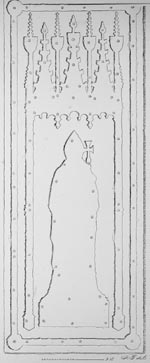
INDENT OF THE BRASS OF ARCHBISHOP STAFFORD. Canterbury Cathedral View larger image
"WITH THE SILVER HAND."
A warm sunny morning in early May, and turning our steps from the thriving and somewhat busy town of Trowbridge,—a place which, like its quieter sister of Westbury, "stondith mostly by clothiers,"—its forest of smoking chimneys, garish town-hall, and tall spire,—our path inclines by the broad south-westerly road that leads to Frome and the parts adjacent. The walk is pleasant enough in its way, but without special incident to interest the wayfarer, beyond the ordinary pedestrian and vehicular motion of the hour.
In this direction we continue for about a mile and a half, and having passed through the village of Studley, halt at a stile or gateway on our left, and looking across a meadow of some extent, discern, environed by orchards, the grey outline of a building, having the unmistakable time-worn appearance of survival from a former age, albeit not of large size, and flanked with clustering outbuildings, that betoken its present inmate to be engaged in the great primeval occupation.
Instinctively—from a memory sympathetically stored—a reverie for the moment takes possession of the thoughts, as at the sight of the unpretending structure, a large picture passes rapidly before the mental eye, and with measured emphasis we observe,—a mother unknown,—a son the most famous,—their last descendant the most unfortunate!
Why—friend of mine—say you, do we propound this enigmatic commentary as we view the old place? Gives it short clue to characters, presumably, once connected with it, whose lives have embodied striking phases of human existence, which whet the imagination to contemplate, and to divine with all its subtle ingenuity, incidents conformable to animate them?
Listen. Yonder is Suthwyke;—there, back in the middle of the fourteenth century, a scion of the great family of Stafford of mediæval fame, found his way from the county that gave them their patronymic, and he, marrying the daughter of its then possessor, settled himself within it, and became its lord and master.
Around its grey walls, so retiring and unpretentious, cluster traditions of the first importance, that lead us out into the great field of national history. From the first of this knightly race that then dwelled therein, by a mother unknown,—who may have been the comely daughter of some villain residing near,—issued a son, who, despite all the contumely of his birth, won the mitre of the adjoining See, rose to the supreme station of being the custodian of the nation's purse, the keeper of the conscience of its reigning King, and finally sat on the archiepiscopal throne of the realm, when the Church was in her best estate. Of his grandson, styled of this place, who, deputed to maintain the royal prerogative against plebeian agression, fell fighting under the fierce onslaught of Wat Tyler in distant Kent. Again, of his son, who rising high in the favour of his Sovereign, was by him dignified with a patent of nobility named after his heritage in this rural spot, with honours further increased; but who, meanly swerving by ingratitude and petty dudgeon, in the first service imposed on him by the monarch who had so recently honoured him,—to the confusion of his royal patron,—was by the same kingly hand, as suddenly and ignominiously extinguished, and with him perished also the name and race of the family, of which he was its last representative.
So we deliver the solution to our parable, as we leisurely cross the broad meadow, but as we draw near the house, or Court as it is termed,—our foot is abruptly stayed by a comparatively invisible—until we are close on its edge—but decisive hindrance to nearer approach, and indicative at once of the olden character of the habitation, a deep and wide moat, still well supplied with water, that surrounds the area on which the house stands. But no mail-clad warrior, with glance of lance and pennon, salutes us, no wimpled lady passes like a shadow around the old gable corners,—all the signs of life visible are a bevy of ducks busily disporting themselves in the water below, and a group of calves on the opposite brink, thrusting their dappled faces through the bars of the fence, and calling lustily to their foster-mother, the dairy-maid, to bring them their accustomed meal.
A short distance below, a friendly stone bridge reveals itself, which spans the chasm, and leads to a building,—that probably still perpetuates in form and size the antient gate-house,—with a large semi-circular-arched, and somewhat ornamented doorway, ghost of the original portal, with its attendant portcullis and drawbridge.
We cross the bridge, but observe at a glance that it is doubtful if any traces of the dwelling of the Stafford dynasty, or their immediate successors, will be found in or upon it, and such proved to be the case. The building is of moderate size, bears the characteristics of having been erected early in the seventeenth century, and these distinguishing features, with the exception of the mullioned windows, a rather fine balustraded and newelled staircase, and the appearance of an old nail-studded door here and there,—have been nearly obliterated by adaptation to modern requirements. No dates were visible, two panels over the entrances may contain such, but they are carefully plastered over.
Suthwyck—Suthwyk—Southwyke, now modernized to Southwick Court, is apparently built on the antient site, and probably very nearly represents the original size of the building. A domestic chapel was attached to the little mansion. This was situate a short distance from it, on the other side of the moat; it now forms the corner of the farm court, and was converted, about the year 1839, into a stable. No trace of ecclesiastical use is found within it, but a few of the old roof-timbers are discernible; the piscina, windows, &c., being doubtless removed when it underwent the process of conversion.
"In Southwick, a tything of North-Bradley," says Canon Jackson,—
"two carucates of land belonged in 1274 to William de Greyville or Greynville, who held under the Abbess of Romsey. About 1294, his son Adam de Greynville, (there was a Justice in Eyre of his name in 1267) attached to his house at Southwick Court a Chapel dedicated to St. John the Baptist. By surrendering to the Rector of Bradley, (at that time the Prebendary of Edington) a ground called Alerleye, he obtained the right of presenting to his Chapel a chantry priest, who in acknowledgment of fealty, was to offer two pounds of wax in Bradley church, every year on the anniversary of the Nativity of St. John the Baptist. In 1369 the Bishop of Sarum (Robert de Wyvil) granted a license for Mass to be said in the private mansion house of Southwick. This chaplain in after times was always instituted to his office by the rectors of Edington Monastery, to whom the church of Bradley then belonged."
At the dissolution of Chantries in the reign of Henry VIII., Southwyke, Grenefreds (Grenvylles) Chantry, as it was called, was reported by the Commissioners "Baltazar Segytte, incumbent, with six pounds seven shillings a year. The plate weighed eight ounces one pennyweight, and the goods were valued at nine shillings, whilst eight and fourpence was allowed for a bell."
Suthwyke Court, and manor passed by successive heiresses through the families of Greynville, Stafford, Cheney, and Willoughby. About 1483, during a temporary forfeiture, it was given by Richard III. to his favourite Ratcliffe; it was however restored, and about 1520 sold by Robert, second Lord Willoughby de Broke to Sir David Owen, a supposed son of Owen Tudor, who in his will, dated 1529, mentions this Manor and Chantry. It was afterward disposed of in parcels, but the Court, by descent, is now held by the old Wiltshire family of Long of Rood-Ashton.
Of its former possessors, a few words.
Sir John Stafford, knt., of Amelcote and Bromshull, Staffordshire, who was living in 1361, married as his second wife the Lady Margaret, daughter of Sir Ralph Stafford, K.G., and one of the original founders of that Order, second Baron Stafford, and who was subsequently raised to the Earldom 5 March, 1351, and died in 1372; by his wife Margaret, only daughter and heiress of Hugh de Audley, Baron Audley.[30] He had issue by this marriage a son and heir named Humphrey.
This son, Sir Humphrey, migrated into Wilts, and married first Alice, daughter and heir of John de Greynville, the then possessor of Suthwyke. By her he "acquired a large estate, viz., the manor, mansion house, and patronage of the Church of St. John Baptist thereto annexed of Suthwyke juxta Frome-Selwood, in the parish of North-Bradley, Wilts,—the manors and advowsons of Clutton and Farnburgh, Somerset, and the manor of Burmington, Warwick," and she was married to Sir Humphrey before 1365. Her father bore for his arms, Argent, six lioncels rampant gules. By her husband Sir Humphrey, she had a son Humphrey, who became her heir. Sir Humphrey married secondly, Elizabeth, second daughter of Sir William d'Aumarle of Woodbury, Devon, who died 15 November, 1362, and widow of Sir John Maltravers of Hooke, in Dorset, who died 15 June, 1386, and whose arms were, Sable, a fret or. She had no children by Sir Humphrey, but two daughters by her first husband; Maud, married first to Peter de la Mare, of Offelegh, Herts, who died about 1395, and secondly to Sir John Dinham, of Buckland-Dinham, Somerset, who died about 1428;[31] and Elizabeth, married to her second husband's only son. He was sheriff of Dorset and Somerset 12 Henry IV., 1411.
Elizabeth, the second wife of Sir Humphrey died the 15 Oct., 1413, and the knight himself survived her sixteen days only, dying on the 31 Oct., 1413, and both were buried beside her first husband, Sir John Maltravers, in the Abbey Church of Abbotsbury. He was the first of his line that bore for his arms, Or, a chevron gules within a bordure engrailed sable.
All the foregoing coats of arms including also D'Aumarle, Per fess gules and azure, three crescents argent, are found among the heraldic display on the tomb of their descendant the Lady Elizabeth Willoughby-Greville at Alcester.
Sir Humphrey Stafford—only child of the foregoing—was of Suthwyke in right of his mother, and of Hooke, jure uxoris. He was surnamed "with the Silver Hand,"—a 'periphrasis' whose meaning has not been explained,—and married Elizabeth, the second daughter of his father's second wife, by her first husband Sir John Maltravers. By her he had three sons, Richard, John, and William, and one daughter Alice.
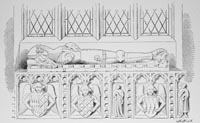
EFFIGY OF SIR JOHN DINHAM, KINGS-CARSWELL CHURCH, DEVON. Circa 1428. View larger image
Sir Humphrey, having thus married the heiress of Maltravers, probably removed to Hooke, their antient seat, and made it his residence. Coker says of Hooke House, that "in foregoing ages the Cifrewasts, men of great antiquity and note dwelled there." Maltravers married Cifrewast's heir, and the old historian continues, "Humphry Stafford who married Maltravers' heir, was the great builder of it. This place hath since been much beholden to William Pawlitt, Marquis of Winchester, who augmented it with new buildings and often lived there, but his successors have not thought so well of it, wherefore it is like to run to decay." Paulet held it through his wife Elizabeth Willoughby, by inheritance from Cheney and Stafford.[32] Arms of Cifrewast of Hooke,—Azure, three bars gemelles or,—also found at Alcester.
Sir Humphrey died 27 May, 1442, his wife had pre-deceased him, dying about 1420, and both were buried in the Abbey Church of Abbotsbury, in the Chapel of St. Anne therein, which he had founded
Before proceeding further with this descent of Stafford, our little annals confront us with its most distinguished representative—albeit by a side issue—John Stafford, consecrated Bishop of Bath and Wells 1425, Archbishop of Canterbury 1443, Lord Chancellor to Henry VI., and who died in 1452. Who were his parents, and where is his position in the family pedigree? The recognized 'authorities' on the subject describe him as being another son of the first Sir Humphrey, and brother to him "with the Silver Hand." Yet no definite proof thereof has been forthcoming. His presumed father Sir Humphrey made his will at Hooke 5 April, 1413, with codicil dated 30 Oct., same year, but in it he does not even mention him. Yet Sir Humphrey's second wife Elizabeth Maltravers in a codicil to her's, dated 14 October, 1413, does refer to him by bequest, Item, Magistro Johanni Stafford, &c.
Sir Humphrey Stafford also, the only son of Sir Humphrey (the Archbishop's presumed father), in his will dated 14 Dec., 1441, includes bequests to the future Archbishop, thus recorded,—
"Item, do et lego Johanni fratri meo divinâ pietate Bathoniensis et Wellensis episcopo, unum par de fflacons argenteis et deauratis.
"Item, eidem Episcopo unam ymaginem argenteam et deauratum decollationis sancti Johannis Baptiste, ac unam magnam peciam de Aras vocatam doser."
He also appoints the said bishop his brother, and William his son, with others to be his executors.
An extraordinary confusion appears to have enveloped the statements of historians and antiquaries as to the pedigree of Stafford, and the Archbishop's origin; this however has of late been satisfactorily cleared up by the researches of an accomplished and accurate genealogist. He was the son of the first Sir Humphrey, but not born within the legal pale of wedlock, and his mother's name was Emma, that she was subsequently admitted to the Sisterhood of the Priory of the Holy Trinity, Canterbury, of which her son the Archbishop was a Brother, but who she was has not as yet been recovered. She died 5 Sept., 1446, and was buried in a mortuary chapel in the north aisle of the parish church of North-Bradley, Wilts, in which Suthwyke is situated.
"As her son was elevated to the primacy in 1443 he is here (on the gravestone) correctly described as Archbishop at the time of his mother's death, which could not have been done had she died in 1440. Considering that the archbishop raised this mortuary chapel as a resting place for his mother's remains,—if not for his own—in the church of the parish in which Suthwyke manor house is situate, and that his father resided at Suthwyke until the period of his marriage with his second wife, when he removed to her dower house of Hoke in Dorsetshire, it is not unreasonable to infer that the archbishop was born in the parish of North-Bradley.
"As his mother survived Sir Humphry's last wife, who died in 1413,—only sixteen days before Sir Humphry—it is impossible the archbishop's mother could have been Sir Humphry's wife, at the time her son was born. His birth must be set as far back as 1387, if not earlier, as in 1413 he was made LL.D. at Oxford, and in the same year he was collated to the Prebendal stall of Barton in the Cathedral church of Wells."[33]
The mortuary Chapel that the Archbishop erected to the memory of his mother, and to which doubtless he had her remains conveyed, and therein interred, occurs at the east end of the north aisle of North-Bradley church, and is of the width of the last bay of the arcade. It is of square form and projects with definite character from the church, to which it forms a kind of transept.
The architecture is Perpendicular, and of rich character. The east window square-headed, of some height from the floor, shewing that there was an altar once below it, and a piscina occurs in the pier of the arch on the south side. The south window is of large size, bay-shaped, and extends to the roof, the side jambs are panelled with window-shaped tracery, and along the top is a string-course of quatrefoil panels with bosses, and these are repeated at the base over the tomb; here they have shields in the centre, but with no charges on them. The roof, in a good state of preservation, is a richly trussed one of oak, with deeply moulded transoms, again subdivided by smaller ones, the squares between ornamented with quatrefoils, having well-carved bosses in their centres, and others at the intersection of the trusses. On one nearest the chancel is the cross and crown of thorns,—on others the arms of Hungerford, the double rose, and some display, apparently representations of stags, a fox, man on horse, &c.
The tomb of the Archbishop's mother is in the recess of the bay of the north window. It occupies its whole width and depth, and assumes the form of a plain solid bench rising some height from the ground, with no ornament of any kind. It is composed of white stone, as is also the gravestone, let in on the top, which appears to be of somewhat different kind, and of more friable character.
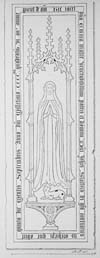
EMMA, MOTHER OF ARCHBISHOP STAFFORD. North-Bradley Church, Wiltshire.—A.D. 1446. View larger image
On this gravestone the effigy of the mother of the Archbishop is incised, below her feet is a pedestal, and over her head a rich canopy supported on side buttresses. Although the lines of the figure are somewhat denuded, yet sufficient remains to shew she was clad in the ordinary costume of a lady of the period. On her head she wears a coverchief that depends to the shoulders, a wimple around her neck, and she is otherwise attired in long gown and robe over. The hands are raised in prayer, and at her feet is a dog, apparently a spaniel, from his dependant ears and clouded coat. The incised lines are filled with a black composition, as is also the inscription that forms a ledger-line around the stone,—
Hic jacet d'na Emma mater venerabilissimi patris et domini D'ni Joh'is Stafford dei gra' Cantuariensis Archiepi' que obiit quinto die mensis Septembris anno d'ni Millesimo ccccmo quadra's'mo vio cuj' anime p'piciet' de' am'
On the outside, the Chapel is very noticeable, on account of its height and rich character as compared with the main fabric of the church. The corner buttresses have pinnacles at their stages, and the space below the north window is filled with quatrefoiled panels, and lozenges, traceried, with plain shields in their centres. A remarkable peculiarity is observable,—the carved ornamentation of the Chapel was never finished, the pinnacles on one buttress are completed, the crockets on the other only roughed out, and the cusps of the panel work above the tomb inside, still display the pencil marks of the intention of the carver, which his chisel never gave form to. The shields also are all perfectly plain and uncharged, and no trace of the armories of Stafford are at present visible anywhere on the Chapel, either within or without.
When Aubrey visited the Chapel in 1669, he notes,—
"By the north aisle is a peculiar chappell of excellent worke, the roof of wood curiously carved. I guesse the worke to be about temp: Henry VI. about which time this kind of Gothique architecture was at the height. This was as noble a Chapelle as any in the county, now, in the windowe, like a great bay windowe is only one scutcheon left entire; viz: Stafford,—Or, a chevron gules. Another was quarterley, now broken: another thus Stafford, imp: Beville. At the bottom thereof is a flatt gravestone of freestone well worked, lineally with the figure of a lady in a Gothique niche. In the limbe thereof this inscription "Hic jacet d'na Emma, &c."
The old antiquary gives the inscription fairly correct as it now is found, but at the end he adds these further words,—"O Deus trina me John conserva ruina,"—(O triune God, save me, John, from perdition). But such never could have existed on the face of the gravestone, as the inscription, without this addition completely fills the ledger-line around its edge. Probably he saw it in one of the windows. He then goes on to say,—
"In the limbe of the windowe are these fragments "Emme matris d... d'ni Joh'is Archiep...r...dicti." In the top of this windowe, and also of the other, in scrolls,—"Gnothi seauton: Nosce te ipsum." The other windowe is all broken, but the scrolls aforesaid: only the picture of the archbishop, except his head, remains, of curious painted glass, he in his formalities, with pall, crozier, &c., in a cope of sky colour. In a limbe of this windowe "hujus capelle ... Archiepi Cantuar." In the carved wood work of the roofe are several little hunting figures, as of men carrying a deer, shooting a deer in the wood. One scutcheon of Hungerford in wood. This chapell is built outside the church, as Hungerfords at Sarum, but the scutcheons of stone are not charged."
A review of the circumstances attending the origin and career of John Stafford, Archbishop of Canterbury, furnishes a subject of peculiar interest. Born, as we have observed, outside the legal pale, and as a consequence, subject to all its worldly disadvantages, this drawback appears to have found no hindrance to his advancement on the path of life, which ultimately led—short of sovereignty—to the highest station it had to offer. This result exhibits another striking instance of those marvellous careers, that have so often waited upon these natural children of mankind, who bearing down all obstacles in their way, and contemptuous of the goody-goody frowns and askant glances of their more piously-bred neighbours, by the force of their character, and the self-reliance engendered by what is termed misfortune of birth, have achieved the position of standing among the leaders and rulers of their race.
Examined by the light of common sense, the cause of this innate distinction is perhaps not far to seek. In its highest and truest sense, such have received their being under the strongest impulses that animate the human heart, knit by the influence of attachment often so powerful, that no present consequence, or after consideration received at the time a moment's parley, and Nature in the result asserts the aristocracy of her lineage; whereof the life of the Archbishop is a notable example. Proscribed doubtless, then as now, by the social world from assuming equality with them, and unable therefore to pursue any of the usual worldly professions with equal chances of success, it is refreshing to find the highest human vocation, the office of the Christian minister, was at his acceptance,—the Church opened her door to the human waif,—who was destined afterward to become her chief pastor. From his presumed father—as usual—he received scant help, but five years before his death, Sir Humphrey bestowed on him a costless gift, by presenting the future Archbishop to the family living of Farnboro', in the diocese of Bath and Wells,—a See he afterward presided over.
The close affection also that evidently existed between the Archbishop and his mother, cemented doubtless by the circumstances of his birth, and her consequent comparative isolation from society, is a delightful trait in his character; and it may be fully surmised caused him to take her to Canterbury, there to become a Sister of the religious house, of which fraternity he was a Brother, in order that she might be well cared for, and be near him, and where she probably passed the last twenty years of her life. She lived long enough to see her distinguished son ascend the Archiepiscopal throne, and as Lord Chancellor also to the reigning sovereign, King Henry VI., become at once the first citizen of his native land, both in Church and State; a remarkable privilege, that few mothers indeed,—no matter what distinction of birth or station they inherited,—have been destined to witness.
At her death in 1446, the Archbishop had her body conveyed back to North-Bradley, of which place she presumably was a native, and where probably her son was born. There he deposited her remains in the mortuary chapel attached to the parish church he had specially built to receive them, under a tomb whereon he caused her form to be depicted, and surrounded it with the simple inscription that still remains to bear witness of his filial affection.
It is noticeable that some intimacy must have sprung up between his father's family and himself, for although Sir Humphrey does not mention him in his will, yet his second wife Elizabeth D'Aumarle does so in hers. This intercourse probably ripened toward the end of his life, for his legally-born half-brother, Sir Humphrey "with the Silver Hand," who died ten years before the Archbishop, bequeaths him some silver plate, and constitutes him one of his executors. This acknowledgment would be quite in accordance with the ordinary ways of the world, Sir Humphrey doubtless properly felt that the honour of the friendship had now passed to the side of his presumed half-brother,—the stray off-shoot of the Stafford blood, had outgrown and overshadowed in position and fame, all the other branches of the family tree, and consequent on this, as a matter of course, his kinship was not disowned, and the Archbishop became the "frater meo" of the Knight "with the Silver Hand."
But, strange irony of this world's remembrance,—in death, if not in life their memory was to be avenged,—not a fragment of a memorial, nor the trace of an inscription remains to any direct member of the influential family of Stafford of Suthwyke and Hooke. Eschewing the humble precincts of the churches of the parishes in which their homes in Wilts and Dorset were situate as a place of burial, they caused their dust to be carried many miles away to the grand Abbey Church of Abbotsbury, and deposited in a Chantry they had founded therein, with its attendant priest to supplicate unceasingly for the welfare of their souls. Not very long after the last member of their race was laid within it, ruthless hands razed the great fabric to the ground, when all the memorials to the dead it contained were destroyed, and with such completeness, that even the position of their sepulchres may not at present be discerned, so that now, the tomb of the mother of the Archbishop alone remains in these western parts, to bear indirect witness of their former existence.
The Archbishop appears to have died at Maidstone on the sixth of July, 1452, and was buried in the "Transept of the Martyrdom" in Canterbury Cathedral.
He lies under an immense (Purbeck?) marble stone, perhaps the very largest in the cathedral, eleven feet five inches in length, by four feet six inches in breadth. On this was originally a magnificent brass, almost entirely filling the stone, but only the indent, now also much frayed, remains.
The outline shews us the effigy of the Archbishop in pontificalibus, with mitre and pastoral staff. He stands under a rich canopy with pinnacles and finials, supported on long buttresses that extend down to the base of the composition. Below his feet there was evidently a square panel which probably contained the "confabulatorie epitaph" seen and copied by Weever. Around the edge of the stone is a ledger-line, that probably had the emblems of the Evangelists at the angles.
The Archbishop's gravestone has shared the common fate accorded to all the brass-inlaid stones, that doubtless formerly thickly adorned the pavement of the cathedral, but of which not a single undespoiled example now remains.
On a boss in the vaulting immediately above, are the prelate's arms, being those of the See of Canterbury, impaling, Or, on a chevron gules, a mitre argent, within a bordure engrailed sable (Stafford of Suthwyke, with difference).
Weever,[34] thus speaks of the Archbishop.—
"Here (Canterbury Cathedral) lies interred in the Martyrdome an Archbishop, very noble, and no lesse learned, one of the honourable familie of the Staffords; sonne (saith the Catalogue of Bishops) vnto the Earle of Stafford, but I finde no such thing in all the Catalogues of Honour; a man much favoured by King Henry the fifth, who preferred him first to the Deanrie of Wells, gave him a Prebend in the Church of Salisbury, and made him one of his privie Councell, and in the end Treasurer of England. And then although this renowned King was taken away by vntimely death, ye hee still went forward in the way of promotion, and obtained the Bishopricke of Bath and Welles, which with great wisedome hee governed eighteene yeares, from whence he was removed to this of Canterbury, in which he sate almost nine yeares; and in the meanetime was made Lord Chancellour of England, which office hee held eighteene years (which you shall hardly finde any other man to have done) vntill wearie of so painfull a place, he voluntarily resigned it over into the King's hands. And about three yeares after that died at Maidstone July 6. Ann: 1452. Vpon a flat marble stone over him I find this confabulatorie Epitaph:—
Quis fuit enuclees quem celas saxea moles? Stafford Antistes fuerat dictusque Johannes. Qua sedit sede marmor queso simul ede? Pridem Bathonie. Regni totius et inde Primas egregius. Pro presule funde precatus Aureolam gratus huic det de Virgine natus."
Of the Archbishop's public career as Metropolitan and Lord Chancellor, this belongs rather to the province of national history, and is altogether too extensive for even short notice here, it has been amply treated by Dean Hook in his Lives of the Archbishops of Canterbury. Lord Campbell in his Lives of the Chancellors thus speaks of Stafford in that capacity,—
"Having with great reputation taken the degree of Doctor of Civil Law at Oxford, he practised for some time as an advocate in Doctors Commons, when Chicheley, Archbishop of Canterbury elevated him to be Dean of the Arches and obtained for him the deanery of St. Martin, and a prebend in Lincoln Cathedral. He then became a favourite of Henry V., who made him successively Dean of Wells, Prebendary of Sarum, Keeper of the Privy Seal, and Treasurer of England. He attached himself to the party of Cardinal Beaufort, by whose interest in 1425, he was appointed Bishop of Bath and Wells.
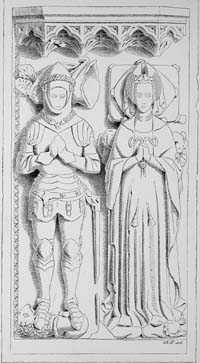
EFFIGIES OF WILLIAM, LORD BOTTREAUX, AND ELIZABETH BEAUMONT, HIS WIFE. North Cadbury Ch— View larger image
"From the Close Roll we learn 'that the Lord Cardinal, Archbishop Kempe, on 25 Feb. 1432, delivered up to the King, the gold and silver seals, and the Duke of Gloucester immediately took them and kept them till the fourth of March, on which day, he gave them back to the King and they were delivered by his Majesty to John Stafford, Bishop of Bath and Wells for the despatch of business.'
"He filled the office of Chancellor till 1450 a longer period than any one had before continuously held the Great Seal. This took place on 31 Jany. 1450, the day the Parliament pursuant to the last adjournment, when 'the Archbishop of Canterbury was discharged from the office of Chancellor, and John Kempe, Cardinal and Archbishop of York was put in his place.'
"He retired from politics and died at Maidstone, in Kent, on 6 July 1452. He was pars negotiis neque supra, one of those sensible, moderate, plodding safe men, who are often much relished by the leaders of political parties, as they can fill an office not discreditably, without any danger of gaining too much éclat, and with a certainty of continued subserviency."
"Sensible—moderate—plodding—safe,"—words which may be condensed into, and construed to embody that most useful, homely, yet withal rarest, of all endowments,—common-sense—whose practice in the long run is of far greater value from its reliability, than the too-often-found instability and hazard of careers termed brilliant,—and ever forms a most desirable, if not a great character.
To return to the descent of Stafford and the four children of Sir Humphrey "with the Silver Hand."
Sir Richard Stafford the eldest son, married Maud daughter and heir of Richard Lovell, Esq., by Elizabeth daughter and coheir of Sir Guy de Briene, knt. By her he had one child only, a daughter, named Avice, ob. 3 June, 1457, "a great heiress," married as his second wife, to James Butler, fifth Earl of Ormonde, created Earl of Wiltshire and K.G. in 1449. He was also Lord Treasurer of England and a staunch adherent of the Red Rose, was taken prisoner after the battle of Towton, by Richard Salkeld, Esq., and beheaded at Newcastle 1 May, 1461. Sir Richard died about 1427, his wife afterward married John Fitzalan, thirteenth Earl of Arundel, K.G., ob. 12 June, 1435, by whom she had a son Humphrey, fourteenth Earl. She died 19 May, 1436, and was buried with her first husband in the Chapel of St. Anne in the Abbey Church of Abbotsbury.
Sir John Stafford, second son, married Anne daughter of William the third and last Lord Bottreaux, ob. 14 May, 1462, by his wife Elizabeth daughter of John, Lord Beaumont. By her he had one child only, Humphrey, who died in Scotland 6 Aug., 1461. Sir John died 5 Nov., 1427, and was buried with his kindred at Abbotsbury Abbey.
The presumed tomb with effigies of Lord and Lady Bottreaux, the parents of Anne, is in the church of North-Cadbury, Somerset. Its original position was in the Founder's place, on the north side of the chancel, but it is now relegated to a corner of the tower at the west end. The knight is in complete plate armour, the lady in richly ornamented horned head-dress, and long robes. A canopy is over their heads. Lord Bottreaux married first Elizabeth, daughter of John, Lord Beaumont, she died about 37 Henry VI. (1459). By her he had two sons and two daughters. William, who died before 1434; Reginald, ob. 1420; Anne, married to Sir John Stafford; and Margaret, who died 7 Feb., 1478-9, eventually sole heiress to the large property and titles of Bottreaux and Mules, married to Robert, Lord Hungerford, ob. 14 May, 1459. Lord Bottreaux married secondly Margaret daughter of Thomas, Lord Roos. He died seized of fifty manors, in the western counties, among them North-Cadbury, which they possessed through the heiress of Mules, and in that church (which they probably rebuilt), by his will he ordered himself to be buried. Reginald, the second son, and brother of Anne, was buried at Aller church, near Langport, which parish was part of the family property. On a flat stone formerly in the pavement of the chancel, but now set upright, on a ledger-line is incised the following inscription,—
Hic jacet Roginaldus filius William dom' de Botreaux qui obiit xxx die mensis Julii anno dom' mo cccc xx
In the centre is a shield,—A griffin rampant (Bottreaux), impaling semée of fleurs-de-lys, a lion rampant (Beaumont).
William Stafford, Esq., third son, was of Suthwyke; he married Katharine daughter of Sir John Chidiock, knt., by whom he had one son Humphrey, subsequently created Lord Stafford of Suthwyke and Earl of Devon. More with regard to him presently. William Stafford, together with his relative Sir Humphrey Stafford of Grafton, knt., Commander of the King's forces, were both killed in the encounter with Jack Cade and the Kentish insurgents (who came off victorious), at Sevenoaks, 18 June, 1450. His wife married secondly Sir John Arundell of Lanherne, Cornwall, knt., ob. 12 Nov., 1473, and thirdly Sir Roger Lewkenor, knt., ob. 4 Aug., 1478. She died 10 April, 1479.
Alice, their only daughter, married first her neighbour Sir Edmond Cheney, of Broke, Wilts, and by him had two daughters, Elizabeth and Anne.[35] Secondly she married Walter Tailboys of Newton-Kyme, Yorkshire, ob. 13 Apl., 1444; by him she had one daughter Alianore, married to Thomas Strangeways, Esq., by whom she had two sons Henry and Thomas, and one daughter Joan. Thomas Strangeways died in 1484, his wife Alianore 2 April, 1502, and both were buried in the Lady Chapel of the Abbey church of Abbotsbury.
Our thoughts now concentrate on the last—most greatly honoured, yet withal most unfortunate—representative of Stafford of Suthwyke, who rose to the highest dignity conferred on the family, but whose possession of the distinction was indeed short, and his life still more suddenly and disastrously extinguished.
This was Humphrey, the only son of William Stafford of Suthwyke, killed at Sevenoaks in 1450. His cousin Humphrey, son of his uncle Sir John Stafford, dying in Scotland in 1461, he became the sole male heir left remaining. He was born about 1440, and appears to have identified himself with the cause of the White Rose, and to have been in much favour with Edward IV.
Stafford is accused of having been ill-disposed toward the Courtenays, Earls of Devon, who were zealous adherents of the Red Rose; naturally so, for they were descendants of that branch of the royal blood, and with such devotion, that the three brothers, Thomas, Henry, and John, who were the last representatives of the elder descent of that illustrious house, lost their lives, either in the battlefield or on the scaffold, and their property by confiscation, in support of its claims. They were the sons of Thomas Courtenay, first of that name, Earl of Devon, who died 3 Feb., 1458, by his wife Margaret Beaufort, second daughter of John, Earl of Somerset, eldest son of John of Gaunt, Duke of Lancaster, by his third wife Katharine Swynford.
A necessary digression respecting the Courtenays takes place here, as Stafford bears the sinister reputation of acquiring, by means not the most honourable, a large portion of their property and their title.
Thomas Courtenay, Earl of Devon, the eldest of these brothers, fighting for the Red Rose, was made prisoner after the battle of Towton, 29 March, 1461, taken to York, attainted and beheaded by order of Edward IV., and all his property confiscated to the crown.
He appears to have been one of the most lawless and unscrupulous men of that lawless era,—his father it was, who is said to have fought with Lord Bonville on Clyst-Heath, and himself, the son, the leader of the outrage and murder of poor old Radford the lawyer, at Poughill, near Crediton, so graphically described in one of the Paston letters, and which as a picture of the ferocity of the time will bear extract here,—
"Also y'r is gret varyance bytwene ye Erll of Devenshire and the Lord Bonvyle as hath be many day and meche debat is like to growe y'rby for on thursday at nyght last passed ye Erll of Denshyres sone and heir come w't lx men of Armes to Radfords place in Devenshire which was of counceil w't my Lord Bonvyle and they sette an hous on fyer at Radfords gate and cryed and mad an noyse as though they had be sorry for ye fyer, and by that cause Radfords men set opyn ye gats and yede owt to se ye fyer and for w't th'erll sone foreseid entred into ye place and intreted Radford to come down of his chambre to spike w't' them p'myttyng him that he shuld no bodyly harm have upon whiche p'mysse he come down and spak w't ye said Erll sone.
"In ye mene tyme his menye robbe his chambre and ryfled his hutches and trussed suyche as they coude gete to gydder and caryed it away on his own hors.
"Thanne y'erll sone seid, Radford thou must come to my Lord my Fadir, he seid he wold and bad oon of his men make redy his hors to ride w't 'hene whiche answerd hym yt alle his hors wern take awey, thanne he seid to y'erll sone sr yo'r men have robbed my chambre and thei have myn hors yt I may not ride w't you to my Lord yo'r fadir, wherfor I p'y you lete me ride for I am old and may not go.
"It was answerid hym ageyn yat he shuld walke forth w't them on his feete and so he dede till he was a flyte shote or more from his place and yanne he was ... softly for cawse he myght not go fast and whanne yei were thus dep'ted he t'ned ... oon forw't come ix men ageyn upon hym and smot hym in the hed and fellid ... of then kyt his throte." (28 October 1455.)
We fear the feud between Bonville and Courtenay, that began with the 'valiant performance' on Clyst-Heath, was still raging, and it may be, the cause of poor old lawyer Radford's death, as it is mentioned he "was of counceil w't my Lord Bonvyle," which circumstance the Courtenays appear to have resented in this terrible manner. Six years afterward the edge of the axe fatally crossed the throat of "ye said Erll's sone," and leader of this outrage, at York.
The place from which this free-booting party set out was Tiverton Castle, the family residence, where his father the Earl was then living. The castle and manor of Tiverton formed part of the Courtenay possessions afterward given by Edward IV. to Stafford.
Henry Courtenay, the next brother, and Earl of Devon, for alleged complicity with Richard Nevill, Earl of Warwick, and his brothers, then exerting their influence for the restoration of Henry VI., was with Sir Thomas Hungerford of Farleigh Castle, seized, attainted of treason, and after a short trial before the King's Justices, both beheaded at Salisbury, 4 March, 1466.
John Courtenay, the third and last of these brothers, fell fighting for the Red Rose at the battle of Tewkesbury, 4 May, 1471. In his death, that branch of the family became extinct for the cause of the Red Rose, as their neighbours and relatives the Bonvilles suffered extermination, about the same time, and in a similar manner, contending for the White Rose.
But the charge against Humphrey, Lord Stafford, chiefly related to his alleged antagonism to Henry Courtenay, the second of these brothers, who was executed at Salisbury, and whose death he is said to have 'procured.' In those days of feud and intrigue, it is impossible to say what men may not have covertly done, to carry out their aims and designs, but it is to be hoped such was not really Stafford's conduct in this case, for if so, the signally sudden and similar retribution, that so soon afterward overtook him, was well deserved.
But be that as it may, it is certain that a large portion of the confiscated possessions of the Courtenays, "the bulk of the estate," about the time of the death of Henry Courtenay, was bestowed by Edward IV. on Stafford, and three years afterward, 7 May, 1469, he was raised by that monarch to the old and coveted title of Earl of Devon, and this while John Courtenay, the last of the three brothers, was still alive, as he perished at the battle of Tewkesbury two years afterward.
But John Courtenay, the true heir to the distinguished title, lived long enough to see this pretender to it as ignominiously extinguished, and it is remarkable that this illustrious heirloom, although twice conferred on others, each attempt has proved futile to wrest it from the rightful owners.
Sir Humphrey Stafford had been created Baron of Suthwyke, first by Writ of Summons dated 21 July, 1461, afterward confirmed by patent dated 24 April, 1464, and, as we have observed, he was further advanced to the dignity of Earl of Devon, 7 May, 1469.
Very soon after this honour was conferred on him, Edward despatched the Earl with eight hundred archers, to aid the Earl of Pembroke and his brother Sir Richard Herbert then in command of about seven thousand Welchmen, marching to give Sir John Coniers and the Lancastrians battle. The sequel cannot be better related than in the words of Cleaveland:—
"With these forces the Earl of Pembroke resolved to hinder the rebels in their journey, and having notice that they took their way by Northampton, he led the whole body of his army against them, having given orders to Sir Richard Herbert with two thousand soldiers, to wheel about and charge the enemy in the rear. Sir John Coniers had so carefully strengthened the rearward, that the Welch were repulsed with loss, whereupon Sir Richard Herbert retired to his brother, and Sir John Coniers diverted from his direct course to London, marched towards Warwick, where the Duke of Clarence, and the Earl of Warwick, had levied a mighty host. The Earl of Pembroke followed him closely, expecting an opportunity of cutting off some part of the enemy, as they marched disorderly, or to give battle to the whole army: but while he was in this pursuit of glory, a small difference between him and the Lord Stafford, ruined the whole attempt; for he encamping at Banbury, a question arose concerning an Inn, to which Stafford pretended, as having long used the house; but the Earl of Pembroke, in regard of his preheminence as General, was resolved to lodge in it. This so trivial distaste, (if there was no farther treason in it) grew so high, that Stafford withdrew himself and his English archers. The rebels, who soon had notice of this unhappy discord, gave the Earl's camp the next morning a sudden assault: the Welch received the charge so stoutly, that they took Sir Henry Neville, the leader; but, guilty of too much barbarity, most cruelly slew him in cold blood, by which act they raised so fierce a desire of revenge in the enemy, that the next day they gave the Earl battle, and the fight was longe and cruel, but at last the Welchmen fled; in the battle five thousand of the Welch were slain, and, among the few prisoners the Earl of Pembroke, and Sir Richard Herbert were taken, whose heads were soon after sacrificed to the ghost of Neville."
Another account says this quarrel about the Inn was the result of a matter of love rather than war, that "a fair damsel was resident in the house, of whom both Earls became enamoured, and contrary to the arrangement entered into between them, the first in possession should remain so, the Earl of Devon was dispossessed by the Earl of Pembroke, which excited so much discord between them that, unmindful of his duty to his Sovereign, and the cause in which he was engaged, he departed with his power,"—and so, as a consequence thereon, the Earl of Pembroke and his brother lost their lives, together with five thousand soldiers, who perished on the plain of Danesmore, near Edgcote, about three miles from Banbury, 6 July, 1469.
Treachery of this kind was not likely to be lightly passed over by Edward, justly angry at the defeat of his army, and ingratitude of the man he had so recently honoured. Orders were sent to the Sheriffs of Somerset and Devon to seize Stafford wherever they could find him, and put him to immediate death. The Earl had returned to Somerset, he was taken at the village of Brentmarsh, promptly conveyed to Bridgwater, and there at once beheaded in the market-place on the 17 Aug., 1469. His body was conveyed to Glastonbury, and buried under the south arch of the great tower, at the cross of the Abbey Church.
He had made his will some years before, bearing date 3 September, 1463, wherein he "bequeathed his body to be buried in the Church of our Lady at Glastonbury, and appointed Mr. Michael Goss, and Mr. Watts, then Wardens of the Grey Friars in Exeter, should for the salvation of his soul, go to every parish church, in the counties of Dorset, Somerset, Wilts, Devon, and Cornwall, and say a sermon in every church, and town, and other. And because he could not recompense such whom he had offended, he desired them to forgive his poor soul, that it might not be in danger" (Dugdale).
So perished Humphrey Stafford, Earl of Devon, still quite a young man, for he could not have been more than thirty years of age,—"he enjoyed," continues Cleaveland, "but a little time that honour and estate which he got by procuring the death of its right owner, and he was in derision called The Earl of three months standing and no more."
The Earl married Isabel daughter of Sir John Barry, knt.,—and after his death she remarried with Sir Thomas Bourchier, knt., fifth son of Henry Bourchier, second Earl of Ewe, and 30 June, 1461, created Earl of Essex, who was also Lord Treasurer of England, and who died in 1483,—by his wife Isabel, daughter of Richard, Duke of York, and sister to King Edward IV., another strange conjunction, her thus marrying a nephew of the man who had so vindictively beheaded her first husband. But sentiment had little place in those days; ambition, station, and love of rule were the things sought after, all else seems to have been forgotten.
Weever gives the following inscription as occurring in the church of Ware, Herts, where both herself and second husband appear to have been buried,—
Hic iacet Thomas Bourchier miles filius Henrici comitis Essex; ac Isabella uxor eius nuper comitissa Devon, filia et heres Johannis Barry militis: qui obiit ... 1491 et Isabella ob. 1 die Marcij 1488, quorum animabus &c.
Whereon the old 'epitaphist' is induced to further moralize,—
"This Isabell, the daughter and heire of Sir John Barry, knight, was, when the said Thomas married her, the widow of Humfrey Lord Stafford, of Southwike, sonne of William Stafford of Hooke, Esquire, created Earle of Devon, by King Edward the fourth; to whom the King gave all honours, manors, Castles, &c., which were Thomas Courtneys, the fourteenth Earle of Devon: who neverthelesse, grew ingratefull to King Edward his advancer, in revolting from him at the battaile of Banbury, for which cowardise (hee being apprehended) was without processe executed at Bridgewater, the seventeenth of August, anno. 1469, having been Earle but three moneths."
At his death the ill-gotten estates of the Courtenays that he possessed, were again forfeited, and Edward IV. gave a considerable portion of them to another eminent west-countryman John, Lord Dinham, and to other grantees, but the succession failed in nearly all the recipients, and Henry VII., in the first year of his reign, made void all these grants by Edward IV., and restored both the title and the estates to their rightful owners.
Here, before we finally dismiss our thoughts on the signal catastrophe that ended the dynasty of Stafford of Suthwyke, we dwell awhile on the singular parallelism of characters and incidents that are presented to us in each of our little narratives relative to the distinguished but unfortunate house of Stafford.
Both the prominent factors of our unpretending histories fell victims to the vengeance of the White Rose, the result of defection doubtless, though of differing kind. Each experienced the same unhappy fate, Humphrey Stafford, Earl of Devon, was sent to the scaffold at Bridgwater, by the peremptory mandate of Edward IV., Henry Stafford, Duke of Buckingham, suffered in similar summary manner at Salisbury, by the relentless order of Richard III.
Two eminent ecclesiastics of the highest dignity are also associated with their relations. John Stafford, Archbishop of Canterbury, and Lord Chancellor to Henry VI., finds place in the one, and John Morton, Cardinal-Archbishop of Canterbury, and Lord Chancellor to Henry VII., appears in the other.
Both were west-countrymen also, having been born in neighbouring counties, the one at a village in north Wilts, the other in a little country town in central Dorset.
Stafford saw the beginning of the internecine strife of the Roses, but was called away as their rival pretensions began to assert themselves, and the deadly conflict to thicken.
Morton appeared at the conclusion of the disastrous quarrel, and it was reserved for him to put a stop to the deluge of blood that had been ruthlessly shed for so many years,—computed to have cost a hundred thousand lives,—decimating his native land, and by uniting and neutralizing the contending claims, bring it peace. A statesman-like mission of the first importance, and carried out with such consummate wisdom, that it has been aptly said, "he joined the Roses, that is, he brought about the union of the Houses of York and Lancaster, for that was his doing, and, so far as can now be seen, would not have been done but for him. He made the Tudor dynasty, and his name is buried under his own creation."
So ends our little story,—such are the momentous issues, that fill the mind's eye, amid this rural quietness, as our steps make homeward. Evening is approaching, and leaving the interesting precincts of North-Bradley church, our path back to Trowbridge,—discerned afar by its hood of smoke,—leads through some pleasant meadows by way of Suthwyke. Here we halt for a moment to take a final look at the old place, and first home of Stafford in these parts. If deserted, one after another, by its antient possessors, it now appears shorn of the original dignity that man's transitory occupation once conferred upon it, and of which nothing but a memory remains, Nature, unchanging, still continues to adorn it with her charms, and specially so just at present, for the trees in the orchard that skirts the Court are in full bloom, some of them "white as a sheet with blooth" (as the old Saxon idiom of the west-country peasantry expressively describes it), and others loaded with clusters of variously expanded chalices of all shades of that inimitable pink, the which—for want of other satisfactory description,—we are content to call "apple-blossom."
There, across the moat, lived the first Sir Humphrey,—this we know,—but what voice shall come back from the Past, and point us to the site of the cottage, wherein the future Archbishop—his presumed son—first saw the light? All is silent.
Of the last resting-places of the Staffords of Suthwyke, greater certainty exists, and widely divided are they all in death.
The two successive Sir Humphreys, their wives, and a stray descendant, sleep where stood a venerable monastic church, on the shores of the Atlantic, in southern Dorset; the unfortunate, headless Earl, lies in Glastonbury's great Abbey in central Somerset; but the record of their graves has perished with them. Not so the memorials that perpetuate the memories of the Archbishop's mother and her famous boy. She received honoured burial, presumably amid her native scenes, and, it may be, among her own kindred, here in this little sanctuary in north Wilts; but her distinguished son found sepulture far away in Kent, in the glorious cathedral, whose throne he filled, and among those whose names are entwined with the greatest traditions of the land, and within the precincts of its most sacred place, near where his canonized predecessor meekly met his death at the hands of savage men, and thenceforward named for all time as