DAYS OF THE TUDORS (continued 4)
Reading edition
The Cardinal-Archbishop waited on the Queen-Mother and did his best by entreaties and assurances to induce her to part with her son, but she could not be persuaded to place her child in the hands of the man she so greatly feared, and believed to be her mortal enemy. At last Bourchier told her the dread truth, that if she did not deliver him up otherwise, they would take him from her by force, notwithstanding the privilege of Sanctuary, but that he could not believe they would have made him the instrument of deceiving her, and bringing harm to her son. Alas, the good Cardinal was thoroughly deceived with the rest, and so, finding he could not persuade her, prepared to depart. The distracted mother thereon chose what appeared the least evil of the two, "caught the boy in her arms, tenderly took leave of him, and in a flood of tears delivered him to the Cardinal."
Bourchier brought the young prince to Gloucester, who received his nephew with much feigned affection,—a few days after both the young King and his brother were lodged in the Tower, never to come out again alive.
Up to this time it is probable that no one, not excepting Buckingham, really had cognizance of the ultimate designs of Gloucester, and he himself had been veiling his purpose as carefully as possible, until he saw his schemes so far matured, that success appeared in sight. And although he was gradually getting the sole power and mastery of the King and government in his own hands, still there were many obstacles to be got out of the way, and many influential men to be won over, or otherwise disposed of, before the sceptre was within his grasp.
At this juncture Buckingham comes to the front, as the undoubted agent and zealous coadjutor of Gloucester, in aiding his ultimate design, and also by apparently acquiescing in any measures, however desperate, that might lead to its fulfilment. Gloucester doubtless thoroughly estimated the unenviable character of his ally. He knew of Buckingham's hatred of the Queen-Mother and her family, and that in consequence, his allegiance to the young King was of very doubtful character, if secretly he did not equally dislike him, though he dared not shew it, and Gloucester was further aware of Buckingham's grievance at never having been possessed of that which by heirship he was entitled to, a moiety of the great Bohun estates, and which had been hitherto vested in the Crown, unjustly as he considered, and Gloucester, it is said, duly whetted his companion's hopes by the promise of the restoration of this, when seated on the throne.
Prompt action was now decided on. Widville and Grey, with their associates, were to be dispatched, and orders were sent down to Pontefract to Sir Richard Ratcliffe for that purpose, and it was further determined that Lord Hastings was to be won over if possible, if not the same fate was to be reserved for him.
Then came Gloucester's tampering with Sir Edmund Shaw, the Lord Mayor, and his brother, the truculent preacher Dr. John Shaw, and the pretences of trying to assume the illegitimacy of Edward's children, and failing that, of Edward IV. himself. Then the simulation of feigning to prepare for the young King's coronation, and the two Councils, one in Gloucester's interests, intriguing for its delay at Baynard's Castle, and the other arranging it for the King in the Tower. Stanley, in the King's Council, was assured there was mischief in Gloucester's designs, but Hastings was slow to believe such treachery, until the truth was apparent to him, when the wretched emissary, Catesby, left him for the second and last time, a betrayed and doomed man. Immediately on this followed the frightful incident in the Tower, and the murder of Hastings,—for it was nothing less,—a scene described at length elsewhere.[18] On the same day the victims at Pontefract were disposed of.
Concerning the barbarous execution of Earl Rivers and his unfortunate companions we get the following graphic picture from More,—
"They had not so much as the formality of a trial, but were brought to the scaffold on the day appointed, and being branded in general by the name of traitors, were beheaded. The Lord Rivers would fain have declared his innocence to the people, but Ratcliffe would not suffer him, lest his words should lay open the Protector's cruelty too much, and so he died in silence. Sir Thomas Vaughan would not endure his mouth to be stopped, but as he was going to the block said aloud, 'a mischief take them that expounded the prophecy, which foretold that G should destroy King Edward's children, for George, Duke of Clarence, who for that suspicion is now dead; for there still remained Richard G (i.e. Duke of Gloucester) who now I see is he that shall, and will, accomplish the prophecy, and destroy King Edward's children, and all his allies and friends, as appeareth to us this day; against whom I appeal to the high tribunal of God, for this wrongful murder and our real innocency.' Sir Richard Ratcliffe heard this with regret, and putting it off, said to him in scorn, 'You have made a goodly appeal, lay down your head.' 'Yea,' saith Sir Thomas, 'but I die in the right, take heed that you die not in the wrong;'—and having said this he was beheaded. He, with the other three, were buried naked in the Monastery of St. John the Evangelist, at Pontefract."
The citizens of London had next to be reckoned with, on whom "fear and consternation" would be sure to fall, on hearing of the sudden and barbarous death of Hastings, who was a great favourite with them, and had much influence in the city. But all things had been prepared,—the Lord Mayor and Aldermen were immediately summoned to the Tower, and Gloucester and Buckingham, who had arrayed themselves in two old rusty suits of armour, received them, and in the name of the King told them that the beheaded man had conspired to seize the King, and kill Gloucester and Buckingham, in order that he may have governed the kingdom as he pleased! That they only discovered it the same morning, and the Council deemed it necessary to execute him immediately, and fearing there were many others in the plot they had hastily harnessed themselves at once for the King's defence. A proclamation, already "cut and dried" before Hastings' death, containing similar statements, was issued in the city within two hours of that event, but it had little effect, for the people jested and said, "it was writ by the spirit of prophecy." True enough, doubtless; the civic deputation withdrew from the presence of Gloucester, quite assured of his dissimulation and the untruth of what he had stated, but told him his orders for the quietness of the city should be obeyed, being too much afraid to give other answer.
The Archbishop of York, Morton, Bishop of Ely, and Lord Stanley had been sent to the Tower, poor Jane Shore publicly disgraced, and so all was well cleared away for Gloucester's ultimate measures. The two dukes were constantly in close conclave, and the next step was to win the citizens of London over to their designs. This was not so easy a matter, but two influences were to be tried, the first by imposing on their credulity and getting a feigned assent, and the second, if necessary, to oblige them into compliance by fear.
The Lord Mayor, Sir Edward Shaw, was already won over, and his brother, the Doctor, was to begin the final proceedings. These commenced by Dr. Shaw preaching the famous—or rather infamous—sermon, on a Sunday morning, at Paul's cross; taking for his text a phrase from the fourth chapter of the Wisdom of Solomon, "Bastard slips shall take no deep root," a tissue of malign slander on the late king, his children, and their mother,—and gross adulation of Gloucester. During a special laudatory parenthesis it was intended Gloucester should, as by chance, shew himself among the people, but he happened to overstay the time, the Doctor having concluded it, and when he did appear immediately after, the preacher re-commenced the passage, and it was hoped he would have heard a call for him as the future king, but there was a complete silence, the audience were disgusted both with the preacher and the subject. This was an ominous and disquieting omen to Gloucester.
The Duke of Buckingham now appears upon the scene as the prime factor in the events that followed. Dr. Shaw's eloquence not prevailing upon the citizens, he determined to see what effect his own reasoning would have on them. For this purpose the Lord Mayor had orders to assemble the Aldermen and all the principal citizens in the Guildhall on the Tuesday following, being the 17 June, 1483. Buckingham addressed the assemblage, and the subject of his harangue was simply an echo of the slander and adulation of what the people had heard at Paul's cross, coupled with the suggestion that Gloucester should be requested to assume the crown and government,—too weighty for a child.
The Duke finished his oration, and a silence was observed by the audience, as at the conclusion of Shaw's sermon; "everyone stood speechless." Then the Duke, surprised at the want of response, asked the Lord Mayor the reason; the answer was, the people did not well understand him. The Duke then "repeated his speech, with a little variation, and with such grace and eloquence, never was so ill a subject handled with so much oratory." Still the people remained silent.
Perplexed, the Duke again turned to the Lord Mayor, who then told him the citizens were not accustomed to hear anyone but the Recorder, and that he had better put the matter before them. Thereon Buckingham requested the Recorder, Sir Thomas Fitz-William, to address them, and he "most reluctantly managed his speech so well, as to be understood to speak the Duke's sense, and not his own." But the assembly stood silent as before,—
"They spake not a word; But, like dumb statuas, or breathing stones, Stared on each other, and looked deadly pale."
Then the Duke, seeing a crisis was at hand, determined to test the citizens for a definite reply, and after once more "muttering" to the Lord Mayor, turned to the assemblage and said,—
"Good friends, we came to acquaint you with a thing we needed not have done, had it not been for the affection we bear you. The Lords and Commons could have determined the matter without you, but would gladly have you join with us, which is for your honour and profit, though you do not see it, or consider it. We require you therefore to give your answer one way or another; whether you are willing as the Lords are, to have the most excellent prince the Lord Protector to be your King, or not?"[19]
Whatever may have been surmised as to the ultimate object to which preceding events were tending, this manifesto and declaration of Buckingham tore off the final shreds of the mask, that had been so thinly veiling it. At the conclusion of the question, a murmur ran through the assemblage, and just at this juncture, a number of the Protector's and Duke's servants, some city apprentices, and a rabble that had crowded into the Hall, cried out, "King Richard! King Richard!" and threw up their hats in token of joy.
Glad to seize hold of this mockery of a response, although perfectly aware of its origin, Buckingham immediately treated it as a genuine and spontaneous demonstration in favour of Gloucester, and said,—
"'Tis a goodly and joyful cry, to hear every man with one voice agree to it, and nobody say, no; since therefore, we see you all as one man inclined to have this noble prince to be your King, we shall report the matter effectually to him, that we doubt not it will be much to your advantage. We require you to attend us to-morrow with our joint petition to his Grace; as has been already agreed on between us."
"Some followers of mine own, At lower end of the hall, hurled up their caps And some ten voices cried, God save King Richard! (And thus I took the vantage of those few.)"
The Duke and his companions then left the Hall, and the citizens dispersed "the most part with aching hearts, though they were forced to hide their sorrows, as much as possible for fear of giving offence, which had been dangerous."
Baynard's Castle in Thames Street, "where the Lord Protector lay," was destined to be the scene of the last act of this miserable drama. Hither the following morning being Wednesday, the 17 April, Buckingham, several lords and gentlemen, the Lord Mayor, and most of the Aldermen and Common-Council, repaired to have audience of Gloucester.
The consummate hypocrisy of Gloucester's character, and his finished acting, were never more fully displayed than at this interview. At first he "made some difficulty of coming forth," and when he appeared, Buckingham, whose guile on the occasion was only short of Gloucester's, introduced the deputation, and after "very submissively begging pardon for himself and company, and liberty to propose to him what they had to offer," and receiving "his Grace's" reply that "he believed none of them meant him any harm," at once "set forth very elegantly and pathetically,"—
"the grievances of the people, and prayed him to redress them by assuming the sovereign authority, which of right belonged to him, and which the whole kingdom with unusual unanimity, desired he would take to himself for the benefit of the Commonwealth, as much as for his Grace's honour."
Gloucester simulated to be "mightily surpriz'd," and said, "although he knew the things, he (Buckingham) alleged, to be true, yet he loved King Edward and his children above any crown whatsoever, and therefore could not grant them their request." Thereon Buckingham "murmured" and "obtained pardon" to speak a second time. He then said, "they were gone too far to go back," and that if he refused "to take the Crown upon him, which they humbly beseeched him to do,"—and gave them "a resolute answer" to the contrary, then "they would look out for some worthy person who would accept their proposal."
The time was now come to throw off the mask, for the climax of hypocrisy had been reached, and Gloucester, never slow to act when the decisive moment arrived, immediately put his foot on the neck of the coveted opportunity. There was no hesitation in the declaration he then made; he "perceived" that the "whole realm was bent upon it not to have King Edward's children to govern them, of which he was sorry,"—and that "he knew the Crown could belong to no man so justly as ourself," a claim now confirmed and joined also by "your election, the Nobles and Commons of this Realm," the which of all titles "possible," he took to be the most effectual, he did therefore "content and agree favourably to receive your petition and request,"—and would forthwith from that day forward, "take upon us the royal estate, to rule, govern, and defend."
"Stand all apart,—Cousin of Buckingham, Give me thy hand;—thus high by thy advice And thy assistance is King Richard seated."
So the farce ended, and the deputation retired. Buckingham had placed the crown on the grisly brow of the White Boar, who, in return was destined not long afterward to rend him that offered it to the heart.
The assumption of the royal dignity by Gloucester, brings to a conclusion the first half of our little narrative, relating to the man who thus offered it to him.
Two equally remarkable, much-alike, and unenviable-in-conduct, personages, are now presented to us, who had both risen to the highest positions in their native land, the one to supreme authority as king; the other his faithful, and almost unscrupulous lieutenant, henchman, and catspaw, possessing a rivalling royal descent, but little removed in directness from his own, to be from this service the most important and influential of that king's subjects. A very dangerous and crazy alliance between men of such kindred character and aspirations, and destined assuredly not to last long.
Life never stands still,—in the very nature of things it cannot,—nor remain long on an even, which means literally a dead level: it must progress or recede. This is true generally of all life, but specially so of one animated by ambitious longings. A spirit so prompted must continue to ascend if there be any altitude to win, but if this be denied, and the unstable path it follows at last begins to sink rather than to rise beneath the advancing step, and points to the dread bourne of obscurity and neglect; or, if the powerful antagonism of rival claims and influence jostle it on one side and precede it; or, the cold shadow of preference, joined with indifference and crushed hopes paralyze its future efforts, there is neither anchorage nor haven for the beaten bark, then the bitter promptings of envy and shattered pride but too often occupy the heart instead, give demon wings to its future course, urging it fatally onward to end in the blind and reckless shipwreck of all.
Gloucester was proclaimed King on 22 June, and on 4 July went to the Tower by water, accompanied by his Queen. On that day among the titles of honour distributed, was that "Henry Stafford, Duke of Buckingham, was made Constable of England for term of life, but he claimed the office by inheritance."[20] He had previously been elected a Knight of the Garter.
The next day Richard rode in state from the Tower through the City to Westminster, and a large cavalcade of the nobility and the great officers of state. "But the Duke of Buckingham carried the splendour of that day's bravery, his habit and caparisons of blue velvet, embroidered with Golden naves of carts, burning, the trappings supported by footmen habited costly and suitable."
On the day following, 6 July, the coronation of Richard and his Queen took place, when "all the prelates mitred in their pontificalibus" received the King in Westminster Hall, and in the grand procession, after the great Officers of State carrying the royal insignia, came the "King in a surcoat and robe of purple, the canopy borne by the Barons of the Five Ports, the King between the Bishops of Bath and Durham, the Duke of Buckingham bearing up his train, and served with a White Staff for Seneschal, or High Steward of England," an office he appears to have held for that day only; while in the Queen's procession "the Earl of Surrey was Constable (pro illa vice tantum)."[21]
Richard, instead of summoning a Parliament, held a conference with some of the principal nobles, and after charging them to preserve the peace and put down all crime and disorder, set off for a progress through the midland counties, the end of the journey to be York, where a second coronation was performed by Archbishop Rotherham, and Richard created his son Prince of Wales.
From Windsor the King passed through his manor of Woodstock to Oxford, and it being fine summer weather, the people kept high holiday on the route of the royal progress. At the University he appears to have been particularly well received, and acceded to their petition to release Morton, the Bishop of Ely, from his durance in the Tower, as that prelate was a special favourite with them, and having done so, consigned him to the gentler and freer espionage of his friend the Duke of Buckingham, who sent the Bishop down to his Castle of Brecknock in South Wales.
This transfer of the Bishop from the Tower to Wales, was the first step in the prelude whose dénouement was to be at Bosworth. There was no man whose ability Richard more disliked and feared than Morton's, and that prelate had an equally intense hostility toward the King. But one thing was manifest by his thus committing the Bishop to Buckingham's custody, he could not at the time have had any doubt of the Duke's continued fealty toward him.
The progress continued to Gloucester, the King "making small stay anywhere." Here at this ominously-named city, from which he derived his title, two circumstances occurred whose issues eventually wrested the Crown from his brow, which he was hastening to York,—as if to make assurance doubly sure,—thereon to have it set with all ceremony for the second time. The first of these incidents was his parting from Buckingham, as it turned out, for ever,—although he appeared to be still "constantly disposed and affected toward him in all outward appearance." The other was that from here the first message is said to have been sped—to be afterward repeated with more deadly effect from Warwick—for the murder of the young Princes in the Tower, a crime that for wanton cruelty and hideousness completely dwarfed the legion of others he had previously committed. At last Richard's daring had reckoned without its host, no such enormity had ever occurred in England before, he had "miscalculated the national sentiment, there was a fierce reaction, his popularity went in a day."
Richard is said to have dismissed Buckingham at Gloucester, "with rich gifts and extraordinary marks of favour and affection." Whatever these may have been, he had previously given him an enormous number of appointments and offices in Wales, which had constituted him almost a little king in the Principality. While Protector, he
"procured for the Duke almost all the government and authority in Wales, and other bordering counties, the offices of Constable of all the King's Castles, and Steward of the said Castles, and divers Manors, Royalties, Lands and Lordships, in Salop, Hereford, Somerset, Dorset, and Wilts, without making account, or rendering anything to the King Edward V. Together with the oversight and government of his subjects in those counties and power and authority for the security of the King's person and kingdom, and conservation of the peace in those parts, to call them together and array and arm them. Also the office of Chief Justice and Chamberlain of North and South for his life."[22]
When Richard became King, he added a further large number of similar appointments, and the most, if not the whole, were dowered "with the fees anciently due and accustomed thereto," so that besides giving him great authority, they must have afforded him a large income.
Buckingham adjournied on from Gloucester, to his castle of Brecknock, in what state of mind, it is difficult to guess. Arrived there, he found his ghostly prisoner, with all complaisance waiting to welcome him. It must have been here also, or on his way hither, that the Duke received the intelligence of the murder of the Princes in the Tower. The ghastly news would presumably have greatly startled both Buckingham and the prelate, unless Richard had confided the grim secret to the Duke prior to his parting from him at Gloucester, a supposition we would fain believe not to have been the case, for two reasons, one that the youths were almost as nearly related to Buckingham as they were to himself, being the Duke's wife's sister's children, his nephews by marriage, and there was not like overwhelming motive for him to acquiesce in such atrocity, as actuated Richard; and secondly, a crime of such glaring enormity would scarcely brook revelation to anyone, beyond the person designed to be the instrument employed to perpetrate it, nor then, until the last moment brought the dire necessity; and although Richard was hardened enough and bold enough for anything, still the youths were nearly related to Buckingham, and Gloucester could not be sure how his—as it turned out—half-alienated friend might receive it.
Morton, who is described as being "a very wise, politic person, a man of learning, and of a winning behaviour," did not allow his host to remain long inactive and unattacked with regard to the great scheme he had in view. Within the influence of such a mind, Buckingham, weak, vacillating, ambitious, and unscrupulous, would literally be nowhere, and so it turned out.
On his arrival at the Castle, Buckingham, it is said, was still full of the praises of Richard. In a qualified sense this was probably so; Morton comprehended the situation at once; he had probably anticipated it, and was prepared with his plans. The argument the astute ecclesiastic used was double-edged. He knew it would not be safe to depreciate Richard's character alone without some compensating, alluring set-off; and so he coupled with it the inevitably unsettling—the prelude to convincing—one to minds constituted as Buckingham's,—that of flattering his vanity with the vision of rivalship, by setting forth the equal if not superior claim to the highest dignity, he possessed, both in disposition, wisdom, and birth; supplemented by a contrasted view of Richard's atrocious wickedness, and unprincipled usurpation. Not that Morton really wished or desired such a thing, as the sequel proved, because a shift of this nature would be only exchanging the bad for as bad; but if he could alienate Buckingham from Richard half the battle would be won, the ultimate design would take care of itself, and may be unfolded in due time. So the fly played with the spider; and, said the Bishop to his gaoler-host,—
"As for the late Protector, since he is now King, I do not intend to dispute his title; however for the good of the realm he governs (of which I am a poor member) I was about to wish, that to the good qualities he possesses, it had pleased God to have added some of those excellent virtues, requisite for the governing a kingdom, which are so conspicuous in the person of your Grace."[23]
So Morton is said to have whetted Buckingham's appetite and appealed to his pride, and the Duke, as a matter of course, wished to hear further of the mind of his adroit and agreeable prisoner, promising the utmost secrecy in all things concerned, on a subject evidently congenial to him. Morton soon discovered this, and growing bolder, placed in striking and flattering contrast the superior qualities of his host, compared with the evil and cruel characteristics of Richard, under whom "if he at any time is suspicious of his fidelity to him, no man is sure of his own life," and continued he,—
"to conclude this discourse, I conjure you by your love to God, your illustrious line, and your native country, to take the imperial crown of this realm upon you, to restore this kingdom to its antient splendor, and deliver it from the violence of the oppressor. I dare affirm if the Turk stood in competition with this bloody tyrant, this killer of infants, the people of England would prefer him to Richard who now sits upon the throne. How much more then would they rejoice to live under the government of so excellent a prince as your Grace? Despise not neither lose so fair an occasion of saving yourself and your country."[24]
Thus much for the preliminary portion of the prelate's speech, to enlist the ear of his auditor, and then he added, what he intended the foregoing adulation should lead up to,—
"But if you will not yourself accept the sovereignty of this kingdom, if the toils and hazards of a crown, prevail over you more than the charms of power, I entreat you by the faith you owe to God, by your affection to the place that gave you birth, and to the English nation; that you will in your high and princely wisdom think of some means of advancing such a good governor, as you shall appoint to rule and govern them. All the hopes of the people of England are in you, and to you only can they fly for succour. If you could set up the house of Lancaster once more, or marry the eldest daughter of king Edward to some great and potent prince, the new King would not long enjoy his usurped empire, all civil war would cease, domestic discord would sleep, and universal peace and profit be the blessings of this noble land."[25]
This candid statement appears to have been a poser for Buckingham, who, it is added, "continued silent some time," at which the Bishop in his turn "changed colour, and was very much confused," expecting the Duke to have warmly coincided; who, "perceiving the Bishop's affright, bade him fear nothing, and they would have further talk on the morrow, but now 'let us go to supper.'"
The Duke sent for Morton the next day, and not being quite easy and sure within himself, bade the Bishop rehearse the whole matter over again. This done, Buckingham "pulled off his hat, and made a sort of prayer," which being ended, "he then put on his hat, and applied himself to the Bishop."
Buckingham's reply to Morton was a kind of declaration and confession combined. He began with a similar strain of profession of regard toward the Bishop, having always found him "a sure friend, a trusty counsellor, and a vigilant statesman," and as the Bishop had so unreservedly opened his mind to him, he would reciprocate the confidence. And so he began by declaring,—
"that when King Edward died, to whom I thought I was very little obliged (though he and I had married two sisters), because he neither promoted or preferred me, as I thought I deserved by my birth, and the relation I had to him; I did not much value his children's interest, having their father's ill usage still in my mind."
and also that it would be of "ill consequence" to the nation, for the young King to govern, with his mother for Regent, and all her family, who were persons of "no high descent" occupying the most important positions, and have more share in the government than the King's relations and the other persons who were of the "very highest quality" in the kingdom, and so,—
"for these reasons I thought it to be for the public welfare, and my private advantage to side with the Duke of Gloucester, whom I took to be as sincere and merciful, as I now find him to be false and cruel. By my means, as you know well, he was made Protector of the King, and Kingdom."
That after this Gloucester produced to him and others "instruments witnessed by doctors, proctors, and notaries," shewing that Edward's children were bastards, and himself the rightful heir to the throne, which they believed to be true, and so took him for their "rightful prince and sovereign," and it was by his assistance he was made King, at which time
"he promised me at Baynards-Castle, laying his hand on mine, that the two young Princes should live and be provided for, to mine and everyone's satisfaction. When he was in possession of the throne he forgot his friends, and the assurances he had given them, and denied to grant my petition for part of the Earl of Hereford's lands, which his brother wrongfully detained from me. And when I was certainly informed of the death of the two innocent Princes, to which (God be my judge) I never consented, my blood curdled at his treason and barbarity, I abhorred the sight of him, and his company much more."
This statement as to the refusal of Richard to give him the portion of the Earl of Hereford's lands, does not accord with Dugdale's account to which we shall refer, nor with Richard's bitter exclamation of reproach when he heard of Buckingham's defection.
The Duke then continues to narrate how on his way homeward to Brecknock, he "meditated" how he might dethrone Richard, and that "had I assumed the supreme power, I thought there was nobody so likely to carry it as myself," that he sojourned two days at Tewkesbury brooding over the matter, but considered altogether "that to pretend to seat myself on the throne would not do," as in that case both the houses of York and Lancaster would join themselves against him, although he remembered,—
"that Edmund, Duke of Somerset, my grandfather, was with king Henry VI. in two or three degrees from John, Duke of Lancaster, lawfully begotten, my mother being Duke Edmund's eldest daughter, I looked on myself as next heir to Henry VI. of the house of Lancaster. But as I further journied between Worcester and Bridgenorth, I met the Lady Margaret, Countess of Richmond, at present wife to the Lord Stanley, who is the rightful and sole heir of John, Duke of Somerset, my grandfather's elder brother, whose title I had forgot until I saw her in my way, and then I remembered that both her claim, and her son the Earl of Richmond's, were bars to mine, and forbad my pretending to the crown of England."
At this interview it was proposed by the Countess that her son should marry one of king Edward's daughters, and "conjured" Buckingham, "by the memory of Duke Humphrey, his grandfather," to do his utmost to forward the match, to be eventually a solution to the present troubles, and he came to a resolution to "spend his life and fortune" in forwarding such a "glorious design," by which, if effected, he doubted not "the proud boar, whose tusks have gored so many innocent persons, shall soon be brought to confusion, the rightful and indubitate heir enjoy the crown, and peace be restored to this distracted kingdom."
This was exactly the kind of confession Morton required, and all being agreed on, the next thing was to get some trusty envoy to send to the Countess of Richmond to concert measures. He was soon found in the person of Sir Reginald Braye, who was despatched to her with the announcement of Buckingham and Morton's design, and to get her to communicate with the Queen-Mother and acquire her assent and adherence to the project. This the Countess effected through the medium of Dr. Lewis, her physician, and the Queen-Mother readily assented, on the stipulated condition that the Earl of Richmond married her daughter Elizabeth, and failing her, the next eldest, Cecilia.
Morton having taken captive the mind, if not the person of his gaoler, now wished the Duke to set him at liberty, and let him go to his diocese in Ely, where his friends would preserve him from any violence of Richard's,—"once I find myself at Ely," said he to Buckingham, "with four days start of Richard, I am ready to defy all his malice." The Duke however had no mind to lose so good an adviser, and did not wish him to leave, but Morton was determined to be gone if he could, and so stole away from Brecknock Castle in disguise, and doubtless without the Duke's knowledge.
It is rather difficult to estimate Morton's action on this occasion. The secret was out, the measures were concerted, and would soon get wind; was he afraid of Richard's vengeance? By his leaving Buckingham thus, he greatly compromised the Duke if their plans failed, and left him to certain destruction, while he would be in safety. With great rapidity he crossed from Brecknock to Ely, a hundred and seventy miles, and thence to Wisbech, and with money and men he had collected from his great works in the Fens, took shipping and got safely over to Flanders, and the first intelligence Richard had of his flight, was that he was in Brittany with the Earl of Richmond. Richard doubtless was fully alive to the threatened danger, and Shakspeare well imagines his apprehension in the words,—
"Ely with Richmond troubles me more near Than Buckingham with all his rash-levied strength."
Matters now proceeded apace toward the development of the movement. Sir Reginald Braye, as the trusty ambassador, had won over Sir Giles Daubeney, Sir John Cheney, Sir Richard Guilford, and others, and with these were the Courtenays, Sir Edward, afterward Earl of Devon, and Bishop Peter Courtenay, Sir Robert Willoughby, afterward Lord Broke, Sir Thomas Arundell, and Sir Thomas Brandon, these were to rendez-vous at or near Salisbury: the Marquis of Dorset had left his sanctuary, and with his uncle Sir Richard Widville had gone to the north. Dr. Christopher Urswick, Chaplain to the Countess, and Thomas Rame, had been despatched by her by different routes to Brittany to apprise her son of the complexion of the movement, and he was to appear off the western coast with a fleet and men to land in aid.
Richard, of course, soon found out the character of the insurrection and those implicated in it. To Buckingham he first sent a "very kind obliging letter," inviting him to come to London, but the Duke "pretended indisposition," and so excused himself. The King thereon being enraged, sent him "a letter in a rougher stile, commanding him on his allegiance to attend him." But the die was cast, matters had gone too far to recede, and the message was returned by the Duke, "that he would not expose himself to his mortal enemy, whom he neither loved nor would serve."
Buckingham gathered together as soon as possible his "rash-levied" strength. These consisted of a number of his tenants and a host of ill-disciplined Welshmen, and he endeavoured by long marches, passing through the Forest of Dean, to get to Gloucester, and thence onward to join the western contingent. The Earl of Richmond set sail from Brittany, the twelfth of October, with a fleet of forty ships and five thousand Bretons on board. They appear to have at once encountered a storm, which dispersed the fleet, but
"the ship in which was the Earl in person, was driven on the coast of England, to the mouth of the haven of Poole, in Dorsetshire; where, finding the shore was crowded with troops to oppose his descent, he forbad any of his men to land until the whole navy came up. However he sent out his boat with some officers to demand of the men who stood on the shore, whether they were friends or enemies? These traitors instructed by king Richard, answered, 'They were friends posted there by the Duke of Bucks to receive the Earl of Richmond.' The Earl suspecting the deceit, and perceiving he was alone, the rest of his fleet not appearing, weighed anchor, returned to France, and landed in Normandy."
But how fared Buckingham and his motley host? Not only circumstances, but Nature fought against him. The river Severn, swollen by ten days continuous rain, overflowed all the adjoining country, doing immense damage, and the inundation was so large, and of such remarkable character, that for a hundred years afterward it was named and recollected as The Great Water, or Buckingham's Water, and tradition delivers it was so severe "that men, women, and children were carried away in their beds with the violence of it."
This inundation totally prevented the Duke and his army crossing the river, and his allies on the other side coming to his support. The Welshmen "tried with being exposed to hunger, rain, and numberless hardships, returned to their homes,"—they appear to have deserted by degrees, "until at last the Duke had none left about him but his domestic servants, nor could prayers nor threats keep them together, so he was obliged to fly with the rest."
Thus prematurely ended this unfortunate movement, and Buckingham fled for refuge and secrecy to the house of his old servant, Ralph Banister, to whom himself, and his father before him, had shewn many acts of kindness.
Richard had gone down north to organize an army to meet the insurrection, and on the twelfth of October was at Lincoln, to see the Bishop, who however was absent and sick. Here the King sent him a letter to the following intent,—
By the King.
"Right Reverend Fadre in God, and Right trusty and wellbeloved; We grete you wele, and in our hertiest wyse thank you for the manyfold Presentes that your Servantes in your behalve have presented unto Us at this oure being here: which we assure you we toke and accepted with good hert; and so we have cawse. And whereas We by Goddes Grace intend briefly to avaunce us towards our Rebel and Traitor the Duc of Buckingham, to resiste and withstand his malicious purpose, as lately by our other Letters We certifyed you oure mynd more at large; For which Cause it behoveth us to have our grete Sele here, We being enfourmed, that for such Infirmities and Deseases as ye susteyne ne may in your person to your ease conveniently come unto us with the same: Wherefore we will, and natheless charge you that forthwith upon the sight of thies, yee saufly do the same our grete Sele to be sent unto us; and such of th'office of oure Chauncery as by your Wisedome shall be thought necessary, receiving these oure Letters for youre sufficient Discharge in that behalve. Yeven under oure Signet at oure Cite of Lincolne the xii day of Octobre."
To which Richard with his own hand, added this remarkable and significant postscript,—
"We wolde most gladly ye came your selff, yf that ye may, and yf ye may not, we pray you not to fayle, but to accomplyshe in al dyllygence oure sayd commaundement, to send oure Seale incontinent apon the syght hereof, as we truste you with such as ye truste, and the Officers parteyning, to attend with hyt; praying you to ascerteyn us of your Newes ther. Here loved be God, is al wel, and trewly determyned, and for to resiste the Malyse of him, that had best Cawse to be trew, the Duc of Bokyngham the most untrew Creature lyvynge. Whom with Gods Grace we shall not be long til that we wyll be in that parties, and subdew his Malys. Wee assure you there was never falsre Traitor purvayde for, as this Berrer Gloucester shal shew you."
What Richard was in such hurry to get his Great Seal for, was manifest at Leicester. Here, on the twenty-third of the month, he issued a proclamation against the rebels, and offering rewards for their apprehension. For Buckingham it was a thousand pounds in money, or a hundred pounds yearly in land, for the Marquis of Dorset and the Bishops of Ely and Salisbury a thousand marks in money each, or one hundred marks in land, and smaller sums for knights and gentlemen of lesser degree. His reprobation appears to have been specially directed against the Marquis of Dorset, "who, at the perill of his soule, hath many and sundry maids, widows, and wives, damnably, and without shame, deflowered and defiled." The next day at Coventry,—
"In order to make short work, and avoid the usual formalities of the courts of justice, he commissioned Sir Ralph Ashton to exercise the office of Vice-Constable, with so extensive a power, that he could condemn and execute on the spot, all persons whatever, guilty or suspected of the crime of high-treason, without having regard to any appeal."
Ashton, who was probably a man after his master's heart, took summary vengeance on the dispersed insurrectionists, and coming into the western counties signalized his zeal by numerous executions of those adjudged by him guilty, or only of favouring the conspirators; anticipating in spirit and action the bloody campaign of the detestable Jeffreys, on a similar errand two centuries afterward.
"It is better to trust in the Lord, than to put confidence in man, than to put confidence in princes;"—had ever the royal Psalmist's words truer interpretation than in the fate of Buckingham, whom we left hiding with his servant near Shrewsbury? Alas for the fidelity of servants when exposed to temptation; but is not falseness ever the attribute of servitude? Instead of the noble self-denial of sheltering and befriending his old master and friend, the glittering prize of a thousand pounds was within his grasp, the position of being a petty squire with a "manor of land" was before his eyes, and the temptation proved to be too much for "Maister Rauf Banistre," who, casting the eternal odium that would inseparably be attached to such conduct to the winds, went and betrayed the whereabouts of his master to John Milton, Esq., then Sheriff of Shropshire, who with a party of soldiery surrounded and searched the locality, apprehended him in a little grove near Banister's house, and conveyed him to Shrewsbury.
After a short confinement there, the Duke by royal order was delivered over to the custody of Sir James Tyler and another knight; and, "appareled in a piled black cloak," was escorted to Salisbury.
Richard who was pursuing his journey southward, had probably reached Salisbury before his prisoner had arrived.
No time was lost in dealing with the noble captive. His fate had already been foreshadowed in Richard's postscript to the Bishop,—
"When this arm of mine hath chastised The petty rebel, dull-brained Buckingham."
And there could be but one effectual way to "subdue his malys," and to put permanently beyond the power of future mischief this "never falsre traitor to be purvayde for,"—this "most untrew creature lyvynge."
The Duke was closely examined by his captors, and is said to have confessed the whole plan of the insurrection, and all particulars of the conspiracy.
He then made energetic efforts to obtain an interview with Richard, hoping to excite his compassion, or, as it has been also surmised, purposing if opportunity offered to despatch him with a concealed dagger. But he was sueing a much more able and crafty person than himself. Richard was about the last man to trust himself into the compromising company of his victim, and so into colloquy with one with whom he had aforetime been partner in so many crimes, and to whom he also owed so much, in acquiring his present position. Richard refused to see him, and his doom was immediate death, without further trial or arraignment.
Buckingham. Will not King Richard let me speak with him?
Sheriff. No, my good lord; therefore be patient.
Buckingham. Hastings, and Edward's children, Rivers, Grey, Holy King Henry, and thy fair son Edward, Vaughan, and all that have miscarried If that your moody discontented souls Do through the clouds behold this present hour, Even for revenge mock my destruction!— This is All-Souls' day, fellows, is it not?
Sheriff. It is, my lord.
Buckingham. Why then All-Souls' day is my body's doomsday.
It was even so. On 2 November, 1483, being All-Souls day, the Duke of Buckingham was beheaded in or near the Market Place, at Salisbury.
It is singular that such little knowledge remains as to the exact spot where this unfortunate but unscrupulous man perished, and no official evidence at all exists as to his place of burial. Relative to this Sir R. C. Hoare says,—
"It is remarkable that no allusion to this transaction is found in the documents at Salisbury, even though it took place on the second of November, the day of choosing the Mayor and other public officers; whose appointment is recorded in the usual form. Possibly the city authorities were too deeply implicated in the intended insurrection to risk even a reference to the subject. The Pipe Roll of the reign of Richard III. has been carefully examined, but the search has been fruitless. It is proper to observe, however, that a stone is still pointed out, as that on which Buckingham suffered. This stone is in the yard adjoining the house now occupied by Messrs. Styles and Large, which formerly belonged to the Blue Boar Inn."
Concerning this, Hall observes,—
"'Without arraignment or judgment, he was, in the open Market-place on a new scaffold, beheaded and put to death. His death he received at the hands of king Richard, whom he had before, in his affairs, purposes, enterprises, holden, sustained, and set forward, above all God's forbode."
And this account is corroborated by documents in the Stafford MSS., quoted by the historian of Shrewsbury. The passage on the subject is as follows:—
"And so all the gentlemen of Harrefordshire weare send for by Privy Seale to King Richard to Salisburie, and by that time Duke Henry of Buckingham, was brought by Sir James Tyler, the third daye, wheare he was pittifullie murdered by the said Kinge, for raisinge power to bring in King Henrie the Seventh."
The Duke having been thus summarily disposed of, what became of the wretch that betrayed him? One account narrates,—
"Banister and his whole family were destroyed by the surprizing judgments of the Almighty. The Usurper refused to pay him the thousand pounds promised in the Proclamation, saying, 'He that would betray so good a Master, would be false to any other.'"
But according to another, and truer version, the informer received his reward, and,—
"with the king's commendation of his service in his letters patent; for he gave him the Manour and Lordship of Ealding in Kent, late belonging to the Duke of Buckingham. So the letters ran,—'Richard &c.,—to al and singular the Officers, &c.,—Wit ye, that in consideration of the true and faithful service which our well beloved servant Rauf Banistre Esq, now late hath done unto us, for and about the taking and bringing of our said great Rebel into our hands, we have given unto the said Rauf, and to his heirs male, the said Manour for ever.'"
Both giver and receiver a congenial pair, and the gift that passed a characteristic one, being a portion of the spoil of their victim. Of such men it may be said,—
"Shame and Desolation sit By their graves ever."
But where was Buckingham buried, after he had been thus "condemned and executed in such summary way, on a new scaffold erected in the Market-place of Salisbury." A tomb to his memory is erected in Britford church, about a mile and a half distant from that city, but it is a cenotaph only, his body was not interred there; where then was its final resting-place, after his troublous life had found such disastrous extinction? Still further ignominy appears to have remained to be meted out to the inanimate form, after man had wreaked his last vengeance on the life.
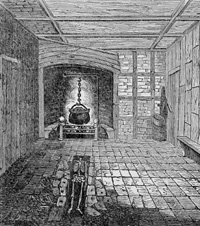
DISCOVERY MADE IN THE KITCHEN OF THE SARACEN'S HEAD INN, SALISBURY. From the Saturday Magazine, 6 April, 1839. View larger image
From an article in the Saturday Magazine, 6 April, 1839, we gather the following,—
"Tradition assigns the court-yard of the Blue Boar Inn, as the scene of this bloody tragedy; but great uncertainty seems always to have prevailed as to the spot where the mutilated remains of this unfortunate nobleman were finally deposited. The frontispiece which is presented to our readers, gives a view of the kitchen of an inn (the Saracen's Head) in Salisbury, in which, while some repairs and alterations were being made, a skeleton, in the condition shewn in the picture, was discovered beneath the floor of the apartment, which is on a level with the ground. A view of the appearance of the figure, together with the apartment, was made and published by Mr. J. M. Cullam—of which view, with his permission we have taken a copy. These human remains, are with good reason, supposed to have belonged to that Duke of Buckingham.
"It is supposed that the head and right arm, after having been submitted to the personal inspection of the King, then resident in "the King's house," in the Close, were sent to London to be affixed to Temple Bar, or exposed on Tower Hill, as was commonly used to be done in those times. A tomb in the north chantry of St. Thomas's church, Salisbury, was once supposed to contain the remains of Buckingham, and another in Britford church, near Salisbury, obtained a similar reputation; but sufficient evidence has been found to shew these were only monuments to his memory, and no indications, leading to probability, have ever appeared, to point out the place of the sepulture of the Duke of Buckingham, till the discovery took place represented in our frontispiece.
"The Saracen's Head Inn (owing to the peculiar contiguity of the two places) is supposed to have once formed part of the premises attached to those of the Blue Boar. The grave, therefore, of the Duke, was probably made only a few yards, possibly feet, from the spot where he suffered decapitation. The skeleton was found about eight inches below the surface of the soil; the spinal column appeared imbedded in the clay, and on taking up some of the detached vertebræ, they crumbled to dust in the hands. All the remains were in a like friable condition."
Commenting on this discovery, Sir R. C. Hoare remarks,—
"The most remarkable circumstance connected with this locality is the recent discovery of a skeleton, found just under the pavement in making some alterations in a kind of kitchen or out-house, belonging to the Saracen's Head, which is close to the site of the Blue Boar. It was that of a person apparently above the middle size and had been deprived of the head and right arm. The workman by whom it was found, omitted to notice whether the bones of the neck had been separated by a sharp instrument, but could remember that the bone of the arm appeared to have been cut off, just below the shoulder, as if by a saw. These remains were destroyed without proper examination.
"Of itself the discovery would prove nothing, but if the fact of Buckingham's execution at Salisbury be indisputably established, we shall not be guilty of too great a stretch of imagination, in supposing these were his mutilated remains, interred clandestinely, or, at least, without ceremony, near the spot where he suffered."
The name of Blue Boar Row is still perpetuated on the south side of the Market Place at Salisbury.
The tomb set up to his memory in Britford church, is in the place of honour, on the north side of the chancel. It is a high-tomb with Purbeck marble cover-stone, but exhibiting no brass indent, or inscription. Below are six canopied niches containing figures:—1. Figure gone.—2. Crowned female saint, with remains of cross (?), probably St. Margaret.—3. A bishop with pastoral staff, and hand raised in benediction.—4. A female saint crowned, St. Katharine with wheel and sword.—5. St. George, with sword, shield, and dragon under his feet.—6. A female saint bearing a pix or shrine, St. Mary Magdalene (?). At the west end are two niches having within them angels holding shields with the bearings sculptured thereon:—1. A chevron, evidently for Stafford, and 2. A fess (apparently cotised engrailed, but perhaps only an ornament introduced by the sculptor), for Widville, Earl Rivers. Over the tomb is a detached ogee arched crocketted canopy, with large finial, springing from embattled and pinnacled side buttresses. The canopy is ornamented with vine foliage and fruit; the workmanship of the whole composition is of coarse character. On a modern brass plate affixed above the tomb is this inscription,—
HENRICUS·STAFFORD·DUX·BUCKINGHAM DECAPITATUS APUD SALISBURI·I·RIC·III A.D. 1483.
It is probable this memento at Britford was erected by the Duke's brother-in-law, Lionel Widville, who was Bishop of Salisbury at the time of Buckingham's execution. Its position outside the city was doubtless adopted to deprecate prominence and discussion at this dangerous era.
The Bishop was the third son of Sir Richard Widville, the first Earl Rivers (so created by Edward IV., in 1466, and who was subsequently beheaded at Northampton, 1467), by his wife Jacqueline of Luxemburg, widow of John Plantagenet, Duke of Bedford. He was brother to Elizabeth, Queen of Edward IV., and so uncle to the unfortunate Princes so relentlessly destroyed by Gloucester, brother also to Katharine, wife of Henry Stafford, Duke of Buckingham, and Anthony, Earl Rivers, executed at Pontefract by Richard III. He held the See two years only, 1482-4, and his death is said to have been accelerated by the fate of his brother-in-law at Salisbury, and the other misfortunes that befell his family during the reign of Richard III.
The tomb assigned to Bishop Widville stands under the first arch of the north aisle of the choir of the Cathedral, leading into the transept.
It is a high altar-tomb, the cover-stone perfectly plain, with indent for inscription on its edge, but the brass has disappeared. Below are traceried panels, with shields in their centres, on which were originally brass escutcheons. Over the tomb is a large and heavy canopy, extending the whole width of the arch of the aisle. The arch of the canopy is depressed, and cusped, with roses on the bosses of the points. The vaulting within is panelled, as are also the side buttresses. The spandrels are traceried with shields in the centres, on which, as on the tomb below, were brasses. The whole composition is of Purbeck marble, and of plain character.
Henry Stafford, Duke of Buckingham, married Katharine, daughter of Richard Widville,—created Earl Rivers by Edward IV., 24 May, 1466, and constituted by that monarch Constable of England,—by his wife Jacqueline of Luxemburg, widow of John Plantagenet, Duke of Bedford, third son of King Henry IV. She was thus sister to Elizabeth, Queen of Edward IV., and so aunt to the unfortunate Princes murdered in the Tower.
By her the Duke had two sons and two daughters. Edward, eldest son, who was restored to all the honours of his father, by Henry VII., and made Constable of England and K.G. He appears to have offended, and, according to Burke, "also excited the enmity of Wolsey," and that ambitious prelate finally succeeded in accomplishing his ruin. Like his father he was doomed to fall by domestic treason, for having discharged one Knevet, a steward, for oppressing his tenantry; that individual became a fit instrument in the hands of Wolsey to effect the object he had at heart. Knevet declared "that the duke had contemplated the assassination of the King, Henry VIII., in order that he might ascend the throne himself as next heir, if his majesty died without issue," and it was further alleged "hee had consulted a monke or wizard, about succession of the crowne."
The Duke made a passionate and indignant denial to this frivolous, yet withal foul charge, but nevertheless he was found guilty and beheaded on Tower Hill, 17 May, 1521. Old Weever says, "he was a noble gentleman, exceedingly much lamented of good men. Of whose death, when the Emperour Charles the fift heard, he said, 'that a Butchers dogge, (meaning the Cardinall, a butchers sonne) had deuoured the fairest Buck (alluding to the name of Buckingham) in all England.' He sometime lay sumptuously entombed in the church of the Augustine Fryers, in London, and the bodies of a hundred more of exemplarie note and degree, but now their bodies are not only despoiled of all outward funerall ornaments, but digged up out of their requietories, and dwelling houses raised in the place, which was appointed for their eternal rest."
Henry, the second son, was created Earl of Wiltshire, 1 Henry VIII., 1509, married first, Margaret, Countess of Wilts, and secondly, Cicely Bonville, Marchioness of Dorset. More of him will be found under the notice of Bonville. He died 6 March, 1523.
Elizabeth, eldest daughter married Robert Ratcliffe, created Lord Fitzwalter, and afterward 28 Dec., 1529, Earl of Suffolk, K.G., and Lord High Chamberlain. He died in 1542.
Anne, married first Sir Walter Herbert, second son of William Herbert, first Earl of Pembroke and K.G. By a singular coincidence this Earl met with his death through the desertion of a Stafford, Humphrey, Earl of Devon, of the Suthwyck in Wiltshire and Hooke in Dorsetshire branch of the family; who withdrew his support at Banbury, and Pembroke was defeated at Danesmore in 1469, and afterward taken to Northampton and beheaded. Secondly, she married George Hastings, first Earl of Huntingdon, of the second creation, who died in 1544, and was buried at Stoke-Pogis. She survived the Earl, and at her death was interred beside him.
The motives that influenced the conduct and actions of Buckingham have been a subject of much speculation among historians, and it is doubtful if any fixed determination or aim lay at the bottom of any of them, beyond the chances or necessities of the passing hour. The social aspect of the age in which he lived exhibited merely a succession of plots for the mastery of ruling for the time being, and almost everyone having station above the ordinary citizen, was by turns embroiled or mixed up in them; while those holding distinguished positions by birth or influence, were almost forced to take active part, with all their consequent perils. Ambition, cruelty, and callous hardness, trampled under foot all the finer feelings of the heart and mind,—hypocrisy and treachery invaded the most sacred ties of home and blood-relationship, the desire of worldly power, and holding their neighbours in the yoke of bondage, was the prevalent feeling, to which all others were sacrificed, and the opposing factions met each other on the field of battle, and fought for the governing power at the sword's point, with the sacrifice of myriads of human lives. At this distance of time it may be asked, what result after all, was effected by this bloodshed that surged through the country for half-a-century? It may be answered, none, beyond letting loose the worst vices that infest humanity, and the consequent retardation of all that tends to civilize the individual.
Amid such a storm of wickedness, strong minds alone had chance to pilot themselves safely through it, and then with much uncertainty, but what would be the fate of weak ones,—vacillating, uncertain, capricious, such as Buckingham was said to possess? Only one in the end, at that era, was reserved for such, and with unsparing revengeful steps it overtook him.
That he was the main instrument of placing the Crown on Gloucester's head, seems to admit of little doubt,—
"The first was I that help'd thee to the crown; The last was I that felt thy tyranny."
It is equally uncertain what motive influenced his defection from Richard. This has been said to have been Richard's withholding from him the large estates which Buckingham claimed should have descended to him as coheir of Bohun, as a reward for helping him to the Throne, and so did not fulfil the implied promise of the compact. But was this so? Richard may be readily believed to have been bad enough for anything, but was he thus ungrateful to the man, to whom he was indebted more than to any other for attaining his present position?
Upon this point there appears to be considerable doubt. Dugdale, under his notice of Stafford in the Baronage, includes the following:—
"Having thus been the principal agent in advancing Richard to the throne, and thereupon pressing his performance of what had been privately promised, this new King signed a Bill for Livery of all those lands unto him whereunto he pretended a right by descent from Humphrey de Bohun; sometime Earl of Hereford, and Constable of England. An abstract whereof I have here inserted, together with a schedule of the Castles and Manors affixed thereto.
"R.R.
"Richard, by the grace of God, King of England, &c. &c. To all, &c. Know ye, that We, not only considering, that our right trusty, and right entyrely beloved Cosyn, Henry, Duke of Buckingham, is Cosyn and Heir of blood to Humphrey Bohun, Earl of Hereford; and rightful inheritor of such inheritances, as were of the same late Earl, but also the true, feythful, and laudable service, the which our seid Cosyn hath in many sundry wises done unto us, to our right singular wele and plesure. Considering also and understanding, that the Mannors, Lordships and Lands, specified in the schedule, hereunto annexed, the which were parcel of the inheritance of the said Earl, and were chosen and accepted in purpartie by Harry the fifth, late King of England; son of Mary one of the daughters and heirs of the said late Earle; of a partition betwene the same late King, and Anne daughter of Alianore, another of the daughters and heires of the sayd late Earle; made by authority of Parliament in the second year of his reigne; in allowance of other Mannours, Lordships, Lands, &c., of the like value, allotted and assured in purpartie to the same Anne, come unto the hands of Edward the fourth, late King of England, our brother, by virtue of certain act or acts of Parliament, made against Harry the sixth, deceased without issue; so that our said Cosyn as true inheritor to the sayd inheritance in forme abovesayd, should by his death have had and inherited the said Mannours, Lordships, &c., specifyed in the said schedule, if the sayd act or acts of Parliament, had never been made. And also for certain other considerations Us especially moving, wille and grant unto our sayd Cosyn, that in our next Parliament to be holden, he shall be surely and lawfully, by act of Parliament restored, fro' the Feste of Easter last past, to all the foresaid Mannours, &c., specifyed in the sayd schedule; and the same have, hold, and enjoy, to him and to his heires, according to such states and titles, as he should or might have done, if none act of Parliament had been made against the sayd King Harry the sixth, touching the sayd Mannours, &c., at any time since the death of the sayd late Earle. And, that our sayd Cosyn now forthwith enter into all the same Mannours, and thereof take the issues, &c., to his own use, fro' the sayd Feast of Easter, unto the time he be thereto restored by authority of Parliament, in fourme above remembered; without any account or other thing yielding unto Us or our heires for the same. And, that he have the making of all Officers, Gifts, and Benefices, Wards, and other Profits, &c. In testimony whereof We have set our Signet, and Sign-Manuell.
"Yoven at our Mannour of Greenwich, 13th of July, of our Reign the First."
These Manors as enumerated in the schedule were fifty-three in number, lying in nineteen counties, of which "total sum valoris, £1084 1s. 9d." And he further adds,—
"Nay, an author of that time reports (Chron. MS. Joh. Rous in bibl. Cotton. p. 269.) that he (Richard) gave him all his riches, so that he then made his boast that "he had as many liveries of Stafford Knots, as Richard Nevill the late great Earle of Warwick had of Ragged Staves."
As we before observed, to attempt to explain or speculate upon the motives that actuated Buckingham in his extraordinary career, would be alike both useless and fruitless. His eagerness and zeal displayed to place Richard on the throne, his consent to, and consequent complicity in the cold-blooded executions of his wife's brothers and their associate at Pontefract, and also of Hastings, together with other heinous transactions, to the prejudice and discomfiture of the nearer tie of his wife's defenceless nephews, appear to have had no very definite purpose as regarded himself, but only exhibited the actions of an unscrupulous partisan and tool for others, the attributes of a weak, contemptible mind. Was he aware of, and did he also assent to, the last and most atrocious of Richard's crimes, the murder of the Princes in the Tower, toward both of whom, the poor boys stood nearly in the same relationship? If so, he was even more vile than Richard, for he had an excuse, ambition, albeit of the most loathsome kind, to offer,—which Buckingham had not, nor indeed any that can be imagined.
This question has, we believe, never been definitely answered, and so we prefer to give Buckingham the benefit of the doubt, and to hope that he did not do so. Although he appears to have excessively disliked the Queen-Mother and her family, and was the chief promoter of the movement to rob her sons of their royal heritage, still there does not appear to be any direct evidence to incriminate him as consenting to their deaths, after circumstances point to the contrary, and he is said to have made use of their inhuman fate, as one of the principal reasons for his desire to dethrone Richard.
The complete confirmation, however, of his weak, unsettled, poorly-ambitious mind, which led to his final defection and action against Richard, was doubtless due to the persuasive powers of his prisoner-guest, the wary, far-seeing, intellectual Morton, in whose hands, with plans carefully prepared, and subtle knowledge of the world and human life, Buckingham would be little more than a child. There is not however much to admire in this ecclesiastic's furtive flight from the custody of his host,—for his enforced sojourn at Brecknock Castle could be called in its conditions but little otherwise than that of a visitor. Then speedily placing himself in a position of safety, he left the seeds of disaffection he found sown in the mind of Buckingham, and which he had carefully nurtured, to ripen into foolish, hasty, miscalculated action, which revealed to Richard truly enough the character of the movement, that was destined in the end to deprive him of his kingdom and his life, but enabled him, as it turned out, easily to send this its first pioneer to the scaffold.
Sufficient stress does not appear to have been laid on this incident, and the influence it probably exercised, connected with the fate of Buckingham. His wretched downfall and unenviable character have consigned him to unpitying oblivion—the fate of many a better, but unsuccessful man,—while the brilliantly fortunate career of his quondam prisoner, has caused this circumstance to be forgotten, or passed over in silence. It is not inferred that Morton originally unsettled Buckingham's mind,—that had taken place before,—but the fact remains he confirmed that unsettledness, pointed out the way in which he could be useful by hostile movement in the western counties, and then took speedy flight beyond seas to Richmond, where he remained in safety from the wrath of Richard, until after the battle of Bosworth.
Buckingham naturally did not want to part with his genial strong-minded prisoner and adviser,—but some excuse must nevertheless be allowed Morton for his hasty exit. He well knew the suspicion Richard had of him, and that king's jealousy of the strength of his ability and influence, which he believed was not loyal toward him, and the Bishop consequently being remitted to the custody of Buckingham. After Morton had tampered with Buckingham, completed his other traitorous negociations against Richard, and when circumstances were rapidly shaping themselves, if not with very defined and concentrated purpose, yet sufficiently large and apparent, as to render a hostile movement against Richard's authority an event of the shortest notice; and having also made full estimate of Buckingham's unreliable character and incapacity, and that no mercy would be meted out to him in such company, should an unsuccessful storm break forth and he fall into the hands of his victor,—which was just what did happen in Buckingham's case,—the first law of nature persuaded him, and he made for a place of safety under the shadow of his idol, there to wait further opportunity to aid, when the course of events afforded it.
John Morton was a west-country man, having been born about 1420, at Bere-Regis, a small market town in central Dorset, where his family had for some time been settled, and were of good standing. He was educated in the Abbey of Cerne, and then entered Balliol College, Oxford, where his proficiency attracted the notice of Cardinal Bourchier. He was successively Rector of St. Dunstan's, London, Prebendary of Wells, Bishop of Ely 1478, Archbishop of Canterbury 1486, Lord-Chancellor 1487, Cardinal of St. Anastasia 1493, and Chancellor of Oxford. But he was much more than this, he was the friend, counsellor, and financier—the last no easy position—to Henry VII., the chief personage both in Church and State, at once Primate and Premier, and the cementer of the union of the rival houses of the Red and White Rose.
The merest glance at Morton's life would involve reference to the principal events of the age in which he lived, and he has been perhaps correctly designated as the foremost Englishman of his time. In their way both Morton and Buckingham were the setters up of kings. Probably the real prompting motive that lay at the bottom of both their minds, and gave force to their action, was much the same,—the consequent advancement, if their efforts succeeded, of their own station and interests. Buckingham accomplished his object, but was disappointed at the result. Then his thoughts turned to substitute another ruler, and by strange circumstance he was thrown into counsel with an individual bent on the same errand, but an infinitely abler and far-seeing man. In this his second design, Buckingham led the forlorn hope and perished; Morton entered the breach with the reserve, after the fortress had been stormed and had capitulated. The motives that actuated these henchmen of kings, as we have said, were doubtless alike, whether fortune led the one to the scaffold, and gave the other the delegated authority of the throne. The White Rose was good enough for Morton until the White Boar became its representative. Then his mind and energies turned to the Red Rose,—the triumph came,—with consummate wisdom he wedded their rival pretensions and extinguished the internecine strife. All now bade for peace, the path of the highest distinction lay before him, he traversed it with the greatest ability and success, and when he died had reached its most exalted eminence, and the dream of his life had been fulfilled.
His death occurred, says Hutchins,—
"at Knole in Kent, 16. cal. Oct. 1500, as the Canterbury Obituary, or 15. Sep. as the Register, aged 90. By his will dated 16 June, and proved 22 Oct. 1500, he ordered 1000 marks to be given in alms at his funeral; his best gilt cross and mitre to the Church of Ely; to King Henry his best portiforium; to Queen Elizabeth his best psalter; to Lady Margaret the King's mother, a round image of the Blessed Virgin of Gold; to Lady Margaret his god-daughter, and the King's eldest daughter, a cup of gold, &c., &c.
"He was buried in the Cathedral of Canterbury, in the crypt, before the image of the Virgin Mary, called our Lady Under-Croft, agreeable to his will. Over his stone coffin, which was first deposited in the ground, was laid a marble, even with the surface of the pavement, which being broken, several parts of his body wrapt in cere-cloth, were taken away. At length the head only remained, which in 1670, Ralph Sheldon of Beoly, Co. Worcester, begged of Archbishop Sheldon, and at his death in 1684 left it to his niece. Near his grave, on the south side of the chapel was a goodly tomb erected to his memory, without any inscription."
The memorial to Cardinal Morton consists of a low altar-tomb on which is his effigy robed in full pontificalibus. Six monks, or weepers, three on each side, kneel beside the body. The arch of the canopy above is ornamented on the inner soffit with the rose crowned, cardinal's hat, portcullis, and his rebus, a hawk or mort, on a tun, alternate; on the outer side with figures in niches. A lily in a pot, between what remains of two figures probably representing the Annunciation, is sculptured in the panel above the feet. The whole, composed of a soft white stone, is in a state of considerable decay, much mutilated, and begrimed with dust and dirt to a sooty hue.
How strange the metamorphosis death often assigns to the claims of fame or station, especially to the memorials set up to them; of this, the tomb and effigy before us furnishes notable example. Here, enveloped in the dark shadows of this crypt, and scarcely discernible, where, unless guided, human foot would scarcely dream of taking its way in search of reminiscence to one so memorable, is the monument of the principal Englishman of his era, who held the highest position in the kingdom ecclesiastically and civilly, a statesman also of the first order, the value of whose influence in settling the great quarrel that had so long distracted his native land, and bringing it peace, can now hardly be estimated.
Broken, tattered, despoiled,—gradually crumbling and decaying,—covered also with the dust and neglect of ages, lies what is left of the outward and visible semblance of John Morton, Prince of the Church, Metropolitan of England, and Lord Chancellor to her King. But a close scrutiny through the gloom shews us the stately lines of his vestments, his broken mitre, his shattered staff, and on them the traces of that sparing but rich ornament, that asserts at once the erstwhile dignity of their wearer when in the flesh,—and typifies with true presentment, the glimpses of his grand character, that now comes back to us so vividly, through depth and dimness of the Past. Even his very dust, carried away piecemeal by the thoughtless wayfarer, adds significant tribute to the greatness of his memory; but the six monks, headless and handless, still remain and kneel by his side, patiently waiting amid the desolation and obscurity for the eternal dawn.
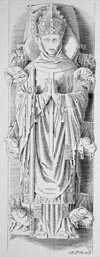
EFFIGY OF JOHN MORTON, ARCHBISHOP OF CANTERBURY AND CARDINAL Cathedral—A.D. 1500 View larger image
Our steps finally take us back to Britford church, and a last look at the cenotaph of the restless, unscrupulous, short-sighted, ill-fated Buckingham. At the end of the tomb the decaying angels still support the proud escutcheons of Stafford and Widville, names here, in the funeral pomp of the grave, linked in the closest and most loving tie of human relationship, but in the olden life precedent, opposed to each other with a bitterness that death alone could appease. Time has now gathered themselves and all their actions into his lap, the fierceness of their strife is hushed into silence, and all the suspense and agony that haunted their lives and tracked them to its last resting-place, is over; and the wayfarer who contemplates their sadly-incidented story, and seeks to identify the few wrecks left to perpetuate their memory, as he turns away, mutters to himself the prayerful entreaty doubtless once inscribed over their dust, "cujus anime propicietur Deus, Amen."
We linger a moment to catch a glance at the remarkable Saxon doorways still preserved in the nave,—relics coeval with the age when Old Sarum was in its best estate, and centuries before the glorious fane that adorns its new namesake was born or thought of,—and then emerge into the pleasant evening sunlight. How delightfully-reviving the communion with the purity of Nature, after our thoughts have been saddened by a contemplation of the self-sought miseries of her children. We saunter quietly along under the fine trees that overhang our path, loiter awhile to survey an old moated house, and then pass on by a winding path through mead and lane to Salisbury. Before us is the bright, busy little city, and above it is upreared the remarkable feature that has made its reputation world-wide, the glorious spire of its Cathedral. Higher and still more heavenward, its faultless proportion rises at every step, until standing within its shadow, our thoughts are lost in admiration of those men, who, when they had built an earthly home "to the high and lofty One that inhabiteth eternity," reared this shaft of beauty from its midst, in testimony that their aspirations were not satisfied until they had placed its top-stone as near His heavenly home as human hands could raise it.
SALISBURY SPIRE.
Eyes of the soul,—turn from thought's busy realm, And dwell awhile on yon height-piercing spire, The sight is none that all things overwhelm, But one that bids us rise to all things higher. Delved from the earth a rude and shapeless thing, Rended by force from the deep quarry's breast,— Behold from such, a pure form upward spring, In beauty's fairest vesture aptly drest.
So may'st thou ravish thought's uncultured mine, From the rude mass harmonious outlines blend, Clothe with true beauty all the fair design, That based on earth shall to the heaven ascend Like Babel's tower,—but no confusion show, By one grand purpose raised from all that's low.
UNHORSED AT BOSWORTH.
The "silent finger that points to heaven" has, beyond all comparison, its finest exemplar at Salisbury, and this record, although common as a household word, is, notwithstanding, none the less true and impressive, and ever returns with Tithonic vigour at each renewed contemplation. Graceful in the happiest degree in proportion, its great altitude gives a power to its slender beauty of form, altogether beyond the rivalry of its sister spires that spring with humbler charms from this land of ours. Thus it stands in grand isolated dignity, amid the long-swelling undulations of the Wiltshire hills, with base trending earth-ward, yet lost before touching the ground amid the blue mist that creeps with shrouding haze along the wolds,—but its fine-drawn point pierces with no uncertain intention the quiet amber of the evening sky.
It would be perhaps difficult to find any where, taken in sympathy with its peculiar associations, a picture more impressive and delightful. The purpose of its builders,—the object of its dedication,—its majesty of size and height, lifting itself as it were far from the busy haunts and homes of those, who living, nestle at its feet, or in death are laid beneath its protective shadow,—its dark-tinted, yet well-defined, heaven-ward rising, beautiful outline,—so suggestive in its form of the design of this life, scarce rooted in the earth, yet with apex cleaving the sky, and tinctured too akin with the gloomy tints of human uncertainty, summon a host of thoughts from the inner recesses of the soul, and bids the gazer on its fair proportion and upward glance ask himself as he views it, how far the resemblance reflects his own condition, what he was designed for, what he has made himself.
And now the attraction of its wonderful presence has drawn us nearer, and we are sitting contemplatively under one of the large elms in the Close where the grand proportions of the fine cathedral are before us. Almost oppressive for a while, is the realization of its great size, and the glance upward from the spirelets of the west front to the apex of the glorious spire, vanishing in the blue ether. But the eye must not dally with, nor dwell too lovingly on the delicate interlacery it is arrayed in, for however beautiful in itself, or when viewed alone, its decoration scarcely harmonizes with the bolder and more largely-defined ornamental details of the structure below; and the comparison at once assures us that this splendid addition was the offspring of a somewhat later age, but redolent of the truest and purest perception of architectural beauty, and was placed there with feeling akin to the tasteful hand that completes the cluster of gathered flowers with a tall spikelet of harmonious form, but of otherwise almost imperceptible contrasting beauty.
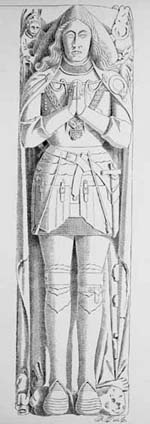
EFFIGY OF LORD CHENEY, SALISBURY CATHEDRAL View larger image
What words may appropriately describe this almost unrivalled picture? Two lines from one of our greatest bards suggest themselves,—
"Simple, erect, severe, austere, sublime— Relic of nobler days, and noblest arts!"
to which may be added that rare impression of unbroken harmony, and the pleasant satisfaction of this feeling clothes gratefully every aspect presented.
Singularly pleasant to the eye, also, and giving a sense of stability to this fine building, is the noble base-line of strong moulding that follows every length, angle, and recess, and adds the finish of completeness from spire to basement.
We enter, and within as without all is pure, severe, and uniform, the offspring of an age before men's minds and hands were wooed of their strength by the blandishments of ornament, and while yet they relied on the rare and noble simplicity of perfected outline, ever the most difficult of achievement, and, consequently when attained, ever the more enduring of pleasure. Those dark, slender shafts, with their deep-cut capitals, stand with airy but decided purpose from jutting quoin, or flank the strong arches, perfectly harmonizing with the contour of all about them; and while they relieve the monotony or severity of their surroundings, do not intrude on the eye, nor distract the attention further, but quietly and unobtrusively fill the true subsidiary position that should ever be assigned to ornament, and nothing beyond.
Were it possible to take a stranger into the cathedral, and, ignorant of its existence, place him under the spire, the wildest flight of imagination could not conjure within his mind the possibility of the existence of the noble finial that rises above his head. The piers of the arches on which it rests afford no clue, and although somewhat larger than those near them, are nevertheless so comparatively slender that they would attract no notice unless carefully pointed out, and then a glance outside, and another survey within would startle him into an almost awe-struck realization of the consummate boldness that planned, and ability that carried to completion, this wonderful afterthought, and impress him that there were indeed giants in architectural resource, even in those "dark days," as we are sometimes pleased to call them.
Another and most distinguished charm too, finds striking witness at Salisbury. Its chaste and simple grandeur has fairly put to the rout the modern decorator, with his paint-pots and gold leaf,—that sturdy and well-patronized defacer of the real, with the garniture of the cheat. No room for him here, or but scant and in soberest guise, and his meretricious attractions are met everywhere with the declaration mirrored in the gleaming Purbeck, or nestling in the ghost-like shadows that haunt the deep-cut foliage that crowns it,—there is no beauty like reality.
Thus much for our short survey of the stately fabric. Our next inquiry is, what is the special purpose of our visit to-day—where is the object we are in search of? It is for the memorial of one of those half-courtier, half-soldier chieftains, so many of whom threw their fortune in with his, and afterward found distinguished place and occupation at the Court and government of the first Tudor king. Where shall we find it? With a sort of shudder we take a survey of the assemblage of monuments lying so regularly and suspiciously disposed, in lines under the arches of the nave. In the long array we note effigies of templars, bishops, and knights—interposed here and there with brassless stones—reclining for the most part on nondescript-looking tombs, composed of heterogeneous and patchwork materials, having little or no relationship apparently to the figures they support. Instantly we apprehend in its fullest sense, the sacrilegious barbarism of Wyatt, who removed almost the whole of them from their original places in other parts of the edifice, to their present incongruous positions, making up the tombs piecemeal from such fragments out of the general destruction, as happened to fit, or be available,—probably the most deplorable desecration of its kind to be found in the annals of archæological record, and which we wish we could not further think of.
Singularly, almost uniquely rich was this cathedral in tombs of every age, before this ruthless resurrectionist and invader of sepulchres was let loose therein, toward the close of the last century to wreak his fury. Dowsing was almost a hero in desecration, compared with the callous and equally destructive energies of Wyatt, for while the fanatic iconoclast had that fiercest of all flames, ignorant bigotry, to urge him on, it was left to the 'cultivated' imagination of one, who aspired to be thought an architect and man of taste, to set himself up as a rival in the detestable business of spoliation, and scarce any escaped him from the Founder downward, for Bishop Poore was meted out the same fate, impartially as others.
Emerging from under the modern brass screen that separates the choir from the nave, slowly we pass down the south aisle. There, is the beautiful effigy of William Longspée, the first Earl of Sarum, son of Henry II. and fair Rosamond, reclining on his glorious tomb, once covered with exquisite mosaic work, the embossed lions on his enamelled shield, chafing at the indignity of their master having been ousted from his olden station of honour in the Lady Chapel,—Bishop de la Wyle the founder of St. Edmund's Collegiate Church in this city at the close of the thirteenth century,—the tomb of the unfortunate Lord Stourton of murderer's fame and silken halter,—the martial proportions of the second Lord Hungerford, brought hither from the demolished Chantry erected by his wife the last Bottreaux, on the north side of the retro-choir,—next, the tomb of Bishop Beauchamp, the "Wykeham of his age" (for he superintended the building of St. George's Chapel at Windsor Castle), taken from his beautiful Chantry, that once had place opposite to Lady Hungerford's; and following him, the interesting effigies of two other early and distinguished Bishops, Roger, and Joceline, A.D. 1184, and brought from old Sarum! The face of Bishop Joceline, although so old and denuded, still exhibits the marvellous placidity of sleep, all the more so from the partial effacement of the features, but displaying an effect no modern sculpture could imitate.
But he whom we seek is not found among this long succession of departed greatness, and we carefully proceed with our investigation up the north aisle.
Here the first we meet with, is the unique and mysterious "Boy Bishop,"—lying at length and much denuded beneath his protective iron grating. Then we pass two "unappropriated" tombs, and next a mail-clad effigy said to be William Longspée, second Earl of Salisbury, son of the William on the other side,—then a fine figure of a knight in bascinet and surcoat, John de Montacute, with fortunately a considerable portion of the original tomb below him. Whom does this desolate-looking pair of brassless stones, side by side record, with indent of man and wife still apparent on them? Ah! the emblem powdered on the stone,—the harvest sickle,—unravels their story, and a feeling of sadness pervades us, as we recognize in them the memorials that once covered the dust of Walter, the first Lord Hungerford—father of Robert on the opposite side—and Katharine Peverel his wife, shifted here about a century since, as an inscription on them informs us, "by Jacob C. Radnor," when he removed the beautiful iron-work Chantry in which they originally had appropriate place, and carried it away to the east end of the choir to do duty as a 'family pew.'
There is but one more effigy, you say,—as we turn from this last memorial of the long sequence of departed and 'translated' worthies—and that must be him whom we seek. A glance at the tall armoured figure immediately assures us that he is found, Sir John Cheney, Baron of that name; and a stout adherent of the first Tudor sovereign, Henry VII.
The family of Cheney, as we have previously noted,[26] was a wide spreading one in the south of England, and, according to Burke, derived their descent from a common ancestor, Ralph de Caineto, who came to England with the Conqueror.
Sir John, of the monument before us, was of Kentish extraction. William, the son of Sir Alexander Cheney, married Margaret, daughter and heir of Sir Robert de Shurland, of Shurland in the parish of Eastchurch, in the Isle of Sheppey. He died 8 Edward III., 1333, leaving issue Robert, who left issue Sir Richard of Shurland, who married Elizabeth, daughter of Robert Cralle, of Cralle, Sussex, by whom he left two sons, William of Shurland, and Richard of Cralle.
Sir William Cheney of Shurland, Sheriff of Kent, 13 Henry IV., 1412,—1 Henry V., 1414,—2 Henry VI., 1424, Knight of the Shire for Kent, 3 Henry V., 1418, died 21 Henry VI., 1443, and was buried with Margaret his wife in St. Benet's church, Paul's Wharf, London.
He was succeeded by his son Sir John, Knight of the Shire for Kent, 27 Henry VI., 1449, and Sheriff 33 Henry VI., 1455. He married Eleanor, daughter and coheiress of Sir Robert de Shottisbroke, knt., and sister to Margaret, Duchess of Somerset. There were two sons, John and William.
Sir William, second son, was Sheriff of Kent 7 Edward IV., 1467, and I Henry VII., 1486, was appointed Constable of Queenborough Castle, the same year. He was twice married; by his first wife had one son, Sir Francis Cheney, who succeeded his father as Constable of Queenborough Castle, and died without issue; and by his second wife one son, Thomas, who became his uncle John's heir. (Hasted.)
Sir John Cheney, the eldest son, of Shurland, is the subject of our narrative. He appears to be the first of this numerous and influential race that reached the honour of the peerage.[27]
We first hear of him in 1465, when he was one of the Commissioners sent to treat with the King of Denmark, accompanied by Dr. Goldwell, Dean of Salisbury. He is here called "strenuus miles," probably from his great stature and strength.
In 1475, where he is termed Esquire of the King's body, with a retinue of seven men at arms, including himself, he accompanied the English army to Calais, in the expedition to France by Edward IV., when that king was first deceived and then out-manœuvred by the Dukes of Brittany and Burgundy, and afterward bought off from all his martial intentions by the French king Louis XI., promising to pay him seventy-two thousand crowns down, and a yearly pension of fifty thousand crowns for life,—marry his son the Dauphin to Edward's daughter Elizabeth (afterward wife to Henry VII.), and a further sum of fifty thousand crowns as a ransom for the release of the widowed Queen Margaret. Louis, remembering Crecy and Agincourt, was exceedingly anxious to see the backs of the English turned on France, and besides all this money, or the promise of it, sent to Edward "three hundred waggon loads of wine," and further cartloads for the use of his army; and "at length the French king's fears vanished with the departure of the English, who went away extremely pleased with the French gold and wine, while the pensions assigned to Edward's principal courtiers amounted to sixteen thousand crowns a year."
Among the "principal courtiers" who were recipients of this inglorious spoil, Sir John Cheney's name is given as one, and associated with him were John Grey, Marquis of Dorset, William, Lord Hastings, his wife's father-in-law, the King's Chamberlain, and Dr. Thomas Morton, born at Bere-Regis, in Dorset,—then Master of the Rolls, and afterward Cardinal and Archbishop of Canterbury; all west-country names of great interest connected with our little annals. It was however stipulated by his French majesty, after seeing Edward, and swearing the treaty, that John, Lord Howard, and Sir John Cheney, Master of the Horse, should be left as hostages, until the King of England (after receiving the seventy-two thousand crowns) had passed the seas with his army. Edward, after receiving the money, embarked his forces with all expedition, and Howard and Cheney remained until his arrival in England, during which interval they were entertained "very nobly" by the French king.
We do not find him further mentioned during the reign of Edward IV., or the short rule of his unfortunate son, but soon after the usurpation of Richard III., he was among those who gave his adhesion to the Countess of Richmond (mother of Henry VII.) being won over to the interest of her son by her trusty envoy, Sir Reginald Braye, and with him was Sir Giles Daubeney, and other influential men.