Volume 27 — CHAPTER VIII.
Reading edition
Until he stood on the platform on Wednesday morning with his brother adventurers Mr. Chalk passed the time in a state of nervous excitement, which only tended to confirm his wife in her suspicions of his behaviour. Without any preliminaries he would burst out suddenly into snatches of sea-songs, the "Bay of Biscay" being an especial favourite, until Mrs. Chalk thought fit to observe that, "if the thunder did roar like that she should not be afraid of it." Ever sensitive to a fault, Mr. Chalk fell back upon "Tom Bowling," which he thought free from openings of that sort, until Mrs. Chalk, after commenting upon the inability of the late Mr. Bowling to hear the tempest's howling, indulged in idle speculations as to what he would have thought of Mr. Chalk's. Tredgold and Stobell bought papers on the station, but Mr. Chalk was in too exalted a mood for reading. The bustle and life as the train became due were admirably attuned to his feelings, and when the train drew up and they embarked, to the clatter of milk-cans and the rumbling of trolleys, he was beaming with satisfaction.
"I feel that I can smell the sea already," he remarked.
Mr. Stobell put down his paper and sniffed; then he resumed it again and, meeting Mr. Tredgold's eye over the top of it, sniffed more loudly than before.
"Have you told Edward that you are going to sea?" inquired Mr. Chalk, leaning over to Tredgold.
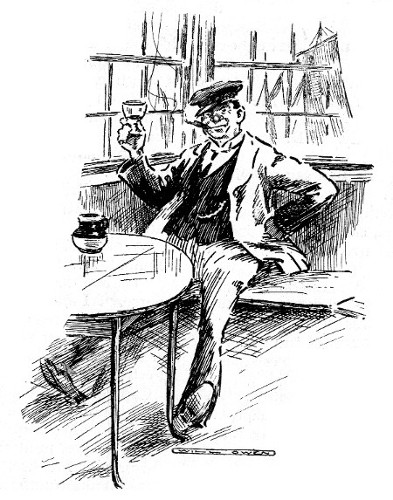
"'FINE DAY, GENTLEMEN,' SAID THE STRANGER, AS HE RAISED HIS GLASS."
"Certainly not," was the reply; "I don't want anybody to know till the last possible moment. You haven't given your wife any hint as to why you are going to Biddlecombe to-day, have you?"
Mr. Chalk shook his head. "I told her that you had got business there, and that I was going with you just for the outing," he said. "What she'll say when she finds out——"
His imagination failed him and, a prey to forebodings, he tried to divert his mind by looking out of window. His countenance cleared as they neared Biddlecombe, and, the line running for some distance by the side of the river, he amused himself by gazing at various small craft left high and dry by the tide.
A short walk from the station brought them to the mouth of the river which constitutes the harbour of Biddlecombe. For a small port there was a goodly array of shipping, and Mr. Chalk's pulse beat faster as his gaze wandered impartially from a stately barque in all the pride of fresh paint to dingy, sea-worn ketches and tiny yachts.
Uncertain how to commence operations, they walked thoughtfully up and down the quay. If any of the craft were for sale there was nothing to announce the fact, and the various suggestions which Mr. Chalk threw off from time to time as to the course they should pursue were hardly noticed.
"One o'clock," said Mr. Stobell, extracting a huge silver timepiece from his pocket, after a couple of wasted hours.
"Let's have something to eat before we do any more," said Mr. Tredgold. "After that we'll ferry over and look at the other side."
They made their way to the King of Hanover, an old inn, perched on the side of the harbour, and, mounting the stairs, entered the coffee-room, where Mr. Stobell, after hesitating for some time between the rival claims of roast beef and grilled chops, solved the difficulty by ordering both.
The only other occupant of the room, a short, wiry man, with a close-shaven, hard-bitten face, sat smoking, with a glass of whisky before him, in a bay window at the end of the room, which looked out on the harbour. There was a maritime flavour about him which at once enlisted Mr. Chalk's sympathies and made him overlook the small, steely-grey eyes and large and somewhat brutal mouth.
"Fine day, gentlemen," said the stranger, nodding affably to Mr. Chalk as he raised his glass.
Mr. Chalk assented, and began a somewhat minute discussion upon the weather, which lasted until the waiter appeared with the lunch.
"Bring me another drop o' whisky, George," said the stranger, as the latter was about to leave the room, "and a little stronger, d'ye hear? A man might drink this and still be in the Band of Hope."
"We thought it wouldn't do for you to get the chuck out of it after all these years, Cap'n Brisket," said George, calmly. "It's a whisky that's kept special for teetotalers like you."
Captain Brisket gave a hoarse laugh and winked at Mr. Stobell; that gentleman, merely pausing to empty his mouth and drink half a glass of beer, winked back.
"Been here before, sir?" inquired the captain.
Mr. Stobell, who was busy again, left the reply to Mr. Chalk.
"Several times," said the latter. "I'm very fond of the sea."
Captain Brisket nodded, and, taking up his glass, moved to the end of their table, with the air of a man disposed to conversation.
"There's not much doing in Biddlecombe nowadays," he remarked, shaking his head. "Trade ain't what it used to be; ships are more than half their time looking for freights. And even when they get them they're hardly worth having."
Mr. Chalk started and, leaning over, whispered to Mr. Tredgold.
"No harm in it," said the latter. "Better leave it to me. Shipping's dull, then?" he inquired, turning to Captain Brisket.
"Dull?" was the reply. "Dull ain't no name for it."
Mr. Tredgold played with a salt-spoon and frowned thoughtfully.
"We've been looking round for a ship this morning," he said, slowly.
"As passengers?" inquired the captain, staring.
"As owners," put in Mr. Chalk.
Captain Brisket, greatly interested, drew first his glass and then his chair a yard nearer. "Do you mean that you want to buy one?" he inquired.
"Well, we might if we could get one cheap," admitted Tredgold, cautiously. "We had some sort of an idea of a cruise to the South Pacific; pleasure, with perhaps a little trading mixed up with it. I suppose some of these old schooners can be picked up for the price of an old song?"
The captain, grating his chair along the floor, came nearer still; so near that Mr. Stobell instinctively put out his right elbow.
"You've met just the right man," said Captain Brisket, with a boisterous laugh. "I know a schooner, two hundred and forty tons, that is just the identical article you're looking for, good as new and sound as a bell. Are you going to sail her yourself?"
"No," said Mr. Stobell, without looking up, "he ain't."
"Got a master?" demanded Captain Brisket, with growing excitement. "Don't tell me you've got a master."
"Why not?" growled Mr. Stobell, who, having by this time arrived at the cheese, felt that he had more leisure for conversation.
"Because," shouted the other, hitting the table a thump with his fist that upset half his whisky—"because if you haven't Bill Brisket's your man."
The three gentlemen received this startling intelligence with such a lack of enthusiasm that Captain Brisket was fain to cover what in any other man might have been regarded as confusion by ringing the bell for George and inquiring with great sternness of manner why he had not brought him a full glass.
"We can't do things in five minutes," said Mr. Tredgold, after a long and somewhat trying pause. "First of all we've got to get a ship."
"The craft you want is over the other side of the harbour waiting for you," said the captain, confidently. "We'll ferry over now if you like, or, if you prefer to go by yourselves, do; Bill Brisket is not the man to stand in anyone's way, whether he gets anything out of it or not."
"Hold hard," said Mr. Stobell, putting up his hand.
Captain Brisket regarded him with a beaming smile; Mr. Stobell's two friends waited patiently.
"What ud a schooner like that fetch?" inquired Mr. Stobell.
"It all depends," said Brisket. "Of course, if I buy—"
Mr. Stobell held up his hand again. "All depends whether you buy it for us or sell it for the man it belongs to, I s'pose?" he said, slowly.
Captain Brisket jumped up, and to Mr. Chalk's horror smote the speaker heavily on the back. Mr. Stobell, clenching a fist the size of a leg of mutton, pushed his chair back and prepared to rise.
"You're a trump," said Captain Brisket, in tones of unmistakable respect, "that's what you are. Lord, if I'd got the head for business you have I should be a man of fortune by now."
Mr. Stobell, who had half risen, sat down again, and, for the first time since his last contract but one, a smile played lightly about the corners of his mouth. He took another drink and, shaking his head slightly as he put the glass down, smiled again with the air of a man who has been reproached for making a pun.
"Let me do it for you," said Captain Brisket, impressively. "I'll tell you where to go without being seen in the matter or letting old Todd know that I'm in it. Ask him a price and bate him down; when you've got his lowest, come to me and give me one pound in every ten I save you."
Mr. Tredgold looked at his friends. "If we do that," he said, turning to the captain, "it would be to your interest to buy the ship in any case. How are we to be sure she is seaworthy?"
"Ah, there you are!" said Brisket, with an expansive smile. "You let me buy for you and promise me the master's berth, provided you are satisfied with my credentials. Common sense'll tell you I wouldn't risk my own carcass in a rotten ship."
Mr. Stobell nodded approval and, Captain Brisket with unexpected delicacy withdrawing to the window and becoming interested in the harbour, conferred for some time with his friends. The captain's offer being accepted, subject to certain conditions, they settled their bill and made their way to the ferry.
"There's the schooner," said the captain, pointing, as they neared the opposite shore; "the Fair Emily, and the place she is lying at is called Todd's Wharf. Ask for Mr. Todd, or, better still, walk straight on to the wharf and have a look at her. The old man'll see you fast enough."
He sprang nimbly ashore as the boat's head touched the stairs, and after extending a hand to Mr. Chalk, which was coldly ignored, led the way up the steps to the quay.
"There's the wharf just along there," he said, pointing up the road. "I'll wait for you at the Jack Ashore here. Don't offer him too much to begin with."
"I thought of offering a hundred pounds," said Mr. Tredgold. "If the ship's sound we can't be very much out over that sum."
Captain Brisket stared at him. "No; don't do that," he said, recovering, and speaking with great gravity. "Offer him seventy. Good luck."
He watched them up the road and then, with a mysterious grin, turned into the Jack Ashore, and taking a seat in the bar waited patiently for their return.
Half an hour passed. The captain had smoked one pipe and was half through another. He glanced at the clock over the bar and fidgeted as an unpleasant idea that the bargain, despite Mr. Tredgold's ideas as to the value of schooners, might have been completed without his assistance occurred to him. He took a sip from his glass, and then his face softened as the faint sounds of a distant uproar broke upon his ear.
"What's that?" said a customer.
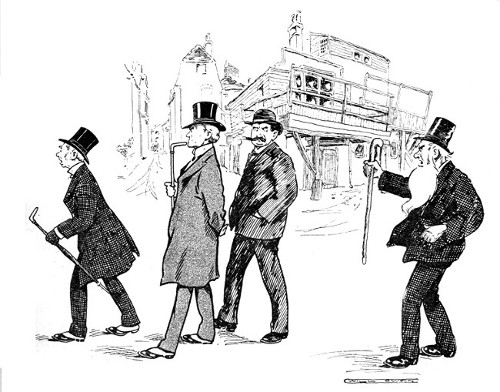
"HIS THREE PATRONS, WITH A HOPELESS ATTEMPT TO APPEAR UNCONCERNED, WERE COMING DOWN THE ROAD."
The landlord, who was glancing at the paper, put it down and listened. "Sounds like old Todd at it again," he said, coming round to the front of the bar.
The noise came closer. "It is old Todd," said another customer, and hastily finishing his beer moved with the others to the door. Captain Brisket, with a fine air of indifference, lounged after them, and peering over their shoulders obtained a good view of the approaching disturbance.
His three patrons, with a hopeless attempt to appear unconcerned, were coming down the road, while close behind a respectable-looking old gentleman with a long, white beard and a voice like a fog-horn almost danced with excitement. They quickened their pace as they neared the inn, and Mr. Chalk, throwing appearances to the winds, almost dived through the group at the door. He was at once followed by Mr. Tredgold, but Mr. Stobell, black with wrath, paused in the doorway.
"Fetch 'em out," vociferated the old gentleman as the landlord barred the doorway with his arms. "Fetch that red-whiskered one out and I'll eat him."
"What's the matter, Mr. Todd?" inquired the landlord, with a glance at his friends. "What's he done?"
"Done?" repeated the excitable Mr. Todd. "Done? They come walking on to my wharf as if the place——Fetch him out," he bawled, breaking off suddenly. "Fetch him out and I'll skin him alive."
Captain Brisket took Mr. Stobell by the cuff and after a slight altercation drew him inside.
"Tell that red-whiskered man to come outside," bawled Mr. Todd. "What's he afraid of?"
"What have you been doing to him?" inquired Captain Brisket, turning to the pallid Mr. Chalk.
"Nothing," was the reply.
"Is he coming out?" demanded the terrible voice, "or have I got to wait here all night? Why don't he come outside, and I'll break every bone in his body."
Mr. Stobell scratched his head in gloomy perplexity: then, as his gaze fell upon the smiling countenances of Mr. Todd's fellow-townsmen, his face cleared.
"He's an old man," he said, slowly, "but if any of you would like to step outside with me for five minutes, you've only got to say the word, you know."
Nobody manifesting any signs of accepting this offer, he turned away and took a seat by the side of the indignant Tredgold. Mr. Todd, after a final outburst, began to feel exhausted, and forsaking his prey with much reluctance allowed himself to be led away. Snatches of a strong and copious benediction, only partly mellowed by distance, fell upon the ears of the listeners.
"Did you offer him the seventy?" inquired Captain Brisket, turning to Mr. Tredgold.
"I did," said Mr. Chalk, plaintively.
"Ah," said the captain, regarding him thoughtfully; "perhaps you ought to ha' made it eighty. He's asking eight hundred for it, I understand."
Mr. Tredgold turned sharply. "Eight hundred?" he gasped.
The captain nodded, "And I'm not saying it's not worth it," he said, "but I might be able to get it for you for six. You'd better leave it to me now."
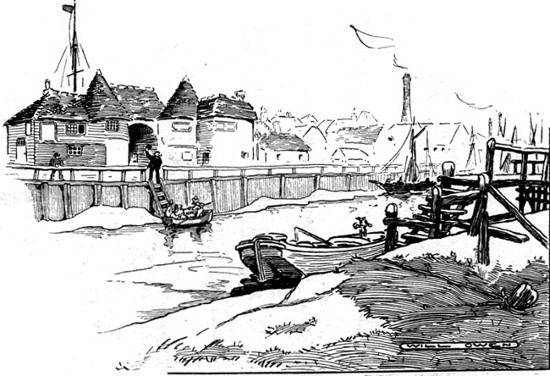
Mr. Tredgold at first said he would have nothing more to do with it, but under the softening influence of a pipe and a glass was induced to reconsider his decision. Captain Brisket, waving farewells from the quay as they embarked on the ferry-boat later on in the afternoon, bore in his pocket the cards of all three gentlemen, together with a commission entrusting him with the preliminary negotiations for the purchase of the Fair Emily.
"CAPTAIN BRISKET WAVING FAREWELLS FROM THE QUAY AS THEY EMBARKED."
(To be continued.)
FOOTNOTES:
By Julian Drake
[In April of last year the steamer Miosen, from Christiania, sailed from New Orleans. Owing to a damaged tail-shaft off Key West she practically drifted from the Straits of Florida to the Färöe Islands. From the captain's notes the following account of the Gulf Stream voyage is transcribed.]
What is the greatest river in the world? Naturally every Kindergarten pupil would instantly respond by naming the Mississippi, with the Amazon a good second. But that is because they are deceived by geographers jealous of the prerogative of the land. Hydrographers—as, for example, Sir John Murray, K.C.B.—would return a different answer, and it is clear that hydrographers ought to know something about water.
The greatest river in the world, then, begins in the vicinity of Key West, Florida. There is on the globe no such stupendous flow of waters. It defies the severest droughts; in the mightiest floods it never overflows. Its current sweeps onward more rapidly than the Mississippi or the Amazon and its volume is a thousand times greater. Let us rid our mind of the idea of land. The banks and the bottom of this stupendous river are of cold, whilst its current is of warm, water. The name of it is the Gulf Stream. It might properly be called the Atlantic River. Doubtless many hundreds, even thousands, of craft have made the voyage down this river from its source to its mouth, and the trip of the Miosen, of Christiania, Norway, is only remarkable in this: that she virtually drifted the whole distance, four thousand two hundred and twelve miles. The Miosen is a Norwegian steamer of one thousand two hundred and eighty tons, and carried a cargo of molasses, rice, and tobacco from New Orleans to Christiania.
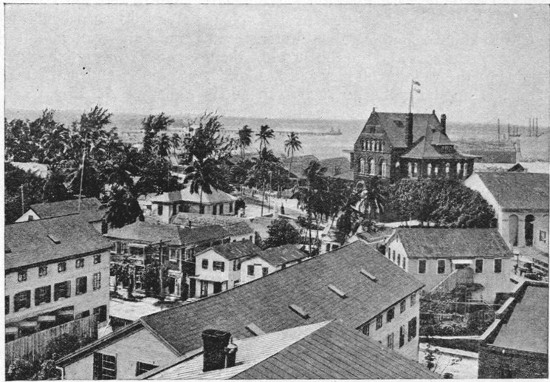
After leaving New Orleans early in April, 1903, she encountered roughish weather in the Gulf of Mexico. But it was not until they had passed the Tortugas group that Captain Westrup suspected that there was anything radically wrong with the machinery. The Miosen was fitted with old-fashioned Glasgow engines, and carried a sail in case of emergency. At Key West she put in for four days to see if the engineer could patch up the propeller sufficiently to enable the vessel to cross the Atlantic. "It was at Key West," said Captain Westrup, "I met an old fellow-mariner, a Swede.
"'Going down the river?' he asked.
"I laughed, not understanding the joke.
"'No; I'm crossing the Atlantic,' I replied.
"I then told him about the fractured propeller.
"'Take my advice,' he said, 'and go by the river route. Like as not you'll drift the whole way, and if you're in no hurry you can give your engines a rest. A single sheet to the wind will do your job.'
"It was the first time I had heard the expression 'river' as applied to the Gulf Stream. The idea entertained me. I already began to regard my forthcoming trip as a mere jaunt down a river, and with this in my head I took pains to note everything of interest connected with this stupendous stream. And here let me say that two leagues to the south-east of Key West the Gulf mariners point to a buoy labelled in prominent letters 'F. C.,' which stands for Florida Channel. It marks the end of the Gulf of Mexico and the beginning of the Atlantic River."
THE BUOY IN FLORIDA CHANNEL.
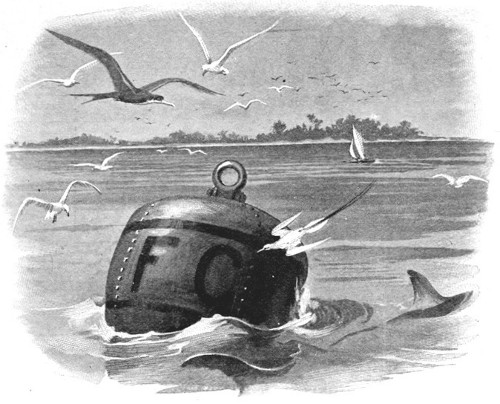
The machinery of the Miosen was patched up by the 5th April, and on the following morning the crew had hoisted her solitary sail and departed from Key West. All along south of the Florida reef they had constant glimpses of tarpon, devil-fish, and barracuda, the mightiest fish in the Gulf Stream. For it must be understood that whales and sharks avoid the greatest river in the world. We will explain why later. During the next few days they frequently saw tarpon (Megalops Atlanticus) six feet long, reminding one of gigantic herring. Some of them must have weighed one hundred and fifty pounds; and the one which nearly boarded the steamer, leaping into the air a foot from the bows of the Miosen, was fully this weight.
KEY WEST. From a Photo. by the Photochrom Co.
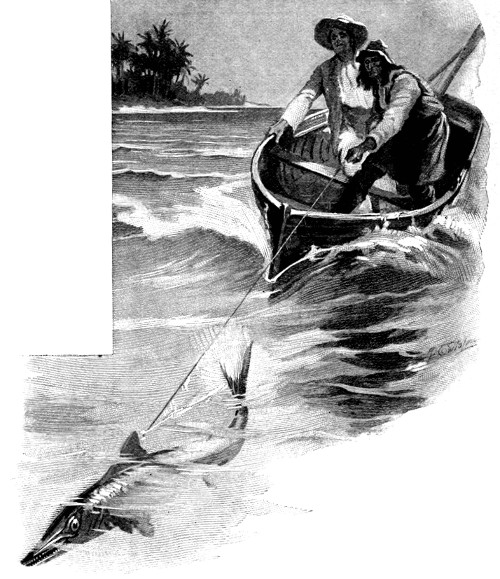
"I had heard stories at Key West about the barracuda, which is harpooned very much in the way whales are, although it is a somewhat smaller fish than the tarpon. My friend Captain Altsen told me he had once gone out in a small dinghy off the Keys with a Seminole Indian who was an adept at spearing barracuda. Armed with a long, slender pole tipped with a barb, to which a long rope was fastened, the native had speared the fish, which darted away like 'greased lightning,' actually towing the boat a full mile before he was hauled aboard exhausted. He said it was pretty exciting sport, and jokingly suggested my engaging a school of barracuda to tow the Miosen to Stockholm. He observed, however, that they would probably leave the ship at Tindhölm, as they only frequent the Gulf Stream.
"THE FISH DARTED AWAY LIKE 'GREASED LIGHTNING.'"
PHOTOGRAPH TAKEN BY THE MATE OF THE "MIOSEN" IN LATITUDE 30, LONGITUDE 82, SHOWING THE DIFFERENT ASPECT OF THE GREAT RIVER AND THE OCEAN.
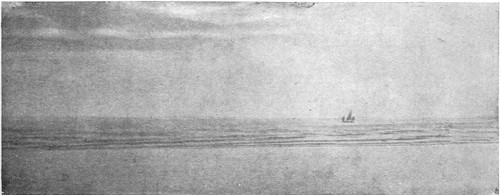
"I may mention that at the beginning our speed was between four and five knots an hour, but we hardly averaged more than about fifty knots a day. There was little wind to speak of. On the 8th we had a fair breeze, which sent us along a couple of knots faster. The speed of the current is, I am told, wholly regulated by the presence or absence of wind; but I give the normal time. As we rounded the south coast of Florida we encountered huge flocks of birds wending their way northward. Anything more placid and beautiful than the Gulf Stream at this point cannot be imagined. The water is a brilliant blue, like the Bay of Naples, while in the far distance may be seen the dark green of the ocean. The temperature of the water I ascertained to be seventy-four degrees Fahrenheit; that of the Atlantic could hardly have been above forty-five degrees. Off Bebini we observed a curious sight, which more than ever impressed the idea of a river on our minds, and this occurred several times in the course of our long trip. The presence of a stiff land breeze blew us out of the channel to the very edge of the Stream, whose boundaries were here as clearly marked as that of the Mississippi. Great quantities of driftwood and flotsam of all sorts, including canes and palm leaves, floated in a long, thin line extending for miles, forming natural banks to the world's greatest river. My mate took a photograph of this phenomenon, together with others, but, unluckily, in developing them later, all were more or less spoiled, although some idea may be got from the one showing the aspect of the Stream. We also observed numerous flying-fish, which, curiously enough, rarely, if ever, deviated from the path of the Stream, as if they were quite aware of its course and boundaries."
DIAGRAM SHOWING THE COURSE OF THE GULF STREAM.
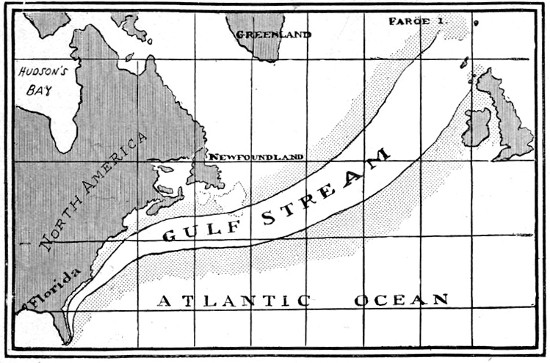
From this point the river flows straight to the north, pressing through the ocean with a width of nearly thirty-seven miles, and of an average depth of two hundred fathoms. The mass of water has been estimated at some forty-five millions of cubic yards a second. The mean discharge of the Mississippi is barely twenty-five thousand cubic yards.
As the Gulf Stream expands and spreads in its northward and easterly course, its depth becomes proportionately less considerable. The strata of cold water which serve as its banks retire on each side and allow it more breadth. The cold bed of water which bears it, and over which it flows, as terrestrial rivers glide over beds of rocks, gradually approaches nearer the surface. Off Cape Hatteras the depth is about one hundred and twenty fathoms, and its speed does not exceed three miles an hour, but it is twice as wide as when it emerges from the Strait of Florida. Its width is here seventy-eight miles. Its thickness, of course, constantly diminishes until it is only a thin sheet of warm water on the other side of the Atlantic, and is gradually dissipated in the sub-Arctic sea.
THE "CITY OF SAVANNAH," WRECKED IN THE GREAT STORMS OF 1893.
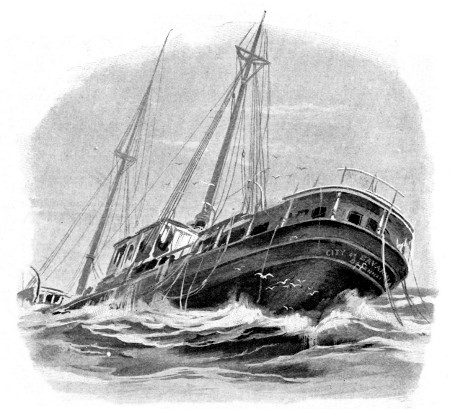
As the travellers proceeded almost due north the island of Great Bahama soon came to form the eastern boundary of the Gulf Stream. In this locality many fearful storms have occurred, for when the river is angry it is one of the most fearful places in the world for a ship to be. It is said that the whole of the Bahama Islands which lie scattered through the sea to the east of the Gulf Stream rest on a foundation of submarine banks formed by the deposits of the river. The same may be said of the islands which line the coasts of Georgia and the Carolinas on the west. Off one of these islands the captain distinctly made out the wreck of a large craft, floating free on the edge of this current, which he has since been told was the City of Savannah, wrecked in the great storms of 1893. Derelicts are common in these parts, no fewer than forty having been reported last year.
Long ago the soundings taken by the officers of the American Coast Survey showed, according to Lieut. Maury, that the Gulf Stream flows along the coast of America at some distance from the land. The slight inclination of the low lands of Georgia and Carolina is continued under water till the sounding line attains a depth of about fifty fathoms. The bottom then sinks rapidly and forms a long valley parallel to the shore of America and the chalky walls of the Appalachian range. In this valley, hollowed to the east of the submarine basement of America, the Gulf Stream waters flow. Owing to the rotatory motion of the globe and also to the curve of the coasts, the Stream follows a constant direction to the north-east. Off New York and Cape Cod it deviates more and more to the east. It ceases to follow the coast-line, and rolls across the open Atlantic towards the shores of Western Europe. Thus, as Maury says, if an enormous cannon had force enough to send a bullet from the Strait of the Bahamas to the North Pole the projectile would follow almost exactly the curve of the Gulf Stream and, gradually deviating on its way, reach Europe from the west.
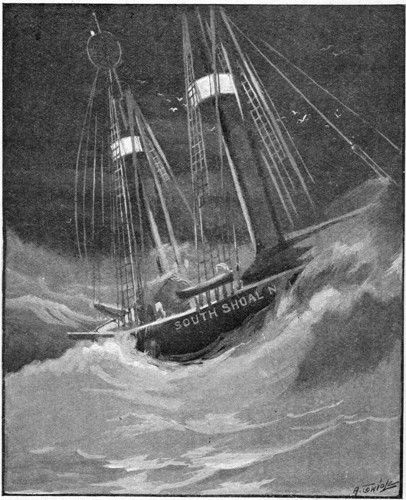
THE SOUTH SHOAL LIGHTSHIP, WHICH MARKS THE SITE OF AN OCEAN GRAVEYARD.
We have spoken of the driftwood boundaries of the Gulf Stream; but there is an even more pronounced barrier easily ascertained by a use of the thermometer. The warmest and most rapid part of the Gulf Stream is that in most immediate juxtaposition to a sheet of cold water flowing in an opposite direction off Carolina which bounds our river like a wall of ice. Occasionally the line of demarcation is so precise that it is visible to the naked eye, and the exact moment when a ship leaves the cold current and its prow cleaves the Gulf Stream may be observed. The latter waters are of a beautiful azure, that of the counter-current is greenish; one is saturated with salt, the other contains the mineral to a far slighter extent. But the chief distinction is that one is tepid, the other frigid as ice.
On the 21st one of the men reported having sighted a light to the north, and had also clearly heard a distant bell tolling. This was probably the South Shoal Lightship, which marks the site of an ocean graveyard hereabouts. This lightship, with a crew of a dozen men, has been adrift nearly thirty times in the course of her history, and was once fourteen days in the Gulf Stream. She is a schooner or barge of two hundred and seventy-five tons, about one hundred feet long, chained to an anchor of three and a half tons. But it is said the life aboard is so unbearably monotonous to the crew that they cut the chain and so send the lightship adrift. The skipper was glad when the Gulf Stream carried him away from the neighbourhood, for he was reminded that over five hundred wrecks have taken place some leagues to the northward of his course.
"THE TEMPERATURE OF THE STREAM WAS DISAGREEABLE TO HIM."
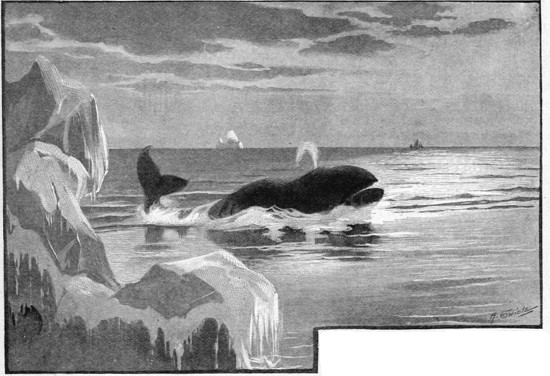
The Miosen was now bound almost due east, as if headed for the Azores, for the great river curves at this point. Just south of Halifax, in longitude sixty-five degrees, they came across their first iceberg, drifting on the very edge of the stream. There is nothing so unhealthy for an iceberg as the Gulf Stream, and an iceberg seems to know it. When, however, it is fairly caught in its clutches it soon melts away to nothingness before it has been carried many leagues eastward, all depending, of course, upon its size. As with icebergs, so with whales, as we have already mentioned. The vessel encountered a whale later in longitude fifty, but it was obvious that the temperature of the Stream was disagreeable to him, for he soon headed again for the Arctic regions. Other whales make a dash through or remain by the side of the big river and so reach lower latitudes, but a brief sojourn is enough for them. The Gulf Stream is a river which can boast everything maritime but whales.
The great river just touches the southern extremity of the Grand Banks of Newfoundland. This bank of Newfoundland, an enormous plateau surrounded on all sides by abysses five to six miles deep, is chiefly due to the contact of the Arctic current with the Gulf Stream. For here is the chief graveyard of icebergs. On entering the tepid waters of the river the frozen mountains gradually melt and let fall the fragments of rock and loads of earth they bear into the sea. The bank, which rises gradually from the bottom, is the work of the Greenland glaciers and the floes of the Polar Sea. It is the presence of the Gulf Stream in these latitudes which is the cause of the prevalent fogs not only here, but in the islands off Europe. From here onward a sailor can always tell whether or not he is in the Stream by plunging a thermometer overboard. Capt. Westrup found that it crosses the Atlantic with a mean speed of twenty-four knots a day. This had previously been ascertained, according to Maury, by direct measurement at different parts of the ocean, or by means of notes, which, having been thrown overboard in bottles, carefully closed, have floated for weeks or months at the will of the waves, and then been fished up in other latitudes or found on some seashore. In its long journey this mighty river transports hardly any other alluvium than the living frustules of animalculæ which fill the tepid waters of the current, and are constantly falling like snowflakes to the bottom of the ocean. However, during the whole distance across the Miosen constantly met with the trunks and branches of trees, cane stalks, and woody flotsam, much of which finally reaches the coasts of Europe, even as far as Spitzbergen.
"It was," says M. Reclus, "these remains which our ancestors of the Middle Ages believed to come from the fabulous island of St. Brandan or from Antilia, and which furnished matter for thought to daring navigators like the great Columbus. Seeds carried from the New World by the current have found a favourable soil on the shores of the Azores, and, although many thousands of miles from their native land, have germinated and borne fruit. Frequently the Gulf Stream brings to Europe the damaged products of human industry and the timber of wrecked ships. During the Seven Years' War the main-mast of an English man-of-war, the Tilbury, which had been burnt near San Domingo, was found on the northern coasts of Scotland. Also, a river-boat laden with mahogany was once driven to the Färöe Islands. The remnants of vessels wrecked in the latitude of Guinea have reached the British Isles on the Gulf Stream, and Esquimaux canoes have often been carried on its waves to the Orkneys."
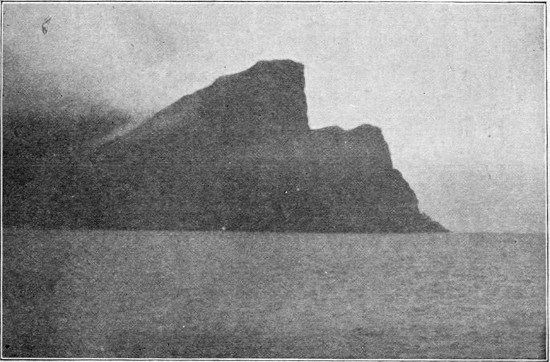
The Färöe Islands formed the temporary stopping-place of the Miosen.
"Here," states the captain, "we disembarked at Thorshaven on May 13th. On the morning of the 12th we sighted Tindhölm, which is generally regarded as the barrier or point marking the end of the longest river in the world. We had begun our voyage at its source, and had traversed four thousand two hundred and twelve miles to its mouth, where the waters spread out into the great North Sea."
APPROACH TO THE FÄRÖE ISLANDS—THE END OF THE GULF STREAM. From a Photo.
Of the incalculable benefit to the climate of the British Isles and Western Europe which the Gulf Stream confers, one need not here pretend to speak. The river waters lose their warmth but slowly, and during winter they often have, off Cape Hatteras and the bank of Newfoundland, a temperature twenty-eight degrees Fahrenheit above that of the ocean. Thus they become a source of heat to Western Europe. Owing to the warmth of its waters the lakes of the Färöe and Shetland Isles never freeze in winter. Great Britain is enveloped in fogs and the myrtle grows on Irish shores in the same latitude as icy Labrador. The western coasts of Ireland have five degrees higher temperature even than those of the eastern, and there the fifty-second degree of latitude corresponds to the thirty-eighth degree in America. All this is ascribed, and rightly, to the proximity of the world's greatest river.