Volume 27 — Curiosities.
Reading edition
Copyright, 1904, by George Newnes, Limited.
[We shall be glad to receive Contributions to this section, and to pay for such as are accepted.]
AN EXTRAORDINARY OCCURRENCE.
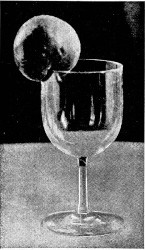
"Whilst lifting a dish of apples from the table one of the apples fell from the dish to the wineglass and remained in the position shown in the photograph. It did not upset the glass, although it was empty. The edge of the glass had cut into the apple, so retaining it in position."—Lieut.-Col. G. T. Trueman, Brooklands, Mansfield Road, Reading.
THE DEVIL'S BRIDGE.
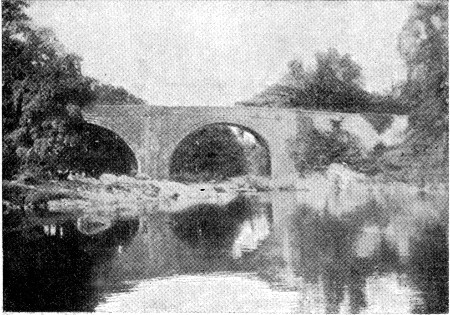
"The bridge shown in the photograph carries with it a curious legend, which runs somewhat as follows. Once upon a time there was no bridge at all, and a ford was the only means at the disposal of the local inhabitants. One day, owing to a flood, an old woman was unable to cross the river to sell her wares at the village market. She began to cry. The Devil hearing her sobs came to her and said he would build a bridge across the river, on condition that he had the very first living being that crossed the bridge after market time, his Satanic Majesty knowing very well that the old woman was always the first on the journey back. The woman promised, and the Devil soon built the bridge. The woman on returning from market was about to step upon the bridge when she suddenly remembered what the Devil had said. Not knowing what to do, she went to the priest and confessed everything. The worthy priest, giving her a cake, advised her to throw it to the other side of the bridge and let her dog run after it. This she did, and the Devil was so angry at being cheated of his prey that he dropped a corner of his apron and the stones fell to the bottom of the river, where they may be seen to this day."—Mr. J. B. Mather, 21, Liverpool Road, Birkdale, near Southport.
A CYCLONIC FREAK.
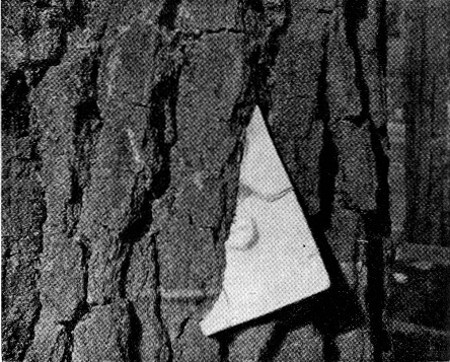
"On Saturday afternoon, October 3rd, 1903, a cyclone passed over the State of Wisconsin from the south-west corner to the north-east corner, doing considerable damage to life and property. At the time I was employed as a local man on the Waupaca Post, and was detailed to write up the results of the storm in that neighbourhood. At a point about seven miles north of Waupaca, near the village of Scandinavia, I found that the wind had demolished a farm-house and that an ordinary cabinet photo. had been blown from a table in the front room and driven about one-half its area into a solid oak tree by the side of the road. The tree was badly broken above, but perfectly solid at the point where the picture was driven in. I took hold of the card and pulled as hard as I dared, but found it to be quite immovable."—Mr. Thos. L. Jacobs, Sumner, Washington.
WHEN IS A MONKEY NOT A MONKEY?
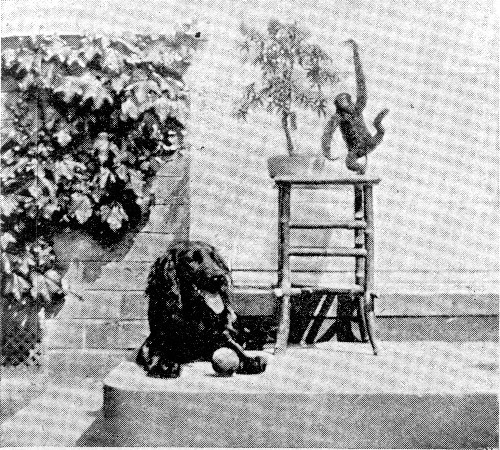
"When it is a Japanese fern tree like that shown in my photograph. The Japanese people are fond of shaping fern roots so as to resemble animals, and when the fern grows a little judicious clipping of the fronds adds much to the realistic and often grotesque effect."—Miss Emmons, Mount Vernon, Leamington.
SCRAP-IRON v. EVIL SPIRITS.
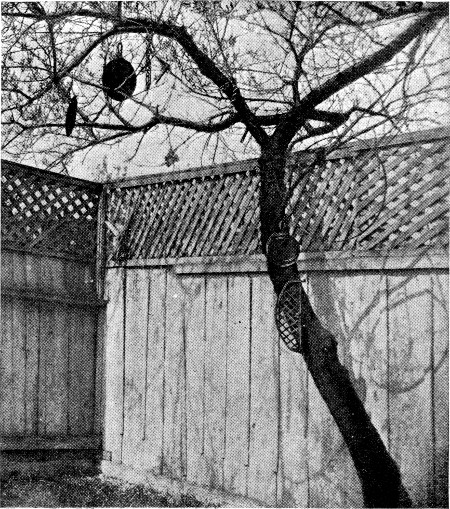
"In the southern part of the United States one of the superstitions of the negroes is that fruit trees should be protected from evil spirits by hanging upon them iron in some form. According to their belief, if the trees do not have some such safeguard the spirits will enter the trunk and branches and prevent the trees from bearing. The accompanying photograph shows a peach tree in Maryland which was protected from the evil spirits in this way. Suspended from the trunk and branches are chains, stove lids, hoops, grates, and iron nails collected by the owner of the tree from piles of old metal for this purpose. It is a peculiar fact, however, that the tree has borne large crops of peaches each year it has thus been protected."—Mr. D. A. Willey, Baltimore.
"NECESSITY IS THE MOTHER OF INVENTION."
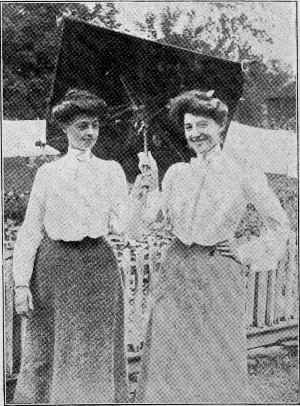
"I send you a photograph showing a unique umbrella which sheltered two young ladies under it during a violent thunderstorm. While spending my holiday in the Blue Mountains of Sullivan County, New York, I decided to take a trip to Minisink Battlefield, in the town of Highland, where, on July 22nd, 1779, a tribe of Indians, led by the noted half-breed, Joseph Brant, massacred a band of white soldiers, who had made an heroic fight and had gained the upper hand, when they discovered that their ammunition had given out. A rude monument of stone marks the spot, and while I was taking a photograph of it the storm broke. Our party found temporary shelter in an abandoned hut in a quarry at the mountain top, but being miles from our stopping-place, and having failed to provide ourselves with even a single umbrella, one of the party, Mr. Ralph Austin, saw possibilities in the umbrella line when I folded up my rubber-coated focusing cloth. A birch sapling furnished the rod, and branches of maple trees were made to serve as ribs. These were held in place by strips torn from a handkerchief. Then the focusing cloth was stretched across the frame and tied down at the corners with more strips from the handkerchief. The homeward journey was then begun, and for a distance of nearly four miles the young ladies walked under the umbrella, which thoroughly protected them from the rain. They were so pleased with this ingenious umbrella that they insisted upon being photographed under it."—Mr. Adolph A. Langer, 116, Danforth Avenue, Jersey City, N.J.
BEAVERS' WORK.
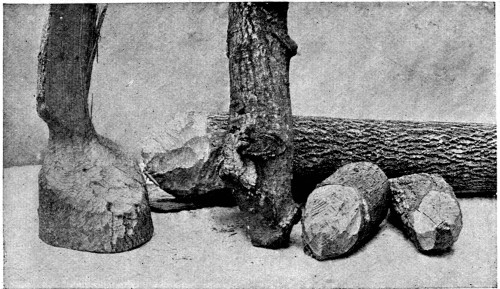
"This photograph shows the remarkable work of what are known as dam-building beavers. The little animals sometimes construct barriers of brushwood and clay in creeks to form their winter habitations. Occasionally they use pieces of timber of quite large size. The logs which are shown in this picture were actually cut by their sharp teeth, and were found in the swamp occupied by a beaver colony near Stroudsburg, Pa. The work was done so nicely that the wood appears as if hewn with an axe. Pieces of this size were used to strengthen the dam and were gnawed from limbs of trees, some of which were over six inches in diameter. As will be noted, one bears a remarkable resemblance to a horse's hoof."—Mr. D. A. Willey, Baltimore.
CATALEPTIC RIGIDITY.
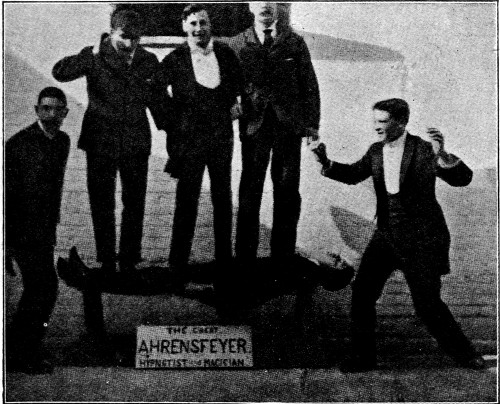
"This is a rather uncommon photograph of a man whilst under hypnotic influence, lying on an upturned stool, bearing the weight of three people on his body. His feet are resting on one leg and his neck on the other without any support between. The photograph was taken without the knowledge of the subject."—Mr. E. E. Vinnicombe, Gloucester Row, Weymouth.
OLD-FASHIONED SURGERY.
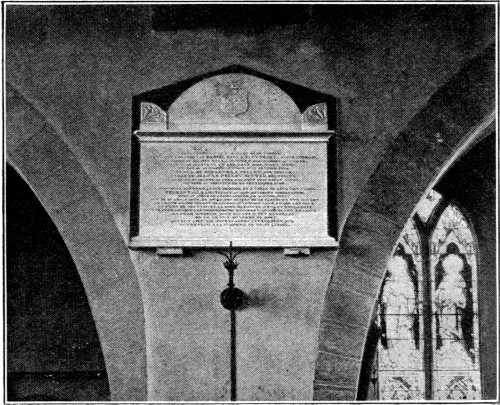
"The accompanying photograph of a mural tablet in St. Sampson's Church, Guernsey, the inscription on which is in French, brings the surgical skill of to-day into striking contrast with that of a hundred years ago. For the benefit of those who do not care to try their eyesight in reading the small type, or who do not understand French, I have translated the latter and more interesting part of the inscription into English, as follows: 'This monument is erected to their memory, and also to that of their eldest son, Thomas Falla, Lieutenant of the 12th Regiment of Infantry, who died at the siege of Seringapatam, April 6th, 1799, aged eighteen years, six months, twenty-five days, as the result of a wound of a solid cannon ball weighing twenty-six pounds, which had lodged between the two bones of one of his thighs. The said wound having become considerably inflamed, the surgeon of the regiment, after he had examined the injury, was unaware that the ball was enclosed in it, and it was only after his death, which took place six hours after the event, that it was extracted, to the surprise of the whole Army.' The solid cannon ball referred to, of twenty-six pounds in weight, must have been five and three-quarter inches in diameter; it is astounding to contemplate that the regimental surgeon was unable to detect the presence of this huge mass of iron in the unfortunate officer's thigh."—Mr. Arthur D. Moullin, "Cintra," Swanage, Dorset.
A SHAM STRONG MAN.
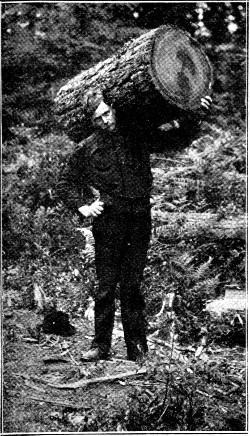
"The picture of the 'Strong Man' was taken as follows: A section of bark was removed from a partly rotten log, a thin slice being then sawn off the log and placed in one end of the bark. This hollow sham was shouldered by the 'Strong Man' whilst a friend snapped the shutter."—Mr. Paul Drake, Green Lake Post Office, Seattle, Washington.
THE POWER OF A GROWING TREE.
"At the time of the American occupation in Cuba a number of anchors were thrown aside by the Americans in the Havana Navy Yard. Since then the tree shown in the photograph has grown up. It is known in Cuba as the 'Frambollan,' or Royal Ponciana. The tree has caught the anchor and lifted it bodily from the ground, one end of the anchor being twenty-one inches from the ground and the other twenty-five inches, although, if measurements were not taken, it would appear as if both sides were perfectly even. The anchor weighs about four thousand five hundred pounds. The photograph was taken by Mr. Marcos Moré, Peña Pobre 27, Havana, Cuba."—Mr. J. A. del Solar, Room 818, 108, Fulton Street, New York.
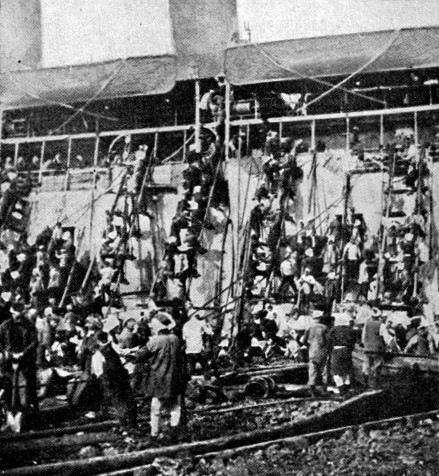
WOMEN COALING A STEAMER IN JAPAN.
"This photograph, which was taken in the harbour at Yokohama, shows one side of a liner with many ladders running up from numerous coal barges which surround the ship. The curious, and at the same time interesting, point of the photograph lies in the fact that the coaling is carried out by gangs of girls. They use little round baskets, which they pass from one hand to another with amazing rapidity. Many of the figures which appear in the photograph to be boys are not really so, for the dress of the girls is in many ways of the masculine type—the large figure in the foreground is a typical specimen of this. By the following figures one can realize the speed with which the coal is put on board. One of the 'Empress' line of steamers has had 1,360 tons loaded in this way in four hours, which is at the rate of 5.7 tons per minute."—Mr. S. Edward Ould, 47, Gloucester Square, Hyde Park, W.
"A RUBBING STONE FOR ASSES."
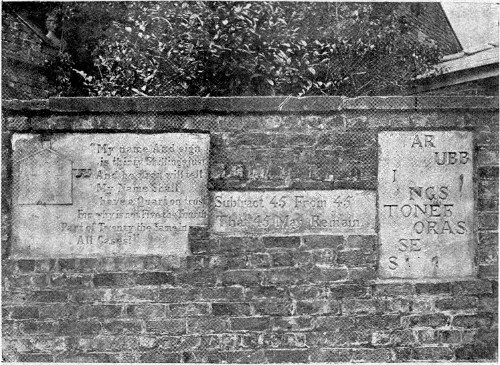
"About the middle of the seventeenth century there stood an inn at the corner of the old Chester road in Lower Bebington (near Birkenhead). The loafers of the neighbourhood used to hang about the corner and loll against the wall of this inn, which very much annoyed the innkeeper. Being an ingenious man, he hit upon the following way of ridding himself of the annoyance. He put a tablet in the wall (right-hand side of photo.), of which none of them could understand the meaning for some time. At last one of the sharpest found that by running the letters together a sentence was formed, reading, 'A Rubbing Stone for Asses.' Of course, this effectually cleared the loafers. The puzzle on the middle stone is solved thus:—
987654321(=45)
minus123456789(=45)
——————————
=864197532(=45)
The worthy innkeeper's name (see third stone) was Mark Noble, and his sign was 'The Two Crowns,' the thirty shillings being made up by—
Mark=13s.4d.
Noble=6s.8d.
Two Crowns=10s.0d.
————
30s.0d.
————
The lettering of the stones has been recut lately to preserve it."—Mr. T. H. Lee, 122, St. Domingo Vale, Liverpool.
ENGLISH AS SHE IS MURDERED.
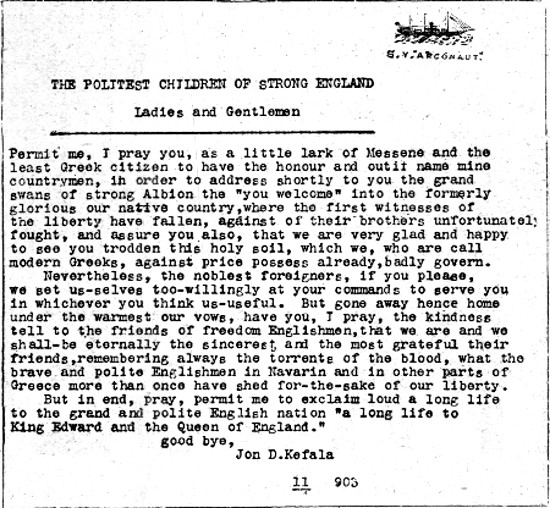
"The accompanying is a faithful copy of an address of welcome presented to the passengers of the s.y. Argonaut on the occasion of their visit to Messene. Though a very amusing curiosity as regards the writer's manipulation of the English language, it cannot fail to convey to the 'grand swans of strong Albion' the feeling of respect and admiration in which they are held by the people of Greece."—Mr. Arthur Williamson, 17, Union Square, S.E.
A SNAIL FARM.
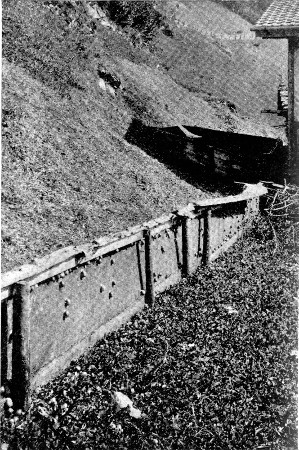
"This is a photograph of a snail farm which I took last summer at Engelberg, near Lucerne. The owner of the farm is a peasant and he has over three thousand Roman snails, some of them of immense size. He sends them to Italy and Paris. They are worth about three a penny, and when dressed and cooked ready for eating they sell for nearly two shillings a dozen."—Miss I. M. Fairbairn, Wood Rising, Rye, Sussex.