Volume 27 — The Best Comic Pictures.
Reading edition
THE OPINION OF HUMOROUS ARTISTS.
Humour is such an elusive quality, depending so much upon individual temperament, that it is difficult to say in what consists its absolute perfection. We know what makes us laugh most; but do we know what will make another laugh most? Yet after all this is true of every art. Why should we not have chefs d'œvure of pictorial comedy?
Suppose any reader of The Strand Magazine with a normal sense of humour were asked, "What is the funniest picture you remember ever to have seen?" Would he not ransack his memory—would he not turn to the files of Punch, to the comic almanacs, to such examples of foreign pictorial humour as had chanced to come in his way—and end by declaring that it was impossible to make any selection at all in such a wilderness of mirth-provoking designs, or, having hit upon one, to find it, upon re-inspection, to be no longer as funny as he thought it at the time—years ago?
But in quite a different case is another small class in the community. These are the authors and manufacturers of humorous pictures themselves. They, not only from having a special gift of comedy, but from having presumably studied, or been interested in, the work of other draughtsmen, might confidently be expected to know their own minds. And so to them the writer addressed the question, What was the funniest picture they had ever seen? What had a right to be considered a masterpiece of pictorial comedy?
At the outset the writer must not forget to mention that a few years ago, in a confidential chat he had with the late Mr. Phil May, he was pleasurably surprised to learn the high esteem in which that gifted humorist held one of the earliest and greatest masters of pictorial comedy, James Gillray.
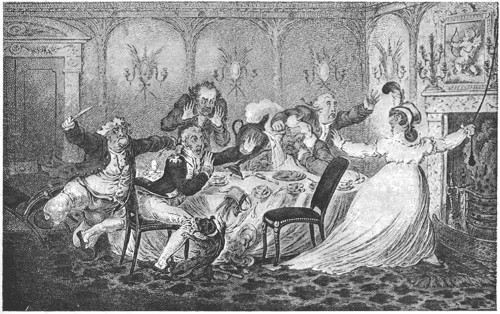
"Company Shocked at a Lady Getting Up to Ring the Bell."—By Gillray. SELECTED BY THE LATE MR. PHIL MAY AS THE BEST COMIC PICTURE
.
"There is nobody to-day to touch him," were May's words. "Look at his sweep of line and his astonishing mastery over the grotesque and ridiculous. There are pictures so extraordinarily funny that you can't laugh—'too funny for words,' if you catch what I mean." As he spoke he turned to a folio containing several specimens of Gillray's drawings. One in particular was, if too funny for words, not too funny to be laughed at, for May's smile broadened enormously as he held it up for inspection—"Company Shocked at a Lady Getting Up to Ring the Bell." "Now, I call that funny," he said, "and it was, perhaps, a hundred times funnier a hundred years ago, when the characters were well-known people. There's nothing 'dates' so much as the average comic picture, especially a social caricature, but the fun of this is pretty fresh still." On the whole, most of Gillray's and Rowlandson's best work is a little too highly flavoured—too broad—for the taste of to-day.
Passing along a half-century we come to John Leech, and thenceforward to a succession of great masters of pictorial fun—Wilhelm Büsch, Charles Keene, Du Maurier, Sambourne, Oberlander, Caran d'Ache, Phil May, Frederick Opper, Zimmerman, and Raven-Hill. To these names many—fully as distinguished—might be added, such as Forain, Gibson, and Graetz, but for pure fun those we have mentioned may be called the masters. Amongst their numerous productions ought to be found some sketch which deserves to be called the very funniest picture or set of pictures delineating a single humorous idea. Each artist has his own followers. We have seen Phil May singling out a drawing by Gillray as appealing to his sense of humour. The draughtsmen of to-day in this line of work in England doubtless count no cleverer men than Raven-Hill, Tom Browne, John Hassall, Leslie Willson, William Parkinson, Louis Wain, and Charles Harrison.
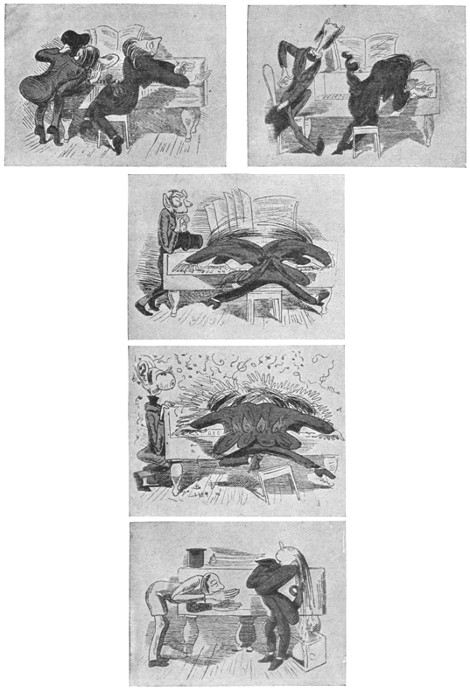
Wilhelm Büsch was for years the chief comic draughtsman of the celebrated Fliegende Blätter—the German Punch. Not all his best work, however, was done for this paper, as Büsch illustrated and occasionally wrote numerous humorous brochures, which enjoyed a wide sale, and in his own opinion—according to one of his intimate friends whom we have consulted—he never achieved anything funnier than the pictures which accompanied a little book called "The Fools' Paradise," and the funniest drawings in that book are those which appear on this page.
"A Pianoforte Performance."—By Wilhelm Büsch. SELECTED BY MR. LINLEY SAMBOURNE.
But now let us hear what Mr. Linley Sambourne has to say about the work of this artist:—
"To attempt to even indicate the birthplace of the world's masterpiece of pictorial humour is beyond the capacity of a single individual. So very few can see humour with the same eyes or appreciation. What you seek has probably perished in past ages, together with its contemporaneous companions in a higher branch. To me, personally, some of the designs of the late Wilhelm Büsch, of Munich, seem to have more humour, if by that is meant fun, than anything I can remember having seen."
Under Her Breath.—Mrs. Conlan: "Whisht, Pat!" Pat: "Whisht, Dalia!" Mrs. Conlan: "Aise yure face. It's an upright we're havin' took." From the New York "Judge." SELECTED BY MR. RAVEN-HILL.
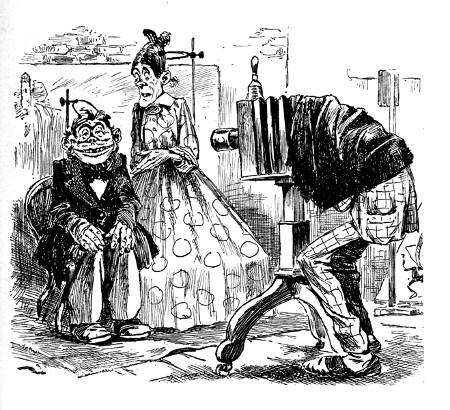
Mr. Sambourne's clever colleague, Mr. Leonard Raven-Hill, finds "the very funniest picture" amongst the work of the American artist, Zimmerman.
"For absolute comic humour," he writes, "no one has equalled Zimmerman, of the New York Judge, in my opinion. Charles Keene is, of course, miles ahead of any other man in quiet humour; but I can't think of any particular examples."
Of Zimmerman's drawings Mr. Raven-Hill selects three, of which we herewith present what strikes us as the most comical.
Wife (to lion-tamer, who has been out late): "You coward!" From "Phil May's Annual." SELECTED BY MR. TOM BROWNE.
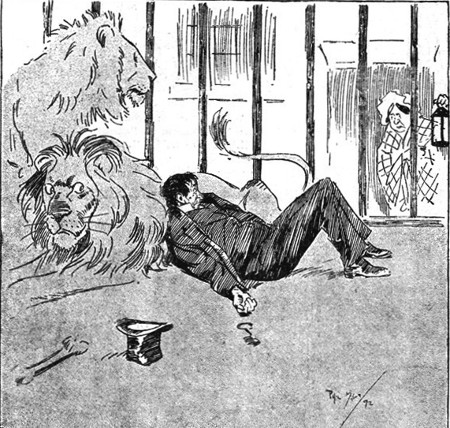
Few comic artists are at once so prolific and so amusing as Mr. Tom Browne, who, in selecting the picture reproduced below, writes to us as follows:—
"I have no hesitation in ascribing to the late Phil May some of the most delightful specimens of illustrated humour that have ever graced the British or any other Press; but to positively indicate what I consider to be that master's choicest joke or drawing is a difficult matter. Phil May had a very keen sense of humour; moreover, he was a master of line. He knew what a line would do better than any man ever did before him. He could seize on the essentials of a subject and adequately represent it in the fewest lines anyone had ever employed before. Yet nothing was lacking. And the lines and the forms they represented were always accurate. There was a lot of humour in the sketch of the lion-tamer which appeared in one of the winter annuals. The tamer of lions had been staying out late, and to avoid the furious attentions of his wrathful spouse had taken refuge in the lions' den. The aforesaid wrathful spouse was shaking her fist in front of the bars and crying out, 'You coward!'
"A Hair-Raising Story."—By Caran D'ache. From the Caran D'ache Album, by Permission of MM. Plon Nourrit & Co. SELECTED BY MR. LESLIE WILLSON.
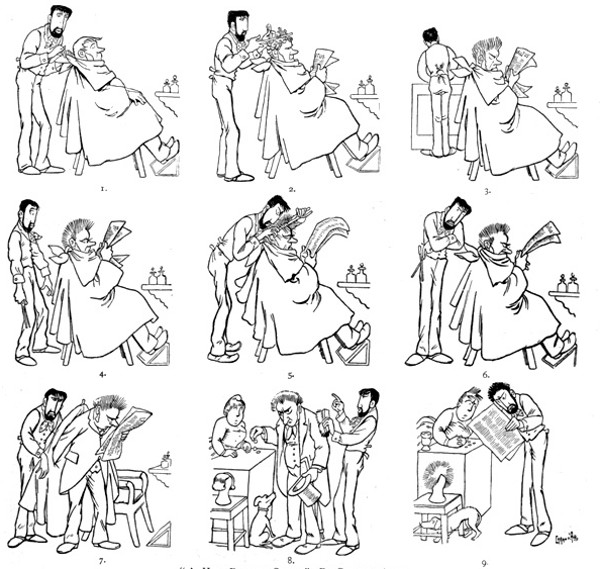
"Quite a little masterpiece in its way was the sketch of the very tipsy newsman, who had the contents-bill of the special edition he was selling stuck on a sandwich board that covered his chest. In large letters on the contents-bill was printed, 'Result of the Cup.'
"And there are others, scores of them, all good because they were Phil May's. In cold type they sound nothing. Phil May's pen made masterpieces of them all."
An English black-and-white draughtsman, with an almost unique experience of pictorial comedy in Germany, America, and this country, is Mr. Leslie Willson, for years one of the chief artists of the New York Judge, and latterly art editor of Pick-Me-Up. Mr. Willson, with his wide experience of comic achievements, says:—
"The very funniest pictures I ever saw were by that astonishingly clever Franco-Russian, Emmanuel Poiré, otherwise 'Caran d'Ache.' The particular set I have in mind depicted a scene in a barber's shop, where the customer's hair, standing on end from horror, defies all the barber's attempts to curl it. There are other funny things from Caran d'Ache's pencil, but this, I think, is the funniest." These are the drawings reproduced on the opposite page.
Parrot: "Here he comes again. If he pulls another feather out I'll fly away!" By H. Grattan in the "Pelican." SELECTED BY MR. JOHN HASSALL.
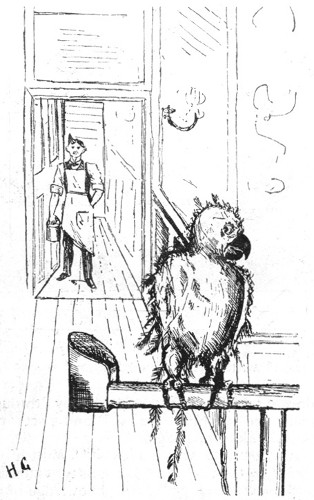
Mr. John Hassall, whose work is familiar to all, writes to say:—
"The most humorous drawing I have ever seen was in the Christmas number of the Pelican, some few years back, of a parrot with one feather sticking out of its tail—the rest bare—sitting on its perch, and a pot-boy in the background. Below was the inscription: 'Here he comes again. If he pulls another feather out I'll fly away!' It was by an actor, I fancy. For the most humorous artist I should plump for Zim. Zimmerman, who draws for New York Judge. About ten years ago his work was, to my mind, always exceedingly humorous."
"An Incident in the Middle Ages."—By Linley Sambourne in "Punch." SELECTED BY MR. WILLIAM PARKINSON.
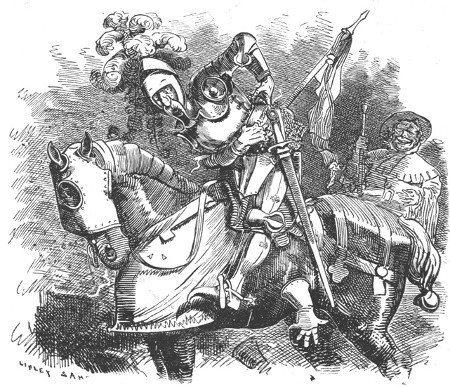
A draughtsman with a keen sense of humour is Mr. William Parkinson. He writes:—
"For real funniness, I think A. B. Frost, the American, is very hard to beat; especially in some of his picture-stories in the last pages of Scribner or the Century. I should call his book of drawings, 'The Good-Natured Man and the Bull Calf,' a masterpiece of humour. Linley Sambourne also is a master and an artist too, and some of his drawings for Punch's Almanacks are real masterpieces. 'An Incident in the Middle Ages,' where a poor knight in armour is tormented under his mail shirt by a persistent——Well, the fancy is tickled as much as was the poor knight."
An ensign who thought he would wake up another ensign for a lark—But he mistook the tent. From the "Graphic."—By A. C. Corbould. SELECTED BY MR. LOUIS WAIN.
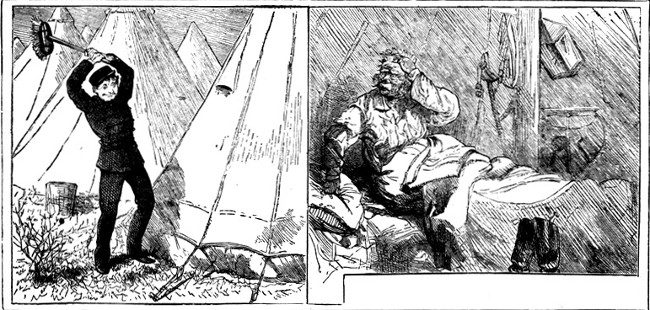
There are not many pictorial comedians with a larger following than Mr. Louis Wain, who tells us:—
"I like one of Corbould's drawings best which appeared in the Graphic of some eighteen years back. A subaltern with a broom over his head was hitting out at a military tent with it where there appeared to be a protuberance. A second picture showed a fat general sitting up in bed rubbing his head and looking furiously mad. (He had had the broom on it.) This drawing has kept me happy through many a gloomy period, and set my own work going again."
The Moustache Movement.—Old Mr. What's-His-Name: "Egad, I don't wonder at moustaches coming into fashion; for—eh? What? By Jove, it does improve one's appearance." By John Leech in "Punch's Almanack," 1857. SELECTED BY MR. CHARLES HARRISON.
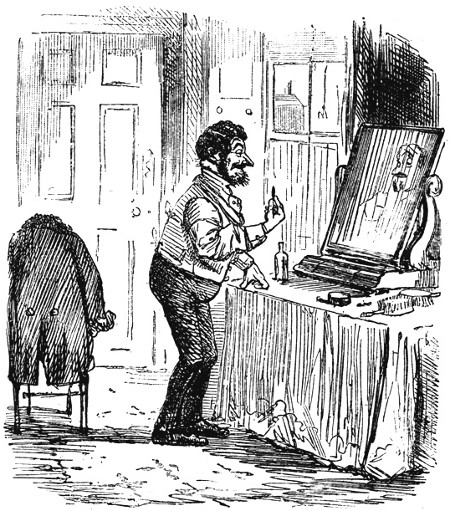
"With a pretty extensive knowledge of all the Continental and American artists," writes Mr. Charles Harrison, one of the regular contributors to Punch, "I think I have derived more amusement from John Leech than anyone else. In certain things he is, and so will ever remain, absolutely unapproachable, and I enclose what I consider one of his funniest efforts. At least, there is no effort in it, which is one of the charms in all Leech's work."