Volume 27 — Detectives at School.
Reading edition
M. BERTILLON'S NEW METHOD OF DESCRIPTIVE PORTRAITS.
By Alder Anderson.
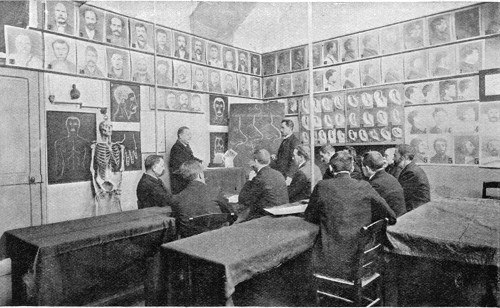
DETECTIVES RECEIVING A LECTURE ON THE METHOD OF IDENTIFICATION BY NOSES. From a Photo.
The painter and the writer, the world has been assured repeatedly by the very highest authorities, can never encroach very far on each other's domains. Whereas a picture conveys the same idea to every beholder, so far at least as the outward aspect of the personages represented is concerned, a mere description can only give such vague and hazy outlines that the ideas of no two readers need ever be identical. How is it that no critic has ever suggested that this apparent inferiority of literature might, perhaps, simply be lack of science on the part of the author? Such, however, would appear to be the logical deduction to be drawn from the innovation which M. Bertillon, after ten years' persistent efforts, has recently succeeded in getting officially adopted by the Paris Detective Police.
M. Bertillon has proved that the appearance of any individual may be expressed in terms so clear, precise, and unequivocal that identically the same image is evoked in the mind of everybody who hears or reads the description. With nothing else but such a description to guide him in his search, anybody of normal intelligence is able, after a few lessons from the inventor of the system, to unerringly pick out the person indicated from a crowd, however great, and in an incredibly short time. The new method materially adds to the efficacy of the anthropometrical system of identification, with which the name of Bertillon, the inventor of the "thumb-prints" method, is inseparably connected. A brief outline of that system may here be given.
The variety of Nature is infinite; she never repeats herself. No two leaves are ever precisely alike, much less two human beings. A superficial observer may fancy that two individuals resemble each other in a remarkable manner. Let him examine them more attentively; he will find that they differ radically in almost every detail. The farther he carries his examination the more numerous and the more conspicuous will the differences appear, until at last he may almost experience a difficulty in discovering any trace of the resemblance that before seemed so striking. This is a résumé of some of the principal axioms at the base of M. Bertillon's teaching.
Every person, then, who for one reason or another comes within the power of the law in France and in some other countries is photographed and measured in prevision of his transgressing on some future occasion.
THESE ARE THE PORTRAITS OF A CRIMINAL, TAKEN IN PROFILE AND FULL FACE.
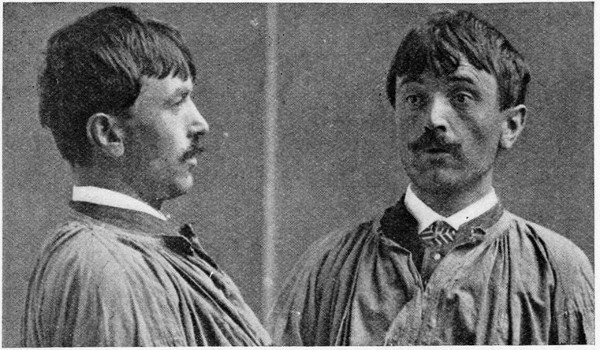
THIS IS THE SAME CRIMINAL, WHO WAS IDENTIFIED BY A DETECTIVE AND ARRESTED ON THE EVIDENCE OF HIS EARS.
The complete description and measurements are transferred to a piece of thin cardboard, on which are also pasted two photographs of the subject—one full face, the other in profile, both reduced to one-seventh of life size. This is termed the prisoner's "fiche," which is now put away for future reference. Every year about twelve thousand "fiches" are thus added to the collection in Paris. In ten years this means one hundred and twenty thousand; in twenty years nearly a quarter of a million.
Let us assume now that a crime has been committed. All the evidence tends to prove that the culprit is none other than a certain man who passed through M. Bertillon's hands some years ago. His "fiche" is taken out, and copies of the photograph on it are distributed in the usual quarters. This old photograph is the only guide the police have by which to identify the fugitive. In the interval that has elapsed since it was taken, however, the man's outward appearance may have so completely changed that he might now walk under the very nose of the cleverest detectives in Europe, trained in the old school, without being recognised. Just such a case occurred quite recently in Paris, and was specially taken in hand by one of the most experienced men the "Sûreté" possessed at the time, but without result. Six months later a comparatively inexperienced detective arrested the criminal, who was on the point of embarking for America. Trained by M. Bertillon's new method to concentrate his attention exclusively on features which hardly ever vary, and to neglect entirely such accidental details as the fashion of wearing the hair and beard and the apparel, he had at once recognised the person he was in search of by the characteristic shape of ears and nose. This case is given in the accompanying photographs.
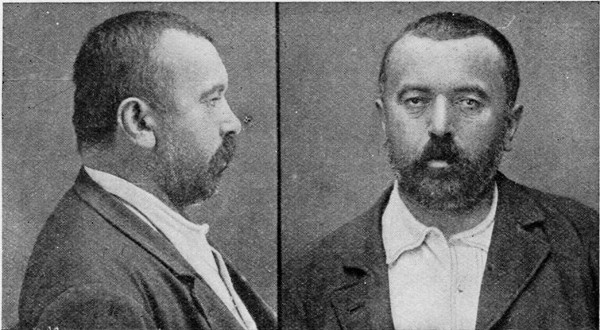
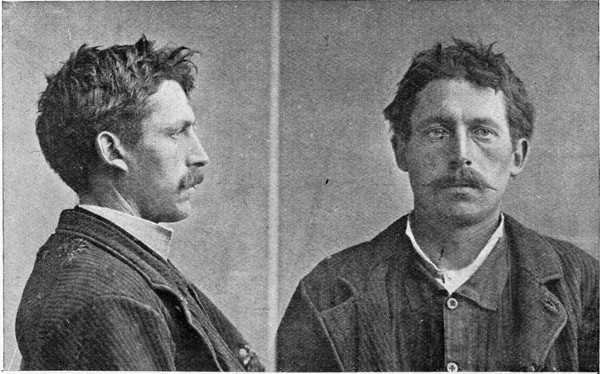
The contrary case to the foregoing instance—that is to say, the arrest of an innocent man, on the ground that he resembled a photograph in the detective's possession—used to be an all too frequent occurrence. Not even the very keenest of the law's sleuthhounds were able to avoid such mistakes. A good example is shown in the photographs next reproduced. Innumerable instances, too, are recorded of people claiming, as that of a brother, a husband, or a son who had disappeared, a body which, had they but been M. Bertillon's pupils for an hour, they could never by any possibility have confounded with their missing relative. So persuaded have women often been of the accuracy of their own judgment that there have been cases in which they have at first indignantly repudiated the husband or son who subsequently reappears on the scene in flesh and blood and seeks to prove that he is not dead after all.
A detective is now taught that he must use the photograph he is supplied with merely as a check, to make assurance doubly sure, before he ventures on an arrest. What he must principally rely upon is the visual portrait he can evoke in his own imagination, a portrait which, he is told, is only valuable so far as he is able to describe it in words. That which we cannot clearly describe we cannot clearly conceive, is the pith of M. Bertillon's teaching. The pupil is, consequently, made to analyze each feature of the photograph separately, and express the result in certain conventional formulæ that convey a definite meaning to his own mind and to the mind of everybody else who has studied the same method. He makes, in fact, "a portrait in words."
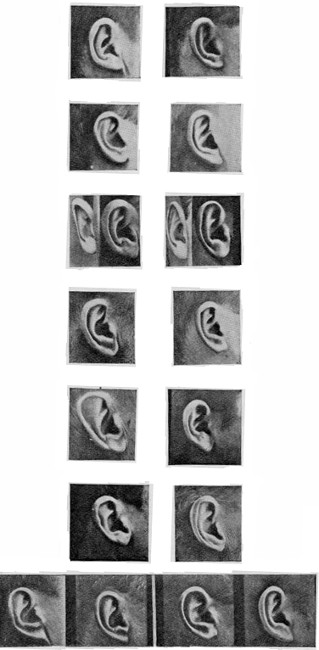
The feature that presents the greatest diversity of form and size is the ear, and, strangely enough, the ear is precisely a feature which we hardly ever consciously look at. It has been reserved for M. Bertillon to point out how admirably it is adapted for the purpose of establishing a person's identity. The size of the ear, the relative proportions to one another of the folds, its contour, the surface and shape of the lobe, the manner the lobe is attached to the cheek, and the inclination of the bottom interior ridge known as the antitragus differ most materially in every individual. Let a modern French detective describe an ear as "Deq. cav. vex. tra. sep"; all his colleagues are immediately able to form a mental image of the description of ear he means.
THESE ARE THE PORTRAITS OF A CRIMINAL.
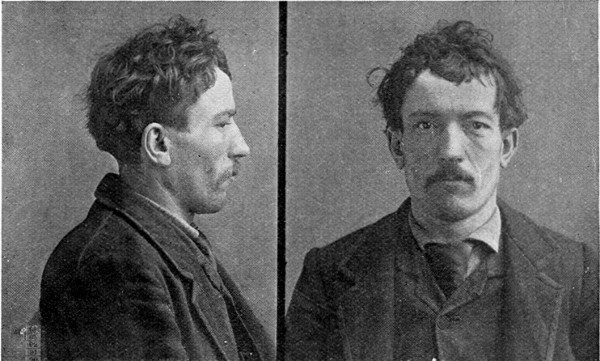
THESE ARE PORTRAITS OF AN INNOCENT MAN WHO WAS ARRESTED BY AN UNTRAINED DETECTIVE AS BEING THE SAME MAN, BUT HIS EARS ALONE WERE SUFFICIENT TO ACQUIT HIM.
Similarly for the nose, of which three main varieties are recognised, according as the line of the back is concave, rectilinear, or convex. Each of these three principal classes is divided into three divisions according to the direction of the base line—ascending, horizontal, or descending. The degree of concavity or convexity of the line of the nose, as well as the degree in which the base line descends or mounts, is indicated in very simple fashion by putting the term denoting the form into brackets or underlining it. Thus a moderately concave-backed nose is expressed by the abbreviation "cav."; if the concavity is very slightly marked by (cav.); and, if very accentuated, by cav. Noses of which the line is very sinuous or arched are denoted by the abbreviations "s" and "a." A nose described as cav. (s) would have a very strongly-marked concavity and be slightly sinuous, whereas (cav.) s would denote a nose but slightly concave, but with a very sinuous outline. The form of the root of the nose is also indicated in similar fashion to the back and base. So much for the shape of the nose. Its dimensions relatively to the face, its width, length, and degree of projection, are also indicated, for it is evident that size is quite independent of shape.
The degree of inclination of the forehead is another feature that is noted, as well as the general aspect of the complexion, colour of hair and eyes, and anything about the face that is in the least abnormal.
The entire course of instruction in "word-portraits" extends over thirty lessons of two hours each. At the end of the course an examination is held, in which the pupil must acquit himself honourably in the practical tests imposed upon him, if he wishes to obtain the coveted certificate, without which he can now hope for no promotion. Several hundred persons are assembled; with the exception of a few privileged strangers, almost all are connected directly or indirectly with the various services of the police administration. M. Bertillon or his principal lieutenant, M. Payen, hands a slip of paper to the candidate, containing some such brief indications as the following: "R—cav. (deq.) cav. × 1·62. O. 1878." "Pick out the person to whom this refers," adds the examiner. In an incredibly short space of time one of the audience finds himself "under arrest." The figures 1·62, it may be said, denote the person's height; "O" stands for orange-coloured eyes; and 1878 denotes, approximately, the year of birth—that is, that he is now about twenty-six years of age.
DIFFERENT TYPES OF EARS FROM THE CLASSIFICATION-BOOK.
We have the authority of our cleverest modern humorist for the statement that the burglar and the cut-throat like a little innocent amusement occasionally; what wonder, then, if the austere detective does also? His chiefs, therefore, thoughtfully turn these examinations into occasions of grave merry-making by giving one or other of the examinees a descriptive portrait of some high functionary, perhaps of the Prefect of Police himself, should he be present. The fledgeling is thus placed in a dilemma; he must either display his incompetence or do violence to all his notions of respect for the official hierarchy, and put a disrespectful hand on one of the few shoulders in the world that he has looked upon as sacred. The manner in which the luckless wight acquits himself of his invidious task forms the theme of many a conversation in the "highest detective circles" of the French capital for the next week or so.
M. Bertillon has recently compiled an album containing about fifteen hundred photographs of the most notorious French criminals, classified exclusively by the shape of their ears and noses and their height. The man whose portrait figures in this blackest of black books has, at any rate, the satisfaction of knowing that his physiognomy will not disappear from the world without leaving some memories behind it.
Other black books contain portraits of foreigners of different nationalities. The writer was allowed to peep into that relating to "English and American" malefactors who are at loggerheads with the Paris Prefecture of Police, and was patriotically pleased to find that their total number—five hundred—is only one-fifth that of the Belgians. A very large proportion, too, of these soi-disant English and American citizens, if their names are any criterion, might be Russians, Danes, Turks, or Prussians, but are certainly not Englishmen. Anglo-Saxondom may flatter herself that, in so far as France is concerned, she is a most exemplary race.
When the practice of portraits in words becomes generalized, as will no doubt very soon be the case, members of all those professions at which the laws of most countries persist in looking askance will have but a sorry time, if, indeed, they are able to subsist at all. Within the space of an hour or two telegraph and telephone will have carried a brief but unmistakable word-portrait of them to every corner of the civilized world if necessary. In large towns like London and Paris, twenty thousand pairs of trained eyes, covering the entire area of the city, can be set simultaneously on the search for the fugitive murderer or burglar, who will discover that the old methods of disguise are of but little use to him. A rumour that certain London banks contemplated having all their employés measured and photographed on M. Bertillon's system caused a considerable amount of murmuring recently, the measure being considered as somewhat derogatory by the clerks. By this extension of the method, however, their portraits can be taken without their knowledge, since neither camera nor measuring rule is necessary. Absconding cashiers will, in future, therefore have to be remarkably circumspect in their choice of foreign residence. Impostors like the claimant to the Tichborne estates, whose trial convulsed the Anglo-Saxon world over thirty years ago, will be given short shrift. It may be remarked, however, that one of the principal points brought forward at the trial to prove that the Claimant was not the man he pretended to be was precisely that the lobe of his ear was quite differently formed to the lobe of the real Roger Tichborne. This only proves once more the old adage that under the sun there is nothing new.
DETECTIVES RECEIVING A LESSON ON EARS. From a Photo.
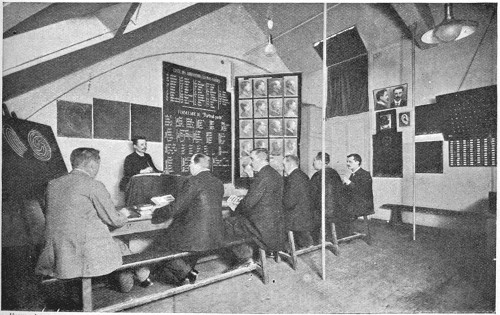
The writer would here express his thanks to M. Lepine, the Prefect of Police, and M. Bertillon for their extreme courtesy in acceding to his request to be allowed to attend the course of lessons, and also for permission to use the photographs now reproduced.