Volume 27 — Two and a Tiger.
Reading edition
By R. E. Vernède.
Nare had enjoyed himself at the picnic until the baronet arrived, in spite of being rather an outsider among these local people, who all knew one another from the cradle. He had enjoyed himself in spite, too, of Mrs. Corcoran, who by many signs and cool politenesses had shown him that her daughter Judith had no need and—as she hinted very plainly—no inclination for his attentions. "Dear Sir Henry will be arriving soon, surely?" Mrs. Corcoran had said in his presence to their hostess, and little Mrs. Harrington, who had been very kind to Nare in that capacity, replied that of course Sir Henry would be arriving soon, but that in the meantime the rector (a mild man with a capacity for being held in awe) was very anxious to consult Mrs. Corcoran on the subject of an altar-cloth. Mrs. Corcoran was unable to resist the invitation. Whether the rector was as grateful for Sir Henry Pove's arrival as Nare was ungrateful, nobody can say, but there is no denying that the rector looked a little browbeaten by that time.
The baronet came on a tricycle, looking reedy in his light suit, but very dignified.
"I have accomplished the distance from Wetherwell in one hour and a quarter," he announced, "which I think is very fair—very fair."
"Wonderful," said Mrs. Corcoran, frowning at her silent daughter.
"Incredible," Nare suggested. "It must be eight miles."
"I thought it incumbent upon me to ride pretty fast," continued Sir Henry, "because a rather alarming thing has occurred."
A chorus of "Ohs!" wavered about the gratified tricyclist.
"A RATHER ALARMING THING HAS OCCURRED."
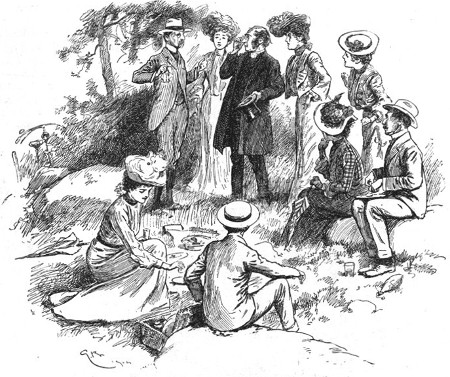
"What is it?" asked Mrs. Corcoran.
"No, don't tell!" cried Mrs. Harrington; "not if it's horrid. I won't have my picnic spoilt. Be a gem, now!"
"But, my dear madam"—Sir Henry's look was a rebuke to all trifling—"I dare not take it upon myself to leave you all in suspense about a matter which cannot in any event be lightly treated. When I say that a travelling menagerie at Sutley has lost one of its wild beasts early this morning, and that up to the time I started from Wetherwell no news of its recapture had come to hand——"
He paused for an effect, and several ladies said: "Good heavens!" Mrs. Corcoran added:—
"And you rode over the moor alone?"
A pleased smile was her reward.
"I could do no less—yes—some say a puma; others a bear." Sir Henry rapidly answered a string of questions.
"Perhaps it was a llama," suggested Miss Corcoran.
"Judith!"
"They're very dangerous, mother."
"But in any case I'm very much annoyed," Mrs. Harrington announced. "Now everybody will want to go home, I suppose, though really Sutley is fourteen miles away, and—well, at any rate, we've all had something to eat. Sir Henry, come and be rewarded with lobster before we start."
I think it must have been because Mrs. Harrington thought she owed her annoyance as much to the baronet's alarmist importunity as to the carelessness of the menagerie owners that she dealt so kindly with Nare afterwards. For it was settled that the picnickers should disband almost immediately instead of going home by moonlight—as Mrs. Harrington had desired—and in the bustle that ensued, while the rector was heading a search-party, organized by Mrs. Corcoran, to recover a shawl she was positive she had brought with her, and the baronet was being regaled on all the choicest delicacies that could be set out on cabbage-leaves by the more insatiably curious ladies, Mrs. Harrington drew Nare and Miss Corcoran aside.
"Now, Judith," she said, "we shall all be starting soon, but I want you to be kind and show Mr. Nare the Mill on the way back."
"Oh, but——" Judith began.
"We shall catch you up in quite a short time, and Mr. Nare will protect you against the——"
"Llama," said Nare.
"Elephant or whatever it is," said Mrs. Harrington, smiling. "I'm quite sure he will. And you'll be doing me a favour. I've promised Mr. Nare should see the Mill, and I'll explain to your mother."
"Very well," said Judith. "Perhaps we ought to start at once, then?"
"Yes," said Mrs. Harrington.
That is why, when, some time later, Sir Henry having replenished himself and found all preparations made for going homeward, and having begun to wonder where Miss Corcoran, whom he had hoped to escort, had vanished to, Nare found himself on the moor with that young lady just drawing near to the Mill, the sight of which he had been promised. It was just after sundown then, pleasantly cool and hazy, with nothing but a noise of stray bees to disturb the silence. Miss Corcoran had had her parasol furled for several minutes, so that Nare, who was slightly behind with the picnic basket which Mrs. Harrington had thrust upon him "in case Judith should want a sandwich on the way, Mr. Nare"—commanded an uninterrupted and delightful view of the curls on her neck.
"Perfect," he said, and she, fancying he referred to the weather, perhaps, agreed.
"'I DON'T THINK YOU'RE WALKING VERY FAST, MR. NARE,' SHE SAID."
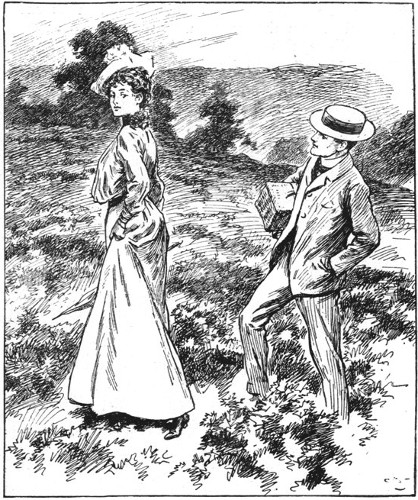
"But I don't think you're walking very fast, Mr. Nare," she said, severely. "And when I promised Mrs. Harrington to show you the Mill, I did think you'd walk a little quicker, even though you are a Londoner."
"Don't be unkind," said Nare. "Recollect that your foot is on your native heath, while mine——"
"But we shall miss the others."
"We started first."
"Not more than half an hour, and we've come right off the road on to the moor and——"
"But it's such a jolly afternoon."
"Evening."
"And it would be a sin to stampede over these attractive buttercups," Nare pleaded.
Miss Corcoran relented with a little laugh.
"Really, you are Cockneyer than I thought. Buttercups! It's gorse."
"Same kind of yellow," said Nare.
"And there's the Mill. Now we must hurry."
Woman, it has been said, disposes, but that depends on circumstances. Nare had no desire to hurry, but hurried he certainly would have been if it were not for the episode that occurred at that moment. Afterwards he was grateful for it, but for the time being he would even have preferred hurrying. For, just as he was taking a last look at the Mill, something shadowy, but alive, came stalking slowly away from it towards them.
Involuntarily Nare whistled. In the hazy twilight it was not easy to distinguish shapes exactly, and the desolate moorland with the black bare Mill frowning in its midst, only a single skeleton sail left to show for what purpose it had been built centuries ago, and the utter silence, except for the homing bees, no doubt tended to ghostly thoughts. But either Nare was dreaming or——
"Whatever is that?" cried Miss Corcoran, suddenly catching sight of it. She put a startled hand on his arm, and Nare regained his cheerfulness.
"This Cockney suggests that it's a cow—a stray cow."
"But——"
"Probably an Alderney," Nare pursued, "with pink eyes and——"
The creature was making towards them on the circumference of a circle, and as Nare talked he walked slowly towards the Mill. There must be some kind of shelter there.
"And crumpled horns," Nare continued.
"But this isn't our way, Mr. Nare."
The girl spoke in a protesting tone, but without giving any sign of a desire to stop. Indeed, she went rather faster and did not look behind her. The Alderney was a little behind them now.
"Don't you think we ought to——"
"G-r-r-r-r!" A noise, thunderous and snarling, interrupted her in the middle of a sentence. Nare was looking back.
"How horrible!"
"Perhaps it wants to be milked"—Nare spoke without turning his head—"or it's hungry. I think you'd better go into the Mill, please."
"You'll come?"
"Yes."
"MISS CORCORAN GATHERED UP HER SKIRTS AND RAN."
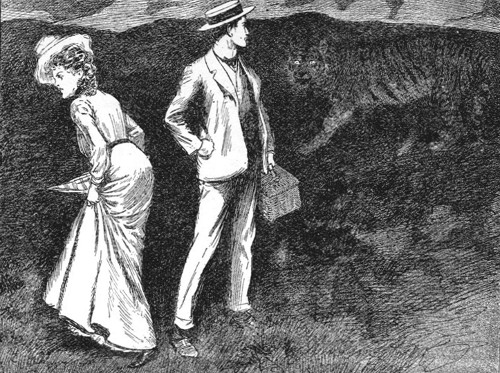
And with that Miss Corcoran gathered up her skirts and ran. Nare followed with one eye on the enemy in the rear. The beast had stopped in its circling and was glaring after them.
"As fast as you can!"
The girl heard Nare talking to her, and felt in a dream. A second growl rose and seemed to shake the rotten timbers of the Mill as she ran into it.
"Up the ladder!"
There was a nine-foot ladder, shaky, with rat-gnawed rungs, leading through a trap on to the first floor of the Mill from the ground. And Miss Corcoran went up it swiftly, with gratitude in her heart to the rats for not having gnawed it through, since there was no door to the Mill wherewith to bolt out undesirable company. The Mill seemed to be echoing still with that growl as she turned at the top and, kneeling, found Nare ascending after her through the narrow hole. She said nothing until he had got up and tried to unfix the ladder without success. Then, as he desisted:—
"Mr. Nare," she said, "was it a—a—tiger?"
Nare put down his picnic basket with an injured air.
"If it wasn't," he said, "I don't know what it was. But I'm beginning to think you're right, and that I don't know the country. I certainly thought tigers were extinct. If they're not, I don't think it's fair to ask an unfortunate Londoner out into the wilds and arm him with nothing better than a picnic basket."
He rattled on to give the girl time to recover herself. He was a little afraid of hysterics, which would have been pardonable but unavailing. She seemed to suspect his fear, for she mustered a smile and said:—
"I don't think I'm going to be foolish. Tell me, please, what do you think we ought to do?"
That was exactly what Nare did not know. Looking down through the trap, he was conscious of a pair of fierce yellow eyes glaring up at him.
"A good deal depends on the tiger," he said. "As this is one from a menagerie it may know how to behave itself in company, but—isn't there a top floor to this Mill?"
There was, and another ladder leading to it. And Miss Corcoran, followed by Nare, reached it in less time than it takes to tell. The tiger had reared its paws on to the lower ladder and delivered itself, of another terrific growl.
"I—I didn't know they could climb," said Miss Corcoran, faintly. "Oh!"
A scuffling noise accompanied by a groaning of wood was what they heard, and then a soft padding of feet in the room they had just deserted. Apparently this tiger could climb.
"The deuce!" said Nare, beneath his breath. He had never in his life been in a more unpleasant situation—never, indeed, in anything like it. At first the thing had seemed like some burlesque nightmare, but now the burlesque was going out of it. What could one do to a tiger?
He sat cross-legged over the trap, reflecting and listening to the pad, pad below. If only there were a cover to the trap, but there was none. His companion was looking out of a sort of small slit in the side of the Mill that had been made to serve the purpose of a window once, hiding her tears, Nare fancied. It was too narrow to get through, and in any case there would be a drop of twenty or thirty feet. Half unconsciously Nare began to unpack the picnic basket which he had carried along from room to room. He had some vague idea of throwing the tiger sandwiches as a sop. "Buns, cucumber sandwiches, a packet of salt. Do you see anything, Sister Anne?" He broke off enumerating the contents of the basket, seeing that Miss Corcoran had started.
"I—no——"
"A chocolate cake—tea—pepper—pepper——"
"Yes, I do," Miss Corcoran suddenly burst out. "There's someone coming—this way. He's—he's on a—it's Sir Henry."
In spite of the presence of the tiger and the diversion likely to be caused by the arrival of the baronet, Nare felt a trifle jealous. If the diversion were caused it would be to the baronet's credit, that was certain, and he sat over the trap, aimlessly untying the packet marked pepper, while he listened to the parley that Miss Corcoran began from the slit in the Mill wall.
A bicycle bell rung in a dignified manner announced the baronet's approach.
"Sir Henry!"
Nare could hear the brake applied before the baronet's thin, piping voice called back:—
"Who is there?"
"It's I—Judith Corcoran—and Mr. Nare. We're in the Mill—and——"
"Indeed!"
Suspicion was plain in the baronet's "Indeed!" Nare lost the next few words in trying to catch a sound of the padding feet below.
"And the animal that escaped that you told us of—is here—it's a tiger!"
An unpleasant, high-pitched laugh greeted Miss Corcoran's explanation—a laugh that showed Sir Henry in about as incredulous a frame of mind as a jealous man might be.
"Ah!" he sniggered. "What charming company! Two—and a tiger!"
"G-r-r-r-r!"
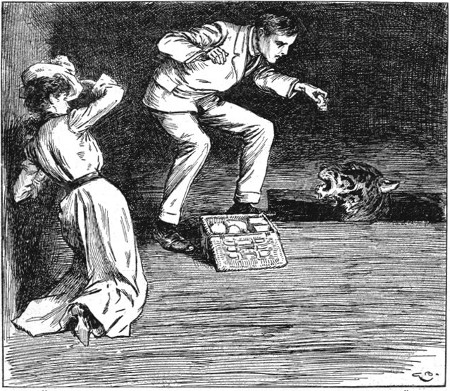
Nare had just risen in a fury of indignation to throw something—anything that could be got through the window—at the baronet's head, when that tremendous growl came, followed by the creaking and groaning of wood. The tiger was ascending to their last retreat. In a whirling fashion Nare was conscious of this, and of Miss Corcoran's pale face, as he stood once more over the trap. From outside came a sound of frantic pedalling, as though Sir Henry had forgotten his scepticism and was wheeling round in order to be off. Otherwise the stillness was intolerable; and in the middle of it Nare, his fingers tearing idly at the white-papered packet in his hands, suddenly found himself looking into those great yellow eyes, not three feet away. And at that, his fingers relaxing, the packet and its contents fell plump into the tiger's face.
"NARE SUDDENLY FOUND HIMSELF LOOKING INTO THOSE GREAT YELLOW EYES."
"By Jove!"
A swishing, sneezing noise, as of a score of cats under a hose, a heavy thud, a downward galloping, pad and patter, and the tiger was gone. It had found an ounce of pepper in its eyes and nostrils as unpleasant as it was unexpected.
"Pepper's the thing," said Nare, devoutly, discovering a moment later that he was supporting Miss Corcoran in his arms.
"Yes," said Judith, faintly; "I'm so glad——"
Of what she did not say, but irrelevancy did not seem to matter.
"Look!" cried Nare.
Through the uncasemented window they could see in the fast-gathering dusk the long white path over the moor. It looked even whiter for the shadows all about, so that, visible at a distance of some quarter of a mile, was the bent figure of a tricyclist, all among the wheels, pedalling away for dear life. After him, and as if in pursuit, cantered a shadowy, four-legged thing, that tossed its head uneasily as it went and seemed to have no tail.
"Tail's between its legs," said Nare. "So's Sir Henry's."
"I hope it won't catch him," said Miss Judith, kindly, but without the intonation of extreme solicitude. After all, Sir Henry had a good start. "He is going fast," she added, critically, as he vanished over a distant ridge. "There goes the tiger."
"We may as well be off too," said Nare, "before it comes back. Sir Henry by himself won't make much of a meal. Awfully jolly walk it's been."
They went on, not too fast, in the opposite direction from that taken by the tiger.