Volume 27 — The Romance of the Bronze Duke.
Reading edition
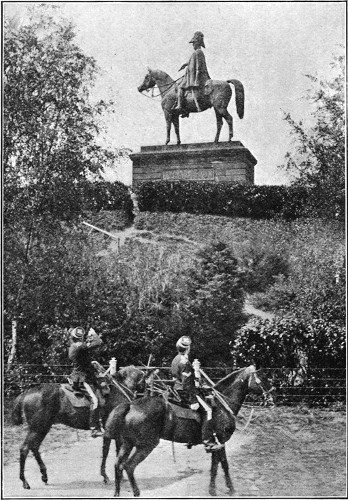
On a green mound commanding Cæsar's Plain, Aldershot, a rider and his horse survey the landscape. Occasionally soldiers come up and salute them—sometimes singly, sometimes in companies, often in battalions. But the salute is never returned; both rider and horse remain rigid. The sun sets and finds them still at their post; it rises and they have never stirred. The explanation is simple—this giant horse and horseman are of bronze; they form the greatest equestrian group in the world.
Yet the pair have not always been thus stationary. They have been thrice moved and may be moved thrice again. Perhaps in the watches of the night on Cæsar's Plain they are thinking of their past, and of the protracted episode which once shook the society of the British capital to its centre, and in which they played the chief part. Factions raged around them ere they left their humble birthplace in the Harrow Road, and for a time the bronze enjoyed far more celebrity than its original, the Iron Duke.
SOLDIERS SALUTING THE DUKE'S STATUE, AS IT STANDS AT ALDERSHOT TO-DAY. From a Photo. By Knight, Aldershot.
The story is well worth telling, for nobody remembers it now. Seventy years ago, although England had then no sculptors to speak of, there was a general passion for erecting statues. The statues were nearly all bad, of course, and to the decade between 1830 and 1840 the kingdom owes some of its worst atrocities in this department of art. About the time the late Queen came to the throne, a sculptor, Matthew Wyatt, was commissioned to execute a statue of George III. The result may be seen in Cockspur Street to-day. Critics complained that it was too small. The reproach greatly offended Wyatt, who roundly declared that he had not aimed at bigness, but that if size had been in question he was quite capable of modelling a statue larger than any Michael Angelo or the Indian idolmakers had ever attempted. He mentioned this to an ardent worshipper of the Duke of Wellington in the City, a Common Councilman named Simpson, who had already raised subscriptions for one Wellington equestrian group, now in front of the Royal Exchange. Simpson and Wyatt talked it over, and the result was the formation of a committee, headed by the Duke of Rutland, and the raising of fourteen thousand pounds for the erection of a memorial to the Duke in the West-end. This body duly handed the commission over to Wyatt as "in every respect eminently qualified to be entrusted with the proposed equestrian statue."
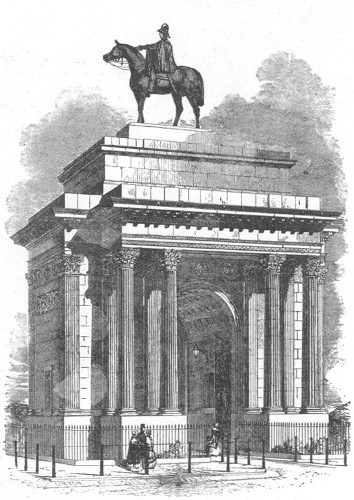
On this point it was plain that there were two opinions prevalent. Wyatt now prepared to realize his boast, and boldly announced that the equestrian statue should be of Titanic proportions. As to the site of his handiwork thereby hangs a tale. Wyatt had a friend with whom he had quarrelled, named Decimus Burton. This Burton, an architect, had recently erected a mighty triumphal arch at the entrance to Green Park. It formed a great feature in the magnificent plan submitted to Parliament in 1827 for the "re-edification" of Buckingham Palace. In this costly design the above arch was to form the Royal entrance to the palace gardens, to be laid out to suit the rather luxurious taste of George IV.
The arch was eighty feet high. Burton's original idea was to embellish the main piers with groups of trophies; to place the figure of a warrior on each stylobate; to enrich the base with a sculptural representation of an ancient triumph; to place a statue over each column; and various other embellishments. But all this ambitious plan was instantly shortened by Wyatt's declaring his intention of placing his colossal statue not in the middle of Hyde Park, or even of Green Park, or Kensington Gardens, but on the very summit of Burton's arch!
The unfortunate architect was beside himself with rage at the suggestion. He protested, but he protested in vain. The complaisant committee had quite fallen in with Wyatt's idea. But it was not so the Government, the Royal Academy, and the Press. They heaped ridicule upon both the project and the sculptor. They roundly declared that it would ruin the unity and symmetry of his building. Then began an acrimonious discussion between the friends of Wyatt and the objectors to his proposed statue. All London divided itself into factions. The common topic of drawing room and dinner conversation was, "Are you for or against putting a gigantic Iron Duke on the top of the arch?" "Brazen impudence!" wrote Thackeray, himself an artist.
Meanwhile, in the studio in the Harrow Road, opposite the Dudley Arms Tavern, the lucky sculptor had been proceeding with his task. He prepared several models and designs, and the sub-committee availed themselves of a model of the Hyde Park Corner arch to consider, which they did with the greatest attention, the position and relative size of the statue to be placed on the summit. Wyatt then prepared a drawing of the arch with the equestrian statue, of which the sub-committee approved.
But at this point the Lords of the Treasury stepped in with an injunction. As the modelling and casting went on the battle raged. Macaulay wrote from India that the sculptor and his friends "ought to be in Bedlam"; his antagonist, Croker, inquired blandly "what a Whig Dissenter knew of high art." "High" art then became a joke. To the query, "What is the very highest form of art?" the jocular answer was, "Wyatt's Duke." The newspapers between 1840 and 1846 contain innumerable references to and descriptions of the statue, and the progress it was making towards completion.
We are told that the plaster of Paris used in the stupendous work considerably exceeded one hundred tons; it was formed upon a turn-plate, or revolving platform, upwards of twenty feet across, travelling upon forty rollers and weighing in itself several tons. The vastness of the model required certain precautions to ensure its integrity. To give strength to the body of the horse, a beam passed through it longitudinally, like a backbone from which spring traverse timbers, like the ribs of a ship. From the body of the horse was a line of iron bolts, beneath which, in the early stage of the modelling, were placed props for security in shifting the figure by means of the platform, so as to obtain the most desirable position for light, etc. To reach the different parts of the statue a travelling stage with a shifting floor was constructed, so that it might be adjusted to any height.
The entire group represented the Duke of Wellington as he appeared on the field of Waterloo upon his favourite horse, Copenhagen. The Duke—at least so Wyatt declared, although this was denied—sat to the sculptor for the portrait, the warrior wearing his customary short cloak, which the artist draped so as to give it something of the grace of classic costume. But the sculptor's intentions generally surpassed his execution.
For melting the sixty tons of bronze Wyatt erected two great furnaces. The first employed was capable of melting only twelve tons at a time, whereas it was found desirable to cast the remainder of the statue in larger and consequently fewer pieces. A record furnace was therefore built capable of melting twenty tons at a time.
The mould and core being placed in the pit in the foundry, the bronze was run into it from the furnace, and the body of the horse and the lower portion of the rider were thus cast in two parts of about twenty tons each. These were magnificent castings, and the effect of so large a surface of molten compound as the twenty tons presented is described as very extraordinary. The statue, or rather group, was thus cast in about eight pieces. In each case the mould was placed in the pit embedded in sand, rammed in as tightly as possible; yet in casting the front of the horse, by some means six tons of metal escaped through the mould, the chest of the horse was left vacant, and the casting was consequently spoiled. In order that the legs of the horse should be capable of carrying the great weight they would have to sustain it was found necessary to cast them solid. The other portions of the work vary from one to three inches in thickness, with strong ribs internally to give additional strength. Its height approaches thirty feet, and such is the bulk of the horse that eight persons once dined within one-half of it.
The following are some of the main dimensions:—
Ft. in.
Girth round the horse228
Ditto arm of54
From the horse's hocks to the ground60
From the horse's nose to the tail260
Length of head60
Length of each ear24
The group being cast in pieces as above, they were joined partly by screw-bolts two inches in thickness. Owing to the colossal size of the group there were, for some time, upwards of thirty men employed at once upon the bronze; and in case of any work being requisite to be done within the figure of the rider, the head was removed to allow the workmen to descend through the neck. The cleansing, chasing, and finishing occupied a considerable time.
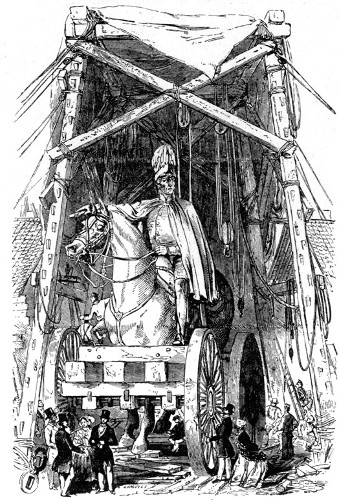
THE STATUE AT MR. WYATT'S FOUNDRY. From the "Illustrated London News."
At last, after being repeatedly canvassed in Parliament and in the country for six years, provoking a greater degree of heat than perhaps any statue in the world had ever provoked before, the business was supposed to be temporarily settled by the authorities agreeing to allow the statue to be placed on the arch "on three weeks' probation," when, "if the location proved to be injudicious," it was to be removed. Whereat there was great joy at the sculptor's studio in the Harrow Road. The Duke of Rutland jumped into his carriage and flew thither himself to bear the glad tidings.
"Once it's up," he is said to have cried, "the devil himself can't pull it down!"
When the gigantic horse and rider was all but finished it was hoisted out of the pit in the foundry and placed upon an enormous car, built especially for the purpose at Woolwich Dockyard. The roof of the foundry had first to be removed and one of the walls completely demolished to allow of the entry of the car, which weighed no less than twenty tons. Its wheels were twenty feet in diameter, with radiating cast-iron spokes, and were surmounted by a platform within which the statue was slung. The feet of the horse rested upon ledges, so close to the ground as to preclude any possibility of danger from a fall. As it stood thus it was visited during three weeks by many hundreds of persons, including most of the celebrities of the day, such as Lytton, Disraeli, and Dickens.
Outside every day saw a vast concourse of people watching the movements of the workmen. On the 28th September, at dusk, by means of chain windlasses, ropes, pulleys, inclined planes, plank tramways, etc., the biggest carriage in the world and the largest statue were moved in proximity to the gate, in readiness for the event of the next day.
From the "Illustrated London News." THE GRAND PROCESSION OF THE STATUE—TURNING FROM PARK LANE.
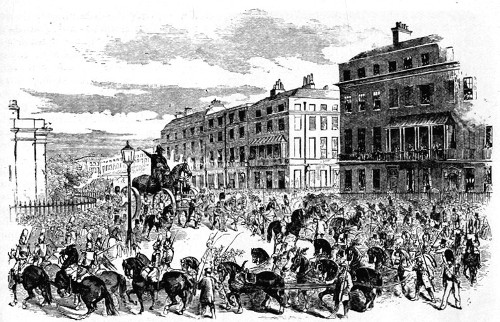
All London was agog on September 29th, 1846. As it was understood by the public that the removal would take place as early as ten o'clock, long before that hour the Harrow Road and the streets adjoining were thronged with well-dressed people. Seats were erected in various places, for which shillings and half-crowns were cheerfully paid. Even the roofs and windows in the neighbourhood of Mr. Wyatt's foundry were crowded with anxious spectators. The whole line of route from the Harrow Road to Piccadilly, was, indeed, one scene of excitement, the windows being mostly filled with company and presenting a scene of much gaiety and animation. Paddington Green was filled, and Hyde Park was crowded towards the Drive and principal walk.
The procession included a large number of troops—Life Guards, Fusiliers, Grenadiers, Coldstreams, together with no fewer than four bands. In brief, the worshippers of the Duke omitted nothing to make the occasion a triumph. Besides, the weather was superb.
"PUNCH'S" SKIT ON THE PROCESSION. Reproduced by permission of the Proprietors of "Punch."
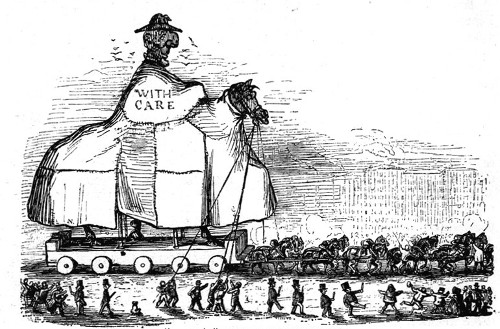
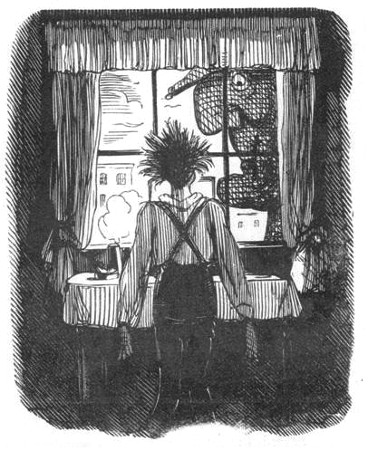
The miserable pageant prophesied by Punch in Leech's amusing drawing was nothing like the reality. Leech afterwards drew a mirth-provoking picture of the effect of the statue's passing down Edgware Road upon a gentleman shaving in the seclusion of an upper window, which we here reproduce.
AWFUL APPARITION TO A GENTLEMAN, WHILST SHAVING, IN THE EDGWARE ROAD—ANOTHER "PUNCH" JOKE ON THE PROCESSION. Reproduced by permission of the Proprietors of "Punch."
Arrived at the arch, where Royal Princes, dukes, earls, and innumerable peeresses were assembled, it was found too late that day to hoist the mighty bronze to its resting-place. In fact, the ceremony took three days before it was concluded.
While all this was happening, on the first and last days the happy sculptor, Wyatt, was holding high revel at his studio, his friends partaking of a banquet at his expense.
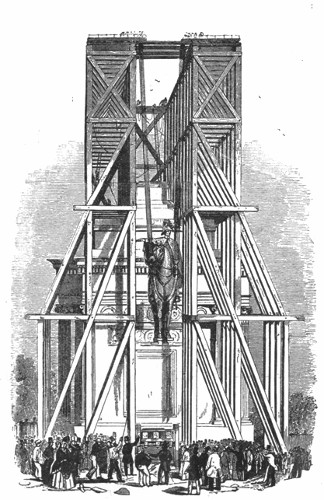
Nobody dreamed of trouble. "Once up—the statue is safe," was the watchword. But the Royal Academy and the Office of Woods and Forests had resolved that the fate of this huge "solecism" was sealed. It had taken six years to set up; it should come down in three weeks! By October 1st, 1846, the sixty tons had been hoisted to the top of the one hundred and fifteen foot scaffold and placed in position by the sculptor himself. A few days later the fatal message arrived: "The Government decides that your statue must come down within three weeks." No wonder the sculptor and his friends were panic-stricken. How were they to be saved? There was only one way—by intercession to the Duke to save his bronze counterfeit.
HOISTING THE STATUE TO THE TOP OF THE ARCH. From the "Illustrated London News."
We have not space to tell the full story; the Iron Duke spake the word and the Government dared not deny him his request.
For nearly thirty-seven years the great statue remained on the summit of the triumphal arch opposite Apsley House. But never during a moment of that time was it unassailed by hostile criticism. Foreigners were said to point at it with scorn. Albert Smith declared that saturnine men came to laugh at it "who had never laughed before." But it was not so much that it was a badly-modelled statue as that it had given rise to prejudices and antagonisms which long survived both Duke and sculptor. So it happened that in 1883, when alterations were projected in the locality, the Duke at last was made to descend from his eminence. It was a tremendous piece of work—both the Duke and Copenhagen had to be decapitated and otherwise mutilated—but the gradual descent was accomplished, witnessed by vast multitudes. Wyatt's enemies had triumphed.
The question arose as to where the statue should be placed. "In the furnace," said many zealous brother sculptors. Ruskin boldly counselled its destruction. But it was decided that a good place for it would be in St. James's Park, opposite the Horse Guards' Parade. The removal thither to this obscure spot was accordingly begun. But the old antagonism apparently revived. The Horse Guards complained; the Duke of Cambridge thought it an eyesore. Lord Randolph Churchill, whose way between Westminster and St. James's led through the park, said he was "driven to frequent Whitehall," and predicted that the big bronze Duke would bring about the fall of the Government. Sir Frederick Leighton, P.R.A., and Lord Hardinge defended the new position, but the former was asked: "How would you like sixty tons of bad bronze opposite the Royal Academy?"
This time the old Duke of Wellington—thirty years in his grave—could give no sign. Rider and man waited immobile for further orders. "Forward—march!" finally, in 1885, came the command from head-quarters, and slowly, with difficulty, and with Copenhagen with his legs in the air, the new journey of forty miles began.
Such is the story of a statue. Where will it end? Two or three years ago a distinguished general, whose wife is also a distinguished painter of soldiers and horses, remarked cruelly that "Aldershot would be delightful if it wasn't for that—ogre."
And as he spoke, from force of habit he grimly raised two fingers to his temple, saluting the insulted Field-Marshal whose mighty shadow now darkens Cæsar's Plain.
Where will it end?
THE STATUE IN THE POSITION WHICH RAISED SUCH A STORM OF OPPOSITION. From the "Illustrated London News."