Weepin' Willie
Reading edition
By Albert Trapmann
I.

Private William Fox was swaggering down the road to Shorncliffe Camp; that is to say, he was trying to swagger as much as his 5ft. 2in. of stature would allow. For the prettiest girl in Folkestone was holding on affectionately to his left arm, and in his right hand he displayed to full advantage his new silver-topped cane, the result of several weeks' savings.
"Little Willie," as his comrades of the 210th line called him, was the most "special" of "special enlistments." He had enlisted at a time when a war scare was running riot throughout the country, and the inspector-surgeon had passed him, saying that he was sure to grow to standard height as he was only just eighteen, although it was evident to anyone who glanced at the set look of his shoulders that he would never be a hair's-breadth taller than he was. It was certainly rather trying to his three-month-old martial dignity to have the street urchins asking him as he strutted through the town whether "his ma knew he was out"—but that was nothing to the jeers of the men of his company, and Little Willie had not found the life of a soldier of the Queen as alluring as the recruiting sergeant had painted it.
But on this particular summer afternoon he had forgotten all that, for was not Nellie, his own little Nellie, tripping along by his side?—and he never thought of his grievances when she smiled those sunny smiles of hers. He had known her for years; as children they had made mud-pies in the gutter together, and when he was a little older he used to spend the pence he got for holding horses and running errands in sweets for Nellie; and now that they were grown up, and that she was in service and he was wearing a red coat, they "walked out" together, and talked of getting married.
"When I get my stripes, Nell, we'll get spliced, thet's what we'll do."
Nell nodded her assent.
"'Ow long'll thet be, Will?"
"Not so very long, neither," he said, his boyish face lighting up with the ambition of a future field-marshal—"a year or two, maybe, maybe less—they're a-wanting good, steady men loike me."
Here a loud voice behind them put an end to further confidences. "Ullo, little 'un, where are yer a-going, so 'aughty-like? Yer won't as much as look at a pal!"
The two stopped and looked round as Big Bob finished his sentence, Willie with disgust written on every feature, Nellie with unqualified admiration in her brown eyes. Big Bob was accustomed to that sort of thing from the girls he condescended to talk to; he was certainly a very handsome man—fair, curly hair, a fierce moustache, and light-blue eyes that looked down protectingly on womankind in general. So without further ado he ranged up on the other side of Nellie with a "Pleased to meet yer, miss."
For the rest of that walk poor Little Willie was decidedly "out of it." He had to dodge lamp-posts and walk on the curb, so that his six-foot rival should not be forced into the hedge on the other side; however, there was one consolatory thought in his mind, namely, that if Nellie managed to impress Big Bob favourably—as he had little doubt she would—the latter perhaps would give up making Willie's barrack-room life a burden to him.
Nellie did make a good impression on Big Bob; but, alas, for poor little Willie, it was not a one-sided affair. Next time the two lovers went for a stroll, Nell was distinctly patronizing.
"Why don't yer grow, Will? Yer ain't as tall as me by a inch, and yer does look small in a red coat!"
This was an awful blow; up till now, Nellie had been the only one person who told him he looked well in his uniform, and now that she should turn on him like this!
"Garn!" he answered, "where's the use in bein' a lamp-post?"
"But Big Bob—I mean Mr. Jones—'e ain't no lamp-post. 'E's a good sight broader in the shoulders than ever you'll be. Why, 'e'd make two of yer, 'e would!"
"Well, 'e don't draw no double pay, no 'ow, and don't yer forget it, neither!"
After half an hour's walk these amenities produced a decided coolness, and when Big Bob strolled up and offered them the pleasure of his company, it was a great relief to both. But Little Willie felt very miserable indeed when he thought over the day's events, as he lay on his hard barrack bed that night and courted sleep in vain.
"I'll make it up with her on Sunday," he kept on saying to himself by way of consolation. But when Sunday came round again, after a long, weary week of bullying, Nellie was absent from the rendezvous, and he wandered disconsolately all over Folkestone in the hope of meeting her. He did meet her—but hanging proudly on the stalwart arm of Bob Jones! Poor Willie did not even reply to her "Good afternoon," but went straight back to his cheerless barrack-room and spent the remainder of the day in putting a vicious polish on his captain's sword and buttons, by way of relieving his feelings.
Captain Archie Trevor was Little Willie's hero—he worshipped him at a distance, and proved his devotion by the care he took of that officer's effects. Captain Trevor's boots were the admiration of the parade, and even the colonel wondered how they always looked so bright and spotless. Willie was an ideal soldier's servant, and was quite happy if he won an occasional word of approbation from his hero; for Willie had never forgotten how, during his first march-out with the battalion, when he was staggering along under his heavy rifle, with blistered feet and aching legs, wondering how long it would be before his knees gave way altogether, his stalwart captain had come up and cheered him with a few words, and had carried his rifle for him all the rest of the long, weary day. "I'd give a month's pay, thet I would, to shake 'ands with the captain," he had afterwards said to a comrade, in a burst of confidence; and so it came about that there was never such an ideal soldier's servant as Little Willie.
That evening A Company had a "smoker" in one of the disused huts of Shorncliffe Camp. The hut was packed with unbelted warriors, who joined noisily in the choruses of the popular songs, and passed round buckets of beer to wet their throats between whiles. Little groups of men were sitting smoking all over the room, some on biscuit-tins, some on benches and tables, all chatting and laughing amongst themselves, and occasionally shouting spicy and personal remarks to the performers, who used a table as a stage, and were not loth to pause in the middle of a song and accept a drink from a proffered mug or pail.
One occupant of the room, however, took little interest in the proceedings. Willie had perched himself in a corner, where he sat unnoticed; why he had come at all he did not know. Perhaps it was that anything was preferable to the deserted barrack-room in his present state of mind. There he sat on an upturned pail, with an untouched mug of beer beside him, giving no heed to what went on around, dismally busy with his own thoughts.
"What-ho, Willie," cried Big Bob, as he espied him for the first time. "What yer so quiet about?"
Willie gave an imperceptible shudder as the bully shouldered his way through the intervening groups. "'Ere, boys, Little Willie's goin' to give us a cormic song!"
A roar of applause greeted this announcement, and several of Willie's particular tormentors closed up around him.
"I carn't sing to-night," protested the victim, feebly.
"More yer can any other time!"
Another round of applause followed this sally.
"Ain't yer going to offer us a tip at yer mug?" Big Bob said, as he caught up the tankard from the floor.
"In course, if yer ain't wet enough already," answered Willie.
"Mates," said the offended one, pointing dramatically at the youth on the bucket—"Mates, the nipper's 'inted as 'ow I'm squiffy! Then take yer bloomin' tipple; Oi'll 'ave none of it!" and he poured the whole contents of the pot over the luckless young soldier.
Willie rose with an angry flush, but someone from behind caught him by the ankle and sent him rolling to the floor.
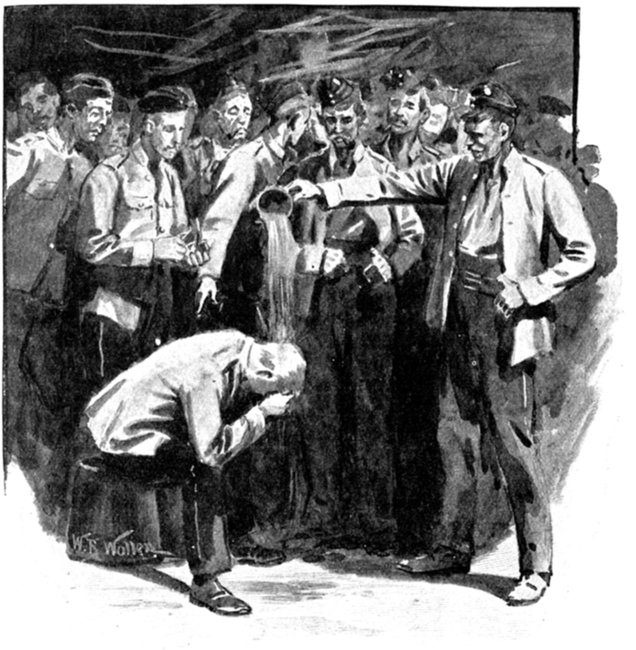
"WEEPIN' WILLIE, TAKE THET."
"So-o-o, yer wants to fight, does yer?" cried Big Bob, as he jerked the lad to his feet again. "What proice thet, Sandow!" and he administered a terrific box on the ear to the half-dazed Willie. It was by no means the first time that Willie had "gone through the mill," but he was getting rather sick of the process, and resolved to show fight.
"Yer bloomin' set of bullies!" he blurted out. But just then a leg from the encircling crowd neatly tripped up our young gallant and deposited him on the floor again. Once more he struggled to his feet, but as he looked round the circle of grinning faces, all many inches above him, and as he thought of his own dear little Nellie "walking out" with the fellow who was making his life unbearable, he felt a lump rise in his throat; his fists unclenched, and in another second he had sunk down on the upturned bucket, sobbing as if his heart would break, and his hot tears mingled with the beer that was trickling from his hair.
"Law lumme, he's acshally weepin'!"
A roar of derision and disgust rose from the astonished soldiers. Then every man solemnly fetched his drink, and poured it over the prostrate lad. "'Weepin' Willie,' take thet," was the formula, as each man upset the contents of his can.
At that moment the door opened, and those who stood nearest it drew themselves up to "attention" as Captain Trevor, who had heard the noise as he was passing by, strode into the room.
"What's this?" he said, addressing the crestfallen gang of tormentors. "Off you all go to your barrack-rooms at once, and don't let this ever happen again in A Company."
They were only too glad to get off so easily, and in less than a minute Captain Trevor and Private Fox were alone.
"What does this mean, Fox? Why, surely, man, you've not been crying!"
"Please, sir, I couldn't 'elp it, I did feel so wretched like."
"You've left school now, remember that—we don't have men who cry in the army. Get back to your room at once, and don't let me ever see you in this state again. I am disappointed in you, Fox."
Poor Willie, sick at heart and sore in limb, crept back to his barrack-room, where he was greeted with jeers and hoots, but, mindful of Captain Trevor's warning, his comrades abstained from stronger measures that night.
The months that followed made his life a perfect pandemonium. All his room-mates taxed their ingenuity to the utmost in order to devise new tortures and humiliations for "Weepin' Willie."
His bed was always soaking wet, his kit and accoutrements hidden away. They painted his buttons, they whitewashed his boots, they borrowed his blankets. When a man could not sleep, he whiled away the hours of the night by throwing the heaviest missiles he could lay his hands on at the luckless youth. On wet afternoons Willie was "crucified" for the public amusement, a process which consisted in tying up the patient's wrists just above the door, so that whenever it was opened he got a severe jerking. And yet through it all he never showed fight and never complained, but bore blows and jibes alike with stolid indifference. Although Captain Trevor never alluded to that awful night, Willie instinctively felt that his hero despised him, and that hurt him more than all the ill-usage of his room-mates. Nellie he had not seen since, but she had scribbled him a line in pencil.
"Mr. 'Weepin' Willie,'—You're a disgrace to the army. I hope never to see you again till you've got given up crying.—Nellie Lindon."
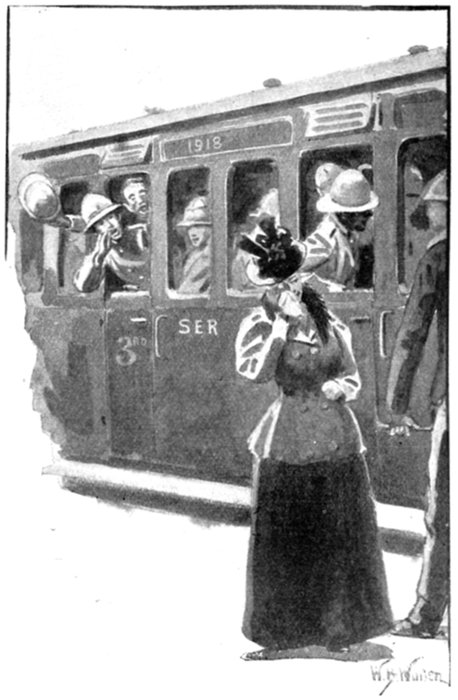
"SHE APPLIED A CORNER TO HER EYES."
This masterpiece of sarcasm Willie kept in the lining of his tunic, and it made him mad every time he thought of it. And so the weary weeks passed by until the trooping season came, and then, much to the delight of all the men, A Company was ordered out to the North-West frontier to join the first battalion as a draft to make good the ravages caused by sickness and the enemy. As the train steamed out of the station, Willie saw Nelly Lindon waving her handkerchief to Big Bob, and as his carriage moved slowly past, she applied a corner to her eyes as if wiping away an imaginary tear, but there was a mischievous smile on her lips.
II.
"Them's the beggars we've got to smash; look at 'em a-wasting of their ammunition, as if hevery round on it wasn't stolen from the Govermint."
"That'll make some of the boys perspirite, I'm thinking," Sergeant Thomson replied, as his eyes followed the direction of Big Bob's finger.
Half a mile or so from where the company was halted to refresh itself after its tedious semi-circular march in the early dawn, a long sloping hill, covered with stunted growth and unsteady boulders, rose gradually up to the sky-line; some little way below the summit, a ledge of rock ran parallel with the top, and it was at this ledge that Captain Trevor directed his field-glasses.
"I'll send the men up to that ledge in skirmishing order," he said to one of his lieutenants. "They'll be protected from the enemy's fire once they get there, then we can re-form and do the rest with a rush; I don't suppose it's more than a hundred and fifty yards to the summit from there. What do you think, Mason?"
"I shouldn't think so; anyway I hope not, as we've got to do it, and the general will be coming along on the far side in another couple of hours. By Jove, Trevor, we'd better hurry up," he added, as he looked at his watch. "We must clear those fellows off the summit by six o'clock, and it's nearly half-past four now. How many of them are there, do you think?"
"Only a couple of hundred, I suppose, but if we don't clear them out of that they could play the very devil with the brigade; it's a sheer drop of 200ft. into the road from where they are, and they'd be rolling those great boulders on to the fellows' heads. Company, fall in. 'Tention! You will advance in skirmishing order up to that ledge of rock. Section commanders to keep their men well in hand and to make the best use of every bit of cover. Now, remember, no target-shooting at those niggers on the sky-line! What I want you to do is to get to that ledge as quickly and with as little loss as possible. The men will widen out as far as they can, so as to offer no mark for the enemy's sharp-shooters. Section commanders, tell off your men!"
Five minutes later the company was straggling along over the broken ground in one long line, with wide gaps between the men, who were left more or less each to take care of himself and choose his own way.
"Blow me if we ain't a-going to 'ave a treat now!" Big Bob shouted to Little Willie, who was staggering along under the weight of his rifle half-a-dozen yards to Bob's left, as a bullet went whistling in between them. As the big man spoke his foot caught in a trailing creeper, and he measured his length on the ground, his rifle going off as he fell.
Immediately a young recruit on the right, hearing the report, and longing to have a shot at the enemy, brought his rifle up to the "ready," took careful aim, and fired. Nothing is so contagious as contagion. In five minutes the whole line were taking pot-shots at the black figures on the sky-line. In vain did the captain and his two lieutenants curse and threaten the men nearest them; in vain did the non-commissioned officers urge their men forward—it was impossible to do anything. The men were all over the place, some of them a hundred or more yards apart, some lying down behind boulders taking aim, others running forward a few paces, and then discharging their rifles from the cover afforded by bushes or rocks. As they gradually worked their way upwards, the tribesmen's good shooting began to take effect. First one man dropped, then another; then one of the lieutenants threw up his hands and fell forward, shot through the heart in the act of kicking a man who was having a little private nigger-shooting competition with his corporal. As the men saw their comrades fall they got more and more chary of exposing their own persons, preferring to lie low and waste ammunition on the sky-line.
Pitter-patter went the bullets on the stone-strewn hill-side, and the soldiers crawled a little closer up to their sheltering rocks and bent their heads down a few inches lower. There was not a man there whom you could have called a coward with impunity. Had they been all together—in line or column—they would have gone up the hill like a herd of buffaloes, with wild cheers and gleaming bayonets, and never given a thought to the dead and wounded. But, scattered as they were over the whole hill-side, with only now and then a comrade's white sun-helmet coming in sight, it was too much to expect of any man with a loaded magazine and clear view of the enemy that he should go on up, alone for all he knew, with the bullets singing around him.
In vain had Captain Trevor called the men nearest him a pack of white-livered curs; in vain had he referred to their parents and antecedents in terms that would have shocked and astonished his eminently respectable aunt, the Dowager-Countess of Trevordine. At last he gave it up in despair. "Lie there, you infernal idiots, and blaze your ammunition away. I'll be cursed if I stand and score for you!" And, fuming with impotent rage, he returned his sword to its scabbard with a vicious click, placed his hands in his pockets, and continued the ascent alone.
"Just as if 'e was goin' on a Halpclimbin' hexpedition," as one of the men remarked.
"'E'll git a bloomin' 'ole knocked in his carcuse afore 'e's gone fur," Big Bob yelled to the man nearest him, as he refilled his magazine and settled his elbows preparatory to wasting more cartridges.
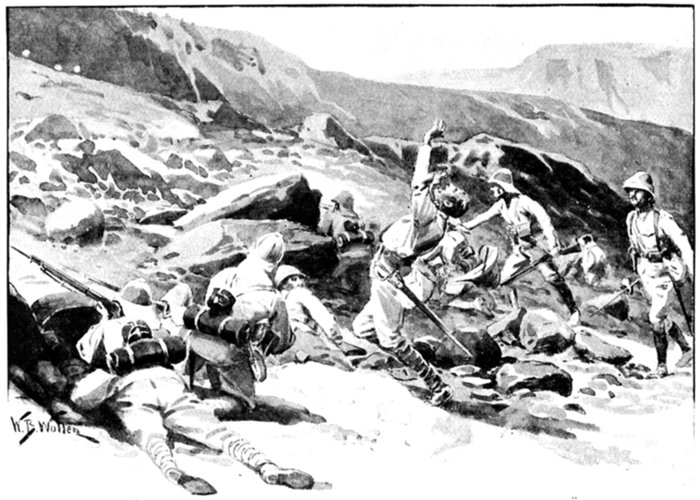
"ONE OF THE LIEUTENANTS THREW UP HIS HANDS AND FELL FORWARD."
How Captain Trevor ever reached the sheltering ridge which was to have been the rendezvous remains a mystery; but reach it he did without a scratch. One man alone was there to welcome him: "Weepin' Willie" furtively drew his sleeve across his mouth to try and disguise the fact that he was munching a commissariat biscuit, and stood at attention as his officer came up. It was Willie's first experience of active service, and he did not know if it was etiquette to be seen breakfasting while under fire.
"That you, Fox? D—— it, man, give me your hand! You're the only man fit to be a soldier in the whole company."
Willie blushed up to his ears with delight. At last he had retrieved himself in his hero's estimation. Almost reverently, he took the captain's outstretched palm.
"Thank ye, sir," he said. "Oi've been wishin' for this ever since ye carried my rifle that day!"
"That's all right, my man. Let's have a look at your rifle." He looked down the polished barrel. "You don't mean to tell me you haven't fired a shot yet?"
"Beggin' your pardon, sir, thin I did misunderstand yer. I thought as 'ow I 'adn't 'eard aright when I saw all the other blokes—I mean fellers, sir—a-blazin' away. But as I ain't much of a shot I thought I'd be on the safe soide, and I certingly did think as 'ow you'd told us not to shoot."
"I'll get you to repeat that in front of the whole company, Fox, if I can ever get them out of this cursed mess; it would be a lesson to them."
Five minutes passed, and still not another man had reached the rendezvous. Away down beneath them, some two, some three, and some four hundred yards away, the little white helmets could be seen from time to time as the skirmishers altered their positions.
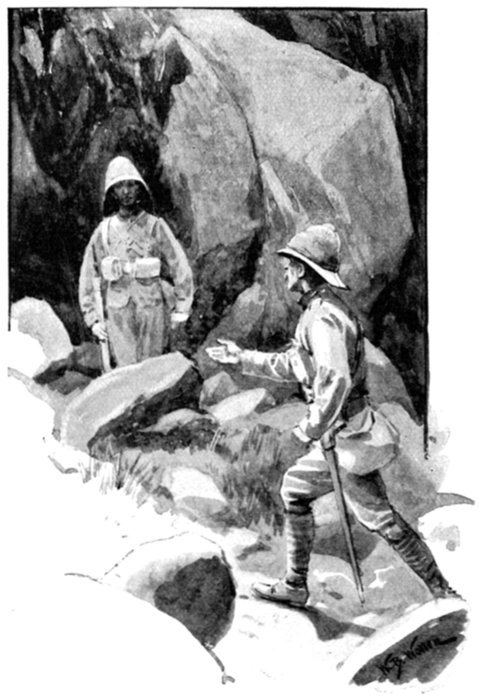
"THAT YOU, FOX? GIVE ME YOUR HAND."
"I'm going to see what the enemy are up to," Captain Trevor said, as he clambered up the seven-foot ledge of rock that was sheltering the two men. "Perhaps those beggars down there will see me then and come up!"
"Weepin' Willie" followed in the wake of his officer, and there the two stood in full view of their own men, and a splendid mark for the enemy. Once Willie almost ducked as a bullet "ventilated" his helmet, and the next moment Captain Trevor staggered, and would have fallen had not the private caught him in his arms.
Carefully, and exerting all his strength, for Trevor was a big man, Willie lifted him over his shoulder, and began slowly to descend from the ridge; but, as he gave a last look round, he saw the tribesmen on the summit suddenly leap to their feet, and, brandishing their murderous knives, begin to rush down the incline. In an instant, Willie was up on the ledge again, and with the full force of his lungs—and his lungs were the only big thing about him—he shouted to his comrades below: "Run, yer blazing beggars, run! They're on yer!" And then, with all the speed his feeble legs would allow, he clambered off the ridge and began to stagger down the hill, the captain's long legs trailing on the ground behind, scraping against the loose stones and starting them rolling. On the little man stumbled, his knees giving under his heavy burden, his breath coming in short sobs, and his heart beating like a steam-hammer. What if he failed to save his hero!
Suddenly he became aware of a big man in "khaki" towering above him. "Here, lad, give 'im to me!" and a pair of strong arms lifted the captain easily, as Willie recognised Big Bob's voice. A cheer went up from below as Lieutenant Mason and a dozen men with gleaming bayonets came dashing up the slope. The tribesmen, who were just coming over the ridge above, saw the little band, saw the fierce, determined look on their faces, the blood-for-blood battle-lust in their eyes. "Illah Allah," shouted the chief, "these are no coward-women after all!" and discharging his rifle haphazard, scrambled down the ledge the way he had come. In less time than it takes to tell, the dusky warriors were laboriously following their chief to the summit again, closely pursued by the Englishmen, while all along the slope white helmets and bright steel flashed in the rising sunlight, as one after another the men leaped to their feet and rushed upwards. In five minutes the struggle was over, and just as the dusty, blood-stained men were opening their haversacks to snatch a hurried breakfast, a troop of the Guides cavalry, the advance guard of the brigade, came clattering along the mountain road two hundred feet beneath them.
It was a proud day for A Company when all the Fingal Valley Brigade were paraded in hollow square to see private Fox receive the Victoria Cross, and no man cheered louder than Big Bob.
"'Weepin' Willie' yer is, and 'Weepin' Willie' yer'll remain," he afterwards said to the hero of the day, as all his comrades gathered round to shake his hand. "I'd weep the 'ole bloomin' day if I thought it'd make me behave as well as yer did under fire, 'ang me tight if I wouldn't!"
"Aye! And if yer hasks my opination, 'e was weepin' cos 'is messmates was such a bloomin' lot of coward, low-'earted skunks! And so we are—compared with 'im, leastwise—ain't we, mateys?"
"Yes, yes. Rayther!" was shouted on all sides.
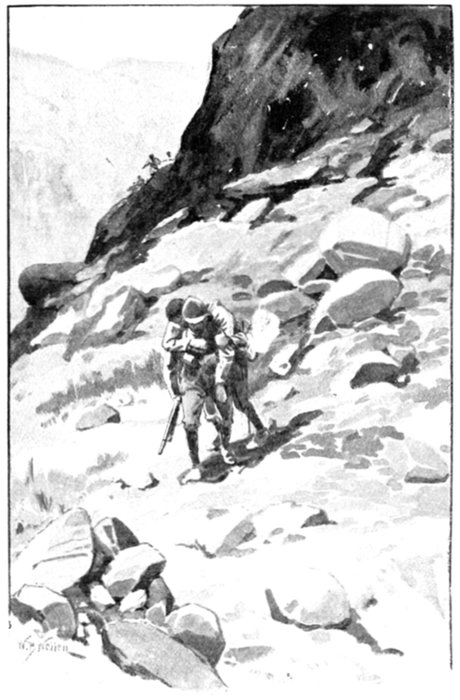
"ON THE LITTLE MAN STUMBLED."
Then someone got on a commissariat biscuit-box: "Three cheers for 'Weepin' Willie,' our little nipper, the bravest man in all the bloomin' brigade!" And the galvanized iron roof fairly rattled an accompaniment to the lusty lungs of A Company.
The day after the 1st Battalion of Her Majesty's 210th Line—late of the Fingal Valley Field Force—was landed at Plymouth, Nellie Lindon received a registered envelope which contained many things. One was a dirty scrap of paper with a few words in pencil on it, that had been carried all through a campaign concealed in the lining of a private's tunic. Then there was a plain gun-metal Maltese cross with the words "For Valour" graven thereon; and, lastly, a line or two from Big Bob: "Take my advice, Nell," he wrote, "and have the nipper."
And Nell did.