Part I.—1841 to 1849.
Reading edition

Mr. Punch has, perhaps, never given a better proof of ability to gauge the public mind of this country than that contained in the following lines, quoted from the issue dated November 5, 1898:
A WARNING WORD.
[From Mr. Punch's "Vagrant."]
Dear Punch,—I am not one to bellow Nor am I much on bloodshed bent; I'm not a tearing Jingo fellow, All fuss, and froth, and discontent.
[Here follow some verses relating to political affairs, and then come the lines printed below. J. H. S.]
We have another, sterner matter— The Frenchman posted on the Nile. Not his to reason? True! I like him, His skill to act, his pluck to dare. I'd sooner cheer him, far, than strike him— But why did others send him there? In truth, they did not mean to please us; They must have realised with joy That Marchand on the Nile must tease us, And sent him merely to annoy. So be it then: we know what's what now, And what the Frenchmen would be at. Though Major Marchand's on the spot now, He's got to pack and go—that's flat. We're tired of gracefully conceding, Tired, too, of jibe and jeer and flout; Our answer may show lack of breeding, But there it is—a plain "Get out." If one should, thinking I am weak, Sir, Smite me on one cheek black and blue, I'm told to turn the other cheek, Sir, But not both cheeks and forehead too. Year in, year out, they've tried to spite us, We've borne it with a sorry grin; And now—well, if they want to fight us, Coat's off, and let the fun begin!
Punch published these lines just before Lord Salisbury announced at the Mansion House dinner, given in honour of Lord Kitchener on November 4, that France had come round to our view of the Fashoda question, and Punch's neat verses just quoted give an excellently succinct and pithy expression to the feeling of the average peace-loving Briton, who has become quite weary of being diplomatically played with by France in our colonial affairs, and who was, and is, quite ready to "take off his coat."
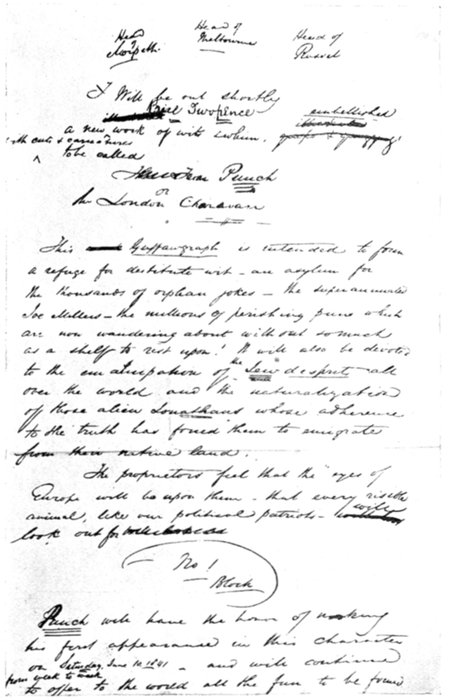
1.—THE FIRST PAGE OF THE ORIGINAL PROSPECTUS OF "PUNCH," IN THE HANDWRITING OF MARK LEMON. 1841.
The preceding illustration of Mr. Punch's terse and true expression of public opinion is the most recent that can now be given, but as one looks through the pages of the 113 Volumes of Punch, which bring this famous periodical to the end of the year 1897, one notices many other examples of Mr. Punch's acute discernment and pithy expression of the public mind, which have been stepping-stones of fame to him during his long life of nearly sixty years, quite apart from the weekly dish of good things offered by Mr. Punch to his public.
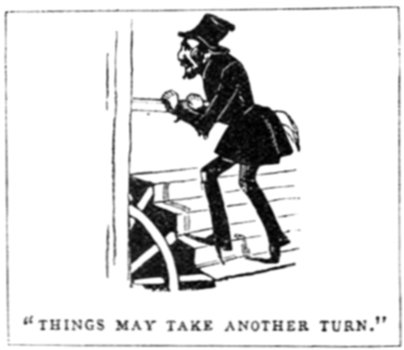
"THINGS MAY TAKE ANOTHER TURN."
2.—THE FIRST PICTURE IN "PUNCH." 1841.
Thanks to the kindness of Messrs. Bradbury and Agnew, the proprietors of Punch, I am able to give to the general public some of the pleasure that comes from the possession of a complete set of Punch. In reading one's Punch the pleasure is much enhanced by Mr. M. H. Spielmann's most admirable book, "The History of Punch" [Cassell and Company, Limited, 1895], for Mr. Spielmann is probably the best living authority on this subject, and his researches, which extended over four years, enable the ordinary Punch-lover to find many points of great interest [specially in the early Volumes] which, without Mr. Spielmann's book, might be passed over without notice. Some of the Punch engravings now shown have been found by the aid of Mr. Spielmann's book, which is a thoroughly reliable and quite indispensable Text-Book on Punch, while, on other points, I have been privileged to consult Mr. W. Lawrence Bradbury and Mr. Philip L. Agnew as well as Mr. Spielmann himself.
CANDIDATES UNDER DIFFERENT PHASES.
CANVASSING. THE DEPUTATON.
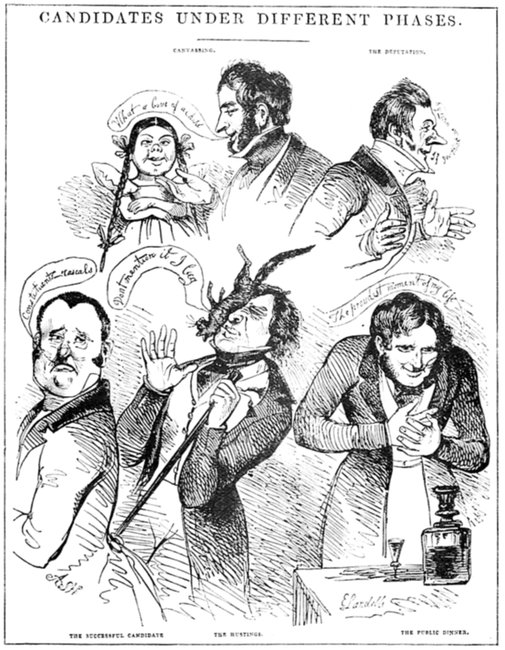
THE SUCCESSFUL CANDIDATE. THE HUSTINGS. THE PUBLIC DINNER.
3.—THE FIRST OF MR. PUNCH'S CARTOONS. 1841.
When the Queen came to the throne there was no Punch. He was conceived in circumstances of much mystery, for many have claimed the honour of his paternity. The historian of Punch has devoted a long chapter to this matter of Punch's paternity, and has judicially weighed the evidence for or against each claimant. Mr. Spielmann writes:—
Yet although it was not ... Henry Mayhew who was the actual initiator of Punch, it was unquestionably he to whom the whole credit belongs of having developed Landell's specific idea of a "Charivari," and of its conception in the form it took. Though not the absolute author of its existence, he was certainly the author of its literary and artistic being, and to that degree, as he was wont to claim, he was its founder.
PUNCH'S PENCILLINGS.——Nº IV.
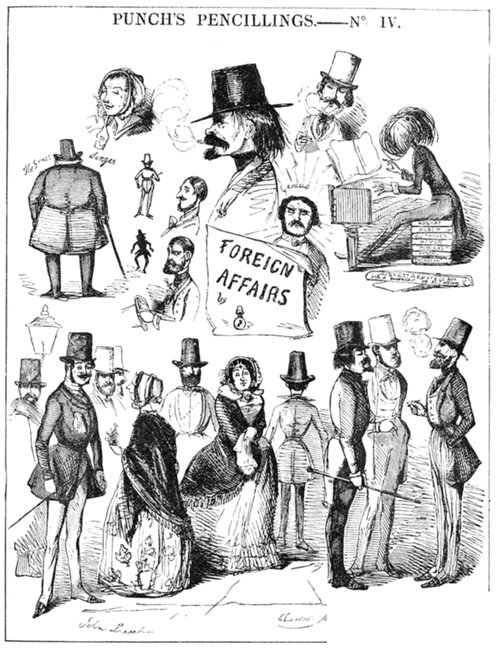
4.—THE FIRST PICTURE BY JOHN LEECH. 1841.
Thus, the opinion of the best authority is that Henry Mayhew and Ebenezer Landells were the real founders of Punch.
Early in 1841, after several discussions between the members of the first staff of Punch, the original prospectus was drawn up by Mark Lemon. The first page of this three-page foolscap document is shown in reduced facsimile in illustration No. 1 of this article. An excellent facsimile, on the original blue foolscap paper, is bound up in a little anonymous pamphlet published in the year 1870, "Mr. Punch: His Origin and Career": but Mr. Bradbury told me that many of the statements about Punch in this pamphlet are erroneous, although the document is an exact copy of the original in Mr. Bradbury's possession, which happens just now to be packed away in a warehouse, and so cannot be photographed.
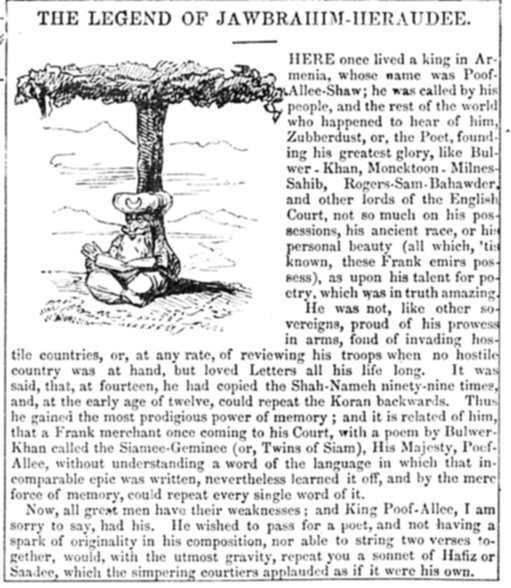
THE LEGEND OF JAWBRAHIM-HERAUDEE.
There once lived a king in Armenia, whose name was Poof-Allee-Shaw; he was called by his people, and the rest of the world who happened to hear of him, Zubberdust, or, the Poet, founding his greatest glory, like Bulwer-Khan, Moncktoon-Milnes-Sahib, Rogers-Sam-Bahawder, and other lords of the English Court, not so much on his possessions, his ancient race, or his personal beauty (all which, 'tis known, these Frank emirs possess), as upon his talent for poetry, which was in truth amazing.
He was not, like other sovereigns, proud of his prowess in arms, fond of invading hostile countries, or, at any rate, of reviewing his troops when no hostile country was at hand, but loved Letters all his life long. It was said, that, at fourteen, he had copied the Shah-Nameh ninety-nine times, and, at the early age of twelve, could repeat the Koran backwards. Thus he gained the most prodigious power of memory; and it is related of him, that a Frank merchant once coming to his Court, with a poem by Bulwer-Khan called the Siamee-Geminee (or, Twins of Siam), His Majesty, Poof-Allee, without understanding a word of the language in which that incomparable epic was written, nevertheless learned it off, and by the mere force of memory, could repeat every single word of it.
Now, all great men have their weakness; and King Poof-Allee, I am sorry to say, had his. He wished to pass for a poet, and not having a spark of originality in his composition, nor able to string two verses together, would, with the utmost gravity, repeat you a sonnet of Hafiz or Saadee, which the simpering courtiers applauded as if it were his own.
5.—THE COMMENCEMENT OF THE FIRST LITERARY CONTRIBUTION BY THACKERAY, WHO ALSO DREW THIS INITIAL SKETCH, 1842.
It is interesting to see in No. 1 that the name Punch was substituted for the struck-out title, "The Fun——." It has been suggested that the title thus cut short in favour of the single word Punch was to have been "The Funny Dogs with Comic Tales," and the prospectus ends with the words, "Funny dogs with comic tales." The price was written "Twopence," although the price of Punch has always been Threepence.
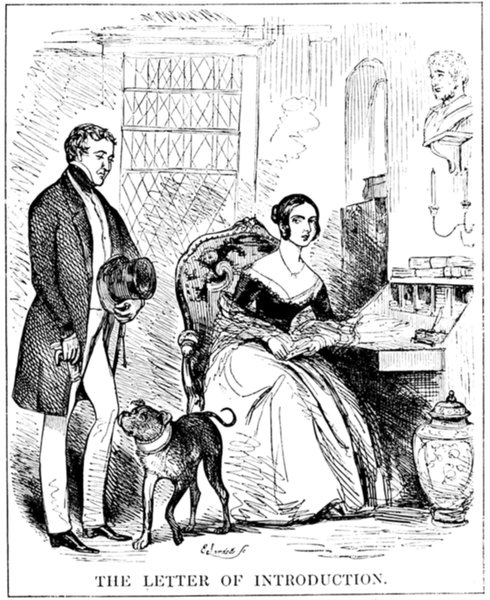
THE LETTER OF INTRODUCTION.
6.—THE FIRST PICTURE OF THE QUEEN IN "PUNCH." 1841.
As regards the sudden change of title to Punch—a change made, as we see from the facsimile, while Mark Lemon was in the very act of writing the title—Mr. Spielmann has recorded that there are as many versions as to the origin of Punch's name as of the origin of the periodical itself.
Hodder declares that it was Mayhew's sudden inspiration. Last asserted that when "somebody" at the Edinburgh Castle meeting spoke of the paper, like a good mixture of punch, being nothing without Lemon, Mayhew caught at the idea and cried, "A capital idea! We'll call it Punch!"
There have been many other claimants to the distinction of having thought of the title "Punch," which is certainly an infinitely better title than "Funny Dogs with Comic Tales" and much better than "The Funny Dogs," which I suggest may have been the title Mark Lemon began to write, judging from the place on the paper (see No. 1), where he began with the words, "The Fun——"; for if he had intended to write the longer title, "The Funny Dogs with Comic Tales," he must have run the last part of this long title too far to the right of his paper to be consistent with the symmetrical position given to his other headings, etc., on the sheet of foolscap: a practised writer unconsciously allows enough space for the symmetrical setting out of his headlines, etc., and that Mark Lemon was a specially practised writer is very clearly shown by inspection of this interesting facsimile.
THE PRINCE OF WALES.—HIS FUTURE TIMES.
A private letter from Hanover states that, precisely at twelve minutes to eleven in the morning on the ninth of the present November, his majesty King Ernest was suddenly attacked by a violent fit of blue devils. All the court doctors were immediately summoned, and as immediately dismissed, by His Majesty, who sent for the Wizard of the North (recently appointed royal astrologer), to divine the mysterious cause of this so sudden melancholy. In a trice the mystery was solved—Queen Victoria "was happily delivered of a Prince!" His Majesty was immediately assisted to his chamber—put to bed—the curtains drawn—all the royal household ordered to wear list slippers—the one knocker to the palace was carefully tied up—and (on the departure of our courier) half a load of straw was already deposited beneath the window of the royal chamber. The sentinels on duty were prohibited from even sneezing, under pain of death, and all things in and about the palace, to use a brand new simile, were silent as the grave!
"Whilst there was only the Princess Royal there were many hopes. There was hope from severe teething—hope from measles—hope from hooping-cough—but with the addition of a Prince of Wales, the hopes of Hanover are below par." But we pause. We will no further invade the sanctity of the sorrows of a king; merely observing, that what makes his Majesty very savage, makes hundreds of thousands of Englishmen mighty glad. There are now two cradles between the Crown of England and the White Horse of Hanover.
We have a Prince of Wales! Whilst, however, England is throwing up its million caps in rapture at the advent, let it not be forgotten to whom we owe the royal baby. In the clamorousness of our joy the fact would have escaped us, had we not received a letter from Colonel Sibthorp, who assures us that we owe a Prince of Wales entirely to the present cabinet; had the Whigs remained in office, the infant would inevitably have been a girl.
7.—THE FIRST MENTION OF THE PRINCE OF WALES. 1841.
The first number of Punch came out on the 17th July, 1841, at 13, Wellington Street, Strand. There was a good demand for it, two editions of five thousand copies each being sold in two days. This demand was caused by advertising in various ways, including the distribution of 100,000 copies of a printed prospectus that was nearly identical with the draft whose first page has been shown here.
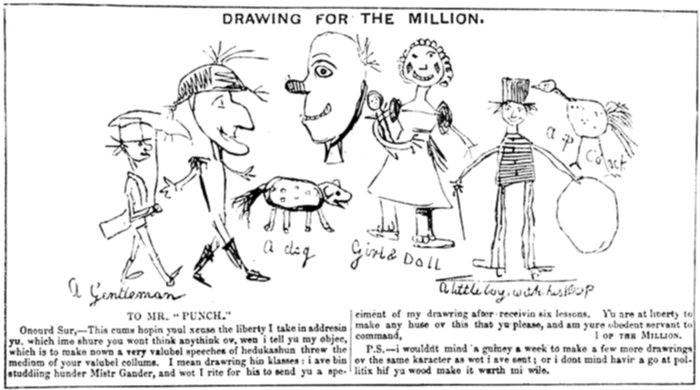
DRAWING FOR THE MILLION.
TO MR. "PUNCH."
Onourd Sur,—This cums hopin youl xcuse the liberty I take in addresin yu, which ime shure you wont think anythink ov, wen I tell yu my objec, which is to make nown a very valubel speeches of hedukashun threw the medium of your valubel collums. I mean drawring bin klasses: i ave bin studdiing hunder Mistr Gander, and wot I rite for his to send yu a speciment of my drawring after receivin six lessons. Yu are at liberty to make any huse ov this that yu please, am yure obedent servant to command,
1 of the Million.
P.S.—i wouldn't mind 'a guiney a week' to make a few more drawrings ov the same karacter as wot I ave sent; or i dont mind havin a go at politix hif yu wood make it wurth mi wile.
8.—A SUPPOSITITIOUS OFFER TO "PUNCH." 1842.
From the first Volume of Punch I have chosen the five pictures here numbered 2, 3, 4, 6, and 7. No. 2 is the first picture in Punch, a distinction that gives importance to this little sketch [the same size as the original] of a broken-down man at work on the tread-mill. By the first picture, I mean the first that was printed on the numbered pages of Punch—this is on page 2 of Vol. I.—for the Introduction contained three wood-cuts, and there was the outside wrapper—of which I shall speak later. But this little cut in No. 2 is really the first of Mr. Punch's famous gallery of black-and-white art. It was drawn by William Newman, and this is one of his so-called "blackies"—little silhouettes that were paid for at the rate of eighteen shillings per dozen.
No. 3 is the first of Mr. Punch's long series of cartoons. This was done by A. S. Henning, and it makes a much nicer picture in its present reduced size than in its original large size, where the work is too coarse in texture. In the forties, there were no ingenious photographic processes for reproducing an artist's work to any scale; the work had to be cut on the wood-block and shown the same size as the original drawing. Hence, in a weekly paper such as Punch, there was often not much time to spend on the wood-engraving, and so many of the drawings, especially the early ones, are wanting in finish.
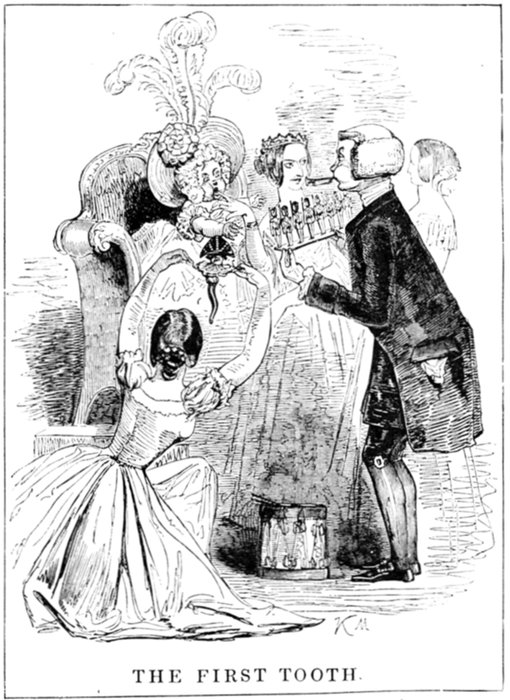
THE FIRST TOOTH.
9.—THE FIRST PICTURE OF THE PRINCE OF WALES. 1843.
Picture No. 4 is the first by famous John Leech—Mr. Punch's first great artist—and in addition to the signature "John Leech" at the bottom of the block, there is in the middle of the design the curious sign-manual, a leech in a bottle, which John Leech often used to mark his work. This first design by Leech was in the fourth number of Punch, August 7, 1841, and its title "Foreign Affairs" has reference to the groups of foreign refugees who at that time were specially numerous in Soho and Leicester Square—places that even nowadays are characterized by the presence of numerous and not too desirable foreigners.
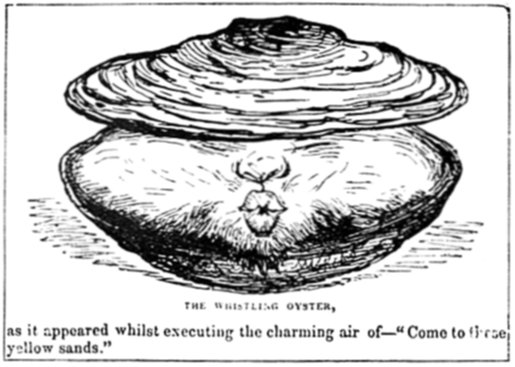
THE WHISTLING OYSTER, as it appeared whilst executing the charming air of—"Come to these yellow sands."
10.—A FANCIFUL DISCOVERY BY "PUNCH." 1843.
The facsimile in No. 5 is from the commencement of Thackeray's first literary contribution to Punch, and the sketch which forms the initial letter T is also by Thackeray. Mr. Spielmann says this sketch is "undoubtedly" by Thackeray; the full contribution is on page 254 of Volume II.
The cartoon shown in No. 6 contains the first picture of Queen Victoria in Punch, and it represents Sir Robert Peel sent for by the Queen to form an Administration in place of the beaten Ministry of Lord Melbourne. This was in the autumn of 1841. The words, The Letter of Introduction, at the bottom of the cartoon, are the title of "a MS. drama, called the 'Court of Victoria,'" on page 90 of Volume I. of Punch, which commences:—
SCENE IN WINDSOR CASTLE.
[Her Majesty discovered sitting thoughtfully at an escritoire.]
Enter the Lord Chamberlain.
Lord Chamberlain: May it please your Majesty, a letter from the Duke of Wellington.
The Queen (opens the letter): Oh! a person for the vacant place of Premier—show the bearer in, my lord. [Exit Lord Chamberlain.]
The Queen (muses): Sir Robert Peel—I have heard that name before, as connected with my family. If I remember rightly he held the situation of adviser to the Crown in the reign of Uncle William, and was discharged for exacting a large discount on all the State receipts; yet Wellington is very much interested in his favour. Etc., etc., etc.
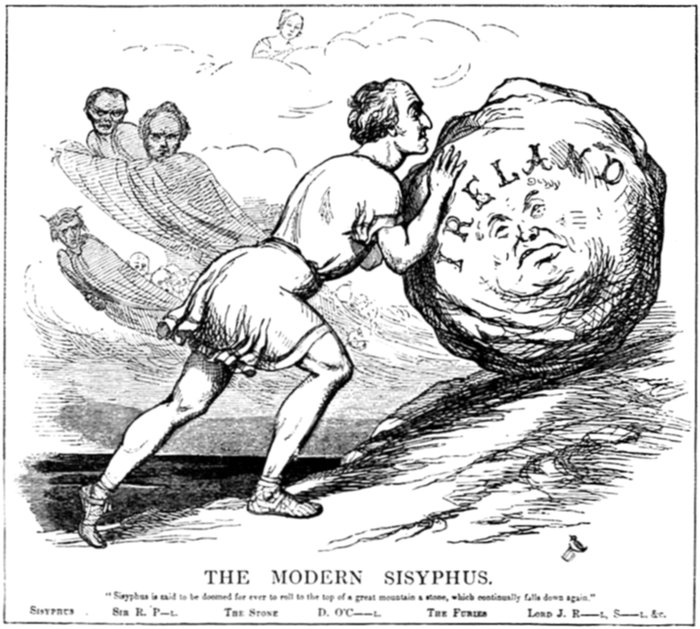
THE MODERN SISYPHUS
"Sisyphus is said to be doomed for ever to roll to the top of a great mountain a stone, which continually falls down again."
Sisyphus Sir R. P—l. The Stone D. O'C——l. The Furies Lord J. R——l, S——l, &c.
11.—RICHARD DOYLE'S FIRST CARTOON. 1844.
In facsimile No. 7 we see the first mention in Punch of the Prince of Wales. It is the first part of a full-page article on page 222 of Volume I., which records the birth of the Prince on November 9, 1841, and which also refers to the disappointment caused to the King of Hanover by the birth of the Queen's second child. Punch writes: "There are now two cradles between the Crown of England and the White Horse of Hanover." How many British Royal "cradles" are there now between the two things named by Punch?
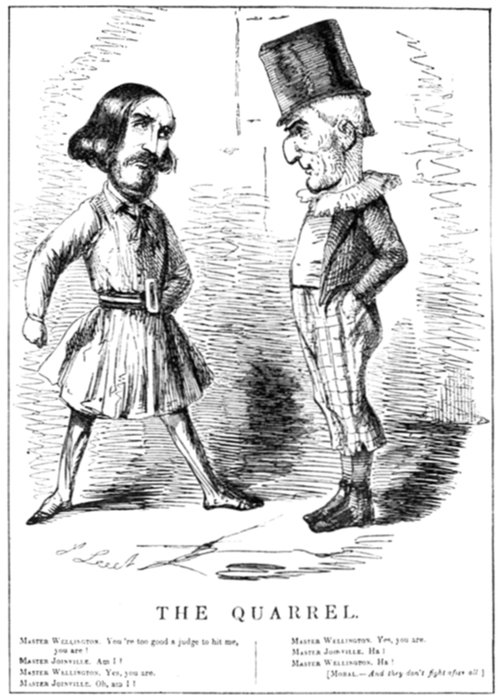
THE QUARREL.
Master Wellington. You're too good a judge to hit me, you are!
Master Joinville. Am I?
Master Wellington. Yes, you are.
Master Joinville. Oh, am I!
Master Wellington. Yes, you are.
Master Joinville. Ha!
Master Wellington. Ha!
[Moral.—And they don't fight after all.]
12.—A SUPPOSITITIOUS CONVERSATION BETWEEN THE DUKE OF WELLINGTON AND THE PRINCE DE JOINVILLE (OF THE FRENCH NAVY). 1844.
This comical sketch in No. 8 was, I suspect, suggested to Mr. Punch by one of the many offers of unsolicited "outside" contributions which have always been severely discouraged. Mr. Punch prefers to rely upon his own staff, although he is always on the alert for fresh talent, and amongst the clever men who have thus been invited to contribute to Punch are Mr. H. W. Lucy ("Toby, M.P."), Mr. R. C. Lehmann (who wrote "The Adventures of Picklock Holes"), Mr. Bernard Partridge (the brilliant successor to Mr. du Maurier), and Mr. Phil May.
We see in No. 9 the first Punch picture of the Prince of Wales. This cartoon was drawn by Kenny Meadows. The Queen is standing at the left of the infant Prince, and points to the first tooth, the doctor blows a toy-trumpet and offers some soldiers, while the lady who kneels is offering a baby's coral with a Punch's head as its chief attraction.
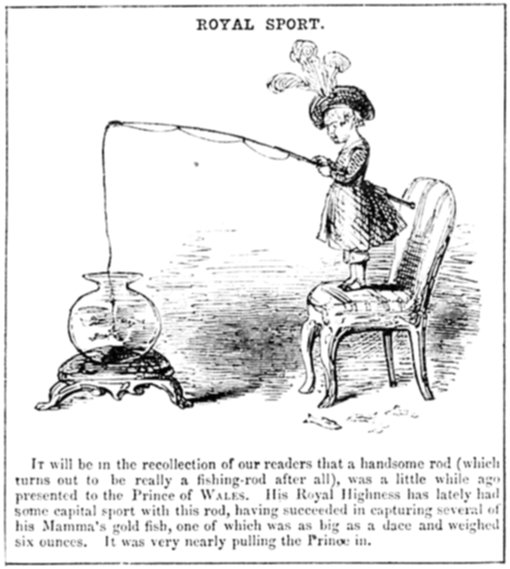
ROYAL SPORT.
It will be in the recollection of our readers that a handsome rod (which turns out to be really a fishing-rod after all), was a little while ago presented to the Prince of Wales. His Royal Highness has lately had some capital sport with this rod, having succeeded in capturing several of his Mamma's gold fish, one of which was as big as a dace and weighed six ounces. It was very nearly pulling the Prince in.
13.—ANOTHER PICTURE OF THE PRINCE OF WALES. 1844.
No. 10 is a very clever sketch of "The Whistling Oyster." A full account of this supposititious discovery is given on page 142-3 of Volume V. of Punch, in the year 1843, and this curiosity was stated to be "in the possession of Mr. Pearkes of Vinegard Yard, opposite the gallery door of Drury Lane Theatre."
The cartoon in No. 11 is the first by another of Mr. Punch's great guns—the famous Richard Doyle. This appeared on March 16, 1844; and "The Modern Sisyphus" is Sir Robert Peel, then Premier, seen in the task of rolling up the great stone [Daniel O'Connell, the Irish orator, who was then agitating for the repeal of the union between Ireland and Great Britain], while Lord John Russell and others represent "The Furies" who are watching Peel's unavailing exertions. The sign-manual at the right of this cartoon—a dicky-bird perched on a D—was often used by Richard Doyle, and may be seen on the present wrapper of Punch. Although No. 11 is the first cartoon contributed by Doyle, it is not the first work he did for Punch, for Doyle commenced his association with the paper by drawing comic borders for the Christmas number of 1842.
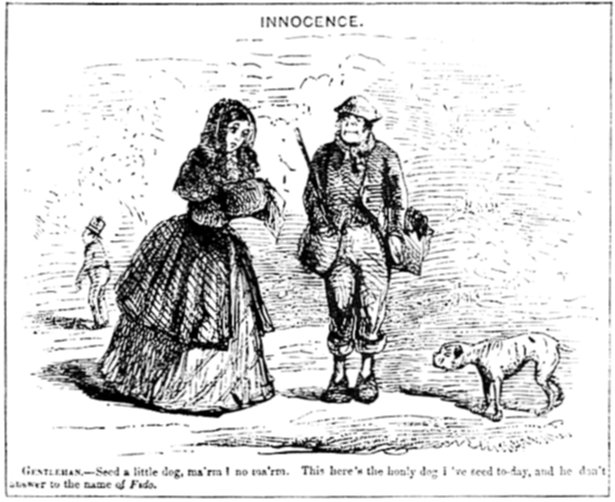
INNOCENCE.
Gentleman.—Seed a little dog, ma'rm? no ma'rm. This here's the honly dog I've seed to-day, and he don't answer to the name of Fido.
14.—A PICTURE OF INNOCENCE. 1845.
John Leech's cartoon, in No. 12, was published September 14, 1844; the Prince de Joinville was in command of the French Navy, and there was some foolish talk in the French papers about an invasion of England. The expression of the Duke of Wellington's face in this cartoon is simply perfect, as he stands with his hands in his pockets calmly looking at the threatening Joinville, and quietly says to the Frenchman, "You're too good a judge to hit me, you are!" One is irresistibly reminded by this clever cartoon of a quite recent affair with our French neighbour, in which the relative positions were not unlike those here shown, and to which the climax was [at any rate, up to date, November, 1898] the same as in Leech's cartoon—And they don't fight after all!
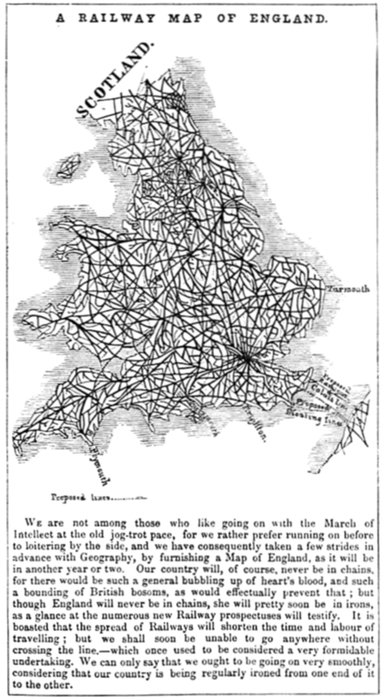
A RAILWAY MAP OF ENGLAND.
We are not among those who like going on with the March of Intellect at the old jog-trot pace, for we rather prefer running on before to loitering by the side, and we have consequently taken a few strides in advance with Geography, by furnishing a Map of England, as it will be in another year or two. Our country will, of course, never be in chains, for there would be such a general bubbling up of heart's blood, and such a bounding of British bosoms, as would effectually prevent that; but though England will never be in chains, she will pretty soon be in irons, as a glance at the numerous new Railway prospectuses will testify. It is boasted that the spread of Railways will shorten the time and labour of travelling; but we shall soon be unable to go anywhere without crossing the line.—which once used to be considered a very formidable undertaking. We can only say that we ought to be going on very smoothly, considering that our country is being regularly ironed from one end of it to the other.
15.—MR. PUNCH POKES FUN AT THE RAILWAY MANIA OF 1845.
No. 13 is from page 157 of Volume VII., October 5, 1844. It represents the Prince of Wales, then not quite three years old, "capturing several of his Mamma's gold fish, one of which was as big as a dace, and weighed six ounces. It was very nearly pulling the Prince in."
In the "Innocence" picture, No. 14, observe that the little dog Fido, which is being sought by the lady, is just visible in the left coat-pocket of the Bill-Sikes-looking rough.
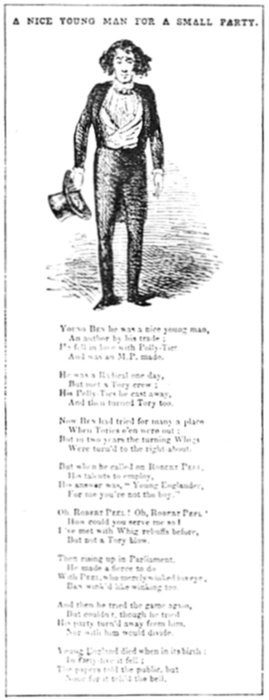
A NICE YOUNG MAN FOR A SMALL PARTY.
Young Ben he was a nice young man, An author by his trade; He fell in love with Polly-Ties And was an M.P. made. He was a Radical one day, But met a Tory crew; His Polly-Ties he cast away And then turned Tory too. Now Ben had tried for many a place When Tories o'en were out: But in two years the turning Whigs Were turn'd to the right-about. But when he called on Robert Peel, His talents to employ, His answer was, "Young Englander, For me you're not the boy." Oh, Robert Peel! Oh, Robert Peel! How could you serve me so! I've met with Whig rebuffs before, But not a Tory blow. Then rising up in Parliament, He made a fierce to do With Peel, who merely winked his eye, Ben wink'd like winking too. And then he tried the game again, But couldn't, though he tried; His party turn'd away from him, Nor with him would divide. Young England died when in its birth; In forty-five it fell; The papers told the public, but None for it toll'd the bell.
16.—AN EARLY PICTURE OF LORD BEACONSFIELD, AS BENJAMIN DISRAELI, 1845.
The Railway Map of England, No. 15, is one of Mr. Punch's prophecies that has become fact. It is in the issue of October 11, 1845, and refers to the precipitate influx of new lines just then taking place. To us, nowadays, there is nothing remarkable in this Railway Map, which might be mistaken for a genuine railway map of England and Wales; but in 1845, when this map was made by Mr. Punch, he no doubt intended it as a piece of satire.

PORTRAIT OF THE RAILWAY PANIC.
17.—AT THE END OF 1845.
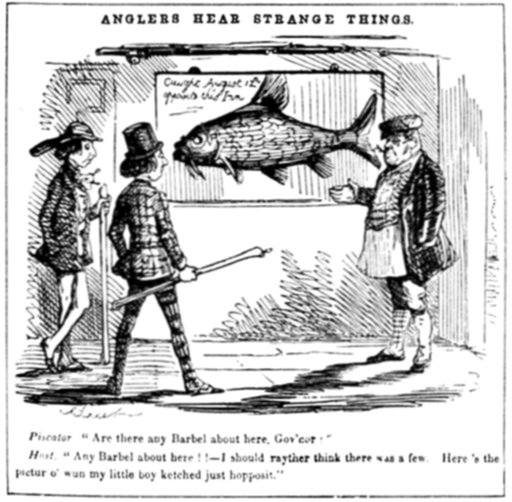
ANGLERS HEAR STRANGE THINGS.
Piscator. "Are there any Barbel about here, Gov'nor?"
Host. "Any Barbel about here!!—I should rayther think there was a few. Here's the picur o' wun my little boy ketched just hopposit."
18.—ONE OF MR. PUNCH'S FISHING TALES. 1845.
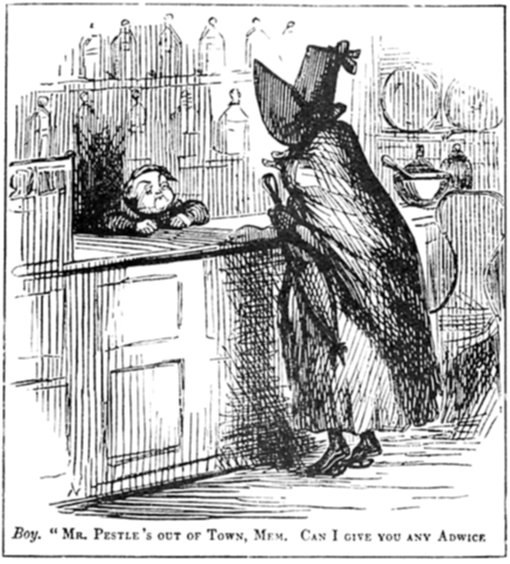
Boy. "Mr. Pestle's out of Town, Mem. Can I give you any Adwice?"
19.—THE DOCTOR'S ASSISTANT. 1846.
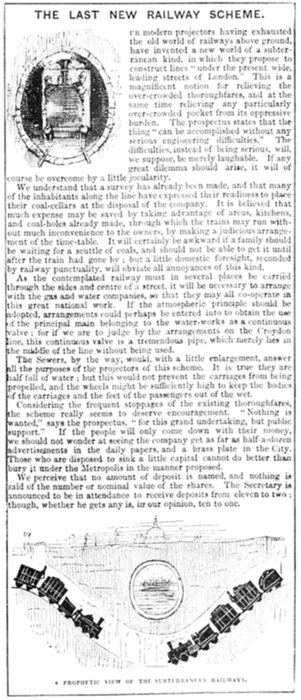
THE LAST NEW RAILWAY SCHEME.
Our modern projectors having exhausted the old world of railways above ground, have invented a new world of a subterranean kind, in which they propose to construct lines "under the present wide, leading streets of London" This is a magnificent notion for relieving the over-crowded thoroughfares, and at the same time relieving any particularly over-crowded pocket from its oppressive burden. The prospectus states that the thing "can be accomplished without any serious engineering difficulties." The difficulties, instead of being serious, will, we suppose, be merely laughable. If any great dilemma should arise, it will of course be overcome by a little jocularity.
We understand that a survey has already been made, and that many of the inhabitants along the line have expressed their readiness to place their coal-cellars at the disposal of the company. It is believed that much expense may be saved by taking advantage of areas, kitchens, and coal-holes already made, through which the trains may run without much inconvenience to the owners, by making a judicious arrangement of the time-table. It will certainly be awkward if a family should be waiting for a scuttle of coals, and should not be able to get it until after the train had gone by; but a little domestic foresight, seconded by railway punctuality, will obviate all annoyances of this kind.
As the contemplated railway must in several places by carried through the sides and centre of a street, it will be necessary to arrange with the gas and water companies, so that they may all co-operate in this great national work. If the atmospheric principle should be adopted, arrangements could perhaps be entered into to obtain the use of the principal main belonging to the water-works as a continuous valve; for if we are to judge by the arrangements on the Croydon line, this continuous valve is a tremendous pipe, which merely lies in the middle of the line without being used.
The Sewers, by the way, would, with a little enlargement answer all the purposes of the projectors of this scheme. It is true they are half full of water; but this would not prevent the carriages from being propelled, and the wheels might be sufficiently high to keep the bodies of the carriages and the feet of the passengers out of the wet.
Considering the frequent stoppages of the existing thoroughfares, the scheme really seems to deserve encouragement. "Nothing is wanted" says the prospectus, "for this grand undertaking, but public support." If the people will only come down with their money, we should not wonder at seeing the company get as far as half-a-dozen advertisements in the daily papers, and a brass plate in the City. Those who are disposed to sink a little capital cannot do better than bury it under the Metropolis in the manner proposed.
We perceive that no amount of deposit is named, and nothing is said of the number or nominal value of the shares. The Secretary is announced to be in attendance to receive deposits from eleven to two: though, whether he gets any is, in our opinion, ten to one.
A PROPHETIC VIEW OF THE SUBTERRANEAN RAILWAYS.
20.—MR. PUNCH SCOFFS AT THE UNDERGROUND RAILWAY SCHEME. 1846.
No. 16 introduces us to a very early Punch-picture of Benjamin Disraeli [June, 1845]; not the first, which was, Mr. Philip Agnew tells me, in the year 1844, but this is the more interesting picture of the two. Mr. Punch was sometimes very severe in his treatment of Disraeli, and this sketch with the accompanying verses is a good example of Punch's early satire. As regards Mr. Punch's politics, it is interesting to quote the following words from "The History of Punch":—
"The Table" [i.e., the weekly Punch dinner-table at which the cartoons, etc., are discussed.—J. H. S.] has always shown an amalgam of Conservative and Liberal instincts and leanings, although the former have never been those of the "predominant partner." The constant effort of the Staff is to be fair and patriotic, and to subordinate their personal views to the general good. For, whatever the public may think, neither Editor nor Staff is bound by any consideration to any party or any person, but hold themselves free to satirise or to approve "all round."
When No. 16 was published, Disraeli was the leader of the "Young England" party, having some years previously been converted from a Radical into a Tory: hence the allusions contained in the lines below this sketch.
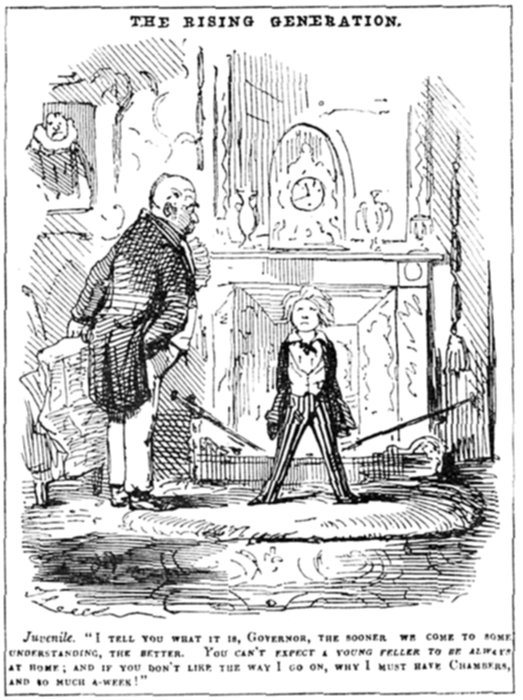
THE RISING GENERATION.
Juvenile. "I tell you what it is, Governor, the sooner we come to some understanding, the better. You can't expect a young feller to be always at home; and if you don't like the way I go on, why I must hate Chambers, and so much a-week!"
21.—ONE OF LEECH'S SKETCHES. 1847.
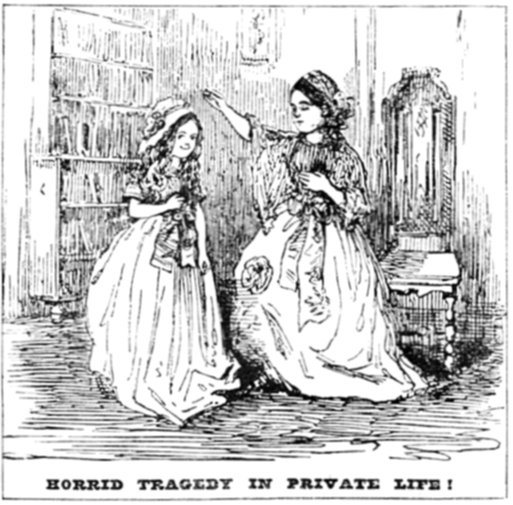
HORRID TRAGEDY IN PRIVATE LIFE!
22.—A JOKE DRAWN BY THACKERAY, THE POINT OF WHICH HAS NEVER BEEN DISCOVERED. 1847.
In a later part of this article Mr. Punch's treatment of Disraeli's great rival Gladstone will be illustrated.
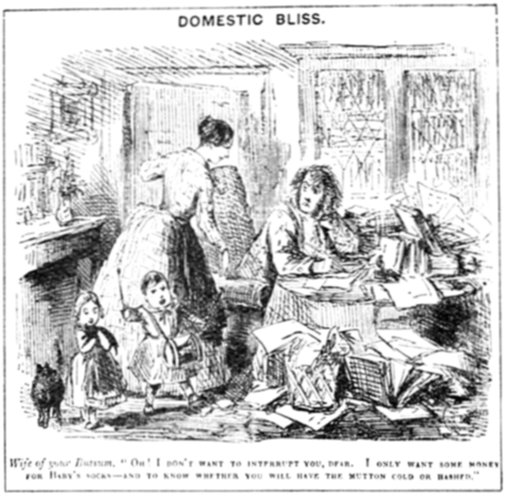
DOMESTIC BLISS.
Wife of your Bussum. "Oh! I don't want to interrupt you, dear. I only want some money for Baby's socks—and to know whether you will have the mutton cold or hashed."
23.—A PICTURE OF DOMESTIC BLISS. 1847.
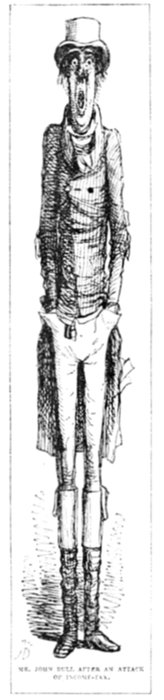
MR. JOHN BULL AFTER AN ATTACK OF INCOME-TAX.
24.—A SKETCH BY DOYLE. 1848.
The vivid "Portrait of the Railway Panic," by Doyle, No. 17, was published November 8, 1845, and refers to the depression in railway-dividends then being caused by over-competition in railway-promotion; No. 20 also refers to the railway-schemes of that time, and is Mr. Punch's ironical notice [dated September 26, 1846] of "The Last New Railway Scheme," i.e., the proposal for making an Underground Railway, which, as we here read, was scoffed at by Punch—"The Secretary is announced to be in attendance to receive deposits from eleven to two; though, whether he gets any is, in our opinion, ten to one." But immediately below these words Mr. Punch gives a sectional diagram of the Underground Railway as he conceived it, and it is not a bad shot at "A prophetic view of the subterranean railways." As a matter of fact, the works for the now familiar Metropolitan (Underground) Railway were commenced in 1860; fourteen years after this ironical prophecy by Punch.
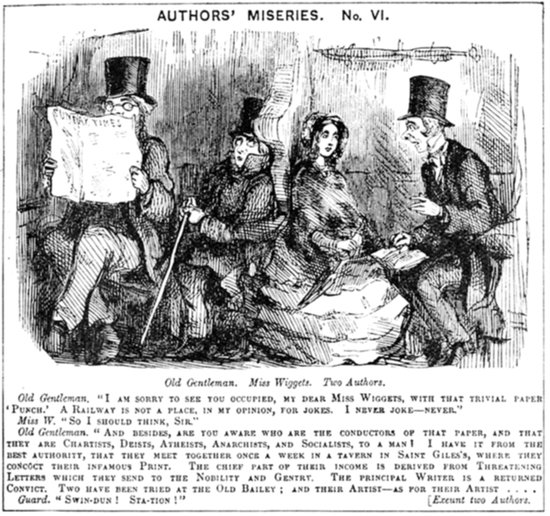
AUTHORS' MISERIES. No VI.
Old Gentleman. Miss Wiggets. Two Authors.
Old Gentleman. "I am sorry to see you occupied, my dear Miss Wiggets, with that trivial paper 'Punch.' A Railway is not a place, in my opinion, for jokes. I never joke—never."
Miss W. "So I should think, Sir."
Old Gentleman. "And besides, are you aware who are the conductors of that paper, and that they are Chartists, Deists, Atheists, Anarchists, and Socialists, to a man? I have it from the best authority, that they meet together once a week in a tavern in Saint Giles's, where they concoct their infamous Print. The chief part of their income is derived from Threatening Letters which they send to the Nobility and Gentry. The principal Writer is a returned Convict. Two have been tried at the Old Bailey; and their Artist—as for their Artist...."
Guard. "Swin-dun! Sta-tion!"
[Exeunt two Authors.
25.—DRAWN BY THACKERAY, AND CONTAINING AT THE LEFT PORTRAITS OF THACKERAY AND OF DOUGLAS JERROLD. 1848.
No. 18 is one of John Leech's jokes on fishermen's tales, and No. 19 is another joke probably based on fact. The amusing picture, No. 21, illustrating "The Rising Generation," is also by John Leech.
No. 22 is a curiosity. It was drawn by Thackeray and published on page 59 of Volume XII., February 6, 1847. From that day to this more than fifty years, no one has discovered the point of this joke by Thackeray. "The History of Punch" records that on the appearance of this sketch the "Man in the Moon" offered "a reward of £500 and a free pardon" to anyone who would publish an explanation. The reward was never claimed.
What does this sketch mean? Is the shorter female a servant caught in the act of trying on her mistress's best cap? But if so, why is the "scene" placed in a room that seems to be a library and not a bedroom? And is the object on, or near, the front of the taller woman's dress, the falling cap of the servant? But if so, how does the servant's cap come to be falling as the figures are placed—there is no sign on the part of the servant [?] that she has just dropped the cap [?] from her left hand? This is truly a puzzle and will probably never be solved, although when one remembers that this was drawn by Thackeray, and passed, as one may suppose, by Mark Lemon, the Editor of Punch in the year 1847, both men of keen wit, it is scarcely possible to think that this joke does not contain any point.
A sketch of "Domestic Bliss" is shown in No. 23, and No. 24 is a picture by Richard Doyle of "Mr. John Bull after an attack of Income-Tax." This was published in the spring of 1848, and must I think have been the outcome of a then-recent smart from an ordinary income-tax payment by Mr. Punch, for on turning up the income-tax records I find that the rate was not unusually high in the year 1848, the tax being 7d. in the £ for the years 1846 to 1852.
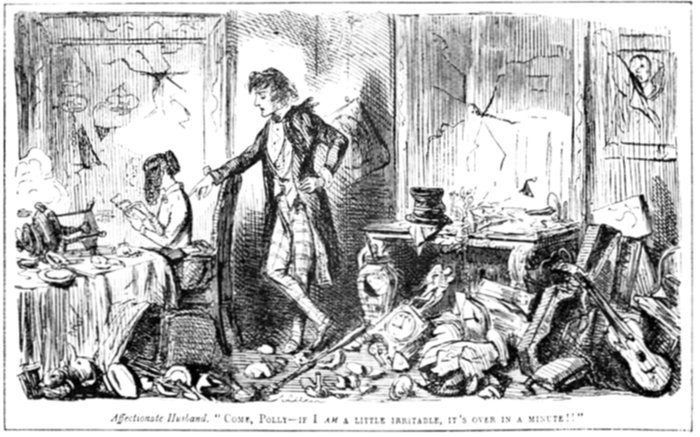
Affectionate Husband. "Come, Polly—if I am a little irritable, it's over in a minute!!"
26.—MORE DOMESTIC BLISS. 1848.
No. 25 was drawn by Thackeray, in 1848 and the "Two Authors" at the left are portraits of Thackeray, who is reading the Sunday Times, and of Douglas Jerrold, who is leaning against the padded division of the railway compartment, while both authors are listening to the denunciations of themselves and of their fellow-Punchites which are being poured out by the reverend gentleman at the other end of the compartment.
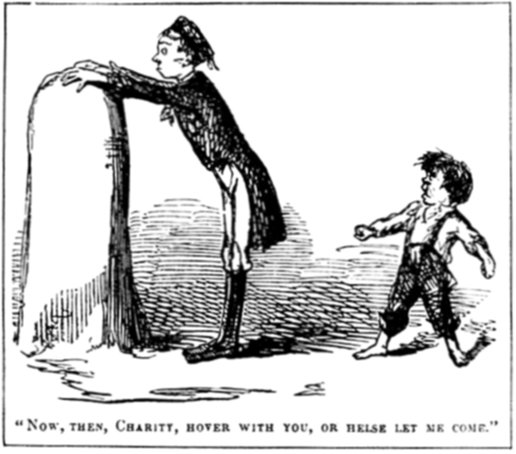
"Now then, Charity, hover with you, or helse let me come."
27.—A STREET-ARAB OF 1849.
Glancing at Nos. 26 and 27, we come to No. 28, which is one of Richard Doyle's very funny serial sketches, entitled "Manners and Customs of ye Englyshe." This is one of the funniest, although, where all are so good, it is difficult to single out any one of this remarkably clever series. Every bit of this sketch, No. 28, is worth looking at; the climbing positions of the deer-stalkers are most comical, and look at the two gillies holding back the dogs, and at the stag who is surveying the approaching attack. This was published September 22, 1849.
Manners and Customs of ye Englyshe in 1849 Nº 28
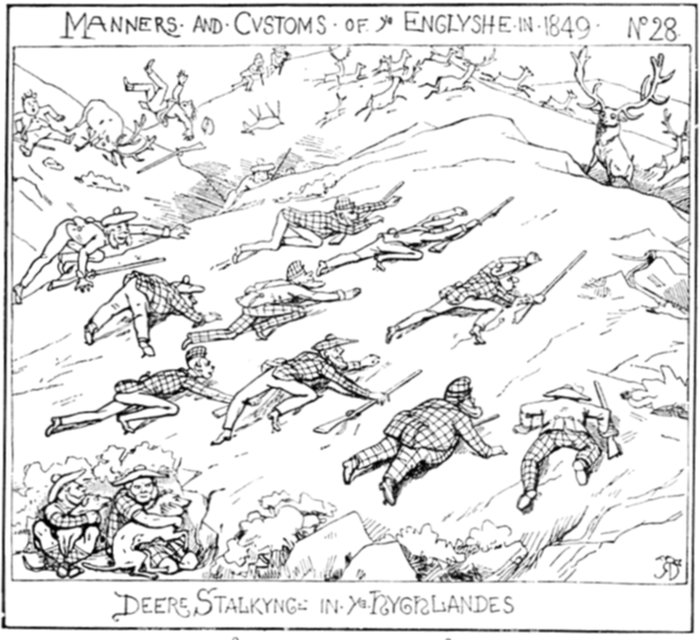
Deere Stalkynge in ye Hyghlandes
28.—BY RICHARD DOYLE. 1849.
When No. 29 was published there were only eleven (half-yearly) volumes of Punch available for use by the patient who is here seen consulting Dr. Punch. There are now available one hundred and fifteen of these volumes, and actual experience of Dr. Punch's advice to his patient enables me to thoroughly indorse the soundness of the advice given by the wise and genial old doctor of Fleet Street.
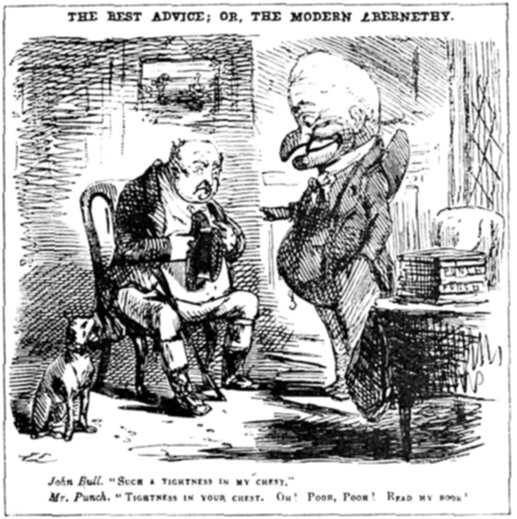
THE BEST ADVICE; OR, THE MODERN ABERNETHY.
John Bull. "Such a tightness in my chest." Mr. Punch. "Tightness in your chest. Oh! Pooh, Pooh! Read my book!"
29.—A PIECE OF GOOD ADVICE BY DR. PUNCH. 1847.
(To be continued.)