A Wedding Tour in a Balloon
Reading edition
By M. Dinorben Griffith and Madame Camille Flammarion.
Once or twice one has come across a story of some adventurous couple (usually in America) who have been married in a captive balloon. The incident is reproduced from time to time, the newspapers printing it almost always placing on some other newspaper the responsibility of the statement. The story may originally have taken its birth in a diseased craving of some undistinguished couple for notoriety, or, as is more likely, in a lack of striking headlines for some very enterprising American paper. But in any case, we are concerned here with no such matter, but with an actual wedding trip, undertaken and carried through by a very distinguished couple, in a perfectly free balloon; and this with no idea of notoriety-hunting.
The name of M. Camille Flammarion, the distinguished French astronomer, is very nearly as familiar in this country as in France, and some of his most important works are made popular by means of translations. He is distinguished by an imagination very rare in men of science, and his theories of the inhabitation of the stars are of a very striking and beautiful character; while many other of his astronomical speculations are similarly bold and original.
M. Flammarion's interest in ballooning began more than thirty years ago, and since that time he has been a most enthusiastic aeronaut; making very numerous ascents and recording large numbers of extremely important scientific observations. His book, "Voyages en Ballon," contains many interesting accounts of his ascents, and has been translated by Mr. James Glaisher, the English meteorologist and aeronaut. It is of the wedding trip performed in a balloon by Monsieur and Madame Flammarion that we are to speak.
Madame Flammarion is herself a most enthusiastic balloon-traveller. Indeed, she has often said that nothing but the practical impossibility of the feat prevents her living altogether in a balloon. And she takes much delight in recounting the story of her wedding trip, which was her first balloon ascent, and of a humorous incident which characterized it. We shall give Madame Flammarion's account as nearly as her own words can be rendered in English. The story was told us in the beautiful garden of the Château Juvisy, the magnificent house which is now M. Flammarion's home and observatory, but which has been the resting-place of French Kings in their journeys between Paris and Fontainebleau, from Henri Quatre to Louis Philippe. Parenthetically we may say that Madame Flammarion is herself a distinguished person, and Vice-President of the League of Ladies on behalf of International Disarmament. This is her story as she tells it:—
I had always wished to make a balloon ascent. The stories and descriptions I had read had touched my enthusiasm, and already, before I had entered a balloon, I was, at heart, an enthusiastic aeronaut. To hang in space above, looking down upon the rolling world below, and all the little people in it, was for years the height of all my ambitions. Nevertheless, I never expected to make an ascent in circumstances so novel and charming as those which actually accompanied my first balloon experience.
Just before our marriage, in discussing with my future husband the form which our wedding journey should take, I begged him to choose the most magnificent and poetical route possible—an ideal route, never before made use of in the like circumstances. M. Flammarion understood my meaning at once. Indeed, the same thought had occurred to himself, though I first gave it expression.
From this moment Flammarion was busily engaged with the aeronaut, M. Jules Godard, in making preparations for the aerial journey. But preparations for the wedding itself also claimed attention, and it was in some part in consequence of Flammarion's desires in this matter that an odd incident made memorable the first part of our journey.
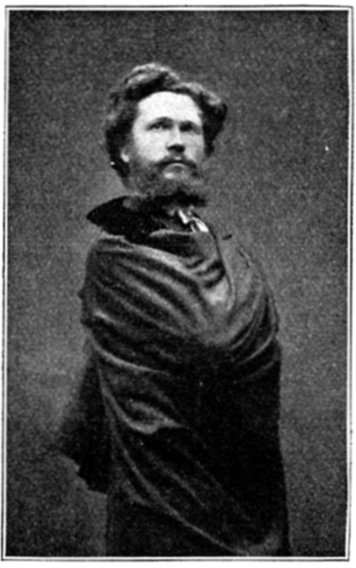
M. FLAMMARION (AT THE TIME OF THE WEDDING). From a Photo. by Alexander Martin, Paris.
First we were married in legal form—in a manner corresponding to marriage before a registrar in England. Flammarion wished this to be the only ceremony, and desired no Church rite; in this being consistent with his great astronomical philosophy, which I expect to be the religion of the future. But in the end he waived his determination, to please our mothers—and, I must confess, to please me also. But he made the condition that there should be no confession, such as is usually made part of the Roman Catholic ceremony. The good Abbé P——, who was to officiate, expended all his eloquence to shake Flammarion's determination in this respect, but his eloquence and his pains went for nothing. It was useless to insist, Flammarion assured him, and he found it so.
"But, my dear friend," pleaded the excellent Abbé, "if not a confession, then at least something: merely a conversation."
"No! Never! Not even that!" was Flammarion's final answer.
"Then," persisted the Abbé, "you will at any rate grant me one personal favour—nothing connected with the ceremony. Say, now, will you grant me that favour?"
"Most certainly," Flammarion replied, rather incautiously. "Granted before asked. What is it?"
"That I may ascend with you in the balloon."
"Abbé—you are a shrewd man. It shall be as you wish, of course. In fact, the balloon will carry four, and as we ourselves, with the aeronaut, M. Godard, make only three, there is a vacancy. You shall fill it, Monsieur l'Abbé—it is promised."
Unfortunately, the outcome of this promise was very deep offence to a very worthy man—so deep, that the Abbé was almost estranged from my husband, as you shall hear.
Every detail of the events of our wedding-day is as clearly defined in my memory as if it were but a recollection of yesterday. It was a brilliant day, and all the town seemed as gay and as happy as we. Still, there was one little matter of regret—our balloon trip must be postponed for a little while, for M. Jules Godard had had an apoplectic fit three days before, and was not yet recovered. This the Abbé did not know.
The service, which was short, had finished, and we were in our carriage—indeed, Flammarion was in the act of closing the door—when a vigorous hand seized the bridegroom's and a joyous voice cried, "And I also?"
It was the Abbé. In the confusion of our happiness we had quite forgotten that he was to accompany us to the breakfast—to which, as a matter of fact, he had been the first person invited.
The Abbé entered the carriage with no more ceremony, installed himself comfortably, and carefully deposited a travelling bag on the seat before him.
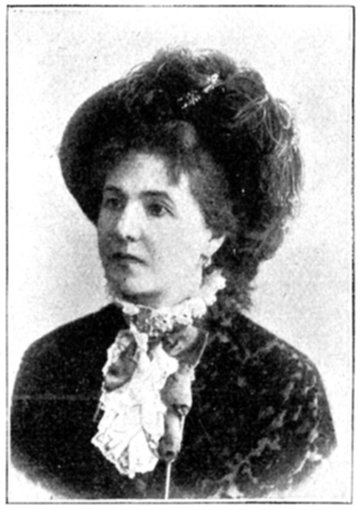
MADAME FLAMMARION (AT THE TIME OF THE WEDDING). From a Photo. by Dagron, Paris.
"Hey! hey!" quoth the Abbé", laughing merrily and rubbing his hands together. "Here we are, my friends! Well! We set out this evening in our balloon, don't we? Eh? I have prepared—O yes, I have prepared! I shall send messages to all my friends. I have filled this bag with little papers, on each of which I have written: 'From the altitude of the heavens I salute you. Abbé P——.' These we will throw out from the balloon!"
"But, my dear Abbé," said Flammarion, a little taken aback; "we haven't told you. We're not going now!"
The Abbé grew almost livid. "Come!" he stammered. "What—what's this? Is it a joke? Anyhow, it isn't a good one!"
"I assure you, my dear Abbé, it is no joke, but the simple truth. We can't go, for Godard the aeronaut is ill. Three days ago he had an apoplectic fit—indeed, he very nearly died. What should we have done if the fit had occurred in the balloon? He is better now, but not well enough to make the ascent."
The poor Abbé was thunderstruck. "And I was so counting on the journey!" he said. "I've been telling everybody I know! People have even been sending me provisions for the voyage. Truly, I don't know where we should have put them; but that's beside the question—they came. And now we are not to go! I shall be the laughing-stock of all my acquaintance! It's too bad—too bad!"
All through the breakfast the Abbé remained melancholy, notwithstanding the merry occasion, and the fact that Madame Godard, who was present, assured him that her husband was quite unable to make an ascent in his weakly condition. Till at last, in parting from him, Flammarion cheered him by the assurance that he should go up in a balloon after all, for, in fact, the project was only deferred. And so the Abbé departed hopefully. But who can count on the future? Fate disposed things differently, and poor Abbé P——'s misfortune endured to the end of the matter.
At last the time arrived, a week after the wedding-day. On the eve of the day fixed for the ascent my brother-in-law—Ernest Flammarion, the publisher—came to see us. He also wished to ascend with us; was most eager, in fact. It must be remembered that, at the time I speak of, balloon ascents were much less common than they have since become, and one had very few opportunities of an experience in the air. In the end, my husband promised his brother that he should come, if only the Abbé should be prevented, or should from any cause forego his claim. Ernest quite understood the situation, and waited with much anxiety, but with little hope. "It's not of much use," he said. "The Abbé won't give up his place. I'm afraid the thing's settled!"
The few hours intervening before the time fixed for the start were hours of anxious watching. The weather was perfect, but we were constantly on thorns lest some change should manifest itself.
But what of the Abbé? When the start was determined upon—on the morning of the day when Ernest Flammarion called on us—my husband hurried out to inform the Abbé, but found that he was away from home, at La Varenne Saint-Hilaire, which he always made his summer residence. Still, the Abbé's servant assured Flammarion that he would be back, doubtless in the evening. So a note was written and left on the Abbé's desk, thus:—
"We set out to-morrow at close of day in a balloon; do not miss this celestial appointment, but meet us at about five o'clock at the gas-works of La Villette.—Flammarion."
The eventful day (it was the 28th of August, 1874) dawned brilliantly, and the day fulfilled the promise of the dawn—a delightfully equable temperature, a gentle breeze, and a bright sky. And at five we assembled at the gas-works—our aeronaut and his wife, my brother-in-law, Ernest Flammarion, and ourselves, with a number of friends to see us off.
It is necessary to allow plenty of time for preparations in view of a balloon ascent, because of the innumerable details to be attended to, any one of which may delay the start for an unexpected length of time. One may allow an hour as ample, and then, at the end of three hours, find the balloon still unready. No such delay occurred in this case, though Godard and his assistants were hard at work for some time, while we talked with our friends.
The balloon, which rolled and swung before us, had been specially made for us, and it was of 2,000 mètres cubic capacity. Its material was the best China silk, and it had a magnificent dark golden tint, most beautiful as it rose, semi-transparent in the sunshine.
In vain we awaited the Abbé. We wondered whether anything could have prevented his receiving the note, or whether he might be ill. It would soon be impossible to wait longer. The balloon trembled, and the great globe rose, little by little, from the ground. Soon it was a truly beautiful object, immense in its rotundity and majestic as it rose above us, vibrating with the powerful breath that soon was to lift us up into the unknown.
Everything was prepared, and still there was no sign of Abbé P——.
"Plainly the Abbé is not coming," said Godard. "We can wait no longer. We must start at once if we are to see Paris at sunset!"
"Then we will go," said my husband. And scarce had he turned to speak to his brother when the latter was in the car beside the aeronaut. Indeed, he scarce seemed certain of his good fortune till he was well in the air.
Now it was my turn. The car was a little way from the ground, so my husband carried me. I was trembling with excitement and impatience. In another minute, when all four were in their places, Godard cried, "Let go, all!" and our friends about the car fell back quickly.
For me, I confess, it was a serious moment. I could not resist speculations as to where we were going, into what tempestuous whirlwind we might be carried, what lightning-cloud might rend and burn our balloon, now so gallant and so beautiful.
We rose, at first, softly and slowly. For a long time we could hear the voices below us, "Au revoir! A good voyage and a quick return!" But with our release from the earth we were no longer the same: we seemed to leave all earthly interests behind us. Our bodily weight we seemed to lose, and our brains also grew buoyant. We were held entirely by admiration of the wonders about us.
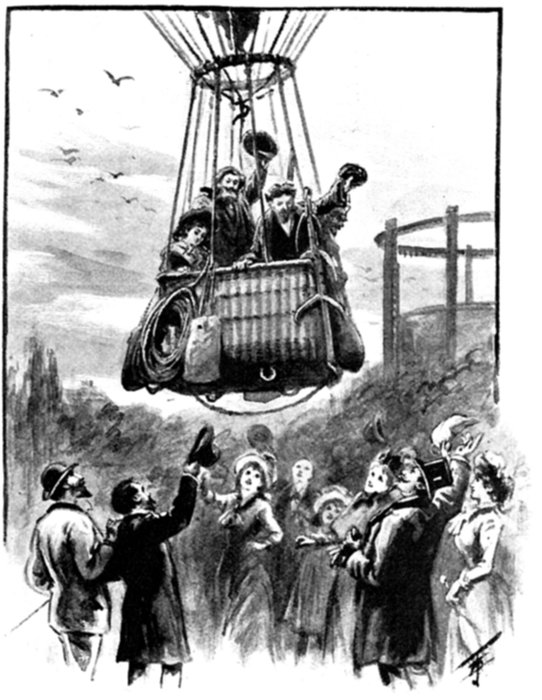
"AU REVOIR!"
Nothing so magnificent had I ever imagined. The charming landscapes of the earth were small things indeed in comparison with the colossal, the marvellous prospect that was before our eyes. When at last we found our voices our exclamations seemed ridiculously inadequate to the occasion.
"Heavens! How beautiful it is, how beautiful!" But we could not find adequate words for it.
My husband said, "The earth descends below us." And the words well expressed the sensation conveyed. The earth seemed to sink away from us in a wonderful, indeed, in a terrible, manner. Everything was wonderful and weird. Indeed, the whole of such a journey seems a strange and fantastic dream, luxurious to the senses and impressively superb. Its beauty cannot be told, cannot be written. It must be seen and felt.
The sun was sinking in the west. For a while the daylight seemed even more intense as it was about to vanish. Then the sun disappeared; it had set. But we rose and rose, and presently we saw the red wonder again. In simple fact, here was the sun rising again for us alone, and in the west! But the sight lasted a very short time, and once more the great luminary sank from sight. We had seen the sun set twice in one evening!
My delight was inexpressible; to sit here beside my newly-made husband here in the sky, travelling I knew not where. Our movement was altogether imperceptible—we would seem to be entirely still; there was no such current of air even as would cause a quiver in the flame of a candle. At this time our height was about 300 or 400 mètres, and we gazed over the edge of the car at the towns, the railway lines, the fields, and the woods—all Liliputian toys, and things to smile at.
We passed over the Buttes-Chaumont, at Vincennes. I turned my head to ask a question of Godard, and was terrified to perceive that he had in his mouth a large pipe! I touched my husband's arm, and pointed. He looked, and with a cry he instantly snatched the pipe away. "Do you want to blow us all up?" he exclaimed.
But Godard merely laughed. "Ha! ha!" he cried, "you don't perceive. There is no light to it! It is a mere habit. I can't do without my pipe, and I keep it in my mouth and imagine I am smoking. Come, let me have it!"
The incident amused us much, and for almost the whole of the remainder of the journey the pipe remained between Godard's lips, while he, to all appearance, smoked with perfect satisfaction.
And now we came by the mouth of the Marne. Suddenly there was a burst of laughter among us; it came from my husband. At first he could not answer our questions; then he pointed below, to a place where we could perceive something moving. "Listen!" he said.
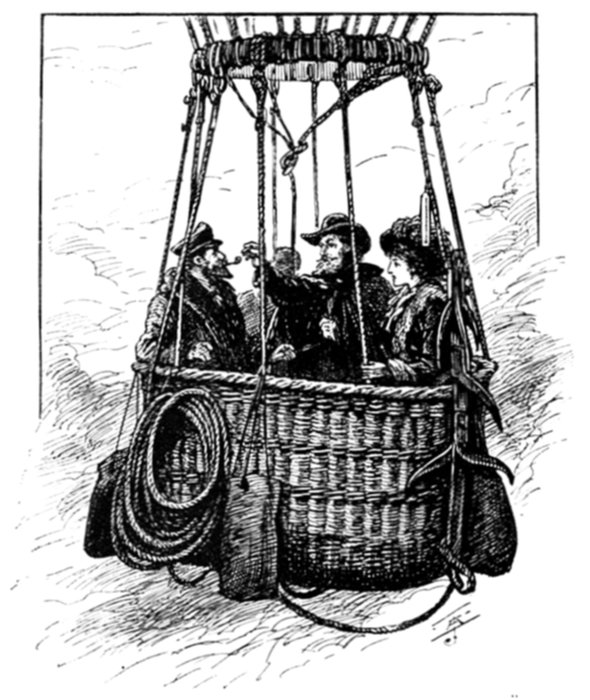
"'DO YOU WANT TO BLOW US ALL UP?' HE EXCLAIMED."
We listened eagerly, and heard cries of despair in the quiet evening air, far below. "Flammarion! Flammarion! Hé! Flammarion! Come down! Come down here!"
There was great excitement in the little place below. From the garden of a little house several persons were making signs to us.
"This is the place," exclaimed Flammarion; "this is the place, clearly. There is a fatality in this! My friends, we are exactly and perpendicularly above the estate of the Abbé P——, at La Varenne Saint-Hilaire! Do you hear? He calls us!"
And indeed it was the fact, the simple fact. What cruel tricks chance will play!
"Come down! Come down, Flammarion!" And then the voices of those below died away, for we had gone from their sight. It is probable that if we had attempted to descend just there we should all have experienced a good bath in the Marne—a dangerous river in these parts.
Godard threw out ballast, and we rose higher still. "What will the Abbé think?" I said. "He will never pardon us for this heart-breaking disappointment!" And, indeed, to finish with the poor Abbé, I may say here that he would never believe the truth of what had happened, nor under what conditions Ernest Flammarion had been allowed to take his place. He maintained that we had arranged the whole thing beforehand; and for more than a year we saw nothing of him, notwithstanding our friendly attentions and most cordial appeals.
Now the moon shone with such intensity that the country stood as clearly defined as in full daylight, and the time was half-past nine. Here we were at the height of 1,900 mètres, and we seemed to be entering into another world. Here all Nature was in dead silence, superb and terrible; we were in the clouds. My husband has described the scene better than I am able. We were in the starry skies, having at our feet clouds that seemed vast mountains of snow—an impressive, unearthly landscape—white alps, glaciers, valleys, ridges, precipices. An unknown Nature revealed herself, creating, as in a dream, the most dazzling and fantastic panoramas. Stupendous combats between the clouds arose and rolled; the air-currents followed one another, hurled and flung themselves in mighty commotion, shaking and breaking, in dead silence, the monstrous masses. We felt, we saw in action, the powerful, incessant, prodigious forces of the atmosphere, while the earth slept below.
It was a scene beyond all words. Presently a monstrous elephant formed itself before our eyes. We entered into the very midst of it, and were blinded by the cold and damp vapour—a singular and awful cloud, whence we emerged but to plunge again into others more awful still; now a furious sea, now a group of hideous phantoms, now long, luminous tracts, glittering like streams of silver in the ghostly white light. "This is not so pleasant," my brother-in-law murmured. "Why not descend?"
The billows of cloud piled together, terribly agitated. Above us, below us and about us, all was stirred to fury. My agitation was great; for of all these circumstances the silence, the absolute silence, was the most terrible. Amid all the shocks of the cloud-masses, amid all the rages of the hideous gigantic phantoms, of those fearful forces that might at any moment crush us in a clap of thunder, not a sound, even of the faintest, was heard. The balloon glided through the enervating, cloud-filled heavens steadily and proudly, and soon we were free of the mists, and sailing serenely under the deep blue sky in the pale light of the moon.
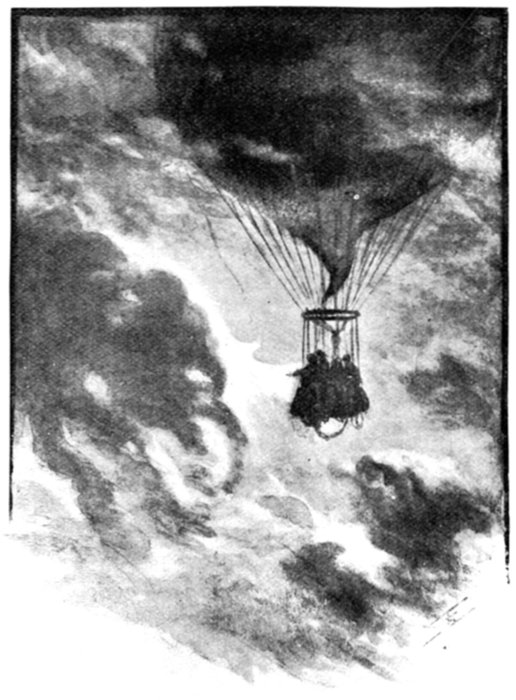
"A SINGULAR AND AWFUL CLOUD."
"I like this better," said Ernest, and we agreed with him.
We gazed at the white plain of rolling clouds below us. What was that—the little ball that ran so quickly along the furrowed white spaces? The little ball edged with an aureole of tender colours?
"That?" answered Godard. "That is we ourselves—the balloon, or rather its shadow. What do you think of its rate of travelling, Madame Flammarion—you who imagine that we are not moving at all?"
Truly, it was our own shadow, swiftly skimming the clouds below, a curious and charming sight.
And now we saw the first signs of dawn. The balloon sank and sank, and soon we were skimming above meadows scented with a thousand perfumes. To us it seemed that we must touch the trees every moment, so nearly did we approach the earth. But, as a matter of fact, we were still a hundred mètres from the ground. Again it was a delightful experience, thus to skim above the earth in the silent, starry morning, without a breath of air that we could feel. The plains, the hills, the rivulets passed before us as in a dream. It was communion with Nature indeed.
"Now," said Godard, suddenly, "we are ascending, and quickly." And, indeed, as he spoke we shot upwards, and in a moment were again among the clouds. In the distance we observed a peculiar light. Was it a lighthouse? No, we were far from the sea. Reassured on this point, we are soon uneasy in regard to another, for presently we saw that lightning-flashes were traversing the clouds. "It is a storm," Godard observed, "and it will be a bad one."
"Then we will throw out ballast and avoid it," said my husband.
It was done, and instantly we ascended to the height of 3,000 mètres. Now we saw that the deep blue of the sky was paling, and day broke. Far above us Sirius glittered, and in a few moments more our altitude was 4,000 mètres, the highest of the trip. At this height I breathed less freely; and everything liquid in the car—even the wine—was frozen. We shivered under our furs, and there was a humming in my ears. In spite of these drawbacks I was as enthusiastic as ever, and I assured my husband, who expressed some solicitude for me, that I had never been better, and that I would be very glad to live in a balloon! And as for descending, who could think of it, with such a spectacle before us? Behind us was the moon and the darkness; below, afar, a storm of lightning and thunder; and before us, most wonderful of all, the rising of the sun, filling the empyrean with his rays and flinging a mantle of purple and gold over all, clouds and balloon alike. The mysterious and weird beauties of the night gave place to the brilliant metamorphosis of day.
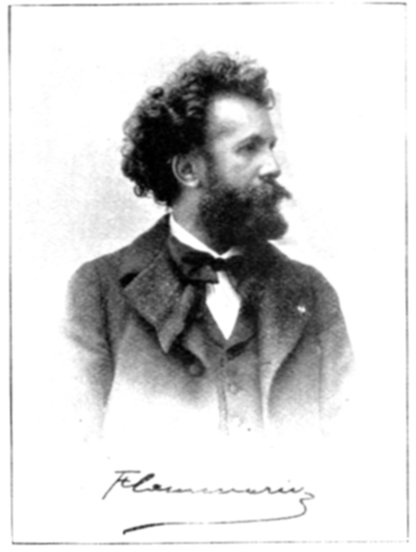
M. FLAMMARION (PRESENT DAY). From a Photo. by Professor Stebbing, Paris.
And now, alas! we returned to earth. In twenty minutes, after a swift though tranquil descent from the height of 4,000 mètres, we were again among our fellow-mortals, in the neighbourhood of Spa. Our trip had lasted nearly thirteen hours.
The population of the district had never seen a balloon so near, and our arrival roused the countryside. The people came running from every direction, yelling and gesticulating, and scarcely had the car touched earth when it was surrounded so closely by a crowd of peasants that it was impossible for Godard to make proper arrangements for landing. By dint of frightful grimaces and abuse, he induced them to draw back sufficiently to enable him to make fast, and then my companions were obliged to protect me: for the women, and even some of the men, came to touch me—my hair, my hands, my face, and my clothes—to make sure that I was really alive!
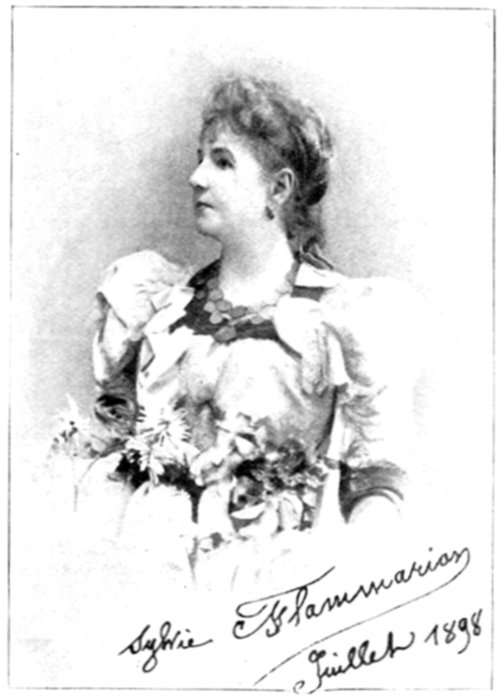
MADAME FLAMMARION (PRESENT DAY). From a Photo. by Professor Stebbing, Paris.
Ernest Flammarion alighted first. "I am very happy," he said, "to have been up in a balloon, but I don't think I shall go again."
As for my husband, his persistent passion for ballooning is well known; and as for myself, I have made two more aerial voyages with him, and I would be glad to make a thousand.
One gets, of course, very little of common luxuries in a balloon. There is just a car of basket-work, and a wooden plank for a seat. The knees must serve for a table, and the head rests on the edge of the car when one sits and rests. The bench will hold only two at a time, and even the two find it a tight fit. Of course, it is impossible to cook in a balloon, for anything in the nature of fire would produce an instant blow-up, and a scattering of the whole expedition to the four winds. The food one takes consists of cold meat, bread, fruit, eggs, and perhaps salad—prepared beforehand. M. Flammarion carried his instruments as usual—his barometers, telescopes, thermometers, and the rest—on his wedding trip, and made scientific observations and notes from first to last.