Part 1 — The Training Ship "Exmouth."
Reading edition
By Dr. Ch. H. Leibbrand.
Illustrated from Photographs taken under his direction by A. and G. Taylor, Photographers to the Queen.

Reader, have you been to Grays, the station next to historical Purfleet, on the London and Tilbury line to Southend? If not, let me tell you that it is not a large place, nor a nice place either. Still, this struggling township on the Thames is worth visiting. Almost within the shadow of its tiny red brick houses lies one of the finest institutions in England for the making of sailors, and soldiers, and citizens—for the making of men.
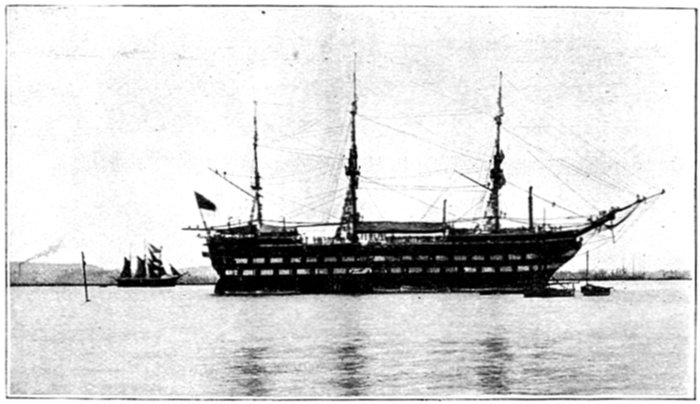
THE "EXMOUTH."
Proceeding a short distance along the main street towards the river the traveller will be brought face to face with this civilizing centre. He will see a huge, bold, sturdy vessel riding proudly upon the ebbing and flowing tide, moored about a hundred yards off the shore. This splendid three-decker, of 3,106 tons displacement and with a measurement of 220ft. by 59ft., is London's training ship Exmouth.
The vessel's ninety-one portholes still proclaim its original character—that of a man-of-war; even though her armament consists now of but two truck and two field pieces, instead of the ninety-one guns which should be mounted there. Its complement of 600 lads, its Captain-Superintendent, and staff of officers still more eloquently testify to its intimate connection with the defences of the country—with the Navy and the Army, with the development of patriotism and citizenship. For, from this training ship have gone forth about 5,700 youths, well equipped for the struggle of existence, and not less well trained to battle with winds and waves and the treachery of oceans deep. Indeed, of these 5,700 no fewer than 2,106 went to swell the ranks of the Royal Navy; 446 shipped as ordinary seamen; 1,385 as deck and cabin boys; 150 as apprentices, and 300 as assistant cooks and stewards. And again, within the same period, 900 have joined the Army as band boys; whilst hundreds, once more, embarked with average fair success upon other occupations, taking to handicrafts, trades, and industries for which they received their first moral and sound practical training on board this veteran three-decker.
A large part of the striking prosperity which has attended the Exmouth is undoubtedly due to the most competent Captain-Superintendent in Staff-Commander W. S. Bourchier. Entering the Navy in 1840, as a navigating midshipman on board the Impregnable, this officer had, previous to his appointment to the Goliath in 1870, passed through a school of excellent training. After successive services as navigating sub-lieutenant, first in the Mediterranean, on board the Polyphemus; then on the south-east coast of America, on the brigantine Griffon, he had (upon being promoted navigating lieutenant) held the command of the Myrtle, steamer-tender to the flagship, for close on twelve years. And this varied and instructive career Captain Bourchier had been able to complete by a further service as navigating lieutenant to the then Captain, now Admiral, Sir Anthony Hoskins, on board the Zebra, engaged upon a lengthy cruise along the coast of Africa. With so thoroughly trained and experienced an officer in command the experiment could, therefore, hardly fail to prosper.
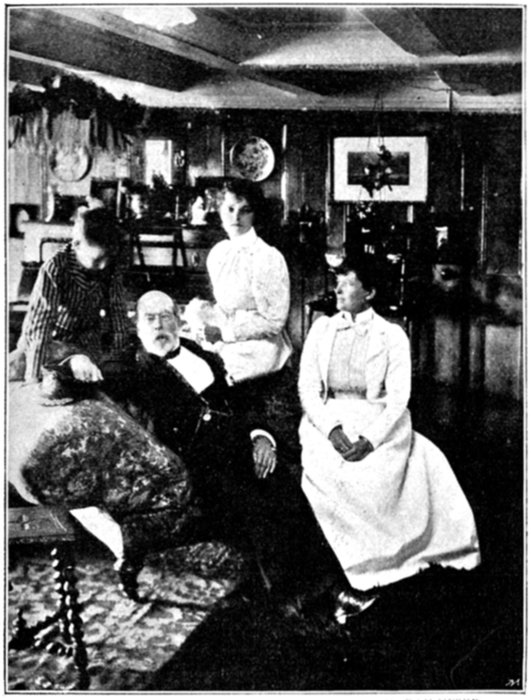
CAPTAIN BOURCHIER, HIS DAUGHTER, AND GRAND-DAUGHTER.
So successful, indeed, has been the training and other educational work carried on on board this splendid three-decker that the last report of Admiral Bosanquet, than whom as Inspecting Captain-General of Naval Training Ships there can hardly be a better authority, may be taken as typical. In this report he says:—
The training ship Exmouth for boys is in most excellent order. The drills and instructions are exceedingly well taught, and the comfort and well-being of the lads is sedulously attended to. Captain Bourchier's arrangements are admirable and conscientiously carried out by a very able staff of officers. It is a model training ship.
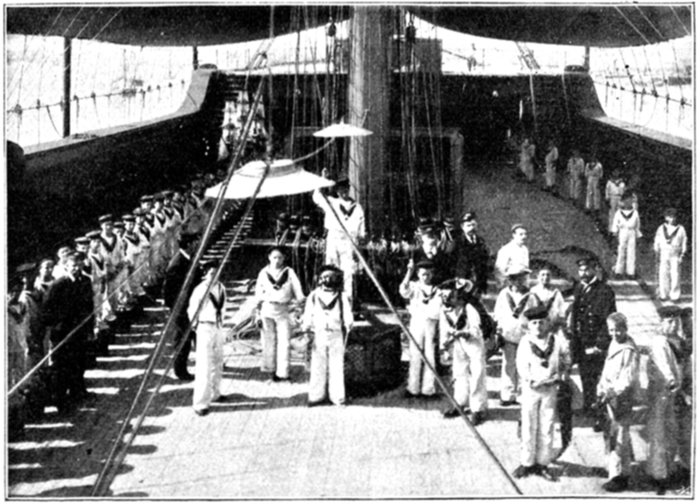
THE FIRE DRILL.
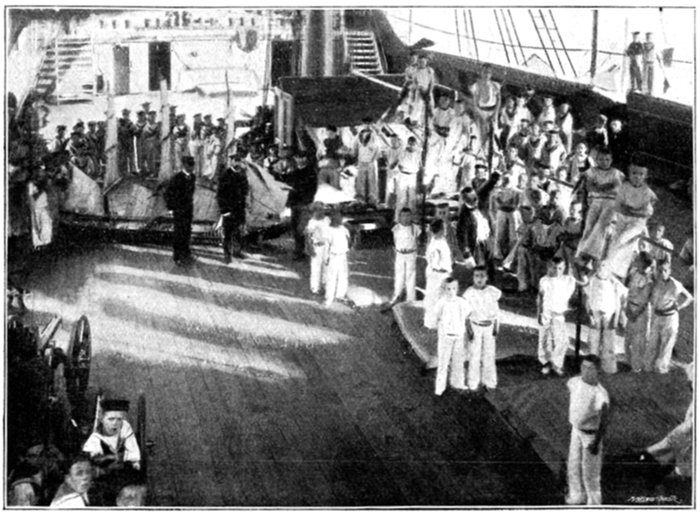
AT GYMNASTICS.
And a model training ship the Exmouth truly is; the brief history of which, who knows? may be a not unimportant factor in the making of British history. To appreciate this paradox, reader, you must see this tiny, yet withal so manly, crew as it was a short time ago my good fortune to see them when I visited the vessel, piloted by that genial assistant clerk to the Metropolitan Asylums Board, Mr. John Mallett. The notice informing the Captain-Superintendent of our intended visit, I afterwards learned, had reached him but a few minutes previous to our arrival. Yet the moment we appeared on the landing-stage, the wind carried to us five notes of an assembly call. This was the only distinct sign of life on board. But scarcely had it passed by when, as if by magic, the cutters and whalers, the gigs and pinnaces, and the launches of the Exmouth were manned and afloat; when on the main and upper decks, and on the bowsprit, and up the fore, main, and mizzen masts swarmed Lilliputians to their posts, every tiny man ready to "do his duty." Though, to be sure, it is not an easy duty these sailor boys have to perform, for the routine and discipline on board the Exmouth is as that on board a man-of-war, tempered only by a consideration of the youth of the crew and by the maxim that "kindness leads farther than harshness."
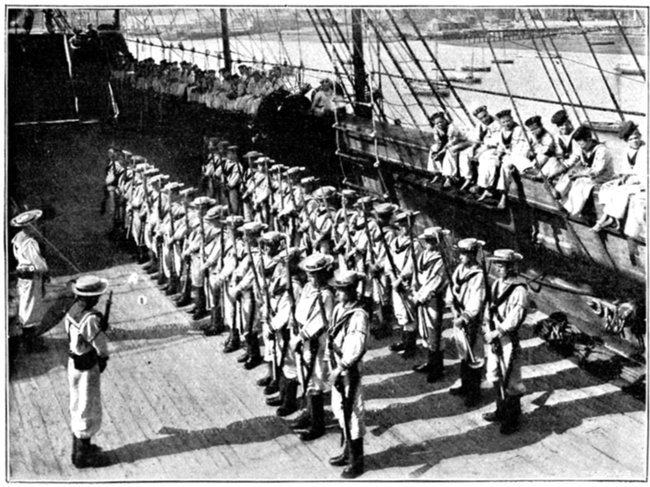
RIFLE DRILL.
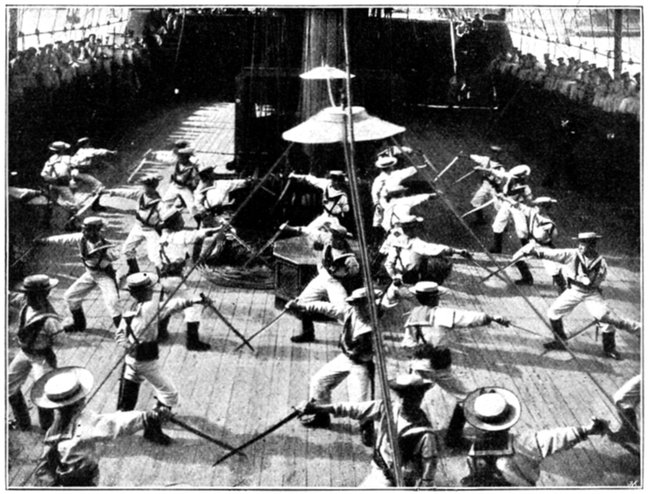
FENCING DRILL.
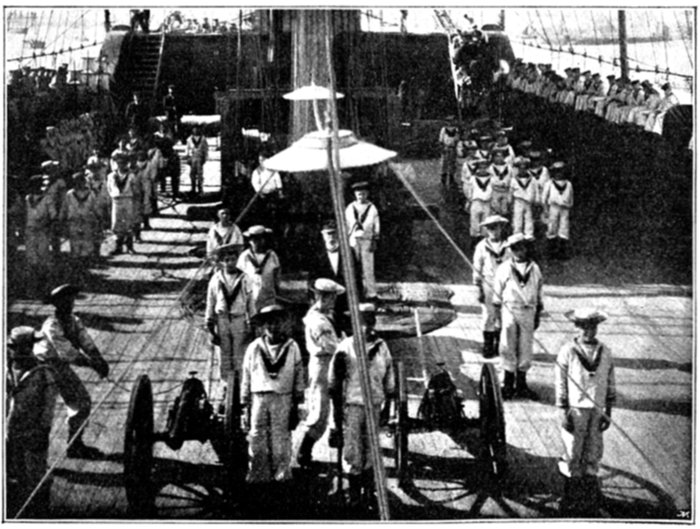
FIELD-GUN DRILL.
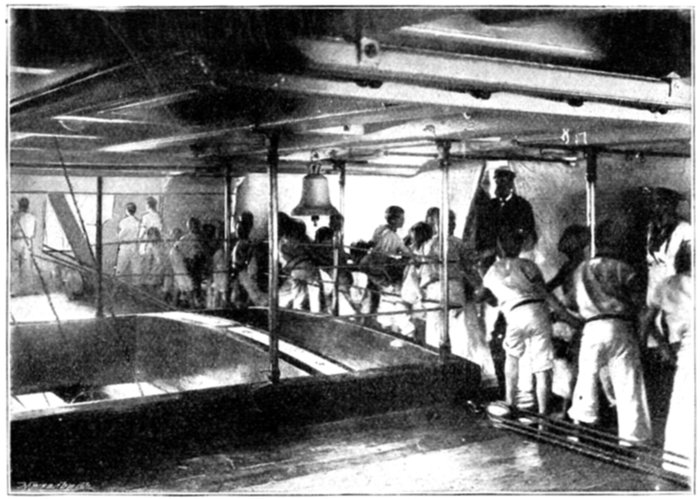
From the early morning, when the bugle calls for the speedy slinging up of their hammocks on the orlop deck, till late in the evening, when the general retreat is sounded and the hammock's are once more unslung, the various boat-crews and classes are kept going. Yet not as fancy's whim suggests; maxims evolved from sound experience inspire the educational system on board. For instance, cleanliness is said to be next to godliness. The two, again, are known to be most conducive to discipline. At the same time, the strictest observance of these three precepts is recognised to be absolutely essential to the well-being of a large floating establishment. In conformity with these truisms, thorough ablutions and thoughtful religious practices, such as morning and evening prayers, at which both officers and crew attend, are, therefore, as prominent features of the training on the Exmouth as is the excellent discipline maintained on board the vessel. The ablutions, however, are particularly worthy of mention; the process is so original. There is a huge, broad tank-bath in the lavatory; not much smaller than a usual-sized swimming bath. Thither the lads proceed in marching order, though, of course, without any baggage, however slight; and promptly start to give themselves a wholesome shampoo with carbolic soap. Being thus lathered they plunge head foremost into the tank. Diving straight through its full width, with wonderful agility they then bound over its anything but low side, landing—at attention—before the officer on watch, ready for inspection as to their outward cleanliness.
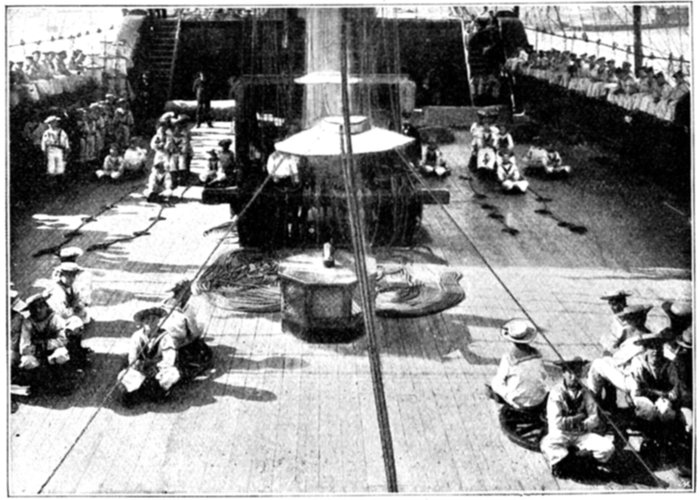
DISMOUNTING FIELD-GUNS.
LOCATING THE TRUCK-GUNS.
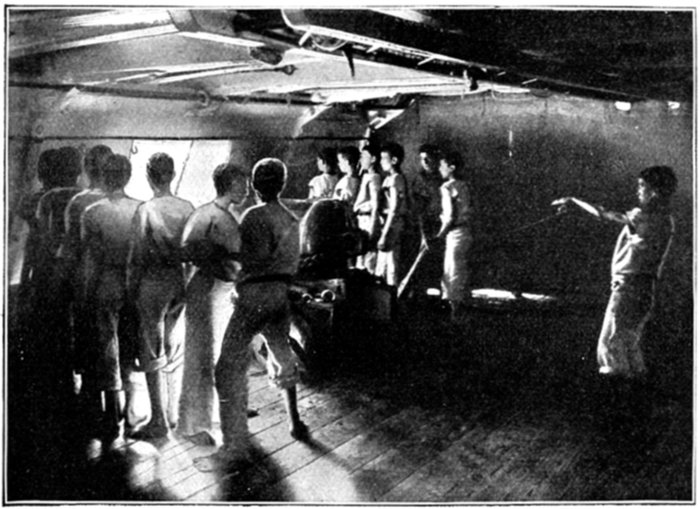
FIRING THE TRUCK-GUN
This agility, this precision in the action and decision in the conduct of the boy-sailors and marines, is noticeable at whatever occupation they may be. Such perfection is to a great extent due to the lads' instruction in gymnastics and athletics. As the several illustrations show, in these they pass through a most comprehensive and systematic course. They are trained in whatever may tend towards the development of their muscles. So efficiently are the boys taught, that those whom I have seen at my visit go through most difficult exercises on the horizontal and parallel bars and on the spring-board, I would safely have compete with the best model sections or Masterriegen of Germany's leading gymnastic societies. Yet the Fatherland is the home and, as it were, the academy of systematic physical culture! Highly satisfactory, too, if not truly astonishing, is the perfect manner in which the Lilliputians on board the Exmouth take to their musketry, bayonet, and cutlass drill. Reader, you need but look at the illustrating snap-shots to feel that, when grown up or even before, these lads will prove men and warriors bold and true should occasion arise. Indeed, as it is, when witnessing the earnestness and skill with which each command of the drill-masters is executed, you soon fancy to be face to face with a company of marines—veterans in the exercise of arms—although, in fact, they are a company of mere boys, rescued from the streets and recruited from the workhouses. And as veterans in arms they behave at gun drill. At mounting or dismounting field-pieces, at charging or discharging the truck-guns, they are equally smart. How well the crews are trained, both in the use of rifle, cutlass, and cannon, and in their more extensive and complicated application to military tactics, is demonstrated by the photos, illustrating a sham-fight between a party of sailors and an imaginary enemy. It can be seen at a glance that the proceedings are looked upon by the boys as something more than an amusing intermezzo in their daily routine; with them it is a serious lesson to be learned seriously.
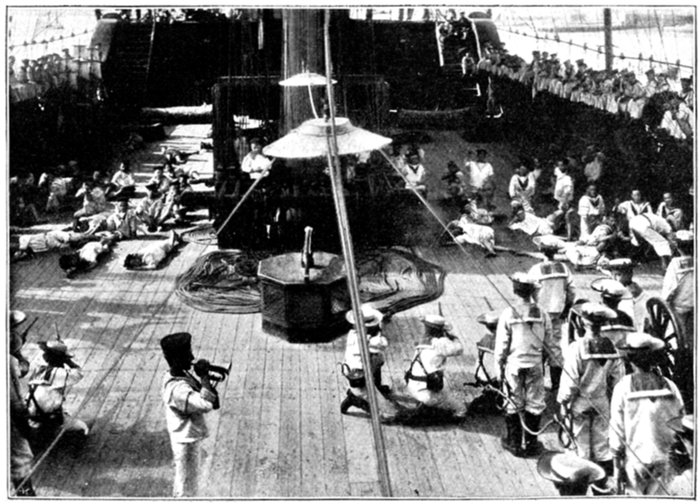
SHAM-FIGHT
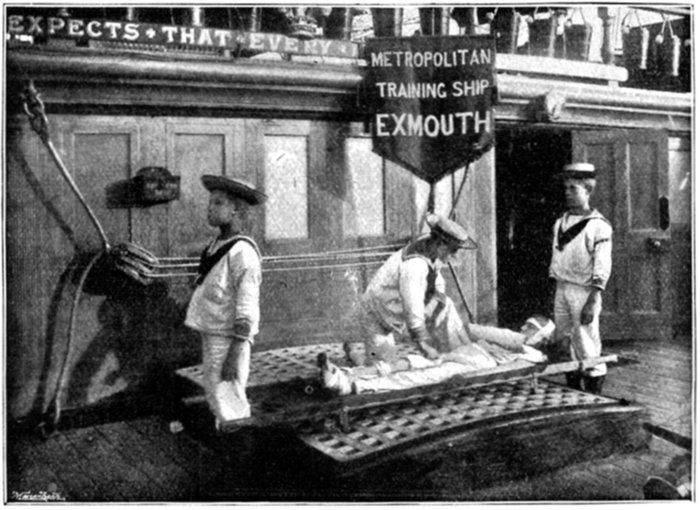
AMBULANCE DRILL.
However, the champions of disarmament and the advocates of peace must not assume that the training ship's youthful crew is reared up only in the spirit of militarism, and instructed only in the manifold defensive and offensive uses of the weapons of war. The picture showing the boy sailors and marines engaged upon Samaritan work, carried out with a promptitude and circumspection of which a master in surgery need not be ashamed, would already disprove their assumption. Yet, they may feel further assured that these principles of assisting the suffering are not confined in their educational operation to the mere bandaging and nursing of the wounded. These are inculcated into the mind and heart of the lads by many other methods, and applicable to many and far different situations.
For, hand in hand with their military training, the wards of the Metropolitan Asylums Board receive the benefit of moral training and a sound elementary education under the able direction of Mr. W. Hollamby, the head schoolmaster on board the vessel. This education, in spite of a rather small staff, considering the hundreds of pupils, is not only equal to that provided at any Metropolitan Board School, but it aspires, justifiably, because successfully—even beyond—at a higher, more comprehensive, more thorough-going instruction, excellent though teaching in London's Board Schools frequently is.
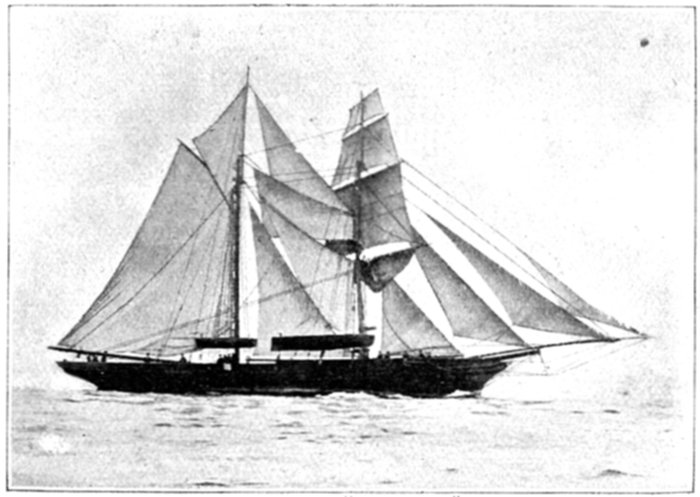
BRIGANTINE "STEADFAST."
Nor is the industrial side forgotten in the system of training on the Exmouth. Tailoring, carpentering, painting, sail and net-making, and so on, are part of the trades the boys have to learn and to prove efficient at. Indeed, most of the extensive and often difficult repairs constantly necessary to the three-decker, to her many boats, and to the boys' own outfits, are done by the latter, and done by these youngsters remarkably well, as, reader, you will see for yourself, if your good fortunes ever ship you to the Exmouth. I say advisedly "good fortunes," because there is a healthiness, a breeziness about the ship, about its captain, officers, and numerous crew which truly smacks of the free, wholesome, bracing sea, and which cannot fail to act upon the visitor from the town as an excellent nerve-tonic.
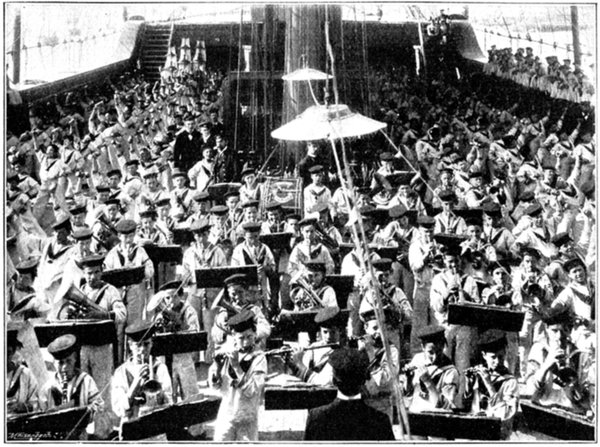
MUSICAL DRILL.
This healthiness, this breeziness, as it were, this sea-atmosphere is, however, easily accounted for by the very nature, by the very purpose of the vessel. Is not the aim of the education, of the training, on board the Exmouth above all to produce sailors of the type of those who have made England what she is to-day—the Queen and the beneficent Ruler Of the Oceans and the foremost colonizing and civilizing Power on earth? Naturally, to achieve this aim the tasks which devolve alike upon instructors and instructed are manifold and heavy. How many thousand and one details have to be taught—and learned? How many thousand and one minute elements are necessary to the making of genuine seamen of these boys? As kindly paymaster, Mr. A. Thompson, puts it in his "Exmouth Song":—
They are to be bothered with splice and knot, With heads and hitches and I don't know what; So many, they can't tell t'other from which; Nor a double Matthew Walker from a plain clove hitch.
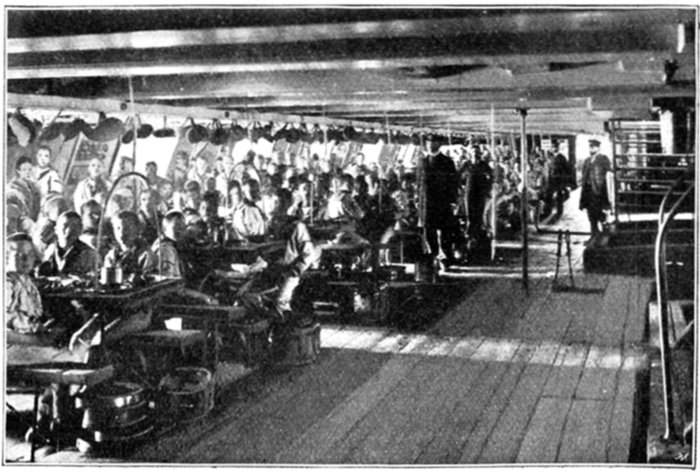
AT MESS.
But it quickly comes all right; the instructors and the lads' hearts are in their work. Thus:—
They very soon pass a torn-i-key (tourniquet) As well as any Captain in the Queen's Navee.
Sometimes, to be sure; a more practical lesson, which brings the matter truly home, is wanted. As for instance when:—
They go for a pull, and whilst afloat, Catch a crab that knocks them down in the boat.
Yet here, too, all things work towards a good end. Therefore:—
To them that crab a lesson will be, To make them smart sailors in the Queen's Navee.
And that these Liliputian men on board the Exmouth become smart sailors is vouchsafed not only by Captain-Superintendent Bourchier, and his capable chief officer, Mr. Wellman; not only by the brigantine Steadfast, the three-decker's sailing tender, and, as our illustration shows, a bold, handsome yacht, of 100 tons burden, with roomy decks and comfortable quarters for fifty lads; but it is also vouchsafed by her weather-beaten commander, Mr. Thomas Hall, than whom there is scarcely a more confidence-inspiring, able salt. Indeed, our Navy owes much to this brigantine. Apart from the nautical training she affords to the Exmouth boys, it is she who, by means of her constant cruises to southern and western ports, brings her complement of excellently taught youths to the direct notice of the captains of our men-of-war. How much they appreciate the budding sailors thus brought before them is shown by the fact that on each return from such a cruise the crew of the brigantine is considerably reduced. But not in consequence of desertions. No, the men-of-war men like the lads, and the lads like the men-of-war men. So it comes to pass that the sailor-boys of London's Training Ship Exmouth become blue-jackets of the Nation and her Queen. And once embarked upon this career we may safely leave them, although, reader, I would fain tell you yet of the large and exceptionally skilled band on board the three-decker which supplies our Navy and, particularly, our Army with so many able musicians every year. I would fain tell you of the Infirmary and its devoted matron, and of the Shipping Home at Limehouse, kept in connection with the training ship for the purpose of providing to the Exmouth lads berths on board merchantmen, and of affording them some safe anchorage when momentarily without a vessel through no fault of their own. I would fain enlist your co-operation in agitating for the increase of training ships such as the one I have endeavoured to describe to you, inasmuch as in these, I hold, lies the strength of our future Navy and supremacy of the seas. But space does not permit me. May I be at least consoled by the hope that I have roused your interest in, and kindled your sympathy for, the Exmouth and her officers and crew.
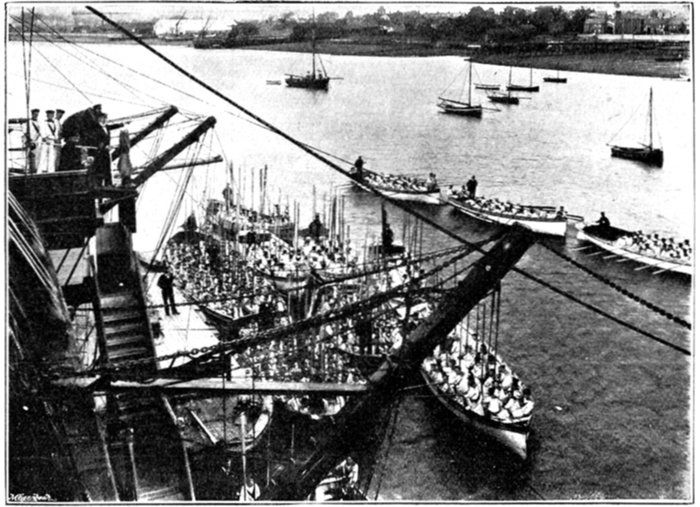
LEAVING THE SHIP.