Unique Log-Marks.
Reading edition
By Alfred I. Burkholder.

Logs belonging to various individuals and firms in the lumber industry of the North Western United States are identified and separated in a striking fashion. To illustrate this it will be necessary to outline briefly the routine of work connected with the great lumbering industry of the regions mentioned. Logging camps are established in the heart of a forest. Where no railroads have been extended to the vicinity of the camps, roads are cut to the nearest river, which is the highway by which the logs are taken in the spring to saw-mills, where they are manufactured into shingles, lath, boards, timbers, and planks. Therefore, proximity to a river is necessarily taken into consideration when a camp is located.
After the trees are sawed down by men engaged especially for this duty, they are sawed into log lengths and hauled, perhaps several miles, to the bank of the river. Some of the camps contain as many as 300 or 400 men, and this force is kept busy during the entire winter cutting down trees, sawing them into logs, and hauling them to the river. Here they are placed in huge piles, and it is at this time that the log-mark of the owner is placed upon them by an individual known as the "scaler," whose duty it also is to measure the diameter of each log and keep a record of it.
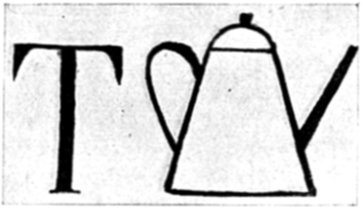
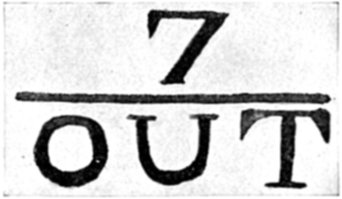
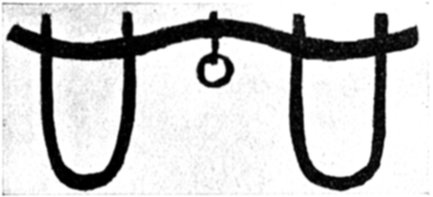
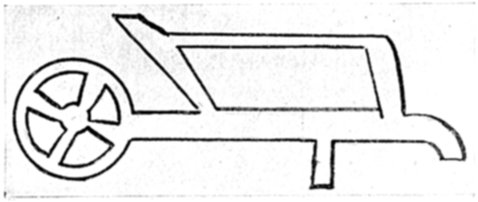
In this article we show a few of these curious log-marks—odd artistic inventions of the untrained minds of the lumber-camps. There is no attempt at uniformity in ideas. Anything that has the least bit of distinctiveness about it is sufficient for the purpose, which explains the presence of pound-marks, tea-pots, frogs, babies, yokes, division signs, and wheel-barrows in the illustrations for this article.
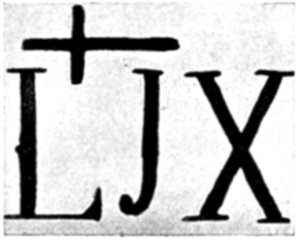
The instrument with which the "scaler" places the mark upon a log is in the shape of a sledge-hammer, the back of the hammer portion having upon it a device similar to the log-mark of the man by whom he is employed and to whom the logs belong. The log-mark itself is raised to a height of about 1½in. or 2in. above the surrounding surface of steel, and when the sawed end of a log is struck with it, the mark of the owner is punched into the end of the log to a depth which prevents its obliteration, unless the whole end of the log is sawed off and removed. Crude designs, differing from the regular log-mark, are sometimes cut into the bark of the log to assist in more readily identifying the owner. Copies of log-marks and cattle-brands are, as provided by law, placed on a file in the office of the county recorder of deeds in the county in which the cattle owner or lumberman operates.
For greater convenience the ice in the river is thickly covered with the logs as spring approaches. When the break-up of ice in the river occurs, and the stream is swollen by the melting of snow and the early spring rains, what is called the log "drive" commences. In some portions of the lumbering regions the disappearance of the forests has left the saw-mills further and further from the product without which they cannot operate, and the logs have to be floated great distances. Thus, a "drive" of 100 or 200 miles is nothing unusual, and on the Mississippi river logs are frequently taken as much as 300 miles.
On one river perhaps a dozen or more lumbering firms, having no connection with each other, are operating, and when spring comes all their logs are rolled into the stream, to soon become so mixed up that the novice naturally becomes of the opinion that their separation is an impossibility. The work during a log "drive" is the hardest and most dangerous connected with the lumbering industry.
The men are required to be up long before daylight, so that they may eat their breakfasts and walk to the river, perhaps several miles distant, arriving there at daylight to begin the work of the day. Refreshments are taken to them twice during the day, at about ten o'clock in the forenoon, and again at two o'clock in the afternoon. They work until it becomes dark, when they walk back to their camps to procure their suppers and much-needed rest. The log drivers are required to keep the logs floating in the streams. In rainy or cold weather, such as is frequently experienced in the lumbering regions, their work is very arduous and debilitating. It is of the utmost importance that the work of floating the logs out be pushed while there is sufficient water in the streams, many of which become nothing more than creeks later in the season, when dry weather sets in.

The force of the current behind the huge mass of logs may force hundreds of logs to a lodgment on the bank when curves in the stream are reached, and then the men are compelled to work, perhaps waist deep, in the water in order to clear the stranded logs and once more get them afloat. The foremost logs are especially looked after and kept on the move, for should they become lodged the obstruction thus formed would speedily cause a log "jam," the thing particularly to be dreaded by the drivers.

Notwithstanding the extreme care and precautions, jams occasionally occur. Then the logs are piled high in the air, the weight of the mass sinking the logs to the bottom of the river, and extending from bank to bank of the stream, forming an almost solid wedge, which constantly becomes larger and more compact. It is nothing unusual for the logs to be piled to a height of 100ft. or 150ft., and extending for several miles up the river.

A jam in the St. Croix river, in Wisconsin and Minnesota, in the spring of 1892, was about six miles in length. Another one that formed in the Chippewa river, in the former State, in 1886, extended ten miles. This river was also the scene, twenty years ago, of perhaps the greatest log jam in history. It extended for a distance of twenty-five miles, and was estimated to contain over 150,000,000ft. of lumber.
It sometimes requires several days' hard labour to "break" a jam. Not infrequently a single log may be the cause of the whole difficulty, and the removal of this "key" log is naturally a dangerous duty. It may be lodged so tightly by the great mass of logs wedged against it by the swift current of the river, that its removal is accomplished only after chopping it in two with an axe. The man who does this takes his life in his hands, for the removal of the "key" log almost instantly releases the towering mass of logs behind it and the greatest agility is required by the daring man to reach a place of safety ere the released mass goes churning onward, forced to almost lightning speed by the irresistible power behind it.
The log drivers wear heavy boots, from the soles of which project sharpened steel or iron spikes, placed thickly. With these, it in time becomes an easy matter for the men to run about on the floating and twisting logs with as much confidence as that exhibited by the dweller in a city when striding along a pavement. Accidents, however, occasionally happen, and some of the men are precipitated into the water. Where an experienced hand loses his balance and falls into the water he immediately becomes an object of ridicule, and is severely bantered by his comrades. The involuntary bath of a new hand is taken as a matter of course, and occasions no particular comment.
The men become surprisingly expert at log "riding," as it is termed. A remarkable instance of this expertness was witnessed by a writer while visiting the lumber region on the Ottawa and tributary rivers, in Canada. He was sitting in his tent one evening on the west bank of the River des Quinze, near the head of Lake Temiscamingue, when he heard a young Frenchman on the opposite side of stream call for a boat to come over him across. At the time, a great many logs were floating down the river, the current carrying them close to the shore a short distance above the point where the young Frenchman stood, and then sweeping them diagonally across the stream close to the shore nearly in front of the tent of the observer.
No boat answering his hail, the Frenchman walked up the shore to where the logs were pressing it most closely, and, watching his opportunity, jumped upon one. With his hands in his pockets he unconcernedly waited for his improvised ferry to take him to the opposite shore. In midstream the logs were carried through a rapid. Here the log upon which the young man was standing began to revolve rapidly in the swift current, but he speedily checked the dangerous movement by forcing it to revolve in the opposite direction.
During the strange journey across the river, which at that point was fully 200yds. wide, he never for a moment lost his balance, and all the time was whistling cheerily, apparently wholly oblivious of the danger. When the log upon which he stood was swept across the river and close to the opposite shore, he calmly leaped to the bank. He could not swim, which, strange to relate, is the case with fully one-half of the men engaged in the dangerous work of log driving.

I am told by a gentleman familiar with the scenes and incidents connected with log driving, that he has frequently seen the drivers cross rivers which were comparatively free of logs, by standing upon a log and with their feet making it revolve quite swiftly, and thus gradually propelling it across the stream. Perhaps it was by observing this operation that the inventor conceived the idea of a roller boat, with which experiments have been made on the Atlantic.
When the logs have reached their destination the utility of the log-marks is apparent. When the great mass of logs have been floated to the vicinity of the saw-mills which will manufacture them into lumber, they are brought to a standstill, and preparations are made to separate the logs belonging to different owners. Long "booms" are constructed up and down the river a short distance below the head of the drive of logs.
Logs placed end to end, and securely fastened together, form the "booms." The upper end is chained to piers or other immovable objects, which are stout enough to hold the string of logs forming the booms. A river is divided off into a sufficient number of "booms" to provide a separate boom for each firm or individual having logs in the "drive." A strong rope is then stretched across the river a short distance above the ends of the booms. This swings only a few feet above the river, and is for the convenience of the men who separate the logs and float them into the proper boom.
The space between the shore and the first boom is exclusively for logs belonging to a certain firm or individual; the space between the first and second booms for those of another, and so on. As the logs are floated down from the stationary "drive" above, which, perhaps, fills the river from bank to bank, and extends up the stream as far as the eye can reach, the men whose duty it is to separate the logs catch them as fast as they are floated down to them, hastily glance at the log-mark, mount the log, and, with the aid of the rope stretched from bank to bank, pull themselves and the log to a point directly above the boom of the owner of the log, and then release it, and permit it to be carried by the current into the proper boom.
With the aid of pike-poles and other appliances, each man can take care of a number of logs at one time, thus simplifying and expediting the work of separating the logs. As many men as can work without being in each other's way are stationed immediately above the booms, and separate the logs with astonishing accuracy and rapidity.
The log-marks, as in the case of cattle-brands, reduce the theft of logs to the minimum, as the tell-tale mark, if overlooked and not removed, is a silent though convincing witness against anyone who steals it and in whose possession it is found.