Illustrated Interviews.
Reading edition
LXII.—MADAME MELBA.
By Percy Cross Standing.
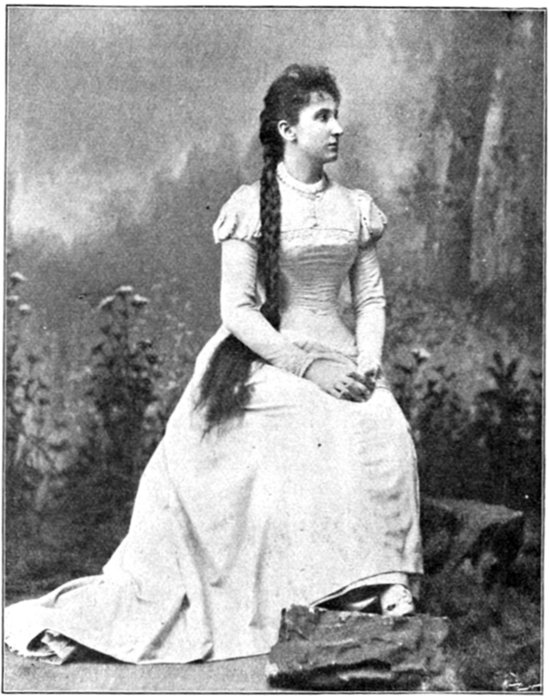
MADAME MELBA AS SHE FIRST APPEARED IN GRAND OPERA.—GILDA IN "RIGOLETTO," BRUSSELS, OCTOBER 15, 1887.
From a Photo. by J. Ganz, Brussels.

To an observant student of the world's genius it is a reflection, not without a peculiar interest of its own, that the Australian Continent has so far produced but one woman-singer of the first rank. Of poets whose genius is as undoubted as their place in the world's literature is certain Australia has given us at least two, in Henry Kendall and the gifted but ill-fated Adam Lindsay Gordon. To the drama this, the "least contiguous" of the four continents, has contributed Haddon Chambers—though the creator of "Captain Swift" and "The Idler" has now dwelt among us so long as to be regarded as a fully naturalized "Englander." The department of imaginative literature is already represented by quite a little army from "down under," as the eminent names of Mrs. Campbell Praed, "Tasma," Mr. Rolf Boldrewood, Miss Ada Cambridge, Miss Ethel Turner, Mr. Guy Boothby, and the late Marcus Clarke bear eloquent testimony; whilst the field of critical and biographical writing finds a worthy representative in Mr. Patchett Martin.
But Melba stands alone. Towering head and shoulders over every other aspirant to the highest honours of grand opera, the retirement of Madame Patti from the operatic field has left "the Australian Nightingale" undisputed ruler of an empire probably the proudest in the sum of this planet's most desirable possessions. Yet these are honours becomingly and graciously worn by one who, scarcely a decade ago, was little more than a name to the patrons and supporters of the opera.
As I sit in her salon to-day, and chat with this queenly woman, whose greatest charm assuredly lies in her consideration for others, I wonder whether she ever recalls that little white-robed girl (herself) who, in far-off Melbourne, in the dead of night, startled her parents and brought them downstairs by her playing of Beethoven's "Moonlight Sonata." It is a pretty story, with a prettier sequel. For the parents of that little girl had not the heart to chide their offspring for her "precocity" (that unmeaning word in which the beginnings of genius are so often concealed), but rather did they coax her back to bed as they marvelled over what they had heard. Surely they must, at that early day, have had some faint glimmering of the future in store for the coming prima donna!
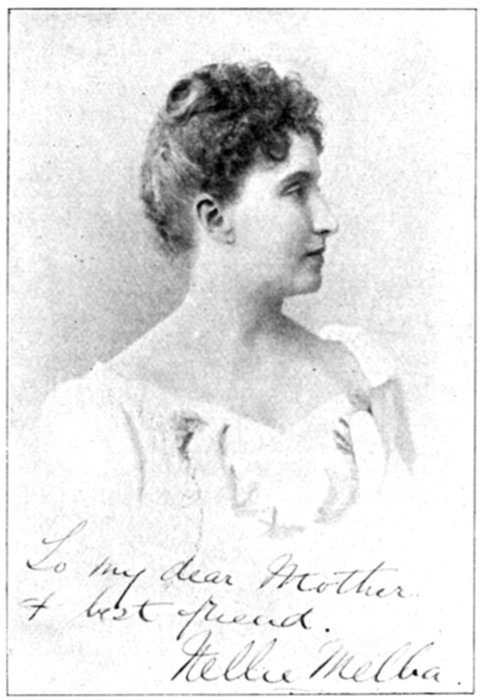
MADAME MELBA BEFORE HER DÉBUT, 1887. From a Photo. by Chalot, Paris.
"Perhaps they did—I do not know," says Madame Melba, dreamily. "But one thing I know for certain—that their daughter did not cherish any such aspirations for a long time to come. I went quietly on with my education—no, not my musical education, that came later—until my marriage, which took place at the early age of seventeen. Stop, though! I was entirely forgetting to tell you the story of what I call 'my first appearance on any stage.' It took place at the Town Hall, Richmond, which is a suburb of Melbourne, and I was aged six at the time! What did I sing? Let me see, now! Yes, I sang 'Shells of the Ocean' first, followed by 'Comin' thro' the Rye.' It was a great occasion, as you may imagine, and I am by no means certain that I am not prouder of it than of anything I have done since."
On the question as to whence—if traceable at all—Madame Melba derives her voice and natural musical gifts, she told me that her mother was an accomplished musician. In addition to being a beautiful pianist, she played also the organ and the harp. Thus it was that the future prima donna was reared so to speak in the lap of Music. Her mother was her first teacher of the piano, and afterwards her studies were aided by the exertions of her aunts Alice and Lizzie.
"Even as a child of three or four," she continued, "I was so passionately devoted to music that I remember frequently crawling under the piano and remaining quiet there for hours while listening to my mother's playing. Yes, my mother sang also, though she had not a particularly notable voice. But her sister, my 'Aunt Lizzie,' as I called her, possessed a soprano voice of extraordinary beauty and quality. To this day I can remember my aunt's absolute control of her voice, and the beauty and ease of her execution even in the highest pianissimo passages. Indeed, I feel sure my Aunt Lizzie would have enjoyed a brilliant career as a public singer, had she adopted it."
It should be mentioned that the diva's father, Mr. David Mitchell, is a squatter resident in the Colony of Victoria, and that his several stations are far removed from important townships. The family now reside at Colbin Abbin Estate; but in the days when Melba was a child they lived at "Steel's Flat," another of her father's estates, where she was born and brought up, with intermittent visits to Melbourne.
I was interested to find that the subject of this interview can also trace the gift of music on the paternal side of the house. To this day her father sings in the local choir, and his daughter told me she well remembered his voice as a deep basso of beautiful timbre. He has always been passionately fond of music, and is, in addition to his vocal talent (to quote his daughter's own expression), "a fiddler of no mean ability." Madame Melba speaks in the most affectionate terms of both her parents. Her mother died while the great singer was in her teens, but Melba cherishes many sweet recollections of her.
"She was a natural artist—not as regards music only, for one remembers it in the general expression of her life. She was, among other things, a charming painter on china, and the dessert-service still in use at home was decorated by her brush.
"Did my father also foster my love of music? Yes, indeed he did, to the utmost of his power. When I was quite a baby it was my great joy, on Sunday afternoons, to sit on my father's knee at the harmonium. He would blow the bellows with his feet, while singing a bass accompaniment to the hymn which I would pick out on the key-board with one finger."
Thus, finding that the Australian singer inherits the gift of song from either side of her family, I inquired whether this passion for music did not begin to take shape at a very tender age.
"In illustration that that was so," she answered, "I remember once our family moving into 'winter quarters' at one of my father's outlying stations. I was ten years old at the time, but I know I felt furious, on arrival, to find that there was no piano in the house. My gentle mother consoled me with the gift of a concertina, which I taught myself to play during the three months that we remained there! In those sequestered places, in the case of country houses very far removed from a church or chapel, it is customary for a clergyman or lay preacher to come along on Sundays and preach to the family, the servants, and station hands—often quite a large congregation, particularly at shearing-time.
"One Sunday—I was then, perhaps, thirteen years old—we were visited by a worthy man, who chanced to be a particularly poor preacher. At the conclusion of his very long and (as we children thought) somewhat wearisome discourse, he suggested that we should sing a hymn. There was a harmonium in the room, and my mother asked me to play a familiar hymn. I accordingly seated myself, but, in revenge for having been so bored, I played—to the horror of some and the secret delight of others—a music-hall ditty which had succeeded in penetrating our wilderness! It was called, 'You Should See Me Dance the Polka.' In the sequel, I received the well-merited punishment of being sent to bed for the remainder of the day.
"It must have been about the end of the same year that I had, what I thought at the time, a very fearsome adventure indeed! It happened at Melbourne. I was learning to play the organ, and I had permission occasionally to practise on the great organ in the Scots Church. Late one afternoon I ceased playing, and fell into a reverie. When, at last, I proceeded to leave the church, I found, to my horror, I was locked in! My playing having ceased for some time, the sexton had concluded I was gone, and had locked up the church and left. You cannot conceive the agony of mind I endured. The church was very dark, and the pulpit and altar in their grey dust-cloths looked, to my frightened imagination, like monstrous ghosts. What should I do?... At last the sexton returned—by the merest chance he had forgotten something, which he came back to fetch, and so I obtained my release."
About two years after her marriage, namely, at the age of nineteen, Melba began concert singing. At first she sang as an amateur; but so rapidly did she betray talents of an extraordinarily high order, that she was strongly recommended to adopt the vocal art as a profession. Upon this advice she acted, and came to England to study. The rest is history.
It is, however, history of an exceedingly interesting character. It will be seen that, in shaping her public career, Madame Melba unconsciously moved in cycles of two years. Thus, she was married at seventeen. At nineteen she commenced to sing publicly. At twenty-one she came to Europe in order to study the art she had elected to follow. At twenty-three occurred her début on the operatic stage.
So far as operatic England is concerned, the distinction of introducing Melba to the Covent Garden public belongs to the late Sir Augustus Harris, who subsequently wrote a rather remarkable letter on the subject of the Australian débutante's quickly won popularity. Madame Melba's initial appearance on the Covent Garden stage took place in May, 1888, as the ill-fated heroine of Donizetti's "Lucia di Lammermoor." Her success, both with the critics and with the public, was so spontaneous and overwhelming, that her engagement for the next (1889) London season was rendered inevitable. The new prima donna's principal appearance of 1889 was in Gounod's "Roméo et Juliette," while her performance in Verdi's "Rigoletto" exhibited how rapidly, to quote Mr. Parker's "Opera Under Augustus Harris," "Madame Melba's popularity was increasing in this country." In 1890 she created at Covent Garden the character of Ophelia in Dr. Ambroise Thomas's "Hamlet," which she had the advantage of rehearsing with the composer himself.
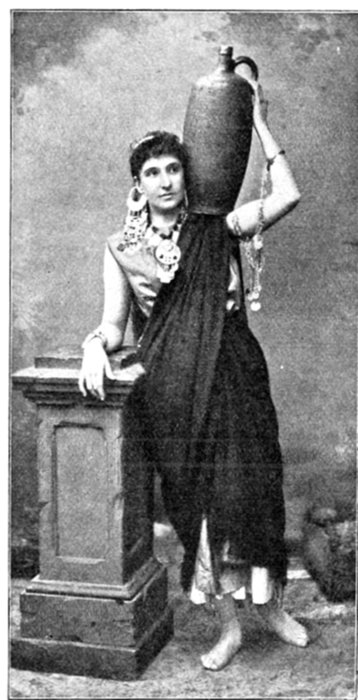
MADAME MELBA IN "LAKMÉ," 1890. From a Photo. by Dupont, Brussels.
In 1893 Melba went to America, to meet with a wholly unprecedented success; but in '94 she was back at Covent Garden, to charm huge audiences with her Nedda in Leoncavallo's "Pagliacci" and her Marguerite in "Faust." Since then the cantatrice has appeared with regularity during the London opera season. Two of her most interesting appearances have been in "Carmen" three years ago, when that opera was performed with the extraordinarily strong cast of Madame Calvé as Carmen, Madame Melba as Michaela, and M. Alvarez as Don José; and in "Les Huguenotś" in 1896, when Albani was the Valentina, and Melba the Margherita de Valois. In that season, by the way, a gloom was cast over English musical life by the deaths of Sir Joseph Barnby and Sir Augustus Harris, the latter being a personal friend of Madame Melba, and of whom she cherishes many pleasant recollections.
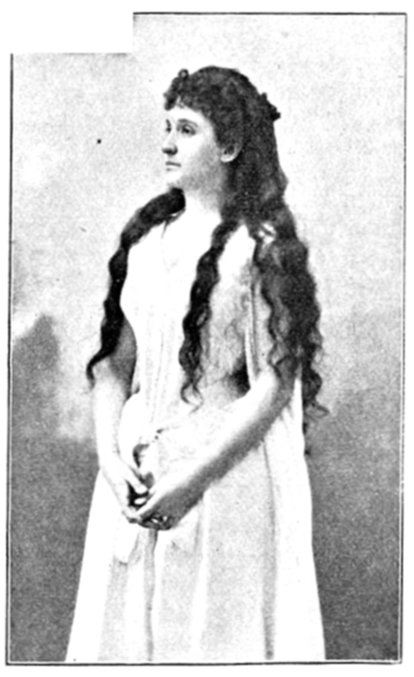
MADAME MELBA AS LUCIA DI LAMMERMOOR, 1891. From a Photo. by Nadar, Paris.
But then, as I told the Australian prima donna, in her case "pleasant recollections" must of necessity multiply themselves, by virtue of the numbers of the world's great ones with whom her art and her remarkable gifts have brought her in contact. And yet she remains so wholly and entirely a "womanly woman," that I verily believe she values the esteem and admiration of the lowliest peasant as highly as that of the great ones of the earth.
In respect of the personal friendships to which I have just made reference, the diva has delightful remembrances of masters like the veteran Verdi, Charles Gounod (with whom she had the privilege of rehearsing his "Faust" and "Roméo et Juliette"), poor Goring Thomas, the creator of "Esmeralda," Tosti, and Puccini. In the case of the latter composer, she studied her part in his "La Bohème" (a new assumption) with him in Southern Italy last summer; and, if all that we hear be true, she is destined to win fresh laurels in the same composer's newest work, "La Tosca," in which Puccini does for Sardou's tragic story what Verdi has done for Shakespeare's "Othello."
Nellie Melba is a woman of rare enthusiasms. In conversation with me, she could not say too much in praise of Madame Matilde Marchesi—the only singing-teacher she has ever had—and whom she speaks of in terms of warmest affection and sympathy.
I asked the prima donna whether she has ever experienced the excitement and danger of a theatre fire. "Yes, on two occasions," she told me; "in San Francisco and in London. In both cases the danger was happily averted. At Covent Garden the outbreak happened actually on the stage during a performance of 'Faust,' and the curtain had to be rung down. I chanced to be in the 'wings' at the time, and while they were battling with the flames behind the curtain, I came in front and begged the people to remain seated. Fortunately that most terrible of calamities, a theatre panic, was averted. As soon as I found myself behind the scenes once more I committed the weakness of fainting."
There have been, not unnaturally, some striking incidents connected with Melba's enormous popularity at the Paris Opera House. There is one of them, however, to which a pathetic interest attaches by reason of the comparatively recent death of Madame Carnot, who figured in it in very sympathetic fashion. The opera was "Lucia di Lammermoor"—one of Melba's greatest, if not her very greatest assumption. It happened that the tenor, Monsieur Cossira, arrived at the Opera House feeling very unwell, but apparently recovering before the opera began he decided to go on. Early in the first act, however, he almost completely lost his voice! When it came to the duet with Lucia in the first act, it utterly failed him. The prima donna, full of sympathy for his difficulty, for a time sang his music as well as her own; but ultimately the curtain had to be rung down, and for a few moments it appeared as though the performance could not proceed, since—surely a thing unprecedented at the Paris Opera House—Monsieur Cossira was not provided with an understudy! As luck would have it, though, among the audience was M. Engel, who had sung the part with Melba, not long before, in Brussels. Grasping the situation, he went behind the scenes and proffered his services, which were gladly and gratefully accepted. The performance proceeded, and for several nights thereafter M. Engel sang the part.
"At the close of the evening," added Madame Melba, in telling me of the incident, "Madame Carnot sent for me. It was during Monsieur Carnot's reign at the Elysée, and so his wife was occupying the Presidential box at the Opera. Being a woman of very quick perception, Madame Carnot had observed my efforts at covering the confusion of my poor colleague. I can never forget her kind words to me then, nor shall I readily forget the sorrow I felt afterwards on hearing the news of President Carnot's terrible end, and of her own death subsequently."
By the time this interview appears in print, Madame Melba will be in the thick of her fifth visit to the United States. Her previous operatic tours of the American Continent have been full of varied and interesting experiences. One of the most characteristic "Melba stories" that I know dates from her last tour but one. It was at St. Louis, where, thanks to a late train, the diva and her company arrived only a very little time before the hour fixed for the commencement. There was, in fact, only just time for the artists to make for their respective dressing-rooms. But Melba, looking down from a coign of vantage into the orchestra, observed, to her dismay and annoyance, that her musicians were in morning dress. She promptly sent for the chef d'orchestre. The poor man expostulated, remonstrated; they had but a few minutes before come off the cars; there was no time, etc. But Melba was firm. "If the gentlemen of my orchestra do not choose to appear in evening dress, I shall refuse to go on the stage. I owe a duty to the public as well as to myself."
This inexorable mandate had its effect, and the musicians were soon seen filing out of the orchestra, to return a few minutes later, suitably clad in the evening garb of comparative civilization. Then the curtain rose and the opera commenced—only a very little behind time. The incident did not, however, pass unrecognised. The critics of the Press had seen the musicians disappear and re-appear, and correctly surmising the cause of their "quick change," the result was a series of graceful little articles in the St. Louis papers complimenting the popular favourite upon her sense of the fitness of things.
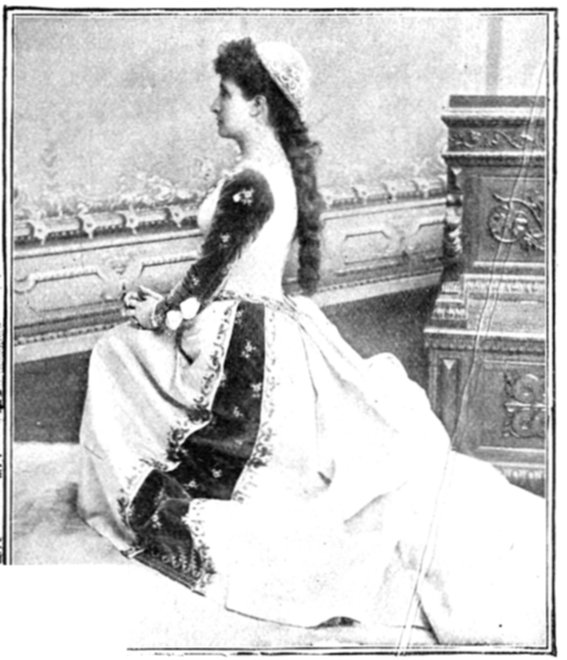
MADAME MELBA AS JULIETTE, 1892. From a Photo. by Dupont, Brussels.
An incident without precedent on the concert stage marked the concert which Melba gave at the Albert Hall, on November 2nd, to signalize her departure for her present trans-Atlantic tour. Of the three principal performers—i.e., Madame Melba herself, Miss Ada Crossley, the contralto, and Mr. Johann Kruse, the solo violinist—all were not only Australians, but Victorians by birth.
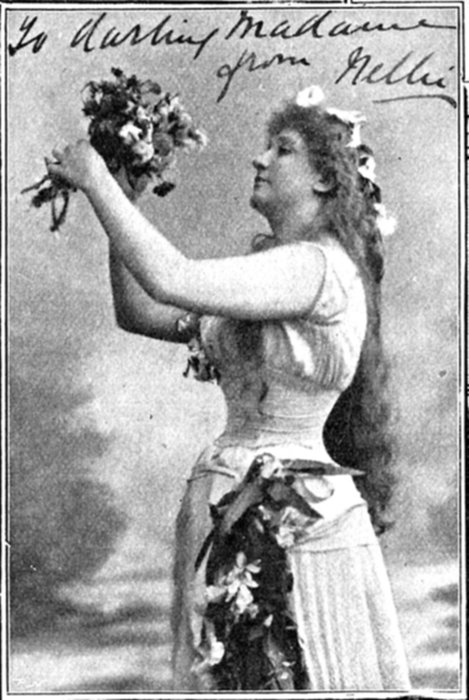
MADAME MELBA AS OPHÉLIE, 1895 From a Photo. by Reutlinger, Paris.
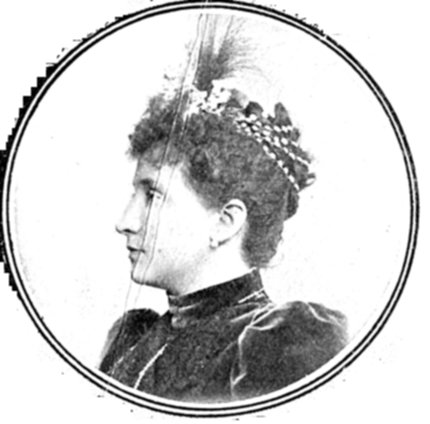
MADAME MELBA, 1893. From a Photo. by Renque et Cie, Paris.
Immediately after her few but brilliant appearances at Covent Garden last season, Madame Melba rented a charmingly-situated house, called "Fernley," near the river at Maidenhead. Here she entertained many friends during the month of August. A very interesting "group" photograph of three distinguished Australians—Melba, Mr. Haddon Chambers, and Mr. Bertram MacKennal—taken at that time on the lawn at Fernley, is shown at the top of this page. It will be interesting to your readers that the last-named distinguished compatriot of Madame Melba's is executing a bust of the diva, which she has decided to present to the Public Library of Melbourne. A bust of the Melbourne Melba, by the Melbourne MacKennal, is obviously an artistic event of peculiar interest.
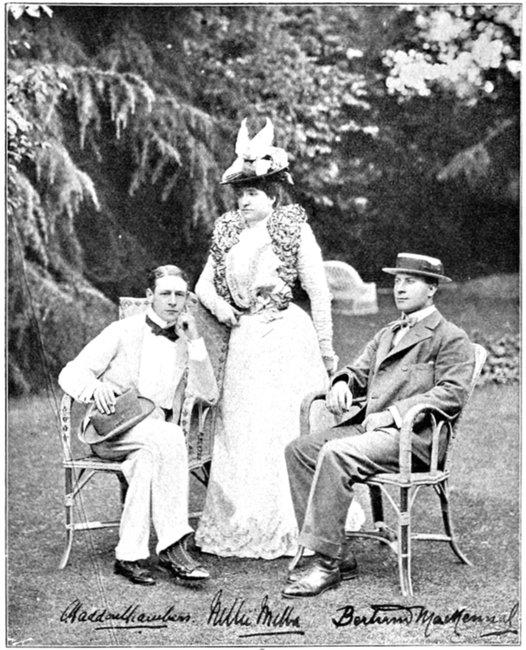
MADAME MELBA, MR. HADDON CHAMBERS, AND MR. BERTRAM MACKENNAL. From a Photo. by H. Gude, Maidenhead.
By the way, the popular morning "daily" that unwittingly represented Melba as an athletic kind of lady, skilled in the gentle art of rowing, was sadly in error! Far and away the most interesting episode of the stay at Fernley was a visit which the prima donna and some members of her house-party paid to the grave of the poet Gray in Stoke Poges churchyard. Here, it will be remembered, Gray wrote his beautiful "Elegy"; and here, too, Melba (who, I omitted to say, is an accomplished organist, and often used to play that instrument in the Scots Church at Melbourne) expressed a desire to try the organ in the charming old church of Stoke Poges.
Thereby hangs this tale: The rector, on it being represented to him that "Madame Melba would like to play the organ," courteously handed over the necessary keys, and Melba gave great pleasure to her audience of half-a-dozen friends by playing and singing for them a selection of pieces, which included the Gounod "Ave Maria," and ended with the National Anthem. Asked by one of the party how she had enjoyed the impromptu sacred concert, the old lady who was in charge of the church, and whose services had been requisitioned to blow the organ, enthusiastically rejoined, "Oh, it were all beautiful, m'm, but 'God Save the Queen' were best of all!"
Madame Melba is fortunate in having some one member of her family—a brother or sister, generally speaking—to accompany her on her travels. During her last American tour she had for companions both a sister and a brother—Miss Dora and Mr. Ernest Mitchell—and she still speaks of the regret with which she parted from them when they were obliged to return to their Antipodean home about the end of the last London season. She says she is not less fortunate in having a man like Mr. Charles A. Ellis (originally the business manager of the Boston Symphony Orchestra) to personally conduct her trans-Atlantic tours. The present one will be very much extended, and will involve the traversing of many thousands of miles by the diva and her company. The principal members of that company are Ternina, Zélie de Lussan, and Gadski, Alvarez, Bonnard, Pandolfini, Kraus, and Bonderesque, and the orchestra is controlled by Signor Seppilli and Mr. Walter Damrosch. As for Melba's répertoire, it comprises not only two rôles quite new to her—"Martha" and "La Bohème"—but also "Lucia," "Hamlet," "Manon," "Les Huguenots," "La Traviata," "Rigoletto," "Faust," "Roméo et Juliette," and "Il Barbière di Siviglia"—in the last-named of which she scored such a shining success at Covent Garden last season. While on the subject of America, I may mention that Madame Melba seriously meditates refusing an offer for a season in South America, which I take to be the most dazzling and tempting ever made to a prima donna. She whimsically says that she thinks she would rather spend the greater part of 1899 in Europe, although she looks forward with pleasure to a visit to South America later on.
I am reminded of one more "Melba anecdote." Two or three years ago she took a party of friends to see the interior of La Scala, the noble opera-house where many of her triumphs have been won. Throwing open the door of a dressing-room, their cicerone exclaimed, "This is where the celebrated Melba used to dress!" The great singer's friends began to laugh, but she, looking hard at the man, quietly asked him, "What! don't you know me?" And then this son of Italy perceived that, sans voice and sans diamonds though she might be, she still was "Melba."
It is, I think, illustrative of Madame Melba's large humanity that the simpler and more sympathetic the anecdote, the better is she pleased to tell it. For example, "one touch of nature" is to her much more than to tell of her many meetings with Royalty—of her brilliant career as queen of opera—of her impressions of the many great ones of the world into whose society she has been thrown. Of her début in opera she readily speaks, for must it not always rank as one of her pleasantest memories? It occurred at the Brussels Opera House, and at the age of twenty-two. Not at that time knowing French, Melba was permitted to sing in Italian, while the other artists sang French—an unprecedented concession to a débutante on the part of the local opera authorities. On that memorable evening, the next box to the one occupied by some friends and relatives of Madame Melba contained a lady and gentleman. At the close of the first act, the latter asked his companion as to her opinion of the débutante, when the lady was heard to reply, "Débutante! Nonsense! I heard her in Madrid ten years ago. She was an awful failure, and she's forty if she's a day!"
"Did you feel any resentment when you heard the story?" I asked.
"Not in the least," replied Madame Melba, laughing merrily, "albeit in those early days I had not grown accustomed, as, alas! I have since, to hearing strangely false reports about myself—reports sometimes amazing, sometimes absurd, and sometimes, I fear, malicious. Besides, I was in far too good a humour with the public success I had achieved to feel angry; and if the story appears in your article, and the lady sees it, I shall feel amply avenged."
Two incidents in connection with her first American tour were related to me so feelingly by the prima donna, that I must do my best to reproduce them. The first occurred in New York. Melba had been practising her part at her hotel one afternoon. Just as she had finished, and was coming out of her rooms, she encountered a strange lady, whose rooms opened into the same corridor. The unknown approached her, and said, "Madame, I think you would be touched to hear what my little boy said just now. He is lying in bed getting over an illness; and when you began to sing he lifted his tiny forefinger and whispered, 'Hist, mummy! Birdie!'"
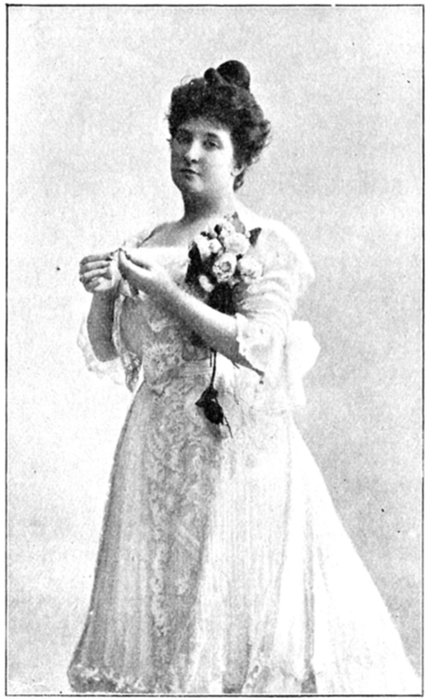
MADAME MELBA (PRESENT DAY). From a Photo. by Reutlinger, Paris.
The second incident referred to occurred one snowy night as the diva was leaving the stage-door of the Opera House at Philadelphia. An old lady, very neatly attired, but evidently not in affluent circumstances, was waiting for her as she crossed the foot-way to her carriage. When Madame Melba appeared the old lady remarked, "Madame, I have just heard you sing, and I've waited here in the hope that you will let me take your hand." Melba, deeply touched, impulsively kissed the old lady on either cheek. This salutation won from its recipient these simple words, which Melba says she will never forget, "God bless your beautiful heart, my dear!"
My interesting visit to Madame Melba terminated with, on my part, a very natural regret. I carried away with me an indelible impression—the impression of a queenly woman, an incomparable artist, bearing her unrivalled gifts and her regal position in the world of music with a simplicity and a womanly modesty which, while unable to enhance their value, add a singular grace and charm to their possession. And I found it a pleasing reflection that I had been accorded an audience of a queen who is delightfully unconscious of her sovereignty, and who, even if robbed of the gifts which now enchant the world, would still retain those qualities which enchant her friends—her bright intelligence, her ever-ready sympathies, and her true womanliness.